in the population sciences published by the Max Planck Institute for Demographic Research Konrad-Zuse Str. 1, D-18057 Rostock · GERMANY www.demographic-research.org
DEMOGRAPHIC RESEARCH
VOLUME 23, ARTICLE 15, PAGES 421-444
PUBLISHED 20 AUGUST 2010
http://www.demographic-research.org/Volumes/Vol23/15/ DOI: 10.4054/DemRes.2010.23.15
Research Article
Family size and schooling throughout the
Demographic Transition:
Evidence from Brazil
Leticia Marteleto
© 2010 Leticia Marteleto.
This open-access work is published under the terms of the Creative Commons Attribution NonCommercial License 2.0 Germany, which permits use, reproduction & distribution in any medium for non-commercial purposes, provided the original author(s) and source are given credit.
1 Introduction 422
2 Theoretical framework 424
3 The Demographic Transition in Brazil 426
4 Data and analytical sample 428
5 Methods 429
6 Results 430
7 Conclusions and discussion 439
Family size, adolescents’ schooling and the Demographic Transition:
Evidence from Brazil
Leticia Marteleto1
Abstract
The goal of this paper is to address whether and how the changing family sizes of cohorts born before and after the demographic transition are associated with increasing schooling in Brazil. Multivariate analyses of nationally representative data demonstrate that, although a higher proportion of adolescents born after the demographic transition live in smaller families, they also suffer a greater disadvantage from being in larger families than their peers born before the demographic transition. Additional case studies and comparative works are needed to disentangle the mechanisms behind the dynamic association between sibship size and adolescents’ educational attainment found in this study.
1 Assistant Professor, Department of Sociology and Population Research Center, University of Texas at
1. Introduction
Educational attainment is the result of the efforts of several institutions: individuals, families, schools, communities, and the state. A large body of research has examined each one of these dimensions in developing countries both separately and, to a smaller extent, simultaneously (Buchman and Hannum 2001). Social scientists have long been interested in the individual and family determinants of social stratification and education, emphasizing the role of parents’ education and occupation in determining children’s schooling (Blau and Duncan 1967; Shavit and Blossfeld 1993). Although parental education explains a large part of the variance in educational attainment, a significant portion of the variation also comes from additional family factors, such as family size.2
Past research has documented a negative association between family size and educational attainment in the West (for excellent reviews, see Lloyd 1994; Steelman et al. 2002). The resource dilution and sibling rivalry hypotheses offer frameworks to explain the nature of this negative relationship: a larger number of siblings translates into less capital (human, social, and cultural) for each child in the family. This negative association between family size and children’s schooling has been challenged in both developed (Black, Devereux, and Salvanes 2005; Guo and VanWey 1999) and developing countries, where studies have found the association between family size and children’s schooling to be positive, negative, and not statistically significant, depending on the period and context examined (Lu and Treiman 2008 for China; Maralani 2008 for Indonesia). The goal of this paper is to address whether and how the changing family sizes of cohorts born before and after the fertility transition are associated with children’s schooling in Brazil. I examine the following specific questions: First, how important is sibship size for educational attainment; and, second, how has the association between sibship size and schooling changed across cohorts born before and after the demographic transition?
That sibship size varies substantially with the demographic transition and socioeconomic development—a cross-national phenomenon—suggests the need for case studies of how sibship size differentially relates to educational outcomes in a variety of demographic regimes and socioeconomic contexts. Brazil offers a particularly interesting case for examining this relationship that can advance our understanding of the process of educational attainment as it relates to family size in at least two important ways.
The first contribution of this paper is to introduce Brazil to the comparative template of research on how family size relates to educational attainment, thereby
2 I use the terms “sibship size” and “family size” interchangeably throughout this paper. Both refer to total
adding variation to a literature that by now recognizes that this relationship is not homogenous across time or context (i.e., Lu and Treiman 2008). While a considerable body of research exists for developed countries, with a few exceptions (Anh et al. 1998; Lu and Treiman 2008; Maralani 2008; Parish and Willis 1993; Post and Pong 1998; Pong 1997), there is less coverage of empirical research that makes a serious attempt at identifying the association between siblings dynamics and educational outcomes outside the United States and Western Europe (Steelman et al. 2002).
The second contribution of this paper is to examine how the influence of family size on children’s schooling varies in very different demographic and socioeconomic regimes within the same country, a necessary step toward the larger goal of understanding the patterns of this association. While past research has examined the relationship between family size and children’s schooling, none has focused on differences between cohorts of children born before and after a demographic transition. Because demographic processes, socioeconomic development, intergenerational transmission of human capital, and opportunities jointly affect patterns of educational attainment, fertility decline may be a significant factor related to educational outcomes. Brazil’s demographic transition has dramatically changed its family structure, particularly in regard to family size. For example, 14-year-olds born in 1963 had an average of 5.4 siblings, while their counterparts born in 1983 had 2.3 siblings. The focus on education is particularly relevant as the country has been characterized by persistent poor educational performance. Despite recent improvements, Brazil still has relatively low educational levels, particularly in comparison to other Latin American countries. For example, among adults 25 years and older, Brazilians averaged 4.9 years of schooling in 2000. In the same year, the average number of years of schooling was 8.8 for Argentineans, 7.5 for Chileans, 7.2 for Mexicans, and 7.6 for Peruvians (UNESCO 2003). Brazil is also noteworthy to social scientists because the country has persistently had one of highest levels of social and economic inequality in the world, and education has been found to be the leading reason for these high levels of inequality (Barros and Lam 1996).
2. Theoretical framework
The sibling rivalry and resource dilution theoretical frameworks offer insights into how the number of siblings is associated with children’s outcomes. These theories posit that children with many siblings are generally worse off than their counterparts with fewer siblings in terms of several outcomes related to life chances and well-being, including nutrition, educational attainment, wealth, and mortality (Becker 1981; Blake 1981). According to the dilution of resources hypothesis (Blake 1985), a large number of siblings, or close spacing among siblings, dilutes the amount of capital (social, human, and cultural) parents invest in each child, which tends to negatively influence subsequent outcomes (Blau and Duncan 1967; Blake 1981). Simply put, parents with more children spend less time with each of them, thus making each of them less likely to develop tools to acquire greater capital than children who receive more support.
In contrast to the dilution of resources framework, which posits an equal allocation of resources among siblings, the sibling rivalry hypothesis assumes that parents invest in their children to maximize family utility, which often results in investment inequities within the family (Becker 1981). This hypothesis assumes that parents make human capital investments in their children based on assessments of their differential ability to contribute to the wealth of the entire family (Becker 1981). These parental investments improve the “quality” or the life prospects of children. However, even with inequities in resource allocation among children, the interaction between the quantity and quality of children means that education per child tends to be lower in families with more children. As a result, given a set pool of family resources, having more children means that fewer resources are available for each of the children, and that the children’s life prospects are therefore reduced (Becker 1981).
The confluence theory also offers insights into how family size and children’s outcomes are related: the presence of additional children lowers a family’s average intellectual environment (Zajonc and Markus 1975). Children are born into intellectual environments that affect intelligence. First-born children are, for example, born into adult-only environments, and have the opportunity to tutor younger siblings, which is likely associated with higher IQ levels. In addition to family size, the confluence model emphasizes the role of birth order and birth spacing. Despite the persuasiveness of the model’s arguments, early empirical analyses have not found much support for this theory (Hauser and Sewell 1985), although recent research has shown that birth order is an important factor in educational outcomes (Black, Devereux, and Salvanes 2005; Guo and Van Wey 1999), including IQ (Black, Devereux and Salvanes 2010).
research has focused on age spacing (Powell and Steelman 1993), sex composition (Conley 2000; Powell and Steelman 1990), and the ordinal position of children in the family (Steelman et al. 2002). The magnitude of the effect of family size on educational outcomes seems to differ according to the type of educational outcome examined— school enrollment, educational attainment, educational achievement—but the negative sign of the relationship persists in these studies. Guo and VanWey (1999) have challenged the uniformity of the negative relationship between family size and intellectual development. When they implement change models to control for unobserved family factors, the effects of sibship size disappear. At the same time, using data from Norway and accounting for the endogeneity issues between family size and schooling, a recent study has shown that there is no causal effect of sibship size on educational attainment, and has argued that the important aspect to consider is birth order (Black, Devereux, and Salvanes 2005).
Less is known about the relationship between family size and education in developing countries than in the United States and Western Europe. Nonetheless, most of the empirical work in developing countries that has examined the associations between family size and schooling attainment confirms the negative association: children from larger families exhibit educational disadvantages compared to children from smaller families (Anh et al. 1998; Knodel and Wongsith 1991; Maralani 2008; Parish and Willis 1993; Patrinos and Psacharopoulos 1997; Pong 1997; Post and Pong 1998; Shavit and Pierce 1991). Past research has argued that the strength of the relationship varies with institutional and socioeconomic development (Knodel, Havanon, and Sittitrai 1990; Lu and Treiman 2008 for China; Maralani 2008 for Indonesia). Additional studies have yielded conflicting results, reporting negative but not statistically significant effects (Lloyd 1994), mixed results (Psacharopoulos and Arriagada 1989), or even a positive association (Chernichovsky 1985).
Among these studies, only a few have examined change over time: Post and Pong 1998 have found decreasing effects of sibship size on educational attainment in Hong Kong, while Pong (1997) has found increases in the negative impact of sibship size on secondary school attainment in Malaysia over a period of rising government regulation of school supply and employment opportunities (Pong 1997). Parish and Willis (1993) found an increasing effect of family size on educational attainment in Taiwan, despite declining average family size and increasing average income. They attributed this unexpected finding to the rising opportunity cost of school in recent decades. Most recently, Maralani (2008) found that the relationship between family size and children’s schooling ranges from positive to negative in Indonesia, depending on the level of socioeconomic development.
holds throughout different periods and contexts, particularly for periods associated with marked decreases in family size. Socioeconomic and demographic trends shape the macro conditions in which the educational attainment process takes place. It is likely that the association between schooling and sibship size differs according to the demographic and social contexts inherent in high and low fertility regimes.
3. The Demographic Transition in Brazil
Brazil’s demographic transition is fairly typical of countries across the developing world, and is documented with excellent census data. As shown in Figure 1, the total fertility rate (TFR) began a rapid decline in the 1960s, falling to about 2.3 by 2000. The fertility decline occurred during a period of rapid social change that included periods of both economic growth and economic crisis (Martine 1996, Lam and Duryea 1999). There was a large degree of regional variation, with the fertility decline starting later in the poorer north and northeast regions than it did in the higher-income south and southeast. Brazil’s rapid population growth in the 1960s and 1970s was also fairly typical.
The demographic transition in Brazil has been attributed to several factors, including ideational change accompanied by material change (Potter, Schmertmann, and Cavenaghi 2002); a dramatic increase in the use of contraception, including female sterilization, despite the complete lack of government-sponsored family planning programs (Martine 1996); and an increase in schooling (Lam and Duryea 1999). It is difficult to pinpoint a single reason for the fertility decline, as the processes of development, the spread of new ideas and values, increases in schooling, and higher levels of female labor force participation and of contraceptive use often take place simultaneously. Over the same period, Brazil underwent important political changes, with the end of a military coup in 1984 and the installation of a democratic regime and a new constitution in 1988.
Figure 1: Total Fertility Rate: Brazil, 1950-2005
Lam and Marteleto (2008) have extensively examined the impact of the demographic transition on cohort size and family size in Brazil. They find that Brazil was in a stage of both increasing family size and cohort size between 1960 and 1970, even though fertility had already begun to decline. By 1980, Brazil was characterized by falling numbers of siblings and rising cohort size. With the largest cohort born in 1982, 1992 marks the year in which there is both a decline in the absolute number of 9-11-year-olds in the population and a (continuing) decline in the average number of siblings (Lam and Marteleto 2008). A recognition of this trend is important for this study, as an awareness of these developments may assist us in identifying the stages of the demographic transition in which the association between family size and educational attainment might vary. Children born between 1960 and 1970 experienced increasing family sizes, while children born after 1980 experienced a declining number of siblings. For this reason, I view birth cohort as an important component of this study (Easterlin 1980). Comparing birth cohorts allows us to address the question of whether the advantageous demographic conditions for children born after the demographic transition have contributed to improvements in children’s schooling through smaller family sizes.
born before and after the demographic transition? Few studies have examined the association between family size and educational attainment over time, and, to my knowledge, none has looked at cohorts born before and after the demographic transition in Brazil. Especially in countries like Brazil, where secondary school enrollment is not yet universal and educational attainment levels are far from satisfactory, understanding how family characteristics other than family wealth relate to education is essential in any broad effort to increase the level and quality of education.
4. Data and analytical sample
In this paper, I use data from the 1977 and 1997 Pesquisa Nacional por Amostra de Domicílios (PNAD), (National Research of Household Sample), which are annual household surveys conducted by the Instituto Brasileiro de Geografia e Estatística (IBGE), the Brazilian statistical bureau. The PNAD is a nationally representative survey with information on 498,679 individuals in 100,039 households for 1977, and on 365,870 individuals in 89,939 households for 1997. The samples are sufficiently large to permit sub-sampling of specific groups, such as of 14-year-olds. The 1977 PNAD provides data on 12,834 14-year-olds born in 1963, while the 1997 PNAD provides data on 7,861 14-year-olds born in 1983. Children’s educational experiences at different ages are sufficiently diverse that it makes sense to analyze them separately. Fourteen-year-olds were chosen as the unit of analysis because this is the highest age at which school attendance is legally required in Brazil. Moreover, children who have been successful in school should be making the transition from primary to secondary education at 14 years of age.
The PNAD contains standard demographic and socioeconomic variables, such as sex, age, income, and schooling, for all members of the household. Data from 1977 and 1997 are comparable, although the 1977 PNAD does not contain information on race and ethnicity, making it impossible to compare cohort racial distributions. Moreover, neither the 1977 nor the 1997 PNAD covered the rural part of the northern region, which probably results in overestimates of the level of education in that region.
information about the total number of children, the data for these years are more suitable than most household survey data used for this type of analysis (such as Conley and Glauber 2006 in the US and Li et al. 2008 in China), which often count only the children living in the household. However, the structure of the data does not allow for an analysis of the age or sex composition of all siblings, only of those living in the household.3 It is important to note that the PNAD data does not have information on
union history or on the support of relatives for children’s education.
To accurately include the mother’s education in the models, I restrict the sample of 14-year-olds to children of the head of the household. This selection does not create a selection bias. Most 14-year-olds live with at least one parent (87.81% in 1977 and 90.71% in 1997), which allows for the use of information on the mother’s education, an important predictor of the child’s educational level. Children of the head of the household are not significantly different from the full sample of children on their distribution across rural/urban location, family income, region, or sex (not shown). Moreover, there are no notable differences in levels of educational attainment among the full and analytical samples.
5. Methods
In order to assess whether and how the number of siblings is related to educational attainment in pre- and post-demographic-transition Brazil, I estimate models of years of schooling for 14-year-olds born in 1963 and 1983. I model complete years of schooling by estimating ordinary least squares regressions. The number of siblings is a set of dummy variables, while the mother’s education is coded as a continuous variable. I include a flag variable for whether the mother’s education is missing. The log of family income was corrected to take account of currency changes and inflation across the period of study by using IPEA deflators, with 1997 as the base year (Corseuil and Foguel 2002). The omitted categories are male-headed household, rural and the state of São Paulo. The reference group is São Paulo because the state has one of the highest
3 One reviewer has suggested that I examine the differential associations between schooling and siblings
levels of educational attainment for adolescents in both cohorts. Including a fixed-effect dummy variable for the birth state of each 14-year-old in the analysis (except for the reference state, São Paulo) reduces the threat of omitted variables bias. These birth state fixed effects represent the influence of characteristics we do not know or cannot measure about each birth state, such as the labor market conditions in the birth state when the adolescents were born. The number of siblings was coded as a set of dummy variables from zero to seven or more, and zero is the omitted category.
A caveat should be made at this juncture. It is possible that parents may make joint decisions about the quantity of children they wish to have in response to a preference for a higher “quality” of children with regard to education (Becker 1981). Family size may be correlated with unmeasured determinants of children’s schooling, as parents may choose a combination of low fertility and high levels of schooling for their children. This contributes to a negative correlation between family size and schooling that tends to overstate the extent to which schooling would increase if parents were required to limit their number of children. Few studies using data from developing countries have attempted to account for such endogeneity by applying twins and
same-sex methods as instrumental variables (Black, Devereux, and Salvanes 2005; Conley
and Glauber 2006). Results from a recent study in Indonesia indicate that the negative relationship between family size and children’s schooling is not sensitive to assumptions about the exogeneity of fertility (Maralani 2008). Although the conventional approach and an instrumental variable approach have yielded similar results in Indonesia, the results of this study should be interpreted with caution to avoid any implication of direct causality. Further research that takes the endogeneity between fertility and children’s schooling into account is needed to examine whether this is the case for other countries.
6. Results
children by the mother’s education has also changed dramatically across cohorts: while 36.12% of the adolescents in the older cohort had mothers with no formal education, 20.60% of the adolescents in the younger cohort had mothers with no formal education. While 44.85% of the 14-year-olds in the older cohort had seven or more siblings, only 11.86% of the 14-year-olds in the younger cohort had seven or more siblings. The consequences of the profound demographic changes that occurred in Brazil during the period that separates this study’s cohorts are evident in the average number of siblings these 14-year-olds have. The average total number of siblings decreased from 6.13 in the older cohort to 3.12 in the younger cohort. Figure 2 illustrates the considerable change in the distribution of number of siblings for adolescents in the 1963 and 1983 cohorts.
Figure 2: Cumulative proportion of 14-year-olds with X siblings or more:
Brazil, 1963 and 1983 cohorts
cohort, boys have 4.37 years and girls have 5.04 years of schooling. These gender differences favoring girls are not surprising. They are markedly different from findings in other developing countries (Knodel and Jones 1996), but are representative of the general trend in other Latin American countries. Table 2 also shows that the schooling levels are slightly higher among adolescents in male-headed households than among those in female-headed households in both cohorts.
Table 1: Characteristics of 14-Year-Olds [%], 1963 and 1983 Cohorts, Brazil
Cohort of 1963 Cohort of 1983 Household Headship
Female 11.94 19.73
Male 88.06 80.27
Number of Siblings
0 1.43 3.82
1 5.33 21.68
2 8.85 25.44
3 9.95 15.39
4 9.91 9.21
5 10.01 7.36
6 9.69 5.24
7+ 44.85 11.86
Rural/Urban Residence
Urban 66.21 80.20
Rural 33.79 19.80
Sex
Male 50.65 50.99
Female 49.35 49.01
Mother’s Education
No Education (0) 36.12 20.60
Attended First Primary (1-4) 43.97 36.49
Attended Second Primary (5-8) 12.81 23.01
Attended High School (9-11) 4.51 12.73
Attended University or more (12+) 2.59 7.17
Household Size 3.70 1.54
Mother’s Age 41.63 40.97
Family Income 1,106 877
[N] 11,082 6,971
Source: From author’s calculations of PNAD 1977 and 1997 data.
Table 2: Complete years of schooling by characteristics of 14-year-old children of the head of the family, 1963 and 1983 cohorts, Brazil
Mean Years of Schooling
Cohort of 1963 Cohort of 1983
National average 3.43 4.70
Family Headship
Female 3.35 4.48
Male 3.43 4.75
Total Number of Siblings
0 4.48 5.49
1 5.17 5.78
2 4.97 5.34
3 4.55 4.59
4 4.01 4.15
5 3.52 3.68
6 3.19 3.44
7+ 2.56 3.09
Rural/Urban Residence
Urban 4.16 5.00
Rural 1.98 3.48
Sex
Male 3.19 4.37
Female 3.67 5.04
Mother’s Education
No Education (0) 2.08 3.08
Attended First Primary (1-4) 3.76 4.46
Attended Second Primary (5- 4.80 5.19
Attended High School (9-11) 5.52 6.06
Attended University or more 6.00 6.60
Family Income (Quintiles)
First Quintile 1.86 3.24
Second Quintile 2.47 3.98
Third Quintile 3.28 4.74
Fourth Quintile 4.02 5.52
Fifth Quintile 5.09 6.20
Mother’s Age
< 40 3.50 4.80
40-50 3.45 4.78
>50 3.25 4.21
[N] 11,082 6,971
Table 3 shows coefficients and standard errors of OLS regressions of complete years of schooling separately by cohort. There are several noteworthy results that can be seen in Table 3. First, girls have an educational advantage over boys in both cohorts, and this advantage increases among adolescents in the younger cohort. This is in contrast to some Asian and African countries, where girls are at an educational disadvantage relative to boys. However, an educational advantage for girls is fairly typical of Latin American countries, where, in general, girls are found to have higher levels of school enrollment rates, as well as higher educational attainment and educational achievement levels. Another interesting finding is the slight decrease in the impact of the mother’s education on children’s schooling—from 0.202 to 0.130—with a statistically significant difference of coefficients at the 0.05 level. Not surprisingly, adolescents in both cohorts living in families with higher levels of income also have higher levels of schooling. Family structure is another important factor related to children’s schooling. Adolescents in families headed by women are at a greater educational disadvantage relative to their counterparts in male-headed families, and this disadvantage is higher for the younger than for the older cohort. Similarly, those adolescents in larger households, net of the number of siblings, are at a disadvantage when compared with those in smaller households. This disadvantage has increased across cohorts—from a coefficient of -0.018 to a coefficient of -0.098—although the difference is not statistically significant. Finally, older-cohort adolescents in urban areas had approximately 1.062 year more of schooling than their counterparts living in rural areas, controlling for all other covariates. The schooling disadvantage associated with living in rural areas has decreased, and was associated with 0.418 year less of schooling in 1997.
Table 3: Estimates of OLS Regressions of Years of Schooling, 14-Year-Olds, 1963 and 1983 Cohorts, Brazil
Cohort of 1963 Cohort of 1983 Coefficient SE Coefficient SE
Sex (omitted: male) 0.437*** 0.032 0.637*** 0.039
Number of Siblings (omitted: 0)
1 0.253 0.147 0.359*** 0.103
2 0.259* 0.139 0.274*** 0.102
3 0.074 0.138 0.063 0.107
4 -0.079 0.138 -0.286** 0.116
5 -0.292* 0.138 -0.662*** 0.121
6 -0.385** 0.138 -0.738*** 0.130
7 or more -0.639*** 0.131 -0.948*** 0.117
Mother's Education 0.202*** 0.007 0.130*** 0.006
Mother's Age 0.019*** 0.003 0.013*** 0.003
Family Headship (omitted: male) -0.027 0.054 -0.404*** 0.052
Household Size -0.018** 0.009 -0.098*** 0.015
Log Family Income 0.413*** 0.021 0.326*** 0.026
Urban vs. rural (omitted: rural) 1.062*** 0.040 0.418*** 0.055
Birth state (omitted: São Paulo)
Rondônia -1.146** 0.485 -0.382 0.326
Acre -1.664*** 0.434 -0.993** 0.397
Amazonas -1.360*** 0.167 -0.987*** 0.155
Roraima 0.353 0.748 -0.712 0.598
Pará -0.997*** 0.113 -1.166*** 0.115
Amapá -1.034** 0.466 -0.843** 0.376
Maranhão -1.334*** 0.106 -1.135*** 0.141
Piauí -1.154*** 0.121 -1.426*** 0.156
Ceará -1.497*** 0.085 -0.841*** 0.099
Rio Grande do Norte -1.027*** 0.124 -0.571*** 0.158
Paraíba -1.271*** 0.108 -1.128*** 0.146
Pernambuco -1.024*** 0.077 -0.892*** 0.100
Alagoas -1.421*** 0.131 -1.595*** 0.166
Sergipe -1.370*** 0.166 -1.416*** 0.191
Table 3: (Continued)
Cohort of 1963 Cohort of 1983
Coefficient SE Coefficient SE Birth state (omitted: São Paulo)
Minas Gerais -0.414*** 0.064 -0.327*** 0.082
Espírito Santo -0.115 0.126 -0.178 0.163
Rio de Janeiro -0.696*** 0.073 -0.556*** 0.094
Paraná -0.311*** 0.086 0.083 0.096
Santa Catarina 0.539*** 0.114 -0.042 0.132
Rio Grande do Sul 0.146* 0.078 -0.018 0.091
Mato Grosso -0.676*** 0.137 -0.151 0.122
Goiás -0.835*** 0.101 -0.643*** 0.102
Distrito Federal 0.001 0.113 -0.385*** 0.140
Outside of Brazil -0.775* 0.466 -1.096 0.705
Constant -1.804*** 0.253 1.362*** 0.217
[N] 10,684 6,521
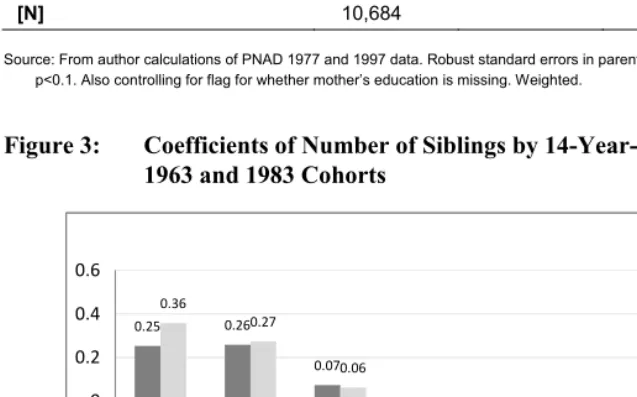
Source: From author calculations of PNAD 1977 and 1997 data. Robust standard errors in parentheses *** p<0.01, ** p<0.05, * p<0.1. Also controlling for flag for whether mother’s education is missing. Weighted.
Figure 3: Coefficients of Number of Siblings by 14-Year-Old Cohort: Brazil,
1963 and 1983 Cohorts
0.25 0.26
0.07
‐0.08
‐0.29
‐0.39
‐0.64 0.36
0.27
0.06
‐0.29
‐0.66
‐0.74
‐0.95
‐1
‐0.8
‐0.6
‐0.4
‐0.2 0 0.2 0.4 0.6
1 sibling 2 siblings 3 siblings 4 siblings 5 siblings 6 siblings 7 or + siblings1963
Figure 3 also shows that the educational disadvantages associated with family size have increased for the younger cohort. The figure makes clear that the coefficients of the number of siblings have changed considerably from the older to the younger cohort at larger parities, placing an additional burden on the schooling of younger-cohort children in larger families. For example, while older-cohort adolescents with six siblings had 0.440 year less of schooling than their only-child peers, younger-cohort adolescents had 0.738 year less of schooling than their only-child peers. I test for whether the difference in coefficients across cohorts is statistically significant in a pooled model in which I interact all variables with each cohort (not shown). I find that the difference in the coefficients of the number of siblings of the older versus the younger cohorts is statistically significant at higher-parity families (four siblings: p=0.0391; five siblings: p=0.0205; six siblings: p=0.0358; seven or more siblings: p=0.000). Adolescents in larger families in the younger cohort are at a greater educational disadvantage than adolescents in larger families in the older cohort.
Figure 4 shows adjusted and unadjusted mean years of schooling by the number of siblings for both younger- and older-cohort adolescents. I calculated the adjusted schooling using the estimates in Table 3. The baseline used for simulating the impact is a 14-year-old with all covariates to their mean values and varying number of siblings. When interpreting the unadjusted and adjusted years of schooling, it is worth noting that, if a 14-year-old had started school at the mandatory age of seven, and did not drop out or repeat a grade, she/he would have six or seven years of schooling. Figure 4 shows that 14-year-olds in both cohorts and in all family sizes are substantially behind this ideal level of educational attainment.
Figure 4: Adjusted and unadjusted educational attainment of 14-year-olds by number of siblings: Brazil, 1963 and 1983 cohorts
Taken together, the findings from this paper suggest that the role of declining family size across cohorts born before and after the demographic transition in Brazil is important even when compared to the role of other covariates of educational attainment, such as the mother’s education and family income. Although more adolescents in younger cohorts are in smaller families, the few who are in larger families should be the target of policies aimed at increasing the educational level of Brazilian adolescents.
7. Conclusions and discussion
The goal of this paper was to examine how the changing family sizes of cohorts born before and after the fertility transition are associated with increasing schooling in these two very different demographic regimes. Family size varies substantially throughout the demographic transition, suggesting the need for case studies of the association between family size and educational attainment in a variety of demographic regimes.
Findings from this study show that family size is an important factor associated with adolescents’ schooling for cohorts of Brazilian adolescents born both before and after the demographic transition. Results of this analysis indicate that both the association between sibship size and schooling has become more negative at higher parities, even as the number of adolescents across larger families has declined. Although a higher proportion of younger-cohort adolescents are in smaller families, they also suffer a greater disadvantage from being in larger families than older-cohort adolescents. The demographic transition has benefited adolescents by producing a higher proportion of smaller families, but that advantage has been partly offset by the larger negative association between sibship size and adolescents’ schooling. Recent cohorts of children in larger families should be the target of policies designed to improve the educational outcomes of youth in developing countries.
We should, however, exercise caution when using the results of this study to imply causality between family size and schooling. As discussed in the methods section, the conventional methodology used in this paper relies on assumptions of exogeneity about the relationship between family size and parents’ preferences for children’s schooling. Although other alternative analyses also require their own set of strong assumptions, it would be useful to compare results from conventional analysis, instrumental variable analysis, and twin data analysis using the same data to corroborate whether results are sensitive to assumptions about the exogeneity of fertility.
this negative effect varies by siblings’ age and sex composition in developing countries. The negative association between larger family sizes and schooling may be offset or even reversed by the support given to younger children by their older siblings, or by other family members in the household. The presence of others in the household might mediate the effect of sibship size, and, where the necessary data are available, should be the focus of future research on how family structure matters for children’s schooling. Another potentially interesting extension of research in this area would be to investigate why only children have not fared consistently better than children with one sibling.
Reference list
Anh, T., Knodel, J., Lam, D., and Friedman, J. (1998). Family Size and Children's Education in Vietnam. Demography 35(1): 57-70. doi:10.2307/3004027.
Barros, R. and Lam, D. (1996). Income and Educational Inequality and Children's Schooling Attainment. In: Birdsall, N. and Sabot, R. (eds.). Opportunity Foregone: Education in Brazil. Washington: Inter-American Development Bank.
Becker, G. (1981). A treatise on the family. Cambridge: Harvard University Press. Black, S., Devereux, P., and Salvanes, K. (2005). The More the Merrier? The Effect of
Family Size and Birth Order on Children's Education. The Quarterly Journal of Economics 120(4): 669-700. doi:10.1162/0033553053970179.
Black, S., Devereux, P. and Salvanes, K. (2010). Small Family, Smart Family? Family Size and the IQ Score of Young Men. The Journal of Human Resources 45(1):33-58.
Blake, J. (1981). Family size and achievement. Berkeley: University of California Press. Blake, J. (1985). Number of siblings and educational mobility. American Sociological
Review 50(1): 84-94. doi:10.2307/2095342.
Blau, P. and Duncan, O. (1967). The American occupational structure. New York: Wiley.
Buchmann, C. and Hannum, E. (2001). Education and Stratification in Developing Countries: Review of Theories and Empirical Research. Annual Review of Sociology 27(1): 77-102. doi:10.1146/annurev.soc.27.1.77.
Chernichovsky, D. (1985). Socioeconomic and demographic aspects of school enrollment and attendance in rural Botswana. Economic Development and Cultural Change 33(2): 319-332. doi:10.1086/451463.
Conley, D. (2000). Sibship Sex Composition and the Educational Attainment of Men and Women. Social Science Research 29: 441-457. doi:10.1006/ssre.2000.0678. Conley, D. and Glauber, R. (2006). Parental Educational Investment and Children’s
Corseuil, C.H. and Foguel, M. (2002). Uma sugestão de deflatores para rendas obtidas a partir de algumas pesquisas domiciliares do IBGE. Rio de Janeiro: IPEA. (IPEA Discussion Paper: 897).
Easterlin, R. (1980). Birth and fortune: The impact of numbers on personal welfare. New York: Basic Books.
Guo, G. and VanWey, L. (1999). Sibship Size and Intellectual Development: Is the Relationship Causal? American Sociological Review 64(2): 169-187. doi:10.2307/2657524.
Hauser, R. and Sewell, W. (1985). Birth order and educational attainment in full sibships. American Educational Research Journal. 22(1): 1-23.
Keister, L. (2003). Sharing the Wealth: The Effect of Siblings on Adults' Ownership of Wealth. Demography 40(3): 521-542.
Knodel, J. and Wongsith, M. (1991). Family Size and Children's Education in Thailand: Evidence from a National Sample. Demography 28(1): 119-131. doi:10.2307/2061339.
Knodel, J., Havanon, N., and Sittitrai, W. (1990). Family size and the education of children in the context of rapid fertility decline. Population and Development Review 16(1): 31-62. doi:10.2307/1972528.
Knodel, J. and Jones, G. (1996). Post-Cairo population policy: Does promoting girls’ schooling miss the mark? Population and Development Review 22(4): 683-702. doi:10.2307/2137805.
Lam, D. and Duryea, S. (1999). The Effects of Education on Fertility, Labor Supply, and Investments in Children, with Evidence from Brazil. Journal of Human Resources 34(1): 160-192. doi:10.2307/146306.
Lam, D. and Marteleto, L. (2008). Stages of the Demographic Transition from a Child’s Perspective: Family Size, Cohort Size, and Children’s Resources. Population and Development Review 34(2): 225-252. doi:10.1111/j.1728-4457.2008.00218.x.
Li, H., Zhang, J., and Zhu, Y. (2008). The Quantity-Quality Trade-off of Children in a Developing Country: Identification Using Chinese Twins. Demography 45(1): 223-243. doi:10.1353/dem.2008.0006.
Lu, Y. and Treiman, D. (2008). The Effect of Sibship Size on Educational Attainment in China: Period Variations. American Sociological Review 73(5): 813-834. doi:10.1177/000312240807300506.
Maralani, V. (2008). The Changing relationship between family size and educational attainment over the course of socioeconomic development: Evidence from
Indonesia. Demography 45(3): 693-717.doi:10.1353/dem.0.0013.
Martine, G. (1996). Brazil's Fertility Decline, 1965-95: A Fresh Look at Key Factors. Population and Development Review 22(1): 47-75. doi:10.2307/2137686. Parish, W.L. and Willis, R. (1993). Daughters, education, and family budgets: Taiwan
experiences. The Journal of Human Resources 28(4): 863-898. doi:10.2307/146296.
Patrinos H. and Psacharopoulos, G. (1997). Family size, schooling and child labor in Peru: An empirical analysis. Journal of Population Economics 10(4): 387-405. doi:10.1007/s001480050050.
Pong, S. (1997). Sibship Size and Educational Attainment in Peninsular Malaysia: Do Policies Matter? Sociological Perspectives 40(2): 227-242.
Post, D. and Pong, S. (1998). Intra-Family Educational Inequality in Hong Kong: The Waning Effect of Sibship Composition. Comparative Education Review 42(2): 99-117. doi:10.1086/447491.
Potter, J., Schmertmann, C., and Cavenaghi, S. (2002). Fertility and Development: Evidence from Brazil. Demography 39(4): 739-761. doi:10.1353/dem. 2002.0039.
Powell, B. and Steelman, L. (1993). The Educational Benefits of Being Spaced Out: Sibship Density and Educational Progress. American Sociological Review 58(3): 367-381. doi:10.2307/2095906.
Powell, B. and Steelman, L. (1990). Beyond Sibship Size: Sibling Density, Sex Composition, and Educational Outcomes. Social Forces 69: 181-206. doi:10.2307/2579613.
Psacharopoulos, G. and Arriagada, A.M. (1989). The determinants of early age human capital formation: Evidence from Brazil. Economic Development and Cultural Change 37: 683-708. doi:10.1086/451755.
Shavit, Y. and Pierce, J. (1991). Sibship size and educational attainment in nuclear and extended families: Arabs and Jews in Israel. American Sociological Review 56: 321-330. doi:10.2307/2096107.
Steelman, L., Powell, B., Werum, R., and Cater, S. (2002). Reconsidering the Effects of Sibling Configuration. Annual Review of Sociology 23: 243-269. doi:10.1146/annurev.soc.28.111301.093304.
Unesco (2003). Global inequality, capabilities, social justice: The millennium development goal for sex equality in education. New York: Unesco.


![Table 1: Characteristics of 14-Year-Olds [%], 1963 and 1983 Cohorts, Brazil](https://thumb-us.123doks.com/thumbv2/123dok_us/8940503.1849871/14.595.64.403.172.515/table-characteristics-year-olds-cohorts-brazil.webp)