RESEARCH REPOSITORY
This is the author’s final version of the work, as accepted for publication
following peer review but without the publisher’s layout or pagination.
The definitive version is available at
:
https://doi.org/10.1002/cbic.201700276
AlShamaileh, H. and Veedu, R.N. (2017) Next-Generation Nucleic Acid
Aptamers with Two-Base-Modified Nucleotides Have Improved Binding
Affinity and Potency. ChemBioChem.
http://researchrepository.murdoch.edu.au/id/eprint/37590/
Copyright: © 2017 John Wiley & Sons, Inc.
HIGHLIGHT
For internal use, please do not delete. Submitted_Manuscript
Next generation nucleic acid aptamers with two base
modified nucleotides improve the binding affinity and
potency
Hadi AlShamaileh and Rakesh N. Veedu*
[a]Aptamers are single-stranded oligonucleotides (RNA or DNA) that can bind to their targets with high affinities and specificities because of their ability to adopt three-dimensional shapes in solution [1]. Aptamers can be developed against a wide range of
targets including small molecules, peptides, and whole cells, and can be developed in a standard molecular biology laboratory. Small size, low immunogenicity and thermo-stability make aptamers a promising tool for diagnostic and clinical applications. Traditionally, aptamers are developed by SELEX (Systematic Evolution of Ligands by Exponential enrichment), a reiterative process involving selection by target molecule incubation with an oligonucleotide library and enrichment of the selected oligonucleotides by amplification[1]. One drawback of
current aptamer selection approach is the lack of diversity in the nucleic acid library with only four nucleobases compositions. In a recent study, Gawande et al. expanded the functional diversity of the starting oligonucleotide library by the introduction of pyrimidine nucleotides containing protein-like modifications at C5-position (Figure 1A)[2]. This is an extension of previous works
using C5-modified uridines containing multiple protein-like modifications that culminated into the development of slow off-rate modified aptamers (SOMAmers) for over 3000 proteins[2-7].
Furthermore, the efficacy of SELEX with a set of unmodified bases against a set of modified bases was compared, and the latter showed enhanced probability of selecting high affinity aptamers[6,7]. Gawande et al. took a step further by using
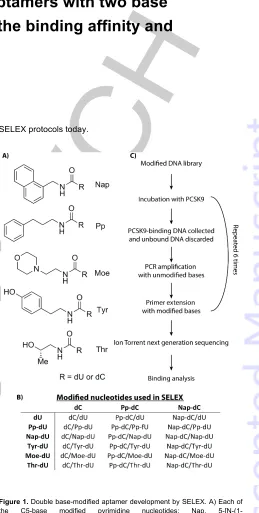
libraries with two different modified pyrimidine nucleotides in SELEX involving two modifications on dC (Nap, Pp; Figure 1A) and five modifications on dU (Nap, Pp, Tyr, Moe, Thr; Figure 1A) in all possible pairwise combinations[2] (Figure 1B). The high
performing aptamers with high binding affinity and specificity with nuclease resistance suitable for clinical applications were selected from libraries with two base modifications, and generally outperformed the isolated aptamers from libraries with single base modifications. This work presented by Gawande et al. and their previous works are important steps towards improving SELEX efficacy which can be readily adopted in most
SELEX protocols today.
Figure 1. Double base-modified aptamer development by SELEX. A) Each of the C5-base modified pyrimidine nucleotides: Nap, 5-[N-(1-naphthylmethyl)carboxamide]-2′-deoxy; Pp, 5-[N-(phenyl-3-propyl)carboxamide]-2′- deoxy; Moe, 5-[N-(1-morpholino-2-ethyl)carboxamide]-2′-deoxy; Tyr, 5-[N-(4-hydroxyphenyl-2-ethyl)carboxamide]-2′-deoxy; and Thr, 5-[N-(S-2-hydroxypropyl)carboxamide]- 2′-deoxy. B) All pairwise combinations of modified bases including unmodified dC and dU as control. C) Schematic representation of SELEX used to enrich for high affinity aptamers.
In this study, all possible pairwise combinations of modified and unmodified pyrimidines in the starting libraries (Figure 1B) were used to generate SOMAmers against a model target, human Proprotein convertase subtilisin/kexin type 9 (PCSK9). The aptamer selection method, using His-tagged paramagnetic [a] Dr. H. AlShamaileh, Dr. R. N. Veedu
Centre for Comparative Genomics, Murdoch University Murdoch, Perth, Australia 6150 ()
[a] Dr. R. N. Veedu
Perron Institute for Neurological and Translational Science, Nedlands, Perth, Australia 6009.
beads to immobilize PCSK9, does not really deviate from the traditional SELEX approach. However, the enrichment process had to be amended, as direct amplification of the modified libraries with modified pyrimidines was difficult. This problem was resolved by amplifying the selected modified oligonucleotides using unmodified nucleotide triphosphates, followed by primer extension of the newly synthesized dsDNA template with the triphosphate derivative of the modified bases to regenerate the selected aptamers using the KOD DNA polymerase (exo-)[3,8,9]. Although primer extension reaction with
the modified bases had generally lower yield than the unmodified bases, there was no notable bias in the base composition of the starting libraries and therefore the approach had no adverse effects on the integrity of aptamer selection. Capitalizing on this, SELEX was performed using 18 different starting libraries and 6 selection cycles to generate enriched SOMAmers (Figure 1B, C). Preliminary results showed a general shift towards an enrichment of modified bases in libraries with one or two base modifications. Binding analysis of the selected sequences (40-mer oligonucleotides) showed the majority of high affinity SOMAmers were obtained from libraries with two base modifications. In particular, libraries with hydrophobic modifications on dC (Nap or Pp) together with Tyr-dU produced high affinity SOMAmers with Kd values <0.1 nM,
while libraries bearing only Pp-dC, Nap-dC or Tyr-dU did not produce ligands with similar affinities (Pp-dC/dU: >250 nM; Nap-dC/dU: < 1 nM; dC/Tyr-dU: >10nM). The authors further truncated the high affinity SOMAmers (Kd < 1 nM) from 40
nucleotides to 30 and showed that the libraries with two modifications containing Pp-dC retained the highest percentage of high affinity SOMAmers (60%) with Kd values up to 12 pM,
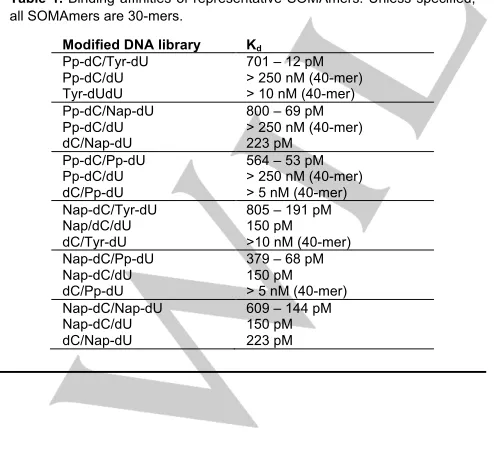
compared to the libraries with single-modifications that showed only 21.5% retention. Based on the obtained binding affinity values, it is clear that most libraries with two modified bases yielded high affinity aptamers far better than libraries with single base modification as shown in Table 1.
Table 1. Binding affinities of representative SOMAmers. Unless specified, all SOMAmers are 30-mers.
Modified DNA library Kd Pp-dC/Tyr-dU 701 – 12 pM Pp-dC/dU > 250 nM (40-mer) Tyr-dUdU > 10 nM (40-mer) Pp-dC/Nap-dU 800 – 69 pM Pp-dC/dU > 250 nM (40-mer) dC/Nap-dU 223 pM
Pp-dC/Pp-dU 564 – 53 pM Pp-dC/dU > 250 nM (40-mer) dC/Pp-dU > 5 nM (40-mer) Nap-dC/Tyr-dU 805 – 191 pM Nap/dC/dU 150 pM dC/Tyr-dU >10 nM (40-mer) Nap-dC/Pp-dU 379 – 68 pM Nap-dC/dU 150 pM dC/Pp-dU > 5 nM (40-mer) Nap-dC/Nap-dU 609 – 144 pM Nap-dC/dU 150 pM dC/Nap-dU 223 pM
The selected SOMAmers not only showed high binding affinities, but also displayed high specificity as well. The specificity of the enriched SOMAmers were tested and showed no binding affinity to other closely related human proprotein convertases (PCs) such as PCSK1, PCSK2, furin, PCSK4, or PCSK7 (13.5–16.2% identity to PCSK9) at concentrations up to 100 nM. In a cross-species binding assay using monkey PCSK9 showed comparable affinity with human PCSK9, and some of the ligands also bound to rat and mouse PCSK9 (12% and 15% identify to PCSK9 respectively) with Kd values below 45 nM, all
of which were derived from libraries containing two modified bases. It should be noted that cross-species reactivity is not an indication of loss of specificity, but demonstrates that the selected double-modified SOMAmers specifically binds to conserved motifs on the protein target. In addition, the cross-species reactivity of the selected SOMAmers also does not suggest that we should overlook specialized selection protocols that specifically generate species cross-reactive aptamers such as toggle-SELEX[10].
The use of two modified bases in SELEX enabled the selection of SOMAmers with enhanced epitope coverage and facilitated the development of SOMAmer sandwich assays, which was particularly impressive as there was no need to direct the ligands to different binding sites, as is the case with multivalent aptamer isolation (MAISELEX) and array-based discovery platform for multivalent aptamers (AD-MAP)[11,12]. The
authors identified SOMAmer pairs in a multiplexed assay by testing 96 of the high affinity SOMAmers in all pairwise combinations (9,216 pairs in total)[13]. The results showed that
the high signalling pairs had at least one SOMAmer with two base modifications. However, the majority of the high signalling pairs consisted of two SOMAmers with two base modifications.
As expected for any high affinity aptamers, the reported SOMAmers demonstrated value as a diagnostic and therapeutic tool for hypercholesterolemia patients. Furthermore, the developed SOMAmer pairs were used in sandwich assays to detect high plasma levels of PCSK9 in samples from a group of patients on atorvastatin therapy (n = 42)[14]. In addition, over
70% of the tested SOMAmers showed at least 90% inhibition of PCSK9 with IC50 values between 0.1–1 nM. Specifically, the
SOMAmer with Pp-dC/Nap-dU modifications (SL1063) potently blocked LDL internalization by PCSK9 and its mutant form D374Y (IC50 = 2.8 nM and 35 pM, respectively). Although IC50
for the mutant D374Y was 80-fold higher than the IC50 for wild-type PCSK9, the binding affinity towards the mutant is only 3-fold higher than the wild type (D374Y Kd = 5.2 pM; PCSK9 Kd =
14.7 pM). The underlying mechanism behind this phenomenon remains to be elucidated, but the authors suggested that it could be related to the differences of steric or kinetic effects of the SOMAmers on both the mutant and wild-type PCSK9.
The authors did a tremendous amount of work to identify the best combinations of two modified bases with 18 separate SELEX experiments. Indeed, the hydrophobic modifications Nap, Pp, and Tyr improved binding affinities, which is in agreement that hydrophobic aromatic side chains are critical for antibody paratopes[15,16]. In particular, the extended methylene
HIGHLIGHT
For internal use, please do not delete. Submitted_Manuscript
modification is the key to high affinity binding for their combinedcapability to access deeper binding pockets. Despite the success in generating high affinity SOMAmers with cross-species reactivity, it does not necessarily mean that we should ignore SELEX protocols dedicated to generating cross-reactive aptamers (toggle-SELEX). Similarly, the selected SOMAmers displayed some degree of nuclease resistance, but post-SELEX modifications remains an important step to further engineer the aptamers for specific purposes, such as modification on the sugar ring (e.g. LNA substitution[17,18]) to improve nuclease
resistance and thermal stability, or modifications at the 3’ or 5’ caps to enhance bioavailability. The results obtained by Gawande et al. reinforce that enhancing the diversity of the starting library is indeed the next evolutionary step for SELEX, and should serve as an inspiration to find new ways to evolve aptamer selection methods.
Acknowledgements
RNV acknowledges funding support from the Department of Health (Merit Award), Western Australia; McCusker Charitable Foundation and Perron Institute for Neurological and Translational Science.
Keywords: SELEX • aptamers • modified nucleotides • SOMAmer • PCSK9
[1]. F. Lipi, S. Chen, M. Chakravarthy, S. Rakesh, R. N. Veedu, RNA biology 2016, 13, 1232-1245.
[2]. B. N. Gawande, J. C. Rohloff, J. D. Carter, I. von Carlowitz, C. Zhang, D. J. Schneider, N. Janjic, Proc Natl Acad Sci U S A 2017, 114, 2898-2903.
[3]. J. D. Vaught, C. Bock, J. Carter, T. Fitzwater, M. Otis, D. Schneider, J. Rolando, S. Waugh, S. K. Wilcox, B. E. Eaton, Journal of the American Chemical Society 2010, 132, 4141-4151. [4]. U. A. Ochsner, E. Katilius, N. Janjic, Diagnostic microbiology and
infectious disease 2013, 76, 278-285.
[5]. D. R. Davies, A. D. Gelinas, C. Zhang, J. C. Rohloff, J. D. Carter, D. O'Connell, S. M. Waugh, S. K. Wolk, W. S. Mayfield, A. B. Burgin, T. E. Edwards, L. J. Stewart, L. Gold, N. Janjic, T. C. Jarvis, Proc Natl Acad Sci U S A 2012, 109, 19971-19976. [6]. L. Gold, D. Ayers, J. Bertino, C. Bock, A. Bock, E. N. Brody, J.
Carter, A. B. Dalby, B. E. Eaton, T. Fitzwater, D. Flather, A. Forbes, T. Foreman, C. Fowler, B. Gawande, M. Goss, M. Gunn, S. Gupta, D. Halladay, J. Heil, J. Heilig, B. Hicke, G. Husar, N. Janjic, T. Jarvis, S. Jennings, E. Katilius, T. R. Keeney, N. Kim, T. H. Koch, S. Kraemer, L. Kroiss, N. Le, D. Levine, W. Lindsey, B. Lollo, W. Mayfield, M. Mehan, R. Mehler, S. K. Nelson, M. Nelson, D. Nieuwlandt, M. Nikrad, U. Ochsner, R. M. Ostroff, M. Otis, T. Parker, S. Pietrasiewicz, D. I. Resnicow, J. Rohloff, G. Sanders, S. Sattin, D. Schneider, B. Singer, M. Stanton, A. Sterkel, A. Stewart, S. Stratford, J. D. Vaught, M. Vrkljan, J. J. Walker, M. Watrobka, S. Waugh, A. Weiss, S. K. Wilcox, A. Wolfson, S. K. Wolk, C. Zhang, D. Zichi, PLoS One 2010, 5, e15004.
[7]. J. C. Rohloff, A. D. Gelinas, T. C. Jarvis, U. A. Ochsner, D. J. Schneider, L. Gold, N. Janjic, Molecular therapy. Nucleic acids
2014, 3, e201.
[8]. J. C. Rohloff, C. Fowler, B. Ream, J. D. Carter, G. Wardle, T. Fitzwater, Nucleosides Nucleotides Nucleic Acids 2015, 34, 180-198.
[9]. M. Takagi, M. Nishioka, H. Kakihara, M. Kitabayashi, H. Inoue, B. Kawakami, M. Oka, T. Imanaka, Appl Environ Microbiol 1997, 63, 4504-4510.
[10]. R. White, C. Rusconi, E. Scardino, A. Wolberg, J. Lawson, M. Hoffman, B. Sullenger, Molecular therapy : the journal of the American Society of Gene Therapy 2001, 4, 567-573.
[11]. Q. Gong, J. Wang, K. M. Ahmad, A. T. Csordas, J. Zhou, J. Nie, R. Stewart, J. A. Thomson, J. J. Rossi, H. T. Soh, Anal Chem 2012, 84, 5365-5371.
[12]. M. Cho, S. S. Oh, J. Nie, R. Stewart, M. J. Radeke, M. Eisenstein, P. J. Coffey, J. A. Thomson, H. T. Soh, Anal Chem 2015, 87, 821-828.
[13]. U. A. Ochsner, L. S. Green, L. Gold, N. Janjic, Biotechniques
2014, 56, 125-128, 130, 132-123.
[14]. S. G. Lakoski, T. A. Lagace, J. C. Cohen, J. D. Horton, H. H. Hobbs, The Journal of clinical endocrinology and metabolism
2009, 94, 2537-2543.
[15]. T. Ramaraj, T. Angel, E. A. Dratz, A. J. Jesaitis, B. Mumey, Biochimica et biophysica acta 2012, 1824, 520-532.
[16]. J. V. Kringelum, M. Nielsen, S. B. Padkjaer, O. Lund, Molecular immunology 2013, 53, 24-34.
[17]. R. N. Veedu, J. Wengel, Chemistry & biodiversity 2010, 7, 536-542.
[18]. R. N. Veedu, J. Wengel, RNA biology 2009, 6, 321-323.
Entry for the Table of Contents
(Please choose one layout)
Layout 1:
HIGHLIGHT
Text for Table of Contents
Hadi AlShamaileh and Rakesh N.
Veedu*
Page No. – Page No.
Next generation nucleic acid aptamers with two base modified nucleotides improve the binding affinity and potency