Vol.4 (2014) No. 4
ISSN: 2088-5334
Physicochemical Characteristics of Composite Flour Made from
Cassava, Sweet Potato, Corn and Rice Bran
Alvi Yani
#, Asropi*, Joko Susilo Utomo
# #Lampung Assesment Institute for Agriculture Technology Jl. Z.A. Pagar Alam No. 1 A. Bandar Lampung. 35145. Indonesia E-mail: [email protected], Phone : +62-721-781776/+62-721-705273
* Indonesian Citrus and Subtropical Fruits Research Institute Jl. Raya Tlekung No.1 Junrejo Kota Batu 65301, Indonesia
Abstract— Lampung province is one of production center for food commodities such as cassava, maize and sweet potato. The
development of these commodities into processed products has been done one of which is a composite flour. The purpose of this study was to determine the physicochemical characteristics of composite flour consisting of a mixture of cassava flour (CF), sweet potato flour (SPF) and corn flour (NF). The study was conducted in the Laboratory of Lampung Assessment Institute for Agriculture Technology (AIAT) and Laboratory of Food Chemistry and Technology, Indonesian Legumes and Tuber Crops Research Institute (ILETRI) on May – July 2014. The design used was completely randomized by four treatments such as F1 (60% CF, 0% SPF, 35% NF, 5% Rice Bran/RB ), F2 (50% CF, 10% SPF, 35% NF, 5% RB), F3 (40% CF, 20% SPF, 35% NF, 5% RB) and F4 (30% CF, 30% SPF, 35% NF, 5% RB), and the activities was repeated 4 times. The data were statistically analyzed and followed by Duncan Multiple range test. Physical characteristics observed were whiteness, water content, water absorption value (NPA) and the water solubility value (NKA). While the chemical characteristics of proximate analysis consist of moisture content, protein, carbohydrates, fat, fiber and ash content by AOAC Methods. The results showed that the whiteness value of four composite flours were not different in the ranged between 57.97% (F4) and 60.37% (F1). While the carbohydrates content ranged from 81.17 to 83.3% (the highest in the F4), protein was from 3.70 to 4.47% (the highest in the F4), fat was from 1.41 to 1.50%, ash content was from 01.47 - 1.66%, 1.81 - 2.17% for crude fiber, 11.64 to 18.80% for amylose, while amylopectin content ranged from 36.68 to 43.98%.
Keywords— Physicochemical characteristics, composite flour.
I. INTRODUCTION
An effort of food diversification in Indonesia was focused on reducing the consumption of rice and increases the consumption of non-carbohydrate sources of rice. These is done by the development of utilization of carbohydrate sources such as cassava, breadfruit, corn, sago, sorghum and tubers, and product development by manufacturing role to improve the taste and image of the typical Indonesian food products [1]. One of the efforts to strengthen food security and support the diversification of food that is by incessant government campaign diversification such as the manufacture of analogous rice that made from a mix local food, such as sweet potatoes, cassava, sago, and corn, reliable for strengthening food security, has the advantage of a lower glycemic index and higher nutrients by fortification process [2]. Usage non-rice carbohydrate sources such as sorghum, cassava, corn and sago has been used as a raw material in the manufacture of food products. In a study [3], analogous rice preferred by consumers is the formulation of
30% corn starch and sago palm. Usage cassava flour as a base for the manufacture of analog rice has the highest acceptance compared to other carbohydrate sources [4].
Therefore, analogous to the development of rice-based cassava flour and maize as local food can be an alternative staple food and increase the added value of local food. Thus, it needs to know the physical and chemical properties of the composite flour mix of cassava flour, sweet potato, corn and rice bran.
II. METHODOLOGY
A. Time and Place of Research
The study was conducted in Mai - July 2013 in AIAT Lampung laboratory and Laboratory of Chemical and Food Technology ILETRI, Malang.
B. Materials and Equipment
materials used were cassava, sweet potato, corn, rice bran, water, and chemical analysis materials.
C. Experimental Design
The experimental design used was a completely randomized design with four treatments of raw material formulations and four replications. The stages researches include making cassava, sweet potato, corn flour and flour mixing.
D. Procedures
Making flour from cassava, sweet potato and corn
Making CF, SPF and NF performed using hammer mill. The raw material was cleaned, peeled, washed, sliced (cassava and sweet potatoes), pressed and dried, then ground using a hammer mill.
Mixing Flour
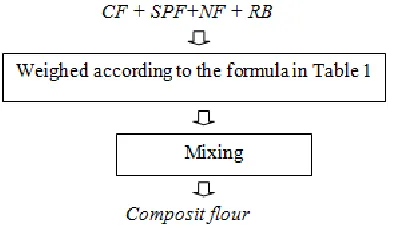
Mixing flour as raw material for analog rice mix of was done according to formula in Table 1.
TABLEI
FORMULATIONOFCOMPOSITEFLOUR
Raw Material F1 F2 F3 F4
CF 60% 50% 40% 30%
SPF 0% 10% 20% 30%
NF 35% 35% 35% 35%
RB 5% 5% 5% 5%
1) Determination of physical and chemical
characteristic: The analysis was conducted at the Laboratory
of Food Chemistry and Technology, ILETRI, Malang. Physical analysis was conducted on the whiteness, moisture content by AOAC method [5], water absorption value (NPA) and the water solubility value (NKA). While the chemical analysis of the proximate analysis such as protein, carbohydrates, fat, ash and fiber content analysis by AOAC method [5].
Fig. 1. Flow chart of composite flour processing
E. Data analyses
Data collected was analysis of variance than separated using Duncan multiple range test.
III.RESULTSANDDISCUSSION
A. Preparation of CF, SPF, NF and RB
Fig. 2 Rendemen cf, spf and nf
CF and SPF were made by the method of dry milling by stages of stripping, washing, slicing, drying, and flouring. While NF was made by wet milling method by stripping phase separation of the epidermis and seed agencies, downsizing, soaking, draining and flouring. NF was made by the same method and produces a rendemen of 31.47%. This value was greater compared CF and SPF, which was 27.34% and 23.05% on 80 mesh screen (Figure 2). In addition flouring method, the amount of rendemen was also influenced by varieties and harvesting time.
B. Physicochemical characteristics of CF, SPF, NF and
composite
1)
Whiteness: The whiteness on CF, SP The resultsFig. 3 Whiteness on the (a) raw material and (b) composite flour
C. Water Content, Water Absorption and Water Solubility
Values
Wet milling method in the manufacture of NF, affected the water content flour. Results showed the highest levels of NF (13.81%). Figure 4 shows the water content and water solubility, while Figure 5 shows the rate of water absorption on flour and composite flour. The lowest water content (9.21%) was belong to Formula 4.
Fig. 4 Water Content and NKA on (a) the raw material and (b) composite flour
Fig. 5 NPA on (a) the raw material and (b) composite flour
The amounts of water added to the starch greatly affect the physical properties of starch. Composite flour have water solubility value of 4.55 to 6.87%, the highest in Formula 4 and have absorption values from 234.59 to 250.14, and the highest was the Formula 3. This indicated the molecular structure of starch from composite flour have been damaged, so that the material easily soluble in water. The higher NKA of the material, the material easily soluble in water [6].
D. Crude fiber, Amylose, and Amylopectin
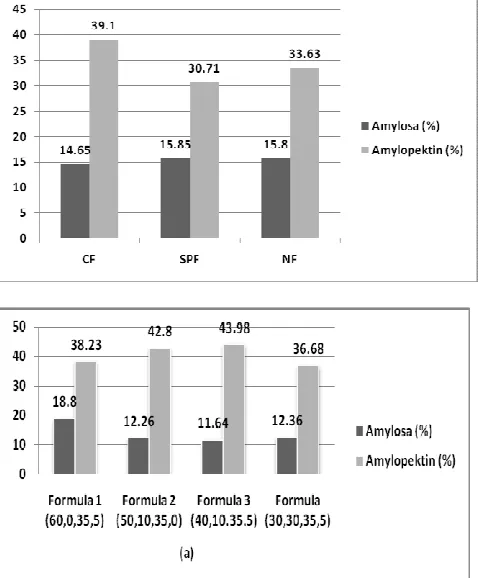
Starch consists of two fractions which be separated by hot water. Soluble fraction mainly composted by amylose, and insoluble composted by amylopectin. In amylopectin food products is stimulating the process of blooming (puffing). Food products derived from starch by high amylopectin will be light, crisp and crunchy. While starch by high amylose, tend to produce a hard, solid.
The results of the analysis of crude fiber, amylose, and amylopectin on CF, SPF, NF and flour composites are shown in Figure 6 and 7.
Starch composition generally consists of amylopectin as the biggest and the rest of amylose [7] which have properties different natural that 10-20% for amylose and 80-90% for amylopectin. Most of the natural starches such as corn starch, wheat, tapioca, potato and sago contains a high percentage of branching chains of amylopectin [8] [9].
Fig. 7 Amylose and amylopectin on (a) the raw material and (b) composite flour
E. Proximate analysis
Proximate analysis is a chemical test to determine the nutrient content in the form of protein, carbohydrate, fat, and fiber in a food substance from food or feed. Proximate analysis has benefit of a quality assessment of feed or foodstuffs, especially on the standard of food substances that should be contained in it. A proximate test result on composite flour is shown in Figure 8.
Fig. 8 Results of the proximate analysis in CF, SPF, NF and RB
The highest carbohydrate content was 86.65% (CF) and the lowest was 56.4% (RB), and otherwise the highest protein was 11.75% (RB) and the lowest 1.55% (CF). Cassava is one of the highest sources of carbohydrates and can be used as an alternative source of carbohydrate.
TABLEIII
CHEMICALCHARACTERISTICSOFSOMERICEVARIETIES
Rice Varieties
Ash (%)
Protein (%)
Fat (%)
Carbohydrate (%)
Formula 1 1.66 3.70 1.51 81.17
Formula 2 1.48 3.91 1.41 81.89
Formula 3 1.47 4.48 1.02 81.62
Formula 4 1.57 4.47 1.42 83.33
Table II shows that the ash content, protein, fat, and carbohydrates from the four formulas were not significantly different. However, the addition of RB in the flour composites can increase protein and fat content of in each formula, thus enriching the nutritional value of food products made from composite flour. Composite flour of Formula 4, on average, has the highest proximate value so well for use as composite flour.
IV.CONCLUSIONS
Cassava flour have the highest whiteness value was 77.13% and the smallest in the rice bran of 28, 23%. Whiteness level of composite flour are not signifivantly different, in the range of 57.97% to 60.37%.
REFERENCES
[1] Simanjutak D. 2006. Pemanfaatan Komoditas Non Beras dalam Diversifikasi Pangan Sumber Kalori. Jurnal Penelitian Bidang Ilmu Pertanian Vol. 4, 1: 45 – 54.
[2] Sibuea, P. 2012. Beras Analog, Solusi Untuk Krisis Pangan. Media Indonesia, 05 September 2012. Jakarta
[3] Widara, S. S. 2012. Studi Pembuatan Beras Analog Dari Berbagai Sumber Karbohidrat Menggunakan Teknologi Hot Extrusion. Skripsi. Institut Pertanian Bogor.
[4] Dewi, R. K. 2012. Rekayasa Beras Analog Berbahan Dasar Modified Cassava Flour (MOCAF) Dengan Teknologi Ekstrusi. Skripsi. Institut Pertanian Bogor.
[5] AOAC. 2005. Official of Analysis of The Association of Official Analytical Chemistry. Arlington. AOAC Inc.
[6] Suriani, A. I. 2008. Mempelajari Pengaruh Pemanasan dan Pendinginan Berulang Terhadap Karakteristik Sifat Fisik dan Fungsional Pati Garut (Marantha arundinacea) Termodifikasi. Skripsi : Departemen Ilmu dan Teknologi Pangan FP IPB, Bogor. [7] Bradbury and Holloway.,1988. Bradbury, J.H dan Holloway,
W.D.1988. Chemistry of Tropical Root Crops: Significance for Nutrition and Agriculture in the Pacific. Australian Centre for international Agricultural Research, Canberra
[8] Pomerans, 1991. Pomeranz, Y., 1991. Functional Properties of Food Components. Academic Press Inc, San Diego.