Current Independent Approximation of
Tokamak Plasma Asymmetry Factor
A. Salar Elahi
*, M. Ghoranneviss
Plasma Physics Research Center, Science and Research Branch, Islamic Azad University, Tehran, Iran
Abstract
In this contribution we have presented a current independent approximation of tokamak plasma asymmetry
factor based on magnetic probes measurement in IR-T1 tokamak. The main advantage of this technique is that it based only
on the one diagnostic (only magnetic probes and not need to plasma current measurement). Based on this method, four
magnetic pickup coils were designed, constructed, and installed on outer surface of the IR-T1 tokamak chamber and then
plasma asymmetry factor was measured from them. Also the result of this technique was compared with other technique (flux
loops technique) and found in agreement with each other.
Keywords
Tokamak, Plasma Asymmetry Factor, Magnetic Probes
1. Introduction
The tokamaks are the most promising candidate for a
viable commercial fusion reactor. Before this very promising
energy source can be harnessed, many scientific and
technological problems must first be resolved. One of the
principal problems facing magnetic confinement schemes
such as the tokamak configuration is the issue of stably
maintaining the plasma column within the discharge
chamber. In order to accomplish this, a suitably shaped
magnetic field structure must be produced.
The tokamak plasma is subjected to several forces in the
major radial direction that must be dynamically
counterbalanced by an appropriate magnetic Lorentz force in
order to maintain plasma equilibrium in the horizontal
direction [1-20]. In general, in the low beta tokamaks, radial
pressure balance is achieved by the poloidal field, and also
toroidal force balance is achieved by interaction of the
external vertical field with toroidal current (when inward
Lorentz force equal with sum of the three outward forces
(hoop force, tire tube force, and 1/R force) due to the toroidal
configuration of the tokamak). But, in toroidal force balance
problem, the two opposite forces may not be equal, and
therefore plasma intend to shift inward or outward, which is
a very dangerous for tokamak plasma equilibrium. Therefore,
plasma equilibrium study is one of the fundamental problems
of the magnetically confined plasmas. Measurement of the
tokamak plasma asymmetry factor (
Λ
) is essential for
tokamak experiments. Very of plasma information can be
* Corresponding author:
[email protected] (A. Salar Elahi) Published online at http://journal.sapub.org/jnpp
Copyright © 2017 Scientific & Academic Publishing. All Rights Reserved
deduced from this parameter, such as the plasma equilibrium
state, plasma energy, plasma confinement time, plasma
toroidal current profile, and Magnetohydrodynamics (MHD)
instabilities [21-50]. In this contribution we presented a
current independent approximation of tokamak plasma
asymmetry factor only based on magnetic probes
measurement in IR-T1 tokamak, which is a small, air core,
low beta and large aspect ratio tokamak with a circular cross
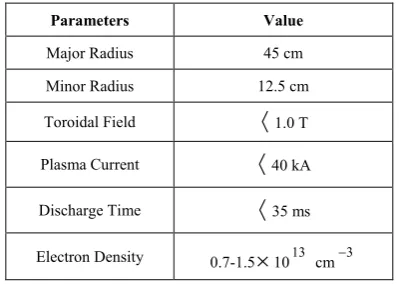
section, (see Table 1). This technique based on magnetic
probes measurement for determination of plasma asymmetry
factor
will be discussed in section 2. In order to compare of
the result, other method is also experimented. Experimental
results and comparison between them will be presented in
section 3. Summary and conclusion are also will be
discussed in section 4.
2. Current Independent Approximation
of Tokamak Plasma Asymmetry
Factor based on Magnetic Probes
Measurement
Because of dependence of the plasma position and plasma
current distribution to the magnetic fields distributions
around the plasma, therefore magnetic pickup coils give us
information about the plasma equilibrium parameters such as
the plasma position and plasma asymmetry factor. Poloidal
and normal magnetic fields distributions around the plasma
are [1, 2]:
,
cos
2
1
2
1
1
ln
4
2
2 0 2
2 0 0 0
θ
π
µ
π
µ
θ
−
∆
+
+
Λ
−
+
×
−
=
b
R
R
b
a
b
a
R
I
b
I
B
p p,
sin
2
1
2
1
ln
4
2 0 2 2 0 0θ
π
µ
∆
+
−
+
Λ
+
×
−
=
b
R
R
b
a
b
a
R
I
B
p r(2)
where
a
,
b
,
R
0,
µ
0, and
I
pare the plasma radius,
chamber minor and major radiuses, free space permeability,
and plasma current, respectively, and where:
).
2
3
(
)
2
(
),
(
)
0
(
),
(
ln
1
2
0 0π
θ
π
θ
π
θ
θ
µ
π
β
θ θ θ θ=
−
=
=
∆
=
−
=
=
∆
∆
+
∆
+
=
−
+
=
Λ
r r r r p i pB
B
B
B
B
B
where
B
B
I
R
b
a
l
(3)
Therefore, by rearranging the above equations, a current
independent relation for the plasma asymmetry factor
obtained:
(
0
)
(
)
,
ln
0
=
+
=
∆
+
∆
+
=
Λ
π
θ
θ
θ θ θB
B
B
B
b
R
b
a
r(4)
where we used the quasi-cylindrical coordinates (
r
,
θ
,
φ
).
Indeed, equations (1) and (2) accurate for the low
β
, large
aspect ratio and circular cross section tokamaks as IR-T1.
Based on this technique, in the IR-T1 tokamak four
magnetic probes were designed, constructed and installed.
Two magnetic probes were located on the circular contour
Γ
of the radius
b
=
16
.
5
cm
in angles of
θ
=
0
and
π
θ
=
to detect the tangential component of the magnetic
field
B
θand two magnetic probes are also located above,
2
/
π
θ
=
, and below,
θ
=
3
π
/
2
, to detect the normal
component of the magnetic field
B
r, as shown in the Fig.
(1). The magnetic fields measured by the magnetic probes
consists of the desired magnetic fields produced by the
plasma current as well as unwanted magnetic fields such as
that produced by the toroidal field coils. This happens
primarily as a result of misalignments of the probes. In order
to eliminate, or at least to reduce, these stray magnetic fields,
the waveforms to which they correspond are added with
suitable polarity to the measured signals via an adjustable
gain passive mixer. To accomplish this, the gains are
adjusted in the absence of the plasma, while all other fields
are present, until the coil signals are zero or as close to zero
as possible. After compensation and integration of magnetic
probes output, and by substituting the poloidal and normal
components of the magnetic fields in Equation (4), plasma
asymmetry factor was determined. Experimental results will
be presented in the next section.
Figure (1). Positions of the four magnetic probes on outer surface of the IR-T1 tokamak chamber
3. Experimental Result and Comparison
with Other Technique Result
In order to determination of the IR-T1 tokamak plasma
asymmetry factor using this technique, only we needed to
determination of the magnetic fields distributions around the
plasma. Therefore we designed, and constructed a four
magnetic pickup coils, and installed them on outer surface of
the IR-T1 chamber. Then, we measured the asymmetry
factor by substitution of output of magnetic probes after
compensation and integration into Eq. (4).
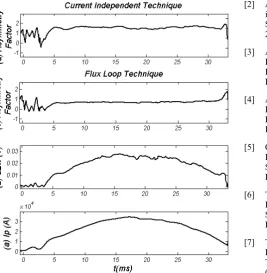
The result of this technique and comparison with other
method (flux loops technique) are presented in the Fig. (2).
These figures show that the results of two techniques are in
good agreement with each other. The acceptable differences
between them are because of (1) approximation in
measurements of magnetic fields distribution around the
plasma because of discrete probes measurements and (2)
large aspect ratio approximation, and (3) possible error in
compensation of excessive magnetic flux.
Table 1. The range of plasma parameters of the IR-T1 Tokamak
Parameters Value
Major Radius 45 cm Minor Radius 12.5 cm Toroidal Field
〈
1.0 TPlasma Current
〈
40 kADischarge Time
〈
35 msFigure (2). Time evolution of (a) Plasma current, (b) differences of poloidal magnetic fields at high field side and low field side of tokamak, (c) IR-T1 tokamak plasma asymmetry factor which determined by the flux loop technique, and (d) plasma asymmetry factor which measured using the current independent method
4. Summary and Conclusions
We presented a current independent approximation of
tokamak plasma asymmetry factor based on magnetic probes
measurement in IR-T1 tokamak. The main advantage of this
technique is that it based only on the one diagnostic (only
magnetic probes and not need to plasma current
measurement). Based on this method, four magnetic pickup
coils were designed, constructed, and installed on outer
surface of the IR-T1 tokamak chamber and then plasma
asymmetry factor was measured from them. Also the result
of this technique was compared with flux loops technique
and found in agreement with each other. The acceptable
differences between them are because of (1) approximation
in measurements of magnetic fields distribution around the
plasma because of discrete probes measurements and (2)
large aspect ratio approximation, and (3) possible error in
compensation of excessive magnetic flux.
REFERENCES
[1] Determination of Plasma Position using Poloidal Flux Loops and Comparison with Magnetic Probes Measurement in IR-T1 Tokamak, A. Salar Elahi et al., IEEE Trans. Plasma Science 38 (2), 181-185, (2010),
DOI: 10.1109/TPS.2009.2037965.
[2] A Modified Flux Loop for Determination of Plasma Position in IR-T1 Tokamak, A. Salar Elahi et al., IEEE Trans. Plasma Science 38 (9), 3163-3167, (2010), DOI: 10.1109/TPS.2010. 2066289.
[3] Analytical and Experimental Approach in Plasma Displacement Measurement in IR-T1 Tokamak, A. Salar Elahi et al., J. Plasma Physics 76 (1), 1-8, (2009),
DOI: 10.1017/ S0022377809008034.
[4] A Novel Technique for the Measurement of Plasma Displacement in IR-T1 Tokamak, A. Salar Elahi et al., Fusion Engineering and Design 85, 724–727, (2010), DOI: 10.1016/ j.fusengdes.2010.04.034.
[5] Comparison between Flux Loops and Magnetic Probes in Determination of Shafranov Parameter in IR-T1 Tokamak, A. Salar Elahi et al., Phys. Scripta 80 (5), 045501, (2009), DOI: 10.1088/0031-8949/80/04/045501.
[6] Two Experimental Methods for Measurement of Plasma Displacement in IR-T1 Tokamak, A. Salar Elahi et al., Phys. Scripta 80, 045501, (2009),
DOI: 10.1088/0031-8949/80/05/055502.
[7] Time Evolution of the Energy confinement Time, Internal Inductance and Effective Edge Safety Factor on IR-T1 Tokamak, A. Salar Elahi et al., Phys. Scripta 81 (5), 055501, (2010), DOI: 10.1088/0031-8949/81/05/055501.
[8] Experimental Determination of Plasma Position Based on Two Analytical Methods in IR-T1 Tokamak, A. Salar Elahi et al., Phys. Scripta 82 (2), 025502, (2010),
DOI: 10.1088/0031-8949/82/02/025502.
[9] The First Results of Electrode Biasing Experiments in the IR-T1 Tokamak, M. Ghoranneviss, A. Salar Elahi et al., Phys. Scripta 82 (3), 035502, (2010),
DOI: 10.1088/0031-8949/82/03/035502.
[10] Theoretical and Experimental Approach in Poloidal Beta and Internal Inductance Measurement on IR-T1 Tokamak, A. Salar Elahi et al., J. Fusion Energy 28 (1), 346-349, (2009), DOI: 10.1007/s10894-009-9198-x.
[11] Effects of Resonant Helical Field (RHF) on Equilibrium Properties of IR-T1 Tokamak Plasma, A. Salar Elahi et al., J. Fusion Energy 28 (1), 416-419, (2009),
DOI: 10.1007/s10894-009-9215-0.
[12] Effects of Resonant Helical Field on Plasma Internal Inductance in IR-T1 Tokamak, A. Salar Elahi et al., J. Fusion Energy 28 (2), 408-411, (2009),
DOI: 10.1007/s10894-009-9213-2.
[13] RHF Effect on Shafranov Parameter and Shafranov Shift in IR-T1 Tokamak, A. Salar Elahi et al., J. Fusion Energy 28 (2), 412-415, (2009), DOI: 10.1007/s10894-009-9214-1. [14] Measurement of Plasma Energy Confinement Time in
Presence of Resonant Helical Field in IR-T1 Tokamak, A. Salar Elahi et al., J. Fusion Energy 28 (3), 394-397, (2009), DOI: 10.1007/s10894-009-9210-5.
[15] Measurement of Plasma Poloidal Beta in Presence of Resonant Helical Field in IR-T1 Tokamak, A. Salar Elahi et al., J. Fusion Energy 28 (3), 404-407, (2009),
DOI: 10.1007/s10894-009-9212-3.
Fusion Energy 28 (4), 390-393, (2009), DOI: 10.1007/s10894-009-9208-z.
[17] Comparative Measurements of Plasma Position using Multipole Moments Method and Analytical Solution of Grad–Shafranov Equation in IR-T1 Tokamak, A. Salar Elahi et al., J. Fusion Energy 28 (4), 385-389, (2009),
DOI: 10.1007/s10894-009-9207-0.
[18] Comparison between Discrete Magnetic Coils and Multipole Coils for Measurement of Plasma Displacement in IR-T1 Tokamak, A. Rahimi Rad, M. Ghoranneviss, M. Emami, and A. Salar Elahi, J. Fusion Energy 28 (4), 420-426, (2009), DOI: 10.1007/s10894-009-9216-z.
[19] Plasma Magnetic Fluctuations Measurement on the Outer Surface of IR-T1 Tokamak, A. Salar Elahi et al., J. Fusion Energy 29 (1), 1-4, (2010),
DOI: 10.1007/s10894-009-9218-x.
[20] Investigation of Effects of Toroidal Field Ripple on Plasma Poloidal Beta in IR-T1 Tokamak, A. Salar Elahi et al., J. Fusion Energy 29 (1), 22-25, (2010),
DOI: 10.1007/s10894-009-9221-2.
[21] TF Ripple Effects on Plasma Energy Confinement Time in IR-T1 Tokamak, A. Salar Elahi et al., J. Fusion Energy 29 (1), 29-31, (2010), DOI: 10.1007/s10894-009-9224-z. [22] Measurement of the Shafranov Parameter in Presence of the
Toroidal Field Ripple in IR-T1 Tokamak, A. Salar Elahi et al., J. Fusion Energy 29 (1), 26-28, (2010),
DOI: 10.1007/s10894-009-9223-0.
[23] Study of Effects of the Effective Edge Safety Factor on the Energy confinement Time in IR-T1 Tokamak, A. Salar Elahi et al., J. Fusion Energy 29 (1), 32-35, (2010),
DOI: 10.1007/s10894-009-9227-9.
[24] Experimental Study of Effects of the Internal Inductance on the Energy Confinement Time in IR-T1 Tokamak, A. Salar Elahi et al., J. Fusion Energy 29 (1), 36-40, (2010), DOI: 10.1007/s10894-009-9226-x.
[25] Plasma Horizontal Displacement Measurement Using Flux Loops in IR-T1 Tokamak, A. Salar Elahi et al., J. Fusion Energy 29 (2), 62-64, (2010),
DOI: 10.1007/s10894-009-9232-z.
[26] Determination of the Plasma Internal Inductance and Evaluation of its Effects on Plasma Horizontal Displacement in IR-T1 Tokamak, A. Salar Elahi et al., J. Fusion Energy 29 (2), 76-82, (2010), DOI: 10.1007/s10894-009-9234-x. [27] Demonstration of Shafranov Shift by the Simplest
Grad–Shafranov Equation Solution in IR-T1 Tokamak, A. Rahimi Rad, M. Emami, M. Ghoranneviss, A. Salar Elahi, J. Fusion Energy 29 (2), 73-75, (2010),
DOI: 10.1007/s10894-009-9236-8.
[28] Effects of Alfvenic Poloidal Flow and External Vertical Field on Plasma Position in IR-T1 Tokamak, A. Salar Elahi et al., J. Fusion Energy 29 (2), 83-87, (2010),
DOI: 10.1007/s10894-009-9235-9.
[29] Relations between the Plasma Diamagnetic Effect and Plasma Basic Parameters in IR-T1 Tokamak, A. Salar Elahi et al., J. Fusion Energy 29 (2), 88-93, (2010),
DOI: 10.1007/s10894-009-9237-7.
[30] Differences between the Toroidal and Poloidal Flux loops in
the Measurement of Plasma Position in Tokamaks, A. Salar Elahi et al., J. Fusion Energy 29 (3), 209-214, (2010), DOI: 10.1007/s10894-009-9260-8.
[31] Measurements of the Plasma Current Density and Q-Profiles in IR-T1 Tokamak, A. Salar Elahi et al., J. Fusion Energy 29 (3), 232-236, (2010), DOI: 10.1007/s10894-009-9264-4. [32] A Simplified Technique for the Determination of Plasma
Displacement in IR-T1 Tokamak, A. Salar Elahi et al., J. Fusion Energy 29 (3), 251-255, (2010),
DOI: 10.1007/s10894-009-9267-1.
[33] Comparative Measurements of the Asymmetry Factor in Tokamaks using the Magnetic Probes, Poloidal and Toroidal Flux Loops, A. Salar Elahi et al., J. Fusion Energy 29 (3), 279-284, (2010), DOI: 10.1007/s10894-010-9275-1. [34] Design, Construction, and Installation of Movable Electrode
Biasing System on the IR-T1 Tokamak, M. Ghoranneviss, A. Salar Elahi et al., J. Fusion Energy 29 (5), 467-470, (2010), DOI: 10.1007/s10894-010-9307-x.
[35] Biasing Effect on Modifying of the Tokamak Plasma Horizontal Displacement, A. Salar Elahi et al., J. Fusion Energy 29 (5), 461-465, (2010),
DOI: 10.1007/s10894-010-9305-z.
[36] Measurement of the Plasma Boundary Shift and Approximation of the Magnetic Surfaces on the IR-T1 Tokamak, A. Salar Elahi et al., Brazilian J. Physics 40 (3), 323-326, (2010).
[37] A Novel Optical Technique based on Image Processing for Determination of Tokamak Plasma Displacement, A. Salar Elahi et al., J. Fusion Energy 30 (2), 116-120, (2011), DOI: 10.1007/s10894-010-9359-y.
[38] Effect of Limiter Biasing on Runaway electrons in Tokamaks, M.R. Ghanbari, M. Ghoranneviss, A. Salar Elahi et al., Phys. Scripta 83, 055501, (2011),
DOI: 10.1088/0031-8949/83/05/055501.
[39] Multipole Moments based Study on Determination of Toroidal Plasma Equilibrium Position and Shift, A. Salar Elahi, J. Fusion Energy 30 (6), 477-480, (2011), 477-480, DOI: 10.1007/s10894-011-9408-1.
[40] Determination of Tokamak Plasma Displacement based on Vertical Field Coil Characteristics, A. Salar Elahi et al., Fusion Engineering and Design 86, 442–445, (2011), DOI: 10.1016/j.fusengdes.2011.03.121.
[41] Analytical Technique for Determination of Toroidal Plasma Displacement, A. Salar Elahi et al., J. Fusion Energy 31 (2), 191-194, (2012), DOI: 10.1007/s10894-011-9452-x. [42] Measurement of Runaway Electrons Energy by Hard X-ray
Spectroscopy in a Small Circular Cross-section Tokamak, M.R. Ghanbari, M. Ghoranneviss, A. Salar Elahi and S. Mohammadi, Radiation Effects & Defects in Solids 166 (10), 789–794, (2011), DOI: 10.1080/10420150.2011.610320. [43] Design and Manufacturing of the Electrode Biasing System
for the Tokamak, A. Salar Elahi et al., IEEE Transactions on Plasma Science 40 (3), 892-897, (2012),
DOI: 10.1109/TPS.2012.2182990.
(2013), DOI: 10.1080/10420150.2011.650171.
[45] Investigation of Tokamak Plasma Fluctuations using Power Spectrum and FFT Analysis of Mirnov Coils Oscillations, Z. Goodarzi, M. Ghoranneviss and A. Salar Elahi, J. Fusion Energy 32 (1), 103-106, (2013),
DOI: 10.1007/s10894-012-9526-4.
[46] Controlling the Energy of Runaway Electrons by Emissive Limiter Biasing in Tokamaks, M.R. Ghanbari, M. Ghoranneviss, A. Salar Elahi et al., Phys. Scripta 85 (5), 055502, (2012), DOI: 10.1088/0031-8949/85/05/055502. [47] Laser Fusion Energy from p-7Li
with Minimized Radioactivity, M. Ghoranneviss, A. Salar Elahi, H. Hora, G.H. Miley et al., Laser and Particle Beams 30 (3), 459-463, (2012), DOI: 10.1017/S0263034612000341.
[48] Design and Fabrication of Emissive Biased Limiter and its Effect on Tokamak Plasma, M. Ghoranneviss et al., Radiation Effects and Defects in Solids 168(1), 42-47, (2013), DOI: 10.1080/10420150.2012.706610.
[49] New Approaches on Application of Multipole Moments for Determination of Toroidal Plasma Shift, A. Salar Elahi et al., Radiation Effects and Defects in Solids 168 (9), 654-663, (2013), DOI: 10.1080/10420150.2012.706609.
[50] Design and Construction of Hot Limiter Biasing System for the Tokamak, A. Salar Elahi et al., Radiation Effects and Defects in Solids 168 (9), 642-653, (2013),