Research Article
Response of wheat varieties to different
zinc application methods
Nauman Aziz
1, Shazma Anwar
1, Shaheen Kashmir
2, Junaid Ahmad
1*,
Beena Saeed
3and Shehryar Khan
11. Department of Agronomy, The University of Agriculture, Peshawar-Pakistan 2. Department of Botany, The University of Agriculture, Peshawar-Pakistan 3. Department of Agriculture, University of Sawabi-Pakistan
*Corresponding author’s email: [email protected]
Citation
Nauman Aziz, Shazma Anwar, Shaheen Kashmir, Junaid Ahmad, Beena Saeed and Shehryar Khan. Response of wheat varieties to different zinc application methods. Pure and Applied Biology. Vol. 8, Issue 1, pp489-495.
http://dx.doi.org/10.19045/bspab.2018.700207
Received: 06/10/2018 Revised: 06/12/2018 Accepted: 08/12/2018 Online First: 12/12/2018
Abstract
An experiment on response of different wheat varieties to zinc application methods was evaluated at Agriculture University Peshawar Pakistan in 2016-17. The experimental design was RCB with 3 replications. Zinc application methods (control, 1% foliar with ZnSO4, 1% priming with ZnSO4, 15 kg ha-1 soil application, 1% foliar with ZnSO4 + 1% priming with ZnSO4, 1% foliar with ZnSO4 + 15 kg ha-1 Zn application to soil, 1% priming with ZnSO4+ 15 kg ha-1 Zn soil application, 1% foliar with ZnSO4 +1% priming with ZnSO4 +15 kg ha-1 Zn soil application) & varieties (Atta Habib & Zincol) were used in the experiment. Plant height, spike m-2, grains spike-1, 1000 seed weight, biological yield and grain yield showed significant response to zinc application methods and varieties. Taller plant (98.8 cm), spikes m-2 (358), grains spike-1 (57), 1000 seed weight (49.1 g), biological yield (10067 kg ha-1) and grain yield (4319.3 kg ha-1) were recorded in plots treated with 1% foliar with ZnSO4 + 1% priming with ZnSO4 + 15 kg ha-1 Zn soil application of ZnSO4. Considering wheat varieties plant height (94 cm), tillers m-2 (317), spikesm-2 (301), grains spike -1
(52), biological yield (9073.3 kg ha-1) and grain yield (4103.5 kg ha-1) recorded from Zincol. It is concluded that Zincol wheat variety with application of 1% foliar with ZnSO4 + 1% priming with ZnSO4 + 15 kg ha-1 Zn soil application of ZnSO4 performed better in terms of yield and thus recommended for general cultivation.
Keywords: Foliar; Priming; Varieties; Zinc application; Zincol
Introduction
In cereals wheat is the most important crop worldwide. Among wheat producing countries Pakistan ranks 8th, contributes almost 3.17% wheat production of the world. In Pakistan wheat crop is a leading food grain and occupies central position in economy. In Pakistan during 2015-16 wheat is cultivated on about 8.66 million hectares with total production of 23.517 million tons [1]. While in Khyber Pakhtunkhwa it was cultivated on 0.758 million hectares with average production of 1607.5 kg ha-1. Wheat, as a food crop is
mostly used for its good taste and source of calories, proteins and vitamins. Low quality of wheat and flour-milling by-products are used as source of feed for livestock.
biological zones and is receiving more attention throughout world [4, 5]. Deficiency of Zn affects about 1/3 of the total world's populations [6, 7]. In soils due to low dissolvability of Zn plant cell growth reduction and development is one of the Zn deficiency symptom [8]. In human beings Zn deficiency is very common especially in those countries with high consumptions of cereal-based foods. Therefore, there is a great need to improve cereal crops with adequate Zn nutrition. Deficiency of Zn is also a critical constraint to wheat production. In cereals based cultivated soils all over the world it is widely accepted that deficiency of Zn in soil is the most commonly occurring micronutrient deficiency. The unavailability of soil Zn resulting in severe losses in terms of economic and decreased plant growth and yield production.
Foliar application of different nutrients to plants is another option when deficiency of nutrient cannot be met properly by nutrients applications to the soil [4]. When the roots cannot provide the required nutrients to plant, in such circumstances foliar spraying of microelements is very helpful [9, 10]. When zinc fertilizer is applied to crop at later stages, Zn deposition in grains particularly increases. Past studies conducted on Zn cleared that maximum accumulation of Zn take place during grain development stage and the concentration of Zn in wheat grains accumulates more at milky stage of grain development. From the foliar spray of Zn it has been shown that in the late growth stages like at milk and dough stage resulted in much more enhancement in grain Zn concentration than application of Zn at earlier growth stages when compared [11]. A potential problem is that increasing in Zn concentration in flour may affect negatively its processing traits [8]. Zn is more effective in increasing Zn concentration in seeds by its foliar application at all seed development stages. In seeds the highest Zn concentration can be achieved when applied at the first stages of development of seed [12]. Currently,
increasing grain Zn concentration is most important global challenge in order to minimize Zn deficiency related health problems. Since wheat crop have very low amount of Zn in grains and growing wheat on Zn deficient soils reduces Zn concentration in Zn. Hence foliar application of Zn to wheat is fundamentally important for both good crop productivity and better human health. Keeping in view the importance of Zn for better wheat production, this research study is designed to study the main and interactive effect of wheat varieties to different zinc application methods.
Materials and methods
phosphorous and half dose of nitrogen was applied at sowing time and the remaining dose was applied later at 2nd irrigation. All other agronomic practices were kept normal and uniform for all the treatments.
Statistical analysis
Data was statistically analyzed [13] and means were computed using LSD test (P < 0.05).
Results
Plant height (cm)
Data on plant height of wheat as influenced by different zinc application methods and varieties are given in (Table 1). The data shows that zinc application methods and varieties shows significant affect plant height of wheat. Highest plant height (98.8 cm) was recorded in plots which were treated with 1% foliar + 1% priming + 15 kg ha-1 soil application while the lowest was recorded with no zinc application. Similarly taller plants (94 cm) were recorded for
Zincol and short stature plants were recorded for Atta Habib (91 cm). V x Zn was found non-significant.
Number of productive tillers (m-2)
Table 1 shows data on number of productive tillers per m2 of wheat as influenced by different zinc application methods. The data shows that zinc application methods and varieties significantly affected number of productive tillers m-2 of wheat. More number of productive tillers m-2 (368) were observed in plots which were treated with 1% foliar + 1% priming + 15 kg ha-1 soil application while lower (281) were recorded with no zinc application. In case of varieties maximum number of tillers per m2 was recorded for Zincol (317) and lower were recorded for Atta Habib (313). The interaction of v x Zn was found non-significant.
Table 1.Plant height (cm), Number of productive tillers m-2, Number of spikes m-2, Number of
grains spikes-1 as affected by different zinc application methods and wheat varieties
Zn Application Methods (Zn) Plant height (cm)
Productive tillers m-2
Spikes m -2
Grains spikes-1
Control 87.8 f 281 f 262 f 45 e
1% foliar with ZnSO4 89.7 e 289 g 276 e 48 d
1% priming with ZnSO4 90.5 de 297 e 275 e 54 c
15 kg ha-1 soil application 90.0 e 282 g 262 f 46 e
1% foliar with ZnSO4+1% priming with
ZnSO4 92.2 d 312 d 297 d 55bc
1% foliar with ZnSO4+15 kg ha-1 Zn soil
application 94.5 c 330 c 316 c 55abc
1% priming with ZnsSO4+15 kg ha-1 Zn
soil application 96.8 b 358 b 345 b 56ab 1% foliar with ZnSO4+1% priming with
ZnSO4+15 kg ha-1 Zn soil application 98.8 a 368 a 358 a 57 a
LSD (0.05) Varieties (V)
Atta Habib 91.0 b 313.1 b 296.7ab 51.9 b
Zincol 94.0 a 317 a 301.6 a 52.8 a
LSD (0.05) 0.88 2.84 3.09
Interaction (Zn x V) ns ns ns ns
Number of spikes (m-2)
Number of spikes per m2 of wheat as affected by various zinc application methods and varieties are given in (Table 1). The data shows that application methods of zinc and varieties effect significantly
recorded for Zincol and lower (296) were recorded for Atta Habib. The combine effect of zinc on wheat varieties was found non-significant.
Number of grains spike-1
Table 1 shows number of grains spike-1 of wheat as affected by different zinc application methods. The data shows that zinc application methods and varieties significantly affected number of grains spike-1 of wheat. Higher number of grains spike-1 (57) were recorded when treated with 1% foliar + 1% priming + 15 kg ha-1 soil application while less (45) were recorded at no zinc application. Higher number of grains spike-1 (52.8) was recorded for Zincol and lower (51) were recorded for Atta Habib. The interaction of V x Zn was found non-significant.
Thousand grain weight (g)
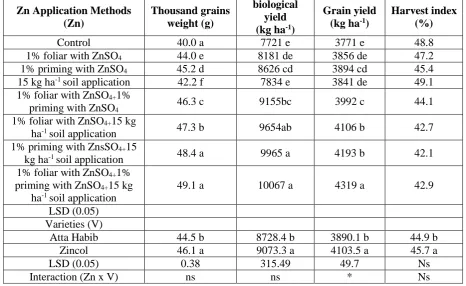
Data regarding thousand seed weight of wheat as affected by various zinc application methods and varieties are given in (Table 2). The data shows that zinc application methods and varieties affected significantly thousand seed weight of
wheat. Heavier grains (49.1 g) were recorded in plants which were treated with 1% foliar + 1% priming + 15 kg ha-1 soil application while lighter grains (40.0 g) were recorded in no zinc applied plants. More thousand grains weight (46.1 g) was recorded for Zincol and lower (44.5 g) was recorded for Atta Habib. The interaction of varieties with zinc application methods was found non-significant.
Biological yield (kg ha-1)
Biological yield of wheat as influenced by different zinc application methods are presented in (Table 2). The data shows that zinc application methods and varieties significantly response to biological yield of wheat. More biological yield (10067 kg ha -1) was recorded in plots which were treated
with 1% foliar + 1% priming + 15 kg ha-1 soil application while least (7721 kg ha-1) was recorded with no zinc application. Higher biological yield (9073 kg ha-1) was recorded for Zincol and lower (8728 kg ha -1) was recorded for Atta Habib. The
combined effect of V x Zn was found non-significant.
Table 2. Thousand grains weight (g), biological yield (kg ha-1), grain yield (kg ha-1) and Harvest
index (%)as affected by different zinc application methods and wheat varieties
Zn Application Methods (Zn)
Thousand grains weight (g)
biological yield (kg ha-1)
Grain yield (kg ha-1)
Harvest index (%)
Control 40.0 a 7721 e 3771 e 48.8
1% foliar with ZnSO4 44.0 e 8181 de 3856 de 47.2
1% priming with ZnSO4 45.2 d 8626 cd 3894 cd 45.4
15 kg ha-1 soil application 42.2 f 7834 e 3841 de 49.1
1% foliar with ZnSO4+1%
priming with ZnSO4 46.3 c 9155bc 3992 c 44.1
1% foliar with ZnSO4+15 kg
ha-1 soil application 47.3 b 9654ab 4106 b 42.7
1% priming with ZnsSO4+15
kg ha-1 soil application 48.4 a 9965 a 4193 b 42.1
1% foliar with ZnSO4+1%
priming with ZnSO4+15 kg
ha-1 soil application
49.1 a 10067 a 4319 a 42.9
LSD (0.05) Varieties (V)
Atta Habib 44.5 b 8728.4 b 3890.1 b 44.9 b
Zincol 46.1 a 9073.3 a 4103.5 a 45.7 a
LSD (0.05) 0.38 315.49 49.7 Ns
Grain yield (kg ha-1)
Data of grain yield of wheat as influenced by various zinc application methods and varieties are present in (Table 2). The data on grain yield of wheat shows significant response to zinc application method and varieties. More grain yield (4319 kg ha-1) was recorded in those plots which were treated with 1% foliar + 1% priming + 15 kg ha-1 soil application while lower (3771 kg ha-1) was recorded with no zinc application. More grain yield (4103 kg ha -1) was recorded for Zincol and lower (3890 kg ha-1) was recorded for Atta Habib. The interaction of V x Zn was found significant.
Harvest index (%)
The impact of different zinc application methods and varieties on harvest index of wheat is shown in (Table 2). The data of different zinc application methods shows significant impact on harvest index of wheat. Maximum harvest index (49.1 %) was observed at 15 kg ha-1 ZnSo4 soil application while minimum (42.1 %) was recorded in those plots where 1% priming with ZnSO4 + 15 kg ha-1 soil application was applied. Varieties showed no profound impact on harvest index of wheat. The interaction of V x Zn was found non-significant.
Discussion
In terms of literature view collected for comparison and clarifications, the results achieved in the previous chapter are briefly discussed here.
Different application methods of zinc and significantly affected the plant height of wheat varieties. Highest plant height was observed in those plots which were treated with 1% foliar + 1% priming + 15 kg ha-1 soil application while the lowest was recorded at no zinc application. This might me due to that zinc enhanced the growth and development of crop which resulted in taller plant. [14] Also reported the similar result that application of zinc increased plant height of wheat. Taller plants were recorded for Zincol and small stature plants were recorded for Atta Habib variety. Our results are in line with [15] who observed
that maximum plant height was recorded in different varieties with zinc application. Productive tillers m-2 of wheat was improved significantly in result of different zinc application methods. Similarly in case of varieties the effect of productive tillers per m2 was found significant. More number of productive tillers m-2 were recorded in those plots treated with 1% foliar + 1% priming + 15 kg ha-1 soil application while least were recorded with no zinc application. [16] Observed that foliar application of zinc increased the number of tillers m-2. While in case of varieties more number of productive tillers m-2 was recorded for Zincol and less were recorded for Atta Habib. The difference in productive tillers m-2might be due to different genetic make-up of the varieties. However our results are in contradiction with [17]who observed that higher tiller m -2 was recorded in different varieties with zinc application.
Data showed that zinc application methods have significant impact on number of spike m-2 of wheat varieties. Higher number of spikes m-2 were recorded in those plots which were treated with 1% foliar + 1% priming + 15 kg ha-1 soil application while least were recorded at no zinc application. Our results are in line with [18] who reported maximum number of spike m-2 zinc application methods. More number of spikes m-2 were recorded for Zincol and the least were recorded for Atta Habib. [19] Reported that number of spike m‐2of different varieties increased positively with the application of zinc.
number of grains spike-1. More number of grains spike-1 were recorded for Zincol and less recorded for Atta Habib. Probable reason for this is that different varieties have different genetical potential to use zinc efficiently. These results are in line with those of [20], who found that application of different methods of zinc to different varieties enhances the number of grains spike-1.
Data showed the impact of zinc application methods and varieties on thousand grains weight of wheat. More thousand grains weight was recorded when treated with 1% foliar + 1% priming + 15 kg ha-1 soil application while least was recorded with no zinc application. This increase might be due to maximum amount of dry matter accumulation in seeds of the wheat because of high concentration of zinc. Similar results are recorded by [21], who found that application of zinc produced heavier grains. Heavier grains weight was recorded for Zincol and least was recorded for Atta Habib. [19] Also reported that Zinc application significantly increased thousand grains weight of wheat varieties. Biological yield of wheat was significantly affected by different zinc application methods. More biological yield was recorded in plots which were treated with 1% foliar + 1% priming + 15 kg ha-1 soil application while least was recorded in no Zinc application. The reason for increase in biological yield might be that zinc application increased vegetative growth of the plant which resulted in greater biomass accumulation. Our results are in line with the result of [11] who reported that the unavailability of zinc may contribute to growth reduction in terms of lesser biomass production. More biological yield was recorded for Zincol and less was recorded for Atta Habib. The probable reason for the better response is that different varieties respond differently to zinc application method.
Grain yield of wheat varieties was affected by different application methods of zinc More grain yield was recorded with 1%
foliar + 1% priming + 15 kg ha-1 soil application method while less was recorded with no zinc application. Higher grain yield was oberved for Zincol and least was recorded for Atta Habib. This might be due to the fact that different varieties have different genetic make-up and hence respond differently to different zinc application method. [22]Also reported that zinc application methods increased the grains yield of wheat significantly.
The different zinc application methods showed significant impact on harvest index of wheat. Higher harvest index was recorded at 15 kg h-1 soil application while minimum was recorded in those plots where 1% priming with ZnSO4 + 15 kg ha -1 soil application was applied. Our results
are in line with those of [23] who reported maximum harvest index for higher dose of zinc. While varieties showed non-significant impact on harvest index.
Conclusion
It is concluded from the above finding that Zinc application method of 1 % foliar + 1 % priming + 15 kg ha-1 soil Zn application produced higher grain yield of wheat. Zincol variety produced more productive tiller m-2, spike per m2, and 1000 seed weight, grains spike-1 and grain yield as compared to Atta Habib. Variety Zincol and Zinc application method consisting of 1 % foliar with ZnSO4 + 1% priming with ZnSO4 + 15 kg ha-1 soil application is recommended for achieving maximum yield and yield components of wheat.
Authors’ contributions
Conceived and designed the experiments: N Aziz & S Anwar, Performed the experiments: N Aziz, Analyzed the data: N Aziz, S Anwar & J Ahmad, Contributed materials/ analysis/ tools: S Kashmir, B Saeed & S Khan, Wrote the paper: S Anwar & J Ahmad.
References
1. MNFSR (2016). Ministry of national food security & research; Agricultural Satistics, Govt. PK. Islamabad.
through soil and foliar zinc application.
Plant Soil Environ 59(8): 348-352. 3. Hafeez B, Khanif YM & Saleem M
(2013). Role of zinc in plant nutrition.
Amr J Exp Agri 3(2): 374-391.
4. Cakmak I (2008). Enrichment of cereal grains with zinc: Agronomic or genetic biofortification. Plant Soil 302: 1-17. 5. Kabata PA & Pendias H (2011). Trace
elements in soils and plants. CRC. Press, Boca Raton. Fla. USA.
6. Habib M (2009). Effect of foliar application of zinc and iron on wheat yield and quality. Afric J Biotech 8(24): 6795-6798.
7. Muyhaura CD, Musyimi IA & Okello SV (2010). Effective microorganisms and their influence on growth and yield of pigweed (Amaranthus dubians). J Agr Bio Sci 5: 17-30.
8. Gomez BH, Abugalieva A, Morgoulfov A, Abdullayev K, Bekenova L, Yessimbekova, Sereda MG, Shpigun S, Tsygankov V, Zelenskiy Y, Pena RI & Cakmak I (2010). Phenotypic correlations, G x E interactions and broad sense heritability analysis of grain and flour quality characteristics in high latitude spring bread wheat from Kazakhstan and Siberia. Euphytica 171: 23-38.
9. Kinaci E & Gulmezoglu N (2007). Grain yield and yield components of triticale upon application of different foliar fertilizers. Interciencia 32(9): 624-628. 10. Babaeian M, Tavassoli A, Ghanbari A,
Esmaeilian Y & Fahimifard M (2011). Effects of foliar micronutrient application on osmotical adjustments, grain yield and yield components in sunflower under water stress at three stages. African J Agric Res 6(5): 1204-1208.
11. Cakmak I (2012). Zinc fertilizer strategy for improving yield: Zinc deficiency represents a common micronutrient deficiency problem in human populations.
Fluid J 20(1): 4-6.
12. Levent I, Yilmaz A, Taban S, Eker S, Torun B & Cakmak I (2006). Phytic acid and phosphorus concentrations in seeds of wheat cultivars grown with and without zinc fertilization. Plant Nutr 25: 113-127. 13. Steel RGD & Torrie JH (1984). Principles
and procedure of statistics 2nd edi Mc, Graw Hill, New York.
14. Massoud AM, Abou-Zied MY & Bakry MA (2005). Response of pea plants grown in clay soil to micronutrients and Rhizobium-inoculation. Egypt J Appl Sci
20: 9-346.
15. Johnson MF & Susan JB (2011). The effect of zinc levels and wheat resistance on the Russian wheat aphid,
Diuraphisnoxia. J Kansas Ento Soci
74(1): 49-55.
16. Nadim MA, Awan I, Baloch MS, Khan N & Naveed K (2013). Micronutrient use efficiency in wheat as affected by different application methods. Pak J Bot 45(3): 887-892.
17. Heidarian A, Kord R, Mostafavi K, Lak AP & Mashhadi FA (2011). Investigating Fe and Zn foliar application on yield and its components of soybean (Glycine max
L.) at different growth stages. Agric. Biotech. Sust Dev 3(9): 189-197.
18. Khalid SM, Bakht J & Khan AB (2004). Effect of zinc application on the yield and yield components of wheat. Sarhad J Agric 20 (3): 277-280.
19. Mann RA, Jehangir WA & Masih I (2004). Improving crop and water productivity of rice-wheat system in Punjab, Pakistan. In Proceedings of the 4th Int. Crop Sci. Congress, Brisbane. 20. Bakht J, Shafi M, Zubair M, Khan MA,
Shah Z (2010). Effect of foliar vs. soil application of zinc on yield and yield components of wheat varieties. Pak J Bot
42(4): 2737-2745.
21. Ananda A & Patil BN (2005). Influence of zinc, iron and time of nitrogen application on growth, yield and quality of durum wheat. J Agric Sci 18 (3): 599- 603. 22. Moghadam MJ, Sharifabad HH,
Noormohamadi G, Motahar SYS & Siadat SA (2012). The effect of zinc, boron and copper foliar application on yield and yield components in wheat (Triticum aestivum L.). Ani Bio Res 3(8): 3875-3884.
23. Al-Abdulsalam MA (1997). Influence of nitrogen fertilization on the growth and yield of wheat (Triticum aestivum L.).