IJSRSET18411 | Received : 11 Dec 2017 | Accepted : 31 Dec 2017 | November-December-2017 [(3) 8 : 1013-1019]
© 2017 IJSRSET | Volume 3 | Issue 8 | Print ISSN: 2395-1990 | Online ISSN : 2394-4099 Themed Section : Engineering and Technology
1013
A Review Report on Data Aggregation Techniques in Wireless Sensor
Networks
1
Shweta S. Parate, 2Ujwala S. Bedarkar, 3Shraddha G. Purohit, 4Shruti S. Padade, 5Vrushada A. Bhadade,
6
Kapil N Hande
12345
BE Students, Department of Computer Science and Engineering, Priyadarshini Bhagwati College of Engineering, Nagpur, Maharashtra , India
6
Assistant Professor, Department of Computer Science and Engineering, Priyadarshini Bhagwati College of Engineering, Nagpur, Maharashtra , India
ABSTRACT
Data aggregation is extraordinarily basic techniques in wireless sensor network. Since with the help of data aggregation we diminish the imperativeness usage by wiping out abundance. Right when wireless sensor network sent in remote locales or debilitating condition. In the wireless sensor network have the most troublesome task is a presence time so with help of data aggregation we can enhance the lifetime of the network .In this paper we discuss the data aggregation approaches based on the coordinating traditions, the estimation in the wireless sensor network. What's more, besides discuss the good conditions and disadvantages or distinctive execution measures of the data aggregation in the network.
Keywords : Wireless sensor network, data aggregation, architecture, Network Lifetime, Routing, Tree, Cluster, Base Station
I.
INTRODUCTION
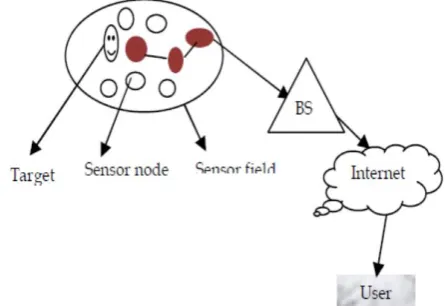
The wireless sensor network is exceptionally delegated network. It contains minimal light weighted wireless center points called sensor centers, sent in physical or characteristic condition. Moreover, it measured physical parameters, for instance, sound, weight, temperature, and clamminess. These sensor center points passed on in significant or thousand numbers and cooperate to shape an exceptionally delegated network fit for offering an explanation to data gathering sink (base station). Wireless sensor network have diverse applications like domain watching, building checking, prosperity watching, military survival lance and target following. However wireless sensor network is an advantage necessity if we talk about imperativeness, figuring, memory and compelled correspondence capacities. All sensor centers in the wireless sensor network are interface with each other or by direct sensor center points.
A sensor centers that produces data, based on its identifying instruments recognition and transmit distinguished data package to the base station (sink). This technique in a general sense arrange transmission since the base station may discovered amazingly a long way from sensor center point‟s needs. Greater essentialness to transmit data over long partitions so a better strategy is than have less center points send data to the base station.
These centers called aggregator center points and strategies called data aggregation in wireless sensor network.
II.
RELATED WORK
A. Clustering In WSN
Sensor center point are thickly passed on in wireless sensor network that infers physical condition would convey on a very basic level the same as data in close to sensor center point and transmitting such kind of data is basically dull. So every one of these substances bolster using a type of accumulation of sensor centers to such a degree, to the point that social event of sensor center can be merged or pack data together and transmit simply littler data. This can reduce restricted movement in particular assembling and besides decrease overall data. This social occasion system of sensor centers in a thickly passed on enormous scale sensor center is known as clustering. The technique for brushing data and pack data having a place with a single cluster called data mix (aggregation).
Issues of clustering in wireless sensor network:-
1. What number of sensor center points should be taken in a single cluster? Assurance strategy for cluster head in an individual cluster
2. Heterogeneity in a network, it suggests customer can put some power full centers, in term of imperativeness in the network which can bear on like cluster head and fundamental center point in a cluster fill in as a cluster part figuratively speaking. Various traditions and figuring have been proposed which deal with each individual issue.
B. Data Aggregation
In common wireless sensor networks, sensor centers are by and large resource constrained and battery-compelled. Remembering the true objective to save resources and essentialness, data must be gathered to swear off overwhelming measures of action in the network. There has been expansive work on data aggregation plans in sensor networks, The purpose of data aggregation is that takes out overabundance data transmission and enhances the lifetime of imperativeness in wireless sensor network. Data aggregation is the system of one or a couple of sensors by then assembles the acknowledgment result from other sensor. The accumulated data must be set up by sensor to reduce transmission stack before they are transmitted to the base station or sink. The wireless sensor network has involved three sorts of centers. Clear standard sensor center points, aggregator center point and querier.
Ordinary sensor center points sense data package from the earth and send to the aggregator center points basically these aggregator centers assemble data from different sensor centers of the network, adds up to the data allocate a some aggregation work like aggregate, typical, count, max min and a short time later sends sums result to upper aggregator center point or the querier center point who deliver the inquiry.
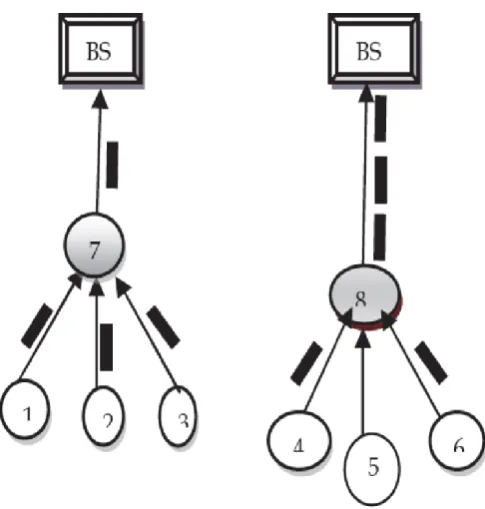
Figure 2 Data aggregation model and Non data aggregation appear
aggregation we redesign the lifetime of wireless sensor network. Sink have a data allocate imperativeness gainful path with minimum data inertness. So data inaction is basic in various employments of wireless sensor network, for instance, condition watching, prosperity, checking, where the freshness of data is in like manner a basic factor. It is essential to make essentialness capable data-aggregation estimations so network lifetime is overhauled. There are a couple of parts which choose the imperativeness adequacy of a sensor network, for instance, network designing, the data aggregation instrument, and the principal guiding tradition. Wireless sensor network has passed on treatment of sensor center point data. Data aggregation is the system. It delineates the planning procedure that is associated on the data got by a sensor center point and what's more data is to be controlled in the entire network. In which reduce imperativeness usage of the sensor center points and moreover diminish the amount of transmissions or length of the data distribute.
Elena Fosolo et al in [5] depict "In network aggregation is the particular strategy of social occasion and coordinating data through a multi hop network. Treatment of data allocate the help of midway sensor centers. The objective of this approach is extending the life time of the network and moreover reduces resource use. There are two kind of approach for in network aggregation. With assess diminishment and without measure reducing .In network aggregation with evaluate diminish. It is the method in which join and compacting the data got by a sensor center point from its neighbours remembering the true objective to diminish the length of data package to be sent towards the base station. Case, in some circumstance a center gets two data packs which have a compared data. In this condition it is inconsequential to send the two data packages. By then we apply a limit like MAX, AVG, and MIN and again send single data package to base station.
With help of this approach we diminish the amount of bit transmitted in the network and moreover save an extensive measure of essentialness. In network aggregation without measure diminishing is described amid the time spent data packs got by different neighbours in to a single data distribute without setting up the estimation of data. This methodology moreover diminishes imperativeness use or augmentation life time of the network.
a. Advantage and Disadvantage of Data Aggregation in WSN
Preferred standpoint: With the assistance of data aggregation process we can improve the power and precision of data which is acquired by whole network, certain excess exists in the data gathered from sensor hubs subsequently data combination handling is expected to lessen the repetitive data. Another preferred standpoint is those diminishes the activity load and monitor vitality of the sensors.
Disservice: The cluster head implies data aggregator hubs send meld these data to the base station .this cluster head or aggregator hub might be assaulted by noxious assailant. In the event that a cluster head is traded off, at that point the base station (sink) can't be guarantee the accuracy of the total data that has been send to it. Another downside is existing systems are a few duplicates of the total outcome might be sent to the base station (sink) by uncompromised hubs. It increment the power expended at these hubs.
b. Performance measure of Data Aggregation
There are critical execution measures of data combination calculation. These exhibitions are exceptionally subject to the coveted application.
Vitality Efficiency: By the data-aggregation plot, we can build the usefulness of the wireless sensor network. In which each sensor hubs ought to have spent a similar measure of vitality in each datum assembling round. A data aggregation conspire is vitality proficient in the event that it augments the usefulness of the network. Network lifetime, data exactness, and inertness are a portion of the critical execution measures of data-aggregation calculations. The meanings of these measures are exceptionally subject to the coveted application.
Idleness: Latency is assess data of time defer encounters by system, implies data send by sensor hubs and got by base station (sink).basically postpone associated with data transmission, steering and data aggregation.
Correspondence overhead: It assesses the correspondence unpredictability of the network combination calculation.
Data precision: It is an assess of proportion of aggregate number of perusing got at the base station (sink) to the aggregate number of created. There are diverse writes data aggregation conventions like network engineering based data aggregation conventions, network-stream based data aggregation conventions and nature of administration (QOS)- mindful data-aggregation conventions intended to ensure QOS measurements. Here network design based conventions are depicted in detail.
c. Impact of Data Aggregation in WSN
In this section we talk about the two principle factors that influence the execution of data aggregation strategies in wireless sensor network, Such as vitality sparing and delay. Data aggregation is the procedure, in which collecting the data bundle originating from the distinctive sources; the quantity of transmission is decreased. With the assistance of this procedure we can spare the vitality in the network. Deferral is the inactivity associated with aggregation data from nearer sources may need to kept down at transitional hubs keeping in mind the end goal to join them with data from source that are more remote away. Fundamentally aggregation technique based on the position of the sources in the network, number of sources and the network topology. On the off chance that it analyse the variables, we think about the two models of the source arrangement. The occasion sweep (ER) model and arbitrary source demonstrate [14]. The demonstrating says us that where the source are clustered close to each other or found haphazardly, noteworthy vitality picks up are conceivable with data aggregation. These increases are most noteworthy when the quantity of sources is vast, and when the sources are found generally near each other and a long way from base station. The displaying through, additionally appears to the recommend that aggregation inertness could be non-immaterial.
III.
LITERATURE SURVEY
Data aggregation process is performed by specific directing tradition. Our point is totalling data to restrain the imperativeness usage. So sensor center points should course packages based on the data distribute and pick the accompanying hop with a particular ultimate objective to progress in network aggregation. Basically guiding tradition is segregated by the network structure that is the reason coordinating traditions is based on the pondered strategies.
a. Tree-Based Approach
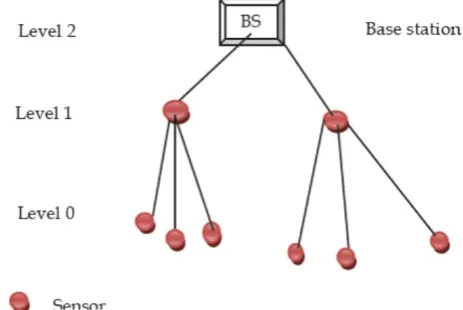
The tree based approach is portraying aggregation from building an aggregation tree. The kind of tree is minimum crossing tree, sink center point consider as a root and source center consider as a gets out. Data gushing of data start from surrenders center over to root infers sink (base station).Disadvantage of this approach, as we most likely am mindful like wireless sensor network are not free from frustration .if there ought to emerge an event of data package incident at any level of tree, the data will be lost for single level and in addition for whole related sub tree as well. This approach is sensible for illustrating perfect aggregation strategies'. Goad et al. in [6] data driven tradition know as Tiny aggregation (TAG) approach. The working of TAG is depending upon two phases: coursed stage and amassing stage.
Figure 3 Tree based data aggregation in wireless sensor network
b. Cluster-Based Approach
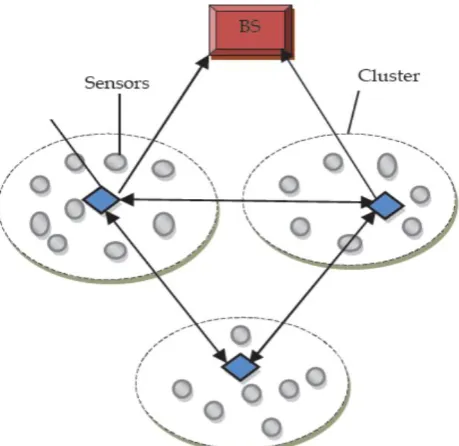
clusters. Each cluster has a cluster-head which is picked among cluster people. Cluster-heads do the piece of aggregator which add up to data got from cluster people locally and after that transmit the result to base station (sink). Starting late, a couple of cluster-based network affiliation and data-aggregation traditions have been proposed for the wireless sensor network. Figure 4 shows a cluster-based sensor network affiliation. The cluster heads can talk with the sink particularly by methods for long range transmissions or multi hopping through other cluster heads.
Figure 4. Cluster based sensor network.
The jolts demonstrate wireless correspondence joins K. Dasgupta et al. in [7] proposed a most extraordinary lifetime data aggregation (MLDA) computation which finds data gathering design gave territory of sensors center point and base-station, data package size, and imperativeness of each sensor center point. A data gathering design decides how data package are assembled from sensors center point and transmitted to base station for each round. A schedule can be thought of as a social event of aggregation trees. In [4], they proposed heuristic-covetous clustering-based MLDA based on MLDA count. In this they distributed network in to cluster and suggested each cluster as super-sensor. They by then enlist most noteworthy lifetime get ready for the super-sensors and after that usage this timetable to manufacture aggregation trees for the sensors. W. Choi et al. in [1] present a two-arrange clustering (TPC) plan. Stage I of this arrangement influences clusters with a cluster-to head and each center point inside that cluster outline an immediate partners with cluster-head. Stage I the cluster-head unrest is confined and is done
based on whatever is left of the imperativeness level of the sensor center points which restrain time change of sensors and this provoke essentialness saving from trivial cluster-head turn. In arrange II, each center inside the cluster searches for a neighbour closer than cluster-head which is called data exchange point and setup up a data hand-off association. By and by the sensor centers inside a cluster either use manage association or data hand-off association with send their data to cluster head which is an imperativeness capable arrangement. The data exchange point aggregates data at sending time to another data hand-off point or cluster-head. In case of high network thickness, TPC arrange II will setup pointless data exchange interface between neighbours as almost passed on sensor will distinguish same data and this provoke an abuse of essentialness.
c. Multi-way Approach
approach for sending groups through the network. In the ideal situation when no mistake happen, this is emphatically the best choice, as the base number of centers is involved with the transmission organize. Inside seeing association or center point disillusionments, the estimation will discover elective courses, so as assurance the movement of however many packages as would be judicious inside the time restrictions. The issue with this approach is that it may cause the developing of issue regions and centers along favoured ways will eat up their imperativeness resources quickly, possibly causing withdrawal in the network.
TABLE I
ROUTING PROTOCOL FOR TREE, CLUSTER, MULTIPATH AND HYBRID APPROACH
IV.
CONCLUSIONS
In this paper we display wireless sensor network is comprise an extensive number of sensor hub. Also, these hubs are asset requirement. That is the reason lifetime of the network is constrained so the different methodologies or convention has been proposed for expanding the lifetime of the wireless sensor network. In this paper we talk about the data aggregation are one of the vital systems for upgrading the life time of the network. Furthermore, security issues is data respectability with the assistance of uprightness we
lessen the traded off sensor source hubs or aggregator hubs from essentially adjusting the last aggregation esteem. Sensor hub in a sensor network is effortlessly too traded off. Traded off hubs have a capacity to adjust or dispose of messages. Technique for secure data aggregation: There are two sort of strategy for securing data hop by hop encryption and end to end encryption, the two strategies takes after some progression.
1. Encryption process must be finished by detecting hubs in wireless sensor network.
2. Unscrambling process must be finished by aggregator hubs.
3. After that aggregator hubs totals the outcome and afterward scramble the outcome once more. 4. The sink hub gets last amassed outcome and
decode it once more.
We likewise examine the different methodologies for data aggregation or additionally talk about the favorable position and weaknesses and different execution measures of the data aggregation.
V.
REFERENCES
[1] I. Akyildiz, W. Su, Y. Sankarasubramaniam, and E. Cayirci, “A Survey On Sensor Networks”, IEEE Communications Magazine, Volume 40, Number 8, pp.102-114, 2002.
[2] T. Arampatzis , J. Lygeros, and S. Manesis, “A Survey Of Applications Of Wireless Sensors And Wireless Sensor Networks”, In Mediterranean Conference On Control And Automation MED05, Nicosia, Cyprus, 2005.
[3] L. Gatani, G. Lo Re, and M. Ortolani, “Robust and Efficient Data Gathering for Wireless Sensor Networks”, in Proceeding of the 39th Hawaii International Conference on System Sciences – 2006
[4] K. Dasgupta, K. Kalpakis, and P. Namjoshi, “An Efficient Clustering-based Heuristic for Data Gathering and Aggregation in Sensor Networks”, IEEE 2003
[5] E. Fasolo, M. Rossi, J. Widmer, and M. Zorzi, “In-Network Aggregation Techniques for Wireless Sensor Networks: A Survey”, IEEE Wireless communication 2007.
[7] K. Dasgupta et al., “Maximum Lifetime Data Gathering and Aggregation in Wireless Sensor Networks”, In Proc. of IEEE Networks‟02 Conference, 2002.
[8] M. Ding, X. Cheng and G. Xue, “Aggregation Tree Construction in Sensor Networks,” 2003 IEEE 58th Vehic. Tech. Conf., vol. 4, no. 4, Oct. 2003, pp. 2168–72.
[9] K. Vaidhyanathan et al., “Data Aggregation Techniques in Sensor Networks,” Technical Report, OSU-CISRC-11/04-TR60, Ohio State University, 2004
[10] V. Raghunathan, C. Schugers, S Park, and M.B. Srivastava,“Energy-Aware Wireless Microsensor Networks”, IEEE Signal Processing Magazine, Volume 19, Number 2, pp. 40-50, 2002.
[11] Lin F.Y.S., Yen H.H., Lin S.P., Wen Y.F.: „MAC aware energyefficient data-centric routing in wireless sensor networks‟. Proc. IEEE Int. Conf. Commun. (ICC), 2006, vol. 8, pp. 3491–3496 [12] Krishnamachari B., Estrin D., Wicker S.:
„Modeling datacentric routing in wireless sensor networks‟, USC Computer Engineering Technical Report, CENG 02-14, 2002.
[13] H.H. Yen, C.L. Lin: ‟Integrated channel assignment and data aggregation routing problem in wireless sensor networks‟, IET Communications, 2009, Vol. 3, Iss. 5, pp. 784– 793.