Experimental Setup to Increase Efficiency and
Emission Reduction in Four Stroke Petrol Engine
Blend with HHO Gas
Mohamed Lukhman M Mohamed Asif M
PG Student PG Student
Department of Production Engineering Department of Production Engineering PSG college of Technology PSG college of Technology
Mohamed Ameen M Raghavanantham R
Design Engineer Supervisor
High Temp Furnace Limited NVH India Auto Parts Pvt. Lt.
Abstract
In the present state of affairs, in order to conquer the disadvantages of the fossil fuel, it is the need of time to totally or mostly supplant the petroleum fuel. In our venture work, an endeavor has been made to decrease the disadvantages of petroleum po wers. Electrolysis of water can give us hydrogen in type of Oxy-hydrogen gas, which can be utilized as a supplemental fuel in any internal combustion engine. In the present situation, presence of carbon component in the routine fuel like petrol and diesel prompts outflow contaminations which are related with the ignition procedure in the traditional internal combustion engine stacked with vehicles. Oxy hydrogen gas, which is enhanced blend of hydrogen and oxygen fortified together molecularly and attractively and Producer gas are developing as best supplemental powers in the current past. Presence of ‘Oxy-hydrogen gas’ throughout the combustion method decreases the ‘brake specific fuel consumption’ and conjointly will increase the ‘brake thermal efficiency’. It is safe to use ‘Oxy-hydrogen gas’ because it does not hold on, however is made and used as and once needed. Along with ‘fuel efficiency’ engine shows improvement within the ‘brake thermal efficiency’ with the mix of fuel. All at once, it has been discovered that the blend of ‘Oxy-hydrogen gas’ and fuel rather than solely conventional fuel improves the performance of the engine.
Keywords: Brown’s Gas, Four stroke petrol engine, Electrolysis Kit, Emission Test and Fuel Efficiency
________________________________________________________________________________________________________
I. INTRODUCTION
Experimental Setup to Increase Efficiency and Emission Reduction in Four Stroke Petrol Engine Blend with HHO Gas
(IJSTE/ Volume 3 / Issue 09 / 094)
II. PROPERTIES OF OXYHYDROGEN GAS
Oxy-hydrogen is degree enriched mixture of gas and element warranted along molecularly and magnetically (Brown, 1978). Oxy-hydrogen gas is created during a common-ducted electrolyser and so sent to the manifold to introduce into combustion chamber of the engine. Oxy-hydrogen gases can combust within the combustion chamber once dropped at its auto-ignition or self-ignition temperature. For a stoichiometric mixture at atmospheric air pressure, auto-ignition of oxy gas happens at concerning 570°C (1065°F). The minimum energy needed to ignite such a mix with a spark is concerning 20 micro joules. At normal temperature and pressure, ‘oxy-hydrogen gas’ will burn once it's between concerning 4 and 94% hydrogen gas by volume.Once ignited, the gas mixture converts to water vapor and releases energy. The number of warmth discharged is freelance of the mode of combustion; however the temperature of the flame varies. The most temperature of concerning 2800°C is achieved with a pure stoichiometric mixture, concerning about 700°C hotter than a gas flame in air.
Oxy-hydrogen gas has terribly high diffusivity. This ability to disperse in air
is significantly bigger than fuel and it's advantageous in principally for two reasons. Firstly, it facilitates the formation of solid air fuel mixture and second, if any leakage happens it will disperse at speedy rate. Oxy gas is extremely low in density. This leads to a storage drawback once employed in an internal combustion engine
III. GENERATION OF OXY HYDROGEN GAS
there are general strategies that are utilized in this analysis work for the generation of oxy-hydrogen gas. The primary methodology (Saed and Ammar, 2011) makes use of the essential principle of faradays law, electric power supply is connected to 2 electrodes, or 2 plates generally made up of some inert metal like noble metal or stainless-steel that is
placed within the water. In a very properly designed cell, element can seem at the cathode
(the charged conductor, wherever electrons enter the water) and oxygen can seem at the anode (the charged electrode). Assuming ideal faradic potency, the quantity of element generated is double the quantity of moles of oxygen and each are directly proportional to the full electrical charge conducted by the solution. Following are the reactions that commonly happen at cathode and anode:
Cathode (reduction): 2 H2O + 2e− → H2 + 2 OH- Anode (oxidation): 4 OH- → O2 + 2 H2O + 4 e−
Overall reaction: 2 H2O → 2 H2 (g) + O2 (g)
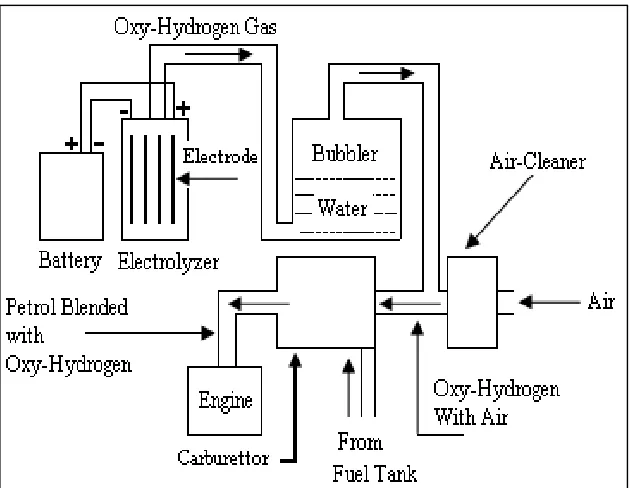
Fig. 1: Block diagram of oxy-hydrogen unit mounted on engine.
Fig. 2: Electrolysis Kit
Experimental Setup to Increase Efficiency and Emission Reduction in Four Stroke Petrol Engine Blend with HHO Gas
(IJSTE/ Volume 3 / Issue 09 / 094)
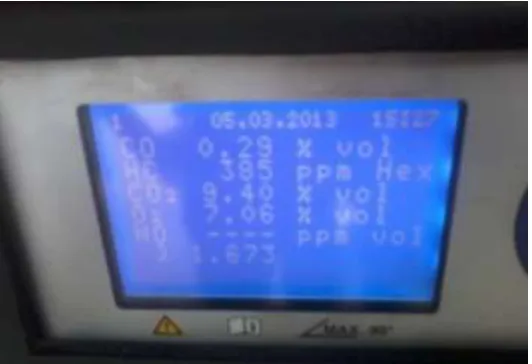
Fig. 4: Emission Test Results Table – 1
Emission Norms
Co2 (%) Hc (ppm)
Bs II 3 1200 Bs III 0.5 750 Bs IV 0.3 200
IV. MODIFICATION OF ENGINE
Actual Engine
In actual engine, petrol from the petrol tank is passed through the carburetor. In the carburetor, air from the air filter and petrol mixed in an optimum ratio and passed through engine by means of intake manifold. When we give the acceleration the carburetor orifice gets increased and more air fuel mixture is send into the engine in order to increase the speed of the engine.
Modified Engine
In petrol blended with brown’s gas engine, in the intake manifold a hole is drilled. In that hole, a tube is connected which drawn the brown’s gas from the brown’s gas apparatus. The flow of brown’s gas in the tube is controlled by control valve, so that corresponding speed can be maintained. The pressure of the gas taken to the engine is fully depending upon the suction pressure of the engine. The brown’s gas and petrol air mixture comes to the engine at different path. The flow of petrol to the carburetor in the engine is modified and the brown’s gas mixed with the petrol only at the intake manifold of the engine. This modification is done only outside the engine that is intake manifold and it will not make any problem to the engine. The engine is modified only by including a hole in the intake manifold so there is no problem for the engine and it can be easily done.
Table - 2
Emission after blending of petrol with brown’s gas in Maruthi 800 BS I engine Brown’s gas flow rate in kg/hr. CO2 (%) HC (Ppm) CO (%)
1 0.41 440 9.86
3 0.29 363 9.62
5 0.25 216 9.26
V. SAMPLE CALCULATION
Blending of Petrol with Brown’s Gas and Test at Loading Condition:
Petrol consumption = volume flow rate × density = 2.549× 10-4 × 670
= 0.171 kg/hr.
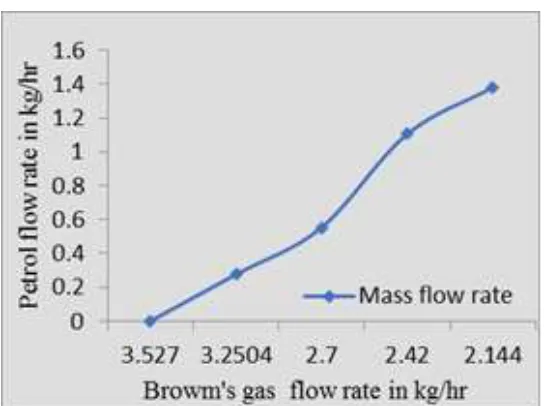
Fig. 6: mass flow rate of petrol vs. brown’s gas Table – 3
Mass flow rate of petrol and brown’s gas
S.no Petrol flow rate in kg/hr. Brown’s gas in kg/hr. 1 3.527 0
2 3.2504 0.2766 3 2.70 0.5532 4 2.42 1.1067 5 2.144 1.383
1 Liter H20 expands to 1,860 Liters of Brown's Gas. 1 kWh = 340 Liters of Brown's Gas.
1,860 divided by 340 = 5.47 kWh.
Losses are dependent upon where DC energy is acquired
VI. SAVING OF PETROL COST UNDER TESTED CONDITION
Cost of petrol per litre = Rs.74
Saving of petrol under loading condition = 30% Therefore petrol saved per litre = 300ml Cost of 400ml petrol saved = Rs.22.2
VII. MERITS
Improves gas mileage by up to 20 %.
Greatly enhance engine power and performance.
Remove carbon deposits and prevent future carbon build up.
Decreases the ‘brake specific fuel consumption’ and also increases the ‘brake thermal efficiency’.
VIII. DEMERITS
HHO gas cannot be stored in a particular place.
IX. CONCLUSION
Experimental Setup to Increase Efficiency and Emission Reduction in Four Stroke Petrol Engine Blend with HHO Gas
(IJSTE/ Volume 3 / Issue 09 / 094)
REFERENCES
[1] C. P. Kothandraman and S. Domkundwar (2001) “Thermodynamics and Thermal Engineering”, Dhanpat Rai & co, 1st Edition, pp: 16.42-16.45 [2] Heywood J.B., “Internal combustion engine fundamentals”, Tata McGraw Hill Publishing Company Limited, Newyork, 1988
[3] Brown Y., “Brown’s Gas”, United States Patent, US Patent 4014, 777; March 28, 1978.
[4] Saed A and Ammar M A A (2011). “Effect of HHO gas on combustion emission in gasoline engines”, Int. J. Fuel, 90 (20110, 3066-3070).