Int. J. of Engg. Sci & Mgmt. (IJESM), Vol. 7, Issue 2: April-June 2017
69
INTERNATIONAL JOURNAL OF ENGINEERING SCIENCES
& MANAGEMENT
PERFORMANCE ANALYSIS OF IMAGE COMPRESSION USING
HAAR AND DB2 WAVELET TRANSFORM WITH MEDIAN FILTER
Deepak Prajapat
1, Prof. Mahesh Goud
2P.G. Student
1, Asst. Prof.
2Sagar Institute of Research and Technology (Truba College), Indore
ABSTRACT
Nowadays, the size of storage media increases day by day. Although the largest capacity of hard disk is about two Terabytes, it is not enough large if we storage a image, audio and video file without compressing it. We live in a digital information society. Exchange of information is a means of knowledge sharing which is vital for the progress of mankind. In this paper analysis of image compression methods is measured by MSE and PSNR with AWGN are used as wireless channel for transmission of image on wireless medium with QPSK modulation. Performance of these systems is measured by SER and BER plot with respect to SNR.
Keyword: AWGN, BPSK, BER, Haar-Wavelet, Image Compression, SNR.
INTRODUCTION
Image compression is an important field of research that has been studied for nearly three decades now. Compression of images has numerous applications in diverse areas such as high definition television, videophones, medical imaging, on-line product catalogs and other multimedia applications. Another important application is browsing, where the focus is on getting high compression. For many years, the most popular image compression technique was based on the discrete cosine transform (DCT).
A. Discrete Wavelet Transform (DWT)
Discrete Wavelet Transform (DWT) is broadly considered as an efficient approach to replace FFT in the conventional OFDM systems due to its better time-frequency localization, bit error rate improvement, interference minimization, improvement in bandwidth efficiency and many more advantages. Moreover, Convolution codes are used in DWT based OFDM system which improves the bit error rate performance of the system. In communication systems, when the signal is transmitted over the channel, noise and unwanted interferences are introduced which leads to the distortion of transmitted signal. Hence, error control coding techniques are used to mitigate the effect of such channel distortions. Concept of image compression Image compression techniques are based on reduction of the number of bits required to store or transmit images without any or less loss of information. The main basis of the reduction process is the removal of redundant data or bits. Data redundancy is the major issue in digital image compression. For data compression, we reduce the number of bits required to represent a given quantity of information. In most digital images, the neighboring pixels are correlated each other so it have redundant information. The most task then is to find less correlated pixels representation of the image. If the number of information carrying units in two data sets that represent the same information respectively is denoted by n1 and n2, then the compression ratio (CR) is expressed by following formula:
𝐶𝑅 = 𝑛1
𝑛2 (1)
In this case, relative data redundancy also called 𝑅𝐷 of the first data set can be defined as follows:
𝑅𝐷 = 1 − 1
𝐶𝑅 (2)
Int. J. of Engg. Sci & Mgmt. (IJESM), Vol. 7, Issue 2: April-June 2017
70
When 𝑛2 ≪ 𝑛1 then 𝐶𝑅−>∞ and hence 𝑅𝐷−> 1. It implies significant compression and highly redundant data.
When 𝑛2 ≪ 𝑛1 then 𝐶𝑅−> 0 and hence 𝑅𝐷−>∞. In this case, the second data set have more data than the original representation.
B. Image Coder
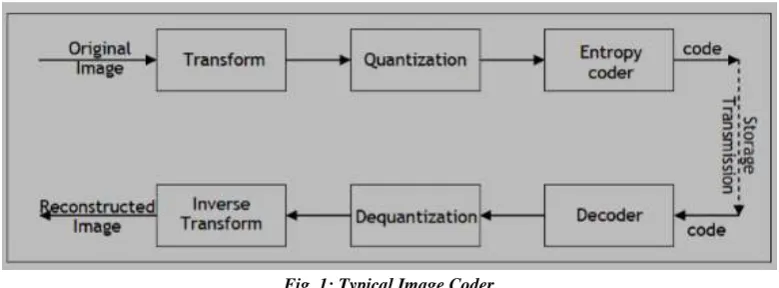
A typical lossy image compression system shown in figure 1, consist of three closely connected components: (a) Source Encoder/Linear Transforms/input (b) Quantize (c) Entropy Encoder [2]. These three basic steps are:
Fig. 1: Typical Image Coder
Transformation:- The discrete wavelet transform cuts the image into blocks of 64 pixels (8 × 8) and processes each block independently, shifting and simplifying the colors so that there is less information to encode.
Encoding:- The reduced coefficients are then encoded. Entropy encoding that finds the optimal system of encoding based on the relative frequency of each character. It also compresses the quantized values loss lessly to give better overall compression. Commonly used entropy encoders are the Arithmetic encoder and the Huffman encoder, for applications require fast process, simple run-length coding has very effective. Quantize and encoding are necessary well designed to get best possible compression [10].
Quantization:- The values in each block are then divided by a quantization coefficient. This is the compression step where information loss occurs. Pixels are changed only in relation to the other pixels within their block. So a Quantizer reduces the no. of bits needed to store the transformed coefficients by reduce the precision of those values. This is a many-to-one mapping. So it’s a lossy procedure and in an encoder, it is the main source of compression. On the basis of each individual coefficient, and group of coefficients, quantization is known as Scalar Quantization (SQ) and Vector Quantization (VQ) respectively. Both, uniform and non-uniform type quantizer is used depending on problem at hand.
SIMULATION BLOCK
Int. J. of Engg. Sci & Mgmt. (IJESM), Vol. 7, Issue 2: April-June 2017
71
Fig. 2: Block diagram of proposed methodology
SIMULATION RESULT
The simulation result presented in the thesis focuses mainly on Compression ratio, PSNR and MSE which typically affects the picture quality. Most of the times as researchers go on increasing the compression ratio the quality of the resulting image use to go down. for the proposed technique, test image “Cameraman.tif” size (256 and 512). The Results are shown in a quality measures such as PSNR and MSE for decompressed “Cameraman.tif” image are calculated and compared. Figure 4 and 5 show the BER and SER performance of proposed scheme, in the figure 3, shows the A. Original image, B. Compressed image and C. De-compressed image
Fig. 3: A. Original image, B. Compressed image and C. De-compressed image
A. Simulation analysis of AWGN with QPSK Modulation
Fig. 4: AWGN of QPSK in Haar with median filter
B. Performance of Db-2 Transform with median filter
origional image
50 100 150 200 250 50
100
150
200
250
Compressed image
20 40 60 80 100120 20
40
60 80
100
120
DeCompressed image
50 100 150 200 250 50
100
150
200
Int. J. of Engg. Sci & Mgmt. (IJESM), Vol. 7, Issue 2: April-June 2017
72
Fig. 5: AWGN of QPSK in Db-2 with median filter
CONCLUSION
Image compression techniques are the most apprehensive topics in today’s high-tech environment. Image compression has been the key technology for transmitting massive amount of real-time image data via limited bandwidth channels. The data are in the form of graphics, audio, video and image. These types of data have to be compressed during the transmission process.
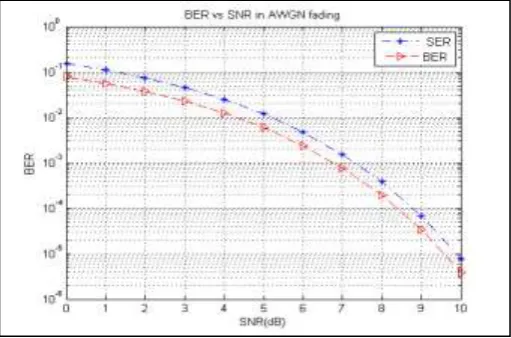
The performance output plotted between BER verses SNR for QPSK modulation techniques with Channel AWGN using Median filter. From the simulation results, we find that that if we increase SNR value, BER performance is improved. Simulation result shows BER v/s SNR in figure 4, for AWGN of QPSK in Haar with median filter at SNR up to 10dB. So, Best BER & SER is at point of 4.873 ∗ 10−6 𝑎𝑛𝑑 9.735 ∗ 10−6and
respectively at SNR of 10 dB. Simulation result shows BER v/s SNR in figure 5, for AWGN of QPSK in Db2 with median filter at SNR up-to 10 dB. So, Best BER is 3.8721 ∗ 10−6 𝑎𝑛𝑑 7.7445 ∗ 10−6 respectively at
SNR of 10 dB.
REFERENCES
I. Manjit Sandhu, Jaipreet Kaur and Sukhdeep Kaur “Matlab Based Image Compression Using Various
Algorithms” International Journal of Advanced Research in Computer Science and Software
Engineering, Vol. 6, Issue 4, April 2016.
II. Rimas A. Zrae, Mohamed Hassan, and Mohamed El-Tarhuni “An Adaptive Modulation Scheme for Image Transmission over Wireless Channels”, 978-1-4244-9991-5/11/ 2011 IEEE.
III. Poonam Dhumal and S. S. Deshmukh “Survey on Comparative Analysis of Various Image
Compression Algorithms with Singular Value Decomposition” International Journal of Computer
Applications, Vol. 133, issue 6, January 2016.
IV. Ms. Vaibhavi P. Lineswala, Ms. Jigisha N. patel, “JPEG Image Compression and Transmission Over Wireless Channel”, 978-0-7695-3915-7/09 © 2009 IEEE DOI 10.1109/ACT.2009.163.
V. Hemalatha Sa, U. Dinesh Acharyaa and Renuka Aa “Wavelet transform based steganography
technique to hide audio signals in image” Science-Direct, Elsevier, Procedia Computer Science vol.
47, 2015.
VI. Ramandeep KaurGrewal, Navneetrandhawa, “Image Compression Using Discrete Cosine Transform
& Discrete Wavelet Transform”, International Journal of Computing & Business Research ISSN (Online): 2229-6166, at GKU, Talwandi Sabo Bathinda (Punjab), Proceedings of ‘I-Society 2012. VII. Jagadish H. Pujar, Lohit M. Kadlaskar, “A New Lossless Method of Image Compression and
Decompression Using Huffman Coding Techniques”, Journal of Theoretical and Applied Information
Technology © 2005 - 2010 JATIT.
VIII. Guojin Liu, Xiaoping Zeng, FengchunTian, KadriChaibou, ZanZheng, “A novel direction-adaptive
Int. J. of Engg. Sci & Mgmt. (IJESM), Vol. 7, Issue 2: April-June 2017
73
IX. K. Khelil , A. Hussainb, R.E. Bekkac, F. Berrezzeka, “Improved multiple description wavelet based
image coding using subband uniform quantization”, Int. J. Electron. Commun. (AEÜ) 65 (2011), Page 967– 974, 1434-8411/2011, Elsevier GmbH.doi:10.1016/j.aeue.2011.03.011.
X. Sandeep Kumar, “Image Compression Based On Improved Spiht and Region Of Interest”, Dept. of Electronics & Communication Engineering Thapar University, Patiala, June 2011.
XI. Vincent Lecuire, Cristian Duran-Faundez, and Nicolas Krommenacker; “Energy-Efficient
Transmission of Wavelet- Based Images in Wireless Sensor Networks”, Hindawi Publishing
Corporation EURASIP Journal on Image and Video Processing Volume 2007, Article ID 47345, 11 pages doi:10.1155/2007/47345.
XII. Ms. Sonam Malik and Mr. VikramVerma, “Comparative analysis of DCT, Haar and Daubechies
Wavelet for Image Compression”, International Journal of Applied Engineering Research, ISSN
0973-4562 Vol.7 No.11 (2012) © Research India Publications.
XIII. Bhabesh Deka and Sangita Choudhury, “A Multiscale Detection based Adaptive Median Filter for
the Removal of Salt and Pepper Noise from Highly Corrupted Images”, International Journal of Signal Processing, Image Processing and Pattern Recognition Vol. 6, No. 2, April, 2013.
XIV. Vinod Kumar, Dr. Priyanka, and Kaushal Kishore, “A Hybrid Filter for Image Enhancement”, International Journal of Image Processing and Vision Sciences (IJIPVS) Volume‐1 Issue‐1 ,2012. XV. Iram Sami, Abhishek Thakur, Rajesh Kumar, “Image Denoising for Gaussian Noise Reduction in
Bionics Using DWT Technique”, Dept. of ECE, Indo Global College of Engineering, Abhipur, Mohali,