Visually Lossless Accuracy of Motion Vector in
Overcomplete Wavelet-based Scalable Video
Coding
Chuan-Ming Song
1, Xiang-Hai Wang
2,3∗, Fuyan Zhang
1,31
Department of Computer Science and Technology, Nanjing University, Nanjing, China
2College of Computer and Information Technology, Liaoning Normal University, Dalian, China
3
National Key Laboratory for Novel Software Technology, Nanjing University, Nanjing, China
Email:
{chmsong, xhwang}@graphics.nju.edu.cn, [email protected]
Abstract— In this paper, we propose a visually lossless accuracy model for scalable coding of motion vectors in overcomplete wavelet-based scalable video codec. By exploiting theory of stationary random process, we first estimate motion compensation errors in spatial domain due to inaccurate motion vectors. We then extend the results to overcomplete wavelet domain, and further derive the errors caused by fraction-pixel motion vectors. Finally, combining with a visibility model of wavelet coefficient errors, we propose a novel algorithm to estimate the accuracy threshold of motion vectors with which motion compensation errors will be invisible.
Experimental results show that our algorithm is effective in estimating visually lossless accuracy threshold of motion vectors. The proposed algorithm can also be used in scalable motion estimation in wavelet domain. It can accelerate motion estimation speed by stopping halfway at the accuracy that will not cause any visible errors.
Index Terms— scalable video coding, scalable motion vec-tor, motion vector accuracy, human visual system, wavelet
I. INTRODUCTION
Wavelet-based scalable video coding (WSVC) is an emerging technology that provides video with high adapt-ability. Many wavelet-based scalable video codecs have been proposed so far [1]–[6]. Nevertheless, when com-pared with state-of-the-art JSVM [7], the performance of WSVC remains inferior. Thus, further studies are needed to improve its efficiency. In most existing WSVC coders, motion vectors are coded losslessly without bitrate or
This paper is based on “Research on Motion Vector Accuracy in Overcomplete Wavelet-Domain Scalable Video Coding Based on Human Visual System Characteristics” by C.M. Song, X.H. Wang, and F.Y. Zhang, which appeared in the Proceedings of the 9th IEEE Conference on Young Computer Scientists (ICYCS), Zhangjiajie, China, Nov. 2008.
c
°2008 IEEE.
This work was supported by the National Natural Science Foundation of China under Grant Nos. 60372071, 60703084, 60723003, and the Natural Science Foundation of Liaoning Province of China under Grant No.20072156, and the Natural Science Foundation of Jiangsu Province of China under Grant No.BK2007571, and Project Innovation of Gradu-ate Students of Jiangsu Province of China under Grant No.CX07B-121z, and Program for Liaoning Excellent Talents in University under Grant No.RC-04-11.
*Corresponding author.
resolution scalability [8], [9]. This nonscalable manner does not favor the performance at both high bitrates and low bitrates. At low bitrates, motion vectors may occupy an undue portion of available bandwidth. As a result, texture information can not be coded effectively. Moreover, decoded video is always in a reduced quality or resolution. In this case, the degree of tolerance is increased of human visual systems (HVS) to decoded errors. Motion vectors with high accuracy are of little benefit to improve video quality. At high bitrates, motion vectors only consume a minor share of total bandwidth. Texture are decoded with high quality or resolution, in which case HVS becomes more sensitive to poor motion-compensated quality. Motion vectors with high accuracy are needed. Thus, a scalable representation of motion vectors is desirable to balance motion vectors and texture bandwidth over a wide range of bitrates.
Recently, several methods [10]–[20] are proposed for achieving motion vector scalability. These methods can be classified into three categories.
The first category provides multiresolution represen-tation for motion vectors, and exploits the correlation between motion vectors at neighboring scales. Ohm [10] used 3-D Laplacian pyramid to code motion vector field, reducing both spatial and temporal redundancies. Hu [11] and Tsai [12] et al.employed quad-tree to partition mo-tion vectors into one based layer and a few enhancement layers in spatial/temporal domain. These vectors are then transmitted from coarse to fine scale. Xiong et al. [13] proposed a framework with multi-layer structure of mo-tion vectors. Under this framework they also put forward a decision model to determine appropriate number of layers to be coded into bitstream at a given rate. Secker et al. [14] used a linear model to quantify the impact of motion errors on video distortion and designed a scalable coding method using rate-distortion optimized layering technique. Wu et al. [15] combined layered structure, alphabet general partition method, and context adaptive binary arithmetic coding to achieve accuracy or quality scalability of motion vectors.
be-tween neighboring motion vectors. Barbarien et al.[16]– [18] introduced an architecture of quality scalable motion vector coding based on median prediction. Motion vectors are first quantized to form nonscalable base layer. The quantization errors are then coded as enhancement layers using fractional bitplane technique.
The third category estimates motion vectors with differ-ent accuracy at differdiffer-ent spatial resolution. Boisson [19] and Mrak [20] et al. proposed accuracy scalable motion vector coding methods that partitioned bitstream into layers with different accuracy. Motion vectors at lower spatial resolution are decoded with less accuracy, and vice versa.
These methods above effectively enhances performance of spatial, temporal, and rate scalable video coding at low bitrates. Nevertheless, some methods are based on implicit models whose parameters are derived from experiments or empirical results, for example [19]. Such parameters can hardly guarantee that the methods achieve optimal performance. As for other methods,such as [13] and [14], although they set up explicit models in terms of rate-distortion optimization, HVS characteristics are not taken into consideration. If the accuracy of motion vectors are too low on base layer, they can not offer video content a legible representation. As a result, this decoded video will present visible distortions even though the coding method is optimal in terms of objective quality. Thus, scalable coding of motion vectors should be designed on the premise of satisfying HVS requirements.
The major contribution of this paper is a visually loss-less accuracy model of motion vectors for overcomplete wavelet-based scalable video codecs. Exploiting theory of stationary random process, we first estimate motion compensation errors in spatial domain due to inaccurate motion vectors. Then we extend the results to overcom-plete wavelet domain. Combining with a visual model of wavelet coefficient errors, we propose a novel algorithm for predicting the accuracy threshold of motion vectors with which motion compensation errors will be invisible. This algorithm enjoys the following advantages not shared by conventional methods.
First, the relationship is modeled between motion vec-tor accuracy and motion-compensated disvec-tortions in terms of HVS. To the best of our knowledge, few methods have been reported in the literature.
Second, as a generic method, the proposed algorithm can be combined with state-of-the-art scalable coding methods of motion vector. Given resolution and features of video content, our algorithm estimates visually lossless accuracy threshold of motion vectors. As long as the accu-racy of base layer is higher than the computed threshold, any current method can then be employed to code motion vectors in the sense of rate-distortion optimization.
Third, our analytical method and results can be ex-tended to other transform domain, such as complete wavelet and contourlet transform, etc., provided that the filter coefficients are given.
The remainder of this paper is organized as follows.
Section II models the motion compensation errors due to inaccurate motion vectors. Section III presents esti-mation method of motion compensation errors in spatial and overcomplete wavelet domain. Section IV describes the proposed visually lossless model of motion vector accuracy and algorithm for computing visually lossless accuracy threshold. Section V reports our experimental results. Finally, Section VI concludes the whole paper.
II. MOTIONCOMPENSATIONERRORS BY
INACCURATEMOTIONVECTORS
Currently, block-based motion estimation model is widely used in video coding standards, which assumes that a macroblock in current frame is translation of a macroblock in reference frame. Let ˆb∗
n+1(x, y) denote
ideal prediction of current macroblock Bc, and V∗ = (vx, vy) ∈ R2 be ideal motion vector that minimizes
prediction error in terms of mean squared error (MSE). Then the block-based motion estimation can be modeled as
ˆ
b∗
n+1(x, y) = bn(x+v∗x, y+vy∗)
= bn+1(x, y) +N(x, y) (1)
where(x, y)∈ {0,1, . . . , B−1}×{0,1, . . . , B−1},Bis the size of macroblock, and(n+1)is current frame index.
N(x, y)denotes interframe noise caused by light changes, camera noise, coding distortions, non-translational mo-tion, occlusions, etc. Without these noises, current roblock will be identical with its ideal reference mac-roblock [21]. However, since accuracy and computational complexity have to be balanced, the coded motion vector in practice is a quantized one rather than an ideal one. Supposing that
V−V∗= (m, n)
whereVdenotes coded motion vector, the actual predic-tion of current macroblock is
ˆbn+1(x, y) = ˆb∗
n+1(x+m, y+n) +N(x, y). (2)
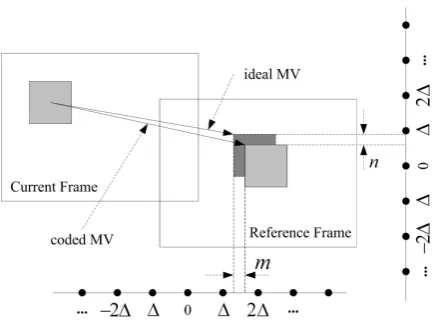
From (2), we can see that prediction of current roblock is the one resulted from ideal reference mac-roblock shifted by (m, n). This process is illustrated by Fig. 1, where the macroblock colored in light grey denotes coded reference macroblock, while the one in dark grey denotes the ideal reference. ∆ is accuracy of motion vectors.
Based on the above assumption, it is reasonable to be-lieve that motion compensation errors are caused mostly by inaccurate motion vectors. In this case, the prediction error of each pixel in terms of MSE can be calculated by
e2 = E{|c(x, y)−c(x+m, y+n)|2}
= E{|c(x, y)|2}+E{|c(x+m, y+n)|2}
Figure 1. Illustration of the error between coded motion vector and ideal motion vector of a macroblock due to limited accuracy.
assume that pixel intensity in a frame obeys an identical random field. Hence, we approximate (3) by
e2= 2(µ2+σ2)−2r(m, n), (4)
where µ and σ2 separately denote the expectation and
variance of pixel intensity, andr(m, n)is autocorrelation function of the stationary random process. Definition of
r(m, n)is as follows.
r(m, n) =E{c(x, y)c(x+m, y+n)} (5) Our task now is to computeµ,σ2, andr(m, n). Then
the mean squared motion compensation error (4) will immediately be obtained.
III. ESTIMATION OFMOTIONCOMPENSATION
ERRORS
By exploiting theory of stationary random process, we develop an approximation method in this section to computeµ,σ2, andr(m, n), as well as (4) in spatial and
overcomplete wavelet domain.
A. Estimation of Errors in Spatial Domain
For 2-D discrete image and video, Jain [22] provided a method as below used for computing approximately the expectation and variance of pixel intensity.
µ' 1
M N
M
X
x=1
N
X
y=1
c(x, y), (6)
σ2' 1
M N
M
X
x=1
N
X
y=1
[c(x, y)−µ]2, (7) whereM andN are height and width of frame, respec-tively.
Moreover, for a 2-D real random process, its covariance is defined as
Cov(m, n) =E{[s(x, y)−µ][s(x+m, y+n)−µ0]}(8)
where s(x, y) denotes sample value of (x, y). µ and µ0
are expectation of sample values at position (x, y) and (x+m, y +n), respectively. Here we assume that the
random process satisfies an identical distribution, then we have
r(m, n) =Cov(m, n) +µ2 (9)
Thus we can compute r(m, n) by Cov(m, n) which is approximated by (10) for digital image and video [22].
Cov(m, n)' 1
M N
M
X
x=1
N
X
y=1
[c(x, y)−µ][c(x+m, y+n)−µ](10)
Using (4)-(10) we can compute the motion compensa-tion errors in pixel domain.
B. Estimation of Errors in Overcomplete Wavelet Domain
Many state-of-the-art wavelet-based scalable video coders carry out motion estimation in wavelet domain. To estimate motion compensation errors for these coders, the method introduced in Section III-B needs to be extended from spatial domain to wavelet domain. One possible method to compute (4) in wavelet domain may be to direct calculate the corresponding µ, σ2, and r(m, n) of
wavelet coefficients. But we have to execute it several times, once for each subband. This is inefficient and expensive. In this section, we model the relationship between motion compensation errors in spatial domain and those in overcomplete wavelet domain. By this model, the motion compensation errors in wavelet domain can be easily computed in terms ofµ,σ2, andr(m, n)in spatial
domain. Thus, significant savings of computation can be achieved.
The one-level overcomplete wavelet transform of 2-D images consists of two consecutive steps: filtering horizontally and vertically using a low-pass filter h0
and a high-pass filter h1 separately. This process forms
four subbands, namely LL1,LH1,HL1 andHH1, each
with the same size as original image. To obtain e2 in
these subbands, we need to compute expectation µsub1 (sub1 ∈ {LL1, LH1, HL1, HH1}), variance (σsub1)
2,
and autocorrelationrsub1(m, n). Suppose thatcsub1(x, y) is the coefficient of c(x, y) in sub1 which results from
filtering by hh horizontally and then by hv vertically.
Then we have
µsub1 = E{csub1(x, y)}
= E
½·XK
k=1
hv(k) S
X
s=1
hh(s)c(x−s, y−k)
¸¾
= µ
K
X
k=1
S
X
s=1
hv(k)hh(s), (11)
whereK andS are separately the length of filterhv and
hh. Note that, downsampling operation is not performed
Like-wise, we also have
(σsub1)
2=E{[c
sub1(x, y)−µsub1]
2} = K X k=1 S X s=1 J X j=1 T X t=1
hv(k)hh(s)hv(j)hh(t)r(s−t, k−j)
−µ2
K X k=1 S X s=1 J X j=1 T X t=1
hv(k)hh(s)hv(j)hh(t) (12)
and
rsub1(m, n) =E{csub1(x, y)csub1(x+m, y+n)} = K X k=1 S X s=1 J X j=1 T X t=1
hv(k)hh(s)hv(j)hh(t)
r(m+s−t, n+k−j),(13) where J andT separately denote the length of filterhv
andhh.
From (11)-(13) we know that the expectation, vari-ance and autocorrelation of wavelet coefficients can be expressed by convolution of filter bank coefficients with expectation and autocorrelation of pixel intensity.
When wavelet decomposition is further performed on
LL1, the above process can be executed oncLL1(x, y)to computeµsub2,(σsub2)
2, andr
sub2(m, n)by substituting
cLL1(x, y)into (11)-(13) and replacingc(x, y). Repeating this process iteratively on LLk(k ≥ 1) at each scale,
we then obtain µsubk, (σsubk)2, and rsubk(m, n) for
any k-level decomposition. Note that, spatial domain corresponds to the scale space that is one time finer than the scale of sub1. Set
µsub0 =µ and rsub0(m, n) =r(m, n). Then the computation ofµsubk,(σsubk)2, andrsubk(m, n)
can be formulated as
µsubk =µsubk−1
K X k=1 S X s=1
hv(k)hh(s), (14) (σsubk)
2= K X k=1 S X s=1 J X j=1 T X t=1
hv(k)hh(s)hv(j)hh(t)rsubk−1(s−t, k−j)
−(µsubk−1)
2 K X k=1 S X s=1 J X j=1 T X t=1
hv(k)hh(s)hv(j)hh(t),(15)
and
rsubk(m, n) = K X k=1 S X s=1 J X j=1 T X t=1
hv(k)hh(s)hv(j)hh(t)
rsubk−1(m+s−t, n+k−j). (16)
C. Estimation of Errors by Motion Vectors with Fraction-Pixel Accuracy
Using (4) and (14)-(16), the prediction errors by motion vectors with integer-pixel accuracy are estimated in any subband of overcomplete wavelet. However, for the video
of high amount of motion and high detailed texture, mo-tion estimamo-tion with fracmo-tion-pixel accuracy always signif-icantly improves coding efficiency and decoded quality. Motion compensation errors by fraction-pixel vectors are thus required to be predicted.
Suppose that pixel (coefficient) csubk(x+ 1/2, y + 1/2)(k ≥ 0) is interpolated by csubk(x, y), csubk(x+ 1, y), csubk(x, y+ 1) and csubk(x+ 1, y+ 1) through
bilinear interpolation. Because we assume that all pixels (coefficients) in one frame obey identical distribution, the expectation and variance of csubk(x+ 1/2, y+ 1/2) are
respectivelyµsubkand(σsubk)2. So, onlyrsubk(1/2,1/2)
is needed to compute e2. Then we have
rsubk(1/2,1/2) =E{csubk(x, y)csubk(x+ 1/2, y+ 1/2)} =E{csubk(x, y)[csubk(x, y) +csubk(x+ 1, y)
+csubk(x, y+ 1) +csubk(x+ 1, y+ 1)]/4} = (µ2
subk+σsubk2 )/4 +rsubk(1,0)/4
+rsubk(0,1)/4 +rsubk(1,1)/4. (17)
Using the same method, we also obtain results as follows.
rsubk(1/2,0) = (µ2subk+σsubk2 )/2 +rsubk(1,0)/2, (18)
rsubk(0,1/2) = (µ
2
subk+σsubk2 )/2 +rsubk(0,1)/2,(19)
and
rsubk(1/4,1/4) = (µ2subk+σ2subk)/4 +rsubk(1/2,0)/4 +rsubk(0,1/2)/4 +rsubk(1/2,1/2)/4. (20)
From the above results, we further generalize a formula as below which can be used to estimate autocorrelation corresponding to shift of any negative power of two.
rsubk(2−n,0) = n
X
j=1
2−j(µ2subk+σsubk2 )+ 2−nrsubk(1,0),
(21)
rsubk(0,2
−n) = n
X
j=1
2−j(µ2
subk+σ2subk)+ 2−nrsubk(0,1),
(22)
rsubk(2−n,2−n) = n X i=1 n X j=1
2−(i+j)(µ2subk+σ2subk)+ n
X
i=1
2−(i+n)rsubk(1,0)
+ n
X
j=1
2−(j+n)r
subk(0,1) + 2−2nrsubk(1,1).(23)
Substituting (23),µsubk andσ2subk into (4), the motion
compensation errors by motion vectors with fraction-pixel accuracy can be estimated in spatial and overcomplete wavelet domain.
Furthermore, from (21)-(23) we can deduce a mean-ingful conclusion. Let ∆n,0 = rsubk(2
−n,0) −
rsubk(2−(n−1),0). Then from (21) we have ∆n−1,0 −
∆n,0 = 2−n(µ2subk + σsubk2 − rsubk(1,0)). Because
µ2
subk +σ2subk = rsubk(0,0) > rsubk(1,0), ∆n−1,0 −
∆n,0 > 0 and ∆1,0 > ∆2,0 > ... > ∆n,0. For the
∆0,1 > ∆0,2 > ... > ∆0,n and ∆1,1 > ∆2,2 > ... >
∆n,n. These results indicate that with increase of motion
vector accuracy, autocorrelation increases and motion compensation error decreases. Moreover, as the vector accuracy doubles, the increased amplitude ∆i,0(i ≥ 1)
(or ∆0,i, ∆i,i) becomes smaller and smaller. It tells us
that motion vectors with high accuracy are not the better. With increase of vector accuracy, coding gain gradually declines even to zero. When the accuracy improves from integer pixel to half pixel, the coding gain is most prominent. The conclusion provides a theoretical proof for the experimental results reported in [21].
IV. VISUALLYLOSSLESSACCURACYMODEL OF
MOTIONVECTOR
The objective of video coding is to approach the ideal rate-distortion curve as much as possible. However, the visual quality should be taken into account as well. Viewers expect scalable video codec to provide a good enough perceptual quality. Hence, we should optimize rate-distortion performance on the premise of satisfying visual quality. In this section, we first propose a visual threshold model of motion vector accuracy according to content characteristics and spatial resolution of video. Then based on this model, we propose a novel algorithm to compute accuracy threshold with which motion vectors will not cause visible motion compensation errors.
A. Wavelet-Based Visually Lossless Threshold Model
Using the model in Section III, we compute motion compensation errors due to inaccurate motion vectors. If the errors exceed a threshold, they will be observed by HVS, reducing subjective quality of decoded video. In this paper, we adopt a visual threshold model proposed by Watson et al. [24]. It is used for measuring visual detection threshold of wavelet coefficient error when the coefficient is against complex backgrounds. Its definition is as follows.
Tλ,θ=
q
D2
λ,θ+σ2λ,θ, (24)
in which λ denotes decomposition level, and θ is ori-entation index of subband (θ ∈ {1,2,3,4}, respectively represent LL, HL, HH, LH). Dλ,θ is visual threshold
for the subband of level λ and orientation θ, expressed in units of the wavelet coefficient. Table I lists the values of Dλ,θ for four-level Daubechies 9/7 wavelet when the
display visual resolution is 32 pixel/degree.σ2
λ,θ denotes
variance of corresponding subband.
TABLE I.
VISUALTHRESHOLD FORFOUR-LEVELDAUBECHIES9/7 WAVELET WHENDISPLAYVISUALRESOLUTION IS32 PIXEL/DEGREE
Level
Orientation 1 2 3 4
1 7.03 5.56 5.68 6.25 2 11.52 7.34 6.36 7.08 3 29.38 14.21 9.77 8.93 4 11.52 7.35 6.36 7.08
As long as motion compensation errore2are lower than
visual thresholdTλ,θ, namely
e2≤T2
λ,θ, (25)
the motion compensated frames will be visually lossless. Thus, our task now is to determine the lowest accuracy of motion vector by which motion compensation errors will not be larger than the computed threshold.
B. Threshold Prediction Algorithm of Visually Lossless Motion Vector Accuracy
Based on the visual threshold model proposed in Sec-tion IV-A, we propose a novel algorithm for estimating visually lossless threshold of motion vector accuracy in overcomplete wavelet-based motion estimation.
The motion estimation method adopted in this paper is a multiscale motion estimation [25]. It first constructs an overcomplete representation of reference frame using low-band-shift method. Only the low frequency subbands of reference frames are saved at each scale. Then this method estimates motion vectors of the lowest frequency subband in a band-to-band manner. Afterwards, motion vectors of the low frequency subband at the next finer scale are computed. The prediction of this low frequency subband is decomposed by one-level wavelet to calculate predic-tion of the high frequency subbands at the coarsest scale. Repeating the above procedure in each low frequency subband from the coarsest scale to the finest one, we will obtain a multiscale prediction of current frame. Since the motion estimation is performed only in low frequency subband at each scale, we substitute hh =hv =h0 into
(14)-(16) and yield
µLLk=µLLk−1
K
X
k=1
S
X
s=1
h0(k)h0(s) (26)
(σLLk)2= K
X
k=1
S
X
s=1
J
X
j=1
T
X
t=1
h0(k)h0(s)h0(j)h0(t)rLLk−1(s−t, k−j)
−(µLLk−1)
K
X
k=1
S
X
s=1
J
X
j=1
T
X
t=1
h0(k)h0(s)h0(j)h0(t)(27)
rLLk(m, n) = K
X
k=1
S
X
s=1
J
X
j=1
T
X
t=1
h0(k)h0(s)h0(j)h0(t)
rLLk−1(m+s−t, n+k−j) (28) Suppose that components of motion vectors along hori-zontal direction and vertical direction are with the same accuracy. Then the proposed algorithm for predicting accuracy threshold of motion vectors on the Nth-level of overcomplete wavelet decomposition can be detailed as follows:
2) Compute µ, σ2, andr of B using (6)-(10)
corre-sponding to different shift in spatial domain. Let
µLL0 =µ,(σLL0)
2=σ2, andr
LL0 =r. 3) Set∆ = 1.
4) Iteratively computeµLLk,(σLLk)2,rLLk(∆,∆)for 1≤k≤N ande2ofBby (4), (26)-(28). Substitute
(σLLN)2ande2 into (24)-(25). If (25) satisfies, go
to Step 5. Otherwise, go to Step 6.
5) Let∆ = 2∆, then computerLLN(∆,∆)ande2. If
(25) still satisfies, then repeat Step 5 until (25) does not satisfy. Then let∆ = ∆/2, and go to Step 7. 6) Let ∆ = ∆/2, then compute rLLN(∆,∆) ande2
by (4), (23). If (25) does not satisfy, then repeat Step 6 until (25) satisfies. Go to Step 7;
7) Output∆. The proposed algorithm is over. Since the maximal error is∆/2when a motion vector is quantized by ∆, motion estimation should be imple-mented with an accuracy not lower than 2∆ in order to ensure visual quality of decoded video.
Note that in the above algorithm, we select a sub-image instead of the whole reference frame for computing visually lossless accuracy threshold. The dimension of the sub-image is smaller than, even equal as well to, that of reference frame. Larger P and Q will produce more accurate threshold, but require higher computational com-plexity. According to the assumption that pixel intensity in a frame obeys an identical random field, this approach is a reasonable choice to balance computational complexity and prediction accuracy of threshold.
V. EXPERIMENTALRESULTS ANDDISCUSSION
To verify the effectiveness of the proposed model, we conduct experiments on standard MPEG-4 test se-quences including “Foreman”, “Football”, “Stefan”, and “Coastguard”. The wavelet used in our experiments was Daubechies 9/7. Parameters in our algorithm are set as follows:P =Q= 64,N = 2.
A. Experimental Results
We first compare visual quality of frames motion-compensated by motion vectors with different accuracy in different spatial resolution. Since we find in our ex-periments that the computed thresholds are all equal or greater than 2, the motion-compensated frames by pro-posed accuracy are compared only with those by integer accuracy. Fig. 2 and Fig. 3 show comparison results of the 2nd frame of four test sequences in 1/16 CIF resolution
and in QCIF resolution, respectively. Meanwhile, the peak signal-to-noise ratio (PSNR) of the above motion-compensated frames is listed in Table II. Although PSNR of the frames motion-compensated by integer vectors is obviously higher than that by vectors with proposed accuracy, these frames present nearly the same subjective quality. Viewing from appropriate distance (23 inches), we can not immediately distinguish the differences be-tween every two corresponding frames in Fig. 2 and Fig. 3 except for “Foreman” sequence.
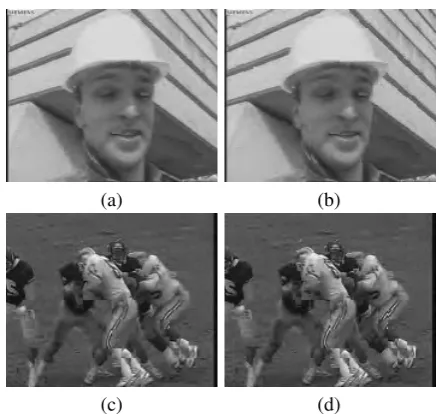
Since decoded video at low resolution is usually played on devices with low or limited bandwidth, we com-press reference frame by Kakadu software [26] at 0.2 bits/pixel to simulate the quality reconstructed at low bitrate. Then we use decompressed frame for motion estimation and compensation. Fig. 4 shows the motion-compensated2ndframes of “Foreman” and “Football” by
proposed accuracy and integer accuracy. Table II also lists the PSNR of these motion-compensated frames. Under such a display condition, from Fig. 4 we can not easily notice the differences between every two corresponding frames, either.
(a) (b)
(c) (d)
(e) (f)
(g) (h)
Figure 2. Visual quality comparison of motion-compensated2ndframes
of “Coastguard”, “Football”, “Foreman” and “Stefan” by motion vectors with integer accuracy (a), (c), (e), (g) and proposed accuracy (b), (d), (f), (h) in 1/16 CIF.
TABLE II.
PSNR COMPARISON OFMOTION-COMPENSATED2ndFRAMES OF
DIFFERENTSEQUENCES BYMOTIONVECTORS WITHDIFFERENT ACCURACY
Resolution Sequence Integer Proposed accuracy accuracy Football 25.14 23.56
1/16 CIF Stefan 27.38 25.85
Coastguard 29.50 25.23 Foreman 31.35 29.64 Football 25.25 23.63
QCIF Stefan 25.71 22.91
Coastguard 29.65 26.05 Foreman 34.15 31.88 QCIF Foreman (0.2bpp) 32.18 30.35 Football (0.2bpp) 25.22 23.12
B. Discussion
(a) (b)
(c) (d)
(e) (f)
(g) (h)
Figure 3. Visual quality comparison of motion-compensated2ndframes
of “Coastguard”, “Football”, “Foreman” and “Stefan” by motion vectors with integer accuracy (a), (c), (e), (g) and proposed accuracy (b), (d), (f), (h) in QCIF.
of motion vector is not only essential to objective quality improvement of reconstructed frames at low bit rates or resolution, but also straightforward and necessary in the aspect of subjective quality.
Note that the proposed model can be used to estimate accuracy threshold of motion vectors at one scale each time, provided that the vectors at other scales are not quantized. Therefore, if all motion vectors at every scale are quantized by corresponding thresholds at the same time, this model can not estimate exactly motion compen-sation errors so as to inevitably produce visible mismatch. In addition, the proposed model does not take temporal masking, frequency masking, and structural correlation into account. This is why Fig. 3(f) presents slightly discontinuous edges. Thus, a more accurate visual model with moderate overhead will be introduced into our model in further study.
(a) (b)
(c) (d)
Figure 4. Visual quality comparison of motion-compensated2ndframes
of “Foreman” and “Football” at 0.2bpp by motion vectors with integer accuracy (a), (c) and proposed accuracy (b), (d) in QCIF.
VI. CONCLUSION
Based on the theory of stationary random process and human visual system model in wavelet domain, this paper constructs a mathematical model for visually lossless accuracy threshold of motion vectors. This model can estimate motion compensation errors due to inaccurate motion vectors with integer and fractional pixel accuracy in spatial domain, as well as in overcomplete wavelet domain. Experimental results support the effectiveness of our model. It can be used for overcomplete wavelet-based scalable motion estimation and scalable coding of motion vectors, enhancing performance of scalable video coders. Moreover, this model can also be extended to estimation of motion compensation errors in other transform domain, provided that the filter coefficients are given.
To the best of our knowledge, few algorithms have been reported on the relationship between motion vector accuracy and visual quality of decoded video in the liter-ature. We believe that our study will be useful in further researches of wavelet-based scalable video coding.
REFERENCES
[1] Y. Chen and W. A. Pearlman, “Three-Dimensional Sub-band Coding of Video Using the Zero-Tree Method,” in
Proceedings of SPIE Symposiums on Visual Communica-tions and Image Processing, 1996, pp. 1302–1312. [2] B. J. Kim, Z. Xiong, and W. A. Pearlman, “Low
Bit-Rate Scalable Video Coding with 3D Set Partitioning in Hierarchical Trees (3D SPIHT),” IEEE Trans. Circuits Syst. Video Technol., vol. 10, no. 8, pp. 1374–1387, Aug. 2000.
[3] J. Xu, S. Li, and Y. Q. Zhang, “A Wavelet Coder Using 3-D ESCOT,” inProc. IEEE-PCM, 2000.
[6] Y. Andreopoulos, M. V. der Schaar, A. Munteanu, J. Bar-barien, P. Schelkens, and J. Cornelis, “Fully-Scalable Wavelet Video Coding Using In-Band Motion Compen-sated Temporal Filtering,” in Proceedings of IEEE Inter-national Conf. Acoustics, Speech and Signal Processing, 2003, pp. 417–420.
[7] “Joint Scalable Video Model,” JVT of ISO/IEC MPEG & ITU-T VCEG, Tech. Rep. Doc. JVT-X202, 2007. [8] M. Wien, H. Schwarz, and T. Oelbaum, “Performance
Analysis of SVC,”IEEE Trans. Circuits Syst. Video Tech-nol., vol. 17, no. 9, pp. 1194–1203, Sept. 2007.
[9] N. Adami, A. Signoroni, and R. Leonardi, “State-of-the-Art and Trends in Scalable Video Compression with Wavelet-Based Approaches,” IEEE Trans. Circuits Syst. Video Technol., vol. 17, no. 9, pp. 1238–1255, Sept. 2007. [10] J. R. Ohm, “Motion-Compensated 3-D Subband Coding with Multiresolution Representation of Motion Parame-ters,” in Proceedings of IEEE International Conf. Image Processing, 1994, pp. 250–254.
[11] Z. Hu, M. van der Schaar, and B. Pesquet-Popescu, “Scal-able Motion Vector Coding for MC-EZBC,” in Proceed-ings of EUSIPCO, 2004, pp. 657–660.
[12] S. S. Tsai and H. M. Hang, “Motion Information Scala-bility for MC-EZBC,”Signal Process.: Image Commun., vol. 19, no. 7, pp. 675–684, Aug. 2005.
[13] R. Xiong, J. Xu, and F. Wu, “Responses of CE1a in SVC: Scalable Motion,” ISO/IEC JTC1/SC29/WG11, Tech. Rep. Doc. M11128, 2004.
[14] A. Secker and D. Taubman, “Highly Scalable Video Compression with Scalable Motion Coding,”IEEE Trans. Image Process., vol. 13, no. 8, pp. 1029–1041, Aug. 2004. [15] Y. Wu and J. W. Woods, “Scalable Motion Vector Coding Based on CABAC for MC-EZBC,”IEEE Trans. Circuits Syst. Video Technol., vol. 17, no. 6, pp. 790–795, June 2007.
[16] J. Barbarien, A. Munteanu, F. Verdicchio, Y. Andreopou-los, J. Cornelis, and P. Schelkens, “Scalable Motion Vector Coding,” in Proceedings of IEEE International Conf. Im-age Processing, 2004, pp. 1321–1324.
[17] ——, “Prediction-Based Scalable Motion Vector Coding,” ISO/IEC JTC1/SC29/WG11, Tech. Rep. Doc. M11016, 2004.
[18] ——, “Motion and Texture Rate-Allocation for Prediction-Based Scalable Motion-Vector Coding,” Signal Process.: Image Commun., vol. 20, no. 4, pp. 315–342, Apr. 2005. [19] G. Boisson, E. Francois, and C. Guillemot,
“Accuracy-Scalable Motion Coding for Efficient “Accuracy-Scalable Video Com-pression,” in Proceedings of IEEE International Conf. Image Processing, 2004, pp. 1309–1312.
[20] M. Mrak, G. C. K. Abhayaratne, and E. Izquierdo, “On the Influence of Motion Vector Precision Limiting in Scalable Video Coding,” in Proceedings of International Conf. Signal Processing, 2004, pp. 1143–1146.
[21] J. Ribas-Corbera and D. L. Neuhoff, “Optimizing Motion-Vector Accuracy in Block-Based Video Coding,” IEEE Trans. Circuits Syst. Video Technol., vol. 11, no. 4, pp. 497–510, Apr. 2001.
[22] A. K. Jain, Fundamentals of Digital Image Processing. Englewood Cliffs, NJ: Prentice-Hall, 1989.
[23] J. Liu and P. Moulin, “Information-Theoretic Analysis of Interscale and Intrascale Dependencies Between Im-age Wavelet Coefficients,” IEEE Trans. Image Process., vol. 10, no. 11, pp. 1647–1658, Nov. 2001.
[24] A. B. Watson, G. Y. Yang, J. A. Solomon, and J. Villasenor, “Visibility of Wavelet Quantization Noise,” IEEE Trans. Image Process., vol. 6, no. 8, pp. 1164–1175, Aug. 1997. [25] C. M. Song and X. H. Wang, “A New Scalable Video Mo-tion EstimaMo-tion Scheme in the Wavelet Domain,”Chinese Journal of Computers, vol. 29, no. 12, pp. 2112–2118, Dec. 2006.
[26] “Kakadu jpeg2000 software v4.5,” available at http://www.kakadusoftware.com/Downloads.html.
Chuan-Ming Song is currently a Ph.D. candidate at Nanjing University, Nanjing, P. R. China. He received his ME and BE degrees both in computer applied technology from the Liaoning Normal University, Dalian, P. R. China, in 2003 and 2006, respectively.
His research interests include scalable image and video coding, and digital watermarking of multimedia.
Xiang-Hai Wang was born in Wangqing, P. R. China. He received his PhD degree in computational mathematics from the Jilin University, Jinlin, P. R. China, in 1999, his MS degree in computer applied technology from the Jilin University in 1995, and his BS degree in mathematics from Jilin Normal University, Siping, P. R. China, in 1986.
He is a Professor at College of Computer and Information Technology, Liaoning Normal University, P. R. China. His current research interests include image and video processing, CG/CAGD, security of multimedia information.
Prof. Wang is a senior member of the China Computer Federation (CCF).
Fuyan Zhangwas born in Shaoxing, P. R. China. He received the BS degree in mathematics from Nanjing University, Nanjing, China, in 1962.
He is a Professor at the Department of Computer Science and Technology, Nanjing University. His research interests include multimedia information processing and digital library. On these topics, he has published over 110 papers in international journals and conferences.