R E S E A R C H
Open Access
‘
Around the edges
’
: using behaviour
change techniques to characterise a
multilevel implementation strategy for a
fall prevention programme
S. McHugh
1*, C. Sinnott
2, E. Racine
1, S. Timmons
3, M. Byrne
4and P. M. Kearney
1Abstract
Background:Implementation strategies are needed to ensure that evidence-based healthcare interventions are adopted successfully. However, strategies are generally poorly described and those used in everyday practice are seldom reported formally or fully understood. Characterising the active ingredients of existing strategies is necessary to test and refine implementation. We examined whether an implementation strategy, delivered across multiple settings targeting different stakeholders to support a fall prevention programme, could be characterised using the Behaviour Change Technique (BCT) Taxonomy.
Methods:Data sources included project plans, promotional material, interviews with a purposive sample of stakeholders involved in the strategy’s design and delivery and observations of staff training and information meetings. Data were analysed using TIDieR to describe the strategy and determine the levels at which it operated (organisational, professional, patient). The BCT Taxonomy identified BCTs which were mapped to intervention functions. Data were coded by three researchers and finalised through consensus.
Results:We analysed 22 documents, 6 interviews and 4 observation sessions. Overall, 21 out a possible 93 BCTs were identified across the three levels. At an organisational level, identifiable techniques tended to be broadly defined; the most common BCT wasrestructuring the social environment. While some activities were intended to encourage implementation, they did not have an immediate behavioural target and could not be coded using BCTs.
The largest number and variety of BCTs were used at the professional level to target the multidisciplinary teams delivering the programme and professionals referring to the programme. The main BCTs targeting the
multidisciplinary team wereinstruction on how to perform the (assessment)behaviour anddemonstration of (assessment) behaviour; the main BCT targeting referrers wasadding objects to the environment. At the patient level, few BCTs were used to target attendance.
Conclusion:In this study, several behaviour change techniques were evident at the individual professional level; however, fewer techniques were identifiable at an organisational level. The BCT Taxonomy was useful for describing components of a multilevel implementation strategy that specifically target behaviour change. To fully and
completely describe an implementation strategy, including components that involve organisational or systems level change, other frameworks may be needed.
Keywords:Implementation, Intervention content, Behaviour change, Fall prevention, Qualitative
* Correspondence:[email protected]
1School of Public, University College Cork, Cork, Ireland
Full list of author information is available at the end of the article
Background
In a system as complex as healthcare, change does not happen by itself [1]. Implementation strategies are increas-ingly recognised as essential for realising the full benefits of evidence-based healthcare, and many have been shown to be effective in changing clinical practice [2,3]. An im-plementation strategy refers to how a clinical, public health or health service intervention is implemented [4]. An implementation strategy is typically a broad‘package’ of techniques wrapped around, and often obscured by, the intervention designed to produce health outcomes [5]. Distinguishing between an intervention and its implemen-tation strategy is an important first step in testing the effi-cacy of strategies and selecting appropriate outcomes to assess implementation success [6].
Almost 10 years ago, Michie and colleagues highlighted the poor and inconsistent description of complex behav-iour change interventions [7]; terms were used inter-changeably and the development and content of interventions was rarely driven by an explicit theory of change. The same weaknesses have been highlighted in the design and reporting of implementation strategies: in-consistent use of terminology, lack of conceptual clarity and underutilisation of theory to select strategies [8]. Out-side of research, the process for selecting the content of an implementation strategy in the health system is also likely to be unsystematic and atheoretical. For policy makers, managers and healthcare professionals (HCPs) tasked with introducing a clinical intervention, there is a potentially confusing array of options [2]. Decisions are in-fluenced by the type of intervention being implemented and the context in which it is being introduced [9], and health systems are increasingly constrained by competing demands for attention and limited resources to make change possible [10]. Also, strategies may be selected to address expected barriers based on previous experience, rather than targeting the most salient barriers that have been identified systematically in advance. In an analysis of quality improvement studies, Bosch and colleagues found that the reasons for believing a particular strategy would overcome a particular barrier to change were often not explained [11].
Tools and checklists, such as the Template for Inter-vention Description and Replication (TIDieR), have been developed to guide the development and to standardise reporting of complex interventions [5, 12–15]. The TIDieR framework describes the main features of an intervention and promotes the reporting of any activities to enable or support an intervention [15]. Complemen-tary tools have been developed in behavioural science, which describe intervention and implementation activ-ities in even greater detail using an agreed standardised terminology [14,16]. One of the most commonly applied frameworks for defining activities in behaviour change
interventions is the Behaviour Change Technique (BCT) Taxonomy [16]. The Taxonomy contains 93 discrete be-haviour change techniques (BCTs) considered to be the
‘active ingredients’ of an intervention. A BCT is defined as an ‘observable, replicable and irreducible component of an intervention’ that has the potential to change be-haviour [16]. BCTs serve different and often multiple intervention functions.
The original development of BCT Taxonomy drew on six classification systems of techniques used primarily to change lifestyle behaviour, and the developers highlighted the importance of examining the extent to which the tax-onomy is generalizable across behaviours, disciplines and countries [16]. It has been argued that successful imple-mentation requires individuals at multiple levels to do things differently [17]. Yet, the behaviours that support im-plementation at the organisational level are often overlooked or are poorly described. While individual organ-isational theories focus on different organorgan-isational factors and how they influence the implementation processes [18], the BCT Taxonomy potentially provides a way to systemat-ically and comprehensively describe the behavioural aspects of these processes at multiple levels, using an agreed ter-minology. The extent to which the taxonomy can be used to characterise the activities within a complex implementa-tion strategy, operating at multiple levels of the health sys-tem and targeting a range of stakeholders, is less well understood. Few studies have applied the BCT Taxonomy to retrospectively characterise implementation strategies. Presseau et al. analysed implementation interventions for diabetes prevention within the confines of randomised con-trolled trials [17]; Steinmo et al. characterised an imple-mentation strategy used for a discrete clinical intervention in an acute care setting [19]. In the latter example, health-care professionals were the sole targets and the implemen-tation strategy was delivered in a single setting.
Methods
We conducted a qualitative analysis, using multiple sources of data, to build a comprehensive description of the implementation strategy being used in the fall prevention programme delivered in the Health Ser-vice Executive (HSE) in Cork city and county (Re-public of Ireland). Data were gathered concurrently over a 6-month period (April–September 2016) (see Additional file 2).
Document analysis
Documents describing the fall risk assessment clinics or their implementation were provided by the implementa-tion steering group. This multidisciplinary group of health professionals and health service managers were responsible for planning, managing and overseeing implementation of clinics. We also collected documents relating to the broader fall prevention pathway, promo-tional material, referral forms and documents used by staff during the fall risk assessment clinic (e.g. risk as-sessment tool) (see Additional file3for an outline of the documents included).
Interviews
Semi-structured face-to-face interviews were conducted with a purposive sample from the 12-member imple-mentation steering group. We followed the principles of critical case sampling to select participants who would yield the most information about day-to-day implemen-tation [23]. As our aim was to examine whether the content of an implementation strategy could be charac-terised using the BCT Taxonomy as opposed to evaluat-ing its acceptability among the target population or its impact on behaviour change, we did not include inter-views with staff and potential referrers in this analysis. Potential participants were invited via email, telephone or in person and were provided with an information sheet outlining the study objectives. As the research lead on the steering group, the lead researcher (SMH) was known to participants.
During interviews, participants were asked to describe what they did to support the set up and running of the fall risk assessment clinics. The interview topic guide was in-formed by TIDieR reporting tool for complex interven-tions [15] and included probes on the implementation processes, activities, their purpose and timing. Prompts were added to the topic guide, informed by concurrent observation and document analysis. Interviews were digit-ally recorded and transcribed verbatim (ER).
Observation
One researcher (SMH) conducted unstructured observa-tions of training sessions with multidisciplinary teams (MDTs) delivering fall risk assessment clinics and
meetings with health professionals eligible to refer to the clinics [24]. As the timing of sessions was determined by those delivering and receiving the training a convenience sample of interactions was selected. Observations took place at two primary care sites where training and the risk assessment clinics were being delivered (April– June 2016). The researcher, who previously conducted interviews with team members, adopted a‘complete ob-server’ role [25], attending with the explicit purpose of collecting data and did not participate in the sessions.
Observation notes were taken to record the implemen-ters’actions and health professionals’behaviours and re-sponses in context. Notes were written up in full at the end of each period of observation.
Analysis
All data sources (documents, interview transcripts and observation notes) were imported into NVivo software to support data management and analysis. Interviews and observation notes were anonymised prior to analysis and reporting.
Data analysis was guided by the principles of directed content analysis, a deductive approach in which coding can begin with predetermined codes [26]. Initially, data were coded deductively (by SMH, trained in health ser-vices research) using the TIDieR framework which helped to clarify the underlying rationale for the imple-mentation strategy [15]. Where possible, we also coded the population and behaviour being targeted [21]. Data were coded to identify what was carried out, at what level (organisational, professional, patient), by whom, how, where, when and how much and any planned tai-loring or modification during the study period.
Data were then coded by one researcher (SMH) using the BCT Taxonomy (version 1) of 93 techniques which are organised into 16 categories. First, data were coded to label potential BCTs and these segments of text were checked carefully against BCT definitions to determine whether a BCT was present or absent [16]. Once this coding was complete, each BCT definition in the tax-onomy was reviewed and the researcher (SMH) assessed all three data sources for presence/absence of this BCT. Implementation activities that did not fit with a BCT taxonomy description were retained and coded using in vivo codes (words and phrases used by participants in the data).
coders had participated in online BCT training and had experience coding qualitative data. Coding discrepancies were listed (by SMH) and reviewed by the coding team (CS, ER). Researchers outlined their rationale for coding a BCT, and the group reviewed the clarity and volume of data available to support its presence. An accumulation of segments of text led to greater certainty about the presence or absence of a BCT rather than a single line of text, so when an interview transcript was taken in its entirety, researchers tended to code the same BCTs. In a small number of cases where researchers identified dif-ferent BCTs, this was typically due to difdif-ferent interpre-tations of the target or purpose of the implementation activity. These discrepancies were reviewed together and resolved by discussing our individual coding rationale, consulting other sources of data and drawing on the lead researcher’s knowledge of the implementation context. Outstanding discrepancies and uncertainties were reviewed by a behavioural scientist with experience in the use of BCTs (MB). Any resultant changes to coding were applied across the data.
BCTs were mapped to intervention functions, guided by data on the rationale and purpose of the implementa-tion strategy and links between funcimplementa-tions and BCTs out-lined in theBehaviour Change Wheel Guide to Designing Interventions[27].
Sampling, data collection and analysis were iterative. As initial data were analysed, participants were recruited using the same sampling and contact methods described above and additional documents were sought to elabor-ate on specific aspects of the implementation strelabor-ategy. We purposively chose a sample of critical cases, interac-tions and documents that provided the best opportunity to gather sufficient depth of information to fully describe the implementation strategy being studied [28]. The stages of analysis and codes were revisited multiple times. We assessed construct saturation, whether the conceptual categories of the BCT Taxonomy and inter-vention functions were adequately populated, based on the analysis of all data sources in consultation with the definitions in the BCT Taxonomy.
Coding assumptions
We made a number of assumptions during analysis. These assumptions were adapted from the approach used by Presseau et al. to code multilevel implementa-tion intervenimplementa-tions [29]. First, we focused on techniques used to support or enable theimplementationof the fall risk assessment clinics (implementation strategy), as dis-tinct from techniques used during the risk assessment it-self (clinical intervention).
Second, in line with the premise of the Behaviour Change Wheel approach, we assumed that the imple-mentation of an intervention depends on behaviour
change at some point [12]. We assumed that all BCTs (included those at the system level) functioned by target-ing the behaviour of health service managers, HCPs (re-ferring to and/or running clinics) and patients, to ultimately influence implementation outcomes.
Third, there were a range of target behaviours which were broadly defined as ‘implementation behaviours’. The specific behaviour varied depending on the actor and level of the strategy being considered. In some cases, the target behaviour was clear and thus BCTs were coded at that level (e.g. referring clients to the clinic). Where the specific target behaviour was not clear, BCTs were coded at a more general level of ‘supporting the implementation of the fall risk assessment clinics’.
Fourth, we considered a BCT to be present based on an accumulation of text segments across a single source of data or multiple sources (document, interview and/or observation field notes). If it was unclear whether a BCT was present or absent, following discussion and consid-eration of multiple data sources, it was not coded. We did not apply a minimum frequency of occurrence of BCTs; techniques that occurred once were coded. Fifth, planning and initial implementation occurred in tandem with data collection. Therefore, some BCTs were planned while others had taken place at the time of data collection.
The Standards for Reporting Qualitative Research (SRQR) was used to guide the reporting of findings (see Additional file4) [30].
Results
Twenty-two documents, six interviews and four observa-tions were conducted across two implementation sites (see Additional file3).
Components of the implementation strategy and target behaviours
Table1presents the main components of the implemen-tation strategy, stratified by target level (i.e. organisa-tional, professional or patient level) [15]. In summary, at an organisational level, the implementation strategy in-volved establishing a multidisciplinary steering group led by a clinical project manager, appointing an implementa-tion coordinator and administrator and assembling multidisciplinary teams to deliver clinics. Multiple be-haviours were targeted simultaneously at this level mak-ing it difficult to identify a specific behavioural target; thus, the target behaviour was defined broadly as ‘ sup-porting implementation of fall risk assessment clinics’.
Table
1
Components
of
the
im
plementation
strategy
de
scribed
using
the
TIDieR
framework
[
15
]
(Co
ntinued)
What
Why
Who
Tar
get
be
haviou
r
How,
whe
n
and
how
often
Tailori
ng
Mod
ification
s
Comp
onent
Rational
e
Delivered
by
D
elivered
to
Mode
and
frequency
Plann
ed
adaptation
Duri
ng
the
st
udy
Patien
t
11
.
Invitation
le
tter
and
inf
ormation
le
aflet
To
info
rm
clien
ts
about
appointment,
clinic
loc
ation
and
how
to
prepare
for
their
visit,
centralising
administrat
ion
to
support
MDTs.
Coordi
nator
Admini
strat
or
Cli
ents
Atte
nd
clinic
Docume
nts
provided
on
receipt
of
refe
rral
and
arrangement
of
appointmen
t
No
refe
rence
Admin
administrator,
ANP
advanced
nurse
practitioner,
Ax
assessment,
Comms
communication,
D
document,
I
interview,
IC
implementation
coordinator,
MDT
multidisciplina
ry
team,
Mgmt
management,
PHN
public
health
nurse,
PM
project
manager,
SG
steering
health nurses, physiotherapists, occupational therapists and advanced nurse practitioners in emergency depart-ments). At this level, the strategy focused on training and ongoing ‘coaching’ for multidisciplinary teams, and stan-dardised referral documentation and promotional meet-ings with referrers. At the patient level, a standardised invitation letter and information leaflet were developed to encourage referred patients to‘attend the clinic’.
The implementation strategy was tailored depending on existing resources at each site, and communication was‘tailored to the requirements of different audiences’. Other components were modified during initial imple-mentation in response to the needs identified at each site, for example the number of training sessions varied according to the health professional and his/her experience.
Behaviour Change Techniques (BCTs)
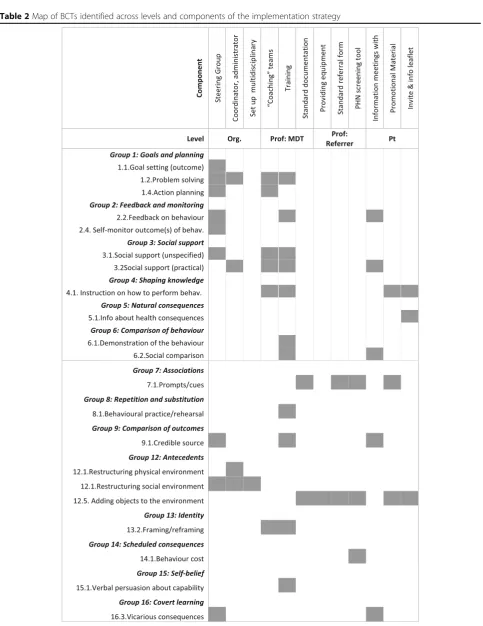
Overall, 21 out a possible 93 BCTs, from 14 of the 16 categories in the taxonomy, were identified (indicated in italics). Table2illustrates the BCTs used at each level of the implementation strategy (Additional file 5 describes each BCT identified within each component, with sup-porting data). The most commonly used BCTs were in-struction on how to perform the behaviour and adding objects to the environment.
BCTs and functions used at each level of the implementation strategy
Organisational level
At the organisational level, the target behaviour was de-fined as ‘supporting the implementation of fall risk as-sessment clinics’. The steering group’s activities concentrated ‘around the edges [of the programme], problem solving and making sure that it’s presented well’ (interview). Overall, 11 BCTs were coded from six of the 16 categorises. The main BCT used was restructuring the social environment.
Even within the organisational level, multiple layers of BCTs were identifiable (see Additional file 5). For ex-ample, we coded the establishment of the implementa-tion steering group itself as restructuring the social environment but there were also specific BCTs evident within the work of the steering group such as‘ monitor-ing and analysmonitor-ing pathway flows and activity, [to] adapt and refine the [fall prevention] pathway’ (document). This activity was coded as the steering group self-moni-toring outcome(s) of behaviour to change their own im-plementation activities. Similarly, members of the steering group who were line managers‘sold’fall risk as-sessment clinics to their staff using framing/reframing andvicarious consequences(for older people):
‘I tell them it's an integrated service for an actual screening tool to be used within the community, and that they're the decision makers around it. They can decide whether the client needs to be referred, they can do the plan of care there and then [and] the client can provide input for what they need.’(interview)
Professional level
We classified target behaviours at the professional level as behaviours relating to ‘delivering the fall risk assess-ment clinic’and those relating to‘referring to the clinic’. The largest number and variety of techniques were iden-tifiable at the professional level. Overall, 16 techniques were coded from 13 of 16 groups of BCTs.
The main BCTs used to target multidisciplinary pro-fessionals tasked with‘delivering the fall risk assessment clinics’were providing instruction on how to perform the assessment and demonstration of assessment behaviour, serving a training function. Training was delivered by a credible source(implementation coordinator with clinical expertise and experience in falls prevention) and in-cluded verbal persuasion about capability. Previous ef-forts to establish fall prevention services had failed because of a lack of ‘practical support’for health profes-sionals, thus social support (unspecified and practical) andproblem solvingwere also used.
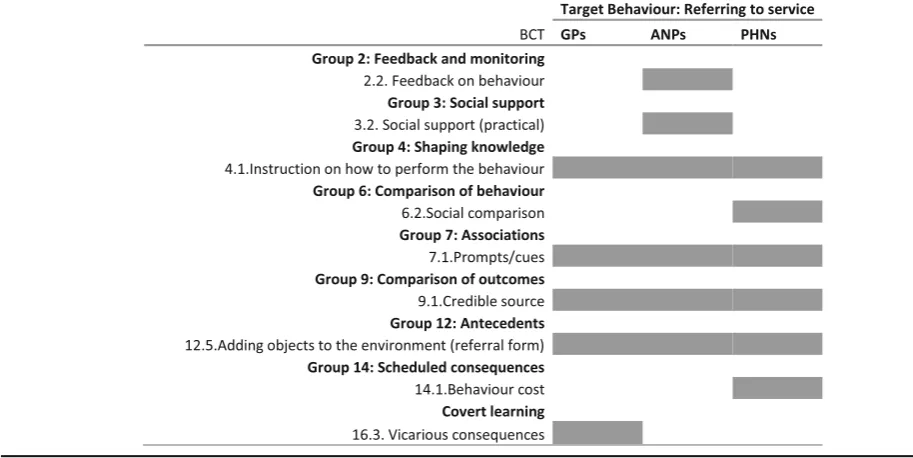
To support health professionals‘referring to the clinic’, a smaller number and range of BCTs were used. The most common BCTs were adding objects to the environ-ment (standardised referral form) which included prompts and cues and using credible sources to meet with referrers to persuade them to use the service. Table3shows differences in the BCTs used to target the range of HCPs eligible to refer to the service: primary care physicians were told about the vicarious conse-quences (shorter waiting times) of referring to the single point of access;social comparison was used to persuade public health nurses whereby colleagues involved in the delivery of clinics would ‘(anonymously) feedback out-comes of clients…, how this [clinic] works, and how they [the clients] proceeded to the clinic’(interview); and ad-vanced nurse practitioners would receive feedback on their referral behaviour.
Table 2Map of BCTs identified across levels and components of the implementation strategy
appliances that people are applying for, they won’t be is-sued unless there’s a falls screen’(interview).
Patient level
At the patient level, the target behaviour was ‘ attend-ing the fall risk assessment clinic’ and in total, three techniques were coded from three categories of BCTs. The invitation letter and information leaflet contained instruction on how to perform the behaviour (attend-ing the clinic). There was brief information about the health consequences and social consequences of at-tending; the information leaflet indicated that clients
‘may be offered the opportunity to attend a falls edu-cation class’ and ‘will be shown how to cope in the event of a fall’.
Participants’activities to shape knowledge, attitudes and intentions to act in future
At the organisational level, we found many implementa-tion activities could not be coded using any of the BCTs and that they appeared to target attitudes rather than immediate behaviour change. First, there were activities, described as ‘the hustle’, to generate buy-in and foster goodwill among key stakeholders. These activities ap-peared to implicitly target stakeholders’ intentions to support clinics in the future for example by releasing staff and space to run clinics (target: heads of discipline) or referring clients (target: health professionals eligible to refer). Selling the clinics served the function of edu-cating health professionals about their ‘existence’ and purpose, but also sought to persuade potential referrers about the benefits and ease of adopting the service.
‘[we tell them] you can’t do without [these clinics] but it’s no trouble [to refer]’(interview)
Second, piloting activities, which were evaluative and reactive and did not align with goals and planning BCTs such as reviewing behaviour and outcome goals, were used at the first implementation site.
‘What changed was the onward referral form and the process of who we were referring on to, and what form they got and what level of information they got or needed. That changed really on a weekly basis in clinic 1.’(interview)
Discussion
Summary
We examined the utility of the BCT Taxonomy to char-acterise the content of a real-world implementation strategy targeting a range of stakeholders across organ-isational boundaries. Overall, 21 distinct BCTs were used to restructure the environment for implementation and to train, educate, enable and persuade health profes-sionals and patients. Of the nine possible intervention functions, none of the techniques sought to restrict be-haviour or incentivise bebe-haviour change. While we iden-tified several techniques at the individual professional level, fewer techniques were identifiable at an organisa-tional level. Furthermore, some implementation activ-ities at this level did not target immediate behaviour change. The utility and application of implementation strategies could be improved by adopting a systematic
approach using a theory-based framework which identi-fies active ingredients and offers the potential to under-stand mechanisms of change [13, 29, 31]. However, to accurately describe and fully understand a multilevel im-plementation strategy, the behavioural approach may need to be integrated with organisational theories of change.
Utility of the BCT Taxonomy
Like Steinmo et al., we found that this systematic ap-proach could be applied‘post hoc’to an existing imple-mentation strategy that was developed pragmatically based on organisational knowledge and experience. Building on their analysis of an implementation strategy targeting professional behaviour in the hospital setting, our results show that the BCT Taxonomy is also applic-able to wider implementation strategies which target multiple groups across different healthcare settings. Similar to Presseau et al., who examined randomised controlled trials of diabetes implementation interven-tions, we found that a small number of the possible BCTs (21/93) were used to support the introduction of a fall prevention programme. The main techniques used to target professional behaviour, including instruction on how to perform behaviour, adding objects to the envir-onment, prompts and cues and social support, were similar across all three studies. The popularity of certain BCTs and the narrow range being used in implementa-tion strategies highlights the potential for practiimplementa-tioners and researchers to think creatively about implementa-tion by drawing on other techniques listed in the BCT Taxonomy [29].
Characterising organisational-level implementation activities and their targets
In this study, fewer BCTs were identifiable at the organ-isational level compared to the professional level. Tech-niques at the organisational level tended to be broadly defined BCTs, such as restructuring the social environ-ment, which were not necessarily specific to the clinical context of fall prevention. Our findings highlight some of the more specific techniques, such as action planning and problem solving, used to operationalise this broad BCT at an organisational level. Rather than simply listing the BCT‘ingredients’in an implementation strategy, we believe that techniques should be linked to specific components and levels of delivery in the strategy’s description.
Some activities did not have an immediate behavioural target, highlighting the importance of measuring prox-imal outcomes (such as attitudes and beliefs) as well as distal outcomes (like changes in behaviour) when evalu-ating implementation strategies. Although the ultimate goal of implementation may be behaviour change,
immediate goals include changing organisational deter-minants of behaviour such as policy and procedures, staffing and resource allocation [32–34]. It could be ar-gued that the recruitment of dedicated staff to coordin-ate implementation, an example of restructuring the social environment and a resource which enabled most components of the implementation strategy in this study, is targeting organisational as well as individual de-terminants of change. Research on implementation cli-mate suggests that when organisations align their policies, practices and resources to support implementa-tion, staff have a clearer understanding of the priorities and value placed on an intervention, and thus are more likely to change their behaviour accordingly [35].
Practical implications
The systematic process of characterising and reporting an implementation strategy may prompt those designing and delivering strategies to think about the intended tar-get(s) and expected outcomes of their activities. Outside of research studies, the process of specifying existing im-plementation strategies using approaches such as the BCT Taxonomy may be difficult to navigate in practice without support, given the number and granularity of techniques, and the specific terminology. An overarching framework, such as the AIMD (Aims, Ingredients, Mechanism, Delivery), may be a useful and efficient starting point for health care professionals, funders, managers and policy makers seeking to formally describe interventions. This simplified framework is deliberately
‘terminology agnostic’ to promote collaboration across related fields including quality improvement, policy, public health, patient safety and behaviour change [32]. As a meta-framework, it accommodates the use of spe-cific frameworks such as BCT Taxonomy for particular purposes.
Characterising an existing strategy using a well-established framework provides an in-depth understanding of
among the implementation steering group. Given the availability of valid routine data with mechanisms for audit and feedback from trusted sources within the health ser-vice and the substantial evidence of effectiveness for chan-ging professional behaviour [37], there is potential to trial different approaches to and components of audit and feedback within this ongoing organisational initiative [38].
This study identified the behaviour change techniques planned or used during the initial implementation of fall risk assessment clinics in the health service. This is likely only a sample of the techniques that will be used over the course of implementation. Indeed, from the outset, the number and type of behaviour change techniques varied depending on the target group and context; differ-ent techniques were used to target referral behaviour among primary care physicians, advanced nurse practi-tioners in hospitals and public health nurses working in the community. It is widely acknowledged that imple-mentation strategies should be tailored to the local con-text [39]. Further research is being conducted with the health professionals and clients to explore their experi-ences of implementation and perceptions of the accept-ability and appropriateness of the implementation strategy. We will combine these results with our current understanding of the content and function of the imple-mentation strategy to address gaps or barriers to its success.
Strengths and limitations
The TIDieR framework helped us to clarify the under-lying rationale for the implementation strategy and thus the intended target population for some activities [15]. We supplemented the TIDieR framework with a descrip-tion of the ‘action targets’ [21], that is population and behaviour being targeted by activities, which was neces-sary before coding behaviour change techniques.
It was not feasible to observe every interaction, par-ticularly at an organisational level, given the dynamic and often unpredictable nature of implementation and the number of actors and settings involved. Therefore, some BCTs at the organisational level may have been missed. While the number of interviews and observa-tions in this study is small, the underlying sampling ra-tionale was to generate a rich and thick description of the content of an implementation strategy. Thus, our sampling was not driven solely by numbers of interviews but also the appropriateness of the data. A purposively chose sample of participants, interactions and docu-ments provided the best opportunity to gather sufficient depth of information to fully describe the implementa-tion strategy being studied [28, 40]. Given our use of deductive content analysis with a pre-determined frame-work, we focused on construct saturation over the con-cept of theoretical saturation from grounded theory.
Data collection and sampling was iterative; however, the process of judging saturation may have been facilitated and enhanced by the use of explicita priorstopping cri-teria which have been used in theory-based interview studies [41]. The identification of BCTs was influenced by the richness of description and the specificity of BCT definitions. As mentioned previously, the definitions of some BCTs are relatively broad which could increase the ease and frequency with which they are coded. Interview participants did not naturally describe their work activ-ities in the language of BCTs. Data from interviews were triangulated with data from documents and observations which provided reassurance about the presence or ab-sence of a BCT [42]. BCTs were typically coded from an accumulation of evidence across data sources rather than relying on a single source.
In line with the Medical Research Council guidance for process evaluations of complex interventions, which warns against forcing an established framework to fit in-terventions which were not originally designed based on theory [43], we used participants’ own language to code and preserve aspects of the implementation strategy that were not adequately or accurately described using BCT definitions.
In this study, we did not evaluate the performance of behaviour change techniques and therefore cannot com-ment on the degree to which they were consistently de-livered as intended or their impact on behaviour change. Capturing what is delivered in practice is essential for evaluators to identify adaptations that may undermine or enhance effectiveness [43]. Variability in the way pro-fessionals deliver an implementation strategy is to be ex-pected as they try to respond appropriately to the needs of the target group and changing context. Hence, sys-temisation may not always be feasible [44].
Conclusions
Additional files
Additional file 1:Outline of Fall Risk Assessment Clinics. Figure depicting the organisation and main features of fall risk assessment clinics being supported by the implementations strategy. (PDF 172 kb)
Additional file 2:Timeline of initial implementation at two primary care sites and data collection for study. Figure depicting the timeline of initial implementation including the timing of clinics being set up and the implementation strategy being delivered and the overlap with data collection for the current study. (PDF 177 kb)
Additional file 3:Documents collated and analysed. Table of the documents collated and analysed in the study. (PDF 189 kb)
Additional file 4:Standards for Reporting Qualitative Research (SRQR) Checklist. (PDF 328 kb)
Additional file 5:List of BCTs and functions used at the organisational level targeting behaviours‘supporting the implementation of fall risk assessment clinics’. Table outlining the activities undertaken within each component of the implementation strategy, the BCT coded to that activity and the intervention function(s) it served. (PDF 358 kb)
Abbreviations
ANP:Advanced nurse practitioner; BCT: Behaviour Change Technique;
GP: General practitioner; HCP: Healthcare professional; MDT: Multidisciplinary team; PHN: Public health nurse; TIDieR: Template for Intervention Description and Replication
Acknowledgements
We thank the members of the Integrated Fall and Fracture Prevention Pathway Steering Group in Community Health Organisation 4 within the Health Service Executive (HSE). We wish to acknowledge Finola Cronin, Orla Hosford, Eileen Moriarty, Olivia Wall, Liz O’Sullivan, Dr. Patrick Barry and
Dr. Kieran O’Connor for designing and delivering the implementation
strategy and for facilitating access to documents for this study. We also thank the multidisciplinary teams of health professionals involved in the delivery of the fall risk assessment clinics for allowing us to visit their clinics. We thank the health professionals involved in information sessions for allowing us access to their meetings.
Funding
Dr. S McHugh would like to acknowledge the funding of the Fellowship by the Centre for Ageing Research and Development in Ireland (CARDI) which became the Ageing Research and Development Division within the Institute of Public Health in Ireland (IPH) in September 2015. Professor Patricia Kearney and Professor Molly Byrne are funded by the Health Research Board Research Leader Awards in diabetes (RL/2013/7) and health behaviour change (RL/2013/8) respectively.
Availability of data and materials
The datasets used and/or analysed during the current study are available from the corresponding author on reasonable request.
Authors’contributions
SMH was the principal investigator on this study and was responsible for its conception. All authors contribute to the development of the research objectives and methods. SMH conducted the data collection. ER transcribed and collated the data. SMH, ER and CS were involved in analysing and interpreting the data. MB reviewed the analysis and interpretation of data. SMH wrote the first draft of the paper. All other authors contributed to successive drafts. All authors read and approved the final manuscript.
Ethics approval and consent to participate
This study received ethical approval from the Clinical Research Ethics Committee for Cork Teaching Hospitals (CREC), and participants provided consent prior to taking part.
Consent for publication Not applicable
Competing interests
The authors declare that they have no competing interests.
Publisher’s Note
Springer Nature remains neutral with regard to jurisdictional claims in published maps and institutional affiliations.
Author details
1
School of Public, University College Cork, Cork, Ireland.2THIS Institute (The Healthcare Improvement Studies Institute), University of Cambridge, Cambridge, UK.3Center for Gerontology and Rehabilitation, University College Cork, Cork, Ireland.4Health Behaviour Change Research Group (HBCRG), School of Psychology, National University of Ireland Galway, Galway, Ireland.
Received: 12 April 2018 Accepted: 23 July 2018
References
1. Plsek P. Redesigning Health Care with Insights from the Science of Complex Adaptive Systems. In: Institute of Medicine (US), editor. Crossing the Quality Chasm: A New Health System for the 21st Century. Washington (DC): National Academies Press (US); 2001. p. 309–22.
2. Grol R, Grimshaw J. From best evidence to best practice: effective implementation of change in patients’care. Lancet. 2003;362(9391):1225–30. 3. Flodgren G, Parmelli E, Doumit G, et al. Local opinion leaders: effects on
professional practice and health care outcomes. Cochrane Database Syst Rev. 2011;(8):CD000125.https://doi.org/10.1002/14651858.CD000125.pub4 4. Pinnock H, Barwick M, Carpenter CR, Eldridge S, Grandes G, Griffiths CJ, et al.
Standards for reporting implementation studies (StaRI) statement. BMJ. 2017;356https://doi.org/10.1136/bmj.i6795.
5. Proctor EK, Landsverk J, Baumann AA, Mittman BS, Aarons GA, Brownson
RC. The implementation research institute: training mental health implementation researchers in the United States. Implement Sci. 2013;8 https://doi.org/10.1186/1748-5908-8-1.
6. Bauer MS, Damschroder L, Hagedorn H, Smith J, Kilbourne AM. An introduction to implementation science for the non-specialist. BMC psychology. 2015;3(1):32. 7. Michie S, Fixsen D, Grimshaw JM, Eccles MP. Specifying and reporting
complex behaviour change interventions: the need for a scientific method. Implementation Sci. 2009;4:40.https://doi.org/10.1186/1748-5908-4-40. 8. Waltz TJ, Powell BJ, Chinman MJ, Smith JL, Matthieu MM, Proctor EK, et al.
Expert recommendations for implementing change (ERIC): protocol for a mixed methods study. Implement Sci. 2014;9(1):39.
9. Powell BJ, Beidas RS, Lewis CC, Aarons GA, McMillen JC, Proctor EK, et al. Methods to improve the selection and tailoring of implementation strategies. J Behav Health Serv Res. 2017;44(2):177–94.https://doi.org/10. 1007/s11414-015-9475-6.
10. Coiera E. Why system inertia makes health reform so difficult. BMJ. 2011;342 https://doi.org/10.1136/bmj.d3693.
11. Bosch M, van der Weijden T, Wensing M, Grol R. Tailoring quality improvement interventions to identified barriers: a multiple case analysis. J Eval Clin Pract. 2007;13(2):161–8.https://doi.org/10.1111/j.1365-2753.2006.00660.x. 12. Michie S, van Stralen MM, West R. The behaviour change wheel: a new
method for characterising and designing behaviour change interventions. Implement Sci. 2011;6(1):42.
13. Powell BJ, Waltz TJ, Chinman MJ, Damschroder LJ, Smith JL, Matthieu MM, et al. A refined compilation of implementation strategies: results from the expert recommendations for implementing change (ERIC) project. Implement Sci. 2015;10(1):21.https://doi.org/10.1186/s13012-015-0209-1. 14. Kok G, Gottlieb NH, Peters G-JY, Mullen PD, Parcel GS, Ruiter RAC, et al. A
taxonomy of behaviour change methods: an intervention mapping approach. Health Psychol Rev. 2016;10(3):297–312.https://doi.org/10.1080/ 17437199.2015.1077155.
15. Hoffmann TC, Glasziou PP, Boutron I, Milne R, Perera R, Moher D, et al. Better reporting of interventions: template for intervention description and replication (TIDieR) checklist and guide. Br Med J. 2014;348https://doi.org/ 10.1136/bmj.g1687.
of behavior change interventions. Ann Behav Med. 2013;46(1):81–95.https:// doi.org/10.1007/s12160-013-9486-6.
17. Presseau J, Ivers NM, Newham JJ, Knittle K, Danko KJ, Grimshaw JM. Using a behaviour change techniques taxonomy to identify active ingredients within trials of implementation interventions for diabetes care. Implement Sci. 2015;10(1):1. 18. Nilsen P. Making sense of implementation theories, models and frameworks.
Implement Sci. 2015;10(1):53.
19. Steinmo S, Fuller C, Stone SP, Michie S. Characterising an implementation intervention in terms of behaviour change techniques and theory: the ‘Sepsis Six’clinical care bundle. Implement Sci. 2015;10(1):111.
20. Gillespie LD, Robertson M, Gillespie WJ, Sherrington C, Gates S, Clemson LM, Lamb SE. Interventions for preventing falls in older people living in the community. Cochrane Database Syst Rev. 2012;(9):CD007146.https://doi. org/10.1002/14651858.CD007146.pub3
21. Proctor EK, Powell BJ, McMillen JC. Implementation strategies: recommendations for specifying and reporting. Implement Sci. 2013;8 https://doi.org/10.1186/1748-5908-8-1.
22. Powell BJ, Proctor EK, Glisson CA, Kohl PL, Raghavan R, Brownson RC, et al. A mixed methods multiple case study of implementation as usual in children’s social service organizations: study protocol. Implement Sci. 2013; 8(1):92.https://doi.org/10.1186/1748-5908-8-92.
23. Patton MQ. Qualitative evaluation and research methods. Thousand Oaks: SAGE Publications, inc; 1990.
24. Green J, Thorogood N. Qualitative methods for health research. London: Sage Publications Ltd; 2004.
25. Mays N, Pope C. Qualitative research: observational methods in health care settings. Br Med J. 1995;311(6998):182–4.
26. Hsieh HF, Shannon SE. Three approaches to qualitative content analysis. Qual Health Res. 2005;15(9):1277–88.https://doi.org/10.1177/1049732305276687. 27. Michie S, Atkins L, West R. The behaviour change wheel: a guide to
designing interventions. London: Silverback Publishing; 2014.
28. O’Reilly M, Parker N.‘Unsatisfactory saturation’: a critical exploration of the notion of saturated sample sizes in qualitative research. Qual Res. 2013;13(2): 190–7.https://doi.org/10.1177/1468794112446106.
29. Presseau J, Ivers NM, Newham JJ, Knittle K, Danko KJ, Grimshaw JM. Using a behaviour change techniques taxonomy to identify active ingredients within trials of implementation interventions for diabetes care.
Implementation Sci. 2015;10:55.https://doi.org/10.1186/s13012-015-0248-7. 30. O’Brien BC, Harris IB, Beckman TJ, Reed DA, Cook DA. Standards for
reporting qualitative research: a synthesis of recommendations. Acad Med. 2014;89(9):1245–51.
31. Michie S, Carey RN, Johnston M, Rothman AJ, de Bruin M, Kelly MP, et al. From theory-inspired to theory-based interventions: a protocol for developing and testing a methodology for linking behaviour change techniques to theoretical mechanisms of action. Ann Behav Med. 2016; https://doi.org/10.1007/s12160-016-9816-6.
32. Bragge P, Grimshaw JM, Lokker C, Colquhoun H. AIMD-a validated, simplified framework of interventions to promote and integrate evidence into health practices, systems, and policies. BMC Med Res Methodol. 2017;17(1):38. 33. Scheirer MA. Linking sustainability research to intervention types. Am J
Public Health. 2013;103(4):e73–80.
34. Weiner BJ, Lewis MA, Clauser SB, Stitzenberg KB. In search of synergy: strategies for combining interventions at multiple levels. J Natl Cancer Inst Monogr. 2012;2012(44):34–41.
35. Aarons GA, Horowitz J, Dlugosz L, Ehrhart M. The role of organizational processes in dissemination and implementation research. In: Brownson RC, Colditz GA, Proctor E, editors. Dissemination and implementation research in health: translating science to practice. New York: Oxford University Press; 2018. p. 121–42.
36. Nyman SR, Victor CR. Older people’s participation in and engagement with falls prevention interventions in community settings: an augment to the Cochrane systematic review. Age Ageing. 2012;41(1):16–23.
37. Ivers N, Jamtvedt G, Flottorp S, Young JM, Odgaard-Jensen J, French SD, O'Brien MA, Johansen M, Grimshaw J, Oxman AD. Audit and feedback: effects on professional practice and healthcare outcomes. Cochrane Database Syst Rev. 2012;(6):CD000259.https://doi.org/10.1002/14651858. CD000259.pub3
38. Ivers NM, Sales A, Colquhoun H, Michie S, Foy R, Francis JJ, et al. No more ‘business as usual’with audit and feedback interventions: towards an agenda for a reinvigorated intervention. Implement Sci. 2014;9(1):14.https:// doi.org/10.1186/1748-5908-9-14.
39. Wensing M, Bosch M, Grol R. Developing and selecting interventions for translating knowledge to action. Can Med Assoc J. 2010;182(2):E85–E8. https://doi.org/10.1503/cmaj.081233.
40. Fusch PI, Ness LR. Are we there yet? Data saturation in qualitative research. Qual Rep. 2015;20(9):1408.
41. Francis JJ, Johnston M, Robertson C, Glidewell L, Entwistle V, Eccles MP, et al. What is an adequate sample size? Operationalising data saturation for theory-based interview studies. Psychol Health. 2010;25(10):1229–45.https:// doi.org/10.1080/08870440903194015.
42. Barbour RS. Checklists for improving rigour in qualitative research: a case of the tail wagging the dog? Br Med J. 2001;322(7294):1115.
43. Moore GF, Audrey S, Barker M, Bond L, Bonell C, Hardeman W, et al. Process evaluation of complex interventions: Medical Research Council guidance. Br Med J. 2015;350:h1258.