Published online May 2, 2013 (http://www.sciencepublishinggroup.com/j/wcmc) doi: 10.11648/j.wcmc.20130101.11
Location agent: a study using different wireless protocols
for indoor localization
Ana Régia de M. Neves
1, Humphrey C. Fonseca
2, Célia G. Ralha
21Dept. of Electrical Engineering, University of Brasília, Brazil 2Dept. of Computer Science, University of Brasília, Brazil
Email address:
[email protected] (A. R. de M. Neves), [email protected] (H. C. Fonseca), [email protected] (C. G. Ralha)
To cite this article:
Ana Régia de M. Neves, Humphrey C. Fonseca, Célia G. Ralha. Location Agent: A Study Using Different Wireless Protocols for Indoor Localization, International Journal of Wireless Communications and Mobile Computing. Vol. 1, No. 1, 2013, pp. 1-6.
doi: 10.11648/j.wcmc.20130101.11
Abstract:
Context-aware systems have received greater interest in the computing community. In order to provide relevant services at context-aware applications, the first task is to locate the user, what can be done preferably dynamically and intelligently. However, indoor mobile users localization is not a trivial problem, since it involves checking various devices, transmitting signals simultaneously on the same radio frequency, with possibly the three existing wireless network protocols: Wi-Fi, Bluetooth and ZigBee. In this direction, this paper presents an agent-based architecture with the Location Agent module defined for context-aware applications that uses three artificial neural network algorithms trained for the different protocols: backpropagation, backpropagation with momentum and levenberg–marquardt. Considering the research experi-mental aspects, a study is presented to compare the neural network algorithms including performance, regression analysis, precision and accuracy. The results indicate that the backpropagation algorithm trained with Bluetooth provides better ac-curacy (the average error of 0.42 meters) and the backpropagation trained with Wi-Fi provides better precision (73%). We consider our approach promising since the Location Agent has a quality of service component associated with the neural network algorithms that can choose the best received signal strength to locate indoor users.Keywords:
Indoor User Location, Context-Aware Systems, Multiagent System, Quality Of Service, Artificial Neural Network1. Introduction
Mobile devices allow user’s mobility and give seamless access to computing resources while moving from one point to another. In this way, there is an increasing interest in context-aware systems that exploit the context to under-stand various current aspects of users situation to interact with the environment in a more intelligent way [1].
One of the most popular mobile services context aware applications are location based services (LBS) [2]. The LBS are value-added services that use the mobile location to provide relevant information or service to the user at an specific location. Such services can be required outdoor and indoor environments. In outdoor environments LBS are possible due to global positioning system (GPS) that enables accurate positioning. Nowadays, most of mobile devices are equipped with a GPS-receiver. But GPS is not suitable to track mobile users (MU) in indoor environments
with acceptable accuracy, since signals might be attenuated by roofs and walls. In this case, the usage of other sensor on mobile devices, such as wireless local area network (WLAN), Bluetooth and ZigBee can be exploited as alter-native positioning sensors in indoor environments. At present, indoor positioning remains an open research prob-lem and is our focus of study.
which is founded on the decay law of the received signal versus the distance, imply the location of any MU. On the other hand, suffer from signal attenuation and noise due to hardware characteristics, exacerbated by environmental factors such as walls, furniture and people in motion.
In this research work we focus on methods using existing infrastructures, such as: (i) Wireless fidelity (Wi-Fi) over IEEE 802.11, that includes IEEE 802.11a/b/g standards for WLAN and allows users to access the Internet at broadband speeds when connected to an access point (AP) or in ad hoc mode; (ii) Bluetooth over IEEE 802.15.1, based on a wire-less radio system designed or short-range and cheap devic-es to replace cabldevic-es for computer peripherals; and (iii) ZigBee over IEEE 802.15.4, defines specifications for low rate wireless personal area network (LR-WPAN) for sup-porting simple devices that consume minimal power and typically operate in the personal operating space (POS) of 10 m.
According to [4], there are two main groups for indoor location based on wireless network existing infrastructure: (i) signal propagation model and information about the geometry of the building to convert RSS to a distance measurement, with knowledge of the coordinates of the WLAN access points (APs), the method of trilateration can be used to estimate the location of the MU; and (ii) location fingerprinting technique that matches the obtained RSS values with a database containing previously captured RSS patterns in the area of interest. According to [5] location fingerprinting includes two phases: offline and online. In the offline phase, the area of interest is divided into grid points and values of the RSS from multiple APs. The RSS data is collected for a certain period of time and stored in a database, called radio map. During the online phase, the server compares by an algorithm the measured RSS finger-print to fingerfinger-prints stored in the radio map to obtain mo-biles location on the grid. The coordinates associated with the fingerprint that provides the smallest distance, for in-stance Euclidean diin-stance, is returned as the estimated position.
Artificial neural networks (ANN) can also be used to es-tablish a relationship between pattern of RSS samples and location [6]. In [7] an ANN is defined as a massively paral-lel model, with distributed processors made up of simple processing units called neurons. A variety of ANN models have been proposed and all of them must be trained. Basi-cally, there are two types of training, supervised and unsu-pervised. Whereas the ANN supervised training knows the desired output, the unsupervised explores correlations be-tween patterns in the data, and organizes into categories from these correlations.
A multilayer feed-forward ANN consists of multiple lay-ers of units connected by directed links and uses supervised training. In this research work there are three supervised learning algorithms being used for training our networks: backpropagation (BP) [8], backpropagation with momen-tum (BPM) [9] and Levenberg-Marquardt (LM) [10].
The BP algorithm has been widely used as a supervised learning algorithm in feed-forward multilayer ANN based on the Gradient Descent method. That attempts to minimize the error of the network by moving down the gradient of the error curve as stated. However, the BP has a slow con-vergence. Consequently, many faster algorithms were pro-posed to speed up the convergence of the BP and can be grouped in two main categories [11]: (i) uses heuristic techniques developed from an analysis of the performance of the standard steepest descent algorithm, for instance BPM, to prevent instabilities caused by a too-high learning rate; and (ii) uses standard numerical optimization tech-niques, such as LM algorithm, which is an approximation to Newton’s method, suitable for training small and me-dium-sized problems.
According to [12], the use of ANN improved perfor-mance and accuracy since they are capable of tackling noisy measurements and are widely used when the correla-tion between the input and output values of a system is unclear or subject to noise data.
Indoor location accuracy can be measured by the error between the estimated position and the actual position of the mobile device. This characteristic can be improved by Quality of Service (QoS), since it chooses the best RSS to locating users and being one of the key evaluations for LBS. Generally, the QoS is measured in relation to accuracy, response time, availability and consistency [13].
The multi-agent system (MAS) approach is also inter-esting to apply for indoor localization using together with the ANN and QoS [14]. According to [15], a MAS is cha-racterized by the existence of multiple agents that interact autonomously and work together to solve a problem or to achieve a common goal. In this way, a MAS can be used as an alternative to deal with the complexities of developing an indoor location system, which aggregates multiple wire-less protocols. The agents have intrinsic attributes, such as: (i) the ability to perceive and act on the environment; (ii) the possibility of achieving individual goals; (iii) the ease of communicating with other agents; (iv) the ability to perform actions with some level of autonomy; and (v) the ability to provide services. Besides, the MAS architecture can incorporate reactive and deliberative agents that take decisions automatically at execution time.
Our previous work presented and evaluated an agent-based user location module -- the Location Agent Module (LAM), based on fingerprinting technique that uses ANN and QoS in the existing wireless network infrastruc-ture to improve accuracy of indoor user location [14]. Fur-thermore, we compare results of three ANN supervised learning algorithms (BP, BPM and LM) to indoor localiza-tion trained with data of three wireless protocols: Wi-Fi, Bluetooth and ZigBee.
works are presented in Section 5.
2. State of the Art
Wireless RSS fingerprinting has become the most prom-ising indoor positioning technique because of its easier deployment and lower cost compare to other methods [5]. In this section some approaches to fingerprint-based indoor localization are going to be presented.
To overcome the limitations suffer from signal attenuation and multipath in Wi-Fi signatures, [16] proposes a new approach to fingerprint based indoor localization that leve-rages FM broadcast radio signals by achieving localization accuracies similar or better to the one achieved by Wi-Fi signals. Besides augmenting the wireless signature, the SI4735 FM receiver has been used and provides three addi-tional signal quality indicators: signal-to-noise ratio, multi-path and frequency offset. Authors show that localization accuracy can be further improved by more than 5%. More-over, combined FM and Wi-Fi signals to generate wireless fingerprints, the localization accuracy increases as much as 83% compared to Wi-Fi RSSI used alone as a signature.
Considering the ANN domain, [17] presents a system to find the location of mobile sensor nodes in the harsh, un-certain, dynamic and noisy conditions using some beacon nodes. To achieve this an ANN was developed and validated through some experiments in real world prone to different sources of noise and signal attenuation. The ANN is trained using BMP algorithm and the results are compared with the trilateration technique.
The system presented in [18] combines two different Wi-Fi approaches to user localization: fingerprinting and trilateration using three known AP coordinates detected on the user's device to derive the position. The combination of the two approaches enhances the accuracy of the user posi-tion in an indoor environment allowing LBS to be deployed more effectively.
[19] present a software architecture designed for a hybrid location system supporting multiple technologies simulta-neously. To demonstrate the application of the architecture and its platform, the paper introduces two case studies based on real deployments: (i) associates ZigBee and Ultra Wide Band mobile nodes, plus the accelerometer; and (ii) uses RSS measurements and a fingerprinting location algorithm.
Another approach is based on collaborative localization of mobile users; for instance, using Bluetooth protocol to improve accuracy and coverage indoors and improve power consumption by duty-cycling GPS outdoors from nearby neighbors [20].
Differing from the presented initiatives, this resear-chwork focus in the modularization of complexity and interaction of multiple wireless protocols in the indoor environment through the use of an agent-based model. The agent model is appropriate to represent complex interac-tions among different entities in the indoor environment and permits that decisions are taken automatically at
execu-tion time. In addiexecu-tion, the different wireless protocols can be contextualized into different agent types that interact in the environment. Another clear difference in our approach from the cited work [16-20] is the implicit way to deal with the QoS mechanisms, without additional hardware and extra costs.
3. Architecture Overview
In [21] previous work, we developed a prototype for in-door user localization using MAS approach. This prototype allowed to define the necessary characteristics for a more complex architecture to context-aware systems. Therefore, we improved our previous architecture with the definition of the LAM, together with the ANN and QoS [14].
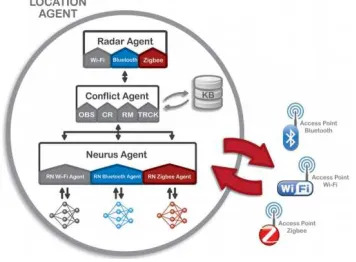
Fig. 1 presents LAM composed of three modules and one knowledge base:
Figure 1. LAM agent-based architecture.
• Radar Agent – it starts the process of indoor users locatlization being composed of three sub-modules: (i) Wi-Fi; (ii) Bluetooth; and, (iii) ZigBee. These sub-modules are responsible for monitoring the en-vironment to gather RSS information and send to the Conflict Agent;
• Conflict Agent – request the RSS for the Radar Agent and is composed of four sub-modules: (i) Observation (OBS), responsible for the RSS request; (ii) Conflict Resolution (CR), responsible to decide which position use, giving access to Knowledge Managed-based; (iii) Knowledge Managed-based (RM), responsible for the inference using If-Then rule statements; and (iv) Tracking (TRCK), respon-sible for monitoring the user;
• Neurus Agents - receive the RSS of Wi-Fi, ZigBee and Bluetooth infrastructure and transfer them to its respective ANNs, in order to check its own QoS and return location for Conflict Agent.
Figure 2. Modular layered architecture.
• LBS interface – an interface that enables commu-nication between the prototype and other applica-tions that make use of the indoor service localiza-tion;
• QoS – analyze data from the LEA layer using two levels of QoS predefined: (i) the maximum accept-able error, defined as 1.5 meters according to [11]; and (ii) the signal strength evaluation for assessing the proximity of an access point AP with the ac-ceptable error level defined as 1.0 meters;
• LEA – each independent ANN are responsible to calculate indoor location and the result is obtained from absolute coordinates of users mobile device;
• Control conflict – prepare data obtained at the data acquisition layer and implement two phases: (i) ca-libration of the account for the hardware differences; and (ii) online to prepare the input values to be used in LEA layer;
• Data acquisition – collect the RSS signals of mobile users in a particular area in the indoor environment. The LAM agent-based architecture was defined to be a flexible, adaptable and extensible one, since new agents can be added considering other wireless protocols, ANN algo-rithms and different QoS levels.
4. Experimental Results and Discussion
The results presented in [14] show that LAM architecture using different wireless protocols and QoS is suitable for indoor localization process. The use of QoS allows to choose the best signal and leads to more accurate location; also improve the service levels offered. Moreover, as cited in Section I, we compare three ANN algorithms, such as BP, BPM and LM. Our experimental tests evaluated the ANN performance, regression analysis, precision and accuracy.
The first experimental test for both ANNs was empirically defined with three types of layers (input, hidden and output) varying the number of neurons at the hidden layer from 100 to 10. The MLPs are trained using the BP, BPM and LM algorithms. The activation function used for the hidden and output layers is the hyperbolic tangent (tansig). The training parameters were defined with: (i) 10,000 epochs; (ii) target of mean squared error (MSE) equal to zero, since the process of training was intended to be permanent, MSE is the
av-erage squared difference between outputs and target; and (iii) the learning rate was set to 0.1 according to the literature [7].
Training automatically stops when generalization stops improving, as indicated by an increase in the MSE. More-over, regression analysis was performed to measure the correlation between outputs and targets.
In order to calculate the accuracy (ρ), our work uses Euclidean distance that measures the distance between an online RSS value (X,Y) obtained (ob) and the offline train-ing database RSS (X,Y) expected (expc) to each point of the grid, as presented in Equation 1.
(
) (
2)
2exp
+
obt-
exp ci
X
obtX
ecY
Y
ρ
=
−
(1)Afterwards, we calculate the value of the average error for the point ρ, defined by ρp, as in Equation 2. Note that, n
represents samples per point in the environment.
1
=
n
n
P ip i
ρ
∑
ρ
(2)The accuracy (ρ) is calculated as in Equation 3.
1 n
P n pp p
ρ
=∑
ρ
(3)In order to determine the precision (δ), the standard dev-iation of the samples (ρi) grouped by the expected point (δp) is calculated as in Equation 4.
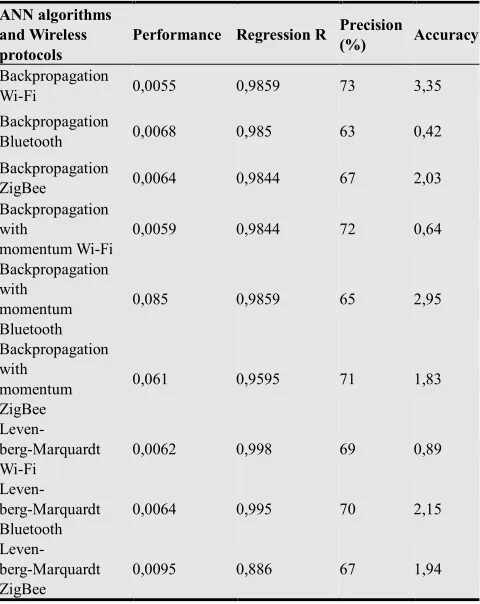
Table 1. ANN algorithms comparison.
ANN algorithms and Wireless protocols
Performance Regression R Precision
(%) Accuracy
Backpropagation
Wi-Fi 0,0055 0,9859 73 3,35
Backpropagation
Bluetooth 0,0068 0,985 63 0,42
Backpropagation
ZigBee 0,0064 0,9844 67 2,03 Backpropagation
with
momentum Wi-Fi
0,0059 0,9844 72 0,64
Backpropagation with
momentum Bluetooth
0,085 0,9859 65 2,95
Backpropagation with
momentum ZigBee
0,061 0,9595 71 1,83
Leven-berg-Marquardt Wi-Fi
0,0062 0,998 69 0,89
Leven-berg-Marquardt Bluetooth
0,0064 0,995 70 2,15
Leven-berg-Marquardt ZigBee
1
1 100
n p
pp p m
σ σ
ρ
= − ×
∑
(4)Table 1 summarizes the main differences among the three ANN algorithms considering performance, regression, precision and accuracy.
For all ANN, the test results to regression analysis presents a stronger level of correlation with a positive in-creasing value that indicates a good fit. In terms of precision, BP trained with Wi-Fi protocol presents a better result: 73%, followed by 72% to BPM also trained with Wi-Fi and 71% to BPM trained with ZigBee protocol. Considering the accuracy, the average error of 0.42 meters to BP trained with Bluetooh, 0.64 meters to BPM trained with Wi-Fi and LM 0.89 meters to LM trained with Wi-Fi.
The results presented in [14] are based on our best ANN architectures and additional level of QoS that improved accuracy in 17% to the Wi-Fi, 11% to the Bluetooth and 21% to the ZigBee protocols.
5. Conclusions
As cited in Section I, the goal of context-aware applica-tions is to perceive the users mobile location and dynami-cally offer them personalized services. In order to achieve this goal, devices and agents must be integrated and coope-rate what is possible through the use of an agent-based approach.
Our previous approach presented and evaluated an agent-based user location module -- the LAM, based on fingerprinting technique that uses ANN and QoS in the existing wireless network infrastructure [14]. These expe-riments were a consequence of our first attempt to develop a prototype for indoor localization using MAS approach [21]. Furthermore, we compared results of three supervised ANN learning algorithms (BP, BPM and LM) to indoor localization, trained with data of three wireless protocols (Wi-Fi, Bluetooth and ZigBee) based on fingerprinting location technique.
Analyzing the experimental results, we can say that even though BP algorithm has a slow convergence, it has better performance in indoor localization than the BPM and the LM algorithms. In addition, the use of QoS together with ANN can improve the accuracy of the results as presented in the previous work [14]. For future work, we intend to study the accuracy improvement possibilities by adding other levels of QoS and integrating them to the ZigBee, WiFi and Bluetooth protocols. Also using semantic re-sources, such as ontologies, to characterize different texts we plan to improve the provision of relevant con-text-aware services to mobile users.
References
[1] A. K. Dey, G. D. Abowd and D. Salber, “A conceptual
framework and a toolkit for supporting the rapid prototyping of context-aware applications,” Human-Computer Interac-tion, vol. 16, no. 2, pp. 97–166, December 2001.
[2] S. Wang, J. Min, and B. K. Yi, “Location based services for mobiles: technologies and standards,” Tutorial for IEEE In-ternational Conference on Communication (ICC'08), Beijing, China, May 2008.
[3] V. Q. Bien, R. V. Prasad, and I. Niemegeers, “Handoff in Radio over Fiber Indoor Networks at 60 GHz,” Journal of Wireless Mobile Networks, Ubiquitous Computing, and Dependable Applications, vol. 1, no. 2/3, pp. 71–82, 2010. [4] Y. Gu, A. Lo, and I. Niemegeers, “A survey of indoor
posi-tioning systems for wireless personal networks,” IEEE Communications Surveys & Tutorials, vol. 11, no. 1, pp. 13–32, First Quarter 2009.
[5] V. Honkavirta, T. Perälä, S. Ali-Löytty, and R. Piché, “A comparative survey of WLAN location fingerprinting me-thods,” Proceedings of the 6th Workshop on Positioning, Navigation and Communication (WPNC’09), pp. 243–251, March 2009.
[6] C. S. Chen, “Artificial Neural Network for Location Estima-tion in Wireless CommunicaEstima-tion Systems,” Sensors, vol. 12, no. 3, pp. 2798–2817, March 2012.
[7] S. O. Haykin, “Neural Networks and Learning Machines,” 3rd ed., Prentice Hall, 2008.
[8] Y. Chauvin, and D. E. Rumelhart (ed.) “Backpropagation: Theory, Architectures, and Applications,” 1st ed., Psychol-ogy Press, 1995.
[9] V. Phansalkar, and P. S. Sastry, “Analysis of the back-propagation algorithm with momentum,” IEEE Trans-actions on Neural Networks, vol. 5, no. 3, pp. 505–506, May 1994.
[10] M. T. Hagan, and M. B. Menhaj, “Training feed forward networks with the Marquardt algorithm,” IEEE Transactions on Neural Networks, vol. 5, no. 6, pp. 989–993, November 1994.
[11] S. Lahmiri, “A comparative study of backpropagation algo-rithms in financial prediction,” International Journal of Computer Science, Engineering and Applications (IJCSEA), vol. 1, no. 4, pp. 15–21, August 2011.
[12] M. Altini, D. Brunelli, E. Farella, and L. Benini, “Bluetooth indoor localization with multiple neural networks,” Pro-ceedings of the 5th IEEE International Synposium on Wire-less Pervasive Computing (ISWPC’10), pp. 295–300, May 2010.
[13] Y. Chen, J. Qi, Z. Sun, and Q. Ning, “Mining user goals for indoor location-based services with low energy and high QoS,” Computational Intelligence, vol. 26, no. 3, pp. 318–336, August 2010.
[14] H. C. Fonseca, A. R. d. M. Neves, and C. G. Ralha, “A user location case study using different wireless protocols,” Pro-ceedings of the 9th ACM international symposium on Mo-bility management and wireless access (MobiWac’11), pp. 143–146, October 31–November 4, 2011.
[16] Y. Chen, D. Lymberopoulos, J. Liu, and B. Priyantha, “FM-based indoor localization”, Proceedings of the 10th International Conference on Mobile Systems, Applications, and Services (MobiSys12), pp. 169–182, June 2012. [17] M. Gholami, N. Cai, R. W. Brennan, “An artificial neural
network approach to the problem of wireless sensor network localization,” Robotics and Computer-Integrated Manufac-turing, vol. 29, no. 1, pp. 96–109, February 2013.
[18] S. Chan, and G. Sohn, “Indoor localization using Wi-Fi based fingerprinting and trilateration techniques for LBS applications”, Proceedings of the 7th International Confe-rence on 3D Geoinformation, pp. 1–5, May 2012.
[19] J. Rodas, V. Barral, and C. J. Escudero, “Architecture for multi-technology real-time location systems,” Sensors, vol. 13, no. 2, pp. 2220–2253, February 2013.
[20] A. Barreira, P. Sommer, B. Kusy, and R. Jurdak, “Collabora-tive localization of mobile users with bluetooth: caching and synchronisation,” Special Issue on the 3rd International Workshop on Networks of Cooperating Objects, CONET 2012, vol. 9, no. 3, pp. 29–31, July 2012.