Vol. 2 Issue 8, August - 2016
Multi-Objective Scheduling In Distributed
Systems Environment: A Fuzzy TOPSIS
Approach
Aidan Ghojoghi
Department of Computer Engineering, Sari Branch, Islamic Azad University, Sari, Iran
Abstract—An efficient resource management is the
first class concern in distributed systems. As such, scheduler as a main part of resource management framework face multi criteria decision making problem to meet variety criteria having potentially conflicts regard to both service user and service provider viewpoints. In this paper, the fuzzy TOPSIS method is applied to schedule user requests specified in terms of execution time and deadline to be met objectives such as minimizing tardy tasks, makespan in favor of users perspectives and maximizing system throughput and cumulative completion time in favor of service providers perspectives. Before launching the main work by TOPSIS module, the AHP method adopted for data mining on servers data history to weight criteria as their importance. The remarkable result show that the fuzzy TOPSIS module can efficiently opt the best alternative and can make trade-off amongst objectives according to their weights.
Keywords—Fuzzy TOPSIS, Cloud Computing, Multi-objective Scheduling
I. INTRODUCTION
Distributed systems include variety heterogeneous computing resources which are interconnected via computer networks and seems to be a single node for its users [1-2]. Nowadays, human long-held dreams, utility computing, have been accomplished such as grid and cloud computing with per-per-use basis [3]. Distributed systems infrastructure is embedded on datacenter with intricate architecture [4]. So, one of the most importance concern is efficient computing resource management which needs smart scheduling to control potential conflicts between users and providers viewpoints. For instance, users of google services need quick response time therefore google broker can conduct users’ request to prolific cluster servers. Consequently, it incurs power consumption, maintenance costs and total
fuzzy TOPSIS specification. Problem statement is brought in section three. Section four and five present work evaluation and conclusion respectively.
II. FUZZY TOPSIS- Technique for Order Performance by Similarity and Ideal Solution
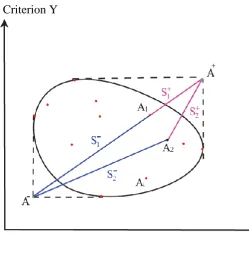
TOPSIS is broadly applied in literature to handle multi objectives decision making problems in real world. Although cab be easily deployed, this technique is often criticized for the sake of its vagueness and uncertainty in decision process resulting of subjective human comparison. Therefore, fuzzy TOPIS has been developed by hwang et al. to obviate its uncertainty [7]. Moreover, TOPSIS has been improved to deal MCDM with an uncertain decision matrix resulting in fuzzy TOPSIS, which has successfully been utilized to figure out various MCDM problems [8-10]. However, we apply AHP method to determine near to exact weight for criteria (metrics) in the inception of the work [11]. The alternatives are placed as points within a n-dimensional Euclidean space with each dimension corresponding to each criterion and their ranking is produced according to their closeness to the ideal and farness to the anti- ideal points which are modeled as hypothetical alternatives that have respectively the best and the worst utility values for each criterion [5-7]. The TOPSIS method determines the metric of “relative closeness” which is a function of the Euclidean distances of each alternative from the ideal (𝐴+) and the
anti-ideal points (𝐴− ) in order to represent the simultaneous satisfaction of two objectives: the best alternative should be the closest to the ideal point and the farthest from the anti-ideal point as Fig. 1 illustrates. Also, the relative closeness
measure is expressed as 𝐶𝑖+ = 𝑆𝑖−
𝑆𝑖−+ 𝑆𝑖+ where 𝑆𝑖 −
and 𝑆𝑖+ are the distances of alternative i from the anti-ideal and the ideal point, respectively (Fig. 1).
Criterion Y
Criterion X
Fig. 1. Alternatives as two points in 2D space corresponding to criteria x and y and their distance from ideal and anti-ideal points
The main method is elaborated as below:
Let us consider the decision matrix A which includes alternatives and metrics (criteria) as following:
A=(
𝑥11 ⋯ 𝑥1𝑛
⋮ ⋱ ⋮
𝑥𝑚1 ⋯ 𝑥𝑚𝑛)
(1)
Whereas 𝐴1, 𝐴2,…, 𝐴𝑚 are alternatives, and 𝐶1, 𝐶2 , …, 𝐶𝑛 are criteria, 𝑥𝑖𝑗 indicates rate of
alternative 𝐴𝑖 regarding to criteria 𝐶𝑗. The weight vector W= (𝑤1, 𝑤2, …, 𝑤𝑛) composed weights 𝑤𝑘
Vol. 2 Issue 8, August - 2016
normalized value 𝑟𝑖𝑗 is calculated by following equation:
𝑟𝑖𝑗 = 𝑥𝑖𝑗 √∑𝑚𝑖=1𝑥𝑖𝑗2
(2)
Matrix R shows the relative rating of alternatives. Then weighted normalized decision matrix P= [𝑝𝑖𝑗]𝑚 𝑥 𝑛 with i=1,…,m and j=1,…,n is
developed. It is obtained by multiplying the normalized decision matrix and its related weights namely 𝑃𝑚 𝑥 𝑛 = 𝑅𝑚 𝑥 𝑛. 𝑊𝑛 𝑥 𝑛. Where 𝑊𝑛 𝑥 𝑛 is a diagonal matrix with weights placed on the main diagonal. After that, TOPSIS method is started with four steps as below:
Step 1: To identify positive ideal solution 𝐴+ as benefit and negative ideal solution 𝐴− as cost:
𝐴+ = (𝑝
1+, 𝑝2+, … , 𝑝𝑚+) (3)
𝐴− = (𝑝
1−, 𝑝2−, … , 𝑝𝑚−) (4)
Whereas 𝑝𝑗+ = (𝑚𝑎𝑥𝑖 𝑝𝑖𝑗, 𝑗 ∈ 𝐽1 ; 𝑚𝑖𝑛𝑖 𝑝𝑖𝑗, 𝑗 ∈ 𝐽2 ) and 𝑝𝑗− = (𝑚𝑖𝑛𝑖 𝑝𝑖𝑗, 𝑗 ∈ 𝐽1 ; 𝑚𝑎𝑥𝑖 𝑝𝑖𝑗, 𝑗 ∈ 𝐽2 ) where 𝐽1and 𝐽2 are benefit and cost types criteria respectively.
Step 2: To calculate Euclidean distances from positive ideal solution 𝐴+ and the negative ideal
solution 𝐴− for each alternative 𝐴𝑖 as follows:
𝑆𝑖+ = √∑𝑛 (𝑝𝑗+− 𝑝𝑖𝑗)2
𝑗=1 with i=1,…,m
(5)
𝑆𝑖− = √∑ (𝑝𝑗−− 𝑝 𝑖𝑗)2 𝑛
𝑗=1 with i=1,…,m
(6)
Step 3: To calculate the relative closeness 𝐶𝑖 for each alternative 𝐴𝑖 with respect to positive ideal solution as follow:
𝐶𝑖 = 𝑆𝑖−
𝑆𝑖++𝑆𝑖− (7)
Where 0<𝐶𝑖<1, 𝐴𝑖 is closer that 𝐴+ than to 𝐴− as 𝐶𝑖 approaches 1.
Step 4: To rank alternatives according to the relative closeness, so the ranking is done based on parameter 𝐶𝑖 in decreasing order which means the higher values 𝐶𝑖 is closer to positive ideal solution.
III. PROBLEM
STATEMENT
This paper applies Fuzzy TOPSIS method to solve MCDM problem such as in grid HPC and
cloud environment. As mentioned, the cloud broker should utilize smart scheduler, optimal virtual machine placement (OVMP), to reach their predefined objectives [12]. The cloud such as other distributed system environment is depicted in Fig. 2.
Fig. 2. Cloud Computing Environment [12].
IV. EVALUATION
After To evaluate the effectiveness of fuzzy TOPSIS on broker performance, we take a broker snapshot which received user workload. The workload includes set of tasks possibly independent such as in current case study. Also, tasks can be both interactive and batch processing. Here, tasks are independent and batch processing in nature such as in grid environment. Take specifications in terms of execution time and due date are brought in table 1.
Table 1. Task Specification
Task No. Task Execution Time (𝒕𝒊)
Due Date of
𝒕𝒊 (𝒅𝒊)
𝒕𝟏 1 2
𝒕𝟐 1 2
𝒕𝟑 2 3
𝒕𝟒 3 4
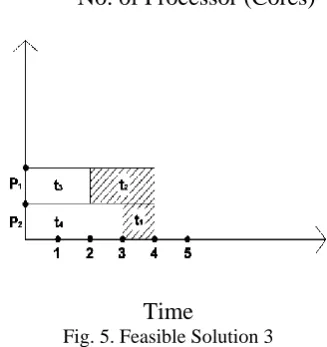
All feasible scheduling are depicted in Fig. 3 though Fig. 5. In addition, the tardy tasks are hatched.
No. of Processor (Cores)
Time
Fig. 3. Feasible Solution 1
No. of Processor (Cores)
Time
Fig. 4. Feasible Solution 2
No. of Processor (Cores)
Time
Fig. 5. Feasible Solution 3
Criteria value determination is brought in table 2. Also, metric (criteria) Cumulative Completion for schedule S is calculated by equation (8) as below:
Cumulative Completion for scheduling (S) =
∑𝑛𝑖=1(1 + 𝐶𝑚𝑎𝑥− 𝑡𝑓𝑖𝑛𝑖𝑠ℎ_𝑡𝑖𝑚𝑒)*𝑡𝑗 (8)
This metric gives partial insight regarding to resource utilization. The only shortcoming of this metric is to use in static environment such as grid static workload in which all of task execution time are determined before execution starts. However, in dynamic environment such as cloud, the broker can apply mining technique to estimate same workload behavior.
Table 2. Determination of Criteria for Feasible Solutions
Soluti ons No.
Tar dy Tas ks
Makes pan
Through put
Cumula tive Comple
tion
Feasibl e Solutio
n 1
2 5 0.8 19
Feasibl e Solutio
n 2
1 4 0.8 24
Feasibl e Solutio
n 3
2 5 1 23
Vol. 2 Issue 8, August - 2016
history of datacenter machines along with applying AHP method using pair comparison of administrators’ interview [11, 15]. We consider weight vector as W= (0.2, 0.4, 0.2, 0.2). In this example, we have three feasible solutions as alternatives (m=3) along with four criteria (n=4). Moreover, the metrics tardy task (TT), makespan (MS) are known as cost type criteria whereas the metrics throughput (TP) and Cumulative Completion (CC) are known as benefit type criteria. Thus, the dimension of decision matrix A is 3X4. So, initial decision matrix is as below:
𝐴3 𝑋 4= [
2 5 0.8 19
1 4 0.8 24
2 5 1 23
] (9)
As nature and source of data are different, it is normalized according to equation (2).
𝑅3 𝑋 4= [
0.67 0.62 0.53 0.50
0.33 0.49 0.53 0.63
0.67 0.62 0.66 0.60
] (10)
Then weighted normalized decision matrix P is calculated as following:
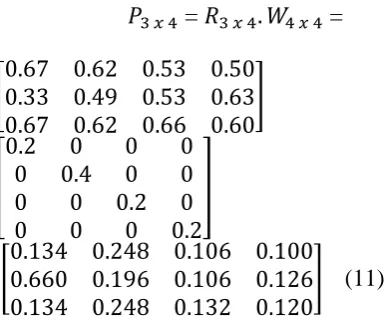
𝑃3 𝑥 4 = 𝑅3 𝑥 4. 𝑊4 𝑥 4 =
[
0.67 0.62 0.53 0.50 0.33 0.49 0.53 0.63 0.67 0.62 0.66 0.60
] .
[
0.2 0 0 0
0 0.4 0 0
0 0 0.2 0
0 0 0 0.2
] =
[
0.134 0.248 0.106 0.100 0.660 0.196 0.106 0.126 0.134 0.248 0.132 0.120
] (11)
Step 1: The vector of positive ideal solution
𝐴+ and negative ideal solution 𝐴− are calculated
according to equation (3) and (4) as following:
𝐴+= (0.134, 0.196, 0.132, 0.126) ,
𝐴−=(0.660, 0.248, 0.106, 0.100) (12)
Step 2: Euclidean distances from positive/negative ideal solution are calculated by equation (5) and (6) and illustrated in table 3:
Table 3. Euclidean distances from positive/negative ideal solution
i 𝑺𝒊− 𝑺𝒊+
1 𝑆1−=0.0637 𝑆1+=0.5260
2 𝑆2−=0.5273 𝑆
2+=0.0520
3 𝑆3−=0.1421 𝑆
3+=0.5270
Step 3: Relative closeness 𝐶𝑖 for each alternative
𝐴𝑖 with respect to positive ideal solution are calculated by equation (7) and illustrated in table 4:
Table 4. Relative Closeness for all Alternatives
i 𝑪𝒊
1 𝐶1 = 0.108 2 𝐶2= 0.910 3 𝐶3= 0.212
Step 4: In this step ranking between alternatives are done in decreasing order regarding to relative closeness coefficient. So, the second feasible solution is the best, third and first feasible solution are in the next order. It makes trade-of amongst contending objectives.
V. CONCLUSION AND FUTURE WORK
REFERENCES
[1] A.S. Tanenbaum & M.V Steen. (2007). distributed systems: principles and paradigms, second edition, prentice hall.
[2] P. Mokarippor and Mirsaeid Hosseini Shirvani, A State Of The Art Survey On DVFS Techniques In Cloud Computing Environment, Journal of Multidisciplinary Engineering Science and Technology (JMEST) 3(50): 2016 .
[3] B.C. Tak, B. Urgaonkar, A. Sivasubramaniam, To move or not to move: The economics of cloud computing. HOTCLOUD 2011, Third USENIX Workshop on Hot Topics in Cloud Computing. 2011.
[4] J. Altmann, M. Kashef, Cost model based service placement in federated hybrid clouds, Future Generation Computer Systems 41 (2014) 79–90.
[5] I. Chamodrakas, D. Martakos, A utility-based fuzzy TOPSIS method for energy efficient network selection in heterogeneous wireless networks, Applied Soft Computing 11 (2011) 3734–3743.
[6] R. A. Krohling, V. C. Campanharo, Fuzzy TOPSIS for group decision making: A case study for accidents with oil spill in the sea, Expert Systems with Applications 38 (2011) 4190–4197.
[7] Hwang, C.L.; Yoon, K. (1981). Multiple Attribute Decision Making: Methods and Applications. New York: Springer-Verlag.
[8] Chen, C. T. (2000). Extensions of the TOPSIS for group decision-making under fuzzy environment. Fuzzy Sets and Systems, 114, 1–9.
[9] Chen, T. Y., & Tsao, C. Y. (2008). The interval valued fuzzy TOPSIS methods and experimental analysis. Fuzzy Sets and Systems, 11, 1410–1428.
[10] Dag˘deviren, M., Yavuz, S., & Kılınc, N. (2009). Weapon selection using the AHP and TOPSIS methods under fuzzy environment. Expert Systems with Applications, 36, 8143–8151.
[11] T.L. Saaty, The Analytic Hierarchy Process: Planning, Priority Setting, Resource Allocation, McGraw-Hill, New York, NY, USA, 1980.
[12] S. Chaisiri et al., Optimal Virtual Machine Placement across Multiple Cloud Providers, Services Computing Conference, 2009. APSCC 2009. IEEE Asia-Pacific.
[13] Mirsaeid Hosseini Shirvani, Evaluating of Feasible Solutions on Parallel Scheduling Tasks with DEA Decision Maker , Journal of Advances in Computer Research, 6(2),2015: 109-115.
[14] A. Burkimsher, I. Bate, L. S. Indrusiak, A survey of scheduling metrics and an improved ordering policy for list schedulers operating on workloads with dependencies and a wide variation in execution times. Future Generation Computer Systems 29(2013) 2009-2025.
![Fig. 2. Cloud Computing Environment [12].](https://thumb-us.123doks.com/thumbv2/123dok_us/8357909.1669803/3.595.318.538.160.327/fig-cloud-computing-environment.webp)