Anupama et al. World Journal of Engineering Research and Technology
HIGH ALTITUDE BALLOON FOR PHOTOGRAMMETRY AND
TELEMETRY USING RASPBERRY PI & ARDUINO UNO
Pushkar Anand1* and Dr. Rajesh S L.2
1
B.E., Student, Department of Computer Science and Engineering, M.S.E.C., Bengaluru,
India.
2
Ph.D., Professor, Department of Computer Science and Engineering, M.S.E.C., Bengaluru,
India.
Article Received on 14/03/2016 Article Revised on 04/04/2016 Article Accepted on 24/04/2016
ABSTRACT
The purpose of our project was to conduct a series of high altitude
balloon experiments on student-designed launch platforms. Many
design goals were considered, including, but not limited to: horizontal
control for helium weather balloons, tethered camera platforms
(controlled and passive), high-definition video platforms, and
miscellaneous data collection. Over the course of the project, the High Altitude Ballooning
payload design and microcontroller programming was designed and tested. We have also
conducted tests on tethered camera payloads. We have also tested the system for atmospheric
data collection and collected the data from the respective sensors and successfully mapped
the data for scientific purposes. No such system exists to date that maps data first hand
independently. Also the imagery obtained is full High Definition and can be used for
geoinformatic and cartographic purposes.
KEYWORDS: Raspberry Pi, Arduino Uno, Raspberry Pi Camera, Bmp180, Dht11, Hmc5883l.
INTRODUCTION
High Altitude Ballooning (HAB) is the application of analog and digital amateur radio to
weather balloons. Often referred to as "The Poorman's Space Program", HAB allows
amateurs to design functioning models of spacecraft and launch them into a space-like
World Journal of Engineering Research and Technology
WJERT
www.wjert.org
SJIF Impact Factor: 3.419*Corresponding Author
Pushkar Anand
environment. Bill Brown (amateur radio call sign WB8ELK) is considered to have begun the
modern ARHAB movement with his first launch of a balloon carrying an amateur radio
transmitter on 15 August 1987. The first recorded HAB launch, however, is recorded to have
taken place in Finland by the Ilmari program on May 28, 1967.
An HAB flight consists of a balloon, a recovery parachute, and a payload of one or more
packages. The payload normally contains a camera system, data collection and amateur radio
transmitter that permits tracking of the flight to its landing for recovery. Most flights use an
Automatic Packet Reporting System (APRS) tracker which gets its position from a Global
Positioning System (GPS) receiver and converts it to a digital radio transmission. Other
flights may use an analog beacon and are tracked using radio direction finding techniques.
Long duration flights frequently must use high frequency custom built transmitters and slow
data protocols such as RTTY, Hellschreiber, Morse code and PSK31, to transmit data over
great distances using little battery power. Use of amateur radio transmitters on an ARHAB
flight requires an amateur radio license, but non-amateur radio transmitters are possible to use
without a license.
There is also a data collection platform that involves an Arduino and a multi sensor system
that writes the data collected from the sensor(s) on to a simple XML (Extensible Markup
Language) database. This raw unformatted data is carried on the SD Card and the later
processed and plotted to obtain changes and variation in atmospheric parameters.
The availability of such real time data is very useful for meteorological purposes and accurate
analysis can be obtained from the data to take appropriate steps for logistics, agricultural
purposes, and maritime and aviation navigation.
The camera platform which uses a multi camera platform to obtain high quality images for
cartographic and geoinformatic purposes. This is stored locally on the payload and cannot be
transmitted effectively due to high quality and hence increase in bandwidth that cannot be
implemented on a short wave transmission system on the payload. The images are stitched
either as a manual or an automated task.
The images can be geotagged or visually identified by any reference map taken of the same
MATERIALS AND METHODS
A payload (an insulated box containing some electronics such as a Camera system, data
collection, GPS and a radio to allow you to follow progress) is attached to a balloon which is
filled with helium (He). The balloon is released and, as He is lighter than air, the balloon rises
and pulls the payload with it. As the balloon rises the outside pressure decreases which leads
to the helium inside the balloon expanding (imagine like its expanding to fill the gap as the
outside pressure decreases), this causes the balloon to stretch.
The balloon is made of a form of latex and is incredibly stretchy however it gets to a point
where it can't stretch anymore and bursts. Now that there isn't any upward pull from the
balloon the payload begins to fall to earth pulled by gravity, as it falls the parachute opens up
slowing its descent and it gently glides down to earth. Therefore if you want to fly a HAB
mission you need to construct a payload box with a tracking device (e.g. Telemetry module,
microcontroller and then a radio). Additional components include for example cameras and
atmospheric data sensor. You also will need a parachute, a balloon and some helium and
permission to launch.
RASPBERRY PI
The methodology that we decided to use for the project is to use a Raspberry Pi Model B+ for
obtaining the images via the proprietary Pi Camera and webcam and an Arduino Uno for
collecting the data.
The webcam is used for horizon photography purely for aesthetic purpose and horizon lock
platform. The proprietary Pi Camera is used for vertical surface facing imagery for
photogrammetric purposes. The Arduino Uno is used to interface the sensors and collect and
store the data.
Released in July 2014, the Model B+ is an updated revision of the Model B. It increases the
number of USB ports to 4 and the number of pins on the GPIO header to 40. In addition, it
has improved power circuitry which allows higher powered USB devices to be attached and
now hot-plugged. The full size composite video connector has been removed and the
functionality moved to the 3.5mm audio/video jack. The full size SD card slot has also been
Fig 1.1 Raspberry Pi Labelled Physical Diagram
ARDUINO UNO
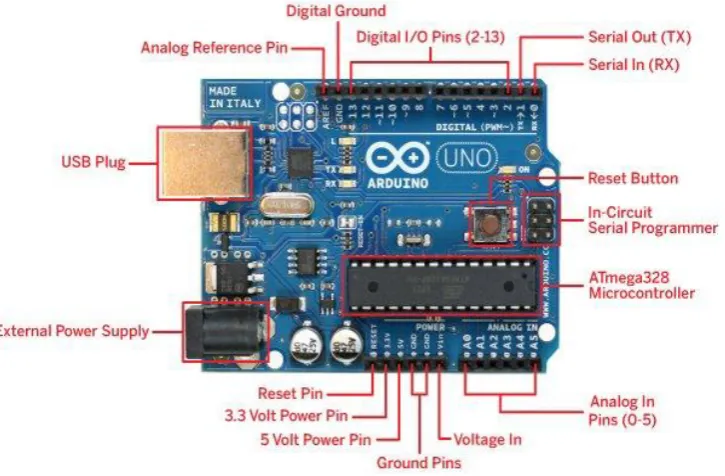
The Arduino Uno is a microcontroller board based on the ATmega328 (datasheet). It has 14
digital input/output pins (of which 6 can be used as Pulse Width Modulation outputs), 6
analog inputs, a 16 MHz ceramic resonator, a USB connection, a power jack, an ICSP header,
and a reset button. It contains everything needed to support the microcontroller; simply
connect it to a computer with a USB cable or power it with a AC-to-DC adapter or battery to
RASPBERRY PI CAMERA
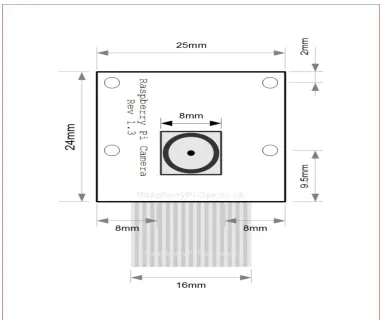
The Raspberry Pi camera module is capable of taking full HD 1080p photo and video and can
be controlled programmatically as shown in Fig 1.3.
Fig 1.3 Raspberry Pi Camera Module
SENSOR PLATFORM
1. BMP180 (DIGITAL PRESSURE SENSOR)
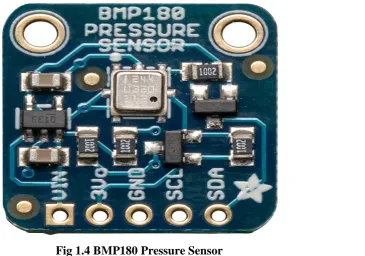
The BMP180 is the new digital barometric pressure sensor of Bosch Sensortec, with a very
high performance, which enables applications in advanced mobile devices, such as smart
phones, tablet PCs and sports devices. It follows the BMP085 and brings many
improvements, like the smaller size and the expansion of digital interfaces.
The ultra-low power consumption down to 3 μA makes the BMP180 the leader in power
saving for your mobile devices. BMP180 is also distinguished by its very stable behaviour
Fig 1.4 BMP180 Pressure Sensor
2. DHT11 (DIGITAL TEMPERATURE AND HUMIDITY SENSOR)
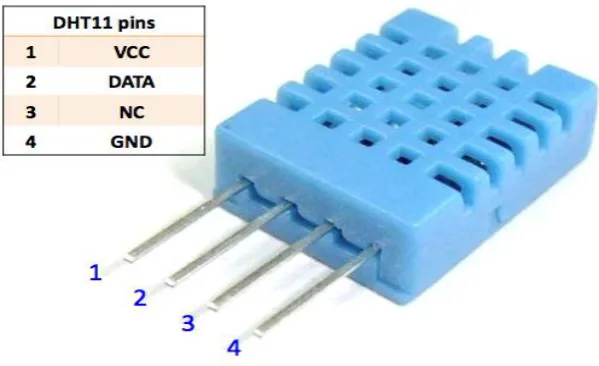
DHT11 Temperature & Humidity Sensor features a temperature & humidity sensor complex with a calibrated digital signal output. By using the exclusive digital-signal-acquisition
technique and temperature & humidity sensing technology, it ensures high reliability and
excellent long-term stability. This sensor includes a resistive-type humidity measurement
component and an NTC temperature measurement component, and connects to a high
performance 8-bit microcontroller, offering excellent quality, fast response, anti-interference
ability and cost-effectiveness.
Each DHT11 element is strictly calibrated in the laboratory that is extremely accurate on humidity calibration. The calibration coefficients are stored as programmes in the OTP
memory, which are used by the sensor’s internal signal detecting process. The single-wire
serial interface makes system integration quick and easy.
Its small size, low power consumption and up-to-20 meter signal transmission making it the
best choice for various applications, including those most demanding ones. The component is
4-pin single row pin package. It is convenient to connect and special packages can be
Fig 1.5 DHT11 (Temperature and Humidity Sensor)
3. HMC5883L (3-AXIS DIGITAL MAGNETOMETER SENSOR)
The Honeywell HMC5883L is a surface-mount, multi-chip module designed for low-field magnetic sensing with a digital interface for applications such as lowcost compassing and
magnetometry. The HMC5883L includes our state-of-theart, high-resolution HMC118X series magneto-resistive sensors plus an ASIC containing amplification, automatic
degaussing strap drivers, offset cancellation, and a 12-bit ADC that enables 1° to 2° compass
heading accuracy. The I 2C serial bus allows for easy interface as shown in Fig 1.6
The HMC5883L is a 3.0x3.0x0.9mm surface mount 16-pin leadless chip carrier (LCC).
Applications for the HMC5883L include Mobile Phones, Netbooks, Consumer Electronics,
Auto Navigation Systems, and Personal Navigation Devices. The HMC5883L utilizes
Honeywell’s Anisotropic Magnetoresistive (AMR) technology that provides advantages over
other magnetic sensor technologies.
These anisotropic, directional sensors feature precision in-axis sensitivity and linearity. These
sensors’ solid-state construction with very low cross-axis sensitivity is designed to measure both the direction and the magnitude of Earth’s magnetic fields, from milli-gauss to 8 gauss. Honeywell’s Magnetic Sensors are among the most sensitive and reliable low-field sensors in
Fig 1.6 HMC5883L (3-Axis Digital Magnetometer Sensor)
RESULTS AND DISCUSSION
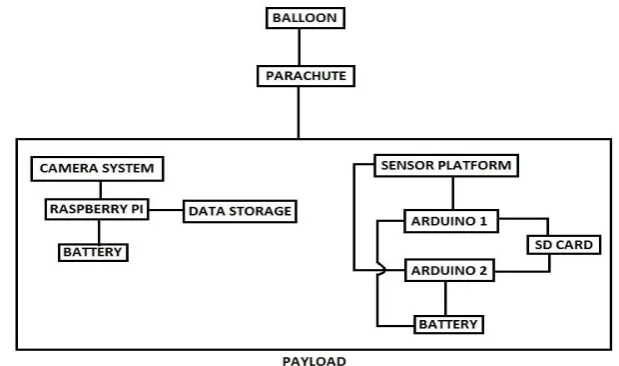
We the undersigned are interested in launching unmanned high altitude balloons into near
space. High altitude ballooning is a multi-skilled hobby which lets you explore the edge of
space relatively cheaply as shown in Fig 1.7
The camera system deployed are used for photogrammetric purposes and the radio portion is
used to track the flight and retrieve the payload for scientific purposes.
Data collected and stored through the microcontroller are used to collect first hand
independent atmospheric data.
This project is mainly a science platform through an engineering solution.
Fig 1.7 High Altitude Balloon Dependency Diagram
CONCLUSIONS
We ran extensive tests on multiple types of microcontrollers before using the Arduino Uno.
We learnt how to create a camera system from scratch and implement it in our project.
We also created the Arduino Data collection and sensor platform.
Overall, this project has expanded all of our horizons. We started with no experience new
parts and with lots to learn, but now we have the resources for a fully operational near space
program. What we have learned from this project will lay the foundation for more advanced
works.
REFERENCES
1. Electronic Communication Systems – S.R.M. Prasanna, Bernard Davis, George Kennedy,
5th Edition, Mcgraw Hill Education, 2011.
2. Electronics in Industry - George M.Chute, Robert D. Chute, 5th Revised edition,
McGraw-Hill, Gregg Division, 1979.
3. Principles of Electronics - V. K. Mehta, Rohit Mehta, 7th Revised edition, S Chand, 1
February 2005.
4. ARM7DI Data Sheet"; Document Number ARM DDI 0027D; Issued: Dec 1994.
5. Sakr, Sharif. "ARM co-founder John Biggs". Engadget. Retrieved December 23, 2011.
"The ARM7-TDMI was licensed by Texas Instruments and designed into the Nokia 6110,
which was the first ARM-powered GSM phone."
6. "D-Link DSL-604+ Wireless ADSL Router - Supportforum - eXpansys Sverige". 090506
expansys.se
7. Andrew (bunnie) Huang. "On MicroSD Problems". Bunnie Studios. "This is comparable
to the raw die cost of the controller IC, according to my models; and by making the
controllers very smart (the Samsung controller is a 32-bit ARM7TDMI with 128k of
code), you get to omit this expensive test step while delivering extra value to customers"
Pushkar Anand
U.G Student, Department of Computer Science and Engineering M. S. Engineering College, Bengaluru (Karnataka), India.
Dr. Rajesh S.L.