Page 556
THE EXPERIENCE OF EDUCATIONAL PROGRAMS DEVELOPING FOR APPLIED BACHELOR TRAINING
Pyzhikova N. I., Antonova N. V., Fomina L. V.
Krasnoyarsk State Agrarian University, Russia, Krasnoyarsk, 90, Mira Avenue
Abstract
The article is devoted to the peculiarities of developing educational programs of applied bachelor training in the field 38.03.03 "Personnel Management". The programs of applied bachelor training are designed to address issues of inconsistency of the labor market and professional education. These programs have a dual approach: firstly, they should provide fundamental education; secondly, they should provide obtaining relevant practical skills, therefore, they are practice-oriented.
Key words: educational program, applied bachelor training, dual approach, practical skills, professional education
Nowadays the requirements of the labor market expand, the need for the highly qualified personnel meeting requirements of an official capacity increases. The practical component of training is the important criterion providing these requirements. It's applied bachelor's training that should solve the problem of gap between theoretical and practical components in the system of high school training, the problem of inconsistency of the labor market and professional education programs. The concept "applied bachelor's training" has for the first time appeared in "The concept of long-term social and economic development of the Russian Federation for the period till 2020". In this Concept creation of system of applied bachelor's training is one of the opportunities of quality education availability increase meeting the innovative development requirements of economy. These programs are developed taking into account the diversity of the labor market, requests of employers and features of regions development. The standard procedural framework for the main educational program development of the applied bachelor' training in the training direction 38.03.03 "Personnel management" includes: The education law in the Russian Federation No 273-FZ of December 29, 2012, the Federal state educational standard of the higher education in the training direction (FSES HE) "Personnel management" No. 1461 approved on12/14/2015, the Methodical recommendations on development and implementation of educational programs of the higher education of level of a bachelor degree, type of an educational program "An applied bachelor degree" approved by the Ministry of Education of the Russian Federation on 9/11/2014 No. AK-2916/05, the Professional standard of the personnel manager No. 691 n approved by the order of the Ministry of Labor and Social Protection of the Russian Federation 10/6/2015, the Order of development and approval of the main professional educational programs of the higher education of Federal state budgetary educational institution of the higher education the "Krasnoyarsk state agrarian university" approved by the order of the rector No. O-1477 on 12/30/2015, the Curriculum of the bachelor training and other documents [1].
The main difference of applied bachelor's training programs consists in their orientation at the focused activity types, the industry labor market and its mass segment [3]. The practice-focused approach implementation is possible by means of the training process integration including practical training and the competences formation necessary for professional activity. We will consider in details these two components of integration.
Page 557
Professional activity objects of the graduates who mastered the bachelor training program are: human resource management services of organizations of any legal form in the industry, trade, on transport, in bank, insurance, tourist and other activity spheres, including research institutions; human resource management services of the state and municipal governing bodies; employment and social protection services of the regions and cities population, recruitment agencies; the organizations specializing in administrative and personnel consulting and audit [2].
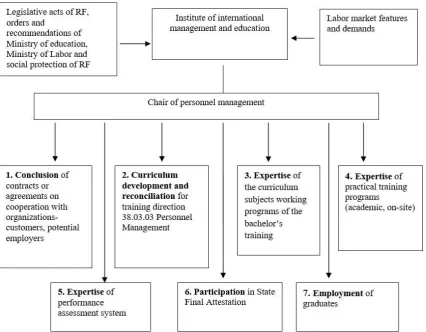
For the purpose of the accounting of labor market features, socio-cultural and economic development of the region and need for HR managers, in MPEP development there participate enterprises- customers: recruiting, law and consulting agency "Acacia", PJSC "Vostochny", LLC "Siberian Tool and Repair Plant", Youth center "Patriot", LLC "Siberian Regional Interuniversity Center", LLC "New city" and other organizations. According to requirements of FSES HE, the share of expert’s teachers has to make up 20% percent; therefore, the organizations heads with academic degrees (the general director of LLC) and structural divisions (heads of departments) are involved in the bachelors training. At the training direction implementation "Personnel management" there is brought into reality the interaction scheme with the enterprises customers and the potential employers possessing necessary resources, shown in Figure 1.
Figure 1. The IIME interaction model with potential employers
Page 558
degree makes up more than 50 %. Share of research - pedagogical employees (in wage rates values reduced to integer values), having the education corresponding to the taught subject (module) profile in total number of the research- pedagogical employees involved in the bachelor’s program has to make up not less than 70 percent.
According to the general system requirements of the educational standard in clause 7.1.2 every student during the training entire period is provided with individual unlimited access to one or several electronic library systems (electronic libraries) and to the electronic information - educational environment of the organization. The software on the Moodle platform allows providing the electronic information - education environment of the organization. It provides students with access to curricula, working programs of subjects (modules), practical trainings, to the editions of electronic library systems and electronic educational resources specified in working programs. It registers the educational process progress, intermediate attestation results and results of the bachelor training program development. It supports all types of classes, training results assessment procedures which implementation is provided with application of electronic training, remote educational technologies. It allows forming an electronic portfolio of a student, including preservation of works, reviews and estimates for these works from any participants of educational process. It performs interaction between participants of educational process by means of the "Internet" network.
According to requirements to structure during the developing and implementation of educational programs of applied bachelor training, the modular principle of educational program design and curricula construction is used. The modular principle is executed in two directions: the module - as a separate unit (making a subject, a training course, working program of a subject, a cycle of subjects, a set of the formed competences) and as modular approach at design of MPEP.
Within the first direction of the modular principle use - a subject, a training course, a working program of a subject and a cycle of subjects with account of credit units are divided into modules which studying comes to an end with a certain type of control.
Within the second direction the curriculum represents the aggregate of the modules including the connected subjects, practical trainings and other types of educational activity. According to competence-based approach the curriculum can be divided into 3 modules. The first one includes the subjects forming common cultural competences, the second module – the one forming common professional competences, the third module – the one forming professional competences.
According to FSES HE an educational program structure consists of three units:
Unit 1 – subjects (modules) including base and variable part. The set and content of subjects (modules) includes 69 titles, of them 30 in a basic part. Their list is specified with account of FSES HE requirements and professional subjects are specified also with account of Professional standard, and labor market features. Besides, subjects allowing learning profoundly English are introduced into the curriculum.
The Professional standard structure of a personnel management specialist includes 8 generalized labor functions:
Documentary support of work with personnel; Activities for personnel recruiting;
Activities for personnel assessment and certification; Activities for personnel development;
Activities for labor organization and personnel payments; Activities for the corporate social policy organization;
Page 559
Each generalized labor function includes 3 labor functions, and activities for personnel development - 4. For the generalized labor functions there are specified possible positions, professions titles; requirements to education and training; requirements to practical work experience; special conditions of the admission to work; other characteristics. For each labor function there are specified labor actions, necessary abilities, necessary knowledge and other characteristics. The subjects’ title and content of the Unit 1 of bachelors' curriculum are attached to 6 generalized labor functions of Professional standard. 2 last functions (7 and 8) belong to the 7th skill level and are implemented on the basis of a specialist or a master's program [4].
Unit 2 – includes practical trainings and variable part. The practical component of applied bachelor training is the major part supporting practice-focused approach. This unit includes educational and work practices, including the pre-degree one. Types of educational practice are: practice on receiving primary professional skills. Ways of carrying out educational practice are: stationary; on-site. The final form of control is test. Types of work practice are: practice for obtaining professional abilities and professional activity experience. Ways of carrying out work practice are: stationary; on-site. Final control form is grading test. Pre-degree practice is carried out for final qualification work performance and is obligatory. During this practice, students perform data collection and analysis for specific problems solutions development of an enterprise in the field of personnel management. Final form of control is grading test. Upon work practice completion students receive a comment of the organization where they undertook practice. The practice in this training direction provides 18 weeks, which makes up 24 credit units, of them 9 – educational and 15 – work ones, unlike the previous educational standard providing 8 credit units. During educational practice students on the basis of university get the chance of receiving a profession of the employee – "Timekeeper". This unit implementation is aimed at providing employment to graduates according to the received higher education profile and level, and also the decrease of adaptation period duration of graduates in real manufacture process. Unit 3 – includes the State Final Attestation (SFA) and basic part. State Final Attestation includes state exam and bachelor's work defense. For SFA into the board there were included representatives of the organizations customers in amount of 3 persons (50 % of the board members) – the general director of LLC Siberian Regional Interuniversity Center, the Deputy of general director of LLC "New City", the specialist in personnel recruiting of LLC "GARS". State exam consists of two parts: the first part – theoretical material knowledge level assessment by tests in the program on the Moodle platform, the second one– the presentation of the enterprise in English.
Within implementation of applied bachelor training programs unlike academic ones, final qualification work is focused on a practical problem solution of a specific enterprise where, by results of work completion, students make recommendations about a production problem solution in the field of personnel management of organizations where they undertook work practice. Besides, students get the chance to defend graduation qualification work in English and in addition to the diploma to receive the certificate on profound studying of English.
The modular principle can be used also within curriculum division into modules without strict sequence of units. Components of different units can enter the module in a certain logical sequence: Basic (main) modules – the modules providing studying of fundamental bases of professional
activity and connection with Professional standard;
Variable modules – the modules supplementing, strengthening mastering of basic ones and considering an educational program profile and labor market features;
Supplementing ones– the modules at the choice of students expanding and deepening professional competences;
Practical modules – the modules providing integration of the theory and practice.
Page 560
professional activity. Within the training direction implementation 38.03.03 "Personnel management" of FSES HE there are provided development of 56 competences, of them 9 common cultural, 10 common professional, 37 professional ones corresponding to professional activity types.
At labor market, first of all, the experts are wanted capable to solve non-standard problems, to make decisions in the conditions of uncertainty and risk, capable to make personal growth, to successfully position themselves, capable to systemically think, process large volumes of information and to single out the main. This component implementation is possible when using the practice-focused training technologies including theoretical knowledge application in the practical issues solution connected with professional competences development of an expert. Methods of competence-based approach allow assessing the gained experience level. When developing competences, it is necessary to consider needs of a student's personality, his abilities, motivation-needs sphere [5].
The applied bachelor training program gives students the chance to check suitability and level of their knowledge and abilities on workplaces, participating in performance of various tasks. As this program is focused on practical actions, it allows mastering the general competences as well, such as, work in team, readiness to make decisions, responsibility for quality of work. Students develop independence, ability to plan and organize own educational and work, ability to lead other people.
For competences development the IIME uses a number of practice-focused educational technologies. Along with active technologies, the interactive training technologies based on interaction of students among themselves and with the educational environment are widely applied. These technologies allow creating new experience, and then through application comprehending its theoretical bases, that is from practice to theory. They allow accelerating assimilation process, material understanding and systematizing, using it at the practical tasks solution [6].
The following ways and techniques are applied within interactive technologies.
1. Trainings. They are used for a personality training and development. They make possible to create an active social position, to develop positive thinking, to develop new professional skills and abilities. 2. Case- technologies. They include method of situation analysis; situational tasks and exercises; analysis of specific situations (case-study); method of cases; incident method; method of analysis of business correspondence; game design; method of situational role-playing games. These methods can be of different types: problem, assessing, illustrating and informational ones. Students learn to work with documents, to make the summary, to choose personnel involvement sources and methods, to make interviews structure in the course of personnel hiring, to make a position profile, learn to delegate powers, to develop ability to convince, to develop communicative qualities, to define personnel development methods and directions, to select personnel motivation ways, to calculate economic indicators and personnel expenses.
3. Method of projects. This method implies independent performance by students under the guidance of a lecturer of a complex of various practical tasks - search, research, calculation, graphic and others. It results in the report which can be submitted in various forms – the presentation, the creative report, the project defense.
4. Discussion. During discussion there is an open exchange of opinions, knowledge, ideas on any problem or a controversial issue. Against emotional discussion and their interest, students gain skills of allocation of the main thing, beliefs defense or acceptance of different view-point.
5. Game. Games recreate various practical situations; imitate real activity requiring administrative decision-making. The following types of games are used: business game, role-playing game and organizational -activity game.
Page 561
the structured and deep interviews; surveillance method on a workplace; assessment method 360, presentation method, etc.
As objects of the personnel assessment and development there serve: powers of thinking, motivation - values features of a personality, psycho-physiological resources of an organism, communicative skills, organizing and managerial skills, creativity and others. Students assess business qualities, psychological features and professional - personal qualities. For assessment of professional -personal qualities there are used test techniques allowing carrying out assessment of administrative qualities, in particular, communicative, organizing and leader's ones. Communicative and organizing abilities – are the main ones in administrative activity. Their level is determined by ability to make the administrative decision in a certain standard professional situation. The used scenarios of business games and trainings as much as possible bring students closer to real practice of work.
7. Traditional practical training and lectures of different types, for example, problem lectures, lectures – dialogues, seminars discussions.
The following interactive technology for competences formation we use is the technology of contextual and competence-based training. This is professionally focused training within which there are modeled functions, tasks, problems and future professional activity competences, i.e. professional context serves as basis of the methods.
One more used interactive technology – technology of the self-regulating studying. It is directed, first of all at development in students of motivation to achievement and self-control, and also at personal qualities development. The students who showed good results in practice and are successfully employed can regulate their studying at senior years, using the individual plan.
As a result of self-regulating educational activity application there is observed development of such personal qualities as attentiveness, accuracy, confidence, independence and flexibility. Besides, there is observed strengthening of this method interrelation with an involvement, speed, plasticity and emotional stability; abilities to self-control of own activity.
Thus, within practice-focused training the internal motivation of the student develops as there appears chance of the free choice of the discussed problem solution ways; students feel own competence; experience own autonomy. Besides, emergence of innovative ideas can be result of practice-focused training. Students are involved in research and creative activity, take part in scientific researches more actively and take part in conferences, forums [7].
In practice-focused training system the following practical experience is developed: comparisons, phenomena and processes assessment, identifications of cause and effect relationships, goals setting, needs for further replenishment of subject knowledge. Practice-focused training implementation assumes practice consideration as knowledge source, as piece of knowledge at an integrated approach to the facts analysis as learning tools.
While developing applied bachelor training programs it is necessary to carry out efficiency monitoring of the practice-focused training methods use. When training students, control has to be carried out with specially developed performance assessment system, making it possible to assess the knowledge, abilities and personal and professional qualities level. The tests appealing to a conceptual framework of a subject make it possible to assess only the level of the acquired knowledge. As for the ability to use knowledge in practice and competences development, they can be assessed by practices results and final qualification work defense. At bachelor's work defense students present Statements on the offered recommendations introduction for the problems solution in the field of personnel management for a specific enterprise. Besides, comments of employers on the working graduates support feedback with employers and enterprises-customers.
Page 562
Applied bachelor training programs provide mastering of broad practical and theoretical knowledge in the field of future professional activity, necessary for ways of behavior identification in various difficult situations, and also abilities mastering to conduct researches for effective professional tasks implementation, to choose from the big range of methods such ones which are necessary for the complex problems solution, to assess actions and results of own and subordinates activity.
REFERENCES
1. Official site of KrasSAU. URL: http://www.kgau.ru
2. FSES HE in the training direction of bachelors’ 38.03.03 "Personnel management" approved by the order of the Ministry of Education and science of the Russian Federation 14.12.2015 No. 1461 – 36 p.
3. The methodical recommendations for development and implementation of educational programs of the higher education of bachelor training level, type of educational program "Applied bachelor training" approved by the Ministry of Education of the Russian Federation of 11.09.2014, No. AK-2916/05-4 p.
4. The professional standard of the personnel manager No. 691 n approved by the order of the Ministry of Labor and Social Protection of the Russian Federation 06.10.2015 -67 p.
5. Bondarenko T. N., Latkin, A. P. Practice-focused approach role in educational process of higher education institution during the forming and development of the branch and regional markets of services of the Russian Federation // Modern problems of science and education. –2012. –№ 6. URL: http://www.science-education.ru/ru/article/view?id=7784
6. Gushchin, Yu. V. Interactive methods of training at higher school // Dubna Psychological Journal. - 2012. - No. 2. URL: http://psyanima.ru
7. Fomina, L. V. Competence-based approach to training conditions formation of bachelors of vocational education / L. V. Fomina, O. Ya. Frolova // Scientific aspect, 2015. V. 2, No. 1., 163-167 pp.