1
Adolescent and young adult (AYA) lymphoma survivors report lower
health-related quality of life compared to a normative population: results from the
PROFILES registry
O. Husson1; J.B. Prins1; S.E.J. Kaal2; S. Oerlemans3; W.B. Stevens4; B. Zebrack5; W.T.A. van der Graaf2,6; L.V. van de Poll-Franse3,7,8
1 Radboud University Medical Center, Department of Medical Psychology, Nijmegen, The Netherlands 2 Radboud University Medical Center, Department of Medical Oncology, Nijmegen, The Netherlands 3 Netherlands Comprehensive Cancer Organisation(IKNL), Utrecht, The Netherlands
4 Radboud University Medical Center, Department of Haematology, Nijmegen, The Netherlands 5 University of Michigan School of Social Work, Ann Arbor, MI, USA
6 Institute of Cancer Research and Royal Marsden NHS Foundation Trust, London, UK
7 CoRPS - Centre of Research on Psychology in Somatic diseases, Department of Medical and Clinical Psychology, Tilburg University, Tilburg, The Netherlands
8 Netherlands Cancer Institute, Division of Psychosocial Oncology and Epidemiology, Amsterdam, The Netherlands
This manuscript has been prepared in accordance with the style of the journal, and all authors have approved its content. This manuscript is not being considered for publication elsewhere and the findings of this manuscript have not been previously published. None of the authors has a conflict of interest. Dr. Olga Husson is supported by a Social Psychology Fellowship from the Dutch Cancer Society
(#KUN2015-7527). This funding agency had no further role in study design; in the collection, analysis and interpretation of data; in the writing of the paper; and in the decision to submit the paper for publication.
Running title: Quality of life in young adult lymphoma survivors
Address for correspondence: Olga Husson PhD
Radboud University Medical Centre Department of Medical Psychology PO Box 9101, 6500 HB Nijmegen The Netherlands
2 Abstract
Background: Trying to simultaneously achieve developmental milestones and cope with a
life-threatening disease may place adolescents and young adults (AYAs) at risk for impaired
health-related quality of life (HRQoL) later in life. The aim of this study was to examine differences in
HRQoL between AYA lymphoma survivors and a normative population and to determine
sociodemographic, clinical and long-term symptom-related factors associated with HRQoL.
Material and methods: This study was part of a longitudinal, population-based survey among lymphoma survivors diagnosed between 1999-2012. The AYA survivor sample (18-39 years at
time diagnosis) was compared to a sex- and age-matched normative population on HRQoL
(EORTC QLQ-C30) and psychological distress (HADS). Multiple linear regression analyses
were conducted to determine factors associated with HRQoL among survivors.
Results: One hundred ninety-eight AYA lymphoma survivors (58%) responded to the study invitation. Compared to an age- and sex-matched normative population (N=380), significantly
and clinically relevant poorer HRQoL was observed for AYA lymphoma survivors in seven
specific domains of HRQoL: physical, role, cognitive, emotional, social functioning, fatigue and
financial difficulties (all p< .05). In addition, AYA lymphoma survivors less often had a
spouse/partner and more often had a lower educational level compared to the normative
population. Linear regression analyses showed that being unemployed, female gender, having
one or more comorbid conditions, high levels of fatigue and psychological distress were most
strongly associated with HRQoL.
Conclusions: These findings identify specific domains of life in which cancer has a significant and long-term impact for AYA lymphoma survivors. Future investigations are needed to identify
and test administrations and timing of psychosocial support interventions having potential to
reduce long-term late effects in specific HRQoL domains and promote function and adaptability
after cancer treatment.
3 Background
In The Netherlands, each year approximately 4,000 people are diagnosed with Non-Hodgkin
lymphoma (NHL) and 450 with Hodgkin lymphoma (HL)[1]. Nearly 4% of the NHL and 38% of
the HL patients are diagnosed within the adolescent and young adult (AYA) age range of 18-39
years. Lymphoma is one of the most common cancers diagnosed at AYA age, affecting both
males and females [2]. Advances in early cancer detection, diagnosis, and treatments have
noticeably improved survival rates of patients with lymphoma[3]. Epidemiological data from the
United States, however, suggest that 5-year survival rates have not improved to the same extent
in AYAs as in children or older adults for several cancers including lymphoma[4]. Three
potential explanations are a patient and doctors delay in diagnosis; cancers diagnosed at AYA
age may be biologically distinct from those diagnosed at older or younger ages; and clinical trial
participation is extremely low in this age group[5]. Although the improvement in survival of
AYAs with cancer lags behind, the 5-year overall survival is still 95% for HL and 76% for
NHL[4].
Adolescence and young adulthood is a challenging period of physical, emotional, cognitive and
social development[6]. Important and complex age-related developmental tasks need to be
achieved, such as forming one’s own identity and a healthy body image, establishing autonomy,
responsibility and independence, finishing education and starting a career, getting a relationship
and having children[6]. A cancer diagnosis may have profound effects on the lives of AYAs,
interfering with the attainment of these normal developmental milestones. Cancer-related issues
such as premature confrontation with mortality, changes in physical appearance, increased
dependence on parents, disruptions of social life and school/employment because of treatment,
and potential loss of reproductive capacity may become particularly distressing and could
negatively impact their health-related quality of life (HRQoL) [6]. Understanding HRQoL
outcomes among AYA lymphoma survivors is important to identify who is at risk for poor
outcomes and to determine potential relevant services and resources required to serve them. This
population-based study aims to (1) assess HRQoL in AYA lymphoma survivors and compare it
to an age- and sex-matched normative population; and (2) identify sociodemographic, clinical
4 Methods
Setting and population
This study is part of a dynamic, longitudinal, population-based survey of lymphoma patients
registered in the Netherlands Cancer Registry (NCR). The NCR records data on all patients who
are newly diagnosed with cancer in the Netherlands. The NCR was used to select all survivors
who were diagnosed with indolent (including Chronic Lymphocytic Leukemia) and aggressive
B-cell non-Hodgkin lymphoma (NHL) or Hodgkin lymphoma (HL), as defined by the
International Classification of Diseases for Oncology-3 codes (ICD-O-3), between 1/1/1999 and
1/6/2012. Patients from 18 hospital locations and 2 large radiotherapy institutes in the southern
part of the Netherlands, an area with 2.3 million inhabitants, were selected. Survivors who had
cognitive impairment or were too ill at time of the study (according to advice from (former)
treating specialist) or died prior to the start of the study (according to the NCR, hospital records,
and the Central Bureau for Genealogy) were excluded. Ethical approval for the study was
obtained from the local certified Medical Ethics Committee of the Maxima Medical Centre
Veldhoven.
For this study we only used data of patients aged 18-39 years at time of diagnosis as this is the
AYA age range in The Netherlands.
Data collection
Data collection was done within PROFILES (Patient Reported Outcomes Following Initial
treatment and Long term Evaluation of Survivorship). PROFILES is a registry for the study of
the physical and psychosocial impact of cancer and its treatment from a dynamic, growing
population-based cohort of both short and long-term cancer survivors. PROFILES contains a
large web-based component and is linked directly to clinical data from the NCR. Details of the
data collection method were previously described[7].
In May 2009, patients diagnosed between January 1999 and January 2009 were included in the
study and received the first questionnaire. In November 2009, May 2011, May 2012 and May
2013, patients newly diagnosed up to 1/6/2012 were subsequently invited to participate.
Study measures
5 HRQoL was measured by the European Organisation for Research and Treatment of Cancer
Quality of Life Questionnaire (EORTC-QLQ-C30)[8]. This 30-item HRQoL questionnaire
consists of five functional scales (physical, role, cognitive, emotional and social), a global
quality of life scale (overall health and overall quality of life during the past week), three
symptom scales and a number of single items assessing common symptoms and perceived
financial impact of the disease. After linear transformation, all scales and single item measures
range in score from 0-100. A higher score on the functional scales and global QoL means better
functioning and HRQoL, whereas a higher score on the symptom scales means more complaints.
Clinical important differences were determined according to the guidelines of the EORTC
Quality of Life Group[9]. This size effect as measured by the EORTC QLQ-C30 is divided into
four size classes: large (one representing unequivocal clinical relevance), medium (likely to be
clinically relevant, but to a lesser extent), small (subtle but, nevertheless, clinically relevant) and
trivial (circumstances unlikely to have any clinical relevance or where there was no difference).
Psychological distress (anxiety and depression) – HADS
Psychological distress was assessed with the Hospital Anxiety and Depression Scale (HADS),
with seven items each for assessing symptoms of anxiety and depression [10]. All items were
scored on a 0- to 3-point scale, with higher scores indicating more symptoms. Clinically relevant
differences were determined according to Norman’s rule of thumb = 0.5 standard deviation[11].
Socio-demographic and clinical characteristics
Clinical information was available from the NCR that routinely collects data on tumour
characteristics, including date of diagnosis, tumour grade, histology, Ann Arbor stage, primary
treatment and patients' background characteristics, including sex and date of birth. Comorbidity
at the time of survey was categorized according to the Self-administered Comorbidity
Questionnaire, assessing the prevalence of 14 comorbidities including heart disease, stroke, high
blood pressure, COPD/asthma, diabetes, stomach disease, kidney disease, liver disease, anemia,
depression, thyroid disease, osteoarthritis, back pain, and rheumatoid arthritis. Self-designed
questions on educational level (high/intermediate/low), partnership (yes/no) and
6
Normative population
Normative population data was obtained from CentERpanel, an online household panel that is
representative for the Dutch population. The process of the annual data collection, which started
in 2009 by our study group, has been described elsewhere[12]. The data wave in 2011 included
assessment of HRQoL. From the 2,040 (82%) respondents ≥18 years, a normative sample
(n=380) was matched on age at time of questionnaire completion and sex.
Statistical analyses
Differences in sociodemographic and clinical characteristics between respondents and
non-respondents or survivors with unverifiable addresses, and between AYA lymphoma survivors
and an age- and sex-matched normative population, were examined with t-tests or analysis of
variance (ANOVA) for continuous variables and chi-square tests for categorical variables, where
appropriate.
The same analytical techniques were used to determine differences in HRQoL and distress
between the AYA lymphoma survivors and an age- and sex-matched normative population.
Hierarchical linear regression models were conducted to identify associations of demographic
and clinical characteristics, long-term symptoms and psychological distress with HRQoL among
AYA lymphoma survivors. The models were composed as follows: 1) demographics+clinical
variables; 2) demographics+clinical variables+long-term symptoms (fatigue, pain, insomnia,
financial difficulties); 3) demographics+clinical variables+psychological distress (anxiety,
depression). All statistical tests were two-sided and considered significant if p<0.05. All analyses
were conducted using SPSS version 22.0 (Statistical Package for Social Sciences, Chicago, IL,
USA).
Results
Patient and tumor characteristics
Of the 360 survivors selected from the NCR, 18 were excluded because of death or too ill at time
of study. The questionnaire was completed by 198 survivors (58%). No differences were found
7 (n=81; 24%) with regard to age, sex, time since diagnosis, primary treatment, lymphoma type
and disease stage (data not shown).
AYA lymphoma survivors differed from the age- and sex-matched normative population in that
AYA lymphoma survivors less often had a partner (p<0.01) and more often had a lower
educational level (p<0.01) at time of questionnaire completion (n=380; Table 1).
Differences in HRQoL and psychological distress between AYA lymphoma survivors and
normative population
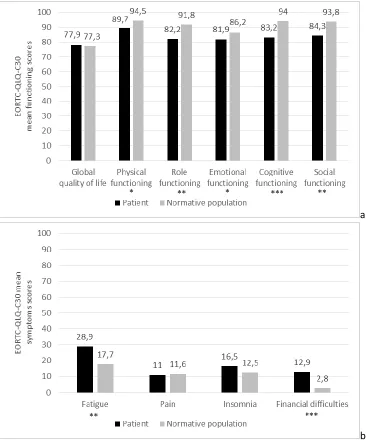
AYA lymphoma survivors scored significantly worse on role, cognitive, social (all small to
medium clinical importance), physical and emotional functioning (both trivial clinical
importance) compared to the age- and sex-matched normative population (Figure 1). No
significant differences were found for global quality of life.
AYA lymphoma survivors had significantly more symptoms of fatigue and reported more
financial difficulties (respectively of small and medium clinical importance) compared to the
normative population (Figure 1).
No statistically significant difference between survivors and the normative population was found
for psychological distress.
Factors associated with HRQoL of AYA lymphoma survivors
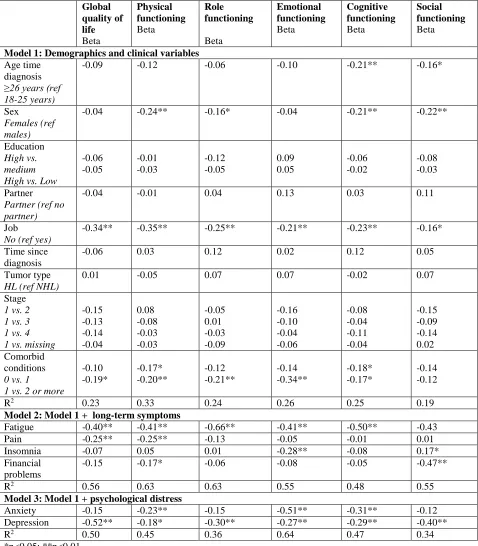
Model 1 of the hierarchical regression analyses showed that age at cancer diagnosis was
negatively associated with cognitive and social functioning (Table 2). Female sex was negatively
associated with physical, role, cognitive and social functioning. Being unemployed and having
one or more comorbid conditions were negatively associated with all scales, except social
functioning for comorbid conditions. Explained variances ranged from 0.19 to 0.33.
In model 2 we added fatigue which was independently, negatively associated with all functioning
scales and global quality of life. Pain was negatively associated with physical functioning and
global quality of life. Insomnia was negatively associated with emotional functioning and
positively associated with social functioning, whereas financial difficulties were negatively
associated with physical and social functioning. Explained variances ranged from 0.48 to 0.63.
Adding anxiety in model 3 showed that anxiety was independently, negatively associated with
8 with all functioning scales and global quality of life. Explained variances ranged from 0.34 to
0.64.
Discussion
In this study, AYA lymphoma survivors reported a considerably lower HRQoL compared to an
age- and sex-matched normative population, with the largest differences for cognitive, role and
social functioning, fatigue and financial difficulties. Our results are in line with those of two
previously conducted studies among heterogeneous groups of AYA survivors in terms of tumor
types[13, 14]. Data from the Adolescent and Young Adult Health Outcomes and Patient
Experience (AYA HOPE) study, a population-based cohort of 523 AYA cancer patients 6 to 14
months post diagnosis at study entry showed that AYA cancer survivors reported significantly
worse HRQoL across both physical and mental scales of the Short Form-12 (SF-12) compared to
population norms[14]. This study found the greatest deficits for AYA cancer survivors in
limitations to physical and emotional roles, physical and social functioning and general health. A
German study among 117 AYA cancer survivors within the first five years after diagnosis, using
the EORTC QLQ-C30 to assess HRQoL, found that AYA cancer survivors reported poorer
outcomes on all scales (physical, role, emotional, cognitive and social functioning) compared to
a normative population [13]. The highest point differences were found for social, role and
emotional functioning.
Poorer functioning among AYA lymphoma survivors may mirror the cumulative effects of
normal developmental challenges in AYAs (e.g., education, work, relationships, starting
families) while dealing with the aftermath of cancer and its treatment. Our finding that AYA
lymphoma survivors less often had a partner, more often a lower educational level and more
financial problems compared to an age- and sex-matched normative population, may indicate
that relationships, school/work and finances are negatively impacted and sustained over time by
a diagnosis of and treatment for lymphoma.
Although we did not find a significant difference in employment status between AYA lymphoma
9 HRQoL functioning scales. It could be that reasons for unemployment are more often disease or
disability related among AYA cancer survivors compared to controls[15]. Not having a job could
reflect a higher severity and impact of the disease. A recent study showed that AYA cancer
survivors who reported their cancer treatment was “very intensive” and those who had quit
work/school after being diagnosed were more likely to report that cancer negatively affected
their work/school after diagnosis, with more than half reporting problems with memory and
attention[16], indicating problems with cognitive functioning. Those who remain employed
during treatment or reenter shortly after treatment have probably less troubles to maintain
normalcy and social reintegration with friends, peers, and others, which minimizes life disruption
and optimizes social functioning[17]. Furthermore, a lymphoma diagnosis could significantly
impact work plans. Not all AYA lymphoma survivors are able to get the type of job or do the
kind of work they would have liked to do and need to adjust their goals as a result of their
cancer, which by itself could negatively affect HRQoL. This is illustrated by a study reporting
that AYA cancer survivors felt “left behind” in their career or job trajectories compared with
their peers[18].
Problems with getting back to work or finding a job after cancer may also be related to the higher
financial difficulties experienced by AYA lymphoma survivors. In addition, there may be
financial strains related to the cost of treatment and loss of pay resulting from time off from
work, but AYA cancer survivors often also have lower earnings as they are in the beginning
stages of work and vocational development. Financial independence is considered a hallmark of
adulthood, AYA cancer survivors may need to rely on significant others for financial support,
which can result in feelings of dependency and loss of control[18].
Interference with work or school and financial difficulties can both result in psychological
distress. Our finding that fewer AYA lymphoma survivors had a partner compared to the
normative population could indicate high relationship concerns. On the one hand a negative body
image, infertility concerns, or feelings of “abnormality” as a result of cancer and its treatment
may lead to troubles with starting a serious relationship[19], on the other hand emotional stress
and financial burdens of cancer can negatively impact AYA lymphoma survivors’ relationship
with their partner. Relationship concerns by itself can lead to higher levels of psychological
distress[19]. In our study psychological distress was strongly associated with HRQoL, however
10 importance of age-appropriate psychosocial support to reduce distress and help AYA lymphoma
survivors adjust to their illness.
Next to factors related to developmental milestones, age and gender were also associated with
HRQoL. Older AYA lymphoma survivors had worse scores on cognitive and social functioning,
which may have to do with higher work-related and social demands at time of diagnosis. Female
gender was associated with lower HRQoL. Women in general have the tendency to report more
problems and express emotions more easily compared to men[13]. Therefore, the association that
we found, should not lead to the conclusion that male patients need less psychosocial support.
Another noteworthy observation was the lack of differences in HRQoL between short- and
long-term AYA lymphoma survivors. This is an interesting finding because it is an indication
that deteriorated HRQoL scores do not improve over time. No other clinical factors (type of
lymphoma, disease stage) were related to HRQoL. This is in congruence with the current state of
research suggesting that subjective appraisals of cancer’s impact on one’s life may be more
salient as contributors to HRQoL than objective cancer-related clinical factors (e.g., time since
diagnosis, type or severity of treatment)[20]. This research suggests that survivors who report
subjective appraisals, perceptions or experiences of how cancer has negatively affected their
lives experience worse HRQoL[20]. Given that perceptions are malleable and change over time,
cognitive and behavioral interventions that reframe perceptions may have the potential to
enhance survivors’ HRQoL. On the other hand, we found that long-term symptoms such as
fatigue were strongly associated with several functioning scales, suggesting that post-treatment
symptom management would be helpful to diminish debilitating symptoms and improve
functioning[14].
Despite the lower functioning scores of AYA lymphoma survivors, no difference in global
quality of life between AYA lymphoma survivors and the normative population was found. One
possible but not yet well investigated explanation could be that some AYA cancer survivors
experience posttraumatic growth post-treatment[21]. It will be interesting for future research to
identify factors that may underpin the emergence of these positive psychological outcomes to
help development of interventions for AYA lymphoma survivors who continue to report
11
Limitations
This study has several limitations that should be mentioned. First, the cross-sectional design
limits the determination of changes over time in AYA lymphoma survivors’ HRQoL.
Longitudinal studies are needed to assess within-person changes in HRQoL to identify risk
groups for persistent lower levels of HRQoL for whom interventions are most needed. Second,
detailed follow-up treatment and relapse data was lacking because the NCR registers only the
primary diagnosis and treatment procedures. Third, although the CentERpanel is designed to be
representative for the Dutch population, due to selective response on our questionnaire we have
included a somewhat higher educated population. Fourth, we did not make use of an AYA
cancer specific HRQoL measure, because there is a relative lack of measures developed or
validated in this population[22]. Qualitative research highlights the need for tools measuring
domains, such as cognition, sexual and reproductive health and social relationships[23]. An
AYA specific HRQoL instrument in research and clinical practice will be instrumental in the
objective evaluation of the new psychosocial and supportive care interventions that minimize or
prevent long-term deleterious effects of cancer but also promote positive adaptation, resilience,
and the achievement of age-specific developmental tasks. Fifth, because lymphoma is a very
heterogeneous disease with respect to subtypes and treatment, our study can only answer the
question how a lymphoma diagnosis at AYA age influenced HRQoL. However, the
homogeneous study sample with respect to tumor type could also be mentioned as strength of
this study. Compared to other studies among more heterogeneous groups of AYA cancer
survivors, we were able to show sex differences in HRQoL not related to tumor type.
Future perspectives
Overall, our findings support research into (early) psychosocial interventions for AYA
lymphoma survivors as well as the need to manage long-term symptoms, provide financial
support and facilitate AYA lymphoma survivors’ involvement in work and/or school. Due to the
still relatively small number of AYA survivors implementing age-appropriate interventions
might be a challenge. Nevertheless, the recent developments of AYA-specific programs with
multidisciplinary care teams to approach this area of need will provide new opportunities[24]. In
12 may become new modes of delivering cost-effective and easy to disseminate psychosocial
support[25].
Conclusion
AYA lymphoma survivor report lower HRQoL scores compared with the normative population.
Although overall global quality of life scores are good, impairments are experienced in the
domains of role, cognitive and social functioning, fatigue and financial problems. Employment
status, gender, comorbid conditions, fatigue and psychological distress were most strongly
associated with HRQoL. Future intervention studies should explore ways to timely address poor
functioning.
Conflict of interest
13 References
1. Cijfers over kanker. 2016. Available: http://www.cijfersoverkanker.nl. Accessed 18 November 2016.
2. Barr RD, Ries LA, Lewis DR et al. Incidence and incidence trends of the most frequent cancers in adolescent and young adult Americans, including "nonmalignant/noninvasive" tumors. Cancer 2016; 122: 1000-1008.
3. Sant M, Minicozzi P, Mounier M et al. Survival for haematological malignancies in Europe between 1997 and 2008 by region and age: results of EUROCARE-5, a population-based study. The Lancet Oncology 2014; 15: 931-942.
4. Keegan TH, Ries LA, Barr RD et al. Comparison of cancer survival trends in the United States of adolescents and young adults with those in children and older adults. Cancer 2016; 122: 1009-1016.
5. Barr RD, Ferrari A, Ries L et al. Cancer in Adolescents and Young Adults: A Narrative Review of the Current Status and a View of the Future. JAMA Pediatr 2016; 170: 495-501.
6. Zebrack BJ. Psychological, social, and behavioral issues for young adults with cancer. Cancer 2011; 117: 2289-2294.
7. van de Poll-Franse LV, Horevoorts N, Eenbergen MV et al. The Patient Reported
Outcomes Following Initial treatment and Long term Evaluation of Survivorship registry: Scope, rationale and design of an infrastructure for the study of physical and psychosocial outcomes in cancer survivorship cohorts. Eur J Cancer 2011; 47(14):2188-94.
8. Aaronson NK, Ahmedzai S, Bergman B et al. The European Organization for Research and Treatment of Cancer QLQ-C30: a quality-of-life instrument for use in international clinical trials in oncology. J Natl Cancer Inst 1993; 85: 365-376.
9. Cocks K, King MT, Velikova G et al. Evidence-based guidelines for determination of sample size and interpretation of the European Organisation for the Research and Treatment of Cancer Quality of Life Questionnaire Core 30. J Clin Oncol 2011; 29: 89-96.
10. Zigmond AS, Snaith RP. The hospital anxiety and depression scale. Acta Psychiatr Scand 1983; 67: 361-370.
11. Norman GR, Sloan JA, Wyrwich KW. Interpretation of changes in health-related quality of life: the remarkable universality of half a standard deviation. Med Care 2003; 41: 582-592.
12. van de Poll-Franse LV, Mols F, Gundy CM et al. Normative data for the EORTC QLQ-C30 and EORTC-sexuality items in the general Dutch population. Eur J Cancer 2011; 47: 667-675.
13. Geue K, Sender A, Schmidt R et al. Gender-specific quality of life after cancer in young adulthood: a comparison with the general population. Qual Life Res 2014; 23: 1377-1386.
14. Smith AW, Bellizzi KM, Keegan TH et al. Health-related quality of life of adolescent and young adult patients with cancer in the United States: the Adolescent and Young Adult Health Outcomes and Patient Experience study. J Clin Oncol 2013; 31: 2136-2145. 15. Tai E, Buchanan N, Townsend J et al. Health status of adolescent and young adult cancer
14 16. Parsons HM, Harlan LC, Lynch CF et al. Impact of cancer on work and education among
adolescent and young adult cancer survivors. J Clin Oncol 2012; 30: 2393-2400. 17. Kwak M, Zebrack BJ, Meeske KA et al. Trajectories of psychological distress in
adolescent and young adult patients with cancer: a 1-year longitudinal study. J Clin Oncol 2013; 31: 2160-2166.
18. Grinyer A. The biographical impact of teenage and adolescent cancer. Chronic Illn 2007; 3: 265-277.
19. Fossa SD, Dahl AA. Fertility and sexuality in young cancer survivors who have adult-onset malignancies. Hematol Oncol Clin North Am 2008; 22: 291-303, vii.
20. Zebrack BJ, Yi J, Petersen L, Ganz PA. The impact of cancer and quality of life for long-term survivors. Psychooncology 2008; 17: 891-900.
21. Arpawong TE, Oland A, Milam JE et al. Post-traumatic growth among an ethnically diverse sample of adolescent and young adult cancer survivors. Psychooncology 2013; 22: 2235-2244.
22. Smith AW, Seibel NL, Lewis DR et al. Next steps for adolescent and young adult oncology workshop: An update on progress and recommendations for the future. Cancer 2016; 122: 988-999.
23. Kuhlthau K, Luff D, Delahaye J et al. Health-Related Quality of Life of Adolescent and Young Adult Survivors of Central Nervous System Tumors: Identifying Domains From a Survivor Perspective. J Pediatr Oncol Nurs 2015; 32: 385-393.
24. Ferrari A, Thomas D, Franklin AR et al. Starting an adolescent and young adult program: some success stories and some obstacles to overcome. J Clin Oncol 2010; 28: 4850-4857. 25. Perales MA, Drake EK, Pemmaraju N, Wood WA. Social Media and the Adolescent and
15 Table 1. Sociodemographic and clinical characteristics of AYA lymphoma patients compared to normative
population
AYA cancer patients
N=198 N (%) Normative population N=380 N (%) p-value
Sex (Male) 112 (57%) 204 (54%) 0.47
Age at time diagnosis – M (SD) 30.4 (6.4) NA
Age at time diagnosis
18-25 years 26-39 years
55 (28%) 143 (72%)
NA
Age at time survey* – M (SD) 34.7 (7.4) 35.2 (8.0) 0.50
Age at time survey*
18-29 years 30-35 years 36-40 years ≥41 years 45 (23) 59 (30) 45 (23) 49 (25) 83 (22) 85 (22) 104 (27) 108 (28) 0.20
Years since diagnosis – M (SD) 4.2 (2.7) NA
Years since diagnosis
<2 years 2-5 years >5 years 54 (27%) 69 (35%) 75 (38%) NA Tumor type Hodgkin Lymphoma Non-Hodgkin Lymphoma 89 (45%) 109 (55%) NA Stage# I II III IV Unknown 43 (22%) 84 (42%) 31 (16%) 34 (17%) 6 (3%) NA Primary treatment
Wait and see Chemotherapy alone Radiotherapy alone Stem cell transplantation Radiotherapy and chemotherapy Other therapies Missing 15 (8%) 85 (43%) 9 (4%) 1 (1%) 82 (41%) 5 (3%) 1 (1%) NA
Number of comorbid conditions^ –
M (SD)
1.3 (3.0) 0.6 (1.3) <0.01
Number of comorbid conditions
None One Two or more
122 (62%) 36 (18%) 40 (20%) 246 (65%) 90 (24%) 44 (12%) 0.01
Partner (yes) 137 (69%) 312 (82%) <0.01
Job (yes) 132 (75%) 301 (79%) 0.22
Educational level Low Middle High 53 (27%) 112 (58%) 29 (15%) 10 (3%) 219 (58%) 149 (39%) <0.01
*Matching was based on age at questionnaire completion and sex
# Disease stage was not available for some indolent Non-Hodgkin Lymphoma patients
16
^Comorbid conditions that were assessed included heart disease, stroke, high blood pressure, lung disease (e.g. COPD, asthma), diabetes, ulcer, kidney disease, liver disease, anemia, thyroid disease, depression, rheumatism, back pain, osteoarthritis,
NA = not applicable
17
Figure 1 Comparison of HRQoL (a), long-term symptoms (b) and psychological distress scores (c) between patients and normative population
a
18
c
Note: *p<.05 and trivially clinically important difference; **p<.05 and small clinically important difference; ***
p<.05 and medium clinically important difference.
a. Scores can range from 0-100 with higher scores implying a better HRQoL.
b. Scores can range from 0-100 with higher scores implying more symptoms
19 Table 2: Standardized betas of hierarchical multiple linear regression analyses evaluating the association of
demographic and clinical characteristics, symptoms and psychological distress with HRQoL among AYA lymphoma patients Global quality of life Beta Physical functioning Beta Role functioning Beta Emotional functioning Beta Cognitive functioning Beta Social functioning Beta
Model 1: Demographics and clinical variables
Age time diagnosis
≥26 years (ref 18-25 years)
-0.09 -0.12 -0.06 -0.10 -0.21** -0.16*
Sex
Females (ref males)
-0.04 -0.24** -0.16* -0.04 -0.21** -0.22**
Education
High vs. medium High vs. Low
-0.06 -0.05 -0.01 -0.03 -0.12 -0.05 0.09 0.05 -0.06 -0.02 -0.08 -0.03 Partner
Partner (ref no partner)
-0.04 -0.01 0.04 0.13 0.03 0.11
Job
No (ref yes)
-0.34** -0.35** -0.25** -0.21** -0.23** -0.16*
Time since diagnosis
-0.06 0.03 0.12 0.02 0.12 0.05
Tumor type
HL (ref NHL)
0.01 -0.05 0.07 0.07 -0.02 0.07
Stage
1 vs. 2 1 vs. 3 1 vs. 4 1 vs. missing
-0.15 -0.13 -0.14 -0.04 0.08 -0.08 -0.03 -0.03 -0.05 0.01 -0.03 -0.09 -0.16 -0.10 -0.04 -0.06 -0.08 -0.04 -0.11 -0.04 -0.15 -0.09 -0.14 0.02 Comorbid conditions
0 vs. 1 1 vs. 2 or more
-0.10 -0.19* -0.17* -0.20** -0.12 -0.21** -0.14 -0.34** -0.18* -0.17* -0.14 -0.12
R2 0.23 0.33 0.24 0.26 0.25 0.19
Model 2: Model 1 + long-term symptoms
Fatigue -0.40** -0.41** -0.66** -0.41** -0.50** -0.43
Pain -0.25** -0.25** -0.13 -0.05 -0.01 0.01
Insomnia -0.07 0.05 0.01 -0.28** -0.08 0.17*
Financial problems
-0.15 -0.17* -0.06 -0.08 -0.05 -0.47**
R2 0.56 0.63 0.63 0.55 0.48 0.55
Model 3: Model 1 + psychological distress
Anxiety -0.15 -0.23** -0.15 -0.51** -0.31** -0.12
Depression -0.52** -0.18* -0.30** -0.27** -0.29** -0.40**
R2 0.50 0.45 0.36 0.64 0.47 0.34