A Novel Framework for Real Time Object Tracking
Systems
#1
Sanketh Datla,
*2Abhinav Agarwal,
#3Rajdeep Niyogi,
*4Barjeev Tyagi
#Department of Electronics and Computer Engineering*
Department of Electrical Engineering Indian Institute of Technology Roorkee, India. {sankipec,abhiapee,rajpfec,btyagfee}@iitr.ernet.in
Abstract— Object tracking is fundamental to automated video
surveillance, activity analysis and event recognition . In real-time applications only a small percentage of the system resources can be allocated for tracking, the rest being required for high-level tasks such as recognition, trajectory interpretation, and reasoning. There is a desperate need to carefully optimize the tracking algorithm to keep the computational complexity of a tracker as low as possible yet maintaining its robustness and accuracy. This paper proposes a novel framework which attempts to attain a light weight tracking system by reducing undesirable and redundant computations. The frames of the video are passed through a preprocessing stage which transmits only motion detected blocks to the tracking algorithm. Further frames containing little motion in the search area of the target object are detected in preprocessing stage itself and are blocked from further processing. Our experimental results demonstrate that the throughput of the new proposed tracking system is exceptionally higher than the traditional one.
Index Term— Video S urveillance, Object Tracking, Appearance
models, Block Cluster, Performance.
I. INT RODUCT ION
The increasing availability of video sensors and high performance video processing hardware opens up exc iting potential for tackling many video surveillance proble ms. It is important to develop robust video surveillance techniques which can process large amounts of data in real time. As an active research topic in co mputer vision, v isual surveillance in dynamic scenes attempts to detect, recognize and track certain objects from image sequences, and more generally to understand and describe object behaviors. The aim is to develop intelligent visual surveillance to replace the tradit ional passive video surveillance that is proving ineffective as the number of ca me ras exceeds the capability of human operators to monitor the m. In short, the goal of v isual surveillance is not only to put cameras in the place of hu man eyes, but also to accomplish exp ressways, detection of military targets. A survey on visual surveillance of object motion and behaviors is given in [1] . Real-time object tracking is the crit ical task in many co mputer vision applications such as surveillance [2, 3], augmented reality [4], object-based video compression [5], and driver assistance. In its simplest form, t racking can be defined as the problem of estimating the tra jectory of an object in the image plane as it moves around a scene[6]. In other words, a tracke r assigns consistent labels to the tracked objects in different fra mes of a video. Additionally, depending on the tracking do ma in, a tracke r can a lso provide object -centric informat ion, such as orientation, area, o r shape of an object. In
the recent decade, different techniques on object tracking a re proposed [7,8,9]. Perhaps, the most e xtensive coverage of different object tracking techniques is covered in [6].
Object tracking is highly co mputationally intensive task. In real-t ime applications , only a small percentage of the system resources can be allocated for tracking, the rest being required for the preprocessing stages or to high-level tasks such as recognition, trajectory interpretation, and reasoning. Therefore, it is desirable to keep the co mputational co mple xity of a tracke r as lo w as possible
.
There is a need to optimize tracking a lgorith ms for its real time applicat ions to be feasible. In this paper, we propose a novel fra mewo rk for object tracking systems that aims at achieving a light weight, computationally ine xpensive tracking system. As against traditional trac king systems, the proposed system wo rks in two phases namely, preprocessing phase and iterative tracking phase.The reminder of this paper is organized as follows. Section II describes the general fra me work of traditional and proposed tracking systems and outlines the differences between them. In Section III, the first stage of our proposed fra me work, the Pre -processing phase is described. In section IV, the second phase called Iterative trac king phase is described. Section V shows the experimental results demonstrating the superiority of our system over the e xisting one and section VI concludes the paper.
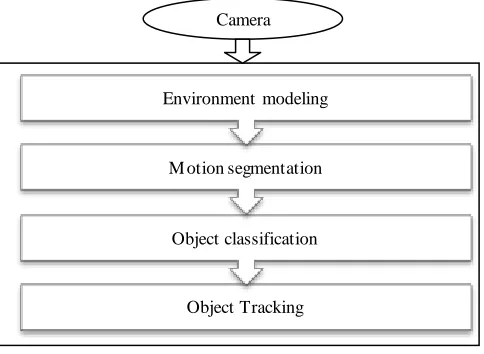
II. TRADIT OINAL VS PROPOSED TECHNIQUE We first describe the traditional fra me work of trac king systems briefly and then illustrate our proposed frame work of tracking systems. We clea rly outline the d ifferences and advantages of the proposed technique over the existing one.
1) Environment Modeling: The continuous construction and updating of background models are indispensable to any video surveillances system. The main prob le m in background modeling is to automatica lly recover and update background fro m a dynamically changing video sequence. Changes in the scene such as moved objects, parked vehicle etc. need to be carefully handled so that interesting foreground targets are detected. In paper [11], a fra mework is presented for recovering and updating background images based on a process in which a mixed Gaussian model is used for each pixe l value. An online estimat ion is used to upd ate background images in order to adapt to illu mination variance and disturbance in backgrounds. Paper [12] p roposes a simp le layered modeling technique to update a background model. In addition, important issues related to background updating for visual surveillance are discussed.
2) Motion Segmentation: Motion Seg mentation in video aims at detecting regions corresponding to moving objects such as humans and vehicles. Most of the segmentation methods use either spatial or te mporal informat ion in the image sequence. Some of the co mmonly e mployed approaches for motion segmentation are background subtraction, Temporal differencing and optical flow.
Backg round Subtraction is the most popularly used method for motion segmentation, especially in a relat ively static background. It detects moving regions in a v ideo by taking the diffe rence between the current fra me and the re ference background fra me. It is simple in approach but is highly sensitive to background illu mination changes. In Tempora l diffe rencing, the pixel-wise diffe rences between two or more consecutive frames in an image sequence are used to extract moving regions.
Fig. 1. T raditional Framework of Object T racking
The temporal diffe rence technique is very adaptive to changes in dynamic environ ment and another advantage is that it does not make assumptions about the scene. Paper [13] detects moving objects in rea l v ideo streams using tempora l
diffe rencing. Here instead of consecutive frames, the video fra mes separated by a constant time
t
are co mpared to find regions which have changed. In Optical flo w methods, The characteristics of flow vectors of moving objects over time a re used to detect moving regions in an image sequence. Optica l flow based methods can be used to detect independently moving objects even in the presence of camera motion.3) Object Classification: The moving regions which are identified in the above steps may correspond to different targets. For exa mp le, the surveillance of road traffic scenes include humans, vehicles and other moving objects like flying birds and moving clouds, etc. To further trac k objects, object classification is essential. Object classificat ion is purely a pattern recognition issue. There are two ma in appro aches for object classification na mely shape based classification and motion based classification.
In Shape-based classification, Diffe rent descriptions of shape informat ion of motion reg ions such as points, boxes, silhouettes and blobs are available for classifying moving objects. For exa mp le, in paper[13], the area of image blobs is used as classification metric to c lassify all moving -object blobs into humans, vehicles and clutter. In Motion based classification, Hu man motion shows a periodic p roperty, so this can be used as strong cue for classification of mo ving objects. Paper [14] presents a similarity based technique to detect and analyze periodic motion. He re the self-similarity of a moving object is co mputed, as it evolves over time . For periodic mot ion, the self-simila rity measure is also periodic . The tracking and classificat ion of moving objects are implemented using periodicity.
4) Ob ject Track ing: In a trac king scenario, an object can be defined as anything that is of interest for further analysis. The aim of an object trac ker is to generate the trajectory of an object over time by locating its position in every fra me of the video. The tasks of detecting the object and establishing correspondence between the object instances across the fra mes can either be performed separately or jointly. In the first case, possible object regions in every fra me are obtained by means of an object detection algorithm, and then the tracker corresponds to the objects across fra mes. In the latter case, the object region and the correspondence is jointly estimated by iteratively updating object location and region info rmation obtained from prev ious fra mes. Tracking methods are divided into four majo r categories: reg ion-based tracking, act ive-contour-based tracking, feature based tracking, and model-based tracking[1].
Region-based tracking algorith ms track objects according to variations of the image regions corresponding to the moving objects. For these algorith ms, the background image is ma intained dynamica lly and motion regions are usually detected by subtracting the background from the current image.Active contour-based tracking algorith ms track objects by representing their outlines as bounding contours and updating these contours dynamically in successive fra mes These algorithms aim at directly e xtract ing shapes of subjects Object Tracking
Object classification M otion segmentation Environment modeling
Iterative Tracking (Phase II)
and provide more effective descriptions of objects than region -based algorith ms. Feature--based tracking a lgorith ms perform recognition and tracking of ob jects by ext racting e le ments, clustering them into higher level features and then matching the features between images.Model-based tracking algorithms track objects by matching projected object models, produced with p rior knowledge, to image data. The models are usually constructed off-line with manual measure ment or co mputer vision techniques.
After successfully tracking the moving objects fro m one fra me to another in an image sequence, behavior analysis is done. It involves the analysis and recognition of mot ion patterns, and the production of high-level description of actions and interactions.
B. Proposed framework for track ing systems
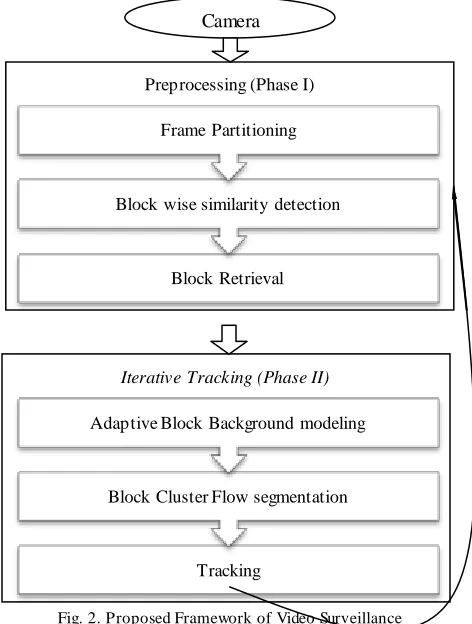
Here Tracking is imp le mented in t wo phases namely Preprocessing stage (Phase I) and Iterative tracking stage (phase II). The fra mes a re first passed to a preprocessing stage called Block Motion Detection phase, where motion in the fra mes are detected in block wise sense and the static blocks(i.e . the blocks containing no motion with respect to corresponding blocks in the previous fra me) are re moved fro m the frames for further processing and then passed to Iterative
Preprocessing (Phase I)
Fig. 2. Proposed Framework of Video Surveillance
tracking phase. Further, if the search reg ion in the fra me (i.e . the region surrounding the object in the previous frame ) contains all the static blocks, then the entire frame is removed
for further processing and is blocked from passing to the second phase. The s teps in the preprocessing stage are broadly divided into Fra me Pa rtit ioning, Block-wise simila rity detection and Block retrieva l phase. These are shown in Fig. 2. These steps are elaborated in the next section.
The second phase is called Iterative tracking phase which operates only on the motion detected blocks that are passed on to it by the above pre-processing stage. It is so named because the object tracker first moves to the centre of every received block in search region and searches for the appearance similarity of the object tracked in the previous fra me . If the appearance similarity is greater than a certain threshold in a block, then that object tracker iterative ly updates the object position. The object position update is done in a d irection such that the appearance similarity is increased. The stages in this Iterative tracking phase are logica lly similar to the stages in the traditional t racking system but diffe r in so me aspects which will be explained later in the next section.
III. PREPROCESSING ( PHASE I ) A. Division of Frames into block s
The incoming fra me is divided into non-overlapping image blocks. The size of the b lock is an important characteristic and will affect the tracking performance. Bigger blocks are less sensitive to noise, while sma ller b locks produce better contours. The next t wo factors are the a mount of noise in the video fra mes and the te xture of the objects and the background. The texture of the objects leads to the so called aperture problem( a lso found in block matching algorith ms). The aperture problem appears in situations where the objects of interest have uniform co lor. The blocks which a re inside the objects do not appear as moving because all of the blocks around them have the same color. When the uniform co lor regions consist of fewer blocks, there is a greater chance that their motion will be detected because some overlapping with non-uniform color reg ions is like ly. A b igger block size can be used to overcome the aperture problem.
B. Block wise similarity detection (Scope for parallelization) The similarity between the corresponding blocks in the successive fra mes is computed. Some of the simila rity measures that can be used here are Su m of absolute difference (SAD), Mean Absolute Difference (MAD) and Nor malized cross correlation (NCC). We have used Normalized c ross correlation in our e xperiments. The correlat ion between two blocks is computed in MATLAB using the following equations.
a = a - mean(a) b = b - mean(b)
c = sum(sum(a.*b))/sqrt(sum(sum(a.*a))*sum(sum(b.*b)))
The function mean ca lculates the mean of the input matrix. The function sum calcu lates sum of a ll e le ments of the input vector. Here 'a' is the matrix representing the pixe l intensities of the block in the present frame and 'b' the matrix representing the pixel intensities of corresponding block in the previous fra me. 'c ' gives the corre lation between the two Block Retrieval
Block wise similarity detection Frame Partitioning
Tracking
Block Cluster Flow segmentation Adaptive Block Background modeling
blocks 'a' and 'b'. The correlation is computed between all the blocks in the present fra me and corresponding blocks in the previous frame. This step can be done in parallel. Severa l paralle l progra mming models like OpenMP, M PI on c lusters and Nvidia CUDA on Graphics processing unit (GPU) can be used for parallelization.
C. Block Retrieval
The above process produces N (N is equal to the number of blocks in the image) values ranging fro m 0 to 1 depending on the absolute difference of the t wo corre lated images. A minimu m va lue of correlat ion called motion threshold is defined to detect motion. In norma l cases, mot ion can easily be detected when the meas ured min imu m cross correlation value of a ll the N va lues is used to set the threshold. However, detection fails when images contain global illu mination variations or during camera move ment. If the correlation of a block with respect to corresponding block in the previous fra me is more than the motion threshold, then the block is considered to be static ( i.e . motion less) and is removed fro m the image fo r further co mputations . If all the blocks in the search region around the object to be tracked are detected as static, then the corresponding fra me is re moved and is not passed to the tracking phase. This saves a lot of redundant computation in the tracking phase and facilitates real-time tracking. Thus, only a subset of fra mes that too containing only a subset of blocks (i.e . the motion detected blocks) a re passed to the tracking phase.
IV. IT ERAT IVE TRACKING ( PHASE II )
A. Adaptive Block Back ground modeling
In this step, the background model is estimated for the blocks which a re continuous around the search region. The group of continuous blocks surrounding a search reg ion is na med a Block c luster. In the case of t racking mult iple objects, the
background model is co mputed separately for d ifferent bloc k clusters surrounding the objects. This would improve the tracking performance significantly as globalized lightning changes are nullified.
B. Block Cluster Flow Segmentation
The technique used in this Block cluster Flow segmentation step is background subtraction. The background model calculated in the previous step is subtracted from th e corresponding group of blocks. The image obtained after subtraction is used as a reference image for tracking in the next fra me. Severa l other conventional motion segmentation approaches like te mpora l d ifferencing and optica l flo w methods may not give satisfactory results because the block clusters around the target object may change fro m fra me to frame.
C. Track ing
The position of the refe rence image obtained fro m the above segmentation phase is updated over time for every inco ming fra me. The object trac ker moves to every block in the c luster and a similarity measure is computed. If the simila rity in a block is less than a certain thres hold, then the tracker moves on to the next block in the c luster. If the similarity is greater than the threshold, then the object tracker ma ximizes the similarity ite ratively by co mparing the appearance simila rity of the object detected in the previous block cluster and the appearance in the window of the present block. At each iteration, the similarity is computed such that the appearance similarity is increased. This process is repeated until convergence is achieved, which usually takes four to five iterations. After the convergence is attained, the block number corresponding to the tracked object location is passed on to the preprocessing stage which will be used to evaluate motion in the new search region for the next frame.
Fig. 4. T racking person using our proposed tracker. Block clusters of frames 5,12,15,21 and 56 are shown
Fig. 5. Multiple object tracker using traditional framework
Fig. 6. Multiple object tracker using our proposed framework. Block clusters for different objects are shown in each frame
V. RESULT S
The visual tracke r imp le mented according to the proposed fra me work was applied to many sequences and for several applications. Here we just present some representative results. We performed e xperiments both using the proposed tracking fra me work and the t raditional fra me work for evaluating their relative performances. Co mpared to the tradit ional imple mentation, this new system performed e xceptionally we ll in terms of throughput. For e xa mp le, for the image sequences shown in this Fig. 3, the new system could track we ll up to 25 fra mes/second, whereas the traditional system could trac k the same sequence only until 15 fra mes/second. The object tracke r used in this image sequence is kalman filter wh ich is composed of two steps, prediction and correction step. The prediction predicts the approximate location of the object . The correction step computes the exact location of the object. The prediction and correction steps are shown by the red and green circ les in the Fig.3 respectively. Fig.4 shows the object
clusters used for tracking in our system. Fig. 5 shows the tracking of two persons moving in an outdoor environment using the traditional mult iple tracke r using mean shift iterations. Fig. 6 shows the tracking of same sequence using our proposed fra me work. The actual position of the object with respect to the entire image is calcu lated based using the two dimensional block ID (Bx,By) , the centroid (Cx,Cy) and the block size (s1s2) as per the below equations
X-coordinate of the object detected = (Bx-1)
s1 + Cx. Y-coordinate of the object detected = (By-1)
s2 + Cy.VI. CONCLUSION
many conventional trac kers, it has certain limitations. All prevailing techniques used for diffe rent stages like Environment modeling, Motion segmentation and tracking may not give satisfactory results. For e xa mple , Motion segmentation techniques like te mpora l diffe rencing and optical flow methods may not give satisfactory results because of the block clusters dynamically change in position and shape in every frame.
REFERENCES
[1] W.Hu, T .Tan,L. Wang and S.Maybank, " A survey on visual
surveillance on object motion and behaviors", In. IEEE Transactions on systems, man and cybernatics, Vol.34, No.3, pp.334-352, 2004.
[2] M.Greiffenhagen, D.Commaniciu, H.Niemann and V.Ramesh,
"Desigh, Analysis and Engineering of Video Monitoring Sytems: An approach and a case study," In Proc. IEEE., pp. 1498-1517, 2001.
[3] R. Collins, A. Lipton, H.Fujiyoshi, and T . Kanade, "Algorithms for
Cooperative Multisensor Surveillance," In Proc IEEE., Vol 89, no. 10, pp. 1456-1477, 2001.
[4] V.Ferrari, T.T uytelaars, and L.V.Gool, "Real-T ime Affine Regiion
Tracking and Coplanar Grouping," In Proc. IEEE conference Computer Vision and Pattern Recognition, vol. II, pp. 226 -233, 2001.
[5] A.D.Bue, D. Commaniciu, V. Ramesh and C. Regazzoni, "Smart
Cameras with Real-Time Video Obejct Generation," In Proc. of International Conference on Image Processing, vol. III, pp. 429-432, 2002.
[6] A.Yilmaz, O.Javed and M.Shah , "Object tracking: a survey",ACM
Computer Surveys,Vol. 38.,No. 4,pp 1-45, 2006.
[7] Commaniciu, V. Ramesh, and P. Meer, “Kernel-Based Object
Tracking,” IEEE Trans. Pattern Anal. Machine Intell., vol. 22,pp. 781-796, Aug.2000.
[8] Han, A. Sethi, W. Hua, and Y. Gong, “A Detection-Based Multiple
Object Tracking Method,” in Proc. IEEE International Conference on Image Processing(ICIP),2004.
[9] McKenna,S.Jabri, Z.Duric, and H.Wechsler, "Tracking Interacting
people", In. Proc. of the International Conf. on Automatic Face and Gesture Recognition,Grenoble, France, pp. 348-353, 28-30 March 2000.
[10] A.R. Dick and M. J. Brooks, “Issues in automated visual
surveillance,", In. in DICT A, pages 195-204, Macquarie University, Sydney, NSW, Australia, 2003.
[11] C.Stauffer and W.Grimson, "Adaptive background mixture models
for real-time Tracking," in Proc. IEEE Conf. computer Vision and Pattern Recognition. vol.2, 1999,pp.246-252.
[12] K. Kim, D. Harwood, and L. S. Davis, "Background updating for
visual surveillance," in First International Symposium on Visual Computing, ISVC, pages 337-346, Lake Tahoe, Nevada, 2005.
[13] A. J. Lipton, H. Fujiyoshi, and R. S. Patil, "Moving target
classification and tracking from real-time video",in Proc. IEEE Workshop Applications of Computer Vision,1998,pp. 8 -14.
[14] R. Cutler and L. S. Davis, "Robust real-time periodic motion