Sensing and Processing of EOG Signals to
Control Human Machine Interface System
C.Kavitha
1, G. Nagappan
21Department of Computer Science and Engineering/ Saveetha Engineering College/ PG Scholar, Chennai, Tamil Nadu/India
2
Department of Computer Science and Engineering/ Saveetha Engineering College/ Associate professor, Chennai, Tamil Nadu/India
Abstract-- Human Machine Interface (HMI) has been extensively discussed to control electromechanical rehabilitation techniques using bio-signals such as EEG, EOG and EMG etc. When patients become completely or partially paralyzed, the only source or a resource offered to them are signals. Among the various bio-signals, EOG signals have been studied in depth because of the occurrence of a definite signal pattern. This work has been focused on controlling Human-machine
interface (HMI) system that is based on
Electrooculography (EOG) signals for guiding
wheelchair motion manually. The user look up, down, left, right and blink to guide the wheelchair to move forward, backward, left, right and stop respectively. A New Algorithm named as “Navigation point Algorithm” has been designed to navigate the wheelchair and finds a direct path from the origin to the goal point in a single head movement. Obstacle detection sensor is also being used to notify about the obstacle that may be found in the path. The distance between the sensors and the nearest obstacle will be detected by this sensor.The process ends when the wheelchair reaches the goal point.
Index Terms -- HMI System, Bio-signals, EOG signals, Eye movements and Navigation Point Algorithm.
I. INTRODUCTION
A large section of our society suffers from one or the other kind of disabilities because of accidents, medical specialty disorders, brain damages etc. These disabilities force the patients to rely completely on their family members, relations or care-givers for everyday activities together with mobility, for communication and controlling the house hold equipment etc. Rehabilitation devices enable persons with disabilities to independently live, work, play or study. In other words, they increase the standard of life led by the differentially abled individuals and increase their self-esteem. A Rehabilitation device is
one that assists a differentially abled individual to regulate his or her to control and communicate more effectively. These helpful devices promote larger independence by enabling individuals to perform tasks with the assistance of technology.
An ideal rehabilitation aid [7] helps in collecting data from the environment, analyze the data, convey it to the user and eventually receive commands from the user. The utilization of those rehabilitation aids assists the differentially abled person to hold out his/her day to day activities other. With improvement in technology, there's a vast development in the field of rehabilitation techniques. Researches are going on to develop reliable, low price and easy to use devices. Out of all the rehabilitation techniques, HCI (Human computer Interface) and HMI (Human Machine Interface) are the most recent and most effective techniques.
This paper discuss about the HMI system, the main objective is that, the conversion of signals generated by humans through numerous gestures to control some electromechanical devices.
Rehabilitation devices are broadly classified into two classes such as Bio-signals and Non Bio-signals which are used as a medium of control. The chief bio-signals used in the Interface are electromyography (EMG), Electroencephalography (EEG) and Electrooculography (EOG).
A. EEG Signals
The Electroencephalography (EEG) [7] records electrical brain signals from the scalp, where the brain signal originates from post-synaptic potentials which aggregates at the cortex, and then transfers the skull to the scalp. BCI is a device that extracts electroencephalogram data from brain and converts it
into device control commands using signal processing methods. The electrical activities of the brain are recorded via the electroencephalogram, through electrodes that are attached to the surface of the skull. The signals that are measured by the electrodes which is a sensor or a conductor are amplified, filtered and digitized for processing in a computer or laptop where feature extraction is performed.
This is often followed by classification and an appropriate control commands which are generated. Also that it is one of the foremost vital technologies for patients with paralysis that suffer from severe neuromuscular disorders, since BCI probably provides them the means of communication, control, and rehabilitation tools to assist compensate for or restore their lost abilities.
B. EMG Signals
EMG measures electrical currents that are generated in a muscle during its contraction [7]. A muscle fibre contracts when it receives an action potential. The Electro-myogram observed is the sum of all the action potentials that occur around the electrode site. In the majority cases, muscular contraction causes an increase in the overall amplitude of the electro-myogram. This signals can be used for a variety of applications as well as clinical applications, HCI and interactive computer gaming. They're easy to accumulate and of comparatively high magnitude than Bio-signals. On the other hand, electro-myogram signals are simply vulnerable to noise and hence contain complicated forms of noise that are caused by inherent equipment noise, electromagnetic wave, motion artifacts, and also the interaction of various tissues. Thus pre-processing is important to filter unwanted noise in Electro-myogram.
C. EOG Signals
The ElectroOculoGram (EOG) [7] is the electrical signal that corresponds to the electrical potential difference between the retina and also the cornea of the eye. This difference is because of the fact that occurrence of metabolic activities in the corneal region which is higher than that in the retinal region. Usually the cornea maintains a voltage of +0.40 to +1.0 millivolts that is above the retinal region. Once the eyes are rolled upward or downward, positive or negative pulses will be generated. Because of the rolling angle increases, the amplitude of the pulse also will increase and also the
width of the pulse is in direct proportion to the duration of the eyeball rolling process.
In this paper, the research has been carried out using bio-signal based approach (EOG Signals) to control HMI system. The advantage of using bio-signal approach is that once patients become fully paralytic, the only resource offered to them are bio-signals.
D. Advantages of using EOG Signals
EOG approach has several advantages when compared to other bio-signal based approaches and different strategies for determining eye movements. The chief application of EOG is the detection
and measurement of eye movements.
EOG recordings are simple and cheaper than different strategies and can be recorded with minimal discomfort.
EOG readings will be measured even when eye is closed, for instance throughout sleep.
In general, partially or full disabled abled persons have a dominant vision which may be used as a residual important tool in developing their rudimentary works through human-machine interfacing.
II. ARCHITECTURE OF
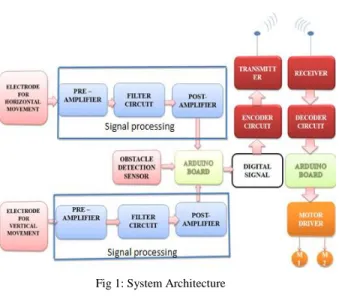
CONTROLLING WHEELCHAIR Fig 1 shows the overall architecture of the Human Machine Interface system.Horizontal electrodes were used for detecting horizontal eye movements which are left and right eye movement and Vertical electrodes were for detecting vertical movements such as up and down cornea movements. Signal processing methods include pre-amplifier, filter circuit and post amplifier. Filter circuit includes band stop filter, low pass filter and DC bias removal. These components are used to design the signal processing circuit to match the impedance with the Arduino board (Arduino mega 2560).
Conversion of analog to digitized signal is done and the digitized signal is encoded to transmit the signal to the Zig bee transmitter and decoded to receive it in the Zig bee receiver. Both the transmitters and receivers are connected to the Arduino board. These received signals are given as command signal to control the wheel chair which is with two motor drivers to move forward, backward, left, and right based on the command signal (eye movements) generated from eyes.
Fig 1: System Architecture
III. RELATED WORK
Gunda Gautam, Gunda Sumanth et.al [1] propose an Optical type eye tracking system which capture eye movements of an user and translate it to the screen position. This system is used to control powered wheel chair by tracking the eye movements. The images are captured and displayed in the laptop or a computer. These images are then processed and the microcontroller takes this output though the USB from the computer and classify those signals to control the wheelchair. They capture the image using MATLAB tool where the segmentation and finding the pupil as well as the exact direction to control wheel chair are done. Using the specially arranged camera, the sequence of iris images are captured and converted to RGB images. Non useful information from these images are removed to make the images as the control commands to control wheelchair. Ericka Janet Rechy-Ramirez et.al [2] propose an Emotive Epoc headset which can measure EEG activities from 14 saline conductor or an electrodes. These electrodes are arranged according to the 10/20 system. This EPOC sensor can be deployed to detect facial expressions and head movements of subjects, which are then recognized and converted to four uni-modal and two bi-uni-modal control modes to control and navigate the wheelchair. Nine Facial expressions including the up-down head movements has been tested, so that user or a subject can select some of these facial expressions and head movements to form the six control commands which are used as command signal to operate wheelchair. Experiments are conducted to show the performance of the HMI. Electromyography, Electroencephalography, and Electrooculography signals as well as vision techniques has been used for obtaining facial
expressions, thoughts, eye-gaze as well as the head and shoulder movements from the user to control the wheelchair.
Xiaodong Xu et.al [3] propose a myoelectric control systemswhich are based on surface electromyography signals proposed for the hands-free control of wheelchair. These signals are generated by the facial movements that are obtained by a bio-signal based electrodes sensing device. After the signals are captures, the features are extracted using the autoregressive model, the extracted features are made as the control commands to control wheel chair. These data samples are updated and trained by a learning algorithm which are done in real-time. Recognition-based controllers, are also used which are mainly constructed on threshold control as well as on the finite state machines, are merely pre-defined control commands that are based on a sequence of signal patterns which are captured from the muscles. Tom Carlson et.al [4] propose a brain controlled wheelchair system using EEG signals. The electrical activity of the brain are monitored in real time using EEG based electrode type, which are placed on the
brain such as scalp known as
electroencephalography. They also find some reliable correlates in the brain signals which are mapped to the intention, hence to perform specific actions while bypassing the peripheral nervous system. Then, Remote joystick module is developed which acts as an interface between a laptop or a computer and the wheelchair. This module directly allows the wheel chair to be controlled from the computer.
IV. METHODS TO CONTROL
WHEELCHAIR
A. Source of Signal and Signal Acquisition
Source of Signal
The Source of Signal is an eye which is a steady electric potential field. There is a fixed dipole such as the positive pole at the cornea and negative pole at the retina. The potential difference between this corneal and retinal region is measured. The resulting signals are called EOG signals.
Signal Acquisition
Signal is recorded through a medium called Electrode. It is a class of sensors or a conductor that transduce ionic conduction to electronic conduction. It is mainly used to acquire ECG, EEG, EMG, EOG signals etc. The Electrode used for recording EOG
Signal is made of Ag/AgCl (silver-silver chloride). This type of electrode will produce low levels of junction potential including the motion artifacts and drift in the direct current signals. EOG signals were recorded by placing silver-silver chloride electrodes on the region surrounding the eye. They were acquired from two separate regions such as the horizontal and vertical regions. Horizontal electrodes were placed for detecting horizontal eye movements known as the left and right eye movement, similarly the vertical electrodes were placed for detecting vertical movements such as the up and down cornea movements. Four to five electrodes were used to record the EOG signals. Electrodes x+ and x- are the horizontal electrodes and y+ and y- are the vertical electrodes. The fifth electrode will be placed on the forehead which is used as the reference electrodes. This electrode is used to make sure that whether all eye signals data are recorded including a small EOG signal.
Fig 2: Electrode Placement B. Signal Processing
The electrical potential that has generated from electrodes will be in the minimum range of 0 microvolt to 10 millivolt. This minimum voltage cannot be used to control the wheelchair, hence we need to boost this voltage to match the impedance with the Arduino board which is of 3.3V to 5V.The Arduino board used here is an Arduino mega 2560. Signal processing circuit involves Instrumentation amplification, Band stop filter, Low pass filter, DC bias removal, and Operational amplifier. First it is been designed using the proteus software and then the experiment is implemented by using the real hardware components.
C. Signal Classification
Signal classification part includes classification of basic eye movement types and blink. Classification is done using the java programming in Processing tool synchronizing with the Arduino tool. When the eye moves downward, the minimum peak shows that the signal will reflect to negative direction. When the eye moves upward which will represents the positive maximum peak accordingly. Similarly, when the eye moves rightward, the signal will be reflected to the right direction, hence the
maximum peak will be in positive direction which are same as when eye moves upward. Therefore when eye moves left, the minimum peak will show the signal to be in the negative direction.
Blink Movement
Blink movements are obtained from the vertical channel. Highest peak in the verticalchannel was obtained from blinking. Time span of blink waveform are short when compared to the othereye movements. This quick span was mainly due to the high-velocity of an eye blink. Blink can be voluntary or involuntary blinks. Involuntary blink are considered as a motion artifacts or noise.
Up – Down Eye Movements
EOG signals adore to up – down eye movements are dominant in vertical channel. From the observations, it was found that EOG signal due to up eye movement consists of a positive peak followed by a negative peak and therefore the amplitude of positive peak was higher than that of the negative peak. In the case of down movement, it was precisely the opposite.
Left – Right Eye Movements
EOG signals adore to left –right eye movements were found to be dominant in Horizontal channel. Hence their EOG Waveforms were the same as that corresponding to up – down movements.
D. Signal Transmission
A transmitter was used to transmit the command signal to the wheelchair module having a receiver. Transmitter will receive the serial data and it will be transmitted wirelessly using any wireless module through its antenna. The transmitted data will be received by a receiver operating at the same frequency as that of the transmitter.Received data will be in the serial mode. It needs to be converted back to parallel data by the decoder IC.Transmitter and receiver modules that can be used are Zigbee.
E. Wheelchair Control
The size of the intelligent wheelchair robot built at 32x18cm. Data was then processed by the Arduino microcontroller to govern the direction of the wheelchair model. Based on the command signal received, wheelchair will be controlled accordingly. Command signals can be of Left, right, forward, backward and blink movements. Wheelchair is
controlled wirelessly based on the eye movements generated from the human eye.
F. Navigation Point Algorithm
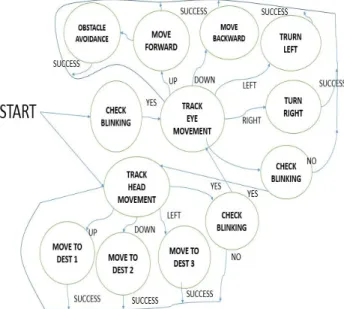
Navigation point Algorithm is used to navigate the wheelchair, it also finds a direct path from the start point to the goal point.Until the sensors detect an obstacle, the wheelchair will move towards the destination.Obstacle detection sensor is also used to notify about the obstacles which may be found in their path.The obstacles will be located at any shape or in any place. This sensor will detect the distance between the sensors and those obstacles that are near. Accelerometer sensor is also used to move from one start point to destination in a single head movement by the disabled person. The process ends when the wheelchair reaches the goal point.
Fig 3: Algorithmic Flowchart
Algorithm 1:Algorithm for wheelchair control
Input: EOG Amplified signal horizontal and vertical movement of eye.
Output: Decision of robot control mode and movement.
Begin
While true: do
Acquire the EOG signals w,x,y,z
Compute the horizontal h(w,x) and vertical movement v(y,z)
Compare the h(w,x) and v(y,z) to the threshold values h1,h2,v1,v2.
If (h(w,x)>0 and in range between h1 and h2):DO
Check for mode change control θ (u,v) If (θ (u,v)>0 and in range h1 and h2 ):do
Switch to path selection mode. Else:do COLLISION CHECKING If no collision: do Move forward If Collision: do OBSTACLE AOIDANCE
If (h(w,x)<0 and in range between h1 and h2):DO move backward
If (V(y,z)>0 and in range between v1 and v2):DO move right
If (V(y,z)<0 and in range between v1 and v2):DO move left
If(h(w,x)<0 and in range between h1 and h2):DO Check for mode change control θ (u,v)
If (θ (u,v)>0 and in range h1 and h2 ):do Switch to normal mode
Choose path1
If(h(w,x)>0 and in range between h1 and h2):DO
Choose path2
If(v(y,z)<0 and in range between h1 and h2):DO
Choose path3
If(v(y,z)>0 and in range between h1 and h2):DO
Choose path4
Algorithm 2: Algorithm for collision detection
Input: smooth path p and obstacle b
Output: obstacle checking and obstacle position Begin
Get the threshold distance (dth)
Calculate the distance(d) between bot (p) and obstacle(B) Compare d and dth If f(d,dth)=0:do Stop() return (d) else:do
return collision free
Algorithm 3: Algorithm for obstacle avoidance
Input: obstacle distance in right side and left side Output: Decision for choosing free path.
Begin
When collision occurs: do Stop
Set ɵx robot angle as (ɵx+90) Calculate dl
Calculate dr
Set ɵx robot angle as (ɵx+90)
Compare dl and dr by using q(m,n) function If q(m,n)>0:do Turnleft() If q(m,n)<0:do Turnleft() If q(m,n)=0:do Backward() return 0 V. CONCLUSION
In this paper, we have presented a detailed study on controlling the wheelchair using the bio-signal such as the EOG signals. In this work, an intelligent wheelchair has been developed at a low cost. An algorithm is presented for navigating the disabled person to reach the destination in a single head movement. A main conclusion is that it is possible to control the intelligent wheelchair using the EOG signal more accurately and effectively by tracking the eye movements through the use of electrodes.
REFERENCES
[1]Gunda Gautam, Gunda Sumanth, Karthikeyan K C, Shyam Sundar, D.Venkataraman, “Eye Movement Based Electronic Wheel Chair For Physically Challenged Persons”, International journal of scientific & technology research volume 3, issue 2, February 2014.
[2]Ericka Janet Rechy-Ramirez, “A Flexible Bio-Signal based HMI for Hands free control of an Electric powered Wheel Chair. ”, International Journal of Artificial research, 4(1), 59-76, January- March 2014.
[3]Xiaodong Xu, Yi Zhang, Yuan Luo and Dongyi Chen, “Robust Bio-Signal Based Control of an Intelligent Wheelchair”Robotics 2013, 2, 187-197; doi:10.3390/robotics2040187, 2013.
[4]Tom Carlson, Member IEEE, and Jos´e del R. Mill´an, Senior Member IEEE “Brain–Controlled Wheelchairs: A Robotic Architecture”, IEEE Robotics and Automation Magazine. 20(1): 65 – 73, March 2013. DOI: 10.1109/MRA.2012.2229936. [5]Soumya Sen Gupta, Sumit Soman, P. Govind Raj, Rishi Prakash, S. Sailaja, Rupam Borgohain, “Detecting Eye Movements in EEG for Controlling Devices”, IEEE International Conference on Computational Intelligence and Cybernetics, 2012.
[6]Rafael Barea, Luciano Boquete, Manuel Mazo, Elena López, L.M. Bergasa, “E.O.G. guidance of a wheelchair using neural networks”, Electronics Department. University of Alcala. Campus Universitario s/n. 28871Alcalá de Henares. Madrid. Spain.
[7]Jobin Jose, “Development of EOG Based Human Machine Interface Control System for Motorized Wheelchair”, Master of Technology in Biotechnology & Medical Engineering, National Institute of Technology Rourkela, June 2013.
[8]Hossein Mousavi Hondori, Pham Quoe Trung, Ling Shih-Fu “Simultaneous Sensing and Actuating for Path Condition Monitoring of a Power Wheel Chair”, Proceeding of the 2013 RSI/ISMInternational Conference on Robotics and Mechatronics February 13-15,2013,T ehran, Iran.
[9]Jobby K. Chacko, Deepu Oommen, Kevin K. Mathew, Noble Sunny, N. Babu, “Microcontroller Based EOG Guided Wheelchair”, World Academy of Science, Engineering and Technology International Journal of Medical, Health, Pharmaceutical and Biomedical Engineering Vol:7 No:11, 2013.
[10]Koo Yin Hui “Guiding wheelchair motion using EOG signal based on Bug two algorithm”, june 2012. [11]Nurul Muthmainnah Mohd Noor, Salmiah Ahmad, “Analysis of Different Level of EOG Signal from Eye Movement for Wheelchair Control “, Department of Mechatronics, Kuliyyah of Engineering, IIUM, Gombak, Malaysia 2012. [12]D.Uma Mageswari, G.Selvavinayaga “Wheelchair Motion Control Guide Using Eye Movement Based on EEG Signals”, International Journal of Engineering Sciences & Research Technology, May 2013, ISSN: 2277-9655.
[13] Robert Krupin´ski and Przemysław Mazurek, “Real–Time Low–Latency Estimation of the Blinking and EOG Signals”, www.intechopen.com.
[14] Hari Singh, Dr. Jaswinder Singh,“Human Eye Tracking and Related Issues: A Review”, International Journal of Scientific and Research Publications, Volume 2, Issue 9, September 2012, ISSN 2250-3153.
[15]Yash Shaileshkumar Desai, “Natural Eye Movement & its application for paralyzed patients”, International Journal of Engineering Trends and
Technology (IJETT) – Volume4, Issue 4, April 2013,ISSN: 2231-5381.
[16]Roshani Ninama, Rutu Nayak,“Review on Eye Movement Controlled Wheelchair”, International Journal of Engineering Development and Research, Volume 2, Issue 2, 2014, ISSN: 2321-9939.
[17]Zhao Lv1, Xiao-Pei Wu1, Mi Li, De-Xiang Zhang, “Development of a human computer Interface system using EOG”, HEALTH, 2009, 1, 39-46, Published Online June 2009 in SciRes. http://www.scirp.org/journal/health.
BIOGRAPHY
C.Kavitha currently pursuingM.E Computer Science
and Engineering in Saveetha Engineering College. She received her Bachelor’s degree in Computer Science and Engineering from Agni College of Technology Her area of interest includes Human machine interface, Bigdata, Cloud Computing, Networks and Network Security.
G.Nagappan currently working as Associate Professor in Saveetha Engineering College. Received Bachelor degree in Computer Science and Engineering from the Periyar University and Master’s degree in Systems Engineering and Operations Research from Anna University. Completed the Doctor of Philosophy in Information & Communication Engineering from Anna University, Chennai. Research interest includes VANETs, Wireless Sensor Networks,Human Computer Interface, Image Processing, Computer Networks, Cryptography and Network Security, Computer Graphics and Multimedia.