DOI : https://doi.org/10.32628/IJSRCSEIT
Search Engine Optimization
Saba Karim
Computer Engineering, DPES Dhole Patil College of Engineering, Pune, Maharashtra, India
ABSTRACT
Due to the presence of vast number of websites, the search engine has a difficult and crucial task of providing the relevant pages to the user and the search engine as Google uses page Ranking Algorithm to rank web pages as per the quality of the content and the presence over the WWW. Search Engine Optimization is a process that increases the chances of web pages to appear top of the search results. By providing the keyword as a phrase instead of the full web address the user wants the information related his requirement, and then search engine uses keyword to find the relevant pages at the top. Therefore, the organization could use Search Engine Optimization techniques to reach the maximum potential consumer by appearing the result at the top. In this paper, we will be classifying and reviewing different technologies for SEO and the main content for developing an SEO friendly website.
Keywords : SEO, File Transfer Protocol, Page Ranking Algorithm, Crawler, Search Engine
I. INTRODUCTION
Search Engine is a web-based application program that searches different websites, documents, and files for keywords and phrases provided by the user over the internet and display the results in the form of a hyperlink to relevant web pages. SEO is a technique, which is implemented to improve the relevance of the webpage in the results produced by the search engine.
Developing an SEO-friendly site architecture requires a significant amount of thought, planning, and communication due to the large number of factors that influence the ways a search engine sees our site and the large number of ways in which a website can be put together, as there are hundreds of tools that web developers can use to build a website – many of which were not initially designed with SEO, or search engine crawlers.
II. METHODS AND TECHNIQUES
Search Engine Architecture: There are two ways in which crawler can access the web sites.
• Manual method and
• Automatic method
1) Algorithm: Algorithm is used to eliminating bad websites and as per the user requirement, it added more information.
2) Page Rank Algorithm: By analyzing the search engine, it determines the value of the page. 3) Algorithm Update: Algorithm update is use to
fight against the spam Google and other search engine create new algorithms regularly and released.
5) Penguin Update: The Penguin update will target the website which does many back links over optimization and. To know whether the website is hit with penguin then we can use traffic data from Google analytics store.
6) Humming bird update: The Humming bird
algorithm understands the context of the query analyzing the word in query.
7) Knowledge Graph: knowledge graph shows some
queries that Google can show more information on the right side area.
8) SERP (Search Engine Result Page): Google SERP consists of the lot of segments that makes very competitive any company to rank in search result. 9) Pigeon Update: The pigeon Update will be affected on the site ranking in local result for local Search Engine Optimization.
10)Pirate Update: Pirate update is released for the target that the website disturbing pirate content. (E.g. Movies download, Torrent, software site and pirate songs etc.)
III.WORKING PROCESS
All paragraphs must be indented. All paragraphs must be justified, i.e. both left justified and right justified.
A. Google Webmaster Tools
Using Webmaster Tools is a great way to see how the search engines perceive our site. We can create a Webmaster Tools account with either Google or Bing quite easily. An important part of creating these accounts is verifying our ownership of the site.
B. Keywords
Keyword research is one of the most important, valuable, and high-return activities in the search engine-marketing field. With keyword research, you can predict shifts in demand, respond to changing market conditions, produce the products, services, and content that web searchers are already actively seeking.
Types of Key word:
Generic terms: These types of keyword are very high volume, we could not predict the user intension, in this the competition are also very high. (E.g. Web design, Web, SEO etc).
Specific Term: The user intention can be predict and there is medium range as well as medium completion (E.g. Web Design Service).
Localize Term: Here the completions are very low we can predict the intension as well as the location of the user.
C. On Page Optimization
On page, optimization is a process where as per the Google or any other search engine guidelines tell us about the changing of our site. We will not be able to get SEO without on page optimization.
There are some factors of On Page Optimization some of them are as follows:
Keyword Research: With keyword research, we can predict shifts in demand, services, respond to changing market conditions and content that web searchers are already actively seeking.
Title Tag: The title tag defines page title and informs the search engine about the theme of the website.
Heading Tag: It is used to lay proper stress on the important text.
Content: Content should have use the proper target key word, perfectly described the theme and idea of the website.
Some on page optimization techniques are:
Page speed Analysis, domain name, static and dynamic URLs name, meta tag optimization, content
optimization, heading optimization, keyword
D. Off Page Optimization
Of page optimization are just the opposite of on page optimization, this is consisting of that elements which are not directly control of the developer mainly outside the website, promotion of social platforms etc.
Some factors of off page optimization:
Star Rating: The user gives star as a review that will consider by the Google or any other search engine that give rank as per the user review.
Sharing: To increase the popularity and traffic our website as a developer we have to share the information as much as we can.
Link building: Link the multiple the search engine consider that website more relevant, so the more black link is more page ranking in search result of the website.
E. Making the site Accessible to Search Engine
The first step in the SEO design process that is we have to ensure that our site can be found and crawled by the search engines. This is not so simple because lots of implementation constructs that the crawler may not understand.
Indexable content: The content should be in a proper format, the material available to visitors of our Site should be in HTML text form. Images are a file type that the search engines have challenges with “identifying” from a relevance perspective, as there are minimum text-input fields for image files in GIF, JPEG, or PNG format.
Spiderable Link Structures: As the search engine use links on web pages to help them discover other web pages and websites, we have strongly that recommend taking the time to build an internal linking structure, which spiders can crawl easily.
Benefits of Site Maps:
• If the URLs that may be duplicate, the engine can use XML sitemaps data that will help us to chose a canonical version.
• If we verify and registered the XML Sitemaps, it may indicate positive trust and authority signals.
• Using a site map registered with Google
Webmaster Tools can give us an extra analytical insight into whether our site is suffering from crawling, indexation, duplicate content issues.
F. Creating an Optimal Information Architecture
Making our site friendly to search engine crawlers also requires that we put some thought into your site
information architecture. Well-designed site
architecture can bring many benefits for both search engines and users.
Usability and search friendliness: Search engines are trying to reproduce the human process of sorting relevant web pages by quality. If a real human were to do this job, usability and user experience would surely play a large role in determining the rankings.
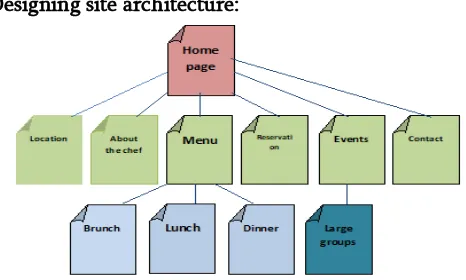
Designing site architecture:
Figure 1. Designing site architecture
G. Root, Domains, Subdomains, and Microsites
domain, when to use subfolders, and when to employ microsites.
When to Use a Subfolder: Subfolders can be registered with the major search engine tools and geo-targeted individually to specific countries and languages as well. Subfolders can be registered with the major search engine tools and geo-targeted individually to specific countries and languages as well. Subfolder content will contribute directly to how search engines view the domain as a whole.
When to Use Subdomains: We have to ensure that subdomains may inherit very little link equity from the main domain. If we want to split our site in the subdomains and have all of them rank well, will have to support each with its own full-fledged SEO strategy. Subdomains may also be a reasonable choice.
Microsites: Here are the reasons for not using microsites
• Search algorithms favor large, authoritative domains
• Multiple sites split the benefits of links
• A large, authoritative domain can host a huge variety of content
• Time and energy are better spent on a single property
H. Optimization of Domain Names/URLs
Optimization of Domain: Some guidelines for optimizing to select the best domain name
• Make the domain unique
• Choose only dot-com available domains • Keep the name as short as possible
• Reject hyphens and numbers
I. Keyword Targeting:
It is a tough task for the search engine to ensure that the relevant list search engine returns as a result what
the user want to search. By using the keywords, it is easy for the search engine to return the relevant list but we have to use the perfect keyword for our site that must be related to the user’s need that searched.
Some guidelines
• Place your keywords at the beginning of the title tag
• Limit length to 50 characters (including spaces) • Incorporate keyword phrases
• Focus on click-through and conversion rate
J. Duplicate Content Issues
Three categories of duplicate content
Exact duplicate: whereby two URLs output identical content
Near duplicates: whereby there are small content differentiators (sentence order, image
Variables, etc.)
Cross-domain duplicates: whereby exact or near duplication exists on multiple domains
How to Avoid Duplicate Content on our site:
• Use robots.txt to block search engine spiders from crawling the duplicate versions of pages on our site. • Use the canonical tag. This is the next best solution
to eliminating the duplicate pages.
• Use the Robots No Index meta tag to tell the search engine to not index the duplicate pages
K. Redirects
A redirect is used to indicate when content has moved from one location to another. Once a redirect is implemented, users who go to the old versions of our pages will be sent to the new versions of those pages.
• Why and When to Redirect:
• We have old content that expires, so we remove it • We find that we have broken URLs that have links
and traffic.
• We change our hosting company.
IV.CONCLUSION
The study started with the aim to analyze the different techniques related to the SEO and know the aware of search-engine-friendly website is the first step towards SEO success. Based on the discussion it has been found that in case of the digital marketing the most important aspect is to connect with the users. Thus, with the rapid growth of technology, the search engines will continue to enhance and upgrade their search ranking algorithms, thus the developers or website owners must continue to enhance and learn new SEO strategies to increase the visibility, user base and to sustain higher raking in the search results.
We have discussed many techniques in this paper, which can be used to increase the presence of a webpage on the internet
V. REFERENCES
[1]. Ad week. (2016) What Trends Will Drive Digital Marketing Success in 2016?. [online].Available from:
http://www.adweek.com/socialtimes/what- trends-will-drive-digital-marketing-success-in-2016/632884 [Accessed 5 Apr. 2016]
[2]. Brennan, R and Croft, R. (2012) The use of social media in B2B marketing and branding: An exploratory study. Journal of Customer Behavior, 11(2), pp.101-115.
[3]. Chaffey, D. (2010) Applying organizational capability models to assess the maturity of digital-marketing governance. Journal of Marketing Management, 26(3-4), pp.187-196. [4]. Leppäniemi, M; Karjaluoto, H; Lehto, H and
Goman, A. (2010) Targeting young voters in a
political campaign: Empirical insights into an interactive digital marketing campaign in the 2007 Finnish general election. Journal of Nonprofit & Public Sector Marketing, 22(1), pp.14-37.
[5]. R.S. Bhandari, A. Bansal. "Impact of Search Engine Optimization as a Marketing Tool." Jindal Journal of Business Research 7.1 (2018): pp.23-36.
[6]. K. Kanathey, R. S. Thakur, and S. Jaloree. "Ranking of Web Pages Using Aggregation of Page Rank and HITS Algorithm." International Journal of Advanced Studies in Computers, Science and Engineering 7.2 (2018): pp.17-22. [7]. L. Kumar, N. Kumar. "SEO Technique for a
website and its effectiveness in the context of Google Search Engine." International Journal of Computer Science and Engineering (IJCSE) Vol 2 (2014): pp 113-118.
[8]. E.D. Ochoa,” Analysis of the application of selected search engine optimization (SEO) techniques and their effectiveness on Google's search ranking algorithm”. Diss. California State University, Northridge, 2012 pp 34-40
Cite this article as :