Impact of Guidance and Counselling Services on Students’
Behaviour Modificatio between Selected Public Urban and Rural
Secondary Schools in Rift Valley Province, Kenya
Davis M. Gatua A.M.Sindabi M.C. ChepchiengDepartment of Psychology Counselling and Educational Foundation, Egerton University, P.O. Box 536-20115, Njoro, Kenya
Abstract
The study sought to establish and compare the impact of guidance and counselling services on students’ behaviour modification in social and emotional adjustment in the selected public urban and rural secondary schools in Rift Valley Province, Kenya. The study adopted ex post-facto causal comparative research design The research population was form 4 students in 24 secondary schools from municipality: Eldoret, Naivasha and Nakuru,and rural/district: Uasin Gishu, Kuresoi and Molo Simple random, stratified and purposive sampling techniques were used to select 346 students, 48 school counsellors and 48 school administrators as respondents. Quantitative data was collected by administering questionnaires to students and school guidance counsellors while Qualitative data was collected through conducting an interview schedule to school administrators. Questionnaires were pilot tested before use and were found to have reliability coefficient of 0.8. The study employed one way analysis of variance (ANOVA) to test the hypothesis at 0.05 level of significance.The Statistical Packages for Social Sciences (SPSS) version 20.0.helped in data analysis. The findings of the study indicated that guidance and counselling services in secondary schools had statistically significant impact on the level of social and emotional adjustments. Rural schools indicated high level of impact of guidance and counselling services where female students expressed higher level of behaviour modification in social and emotional adjustment It was concluded that guidance and counselling services in secondary schools helps in modifying students’ behaviour in social and emotional adjustments. Stakeholders in education sector and other youth institutions could find these findings useful in addressing secondary schools students’ social and emotional needs.
Keywords: Behaviour Modification, Guidance and Counselling Services, Social and Emotional Adjustment, Rural andUrban Secondary Schools
Introduction
The need for guidance and counselling services in all secondary schools cannot be overstated due to increasingly complexities of modern life that have placed heavy demands and responsibilities on secondary school students. These students are faced with numerous personal, academic, social and emotional needs and problems in which if unattended could lead to host patterns of undesirable behaviours (Weiten, 2007).. Virtually, all countries have established channels to intensify and improve guidance and counselling services in their respective learning institutions in attempt to address tenets of students’ behaviours. The history of guidance and counselling around the world varies greatly based on how different countries and local communities have chosen to provide personal, academic, and social competencies among the post primary students
Kaminer (2004) contends that in the United States, the school counselling profession began as a vocational guidance movement at the beginning of 20th century when a systematic school guidance program was developed and provided for the consumption by the schools. The movement emphasized on personal issues, social and emotional adjustments in order to develop and promote students’ character and avoid behavioural problems. In Japan, the goal of high school guidance counselling services is to help every student develop abilities of self-understanding, decision- making, life planning studies on the modification of behaviour among students and action taking to be able to adjust to social and emotional adjustment (Watanabe-Muraoka, 2007). According to Makinde (1984), African states need to establish guidance and counselling programmes in education sector to curb undesirable behaviour and inculcate desirable behavioural patterns among students
In Kenya, guidance and counselling is an initiative that is aimed at providing information and skills to impart self- awareness and optimal use of students’ potential for holistic growth and development (Muriithi, 2007). Dondo (2004) holds the view that school guidance and counselling in Kenyan context, employs ‘whole person approach’ in addressing the increasingly and complex needs of the secondary school students which include social and emotional challenges. Since the attainment of independence in 1963, the Government of Kenya has embraced the establishment of guidance and counselling services in secondary schools through the Ministry of Education (MOE, 2008). In order to improve students’ social and emotional adjustment, quality and standard of Education in Kenya, the government has from time to time appointed various Education Commissions, Committees, and Task Forces to address various challenges facing the education sector (KIE,
2007). The report of the National Committee on Educational Objectives and Policies (G.O.K, 1976), recommended the establishment of Guidance and Counselling programme in secondary schools for enhancement of total growth and development of the youth.
The Commission of Inquiry into Education System of Kenya (G.O.K, 1999), recommended that the Guidance and Counselling programme in high schools be strengthened for effective assistance of students in their needs: Personal, academic, social and emotional assessment. The report of the Vice Chancellor’s Committee on causes of Disturbances/Riots in Public Universities (G.O.K, 2000), revealed that lack of Guidance and Counselling that enhance growth and development of learners in high schools result to student problems in Universities. The Task Force on Students Indiscipline and Unrest in Secondary Schools (G.O.K, 2001) indicates that lack of guidance and Counselling services is a major cause of indiscipline and students’ unrest in secondary schools. The Presidential Working Party on Education and Manpower Training for the Next Decade and Beyond. (G.O.K, 1988) articulates the need to strengthen the Guidance and counselling programme in secondary schools to aid in students’ holistic growth and development.
According to Karega (2008), learning in secondary schools is often interrupted by the deviant behavioural patterns of the adolescents. Dryafol (2002) pointed out that secondary school students carry along with them a host of adolescent challenges. They are highly influenced by technological change and transformation. Also, the high school students experience erratic physiological changes resulting to unpredictable mood swings, social development and changes that are evident; for instance they become defiant to the authority (Conger & Peterson, 1984). Sindabi (1992) postulates, that young people in secondary schools undergo emotional development, manifesting characteristics of being erratic, irritable, unpredictable, ambivalent, critical and rebellious.
Allen (2002) depicts guidance and counselling as an ultimate icon that addresses students’ behavioural content, taking into account context, global issues, local priorities, building moral capacities based on rational decision-making, social tolerance, environmental stewardship, adaptable student force and quality of life. The M.O.E (2008) argues that the secondary school students’ disturbances are gradually decreasing since the year 2001 when the Ministry demanded that guidance and counselling department be established in every secondary school in the country. Table 1 gives statistics of students’ disturbances from1990 – 2010.
Table 1
Schools Involved in Students' Disturbances in Kenya from 1990-2010
Year Cases of Arson Destruction Deaths of Students Cancellation of KCSE
1990 – 2000 200 318 25 3720 2001 – 2010 Total 120 320 210 528 16 41 2645 6365 Source: Education Watch (2008)
Rift Valley secondary schools have also experienced devastating consequences of students’ disturbances in the last one decade. However, there has been a significant decrease in students’ disruptive behaviours since 2001. The Rift Valley Provincial Education statistics (2010) indicate a decline in cases of students’ undesirable behaviour on the awake of establishment of guidance and counselling services in the year 2001 in Kenyan secondary schools as shown in Table 2
Table 2
Schools involved in Student's Disturbances in Rift Valley, 2001−2010
Year Cases of Arson Destruction Deaths of Students Cancellation of KCSE 2001 – 2003 67 85 4 637 2004 – 2006 34 42 2 249 2007 – 2009 28 36 - 253 2010 Total 4 133 15 178 2 8 248 1387 Source: Rift Valley Provincial Education Office: Statistics Department, 2010
Therefore, this study sought to provide a pertinent case to examine in depth, the impact of guidance and counselling services in public urban and rural secondary schools students’ behaviour modification in Rift Valley Province, Kenya.
The following hypothesis was tested at 0.05 level of significance:
There is no statistically significant impact of guidance and counselling services on students’ social and emotional adjustments in selected urban and rural secondary schools in Rift Valley province.
Research Methodology
This study adopted ex post facto causal comparative research design. According to Gitau (2008) the design permits a comparison of two or more items without necessarily manipulating the independent variables. Thus the
study upholds the guidelines for educational research and social sciences research studies on human behaviour (Fraenkel &Wallen, 2000). In the study, ex post facto causal comparative design helped to determine and compare the impact of guidance and counselling services (independent variable) and students’ behaviour modification in secondary schools settings. Also, Oso and Onen (2009) has confirmed that ex post- facto causal comparative research design is suitable for extensive educational research and psychological related studies where this study falls.
Population of the Study
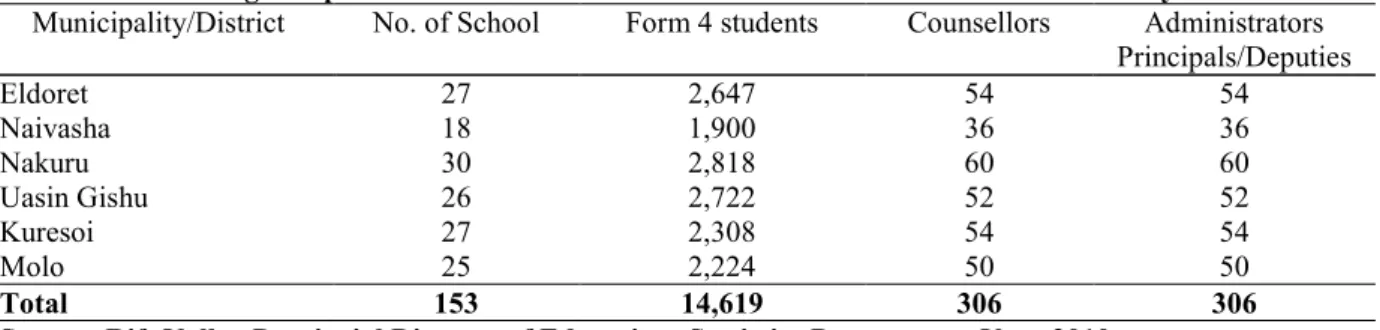
The target population of this study comprised all form four students in Rift Valley Province, school counsellors, and school administrators (Deputy Principals and the Principals). A study by Loescher (2006) indicated that form four students are considered to be more mature in their reasoning, expression of own ideas, and feelings and even having higher ability of explaining their observations in relation to the area under the study and that being in school for longest time were better placed and most appropriate respondents in this study. According to Rift Valley Director of Education, Statistics Department (2010). The target population consisted of 14,619, form four students, 306 counsellors and 306 school administrators from 153 schools while the accessible population was 3,345 students, 48 school counsellors and 48 administrators (principal and deputy principals). These schools are in municipalities of Eldoret, Naivasha and Nakuru and Rural/ Districts of Uasin Gishu, Kuresoi and Molo.
Table 3 shows the distribution of the target population of the study in the selected public urban and rural secondary schools.
Table 3
Distribution of Target Population in Selected Public Urban and Rural Schools in Rift Valley
Municipality/District No. of School Form 4 students Counsellors Administrators Principals/Deputies Eldoret 27 2,647 54 54 Naivasha 18 1,900 36 36 Nakuru 30 2,818 60 60 Uasin Gishu 26 2,722 52 52 Kuresoi 27 2,308 54 54 Molo 25 2,224 50 50 Total 153 14,619 306 306
Source: Rift Valley Provincial Director of Education: Statistics Department, Year 2010.
The study used the codes for individual schools for the purpose of confidentiality. Table 4 shows the population of the twelve (12) selected public urban secondary schools
Table 4
Distribution of Accessible Population in the Selected Urban Schools
Municipal Schools code Boys Girls Total
Eldoret EL01/BB EL02/MD EL03/MD EL04/MD 134 95 72 74 - 73 66 52 134 168 138 126 Naivasha NV01/MD NV02/MD NV03/GB NV04/MD 79 74 - 88 64 59 98 62 143 133 98 150 Nakuru NK01/MD NK02/BB NK03/GB NK04/MD 106 206 - 76 74 - 122 58 180 203 122 134 Total 1001 728 1729
Source: Rift Valley Provincial Director of Education: Statistics Department, 2010
The study also selected twelve (12) secondary schools from the rural setting. Table 3.3 shows the students’ population in rural areas.
Table 5
Distribution of Accessible Population in Selected Public Rural Schools
District School Code Boys Girls Total
Uasin Gishu UG901/MD UG902/BB UG903/GB UG904/MD 92 110 - 86 73 - 136 66 165 110 136 152 Kuresoi KU 801/MD KU802/MB KU803/MB KU804/GB 56 74 78 - 38 52 54 108 94 126 132 108 Molo ML701/MD ML702/MBD ML703/MD ML704/MDB 76 82 79 82 70 80 58 66 146 162 137 148 Total 815 801 1616
Source: Rift Valley Provincial Director of Education; Statistics Department, 2010
The study selected a sample size of 346 students, 48 school counsellors and 48 school administrators (principals and D/principals). Therefore the total sample size was 444 respondents. The students’ sample size was arrived at by using the formula provided by Kathuri and Pals (1993).The formula is:
)
1
(
)
1
(
)
1
(
2 2 2P
N
d
P
NP
S
−
+
−
−
=
χ
χ
WhereS = Required Sample Size
N = The given population size (in this case 3,345 form 4 students)
P = Population Proportion of individual that yield maximum possible sample size (Assumed to be 0.5)
d = Degree of accuracy as reflected by the amount of error that can be tolerated (taken as 0.5)
χ2 = Table Value of chi-square for one degree of freedom taken as 3.841 for the 0.95
The students’ sample size was drawn from the randomly selected 12 urban and 12 rural secondary schools. The schools were randomly selected from the 3 municipalities (urban) and 3 districts (rural) settings. Stratified random sampling technique was employed to obtain a sample size of 179 urban respondents (students) and 169 rural respondents. Further, proportionate sample of respondents was selected in mixed schools to obtain representative boys and girl’s respondents. Then, simple random technique was adopted to select student respondents from individual schools, a technique supported by Gitau, (2008). Purposive sampling technique was employed to select 48 school counsellors and 48 school administrators (D/principals and principals). The rationale for purposive sampling is that the respondents possess the information that meet the purpose of this study. Table 6 shows the sample size in public urban schools while Table 6 and 7 show the sample size in public urban and rural secondary schools respectively
Table 6
Distribution of Sample in Public Urban Secondary Schools Municipality School Code Teachers
Counsellors Schools Administrators Boys Girls Eldoret EL401/BB 2 2 14 - EL402/MD 2 2 11 7 EL403/MD 2 2 8 6 EL404/MD 2 2 7 6 Naivasha NV501/MD 2 2 9 6 NV502/MD 2 2 8 6 NV503/GB 2 2 7 5 NV504/MD 2 2 9 6 Nakuru NK601/MD 2 2 10 8 NK602/BB 2 2 9 9 NK603/GB 2 2 7 7 NK604/MD 2 2 8 6 Total 24 24 107 72
Table 7
Distribution of Sample in Public Rural Secondary Schools District School Type Teachers
Counsellors
School Administrators
Boys Girls
Uasin Gishu UG/701/MD 2 2 9 6
UG702/BB 2 2 7 5 UG703/GB 2 2 8 6 UG704/MD 2 2 9 6 Kuresoi KU801/MD 2 2 7 5 KU802/MB 2 2 9 5 KU803/MB 2 2 8 6 KU804/GB 2 2 7 5 Molo ML901/MD 2 2 10 6 ML902/MDB 2 2 10 7 ML903/MD 2 2 8 5 ML904/MBD 2 2 9 6 Total 24 24 101 68
The students’ and schools counsellors’ questionnaires were designed to collect the quantitative data on the impact of guidance and counselling services on students’ behaviour modification between public urban and rural secondary schools. Use of questionnaire to obtain quantitative data was found to be most appropriate tool since large amount of information would be collected from a large sample size within expected period of time and without effecting the validity and reliability of the instrument as explained by Gitau (2008). Also the quantitative data can be analyzed more scientifically and objectively and the results can easily be quantified by a use of a software package or a researcher where the quantified can data used to measure some impact or any change and offer basis for comparison of variables (Mugenda & Mugenda, 1999).
An interview schedule was conducted to obtain the necessary and detailed qualitative data from the school administrators (principles and deputy principles) on the impact of guidance and counselling services on students’ behaviour modification. A study by Mc Leods (2006) pointed out that qualitative data is essential in an educational and psychological research study since it supplements the quantitative data.
Both descriptive and inferential statistical techniques were used to analyse the data, whereby descriptive statistics involved frequencies percentages and mean scores. On the other hand, inferential statistics;
one way analysis of variance (ANOVA) was used to test the significance of quantitative data. Further, Post hoc LSD test was carried out to reveal comparison of differences in impact in variables of the study. The hypothesis was tested at significance level set at alpha 0.05. The data was analysed by use of a Computer programme, the Statistical Package for Social Science (SPSS) version 20.0 for windows.
In analysing the qualitative data, The study used excerpts to give representative information required where the researcher evaluated the meaning, importance and usefulness of the information given by the respondents.
The researcher sought quantitative data from the sampled 346 students and 48 school counsellors while qualitative data was gathered from school administrators (Principals and Deputy Principals) by use of interviews as represented in Table 8.
Results and Discussion
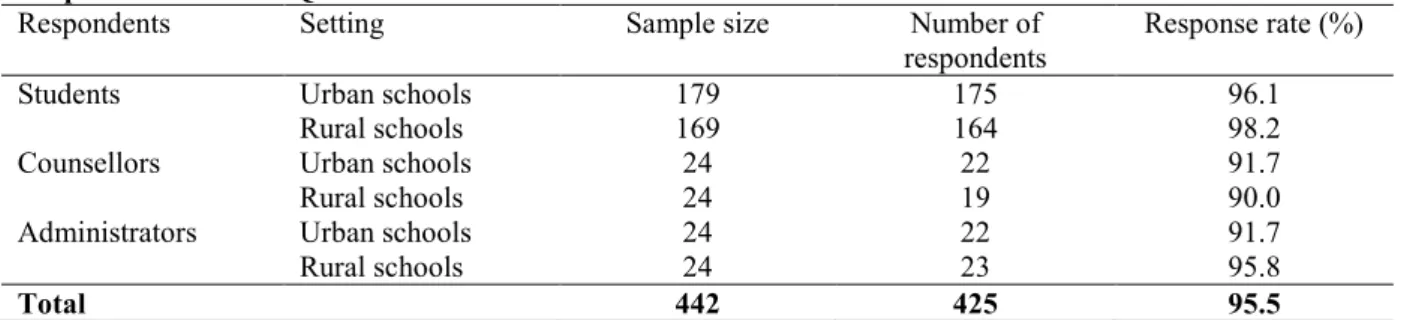
The response rate for the study as shown in table 8
Table 8
Response Rate of the Questionnaires and Interviews
Respondents Setting Sample size Number of
respondents
Response rate (%)
Students Urban schools 179 175 96.1
Rural schools 169 164 98.2
Counsellors Urban schools 24 22 91.7
Rural schools 24 19 90.0
Administrators Urban schools 24 22 91.7
Rural schools 24 23 95.8
Total 442 425 95.5
Table 8 indicates that response rate for urban students were 96.1 %, where 175 out of 179 urban students responded to the administered questionnaires. In the rural setting, 98.2% students were responsive to the administered questionnaires where 164 out of 167 returned their questionnaires. For the urban school counsellors 91.7 % responses were received indicating that 22 out of 24 counsellors actively participated in the
study. In the rural set up, 90 %, that is 19 out of 24 school counsellors responded to the administered questionnaires.
It is evident that 91.7 % of the urban school administrators responded to an interview which means that 22 out of 24 were available for the interviews. In the rural schools, 95.8% of the school administrators responded indicating that 23 out of 24 availed themselves for the interview. The attrition in the school administrators was caused by unpredicted call of official duties outside the schools. However, these response rates were considered very sufficient for analysis and to draw conclusions and recommendations when compared to the recommended response rates to verify consistency of measures required of over 60 % (Kothari, 2009).
Demographic Characteristics of Students in Urban and Rural Secondary Schools
Section A of the student’s questionnaires sought information on their demographic characteristics. This information was crucial in getting the necessary data for describing the main respondents of the study. The study involved 346 students as respondents. Nevertheless, the analysis of the responses depicted slight variations for the sampled size. Table 9 shows the distribution of students by gender in both urban and rural secondary schools.
Table 9
Distribution of Students by Gender in Urban and Rural Schools
Gender Urban Rural Sample size Actual Respondents Sample size Actual Respondents
Male Frequency % Frequency % Frequency % Frequency %
Male 107 59.8 97 90.7 102 60.4 102 100
Female 72 40.2 72 100 67 39.6 67 98.5
From Table 9, it is revealed that male students in both urban (59.8 %) and rural (60.4 %) secondary schools outnumbered female students represented by 40.2 % and 39.6 % respectively. However, boy’s enrolment in rural schools (60.4 %) is slightly higher than those in urban schools. On the same note, it is vividly clear from the table that girls enrolment in urban schools (40.2 %) is high than those enrolled in rural secondary schools, (39.6 %). A research by Gatua (2008) illustrated that enrolment of more boys than girls is a common trend observed in Kenyan education despite the government’s effort to encourage all children to go to school. The low enrolment of girls in secondary education poses a great challenge especially in rural areas without regard to governments’ affirmative action that permits girls to be admitted in public secondary schools alongside the free secondary education (MOE, 2008). A study by Nyaga (2011) found that gender disparity in Kenyan education may be attributed to the reasoning in the African cultural context that education of males is seen to be a better investment choice than the females’ education. MOE and USAID (2007) attempted to substantiate that the low tendencies of girls enrolment in secondary schools particularly in rural areas emanates from a high rate of school dropout for girls. United Nations Girls Education Initiative (UNGEI) Kenya chapter in collaboration with KESSP (2005) conducted a study and confirmed that there seems to be a wide disparity in enrolment for girls in Kenyan secondary schools especially in rural areas where more girls are involved in domestic chores in favour of boy children.
Impact of Guidance and Counselling Services on Students’ Social and Emotional Adjustment by Students
The fourth objective of the study was to determine whether there existed any significant impact of guidance and counselling services on students’ social and emotional adjustment between urban and rural secondary school students in Rift Valley Province.
The students reflected the levels of impact of guidance and counselling services on the social and emotional adjustment as shown in Table 10,
Table 10
Impact of Guidance and Counselling Services on Students’ Social and Emotional Adjustment
Setting N Low Moderate High
F % f % F %
Urban 172 15 8.7 19 11.0 138 80.2
Rural 164 6 3.7 12 7.3 146 89.0
The data in Table 10 shows that most of the urban student respondents, 138, representing 80.2% rated a high level of impact of guidance and counselling services on students’ social and emotional adjustment. Also, 15 urban student respondents (8.7%) ranked the impact of guidance and counselling as low while 19 (11.0%) rated it as moderate. On the other hand, more of the rural student respondents, 146 representing 89.0% scored the level of impact guidance and counselling services on students’ social and emotional adjustment as high. On the same setting, the data indicated 12 respondents (7.3%) and six (6) respondents (3.7%) positioned the level of impact of guidance and counselling services as moderate and low distributive. Further, the data indicated that the rural respondents scored high level of the impact of guidance and counselling with 89.0% in comparison with the less high level 80.2% rated by the urban respondents.
emotional adjustment in all the three levels low, moderate and high in comparison with students’ relatively low scores in urban schools, has received endorsement from Esuong (2011). Ng’ang’a (2002) confirmed that social and emotional development adjustment of students is influenced by three factors which seem to be in favour of rural school settings. These factors include community factors where rural schools are commonly dominated by a particular ethnic group of students. Such schools are seen as mechanism for community cohesion and continuity of cultural norms and values standards which dictate social relationship based on emotional mutual adjustment. Mutie and Ndambuki (1999) maintained that social emotional adjustment among rural school students would be higher due to location with single ethnic community contrary to the urban school with multicultural; context. The location contributing to a steady social and emotional competence among students in rural schools (Ng’ang’a, 2002). The reason for higher score in SEA in rural schools as advocated by Coleman (2007) regards to location with less challenges as compared to complex distracters of social cohesion and emotional adjustment in urban schools. Such distractions include loneliness, high exposure to pornographic materials, easy access to drug and substance abuse and loose cultural norms, values and standards due to diverse cultural practices.
The findings in table 24 tend to agree with the reviewed literature. Sheldon and Ames (1999) hold the view that social and emotional adjustments are central to all aspects of life, including intellectual performance, social behaviour and physical health. Macharia (2007) attempts to explain that students in rural areas are likely to respond more positively in matte pertaining to social and emotional adjustment. As noted by Olson and Defrain (2000) rural families are closely neaten together where such integration become a contributing factor in upholding of cultural norms, values, ethos and moral fibres. In addition, students from rural schools tend to change their behaviour as directed more swiftly as the respect of the community elites is always emphasized contrary to urban centres where permissiveness tend to take the front stage. As such, Brigman and Campbell (2003) argue that the key challenge for the 21st century secondary school students, especially those in urban centres, involve serving culturally diverse, high level of morally deviant behaviour antisocial and unstable emotions. According to Dondo (2004) many students lack social and emotional adjustment and become less connected to school as they progress from secondary schools to the post secondary institutions. Consequently, deficiency in social and emotional adjustment often impede students’ academic engagement, obedience and adherence to school rules, personal commitment and ultimate school success. Makinde (1984) articulates that comprehensive guidance and counselling services sets students standards for competences and adjustments’ to be achieved, contains a body of content and uses a variety of strategies to help students realize remarkable behaviour modification. As a fact, the goal or expected outcome of all guidance and counselling services is enhancement of development of competencies, coping skills and climax at behaviour change for a better and successful life.
Boutwell and Myrick (2006) contend that guidance and counselling plays a major role of promoting students’ success through a focus on social and emotional adjustment by means of prevention and intervention services, advocacy and treatment of emotional turbulence. In addition, guidance and counselling services provide students with the opportunity to learn more about themselves and others before they have problems resulting from fear, anger and mood swings. Weissberg and Walberg (2007) articulate that most students express a basic need of social and emotional adjustment which is grounded on foundations of comprehensive guidance and counselling services. These services integrate competence promotion and foster students’ social and emotional development framework for reduction of risk and detrimental behaviours such as substance use, promiscuous sex, violence, depression and attempted suicide that deter success in life.
Further, the study presented the levels that determined the impact of guidance and counselling services on students’ social and emotional adjustment as shown in figure 1.
2.49
3.71
4.28
2.05
3.45
4.3
0
1
2
3
4
5
Low
Mode rate
High
Urban Schools
Rural Schools
Figure 1: Levels (means) Indicating Impact of Guidance and Counselling Services on Students’ Social and Emotional Adjustments by Students
From figure 1 the means indicating levels of the impact of guidance and counselling services among rural and urban students are shown.
The figure indicates a mean of 4.28 and 4.07 for rural and urban schools respectively. The two means indicate that rural schools experience a higher level of the impact of guidance and counselling on students’ S.E.A. in comparison to the urban schools attaining high level with a mean of 4.07. Also, the levels of impact show that guidance and counselling have high impact (mean of 4 and above) on students’ SEA in both rural and urban schools. The levels depict a general trend where guidance and counselling have more impact in rural schools in comparison to urban schools. These findings suggest that levels (means) of the impact of guidance and counselling on students’ SEA there seem to be different. To ascertain whether there was any significant difference in the impact of guidance and counselling on students’ social and emotional adjustments, the data was subjected to statistical test of significance 0.05 level of significance using one way analysis of variance(ANOVA). The test was based on the study hypothesis three where null hypothesis stated that “There is no statistically significant difference in the impact of guidance and counselling services on urban and rural students’ social and emotional adjustment.” The results of the ANOVA test are as shown in Table 25.
Table 11
One Way Analysis of Variance (ANOVA) on Impact of Guidance and Counselling Services on Students’ Social and Emotional Adjustment
Groups Count Sum Average Variance
Low 18 40 2.267 0.566
Moderate 37 118 3.211 0.428
High 284 1352 4.762 1.116
ANOVA
Source of Variation SS Df MS F P-value F crit
Between Groups 36.395 1 36.395 24.823 0.000* 3.0545
Within Groups 249.254 337 1.466
Total 285.649 338
The ANOVA Table 11 shows that the computed p – value (0.000) was less than the set alpha level (P < 0.05). Therefore, it was ascertained that there was a statistically significant difference in the levels of impact of guidance and counselling services students’ social and emotional adjustment. Based on the results in the ANOVA Table 25 the null hypothesis was rejected and the study concluded that there exists a statistically significant difference in the impact of guidance and counselling services on urban students’ social and emotional adjustment.
Nevertheless, it was not clear whether the differences were significant in the three levels of impact; the low, moderate and high within the urban and rural schools. To establish whether there existed any significant difference in the three levels within the urban and rural schools, the ANOVA results were subjected to the post hoc test table for urban schools shown in Table 12.
Table 12
Post-Hoc Test (LSD) for Comparison of Guidance and Counselling Services on Urban Students’ Social and Emotional Adjustment
(I) Levels (J) Levels Mean Difference (I-J) Std. Error Sig.
95% Confidence Interval Lower Bound Upper Bound
Low Moderate -.512 .274 .044 -1.05 .03 High -1.369* .216 .025 -1.80 -.94 Moderate Low .512 .274 .044 -.03 1.05 High -.857* .194 .224 -1.24 -.47 High Low 1.369* .216 .000 .94 1.80 Moderate .857* .194 .325 .47 1.24
*. The mean difference is significant at the 0.05 level.
Analysis of the differences on SEA among students using Post-Hoc LSD (Table 12), indicates that means of the levels of the impact of guidance and counselling services on students’ social and emotional adjustment differed between students with low levels as compared to those with moderate and high levels. Similarly, the impact of guidance and counselling services also differed between students with moderate levels as compared to those with low and high levels of counselling. Meanwhile, students with high levels recording high levels of impact differed significantly from students with low and moderate impact of guidance and counselling services on students’ social and emotional adjustment.
Moreover, the study attempted to determine whether there existed any significant difference in the levels of impact of guidance and counselling services on rural students’ social and emotional adjustments in the three levels of impact. In that respect, the study did subject the ANOVA results on table 12 to post hoc test table in order to find out whether there existed the differences in the levels of impact in students social and emotional adjustment in rural schools. The result of post hoc test is shown in Table 13.
Table 13
Post-Hoc Test (LSD) for Guidance and Counselling Services on Rural Students’ Social and Emotional Adjustment
(I) Levels (J) Levels Mean Difference (I-J) Std. Error Sig.
95% Confidence Interval Lower Bound Upper Bound
Low Moderate -.512 .274 .044 -1.05 .03 High -1.369* .216 .000 -1.80 -.94 Moderate Low .512 .274 .035 -.03 1.05 High -.857* .194 .025 -1.24 -.47 High Low 1.369* .216 .045 .94 1.80 Moderate .857* .194 .020 .47 1.24
*. The mean difference is significant at the 0.05 level.
Analysis of the differences using Post-Hoc LSD (Table 13) indicates that means of the levels of the impact of guidance and counselling services on students’ social and emotional adjustment differed between students with low levels as compared to those with moderate and high levels. Similarly the impact of Guidance and counselling services differed between students with moderate levels as compared to those with low and high levels. At the same time, students with high levels of differed significantly from students with low and moderate levels of the impact of guidance counselling services on social and emotional adjustment.
The findings get substantial support from Gichaga et al. (2006) that humans are social beings who need to create interpersonal well being that enhances peaceful and harmonious co-existence. The main reason
why students with poor levels of counselling services also reported low levels of personal competencies could be attributed to the fact that these students don’t seek regular counselling and just go for the counselling as an obligation and not to find solution. On the other hand, those who find counselling services to be good appear to take it seriously and it also seems to be helping them re-invent their personalities. Theodore (2002) contends that school counsellors apply individual or group counselling techniques to help students acquire social values such as love, acceptance, humility and integrity. As noted by Steward (2001) school guidance counsellors provide social values to propagate students’ healthy interactions. These values include integrity, honesty, humility, perseverance and team spirit. This indicates that students may be having some social and emotional problems that made the majority to have low levels of emotional adjustment. On the other hand, it appears that the counsellors believed that they were able to solve the social and emotional problems of the students and therefore believed that due to their counselling services the students may have high levels of social and emotional adjustments.
Impact of Guidance and Counselling Services on Students’ Social and Emotional Adjustment According to School Counsellors
The objective three sought to determine whether there existed any significant difference in the impact of guidance and counselling services on students’ social and emotional adjustment in the urban and rural secondary schools in Rift Valley Province. The study also targeted the schools counsellors who gave their view on the impact of guidance and counselling services on students’ social and emotional adjustment. Table 14 shows the responses from the school counsellor.
Table 14
Impact of Guidance and Counselling on Students’ SEA According to Guidance Counsellors
Setting N Low Moderate High
F % F % f %
Urban 22 2 9.1 3 13.6 17 77.3
Rural 19 1 5.3 1 5.3 17 89.5
Table 13 shows that 14 urban and 19 rural school counsellors responded to the administered questionnaire that sought to establish counsellors’ view on the impact of guidance and counselling services on students’ social and emotional adjustment. The data from the table shows that 77.3% school counsellors from urban schools ascertained the high level of impact of guidance and counselling on Students Social and emotional adjustment while 89.5 counsellors from rural school endorsed positively high impact. Further observation from the data noted that three counsellors and one counsellor from urban and rural settings respectively opined that guidance and counselling has moderate impact on students’ SEA. In addition, two counsellors from urban schools and one counsellor from rural schools endorsed low impact of guidance counselling on students’ Social and emotional adjustment.
The study also computed the mean scores that revealed the levels of impact of guidance and counselling on students’ SEA in relation to guidance counsellors’ view as indicated in the Figure 2.
2.4
3.5
4.26
2.1
3.21
4.02
0.0
0.5
1.0
1.5
2.0
2.5
3.0
3.5
4.0
4.5
Low
Moderate
High
M
ea
n
s
c
o
r
e
Urban Schools
Rural Schools
Figure 2: Impact of Guidance and Counselling Services on Students SEA According to Schools Counsellors.
Figure 8 show that both urban and rural counsellors rated the level of impact of guidance and counselling services on students’ SEA a high with a mean score of 4.00 and 4.3 for urban and rural settings respectively. These findings imply that counsellors from rural setting have it that guidance and counselling services impact highly on students who have matters relating to social and emotional perspectives than those in urban schools. In support of this finding, MOE (2008) contends that rural communities value guidance and counselling for their children that enhances desired behaviour for societal cohesion and emotional stability issues. Further observation from the figure shows that the urban and rural counsellors attained the moderate level with mean score of 3.21 and 3.50 for urban and rural schools. Finally, the low level of impact of guidance and counselling on Students SEA was recorded with a mean score of 2.1 and 2.4 by the urban and rural school counsellors in that order. From the mean scores presented in figure 6, the findings show that school counsellors attained the high level of impact scoring a mean 4.00 and 4.3 which reflect high impact of guidance and counselling on students’ SEA in both urban and rural settings. According to Mutie and Ndambuki (1999) schools counsellors play a vital and immense role in holistic growth and development of students. Weissberg and Walberg (2004) confirm that students typically do not learn or exist alone, but rather in close collaboration with their school counsellors, peer counsellors and with encouragement from significant others. Corroborative and systematic guidance and counselling services are mandatory for excellence for excellence in academic, personal competencies social and emotional adjustment. According to Brigman and Campbell (2007), school counsellors help students acquire effective mastery of social and emotion competency for easy adjustment which is associated with greater-well-being, better school programme and desired behaviour. Moreover, Lewis (2004) postulates that guidance counsellors are key in propelling the proximal goals of guidance and counselling programme that aims at fostering the development of the interrelated sets of cognitive, effective and behaviour modification. Horgan (2003) describes the role of guidance counsellors as equipping students with competence in area of social and emotional adjustment who obtain abilities to generate and coordinate flexible, adaptive response to daily needs, demands and pressures in a more profitable and constructive manner. In this respect, counsellors aid students to be well grounded on the core competencies to recognize, manage and adjust turbulent emotions, set and achieve positive goals, appreciate the perspective of others, establish and maintain positive relationship, make responsible decision and handle interpersonal situations constructively.
Conclusion and Recommendations
This study was set to determine the impact of guidance and counselling services on students’ behaviour modification in the selected public urban and rural secondary schools in Rift Valley Province.
There is a statistically significant impact of guidance and counselling services on students’ social and emotional adjustment in both rural and urban secondary schools. Since the findings showed that students from
the rural secondary schools rated higher impact than their urban secondary schools counterparts on the components of social and emotional adjustment which included interpersonal skills, management of fear and anger it can therefore be concluded that guidance and counselling services play a major role in enhancing social and emotional adjustment among the students in secondary schools. Also, guidance and counselling unit helps in promoting prosaically behaviour among the students in secondary schools. In addition, it can be concluded from the findings that guidance and counselling services in secondary schools are paramount in modifying students behaviour through assisting students control their emotions such as fear and anger thus creating a harmonious environment for students to stay and learn Thus, Zunker (2008) points out that secondary school require intensive and frequent guidance counselling services in order to overcome students’ antisocial behaviour characterized by conflicts, fighting anger fear of uncertainties and possible massive destruction of property and loss of innocent lives.
Recommendations
The clear evidence from the findings is that guidance and counselling services impact highly on students’ behaviour modification in the selected public urban and rural secondary schools in Rift Valley Province. It was established that many students were aware of the existence of the guidance and counselling department in their respective schools. Further it was found that significant impact of guidance and counselling services on students’ behaviour modification existed between the urban and rural schools and also the multiple comparisons revealed the impact had variations within each category of schools. Based on the findings of this study a number of recommendations are made in order to promote secondary school students’ behaviour modification underpinning core preliquisite for a happy, peaceful and conducive school environment for learning. It was also established that guidance and counselling services had significant impact on students social and emotion adjustment with rural school attaining higher impact in comparison to urban school students. Since guidance and counselling services seem to determine students’ social and emotional adjustment, this study recommends the need for the secondary school leadership establish forums for involvement of students’ leadership bodies in school policy making and implementation at all levels that look into and comprehensively addresses social and emotional issues that may influence students’ behaviour. Thus students feel and appreciate their role as stakeholders in the school decision making process enhancing a sense of ownership and moral obligation in practicing understanding and tolerance. Guidance and counselling teachers need some more training and helping students process their emotions in better and constructive manner.
(i) Taken together the established significant impact of guidance and counselling services on students’ behaviour modification in urban and rural secondary schools necessitate the need to allocate more time and motivation by the teachers service commission to the school guidance counsellors. The identified significant gender variation indicating higher impact on female students’ behaviour modification, call for guidance counsellors to device more attracting strategies for encouraging and reaching out to more male students in need of psychological well being and thus promotion of desired behaviour patterns among all students in secondary schools.
References
Brigman, G & Campbell, C. (2003). Helping Students Improve Academic Achievement and School Success .Behaviour.Texas:Macmillan
Collins, G.R. (2007). Christian Counselling: A Comprehensive Guide completely Revised, Expanded & Updated (3rd Edition). Texas: Zondervan Publishing House.
Conger, J. J. & Peterson, A.C. (1984). Adolescence and Youth Psychological Development in changing World (3rd Ed) New York: Herper and Row Publishers.
Dondo, M. (2004). Guidance and Counselling for Schools and Colleges. Nairobi: Barclay Christian Publishers. Dryafol, N.J. (2002). Stress Management: The Quickest Way to Relax and Ease Anxiety. Mumbai: Magna Publishing
Co. Ltd.
Fraenkel, J.R. &Wallen, N.E (2000). How to Design & Evaluate Research in Education{(4th Ed.).NewYork: Mc Graw-Hill Companies, Inc.
Gichaga, et al., (2006). Essentials of Life Skills: A Handbook for Schools and Colleges: Nairobi: Jomo Kenyatta Foundation.
Gitau, A.M. (2008). Social Science Research. Nairobi: Applied Research & Training Services (ARTS).
Government of Kenya. (1999). The Commission on Inquiry in the Education System in Kenya. Nairobi: Government Printers
Government of Kenya (1964-1965). Kenya Educational Commission. Nairobi: Government Printers
Government of Kenya (1976). National Committee on Educational Objectives and Policies. Nairobi: Government Printers.
Government of Kenya (1979-1983). The Development Plan. Nairobi: Government Printers.
Government Printers
Government of Kenya (1988). The Presidential Working Party on Education and Manpower Training for the Next Decade and Beyond. Nairobi: Government Printers
Government of Kenya (1997 – 2000). The Development Plan. Nairobi: Government Printers.
Government of Kenya (2001). Task Force on Students’ Indiscipline and Unrest in Secondary Schools.Nairobi: Government Printers
Government of Kenya. (2000). The Vice Chancellors Committee on Causes of Disturbances/Riots in Public Universities. Nairobi: Government Printers
Horgan, P. (2003). Personal Competencies: Life Skills for Adolescents and Parents. California: McGrow Hills Inc. Kabiru, M. & Njenga, A (2009). General Psychology and Personality Development. Nairobi: Focus Publishers. Kaminer, (2004). Adolescent Substance Abuse: A Comprehensive Guide to Theories and Practice. Boston: Little
Brown and Company
Karega, M. (2008,July 14 pg 15). School Conduct and indiscipline Issues.Daily Nation.Nairobi: Nation Media Ltd. Kathuri, N.J & Pals, D.A. (1993). Introduction to Educational Research. Njoro: Egerton University Press. Kessp (2005). Kenya Education Sector Support Programme. Nairobi: MOE
KIE (2008). Skills of Guidance and Counselling in Education. Nairobi: K.I.E.
Kothari, C.R (2009). Research Methodology: Methods and Techniques (2nd ed).New Delhi: New Age International Publishers.
Lewis, A.W. (2004). Theory and Practice of Counselling and Psychotherapy. New Delhi: Sterling Publishers.
Loescher, N.W. (2006). Introduction to Guidance and Counselling in Education: Crisis Counselling in Schools and Colleges. London: Oxford University Press.
Loescher, S.J. (2000). Working with Deviant Children: Scheme of Behaviour Change in Practice and Research. London: Allyn and Bacon Inc.
Macharia, M. (2007). Access to Success in School and Beyond. Nairobi: Sage Educational Media.
Makinde, O. (1981). Fundamentals of Guidance and Counselling. London: Macmillan Educational limited
Mc Lead, J. (2006). The Effects of a Counsellor – Led Guidance Intervention on Students’ Behaviours and Attitudes. New York: National Center for Children in Poverty.
MOE &USAID (2007). Participatory Peer Education Manual: School as a Work Place-Life Skills Education for Teachers. Nairobi: USAID, APHIA II
MOE& USAID(2006). Tuko Pamoja: Adolescent Reproduction Health and Life Skills Curriculum. Nairobi: USAID, APHIA II
MOE, (2008). Safety Standards Manual for Schools in Kenya: Schools as Safe Zones. Nairobi: Ministry of Education. Mugenda, O.M & Mugenda, A.G. (1999). Research Methods: Quantitative and Qualitative Approaches. Nairobi: Acts
Press.
Mutie, Z.K. & Ndambuki, P. (1999). Guidance and Counselling for Schools and Colleges. Nairobi: Oxford University Press.
Njenga ,F.(2010).What’s Wrong With this Child?: A Guide for Parents and Teachers. Nairobi: Oxford University Press.
Nyaga, K. V. (2011). Effectiveness of Guidance and Counselling Services and Development of Students’ Academic, Social and Personal Competencies in Public and Private Universities in Kenya: Doctoral Dissertation, Meru Chuka University College.
Oso, W. Y & Onen, D. (2009). General Guide to Writing Research Proposal and Report: A Handbook for Beginning Researchers. Nairobi: Jomo Kenyatta Foundation.
Sheldon, M. & Ames, D. (1999). A Foundation in Christian Counselling. London: Mission to Marriage Publishers. Sindabi, A.M. (1992). An Analysis of Guidance and Counselling Programme in Selected Kenya Schools: Unpublished
Dissertation. Falls Church Virginia.
Stewart, J. (2003). Bridges not Wall: Interpersonal Communication (7th Ed.). Sydney: Allyn and Bacon, Inc.
Theodore, S.N. (2002). The Students’ Guide to Exam Success: Focus on Excellence. London: Oxford University Press.
Weinten, W. (2007). Psychology: Themes and Variations. California: Wadsworth.
Weissberg, T. M. & Myrisks, C. H. (2007). Resolving Conflict Creativity in Community Psychology and the Schools: A Prosocial Behaviour and Academic Achievement. Chicago: Behavioural Research Associations. Zunker, P.N (2008). The Profession and Practice of Educational Psychology in Postmodernism Schools. Manchester: