JOB SATISFACTION STABILITY INCREASES OVER TIME: META-ANALYSIS AND FIFTEEN-YEAR LONGITUDINAL STUDY
BY
GAHYUN JEON
DISSERTATION
Submitted in partial fulfillment of the requirements for the degree of Doctor of Philosophy in Psychology
in the Graduate College of the
University of Illinois at Urbana-Champaign, 2015
Urbana, Illinois
Doctoral Committee:
Associate Professor Daniel A. Newman, Chair Assistant Professor Nichelle C. Carpenter Professor Fritz Drasgow
Professor Emeritus Charles L. Hulin Professor R. Chris Fraley
Abstract
I investigate the stability of job satisfaction under the hypothesis that stability increases with employee age and work experience. This idea is tested via both meta-analytic evidence and a 15-year longitudinal data set with four waves of observation. The target phenomenon—i.e., the increase in job satisfaction stability across time—is specified as a moderator effect of age or tenure on the relationship between job satisfaction at time t and job satisfaction at time t + 1. Results indicate that job satisfaction stability increases with age and tenure at both the between-persons and within-between-persons levels of analysis. At the between-between-persons level of analysis, rank-order correlations for job satisfaction increase with age and job tenure in linear and nonlinear patterns, based on meta-analysis (Study 1). At the within-persons level of analysis, results suggest that the intra-individual lagged effect of early job satisfaction on later job satisfaction also increases with age and tenure (Study 2). I further show additional moderators of job satisfaction stability, including time lag, job change, and organization change.
TABLE OF CONTENTS
CHAPTER 1: INTRODUCTION ...1
CHAPTER 2: STUDY 1 META-ANALYSIS ... 20
CHAPTER 3: STUDY 2 LONGITUDINAL STUDY ... 35
CHAPTER 4: DISCUSSION ... 41
TABLES ... 47
FIGURES ... 59
REFERENCES ... 65
CHAPTER 1: INTRODUCTION
Job Satisfaction Definition and Importance
Job satisfaction is one of the most extensively studied topics in the field of industrial and organizational (I/O) psychology. Job satisfaction has been classically defined as an affective reaction to aspects of one’s job [e.g., job satisfaction is, “an affective response which is a result of experience on the job,” (Locke, Smith, Kendall, Hulin, & Miller, 1964, p. 314), as “feelings a worker has about his job,” (Smith, Kendall, & Hulin, 1969, p. 12), and as, “a pleasurable or positive emotional state resulting from the appraisal of one’s job or job experiences” (Locke, 1976, p. 1304)]. In addition to the affective component of satisfaction, the more contemporary viewpoint defines job attitudes as, “multidimensional psychological responses to one’s job,” which involve “cognitive (evaluative), affective (emotional), and behavioral components,” that are inherently dynamic in nature (Hulin & Judge, 2003, p.255; Judge, Hulin, & Dalal, 2012; Weiss, 2002). The latter definition highlights the complex nature of job satisfaction based on the tripartite model of social attitudes, which defines attitudes in terms of the three classic
components: affect, cognition, and behavior (Campbell, 1963; Katz & Stotland, 1959; Smith, 1947).
My own view is that job satisfaction, as typically studied by I/O psychologists, can be treated as a cognitive evaluation of one’s work role. This viewpoint is consistent with Eagly and Chaiken’s (1993) definition of an attitude as, “a psychological tendency that is expressed by evaluating a particular entity with some degree of favor or disfavor,” (p. 1). In the case of job satisfaction, the attitude object that is being evaluated either favorably of disfavorably is the individual’s entire work role. A work role, in turn, is defined as, “standardized patterns of
1978, p. 43), and the term work role can be used synonymously with the term job. In short, job satisfaction conveys the degree to which an individual likes her/his job.
With this definition of job satisfaction, I turn to the question of job satisfaction’s importance. First, from the perspective of the employees themselves, the importance of job satisfaction is self-evident. Second, from the perspective of managers, the importance of job satisfaction inheres in its relevance to employee behavior in organizations. In this regard, job satisfaction has been implicated as a precursor to organizational citizenship behavior (Bateman & Organ, 1983; LePine, Erez, & Johnson, 2002; Roznowski, Miller, & Rosse, 1992), attendance and absenteeism (Smith, 1977; Hackett, 1989; Hackett & Guion, 1985; Scott & Taylor, 1985), turnover and turnover intentions (Hom, Katerberg, & Hulin, 1979; Tett & Meyer, 1993), withdrawal behavior (Hulin, 1991; Roznowski et al., 1992), counterproductive work behavior (Berry, Carpenter, & Barratt, 2012; Dalal, 2005), job performance (Judge, Thoresen, Bono, & Patton, 2001), decision to retire (Hanisch & Hulin, 1990, 1991), prounion representation votes (Getman, Goldberg, & Herman, 1976), prevote unionization activity (Hamner & Smith, 1978), burnout (Alarcon, 2011; Lee & Ashforth, 1996), and organizational aggression (Hershcovis et al., 2007).
Despite the large number of instances where evidence supports a job satisfaction-work behavior association, there was early debate over whether job satisfaction was a meaningful predictor of work outcomes, on average (Brayfield & Crockett, 1955; Herzberg, Mausner, Peterson, & Capwell, 1957; Iaffaldono & Muchinsky, 1985). At the extremes, Landy (1989) referred to the relationship between job satisfaction and job performance as the ‘Holy Grail’ of I/O psychology (because no one could find evidence for it), whereas Hulin (1991) asserted that job satisfaction was one of the two most useful pieces of information an organization could have
about its employees (i.e., in addition to general mental ability). Fortunately, this debate over the utility of job attitudes was largely resolved when Harrison, Newman, and Roth (2006)
demonstrated that—by aggregating work behaviors into a broad composite of job performance, citizenship behavior, and withdrawal behavior (following recommendations from decades earlier about the need for a multiple-act behavioral criterion in attitude and job attitude research; see Fishbein & Ajzen, 1974; Fisher, 1980)— the latent correlation between job attitudes and work behavior exceeded .5 (also see Kraus, 1995). This finding reaffirmed Hulin’s viewpoint,
concluding that, “a sound measurement of overall job attitude [e.g., job satisfaction] is one of the most useful pieces of information an organization can have about its employees” (Harrison et al., 2006, pp. 320-321). In sum, broad attitudes (like job satisfaction) will strongly predict a
behavioral criterion that is equally broad (Ajzen & Fishbein, 1977).
Theoretical implications of job satisfaction stability
The reason that a study of job satisfaction stability is important is because it has
implications for dominant and longstanding theories of the origins of job satisfaction, which to date have been primarily static theories. For example, the job characteristics model (Hackman & Oldham, 1976; 1980) would become less plausible as a comprehensive model of job satisfaction if the stability of job satisfaction were higher than the stability of the job features that allegedly drive satisfaction. The same is true for the dispositional approach to job satisfaction (Judge & Larsen, 2001; see Judge, Heller, & Mount, 2002; Staw & Ross, 1985)—if job satisfaction is more stable than its supposed underlying dispositions, this would imply some additional, non-dispositional basis for job satisfaction. A similar line of argument could be advanced for age differences in job satisfaction stability. For example, if the stability of job satisfaction changes with age in a way that mimics the change in self-esteem stability across the lifespan, then this
could lend credence to the view that job satisfaction is partly an outcome of self-esteem. Finally, I note that job satisfaction stability is a key component in causal models of attitude-behavior relationships. In particular, panel models of the origins of job satisfaction explicitly assess the predictive utility of a theorized antecedent (i.e., performance) on job satisfaction while
controlling for earlier job satisfaction (e.g., see Riketta, 2008). The more stable job satisfaction is, the less likely one will find support for a cross-lagged panel effect demonstrating its antecedents.
The current paper seeks to make three contributions to the study of job satisfaction. First, I conduct meta-analysis to estimate the magnitude of job satisfaction stability (i.e., retest
correlation) over varying time spans. Second, I hypothesize that job satisfaction stability increases with age and job tenure, and test this hypothesis both meta-analytically and with a longitudinal data set including four waves of data collected over a 15-year period. The longitudinal data enable a within-persons test of my increasing job satisfaction stability hypothesis, which naturally rules out the possibility of all between-person confounds (e.g., cohort effects masquerading as tenure effects on job satisfaction stability). Third, I meta-analytically evaluated additional moderators of job satisfaction stability, including time lag, whether an individual has changed jobs (replicating Dormann & Zapf, 2001), and job hire cohort (i.e., hire date).
Origins of Job Satisfaction
Job attitudes are formed via various routes, and the origins of job satisfaction can be explained by at least three overarching perspectives: dispositional, environmental, and interactional influences. These three perspectives are described below.
Advocates of dispositional influences on job satisfaction have argued that job attitudes are stable characteristics that predispose individuals to respond either positively or negatively to job contexts and are consistent over time and across situations (Staw & Ross, 1985; Staw, Bell, & Clausen, 1986; Steel & Rentsch, 1997). One rationale for the dispositional mechanism is that job satisfaction reflects a biologically-based trait that predisposes individuals to perceive environments in particular ways (Arvey, Bouchard, Segal, & Abraham, 1989; Arvey, Carter, Buerkley, 1991; Buss, Plomin, & Willerman, 1975). Over the years, Arvey and colleagues have investigated genetic components of intrinsic and overall job satisfaction via twin studies, and replicated their findings that nearly 30% of the observed variance in job satisfaction is due to genetic factors (Arvey, McCall, Bouchard, Taubman, & Cavanaugh, 1994; Arvey et al., 1989; cf. Ilies & Judge, 2003). However, one should note that past research on heritability often
misattributed variance to genetic factors ignoring the interaction between environmental and genetic influences. For example, more recent findings show environmental influences on heritability of intelligence (e.g., population dependence of heritability across time and social class; Haworth et al., 2010; Plomin, DeFries, & McClearn, 1990; also see Nisbett et al., 2012).
Another stream of research emerging from the dispositional approach involves linking trait-like individual differences to job satisfaction. For example, researchers have considered positive and negative affectivity (PA/NA) as core dispositional antecedents to job satisfaction (Watson & Slack, 1993). Meta-analytic evidence suggested that overall job satisfaction is correlated .34 with PA and -.34 with NA (Thoreson, Kaplan, Barsky, Warren, & de Chermont, 2003). Likewise, facet-level job satisfactions are also related to PA and NA, respectively (Bowling, Hendricks, Wagner, 2008). Based on the framework of Big Five model, the
job satisfaction (Bruk-Lee, Khoury, Nixon, Goh, & Spector, 2009; Judge et al., 2002). These specific antecedents of job satisfaction, however, are multicollinear, and only neuroticism, extraversion, and conscientiousness explain unique variance in job satisfaction after controlling for the other Big Five traits. In addition to the Big Five and PA/NA, researchers have also attempted to directly measure individual differences in the general tendency to be satisfied or dissatisfied with neutral objects, as a precursor to job satisfaction (Judge & Hulin, 1993; Weitz, 1952).
Further, a core self-evaluations (CSE) model of job attitudes proposed by Judge and colleagues provides an integrative theory of the dispositional perspective on job satisfaction. Core self-evaluations are defined as an individual’s fundamental beliefs about the self and one’s functioning in the world, comprising four factors which are self-esteem, generalized self-efficacy, locus of control, and neuroticism/emotional stability (Judge, Erez, Bono, & Thoreson, 2002; Judge, Locke, & Durham, 1997). The CSE model highlights the genetic or biological
characteristics of individuals and life expectations that simultaneously lead to one’s core evaluations of the self, reality, and others. Job satisfaction, in turn, is formed by using these evaluations and affective dispositions (Judge et al., 1997). Based on meta-analytic results, CSE is correlated .37 with job satisfaction and is at least as strong an antecedent of job satisfaction as PA/NA and Big Five personality (Judge & Bono, 2001; Judge & Heller, 2002).
Job Environment Perspective on Job Satisfaction
An alternative perspective on the origin of job satisfaction has focused on the role of the work environment. The job characteristics model (JCM) of work motivation, for example, posits that core dimensions of job characteristics, including skill variety, task identity, task significance, autonomy, and task feedback eventually determine job satisfaction through the mechanism of
psychological states (Hackman & Oldham, 1976). The relationships between job characteristics and job satisfaction are strong and positive, as evidenced by five meta-analyses (Fried, 1991; Fried & Ferris, 1987; Frye, 1996; Humphrey, Nahrgang, & Morgeson, 2007; Loher, Noe, Moeller, & Fitzgerald, 1985). Humphrey et al. (2007) tested the job characteristics theory and found a true correlation of .34 between job characteristics and job satisfaction based on meta-analytic evidence. Some researchers have argued that the five core dimensions constitute an overall index of job complexity (Chung-Yan, 2010; Dunham, 1976), while others have
conducted separate analyses for JCM characteristics and job complexity (Humphrey et al., 2007). Yet another group of researchers noted the discrepancy between subjective verses objective job characteristics and their relationships to job complexity (Gerhart, 1988; James & Jones, 1980; Judge, Bono, & Locke, 2000; Spector & Jex, 1991).
Job complexity also predicts job satisfaction. Job complexity generally refers to
challenging jobs that demand various complex skills, or the extent to which a job is difficult to perform (Campbell, 1988). High job complexity is generally associated with higher job
satisfaction, with a meta-analytic corrected correlation of .37 (Humphrey et al., 2007; although individuals may vary somewhat in their responses to complex, enriched jobs; Hulin, 1971). As with job complexity, pay level is another aspect of job context that is expected to positively influence job satisfaction. In support of the notion that pay would positively influence job satisfaction, pay level is modestly positively related to both overall job satisfaction and to pay satisfaction (rcorrected = .15 and .23, respectively) based on meta-analytic findings (Judge, Piccolo, Podsakoff, Shaw, & Rich, 2010).
Another, integrative theory of the origins of job satisfaction is the Cornell model (Smith et al., 1969), which highlights the interplay among job inputs, job outcomes, and situational
factors such as social and economic contexts, to arrive at one’s job or work role evaluations (Hulin, 1991; Smith et al., 1969). In particular, the Cornell model posits that frames of reference, or the relative standards that workers use in evaluating their job/work outcomes, play an
important role in determining job satisfaction (Hulin, 1966, 1969; Judge et al., 2012). That is, individuals’ perceptions of the prosperity of others in their surroundings influence the ways they evaluate their own work outcomes (i.e., occupying the same job while in a community with low prosperity will improve one’s job satisfaction, due to a frame-of-reference effect).
Person x Job Environment Interaction (i.e., PJ Fit) Perspective on Job Satisfaction
Finally, proponents of the interactional approach have advocated for simultaneously considering person/dispositional factors, and job/environment factors, and the interaction between the two, as influences on job satisfaction. For example, the original job characteristics model (JCM) posited that job environment effects on job satisfaction would be moderated by an individual difference factor called growth need strength (GNS), which refers to individual differences in need for personal growth and development (Hackman & Lawler, 1971). More broadly, the theory of work adjustment (Dawis, England, & Lofquist, 1964; Rounds, Dawis, & Lofquist, 1987) posits that job satisfaction is a function of the fit between individual needs and the work environment. Holland’s theory of careers also highlights the congruence between vocational personalities and work environments (Holland, 1985). In support of these views, meta-analytic evidence suggests that the congruence between interest and work environment is correlated .24 with job satisfaction (Morris, 2003). Furthermore, person-job (PJ) fit, or the match between a worker’s characteristics and the characteristics of the job/tasks, is related .56 with job satisfaction based on meta-analytic results (corrected correlation; Kristof-Brown, Zimmerman, & Johnson, 2005). Similarly, meta-analysis on person-organization (PO) fit indicated that PO fit
has the strongest effects for job satisfaction (.36) among all other criteria included in the study1 (Arthur, Bell, Villado, & Doverspike, 2006). At the within-individual level of analysis, daily work-related events might serve as salient situational factors. Affective events theory posits that work events and dispositions interact to predict affective reactions, which in turn lead to work attitudes/job satisfaction and affect-driven behaviors (Weiss & Cropanzano, 1996).
Before moving to the next section, I note that the dispositional, job environment, and interactional (PJ fit) perspectives on the origins of job satisfaction are not mutually exclusive. Indeed, it is possible for all three models to be supported simultaneously. That is, it is possible to observe two main effects and an interaction effect simultaneously.
Effects of Age and Job Tenure on Job Satisfaction
Past research on the effects of job tenure and chronological age in predicting job
satisfaction has been mixed. For example, older workers can be happier at work not only because they get more from work (higher perceived control, salary, occupational level), but also because older workers tend to have longer tenure (i.e., tenure could mediate the effects of age on job satisfaction; see Bedeian, Ferris, & Kacmar, 1992; White & Spector, 1987). Other scholars have believed that older workers are happier with their jobs compared to younger counterparts
because older workers are more likely to be working in jobs that they like as they become more skillful through experience at maximizing their social/emotional gains while minimizing their losses (Socioemotional selectivity theory; Carstensen, 1991). Also, a monotonic increase in job satisfaction with tenure is implied by Schneider’s (1987) attraction-selection-attrition (ASA) model, which suggests that individuals with poor PJ fit (i.e., those who would have experienced lower job satisfaction) tend to quit or lose the job, leaving behind their more-satisfied peers.
1 Other criteria included job performance (task, contextual, unspecified), turnover, turnover intention, and
Those who remain in the job the longest would then be the best-fitting, and therefore most-satisfied, employees. In support of these contentions, recent meta-analysis indicated that older workers tend to have modestly higher job satisfaction than younger workers (sample-size weighted corrected correlation = .18; Ng & Feldman, 2010).
Perhaps one of the most influential and controversial works on the effects of age and tenure on job satisfaction would be Herzberg and colleagues’ (1957) model. In their qualitative review of past findings, Herzberg and colleagues proposed a U-shaped function for both age and tenure predicting job satisfaction. With respect to age, they argued that young workers start with high morale that starts to decrease due to difficulty in adjustment to a new job, and higher workload and task complexity. Then the workers reach a low point in their mid-twenties to early thirties, because these age groups may represent those who are highly dissatisfied but have not yet acted on such dissatisfaction (e.g., by leaving the job). Eventually, these workers become more satisfied steadily with age either because (a) they may change to a job that they can be happy in, (b) they become better at adjusting to the job, or (c) their range of interests broadens (e.g., job security becomes more important). With respect to tenure, Herzberg and colleagues make a similar proposition: “Workers begin with high morale which drops during the first year of service and remains low for a number of years. As service increases, morale tends to go up,” (Herzberg et al., 1957, p.13). These arguments were inspired by past findings that job
satisfaction tends to decline with increasing job tenure for the first few years, after which it steadily increases (Benge & Copell, 1947; Hull & Kolstad, 1942). Although Herzberg’s U-shaped relationship has received great attention, the model was also frequently criticized (e.g., Hulin & Smith, 1965), and empirical results were inconsistent (see review by Clark, Oswald, & Warr, 1996).
Alternatively, many researchers argued for a linear function of tenure on job satisfaction. For example, some researchers asserted that tenure will be positively related to job satisfaction (Katz, 1980; Quinn, Staines, & McCullough, 1974). On the other hand, others have empirically demonstrated that tenure and job satisfaction are linearly and negatively related, especially after controlling for age effects (Hulin & Smith, 1965; Gibson & Klein, 1970; Borjas, 1979). Gibson and Klein (1970) argued that Herzberg’s U-shaped findings reflect a combination of two monotonic relationships (positive age effect and negative tenure effect) that are attenuated by cultural factors; specifically, highly satisfied older workers tend to reside at the longer-tenured end of the continuum while short-tenured workers are at the younger age end of the continuum. They explained that the negative, linear relationship between tenure and job satisfaction can be explained by (a) disconfirmed expectations of newcomers (b) an acculturation process into an existing value system, and finally, (c) perceptions of favoritism as others are promoted (Gibson & Klein, 1970). These explanations are comparable to honeymoon-hangover effect (Boswell, Boudreau, & Tichy, 2005; Boswell, Shipp, Payne, & Culbertson, 2009), which describes a decreasing pattern of job satisfaction with tenure, among organizational newcomers.
At this point, a caveat is in order. In particular, it is important to note that the literature on job satisfaction mean trends (e.g., U-shaped curves, cited above) can be distinguished from research on job satisfaction rank-order stability (i.e., retest correlations). It is job satisfaction stability that constitutes the focus of the current paper.
Job Satisfaction Stability
Stability can be conceptualized in terms of between-individual changes (e.g., stability in rank-orders or mean-levels) or within-individual changes (e.g., within-individual stability over time, or ipsative consistency of job satisfaction facets; Caspi & Roberts, 1999). In the present
study, job satisfaction stability is defined in two ways: (a) between-persons, as consistency in the rank ordering of individuals on job satisfaction over time, and operationalized in terms of test-retest correlations; and (b) within-persons, as intraindividual consistency.
In job satisfaction research, the findings of rank-order stability have been interpreted as indirect evidence in support of the dispositional approach (Newton & Keenan, 1991; Staw & Ross, 1985; cf. Judge & Larson, 2001). Highlighting the importance of dispositional influences, Bowling, Beehr, Wagner and Libkuman (2005) proposed an integrated approach to the stability of job satisfaction that combines the classic dispositional approach, opponent process theory, and adaptation-level theory. Opponent process theory states that individuals have a tendency to return to their own attitudinalequilibria or normal levels of job satisfaction as environmental effects dissipate across time (Landy, 1978; Solomon & Corbit, 1973, 1974). In other words, a worker’s satisfaction level fluctuates in the earlier stage in her/his job as s/he experiences various situational changes (e.g., training, promotions, or pay increase), but becomes increasingly stable and converges to one’s general satisfaction tendencies as those situational changes become less frequent. Similarly, Helson (1948) introduced the theory of adaption-level to examine, “the way we react to a perceptual field” (p. 297). The theory posits that an object is evaluated based on an individual’s frame of reference, which is equivalent to one’s unique adaptation level formed by contexts and experiences (Herman & Hulin, 1972). Bowling and colleagues’ (2005) integrated approach stresses dispositional influences on employees’ equilibrium or adaptation level of job satisfaction, as well as sensitivity to workplace events, and how fast job satisfaction returns to equilibrium after a workplace event.
Job satisfaction stability can be conceptualized in terms of the changing task vs. changing person model (Alvares & Hulin, 1972; Henry & Hulin, 1987; Hulin, Henry, & Noon, 1990). For example, the changing task model (originally suggested by Woodrow, 1938) states that the structure of the task, defined as the set of abilities required for a task, changes systematically over time; on the other hand, the changing person model describes that the ability levels of individuals systematically change with practice (see Alvares & Hulin, 1972; who originally referred to the ‘changing person’ model as the ‘changing subject’ model). While the authors demonstrated that an individual’s attributes (skills and abilities) change with practice, others have found support for changing task that contributes to academic performance in college (Humphreys, 1968). Job satisfaction stability can also be conceptualized in terms of changing task model and changing person model. For example, individuals may become more stable over time in general under the changing person model; based on changing task model, it is also likely that work task may become more stable over time, and this could contribute to higher stability in job satisfaction later in life.
In the section that follows, I will describe research on several dispositional antecedents of job satisfaction, which shows that these antecedents all tend to become more stable across the lifespan. Under the changing person model, I will then use this evidence to support my own novel hypothesis that job satisfaction itself will become more stable across the life course.
Stability of Job Satisfaction Antecedents Increases over Time
I here argue that both dispositional and job environment antecedents of job satisfaction become more stable over time. The seminal work by Roberts and DelVecchio (2000) was among the first to demonstrate that dispositional traits become increasingly stable over the life course.
The authors meta-analyzed 3,217 test-retest correlations of dispositional constructs2 and showed the increasing pattern in rank-order stability across life stages. According to the authors, trait stability linearly increased from infancy, peaked when participants were in their fifties, and reached a plateau afterwards. The stability increased in a steplike pattern, where it increased markedly at three periods in the life course: preschool years, young adulthood, and middle age. They explained that traits become more stable because individuals develop and acquire
emotional, cognitive, and behavioral skills as they age (Roberts & DelVecchio, 2000). For example, personality becomes more stable in middle age as individuals attain higher self-awareness and better control over the environment and life events (e.g., executive personality; Neugarten, 1968).
To explain patterns of continuity, Roberts and DelVecchio (2000) originally reviewed five mechanisms that could potentially give rise to trait consistency, including environmental, genetic, psychological factors, person-environment transactions, and identity structure; although they were largely unable to tease apart these various potential theoretical explanations. To empirically examine the different developmental processes, Fraley and Roberts (2005) tested a structural model that incorporates (1) stochastic-contextual processes, (2) person-environment transactions, and (3) developmental constancies, using the same meta-analytic data collected by Roberts and DelVecchio (2000). According to Fraley and Roberts (2005), the stochastic mechanism
represents the role of context stability in explaining change in trait stability. Person-environment transactional processes reflect the role of person-situation interaction. Finally, developmental consistency factors imply genetic or other constant factors in stability change. The authors
2 Trait categories used in Roberts and DelVecchio (2000) include: extraversion, agreeableness, conscientiousness,
neuroticism, openness to experience, femininity/masculinity, activity level, negative affect, task persistence, adaptability, approach/withdrawal, rhythmicity, and threshold.
concluded that the full model that accounted for all three processes described their data on neuroticism best, which may indicate that each of the three mechanisms functions under an overall integrated process rather than on its own (Fraley & Roberts, 2005). By using the
assumptions of the Fraley-Roberts dynamic model to job satisfaction, we can begin to tease apart the relative magnitudes of the dispositional and contextual mechanisms of job satisfaction
stability.
In addition to the trait constructs reviewed by Roberts and DelVecchio (2000; e.g., the Big Five, affect, etc.), the retest stability of vocational interests has also been assessed. Similar to other traits, vocational interest stability also increases with age (Low, Yoon, Roberts, & Rounds, 2005). Dispositional interests, which refer to an individual’s relatively stable preferences for behaviors, situations, and contexts where activities occur, might explain such stability (Round, 1995). Unlike personality traits however, interest stability remained relatively unchanged during adolescence (12 to 17.9 years) and increased drastically in the college years (18 to 21.9 years), after which it remained relatively stable3. The authors speculated that stability spikes in the college years because children and adolescents lack opportunities to observe and learn about various vocational interest options until they reach the college years, when they are forced to think about occupational options (choosing the first job after high school or deciding on a major in college). Specifically, they conjectured that, “the process of simply being forced to confront one’s interests… may be the stimulus for growth in stability” (Low et al., 2005, p.729). In general, these dispositional vocational interests were more stable than the dispositional constructs studied by Roberts and DelVecchio (2000). Low and colleagues also found that
3 Although interest stability appears to peak at age 25-29.9 years, Low et al. (2005) suggested interpreting the result with caution due to lack of studies in the age category (k = 2, N = 144).
realistic interests (based on Holland’s classification) and artistic interests (based on Kuder’s classification) were more stable than the other interests.
Beyond personality traits and interests, self-esteem stability also has been studied over the life course. Self-esteem stability shows an essentially monotonic increase in self-esteem stability through adulthood, which then drops in retirement age (60-82 years) yielding an overall inverted U-shape across the lifespan (Trzesniewski, Donnellan, & Robins, 2003). Stability increases from childhood (6-11 years) into young adulthood (22 to 29 years), plateaus in middle age (30-39 years), and then declines at older age (60-82; Trzesniewski et al., 2003). This curvilinear trend was replicated using samples from four large-scale national studies. With the exception of the older age group (60 years and older), self-esteem showed similar stability estimates to Roberts and DelVecchio’s trait stability. Trzesniewski and colleagues (2003) interpreted that self-esteem stability first increases due to a slowing rate of developmental/maturational change, coupled with increased control of environmental changes and a more developed sense of self. However, self-esteem stability eventually decreases because of an increase in critical self-appraisals or other normative life events that might change one’s identity; such as losing a loved one, retirement, and children leaving home.
Another intriguing possibility is that the general increasing trend in stability of dispositional constructs (traits, interests, and self-esteem) over time could be potentially
explained by genetic influences. More recently, Plomin and colleagues suggested that the genetic component of IQ increases with age: “The heritability of general cognitive ability increases significantly and linearly from 41% in childhood (9 years) to 55% in adolescence (12 years) and to 66% in young adulthood (17 years) in a sample of 11,000 pairs of twins from four countries,” (Haworth et al., 2010, p.1112). These researchers argued that genotype-environment correlation
may explain why genetic influences increasingly account for future intelligence; that is, “as children grow up, they increasingly select, modify and even create their own experiences in part on the basis of their genetic propensities” (Haworth et al., 2010, p.1118). In addition, previous longitudinal research showed that genetic components are mostly responsible for age-to-age stability in general cognitive ability from infancy to school years; for example, biological siblings are more similar across measurement times than adoptive siblings (Fulker, Cherny, & Cardon, 1993; Petrill et al., 2004). By analogy, genetic components of dispositional traits, interests, and attitudes may also increase with age, which could explain the general increasing trend in stability of dispositional and attitudinal constructs over time.
The above sections described how several dispositional antecedents of job satisfaction (personality, vocational interests, and self-esteem) tend to increase in rank-order stability across the lifespan. Along with these dispositional factors, I also acknowledge that job contexts (e.g., job characteristics, occupational status, and pay) might become more stable over time. As Gerhart (1987) noted, test-retest correlations of pay and occupational status were both as high as .84 in the elderly sample used by Staw and Ross (1985). Gerhart stated that, “Relative to younger workers, this older cohort is less likely to experience significant change in the work situation” (Gerhart, 1987, p.367). Similarly, Roberts (1997) found that over 16 years (ages 27 to 43), occupational status was similarly as stable as the personality trait of agency.
Does Stability of Job Satisfaction Increase over Time?
In the preceding section, I reviewed research on the stability of both person-level antecedents of job satisfaction (i.e., the changing person model) and job environment-level antecedents of job satisfaction (i.e., the changing task model; Alvares & Hulin, 1972). I presented evidence that several well-known person-level antecedents of job satisfaction—
extraversion, neuroticism, conscientiousness, vocational interests, and self-esteem—notably increase in stability across the lifespan. I additionally assert that job environment conditions become more stable with tenure, as the job becomes fully learned (e.g., transition vs.
maintenance stages, Murphy, 1989). As such, I hypothesize that job satisfaction stability will increase with job tenure.
Hypothesis 1: Job satisfaction stability will increase with (1) age and (2) tenure. One important meta-analysis has already been published that examined trends in job satisfaction stability. Dorman and Zapf (2001) reviewed 42 longitudinal studies (60 samples) of job satisfaction and found a sample-weighted corrected retest correlation of .50. Dorman and Zapf (2001) further showed that the job satisfaction retest correlation was larger for job stayers (those who stayed in the same job) than for job changers, and they also found that the retest correlation decreases as the time lag between measures increases. However, these past authors did not examine change in stability across tenure or age.
In longitudinal studies that involve repeated measurements of a construct, one should consider the possibility of serial dependence (a.k.a., residual autocorrelations), and job satisfaction is not an exception (Illies & Judge, 2002). Due to serial dependence, predictive validities tend to decline as the temporal distance between predictor and outcome increases (Henry & Hulin, 1987; Hulin, Henry, & Noon, 1990). In fact, all of the previous meta-analyses on stability reviewed above consistently showed a negative relationship between time lag and retest stability for the constructs of interest (Dorman & Zapf, 2001; Low et al., 2005; Roberts & DelVecchio, 2000; Trzesniewski et al., 2003).
Controlling for time lag, I hypothesize that job satisfaction stability will be larger for job stayers than for job changers. Transitioning to a new job likely involves changes in work
contexts (Dorman & Zapf, 2001; Elfering, Semmer, & Kalin, 2000), and so comparing retest correlations among job changers to those among job stayers should give some indication of the magnitude job satisfaction stability that can be attributed to the job environment.
Age versus Tenure
As a final note, although past theories have attempted to distinguish age effects from tenure effects, age and tenure are very strongly correlated in practice, and may affect both job satisfaction and the stability of job satisfaction in a very similar fashion. Some scholars have suggested that job tenure (also referred to as experiences, seniority, length of service, or job longevity) deserves more attention than age does (Gordon & Johnson, 1982), and others have proposed that tenure might mediate the effects of age on job satisfaction (White & Spector, 1987). I also note that some scholars consider the effect of tenure on job satisfaction to be more important than the effect of chronological age (e.g., career stage effect). According to Katz’s (1980) job experience model, workers experience three transitional stages which include socialization, innovation, and adaptation stages; these experiences and work contexts
simultaneously influence job satisfaction. Bedeian and colleagues (1992) empirically compared the [tenure-based] job experience model against the [age-based] career stage model, and
demonstrated that tenure was a more consistent predictor of job satisfaction than was age. To explore the potential differences and similarities between age and tenure effects on job satisfaction stability, the current paper analyzes both age and tenure as research questions.
CHAPTER 2
STUDY 1: META-ANALYSIS
The current Study 1 updates and attempts to replicate Dormann and Zapf’s (2001) meta-analysis on the retest stability of job satisfaction over time, and also extends previous analyses to: (a) test the novel hypothesis that job satisfaction retest stability increases with age and tenure, (b) examine linear and nonlinear effects of time lag, age, and tenure, and (c) rule out the possibility of cohort effects in retest stability. Since the original meta-analysis by Dormann and Zapf (2001; 60 samples in 42 studies conducted up to September 1997), there has been an ample number of two-wave and longitudinal studies that measured job satisfaction at multiple time points. The current study updated the previous meta-analysis. For example, whereas Dormann and Zapf (2001) focused on one moderator to compare job stayers and job changers, I examined additional moderators such as age, tenure, and birth/hire cohorts to examine how these factors contribute to job satisfaction stability.
Method Literature search
To examine the temporal stability of job satisfaction, I conducted a literature search in PsycInfo (ProQuest) and ERIC databases, using the following search terms: job/work/task satisfaction, satisfaction with work, and stability/retest/panel/longitudinal/follow up (temporal terms used in Dormann & Zapf, 2001).
Inclusion criteria
Studies that met the following criteria were included in the meta-analysis. First of all, a study had to measure job satisfaction at two or more time points and report the relationship between job satisfaction measures across time (i.e., test-retest correlation). Second, a study needed to provide information on sample size. Third, the sample had to involve normal working
adults; studies using clinical or younger samples were not included. In addition, studies of unit/group level job satisfaction (e.g., Hausknecht, Hiller, & Vance, 2008), expected job satisfaction (e.g., Gottfredson & Holland, 1990), and retrospective job satisfaction reported by unemployed individuals (e.g., Vuori, Silvonen, Vinokur, & Price, 2002; Wanberg, 1995) were excluded from the current meta-analysis. Finally, studies using experience sampling
methodology, which involves frequent assessment of job satisfaction (i.e., weekly, daily, or multiple times a day) are not included, because these studies report summary indices of job satisfaction (e.g., means, SD’s) rather than retest correlations across all measurement waves (e.g., Illies & Judge, 2002; Gabriel et al., 2014).
Coding study variables
Job satisfaction stability. I examined rank-order stability of job satisfaction using test-retest correlations. If the study reported other types of effect sizes that could be converted to r’s (e.g., F-ratio and sample size from one-way analysis of variance, t-value for testing r’s statistical significance), these effect sizes and the relevant information were recorded. In addition, if a study involved more than two waves of job satisfaction measurements, I recorded all available stability coefficients in each sample. For a three-wave study for example, the correlations between (1) T1 and T2, (2) T2 and T3, and (3) T2 and T3 were recorded, along with the corresponding lags between time points. In addition to overall job satisfaction, job satisfaction facet or dimension correlations were also recorded.
Tenure (years). Imitating Roberts and DelsVecchio (2000), the mean or median tenure for each measurement period were recorded for both job tenure and organizational tenure. If only a tenure range was provided, the midpoint was used as a central tendency estimate of sample
tenure. If a sample consisted of new hires or newcomers, organizational tenure was coded as zero unless reported otherwise.
Age (years). As with tenure, the mean, median or the midpoint of the reported age range was recorded.
Time lag (years). The lag between measurements was coded for each test-retest correlation estimate.4
Gender. Percent female was coded for gender proportion of each sample.
Job satisfaction scale. Job satisfaction measures used in each study were coded, including the instrument and number of items used. I also recorded Cronbach’s alpha reliabilities of job satisfaction measures in each wave of observation.
Survey year. I coded for initial year of assessment in each dataset. A total of 47 samples reported this information. For these studies, the median lag between initial data collection and publication year was 8 years (ranging from 3 to 35 years). Therefore, if the year of data
collection was not available, I subtracted 8 years from the publication date to determine survey year, echoing the procedures of Trzesniewski and colleagues (2003; cf. these authors estimated a median lag of 9 years).
Hire cohort. I coded for hire cohort by subtracting the average job tenure at the initial assessment from the survey year (see previous section) in each longitudinal sample. Based on the estimated year started working, five cohorts were coded as follows: the hire cohort of the 1970s consisted of 6 samples, and 1980s and 1990s cohorts included 13 samples each. There were four samples with hire cohort pre-1970, and four samples post-2000.
4 Both Roberts and DelVecchio (2000) and Low et al. (2005) excluded stability coefficients with < 1 year lag, to
reduce potential carry-over effects (e.g., continued effects of administration/treatment) and to emphasize
longitudinal stability. However, the current study involves job satisfaction, which could realistically change over a relatively shorter time period than 1 year. Thus, the current study included all test-retest correlations, even if the lag is less than 1 year.
Birth cohort. As with hire cohort, I coded for birth cohort by subtracting the age at the initial assessment from the survey year of each longitudinal study. Next, samples were
categorized into four birth-cohort categories; pre-1950 (k = 22), 1950’s (k = 35), 1960’s (k = 32), and 1970’s and on (k = 14). There were only two samples with birth cohort in the 1980s, so this category was merged with the 1970s.
Job complexity. I coded for both job title and job complexity based on the Job Zone categories described in the O*Net website. The five Job Zone categories refer to occupations that need: 1 = little or no preparation; 2 = some preparation; 3 = medium preparation; 4 =
considerable preparation; and 5 = extensive preparation (Dierdorff & Rubin, 2007; Grotto & Lyness, 2010; Morgeson & Humphrey, 2006).
Job and employer change. I coded for job and employer change in terms of percentage. For example, if everyone in a sample stayed in the same job/organization, job change was recorded as 0%. If large-scale, national longitudinal studies that follow up with the same group of participants over time (representing numerous organizations and job titles) reported the number or percentage of the participants who held the same job on different occasions, this information was recorded (e.g., the SI project of Dutch young adults, Taris & Feij, 2001).
Sample size was coded for each test-retest coefficient. For studies with more than two waves of data, different sample sizes that were relevant to each retest coefficient were recorded unless the final dataset had been reduced based on listwise deletion (in which case only a single sample size was recorded). However, most studies (91%) reported using listwise deletion after the last data collection. If a range of sample sizes was provided (e.g., for a correlation matrix), minimum N was conservatively used. In addition, 24 intervention studies were found in the search process. These studies assessed job satisfaction of participants at both pre and post
organizational events, such as merger and acquisition (Amiot, Terry, & Callan, 2007; Newman & Krzystofiak, 1993), downsizing (Armstrong-Stassen & Schlosser, 2008; Heaney et al., 1994), consolidation (Begley & Czajka, 1993), restructuring (Burke, 2003), and other intervention programs (Biggs, Brough, & Barbour, 2014; Nielsen & Randall, 2009). These studies were also included in the current study and intervention was dummy coded as a potential moderator (1 = intervention, 0 = no intervention).
Analysis Computation of meta-analytic coefficients
First of all, effect sizes other than test-retest correlations were converted to r using the formulae provided by Lipsey and Wilson (2000). Next, three meta-analytic datasets were created: (1) a within-samples dataset which included all of the correlation coefficients collected in the coding process (multiple coefficients per sample for more than two-waves and corresponding lag and reliability information), (2) a between-samples dataset which consisted of a single effect size per sample, and (3) a multilevel dataset which was created by merging the first two datasets. The between-samples dataset was created by computing the average of retest correlation coefficients, lags, and reliabilities for each sample. All moderator variables except for time lag (e.g., age and tenure at the initial data collection, % female, job change, birth and hire date cohort) were at the between-sample level of analysis (see Table 1 for detailed descriptions of the variables in Study 1).
Using the between-samples dataset, I followed the meta-analytic procedures described by Borenstein, Hedges, Higgins, and Rothstein (2009). Specifically, I performed random effects meta-analysis, which models true variance of effects across subpopulations (Borenstein et al.,
2009). Test-retest correlation coefficients were transformed to Fisher’s z- values, and each effect size was weighted by the inverse of its sampling variance (i.e., weighted by sample size n).
As described in the Appendix, I also computed the overall stability estimate with each effect size was additionally corrected for unreliability attenuation (using Cronbach’s alpha; see Hunter & Schmidt, 2004). Of the 138 samples, 64% (N = 89) provided Cronbach’s alpha
reliability information of the job satisfaction measures used at one or more of the time points (22% of the samples that did not report reliability information had used a single-item measure of job satisfaction). The average Cronbach’s alpha reliabilities across the 89 samples were .82 at Time 1 and .84 at Time 2. If a sample provided the name of a job satisfaction scale and the number of items used, but without reliability information, the average Cronbach’s alpha for the scale was imputed for using the mean reliability for the corresponding measure, adjusted for the number of items used (Spearman-Brown). If no information regarding the measure was available, the overall average Cronbach’s alpha reliabilities were imputed, with the exception of composite correlations (e.g., correlations combined across multiple dimensions of job satisfaction; Hunter & Schmidt, 1990). For single-item measures, the average reliabilities were adjusted to .42 at Time 1 and .45 at Time 2 (using the Spearman-Brown prophecy formula).
One issue that arises when correcting retest correlations for internal consistency unreliability is that the corrected correlations occasionally exceed 1.0 (which is theoretically impossible). In the current meta-analytic database, 12 out of 138 samples provided retest correlations that exceeded 1.0 after correction for attenuation. I assert that disattenuated retest correlations can realistically attain values near 1.0 in the current scenario, because I am assessing the correlation of a construct with itself.
However, because Borenstein et al.’s (2009) meta-analytic procedures involve
performing a Fisher r-to-z transformation on each primary study effect size, the use of corrected correlations near 1.0 can have a sizeable influence on the meta-analytic results (because Fisher’s z becomes very large as r approaches 1.0). As such, I have decided to truncate all attenuation-corrected correlations that exceeded .95 to an upper-limit value of .95, in order to prevent undue influence from the small number of corrected correlations that were near-unity (and to place the disattenuated correlation estimates that exceeded 1.0 into a theoretically possible range).5
Next, to detect moderators of job satisfaction stability, I used weighted least squares (WLS) regression methods suggested by Steel and Kammeyer-Mueller (2002). Specifically, I used a sample size-weighted regression technique to regress the test-retest correlations onto time lag, average age, average tenure, job complexity, % job change, % employer change, birth cohort, and hire cohort.
In order to compare the magnitude of job satisfaction stability estimates across age and job tenure groups, I followed the example of Roberts and DelVecchio (2000), who used an rt estimate. The rt parameter provides an estimate of stability while controlling for between-group differences in average time lag studied. To calculate rt for age groups, for example, I performed a sample-size weighted regression of the Fisher z values for the observed effect sizes onto both time lag and age group, and then recorded the least squares mean estimates for each age category, which were then transformed back into Pearson correlations (r).6
Results Study Characteristics
5
Meta-analytic results based on disattenuated correlations are presented in appendix tables.
6
Note that Roberts and DelVecchio (2000) described the technique as an ANCOVA, which it technically is.
A total of 138 samples were included in the final meta-analytic dataset (N = 43,618 individuals). If a study included more than one sample (non-overlapping participants), independent effect sizes were recorded. If there was more than one study that used the same sample, the study with the largest sample size was included in the meta-analysis. If multiple studies used the same sample with the same sample size, then the study that reported more information (moderators) was included (e.g., Amiot, Terry, & Callan, 2007, was included, as opposed to Amiot, Terry, Jimmieson, & Callan, 2006; and Cramer, 1996, instead of Cramer, 1995). Only ten studies reported level job satisfaction results longitudinally. These facet-level results include dimensions such as: Job Descriptive Index (JDI) facets of satisfaction with pay, supervisor, coworker, work itself, and promotion opportunity (Smith et al., 1969; e.g., Glomb, Munson, Hulin, Bergman, & Drasgow, 1999; Johnson & Johnson, 2000; Schaubroeck, Ganster, & Kemmerer, 1996; Schneider & Dachler, 1978); or intrinsic and extrinsic job
satisfaction facets (e.g., Pulakos & Schmitt, 1983; Schmitt & Mellon, 1980). Some used only one or two facets of the JDI. In general, these facets were combined by calculating composite
correlations (Hunter & Schmidt, 2004).
The mean age of the participants in the current meta-analytic database was 35.65 years (SD = 9.20; k = 103). The samples had average job tenure of 8.38 years (SD = 5.93; k = 40) and organizational tenure of 8.87 years (SD = 5.37; k = 18). Given that most job satisfaction studies involve working adults, the small percentage of studies that reported mean or median tenure of the sample was rather striking (only 29% directly reported job tenure, and less than 12% reported organizational tenure). Whereas most studies did not report any information regarding tenure, some studies provided sufficient information to enable estimation of the mean or median tenure. For example, Pomaki, Karoly, and Maes (2009) reported that nearly half of the participants
(46.5%) had been employed at their current position for over 6 years. In this case, job tenure was recorded as 6 years because this approximates the median tenure of that sample. Regardless, it was still not possible to determine the mean or median tenure for most studies.
Of the 138 samples, 111 samples (80%) were based on two waves of data that included job satisfaction, 19 samples were based on three waves, and 6 samples were based on four waves. In addition, one sample was based on five waves, and another sample was based on ten waves. Average Job Satisfaction Stability
Meta-analytic estimates for retest stability of job satisfaction are presented in Table 2. The average sample-weighted job satisfaction stability coefficient based on the overall dataset was .51 (k = 138, N = 43,618, 95% CI = .48, .54). This coefficient is slightly greater than the stability coefficient found by Dorman and Zapf (2001; .42, k = 60, N = 14,944), although the current estimate is based upon nearly three times as much data.
Effects of Time Lag on Job Satisfaction Stability (Between-Samples)
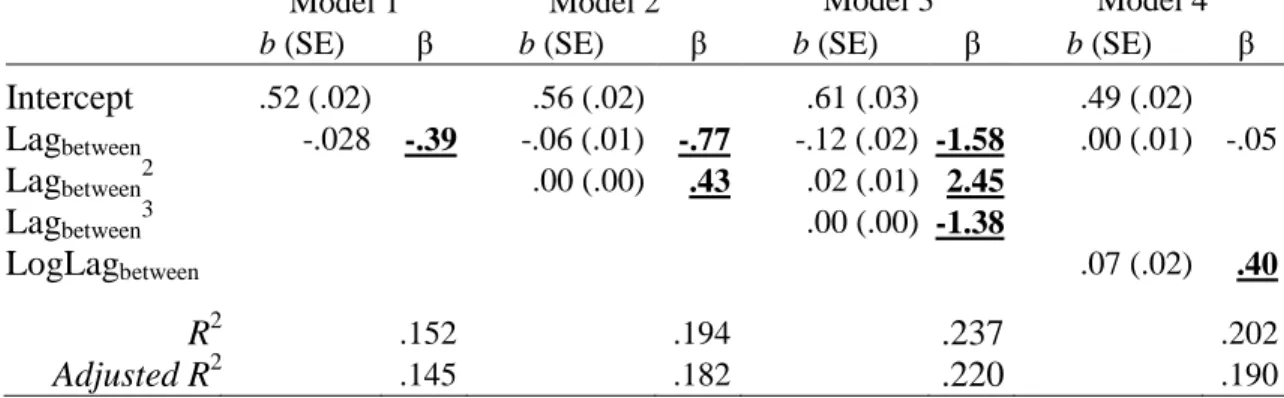
Prior to examining other moderators of job satisfaction stability, I first regressed the stability correlations onto time lag, to assess whether satisfaction stability relates to time lag across studies (see similar analysis for job performance by Sturman, Cheramie, & Cashen, 2005). As shown in Table 3 (Model 1), as time lag increases, job satisfaction stability decreases (= -.39; p < .05). This result (linear relationship between job satisfaction stability and time lag) is consistent with the estimate reported by Dormann and Zapf (2001; r = -.41), although the current estimate is based upon more than twice as many primary studies.
I also assessed the possibility of a nonlinear relationship between time lag and job satisfaction stability. Model 2 of Table 3 shows a statistically significant quadratic (lag2) relationship between time lag and satisfaction stability (= .43, p < .05), whereas Model 3
shows a statistically significant cubic (lag3) relationship between time lag and satisfaction stability (= -1.38, p < .05). Lastly, Model 4 shows a statistically significant log of lag effect on job satisfaction stability (= .40, p < .05). The cubic relationship between time lag and
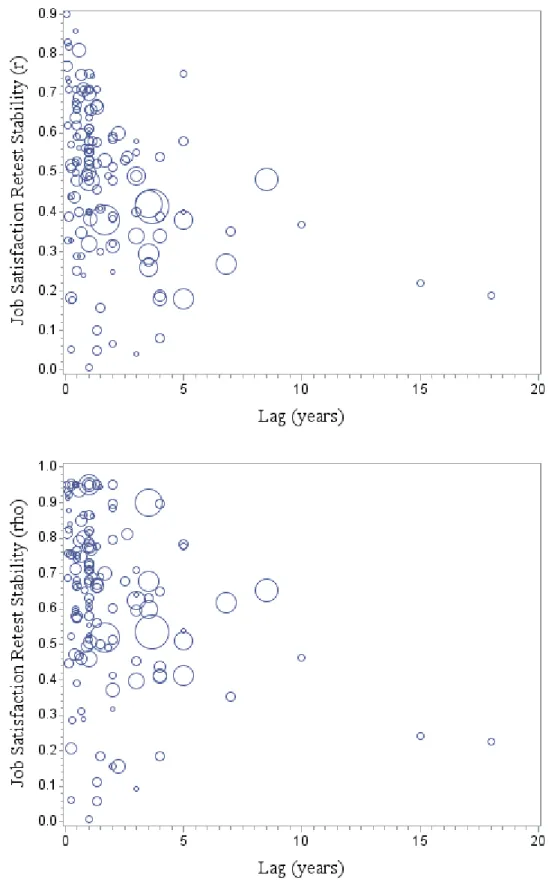
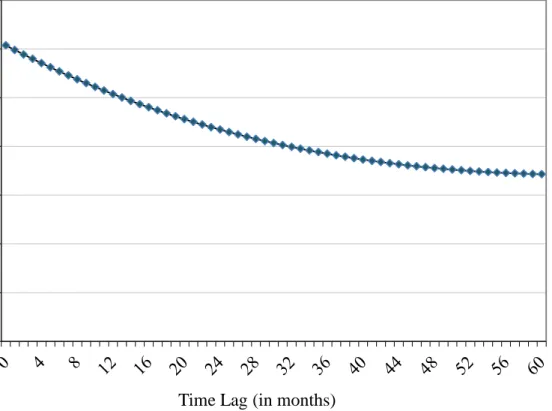
satisfaction stability best described the data. The cubic relationship between time lag and job satisfaction stability is depicted in Figure 1a. It essentially shows that job satisfaction stability declines monotonically with time lag, but with diminishing returns with time. This result also shows that the asymptote of job satisfaction stability remains greater than zero as time lag increases (see Fraley & Roberts, 2005), which would imply a dispositional basis of the construct (Fraley, 2002; Fraley, Vicary, Brumbaugh, & Roisman, 2011) of job satisfaction. Figure 1b presents a bubble plot of all the studies in the meta-analytic database, and shows that there exist a few studies that used especially large lag lengths (in excess of 60 months). If I were to focus on analyzing the datasets with lag lengths up to 60 months only (i.e., with the longest 5% of samples that used extremely long lag length [over 60 months] excluded), I would find that the job
satisfaction test-retest correlation appears to approach .3 as time lag increases (see Figure 1c; k = 129, lag up to 60 months).
Effects of Age and Tenure on Job Satisfaction Stability (Between-Samples)
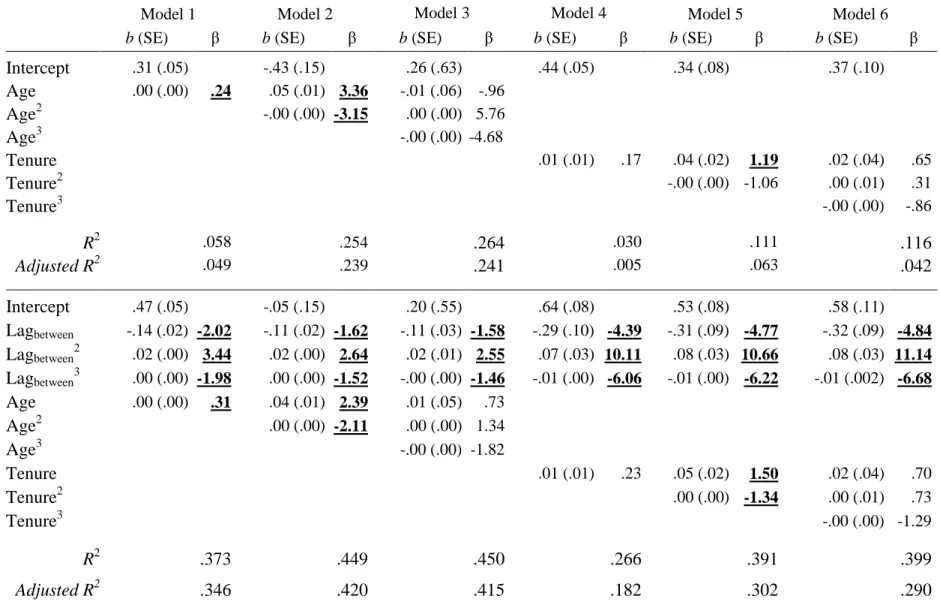
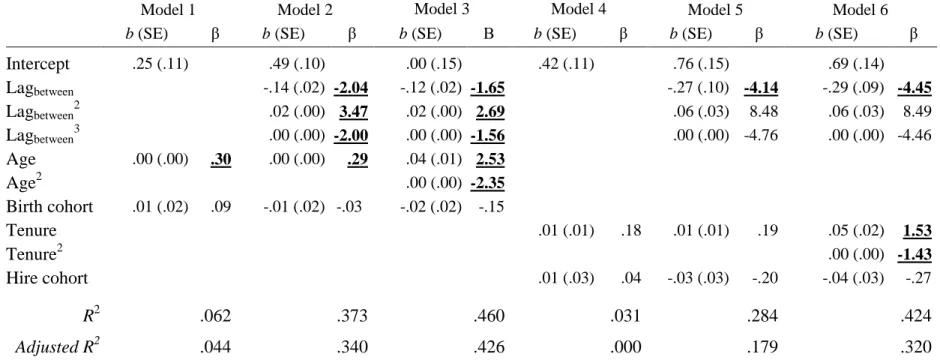
After establishing a negative relationship between time lag and job satisfaction stability, I next estimated the relationship between age and job satisfaction stability. This association was positive (β = .24; p < .05; see Table 4, Model 1; Figure 2). The age effect on satisfaction stability, as assessed across samples, also appears to be quadratic (β = -3.15; p < .05; see Table 4, Model 2). Further, the linear and quadratic age effects on satisfaction stability were maintained even once time lag effects on stability were controlled (see Table 4).
Similar to age, job tenure was found to increase the stability of job satisfaction
nonlinearly while controlling for time lag (quadratic effect; see Table 4, Model 5). This suggests that job satisfaction stability increases with job tenure, but with diminishing returns to tenure. For both age and tenure, cubic effects were not apparent (see Table 4, Models 3 and 6). In addition, in supplemental analyses (not reported here), age and job tenure did not show any incremental effect over each other, because they are highly collinear at the between-samples level of analysis (r = .63).
In order to give more insight into age and tenure effects on job satisfaction stability, I have plotted the meta-analytic job satisfaction stability means for different age categories (Figure 3), and for different job tenure categories (Figure 4; controlling for time lag by using rt, see Roberts & DelVecchio, 2000). As shown in Figure 3, job satisfaction stability appears to
increase with age, at least up to age 50. Unfortunately, the amount of available data is slim after age 50 (i.e., k = 4 studies), leaving it uncertain whether the apparent dip in job satisfaction
stability after age 50 is real. For job tenure effects, Figure 4 depicts an increase in job satisfaction stability that occurs as individuals have been in their jobs for longer amounts of time. In Figure 4, the increase in satisfaction stability appears to be similar to a step function, with stability
suddenly increasing after 5 years on the job, and then remaining relatively constant.
Meta-analytic correlations of job satisfaction stability across age and tenure categories are presented in Table 2.
Effects of Birth Cohort and Hire Date Cohort on Job Satisfaction Stability (Between-Samples) Although not the focus of the current study, I also estimated generational effects on job satisfaction stability. These included birth cohort effects and hire date cohort effects. Meta-analytic correlations of job satisfaction stability across birth and hire date cohort categories are
presented in Table 2. Birth and hire date cohort did not uniquely predict job satisfaction stability (β = -.10, n.s., and β = -.01, n.s., respectively). More importantly however, the age effects remained statistically significant even after controlling for cubic lag and birth cohort (β = .29, p < .05 for the linear age effect; β = -2.35, p < .05 for the quadratic age effect; see Table 5, Model 2 and 3). The quadratic job tenure effect also remained statistically significant after controlling for cubic lag and hire date cohort (β = -1.43; Table 5 Model 6).
Between-Sample Moderators of Job Satisfaction Stability
For the sake of completeness, I also investigated several potential between-sample level moderators of job satisfaction stability. Job satisfaction was slightly more stable in studies that did not involve any intervention (i.e., in studies that did not involve pretest-posttest stability in the presence of an organizational event, such as mergers/acquisitions, downsizing, or leadership training). As shown in Table 7, without interventions/events, the stability of job satisfaction was r = .52 (k = 114, N = 37,896), but interventions appear to make job satisfaction a bit less stable (r = .45, k = 24, N = 5,722). Nonetheless, the confidence intervals overlapped for these two
conditions, so the effect of interventions on job satisfaction stability should not be overstated. Also, as the percentage of job changers in a sample increased, the stability of job
satisfaction tended to decrease (β = -.36; p < .05; see Table 7 and 8). Dormann and Zapf (2001) had drawn a similar conclusion, based upon their descriptive comparison of the average stability estimates from two categories of primary studies that they labeled job changers and job stayers. Further, I found that as the percent of organization changers increased in a sample, job
satisfaction stability tended to decrease (β = -.56; p < .05). Additionally, as the sample included more women, job satisfaction stability increased slightly (β = .23; p < .05). There were no moderator effects for the job complexity of the samples.
In Table 7, I also compared job satisfaction stability estimates across different job
satisfaction inventories. Job satisfaction stability does not seem to depend greatly upon which job satisfaction instrument was used (rt values range narrowly from rt = .43 to .64), with the
exception of single-item measures, which naturally have smaller observed stability correlations (rt = .43) due to reliability attenuation (i.e., Spearman-Brown formula).
Multilevel Analysis of Time Lag Effects on Job Satisfaction Stability (Within- and Between-Samples)
As is common in meta-analysis, the above analyses were all implemented at the between-sample level of analysis. Each moderator (e.g., lag, age, tenure, birth cohort, hire cohort) was coded at the sample-level of analysis (i.e., one moderator score for each sample). For most moderators assessed in the current meta-analysis, sample-level moderator analysis was a
technical necessity, because only one value of each moderator was reported for each sample (e.g., each sample only reported one score for average job tenure).
However, for one moderator in particular—time lag—it was possible for me to assess both within-sample effects and between-sample effects. This is an important distinction between the current study and the previous work by Dormann and Zapf (2001), who deleted all the effect sizes from each sample except for the one effect size corresponding to the longest lag (i.e., Dormann and Zapf only recorded one effect size for each study, even when the study reported more than two waves of data collection). For the current effort, the estimation of two levels of time lag effects on job satisfaction stability was achieved via multilevel modeling (Aguinis, Gottfredson, & Culpepper, 2013; Bryk & Raudenbush, 1992; Raudenbush & Bryk, 2002; Erez, Bloom, & Wells, 1996; Hofmann, 1997). The multilevel model I estimated was as follows:
Level 1 Equation (Within-Sample):
rls = β0s + β1s(Lagls) + els (1)
Level 2 Equation (Between-Sample):
β0s = γ00 + γ01(Lagbetween) + u0s (2)
β1s = γ10 + γ11(Lagbetween) + u1s (3)
where rls is job satisfaction stability correlation at each lag (l) within each sample (s), els is
within-sample error, γ00 and γ10 are level 2 intercept, γ01 is linear effect of Lagbetween on intercept, γ11 represents the cross-level interaction effect, u0s and u1s each representing between-sample
random error in intercepts and slopes. The same model can be presented in the form of a linear mixed model (by substitution):
rls = γ00 + γ01(Lagbetween) + γ10Lagls + γ11(Lagls)(Lagbetween) + u0s + u1sLagls+ els (4)
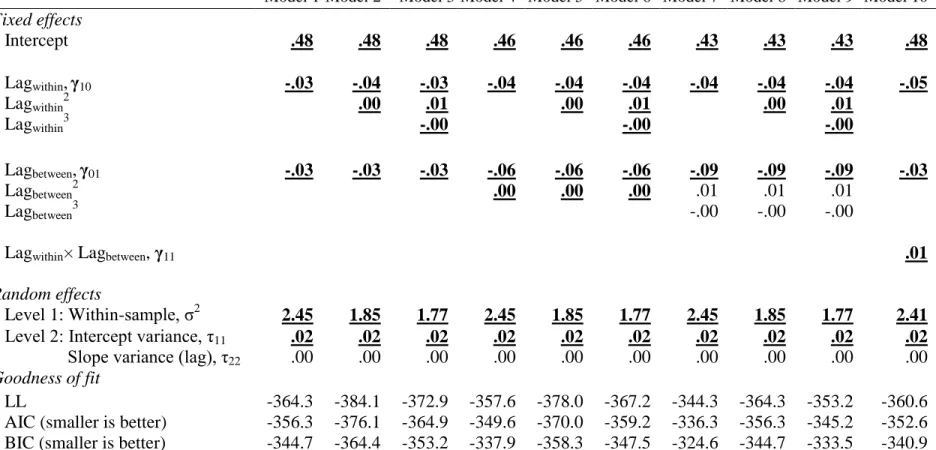
For estimating the multilevel model shown above, I was able to use multiple effect sizes from any study that reported more than two waves of measurement. This resulted in a total of 258 effect sizes (i.e., retest correlations) for estimating the multilevel model. Results of the multilevel model (with sample-size weighted estimation) are given in Table 9. In Table 9, it can be seen that between-sample differences in time lag length still have effects on job satisfaction stability (e.g., γ01 = -.03, p < .05 for linear effect in Models 1, 2, and 3). More importantly, I can
now establish that time lag has a robust negative within-sample effect on job satisfaction stability (e.g., γ10 = -.03, p < .05 for linear effect in Model 1). The within-sample effect of time lag on job
satisfaction stability also appears to be nonlinear.
Although slope variance appears to be approximately zero, I observed a statistically significant cross-level interaction between time lag and sample-level mean lag (e.g., γ11 = .01, p
< .05; see Model 10). In other words, the time lag-stability slope seems to vary across contexts. This means that the negative time lag effect on job satisfaction stability is stronger in samples with longer average time lag. In the subsequent section, I examine age and tenure effects using a large-scale longitudinal study.
CHAPTER 3
STUDY 2: LONGITUDINAL STUDY
Study 2 tests the hypothesis that job satisfaction stability increases over time at the within-persons level of analysis. I define within-person job satisfaction stability as the following: on occasions when an individual has high job satisfaction, s/he will tend to experience high job satisfaction on a subsequent occasion (i.e., intraindividual consistency).
Method Participants
Data were obtained from a state-wide longitudinal survey to examine opinions of public school teachers on their job attitudes and union association experiences. Because nearly all participants held the same job, job characteristics are mostly controlled in the current data, by design. Data were collected at four different time points, approximately five years apart (1995, 1999, 2005, and 2010). Sample size varied across waves of data collection (N = 1,366 at Time 1, N = 2,627 at Time 2, N = 3,589 at Time 3, and N = 3,855 at Time 4). Removing responses from those who report their satisfaction at fewer than two time points resulted in the final longitudinal N of 2,802.
Measures
Job satisfaction. Job satisfaction was assessed using a facet-composite measure designed by the sponsoring organization. At all four time points, participants reported their satisfaction with the job using six items rated on a scale from 1 (very dissatisfied) to 5 (very satisfied). The items included, “To what extent are you satisfied with: (1) Student behavior in your class(es)? (2) The personal fulfillment you get from teaching? (3) Your pay? (4) Your benefits? (5) Your
opportunity for career advancement?” and finally, (6) “All in all, how satisfied are you with your job?” These items are similar to the items in classic job satisfaction measures. For example, the
![Table 11a. Coefficient Estimates of Linear Job Satisfaction Stability Models [STUDY 2: LONGITUDINAL STUDY] Job satisfaction t + 1 1 2 3 4 5 6 7 8 Fixed effects Intercept, β 00 3.780 1.743 3.170 2.185 2.999 3.159 2.102 2.989 Job satisfac](https://thumb-us.123doks.com/thumbv2/123dok_us/1541106.2706480/60.918.96.810.220.729/coefficient-estimates-satisfaction-stability-longitudinal-satisfaction-intercept-satisfac.webp)
![Table 11b. Coefficient Estimates of Quadratic Job Satisfaction Stability Models [STUDY 2: LONGITUDINAL STUDY] Job satisfaction t + 1 1 2 3 4 5 6 Fixed effects Intercept, β 00 5.827 2.43 5.650 5.669 2.313 5.494 Job satisfaction t , β 10 -](https://thumb-us.123doks.com/thumbv2/123dok_us/1541106.2706480/61.918.98.780.217.820/coefficient-estimates-quadratic-satisfaction-stability-longitudinal-satisfaction-satisfaction.webp)