A
University
of
Sussex
PhD
thesis
Available
online
via
Sussex
Research
Online:
http://sro.sussex.ac.uk/
This
thesis
is
protected
by
copyright
which
belongs
to
the
author.
This
thesis
cannot
be
reproduced
or
quoted
extensively
from
without
first
obtaining
permission
in
writing
from
the
Author
The
content
must
not
be
changed
in
any
way
or
sold
commercially
in
any
format
or
medium
without
the
formal
permission
of
the
Author
When
referring
to
this
work,
full
bibliographic
details
including
the
author,
title,
awarding
institution
and
date
of
the
thesis
must
be
given
Mesfer Al Duhayyim
Thesis Submitted for the Degree of Doctor of Philosophy Informatics Department
University of Sussex May 2019
Declaration
I hereby declare that this thesis has not been and will not be, submitted in whole or in part
to another University for the award of any other degree.
University of Sussex
Thesis submitted by Mesfer Al Duhayyim for the Doctor of Philosophy
Abstract
E-learning systems have been available for several decades and are now ubiquitous in higher education, however, the vast majority of these e-learning systems do not adapt to the student. Adaptive e-learning gives students the appropriate learning materials based on their abilities in the subject area being studied. This thesis presents a novel adaptive e-learning system (CaFAE) that has been designed to show learners their knowledge level for each concept in the subject area using a coloured concept map, and then recommend a bespoke learning path based on a ranked concept list.
This work has made several key contributions, including a differential assessment strategy, coloured concept map visualisation, ranked concept list ordering and bespoke learning path. This thesis evaluates the effectiveness of the proposed system by conducting a pilot study at the University of Sussex, followed by a full study with a teaching group as part of the Algorithms and Data Structure course in Prince Sattam bin Abdulaziz University in Saud Arabia. From the experimental outcomes, it can be seen that the proposed system has made an identifiable contribution to the subject understanding for the students who used the interventional (adaptive) system over those who used the non-interventional (non-adaptive) system. These students also show increased engagement and attainment and expressed satisfaction with the system.
Acknowledgements
ALLAH says: "And when your Lord proclaimed: If you give thanks, I will give you more" [The Holy Quran: Ch.14, Ver: 7]. Firstly, I thank ALLAH for giving me the patience and strength to complete my PhD thesis. Secondly, I would like to thank many people who supported me during my study. I would like to express my great gratitude to my first supervisor Dr.Paul Newbury for his guidance, encouragement, support, useful suggestions and comments from the beginning of my study to the end. I also would like to thank my second supervisor Dr.Phil Watten for his support and valuable advice.
My sincere thanks to Prince Sattam bin Abdulaziz University (PSAU) and Saudi Arabian Cultural Bureau (SACB) for giving me the opportunity to complete my PhD study and support me financially and morally.
I would also like to thank my parents for their continuous prayers; Without them, it would not have been possible to complete my study successfully. A special thanks to my wife for her motivation and support, and a big thank to my kids (Almaha and Abdullah) for patience and for the time I spent away from them. Also, I would like to thank my brothers, my sister, my relatives, my colleagues and friends for their moral support and prayers during my PhD journey.
Publications
• Al Duhayyim, Mesfer and Newbury, Paul (2019) Concept-based and fuzzy adaptive e-learning: Case Study. ICCIS 2019 : International Conference on Computer and Information Sciences, Aljouf, Kingdom of Saudi Arabia, 10-11 April 2019. Published in: 2019 International Conference on Computer and Information Sciences (2019 ICCIS). Institute of Electrical and Electronics Engineers (Accepted)
• Al Duhayyim, Mesfer and Newbury, Paul (2018) Concept-based and fuzzy adaptive e-learning. ICIEI 2018 The 3rd International Conference on Information and Education Innovations, London, United Kingdom, June 30 - July 02, 2018. Published in: Proceedings of the 2018 The 3rd International Conference on Information and Education Innovations. 49-56. Association for Computing Machinery ISBN 9781450364409
Table of Contents
Chapter 1: Introduction... 1
1.1
E-learning ... 1
1.2
Problem Statement ... 3
1.3
Research Aim ... 3
1.4
Research Approach and Objectives ... 3
1.5
Research Questions and Hypotheses ... 4
1.6
Research Contribution ... 5
1.7
Thesis Outline ... 6
Chapter 2: Literature Review ... 9
2.1
Introduction ... 9
2.2
Adaptation in E-Learning ... 9
2.3
Adaptive E-learning Techniques ... 11
2.3.1 Concept Maps ... 11
2.3.2 Overlay Model ... 21
2.3.3 Stereotypes ... 22
2.3.4 Fuzzy Logic Theory ... 22
2.3.5 Expert System ... 34
2.3.6 Bayesian Network ... 40
2.4
Summary ... 45
Chapter 3: Design and Development of CaFAE (an Adaptive E-learning System)
52
3.1
Introduction ... 52
3.2
Adaptive System Architecture ... 52
3.2.1 System Structure ... 53
3.2.2 Adaptation Mechanism... 55
3.3
System Software ... 66
3.3.2 System Framework ... 67
3.4
Sample Course ... 67
3.4.1 Teacher Interface ... 67
3.4.2 Student Interface ... 70
3.5
Non-Adaptive System Architecture ... 73
3.6
Summary ... 74
Chapter 4: Methodology ... 75
4.1
Introduction ... 75
4.2
Research Approach ... 76
4.3
Research Design and Variables ... 77
4.4
Sampling Participants: ... 79
4.5
Materials used:... 80
4.6
Data Collection Procedure: ... 81
4.7
Ethical Consideration ... 82
4.8
Pilot Study ... 82
4.9
Analysis Techniques: ... 84
4.10
Summary ... 86
Chapter 5: Pilot Study ... 87
5.1
Introduction ... 87
5.2
Sampling Participants ... 87
5.3
Experiment Location ... 88
5.4
Objectives of Experiment ... 88
5.5
Experiment Procedures ... 88
5.6
Pilot Study Findings... 89
5.6.1 Pre-Experiment Questionnaire ... 90
5.6.2 Hypotheses Testing ... 90
5.6.3 Post-Experiment Questionnaire Findings ... 94
5.8
Summary ... 100
Chapter 6: Full Study ... 101
6.1
Introduction ... 101
6.2
Participants ... 101
6.3
Location of Experiment ... 101
6.4
Experiment Aims ... 101
6.5
Experiment Procedures ... 101
6.6
Full Study Findings ... 102
6.6.1 Pre-Experiment Questionnaire Overview ... 102
6.6.2 Hypothesis Analysis ... 107
6.6.3 Hypothesis Test Result ... 110
6.6.4 Post-Experiment Questionnaire Findings ... 112
6.6.5 Adaptive Post-Experiment Questionnaire Findings ... 112
6.6.6 Non-Adaptive Post-Experiment Questionnaire findings: ... 128
6.7
User Data ... 138
6.8
Summary ... 139
Chapter 7: Discussion ... 140
7.1
Introduction ... 140
7.2
Discussion of the Pilot Study Results ... 140
7.2.1 Pilot Study Limitations ... 140
7.2.2 Background of Students ... 141
7.2.3 System Quality Factors ... 141
7.2.4 Group Differences ... 142
7.2.5 Summary of the Pilot Study ... 143
7.3
Discussion of the Full Study Results ... 143
7.3.1 Overview of Full Study ... 143
7.3.2 Background of Students ... 144
7.3.3 Hypotheses Discussion ... 145
7.3.5 Motivation and Engagement ... 147
7.3.6 Adaptation Factors ... 147
7.3.7 System Quality Factors ... 148
7.3.8 Conclusion of the Full Study ... 148
7.4
Summary ... 148
Chapter 8: Conclusions and Future Work ... 150
8.1
Conclusions ... 150
8.1.1 Research Contributions ... 150
8.1.2 Research Questions ... 152
8.2
Research Limitations ... 154
8.3
Future Work ... 154
8.3.1 Recommendation for practitioners ... 154
8.3.2 Recommendation for researchers ... 155
8.4
Summary ... 155
References ... 156
Appendices ... 162
Appendix A Ethical Approval ... 162
Appendix A.1 Information Sheet ... 162
Appendix A.2 Consent Form ... 165
Appendix A.3 Recruitment Email ... 166
Appendix B Experiments Questionnaires... 167
Appendix B.1 Pre- Experiment Questionnaire ... 167
Appendix B.2 Adaptive Post-Experiment Questionnaire ... 169
List of Figures
Figure 2.1 Concept map created by teachers for density and buoyancy unit (Vanides et al., 2005) ... 12
Figure 2.2 Two examples of concept maps about the topic “socket head screw.” (a) classical concept map (b) 2D concept map (Violante and Vezzetti, 2015) ... 13
Figure 2.3 An example of concept maps about the topic “socket head screw.” (c) Web‐based 3D interactive concept map (Violante and Vezzetti, 2015) ... 14
Figure 2.4 system Architecture (Awati and Dixit, 2017) ... 15
Figure 2.5 The architecture of OPCOMITS (Dogan and Dikbıyık, 2016) ... 17
Figure 2.6 Student concept map screen (Dogan and Dikbıyık, 2016) ... 18
Figure 2.7 Creating concept and concept relations defining screens for experts (Dogan and Dikbıyık, 2016) ... 19
Figure 2.8 Fuzzy sets with very hedge (Negnevitsky, 2005) ... 23
Figure 2.9 Concept map of the SQL course (Zafar and Albidewi, 2015) ... 25
Figure 2.10 Partition for cognitive status of chapter (Chrysafiadi and Virvou, 2012) ... 27
Figure 2.11 Fuzzy variables: (a) test difficulty, (b) duration, (c) success, (d) degree of freedom (Jeremić et al., 2012) ... 29
Figure 2.12 Analysis of the nodes of the hierarchical structure (Chrysafiadi and Virvou, 2015) ... 32
Figure 2.13 Fuzzy cognitive maps (Chrysafiadi and Virvou, 2015) ... 33
Figure 2.14 UZWEBMAT System Architecture (Özyurt et al., 2013b)... 38
Figure 2.15 Expert system supported direction architecture within UZWEBMAT (Özyurt et al., 2013b) ... 39
Figure 2.16 SITS Entry Page (Hooshyar et al., 2016) ... 42
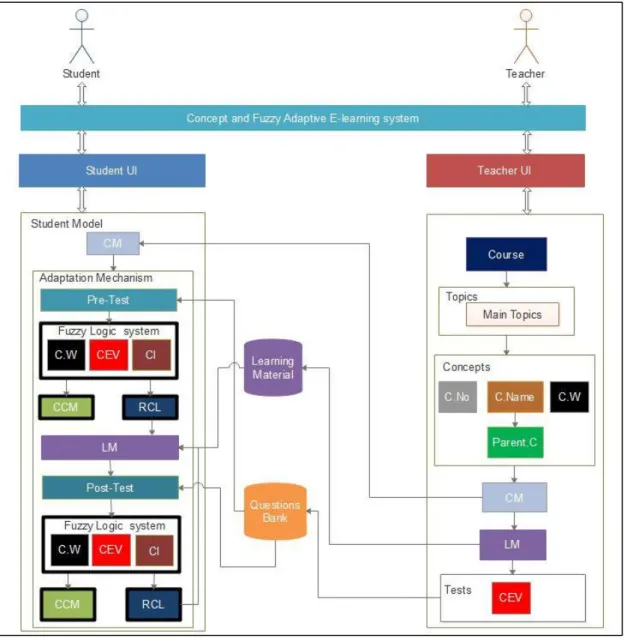
Figure 3.1 The architecture of CaFAE system ... 54
Figure 3.2 Pre- and Post-Tests Multiple Choice Questions ... 56
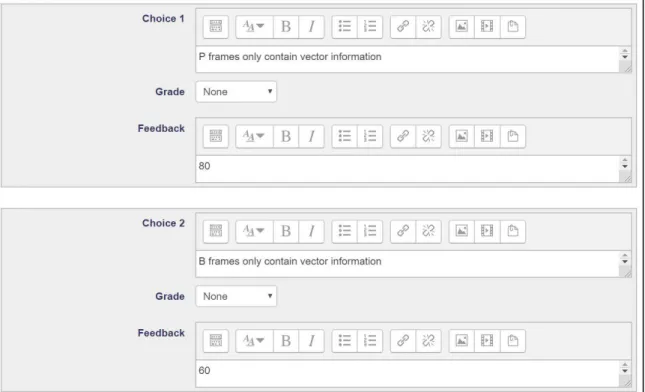
Figure 3.3 Defining Concept Error Value (CEV) for each choice to each question ... 56
Figure 3.4 Linguistic variables of CaFAE system ... 57
Figure 3.5 Fuzzy Set for Input Variable (Concept Weight) with three different fuzzy levels ... 58
Figure 3.6 Fuzzy set for Input Variable (Concept Error Value) with four different fuzzy levels... 58
Figure 3.7 Membership functions for Output Variable (Concept Impact) with three different fuzzy levels... 59
Figure 3.8 Fuzzy rules inference using MATLAB fuzzy Logic Toolbox ... 60
Figure 3.9 The Coloured Concept Map for pre-test or post-test ... 62
Figure 3.10 Ranked Concept List after taking the pre-test ... 63
Figure 3.11 The process of Algorithm in the Ranked Concept List... 64
Figure 3.12 Ranked Concepts List for the teacher or admin using fuzzy logic method – with additional numerical values ... 65
Figure 3.13 Learning Materials in different formats ... 66
Figure 3.14 The Concept Map of the Multimedia Design and Applications course created by the teacher... 68
Figure 3.15 Concept Topics Creation by the teacher ... 69
Figure 3.16 Course Admin Block for the teacher ... 69
Figure 3.17 A sample concept topic list after adding the concepts by the teacher ... 70
Figure 3.18 Navigation Menu for the student ... 71
Figure 3.19 Student Pre-test Result Feedback ... 71
Figure 3.20 Student Coloured Concept Map (CCM) after pre-test ... 72
Figure 3.21 Student Ranked Concepts List (RCL) after pre-test ... 72
Figure 3.22 Course Admin Block for the student ... 73
Figure 6.1 Percentage Gain from Pre-test to Post-test Scores for both Groups ... 111
Figure 6.2 Differences between Mean Scores of the Pre-Test and Post-Test ... 111
Figure 6.3 Effect Size between the Two Groups in Mean Scores of the Pre-Test and Post-Test ... 112
Figure 6.4 Results of Measured Items for System Usability Factor (Adaptive Group) ... 113
Figure 6.5 Results of Measured Items for Learning Material Factor (Adaptive Group) ... 115
Figure 6.6Results of User Satisfaction Measurement Items (Adaptive Group) ... 116
Figure 6.7 Results of Measured Items for Adaptation Factor ... 118
Figure 6.8 Results of Measured Items for Coloured Concept Map Effectiveness Factor ... 120
Figure 6.9 Results of Measurement Items for Ranked Concepts List Effectiveness Factor ... 121
Figure 6.10 Results of Measured Items for System Usability Factor (Non-Adaptive Group) ... 129
Figure 6.11 Results of Measured Items for Learning Material Factors (Non-Adaptive Group) ... 131
Figure 6.12 Results of Measured Items for User Satisfaction Factor (Non-Adaptive Group) ... 132
List of Tables
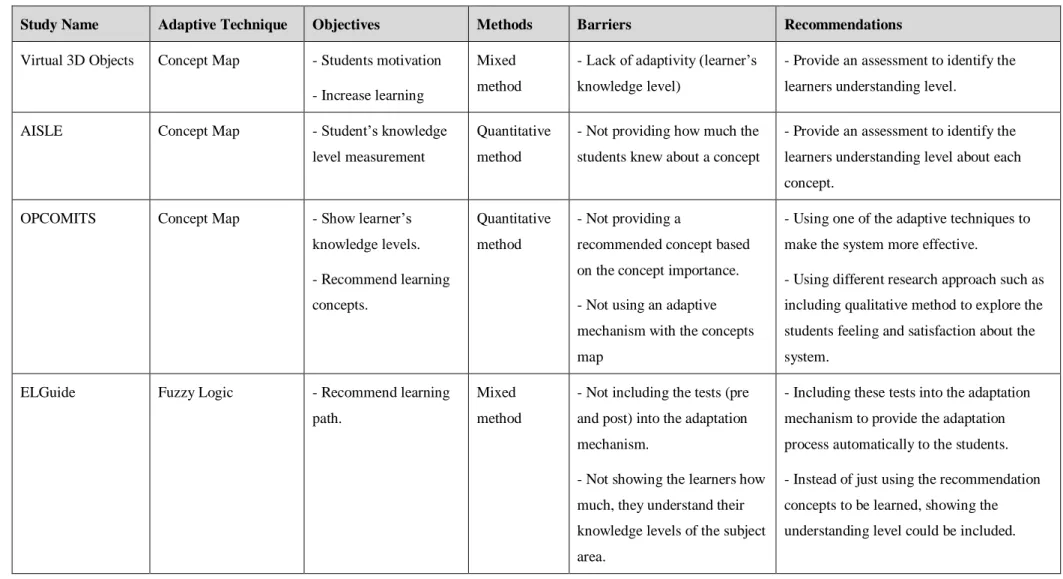
Table 2.1 Summary of the previous studies in adaptive e-learning systems ... 47
Table 5.1 Results for Closed-End Questions for Pre-Experiment Questionnaire ... 90
Table 5.2 Results of Mann-Whitney U Test for Differences between the Mean Pre-test Scores of the two Groups .... 91
Table 5.3 Results of Mann-Whitney U Test for Differences Between the Mean Post-Test Scores of the Two Groups92 Table 5.4 Results of Two-Related-Sample Test Using Wilcoxon Signed-Rank Test to Compare Two Test Means Pre- and Post-Scores within the Same Group ... 92
Table 5.5 Results of Mann-Whitney U Test for Differences in Time Spent in Learning Materials Between the Two Groups ... 93
Table 5.6 Results for the System Usability Factor ... 94
Table 5.7 Results for the Learning Material Factor ... 95
Table 5.8 Results for the User Satisfaction Factor ... 95
Table 5.9 Results for the Adaptation Factor ... 95
Table 5.10 Results for the Coloured Concept Map Effectiveness Factor ... 96
Table 5.11 Results for the Ranked Concepts List Effectiveness Factor ... 96
Table 5.12 Results for Closed-End Questions for Post-Experiment Questionnaire ... 96
Table 6.1 Pre-Experiment Questionnaire Closed-Ended Questions Combined for Both Groups ... 103
Table 6.2 Results of Independent Sample t-test for Differences between the Mean Pre-test Scores of the two Groups ... 108
Table 6.3 Results of Independent Sample t-test for Differences between the Mean Post-test Scores of the two Groups ... 109
Table 6.4 Results of Paired-Samples t-Test to Compare Two Test Means Pre- and Post- Scores within the Same Group ... 109
Table 6.5 Results of Independent Sample t-test for Differences between the Mean Time Spent in Learning Materials for the two Groups ... 110
Table 6.6 Measured Items for System Usability Factor (Adaptive Group) ... 113
Table 6.7 Measured Items for Learning Material Factor (Adaptive Group) ... 114
Table 6.8 Measured Items for User Satisfaction Factor (Adaptive Group) ... 116
Table 6.9 Measured Items for Adaptation Factor ... 117
Table 6.10 Measured Items for Coloured Concept Map Effectiveness Factor ... 120
Table 6.11 Measured Items for Ranked Concepts List Effectiveness Factor ... 121
Table 6.12 Descriptive Statistics for the Factor Means and Ranking (Adaptive Group) ... 122
Table 6.13 Student Opinions about The Ease and Difficulty of The System Usability (Adaptive Group) ... 122
Table 6.14 Results for Closed-Ended Questions in Post-Experiment Questionnaire (Adaptive Group) ... 124
Table 6.15 Advantages and Disadvantages of the system (Adaptive Group) ... 127
Table 6.16 The Understanding and Adaptation Levels of the System Rated by the Students (Adaptive Group) ... 128
Table 6.17 Measured Items for System Usability Factor (Non-Adaptive group) ... 129
Table 6.18 Measured Items for Learning Material Factor (Non-Adaptive Group) ... 130
Table 6.19 Measured Items for User Satisfaction Factor (Non-Adaptive group) ... 132
Table 6.20 Measured Items for Ease of Learning Factor ... 133
Table 6.21 Descriptive Statistics for the Factors means and Ranking (Non-Adaptive group) ... 135
Table 6.22 Opinions of Students about The Ease and Difficulty of Use of the System (Non-Adaptive Group) ... 136
Table 6.23 Results of Closed-Ended Questions for Post-Experiment Questionnaire (Non-Adaptive Group) ... 136
Abbreviations
A Adaptation
AH Adaptive Hypermedia
AI Artificial Intelligent
AISLE Artificial Intelligence-based Learning Evaluation
AITS Adaptive Intelligent Tutoring System
ATI Aptitude Treatment Interaction
BNs Bayesian Networks
C.Name Concept Name
C.No Concept Number
C.W Concept Weight
CaFAE Concept-based and Fuzzy Adaptive E-learning
CCM Coloured Concept Map
CCME Coloured Concept Map Effectiveness
CER Concept Error Value
CI Concept Impact
CM Course Map
DEPTHS Design Pattern Teaching Help System
DPs Design Patterns
EL Ease of Learning
E-Learning Electronic Learning
FuzKSD Fuzzy Knowledge State Definer
IR Information Retrieval
ITS Intelligent Tutoring System
LM Learning Materials
LMS Learning Management Systems
LOs Learning Objects
LS Learning Style
MPRLS Moodle-based Personalized Remedial Learning System OPCOMITS Object Oriented Programming Tutor using Concept Map
Model
PeRSIVA Performance, Results, Satisfaction, Individual state, Validity of conclusions, Adaptation’s validity
PSAU Prince Sattam bin Abdulaziz University
RCL Ranked Concepts List
RCLE Ranked Concepts List Effectiveness
SITS Solution-based Intelligent Tutoring System
SU System Usability
TAS Test Assessment System
TRS Test Remedial System
US User Satisfaction
Chapter 1: Introduction
1.1
E-learning
E-learning is a “delivery of a learning, training or education program by electronic means” (Stockley, 2003). In practice, this delivery may be through computers, smartphones or similar electronic devices which are linked by a communication network, or by radio or television. Technology not only is widening the availability of opportunities for education but also successfully combating a number of traditional obstacles to learning, such as lack of provision of different learning styles as the students have different preferable ways to learn, and also lack of learning support to enable students to learn the subjects, whenever and wherever, based on their own pace.
Twenty years ago, CDs were seen as the leading-edge e-learning technology (Bezovski and Poorani, 2016) and training CDs were sometimes used as the basis of workshops. IT lessons constituted the content in more than 95% of these training CDs at the time. The late 1980s introduction of multimedia saw CD-based systems represented as a potentially transformative way of accessing large works of reference and strengthening their learning potential (Alevizou, 2002). Encyclopaedias and similar resources could now make home users’ personal computers significant educational tools. Microsoft, for example, used Funk and Wagnall’s printed encyclopaedia as the basis for its 1993 multi-media CD offering, Encarta (Alevizou, 2002).
Five years later, the World Wide Web had surpassed training using CDs by not only making educational materials and instructions available online but also by personalising the experience – an effect supported by chat rooms, interactive content, newsletters and study groups (Cross, 2004). Since then, a large number of educational institutions, companies and organisations around the world have taken on the integration of asynchronous e-learning educational systems by means of VLEs (virtual learning environments) (Georgouli, 2011). A VLE is a software system designed to improve e-learning both for groups and for individuals. Available on the internet, they take care of a range of functions including downloading and uploading; educational material management; monitoring; and evaluating progress. Social software, such as blogs, wikis, and RSS, can be integrated into a VLE, and integrating external modules, web services and plug-ins underlies the majority of VLEs.
The majority of e-learning at present uses the Internet accessed through a series of different devices, such as desktops, laptops and mobile phones etc. Mostly, the educational material available is predesigned, covers fixed courses, and entails interaction between students and educators. E-learning systems currently available make efficient use of the facilities provided by
existing communication technologies to deliver the content but are not equipped to respond to learners’ reactions and perceived needs (Ab Hamid et al., 2006). For example, students taking the same course may have widely different learning styles, backgrounds and cultures, as well as different expectations and different ideas about what learning is (Blanchard et al., 2005, R-Moreno et al., 2008).
E-learning management systems, such as Blackboard (Blackboard, 2019) and Moodle (Moodle, 2019b) are common in e-learning and have been very successful, providing teachers and administrators with the necessary software features and supporting them in creating manageable courses for online instruction (Godwin-Jones, 2006). However, they do not make it possible to deal effectively with the differences between individual learners (Cristea and Stash, 2006, Graf, 2005, Graf and List, 2005, Popescu et al., 2007). To personalise an e-learning program means that the material must be modified to fit the needs of individual students, and presentation must also be modified in line with their ability to learn and understand. Questionnaires are one way to understand what modifications are needed; the extent to which students succeed or fail with existing material is another (Chen et al., 2005, Esposito et al., 2004).
Traditional e-learning systems have typically not been adapted to take account of the knowledge level, existing skills and/or learning style of individual students. However, adaptive e-learning systems are capable of improving the learning experience through personalisation to meet those individual characteristics (Alshammari et al., 2014). This has made adaptive e-learning systems a current e-learning trend with the ultimate goal of personalising the material and the way it is presented to provide the closest possible match with an individual’s needs (Alshammari, 2016). Some of the learner’s characteristics that can be successfully integrated into an adaptive system are: the individual’s existing knowledge level; the individual’s learning style; and the consequence of whether the learner approaches the system in a positive or negative manner (Brusilovsky, 2001, Leka et al., 2016). Jameson defines an adaptive system as the one that is interactive and can infer from the way individual users react and behave, how they learn and how they apply themselves – it first “sees” the way the individual learns and then adapts the way it teaches to fit that learning style (Jameson, 2009, Leka et al., 2016).
The aim of this research is to design an adaptive e-learning system that combines two adaptive mechanisms, fuzzy logic (Zadeh, 1996) and concept maps (Cañas et al., 2003, Plotnick, 1997). The concept map would be driven by the fuzzy logic and would show the knowledge level that the student has for each of the topic’s concepts, while a concept list of learning materials would allow weaknesses in the learner’s understanding of the subject to be addressed. Before the teaching materials are provided to the user, the system would carry out an initial pre-test to obtain information about the level of understanding a learner has for the concepts to be taught. After the
learning system has been used, a post-test would assess the learner’s success. This research aims to demonstrate that an adaptive e-learning system of this type will improve not only the learner’s understanding and knowledge but also their engagement and motivation.
1.2
Problem Statement
The inspiration for this research is the idea that combining two different adaptive e-learning techniques can produce an AITS (adaptive intelligent tutoring system) capable of improving learning outcomes (Phobun and Vicheanpanya, 2010). The two techniques in question were: AH (Adaptive Hypermedia) and ITS (intelligent tutoring systems). A review of the current state of these techniques shows that, though popular at the end of the twentieth century and the beginning of the twenty first, the terms have been superseded by adaptive e-learning and there has been little research into AH and ITS. The two terms however represent concepts relevant to this research.
The majority of e-learning systems were developed to create an environment acceptable to both learners and tutors. The benefits these systems bring to the process of learning are many, but they are not able to take into account the level of knowledge users have, individual feedback, students’ learning style, and whether more suitable learning material exists. A number of adaptive mechanisms have been used in e-learning; however, many are appropriate to some courses but not to others. What works when teaching computer programming, for example, may not be right when teaching History. Determining which system best fits which subject requires an understanding of the subject and a review of research; things necessary to know include: the systems’ effectiveness, their relevance, and what distinguishes one from another.
This research reviews adaptive e-learning systems developed over the past ten years and explores how they have been used as ways of identifying individual learners’ understanding, presenting the material, establishing remedial content, and determining relationships between concepts. This background is then used to propose a novel adaptive e-learning system.
1.3
Research Aim
The aim of this research is to find ways to increase learners’ level of knowledge and understanding, and to improve motivation and engagement by designing an adaptive e-learning system that will be effective through the use of a combination of fuzzy logic and a concept map for evaluation of learners' level of knowledge and consequent content adaptation.
1.4
Research Approach and Objectives
This thesis presents and implements a new adaptive e-learning system, CaFAE (Concept-based and Fuzzy Adaptive E-learning), and then evaluates it. The system is designed to adapt to student needs as a result of a Coloured Concept Map (CCM) and Ranked Concepts List (RCL).
Implementation is carried out using a developed platform operating under the Moodle learning management system. To identify understanding levels, students are tested on the subject area before they begin learning the materials (called pre-test). On the basis of their pre-test results. students are given the CCM and RCL which constitute the adaptive system’s two components.
The main objective of this research is the identification and investigation of the adaptive mechanisms affecting e-learning systems’ effectiveness. The aim is to improve students' performance and engagement with the online learning systems. The objectives may be summarised as follows:
• Critically review and investigate the adaptive mechanisms most frequently used by e-learning systems to evaluate their suitability for adaptation in e-e-learning.
• Develop an adaptive e-learning system combining a fuzzy logic system and a concept map.
• Apply the developed system to analyse how adaptive techniques influence the use of e-learning using two components:
➢ Coloured Concept Map (CCM): helps to establish students’ knowledge levels and increases their motivation and engagement.
➢ Ranked Concepts List (RCL): suggests the concepts appropriate to be learned in an orderly way.
• Functionally test the proposed system to show how well it works and the effect it has on learners.
• Evaluate the proposed system experimentally with students to show its effectiveness.
1.5
Research Questions and Hypotheses
The central question in this research is: Can an adaptive e-learning system enhance learners’ understanding, knowledge, motivation and engagement, and make learning more effective as compared to a standard e-learning system?
The experimental results will be compared using three sub-questions:
1- Is student understanding, knowledge, engagement and motivation improved by the proposed adaptive e-learning system?
2- Do students express satisfaction with the engagement provided by an adaptive learning system as being a more active learning process?
To answer the primary and secondary questions of this research, an adaptive e-learning system is developed and evaluated in this thesis using these evaluation techniques:
• Questionnaires:
- A pre-experiment questionnaire to ascertain the students' experience of e-learning and, more specifically, their experience of adaptive e-learning systems before exposure to the proposed system.
- A post-experiment questionnaire to measure students' satisfaction with the proposed system and its features, and to know their thoughts about adaptive mechanisms after they had used the proposed system.
• Tests: pre- and post-test questions are used to assess the students' abilities before and after they have used the proposed system.
• Hypotheses: There are general hypotheses which are formulated on the basis of students' results in the pre and post-tests; the adaptive system will show an improvement in understanding; the adaptive system will outperform the non-adaptive system and the adaptive system will be usable.
These five key hypotheses, formulated and tested based on the results of the students’ test scores and time spent learning the materials and answering the questions, are as follows:
H1: The pre-test will show no significant difference in knowledge level between the adaptive group and non-adaptive group.
H2: Post-test,the adaptive group will significantly outperform the non-adaptive group in knowledge level.
H3: Comparison of pre-test and post-test scores will reflect significant differences in the performance of the two groups separately and combined, i.e. post-tests in both groups will show improvements.
H4: Less time will be needed to learn the concepts and answer post-test questions by those using the adaptive e-learning system as compared to those using the non-adaptive e-learning.
H5: Students will find the adaptive system engaging with good usability.
1.6
Research Contribution
This research contributes to the knowledge and practice concerning e-learning systems by providing adaptive techniques that have a positive influence on learners’ performance. The main research contributions of this thesis are:
• Critical review of the adaptive mechanisms most frequently used in e-learning systems and their contribution to learners’ improved performance and motivation. While literature exists on such theories and models, this review justifies the need for a new adaptive e-learning system (that is proposed in this thesis).
• Utilization of a combination of two adaptive techniques (fuzzy logic and concept map) to influence learners’ performance and engagement. This combination of these two adaptive techniques produce two main objects (Coloured Concept Map and Ranked Concepts List) that increase the students’ understanding and engagement levels (Al Duhayyim and Newbury, 2018). These two adaptive techniques have not previously been considered in e-learning systems studies.
• Implementation of a bespoke test system based on multiple-choice answers were answers have a variable value of correctness.
• Contribution to understanding comparisons between an adaptive e-learning system and a standard e-learning system utilizing two different groups (Al Duhayyim and Newbury, 2019):
o The experimental group: students using the adaptive e-learning system.
o The control group: students who use a standard e-learning system.
• Application of the proposed adaptive e-learning system in a pilot experiment and a full experiment in two different universities to evaluate statistically the proposed system’s performance.
• Unique mixed method: This design and research method also contributes to adaptive e-learning, through using different data obtained via the students' outcomes in the system from various sources such as questionnaires, test scores, etc., which assisted in achieving the objectives. Thus, using combined methods to collect the data (qualitative and quantitative) backs up the significance of results from the research, which was unique. The methods used here are for analysing and explaining the efficacy of the CaFAE system, which provides adaptation benefits to students.
1.7
Thesis Outline
This section shows the order of the thesis chapters and provides a brief description of each.
It introduces the research area and definition of the research problem. It presents the main objectives of this research together with the research questions and hypotheses. It describes the approach to the research and briefly lists the research contributions.
Chapter 2:
It provides literature review covering aspects of e-learning adaptivity, and critically reviews common adaptive mechanisms. The focus is on the importance of e-learning systems in education and the theories, methods and techniques used to provide adaptivity to learners. The review identifies the knowledge gaps and answers the main research question by analysing current systems and their limitations.
Chapter 3:
It presents the design of a new adaptive e-learning system and explains in detail the role played by adaptive mechanisms in evaluating system outcomes. It discusses the working of the coloured concept map and ranked concepts list, how students' knowledge level is evaluated, and the appropriate learning materials recommended.
Chapter 4:
Chapter 4 discusses the research methodology which was employed in the full studies as well as in the pilot. It can explain the research design, philosophy, approach, strategy, method and data collection techniques in addition to the analytical procedures used in the research.
Chapter 5:
Chapter 5 provides a data analysis of the pilot study data. Additionally, it discusses the findings and presents an assessment of the research hypotheses from both the non-adaptive and the adaptive group results alongside their feedback.
Chapter 6:
Chapter 6 provides a collection of the data from the full study (as in Chapter 5). It also presents a discussion of the findings and an assessment of the research hypotheses from the non-adaptive and non-adaptive group results alongside their feedback.
Chapter 7:
It discusses the general findings of the pilot study and the full study.
Chapter 8:
It presents the general conclusions of the thesis, reflecting the relationship between the findings and the research questions and hypotheses. Detailed research contributions and
limitations are explained together with recommendations for future work for both practitioners and researchers.
Chapter 2: Literature Review
2.1
Introduction
E-learning is generally used for web-based instruction to allow learners to access online courses through the internet (Phobun and Vicheanpanya, 2010). In e-learning, it is assumed that the learners are capable of learning independently and are self-motivated. The benefits of e-learning systems have been examined extensively in previous investigations (Liaw, 2008). However, there are also several limitations to existing e-learning systems. Two of the key issues with traditional e-learning are: each learner views the same learning content and is provided with the same learning style; there can be a lack of feedback and tutor interaction in the learning process (Vasilyeva et al., 2008). The absence of feedback and tutor interaction is one of the critical e-learning issues that limits the learning of users. In the worst cases, this limitation can make the learners stop using the e-learning system or even to drop the course (Pechenizkiy et al., 2008). Based on these two key factors (reviewing same contents and learning style, and lack of feedback and tutor interaction) this chapter will critically review different adaptive e-learning systems and techniques that have sought to find solutions to these limitations.
Typically, e-learning systems are designed without taking into account an individual’s learning style, or existing skills and knowledge level. Adaptive e-learning systems, however, can personalise learning material to focus on a learner’s individual characteristics and can thereby improve the learning experience (Alshammari et al., 2014).
Adaptive e-learning systems is an emerging trend in this domain. The ultimate goal is to personalize learning material and its sequencing to match the needs of an individual learner as much as possible. Characteristics of learners which may be integrated into adaptive e-learning systems include: affective state of learner’s positive or negative attitude about the system; learning style; and existing level of knowledge (Brusilovsky, 2001, Leka et al., 2016). According to (Jameson, 2009), an adaptive system is interactive and learns, infers, and/or makes decisions, from behaviour of individual users concerning their mode of learning acquisition and application. In other words, it “sees” how an individual learns, and from that information, adapts its teaching methods for that individual (Jameson, 2009, Leka et al., 2016).
2.2
Adaptation in E-Learning
In computer-based education, researchers have become increasingly interested in the subject of adaptation in e-learning, and two important terms have emerged: adaptivity and adaptability. Adaptivity describes the modification of e-learning lessons in response to user behaviour, with such modification being based on what amounts to an artificial intelligent (AI) or
procedural application using rules that are predefined and connect with a series of different parameters. Adaptability, on the other hand, is what happens when it is the user who modifies and changes the learning process by personalising e-learning lessons to suit themselves (Khemaja and Taamallah, 2016, Klašnja-Milićević et al., 2017). Adaptability is also defined as the people or student's capacity to adapt with a new changing, behaviour, emotion and challenging circumstances in the e-learning area (Martin, 2010). Hence, this research is focused on the adaptivity of e-learning system.
Currently, adaptation in general in e-learning makes use of new technologies and modes of expression that are developed originally in computer-based training and adaptive hypermedia systems (Klašnja-Milićević et al., 2017). The purpose of adaptive e-learning is to increase the effectiveness of e-learning by presenting content in a way that is adapted to an individual user in order to match the way that user behaves and the knowledge that user has. The underlying assumption of adaptive e-learning is that the learning characteristics of each learner are different, and that various kinds of learners benefit from different educational settings, as proposed by ATI (aptitude treatment interaction) (Cronbach and Snow, 1977, Esichaikul et al., 2011). Presenting the contents of the course flexibly so that it is adapted to the characteristics of the individual learner allows an e-learning system to achieve the best possible learning outcome (Brusilovsky, 1999, Brusilovsky and Peylo, 2003, Shute and Towle, 2003, Esichaikul et al., 2011).
The purpose of adaptive e-learning is provision of the right information at the right time to the right student. Adaptive e-learning systems monitor usage and can adjust content for each user automatically in order to obtain the best learning results. Adaptive systems are supported by a model for each student built on that student’s existing knowledge, preferences, and goals; this model allows interaction of the e-learning system with the user to be adapted in a way that meets the user’s needs (Brusilovsky, 1999, Brusilovsky and Peylo, 2003). An adaptive e-learning system can make material more usable, thereby increasing the effectiveness of e-learning systems, leading in turn to better knowledge acquisition by the student (Esichaikul et al., 2011). An adaptive e-learning system constructs a model for each student based on their existing knowledge, preferences, and goals. This model is used all through the system/student interaction so that the system is adapted to the maximum possible extent to that student’s needs (Beldagli and Adiguzel, 2010, Brusilovsky and Nijhavan, 2002). Stoyanov and Kirchner, define an adaptive e-learning system in these words: “…an interactive system that personalizes and adapts e-learning content, pedagogical models, and interactions between participants in the environment to meet the individual needs and preferences of users if and when they arise.” (Stoyanov and Kirchner, 2004). The definition given by Burgos, is that adaptive e-learning is “a method to create a learning experience to the student, but also to the tutor, based on the configuration of a set of elements in a specific period aiming to increase of the performance of a pre-defined criteria” (Burgos et al.,
2006). These criteria may be one of the following: economic, user satisfaction, time-based, educational (Beldagli and Adiguzel, 2010).
2.3
Adaptive E-learning Techniques
Various adaptive techniques have been used in adaptive e-learning systems in different forms to provide adaptation services to the e-learning environment. In fact, adaptive e-learning techniques answer three fundamental questions which are considered as main components of the adaptive frameworks: what can they adapt, to what they can adapt, how can they adapt (Alshammari, 2016, Brusilovsky, 1996). These adaptive techniques have been used in different aspects of e-learning environment to provide adaptivity and personalization. For example, some researchers have used adaptive techniques to determine the knowledge level of an individual student (Chrysafiadi and Virvou, 2013a, Dogan and Dikbıyık, 2016, Hsieh et al., 2012). Others have used an adaptive mechanism to identify the learning styles and preferences of each learner (Alkhuraiji, 2016, Alshammari, 2016, Özyurt et al., 2013b). Adaptive algorithms have been used to evaluate and adapt the learning content for each student based on their performance (Aris and Badawi, 2017, Dolenc and Aberšek, 2015, Gutiérrez et al., 2016). Therefore, many adaptive techniques have been employed in the last decade, such as concept maps (Dogan and Dikbıyık, 2016), fuzzy logic (Almohammadi et al., 2017), expert system (Hafidi and Bensebaa, 2013), Bayesian network (Hooshyar et al., 2016), overlay model (dos Santos Guimarães et al., 2016), stereotypes (Chrysafiadi and Virvou, 2015) etc. to provide an effective adaptation system in the learning process. The following sections review the key adaptive techniques applied to e-learning systems.
2.3.1 Concept Maps
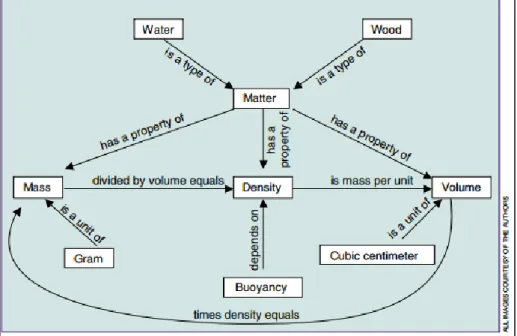
A concept map is a method of denoting relationships between ideas, images, or words. There are various uses of concept maps, such as stimulating the generation of ideas, brainstorming, communicating complex ideas etc (Cañas et al., 2003, Plotnick, 1997). For example, using concept maps in the science classroom, where learners are provided only the concepts and asked to connect concepts with a directional arrow, then name the arrow with a word or short phrase that represents the relationship between the two connected terms (Figure 2.1). Therefore, it can be read as a statement, such as “Water has density”. The statement of these two words linked by an arrow and phrase are called propositions (Vanides et al., 2005). Concept maps are also used in assessing learner’s knowledge of learning goals, concepts, and the relationship between those concepts. There are two key uses of concept maps in the adaptive e-learning: they are used to show the structure of learning materials, and they are also used to capture the understanding of the student of those materials. In the context of this thesis, a concept map model is a way of generating a domain model by classifying the relationship between concepts in a
specific course. This being particularly appropriate to the learning of programming languages and computer science theory which has a series of related concepts many of which need to be understood in a certain order, e.g. classes, methods, inheritance etc.
Figure 2.1 Concept map created by teachers for density and buoyancy unit (Vanides et al., 2005) • Virtual 3D Objects:
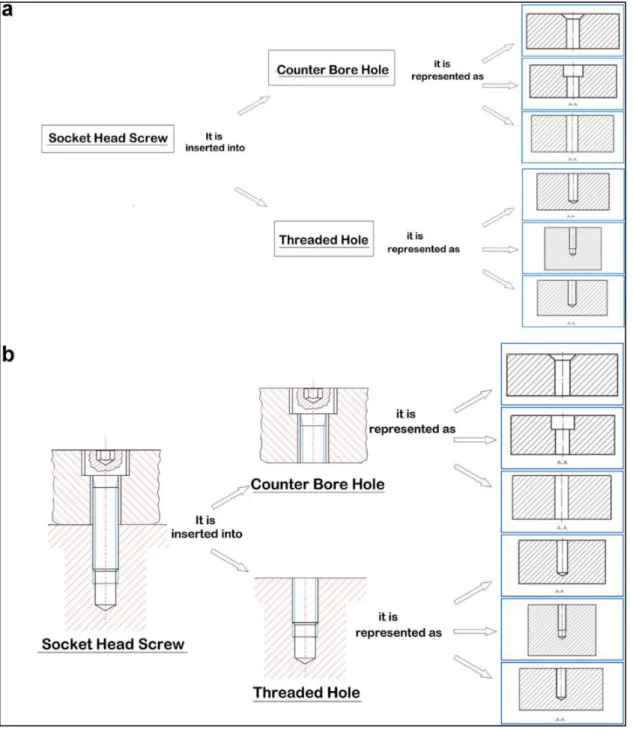
A web-based 3D interactive concept map is developed to help the students learn and motivate the challenging topics in Engineering drawing course in (Violante and Vezzetti, 2015). They have used concept maps to provide teaching, learning and evaluations of the student learning to the learners. In this concept map, a virtual 3D object describes a real-world object, and this supports students to imagine the actual global situation and helps them in collecting information and its processing to have better understanding about the problem and how to solve it. Violante and Vezzetti, as shown in Figure 2.2, have used the “threaded fasteners” topic as an experiment for their concept maps approach; more specifically, how to connect the hole to the kind of fastener correctly and how to properly represent the hole on an engineering 2D drawing with a simplified representation.
Figure 2.2 Two examples of concept maps about the topic “socket head screw.” (a) classical concept map (b) 2D concept map (Violante and Vezzetti, 2015)
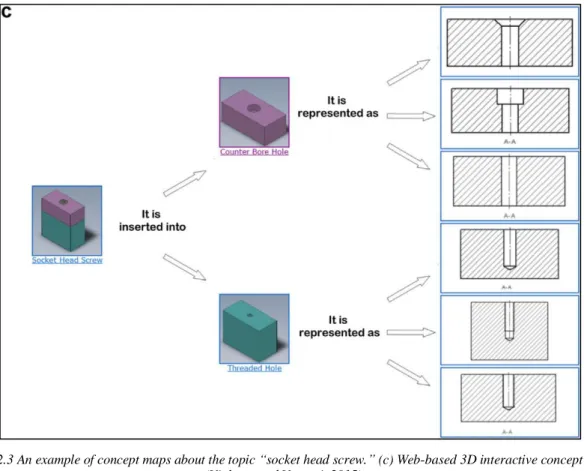
As shown in Figure 2.3, three interactive 3D objects are included in the concept map: a socket head screw that consists of two moulded parts, the clearance hole which is at the top, and the threaded hole which is at the secondary part. With these 3D interactive visualizations, the students can measure the hole pattern present in the high and lower part, and then determine the correct 2D design of each hole. Violante and Vezzetti have used this example to show the structure of the learning and to evaluate the understanding of students using concept maps.
Figure 2.3 An example of concept maps about the topic “socket head screw.” (c) Web‐based 3D interactive concept map (Violante and Vezzetti, 2015)
Violante and Vezzetti have conducted an empirical study on 32 students to test their spatial abilities. They have manipulated with a flat shape with numbered sides, and a three-dimensional shape with lettered sides, and have participated to indicate which numbered side corresponds to which lettered side. The results of their research showed that the concept maps helped the students to know how to correspond the shapes to the appropriate sides. Even though this shows good evidence of the advantages of using concept maps in e-learning this research is not in itself adaptive. They could improve their work by using 3D animations with immediate step-by-step instructions and apply it to students with both low spatial ability and high spatial ability.
• AISLE:
A more adaptive use of concept maps is that explored by Awati and Dixit. The concept map in this instance has been used to calculate student knowledge about a specific topic “History of America” automatically (Awati and Dixit, 2017). Markov chains technique is applied to determine the score of student understanding, along with XML parsing technique to analyse and assess the concept maps that the students have created (Markov, 1971). The framework for student learning assessments provides the score of student understanding about the topic and generates feedback for the teacher and the student as shown in Figure 2.4. Awati and Dixit have used artificial intelligence-based learning evaluation tool (AISLE) to perform learning evaluation of
concept maps using three main units: XML analyser module, Markov chain analysis module, and user interaction module.
Figure 2.4 system Architecture (Awati and Dixit, 2017)
In the XML analyser module, the concept maps are converted into XML documents by using Java and XML parser. After generating XML files, the required data is gathered, and hierarchy is created by Markov chain analysis module. The analysis is performed by this unit and conveyed to the user interaction module for providing analysis to the instructor in the form of charts and/or graphs. The Cmap tool (Cañas et al., 2004) is used by students to construct the concept maps and are given to the XML analyser module. In the concept map, there are three levels: Gist level, which is assumed to have only one gist level element and that is root node or subject of the topic; Support level, which is the concept after the root node; Detail level, which includes the concepts that are connected to the support level and considered as details nodes. XML Dom parser (Wang et al., 2007) is used to collect the information from a generated XML file for any concept maps. The values from this XML can be obtained based on the number of concepts in the hierarchy, the number of relations that connect to the different level in the concept map hierarchy, and the score that is calculated to each concept map in the hierarchy (Score). After calculation of these values, XML Dom parser can produce the summation of all scores in each level. Awati and Dixit have mentioned that this tool couldn't maintain a large number of students because graph is a complicated method, and it is hard to identify student's gaps in comprehending the topic. A powerful user interface is needed to show the outcomes of students. They have proposed a new module in their system, Result Analysis Module, to display the results of the students. It provides concept logical result of each student, rank of the students among their classmates, strengths and weaknesses of the concepts for students in understanding the topic. However, a key output of this research is that concept maps can be used to show a student’s understanding of a topic.
• OPCOMITS:
Dogan and Dikbıyık developed an adaptive intelligent system called OPCOMITS (Object Oriented Programming Tutor using Concept Map Model) based on a concept map model to organise topics in a hierarchal approach and measure the student’s knowledge about a topic to adapt learning (Dogan and Dikbıyık, 2016). This system structures the course based on the expert's desire, measures the student's knowledge levels about a topic, suggests enhancement feedback, diagnoses students’ weaknesses and guides them to related chapter topic in the domain for improvements. It uses concept maps to structure the learning material, and similarly concept maps to understand how much the students know the subject area and recommend them with the appropriate contents using the concept error rate. An Object-Oriented Programming course is used to evaluate the proposed system.
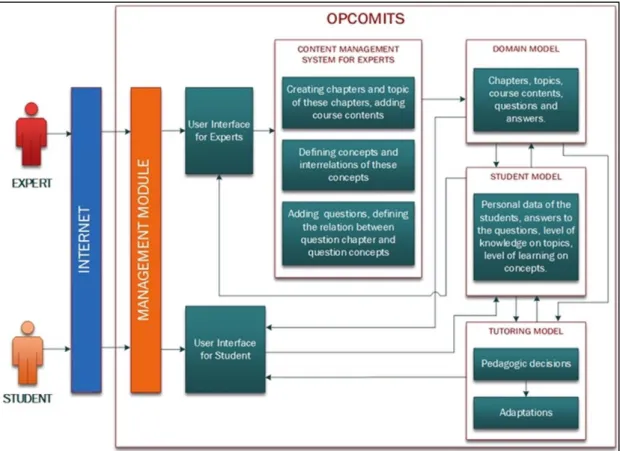
In the OPCOMITS system, which is shown in Figure 2.5, two primary users, which are experts and students, login into the system. Experts can set up the courses, concepts, chapters and topics followed by questions in the concept map using the “Content Management System for Experts” module in the system. Experts can create a domain model by identifying concept-subject, concept-question, concept-prerequisite and concept relationships. Experts can also control the concept learning level, and students' success displayed in chapters. The system keeps the course content and topic saved that the student achieved continuously in the student model, and all the student information on student model is employed in the decision-making process of the teaching model. At the end of each chapter, significant guidance is produced based on knowledge level and the evaluation conducted.
Figure 2.5 The architecture of OPCOMITS (Dogan and Dikbıyık, 2016)
In Student model, an individual student or learner can follow their adaptive path or navigate support through the system for each concept. The student interacts with each concept and then answers questions based on that concept's contents. The system evaluates the student's knowledge level adaptively for each concept when the student completes all topics in the chapter by calculating the concept error rate (CER). CER represents how much the students have done wrongly answering the question that is related to a particular concept. Therefore, the learners are determined based on their knowledge levels and coloured concept maps are generated to show them their understanding levels of the subject area as shown in Figure 2.6.
F igur e 2 .6 St ude nt c on ce pt m ap s cr ee n (D ogan and D ik bı yı k, 2 016)
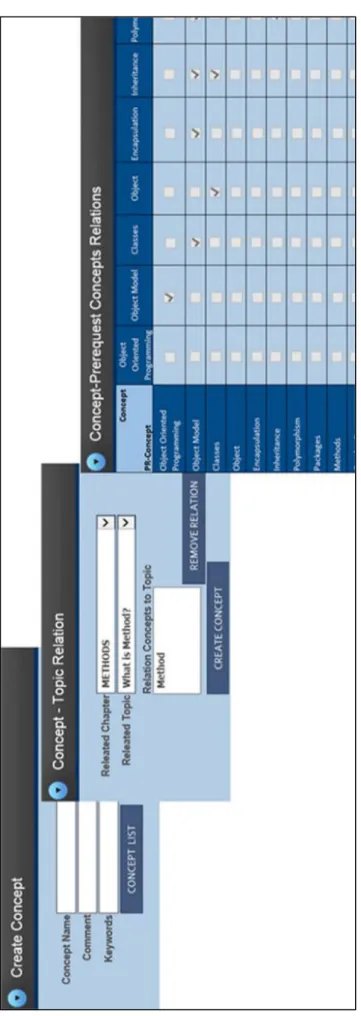
F igur e 2 .7 C re at ing c onc ept and c onc ept r el at ion s de fi ni ng sc re ens fo r ex pe rt s (D ogan an d D ik bı yı k, 201 6)
Domain model can be created by experts through the “Content Management System for Experts” to use the system operations which are: content operations, concept operation, and question operations. In content operations, the expert can create different types of content for each concept, such as visual, textual, auditory, and kinaesthetic content. In concept operations, when the expert creates the content, concepts are set to be added using the “Content Management System for Experts” and relates each concept with one or more topics (Figure 2.7). “Concept– topic relation means what concepts in the system are connected to which topic in the course content. This information is used to guide students to the topic content based on the result of the student evaluation. The expert determines the concept map by identifying concept-prerequisite and concept relationships. In question operations, the expert can create questions. Concept– question relation describes the level of relationship between the concepts and the questions provided by the expert to define the scope of learning the concepts.”
The system was tested with a dataset of 40 students enrolled in an object-oriented programming course at Istanbul Arel University in Istanbul, Turkey. Those students were divided into two groups, experimental and control, to investigate the impact of adaptation using concept map model and to define the influence on learning accomplishment. They have used a t-test for these two groups to compare them by utilizing the pre-test and post-test results of the empirical study. The analytical investigation pointed out that the change from the pre-test to the post-test results was greater for the experimental group than the control group. These results showed that the students who learned using OPCOMITS achieved much better than the students who learned with conventional e-learning.
Although this experiment gained positive results for a programming course and it works for well-structured subjects, it suggests that it would work well for most subjects in the area of computer science. They also provide a method to form learning content and determine students’ learning problems. Students can learn each concept in different learning styles depending on the content that the expert creates, such as textual content, visual content, auditory content, or kinaesthetic content, but combining different learning styles may be more effective and increase the student's learning achievement. Dogan and Dikbıyık have mentioned to improve this investigation using data mining techniques, such as Bayesian Networks, Fuzzy logic theory, decision tree etc. to perform enhancements according to the results collected from analysing data gathered from the students and to identify the prerequisite relationship between the concepts. Adding these adaptive techniques to OPCOMITS system could help to add the appropriate contents based on the student's performance and it could be capable to identify the concepts and determine the relationships between them.
2.3.2 Overlay Model
The overlay model was designed by (Stansfield, 1976) for students who possess incomplete but correct domain knowledge. In overlay modelling, the student model is a subset of the domain model revealing expert-level knowledge. The overlay model technique enables the domain model of the individualized and/or adaptive tutoring system as a representation of specific concepts and topics. Consequently, its complexity is because of the domain model’s structure, design, and student knowledge appraisal (Martins et al., 2008). Therefore, the overlay model defines user knowledge for each individual concept and is the reason for extended use. Overlay models are incomplete as an advanced model since they do not account for how the user makes an inference, and how new knowledge is combined with previous knowledge. This is why an adaptive and/or personalised tutoring system is representative of student modelling by combining the overlay model with other student modelling methods, e.g. stereotypes, perturbation and fuzzy techniques.
The overlay technique has been used by (Kumar, 2006a, Kumar, 2006b) when programming a tutor as a way of modelling students, and when (Glushkova, 2008) developed the DeLC system it modelled the level of knowledge that learners had by using a qualitative overlay. Because Glushkova wanted also to model a number of other things, the system combined stereotype modelling (discussed below) with the overlay. The other things that were modelled included how learners accessed training resources and learners’ behaviours, habits and preferences. When (Limongelli et al., 2009) constructed the LS-Plan, a framework that allows e-learning to be adapted and personalised, they also used a qualitative overlay model. Competence in mathematics in e-learning environments is modelled by IWT (Albano, 2011) using an overlay model that applies a representation of the knowledge domain derived ontologically. Thinking style is integrated into their adaptive hypermedia system (AHS-TS) by (Mahnane et al., 2012) by the application of an overlay model. PDinamet is a web-based adaptive system for secondary education physics teaching developed by (Gaudioso et al., 2012) that enables the appropriate learning resources to be selected effectively and in personalised form by use of an overlay model.
However, Rivers has identified the inadequacy of overlay models for complex student modelling in that they take no account of how users infer things, how they integrate new knowledge into their existing store of knowledge or how learning changes their representational structures (Rivers, 1989). The overlay model does not make it possible either to identify incorrect knowledge acquired or possibly acquired by the student and nor does it distinguish individual learners’ personality, behaviours, preferences and cognitive needs. It is because of those shortcomings that a number of personalised and/or adaptive learning systems when modelling students combine the overlay model with such other techniques as stereotyping, fuzzy techniques and perturbation (Chrysafiadi and Virvou, 2013c).
2.3.3 Stereotypes
An additional approach frequently used for student modelling is stereotyping. Stereotypes were presented by (Rich, 1979) for student modelling in the GRUNDY system. The stereotype technique is used for classifying ever adaptive system user into a group based shared attributes. These groups are called stereotypes. More specifically, a stereotype regularly includes the basic knowledge about a group of users. New users are enrolled into a suitable stereotype if individual characteristics match those of the stereotype. The stereotype is an important way to rationalize about users and a solution to the problem of initializing the student model by allocating a student into a particular group (Tsiriga and Virvou, 2002). The stereotype technique is beneficial in that the knowledge of a certain user is decided upon from the related stereotype(s). Additionally, information about user stereotypes can be maintained with low repetition without using the knowledge deriving process for all users (Zhang and Han, 2005).
However, stereotypes can also cause issues. Stereotypes are inflexible since they are constructed in a handcrafted manner before a real user has dealt with the system. They are also not updated until someone specifically does so (Tsiriga and Virvou, 2002). Additionally, (Kass, 1991) states that stereotypes face two problems. Firstly, to use the stereotypes the system user groups must be divided into classes; although, these classes may not exist. Secondly, even if it could identify classes of system users, the system creator needs to create the stereotypes, which is time consuming and can cause errors. Additionally, stereotypes are not flexible and any system involving allocating students into set groups risks not addressing the particular needs of students.
2.3.4 Fuzzy Logic Theory
Another adaptive technique often used in e-learning is Fuzzy logic which was introduced by (Zadeh, 1965) as a method for computing with words (Zadeh, 1996). It can manage uncertainty in problems having ambiguous and incomplete data as well as individual subjectivity (Drigas et al., 2009). “Fuzzy logic is design of multi-valued logic that enables intermediate values between regular evaluations, such as true/false, yes/no, high/low, and big/small. Ideas such as rather tall or very fast can be declared mathematically and treated by computers to apply a more human-like approach of thinking in computer programming” (Hájek, 2006, Zadeh, 1984). Therefore, fuzzy logic theory is very applicable to the job of modelling student understanding. Fuzzy logic theory enables reasoning in real-life uncertainty scenarios without an actual border in standard set theory (Yen et al., 1998, Zimmermann, 2011), or the phrase “only slightly understood” may be represented as a score, e.g. between 65 and 75. Similarly, the phrase “understood fairly well” may represent a score between 80 and 90 in the field of learning environment.
A fuzzy set is a set of objects with fuzzy boundaries, with low, medium or high to understand specific concept levels of the subject matter (Negnevitsky, 2005). For the assignment
of a fuzzy set, it is represented as a function with elements mapped to the set based on their membership degree. A weakly understood concept is a good example of a fuzzy set. The fuzzy set elements of “weak concepts” are all weak concepts, however their membership degrees are based on their levels. Triangles and trapezoids are standard membership functions applied in fuzzy expert systems. The fuzzy set theory addresses linguistic variables. A linguistic variable is a fuzzy variable. For instance, in a programming language course, the statement “If-Statement concept is weak” is an indication that the linguistics variable ‘If-Statement’ takes the linguistic value ‘weak’. A linguistic variable represents a concept with uncertain or fuzzy values expressed in fuzzy sets. Hedges is another term in fuzzy sets, these are fuzzy set qualifiers for changing the form of fuzzy sets. This includes adverbs such as ‘very’, ‘somewhat’, ‘quite’, ‘more’, ‘less’ and ‘slightly’. Hedges implements an analytical concentration process by decreasing the membership degree of fuzzy elements (e.g. very low concept), expansion by increasing the membership degree (e.g. more or less low concept), and reinforcement by increasing the membership degree above 0.5 and decreasing those below 0.5 (e.g. indeed low concept). A way of describing the hedges is illustrated in Figure 2.8. An individual with a height of 185cm is considered as a member of the tall men set with a degree of membership of 0.5. Additionally, he is a member of the set of very tall men with a degree of 0.15 (Negnevitsky, 2005).
Figure 2.8 Fuzzy sets with very hedge (Negnevitsky, 2005)
Fuzzy sets interact with its operations, the main operations of which are: complement, containment, intersection and union. A fuzzy rule is a conditional statement in the form (IF x is A, THEN y is B), where x and y are linguistic variables, and A and B are linguistic values defined by fuzzy sets. For instance, if the understanding of a concept is weak, then the remedial learning material is large.
Fuzzy inference is where there is an expression of the mapping from a particular input to an output by using the fuzzy sets theory. The fuzzy inference process has four stages: fuzzification of the input variables, rule evaluation, aggregation of the rule outputs, and defuzzification. There are two primary fuzzy inference system types, which are the Mamdani and Sugeno methods
(Mamdani and Assilian, 1975) (Takagi and Sugeno, 1985). These two inference techniques vary in how outputs are defined. The Mamdani approach is popular in fuzzy expert systems as it can use expert knowledge in fuzzy rules. Yet, Mamdani-type fuzzy inference needs a greater degree of computational load. The Sugeno method uses a single spike, a singleton, as the rule membership function sequential for enhancing the fuzzy inference computational performance. Thus, the Sugeno system is effective in control applications, particularly for dynamic nonlinear systems, since it operates with optimization and adaptive systems. Researchers use both techniques in adaptive e-learning systems based on the description of outputs (Negnevitsky, 2005).
Fuzzy expert systems use uncertainty to simulate human rationalizing and thinking processes. Usually, a fuzzy expert system is structurally based on knowledge, determined by a fuzzy rule set of the IF-THEN form (antecedent and consequent), including a fuzzy logic quantification of linguistic information from experts, for example values and variables. Creating a fuzzy expert system includes defining fuzzy rules and fuzzy sets, evaluating and then harmonizing the system to match the specific conditions.
• ELGuide:
The fuzzy logic theory has been used to personalize tracking for each student, provide students with materials, and give advice to them, and for modelling student’s understanding using (eLGuide) system (Zafar and Albidewi, 2015). Fuzzy clustering, fuzzy relation, and information retrieval (IR) have been used to discover knowledge-based structure and identify relationships between the knowledge material contents and their relevant documents. To personalize tracking or navigation of each student, the difficulty level of each concept and student's knowledge level are considered to produce a learning path for each learner. Each registered student can select and interact with different concepts or learning units. After each concept, there are self- assessment quizzes for that concept, so the students can know their ability or performance after taking the assessments, before they take the final test. The system computes and updates student's knowledge level based on their performance by taking the assessments, recommends different options of taking following concepts regarding their knowledge of the previous concept, and generates advice for the student about which next concept they should take.
To measure the students' abilities, Zafar and Albidewi use time-consuming measurement which means how many times the student reviews and interacts with a learning object. In fact, they have used two types of measurements in the knowledge assessment; a measure of belief (MB, used as a measure for understanding the concept) and a measure of disbelief (MD, used as a measure for not understanding the concept). Therefore, the fuzzy logic system has been used to recommend the suggested concepts by using three input linguistic vari