Research Article
Design of a Distribution Network Using
Primal-Dual Decomposition
J. A. Marmolejo,
1R. Rodríguez,
2O. Cruz-Mejia,
3and J. Saucedo
4 1Faculty of Engineering, Anahuac University, 52786 Mexico City, MEX, Mexico2School of Economics, National Polytechnic Institute, 11350 Mexico City, MEX, Mexico
3UAP Nezahualc´oyotl, Universidad Aut´onoma del Estado de M´exico, 57000 Nezahualcoyotl, MEX, Mexico
4Posgrado en Log´ıstica y Cadena de Suministro, Universidad Aut´onoma de Nuevo Le´on, 66450 Monterrey, NL, Mexico
Correspondence should be addressed to J. A. Marmolejo; [email protected] Received 22 October 2015; Revised 1 January 2016; Accepted 10 January 2016
Academic Editor: Young Hae Lee
Copyright © 2016 J. A. Marmolejo et al. This is an open access article distributed under the Creative Commons Attribution License, which permits unrestricted use, distribution, and reproduction in any medium, provided the original work is properly cited. A method to solve the design of a distribution network for bottled drinks company is introduced. The distribution network proposed includes three stages: manufacturing centers, consolidation centers using cross-docking, and distribution centers. The problem is formulated using a mixed-integer programming model in the deterministic and single period contexts. Because the problem considers several elements in each stage, a direct solution is very complicated. For medium-to-large instances the problem falls into large scale. Based on that, a primal-dual decomposition known as cross decomposition is proposed in this paper. This approach allows exploring simultaneously the primal and dual subproblems of the original problem. A comparison of the direct solution with a mixed-integer lineal programming solver versus the cross decomposition is shown for several randomly generated instances. Results show the good performance of the method proposed.
1. Introduction
The constant emphasis on customer satisfaction has high-lighted the importance of designing distribution networks of firms [1]. Optimal network design plays an important role in the supply chain operation, as good logistics distribution network can save transportation costs as well as improve customer service levels [2]. Facility location can be a criterion for the design of distribution networks. Many organizations consider facility location as a strategic decision for having high material handling cost.
Distribution costs in many industries constitute an important part of the total logistics expenditure. Conse-quently, the final price is strongly linked to the location of facilities where products are manufactured or stored; see Figure 1. In particular, a cost to take into consideration is the fix cost of opening and setting up new facilities as tempo-ral consolidation centers or mixing centers, that is, cross-docking or merge-in-transit centers [3].
Given that the complexity of the mathematical model falls in Np-hard, we propose an efficient method to solve
the design of a soda bottling distribution system, depicted in Figure 2. The proposed distribution network is constituted by plants, warehouses (cross-docking and merge-in-transit cen-ters), and distribution centers. Commodities are produced at several capacitated plants and the demand of distribution centers is satisfied from warehouses.
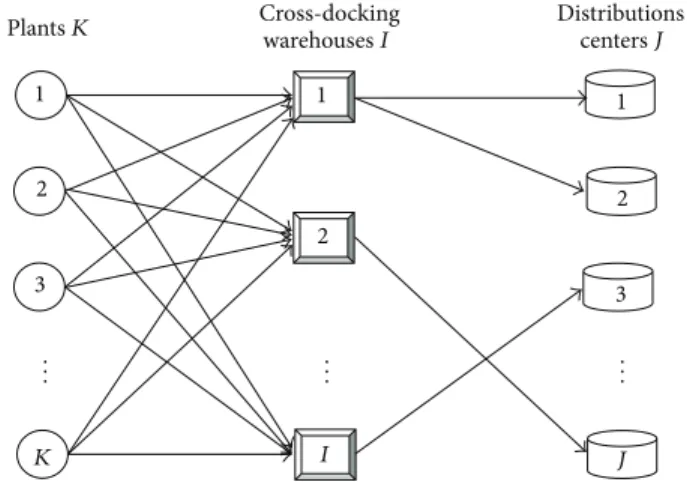
The problem is to determine among the possible ware-houses the ones to be opened to consolidate the demand and by which warehouse each distribution center is exclusively served. The objective is minimizing fix costs and total transportation costs and to establish a network of routes that enables the flow of products in order to satisfy some demand characteristics. The proposed network is shown in Figure 3.
2. Literature Review
Network design problems with real scenarios are widely addressed in optimization problems. Most of them study four supply chain functions: location, production, inventory, and transportation with the aim of integrating them. In [4],
Volume 2016, Article ID 7851625, 9 pages http://dx.doi.org/10.1155/2016/7851625
Figure 1: Three-echelon supply chain. i 7 6 8 2 1 1 2 3 4 5 6 7 8 9 10 j 3 4 5 2 1 3 4 k Plants K Cross-docking I Cross-docking I Distribution center J Distribution center J · · · · · · · · ·
Figure 2: Distribution system of the company.
an integrated optimization model of supply chain functions in a multiplant, multiproduct, and multicustomer supply chain with deterministic demand is developed and formu-lated as a capacitated location, production, and distribution problem.
More recent papers include the study of real cases focus-ing on particular aspects of the location problem. In [5], the authors present a review in the context of supply chain management and its integration with other decisions in the context of network design. For example, in [6, 7], interesting aspects in the distribution network design are enumerated including the classical facility location problem solved by different techniques according to the specific objectives.
Nowadays the competitive and ever-changing business environment makes the distribution network design more complicated. New features including specific conditions with suppliers, distribution centers, and customers are modeled. A seminal work was done by [8] in which an extended view of the distribution network design including suppliers, facilities (production and distribution), customers, and many kinds of transportation means is included.
Research work by [9] provides a literature review about the main research papers published from 2005 to 2015 under
Plants K Distributionscenters J
2 3 1 2 3 1 2 1 Cross-docking warehouses I I J K ... ... ...
Figure 3: Proposed distribution system.
the following keywords: distribution networks design, supply chain, logistics, and global. The review includes a description of the operations research techniques used to solve each problem.
Numerous methods of solution have been used to solve facility location problems including [10], in which a new method for the solution of the problem addresses the optimal location of distribution centers between plants and cus-tomers. Because of the dimension of the problem, they develop an algorithm based on Benders decomposition (BD) [11] for solving a multicommodity distribution network. Reference [12] introduces a mixed-integer problem (MIP) to model a multiproduct distribution network solved with BD and two Tabu Search heuristics that made possible the convergence and solution quality. Another classical model is found in [13], in which a model solves a minimization function that includes fix costs in warehouses, distribution centers, and transportation costs for multicommodities from plants to warehouses and finally to customers. Similarly in [13], a triechelon, multicommodity system including produc-tion, distribuproduc-tion, and transportation planning is solved using Lagrangian Relaxation (LR) in a heuristic. In [14–16], a facility location problem is also solved but they consider the specific features to solve the problem.
In [17] a distribution network design problem with 3 stages is solved optimizing the numbers of locations and capacities of plants and warehouses. At the same time the problem minimizes total costs and satisfies all demands. Given the complexity of the solution the authors use a Lagrangian based solution procedure for the problem. In [18] a variable neighborhood search (VNS) heuristic method integrating a Tabu Search procedure is used to solve a large scale production and distribution network design model.
A different solution strategy is presented by [19] based on bilevel programming problem. In this paper a distribution network with distribution and production plants around the world is solved using an extended genetic algorithm. Another multicriteria proposal is given by [20] whose authors solve the problem with MIP (is not large scale problem) making tactical decisions for distributing the product to customers. In [21], a multiobjective genetic algorithm is developed to solve
a stochastic production-distribution network in which the objective function is optimizing the costs and service level.
In [22], an integrated distribution network design and site selection problem is analyzed. The setting is in the context of transportation planning faced by the freight-forwarding industry. The problem includes a strategic level multicom-modity network design. In this problem each commulticom-modity is defined by a unique pair of origin and destination points and a required amount of flow and other considerations proper to the real world using BD.
In [23, 24], also a BD approach is used, first in com-bination with an intelligent algorithm to improve the time solution for the main problem and later in a modified version that takes advantage of the mathematical formulation. In both cases the problem is in deterministic, multicommodity, and single period contexts.
BD or primal decomposition methods exploit only the primal structure of the original problem. However, many mixed-integer programming problems have primal and dual easy-to-solve problems; for example, in [25–27], cross decomposition (CD) is used to solve a capacitated facility location problem by defining subproblems of transportation and location of plants.
In conclusion, the reviewed research papers addressing the facility location and transportation planning problems have missed modeling cross-docking and merge-in-transit centers which are a novel feature in this paper.
In this paper, we propose single-sourcing constraints ensuring that each distribution center is exclusively served by a single cross-docking or merge-in-transit center; see Figure 2. This condition arises often in bottled drinks com-panies where the operating conditions restrict that only one cross-docking center serves one distribution center. Addi-tional operating conditions from the real case are included in the constraints and explained in Section 3.
The model considers binary variables for cross-docking locations and the allocation of cross-docks to distribution centers. Continuous variables for the flow of a single com-modity from plants to operating cross-docks are defined. This is a common problem for bottling companies to define specific supply routes to each distribution center. Using the proposed mathematical model more efficient transportation routes will be generated.
We assume that the design of the distribution network can be solved efficiently by using decomposition techniques, more specifically a primal-dual decomposition. This method was originally developed for linear mixed-integer program-ming problems but the approach is more general and not restricted to such problems.
Many combinatorial optimization problems can be solved if the complexity of variables and constraints were removed. Some examples are the assignment problem, the facility location problem [28], the optimal power flow [29], and other mixed-integer programming problems.
Primal-dual decomposition can offer also better com-putational time than traditional decomposition techniques, such as Benders decomposition and Lagrangian Relaxation. However, the key point for having good results using primal-dual decomposition techniques is the mathematical structure
of the problem. By this we mean if the rows and columns of the coefficient matrix can be rearranged so that the matrix has block-angular form, then primal-dual decomposition method will generate better solutions.
The paper is organized as follows. Section 3 presents a mathematical programming model of the distribution problem. Section 4 describes the cross decomposition that is the solution methodology. In Sections 5 and 6 we present the computer implementation and experimental results. Conclu-sions are reported in Section 7.
3. Mathematical Model
Let𝐾be the set of manufacturing plants. An element𝑘 ∈ 𝐾
identifies a specific plant of the company. Let𝐼be the set of
the potential cross-docking warehouses. An element𝑖 ∈ 𝐼is
a specific cross-docking warehouse. Finally, let𝐽be the set of
distribution centers; a specific distribution center is any𝑗 ∈ 𝐽.
LetZdenote the set of integers{0, 1}.
Parameters.Consider the following:
𝑄𝑘= capacity of plant𝑘.
𝛽𝑖= capacity of cross-docking warehouse𝑖.
𝐹𝑖= fixed cost of opening cross-docking warehouse in
location𝑖.
𝐺𝑘𝑖= transportation cost per unit of the product from
plant𝑘to the cross-docking warehouse𝑖.
𝐶𝑖𝑗= cost of shipping the product from cross-dock𝑖
to the distribution center (CeDis)𝑗.
𝑑𝑗= demand for the distribution center𝑗.
Decision Variables. We have the following sets of binary variables to make the decisions about the opening of the docking warehouse and the distribution for the cross-docking warehouse to the distribution center:
𝑌𝑖
={{
{
1 If location𝑖is used as a cross-docking warehouse,
0 otherwise,
𝑋𝑖𝑗
={{
{
1 if cross-dock𝑖supplies the demand of CeDis𝑗,
0 otherwise.
(1)
𝑊𝑘𝑖is the amount of product sent from plant𝑘to the
cross-dock𝑖which is represented by continuous variables.
We can now state the mathematical model as a (P) problem. See [30]. Consider
min
𝑊𝑘𝑖,𝑌𝑖,𝑋𝑖𝑗 𝑍 = ∑𝑘∈𝐾∑𝑖∈𝐼𝐺𝑘𝑖𝑊𝑘𝑖+ ∑𝑖∈𝐼𝐹𝑖𝑌𝑖+ ∑𝑖∈𝐼∑𝑗∈𝐽𝐶𝑖𝑗𝑑𝑗𝑋𝑖𝑗. (2) Subject to Constraints
Capacity of the plant is as follows:
∑
𝑖∈𝐼
Balance of product is as follows: ∑ 𝑗∈𝐽 𝑑𝑗𝑋𝑖𝑗= ∑ 𝑘∈𝐾 𝑊𝑘𝑖, ∀𝑖 ∈ 𝐼. (4)
Single cross-docking warehouse to distribution center is as follows:
∑
𝑖∈𝐼
𝑋𝑖𝑗= 1, ∀𝑗 ∈ 𝐽. (5)
Cross-docking warehouse capacity is as follows:
∑
𝑗∈𝐽
𝑑𝑗𝑋𝑖𝑗≤ 𝛽𝑖𝑌𝑖, ∀𝑖 ∈ 𝐼. (6)
Demand of items is as follows:
𝑝𝑌𝑖≤ ∑ 𝑘∈𝐾 𝑊𝑘𝑖, ∀𝑖 ∈ 𝐼 (7) 𝑝 =min{𝑑𝑗} (8) 𝑊𝑘𝑖≥ 0, ∀𝑖 ∈ 𝐼, ∀𝑘 ∈ 𝐾 (9) 𝑌𝑖∈Z, ∀𝑖 ∈ 𝐼 (10) 𝑋𝑖𝑗∈Z, ∀𝑖 ∈ 𝐼, ∀𝑗 ∈ 𝐽. (11)
The objective function (2) considers in the first term the
cost of shipping the product from plant 𝑘 to the
cross-docking warehouse𝑖. The second term contains the fix cost
to open and operate the cross-docking warehouse𝑖. The last
term incorporates the cost of fulfilling the demand of the
distribution center𝑗. Constraint (3) implies that the output
of plant𝑘does not violate the capacity of plant𝑘. Balance
constraint (4) ensures that the amount of products that arrive
to a distribution center𝑗 is the same as the products sent
from plant 𝑘. The demand of each distribution center 𝑗
will be satisfied by a single cross-docking warehouse𝑖, and
this is achieved by constraint (5). Constraint (6) bounds the amount of products that can be sent to a distribution center
𝑗 from an opened cross-docking warehouse 𝑖. Constraint
(7) guarantees that any opened cross-docking warehouse𝑖
receives at least the minimum amount of demand requested
by a given distribution center 𝑗. Constraint (8) ensures
that the minimum demand of each distribution center 𝑗
is considered. Finally, constraints (9), (10), and (11) are the nonnegative and integrality conditions.
4. Cross Decomposition Approach
Many of the large scale mixed-integer linear programming problems are too complex to be solved directly with mercial software. However, when the computational com-plexity grows exponentially according to the instance size, decomposition techniques usually offer better solutions. As it is seen before, in this cases Benders decomposition is used as well as the Lagrangian Relaxation. In general terms, Benders decomposition generates good results. However, the master
Dual subproblem Master problem Primal subproblem CTD Stop CTP Stop 𝜆i 𝜆i 𝜆i Xij Xij Xij Yi Yi Yi
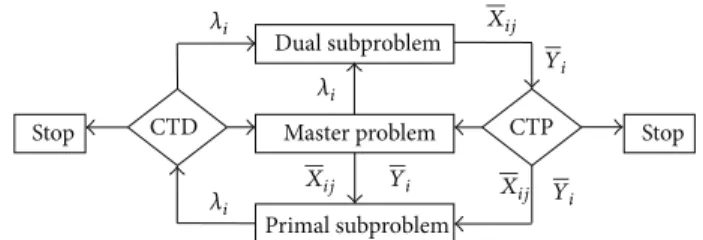
Figure 4: Cross decomposition algorithm.
problem of Benders can be difficult to solve and require very large computation time [31, 32].
In this paper, with very large instances including several plants, cross-docks, and distribution centers, the optimal design of the distribution network involves a very large number of integer binary variables that generate large com-putational time for reaching the optimal solution.
Because Benders method sometimes produces better bounds than Lagrange method but the solution of its master problem involves large amount of computational time, in this paper we use cross decomposition to obtain automatically the best primal and dual bounds and an approximate optimal solution. Cross decomposition can obtain exact and finite solutions for mixed-integer models if the continuous part of the problem is convex and linear. This decomposition method unifies Benders decomposition and Lagrangian Relaxation into a single framework that involves iterative solutions to a primal subproblem (Benders) and a dual subproblem (Lagrange).
Cross decomposition [28] consists basically in a first stage of solving subproblems: primal and dual. The dual
subproblem generates the binary variables (𝑌𝑖and𝑋𝑖𝑗) that
will be fixed for the primal subproblem. Additionally, the dual subproblem provides a lower bound of the optimal value
for the objective function (ΦDS). The primal subproblem
generates the Lagrangian multipliers (𝜆𝑖) that will be fixed
for the dual subproblem. At the same time, the primal subproblem produces an upper bound of the optimal value
for the objective function (ΩPS). In each iteration a primal
and a dual convergence test will be performed (CTP and CTD). If any of these tests fail, there will be a need to solve the master problem; see Figure 4:
CTP = IfΩPS <Vgo to solve the primal subproblem,
and if not, go to solve Dual Master Problem.
CTD = IfΦDS < Vgo to solve the dual subproblem,
and if not, go to solve Dual Master Problem.
V is the least upper bound known and Vis the largest
lower bound known at the current step of the algorithm. Consequently, this method can be used to reduce cpu time of the original problem [29]. For large scale instances, that is, problems with large number of plants, cross-docks, and distribution centers, the direct solution is very complicated and cpu time increases exponentially. The exponential growth of the cpu time is related to selecting what cross-dock must supply the demand for the distribution center.
In this work we use only the Dual Master Problem because the subgradient method is implemented; see [33, 34]. A good but not necessary optimal set of multipliers is obtained by subgradient optimization. The starting multipli-ers can be set equal to zero. The objective is to limit as much as possible the use of any master problem. The master problem is more difficult to solve than the primal or dual subproblems. To generate the dual subproblem we relax the cross-dock
balance constraint (4). 𝜆𝑖 is the Lagrangian multiplier of
dualized constraint (4). By dualizing this constraint we obtain a dual subproblem that is less expensive to solve. This relaxation also speeds up the solution of this subproblem. Primal and dual convergence tests are used to check a bound improvement and to verify when an optimal solution is reached.
The procedure generates a primal bound (ΩPS) and a dual
bound (ΦDS) with corresponding optimal values. A
disadvan-tage is that, for nonconvex problem, the convergence cannot be guaranteed because there is no monotonic improvement of the bounds. For this reason, the procedure includes a convergence test that makes sure of obtaining a better bound. Next we describe the primal and dual subproblems obtained from the original problem.
Dual Subproblem (DS). Consider the following: min 𝑊𝑘𝑖,𝑌𝑖,𝑋𝑖𝑗 ΦDS = ∑ 𝑘∈𝐾 ∑ 𝑖∈𝐼 𝐺𝑘𝑖𝑊𝑘𝑖+ ∑ 𝑖∈𝐼 𝐹𝑖𝑌𝑖+ ∑ 𝑖∈𝐼 ∑ 𝑗∈𝐽 𝐶𝑖𝑗𝑑𝑗𝑋𝑖𝑗 + ∑ 𝑖∈𝐼𝜆𝑖( ∑𝑘∈𝐾 𝑊𝑘𝑖− ∑ 𝑗∈𝐽𝑑𝑗𝑋𝑖𝑗) (12) subject to constraints (3), (5)–(11).
Primal Subproblem (PS).Consider the following:
min 𝑊𝑘𝑖 ΩPS = ∑ 𝑘∈𝐾 ∑ 𝑖∈𝐼 𝐺𝑘𝑖𝑊𝑘𝑖+ ∑ 𝑖∈𝐼 𝐹𝑖𝑌𝑖 + ∑ 𝑖∈𝐼 ∑ 𝑗∈𝐽 𝐶𝑖𝑗𝑑𝑗𝑋𝑖𝑗 subject to: ∑ 𝑖∈𝐼 𝑊𝑘𝑖≤ 𝑄𝑘, ∀𝑘 ∈ 𝐾 ∑ 𝑗∈𝐽 𝑑𝑗𝑋𝑖𝑗= ∑ 𝑘∈𝐾 𝑊𝑘𝑖, ∀𝑖 ∈ 𝐼 ∑ 𝑗∈𝐽 𝑑𝑗𝑋𝑖𝑗≤ 𝛽𝑖𝑌𝑖, ∀𝑖 ∈ 𝐼 𝑝𝑌𝑖≤ ∑ 𝑘∈𝐾 𝑊𝑘𝑖, ∀𝑖 ∈ 𝐼 𝑝 =min{𝑑𝑗} 𝑊𝑘𝑖 ≥ 0, ∀𝑖 ∈ 𝐼, ∀𝑘 ∈ 𝐾. (13)
Dual Master Problem (DMP).Consider the following:
max
𝜆𝑖
ΨDMP= ΦDS
subject to: 𝜆𝑖≥ 0.
(14)
4.1. Cross Decomposition Algorithm
Step 1(initialize). Select initial values𝜆𝑖 for the Lagrangian
multipliers and set up and apply the corresponding CTD. The starting multipliers can be set equal to zero. Either stop (the
algorithm terminates whenV−V≤ 𝜖) or go to Step 4 or set up
the dual subproblem.
Step 2. Solve the dual subproblem (DS) that is a lower
bound. Apply CTP for𝑌𝑖and𝑋𝑖𝑗. Either stop (the algorithm
terminates whenV−V≤ 𝜖) or go to Step 4 or set up the primal
subproblem.
Step 3. Solve the primal subproblem (PS) that is an upper
bound. Apply CTD for𝜆𝑖. Either stop (the algorithm
termi-nates whenV−V ≤ 𝜖) or go to Step 4 or set up the dual
subproblem corresponding to the optimal solution of the current (PS) and go to Step 2.
Step 4. Solve the master problem. In this work we solve
the Dual Master Problem (DMP). Find new values for the Lagrangian multipliers that are held fix in DS. Set up the cor-responding subproblem and go, respectively, to Step 2. In this case we use subgradient method to solve DMP.
5. Computer Implementation
In this section we compare the computational implementa-tion for the direct soluimplementa-tion versus the soluimplementa-tion obtained using cross decomposition. Both were solved using a commercial software GAMS [35]. We randomly generated 30 instances according to the structure and complexity of the real case instance. The size of an instance is given by the number
of manufacturing plants (|𝐾|), the number of cross-docking
warehouses (|𝐼|), and the number of distribution centers (|𝐽|).
|𝐽|are chosen randomly in set{254, . . . , 1000}according to a
uniform distribution.|𝐾|and|𝐼|follow the same proportion
of the real case instance.
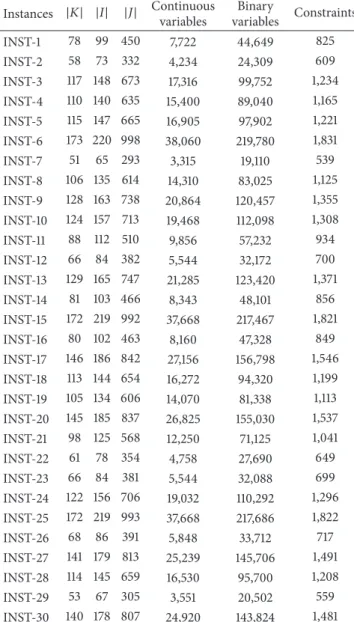
In Table 1, the instances generated with different numbers of plants, cross-docks, and distribution centers are observed.
Additionally, an instance based on a real case with|𝐾| =
44, |𝐼| = 56, and |𝐽| = 254 was solved. We test the solution method under different circumstances to evaluate the performance under different complexity instances. The full-scale model and the decomposition strategy proposed were implemented in GAMS using the solver CPLEX [36] for the mixed-integer programming (DMP, DS) and the linear problems (PS). All mathematical models were carried out on
Table 1: Size and characteristics of problem instances. Instances |𝐾| |𝐼| |𝐽| Continuous variables Binary variables Constraints INST-1 78 99 450 7,722 44,649 825 INST-2 58 73 332 4,234 24,309 609 INST-3 117 148 673 17,316 99,752 1,234 INST-4 110 140 635 15,400 89,040 1,165 INST-5 115 147 665 16,905 97,902 1,221 INST-6 173 220 998 38,060 219,780 1,831 INST-7 51 65 293 3,315 19,110 539 INST-8 106 135 614 14,310 83,025 1,125 INST-9 128 163 738 20,864 120,457 1,355 INST-10 124 157 713 19,468 112,098 1,308 INST-11 88 112 510 9,856 57,232 934 INST-12 66 84 382 5,544 32,172 700 INST-13 129 165 747 21,285 123,420 1,371 INST-14 81 103 466 8,343 48,101 856 INST-15 172 219 992 37,668 217,467 1,821 INST-16 80 102 463 8,160 47,328 849 INST-17 146 186 842 27,156 156,798 1,546 INST-18 113 144 654 16,272 94,320 1,199 INST-19 105 134 606 14,070 81,338 1,113 INST-20 145 185 837 26,825 155,030 1,537 INST-21 98 125 568 12,250 71,125 1,041 INST-22 61 78 354 4,758 27,690 649 INST-23 66 84 381 5,544 32,088 699 INST-24 122 156 706 19,032 110,292 1,296 INST-25 172 219 993 37,668 217,686 1,822 INST-26 68 86 391 5,848 33,712 717 INST-27 141 179 813 25,239 145,706 1,491 INST-28 114 145 659 16,530 95,700 1,208 INST-29 53 67 305 3,551 20,502 559 INST-30 140 178 807 24,920 143,824 1,481
AMD Phenom II N970 Quad-Core with a 2.2 GHz processor and 4 GB RAM. We set GAMS parameter OPTCR at 0.0015; that is, the relative termination tolerance is within 0.15% of the best possible solution. Additionally, the size of all MIP models was reduced through presolver phase of CPLEX. The cross decomposition algorithm stops when the values of the lower and upper bounds are equal, except for a small
tolerance𝜖= 0.15%:
𝜖 = [(UB−LB)
UB ] ⋅ 100%. (15)
6. Experimental Results
The design of the distribution network studied in this paper was undertaken using an algorithm of cross decomposition described in earlier sections. Table 2 illustrates the cpu times of 30 instances by proposed decomposition strategy. It is
Table 2: Computational statistics.
Instances |𝐾| |𝐼| |𝐽| GAP (%) cpu time (seconds)
INST-1 78 99 450 0.20 954 INST-2 58 73 332 0.20 549 INST-3 117 148 673 0.29 1734 INST-4 110 140 635 0.33 1259 INST-5 115 147 665 0.36 1632 INST-6 173 220 998 0.25 3500 INST-7 51 65 293 0.25 495 INST-8 106 135 614 0.24 1476 INST-9 128 163 738 0.26 1847 INST-10 124 157 713 0.33 1810 INST-11 88 112 510 0.35 921 INST-12 66 84 382 0.28 769 INST-13 129 165 747 0.34 1930 INST-14 81 103 466 0.26 1093 INST-15 172 219 992 0.30 3180 INST-16 80 102 463 0.22 852 INST-17 146 186 842 0.28 2031 INST-18 113 144 654 0.29 1027 INST-19 105 134 606 0.32 921 INST-20 145 185 837 0.32 2160 INST-21 98 125 568 0.25 1328 INST-22 61 78 354 0.34 465 INST-23 66 84 381 0.28 643 INST-24 122 156 706 0.24 1759 INST-25 172 219 993 0.30 3420 INST-26 68 86 391 0.32 865 INST-27 141 179 813 0.30 2090 INST-28 114 145 659 0.32 1426 INST-29 53 67 305 0.27 539 INST-30 140 178 807 0.31 2647
also shown that the approximate optimal solution is very close to the optimal/best found integer feasible solution. The maximum gap was 0.35%:
gap= [(GAMS Solution−CD Solution)
GAMS Solution ] ⋅ 100%. (16)
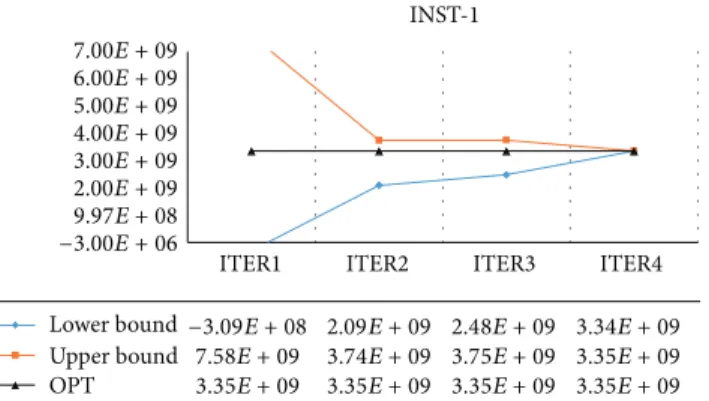
In Figures 5, 6, 7, 8, 9, and 10 are shown the results of six instances randomly generated. These results were obtained by the cross decomposition of the original problem.
Looking at the results in Figures 5, 6, and 8 it can be observed that the number of iterations and the performance of the lower and upper bounds pick up well the complexity of small instances.
At the same time, Figures 7, 9, and 10 show an increment in iterations required and the gap of the solution. These instances were selected to test the performance of the cross decomposition in very large and complex scenarios.
ITER1 ITER2 ITER3 ITER4 Lower bound Upper bound OPT INST-1 7.00E + 09 6.00E + 09 5.00E + 09 4.00E + 09 3.00E + 09 2.00E + 09 9.97E + 08 −3.00E + 06 3.35E + 09 3.35E + 09 3.35E + 09
3.35E + 09 3.74E + 09 3.75E + 09 3.35E + 09 7.58E + 09 2.09E + 09 2.48E + 09 3.34E + 09 −3.09E + 08
Figure 5: Comparison between the objective functions obtained by GAMS and by the proposed cross decomposition.
INST-2
ITER1 ITER2 ITER4
9.00E + 09 8.00E + 09 7.00E + 09 6.00E + 09 5.00E + 09 4.00E + 09 3.00E + 09 2.00E + 09 9.97E + 08 −3.00E + 06 4.33E + 09 4.33E + 09
4.33E + 09 4.62E + 09 4.34E + 09 9.83E + 09 2.08E + 09 4.32E + 09 −9.09E + 08
Lower bound Upper bound OPT
Figure 6: Comparison between the objective functions obtained by GAMS and by the proposed cross decomposition.
INST-real case
ITER1 ITER2 ITER3 ITER4
4.00E + 11 2.00E + 11 6.00E + 06 8.45E + 10 8.45E + 10 8.45E + 10
8.45E + 10 1.76E + 11 9.43E + 10 8.46E + 10 3.54E + 11 2.43E + 10 8.43E + 10 8.44E + 10 −5.05E + 08
Lower bound Upper bound OPT
Figure 7: Comparison between the objective functions obtained by GAMS and by the proposed cross decomposition.
Tables 1 and 2 present the structure of the generated instances and, aditionally, the computational statistics of each one.
7. Conclusions
In this paper a primal-dual method is used to design a distribution network for bottled drinks company. Cross decomposition is a good method for solving large scale
INST-26
ITER1 ITER2 ITER3
1.80E + 11 1.60E + 11 1.40E + 11 1.20E + 11 1.00E + 11 8.00E + 10 6.00E + 10 4.00E + 10 2.00E + 10 0.00E + 00 −2.00E + 10 4.45E + 10 4.45E + 10
4.45E + 10 7.62E + 10 4.46E + 10 1.54E + 11 1.43E + 10 4.44E + 10 −8.05E + 08
Lower bound Upper bound OPT
Figure 8: Comparison between the objective functions obtained by GAMS and by the proposed cross decomposition.
INST-13
ITER1 ITER2 ITER3 ITER4 ITER5
4.00E + 11 3.50E + 11 3.00E + 11 2.50E + 11 2.00E + 11 1.50E + 11 1.00E + 11 5.00E + 10 0.00E + 00 −5.00E + 10 6.45E + 10 6.45E + 10 6.45E + 10 6.45E + 10 6.45E + 10 6.46E + 10 8.46E + 10 9.44E + 10 1.76E + 11 3.54E + 11 6.44E + 10 5.44E + 10 4.44E + 10 2.43E + 10 −5.05E + 08 Lower bound Upper bound OPT
Figure 9: Comparison between the objective functions obtained by GAMS and by the proposed cross decomposition.
ITER1 ITER2 ITER3 ITER4 ITER5 ITER6 ITER7 INST-17 3.00E + 11 2.50E + 11 2.00E + 11 1.50E + 11 1.00E + 11 5.00E + 10 0.00E + 00 −5.00E + 10 8.45E + 10 8.45E + 10 8.45E + 10 8.45E + 10 8.45E + 10 8.45E + 10 8.45E + 10 8.46E + 10 8.47E + 10 8.47E + 10 8.47E + 10 9.44E + 10 1.76E + 11 2.55E + 11 8.44E + 10 8.44E + 10 8.44E + 10 8.44E + 10 8.44E + 10 4.43E + 10 −3.05E + 08 Lower bound Upper bound OPT
Figure 10: Comparison between the objective functions obtained by GAMS and by the proposed cross decomposition.
mixed-integer programming problems, especially when the resulting primal and dual subproblems are easy-to-solve, as in this case. This work proposes a decomposition scheme that reduced the computational time while maintaining the convergence of primal and dual solutions.
If the duality gap of the Lagrangian Relaxation is small, the algorithm converges quickly to optimal or near-optimal solutions. Otherwise, the method needs other algo-rithms in order to obtain an exact solution. However, this
method can be used as a heuristic which produces a feasible solution.
Computational tests are presented using 30 random instances and real case data. The results show that the pro-posed solution strategy obtains a maximum gap of 0.35%. For these kinds of problems, we can often obtain an acceptable gap between approximate optimal solution (cross decompo-sition solution) and the optimal solution (CPLEX solution). For problems with a large duality gap, it is recommended to use a branch and bound algorithm to reduce this gap. For the problem studied in this paper there was no need to use heuristic to eliminate the duality gap. Because of this the use of convergence tests is recommended.
Future research can be directed towards developing new procedures to obtain specific Lagrangian multipliers and improve the quality of the lower and upper bound. The solu-tion of large scale mathematical problems using tradisolu-tional methods takes large computational times. For this reason, the use of cross decomposition techniques allows the solution in shorter computational time. In this paper the cpu time was
<3500 seconds. Additionally, cross decomposition methods
can be used in parallel computing which decreases cpu time. The model proposed in this paper assumes deterministic parameters and does not consider a decomposition by stages. Solving the model by stages potentially can generate even faster solutions but at the same time produce a Lagrangian multiplier per subproblem. Large number of Lagrangian multipliers imply a method more sensitive to numerical stability.
Future research for distribution networks using decom-position techniques can focus on the implementation on a grid computing platform that takes advantage of superputer nodes. This approach can offer a better usage of com-putational resources. The design of the distribution network can be advanced using innovative concepts of collaboration in supply chains as it is the vendor managed inventory, which is a way to integrate production and supply decisions reducing the delay of information.
Conflict of Interests
The authors declare that they have no conflict of interests.
References
[1] S. Chopra, “Designing the distribution network in a supply
chain,”Transportation Research E: Logistics and Transportation
Review, vol. 39, no. 2, pp. 123–140, 2003.
[2] S.-H. Liao, C.-L. Hsieh, and Y.-S. Lin, “A multi-objective evo-lutionary optimization approach for an integrated location-inventory distribution network problem under
vendor-man-aged inventory systems,”Annals of Operations Research, vol. 186,
pp. 213–229, 2011.
[3] M. M. M. Barrera and O. Cruz-Mejia, “Reverse logistics of recovery and recycling of non-returnable beverage containers
in the brewery industry: a ‘profitable visit’ algorithm,”
Interna-tional Journal of Physical Distribution & Logistics Management, vol. 44, no. 7, pp. 577–596, 2014.
[4] H. Pirkul and V. Jayaraman, “A multi-commodity, multi-plant, capacitated facility location problem: formulation and efficient
heuristic solution,”Computers and Operations Research, vol. 25,
no. 10, pp. 869–878, 1998.
[5] M. T. Melo, S. Nickel, and F. Saldanha-da-Gama, “Facility
loca-tion and supply chain management—a review,”European
Jour-nal of OperatioJour-nal Research, vol. 196, no. 2, pp. 401–412, 2009. [6] M. S. Jabalameli, B. Bankian Tabrizi, and M. Javadi,
“Capac-itated facility location problem with variable coverage radius
in distribution system,”International Journal of Industiral
Engi-neering & Production Research, vol. 21, no. 4, pp. 231–237, 2010. [7] H. D. Sherali and D. C. Myers, “Dual formulations and sub-gradient optimization strategies for linear programming
relax-ations of mixed-integer programs,”Discrete Applied
Mathemat-ics, vol. 20, no. 1, pp. 51–68, 1988.
[8] Y. Cheng, S. Farooq, and J. Johansen, “Manufacturing network
evolution: a manufacturing plant perspective,” International
Journal of Operations and Production Management, vol. 31, no. 12, pp. 1311–1331, 2011.
[9] S. Mitra, P. Garcia-Herreros, and I. E. Grossmann, “A novel cross-decomposition multi-cut scheme for two-stage stochastic
programming,” inComputer Aided Chemical Engineering, J. J.
Klemeˇs, P. S. Varbanov, and P. Y. Liew, Eds., vol. 33, pp. 241–246, Elsevier, Philadelphia, Pa, USA, 2014.
[10] A. M. Geoffrion and G. W. Graves, “Multicommodity
distri-bution system design by benders decomposition,”Management
Science, vol. 20, no. 5, pp. 822–844, 1974.
[11] J. F. Benders, “Partitioning procedures for solving
mixed-variables programming problems,”Computational Management
Science, vol. 2, no. 1, pp. 3–19, 2005.
[12] G. Easwaran and H. ¨Uster, “Tabu search and benders
decom-position approaches for a capacitated closed-loop supply chain
network design problem,”Transportation Science, vol. 43, no. 3,
pp. 301–320, 2009.
[13] J. Olhager, S. Pashaei, and H. Sternberg, “Design of global pro-duction and distribution networks: a literature review and
research agenda,”International Journal of Physical Distribution
& Logistics Management, vol. 45, pp. 138–158, 2015.
[14] V. Jayaraman, “An efficient heuristic procedure for
practical-sized capacitated warehouse design and management,”Decision
Sciences, vol. 29, no. 3, pp. 729–745, 1998.
[15] H. Pirkul and V. Jayaraman, “Production, transportation, and distribution planning in a multi-commodity tri-echelon
sys-tem,”Transportation Science, vol. 30, no. 4, pp. 291–302, 1996.
[16] V. Jayaraman and H. Pirkul, “Planning and coordination of pro-duction and distribution facilities for multiple commodities,”
European Journal of Operational Research, vol. 133, no. 2, pp. 394–408, 2001.
[17] A. Amiri, “Designing a distribution network in a supply chain
system: formulation and efficient solution procedure,”European
Journal of Operational Research, vol. 171, no. 2, pp. 567–576, 2006.
[18] H. Amrani, A. Martel, N. Zufferey, and P. Makeeva, “A variable neighborhood search heuristic for the design of multicommod-ity production-distribution networks with alternative facilmulticommod-ity
configurations,”OR Spectrum. Quantitative Approaches in
Man-agement, vol. 33, no. 4, pp. 989–1007, 2011.
[19] H.-Y. S. Chen, C.-W. R. Lin, and Y. Yih, “Production-distri-bution network design of a global supply chain alliance from
the key player’s perspective,”International Journal of Production
[20] A. Cintron, A. R. Ravindran, and J. A. Ventura, “Multi-criteria mathematical model for designing the distribution network of
a consumer goods company,”Computers and Industrial
Engi-neering, vol. 58, no. 4, pp. 584–593, 2010.
[21] H. Ding, L. Benyoucef, and X. Xie, “Stochastic multi-objective production-distribution network design using
simulation-based optimization,” International Journal of Production
Research, vol. 47, no. 2, pp. 479–505, 2009.
[22] P. N. Thanh, O. P´eton, and N. Bostel, “A linear relaxation-based
heuristic approach for logistics network design,”Computers &
Industrial Engineering, vol. 59, no. 4, pp. 964–975, 2010. [23] W. Jiang, L. Tang, and S. Xue, “A hybrid algorithm of tabu
search and benders decomposition for multi-product
produc-tion distribuproduc-tion network design,” inProceedings of the IEEE
International Conference on Automation and Logistics (ICAL
’09), pp. 79–84, Shenyang, China, August 2009.
[24] H. M. Bidhandi, R. M. Yusuff, M. M. H. M. Ahmad, and M. R. A. Bakar, “Development of a new approach for deterministic
supply chain network design,”European Journal of Operational
Research, vol. 198, no. 1, pp. 121–128, 2009.
[25] T. J. Van Roy, “Cross decomposition for mixed integer
program-ming,”Mathematical Programming, vol. 25, no. 1, pp. 46–63,
1983.
[26] C. Y. Lee, “Application of a cross decomposition algorithm to a location and allocation problem in distributed systems,”
Computer Communications, vol. 18, no. 5, pp. 367–377, 1995. [27] K. Holmberg and K. O. Jonsten, “Cross decomposition applied
to the stochastic transportation problem,”European Journal of
Operational Research, vol. 17, no. 3, pp. 361–368, 1984.
[28] H. ¨Uster and H. Agrahari, “A benders decomposition approach
for a distribution network design problem with consolidation
and capacity considerations,”Operations Research Letters, vol.
39, no. 2, pp. 138–143, 2011.
[29] J. A. Marmolejo, I. Litvinchev, R. Aceves, and J. Ramirez, “Multiperiod optimal planning of thermal generation using
cross decomposition,”Journal of Computer and Systems Sciences
International, vol. 50, no. 5, pp. 793–804, 2011.
[30] J. A. Marmolejo, I. Soria, and H. A. Perez, “A decomposition strategy for optimal design of a soda company distribution
sys-tem,”Mathematical Problems in Engineering, vol. 2015, Article
ID 891204, 7 pages, 2015.
[31] L. Kaufman, M. Vanden Eede, and P. Hansen, “A plant and
ware-house location problem,”Journal of the Operational Research
Society, vol. 28, no. 3, pp. 547–554, 1977.
[32] S. Mitra, P. Garcia-Herreros, and I. E. Grossmann, “A novel cross-decomposition multi-cut scheme for two-stage stochastic
programming,”Computer Aided Chemical Engineering, vol. 33,
pp. 241–246, 2014.
[33] J. A. Marmolejo-Saucedo and R. Rodr´ıguez-Aguilar, “Short-term generation planning by primal and dual decomposition
techniques,”DYNA, vol. 82, no. 191, pp. 58–62, 2015.
[34] N. A. Pujari, J. M. Day, F. Huq, and T. S. Hale, “A framework for an integrated distribution system optimisation model,”
International Journal of Logistics Systems and Management, vol. 4, no. 5, pp. 61–76, 2008.
[35] A. Brooke, D. Kendrick, and A. Meeraus,GAMS: A User’s Guide,
Boyd & Fraser Publishing Company, 2010.
[36] A. Brooke, D. Kendrick, and A. Meeraus,GAMS: The Solver
Submit your manuscripts at
http://www.hindawi.com
Hindawi Publishing Corporation
http://www.hindawi.com Volume 2014
Mathematics
Journal ofHindawi Publishing Corporation
http://www.hindawi.com Volume 2014
Mathematical Problems in Engineering
Hindawi Publishing Corporation http://www.hindawi.com
Differential Equations International Journal of
Volume 2014
Hindawi Publishing Corporation
http://www.hindawi.com Volume 2014 Hindawi Publishing Corporationhttp://www.hindawi.com Volume 2014
Hindawi Publishing Corporation
http://www.hindawi.com Volume 2014
Mathematical PhysicsAdvances in
Complex Analysis
Journal ofHindawi Publishing Corporation
http://www.hindawi.com Volume 2014
Optimization
Journal ofHindawi Publishing Corporation
http://www.hindawi.com Volume 2014
Combinatorics
Hindawi Publishing Corporation
http://www.hindawi.com Volume 2014 International Journal of
Hindawi Publishing Corporation
http://www.hindawi.com Volume 2014
Journal of
Hindawi Publishing Corporation
http://www.hindawi.com Volume 2014
Function Spaces
Abstract and Applied Analysis
Hindawi Publishing Corporation
http://www.hindawi.com Volume 2014 International Journal of Mathematics and Mathematical Sciences
Hindawi Publishing Corporation http://www.hindawi.com Volume 2014
The Scientific
World Journal
Hindawi Publishing Corporation
http://www.hindawi.com Volume 2014
Hindawi Publishing Corporation
http://www.hindawi.com Volume 2014
Discrete Dynamics in Nature and Society
Hindawi Publishing Corporation
http://www.hindawi.com Volume 2014
Hindawi Publishing Corporation
http://www.hindawi.com Volume 2014
Discrete Mathematics
Journal ofHindawi Publishing Corporation
http://www.hindawi.com Volume 2014 Hindawi Publishing Corporationhttp://www.hindawi.com Volume 2014