‘Figuring and becoming’: developing
identities among beginning nursing
students
Daniel Butcher
A thesis submitted in partial fulfilment of the
requirements for the award of
Doctor of Education
School of Education
Oxford Brookes University
3 Contents Contents ... 3 List of Tables ... 8 List of Figures ... 8 Abstract ... 9 Acknowledgements ...10 Abbreviations ...11
Chapter 1 – Introduction and Context ...12
Introduction ...12
A brief history of nurse education in the UK ...12
Contemporary challenges for UK nurse education ...14
Relevance of this research ...17
Research aims and questions ...19
My own story ...19
Thesis structure ...22
Conclusion ...22
Chapter 2 - Literature review & Theoretical perspective ...24
Introduction ...24
Identity as a collective societal image ...25
Identity as a consequence of socialisation ...28
Identity as self-concept ...30
Identity as trajectories ...33
Identity constituted in discourse ...35
Poststructuralist orientation ...39
Becoming ...40
Figuring and Figured Worlds ...42
Conclusion ...44
Chapter 3 - Methodology ...45
Introduction ...45
4
Narrative Inquiry ...47
The function of narratives...49
Research procedure ...50
Location and context ...50
Representing those involved ...50
Participants ...51 Retaining participants ...52 Data Sources...53 Meetings ...53 Field notes ...55 Audio diaries ...55 Personal statements ...57 Ethical considerations ...57 Insider research...58 Data Analysis ...59
Pluralism and decision-making in data analysis ...59
Data preparation ...59
Early analysis ...60
Later analysis ...60
Evaluating quality of narrative research ...65
Trustworthiness ...65
Verisimilitude ...66
Practical Utility ...66
Limitations ...67
Conclusion ...67
Introducing the Narratives ...69
Chapter 4 - Andrea ...71
Introducing Andrea ...71
Pre-course personal statement...71
Meeting in Month 1 (Pre-clinical) ...72
Month 3 (Beginning practice) ...75
5
Meeting in Month 8 (Nearing year’s end) ...81
Coda ...84
Chapter 5 - Beth ...85
Introducing Beth ...85
Pre-course personal statement...86
Meeting in Month 1 (Pre-clinical) ...87
Meeting in Month 5 (Returning to university) ...90
Meeting in Month 8 (Nearing year’s end) ...94
Coda ...99
Postscript ...99
Chapter 6 - Denise...101
Introducing Denise ...101
Pre-course personal statement...102
Meeting in Month 1 (Pre-clinical) ...102
Month 3 (Beginning practice) ...107
Meeting in Month 5 (Returning to university) ...107
Month 6 (Second placement) ...113
Meeting in Month 8 (Nearing year’s end) ...114
Coda ...119
Chapter 7 - Helen ...121
Introducing Helen ...121
Pre-course personal statement...122
Meeting in Month 1 (Pre-clinical) ...123
Meeting in Month 5 (Returning to university) ...128
Meeting in Month 8 (Nearing year’s end) ...134
Coda ...140
Postscript ...140
Chapter 8 - Julia ...142
Introducing Julia ...142
Pre-course personal statement...143
Meeting in Month 1 (Pre-clinical) ...144
6
Meeting in Month 8 the (Nearing year’s end) ...155
Coda ...160
Chapter 9 -Discussion...162
Introduction ...162
Question 1 - What do beginning nursing student narrate as significant experiences, events and interactions during the first year of a pre-registration undergraduate programme? ...162
The nature of ‘significant’ ...162
Events, experiences and interactions ...164
Novice vs Experienced ...168
Question 2 - What are the forms and functions of stories told by beginning nursing students as they develop their emerging identities? ...169
Narratives ...172
Anecdotes ...173
Exemplum ...175
Recounts ...176
The therapeutic act of telling ...177
Question 3 - What are the identity claims that beginning nursing students make? How do these change as they progress through their first year of a pre- registration undergraduate programme? ...178
Andrea ...179 Beth ...180 Denise...180 Helen ...181 Julia ...182 Emergent commonalities ...182 Caring ...183
Differences and similarities...183
Resilience ...184
Agency ...184
Fitting in ...185
7 Question 4 - What are the Figured Worlds beginning nursing students
inhabit? ...186
The Figured World of the ‘nursing student’ ...186
The Figured World of the Student Nurse...187
Question 5 - How do beginning nurses go about figuring their identities in these worlds? ...188
Conclusion ...190
Chapter 10 – Reflections on my contributions to knowledge and recommendations for development of practice and further research ...191
Introduction ...191
Reflections on the storied data...191
Reflections on the narrative analysis of the storied data ...193
Insights on support for nursing student development ...194
Methodological contributions ...195
Further research ...195
Final thoughts ...197
Appendix 1: Glossary ...199
Appendix 2: Key events and regulatory developments in UK pre-registration nurse education ...201
Appendix 3: Audio diary guide and instructions ...203
Appendix 4: University Research Ethics Committee approval letter...204
Appendix 5: Transcription convention ...205
Appendix 6: Examples from Data Analysis Frame ...206
Appendix 7: Wheel of Emotions ...211
8 List of Tables
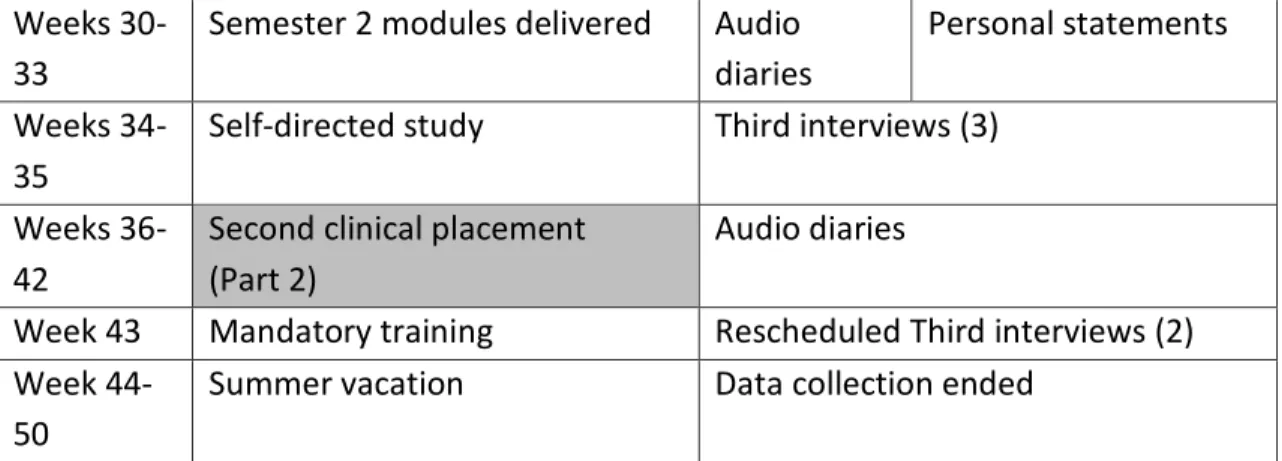
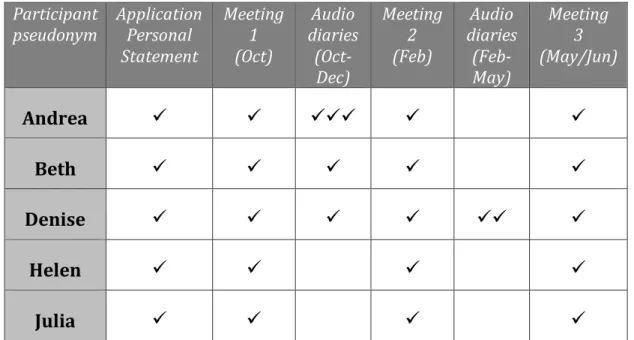
Table 1: Timeline to indicate the structure of the first year programme and the timing of data gathering points ... 543 Table 2: Data gathered from each participant at points throughout the study ... 566 Table 3: Plum’s (1988) generic structures of spoken storytelling genre used for
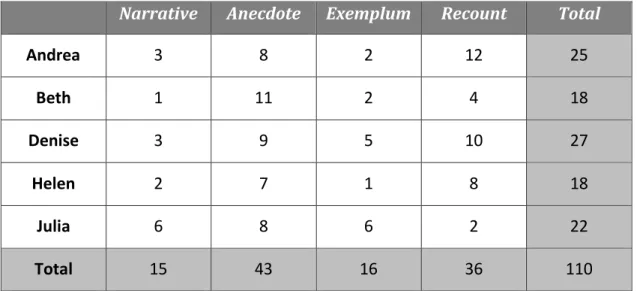
linear level of analysis ... 622 Table 4: Summary of the number of bounded stories by genre ... 171 List of Figures
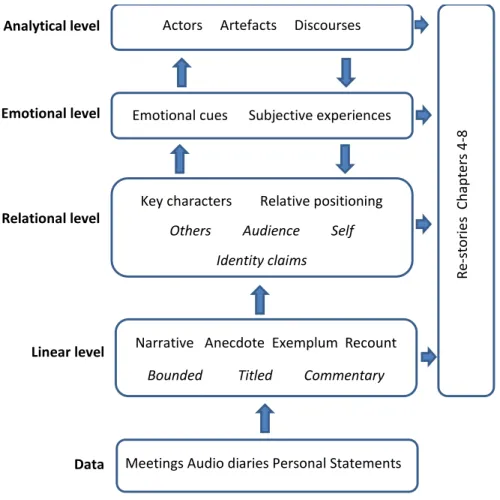
Figure 1: Multidimensional analysis illustrating the sequential steps from transcribed data to re-storied chapters ... 611
9
Abstract
The contemporary professional context of initial nurse preparation is characterised by multiple and sometimes competing social and historical discourses. It is in this context that beginning nursing students take their early steps on the road to developing identities that will shape their future practice and continued professional development. Unlike much of the existing nursing literature, the study adopts a post-modern perspective towards the nature of identity. Here it is conceived as a relational concept, dynamic and continuously evolving through the production and performance of narratives of experience embedded in cultural and social environments.
This thesis examines, in detail, the stories told by five pre-registration nursing students at points throughout the first year of their undergraduate education with the aim of exploring how emergent professional identities are constructed. The study is grounded in the social constructivist approach that recognises the impact of distinct cultural contexts and
foregrounds the embodied processes of meaning-making and agency in the negotiation of identity. The study seeks to honour the voices of students in this process.
Data was gathered through a series of one-to-one meetings with each participant and supplemented with occasional audio diary recordings and the personal statements used to support their pre-course application. The narrative structure and content of 110 bounded stories were analysed using a multi-dimensional approach designed to reveal the changing identity claims made by individuals.
This thesis contributes to understanding of professional identity development in a number of ways. It demonstrates that nursing students begin their nurse preparation with pre-existing and rudimentary images of the profession that serve as frameworks for their interpretation of early clinical and education experiences. Beginning nursing students improvise their identities, telling tales to audiences that include themselves, at the intersection between the Figured Worlds of practice and education. This represents an arena where they author their present and future selves, using individualised and unique stories to buffer conflicts and establish affiliations. Each participant created a rich and detailed compendium of stories that served to positively represent themselves and ‘tell’ themselves into nursing.
This small scale study reveals the significant and often untapped potential of nursing students’ stories to establish understanding of identity development. As such they are under-utilised educational and developmental tools that have significant potential for enhancing nurse education.
10 Acknowledgements
At the heart of this research are the small group of participants who generously and openly shared their time and their stories with me. I am indebted to the five individuals who allowed me the privilege of sharing their first-year journey with them and whose
experiences form the lion share of this thesis. I wish them well in their futures. Their interest and enthusiasm for the project while they were involved helped to turn a research idea into a reality.
I would like to express my immense gratitude to my supervisory team, Professor Debra McGregor and Professor Guida de Abreu. I have felt very fortunate to benefit from your wisdom and encouragement throughout the process of completing this project.
I am grateful to my colleagues, particularly Dr Chris Bulman & Mrs Juliet Bostwick, for their understanding and patience over the 5 years of the EdD programme.
Having searched for the opportunities to undertake a professional doctorate rather than a PhD I feel very fortunate with the timing of the initial intake of the Oxford Brookes EdD programme. I would like to thank the teaching team as a whole, especially Linet and Ian, for their dedication to supporting us and sensitively managing the evolution of the EdD over the past 5 years. I am also extremely grateful for the support of my student colleagues,
Kathleen, Adrian, Sunitha and previously Steve, Jenny, Ross and Janet.
I very much appreciate the quiet support of friends, the prayers, gentle encouragement, understanding and good wishes. I have valued the times where you have shown interest, and where you have provided ‘perspective’.
Finally, I am very aware that my family have been on this journey with me including Mum, Dad, Llwyd and Irene.
Joe, thanks for the coffee fill-ups and the reassuring hand on my shoulder. Emma, thanks for the singing, the music and keeping me grounded with what is
really important.
Tee, for your quiet company.
Katy, you made this possible in so many ways. Thank you for everything you do for us all.
11 Abbreviations
BNF - British National Formulary
BSc – Bachelor of Science
CQC - Care Quality Commission
DNAR - Do not attempt resuscitation
GNVQ – General National Vocational Qualification
HCA - Health Care Assistant
MSc – Master of Science
NHS – National Health Service
NMC - Nursing and Midwifery Council
OSCE -Objective Structured Clinical Examination
PGCE - Postgraduate Certificate in Education
RCN - Royal College of Nursing
UCAS – Universities and Colleges Admissions Service
UKCC - United Kingdom Central Council
12
Chapter 1 – Introduction and Context
Introduction
Being a nurse and nurse educator is important to me. It is not only what I do, but who I am, or rather, who I have become. It is how I identify myself. It is a journey that formally began thirty years ago but which, in reality, probably has no discernible starting point. In 2000, I switched from a direct clinical role to focussing on developing the next generation of nurses. As a proud and passionate nurse, I saw education as a way to contribute to the sustainability and modernisation of a profession that is often constrained by its own history. This thesis seeks to offer fresh insights into the early steps taken by nursing students as they embark on developing a nursing career and forming their professional identities. This study is designed to appraise the experiential stories of five beginning nursing students during the first twelve months of a three-year pre-registration programme. The outcomes of this research offer rich insights into the process of becoming a nurse in the UK in the 21st Century.
This chapter will introduce the context of the study by outlining a brief history of nurse education in the United Kingdom. It will then highlight the current arrangements that require nursing students to engage simultaneously across academic and clinical settings as they embark on their professional preparation. Contemporary issues that form the backdrop for this research and the context within which beginning nursing students take their early steps are then considered. Next, there is a statement of the aims and questions that have shaped the study. This is followed by a brief account of my own professional journey. The intention is to indicate how my own experience has informed what I focus on in the study. The final section outlines the overall structure of the thesis and the nature of the chapters to follow.
A brief history of nurse education in the UK
Nurse education in the UK has been influenced by a number of regulatory developments and policy changes (See Appendix 2). At the inception of the National Health Service, it was
13 based on a quasi-apprenticeship model with Schools of Nursing established at major
teaching hospitals (Bradshaw, 2001). Student Nurses were salaried from the beginning of their ‘training’ and often developed very close associations with a particular institution (Brennan & Timmins, 2012). Unlike traditional apprenticeships, nurse education consisted of numerous short-term rotational allocations to wards with differing specialities. An emphasis was placed on practical, ‘hands on’ imitation of established practices in a variety of
situations. In addition, experienced senior nurses provided on-site classroom-based
teaching. Significant amounts of learning involved the ‘trickle down’ of knowledge, practices and values from senior nurses to junior students (Melia, 1987). Assessment was comprised primarily of ward-based practical tests. In the post war period, two statutory levels were established with 3-year preparation leading to Registered status and 2-year preparation leading to Enrolled status. In 1985, the Royal College of Nursing published the Judge Report which called for the introduction of a broader curriculum (to include relevant aspects of sociology and psychology), a move to higher education and a change in student status (RCN, 1985).
In 1986, the regulatory body for nurses and midwives (UKCC) published ‘Project 2000. A new preparation for practice’ designed to fundamentally change how nurses were prepared and implementing many of the Judge Report’s recommendations (Fulbrook et al, 2000; RCN, 1985). No longer employed by hospitals, nursing students became
educationally-supernumerary, working in practice settings without being part of the complement. The intention was that they would be recognised as learners rather than as workers (Ousey, 2011). Education provision switched to Higher Education Institutions, principally the Post-1992 universities, and the theoretical component was increased to 2,300-hours within a 3-year programme. This was delivered at a minimum of Level 4 (Diploma). In addition, students had to complete 2,300 hours of clinical practice in order to register with what became the Nursing and Midwifery Council (NMC). All students were enrolled onto a 1-year Common Foundation Programme before specialising in Adult, Children’s, Mental Health or Learning Disability Nursing for the remaining 2-years. Some universities that began offering degree courses in nursing in the 1960s subsequently expanded their provision with the introduction Project 2000 (UKCC, 1986).
14 In 2004, the newly formed NMC published the Standards of proficiency for pre-registration nursing education in order to establish, in a single publication, guidance for education providers and defining the overarching principles of nursing practice (NMC, 2004). This was superseded by the Standards for pre-registration nurse education (NMC, 2010) which included in Section 2, the Standards for competence which must be included in the provider’s ‘degree-level competency framework’ (p7). These were introduced in order to enhance clinical skills competence in the absence of a single national approach to practice assessment (Bradshaw & Merriman, 2008). While competence-based nurse education has been introduced in the UK and internationally, there remains a lack of consensus concerning the definition of clinical competence (Yanhua & Watson, 2011).
Increasing European and international alignment in nurse education during the first decade of the new millennium resulted in the NMC declaration in 2008 that the minimum academic award should be a bachelor’s degree. This saw the discontinuation of diploma level
programmes and progression towards an all graduate profession at the point of registration. These developments have occurred amid ongoing debate concerning a would-be nurse’s fitness for practice and purpose. This has been informed and influenced by changes in social demographics, disease epidemiology, treatment technologies and health economics
alongside increasing public expectations and reasonable demands for high quality personalised care (RCN Policy Unit, 2007). The large number of stakeholders (health
consumers, service commissioners, service providers, education providers, students and the profession as whole) means this debate continues to form the backdrop for contemporary nurse education in the UK (Mannix et al., 2014).
Contemporary challenges for UK nurse education
Since the inception of the NHS, there have been considerable changes in the roles and functions of nurses. This includes activities previously carried out by medical practitioners. As triage, diagnosis and medicines prescription become part of Advanced Nurse Practitioner roles, so activities such as history-taking and venepuncture are increasingly considered part of core nursing practice (Shape of Caring Advisory Group, 2016). Simultaneously,
15 provision and coordination of fundamental care (Griffiths & Robinson, 2010). The new Nursing Associate role, located between support workers and registered nurses, is being introduced to provide a formal pathway for development rather than the informal role drift that has occurred. While enhanced collaboration across and between professional groups and increasing inter-professionalism has considerable potential benefits for patients it has also resulted in role confusion and the blurring of boundaries which can be particularly challenging for beginning professionals (McNeil et al., 2013; Niezen & Mathijssen, 2014).
In 2012 Nursing became a graduate entry profession in the UK. Diploma level courses were discontinued and all new and revalidated courses were offered at Bachelor’s or Master’s degree level along with NMC registration. This represented a further step towards achieving the pan-European standardisation and harmonisation whilst also seeking to ensure effective care provision and workforce sustainability in the 21st Century (Davies, 2008).
Competing discourses about the significance of this development have resulted in a decade of debate played out in the nursing literature and the public arena. Some view nursing as a practical vocation ‘unworthy of academic study’, while others insist that nurses need detailed knowledge and skills to make health-care decisions and provide high-quality care (Fealy & McNamara, 2007; Stacey et al., 2015). Recent international research established that every increase of 10% in graduate nursing numbers was associated with a 7% reduction in a hospital's mortality figures (Aiken et al., 2014). Despite this growing evidence, there is a concern, played out very publically in the media, over the perceived correlation between increasing professionalisation and a decline in care standards and nurses’ compassion (Chapman & Martin, 2013; Hall, 2004).
Key stakeholders including those who commission and provide nurse education (Burke & Harris, 2000) have sought to make a case in the face of what has been described as a ‘simplistic and erroneous explanation’ of perceived instances of poor care (Willis
Commission, 2012, p43). At the heart of this is a concern with the professionalisation of nursing and a division over what the ‘core’ identity of the nurse should be (Baxter, 2011). The public image means that nursing, much like medicine and teaching regularly finds itself part of a wider political discourse, particularly when there is capital to be made from
16 debates about its contribution and value to the state (Krejsler, 2005). During the data collection period of this study, the UK Parliamentary Electoral campaigns of all major political parties made manifesto pledges concerning health services in general and an increase in nursing numbers in particular.
These contemporary influences on the personal and professional identity of the nurse have informed the most recent policy guidance on education and preparation. Health Education England, the nationwide organisation responsible for workforce planning, education purchasing and provision for all health care professions is focussed on ‘attracting and recruiting the right people to the education and training programmes we commission’
(Willis, 2015, p10). What constitutes the ‘right people’ continues to inform both popular and professional debates and influence the choices of potential recruits (Eley et al., 2012;
Mazhindu et al., 2016).
As a consequence, there is an increased interest in the values and qualities of nurses, particularly among those at the very beginning of their careers. Values-based recruitment (VBR) has been widely introduced for employer organisations seeking to reassure
themselves and the general public that care expectations are being addressed (Miller & Bird, 2014; Rankin, 2013). While there is no evidence that recent concerns have involved nursing students (Dean, 2014), values-based approaches are increasingly being employed in pre-registration recruitment and selection processes. Values-based recruitment assumes that a necessary character and quality should be established before someone is regarded as a candidate for nurse education. Typically the values informing new entrants to the profession remain those of care and person-centredness with which nursing has historically been associated (Eley et al., 2012; Tuckett, 2015).
Beginning nursing students starting out on pre-registration programmes, therefore, find themselves at what has been termed ‘a complicated nexus between policy, ideology and practice’ (Stronach et al., 2002, p109). They are required to learn effectively in both academic and clinical settings, whilst balancing the roles of ‘learner’ and ‘worker’. In 1987, Melia referred to this situation as ‘part of the nursing folklore’ (p54) where Student Nurses were expected to traverse the worlds of education and practice with two alternative
17 versions of nursing. Unfortunately, changes in both service and education provision over the intervening thirty-year period seems broadly to have failed in resolving this dichotomy (Newton et al., 2015; Solvoll & Heggen, 2010). Students are still confronted with contrasting cultural routines and practices in both clinical and academic settings. Vexingly, for the beginning nursing student, they are required to operate in situations and contexts that present differing and sometimes antithetical values (Newton & Darbyshire, 2016). In this narrative inquiry, Figured Worlds theory, developed by Holland et al. (1998), has been adopted as a theoretical framework with the capacity to explore the diverse constructions of identity (Bennett et al., 2016). Figured Worlds are social and cultural constructions, populated by recognisable characters engaged in meaningful acts with contextualised value. They are ‘realms of interpretation’ that provide a means of coming to understand the socially organised and reproduced contexts of identity development (Holland et al., 1998, p52).
Relevance of this research
Interest in better understanding the ways in which identities are established and negotiated has developed alongside an appreciation of the potential influence they have on nurse effectiveness. Identity concerns how one sees oneself and affords a sense of personal control and free will (Adams and Marshall, 1996). In addition, identities generate meaning and direction from experience, establish purpose in action and achieve unity within groups (Iedema & Caldas-Coulthard, 2008; Jenkins, 2008; McAdams & McLean, 2013). Importantly they can also enable one to recognise future possibilities in the ongoing process of
becoming (Adams and Marshall, 1996). According to Holland et al. (1998), they are ‘the means through which people care about and care for what is going on around them’ (p5).
While every nurse has been a student and has their own ‘tales’ to recount, individual reactions to events are unique. The process of establishing new or emerging identities can be challenging and stressful, particularly when faced with competing and contrasting social contexts (Slay & Smith, 2011). It is, therefore, important to attempt to understand how beginning nurses develop their identities in the complex social environment described above. The development of competent, capable nurses is of paramount importance if
18 individuals are to ‘provide essential care to a very high standard and provide complex care using the best available evidence and technology where appropriate’ (NMC, 2010, p4).
Undertaking research into emerging and developing identities is a way of illuminating the often unseen experiences of beginning nurses and the discourses they encounter. It can render explicit what is deeply meaningful to the individuals, even at the very outset of their professional career (Timostsuk & Ugaste, 2010) since this shapes their understandings about practice and directs their action in the continued development of knowledge and skills (McCarthy & Moje, 2002). As a result, the mechanisms by which identities are formed and transformed is of increasing interest to those involved in the contemporary nurse education (Andrew, 2012; Cowin et al., 2013; Hershey, 2007; Johnson et al., 2012; Worthington et al., 2013).
For nurse educators, any insights into the process of identity formation offer opportunities to evaluate and enhance teaching and learning practices and experiences. Clements et al. (2016) argue that little attention has been paid to the early stages of professional identity development. They conclude that nurturing professional identity should be a priority for educators in both academic and practice settings to promote retention in the short and longer term. The lack of standardised data sets limits the accurate calculation of attrition rates reported in some places to be at 40% (Clements et al., 2016). These are typically highest in the early stages of a programme as new students begin to comprehend the realities of the choices they have made, the knowledge they will need to master and the skills both technical and interpersonal that they will need to acquire. Contemporary longitudinal research has mapped non-linear changes in nursing students’ orientation towards the profession over time (ten Hoeve et al., 2017). Most worrying are the instances where dissonance between students original personal values and those encountered in practice result in withdrawal and considerable individual emotional distress (O’Donnell, 2009). Having recognised the problem there are growing calls for research to explore and understand in detail these processes, beginning at an individual level (Cowin & Johnson, 2015; ten Hoeve et al., 2017).
19 Research aims and questions
The overall aim of this study is to better understand the way in which beginning nursing students develop their emergent identities through the self-authored stories of the early steps in their nursing career. Much of the research to date has concerned the development of professional identity among nurses at the point of registration (Björkström et al, 2008; Gerrish, 2000; O’Shea & Kelly, 2007; Sandvik et al., 2015; Thrysoe et al., 2010). This marks the point of formal social recognition as a nurse but does not represent the genesis of the process of becoming a nurse which is likely to begin much earlier. To examine this, some studies have addressed specific watershed moments such as first placement experiences (Andrew et al., 2009; Leducq et al., 2012) or early choices about branch specialisation (Bradby & Soothill, 1993). In each instance, the focus is almost exclusively on role
development in clinical practice (Felstead, 2013; Lewis, 1998) and, with a limited number of exceptions (Rees et al., 2015), has tended to lack narrative detail. By answering the
following questions, this study seeks to foreground the individuals’ voice and explore the numerous complex early formative and potentially transformative pre-inaugural
experiences that rarely appear in the research literature.
1. What do beginning nursing students narrate as significant experiences, events, and interactions during the first year of a pre-registration undergraduate programme?
2. What are the forms and functions of stories told by beginning nursing students as they develop their emerging identities?
3. What are the identity claims that beginning nursing students make? How do these change as they progress through their first year of a pre-registration
undergraduate programme?
4. What are the Figured Worlds beginning nursing students inhabit?
5. How do beginning nursing students go about figuring their identities in these worlds?
My own story
Before setting out to answer the research questions listed above and consider the stories of others, it is necessary and appropriate to elaborate my own reflexive autobiography
20 (Connelly & Clandinin, 2006). This serves to illuminate the worldview that informs my
nursing, education, and research practice as well as position me in relation to the study and the experiences of the participants.
My aim in telling one of my own stories is to engage in sharing and to represent to the reader the ‘interpenetration’ of spheres of experience, mine and the participants (Clandinin & Connelly, 1988, p281). In doing so, I seek to demonstrate my appreciation and
acknowledgement of subjectivity, as way of achieving a reflexive standpoint. I am conscious that, as a nurse myself, my own experiences influence what and how I interpret the
experiences of others. I use the story below to illustrate the relationships I sought to
establish with people I cared for in my clinical career, the students I support in my education career and the participants’ who aided me in this research.
I have come to appreciate that this story also serves as a means of representing my own professional identity to the reader. While I have provided a brief chronology of my career, storying the central experience provides an opportunity to show the reader who I am and what is important to me as a nurse and educator. In doing this, I am holding a mirror up to myself.
I became a Student Nurse at the age of 18. This is when I started what was at the time, one of only a few pre-registration degree courses. I frequently had to explain why I was ‘doing a degree in Nursing’ to those who believed it was unnecessary. Many did not recognise the value of a degree and thought it only necessary for those who intended to become nurse managers. After the initial insecurities of being an 18-year old, in a minority and looking to better understand who I was and what I was to become, being a nurse has become how I think of myself. I am aware that I see the world through the eyes of a nurse. When I made the challenging transition from clinical practice to education, it was returning to the core of what made me a nurse that provided a foundation for building a ‘new’ identity and starting a fresh chapter in my career and life story, a consistency identified by others in their
reflective narratives of becoming professional educators (Chan & Schwind, 2006; Lindsay, 2006; Young & Erickson, 2011).
21 I had worked for seven years at a local hospice with people, colleagues and those I was caring for, who taught me what it was to be a good nurse. Sitting with someone as they die, sharing critical times in people’s lives showed me what is important about the work that nurses do. It was also here that I came to more formally appreciate my subjectivist interpretation of social reality. It provided a setting where I could spend time listening to what people wanted to tell me, stories of their lives and experiences, their work, their families and the details that made them unique. All of these are embodied in my story of Raymond.
Raymond is with me all the time, as a point of reference for both what is important in practice and what I feel I need to be as an educator. Raymond was big, physically and intellectually. He was trapped in a body that did not work for him or even allow him to exercise simple and taken-for-granted controls over his environment but his voice, his personality and his sense of humour certainly did. Living with an extreme form of Motor Neurone Disease, Raymond could be cantankerous, insistent and hurtful and he often needed to be although this was never driven by spite. He faced what many would consider an intolerable existence, dependent upon his wife, daughters, and carers for 3 of every 4 weeks to then be relocated to the hospice for regular respite care. It was hard work caring for him and many of the team avoided being involved or limited their contact.
Picky, fussy and mischievous, he would tell the same stories of his working life as a scientist during each stay. He would put efficacious junior doctors in their place and fix people with one, slightly wonky eye. When amused he would laugh, inevitably prompting a coughing fit and a worrying change in his colour. But Raymond needed to be all these things because that was who he was. When I figured that out, we established what I still consider to be one of the most effective and fulfilling professional relationships I have had as a nurse. Both of us would perform our identities through the stories we exchanged in the context of our 5-year working relationship. It was only talking to his daughters at his funeral that I came to appreciate how much he too had valued these opportunities.
My career changed direction not long after he died. I was looking to consolidate myself as a graduate nurse, building on nearly ten years of clinical experience and moving into nurse
22 education, and Raymond came with me. Like many other nurses who move out of
principally clinical roles, I needed time and opportunities to renegotiate my evolving professional identity (Findlow, 2012) . I regularly retell myself the story of working with Raymond as this serves to rehearse and remind me of the nature of my identity as a nurse. I also tell the story to students as a means of articulating the characteristics of the
therapeutic relationship as well as presenting myself/performing my identity as a credible nurse and educator. It acts as an example of the elements of narrative competence,
attention, representation, and affiliation, which embody the professional artistry and ethical practice that I seek to convey in my teaching, my research and my own reflective writing (Charon, 2007).
Thesis structure
The remainder of this thesis is structured into nine chapters. Having contextualised the research study here, Chapter Two provides a review of the literature concerning identity theories and the notions of professional identities in the context of nurse education.
Chapter Three explains and justifies the narrative methodology and research methods used in this study. It provides a description of the practical steps undertaken as well as an
illustration of, and support for, the design choices made. Chapters Four to Eight contain the stories and analysis of each of the five participants in a format designed to both honour their voices and provide evidence of the detailed scrutiny required for robust analysis. The aim is not to present generalizable findings but to reify the stories shared by a small number of beginning nurses. Chapter Nine is structured around the research questions and Chapter Ten contains observations drawn from the detailed analysis of the participant’s stories and recommendations for future research. It also contains a brief evaluation of the research, of me as a researcher and the implications for my own future education and research practice. Conclusion
This chapter has provided an overview of the historical and cultural context for the study as well as a brief insight into the ongoing professional and social discourses. It included a case for developing a better understanding of the ways in which beginning nurses negotiate their emergent identities and outlined the structure of this thesis. In addition, it contained a brief
23 personal narrative intended to introduce the nature of the research undertaken and
elaborate why I was curious to explore the self-narrated stories of beginning nursing students as they developed their professional identity. The next chapter will report on the literature review undertaken. This serves to illustrate existing understanding of key concepts and establish the theoretical and philosophical basis for this research.
24
Chapter 2 - Literature review &
Theoretical perspective
Introduction
The notion of identity, including professional identity in nursing has interested educators and researchers over the past four decades. A recent review of the contemporary nursing literature highlighted a lack of clarity in the theoretical origins of the concepts and a distinct lack of agreement about their meaning (Johnson et al., 2012). A typical example of this confusion appears in a paper by Hao et al. (2014) who claim professional identity ‘is’ professional self-concept (how students and nurses perceive the profession) ‘or’ the values and beliefs that guide practice. This is not a situation unique to nursing as similar
uncertainty is found within the wider qualitative literature (Smith & Sparkes, 2008). As a consequence, the notion of identity is ‘promiscuously mingled, producing a good bit of confusion and ambiguity ’(Holland & Lachicotte, 2007, p101).
In a 2012 literature review of professional identity development within Higher Education, Trede et al. established that, while the concept had been explored by a number of
disciplines, very few of the papers provided clear definitions of professional identity as a concept leaving the reader to assume a self-evidence based on personal experience. The most recent attempt to define professional identity in nursing, based on a rather generic concept analysis, suggests that it ‘guides how nurses think, act and interact with their patients and compare and differentiate themselves from other professional groups’ (Dehghanzadeh et al., 2016, p1113) There is general agreement that it is a complex and multi-dimensional concept influenced by social, cultural, historical, political and
organisational considerations (Öhlén & Segesten, 1998). The broad thrust of descriptions agreed that professional identity was concerned with a way of being and means of learning and making sense of experiences, be they occupationally related or not. Sims (2011)
25 The initial aim of this chapter is to achieve some clarity by untangling how identity and professional identity are employed within the literature in relation to nursing students. A review of the considerable material published on this topic is presented in broad themes of identity as collective societal image, the consequence of socialisation, as self-concept, and to a limited extent, as trajectories. Perhaps surprisingly, very little nursing specific literature has considered identity constituted in discourse and so it has been necessary to consult a wider body of material. Restrictions on space preclude a detailed consideration of the full gamut of theories and neither will this review attempt to wrestle with contrasting
definitions. Instead, the aim is to summarise those frameworks, relevant literature and student experiences which have informed the research questions and subsequent data collection and analysis activities.
The second part of the chapter will address the post-structuralist approach that represents the philosophical approach adopted for this research. The understanding of identity towards which I shall be working during the earlier sections of this chapter is one of becoming
through narrative. I conclude with a consideration of Figured Worlds, a theoretical framework with foundational elements drawn from the work of Bourdieu, Vygotsky, and Bakhtin (Holland et al, 1998).
Identity as a collective societal image
Frequently, the notion of professional identity refers to ‘a’ professional identity; the collective image that serves as a heuristic (characterisation) for society, enabling people to have a sense of who a particular group are and what they do. This is particularly so when there is public uncertainty about professional complexities (Buresh & Gordon, 2013; Davidson, 2015). Nursing has historically been framed by various common public portrayals that may have proved entertaining for many but represented a significant impediment to the development of the nursing profession (Huston, 2014). It is this societal image conveyed through various media that beginning nurses are exposed to even before they contemplate making their career choices (Sand-Jecklin & Schaffer, 2006).
26 Historically, nursing recruitment has benefitted from a positive cultural image. Nursing is generally regarded as a worthwhile occupation with a level of social capital, and nurses as people with integrity, who are hardworking and caring (Huston, 2014). An affinity with this virtuous cultural image (nursing and nurses embody the virtues of care, compassion and altruism), along with the stereotypical understanding of nursing, has a strong influence on the decisions made by would-be nurses (Price et al., 2013). Association with and adoption of a collective group or social identity reinforces the integration of group and personal
characteristics. These serve to motivate the actions of students required to overcome the hurdles to group membership, particularly concerning their role in clinical practice (Spouse, 2000).
The societal image of nursing has long been dominated by contrasting, often polar, representations of the profession and individual nurses (ten Hoeve et al., 2014; Huston, 2014). While many embody positive characteristics of caring and committed professionals, there are numerous stereotypes that might negatively impact on the self-esteem of the profession (Fletcher, 2007; Takase et al., 2002) and individual practitioners (ten Hoeve et al., 2014; Takase et al., 2006). Popular images are often stereotypical and rooted in a historical predisposition towards caring as non-technical ‘women’s work’ in contrast to the masculine activity of medicine (Takase et al., 2006). These stereotypical images have proved
remarkably durable, not least because of the relative absence of a competing counter-discourse that advocates the true nature and complexity of modern nursing practice (Willis Commission, 2012; Kelly et al., 2012). It is on this basis that many nursing students initially construe the nature of nursing work and their emergent professional identity (Price et al., 2013). However, research exploring influences on career decisions indicate that few if any, potential nursing students acknowledge the direct impact of stereotypes on their own identity (Larsen et al., 2003). The findings of Sand-Jecklin & Schaffer (2006), in one of the few studies undertaken prior to classroom or clinical experience, highlighted how beginning nurses disassociated themselves from the stereotypes. Where family or friends expressed these enduring lay images, Day et al. (2005) found discontent among nursing students resulting from the clash with their rapidly acquired ‘new professional values’ (p642).
27 Cook et al. (2003) established that nursing students, on their very first day in a university setting, had already developed rudimentary, if not always practically consistent, notions of nursing and their potential future roles. Sometimes referred to as ‘idealised’ views, these serve as a basis for initial choices and form an important part of the milieu of becoming. The primary factor identified as influential in choosing a career in nursing relates to its definition as a caring profession (Alpers et al., 2013). Numerous studies have consistently identified that while complex motivations are at work, the personal aspiration to care and make a contribution to the community is significant (Day et al., 2005; Mooney et al., 2008; Wilkes et al, 2015), are consistent across different cultures (Halperin & Mashiach-Eizenberg, 2014) and throughout the pre-registration and early career phase (Fagerberg & Kihlgren, 2001). Limits to the understanding of what care is or the specific conceptions of care and caring (Wilkes et al., 2015) suggest that, while it is important for the self-image of potential nurses, the practical implications and details may not have an influential impact. Age and gender variations account for some variance (Haron et al., 2014). While there is a
constellation of motivators influencing decisions including pragmatic and material factors (Jirwe & Rudman, 2012), altruistic personality traits have been advanced as an explanation (Eley et al., 2012) impacting upon the way the person sees herself or himself in present and future contexts.
Results from these various studies highlight the fact that students do not begin their pre-service programmes as ‘blank slates’, devoid of pre-existing understandings (Hershey, 2007; Izadinia, 2013). They may not have experienced the successes that trigger what it ‘feels’ like to be a nurse but they have already begun their journey towards constructing a professional identity (Sandvik et al, 2015). Within the nursing education literature, aspirations and intentions are often described as dreams representing an idealised and future orientated position that is significantly desirable to the person (Spouse, 2000; Williams et al., 1997). This allows the individual to focus their effort on a goal even if this is not a realistic representation of their future or the role they may adopt.
Social images of nursing abound and show a consistency across national boundaries (Kirpal, 2004). These may be characterised as constructive or destructive. While they may not always be acknowledged as a central influence on nurses’ own perceptions of their
28 profession, it is clear that early conceptions of nursing play a role in very early professional self-image (Brodie et al., 2004; Milisen et al., 2010) often as a starting point for
understanding their initial learning experiences.
Identity as a consequence of socialisation
Professional socialisation concerns the process by which a beginning nurse acquires the knowledge and skills, values and beliefs of the professional group. It has been closely associated with the development of professional identity and therefore has been of consistent interest to nurse educators. Much nursing research has sought to examine the effects of role-modelling and the emulation of traits that perpetuate images and practices among those new to a particular social situation (Brown et al., 2013; Clouder, 2003; Curtis et al., 2012; Melia, 1987). It is often regarded as an essential process necessary for establishing a sense of belongingness that contributes to the effective integration and retention of newcomers to a professional group (Houghton, 2014; Willetts & Clarke, 2014).
Simpson's (1979) longitudinal study of eight cohorts of American nursing students in the early 1960s highlighted the multidimensional processes that result in the internalisation of norms, customs, and ideologies. These preserved the so-called ‘core values’ which were regarded as fundamental and, in many ways, definitive of nursing practice informing the characteristic behaviours and identity descriptors of the nurse (caring, integrity, person-centred, ethical practice)(Burkitt et al., 2001; Larson et al., 2013). The findings highlighted the significance of an emerging role identification; the importance of taking the label of Nurse as an identity and establishing group affiliation.
While the significance of how a person feels about herself or himself as part of a group has informed subsequent sociological theories of identity development (Burke & Stets, 2009; Turner, 2013) early explanations of identity formation were often understood in relation to processes of power and conformity (Melia, 1987). The enduring hierarchical nature of many clinical health care environments means these drivers remain significantly influential. As a nursing student comes to recognise the role expectations of others (fellow nurses, patients, and medical staff) they seek to reciprocate these in order to fit in. Recent research has
29 established that this often occurs even when these expectations do not align with the
student’s own personal views or the espoused values from the university (Levett-Jones & Lathlean, 2009). In order to manage their vulnerability and uncertainty, beginning nurses frequently adapt or ‘realign’ to the team or institutions values (Curtis et al., 2012). Through this repeated interactive process individuals construct a socialised professional self-view that is consistent with the prevailing discourses.
The clinical learning environment is often considered to be where students are ‘socialized into the profession’ (Hegenbarth et al., 2015, p304). In most nurse education systems, students spend considerable time in these learning venues, recognising them and their mentors as critical in their professional socialisation (Myall et al., 2008). Unsurprisingly, environments with which students are most satisfied provide what are perceived to be the best learning experiences, a feature which is consistent internationally (D’Souza et al., 2015; Dunn & Hansford, 1997; Henderson et al., 2012). Positive learning experiences enable students to engage with practical aspects of the nursing role, in an environment that values them as individuals (Papathanasiou et al., 2014). They create a culture that clearly
demonstrates a willingness to ‘invest’ in students (Hegenbarth et al., 2015) whilst supported by knowledgeable and committed mentors (Shakespeare & Webb, 2008). Marañón & Pera (2015) in their ethnographic consideration of the impact of theoretical and practice training components, identified, as much previous research has, that the clinical practice mentor has a key and influential role in the degree to which the experience is valued but that the
central challenge in forming a professional identity lay in the integration of theoretical ideals and practical realities.
Longitudinal studies have been used to reveal some of the most interesting changes associated with the process of socialisation. The results do not always help to clarify the situation. Mackintosh (2006) painted a rather disconcerting picture regarding the changing attitudes towards the caring aspects of a beginning nurse’s role. Between Years 1 and 3 she noted a ‘loss of idealism’ as students focussed on their ability to cope with challenging situations. Bolan & Grainger (2009), investigating changing professional perceptions, suggested that over the same timespan students developed an increasingly positive image of nursing even though this declined slightly during Year 1. By the end of Year 3 Maben et
30 al., (2007) established that idealised views of practice had been re-established and provided a springboard for the transition to registered nurse. In combination, these results emphasise the complexity and variability of factors likely to impact on each individual’s identity.
One of the most illuminating explorations of occupational socialisation among nurses in the UK was conducted by Melia in 1987. This revealed the foundational problem, reported widely in the subsequent literature, of a dichotomy between the ‘ideal’, academic and the ‘real’ practice world (Adams et al., 2006; Clouder, 2003; Newton et al., 2015). Contrasts between the classroom segment of nurse preparation that focuses on professional values and the practice segment that prioritises ‘getting the job done’ results in nursing students experiencing two versions of nursing. Some suggest that rather than resolving this over the past 4 decades, the increasing professionalisation and intellectualisation of nursing has maintained and, to an extent accentuated this dichotomy (Stacey et al., 2015). The consequences for the student of confusion and anxiety, personal disappointment and professional dissatisfaction, threaten the likelihood that they will develop an identity that is consistent across both settings (Maben et al., 2007).
Professional socialisation in the nursing literature often regards identity as a consequence of a process. Socialisation internalises practice values and establishes an identity that is
characteristic of a professional nurse, understood with reference to the practice community alongside the person’s own experiences or self-concept (Willetts & Clarke, 2014).
Identity as self-concept
An alternative stream of research has addressed the psychological construct of professional self-concept, the majority building on the seminal works of Goffman (1959), Mead (1934) and Erikson (1968). Erikson modelled human development as a transformation resulting from the resolution of a number of psychosocial dilemmas (Illeris, 2014). The significance of successful resolutions was the achievement of a coherent and consistent identity that persists throughout adulthood and which some might be considered a person’s ‘core identity’ (Gee, 2000). While post-structural conceptions reject these essentialist notions of objective identity, it has proved appealing since it represents an apparently achievable
31 outcome and a pathway of development that can be measured and manipulated to improve both practice and academic outcomes (Gemeay et al., 2013). Postmodern views of the self seek to retain the notion of the ‘authentic’ whilst acknowledging the fragmentation and ‘decentring’ of ‘fluid’ societies (Bauman, 2007) that result in a creative potential for self-definition.
Within much of the nursing literature, the term ‘self-concept’ is often used interchangeably with ‘esteem’, ‘identity’ and ‘perception’. Specific notions of ‘professional self-concept’ are associated with some uses of ‘professional identity’ as the ‘identity of a profession’ (ten Hoeve et al., 2014, p 297) but frequently address reflexive notions of what it is to be a nurse. Researching and writing about nursing self-concept over the past 15 years, Cowin (2001) has consistently operationalised this as a link between the inner thoughts of the individual and their experiences of the external world (Cowin et al., 2008). Emphasis is placed on the description and evaluation of the self at an overarching global level and at a domain-specific or professional level. Contemporary understandings of self-concept recognise its dynamic, multidimensional and cognitively constructed nature (Arthur & Randle, 2007) and have sought to exploit its predictive potential. A positive professional self-concept is represented by emotions and experiences that enhance the way in which the nurse views herself or himself ‘as a nurse’. As an empirical tool, it has been positively
associated with initial career choice (Larsen et al., 2003), improved graduate retention (Cowin et al., 2006) and higher levels of job satisfaction (Cowin et al., 2008).
A desire to both measure and subsequently influence professional identity has resulted in the continued development of tools and instruments. Within the literature, there is growing reference to Professional Identity in Nursing (PIN), a measurable entity that can be used to evaluate an individual’s suitability for pre-registration nurse education (Mazhindu et al., 2016). This frames professional identity as socially owned and socially constructed and illustrates the increasingly normative nature of some of the discussion in the nursing literature in response to recent high-profile failings (Francis, 2013).
Arthur & Randle (2007) are critical of self-concept research that fails to locate a theoretical position but are also concerned at the preoccupation with descriptive studies. This trend has
32 continued (Angel et al., 2012; Kelly & Courts, 2007), possibly as a result of an increasing pressure to use evidence-based practice methods. This is clearly illustrated by the growth of professional self-concept studies being undertaken by nurse researchers working in non-Western (Eastern) settings. Eastern notions of the self differ considerably from those outlined above and yet, the hegemony of empirical, evidence-based practice has seen the application of post-positivist conceptions (Hao et al., 2014) over traditional notions. The effects of globalisation on healthcare and nursing have seen a ‘grafting’ of Western humanist discourse in Singapore, Japan and most notably in Hong Kong (Parker, 2005). There remains, however, a strong cultural gender discourse that alongside broader cultural beliefs have resulted in differing conceptions of nurses and nursing.
One of the apparent paradoxes in Western considerations of identity is the dynamic tension between similarity, or what we share, and difference which acts as the basis of individuality (Bamberg, 2012; Lawler, 2014). Group affinity and self-categorisation frequently employ what Bleakley (2011) refers to as ‘selfsame’: the tendency to identify with ‘my’ specific and bounded group, particularly in a multi-professional context such as health care. An
unfortunate potential risk of this approach is an assumed superiority and the reinforcement of accepted hierarchies, and divisions (Finn, 2008). The emphasis is on establishing an apparently stabilised sense of professional self, tested variously through the act of being recognised as a particular sort of person by the group and by others.
Alternatively one might come to understand and recognise oneself and one’s group identity through a focus on the difference (Bleakley, 2011). Here the contrast with ‘others’ is used as a means of establishing distinctions and uniqueness, that the identity of self is defined in relation to a non-self. A Western focus on individuality often results in the accentuation of differences to the point that they become defining characteristics. This should be
understood not simply in terms of single and discrete occasions but as a constant stream of interactions with key actors in changing contexts: doctors, health care/nursing assistants, patients and experienced nurses/mentors in clinical contexts, tutors/lecturers and fellow students in the academic setting. These differences are not innate but are created and become embedded in cultural and social structures. As a result, they form what have been
33 referred to as ‘horizons of possibility’ where characteristics are attributed as valuable in the particular context (Scanlon et al., 2007, p228).
In establishing these arbitrary boundaries, binary oppositional discourses are frequently used to create space between the ‘self’ along with those one associates with, or wishes to be associated with, and others who one does not wish to be associated with, by the particular audience. In health care, the discourses of ‘good’ vs ‘bad’, ‘new’ vs ‘old’,
‘evidence-based practitioner’ vs ‘routine based practitioner’ are often used to achieve this and in the process either establish or challenge the existing hierarchy. Representing oneself to others almost always serves the speaker’s objective of favourably emphasising their own image as a ‘good’ person (Alvesson et al., 2008). Being a ‘good’ person informs the claim of being a ‘good’ nurse and is inherently associated with the notions of care and compassion that the idealised nurse continually strives to demonstrate in order that their patients might flourish (Sellman, 2011).
Identity understood and researched as self-concept brings to the fore factors that influence what it means to be and act as a nurse (Fagermoen, 1997). These are frequently expressed as values that guide agency and emotions that ensure meaningfulness. Recent research highlights the significance of meaning for identity, a feature which appears consistent for nurses internationally (Malloy et al., 2015).
Identity as trajectories
More contemporary research has gradually begun to untangle the notions of professional self-concept from those of professional identity (Johnson et al., 2012). While the former is defined as ‘our personal understanding of our perceived attributes’ (p563) the latter is understood to be ‘a sense of self that is derived and perceived from the role we take on in the work that we do’ and therefore how we interact with people and artefacts in a particular context (p563) . It is influenced by the work of Skorikov & Vondracek (2011) who suggest that occupational identity formation often plays a leading role in the formation of other aspects of personal identity, representing ‘a major factor in the emergence of meaning and structure in individual’s lives’ (p694). Increasingly professional identity is being
34 conceptualised as a pathway or trajectory and is dynamic (McAlpine, 2012) with a
recognition that formation begins prior to any formal professional education and involves the melding of the personal and professional. Cook et al. (2003) established new nursing students had a clear sense of occupational identity, closely linked to their sense of self and based upon images and the influence of significant others even in the absence of personal experience.
Conceptions of identity as a trajectory foreground the processes of formation and reformation that continue throughout formal education and into the early career phase (Deppoliti, 2008; McAlpine et al., 2014; Newton et al., 2009). The limited consideration of identity trajectories in nursing requires a glance towards teacher education. Beijaard et al. (2004) established in their review that identity as a trajectory represented the coming together of personal and professional sub-identities where the individual exercises agency rather than passive reaction. This action takes the form of bridge-building between existing and newly revised identities. Many nursing students, especially mature students, come from previous careers as carers or Health Care Assistants (now Nursing Assistants). There is a need to accommodate the previous sense of self alongside the values, beliefs, and practices that may conflict with the new sense of self as a student causing discomfort and a sense of culture shock (Brennan & McSherry, 2007).
The result of an extensive concept analysis by Ohlén & Segesten (1998) concluded that the professional identity of the nurse is fundamentally integrated with their personal identity, each closely influencing and informing the other. It consists of the objective image other people hold of the person in a reciprocal relationship with the subjective feelings and experiences of themselves as a nurse. This mirrors the accumulated research on teacher professional identity which recognises the complex interplay between the subjective and objective across a range of contexts and expressed in terms of the connections between the teacher, their students, and the workplace in the context of micro (personal) and macro (national) environments (Meijer et al., 2014).
A major feature of identity understood as trajectories is the centrality of continuous and multifaceted reformulations over a person’s lifetime. While a great deal of interest is
35 already focused on registration and beyond, there is a growing appreciation that this
pathway, definable or not, extends from before the commencement of and throughout nurse education (Johnson et al., 2012). Increasingly, educators responsible for professional preparation across a range of settings acknowledge the potential of professional identity development as a critical focus for their endeavours (Goldie, 2012; Johnson et al., 2012; Langendyk et al., 2015).
From a detailed review of the nursing specific literature, various conceptions of identity and professional identity have been established. These were presented in broad themes of identity as adopted societal image, the consequence of socialisation, as self-concept, and as trajectories. Images, experiences, emotions and the ongoing formulation and reformulation of identity inform the first three research questions but also come together in the next section where I consider identity constituted in discourse. Somewhat surprisingly, unlike many other professions, there is very little nursing specific literature based on this conception of identity.
Identity constituted in discourse
Many contemporary theorists conceptualise identity through discourse. It is through discussions about ‘being’, ‘doing’ and ‘believing’ that abstract notions are reified. Of particular relevance to this study is the work of narrative theorists who regard identity as the accumulation of stories people tell about themselves and the uses to which these are put (we tell about ourselves) (Bamberg & Georgakopoulou, 2008; Kraus, 2006; McAdams et al., 2006; McAdams, 1997; Ricoeur, 1991). The common emphasis shared by each approach is that it is through the narrative telling that identities are constructed and reconstructed. ‘[S]elves are made coherent and meaningful through the narrative or ‘biographical’ work that they do’ (Benwell & Stokoe, 2006, p42). As a result, identities can be viewed as
‘achievements’ (Lawler, 2014) or an ‘accomplishment’ (Benwell & Stokoe, 2006), created as a result of the way people talk about their lives. This view does, however, risk regarding identity as an objective, or an achievable end point rather than a waypoint on a continuing process of becoming (Ybema et al., 2009).
36 Polkinghorne (1988) understood identity in terms of the person’s life, having an inherently temporal nature as one experiences and interacts with the world and seeks to make sense of these happenings through a narrative form of knowing. As a result, Polkinghorne (1988) saw identity not as an entity that grows and develops reaching a fixed point, but as a constantly evolving sense of self. According to Ricoeur's (1992) conception, narrative identity is fragile and incomplete, forming part of the overall process of narration. The narrative creates a bond between the past, the present and the future with the creation of an identity that is both temporal and contextual. It also seeks to address the paradox of similarity and difference. Ricoeur (1992) suggests that identity is a combination of selfhood (memete) and similarity (ipseite), the former being the way in which a person defines herself or himself as distinct from others and the latter being the endurance of this individuality over time and in the presence of similarity.
McAdams & McLean (2013) regard narrative identity as the construction and internalisation of ‘an evolving and integrative story for life’ [my emphasis] in order to achieve ‘some degree of unity, purpose and meaning’ (p233). The self is configured through the recall,
interpretation and reinterpretation of episodes from the past, real and imagined, that are used to comprehend the present and anticipate the future. They are produced and
performed for ourselves and others on a continuing basis. Examples from nursing (Chan & Schwind, 2006) and education (Young & Erickson, 2011) illustrate the potential of the self-study of narratives as a means of illuminating understating of personal and professional identities. Both studies are grounded in the close examination of life experiences, the ways in which these have been storied, told and retold. For these researcher/practitioners, it provided a mechanism of self-analysis. For others, the analysis of narratives provides a means of making sense of significant change resulting from trauma (Lambrou, 2014; Loots et al., 2013), illness (Mills, 1997) and bereavement (Campesino, 2007). Stories, particularly self-narratives, offer a mechanism by which diverse, complex, and sometimes contradictory interpretations of experiences can be drawn together into a coherent account of the self (Maple et al., 2007; Minichiello & Kottler, 2009).
The stories we tell do not simply represent accounts of the experiences. They are influenced by the teller's memory, the cultural and social structures of story-telling as well as the
37 preferences we wish to perform for the particular audience in the particular context
(Riessman, 2001). As a consequence, where the audience is a researcher with a particular interest in a person’s stories, it is essential that they recognise the co-construction of the narrative and, during interpretation, are open to the details of the narrator’s position and situation (Frid et al., 2000).
The audience for a projected or presented identity is critical, influencing the extent to which people exert their claims. Projected identities in the form of statements and actions are generally understood to represent not only how a person sees themselves but also how they wish to be seen by others (Barreto et al., 2003). Drawing on the Bakhtinian notion of ‘dialogism’, that language mediates human perception, this performance in response to the social context becomes a process of ‘self-authoring’. Humans are constantly being
addressed by and answering to the world around them, choosing responses that enable them to present a persona. ‘We create our identities by telling the stories of our lives’ (Dornan et al., 2015, p176). The degree to which this is challenged or reinforced by observers is likely to dictate the extent to which people internalize these self-conceptions and repeat or embellish them in similar contexts (Ibarra & Barbulescu, 2010). In accepting that identities are socially constructed and therefore inherently dependent upon and called into existence in light of the context, identity becomes a claim one makes in order to achieve a position and acceptance, telling oneself into nursing (Jordal & Heggen, 2015). From a postmodernist perspective, it is only durable to the extent that the person is able to continue making the claim rather than any inherent aspect of the person. Ybema et al. (2009) suggest that identity is ‘a matter of claims, not characteristics; persona not personality; and presentation, not self’ (p306).
Discursive approaches have come to play an increasingly dominant role in the understanding of identity construction and articulation where language is no longer
understood simply to convey meaning but to make meaning. Talk, be it formal or casual, as well as created texts are generally understood to be the primary expressions of identity and therefore the focus of much research (Ybema et al., 2009). Other forms of non-linguistic communication are increasingly being used acknowledging the multidimensional nature and significance of identity representations (Riessman, 2008a).These might include the use of