Learning error-correcting representations
for multi-class problems
Miguel Ángel Bautista Martín
Aquesta tesi doctoral
està subjecta a la llicència
Reconeixement 3.0. Espanya de Creative
Commons
.
Esta tesis doctoral está sujeta a la licencia
Reconocimiento 3.0.
España de Creative
Commons
.
Learning Error-Correcting Representations
for Multi-Class Problems
A dissertation submitted by Miguel Ángel Bautista Martínat Universitat de Barcelona to fulfil the degree of Doctor en Matemàtiques. Barcelona, November 25, 2015
Director Dr. Sergio Escalera
Dept. Matemàtica Aplicada i Análisi Universitat de Barcelona
Co-director Dr. Oriol Pujol
Dept. Matemàtica Aplicada i Análisi Universitat de Barcelona
This document was typeset by the author using LATEX 2ε.
The research described in this book was carried out at Dept. Matemàtica Aplicada i Análisi, Universitat de Barcelona and the Computer Vision Center, Universitat Autònoma de Barcelona.
Copyright c2015 by Miguel Ángel Bautista Martín. All rights reserved. No part of this publication may be reproduced or transmitted in any form or by any means, electronic or mechanical, including photocopy, recording, or any information storage and retrieval system, without permission in writing from the author.
ISBN: XXXXX
Acknowledgements
As most things in life, this dissertation is the result of certain people allocated in certain time and place, I would like to thank all of them here. First and foremost I am deeply thankful to my supervisors Dr. Sergio Escalera and Dr. Oriol Pujol for their motivation, hard work and efforts during all these years, this would have not been possible without them. I would also like to thank Dr. Xavier Baró for his guidance and comments.
Staying at the Human Sensing group Carnegie Mellon University I had the chance to meet Dr. Fernando de la Torre to whom I am very thankful for sharing his experience, knowledge and overall working process with me. I am also very thankful to the bright students that I met there and with whom I enjoyed a lot of very nice discussions. Amongst them all, I would like to thank Ricardo, Paco and Ishan for sharing their comments and experiences with me. I also would like to thank to all the people at the Applied Mathematics and Analysis department at University of Barcelona: Francesco, Piero, Adriana, Víctor, Jordi, Petia, Eloi y Laura. All of you shared your moments, experiences and discussions with me, making me a better scientist.
Engaging in the birth of the Human Pose and Behavior Analysis (HuPBA) group at the University of Barcelona, was one of the best scientific experiences I have ever had. I am deeply thankful to all my colleagues at the HuPBA group. In particular, to Toni, Xavi, Victor and Albert. Not only did I learn from their hard-work, dedication and knowledge but I also shared with them great memories that I will hold dear forever.
Levemente, quisiera tomarme unas líneas en español para agradecer a todos mis amigos en Ibiza y Barcelona que durante estos años han estado a mi lado haciendo que el camino fuera más fácil. En primer lugar querría agradecer a Pau los momentos que hemos compartido juntos durante todos estos años. También me gustaría agradecer a Adri, Adrián y Javi por los años compartidos en Barcelona. A todas las nuevas amistades hechas en Barcelona: Jordi, Óscar, Christian, Daniel, David, Vicente, Borja, Víctor, Oriol, y un largo etcétera que ocuparía varias páginas. Finalmente, quiero agradecer a mis padres Ana y Miguel por la educación que me han dado así como por los valores de humildad, esfuerzo y honestidad que siempre me han inculcado.
A mi hermana Ana quiero dedicarle no solo esta línea sino la tesis en su totalidad, es un ejemplo para mí.
iv
Two monks were watching a flag flapping in the wind. One said to the other, "The flag is moving." The other replied, "The wind is moving." the sixth and last patriarch of Chán Buddhism who was happening to pass by, overheard this. He said, "Not the flag, not the wind; mind is moving."
Abstract
Real life is full of multi-class decision tasks. In the Pattern Recognition field, several method-ologies have been proposed to deal with binary problems obtaining satisfying results in terms of performance. However, the extension of very powerful binary classifiers to the multi-class case is a complex task. The Error-Correcting Output Codes framework has demonstrated to be a very powerful tool to combine binary classifiers to tackle multi-class problems. However, most of the combinations of binary classifiers in the ECOC framework overlook the underlay-ing structure of the multi-class problem. In addition, is still unclear how the Error-Correction of an ECOC design is distributed among the different classes.
In this dissertation, we are interested in tackling critic problems of the ECOC framework, such as the definition of the number of classifiers to tackle a multi-class problem, how to adapt the ECOC coding to multi-class data and how to distribute error-correction among different pairs of categories.
In order to deal with this issues, this dissertation describes several proposals. 1) We define a new representation for ECOC coding matrices that expresses the pair-wise codeword separability and allows for a deeper understanding of how error-correction is distributed among classes. 2) We study the effect of using a logarithmic number of binary classifiers to treat the multi-class problem in order to obtain very efficient models. 3) In order to search for very compact ECOC coding matrices that take into account the distribution of multi-class data we use Genetic Algorithms that take into account the constraints of the ECOC framework. 4) We propose a discrete factorization algorithm that finds an ECOC configuration that allocates the error-correcting capabilities to those classes that are more prone to errors.
The proposed methodologies are evaluated on different real and synthetic data sets: UCI Machine Learning Repository, handwriting symbols, traffic signs from a Mobile Mapping System, and Human Pose Recovery. The results of this thesis show that significant perfor-mance improvements are obtained on traditional coding ECOC designs when the proposed ECOC coding designs are taken into account.
Resumen
En la vida cotidiana las tareas de decisión multi-clase surgen constantemente. En el campo de Reconocimiento de Patrones muchos métodos de clasificación binaria han sido propuestos obteniendo resultados altamente satisfactorios en términos de rendimiento. Sin embargo, la extensión de estos sofisticados clasificadores binarios al contexto multi-clase es una tarea compleja. En este ámbito, las estrategias de Códigos Correctores de Errores (CCEs) han demostrado ser una herramienta muy potente para tratar la combinación de clasificadores binarios. No obstante, la mayoría de arquitecturas de combinación de clasificadores binarios negligen la estructura del problema multi-clase. Sin embargo, el análisis de la distribución de corrección de errores entre clases es aún un problema abierto.
En esta tesis doctoral, nos centramos en tratar problemas críticos de los códigos correc-tores de errores; la definición del numero de clasificadores necesarios para tratar un problema multi-clase arbitrario; la adaptación de los problemas binarios al problema multi-clase y cómo distribuir la corrección de errores entre clases. Para dar respuesta a estas cuestiones, en esta tesis doctoral describimos varias propuestas. 1) Definimos una nueva representación para CCEs que expresa la separabilidad entre pares de códigos y nos permite una mejor com-prensión de cómo se distribuye la corrección de errores entre distintas clases. 2) Estudiamos el efecto de usar un numero logarítmico de clasificadores binarios para tratar el problema multi-clase con el objetivo de obtener modelos muy eficientes. 3) Con el objetivo de en-contrar modelos muy eficientes que tienen en cuenta la estructura del problema multi-clase utilizamos algoritmos genéticos que tienen en cuenta las restricciones de los ECCs. 4) Pro-ponemos un algoritmo de factorización de matrices discreta que encuentra ECCs con una configuración que distribuye corrección de error a aquellas categorías que son más propensas a tener errores.
Las metodologías propuestas son evaluadas en distintos problemas reales y sintéticos como por ejemplo: Repositorio UCI de Aprendizaje Automático, reconocimiento de sím-bolos escritos, clasificacion de señales de trafico y reconocimiento de la pose humana. Los resultados obtenidos en esta tesis muestran mejoras significativas en rendimiento comparados con los diseños tradiciones de ECCs cuando las distintas propuestas se tienen en cuenta.
Contents
1 Introduction 1
1.1 Motivation . . . 2
1.2 Statistical Pattern Recognition . . . 3
1.2.1 Visual Pattern Recognition . . . 5
1.3 The Multi-class Classification Problem . . . 6
1.4 State-of-the-art Classification Techniques in Visual Pattern Recognition . . . 7
1.4.1 Classifiers . . . 7
1.4.2 Multi-class classifiers . . . 8
1.5 Objective of the Thesis . . . 12
1.6 Contributions . . . 12
1.7 Thesis Outline . . . 13
1.8 Notation . . . 13
I
Ensemble Learning and the ECOC framework
15
2 Error-Correcting Output Codes review and properties 17 2.1 The Error-Correcting Output Codes Framework . . . 172.2 ECOC Coding . . . 19 2.2.1 Binary Coding . . . 19 2.2.2 Ternary Coding . . . 19 2.3 ECOC Decoding . . . 19 2.3.1 Binary Decoding . . . 19 2.3.2 Ternary Decoding . . . 21
2.4 Good practices in ECOC . . . 21
2.5 ECOC constraints . . . 22
2.6 Conclusions . . . 23
3 A novel representation for ECOCs: the Separability Matrix 25 3.1 The Separability matrix . . . 25
3.2 From global to pair-wise correction capability . . . 25
3.3 Conclusions . . . 26
II
Learning ECOC representations
29
4 Learning ECOCs using Genetic Algorithms 31 4.1 Towards Reducing the ECOC Code Length . . . 31x CONTENTS
4.2 Learning Minimal ECOCs using standard Genetic Algorithms . . . 33
4.2.1 Minimal ECOC Coding . . . 33
4.2.2 Evolutionary Minimal ECOC Learning . . . 34
4.2.3 Experiments . . . 37
4.3 Learning ECOCs using ECOC-compliant Genetic Algorithms . . . 42
4.3.1 Genetic Algorithms in the ECOC Framework . . . 42
4.3.2 ECOC-Compliant Genetic Algorithm . . . 43
4.3.3 Experiments . . . 52
4.3.4 Discussion . . . 56
4.4 Conclusions . . . 60
5 Learning ECOCs via the Error-Correcting Factorization 63 5.1 Error-Correcting Factorization . . . 63
5.1.1 Objective . . . 64
5.1.2 Optimization . . . 64
5.1.3 Connections to Singular Value Decomposition, Nearest Correlation Matrix and Discrete Basis problems . . . 65
5.1.4 Ensuring a representable design matrix . . . 66
5.1.5 Defining a code length with representation guarantees . . . 67
5.1.6 Order of Coordinate Updates . . . 68
5.1.7 Approximation Errors and Convergence results when D is an inner product of binary data . . . 69
5.2 Experiments . . . 71
5.2.1 Data . . . 71
5.2.2 Methods and settings . . . 71
5.2.3 Experimental Results . . . 72
5.3 Conclusions . . . 73
III
Applications in Pose Estimation Problems
79
6 Applications of ECOCs in Pose Estimation Problems 81 6.1 Human Pose Estimation . . . 816.2 HuPBA 8K+ Dataset . . . 83
6.3 ECOC and GraphCut based multi-limb segmentation . . . 84
6.3.1 Body part learning using cascade of classifiers . . . 84
6.3.2 Tree-structure learning of human limbs . . . 84
6.3.3 ECOC multi-limb detection . . . 85
6.3.4 Binary GraphCut optimization for foreground mask extraction . . . . 86
6.3.5 Tree-structure body part learning without background . . . 86
6.3.6 ECOC multi-limb detection . . . 86
6.3.7 Alpha-beta swap Graph Cuts multi-limb segmentation . . . 87
6.4 Experimental results . . . 87
6.4.1 Data . . . 87
6.4.2 Methods and experimental settings . . . 88
6.4.3 Validation measurement . . . 88
6.4.4 Multi-limb segmentation results . . . 88
CONTENTS xi
IV
Epilogue
97
7 Conclusions 99 7.1 Summary of contributions . . . 99 7.2 Future work . . . 100 A Datasets 101 B Publications 105 B.1 Journals . . . 105 B.2 International Conferences and Workshops . . . 105List of Figures
1.1 Baby analyzing shapes and colors. . . 1
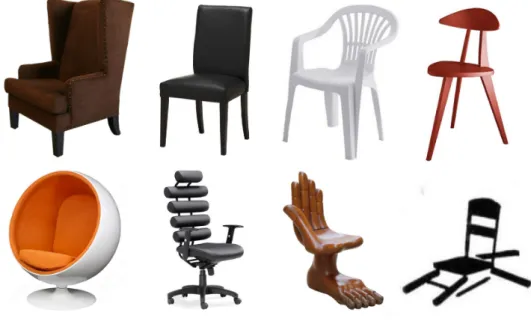
1.2 Chair samples. . . 4
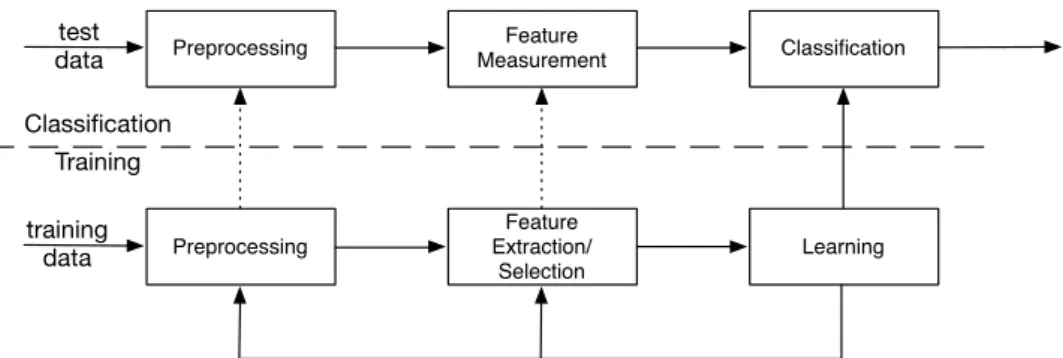
1.3 Standard pipeline for statistical pattern recognition. . . 5
1.4 Nao detects and classifies the furniture in the scene. . . 6
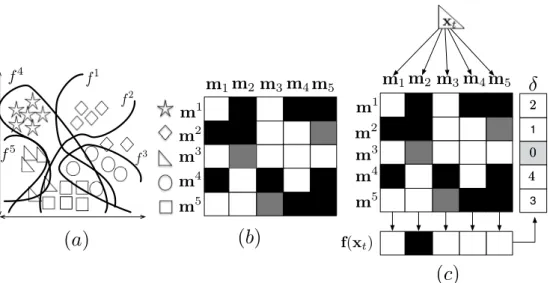
2.1 (a) Feature space and trained boundaries of dichotomizers. (b) Coding matrix M, where black and white cells correspond to {−1,+1}, denoting the two partitions to be learnt by each base classifier (white cells vs. black cells) while grey cells correspond to 0 (ignored classes). (c) Decoding step, where the predictions of classifiers,{h1, . . . , h5}for sample xt are compared to the codewords{m1, . . . ,m5}andx tis labelled as the class codeword at minimum distance. . . 18
2.2 (a) ECOC One vs. All coding design. (b) Dense Random coding desing. (c) Sparse Random coding. (d) One vs. One ECOC coding design. . . 20
3.1 ECOC codings of One vs. All (a), Dense Random (b), Sparse Random (c) and One vs. One (d). Separability matrices for One vs. All (e), Dense Random (f), Sparse Random (g) and One vs. One coding (h). Note how predefined coding designs generate constant separability matrices, while other designs present different distributions of separation between codewords. . . 27
3.2 Example of global versus pair-wise correction capability. On the left side of the figure the calculation of the global correction capability is shown. The right side of the image shows a sample of pair-wise correction calculation for codewordsm2 andm8. . . 28
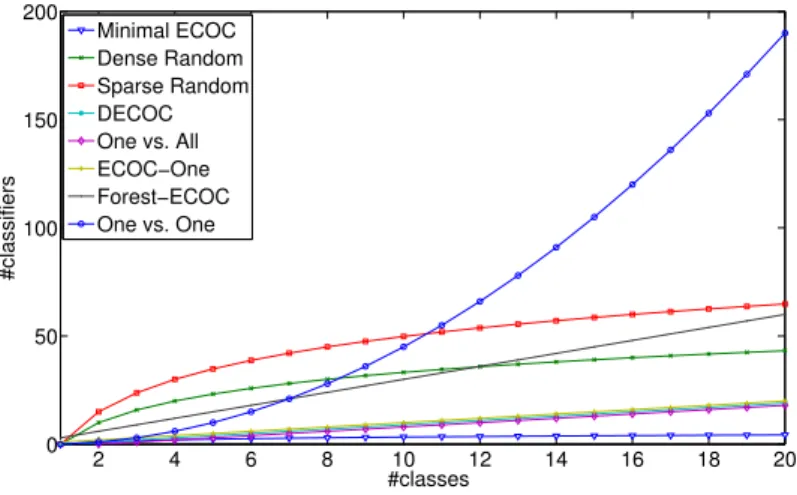
4.1 Number of classifiers per coding design and number of classes. . . 32
4.2 (a) Binary Minimal, (b) Gray Minimal, and (c) One vs. All ECOC coding designs of a 8-class problem. . . 33
4.3 Nested evolutionary optimization process for 3-class toy problem. . . 37
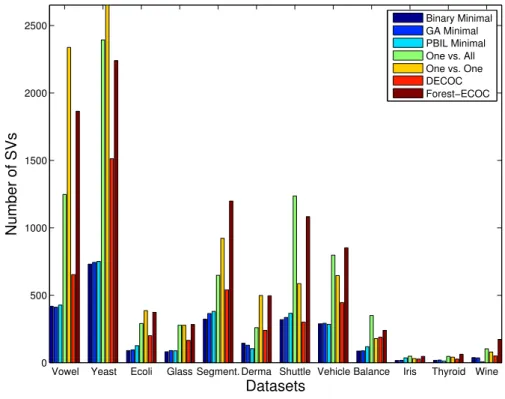
4.4 Number of SVs for each method on UCI datasets. . . 40
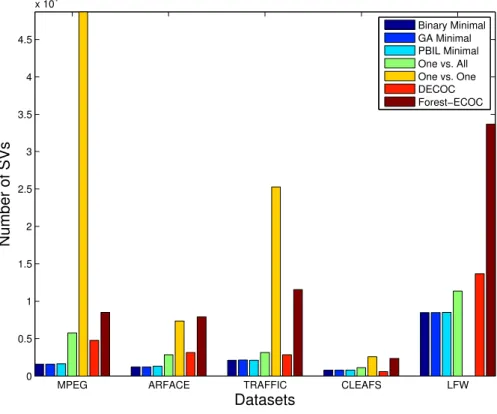
4.5 Number of SVs for each method on Computer Vision datasets. . . 41
4.6 Diagram of the ECOC-Compliant Genetic Algortihm. . . 44
4.7 Crossover example for a 5-class toy problem. (a) Feature space and trained classifiers for parentIM. (b) ECOC coding matrix of parentIM. (c) Feature representation and boundaries for parentIF. (d) Coding matrix ofIF. (e) ECOC coding matrix composition steps for the offspringIS. (f) Feature space and inherited classifiers forIS. . . 48
xiv LIST OF FIGURES
4.8 Mutation example for a 5-class toy problem. (a) Feature space and trained dichotomizers for and individual IT. (b) ECOC coding matrix of IT. (c)
Confusion matrix of IT. (d) Mutated coding matrix. (e) Mutated feature
space with trained dichotomizers. . . 51 4.9 Sparsity extension example for a 5-class toy problem. (a) Feature space and
trained dichotomizers forIT. (b) ECOC coding matrix of IT. (c) Confusion
matrix ofIT. (d) Extended coding matrix. (e) Extended feature space with
trained dichotomizers. . . 53 4.10 Critical difference for the Nemenyi test and the performance per classifier
ranking values. . . 55 4.11 (a) Number of classifiers perλvalue on the UCIVowel dataset. (b) Number
of SVs per coding design in the Computer Vision problems. . . 58 4.12 Number of SVs per coding design in the UCI datasets. . . 59 4.13 (a) Classification error evolution for theGlass dataset. (b) Evolution of the
Performance per classifier rate for theGlass dataset. (c)Classification error evolution for theVoweldataset.(d) Evolution of the Performance per classifier rate for the Vowel dataset. (e)Classification error evolution for the Yeast dataset. (f) Evolution of the Performance per classifier rate for the Yeast dataset. . . 60 5.1 Dmatrix for theTraffic(a) andARFace (b) datasets. MM>term obtained
via ECF forTraffic(c) andARFace (d) datasets. ECOC coding matrix M obtained with ECF forTraffic(e) andARFace (f). . . 68 5.2 Mean Frobenius norm value with standard deviation as a function of the
number of coordinate updates on 50 different trials. The blue shaded area corresponds to cyclic update while the red area denotes random coordinate updates forVowel (a) andARFAce(b) datasets. . . 69 5.3 (Mean objective value and standard deviation for 30 runs of ECF on a random
DG of 10 classes (a), 100 classes (b), and 500 classes (c). (d) Toy problem
synthetic data, where each color corresponds to a different category in the multi-class problem. . . 70 5.4 Toy problem synthetic data, where each color corresponds to a different
cat-egory in the multi-class problem. . . 71 5.5 Multi-class classification accuracy (y axis) as a function of the relative
com-putational complexity (x axis) for all datasets and both decoding measures. . 74 5.6 Multi-class classification accuracy (y axis) as a function of the number of
dichotomies for all datasets and both decoding measures (x axis). . . 75 5.7 (a) Summary of performance ofECF-H method over all datasets using the
number of SVs and the number of dichotomies as the measure of complexity, respectively forECF-H (a)(d),ECF-E(b)(e) andOVA(c)(f). . . 76 6.1 Different samples labeled on the HuPBA 8k+ dataset. . . 90 6.2 Scheme of the proposed human-limb segmentation method. . . 91
6.3 (a) Tree-structure classifier of body parts, where nodes represent the defined dichotomies.
Notice that the single or double lines indicate the meta-class defined. (b) ECOC decoding step, in which a head sample is classified. The coding matrix codifies the tree-structure
of (a), where black and white positions are codified as +1 and−1, respectively. . . 92
6.4 Multi-limb segmentation results for the three methods, for each sample, we also show the RGB image and the ground-truth (GT). . . 93
LIST OF FIGURES xv
6.5 Multi-limb segmentation results for the three methods, for each sample, we also show the RGB image and the ground-truth (GT). . . 94 6.6 Jaccard Indexes for the different limb categories from (a) to (f). (g) Mean
Jaccard Index among all limb categories. . . 95 A.1 Labeled Faces in the Wild dataset. . . 102 A.2 Traffic sign classes. . . 102 A.3 ARFaces dataset classes. Examples from a category with neutral, smile, anger,
scream expressions, wearing sun glasses, wearing sunglasses and left light on, wearing sun glasses and right light on, wearing scarf, wearing scarf and left light on, and wearing scarf and right light on. . . 103 A.4 (a) Object samples. (b) Old music score. . . 104 A.5 MPEG7 samples. . . 104
List of Tables
1.1 Summary of classification methods. . . 9
1.2 Table of symbols. . . 14
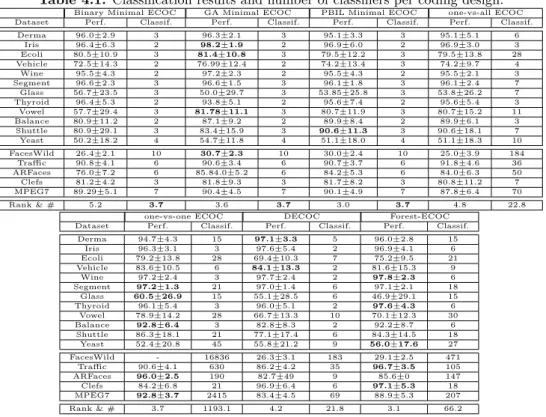
4.1 Classification results and number of classifiers per coding design. . . 38
4.2 Classification results and number of classifiers per coding design. . . 56
4.3 Mean rank per coding design. . . 57
5.1 Percentage of wins over all datasets for each method using as a complexity measure the number SVs and the number of classifiers. Last row shows the average complexity of each method over all datasets. Abbreviations: ECF-H (H), ECF-E (E), OVA (A), OVO (O), DENSE (D), RAND (R), S-ECOC(S). 73 6.1 Comparison of public dataset characteristics. . . 83
6.2 Prior cost between each pair of labels. . . 87
A.1 UCI repository datasets characteristics. . . 101
Chapter 1
Introduction
The quintessential goal of Artificial Intelligence is to build systems that replicate (or even improve) the processes performed by humans in order to acquire knowledge and interpret the environment around them. Although the Artificial Intelligence field has recently seen enormous advances, specially in those areas regarding with acquisition of knowledge from perception (e.g Computer Vision, Speech Recognition, Remote Sensing, etc.), we are still far from reaching human performance in different tasks.
This is due to the fact that humans spend an incredible number of hours gathering information from which make hypotheses, which become more credible as the quantity of information acquired increases. This phenomenon is clearly observed in babies (see Figure 1.1), which spend few years perceiving their environment by looking, touching, hearing, smelling and asking an innumerable number of questions. This acquisition of information by means of the sensory stimuli and supervision, leads to an improvement on the confidence of their hypotheses. This process is referred to aslearning. In fact, the problem of taking decisions among different hypotheses given sensory stimuli is often described as supervised categorization.
This dissertation tackles the problem of modeling different hypotheses to solve multi-class pattern and object categorization problems.
Figure 1.1: Baby analyzing shapes and colors.
2 INTRODUCTION
1.1
Motivation
Humans perceive and reason about the world that surrounds them from multi-modal stimuli that sensory organs capture. Even though those stimuli are of different nature and therefore come from different sensory organs (e.g. light stimuli is captured by the retina in our eyes while sound waves are captured by the cochlea in our ears), the brain is able to process and integrate all this information. The mammalian brain has been studied over years, yielding interesting findings on its topological organization. As a result, it has been observed that the cerebral cortex can be categorized in three kinds of regions:
• Motor areas, which are dedicated to move parts of the body.
• Sensory areas, dedicated to process the input signals captured by sensory organs. For example, the V1 area (primary visual cortex) is specialized in recognizing patterns coming from visual stimuli, while the A1 area (primary auditory cortex) is specialized in processing sounds captured by the ears. In addition, some smaller regions have been discovered to be dedicated to much specific tasks, e.g. the Fusiform Face Area [78] for facial recognition, the Parahippocampal Place Area [44] for scene context recognition, or the Extrastriate Body Area [40] for recognizing parts of the human body.
• Association areas, produce meaningful perceptual experience of the world by integrat-ing sensory information and information stored in memory. As pointed out by [140], association areas are globally organized as distributed networks, connecting different widely-spaced parts of the human brain. More specifically, the authors found a coarse parcellation of the brain in seven different regions (and a finer categorization in 17 re-gions), which can be connected following different pathways. While it is clear that our brains integrate signals and hypotheses coming from different sensory modalities, for example, when trying to perform recognitiona word from its sound and the move-ment of the lips of the speaker, it still remains unclear how this integration process is exactly performed. Among the different theories, statistical integration has been backed by a number or works providing results that correlate with human behaviour [13, 92, 134].
Given that different sensory modalities are not equally reliable (e.g. vision is usually more reliable than hearing in daylight, but not at night), it is natural to think of a statistical approach or a combination of statistical approaches to combine multi-modal cues coming from different senses. Hence, it has been shown that in order to improve the confidence of the decision making process the human brain uses information coming from different sensory areas in the brain [140]. This has three obvious reasons:
• The decision taking capabilities of the brain, although great are limited and can be defective in certain situations.
• The information acquired by the sensory areas in the brain can be imperfect, due to environmental conditions or faulty processing abilities.
• The experience stored in memory only represents a part of the space of the information and possible decisions available for the task.
Therefore, by using different sources of information the brain is able to make more confident decisions with a capability to generalize to different tasks.
However, studies have shown that the reasoning processes related to our visual system play a very important role in our global intelligent behavior. This can be often proved by trying to interact with our daily environment without perceiving visual information. Being deprived of this information makes simple tasks (i.e walking, avoiding obstacles, etc.) much
1.2. Statistical Pattern Recognition 3
harder. The area of Artificial Intelligence that deals with the processing of visual information is known as Computer Vision, and it covers from the extraction valuable information from digital two-dimensional projections of the real world, up to how process that information to obtain high level representations to understand and make sense of what is happening in those images.
For this reason, in this dissertation we are particularly interested in categorization prob-lems which deal with visual data as their main source of information.
1.2
Statistical Pattern Recognition
Automatic (machine) recognition, description, classification, and grouping of patterns are important problems in a variety of engineering and scientific disciplines such as biology, psychology, medicine, marketing, computer vision, artificial intelligence, and remote sensing. But what is a pattern? Watanabe [132] defines a pattern as the opposite of chaos; it is an entity, that could be given a name and which exhibits a certain type of structure. For example, a pattern could be a fingerprint image, a handwritten cursive word, a human face, or a speech signal. Given a pattern, its recognition/classification may consist of one of the following tasks: 1) Supervised Classification (categorization) in which the input pattern is identified as a member of a predefined class, 2) Unsupervised Classification (clustering) in which the pattern is assigned to a hitherto unknown class. Note that the recognition problem here is being posed as a classification or categorization task, where the classes are either defined by the system designer (categorization) or are learned based on the similarity of patterns (clustering). 3) Semi-supervised learning is halfway between supervised and unsupervised learning. In addition to patters without any predefined classes, the algorithm is also provided with some patterns with their predefined classes – but not necessarily for all examples.
Statistical Pattern Recognition denotes asSupervised Classificationthe problem of making a decision based on certain learning information available. [76]. In this sense, a classification system looks for a method that makes those judgments or decisions in previously unseen situations. In particular, a binary classification task refers to the problem of making a decision for a new objectxi (data sample or pattern), so thatξi is classified among two
predefined categories (or classes), c1 and c2. Thus, in binary classification we only have two alternatives to decide amongstc1 and c2. Formally, given training data{X,y} X ∈ Rn×m,y∈ {c1, c2}1×n, wherexi is thei−th object andyi is the true class of objectxi, a
classifier functionf is trained to distinguish the objects which label isc1 from the objects
which label isc2. The classifier function is defined asf :X→y, whereyi∈ {c1, c2}∀i∈
{1, . . . , n}. However, in order to approximate or learn the classifierfeach elementxishould
be described with a set of characteristic or features, inherent to the object itself. For instance, we could describe a baby based on his weight, height, eyes color, etc. Then, the process of approximating the classifier function also called learning or training uses the set of object features from all the samples in order to define a boundary between two classes.
There are different techniques that deal with the task of object/pattern description [14][91]. Informative features depends on the object itself and its relationships with other classes, as well as the problem one wants to solve. In addition, some features can change their description when environmental factors introduce noise in the description process. For example, using the weight as feature description of a baby can be sensible to the planet in which this measure is being performed. In particular, when describing or extracting features from images, we can find that such features are sensible to changes in illumination, occlusions between parts or deformations on non-rigid entities.
4 INTRODUCTION
The problem of object description is a very difficult task. Observe the objects of Figure 1.2. Which are the representative features to describe a chair? shape? color? Obviously, it depends on the categorization problem we consider. Binary classification not only does con-sist on distinguishing apples from tables. In the chair class, we can also apply categorization. Which chairs are broken? Which chairs are black or brown? These questions correspond to binary problems. In the first case, the variations of the shape of the object can be useful, but not the color. In the second case, the color has an outstanding decision, while the shape is not a relevant feature.
Figure 1.2: Chair samples.
Given the features or descriptions obtained for each data sample, in the statistical ap-proach, each of these patterns is viewed as a point in a high-dimensional space of features. Then, the goal is to choose those features that allow pattern vectors belonging to different categories to occupy compact and disjoint regions in that feature space [17]. The effectiveness of the representation space (feature set) is determined by how well patterns from different classes can be separated. Given a set of training patterns from each class, the objective is to establish decision boundaries in the feature space which separate patterns belonging to different classes. In the statistical decision theoretic approach, the decision boundaries are determined by the probability distributions of the patterns belonging to each class, which must either be specified or learnt [17][129].
The classification or categorization system is operated in two modes: learning (training) and classification (testing) (see Figure 1.3). The role of the preprocessing module is to re-move noise, normalize the pattern, and any other operation which will contribute in defining a compact representation of the data samples. In the training mode, the feature extrac-tion/selection module finds the appropriate features for representing the input patterns and the classifier is trained to partition the feature space. The feedback path allows a designer to
1.2. Statistical Pattern Recognition 5
optimize the preprocessing and feature extraction/selection strategies. In the classification mode, the trained classifier assigns the input pattern to one of the pattern classes under consideration based on the measured features. Based on the previous scheme, some points to design a robust Statistical Pattern Recognition model should be considered [42]:
• How the learning system should adapt to the representation?: It is an intermediate stage between preprocessing and learning, in which representations, learning method-ology or problem statement are adapted or extended in order to enhance the final recognition. This step may be neglected as being transparent, but its role is essential. It may reduce or simplify the description, or it may enrich it by emphasizing particular aspects, e.g. by a nonlinear transformation of features that simplifies the next stage. Background knowledge may appropriately be (re)formulated and incorporated into a representation. If needed, additional representations may be considered to reflect other aspects of the problem. Exploratory data analysis (unsupervised learning) may be used to guide the choice of suitable learning strategies.
• How can we generalize or infer?: At the learning stage, we learn a concept from a training set, the set of known and appropriately represented examples, in such a way that predictions can be made on some unknown properties of new data samples. We either generalize towards a concept or infer a set of general rules that describe the qualities of the training data. The most common property is the class or pattern it belongs to, which corresponds to the classification task.
• How the evaluation should be performed?: In this stage, we estimate how our system performs on known training and validation data while training the entire system. If the results are unsatisfactory, then the previous steps have to be reconsidered using the feedback module of Figure 1.3.
Preprocessing Feature Measurement Classification Preprocessing Feature Extraction/ Selection Learning Classification Training training data test data
Figure 1.3: Standard pipeline for statistical pattern recognition.
This dissertation aims to focus on a subset of the previous question to present powerful multi-class pattern and object recognition systems. The architecture of multi-class strate-gies that we present adapt the previous representation of the data samples, in a problem-dependent way, so that the learning process obtains high generalization performance.
1.2.1
Visual Pattern Recognition
One of the most challenging areas in which statistical pattern recognition and learning theory is applied is the field of Computer Vision. Many of the visual Pattern Recognition techniques that achieve current state-of-the-art results are biological inspired [121]. The majority of
6 INTRODUCTION
studies in this area assume that not all parts of an image give us valuable information, and only analyzing the most important parts of the image in detail is sufficient to perform recognition or categorization tasks. The biological structure of the eye is such that a high resolution fovea and its low-resolution periphery provide data for recognition purposes. The fovea is not static, but is moved around the visual field in facades. These sharp, directed movements of the fovea are not random. The periphery provides low-resolution information, which is processed to reveal salient points as targets for the fovea, and those are inspected with the fovea. The eye movements are a part of overt attention, as opposed to covert attention which is the process of moving an attentional focus around the perceived image without moving the eye. In the case of Neural Networks, the objective is to simulate the behavior of some neuronal circuits of our brain.
To model a Visual Pattern Recognition problem, a common approach consists of detecting the objects in an image, and then, classifying them to their respective category. Many recognition systems also treat the problem of object detection as a binary classification problem, where the information of each part of the image is classified as object or background. Look to the situation presented in 1.4.
?
Figure 1.4: Nao detects and classifies the furniture in the scene.
The humanoid robot Nao from Aldebaran Robotics captures images from a scene, dis-carding background regions. At the first step, it treats to find the regions of the image that contain a piece of furniture. Once the region containing a piece of furniture is found, given four previous furniture categories, Nao classifies the inner object as a chair. Hence, the problem of object recognition can be seen as an object detection problem followed by a classification procedure.
1.3
The Multi-class Classification Problem
When using the term binary classification, the labels from classesc1 andc2 use to take the values +1 or−1, respectively as a convention. At the learning process explained in previous sections, the labels for the training objects are known.
1.4. State-of-the-art Classification Techniques in Visual Pattern Recognition 7
In previous examples, the underlaying problem corresponded to Supervised Binary Clas-sification. However, Binary Classification is far from representing real world problems. We can classify between black and brown chairs or we can also distinguish among chairs, tables, couches, lamps, etc. Multi-class classification is the term applied to those Machine Learning problems that require assigning labels to instances where the labels are drawn from a set of at least three classes. Real-world situations are full of multi-class classification problems, where we want to distinguish amongkpossible categories (obviously, the number of objects that we have learnt during our life tends to be uncountable). If we can design a multi-classifierF, then the prediction can be understood as in the binary classification problem, beingF :X →y, where now yi ∈ {1, . . . , k}, for a k−class problem. Several multi-class
classification strategies have been proposed in the literature. However, though there are very powerful binary classifiers, many strategies fail to manage multi-class information. As we show in successive sections, a possible multi-class solution could potentially consist of designing and combining of a set of binary classification problems.
1.4
State-of-the-art Classification Techniques in
Vi-sual Pattern Recognition
In this chapter we describe the state-of-the-art techniques for classification with a particular interest in those applied in Computer Vision.
1.4.1
Classifiers
In the Statistical Pattern Recognition field, classifiers are frequently grouped into those based on similarities, probabilities, or geometric information about class distribution [41, 76].
1. Similarity Maximization Methods: The Similarity Maximization Methods use the sim-ilarity between patterns to decide a classification. The main issue in this type of classifiers is the definition of the similarity measure.
2. Probabilistic Methods: The most well known probabilistic methods make use of Bayesian Decision Theory. The decision rule assigns class labels to that having the maximum posterior probability. The posterior can be calculated by the well-known Bayes rule:
posterior= likelihood×prior
evidence (1.1)
IfP(yj) is the prior probability that a given instancexj belongs to classyj,p(xj|yj)
is the class-conditional probability density function: the density forxj given that the
instance is of classyj, andp(xj) is defined asp(xj|yj)×P(yj) over all classes. Then,
Equation 1.1 is equivalent to:
P(yj|xj) =
p(xj|yj)×P(yj) p(xj)
(1.2) The classification is done in favor of thej-th class ifP(yj=i|xj)> P(yj=k|xt),∀i∈
{1, . . . , k}andi6=j, where{1, . . . , k}is the set of classes.
3. Geometric Classifiers: Geometric classifiers build decision boundaries by directly min-imizing an error criterion based on geometric considerations such as the margin, the convex envelope o topological properties of the set.
8 INTRODUCTION
Table 1.1 summarizes the main classification strategies studied in literature. For each strategy, we show its properties, comments, and type based on the previous grouping.
1.4.2
Multi-class classifiers
Intrinsic multi-class methods
In classification problems the goal is to find a function F : X → y, where X is the set of observations and y ∈ {1, . . . , k}1×n the set composed by the label of each observation
(max(y) >2 for the multi-class context). The goal ofF is to map each observationxi ∈ R1×m to its label yi ∈ {1, . . . , k}. There are many possible strategies for estimating F,
nevertheless, literature has shown that the complexity for estimating a unique F for the whole multi-class problem grows with the cardinality of the label set. In this sense, most of the strategies aim to model the probability density function of each category. Moreover, lazy learning methods like Nearest Neighbours to estimate kby a local search of the most proximate observations.
The class problem can be directly treated by some methods that exhibit a multi-class behaviour off the shelf (i.e Nearest Neighbours [133], Decision Trees [107], Random Forests [26]). However, some of the most powerful methods for binary classification like Support Vector Machines (SVM) or Adaptive Boosting (AdaBoost) can not be directly ex-tended to the multi-class case and further development is required. In this sense, literature is prolific on single-loss strategies to estimate F. One of the most well know approaches are the extensions of SVMs [18] to the multi-class case. For instance, the work of Weston and Watkins [135] presents a single-machine extension of the SVM method to cope with the multi-class case, in which k predictor functions are trained, constrained with k−1 slack variables per sample. However, a more recent adaptation of [33] reduces the number of con-straints per samples to one, paying only for the second largest classification score among the
kpredictors. To solve the optimization problem a dual decomposition algorithm is derived, which iteratively solves the quadratic programming problem associated with each training sample. Despite these efforts, single-machine approaches to estimate f scale poorly with the number of classes and are often outperformed by simple decompositions [111, 125]. In recent years various works that extended the classical Adaptive Boosting method [57] to the multi-class setting have been presented [98, 119]. In [147] the authors directly extend the AdaBoost algorithm to the multi-class case without reducing it to multiple binary problems, that is estimating a single F for the whole multi-class problem. This algorithm is based on an exponential loss function for multi-class classification which is optimized on a for-ward stage-wise additive model. Furthermore, the work of Saberian and Vasconcenlos [116] presents a derivation of a new margin loss function for multi-class classification altogether with the set of real class codewords that maximize the presented multi-class margin, yielding boundaries with max margin. However, though these methods are consistently derived and supported with strong theoretical results, methodologies that jointly optimize a multi-class loss function present some limitations:
• They scale linearly withk, rendering them unsuitable for problems with a largek. • Due to their single-loss architecture the exploitation of parallelization on modern
multi-core processors is difficult.
1.4. State-of-the-art Classification Techniques in Visual Pattern Recognition 9
Method Property Comments Type
Template matching Assigns patterns to the most similar template
The templates and the metric have to be supplied by the user; the procedure mayinclude nonlinear normalizations; scale (metric) dependent
Similarity Maximization
Nearest Mean Classifier Assigns patterns to the nearest class mean
No training needed; fast testing;
scale (metric) dependent Similarity Maximization
Subspace Method Assigns patterns to the nearest class subspace
Instead of normalizing on in-variants, the subspace of the invariant is used; scale (metric) dependent
Similarity Maximization
1-Nearest Neighbor Rule Assigns patterns to the class of the nearest training pattern
No training needed; robust performance; slow testing; scale (metric) dependent
Similarity Maximization
k-Nearest Neighbor Rule
Assigns Patterns to the majority class among k nearest neighbor using a performance optimized value for k
Asymptotically optimal; scale
(metric) dependent, slow testing Similarity Maximization
Bayes plug-in
Assigns pattern to the class which has the maximum estimated posterior probability
Yields simple classifiers (linear or quadratic) for Gaussian distributions; sensitive to density estimation errors
Probabilistic
Logisctic Classifier
Maximum likelihood rule for logistic (sigmoidal) posterior probabilities
Linear classifier; iterative procedure; optimal for a family of different distributions (Gaussian); suitable for mixed data types
Probabilistic
Parzen Classifier
Bayes plug-in rule for Parzen density estimates with performance optimized kernel
Asymptotically optimal; scale
(metric) dependent; slow testing Probabilistic
Fisher Linear Discriminant Linear classifier using MSE optimization
Simple and fast; similar to Bayes plug-in for Gaussian distributions with identical covariance matrices
Geometric
Binary Decision Tree
Finds a set of thresholds for a pattern-dependent sequence of features
Iterative training procedure; overtraining sensitive; needs pruning; fast testing
Geometric
Adaboost Logistic regression for a combination of weak classifiers
Iterative training procedure; overtraining sensitive; fast training; good generalization performance
Geometric
Perceptron Iterative optimization of a linear classifier
Sensitive to training parameters;
may produce confidence values Geometric
Multi-layer Perceptron (Feed-Forward Neural Network)
Iterative MSE optimization of two or more layers of perceptrons (neurons) using sigmoid transfer functions
Sensitive to training para-meters; slow training; nonlinear classification function; may produce confidence values; overtraining sensitive; needs regularization
Geometric
Radial Basis Network
Iterative MSE optimization of a feed-forward neural network with at least one layer of neurons using Gaussian-like transfer functions
Sensitive to training parameters; nonlinear classification function; may produce confidence values; overtraining sensitive; needs regularization; may be robust to outliers
Geometric
Support Vector Classifier
Maximizes the margin between the classes by selecting a minimum number of support vectors
Scale (metric) dependent; iterative; slow training; non-linear; overtraining insensitive; good generalization performance
Geometric
10 INTRODUCTION
Ensemble Learning for multi-class problems
Multi-class classification (i.e. automatically attributing a label to each sample of the dataset) is one of the classic problems in Pattern Recognition and Machine Intelligence. In this sec-tion we review the state-of-the-art for Ensemble Learning techniques that tackle multi-class classification problems.
Divide and Conquer Approaches
The divide and conquer approach has drawn a lot of attention due to its excellent results and easily parallelizable architecture [3, 7, 51, 64, 94, 106, 111, 125]. In this sense, instead of developing a method to cope with the multi-class case, divide and conquer approaches decouple F into a set ofl binary problems which are treated separatelyF ={f1, . . . , fl}. Once the responses of binary classifiers are obtained a committee strategy is used to find the final output. In this trend one can find three main lines of research: flat strategies, hierarchical classification, and ECOC. Flat strategies like One vs. One [125] and One vs. All [111] are those that use a predefined problem partition scheme followed by a committee strategy to aggregate the binary classifier outputs. Hierarchical classification relies on a similarity metric distance among classes to build a binary tree in which nodes correspond to different problem partitions [60, 64, 94]. Finally, the ECOC framework consists of two steps: In thecoding step, a set of binary partitions of the original problem are encoded in a matrix of discrete codewords [39] (univocally defined, one codeword per class). At the decoding step a final decision is obtained by comparing the test codeword resulting of the union of the binary classifier responses with every class codeword and choosing the class codeword at minimum distance [47, 146]. The coding step has been widely studied in litera-ture, yielding three different types of codings: predefined codings [111, 125], random codings [3] and problem-dependent codings for ECOC [7, 51, 61, 106, 141, 142]. Predefined codings like One vs. All or One vs. One are directly embeddable in the ECOC framework. In [3], the authors propose the Dense and Sparse Random coding designs with a fixed code length of {10,15}log2(k), respectively. In [3] the authors encourage to generate a set of 104 ran-dom matrices and select the one that maximizes the minimum distance between rows, thus showing the highest correction capability. However, the selection of a suitable code lengthl
still remains an open problem. Problem-dependent designs
Alternatively, problem-dependent strategies for ECOC have proven to be successful in multi-class classification tasks [51, 60, 61, 106, 141, 142, 143, 144]. A common trend of these works is to exploit information of the multi-class data distribution obtained a priori in order to design a decomposition into binary problems that are easily separable. In that sense, [141] computes a spectral decomposition of the graph laplacian associated to the multi-class problem. The expected most separable partitions correspond to the thresholded eigenvectors of the laplacian. However, this approach does not provide any warranties on defining unequivocal codewords (which is a core property of the ECOC coding framework) or obtaining a suitable code lengthl. In [61], Gao and Koller propose a method which adaptively learns an ECOC coding by optimizing a novel multi-class hinge loss function sequentially. On an update of their earlier work, Gao and Koller propose in [60] a joint optimization process to learn a hierarchy of classifiers in which each node corresponds to a binary sub-problem that is optimized to find easily separable subsub-problems. Nonetheless, although the hierarchical configuration speeds up the testing step, it is highly prone to error propagation since node mis-classifications can not be recovered. In addition, the work of Zhao et. al [142] proposes a dual projected gradient method embedded on a constrained concave-convex procedure to optimize an objective composed of a measure of expected problem separability,
1.4. State-of-the-art Classification Techniques in Visual Pattern Recognition 11
codeword correlation and regularization terms. In the light of these results, a general trend of recent works is to optimize a measure of binary problem separability in order to induce easily separable sub-problems. This assumption leads to ECOC coding matrices that boost the boundaries of easily separable classes while modeling with low redundancy the ones with most confusion.
Furthermore, [10] proposed a standard Genetic Algorithm to optimize an ECOC ma-trix, known as Minimal ECOC mama-trix, which is the theoretical lower-bound in terms of the number of classifiersdlog2k e. In this work the evaluation of each individual (ECOC ma-trix) is obtained by means of its classification error over the validation set. In addition, [62] proposed the use of the CHC Genetic Algorithm [52] to optimize a Sparse Random ECOC matrix. In this work, the code length is fixed in the interval [30,50] independently of the number of classes. Finally, [89] used a Genetic Algorithm to optimize a Sparse Random coding matrix of length in the interval [log2(k), k]. The evaluation of each individual (ECOC
coding matrix) is performed as the classification error over a validation set.
Convolutional Neural Networks
Neural Networks are a family of models inspired by biological neural networks. These models are generally presented as systems of interconnected "neurons" which exchange mes-sages between each other. The connections have numeric weights that can be tuned based on training data, making neural nets adaptive to inputs and capable of learning. Neural Networks (NNs) were successfully applied to multi-class classification problem in 90s [123]. These methods can be seen as a stacking of different neuron layers in which outputs of layer
iare the input of layeri+ 1.
Particularly, the introduction of the multi-layer perceptron by Rosenblatt [113], which was demonstrated to be a universal function approximator [113] made Neural Networks a hot topic at the time. Furthermore, the introduction of back-propagation to train Neural Networks meant that these models could be trained efficiently [59, 113, 115]. However, with the appearance of SVMs in the mid 90s Neural Networks lost all there interest due to the stronger theoretical properties and easier interpretation of the Support Vector Machine model.
In despite of the great performance exihibited by SVMs, several researchers kept on working with Neural Networks after the introduction of SVMs [15, 16, 87, 121]. In this sense, based on previous work from Fukushima [59] Convolutional Neural Networks (CNNs) were first introduced by LeCun and Bengio [86]. The idea of this method was to use a set of convolutional layers to combine three architectural ideas to ensure some degree of shift and distortion invariance: local receptive fields, shared weights and sometimes spatial or temporal subsampling. Each neuron of a layer receives inputs from a set of units located in a small neighborhood in the previous layer.
However, it was not until the paper of Krizhevsky et. al [82] that Convolutional Neu-ral Networks gained an overwhelming attention given the fact that the method proposed by Krizhevsky et. al [82] outperformed other methods by 10% in the ILSRVC challenge [82]. This method followed the line of previous Convolutional Neural Networks [86], definin-ing a deep architecture with 5 convolutional layers and 3 fully-connected layers, generatdefinin-ing a model consisting of 60 million parameters. Convolutional Neural Networks have con-sistently outperformed state-of-the-art methods for most classification tasks in Computer Vision. However, further analyses of this methods on this dissertation falls out of scope given the overly large number of parameters and data needed to train these models.
12 INTRODUCTION
1.5
Objective of the Thesis
In this dissertation we are interested in proposing novel techniques to learn problem-dependent ECOC coding designs for multi-class problems in Computer Vision, in particular, we are very interest in strategies that scale sub-linearly with the number of classes in the multi-class prob-lem. Hence, we most of our experimental results analyze performance as a function of the complexity of the model.
1. Reduce the code length of problem-dependent ECOC codings. Code length has a direct implication in the model complexity of the overall ECOC model. One objective of this dissertation is analyze and explore ECOC coding designs which code length scales sub-linearly with the number of classes in the multi-class problem. There-fore rendering them suitable to treat problems with very large number of classes using very reduced computational resources.
2. Design strategies to optimize the ECOC coding designs. Another objective of this dissertation is to exploit the distribution of the multi-class data to define problem-dependent ECOC designs that distribute their learning effort accordingly. In order to do so, we study different ways of optimizing ECOC coding matrices.
3. Analyze and understand how error-correction is distributed among classes. Error-correction has always been in the core of all ECOC analyses. Our objective in this dissertation is to show that the current way to analyze and understand error-correction for ECOC matrices does not reflect how the error-error-correction is distributed among classes. Hence, a novel way of representing ECOCs and their correcting capa-bilities has to be defined.
1.6
Contributions
Error-Correcting Output Codes were proposed to deal with multi-class problems by embed-ding several binary problems in a coembed-ding matrix. This approach showed to be very robust applied to many real-world problems. However, several aspects of this framework that can help us to improve the classification performance have not been previously analyzed. In this thesis, we theoretically and empirically analyze the ECOC framework.
1. Minimal ECOC Coding Design: We propose to define the lower bound of an ECOC coding design in terms of the number of binary problems embedded in the coding design. We show that even with a very reduced number of binary classifiers we can obtain comparable results to state-of-the-art coding designs.
2. Genetic Optimization of Minimal ECOCs: Although showing a good perfor-mance, Minimal ECOCs are bounded in terms of generalization capabilities due to the reduced number of classifiers. In this sense, we propose to use a Genetic Algo-rithm to optimize the ECOC coding configuration and obtain a Minimal ECOC coding matrix with high generalization capabilities.
3. ECOC-Compliant Genetic Algorithm: Standard Genetic Algorithm use crossover and mutation operators that treat individuals as binary strings. This operators do not take into account the constraints of the ECOC framework and can lead to poor opti-mization schemes. We propose to redefine the standard crossover and mutation opera-tors in order to take into account the constraints of the ECOC framework. In addition we also proposes and operator to dynamically adapt the code length of the ECOC during the training process. This redefinition of operators leads to very satisfying results in terms of classification performance as a function of the model complexity.
1.7. Thesis Outline 13
4. ECOC separability and error-correction: The error-correcting capability of an ECOC has always been depicted in literature as a single scalar, which hinders further analyses of error-correction between different categories. We propose to represent an ECOC by means of its separability matrix and use very simple heuristics to exploit the distribution of error-correction among pairs of classes to outperform state-of-the-art results.
5. Error-Correcting Factorization: Empowered by the novel representation of an ECOC as its Separability Matrix we propose to obtain an estimated Separability ma-trix from data using very simple statistics. Then, we defined the novel Error-Correcting Factorization to factorize that estimated Separability matrix into a discrete ECOC coding matrix that distributes error-correcting to those classes that are more prone to errors.
6. Applications in Human Pose Recovery: We applied the ECOC framework in the challenging problem of Human Pose Recovery, obtaining very satisfying results in comparison with state-of-the-art works. In addition we propose the HuPBA 8k+ dataset, a large dataset for Human Pose Recovery in still images.
The experimental results of this thesis show that the presented strategies outperform the results of the state-of-the-art ECOC coding designs as well as the state-of-the-art multi-classifiers, being specially suitable to model several real multi-class categorization problems.
1.7
Thesis Outline
This dissertation is organized as follows:In Part I, Chapter 2 introduces the basis of the Error-Correcting Output Codes (ECOCs), as well as the state-of-the-art coding and decoding designs. In addition, we also present good practices for ECOC coding and the constraints of ECOC coding matrices. In Chapter 3 we introduce a novel way to represent ECOCs by means of the separation between codewords and analyze how error-correcting capabilities are distributed for state-of-the-art designs.
Part II presents our contributions to problem-dependent coding designs for ECOCs using Genetic Algorithm in Chapter 4. In particular, we present the Minimal ECOC coding, which defines the lower bound in terms of the number of classifiers embedded in an ECOC coding matrix. Moreover, we also present a novel Genetic Algorithm that takes into account the constraints of the ECOC framework. Chapter 5 present a novel method to compute problem-dependent designs from ECOC based on the Error-Correcting Factorization, which factorizes an estimated codeword separability matrix obtained from training data.
In Part III Chapter 6 presents applications of ECOC codings in the challenging Computer Vision problem of Human Pose Estimation, in which we cast the problem of recognizing the human body parts as a classification problem at tackle it using the ECOC framework.
Finally, Part IV concludes the dissertation with a summary of contributions and future work in Chapter 7. Annex A provided technical details of datasets used for experimental results, and Annex B shows the complete list of publications generated as a result of this dissertation.
1.8
Notation
We introduce the notation for the this dissertation.
Bold capital letters denote matrices (e.g. X), bold lower-case letters represent vectors (e.g.,x). All non-bold letters denote scalar variables. xi is thei−th row of the matrixX.
14 INTRODUCTION
xjis thej−th column of the matrixX. 1is a matrix or vector of all ones of the appropriate
size. Iis the identity matrix. diag(d) denotes a matrix withdin the main diagonal. xij
denotes the scalar in thei−th row andj−th column ofX. kXkF = tr(X>X) denotes the
Frobenius norm. k·kpis used to denote the Lp-norm. x⊕yis an operator which concatenates
vectorsxandy. rank(X) denotes the rank ofX. X≤0 denotes the point-wise inequality. Table 1.2 shows the different symbols used in this dissertation.
Matrix of training samples X i−th training sample xi Vector of labels y label of thei−th samples yi
i-th category ci Indicator function I
ECOC coding matrix M i-th codeword mi
i−th dichotomy mi i−th classifier fi
Number of classes k Number of dichotomies l
Vector of classifier predictions
for thei−th sample f(xi) Decoding measure δ
Chromosome s Error function E
Number of Generations G i−th individual Ii
Confusion matrix C Performance of binary classifiers p
Dichotomy selection order t Mutation control value mtc
Separability matrix H i-th row ofH hi
Design Matrix D i−th row ofD di
Minimum distance between
pairs of codewords P i−th row ofP p
i
Matrix of eigenvectors V Vector of eigenvalues λ
Likelihood map B Weight matrix W
Part I
Ensemble Learning and the
ECOC framework
Chapter 2
2.1
The Error-Correcting Output Codes Framework
ECOC is a general multi-class framework built on the basis error-correcting principles in communication theory [39]. This framework suggests to view the task of supervised multi-class multi-classification as a communication problem in which the label of a training example is being transmitted over a channel. The channel consists of the input features, the training examples, and the learning algorithm. Because of errors introduced by the finite number of training samples, choice of input features, and flaws in the learning process, the label information is corrupted. By coding the label information in an error-correcting codeword and transmitting (i.e learning) each bit separately (i.e., via uncorrelated independent binary classifiers), the algorithm may be able to recover from the errors produced by the number of samples, features or learning algorithm.The ECOC framework is composed of two different steps: coding [3, 39] and decoding [47, 146]. At the coding step an ECOC coding matrixM∈ {−1,+1}k×lis constructed, where k denotes the number of classes in the problem and l the number of bi-partitions defined to discriminate thekclasses. In this matrix, the rows (mi’s, also known as error-correcting
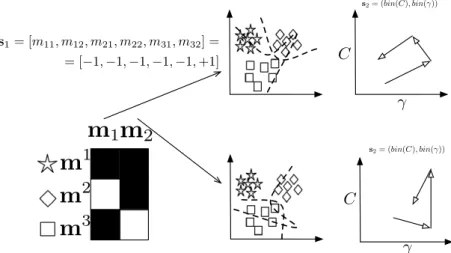
codewordsor codewords for shorter) are univocally defined, since these are the identifiers of each category in the multi-class categorization problem. On the other hand, the columns of Mdenote the set of bi-partitions, dichotomies, or meta-classes to be learnt by each binary classifierf(also known as dichotomizer). In this sense, classifierfjis responsible of learning the bi-partition denoted on thej−th column ofM. Therefore, each dichotomizer learns the classes with value +1 against the classes with value−1 in a certain column. Note that the ECOC framework is independent of the binary classifier applied. For notation purposes in further sections we will refer to the entry ofMat thei-th row and thej-th column asmij.
Following this notation thei-th row (codeword of classci) will be referred asmi and, the j-th column (j-th bi-partition or dichotomy) will be referred asmj.
Originally, the coding matrix was binary valued (M∈ {−1,+1}k×l
). However, [3] intro-duced a third value, and thus,M∈ {−1,+1,0}k×l, defining ternary valued coding matrices.
In this case, for a given dichotomy categories can be valued as +1 or−1 depending on the meta-class they belong to, or 0 if they are ignored by the dichotomizer. This new value allows the inclusion of well-known decomposition techniques into the ECOC framework, such has One vs. One [125] or Sparse [3] decompositions.
At the decoding step a samplextis classified among thekpossible categories. In order to
perform the classification task, each dichotomizer infjpredicts a binary value forxtwhether
it belongs to one of the bi-partitions defined by the correspondent dichotomy. Once the set of predictionsf(xt)∈Rlis obtained, it is compared to the codewords ofMusing a distance
18 ERROR-CORRECTING OUTPUT CODES REVIEW AND PROPERTIES
metric δ, known as the decoding function. The usual decoding techniques are based on well-known distance measures such as the Hamming or Euclidean distances. These measures were proven to be effective in binary valued ECOC matrices{+1,−1}. Nevertheless, it was not until the work of [47] that decoding functions took into account the meaning of the 0 value at the decoding step. Generally, the final prediction forxt is given by the classci,
where argmin
i
δ(mi,f(xt)),i∈ {1, . . . , k}. Figure 2.1 shows an example of ECOC matrices
for a toy problem.
By analysing the ECOC errors it has been demonstrated that ECOC corrects errors caused by the bias and the variance of the learning algorithm [81]. The variance reduction is to be expected, since ensemble techniques address this problem successfully [104] and ECOC is a form of voting procedure. On the other hand, the bias reduction must be interpreted as a property of the decoding step. It follows that if a point xt is misclassified by some
of the learnt dichotomies, it can still be classified correctly after being decoded due to the correction ability of the ECOC algorithm. Non-local interaction between training examples leads to different bias errors. Initially, the experiments in [81] show the bias and variance error reduction for algorithms with global behavior (when the errors made at the output bits are not correlated). After that, new analysis also shows that ECOC can improve performance of local classifiers (e.g., the k-nearest neighbor, which yields correlated predictions across the output bits) by extending the original algorithm or selecting different features for each bit [3].
x
tf
(
x
t)
3 44 00 1 22(
a
)
(
b
)
(
c
)
f3 f2f
1f
4f
5m
1m
2m
3m
4m
5m
1m
2m
3m
4m
5m
1m
2m
3m
4m
5m
1m
2m
3m
4m
5δ
Figure 2.1: (a) Feature space and trained boundaries of dichotomizers. (b) Coding matrix M, where black and white cells correspond to{−1,+1}, denoting the two partitions to be learnt by each base classifier (white cells vs. black cells) while grey cells correspond to 0 (ignored classes). (c) Decoding step, where the predictions of classifiers, {h1, . . . , h5}for samplext are compared to the codewords{m1, . . . ,m5}