This is a peer-reviewed, accepted author manuscript of the following conference paper: Marriott, H., & McLean, G. (2019). Developing the mUTAUT model – a mobile shopping perspective. Paper presented at 2019 Academy of Marketing Science Annual Conference, Vancouver, Canada.
Developing the mUTAUT model
–
A Mobile shopping perspective
Abstract
Smartphones and tablets (mobile devices) worldwide usage has reached an all-time high, of which the services they provide to users are also increasing in popularity. While mobile banking and mobile payments are increasing in consumer adoption in the UK, mobile shopping (m-shopping) surprisingly remains an under-utilised commodity. Responding to the call for specific theoretical understanding in the mobile context, this study seeks to examine the factors influencing consumers’ mobile shopping (m-shopping) adoption intention, through development of the mUTAUT model, to incorporate more consumer-orientated constructs of innovativeness, risk and trust. The research model is tested using quantitative data (n = 435) and structural equation modelling analysis. Findings reveal performance expectancy, hedonic motivation, habit, risk and trust to be significant influencers of consumer m-shopping intention. Despite inclusion of three control variables of age, gender and experience, only age is found to have a partial moderating effect.
Keywords - M-shopping; intention; UTAUT2; innovativeness; risk; trust
1.
Introduction
Due to their sophisticated operating systems, smartphones and tablets (‘mobile devices’) are considered the new generation of mobile devices in providing consumers with supplementary convenience and comfort when using them for online shopping (Lu et al., 2017; Persaud & Azhar, 2012). Despite m-shopping having been established for over 15 years, it has only recently become the most contemporary alternative approach for searching, browsing, comparing, and purchasing products and services online (Groß, 2015; Holmes, Byrne & Rowley, 2014; Marriott et al., 2017). Practitioners identify e-commerce as the most “trusted”
means of online shopping, whereas m-shopping is the least preferable in only contributing to a small percentage of online sales (Centre for Retail Research, 2016), despite growing smartphone adoption, with 85% of UK adults owning a smartphone (Deloitte, 2017). This limited m-shopping adoption rate is universally reciprocated and international interest into intention predictors is increasing (e.g. Holmes, Byrne & Rowley, 2014; Marriott et al., 2017; Yang & Forney, 2013).
M-shopping adoption creates additional opportunities for consumers to search for and buy products and services at any-time any-place (Wang et al, 2015), thus increasing their spontaneous purchasing behaviour (Hillman et al., 2012). Understanding consumer m-shopping intentions can help shape and develop more effective business strategies and marketing campaigns to ensuring future competitiveness; as m-shopping adoption rates rise, more traditional marketing techniques may become ineffective with only the proactive companies reaping the benefits (Hung, Yang & Hsieh, 2012; Marriott & Williams, 2018; Wang, Malthouse & Krishnamurthi, 2015).
Existing m-shopping literature reveals significant limitations surrounding theoretical developments in either not adopting a theoretically grounded background (e.g. Bigné, Ruiz & Sanz, 2005; Holmes, Byrne & Rowley, 2014) or adopting a less contemporary model (e.g. Agrebi & Jallais, 2009; Aldás-Manzano, Ruiz-Mafe & Sanz-Blas, 2009; Hubert et al., 2017; Marriott & Williams, 2018). Although m-commerce literature is beginning to use more contemporary research models in conceptual developments (e.g. McLean, 2018; Oliveira et al., 2014; Slade et al., 2015), with m-shopping literature beginning to incorporate more
2
contemporary theoretical foundations within app adoption (e.g. Chopdar et al., 2018) and cross-cultural (e.g. Lu et al., 2017) research, m-shopping literature remains inherently limited in this respect. Therefore, this research aims to examine m-shopping intention in adopting a contemporary technology acceptance model, being UTAUT2, to account for some of the most relevant and frequently examined antecedents of intention in the digital retail environment. This research subsequently aims to adapt the model to include more consumer-related variables specifically applicable to the mobile context, being innovativeness, risk and trust, to develop a new mobile-orientated UTAUT model (i.e. mUTAUT).
The remainder of this paper, first, outlines the theoretical background according to determinants of consumer m-shopping acceptance and the significance of innovativeness, risk and trust in this context. Second, the theoretical development of the mUTAUT model and research hypotheses are discussed and developed, followed by insight into research method, data analysis and results. A discussion into findings and their theoretical and practical implications is then explored before concluding with final remarks, theoretical and managerial implications, research limitations and, finally, recommendations for future research.
2.
Theoretical Background
2.1. Definitions
M-commerce has been described as an effective online shopping medium allowing consumers to buy or sell goods and services through mobile devices over a wireless telecommunications network (Chong, 2013). Literature examining m-commerce has drawn attention to the fact that it can be used as an umbrella term for more specific types of m-commerce services. As such, literature has revealed thee primary subsections of commerce, being banking, m-payments and m-shopping. Although all types of m-commerce share certain traits, such as the online mobile platform and the dealing of money, products and services, three encompass independent activities which demand varying levels of user involvement and therefore generate various attitudes and behaviours. M-shopping has been defined as the searching, browsing comparing and purchasing of goods and services through wireless handheld mobile devices (Holmes, Byrne & Rowley, 2014; Marriott, Williams and Dwivedi, 2017) and, for the purpose of this research, involves business-to-consumer settings.
2.2. Determinants of Consumer Mobile Shopping Acceptance
Despite literature emerging in the late 1990s, interest in m-commerce primarily began in 2007, upon the development of internet-enabled mobile devices (Marriott, Williams and Dwivedi, 2017). Although there has been a surge of m-shopping research since 2008, literature remains in its infancy, giving rise to research limitations surrounding consumer intention understanding. M-shopping literature exploring the consumer perspective provides insight into factors, derived from technology acceptance research, affecting overall intention and use behaviour and draw on practical implications in identifying where merchants can adapt their marketing and systems strategies. The review of literature identified 89 articles written in the English language examining consumer’s m-shopping perspective across research topics, such as in the general shopping environment, utilisation of mobile coupons, in specific fashion shopping context, and in mobile marketing.
Marriott, Williams and Dwivedi (2017) examine literature surrounding m-commerce and m-shopping and identified 20 most explored factors being: perceived usefulness, perceived ease of use, mobile affinity, mobile aesthetics, facilitating conditions, cultural influences, attitude, innovativeness, experience, satisfaction, trust, perceived behavioural control, product category impact, utilitarian motivation, anxiety/risk/privacy/security, hedonic
3
motivation/enjoyment, self-efficacy, impulsivity, social influence, age, and gender. Most factors concern external influences rather than consumer traits, implying that consumers generally place greater focus on cost-benefit analysis. However, of the fewer studies examining consumer traits, most find them equally significant, therefore validating further research in this area. Furthermore, research rarely explores both positive and negative external influencers alongside consumer traits, subsequently hindering a holistic depiction of intention, thus prompting for further insight.
2.3. Innovativeness
Despite its inclusion some in empirical m-commerce research (e.g. Natarajan et al., 2017; Rouibah et al., 2016; Yang, 2012), “personal innovativeness” has not been incorporated into any dominant theoretical technology acceptance model within the m-shopping context. Venkatesh et al. (2012) argue that the decision not to empirically include innovativeness within UTAUT2 is due to its close relation to “hedonic motivation”. However, it can be argued that
hedonic motivation examines the enjoyment experienced when using a technology, rather than
a person’s predisposition in using it; this distinction is especially necessary when considering m-shopping as it encompasses two familiar activities (i.e. using a mobile device and online shopping) yet is not as widely accepted as a holistic activity.
As innovation is product or domain-specific, some research suggests that innovativeness is only significant when considered alongside product category (Aldás-Manzano et al., 2009); domain-specific innovativeness refers to a users’ inclination or specific intention to learn about and adopt innovations (Goldsmith & Hofacker, 1991). Innovativeness
is often examined against consumers’ willingness to partake in m-commerce activities and is found to positively affect intention (Chong, 2013; Dai & Palvia, 2009; Jackson et al., 2013; Natarajan et al., 2017; Rouibah et al., 2016). Although innovativeness has significant and positive effects on both m-commerce and m-shopping intention, geographical context effects this; for example, Dai and Palvia (2009) found innovativeness to have higher significance in America than China; innovativeness is even more significant in the minds of Spanish consumers (Aldás-Manzano et al., 2009). Innovativeness is also considered a moderator of intention as the level of innovativeness often relates to the risk-taking nature of individuals, which exists in only certain individuals (Thiesse, 2007); only consumers who are particularly innovative can deal with higher levels of uncertainty (Rogers, 2003). As such, it would be interesting to examine the role of innovativeness alongside perceived risk when examining
consumer’s m-shopping adoption intention.
Despite m-commerce literature finding various levels of significance of the role of
innovativeness within consumers’ adoption intention, its examination within the specific m -shopping context is severely underdeveloped. Due to the wide adoption of mobile devices and online shopping, it will be interesting to examine whether personal innovativeness has a role
to play within the consumer’s decision-making process to adopt m-shopping as a collaborative service. It can therefore be recommended for its empirical examination alongside UTAUT2 within the m-shopping realm.
2.4. Trust
“Trust”, in this research, is considered an accumulation of consumers’ beliefs surrounding
ability, benevolence and integrity, which enhance their disposition to use m-shopping (Gefen et al., 2003). Online transactions require disclosure of large amounts of personal and sensitive information to a web-vendor, placing consumers at significant risk (Beatty et al., 2011). Due to the impersonal nature of online transactions, common reservations towards online shopping stem from fears of lack of security, hacking, fraud, and information misuse (Castañeda et al.,
4
2007; Groß, 2016; Yang & Forney, 2013). Although the inclusion of trust within research models has been debtaed in the extant literature (e.g. Chong, 2013; Hillman & Neustaedter, 2017; Luo et al., 2010; Slade et al., 2015), most digital retail research maintains its significance (e.g. Alalwan et al., 2017; Chong et al., 2012; Hung et al., 2012; Wei et al., 2009).
Trust in mobile-related literature is often tested as an independent factor (e.g. Benamati et al., 2010; Luo et al., 2010) or a moderator (e.g. Roca et al., 2009; Srivastava et al., 2010; Zhang et al., 2013) on various antecedents of behaviour. The most common theoretical model to be adopted to examine trust is the Technology Acceptance Model (TAM; Davis, 1989) (e.g. Benamati et al., 2010; Dai & Palvia, 2009; Roca et al., 2009; Zhang et al., 2013). Although there are existing trust-related models, TAM remains the most prominent used model in examining trust. However, more recent mobile-related research is beginning to integrate trust into UTAUT (e.g. Slade et al., 2015; Zhou, 2014). Despite this gradual integration of trust against more contemporary theoretical groundings, there is lack of such research within the m-shopping context.
Some m-shopping research finds trust to be a crucial element within the online purchasing process (Yang et al., 2008; Hung et al., 2012). Literature reveals that, when transacting online, individuals displaying greater levels of trust are often more likely to disclose their personal information (Dinev & Hart, 2006; Malhotra et al., 2004; Wu et al., 2012); however, lack of such trust often results in them not disclosing personal details when they fear for their private personal information safety (Dinev & Hart, 2006). However, upholding a level of control over consumers’ information disclosure can be seen to decrease perceptions of risk (Malhotra et al., 2004), thus giving rise to risk acceptance. Therefore, establishing trust is
essential for increasing a consumer’s willingness to take risks to fulfil their need with no prior
experience (Zhou, 2014).
Although attention into trust within the m-commerce environment has increased
significantly in recent years, “trust” remains to be examined as an additional construct to a theoretically grounded model and is seldom seen within the m-shopping sphere. It would, therefore, be interesting to examine whether trust has a more grounded effect on consumer’s
m-shopping adoption intention. As such, it can be recommended for its empirical examination alongside UTAUT2 within the context of m-shopping.
2.5. Perceived risk
Perceived risk, or “risk”, is considered a significant barrier within technology acceptance (e.g. Rose, Hait & Clark, 2011; Zhang, Chen & Lee, 2012). It is acknowledged that consumer’s
perceived risks are often greater than the actual risks associated with using certain technologies for various services. For example, Eiband et al. (2017) observes that the perceived risks associated with shoulder surfing when using mobile devices in public places is often a high security concern for users, despite the likelihood of it occurring with malicious intent being inherently low. Furthermore, perceived risks can lead to emotional ambivalence, which can subsequently result in mobile shopping cart abandonment (Huang, Korfiatis & Chang, 2018). However, perceived risks associated with using such technology for services extends beyond shoulder surfing and stretches to distrust in the technology itself (e.g. Wolf, Kuber & Aviv, 2018). Although risk is beginning to be more widely discussed in m-shopping research (e.g. Agrebi & Jalliais, 2015; Holmes, Byrne & Rowley, 2014; Hubert et al., 2017; Hung, Yang & Hsieh, 2012), its empirical examination remains in its infancy.
Perceived risk has more recently been examined within m-commerce literature, with most literature supporting its inclusion within consumer-orientated research models. For example, Yang et al. (2012) outlined perceived risk as the third major predictor of Chinese
5 consumers’ intention to continue using m-payment services with no differences across levels of experience. Zhang et al. (2012) found perceived risk the least significant determinant of
Chinese consumer’s m-commerce intention. Slade et al. (2015) examined risk alongside UTAUT in the context of m-payments and found it the third strongest predictor of UK
consumers’ adoption intention. Furthermore, Natarajan et al. (2017) explored Indian
consumers’ intention to use m-shopping apps and descovered perceived risk the fifth most significant predictor of intention, with no moderating effects of gender, experience and frequency. Although most literature finds perceived risk a significant negative antecedent on intention, some research argues otherwise; Wong et al. (2012) found risk to be insignificant towards Malaysian consumers’ overall m-shopping adoption intention. Similarly, Tan et al. (2014) illustrated perceived risk an insignificant antecedent of Malaysian consumers’ intention
to adopt mobile payments and further found there to be no moderating influence of gender. Rouibah et al. (2016) descovered perceived risk insignificant towards consumers’ online
payments adoption in Kuwait. Furthermore, Laukkanen (2016) found perceived risk to not be a significant predictor of non-acceptance of m-banking services in Finland.
Of the consumer behaviour research examining perceived risk, most empirically examine their effects with little consideration into acceptance factors. Furthermore, of those testing ways to reduce risk perceptions, only a fraction utilises acceptance models; of these, TAM (e.g. Featherman et al., 2010) and UTAUT (e.g. Martins et al., 2014; Musleh & Marthandan, 2014) are most commonly, but nevertheless seldom, utilised. While perceived risk has been mentioned in m-shopping articles (e.g. Agrebi & Jalliais, 2015; Holmes et al., 2014; Hung et al., 2012), its empirical examination within m-shopping remains in its infancy. Particularly with the new General Data Protection Regulation (GDPR) under effect in Europe since May 2018, the role of perceived risks associated with shopping online through a handheld mobile device remains prevalent in the minds of consumers; as such, perceived risk can be argued to need to be incorporated within a grounded theoretical model to account for negative, alongside positive, influencers of intention within the m-shopping context.
3.
Theoretical Foundation and Development
It is commonplace in IS, marketing, e-commerce, m-commerce, and m-shopping research to utilise theoretical developments as a solid basis to expand current understandings. TAM (Davis, 1989) is the most commonly utilised theoretical model and is often extended to incorporate perceived risk and trust (e.g. Featherman & Pavlou, 2003; Kesharwani & Bisht, 2011). Despite advantages of using TAM in m-shopping research, its contemporary inclusion is criticised in having reached saturation point and recommendations have been made to either integrate its core factors within other models or to utilise different theoretically grounded models to offer further understanding in this area (e.g. San- Martín, López-Catalán & Ramón-Jerónimo, 2013; Taylor & Levin, 2014).
The Unified Theory of Acceptance and Use of Technology (UTAUT; Venkatesh et al.,
2003), incorporates ‘performance expectancy’, derived from TAM’s “perceived usefulness”, ‘effort expectancy’, derived from TAM’s “perceived ease of use”, ‘social influence’ and
‘facilitating conditions’, which are modified by age, gender, experience, and voluntariness of use; all of which have a significant effect on intention. Despite heightened application of UTAUT, its extension of UTAUT2 (Venkatesh, Thong & Xu, 2012), which incorporates
‘hedonic motivation’, ‘price value’, and ‘habit’, is considered an appropriate theoretical basis in applying TAM alongside other voluntary-based and social-focused models. Due to its contemporary and comprehensive nature, it is fitting to recommend incorporating UTAUT2 in future m-shopping research. Upon establishing a theoretical grounding, it is appropriate to develop the model to incorporate other constructs.
6
Due to the low adoption rate of m-shopping among UK consumers, “use behaviour” as
an original dependent construct within UTAUT2 was removed, subsequently excluding
“facilitating conditions”. Literature reveals innovativeness as having a significant positive effect on m-commerce and m-shopping intention across geographical contexts (e.g. Aldás-Manzano, Ruiz-Mafe & Sanz-Blas, 2009; Dai & Palvia, 2009; Slade et al., 2015). However, research highlights geographical discrepancies among findings with no exploration into its
effects on UK consumer’s m-shopping intention, thus encouraging further insight. Trust is often examined as an independent factor (e.g. Luo et al., 2010; Sichtmann, 2007) or a moderator (e.g. Gefen, 2000; Srivastava et al., 2010; Zhang et al., 2014) and is found highly significant across contexts. Despite more contemporary research incorporating trust into UTAUT (e.g. Slade et al., 2015; Zhou, 2014), it is seldom integrated into UTAUT2, particularly within the m-shopping sphere. Of consumer behaviour research examining perceived risk, most examine its effects without consideration into acceptance factors. Of the few studies examining risk-reduction mechanisms, only a fraction utilises acceptance models, of which TAM (e.g. Featherman, Miyazaki & Sprott, 2010) and UTAUT (e.g. Martins, Camarero & Popovič, 2014; Musleh & Marthandan, 2014) are the most common. As this research aims to examine both positive and negative factors affecting consumer adoption intention, it is appropriate to integrate risk into the research model.
Consumer age is of high interest throughout literature, particularly in the IT and online retail spheres (e.g. Ansari, Channar & Syed, 2012; Choudrie et al., 2018; Oblinger & Oblinger, 2005; Rogers, 2003; San-Martín, Prodanova & Jiménez, 2015; Yang, 2005; Yu, 2012). A consensus exists whereby younger consumers are more likely to adopt new technologies due to them being more technological proficient in being surrounded by digital advancements (Oblinger & Oblinger, 2005; Pieri & Diamantinir, 2010). The significance of consumer age is disputed, revealing discrepancies among findings, whereby age differences have little to no effect on overall intention (e.g. Hernández-Garcia & Acquila-Natale, 2015; Wang, Wu & Wang, 2009). Rather, level of experience is often more integral than age alone (e.g. Al-Somali, Gholami & Clegg, 2009; Hernández, Jiménez & Martín, 2011). Due to the infancy of m-shopping literature and lack of confirmation into age effects, it is appropriate to examine the moderating effect of age in this study.
Gender has attracted considerable attention throughout Information Systems and digital retail research. Understanding different motivations of male and female consumers has been explored in IT usage (e.g. Dong & Zhang, 2011; Venkatesh, Thong & Xu, 2012), e-commerce (e.g. Rodgers & Harris, 2003) and m-commerce (McLean et al, 2018; Faqih & Jaradat, 2015), but not in m-shopping research. A consensus has emerged that gender has varying effects among a variety of constructs (Jayawardhena et al., 2009; Marriott & Williams, 2018); for example, men are often more technologically inclined than women, implying a higher willingness to use new technologies (Rodgers & Harris, 2003; Venkatesh, Thong & Xu, 2012; Wang, Wu & Wang, 2009). However, some studies argue that gender differences are becoming more diffused (e.g. Bigné, Ruiz & Sanz, 2005; Faqih & Jaradat, 2015). Due to discrepancies among findings, it is appropriate to examine the effect of gender on UK consumer’s m -shopping intention.
Experience fundamentally enhances consumer behaviour across research contexts; ensuring positive consumer experiences is essential in encouraging future behaviour (e.g. Rose, Hair & Clark, 2011; Yu & Kong, 2016). Despite consistent findings, the level of experience is often examined as a stand-alone construct and is seldom examined as a moderator. Venkatesh et al. (2003) highlights the significance of incorporating experience as a moderator, as doing so allows for a more refined explanation into individual construct effects on overall intention, which has subsequently been explored in more recent works (e.g. Liao, Liu & Chen,
7
2011; Liébana-Cabanillas et al., 2014; Pappas et al., 2014). Liébana-Cabanillas et al. (2014) identify experience as the most significant predictor of intention and therefore supports further exploration into level of experience on adoption intention to utilise m-shopping.
4.
Hypotheses Development
The research model (Figure 1) comprises of 11 hypotheses drawing on positive and negative external influencers based on the UTAUT2 model, alongside consumer traits. Six hypotheses from the original UTAUT2 model are adopted with five new relationships introduced, which are discussed below. In line with UTAUT2, all hypothesised structural relationships (hypotheses H1a-H11a) are moderated by gender (hypotheses H1b-H11b), age (hypotheses H1c-H11c) and experience (hypotheses H1d-H11d).
Performance expectancy (PE) is the degree to which the use of a technology will provide benefits to consumers when performing certain activities (Venkatesh et al., 2003; Venkatesh, Thong & Xu, 2012). PE is comprised of perceived usefulness, relative advantage, extrinsic motivation, job-fit, and outcome expectations, and is often considered the second strongest predictor of intention (Chong, 2013; Compeau & Higgins, 1995; Taylor & Todd, 1995; Thong, Hong & Tam, 2006; Venkatesh & Davis, 2000; Wei et al., 2009). Gender significantly affects the relationship between PE and behavioural intentions as men are highly task-oriented and often more willing to exert effort whereas women focus more on the magnitude of the effort involved in the process (Hennig & Jardim, 1977; Rotter & Portugal, 1969; Venkatesh et al., 2003). Furthermore, younger consumers place more importance on extrinsic rewards, resulting in their PE being heightened (Hall & Mansfield, 1975). Moreover, new users often place greater focus on initial perceptions of a technology’s expected benefits
when developing adoption incentives (Pappas, 2014). Therefore, we hypothesise:
H1a: Performance expectancy positively influences consumer’s m-shopping adoption intention
H1b: Gender has a significant influence between performance expectancy and intention
H1c: Age has a significant influence between performance expectancy and intention
H1d: Experience has a significant influence between performance expectancy and intention
Effort expectancy (EE) is the extent to which the consumer’s use of a technology is easy to use
(Musleh & Marthandan, 2014; Venkatesh et al., 2003; Venkatesh, Thong & Xu, 2012) and consists of perceived ease of use and complexity. Effort is often more significant during early stages of technology acceptance behaviour as perceptions give rise to perceived initial hurdles (Davis, 1989; Lai and Lai, 2014; Oliveira et al., 2014). Literature often finds women more heavily influenced by EE than men (Bern & Allen, 1974; Venkatesh & Morris, 2000). Likewise, age is often associated with difficulty in processing complicated stimuli and allocation of attention to information; younger consumers are often more technologically proficient than older consumers and are therefore more likely to place lower levels of significance on required effort (Oblinger & Oblinger, 2005; Pieri & Diamantinir, 2010). Furthermore, less experienced consumers are often more heavily influenced by the amount of effort expected to be exerted when adoption a new technology; the more effort needed, the less incentive is experienced (Venkatesh et al., 2003). Therefore, we hypothesise:
H2a: Effort expectancy positively influences consumer’s m-shopping adoption intention
8
H2b: Gender has a significant influence between effort expectancy and intention
H2c: Age has a significant influence between effort expectancy and intention
H2d: Experience has a significant influence between effort expectancy and intention
EE is considered a significant influencer of PE (e.g. Chang & Chen, 2009; Gao & Deng, 2012) as, within the confines of TAM, perceived ease of use and usefulness have a significant relationship (e.g. Davis, 1989). The more consumers believe adopting a technology will be of less effort, the more they will believe it will increase job performance, resulting in more positive effects of PE on overall intention (Baabdullah, Dwivedi & Williams, 2014; Xu & Gupta, 2009). Therefore, it is appropriate, within the theoretical model, to examine the effect of EE on PE to contribute to intention. Therefore, we hypothesise:
H3a: Effort expectancy positively influences performance expectancy of m-shopping
H3b: Gender has a significant influence between effort expectancy and performance expectancy
H3c: Age has a significant influence between effort expectancy and performance expectancy
H3d: Experience has a significant influence between effort expectancy and performance expectancy
Social influence (SI) is the extent to which consumers perceive that their important others believe that they should, or should not, use a technology (Lu et al., 2017; Venkatesh et al., 2003; Venkatesh, Thong & Xu, 2012). Although SI is often more influential during early stages of technology experiences (e.g. Chong, Chan & Ooi, 2012; Williams, Rana & Dwivedi, 2011; Yang, 2010), some studies criticise its inclusion in acceptance models with some omitting it from their research (e.g. Davis, 1989; Taylor & Todd, 1995; Thompson, Higgins & Howell, 1991). However, other research supports its relevance alongside demographical information as SI is more significant among women than men and among older consumers than younger (e.g. Venkatesh & Morris, 2000; Venkatesh et al., 2003). Thus, we hypothesise:
H4a: Social influence positively influences consumer’s m-shopping adoption intention
H4b: Gender has a significant influence between social influence and intention
H4c: Age has a significant influence between social influence and intention
H4d: Experience has a significant influence between social influence and intention
Hedonic motivation (HM) is the fun or pleasure consumers experience when using technology (Brown & Venkatesh, 2005; Venkatesh, Thong & Xu, 2012) and is a significant influencer of consumer behaviour towards mobile services (e.g. Pappas et al., 2014); consumers use mobile devices for both utilitarian purposes, such as obtaining information and problem solving, and hedonic purposes, such as having fun when using certain features and functions of mobile devices (Yang, 2010). During early adoption stages, younger men are found more likely to seek novelty and innovativeness than older women (Chau & Hui, 1998; Lee & Wan, 2010). Therefore, we hypothesise:
H5a: Hedonic motivation positively influences consumer’s m-shopping adoption intention
H5b: Gender has a significant influence between hedonic motivation and intention
9
H5d: Experience has a significant influence between hedonic motivation and intention
Price value (PV) is considered to be a consumers’ cognitive trade-off between their perceived benefits surrounding the technology itself and the monetary cost of using it, which is positive when the perceived benefits are greater than monetary costs (Dodds et al., 1991; Venkatesh, Thong & Xu, 2012). PV is relevant in technology acceptance research when examined against demographic moderators; older consumers are often more price conscious than younger consumers due to their higher levels of monetary values than younger consumers (Venkatesh, Thong & Xu, 2012). Furthermore, men often make decisions based on selective information whereas women are more inter-dependent and consider more details, resulting in women being more involved and price conscious than men (Venkatesh, Thong & Xu, 2012). Due to links with habitual behaviour, experience positively influence PV perceptions as the more consumers use m-shopping the more they are willing to accept its associated prices (Broeckelmann & Groeppel-Klein, 2008). Therefore, we hypothesise:
H6a: Price value positively influences consumer’s m-shopping adoption intention
H6b: Gender has a significant influence between price value and intention
H6c: Age has a significant influence between price value and intention
H6d: Experience has a significant influence between price value and intention
Habit is defined as the extent people perform behaviours automatically due to previous learnings and is an integral factor in explaining consumer behaviour (Kim & Malhotra, 2005; Limayem, Hirt & Cheung, 2007). Older consumers are more reliant on automatic information processing than younger consumers, resulting in the prevention or suppression of new learning experiences (Jennings & Jacoby, 1993). Furthermore, women are generally more sensitive to new cues, subsequently weakening the effect of habit on their intention or behaviour (Venkatesh, Thong & Xu, 2012). Although habit and experience are inter-connected, they are not the same; rather, prior use (experience) is a strong predictor of future use (habit) (Kim & Malhotra, 2005; Venkatesh, Thong & Xu, 2012). Therefore, we hypothesise:
H7a: Habit positively influences consumer’s m-shopping adoption intention
H7b: Gender has a significant influence between habit and intention
H7c: Age has a significant influence between habit and intention
H7d: Experience has a significant influence between habit and intention
Innovativeness is the personality trait of an individual that reflects their willingness to adopt new products or ideas, according to their personal experience (Aldás-Manzano, Ruiz-Mafe & Sanz-Blas, 2009; Citrin et al., 2000; Rogers, 2003); the higher the innovativeness of a person, the more open they are to try new technologies (e.g. Citrin et al., 2000; Wong et al., 2012). Younger consumers are considered more innovative than older consumers (Steenkamp et al., 1999; Tellis, Prabhu & Chandy, 2009), increasing their overall intention. Furthermore, men are considered more innovative that women and a more likely to intend to adopt new technologies than women (Tellis, Prabhu & Chandy, 2009). Moreover, the more experience consumers have in using a shopping medium the lower levels of innovativeness are required over time (e.g. Blake et al., 2003). Therefore, we hypothesise:
H8a: Innovativeness positively influences consumer’s m-shopping adoption intention
H8b: Gender has a significant influence between innovativeness and intention
10
H8d: Experience has a significant influence between innovativeness and intention
Due to the impersonal nature of online transactions, reservations towards online shopping often derive from fears of lack of security, hacking, fraud, and information misuse (Castañeda, Montoso & Luque, 2007; Groß, 2015; Sichtmann, 2007; Yang & Forney, 2013). Trust is often more prominent among younger consumers as younger consumers often have fewer perceived risks than older consumers (Forsythe & Shi, 2003). Furthermore, women often have higher perceptions of trust in the digital environment than men (Okazaki, 2007). Furthermore, the more experienced consumers have with a shopping medium, the more likely they will engage in shopping activity, increasing trust perceptions (e.g. Hsu, Chuang & Hsu, 2014; Dennis et al., 2009; Jayawardhena et al., 2009). Therefore, we hypothesise:
H9a: Trust positively influences consumer’s m-shopping adoption intention
H9b: Gender has a significant influence between trust and intention
H9c: Age has a significant influence between trust and intention
H9d: Experience has a significant influence between trust and intention
Trust is an essential component of consumers’ online decision making process, in which perceived risk can have an overarching negative influence (Hung et al., 2012; Yang, Cheng & Dia, 2008). Although counter to some studies (e.g. Hillman & Neustaedter, 2017), literature often finds that, when concerning online transactions, consumers with higher levels of trust are often more willing to divulge their personal details as their trusting beliefs often outweigh any risk apprehensions (Dinev & Hart, 2006; Hansen, Saridakis & Benson, 2018; Marriott & Williams, 2018; Wu et al., 2012). Therefore, establishing initial trust is essential for increasing
consumers’ willingness to take risks to fulfil their need with no prior experience (Zhou, 2014). As the role of initial trust is confirmed in Internet shopping literature (e.g. Lee & Turban, 2001), we hypothesise:
H10a: Trust negatively influences consumer perceived risk of m-shopping
H10b: Gender has a significant influence between trust and perceived risk
H10c: Age has a significant influence between trust and perceived risk
H10d: Experience has a significant influence between trust and perceived risk
Perceived risk has been considered the more fundamental barrier to consumer’s technology
adoption behaviour and has been examined across e-commerce and m-commerce research. Despite the growing mainstream nature of mobile technologies and online services, perceived risks remain a prominent deterrent within the m-banking, m-payments and m-shopping spheres (e.g. Marriott & Williams, 2018; Rose, Hait & Clark, 2011; Slade et al., 2013). Perceived risks differ according to consumer demographics, particularly in the digital environment as older consumers are generally more familiar with more traditional shopping mediums than virtual stores (Hanson, 2010; Lian & Yen, 2014). Women are more likely than men to perceive online transactions as risky, resulting in reluctance behaviour (Forsythe & Shi, 2003). Perceived risks are likely to be higher among inexperienced consumers as past experiences inflict memories which shape future behaviour (Rose, Hair & Clark, 2011); if consumers have had positive mobile shopping experiences, it could be assumed that perceived risks reduce and adoption intention increases. Therefore, we hypothesise:
H11a: Perceived risk negatively affects consumer’s m-shopping adoption intention
H11b: Gender has a significant influence between perceived risk and intention
11
H11d: Experience has a significant influence between perceived risk and intention
Figure 1. Theoretical model with hypotheses, moderated by age, gender and experience (Adapted from Venkatesh, Thong & Xu, 2012)
5.
Method
5.1. Sampling and data collection
Most m-shopping literature originates from Asia and America, with fewer studies from Spain, Germany and France (Marriott, Williams & Dwivedi, 2017). Consumer behaviour is not generalizable across countries and geographical constrains surrounding m-shopping intention developments have negative implications on the effectiveness of organisational marketing strategies in limiting international competitiveness. Despite increasing universal interest, there are only three empirical studies deriving from the UK, using national participants (see Holmes, Byrne & Rowley, 2014; Hubert et al., 2017; Marriott & Williams, 2018) and two specifically on mobile applications (see McLean et al, 2018; Mclean, 2018). Holmes et al. (2014) found m-shopping to be highly valued to the extent of its convenience and accessibility and reveals the pre-purchase stages to be more prominent than actual purchases when using mobile devices. Although this research was the first of its kind to explore the use of mobile devices within m-shopping stages across several product categories, there has since been lack of insight into UK consumers. Hubert et al. (2017) offer further understanding of UK consumers’ acceptance of
smartphone-based m-shopping in providing quantitative evidence to support the inclusion of several antecedents of PU and PEOU, including three facets of perceived risk. Furthermore, Marriott and Williams (2018) found risk and trust to have significant effects on UK consumer’s
Moderated by age, gender and experience
12
m-shopping adoption intention. These research findings raise awareness that literature, particularly within the UK context, remains limited, thus requiring further investigation. Understanding different worldwide consumer behaviours increases comparable validity in this area and it can be proposed for analysis be undergone in the context of the UK.
Accordingly, the target population comprise of UK residents over the age of 18, of which the sampling frame required participants to have at least some experience with using mobile devices and online shopping. To enhance validity and ubiquity, student sampling was avoided to aim for a more representative sample of the UK. Non-probability sampling was chosen, in which convenience and snowball sampling were used. Data obtained was collected through online, via a weblink, and face-to-face survey distribution techniques. The link to the online survey was distributed primarily through social media sites and emails, whereas paper questionnaires were distributed face-to-face to general members of the public. An independent
t-test was used to compare online and face-to-face survey responses, which generated no statistically significant results. As such, survey respondents were randomly selected and participated voluntarily.
Participants were made aware of the reason of the survey and were provided a definition of
‘mobile shopping’ before active participation. The survey required participants to answer general questions, progressing to include more specific questions relating to the tested constructs. To gage levels of e-shopping and m-shopping experience, a seven-point Likert scale was used. Results reveal the sample comprising of all e-shoppers but not all m-shoppers.
When asked “how often do you use your mobile device to shop for products/services online?”,
23 did so constantly, 94 very often (1+ times a week), 94 often (once every few weeks), 97 sometimes (once/twice every few months), 64 rarely (once/twice every few months), 38 very rarely (once/twice a year), and 25 having never done so.
Respondents submitting complete surveys entered a raffle draw with a chance to win a monetary reward. A total of 435 responses were collected, of which 197 (45.3%) are male and 234 (53.8%) are female. 330 respondents (75.9%) are aged between 18 and 35 (i.e. generation Y), 70 respondents (16.1%) are aged between 36 and 51 (i.e. generation X), and 35 respondents (8.0%) are aged over 52 (i.e. baby boomer). Most respondents have achieved at least A Levels
(36.7%), an Undergraduate degree (25.7%) or a Master’s degree (20.5%). Therefore, the sample primarily comprises of respondents below the age of 35 who are well-educated and have at least some mobile shopping experience.
5.2. Measures and Measurement Properties
The instruments used for this study were drawn from existing research and altered to fit the context of this research. Table 1 reveals that most items are taken from Venkatesh, Thong and Xu (2012), due to the adoption of UTAUT2 constructs, alongside other sources across digital retail settings; the items for each construct were measured using a 7-point Likert scale (Strongly Disagree – Strongly Agree) and grouped accordingly. Table 1 also shows the Cronbach’s alpha,
Average Variance Extracted (AVE) scores, and Composite Reliability (CR) and shows all variables to be reliable, satisfying established thresholds (Hair et al., 2010; Nunnally & Bernstein, 1994).
13
Table 1. Construct Reliability and Validity
5.3. Method of analysis: CB-SEM
When adopting SEM, a covariance or variance based approach can be taken. Covariance-based SEM (CB-SEM) analysis calculates path estimates whilst minimising the difference between the structure of the predicted and observed covariance matrix (Amaro et al., 2015). Bagozzi and Yi (2012) find covariance-based SEM (CB-SEM) techniques beneficial as (1) complex
14
and interactive effects can be effectively examined, (2) the error terms used are modelled for each indicator and loadings of the individual indicator are obtained, thus enabling elimination of indicators with large error terms and/or low loadings, and improving the quality of the latent construct, (3) it allows all latent constructs to mutually covary, thus permitting quantitative assessment of convergent and discriminant validity for each construct, and (4) permits the simultaneous optimization of correlations among constructs (Bagozzi & Yi, 2012; Hair et al., 2010). CB-SEM techniques are preferable when conceptual models involve mediating and moderating relationship; the chi-square difference test has been argued to be a substantially appropriate means to examine invariance among multiple groups, of which CB-SEM tools are particularly well-suited (Byrne, 2016). AMOS provides various advantages to researchers as it allows for a visual representation of path analysis, has a user-friendly interface, and is proven to provide reliable and useful results (Gao et al., 2015; Natarajan et al., 2017).
6.
Analysis and Results
6.1. Measurement Model
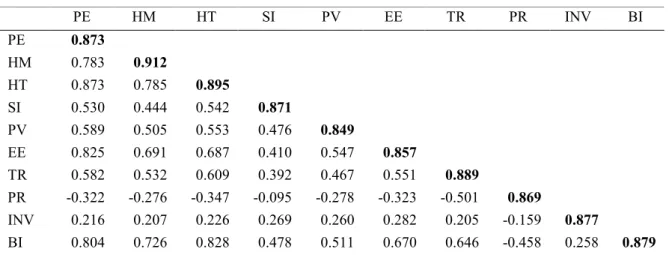
Overall model fit is assessed against five commonly utilised fit indices and their thresholds, including the normed chi-square (CMIN/DF; = <3), Comparative Fit Index (CFI; = >.95), Goodness-of-Fit Index (GFI; = >.85), Adjusted Goodness-of-Fit Index (AGFI; = >.80), and Root Mean Square Error of Approximation (RMSEA; = <.06) (Hair et al., 2010). In examining model fit, standardised regression weights, modification indices, and standardised residual covariance estimates, items PE2, EE1, SI4, HM4, HT1, INV4 and PR1 were removed to circumvent convergent and validity issues. The measurement model subsequently achieved good model fit (CMIN/DF = 1.773, GFI = .913, AGFI = .885, CFI = .977, and RMSEA = .042). To confirm model reliability, validity and internal consistency measures were examined. Table 2 shows that the standardised loadings are greater than the recommended >.50 threshold with no discriminant validity concerns being identified in this instance.
Table 2. Discriminant validity of latent construct correlations
PE HM HT SI PV EE TR PR INV BI PE 0.873 HM 0.783 0.912 HT 0.873 0.785 0.895 SI 0.530 0.444 0.542 0.871 PV 0.589 0.505 0.553 0.476 0.849 EE 0.825 0.691 0.687 0.410 0.547 0.857 TR 0.582 0.532 0.609 0.392 0.467 0.551 0.889 PR -0.322 -0.276 -0.347 -0.095 -0.278 -0.323 -0.501 0.869 INV 0.216 0.207 0.226 0.269 0.260 0.282 0.205 -0.159 0.877 BI 0.804 0.726 0.828 0.478 0.511 0.670 0.646 -0.458 0.258 0.879
Note: CR = Composite Reliability; AVE = Average Variance Extracted; PE = Performance expectancy; HM = Hedonic motivation; HT = Habit; SI = Social influence; PV = Price value; EE = Effort expectancy; TR = Trust; PR = Perceived risk; INV = Innovativeness; BI = Behavioural intention
6.2. Structural Model
The structural model’s fit indices maintain good fit: CMIN/DF = 2.281, GFI = .886, AGFI = .856, CFI = .960, and RMSEA = .054. The analysis of the path coefficients shows Performance Expectancy (β = .325, p = .000), Hedonic Motivation (β = .130, p = .019), Habit (β = .416, p = .000) and Trust (β = .129, p = .006) to be significant predictors of intention, thus supporting hypotheses H1a, H4a, H6a and H8a. However, Effort Expectancy (β = .118, p = .128), Social
15
Influence (β = .007, p = .861), Price Value (β = .118, p = .128), and Innovativeness (β = .118,
p = .128) are not significant, thus rejecting hypotheses H2a, H3a, H5a and H7a. Furthermore, Effort Expectancy significantly influences Performance Expectancy (β = .894, p = .000), supporting hypothesis H10a, with Trust strongly influencing Perceived Risk (β = -.506, p = .000), supporting hypothesis H11a, alongside Perceived Risk negatively effecting Intention (β
= -.155, p = .000), supporting hypothesis H9a. Of the supported hypotheses, Effort Expectancy on Performance Expectancy has the strongest relationship in achieving a p value at the 99% confidence level with a high standardised coefficient. The relationship between trust and perceived risk is also strong with a standardised coefficient at the 99% confidence level. Habit has the strongest effect on Intention, followed by Performance Expectancy, with Perceived Risk having a strong negative effect. Hedonic Motivation and Trust have the least influential effects on Intention.
Overall variance explained by this model is established as 75% (R2 = .752). This is a
significant finding as the explained variance is higher than seen in the frequently utilised TAM, which explains 41% variance; this confirms validity in adopting more contemporary technology acceptance models to explain consumer behaviour. Furthermore, the explained variance for this theoretical is higher than that of UTAUT, being at 69%, and UTAUT2, being at 74%. It is important to note that the explained variance within this theoretical model is achieved without interactions. Bagozzi (2007) observed that the high explained variance of UTAUT is achieved with 41 independent variables for predicting intention and criticised it for reaching a stage of chaos. It is therefore essential to draw attention to this theoretical model has achieved a high explained variance with no such interaction terms.
The mediating relationships between Effort Expectancy on Performance Expectancy (H3a) and Trust on Perceived Risk (H11a) are highly relevant. To confirm the validity of these relationships, a bootstrap analysis was performed using AMOS, comprising of 3000 bootstrap samples with 95% bias-corrected confidence intervals. Results reveal Effort Expectancy has an insignificant direct effect on Behavioural Intention without the mediating relationship with Performance Expectancy (β = -.020, p = .795), whereas Trust has a significant direct effect on Behavioural Intention without the presence of Perceived Risk (β = .128, p = .009). When examined against mediating relationships, Effort Expectancy has no significant direct effect on Behavioural Intentions (β = -.101, p = .373) whereas Trust has a significant direct effect (β = .129, p = .010). Both mediators indirectly effect Behavioural Intentions, with Effort Expectancy becoming significant (β = .290, p = .005) and Trust remaining significant (β = .078,
p = .001). Therefore, Trust has an overall direct effect on Intention whereas Effort Expectancy has an indirect effect.
6.3. Moderating relationships
To examine the moderating effect of gender, the dataset was divided into two groups; 197 males and 234 females. Upon examination into configural and metric invariance (Table 3), the model maintained good fit indices and displayed early indicators of moderating effects. The χ²
difference test reveals overall invariance of gender moderators, purporting no difference at the model level. Despite initial metric analysis indicating moderating differences between various
16
Table 3. Comparison of structural relationships for gender Hypothesis Structural path Males Females SRW CR p-value SRW CR p-value H1b PE → BI .454 3.121 .002 .211 1.746 .081 H2b EE → BI -.259 1.469 .142 .031 .188 .851 H3b EE → PE .883 12.070 .000 .907 14.558 .000 H4b SI → BI -.025 -.409 .682 .030 .617 .537 H5b HM → BI .224 2.651 .008 .026 .350 .726 H6b PV → BI -.007 -.102 .919 -.024 -.479 .632 H7b HT → BI .269 2.738 .006 .546 5.836 .000 H8b INV → BI .088 1.540 .124 .019 .484 .628 H9b TR → BI .246 3.368 .000 .015 .231 .818 H10b TR → PR -.396 -5.267 .000 -.615 -8.696 .000 H11b PR → BI -.109 -2.053 .040 -.213 -4.130 .000
Note: χ²/df = 1.726; GFI = .844; AGFI = .802; CFI = .955; RMSEA = .041; PE = Performance expectancy; HM = Hedonic motivation; HT = Habit; SI = Social influence; PV = Price value; EE = Effort expectancy; TR = Trust; PR = Perceived risk; INV = Innovativeness; BI = Behavioural intention
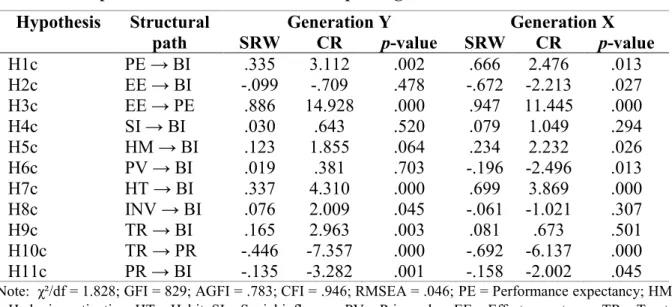
In examining the moderating role of age, two generation categories were used, with generation Y comprising of respondents aged 18-35 (n = 330) and generation X comprising of respondents aged 36-55 (n = 70). Although responses for generation Y (75.8%) are significantly more than those in generation X (16.09%), generational categorisation and division of the data was appropriate in this instance to eliminate “young” and “old” categories in allowing for more generalizable results. Although configural invariance was not initially determined, partial configural invariance was followed to allow for further investigation into the moderating relationship. Despite the fit indices adjusting model complexity, they remain sensitive to it, thus relaxing the rules for determining model fit. Therefore, the proposed cut-off criteria for
CFI is extended to ≥ 0.90, rather than ≥ 0.95 and the RMSEA from ≤0.06 to ≤0.08 (Hu &
Bentler, 1998). Metric results indicate scope for further analysis (Table 4). During the χ²
difference test (Table 5), the structural residual attached to Performance Expectancy (SR3) was freed to establish invariance at Model 3. Model 4 revealed non-invariance, thus prompting for a structural path-by-path analysis. Only two relationships are moderated by age, being Habit on Intention (Model 5f) and Price Value on Intention (Model 5g), both of which are at the 95% confidence level.
17
Table 4. Comparison of structural relationships for generation Hypothesis Structural path Generation Y Generation X SRW CR p-value SRW CR p-value H1c PE → BI .335 3.112 .002 .666 2.476 .013 H2c EE → BI -.099 -.709 .478 -.672 -2.213 .027 H3c EE → PE .886 14.928 .000 .947 11.445 .000 H4c SI → BI .030 .643 .520 .079 1.049 .294 H5c HM → BI .123 1.855 .064 .234 2.232 .026 H6c PV → BI .019 .381 .703 -.196 -2.496 .013 H7c HT → BI .337 4.310 .000 .699 3.869 .000 H8c INV → BI .076 2.009 .045 -.061 -1.021 .307 H9c TR → BI .165 2.963 .003 .081 .673 .501 H10c TR → PR -.446 -7.357 .000 -.692 -6.137 .000 H11c PR → BI -.135 -3.282 .001 -.158 -2.002 .045
Note: χ²/df = 1.828; GFI = 829; AGFI = .783; CFI = .946; RMSEA = .046; PE = Performance expectancy; HM = Hedonic motivation; HT = Habit; SI = Social influence; PV = Price value; EE = Effort expectancy; TR = Trust; PR = Perceived risk; INV = Innovativeness; BI = Behavioural intention
Table 5. Age as a moderator Model
no. χ² df χ²/df CFI RMSEA
Nested model ∆χ² ∆df p -value Inv. 1 1254.294 686 1.828 .946 .046 1 2 1275.937 705 1.810 .945 .045 1-2 21.643 19 .302 YES 3 1286.946 708 1.818 .945 .045 2-3 11.09 3 .012 NO 3a 1278.373 707 1.808 .945 .045 2-3a 2.436 2 .296 YES 4 1305.808 718 1.819 .944 .045 3a-4 27.435 11 .004 NO 5a 1278.845 708 1.806 .945 .045 3a-5a 0.472 1 .492 YES 5b 1281.699 708 1.810 .945 .045 3a-5b 3.326 1 .068 YES 5c 1278.969 708 1.806 .945 .045 3a-5c 0.596 1 .440 YES 5d 1281.063 708 1.809 .945 .045 3a-5d 2.690 1 .101 YES 5e 1278.389 708 1.806 .945 .045 3a-5e 0.016 1 .899 YES 5f 1283.470 708 1.813 .945 .045 3a-5f 5.097 1 .024 NO 5g 1283.808 708 1.813 .945 .045 3a-5g 5.435 1 .020 NO 5h 1278.916 708 1.806 .945 .045 3a-5h 0.543 1 .461 YES 5i 1278.992 708 1.806 .945 .045 3a-5i 0.619 1 .431 YES 5j 1280.975 708 1.809 .945 .045 3a-5j 2.602 1 .107 YES 5k 1280.523 708 1.809 .945 .045 3a-5k 2.150 1 .143 YES
Note: Model 1=unconstrained; Model2=measurement weights constrained; Model3=measurement weights and structural residuals constrained; Model3a = no structural residual SR3; Model4=measurement weights, structural residuals (without SR3 constrained) & structural paths constrained; Model5a=PE – BI; Model 5b = INV – BI; Model 5c = TR – BI; Model 5d = TR – PR; Model 5e = PR – BI; Model 5f = HT – BI; Model 5g = PV – BI; Model 5h = HM – BI; Model 5i = SI – BI; Model 5j = EE – BI; Model 5k = EE – PE.
When examining the model alongside the moderating role of experience, two categories were used; low and high experience. Respondents in the “low experience” category are classified
as those who never, very rarely or rarely shop for products/services on mobile devices (n =
127). Those in the “high experience” category shop using mobile devices sometimes, often, very often or constantly (n = 308). As with age, the threshold for CFI was reduced to ≥ 0.90 from ≥ 0.95; upon establishment of configual invariance, metric invariance results revealed partial differences between low and high levels of experience (Table 6). However, upon further exploration using the χ² difference test, no moderating effect of experience is established.
18
Table 6. Comparison of structural relationships for experience Hypothesis Structural
path
Low experience High experience SRW CR p-value SRW CR p-value H1d PE → BI .238 2.080 .038 .304 2.303 .021 H2d EE → BI -.081 -.604 .546 -.146 -.873 .383 H3d EE → PE .718 6.675 .000 .888 15.620 .000 H4d SI → BI .107 1.406 .160 -.044 -.831 .406 H5d HM → BI .179 1.644 .100 .123 1.771 .077 H6d PV → BI -.077 -1.012 .312 .058 .965 .335 H7d HT → BI .249 2.199 .028 .466 5.354 .000 H8d INV → BI .092 1.228 .219 .032 .720 .471 H9d TR → BI .193 1.882 .060 .075 1.528 .208 H10d TR → PR -.557 -5.580 .000 -.412 -6.514 .000 H11d PR → BI -.287 -3.366 .000 -.142 -2.884 .004
Note: χ²/df = 1.715; GFI = .844; AGFI = .803; CFI = .947; RMSEA = .041; PE = Performance expectancy; HM = Hedonic motivation; HT = Habit; SI = Social influence; PV = Price value; EE = Effort expectancy; TR = Trust; PR = Perceived risk; INV = Innovativeness; BI = Behavioural intention
6.4. The mUTAUT model
Based on the findings from this research, a new mUTAUT model has been established; Figure 2 reveals the proposed mUTAUT model. The model provides that Performance Expectancy, Hedonic Motivation, Habit and Trust have significant positive influences on consumer’s m -shopping intention, with Perceived Risk having a significant negative effect. Furthermore, the model provides that Effort Expectancy has a significant mediation relationship with performance expectancy and that habit is moderated by age, being younger and older consumers. As such, if consumers find m-shopping to be useful, particularly due to being easy to use, enjoyable, trustworthy and familiar they will more likely develop the intention to use it. However, if they experience a level of perceived risk, which is not outweighed by their level
19
Figure 2. mUTAUT model
7.
Discussion
Through the utilisation of UTAUT2 and incorporation of innovativeness, risk and trust, this
study proposes a new mUTAUT model to explain consumer’s m-shopping adoption intention.
This research provides support for some of the existing constructs from UTAUT2 in a contemporary consumer context and supports inclusion of additional constructs. Adaptation of the original model has increased the level of variance explained, confirming the variability of consumer attitudes and intentions within the digital retail environment and supports future tailoring of technology acceptance models in specific contexts. While the original model by Venkatesh, Thong and Xu (2012) explains 74% of variance in the mobile Internet context, this model explains 75% of the variance in the m-shopping context. This is a significant finding at the new mUTAUT model explains such high level of variance without the interaction effects, as seen in the original UTAUT and UTAUT2 models. Alongside criticisms by Bagozzi (2007), van Raaij and Schepers (2008) found UTAUT to be less parsimonious that other previous technology acceptance models, particularly referring to TAM and TAM2, due to the high R2
only being attained when moderating relationships with up to four variables. Additionally they argued that the grouping and labelling of items and factors within UTAUT is problematic due to a variety of disparate items combined to represent a single psychometric construct. As such, this new mUTAUT model has offered high variance explained through seven established relationships and one interaction term. Accordingly, the mUTAUT model can be argued to be
a contextual and theoretical development of UTAUT2 in relation to understanding consumer’s
m-shopping adoption intention.
Consistent with literature examining the significance of performance expectancy on consumer intention, this research supports that practical benefits of engaging in m-shopping are highly determinant of intention to use it (e.g. Chong, 2013; Compeau & Higgins, 1995; Taylor & Todd, 1995; Thong, Hong & Tam, 2006; Venkatesh et al., 2003). Despite Venkatesh, Thong and Xu (2012) finding performance expectancy the strongest predictor of intention, its
20
significance in this instance is positioned lower and therefore holds less weight than other predictors. Despite the original model and literature reporting moderating effects of gender, age and experience on performance expectancy, the mUTAUT model indicates otherwise. It is integral for online retail merchants to enhance individual utilitarian benefits of using m-shopping services as doing so not only encourages general consumer engagement but also discourages such with competitors. Therefore, marketers should consider developing usability of m-shopping apps and websites, in a general sense, to further encourage intention and subsequent acceptance (e.g. McLean, Al-Nabhani & Wilson, 2018).
Although effort expectancy was predicted to positively influence consumer intention, the hypothesis is unsupported in this instance. Despite high levels of support for the construct in existing literature, one explanation for this conflicting result is that utilisation of mobile devices is ubiquitous in contemporary society and is often considered effortless. More recent literature acknowledges that levels of familiarity with mobile devices lessens the effect of effort expectancy (e.g. Lai & Lai, 2014; Oliveira et al., 2014; Slade et al., 2015). As the sample comprises of consumers who own at least one mobile device with at least some online shopping experience, the result is unsurprising. This finding is important for marketers in ensuring effective utilisation and distribution of resources in discouraging developments surrounding enhancing effort expectancies, as doing so would be ineffective and wasteful.
Although effort expectancy has no direct effect on intention, it has a highly significant effect on enhancing performance expectancies, having the strongest structural relationship in the theoretical model. This finding is consistent with the equivalent path of perceived ease of use on perceived usefulness in TAM (e.g. Baabdullah, Williams & Dwivedi, 2014; Xu & Gupta, 2009) and accredits inconsistency of the moderating role of experience (e.g. Al-Qeisi et al., 2014; Sun & Zhang, 2006). Therefore, effort expectancy has no influence on intention directly but does so indirectly through enhancing performance expectancy through existing experiences. Therefore, marketers cannot entirely disregard effort enhancing measures but should remain mindful of developing techniques required to enhance utilitarian benefits. As such, the mUTAUT model highlights the significant relationship between effort expectancy and performance expectancy, but not between effort expectancy and intention.
Literature across digital retail reports high significance of social influence on intention, with Venkatesh, Thong & Xu (2012) finding it the most influential factor on intention in the original model. However, these findings are contrary to the existing consensus in finding social influence immaterial. One explanation is that, despite enhanced societal materialism and consumer need to share products and services purchased, the m-shopping process is nevertheless a personal activity (Oliveira et al., 2014). Another explanation derives from the sample frame. For example, Barnes et al. (2007) observe American consumers to be more open-minded than European consumers towards m-shopping acceptance whereas Faqih and Jaradat (2015) find UK consumers to be more independent decision-makers, due to their independent society. Furthermore, Yang and Forney (2013) find American consumers to be highly affected by social influence when faced with levels of anxiety, whilst Lu et al. (2017) find social influences to be stronger in eastern cultures than western cultures. As the sample is significantly different to the more inter-dependent sample frames used in previous studies, these results are unsurprising. Therefore, counter to some previous beliefs (e.g. Bruhn & Schnebelen, 2017; Venkatesh, Thong & Xu, 2012), marketers must remain mindful that consumer sharing on social networking sites cannot be relied upon as the primary marketing tool when attempting to enhance UK consumer’s m-shopping intention as consumers generally like to make up their own minds.
21
Alongside practical and utilitarian benefits of using m-shopping, concurrent with the extant literature (e.g. Pappas et al., 2014; Yang, 2010), hedonic motivation is a significant influencer of m-shopping intention. Despite its significance on intention, it is one of the least influential within the mUTAUT model. Nevertheless, it is significant for marketers to maintain efforts to enhance a sense of enjoyment when consumers use their mobile devices to shop online as the more they enjoy doing so the more likely they will engage in regular spontaneous purchasing behaviour. However, hedonic motivation is uninfluenced by consumer age, gender or level of experience and is therefore unanimously significant antecedent of intention, subsequently facilitating marketers’ ubiquitous strategies.
Inconsistent with the original model, price value is found insignificant. Despite its overall insignificance, results reveal a moderating effect of age whereby younger consumers are less influenced by price whereas older consumers are heavily influenced. However, lack of support for the construct may be explained from limitations surrounding the measurement items, in that no specific prices or product categories were provided to respondents, potentially resulting in confusion or indecisiveness. Another explanation derives from lack of consumer’s
sensitivity to price in being more accepting of high network costs and purchasing products/services based on want rather than value. Findings indicate that marketers need not engage with price value-based marketing mechanisms to encourage consumer willingness, particularly surrounding younger consumers. However, due to age discrepancies within the sample, in having a larger percentage of younger consumers, results may not be fully conclusive and therefore requires further research confirm the construct’s validity in the model. Concurrent with existing research, habit is highly significant (e.g. Limayem, Hirt & Cheung, 2007; Venkatesh et al., 2012), being the third most influential antecedent on intention. As most respondents have at least some m-shopping experience, findings are unsurprising but relevant. The structural relationship between habit and intention is moderated by age within mUTAUT, in finding older consumers being more influenced than younger consumers, further supporting literature (e.g. Jennings & Jacoby, 1993). It is therefore important for merchants to strengthen implementation of measures encouraging initial m-shopping intention to ensure higher volume of future purchases upon establishing habitual behaviour
Whereas the level of innovativeness is deemed relevant in digital retail acceptance literature (e.g. Aldás-Manzano, Ruiz-Mafe & Sanz-Blas, 2009; Citrin et al., 2000; Rogers, 2003), it is insignificant in this instance. Despite being contrary to some existing research, findings support studies by Lu et al. (2005) and Wong et al. (2012) whereby innovativeness had no effect on intention due to a high percentage of well-educated respondents having a more logical approach to decision-making rather than relying on braveness or curiosity. As this study primarily consists of respondents with A-levels and Undergraduate degrees, findings remain in-line with the latter studies. Another explanation is that mobile devices and their services are frequently used in modern society, rarely requiring levels of innovativeness. These findings therefore suggest that, for the most part, marketing strategies centred on highlighting new features and processes are not required and that resources are better spent elsewhere.
Results find risk and trust highly correlated with intention, conforming to previous research. Despite being the least significant influencer on intention, trust remains a significant influencer of mobile shopping intention; although this is in contrast to some research (e.g. Hillman & Neustaedter, 2017), it supports other findings (e.g. Hansen, Saridakis & Benson, 2018; Martín, Camarero & José, 2011; Sichtmann, 2007). Furthermore, trust has a highly significant effect on perceived risk, implying that the more consumers trust m-shopping the less perceived risk they will have, again supporting previous literature (e.g. Dinev & Hart, 2006; Marriott & Williams, 2018; Wu et al., 2012). It is therefore integral for online merchants