Generic Quality-Aware Refactoring and
Co-Refactoring in Heterogeneous
Model Environments
Dissertation
zur Erlangung des akademischen Grades Doktoringenieur (Dr.-Ing.)
vorgelegt an der
Technischen Universität Dresden Fakultät Informatik
eingereicht von
Dipl.-Inf. Jan Reimann
geboren am 16.03.1982 in Potsdam
Gutachter:
Prof. Dr. rer. nat. habil. Uwe Aßmann (Technische Universität Dresden)
Prof. Dr. rer. nat. Ralf Reussner (Karlsruhe Institute of Technology)
Fachreferent:
Jun.-Prof. Dr.-Ing. Thomas Schlegel (Technische Universität Dresden)
Tag der Einreichung: 7. Mai 2015 Tag der Verteidigung: 9. Juli 2015
Confirmation
I confirm that I independently prepared this thesis with the titleGeneric Quality-Aware Refactoring and Co-Refactoring in Heterogeneous Model Environmentsand that I used only the references and
auxiliary means indicated in the thesis.
Dresden, 7th May 2015
Abstract
Software has been subject to change, at all times, in order to make parts of it, for instance, more reusable, better to understand by humans, or to increase efficiency from a certain point of view. Restructurings of existing software can be complex. To prevent developers from doing this
manually, they got tools at hand being able to apply such restructurings automatically. These automatic changes of existing software to improve quality while preserving its behaviour is calledrefactoring. Refactoring is well investigated for programming languages and mature tools
exist for executing refactorings inintegrated development environments (IDEs).
In recent years, the development paradigm ofModel-Driven Software Development (MDSD) became more and more popular and we experience a shift in the sense that development artefacts
are considered asmodelswhich conform to metamodels. This can be understood as abstraction, which resulted in the trend that a plethora of new so-called model-basedDomain-Specific Lan-guages (DSLs)arose. DSLs have become an integral part in the MDSD and it is obvious that
models are subject to change, as well. Thus, refactoring support is required for DSLs in order to prevent users from doing it manually.
The problem is that the amount of DSLs is huge and refactorings should not be implemented for
new for each of them, since they are quite similar from an abstract viewing. Existing approaches abstract from the target language, which is not flexible enough because some assumptions about the languages have to be made and arbitrary DSLs are not supported. Furthermore, the
relation between a strategy which finds model deficiencies that should be improved, a resolving refactoring, and the improved quality is only implicit. Focussing on a particular quality and only detecting those deficiencies deteriorating this quality is difficult, and elements of detected
deficient structures cannot be referred to in the resolving refactoring. In addition, heterogeneous models in an IDE might be connected physically or logically, thus, they are dependent. Finding such connections is difficult and can hardly be achieved manually. Applying a restructuring in a model implied by a refactoring in a dependent model must also be a refactoring, in order
to preserve the meaning. Thus, this kind of dependent refactorings require an appropriate abstraction mechanism, since they must be specified for dependent models of different DSLs.
The first contribution,Role-Based Generic Model Refactoring, uses role models to abstract from
refactorings instead of the target languages. Thus, participating structures in a refactoring can be specified generically by means of role models. As a consequence, arbitrary model-based DSLs are supported, since this approach does not make any assumptions regarding the target languages.
Our second contribution,Role-Based Quality Smells, is a conceptual framework and correlates deficiencies, their deteriorated qualities, and resolving refactorings. Roles are used to abstract from the causing structures of a deficiency, which then are subject to resolving refactorings.
The third contribution,Role-Based Co-Refactoring, employs the graph-logic isomorphism to detect dependencies between models. Dependent refactorings, which we callco-refactorings, are specified on the basis of roles for being independent from particular target DSLs.
the reuse of generic refactorings in arbitrary languages. Role models are suited as an interface for certain structures which are to be refactored, scanned for deficiencies, or co-refactored. All of the presented approaches benefit from it.
Acknowledgment
Starting this thesis and bringing it to an end has been a long way. A lot of people accompanied
me in the one way or another. I want to express my deep gratitude to the following people. Without them, I could have never reached the goal.
First of all, I want to thank my supervisor Uwe Aßmann. After an oral exam when I was an undergraduate, he asked me to come to his group. This was the beginning of the whole process, the beginning of many interesting and demanding discussions. He pushed me into many
directions and his feedback and encouragement was so valuable.
Second of all, I want to thank my parents for their great support. Especially my mother did an invaluable job for reading my thesis. Furthermore, she was the first person who gave me the
chance to use a computer when I was eight years old. She showed me the game Sokoban and I was so impressed. Since then, I had no doubt that “I will do something with computers”. Thank you so much.
I had a great time at the chair of software technology. I got to know many excellent researchers and friends. At first, I want to thank the DevBoost guys Mirko Seifert, Christian Wende, Florian
Heidenreich, and Jendrik Johannes. I appreciate your professionalism but also your relaxed nature. The time at conferences we had, or programming in my kitchen, was always a pleasure and I pretty much enjoyed the beers with you. Mirko, that we have won the best paper award
at the MoDELS 2010 was so huge, I would have never had expected such a big thing before. In addition, it was my first paper. Thank you for being part of this experience. It’s so great to be at your team now.
I want to thank other guys from the software technology chair: Christoph Seidl, for his nice support, discussions and the good time at the last two trips to Wien and Karlsruhe; Birgit
Demuth, for her great backup at the chair and the eTe project; Katrin Heber, for all the help in the administrative stuff. Furthermore, I want to thank the following persons for their fruitful discussions and valuable feedback: Julia Schroeter, Claas Wilke, Birgit Grammel, Sven Karol,
Konrad Voigt, Thomas Kühn, Sebastian Götz, and Christian Piechnick.
In the last year of my PhD trip, I got to know the group of Ralf Reussner, my external reviewer.
We had a great workshop there. I want to thank Ralf and Benjamin Klatt for their openness and their comments on my work, and not to forget Erik Burger, for giving me support in some LA
TEX fonts and TikZ issues.
I want to thank Helge Pfeiffer and Andrzej Wąsowski, it was a great experience to write the Lässig-paper with you. Furthermore, my gratitude goes to Frank Furrer, it was very pleasant to work with you in the seminars which resulted in my last publication, since we had so interesting
topics and good students. Stefan Pietschmann and Vincent Tietz were my supervisors in the minor thesis, and they brought me closer to research and scientific writing for the first time. Gratitude to Jens Dietrich, for our discussions about graph querying and your support regarding
Special thanks go to Cloudy. You supported me enormously during my PhD journey. I appreciate a lot what you have done! Furthermore, I want to thank Schulle for reading parts of my thesis and for just being around when I needed it. Jochen and Jakob, it is great to have you
as brothers, you sometimes made me not to forget the crazy things in life.
I also want to thank my students who have contributed a lot to my thesis: Erik Tittel, Michael Muck, Christian Vonsien, Fabian Hänsel, Martin Brylski, Anja Kirste, Kristin Blawatt, and the
students of my last Komplexpraktikum regarding the Quality Smells.
The first BASIC programme I got to know was from my uncle Bruno. Thank you for this, although I cannot remember what it was about, but at that time I did not understand it anyway.
Finally, thanks go out to my flat mates, Dave and Jonathan, and to my former computer science teacher from school, Bernd Burmeister, who taught me programming with Pascal and aroused this passion.
Publications
This thesis is partially based on the following peer-reviewed publications:
• J. Reimann, M. Seifert and U. Aßmann, “Role-based Generic Model Refactoring”, inModel Driven Engineering Languages and Systems - 13th International Conference, MoDELS 2010,
Oslo, Norway, October 3-8, 2010, Proceedings, Part II, D. C. Petriu, N. Rouquette and Ø.
Haugen, Eds., ser. Lecture Notes in Computer Science, vol. 6395, Springer, 2010, pp. 78–92.
doi:10.1007/978-3-642-16129-2_7.
• J. Reimann, M. Seifert and U. Aßmann, “On the reuse and recommendation of model refactoring specifications”, English,Software & Systems Modeling, vol. 12, no. 3, pp. 579– 596, 2013,issn: 1619-1366.doi:10.1007/s10270-012-0243-2.
• J. Reimann and U. Aßmann, “Quality-Aware Refactoring for Early Detection and Resolution of Energy Deficiencies”, inProceedings of the 2013 IEEE/ACM 6th International Conference on Utility and Cloud Computing, ser. UCC ’13, Washington, DC, USA: IEEE Computer Society, 2013, pp. 321–326,isbn: 978-0-7695-5152-4.doi:10.1109/UCC.2013.70. • J. Reimann, M. Brylski and U. Aßmann, “A Tool-Supported Quality Smell Catalogue For
Android Developers”, inProceedings of the conference Modellierung 2014 in the Workshop
Modellbasierte und modellgetriebene Softwaremodernisierung – MMSM 2014, 2014.
• J. Reimann, C. Wilke, B. Demuth, M. Muck and U. Aßmann, “Tool supported OCL re-factoring catalogue”, in Proceedings of the 12th Workshop on OCL and Textual Model-ling, ser. OCL ’12, Innsbruck, Austria: ACM, 2012, pp. 7–12,isbn: 978-1-4503-1799-3.doi:
10.1145/2428516.2428518.
The following peer-reviewed publications cover work that is closely related to the content of
the thesis, but not contained herein:
• R.-H. Pfeiffer, J. Reimann and A. Wąsowski, “Language-Independent Traceability with Lässig”, in, ser. Lecture Notes in Computer Science, J. Cabot and J. Rubin, Eds., vol. 8569, Springer International Publishing, 2014, pp. 148–163,isbn: 978-3-319-09194-5.doi:10.
1007/978-3-319-09195-2_10.
• U. Aßmann, A. Bartho, C. Bürger, S. Cech, B. Demuth, F. Heidenreich, J. Johannes, S. Karol, J. Polowinski, J. Reimann, J. Schroeter, M. Seifert, M. Thiele, C. Wende and C. Wilke,
“DropsBox: the Dresden Open Software Toolbox”, English,Software & Systems Modeling, vol. 13, no. 1, pp. 133–169, 2014,issn: 1619-1366.doi:10.1007/s10270-012-0284-6.
ings of the First International Workshop on Model-Driven Software Migration (MDSM 2011)
and the Fifth International Workshop on System Quality and Maintainability (SQM 2011), A. Fuhr, W. Hasselbring, V. Riediger, M. Bruntink and K. Kontogiannis, Eds., Oldenburg,
Germany: CEUR Workshop Proceedings, Mar. 2011, pp. 8–11.
• C. Wilke, S. Götz, J. Reimann and U. Aßmann, “Vision Paper: Towards Model-Based Energy Testing”, inModel Driven Engineering Languages and Systems - 14th International Conference, MoDELS 2011, Wellington, New Zealand, J. Whittle, T. Clark and T. Kühne, Eds., ser. Lecture Notes in Computer Science, vol. 6981, Springer Berlin Heidelberg, 2011, pp. 480–489,isbn: 978-3-642-24484-1.doi:10.1007/978-3-642-24485-8_35.
• S. Götz, M. Leuthäuser, J. Reimann, J. Schroeter, C. Wende, C. Wilke and U. Aßmann, “A Role-Based Language for Collaborative Robot Applications”, inLeveraging Applications of Formal Methods, Verification, and Validation, ser. Communications in Computer and
Information Science, R. Hähnle, J. Knoop, T. Margaria, D. Schreiner and B. Steffen, Eds., Springer Berlin Heidelberg, 2012, pp. 1–15,isbn: 978-3-642-34780-1.
• S. Pietschmann, V. Tietz, J. Reimann, C. Liebing, M. Pohle and K. Meißner, “A Metamodel for Context-Aware Component-Based Mashup Applications”, inProceedings of the 12th International Conference on Information Integration and Web-based Applications & Services
(iiWAS 2010), ACM, Nov. 2010,isbn: 978-1-4503-0421-4.
• S. Götz, M. Leuthäuser, C. Piechnick, J. Reimann, S. Richly, J. Schroeter, C. Wilke and U. Aßmann, “Entwicklung Cyber-Physikalischer Systeme am Beispiel des NAO-Roboters”, inChemnitzer Linux-Tage 2012 – Tagungsband –, Team der Chemnitzer Linux-Tage, Uni-versitätsverlag Chemnitz, Mar. 2012, pp. 45–52.
The following publication covers work that is slightly related to the content of the thesis, but not contained herein:
• F. Furrer and J. Reimann (Eds.), “Impact and Challenges of Software in 2025”, Technische Universität Dresden, Software Technology Group, Tech. Rep., 2014. [Online]. Available:
Contents
List of Figures xv
List of Tables xvii
List of Listings xix
1. Introduction 1
1.1. Language-Tool Generation Without Consideration Of Time And Space . . . 4
1.2. Challenges . . . 9
1.3. Generic Quality-Aware Refactoring and Co-Refactoring in Heterogeneous Model Environments . . . 10
2. Foundations 15 2.1. Refactoring . . . 15
2.2. Model-Driven Software Development . . . 16
2.2.1. Levels of Abstraction and Metamodelling . . . 17
2.2.2. Model Transformations . . . 18 2.3. Role-Based Modelling . . . 19 3. Related Work 23 3.1. Model Refactoring . . . 25 3.1.1. Requirements . . . 25 3.1.2. Literature Review . . . 26 3.1.3. Evaluation . . . 30
3.2. Determination of Quality-Related Deficiencies . . . 32
3.2.1. Requirements . . . 33 3.2.2. Literature Review . . . 34 3.2.3. Evaluation . . . 37 3.3. Co-Refactoring . . . 38 3.3.1. Requirements . . . 38 3.3.2. Literature Review . . . 40 3.3.3. Evaluation . . . 46 3.4. Conclusion . . . 48
4. Role-Based Generic Model Refactoring 51 4.1. Motivation . . . 51
4.2. Specifying Generic Refactorings with Role Models . . . 53
4.2.1. Specifying Structural Constraints using Role Models . . . 55
4.2.2. Mapping Roles to Language Concepts Using Role Mappings . . . 57
4.2.3. Specifying Language-Independent Transformations using Refactoring Specifications . . . 60
4.2.4. Composition of Refactorings . . . 67
4.3. Preserving Semantics . . . 70
4.4. Conclusion . . . 71
5. Suggesting Role Mappings as Concrete Refactorings 73 5.1. Motivation . . . 73
5.2. Automatic Derivation of Suggestions for Role Mappings with Graph Querying . 74 5.3. Reduction of the Number of Valid Matches . . . 76
5.4. Comparison to Model Matching . . . 77
5.5. Conclusion . . . 78
6. Role-Based Quality Smells as Refactoring Indicator 79 6.1. Motivation . . . 79
6.2. Correlating Model Deficiencies, Qualities and Refactorings . . . 80
6.2.1. Quality Smell Repository . . . 81
6.2.2. Quality Smell Calculation Repository . . . 85
6.3. Discussion . . . 87
6.4. Conclusion . . . 88
7. A Quality Smell Catalogue for Android Applications 89 7.1. Quality Smell Catalogue Schema . . . 89
7.2. Acquiring Quality Smells . . . 90
7.3. Structure-Based Quality Smells—A Detailed Example . . . 92
7.3.1. The Pattern Language . . . 92
7.3.2. Quality Smell: Interruption from Background . . . 93
7.4. Quality Smells for Android Applications . . . 96
7.4.1. Quality Smell: Data Transmission Without Compression . . . 96
7.4.2. Quality Smell: Dropped Data . . . 98
7.4.3. Quality Smell: Durable WakeLock . . . 98
7.4.4. Quality Smell: Internal Use of Getters/Setters . . . 99
7.4.5. Quality Smell: No Low Memory Resolver . . . 101
7.4.6. Quality Smell: Rigid AlarmManager . . . 101
7.4.7. Quality Smell: Unclosed Closeable . . . 102
7.4.8. Quality Smell: Untouchable . . . 103
7.5. Discussion . . . 104
8. Role-Based Co-Refactoring in Multi-Language Development Environments 105 8.1. Motivation . . . 105
Contents
8.3. Dependency Knowledge Base . . . 108
8.3.1. Categories of Model Dependencies . . . 108
8.3.2. When to Determine Model Dependencies . . . 110
8.3.3. How to Determine Model Dependencies . . . 111
8.4. Co-Refactoring Knowledge Base . . . 113
8.4.1. Specifying Coupled Refactorings with Co-Refactoring Specifications . . 114
8.4.2. Specifying Bindings for Co-Refactorings . . . 116
8.4.3. Determination of Co-Refactoring Specifications . . . 118
8.5. Discussion . . . 118
8.6. Conclusion . . . 119
9. Refactory: An Eclipse Tool For Quality-Aware Refactoring and Co-Refactoring 121 9.1. Refactoring Framework . . . 122
9.1.1. Role Model . . . 122
9.1.2. Refactoring Specification . . . 124
9.1.3. Role Model Mapping . . . 126
9.1.4. Refactoring Composition . . . 128
9.1.5. Custom Refactoring Extensions . . . 129
9.1.6. Pre- and Post-conditions . . . 129
9.1.7. Integration Into the Eclipse Refactoring Framework . . . 130
9.2. Quality Smell Framework . . . 134
9.3. Co-Refactoring Framework . . . 137
9.3.1. Concrete Syntax of a CoRefSpec . . . 138
9.3.2. Expression Evaluation by Using an Expression Language . . . 138
9.3.3. UI and Integration . . . 140
9.4. Conclusion . . . 141
10. Evaluation 143 10.1. Case Study: Reuse of Generic Refactorings in many DSLs . . . 143
10.1.1. Threats to validity . . . 143
10.1.2. Results . . . 144
10.1.3. Experience Report . . . 146
10.2. Case Study: Suggestion of Valid Role Mappings . . . 147
10.2.1. Implementation . . . 147
10.2.2. Evaluation and Discussion . . . 151
10.3. Proof of Concept: Co-Refactoring OWL and Ecore Models . . . 155
10.3.1. Coupled OWL-Ecore Refactorings . . . 156
10.3.2. Realisation . . . 157
10.3.3. Discussion . . . 160
11. Summary, Conclusion and Outlook 161 11.1. Summary . . . 161
11.2. Conclusion . . . 163
Appendix 169
A. List of Role Models . . . 169
B. Comparison to Role Feature Model . . . 171
C. Complete List of Role Mappings . . . 173
D. List of all IncPL Patterns for Detecting Quality Smells . . . 176
E. Post-Processor of theExtract CompositeStaterefactoring for UML State Machines 183 F. Specification of the Conference Language . . . 185
List of Abbreviations 187
List of Figures
1.1. Examples of cave art. . . 2
1.2. The Tower of Babelby Pieter Bruegel the Elder, 1563. . . 2
1.3. Examples of abstraction in scientific or engineering DSLs. . . 3
1.4. Abstraction Gap . . . 3
1.5. Example ofExtract Methodrefactoring in Java . . . 5
1.6. Example ofExtract Trackrefactoring in the Conference DSL. . . 6
1.7. Overview of model life cycle in MDSD. . . 7
2.1. MOF architecture. . . 17
2.2. Role model forCompositepattern [GHJV94] according to [RG98]. . . 20
3.1. Classification scheme for the related work. . . 24
4.1. Example ofExtract Trackrefactoring in the Conference DSL. . . 52
4.2. Metamodels, relations and stakeholders. . . 54
4.3. Different representations of genericExtract X with Reference Classrefactoring. . 56
4.4. Role metamodel. . . 56
4.5. Role Mapping metamodel. . . 58
4.6. Role mappings to different DSLs for the genericExtract X with Reference Class refactoring. . . 59
4.7. Refactoring Specification metamodel. . . 62
4.8. RefSpec metamodel: Variable Declaration. . . 63
4.9. RefSpec metamodel: Index Assignment. . . 64
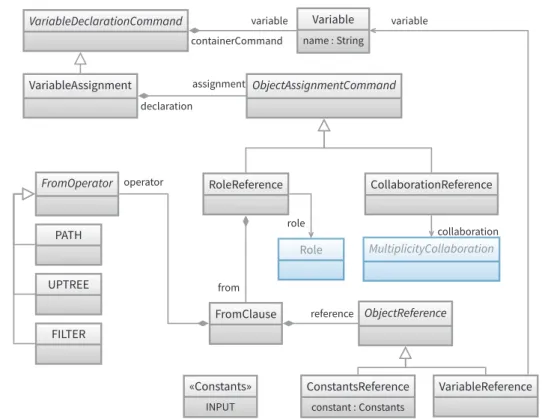
4.10. RefSpec metamodel: Create and Move Elements. . . 64
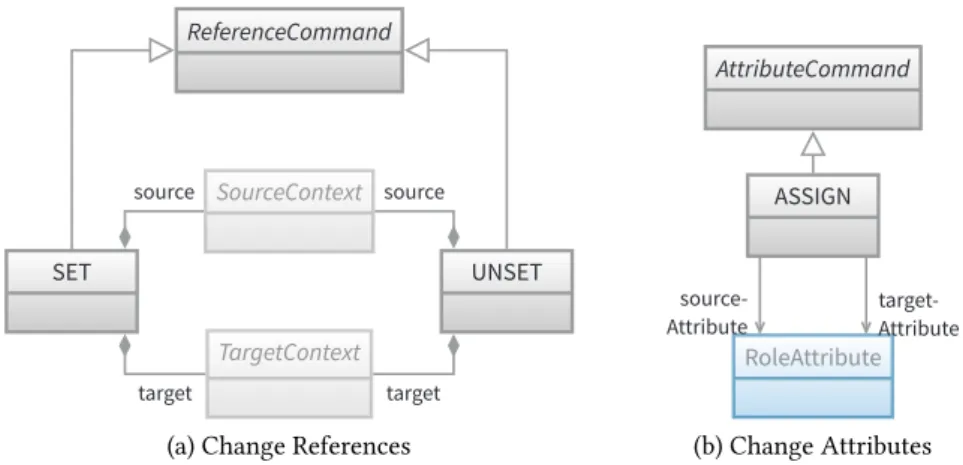
4.11. RefSpec metamodel: Changing Elements. . . 65
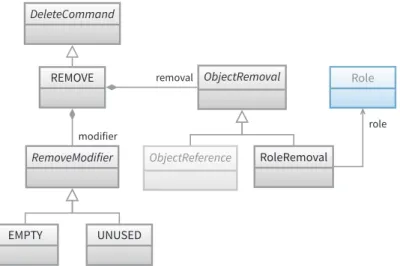
4.12. RefSpec metamodel: Remove Elements. . . 66
4.13. AdjustedExtract Method refactoring example in Java. . . 68
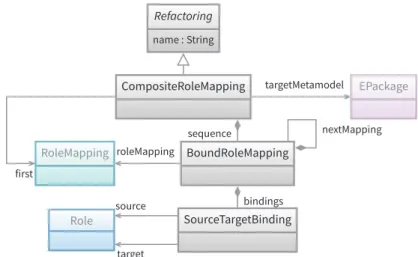
4.14. Composite Role Mapping metamodel. . . 69
5.1. Example for conversion of role model to GUERY query. . . 75
6.1. Refactoring architecture extended by Quality Smell infrastructure. . . 81
6.2. Metamodel of the quality smell repository. . . 82
6.3. Metamodel of the quality smell repositoryDetectionStrategypart. . . 84
6.4. Detection strategy of theFeature Envyquality smell. . . 85
7.1. Strategy of information extraction. . . 91
7.2. Excerpt of quality smell calculation metamodel. . . 92
8.1. Extract of the successive progression of model co-refactoring. . . 106
8.2. Schematic workflow of Co-Refactoring. . . 107
8.3. Example of an ontology-driven requirements and software engineering process. 107 8.4. Categories of model dependencies. . . 109
8.5. Refactoring architecture extended by Co-Refactoring infrastructure. . . 114
8.6. Co-Refactoring Knowledge Base Metamodel. . . 115
9.1. Overall Architecture of Refactory. . . 122
9.2. Textual editor and tree-like outline for Role Models applied in Refactory. . . 124
9.3. Textual editor and tree-like outline for RefSpec models applied in Refactory. . . 126
9.4. Textual editor and tree-like outline for role mapping models applied in Refactory. 127 9.5. Textual editor and tree-like outline for refactoring composition models applied in Refactory. . . 128
9.6. PL/0 example programme before refactoring should be applied. . . 130
9.7. OCL constraints and representation of the violation in the refactoring dialogue. 131 9.8. Selection of talks to be refactored. . . 132
9.9. Refactoring wizard for providing the name of the new Track. . . 133
9.10. Preview of theExtract Trackrefactoring in a conference model. . . 133
9.11. Preference page for the definitin of generic quality smells. . . 134
9.12. Qualitiesview of Refactory. . . 136
9.13. Quality Smellsview of Refactory. . . 137
9.14. Resolving refactoring invokable by a quick-fix in Refactory. . . 138
9.15. Implicit Dependenciesview in Refactory. . . 140
A.1. Role Models Part 1. . . 169
A.2. Role Models Part 2. . . 169
A.3. Role Models Part 3. . . 170
A.4. Role Models Part 4. . . 170
List of Tables
1.1. Example DSLs and their semantic contexts. . . 4
3.1. Categories of the classification scheme. . . 24
3.2. Comparison of related work regarding generic model refactoring. . . 31
3.3. Comparison of related work regarding quality evaluation. . . 38
3.4. Comparison of related work regarding co-refactoring. . . 47
10.1. Refactorings applied to metamodels. . . 145
10.2. DSL Complexity. . . 148
10.3. Automatically determined role mappings with maximum path length of 1. . . . 150
10.4. DSL complexity reduced due to omitting sub-metaclasses. . . 151
10.5. Number of possible matches and average needed manual mappings. . . 152
11.1. Evaluation of the generic model refactoring approach regarding the fulfilment of the requirements. . . 164
11.2. Evaluation of the quality smells approach regarding the fulfilment of the require-ments. . . 165
11.3. Evaluation of the co-refactoring approach regarding the fulfilment of the re-quirements. . . 166
List of Listings
4.1. Refactoring specification forExtract X with Reference Class. . . 61
4.2. Move Method role mapping. . . 69
4.3. Composite refactoringExtract and Move Method. . . 70
5.1. Conversion of collaboration to edge with intermediate vertex. . . 76
5.2. Conversion of a role model to a graph query with a manual pre-mapping. . . 76
7.1. Interrupting service. . . 93
7.2. Interruption from background pattern. . . 94
7.3. Notifying service. . . 95
7.4. File transmission without compression before refactoring. . . 96
7.5. File transmission with compression after refactoring . . . 97
7.6. Acquiring aWakeLockwithout releasing it. . . 99
7.7. Acquiring aWakeLockwith time-out. . . 99
7.8. IncPL pattern for detecting access of internal getters. . . 100
7.9. Use of an exactAlarmManagerwhich results in higher energy consumption. . . 102
7.10. Use of an inexactAlarmManagerreducing energy consumption . . . 102
7.11. ACloseableobject is not closed. . . 103
7.12. Closeableobject is closed. . . 103
7.13. A button which is not touchable. . . 104
7.14. A layout with appropriate size. . . 104
8.1. Prolog fact pattern to capture explicit dependencies. . . 111
8.2. Prolog rules to determine inverse dependencies. . . 112
8.3. Prolog rule to determine mapping dependencies. . . 112
8.4. Example Co-RefSpec for renaming an Ecore model dependent on an OWL model. 117 9.1. Textual syntax for role models. . . 122
9.2. Textual syntax for refactoring specifications. . . 124
9.3. Textual syntax for role mappings. . . 127
9.4. Textual syntax for refactoring compositions. . . 128
9.5. Invocation of IncQuery engine to query structure-based quality smells. . . 135
9.6. Creation of a result with respect to the matches determined by IncQuery. . . 136
9.7. Textual syntax for co-refactoring specifications. . . 139
10.1. Derived role mappingExtract StateMachine in Interface. . . 153
10.3. Rename Element(Rename X)⇒Rename EElement(Rename X). . . 158
10.4. Extract Superclass(Extract Loosely X)⇒Extract Super Class(Extract X). . . 158
10.5. Pull Up Property(Re-reference X)⇒Pull Up Feature(Move X). . . 158
10.6. Introduce Inverse Property(Introduce Inverse Reference In Container)⇒Introduce Inverse Reference(Introduce Inverse Reference). . . 159
10.7. Duplicate Class(Duplicate With Reference)⇒Duplicate Class(Duplicate With Reference). . . 159
10.8. Convert Data Property To Object Property(Replace Feature)⇒Replace Data Value with Object (Replace Feature In Container). . . 159
D.1. Data Transmission Without Compression. . . 176
D.2. Dropped Data. . . 178
D.3. DurableWakeLock. . . 178
D.4. Internal Use of Getters/Setters. . . 179
D.5. No Low Memory Resolver. . . 180
D.6. RigidAlarmManager. . . 180
D.7. UnclosedCloseable. . . 180
D.8. Untouchable. . . 181
E.9. UML-specific post-processor for determining incoming and outgoing transitions of the extracted composite state. . . 183
1
Introduction
Language has been the means of humans to express themselves, at all times. Let it be the spoken
or written word, drawings or body language — what all kinds of communication have in common is that there must be a mutual understanding of the meaning of the language’s concepts, if the communicator wants to ensure that a message is interpreted equally. That is the reason why
syntax andsemanticsare essential in most languages. In contrast,painting, as the choice of communication, is not meant to be precise and concise. Thus, painters enjoy the freedom of art and create space for interpretation for the recipients of their messages. Different people might
probably reflect divergently about art.
Consider another example: raising children. When parents want to pass on their values, they have several alternatives (not being mutual exclusive). They can, for example, tell their children what to do and what not to do. Or they may hope that children learn things by rewarding
or punishment. Another educationally more valuable methodology can be to lead children to literature and provide stories of characters expressing the parents’ desired values. This kind of indirect teaching of children with literature is promising when strong child characters are
used, as shown for example in [Mah81]. But again, these examples illustrate that people may communicate differently about the same things.
When we look back further in history and glance at the Old Testament, we can eventually say that this has not always been like this. Consider, for example,The Tower of Babel1(see Fig. 1.2) which is a biblical story telling that mankind tried to equal God by building a huge tower in Babel with its top in the sky. At this time, the story says, only one common language was spoken all over the world. But, the attempt to build the tower was interpreted by God as
hubris and arrogance. So he decided to punish mankind and initiated theconfusion of tongues2 by eliminating the common language and creating a plethora of different ones. As a result, the
1
cf. Book of Genesis Chapter 11 (http://www.vatican.va/archive/bible/genesis/documents/bible_ genesis_en.html#Chapter%2011visited 10th February 2015)
2
Figure 1.1.: Examples of cave art.3
humans were confronted with insuperable communication difficulties and, hence, could not continue building the tower. Furthermore, God scattered them all over the world.
Figure 1.2.:The Tower of Babelby Pieter Bruegel the
Elder, 1563.4 By contrast to the idea of punishment
through God, the story of the Tower of Babel and the confusion of tongues can
be interpreted differently. It can be seen not as a curse but a blessing, since the di-versity of languages corresponds with the
variety of different cultural groups, which left their indelible mark of human yearn-ing to travel, get to know other coun-tries, to communicate and to cooperate.
Without such a great diversity mankind as a whole would be rather monotone.
This diversity arrived in life a long time ago. Nowadays, as a tool of communic-ation, language has many shapes. For
instance, humans managed to form different kinds of communication for same domains. The most general kind is the spoken or written word, while quite often more dedicated languages are better to communicate about matters or problems, so that humans choose a suitable language
for communicating about problems and solving them.
A popular example is the language of cave painting. Some of the masterpieces are supposed
to be older than 40,000 years [Amo12]. The point is that the examples from Fig. 1.1 show that abstractionis a powerful tool for humans to express themselves. Animals or hunting scenes were painted without details, environmental surroundings were neglected. The informationwhere
something happened was less important to the painter in contrast towhat happened. To this end, facts of reality were omitted, while others were emphasized.
Such techniques of abstraction and specialisation are used in almost every area of our daily lives and became apparent in languages used to solve problems in many scientific or engineering disciplines. Languages, being dedicated to a particular problem space, are calledDomain-Specific Languages (DSLs). Some prominent examples can be seen in figures 1.3 (a)–(c).
Similar progress has happened in the discipline of computer science. In the beginning,
instruc-3
http://en.wikipedia.org/wiki/Cave_painting(visited 10th February 2015)
4
(a) Cartography5 A 20Ω 10Ω 5Ω B (b) Electronics H C H3 C H3 O CH3 OH H CH3 (c) Chemistry
Figure 1.3.: Examples of abstraction in scientific or engineering DSLs.
Problem Domain
Solution Domain
DSL
High-level programming language
Low-level programming language Interpretation/ Translation Interpretation/ Translation Pr ogr amming p ar adigm e v olution o v er time Abs tr ac tion incr e ase
Figure 1.4.: Abstraction Gap based on [KT08, p. 16].
tion sets of programming languages corresponded heavily to those of the machine which the
programme was intended to run on. Therefore, programmers had to bridge a big gap between the domain of the initial problem and the domain of the problem-solving programme (the solution). Between these domains, namelyproblem domainandsolution domain, the so-calledabstraction
gap[KT08; IM10] was very big, because the used concepts of a solution idea and the particular solution implementation (machine instructions) are very different. Figure 1.4 illustrates this contemplation in the lower part. At that time, realising an implementation was very complex
until high-level programming languages (such as C++ or Java) came out onto the market. These languages raised the level of abstraction and increased developer’s productivity by 450 % [KT08]. This progress got another impetus, when it was recognized that taking advantage of the concept
of DSLs can raise the abstraction level even more. Thus, DSLs arrived in computer science and information technology (IT), enabling developers to implement solutions closer to the problem domain. Most often, these languages are delivered with some kind of compiler or interpreter to
map abstract instructions to less abstract ones in an already known and executable formalism. Such a mapping specifies the translational or interpretative semantics of a DSL and defines how to resolve DSL instances to an instance of the underlying layer in Figure 1.4: compilation
to another language, or direct execution respectively [EvSV+13]. Examples for popular DSLs are, e.g., the Unified Modeling Language [OMG11a] (UML), the Business Process Model and Notation [OMG13b] (BPMN) or Cascading Style Sheets [W3C11] (CSS). Table 1.1 shows the
5http://en.wikipedia.org/wiki/File:Orienteringskort_bygholm_2005_detail.jpg
(visited 10th
Table 1.1.: Example DSLs and their semantic contexts.
DSL Application Context Realisation
UML development environment code generation (compilation)
BPMN running application translation into execution language and executed in workflow engine (transformation and interpretation)
CSS web browser layout engine (interpretation)
context in which these languages are applied and how they are realised. The table gives an idea
about DSLs being deployed in a variety of different contexts, domains, or platforms.
In practice, there are heaps of DSLs supporting daily developer’s and engineer’s work, and
their number is still growing. One reason for the quantitative increase is a development paradigm, which became more and more popular in the last decade. This paradigm is calledModel-Driven Software Development [SVB+06] (MDSD)and takes advantage of formal artefacts to create
in-stances of abstract concepts. The following short example illustrates the MDSD paradigm. Consider, e.g., a detached house on the one hand and a tool shed on the other hand. Both are buildings but have distinct purposes. The former is for living and the latter is for storing
garden-ing tools. From an abstract point of view both exemplars have several thgarden-ings in common. Both arebuildings, have adoorand aroof. Unless a building has no roof or door it is not considered to be a building. Single parts of the houses are conceptualised (e.g.roof ordoor) and a rule is given
under which circumstances a set of single parts is meant to be abuilding. These concepts and the rule are the formal base of both buildings. They enable us to reflect about houses and to evaluate, if something belongs to the domainbuildingsor not. This formalisation is called ametamodel,
because it specifies properties of all its instances: themodels. Since metamodels have a higher level of abstraction than their models, they can be used, e.g., to generate other artefacts from the models, because the generation rules can be specified on top of the metamodel’s concepts.
Coming back to the small example, such a generation rule could automatically produce a list of all consumed materials for a building, instead of having to write the list manually. A deeper insight into MDSD is given in Section 2.2. At this point, it is important to know that a metamodel is considered to be the abstract formal grounding of a DSL, not focussing the concrete, but on
the abstract syntax of the DSL’s instances, the models.
There are other technical spaces suitable for developing DSLs (such as, e.g., grammars), but in this work only model-based DSLs are considered, since they allow for abstraction of languages to their constructional concepts. Their instances conform to these concepts. In the following,
the strengths of such DSLs are illustrated and how the abstract concepts can be exploited to generate tools. Apart from that, the problems which are to be solved in this thesis are analysed and emphasized.
1.1. Language-Tool Generation Without Consideration Of Time And Space
As mentioned before, the increase of abstraction in programming languages fostered developers’
productivity [KT08]. At the same time, software complexity rose and still rises [Leh96; Kle09]. Software design evolved as an essential tool to cope with that complexity before developing the software itself. Therefore, the design is the base for understanding a software system
1.1. Language-Tool Generation Without Consideration Of Time And Space 1 void printOwing() { 2 printBanner(); 3 4 //print details 5 System.out.println ("name: " + _name); 6 System.out.println ("amount " + getOutstanding()); 7 } (a) before 1 void printOwing() { 2 printBanner(); 3 printDetails(); 4 } 5 6 void printDetails() { 7 System.out.println ("name: " + _name); 8 System.out.println ("amount " + getOutstanding()); 9 } (b) after
Figure 1.5.: Example ofExtract Method refactoring in Java, based on [FBB+99].
and for the early identification of problems instead of living with them afterwards [Pfl98]. Furthermore, Lehman, Davis and Bersoff realised early that software changes: “If we do not learn to manage change, we will become its victims, not its beneficiaries” [DB91]. Opdyke
and Johnson investigated on this and introduced the termrefactoringin [OJ90], which signifies the restructuring of code while preserving its semantics to improve the design of a software. Later, Opdyke published a first catalogue of refactorings in his dissertation [Opd92] forming the
foundation of refactoring tools in nowadaysintegrated development environments (IDEs). These IDEs came into the market to support developers in managing the complexity of developed software so that qualities, such asreusability,readability, orcomprehensibility, are improved.
Let us consider the example in Fig. 1.5. In (a) a method can be seen printing a banner and some details afterwards. The comment in Line 4 suggests a different purpose of the following statements compared to the banner printing in the first statement. Thus, the last two statements
can be extracted into a new method in (b) (equally named as the comment suggests) which is then invoked at the original position in the old method. As can be understood easily, the semantics of the methodprintOwing()didn’t change, but from a design viewprintDetails()now can be reused, and concerns are separated better. Opdyke called this refactoringConvert a Code Segment to a Function[Opd92, p. 34], but today it is better known asExtract Method[FBB+99].
In the beginning, refactorings had to be applied manually after every regression, which was error-prone and required huge effort. Later, the IDEs were equipped with mature refactoring
tools enabling developers to execute them (semi-)automatically. Today, all modern IDEs support refactoring in one or the other modality [XS06]. For high-level programming languages code refactoring is well investigated and can be applied easily.
In recent yearsLanguage Workbenches (LWs)[Fow05] emerged enabling the development of mature tools for using DSLs. Representatives of LWs are MetaCase [KT08], the Eclipse Modeling Framework [SBPM08] (EMF), EMFText [HJK+09], Xtext [EV06], Spoofax [KV10], MPS [Cam14],
GME [LMB+01] and many others. Some of them follow a generative approach, while others apply interpretation of a DSL’s specification. What they all have in common is that they somehow produce a tool environment dedicated to the developed DSL. To distinguish between a LW
1 CONFERENCE
2 "International FooBar Camp" 3 ("Peter Meyers")
4
5 TRACK "Interesting Stuff" :
6 AT 09:00 : TALK "The future of Foo" PRESENTED BY "Peter Meyers" 7 AT 10:00 : TALK "Foo vs. F00" PRESENTED
BY "Andrew Bloomfield"
8 AT 11:00 : TALK "Onyl Bar-S is true" PRESENTED BY "Homer Simpson" 9
10 REGISTERED SPEAKERS:
11 "Peter Meyers" FROM Germany, 12 "Andrew Bloomfield" FROM USA, 13 "Homer Simpson" FROM USA
(a) before
1 CONFERENCE
2 "International FooBar Camp" 3 ("Peter Meyers")
4
5 TRACK "Interesting Stuff" :
6 AT 09:00 : TALK "The future of Foo" PRESENTED BY "Peter Meyers" 7
8 TRACK "Less Interesting Stuff" :
9 AT 10:00 : TALK "Foo vs. F00"PRESENTED BY "Andrew Bloomfield"
10 AT 11:00 : TALK "Onyl Bar-S is true" PRESENTED BY "Homer Simpson" 11
12 REGISTERED SPEAKERS :
13 "Peter Meyers" FROM Germany, 14 "Andrew Bloomfield" FROM USA, 15 "Homer Simpson" FROM USA
(b) after
Figure 1.6.: Example ofExtract Trackrefactoring in the Conference DSL.
and a resulting tool environment for a developed DSL, we define a new term for the produced
result. ADomain-Specific Language Environment (DSLE)is a tool, which is derived by a LW to interact (work/edit/debug/or many other actions) with a particular DSL. According to [EvSV+13] a resulting DSLE usually consists of an editor, syntax highlighting, a parser, language-specific
refactoring, and semantic services as reference resolution or error marking. It is not relevant, if the resulting DSLE is integrated into the LW used for developing it, or if a separate tool is generated. All these features are not new since they were adopted from programming language
IDEs [Fow05]. Many of them can be derived from a DSL’s abstract or concrete syntax. But one of the biggest problems in nowadays LWs is still the lack of adequate refactoring support in the produced DSLE [KV10; Mer10; EvSV+13; VWT+14]. As a result, developers cannot apply
refactorings in DSLEs, as they are used to it from modern IDEs.
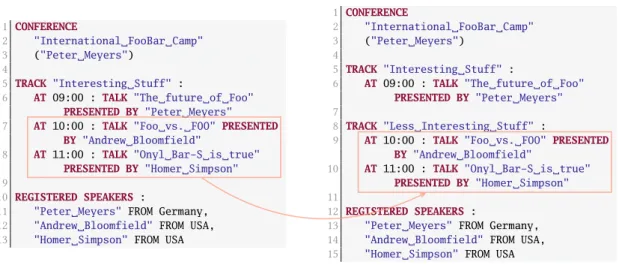
Consider, e.g., our model-based DSL for planning conferences.6We used EMFText to generate a DSLE for this DSL. This is a little language and can be used to define different tracks, talks
and speakers for conferences. For the talks only declared speakers can be referred. Having the Extract Methodrefactoring from Fig. 1.5 in mind, Fig. 1.6 illustrates a very similarExtract Track refactoring for the conference DSL. The last two talks in (a) (Lines 7 and 8) are less interesting
and are therefore moved to a newly created track. The result can be seen in (b). This example shows that known code refactorings from programming languages should be made available for DSLEs.
The main problem regarding the lack of appropriate refactoring support can be subdivided into the following three issues.
6http://www.emftext.org/index.php/EMFText_Concrete_Syntax_Zoo_Conference
(visited 11th
1.1. Language-Tool Generation Without Consideration Of Time And Space
Figure 1.7.: Overview of model life cycle in MDSD.
Creation/ Initialisation Evolution/ Maintenance Quality Evaluation Creation/ Initialisation Evolution/ Maintenance Quality Evaluation Co-Evolution Model 1 Model 2
Only structural information is available in metamodel DSLs only provide structural information in their metamodels, especially knowledge about how concepts relate to each other. This information is only of static nature and is regarded as the abstract syntax. Consequently, it is not possible to establish a relation to a concept ofqualityrepresenting information about which
quality a model actually has. Without such a fact it is not possible to interrelate qualities with refactorings, which results in the fact that one cannot specify an indicator expressingwhenand whatstructure to refactor. As a consequence, refactorings would be executedrandomlywithout a
formal grounding. Furthermore, refactorings cannot be derived automatically for DSLs, because they do not only depend on the structure, but on the specifics of the particular language as well. Consider, e.g.,Extract Methodin Fig. 1.5 again. From an abstract point of view, some children
(the statements) of a parent (original method) are moved to a new parent (new method). But one would never declare that every parent-child relation in the syntax tree should be restructured in the sense that the child gets a new parent. It does not even make sense in every case. Thus, from
a pure structural viewpoint refactorings cannot be generated automatically. For that reason, refactorings cannot be derived from the abstract syntax (the DSL’s metamodel). DSLEs are not able to provide DSL-specific mature refactoring tools and they omit the aspect of evolution over timecompletely. As a consequence, the effort to specify refactorings for a particular DSL is huge.
In the worst case, the restructurings a refactoring comprises must be applied manually. This means that the consistency of the model to be refactored may break, because this manual process is error-prone.
Figure 1.7 summarizes this subproblem on the left hand side forModel 1. This DSL instance is created before it undergoes a process of evolution. Modifications are applied, e.g., by a user or by a model transformation. Afterwards, the quality should be evaluated for being able to give
evidence which refactoring could be applied upon which structure for improving the overall quality of the model. The process of evolution and quality evaluation is a cycle which might stop when a model is not modified anymore and its quality requirements are satisfied.
DSL is regarded as isolated The second subproblem is the fact that, when DSLs are engineered, potential relations to other DSLs are not taken into account, thus, the DSL is considered as
isolated. In general, it is not even possible to estimate which other DSLs are candidates for interaction at the design or instance level. The trivial case is when a DSL is referenced by another at the design level. Obviously, models of such referring DSLs might relate to models of the
referred DSL. In contrast, it is also possible that a reference of a DSL at design level is very vague or weak. This means that a referred DSL cannot be specified precisely and the connection to models is established at the instance level. Those connections then can point to instances of
arbitrary DSLs and cannot be foreseen. In such a case, interdependencies between those models arise. This means they relate to each other and are dependent on each other. As a consequence, a dependent model is influenced by modifications of the other model. Figure 1.7 illustrates this
relationship forModel 1andModel 2exemplarily. IfModel 2evolves in terms of a refactoring its quality must be evaluated again. SinceModel 1depends on the evolved model it must co-evolve. This co-evolution is highly dependent on the concrete modifications inModel 2and the current
state ofModel 1. A popular example for the described scenario is the process of aging between requirements model, design model and code. Most often, changes in one of these artefacts are not propagated to the others and thus they age. This is a problem when different DSLs are considered
isolated, because an evolution of one model can violate the consistency of a dependent model in its surroundingspace.
By means of substantiating the aforementioned scenario of multiple DSLs being integrated in one IDE Pfeiffer and Wąsowski introduced a more specific term in [Pfe13; PW15]: Multi-Language Development Environment (MLDE). Regarding Pfeiffer a MLDE is an IDE providing
cross-language support (CLS) mechanisms. Since MLDEs “[. . . ] integrate editors and other language specific tools across language boundaries with each other” [Pfe13], multiple DSLEs in combination with additional CLS mechanisms form a particular MLDE. Consequently, IDEs are
commonly accepted for programming. For the sake of not breaking usual habits of developers in programming, MLDEs should be used formodelling. For this reason the term Multi-Language Development Environment (MLDE) corresponds to our idea of environments for modelling and
it is therefore used throughout this thesis.
Another consequence of DSL isolation is that refactorings cannot be reused across different DSLs. Have a look at theExtract Method refactoring in Fig. 1.5 on page 5 again. This is an
example for the programming language Java. The same semantics-preserving restructuring is available for other programming languages as well. The difference between these refactorings is not the specifics of the refactoring itself but the language which it is applied to. Thus, from an
abstract point of view, the same steps are executed in different languages. The same holds for DSLs. If refactorings cannot be reused they must be specified and implemented anew for every different DSL.
Appropriate refactorings are dependent on DSL designer’s preferences Apart from the two sub-problems above, the decision which refactorings to specify for a DSL highly depends on the preferences of the DSL designer. On the one hand, the DSL designer must determine which
structures are suitable for refactoring at the design level. Therefore, the abstract syntax must be examined and feasible relations between concepts have to be found for establishing potential candidates for refactorings. As an example, let us regard the Java programming language as a
1.2. Challenges
model-based DSL. The Java Model Parser and Printer [HJSW10] ( JaMoPP)7enables us to consider Java source code as models. A more detailed explanation about why this is possible will be
provided in Sect. 2.2. Here it is sufficient to know that Java code can be considered as models. Within the metamodel of JaMoPP, there is a parent-child relation between the conceptsMethod andStatement. This structure, e.g., is suitable for theExtract Methodrefactoring in Fig. 1.5, because statements are extracted from an original method to a new one. Another parent-child relation can be found betweenEnumerationandEnumConstantexpressing the fact that an enumeration can contain several constants. In this case, it does not make sense to provide an
Extract Enumerationrefactoring because referencing another enumeration as a constant in the original enumeration is not possible due to the Java specification. Such structures have to be determined by the DSL designer and the challenge is to find the suitable ones.
On the other hand, the technical background of the intended DSL users should be taken into
consideration by the DSL designer. Depending on the target group refactorings of different maturity could be provided. The Java language, e.g., is most probably used by engineers whereas the conference DSL for describing conferences does not need a technical background, thus,
its users might not have a programming background and could be overtaxed with mature refactorings at their hands.
As a consequence, this subproblem again leads to the fact that DSL-specific refactorings cannot be derived automatically, since the decision which refactorings to provide is highly subjective.
1.2. Challenges
The aforementioned problems find expression in the following goals and challenges which will be covered in this work.
Generic Specification of Refactorings As already mentioned, there is a plethora of DSLs which is still growing. In general, DSLs should not be regarded as isolated, thus it is not efficient to specify and implement a refactoring for different DSLs anew, although the same modifications are
applied except that the target language is different. As argued in the previous section, the same refactorings must be reusable in different DSLs from an abstract point of view. Consequently, the specification of refactorings should be independent from the target language which it is intended
to be applied to. Thus an approach for the generic specification of refactorings is essential.
DSL-Specific Instantiation of Refactorings When refactorings can be specified generically, an approach is needed that supports the declaration of what a generic refactoring means for a particular DSL. This is the consequence of the previous goal and comprises the DSL-specific
instantiation of generic refactorings.
Explicit Relation Between Refactoring Candidates, Refactorings and Qualities In [FBB+99], Fowler et al. defined structures suggesting the application of a particular refactoring as bad smells.
The presence of a bad smell is a refactoring candidate, because it deteriorates specific qualit-ies and the execution of a refactoring might improve them [FBB+99; SSL01; MTM07; Als09].
7
The problem of Fowler et al.’s term is that it has not been defined precisely. Furthermore, the connection to qualities and refactorings is only implicit. Hence, it is not possible to give
evidence about whatsmellingstructures influence which quality negatively and can be resolved by which refactoring [MTM07]. That’s why a precise definition of abad smellin the context of MDSD is needed, explicitly relating refactoring candidates, refactorings and qualities to allow
for automatic detection and resolution.
Specification of Dependent Modifications As argued in Sect. 1.1, a DSL and its models can have interdependencies to instances of other DSLs in MLDEs. If a model evolves, it might have effects on dependent models. To avoid violation of consistency of the dependent models an approach
for specification of dependent modifications is needed. Since the subsequent changes must not alter the dependent model semantics such modifications are considered to be refactorings. In addition, the subsequent refactorings depend on a preceding refactoring and are therefore called
co-refactoring. Such a specification should enable the mapping of preceding modifications in a model of one DSL to succeeding modifications in a dependent model of another DSL.
Detection of Dependent Models Apart from the specification of dependent modifications, de-pendent models themselves must be detectable in MLDEs. This goal contains two essential parts.
First, dependencies between models must be tracked. Second, it must be recognized when a tracked model evolves, what modifications occurred and which other models they have influence on. After this detection process, the dependent modifications must be applied to the dependent
models.
In summary, an approach is missing that provides mature refactoring means in MLDEs and considers time, space and quality. Thetimeaspect takes the fact into account that models might evolve through refactoring over time. Thespace aspect takes the circumstance into account
that a model is never alone. Several other dependent DSL instances of the same or different metamodel may be contained in the model’s surrounding. Thus, the approach must comprise the co-refactoring of those dependencies as a consequence of an initially refactored model to
preserve the consistency of all models. Furthermore, the approach must take thequalityaspect that way into account that evidence can be given about which model structures influence what quality negatively, and which refactorings can resolve those deficiencies. As a consequence
refactorings can be suggested to the DSL user.
1.3. Generic Quality-Aware Refactoring and Co-Refactoring in
Heterogeneous Model Environments
To establish a connection between the problems from Section 1.1 and the challenges from
Section 1.2, a simplified MDSD model life cycle from Figure 1.7 is underlain. The simplified life cycle starts with the phase of Refactoringin which a model evolves. In the general case, two subsequent phases follow. On the one hand, the phase ofQuality Evaluationfollows, in
which quality properties of the evolved model are evaluated, and, when indicated, refactoring candidates are identified and possible refactorings for resolution are suggested. On the other hand, theCo-Refactoringphase follows, in which dependent models are detected and possible
1.3. Generic Quality-Aware Refactoring and Co-Refactoring in Heterogeneous Model Environments
dependent refactorings are determined. If applicable, subsequent co-refactorings are executed on dependent models and again, theQuality Evaluationis the next step. Now, the quality of the
dependent models is evaluated as a consequence of an applied co-refactoring. In either case, after the quality was evaluated, the next phase isRefactoringagain when the desired quality requirements are not satisfied.
To address all three of these phases and to support the entire life cycle of heterogeneous models in MLDEs, this thesis contributes a comprehensive approach for quality-aware refactoring and
co-refactoring based on role modelling. It is structured as follows.
Foundations (Chapter 2)
Before the parts of the comprehensive approach of this thesis are elaborately presented
founda-tions are accomplished in Chapter 2.
Review of Related Work (Chapter 3)
For being able to give evidence about what other related approaches exist to tackle the overall
problem, a broad review of the state-of-the-art is provided as well. For this purpose, requirements are established to compare the approach of this thesis with the related work.
Generic Role-Based Model Refactoring (Chapter 4)
To provide means for language-independent [MTM07; TMM08; MMBJ09] specification of
refac-torings, an appropriate abstraction mechanism is essential. On the one hand, abstraction over all potential languages is one option. The limitation of this alternative is that the DSLs which refactorings should be provided for are constrained in the sense that all must be similar to the
concepts in the language abstraction. Thus, this approach would be too static, as will be discussed in Sect. 3.1. For this reason, the approach of abstraction over the desired refactorings is chosen as another option. In detail,role modellingis applied as abstraction technique, since arole model
represents a dedicated view of objects in an interesting context and the collaborations of the objects within this context [RWL96; RG98]. In this thesis, a role model defines the participants of a refactoring and their collaborations, independent from the target DSL which it should be made
available in. The differentcontextof the same generic refactoring is considered the particular refactoring of a specific DSL.
Hypothesis 1: Abstraction over refactorings instead of abstraction over lan-guages is feasible to provide means for specifying refactorings generically.
The prove of this hypothesis is twofold. First, role-based generic model refactoring is conceptu-alized and implemented. Second, a set of generic refactorings is elaborated which is then applied in different DSLs.
Suggestion of Refactoring Specifications (Chapter 5)
When refactorings are specified generically, it must be possible to instantiate them for particular DSLs. The process of making a generic refactoring DSL-specific is not trivial, since there might
be many possibilities to do so. Some of them are suitable while others are not. To provide support for this task, Chapter 5 presents an approach making use of graph querying in order to provide
suggestions of DSL-specific refactoring specification.
Correlating Bad Smells, Qualities and Refactorings (Chapter 6)
As already illustrated in the previous section, the termbad smell[FBB+99] is vague and imprecise. Furthermore, the explicit connection of structures violating particular quality requirements is
omitted completely. This relation is considered only informally, just the same as the relation to resolving refactorings. As a consequence of the mentioned shortcomings, the termbad smell lacks precise understanding. We argue that a correlation between bad smells from Fowleret al.,
qualities and resolving refactorings exists, which must be made explicit to automate tool support in suggesting particular refactorings.
Hypothesis 2:To provide a precise understanding ofbad smells[FBB+99] and their explicit relationship to qualities and resolving refactorings the new termQuality Smelland a conceptualization is required. It must incorporate known approaches
for quality determination, such as metrics and anti-patterns.
To prove this hypothesis the new termQuality Smellis defined and a conceptual framework
is specified. This framework serves for sharpening the understanding of what it means when model structures do not meet particular quality requirements and how this circumstance can be eliminated. Furthermore, the conceptualization is implemented and it is shown that the
suggestion of potential refactorings to resolve particular quality smells now is possible.
Quality Smell Catalogue (Chapter 7)
As we have seen in history [BC87; GHJV94; Sai03] pattern catalogues and pattern languages support designers of object-oriented software “[. . . ] to ask (and answer) the right questions at the
right time” [BC87]. This means that they provide means to declare reusable patterns for recurring problems in object-oriented design. If such a problem occurs and is detected, the appropriate pattern can be applied to solve the problem. A more rigorous approach is presented in [TM15]
arguing thatPattern First Thinkingimproves software quality, in terms of more flexible software, and team communication. The authors of [BC87; GHJV94; Sai03] presented their catalogues for design problems in object-oriented software, but the same holds for quality-related problems in
MDSD models.
Hypothesis 3:A quality smell catalogue can be mined to improve the under-standing of the termquality smelland its connection to qualities and refactorings. Such a catalogue enhances documentation and contributes reusable patterns for quality improvement.
To prove this hypothesis a quality smell catalogue is compiled for the domain of mobile devices’ applications. Exemplarily the Android8operating system as target platform is used because of its open-source character.
8
1.3. Generic Quality-Aware Refactoring and Co-Refactoring in Heterogeneous Model Environments
Co-Refactoring Dependent Models (Chapter 8)
Usually models do not occur isolated, but have dependencies on other models or other models are dependent on them. To ensure consistency of dependent models, they must be synchronized
with the initially refactored model in terms of behaviour preservation. Thus, they must be co-refactored. This task comprises, first, the specification of modifications dependent on the preceding refactoring changes, second, the detection of dependent models, and, third, the
application of the specified dependent modifications on the dependent models. The first subtask demands for distinction between two different situations. On the one hand, the DSL of the initially refactored model is known, and on the other hand, the DSL is not known. In the latter
case, the dependent modifications are specified with respect to the generic specification of the initial refactoring, while concrete concepts of the known language can be used in the former case.
Hypothesis 4:Consistency of models, being dependent on an initially refactored model, can be maintained through the specification and execution of modifications dependent on the preceding changes of the refactored model. Such co-refactorings must be applied on those models being recognized as dependencies of an initially
refactored model.
To prove this hypothesis a concept and implementation for the detection of dependent models and the specification and execution of dependent modifications are developed. Afterwards it is
applied to a case study in the domain of co-refactoring Web Ontology Language [W3C12] (OWL) models dependent on changes in metamodels which the OWL models are derived from.
Refactory: An Implementation (Chapter 9)
For validation of the concepts developed in this thesis we provide an implementation. It is realised in our tool calledRefactory.9
Evaluation (Chapter 10), Conclusion and Outlook (Chapter 11)
The evaluation of the aforementioned contributions is presented in Chapter 10. Finally, this thesis is closed with a conclusion and discussion of future work in Chapter 11.
9
2
Foundations
To ensure that the reader has the same understanding of concepts and terms used throughout
this thesis, this chapter provides the foundations to form a common base. First of all, the concept refactoringis explained in general. Since we consider only model-based DSLs, the MDSD and its abstraction layers are presented afterwards. The concept ofrolesis an essential constituent in the
whole thesis. Therefore the origin and the foundations we base our work on is illustrated then.
2.1. Refactoring
In 1990 Opdyke and Johnson defined the termrefactoringfor the first time in [OJ90]. Shortly thereafter, Opdyke published his dissertation “Refactoring Object-Oriented Frameworks” and
the termrefactoringhas been established. He gives the following explanation:
“Refactoringsare reorganization plans that support change at an intermediate level. [. . . ] Refactorings do not change the behaviour of a program; that is, if the
program is called twice (before and after a refactoring) with the same set of inputs, the resulting set of output values will be the same.” [Opd92]
The main motivation of Opdyke’s work was to increase reuse in object-oriented frameworks
because of the rising complexity. The problem is that a refactoring can be applied after a part of a software is already reused and, thus, it can have extensive impact to existing clients. Therefore tool support must be provided in order to manage the complexity and error-proneness. As a
prerequisite for the behaviour preservation Opdyke identified the satisfaction of pre-conditions as essential part of a refactoring.
In his work, he studied object-oriented frameworks and proposed a catalogue of 29 refactorings,
as, e.g.,Convert a Code Segment to a Function[Opd92, p. 34], which moves a segment of code to a new function and calls it at the previous position. As already mentioned in Sect. 1.1, this refactoring is better known asExtract Methodnowadays [FBB+99].
Some years later, the standard work which is cited most often with respect to practical refactoring has been published by Fowleret al. in [FBB+99]. The authors identified the importance
of testing before and after the application of refactorings in order to prove the behaviour preservation on an informal base. Furthermore, they related the refactorings tobad smells indicating potential candidates to be restructured. An essential result of their work is the
catalogue of refactorings presented therein. It is based on the work of Opdyke, but underlies a schema similar to the one presented in [GHJV94] (“Gang of Four”) regarding design patterns in object-oriented software.
With the advent of the MDSD, it was recognized that known code refactorings should be made available for the emerging amount of DSLs [TDDN00; MTM07]. As a consequence the idea of model refactoringwas born and Van Der Straeten, Jonckers and Mens, e.g., defined it as “[. . . ] a
transformation used to improve the structure of a model while preserving its behaviour” [VJM07]. This is the tenor of most other informal definitions of the termmodel refactoring. Common sense is that the meaning is very similar to the one of code refactoring, except that instead of
code existing models are restructured in order to improve design quality while the behaviour is preserved.
In this thesis, a new technique for generic model refactoring is presented. To differentiate
clearly between a generic refactoring, its instantiation and the execution the following termino-logy is used throughout the thesis:refactoringdenotes a concrete restructuring in a model of a particular language,generic refactoring indicates a reusable abstraction of similar refactorings
applicable in models of one or more languages, andrefactoring executionmeans the application of a refactoring on a particular model.
2.2. Model-Driven Software Development
In order to understand the need formodels, Kleppe argued that the rise of complexity in software development can be managed with the use of frameworks and reusable patterns [Kle09]. But this is only a short-term solution which can only be mastered by a rise of abstraction to understand
what software does in the core. Due to this background software development has been subject to change by means of separating concerns (separation of concerns (SoC)) in abstract representations of particular aspects of a software. Those abstractions are considered to be amodel. Rothenberg
defined amodelas follows:
“A model represents reality for the given purpose; the model is an abstraction of reality in the sense that it cannot represent all aspects of reality. This allows us to
deal with the world in a simplified manner, avoiding the complexity, danger and irreversibility of reality” [Rot89].
This definition reflects the fact that a model focusses on specific concerns of reality and omits
certain properties. In software development, this technique of abstraction has been taken over in the paradigm ofModel-Driven Software Development (MDSD)[GS03; SVB+06]. In MDSD, models are used to abstract from typical technical aspects of the system under development. Those
aspects are, e.g., the target platform the software is intended to be run on, or the programming language used for implementation. Furthermore, different models are used to describe solutions of different problems of the overall system. The UML is a prominent example for it, since it
2.2. Model-Driven Software Development
Person
Age void eat() UML Class Diagram M1
Model
Class
Attribute Method UML Metamodel
M2 Metamodel (Language) Concept Ecore Metalanguage M3 Meta-Metamodel (Metalanguage) john john.age john.eat() M0 Software Objects Abs tr ac tion Ins tantia tion
Figure 2.1.: MOF architecture.
provides various types of diagrams to specify distinct parts of a software [OMG11a]. Examples areclass diagramsto define concepts of the system domain orstate machine diagramsto specify a protocol a software component must satisfy.
To make use of defined models regarding the concrete realisation of a system, they are then
translated into representations being meaningful for underlying executors. This conforms to the explanation of the abstraction gap in Fig. 1.4. The translation into other representations is explained in more detail in Sect. 2.2.2. But at first the question is answered how different kinds
of models can be distinguished. In this sense this reflects the need for a formalisation in order to let models be processed by aforementioned translators. Thus a formal description of models is needed which provides further information about the structure of models. This is explained in
the following section.
2.2.1. Levels of Abstraction and Metamodelling
As already mentioned in Chap. 1, we only consider model-based DSLs in this thesis. Consequently, it must be clarified what this means exactly and how to distinguish different DSLs in this regard.
To let models be processed by a machine, the structure of a model must be known. The reason
is that the set of models is potentially infinite and thus a finite specification of the commonalities of models is needed. Therefore a formalism is required to model the structural constraints of models. The process of providing the definition of model structures by means of a model is
calledmetamodelling. Thus a metamodel describes properties of models. It can be observed that we already have different abstraction layers: one for a metamodel and another for the models described by the metamodel.
The Object Management Group (OMG) provided a formal base for metamodelling in order to support the creation of concrete metamodels. This formalism is defined as Meta Object
Facility [OMG13c] (MOF)and provides an architecture where constituents of one layer describe constituents in an underlying layer. This architecture is illustrated in Fig. 2.1.
It consists of four metalayers to express the different levels of abstraction. On top, we have the M3 layer which represents the metalanguage layer to describe langua
![Figure 1.5.: Example of Extract Method refactoring in Java, based on [FBB+99].](https://thumb-us.123doks.com/thumbv2/123dok_us/789632.2599828/25.892.121.743.194.416/figure-example-extract-method-refactoring-java-based-fbb.webp)