EXPLOITING STRUCTURE FOR SENTIMENT
CLASSIFICATION
A Dissertation
Presented to the Faculty of the Graduate School of Cornell University
in Partial Fulfillment of the Requirements for the Degree of Doctor of Philosophy
by
Ainur Uskemenovna Yessenalina August 2012
c
2012 Ainur Uskemenovna Yessenalina ALL RIGHTS RESERVED
EXPLOITING STRUCTURE FOR SENTIMENT CLASSIFICATION Ainur Uskemenovna Yessenalina, Ph.D.
Cornell University 2012
This thesis studies the problem of sentiment classification at both the doc-ument and sentence level using statistical learning methods. In particular, we develop computational models that capture useful structure-based intuitions for solving each task, treating the intuitions as latent representations to be dis-covered and exploited during learning.
For document-level sentiment classification, we exploit structure in the form of informative sentences — those sentences that exhibit the same sentiment as the document, thus explain or support the document’s sentiment label. We first show that incorporating automatically discovered informative sentences in the form of additional constraints for the learner improves performance on the document-level sentiment classification task. Next, we explore joint structured models for this task: our final proposed model does not need sentence-level sentiment labels, and directly optimizes document classification accuracy using inferred sentence-level information. Our empirical evaluation on two publicly available datasets shows improved performance over strong baselines.
For phrase-level sentiment classification, we investigate the compositional linguistic structure of phrases. We investigate compositional matrix-space mod-els, learning matrix-space word representations and modeling composition as matrix multiplication. Using a publicly available dataset, we show that the matrix-space model outperforms the standard bag-of-words model for the phrase-level sentiment classification task.
BIOGRAPHICAL SKETCH
Ainur Yessenalina is originally from Almaty, Kazakhstan. She received a Spe-cialist degree (B.S) with Honours in Applied Mathematics and Informatics from Lomonosov Moscow State University, and Ph.D. degree in Computer Science from Cornell University.
ACKNOWLEDGMENTS
I am grateful to my advisor Claire Cardie for the great advice and support she provided. I gratefully acknowledge the advice from my committee members John Hale and John Hopcroft. Interactions with Cornell professors were benefi-cial for my professional development, spebenefi-cial thanks to professors David Bindel, Rich Caruana, Thorsten Joachims, Lillian Lee, and Emin G ¨un Sirer. Insightful discussions with other students at Cornell were valuable for me, special thanks to Yejin Choi, Nikos Karampatziakis and Yisong Yue.
I am very grateful to my family and my dear friends, who supported me in this journey. I thank Nikos for inspiration and support through these years.
TABLE OF CONTENTS
Biographical Sketch . . . iii
Dedication . . . iv
Acknowledgments . . . v
Table of Contents . . . vi
List of Tables . . . viii
List of Figures . . . ix
1 Introduction 1 1.1 Document-Level Sentiment Classification: Beyond Conventional Models . . . 3
1.2 Phrase-level Sentiment Classification . . . 7
1.2.1 Semantic Compositionality for Sentiment Analysis . . . . 7
1.2.2 Modeling Semantic Compositionality . . . 8
1.3 Structure of the Thesis . . . 9
2 Related Work 10 2.1 Overview of Sentiment Analysis . . . 10
2.2 Document-Level Sentiment Classification . . . 14
2.2.1 Document-Level Sentiment Classification: Using Sentence-Level Information . . . 16
2.2.2 Annotator Rationales . . . 19
2.3 Phrase-level Sentiment Classification . . . 20
2.4 Summary of the Chapter . . . 24
3 Using Automatically Discovered Informative Sentences to Improve Document-Level Sentiment Classification 25 3.1 Background: Incorporating Informative Text Spans as Additional Constraints . . . 27
3.2 Automatically Acquiring Informative Sentences . . . 28
3.2.1 Contextual Polarity Classification . . . 30
3.2.2 Polarity Lexicons . . . 31
3.2.3 Random Rationales . . . 31
3.2.4 Comparison of Automatically Acquired Informative Sen-tences vs. Human Annotated SenSen-tences . . . 32
3.3 Experiments . . . 33
3.3.1 Experiments with Movie Review Data . . . 34
3.3.2 Experiments with Product Reviews . . . 35
3.3.3 Examples of Automatically Acquired Informative Sentences 37 3.4 Related Work . . . 37
4 Multi-level Structured Models for Document-Level Sentiment
Classi-fication 39
4.1 Related Work . . . 41
4.2 Extracting Latent Explanations . . . 42
4.3 Model: Structural SVMs for Sentiment Classification with Latent Explanations (SVMsle) . . . 43
4.3.1 Making Predictions . . . 45
4.3.2 Training . . . 46
4.3.3 Feature Representation . . . 48
4.3.4 Incorporating Proximity Information . . . 50
4.3.5 Extensions . . . 50
4.4 Experiments . . . 53
4.4.1 Experimental Setup . . . 53
4.4.2 Experimental Results . . . 55
4.5 Discussion . . . 61
4.6 Summary of the Chapter . . . 62
5 Compositional Matrix-Space Models for Phrase-Level Sentiment Clas-sification 64 5.1 Compositional Effects in Sentiment Analysis . . . 67
5.2 The Model for Ordinal Scale Sentiment Prediction . . . 68
5.2.1 Notation . . . 69
5.2.2 Ordered Logistic Regression . . . 71
5.2.3 Bag-Of-Words Model . . . 77 5.2.4 Initialization . . . 77 5.3 Experimental Methodology . . . 79 5.3.1 Training Details . . . 79 5.3.2 Methods . . . 80 5.4 Results . . . 81 5.5 Related Work . . . 83 5.6 Discussion . . . 84
5.7 Summary of the Chapter . . . 85
6 Conclusions 86 6.1 Summary of Contributions . . . 86
6.2 Future Work . . . 87
LIST OF TABLES
1.1 Example of a positive movie review from the Movie Reviews dataset split by sentences. Positive sentences are denoted in bold, negative sentences are in italics. . . 4 3.1 Comparison of Automatically Acquired Informative Sentences
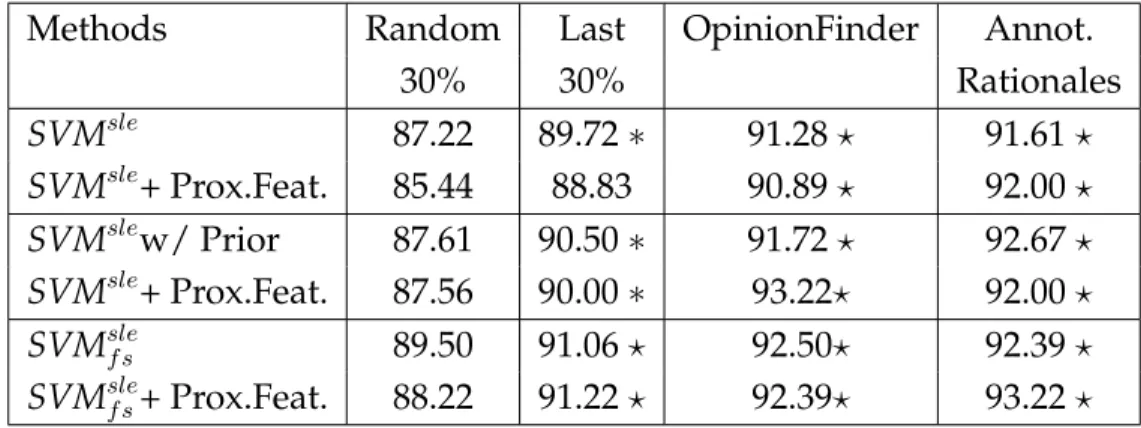
vs. Human-annotated Rationales. . . 32 3.2 Experimental results for the movie review data. . . 34 3.3 Experimental results for Product Review data. . . 36 4.1 Summary of the experimental results for the Movie Reviews
datasets using SVMsle, SVMsle w/ Prior and SVMslef s with and without proximity features. . . 56 4.2 Summary of the experimental results for the U.S.
Congres-sional Floor debates datasets usingSVMsle,SVMslew/ Prior and
SVMslef s with and without proximity features. . . 56 4.3 Comparison of SVMslef s with previous work on the Movie
Re-views dataset. We considered two settings: when human an-notations are available (Annot. Labels), and when they are un-available (No Annot. Labels). . . 57 4.4 Comparison ofSVMslef s with previous work on the U.S.
Congres-sional Floor Debates dataset for the speaker-based segment clas-sification task. . . 57 4.5 ”yea” speech with Latent Explanationsfrom the U.S.
Congres-sional Floor Debates dataset predicted bySVMslef s with Opinion-Finder initialization. Latent Explanations are preceded by solid circles with numbers denoting their preference order (1 being most preferred by SVMslef s). The five least subjective sentences are preceded by circles with numbers denoting the subjectivity order (1 being least subjective according toSVMslef s). . . 60 5.1 Mapping of combination of polarities and intensities from
MPQA dataset to our ordinal sentiment scale. . . 79 5.2 L1loss for vector-space Ordered Logistic Regression and
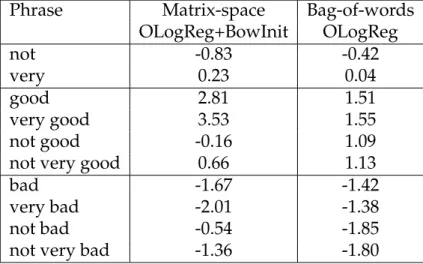
Matrix-Space Logistic Regression. † Stands for a significant difference w.r.t. the Bag-Of-Words OLogReg model with p-value less than 0.001 (p < 0.001). . . 81 5.3 Phrase and the sentiment scores of the phrase for 2 models
Matrix-space OLogReg+BowInit and Bag-of-words OLogReg re-spectively. Notice thatrelative ranking order what matters. . . . 82
LIST OF FIGURES
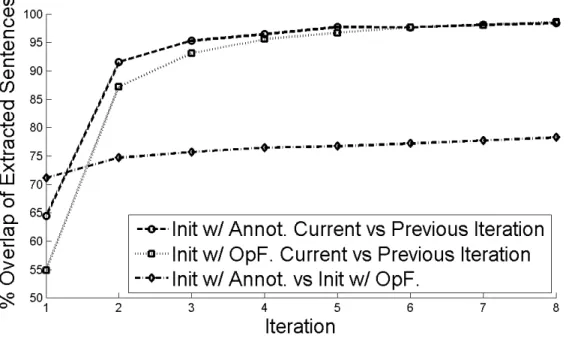
4.1 Overlap of extracted sentences from differentSVMslef s models on the Movie Reviews training set. . . 58 4.2 Test accuracy on the Movie Reviews dataset for SVMslef s while
CHAPTER 1
INTRODUCTION
Understanding opinions, attitudes, emotions of people towards objects and to-wards each other is important for making decisions (e.g., which movie to watch, which camera to buy) and building a mental picture of the world and interper-sonal relationships (e.g., who likes whom, who likes what). Sentiment analysis
is a research area of natural language processing that aims to understand these types of private mental and emotional states in text.
There has been a great burst of interest in sentiment analysis research in re-cent years (Pang and Lee (2008), Liu (2012)). This interest is due to a number of factors. First, and most importantly, there are numerous practical applica-tions of opinion analysis for corporate business intelligence, political analysis and personal decision-making. Second, there have been developments in ma-chine learning and statistical natural language processing that allow for proper computational treatment of these real-world application scenarios. Third, since people often post their opinions on forums and various websites and access to user-generated content has become easier, it is now possible to create datasets to support the study of sentiment analysis using statistical methods.
Research in sentiment analysis can be roughly split into two main threads: coarse-grained sentiment analysis (e.g., Pang et al. (2002), Turney (2002)) and fine-grained sentiment analysis (e.g., Wiebe et al. (2005)). Coarse-grained senti-ment analysis is concerned with analysing the overall sentisenti-ment of a docusenti-ment or larger snippet of text, while fine-grained sentiment analysis studies opinions at the sentence or phrase level, identifying the polarity, topic, and sometimes even the source of the opinion.
Sentiment classification, one of the subtasks of sentiment analysis, identifies whether a given text carries positive or negative polarity. This thesis studies the task of supervised sentiment classification at both the document and sen-tence level. In document-level sentiment classification (or categorization), we are given a set of documents with document-level sentiment labels, the goal is to learn a statistical model, so that it can predict the sentiment labels for previ-ously unseen documents. The same question of sentiment categorization could be posed at a much finer level as well — for example, at the sentence or phrase level. Though the question is the same, the intuitions for figuring out the an-swer in each of these settings could be different. For example, the sentiment of a document generally revolves around a few phrases and sentences that are subjective and that express the feelings of the author towards the topic under consideration, while the rest of the document might describe the topic itself. Thus, correctly identifying phrases and sentences that explain the document’s sentiment label might improve document-level sentiment classification. In con-trast, deciding the sentiment of a phrase requires accounting for more of the linguistic structure of the phrase: since phrases usually have many fewer words than documents, the exact way the words combined matters a lot.
As a result, in this thesis we develop computational models that capture useful intuitions for solving document-level and phrase-level sentiment classification. We fur-thermore treat these intuitions as latent representations to be discovered and exploited during learning.
For document-level sentiment classification, for example, our proposed methods rely on the intuition outlined above — that the overall sentiment is based on just a subset of the sentences or phrases in the document, i.e., the sentiment-bearing sentences or phrases. For phrase-level classification, our
pro-posed approach relies instead on the principle of semantic compositionality, which states that the meaning of a phrase is composed from the meaning of its words via a set of rules that combine them (Frege (1892), Montague (1974), Dowty et al. (1981)). We describe our approach to, and the intuitions behind, each in the sections below.
1.1
Document-Level Sentiment Classification: Beyond
Con-ventional Models
A conventional approach to the document-level sentiment classification task is to treat it as a standard text categorization task: use a bag-of-words representa-tion that treats all words in the document equally, and, thus, does not account for the structure of the document; and then apply off-the-shelf machine learning classifiers such as SVMs or Naive Bayes to create the sentiment classifier (Pang et al. (2002)). Now the natural question of interest is: How can we do better than that? To improve the performance of the document-level sentiment classifier, one option is toexploit the structure of the document. In particular, documents are comprised of sentences, and sentences, of phrases. And as discussed earlier, the sentiment of a document usually revolves around just a few sentences or even a few phrases that express the overall sentiment of the writer. We can see from the example in Table 1.1 that in a positive movie review not all sentences are sentiment-bearing (or subjective); instead, subjective sentences are interleaved with objective sentences that describe, for example, the plot. Moreover, negative sentences could be present as well.
The idea of using sentence-level information to aid document-level senti-ment classification was first proposed by Pang and Lee (2004), who suggested
Table 1.1: Example of a positive movie review from the Movie Reviews dataset split by sentences. Positive sentences are denoted in bold, negative sentences are in italics.
”Being John Malkovich” is the type of film we need to see more. Today’s films are either blockbusters that entertain us with tiresome formula, or those that have similar themes. Malkovich falls under none of these categories , and it’s quite refreshing to see that occur. This strangely provoking story, is actually somewhat understandable. John Cusack plays a puppeteer trying to make it to the big time. His wife (Cameron Diaz) supports the both of them by working at a petstore, which explains the obscure pets they keep in their apartment.
...
I don’t want to give away too much, but Cusack becomes too attached with his discovery. In my opinion, this idea is absolutely brilliant. It’s really quite scary to think that someone could become you, control you, be you. It makes you wonder why we act like we do , and why sometimes we blurt out things or act out something out of the blue.
...
”Being John Malkovich” isn’t an excellent film, but it is definitly entertain-ing and will eaisly become a cult favorite. What’s even better is the film’s puzzling message... am I Nick Lyons ?
filtering out objective sentences and keeping only thesubjective ones and then using the resulting subjective extracts as the training set for the classifier. How-ever, the authors note that unless the filtering step is done carefully, the result-ing system does not always lead to improved performance. Zaidan et al. (2007) instead proposed relying on annotator rationales — text segments identified by human annotators that support or explain the annotator’s decision about the sentiment label of the document. The authors subsequently modify the ma-chine learning algorithm to make use of annotator rationales. In this thesis we rely onautomaticallyidentified rationales, which we refer to as the informative sentences in the sense that they exhibit the same sentiment as the document. Thus, these sentences are not only subjective, but also support thesentiment
la-bel (positive or negative) of the document, i.e., for documents with overall pos-itive sentiment, sentences that exhibit pospos-itive sentiment are considered infor-mative; for documents with overall negative sentiment, sentences that exhibit negative sentiment are considered informative.
In this thesis we use the set of informative sentences as latent structure for the document-level sentiment classification taskand investigate two ways to incorpo-rate them into a sentiment classifier: first, as additional constraints for an SVM classifier, and, second, as latent variables in a two-level joint structured model. We provide a high-level description of each approach below.
Incorporating informative sentences as additional constraints. Zaidan et al. (2007) show that the use of manually annotated informative snippets of text can improve the performance of document-level sentiment classifiers. They incor-porate the informative text segments as constraints for the SVM learner that aim to ensure that the resulting classifier is less confident in its classification of train-ing documents that have the annotator rationales removed vs. the original doc-ument (that contained the rationales). The addition of these constraints leads to performance gains over an SVM learner without the constraints. Of course, obtaining the text snippets that support the sentiment label requires more time from human annotators than simply labeling the document as positive or neg-ative. Ideally, we would like to have the best of both worlds: improved perfor-mance and a small annotation effort.
Contribution 1. In this thesis we investigate ways to use available senti-ment analysis resources to automatically discover informative sentences for document-level sentiment classification. As in Zaidan et al. (2007) we incor-porate them in the learning procedure in the form of additional constraints for an SVM classifier. Empirical results on a standard movie review corpus indicate that the automatically discovered informative sentences are just as helpful as human rationales. Furthermore, using both the human annotator rationales and automatically discovered informative sentences boosts perfor-mance even further for this domain.
Using informative sentences in a joint structured model. Though automat-ically discovered informative sentences are cheap to obtain, they are less than perfect: the automatic methods can miss some informative sentences or mistak-enly include non-informative ones. Therefore, one option is to develop statisti-cal models that jointly learn to predict both the sentiment of the document and the set of informative sentences, thus controlling the error propagation due to noisy sentence-level labels (Tsochantaridis et al. (2004), Yu and Joachims (2009)).
Contribution 2. In this thesis, we also investigate structured models for document-level sentiment classification. We introduce a two-level joint ap-proach for document-level sentiment classification that simultaneously ex-tracts informative sentences and predicts document-level sentiment based on the extracted sentences. The proposed approach (1) does not rely on gold standard sentence-level subjectivity annotations (which may be expensive to obtain), and (2) optimizes directly for document-level performance. Empiri-cal evaluations on movie reviews and U.S. Congressional floor debates show improved performance over previous approaches.
1.2
Phrase-level Sentiment Classification
Phrase-level sentiment classification is the task of identifying the polarity of a phrase. It is an important step in systems that aim to summarize the opinions of people or entities toward each other or toward a particular topic as expressed throughout a document or a corpus (Stoyanov and Cardie (2011)). It is also im-portant in the analysis of social media sources, where the sentiment expressed in short sentences or phrases (e.g., from Twitter) has been used to predict the results of political polls (O’Connor et al. (2010)) and find the sentiment w.r.t. various topics (Jiang et al. (2011)).
Though the task of phrase-level sentiment classification somewhat resem-bles document-level sentiment classification, there are certain differences be-tween the two. The biggest difference is the length of the text: a phrase contains substantially fewer words than a document. As a result, we go about inter-preting its sentiment differently: for example, instead of glancing through the document in a search of informative phrases or sentences that might explain the label of the document, one instead should try to understand the meaning of the phrase by looking at the how the words are combined. Thus, the computa-tional treatment of this task will rely on intuitions from the linguistic study of compositional semantics.
1.2.1
Semantic Compositionality for Sentiment Analysis
Thesemantic compositionality principlestates that the meaning of a phrase is com-posed from the meaning of its words and the rules that combine them. A key ef-fect of semantic compositionality in the context of sentiment analysis is a polar-ity change (e.g., flip, increase, decrease) when combining one word with other
words. Consider the following examples:
• prevent war • limiting freedom
• absolutely delicious
In all of these phrases we observe changes in sentiment w.r.t. underlined word when the preceding word is considered. In the first example, “war” has a neg-ative sentiment; however, the word “prevent” essentially flips the polarity of the phrase to positive (i.e., preventing war is good). In the second, “freedom” has positive sentiment; however, “limiting freedom” makes the resulting senti-ment of the phrase negative. And in the final third example, the presence of the adverb “absolutely” strengthens the already positive sentiment of “delicious”. The bottom line is that the computation of phrase-level sentiment follows com-positional rules.
1.2.2
Modeling Semantic Compositionality
According to the semantic compositionality principle in the context of sentiment analysis, the sentiment of a phrase depends on thesentiment of the words used in the phraseand therules to combine them. The sentiment of individual words could be determined by using a sentiment lexicon (Wilson et al. (2005b)) — a list of words with their corresponding sentiment. The next question is: What are these compositional rules? One might look at a number of sentiment-bearing phrases and provide a set of hand-written compositional rules for a sentiment analysis system, similar to Choi and Cardie (2008). However, writing the rules by hand could be a tedious process. For example, to obtain a set of rules such as “IF the
syntactic pattern is ’VB NP’ and the verb is ’prevent’ and noun phrase has a neg-ative sentiment, THEN the resulting sentiment of a phrase is positive”, one has to consider various syntactic patterns and observe how the resulting sentiment changes when composing with certain lexical items.
Contribution 3. In this thesis we develop a model that learns latent semantic representations for words and is compositional: each word is represented by a matrix and the composition of words is modeled as matrix multiplication. Thus, there is no need to hand-write the compositional rules: combinations of words are represented as the successive multiplication of the matrix corresponding to each word with that of its successor. Each word itself acts as a linear operator. We present an algorithm for learning matrix-space word representations for semantic composition from sentiment-labeled phrases. The empirical results indicate statistically significant improvements in performance over a bag-of-words model for the phrase-level classification task.
1.3
Structure of the Thesis
The rest of the thesis is organized as follows. In Chapter 2 we discuss related work in the sentiment analysis area, focusing on document-level and phrase-level classification tasks. Chapter 3 describes our work on automatically dis-covering and employing informative sentences for document-level sentiment classification in the form of additional constraints to the learner. Chapter 4 then introduces a joint structured model for document-level sentiment classification. In Chapter 5 we propose the compositional matrix-space model for phrase-level classification. Finally, we conclude and summarize our work in Chapter 6.
CHAPTER 2
RELATED WORK
In this chapter we give an overview of research done in sentiment analysis and opinion mining. In particular, we begin the chapter with an overview of the sentiment analysis area and then describe prior research in sentiment clas-sification both at the document level and at the sentence level. We specifically focus on research that is directly related to the contributions of this thesis. We further discuss (compare and contrast) the related work in the context of thesis contributions in the appropriate chapters.
2.1
Overview of Sentiment Analysis
As we mentioned in Chapter 1, there has been a great interest in recent years in the sentiment analysis area. Pang and Lee (2008) provide a very insightful and comprehensive overview of the area. Liu (2012) provides a more recent survey as well as introductory text about the area. Both surveys trace the very first work on detecting opinions and sentiment using statistical methods to be around 2001: Wiebe (2000), Das and Chen (2001), Tateishi et al. (2001), Tong (2001), Morinaga et al. (2002), Pang et al. (2002), Turney (2002). We briefly de-scribe the early work in the area according to the domains and/or genres of the texts under study.
Reviews. A lot of research in sentiment analysis and opinion mining area has been done on movie and product reviews (e.g., Pang et al. (2002), Dave et al. (2003), Hu and Liu (2004b), Blitzer et al. (2007)). As discussed in Chapter 1, the burst of interest in analysing product reviews is in part due to the creation ofpublicly available sentiment-labeled review datasets. These datasets were created
using websites such as Amazon.com, Imdb.com, Epinions.com, etc., whose in-terface for writing a review typically requires a user to provide a star-rating as well as the textual description of the user’s opinion about a certain product or movie. The star ratings are normally used during system development to infer whether the given review is positive or negative (Pang et al. (2002)). In this thesis we use publicly available sentiment-labeled corpora to evaluate the statistical methods that we develop.
Some of the work on product reviews falls into the category of coarse-grained sentiment analysis (e.g., Pang et al. (2002), Blitzer et al. (2007)) and tries to answer the question ”is the review for the product positive or negative?”. But there is a great body of research on product reviews that is trying to an-swer more fine-grained questions such as ”what feature(s) of the product do customers like?”, ”what feature(s) of the product do customers not like?” (e.g., Hu and Liu (2004b), Mei et al. (2007), Snyder and Barzilay (2007), Titov and McDonald (2008)). This interest in fine-grained sentiment analysis of product reviews lead to the rapid formation of a sub-area of sentiment analysis called
aspect-based (or feature-based) sentiment analysis (Liu (2012)). One of the crucial assumptions in this line of work is that the product is known in advance and that there are a few important aspects, or facets, of the product, that are also sometimes known in advance (e.g., Hu and Liu (2004b), Snyder and Barzilay (2007), Titov and McDonald (2008)).
Changing the domain of a product review might cause a performance drop: a classifier trained on movie reviews might not do well on reviews of kitchen ap-pliances. Due to influential work by Blitzer et al. (2007), sentiment classification became one of the attractive tasks for developingdomain adaptationalgorithms (e.g., Glorot et al. (2011)). In this thesis we will not focus on the domain
adap-tation problem; however, we will use the product review datasets provided by Blitzer et al. (2007) for some of our experiments.
Newswire. In around 2003 a different group of researchers started thinking about other real-world needs and scenarios that involve fine-grained sentiment analysis (e.g., Cardie et al. (2003), Wiebe et al. (2003), Bethard et al. (2004), Stoy-anov et al. (2005)). Researchers started looking at the newswire domain, where one wants to extract the opinions in each story, including the identification of the opinion holder, the opinion expression itself, its polarity, and the topic/target of the opinion. The early efforts in facilitating research in fine-grained senti-ment analysis resulted in the creation of an annotation scheme together with the sentiment-annotated MPQA (Multi-Perspective Question Answering) dataset (Wiebe et al. (2005)). This became a test-bed for fine-grained sentiment analy-sis tasks and provided a framework for developing statistical methods for those tasks (e.g., Choi et al. (2005), Breck et al. (2007), Nakagawa et al. (2010), Stoyanov and Cardie (2011), Johansson and Moschitti (2011)). Furthermore, the output of fine-grained sentiment analysis system could be used to construct aggregate opinion summaries (Stoyanov (2009)). This type of summary is crucial for ap-plications such as opinion-oriented question answering, for example finding the answers for the queries of the form:”What is X’s opinion toward Y?”or”What do people think about Z?”(Stoyanov et al. (2005), Somasundaran et al. (2007)).
Fine-grained sentiment analysis for the newswire articles domain poses dif-ferent challenges compared to product reviews domain (e.g., Bethard et al. (2004), Kim and Hovy (2005), Wiebe et al. (2005), Stoyanov et al. (2005), Choi et al. (2006), Somasundaran et al. (2007)). First, the opinion topic in case of product reviews is a pre-specified product, for example a movie or a camera. In contrast, a news article could be coveringanyevent. Therefore, the lexical items
and syntactic structures and patterns involved in identifying and characterizing opinions in newswire domain vary substantially. Also the opinion topic could be changing throughout the news article and multiple topics could be discussed in the same article (Stoyanov and Cardie (2008)). Second, in contrast with the product reviews where the user usually expresses his/her opinion about a prod-uct, a news article could be covering a political event, where the opinions are expressed by multiple opinion sources (opinion holders) (Choi et al. (2005), Kim and Hovy (2005)).
Political debates. Another interesting domain for sentiment analysis pro-posed by work of Thomas et al. (2006) is Congressional floor debates. The speaker for each Congressional floor-debate speech is known, the votes of all speakers for the bills under discussion are known too; therefore the sentiment of the speaker towards the bill under discussion could be inferred assuming that the speaker’s speech is motivated by his/her vote. This provides a simple means for obtaining speech-level gold standard sentiment labels. The NLP task, then, is to predict that sentiment of each speech towards the bill under discus-sion given its transcript. To do this, Thomas et al. (2006) exploit an agreement structure between speeches using minimum cuts. The graph is constructed as follows: the speeches are the nodes, and the edges model the same-speaker constraints and the agreements between different speakers. The authors train two classifiers: one is to predict the speech labels in isolation, and the other — to predict the agreement weights. A high agreement weight between different speeches encourages the assignment of the same label to those speeches. Infer-ence is performed by finding the minimum cut which partitions the speeches in two groups: support or oppose. The experimental results show improved per-formance over a model that does not take into account agreement information.
In follow-up work, Bansal et al. (2008) take into account information about both
agreement and disagreement between speakers. In our work, we use the Congres-sional floor-debates dataset for evaluation; however, we exploit a different and complementary structure in the form of informative sentences.
Other domains. There are a few other domains in which sentiment analysis has been applied. Niu et al. (2005) study the sentiment analysis problem for the medical domain, predicting outcomes for patients. Sentiment analysis has also been applied to conversations (e.g., Murray and Carenini (2009), Wang and Liu (2011), Murray and Carenini (2011)), blogs (e.g., Chesley et al. (2006), Kale et al. (2007), Godbole et al. (2007), Bautin et al. (2008)), financial news and reports (e.g., Das et al. (2005), Devitt and Ahmad (2007)).
2.2
Document-Level Sentiment Classification
Some of the pioneering work on sentiment classification started by tackling the document-level sentiment classification task (Turney (2002), Pang et al. (2002)). The two main approaches to this task are: (1) lexicon-based (e.g., Turney (2002), Hu and Liu (2004a)); and (2) machine learning based (e.g., Pang et al. (2002), Mao and Lebanon (2006), McDonald et al. (2007)). Real-world commercial sys-tems use a hybrid approach that combines (1) and (2) (e.g., Blair-Goldensohn et al. (2008)).
Seminal work by Turney (2002) develops a lexicon-based method for un-supervised document-level sentiment classification. The method developed in that paper first identifies phrases with adjectives or adverbs in a review and then assigns a sentiment label to a review based on the averagesemantic orientationof those phrases. Semantic orientation of a phrase represents whether the phrase
is semantically associated with positive or negative words. Turney proposes to calculate it as a difference between the PMI-IR (Pointwise Mutual Informa-tion defined by search engine) w.r.t a known positive word (“excellent”) and the PMI-IR w.r.t a known negative word (“poor”). The evaluation is performed on 410 reviews from Epinions.com from four different domains: automobiles, banks, movies and travel destinations. The average accuracy that is achieved by the proposed method is 74%, varying from 66% to 84%, depending on the domain. Other work that computes the semantic orientation of words includes Turney and Littman (2003), Takamura et al. (2005), etc.
Work by Pang et al. (2002) was the first to consider the task of supervised document-level sentiment classification. They start by creating a sentiment-labeled dataset of movie reviews, which facilitated research in the sentiment analysis area. The movie reviews were obtained from the Imdb website and automatically labeled as “thumbs up” (positive) or “thumbs down” (negative), by utilizing heuristic rules based on the user assigned star rating; the reviews with mixed sentiment, i.e., with the rating at the middle of the star rating scale were skipped. Then the authors employ various supervised machine learning methods such as Naive Bayes, maximum entropy and support-vector machines and use bag-of-features representation of the documents, with features such as unigrams, bigrams, trigrams, unigrams with part-of-speech tags, etc. Pang et al. (2002) conclude that the support-vector machine classifier that uses unigram features works the best, achieving performance of around 83% accuracy and outperforming the human-produced baselines.
Back in 2002, Pang et al. (2002) as well as Turney (2002) note that the task of classifying reviews is hard, compared to topic-based text categorization, since the reviews might contain a “thwarted expectations” narrative, when the author
uses a contrast to previous discussions (example from Pang et al. (2002)):
“This film should be brilliant. It sounds like a great plot, the ac-tors are first grade, and the supporting cast is good as well, and Stal-lone is attempting to deliver a good performance. However, it can’t hold up.”
The existence of words like “great”, “brilliant”, “good”, in this review passage could be misleading for the machine learning classifier that uses bag-of-words representation of a document. As a result, Pang et al. (2002) hypothesize that a document-level sentiment classifier potentially could benefit from sentence-level analysis, which would identify whether the author is expressing his/her opinion about the topic of interest or not. Thus, the subsequent work on the document-level sentiment classification task tries various ways of incorporating the sentence-level information in the final model. We will describe it in detail in Section 2.2.1 and 2.2.2, since it is directly related to the contributions described in Chapter 3 and Chapter 4.
2.2.1
Document-Level Sentiment Classification: Using
Sentence-Level Information
Pang and Lee (2004) noted that an opinionated text usually consists of evalu-ative sub-parts (phrases or sentences) that express the sentiment of the author towards a topic of interest, as well as non-evaluative sub-parts. Consider the following example sentence (Pang and Lee (2004)):
The protagonist tries to protect her good name.
sentiment towards the topic (movie); it simply states the fact and potentially could be a part of a negative movie review.
Pang and Lee (2004) address this problem by trying to operate only on the subjective sentences from a movie review and, thus, reduce the influence of potentially objective sentences for the document-level sentiment classification. They employ a two-step approach: (1) they label the sentences in the document as subjective vs. objective using minimum cuts; (2) apply machine-learning techniques to the subjective extracts. For step (1), the authors first classify the sentences in a document as subjective or objective using a classifier trained on an automatically labeled set of subjective-objective sentences (from plot sum-maries and reviews, respectively) and then construct a graph. The nodes of this graph are the sentences and the edges are determined by the proximity of sen-tences to each other. They further use a minimum cut algorithm which assumes that subjective sentences, as well as objective ones, are usually grouped together, transitions between subjective and objective and vice-versa are preferable when the classifier is confident on the sentence label. The experimental results show that when employing a Naive Bayes classifier, the use of subjectivity extracts leads to improved accuracy compared to the full reviews from 83% to 86%, but for the SVM classifier there is no significant difference. So, the resulting set of subjective sentences can be noisy, providing less than ideal support for the document-level sentiment categorization.
Another notable work by Mao and Lebanon (2006) incorporates the dis-course structure of the document into the statistical model. Their approach operates in two stages. First, given the training data with ordinal sentence-level sentiment labels the isotonic conditional random fields model is learned, so that given an unseen document from the test set, it can predict the sequence of
sentence-level sentiment labels. Next, this sequence is converted to alocal senti-ment flow, which is in essence a smooth length-normalized representation of the whole document. Finally, the authors use the local sentiment flow representa-tion of the document for k-nearest neighbour classificarepresenta-tion. The experimental results on small set of 249 movie reviews show that the sentiment flow repre-sentation outperforms the bag-of-words reprerepre-sentation. The advantage of their proposed model is that it outperforms a conventional model for the document-level sentiment prediction. However, their model needs sentence-document-level senti-ment annotations, obtaining which requires significant human annotator effort. The other drawback is that the model works in two stages and there is no feed-back between those two stages to control the error propagation from the first stage to the second one.
The work by McDonald et al. (2007) proposed a joint structured fine-to-coarse model for document-level sentiment classification. The proposed model is a graphical model that has a linear chain of sentence-level sentiment vari-ables each of which is connected to the respective sentence, as well as an ad-ditional variable that represents the level sentiment. The document-level variable is connected to all sentence-document-level sentiment variables. The au-thors used the MIRA learning algorithm (Crammer and Singer (2003)) for train-ing their joint structured model and the predictions were made ustrain-ing an algo-rithm based on Viterbi inference. The advantage of the presented model is that training of the model is done jointly, i.e., the sentence-level decisions affect the document-level decisions and vice versa. However, the proposed method op-timizes a loss function that is composed of sentence-level and document-level parts, which can potentially hurt document-level performance in order to com-pensate for poor sentence-level performance. Also the proposed model requires
training data with sentence-level and document-level sentiment labels, which might be expensive to acquire.
2.2.2
Annotator Rationales
The notion of ”annotator rationales” was first introduced by work of Zaidan et al. (2007). The key idea proposed in that work was to use a different kind of training label: document-level sentiment annotation with “rationales”. The an-notator rationales are in essence those text spans, highlighted by the human anan-notators in support of (i.e., as an explanation of) the sentiment label they select for a document as a whole. Since these annotator rationales can provide performance gains only if incorporated somehow into a learning framework capable of exploiting them, Zaidan et al. (2007) propose to modify a standard SVM classifier by incorporat-ing the annotator rationales in the form of additional constraints for the learnincorporat-ing procedure. The role of the additional constraints is to ensure that the final clas-sifier is more confident in a document from the training set than the same doc-ument but without the rationales (i.e., the rationale text spans are deleted). The authors conduct an extensive annotation study of rationales by providing the annotation guidelines and exploring inter-annotator agreements, and conclude that annotator rationales can be helpful regardless of the fact that different anno-tators might identify different text spans as supporting the document label; the number of annotator rationales could vary as well. The authors argue that their framework is useful for all text categorization domains, however they only con-sider the sentiment categorization task for evaluation. In this thesis, we use the proposed approach to handle automatically discovered rationales (Chapter 3).
In their follow-up work Zaidan and Eisner (2008) propose a generative model for learning from annotator rationales, that aims not only to predict
document-level sentiment but also to generate rationales. Though their ap-proach learns to predict the document label and the rationales jointly, it assumes that the human annotator is consistent in marking rationales.
Annotator rationales for other tasks. Interestingly, there has been some re-search in using annotator rationales in computer vision (Donahue and Grauman (2011)), more specifically for the image classification task.
2.3
Phrase-level Sentiment Classification
In this section we will discuss work on the phrase-level sentiment classification task. Since a lot of work on computing phrase-level sentiment relies on word-level sentiment, we start with a brief overview of research on constructing sen-timent lexica — lists of words with their corresponding polarities — and then continue with the discussion of previous approaches to phrase-level sentiment classification.
Sentiment lexica. There has been a lot of research in determining the senti-ment of words and constructing sentisenti-ment dictionaries (e.g., Hatzivassiloglou and McKeown (1997), Turney and Littman (2003), Rao and Ravichandran (2009), Mohammad et al. (2009), Velikovich et al. (2010)). Some of the proposed ap-proaches for sentiment lexicon construction (e.g., Wilson et al. (2005b), Esuli and Sebastiani (2006)) rely on manually built lexical resources such as General Inquirer (Stone et al. (1966))1, WordNet (Fellbaum (1998)), etc. Mohammad et
al. (2009) constructed a high-coverage sentiment lexicon using a Roget-like the-saurus and affix rules. Other approaches to sentiment lexicon induction build it from corpora typically using machine learning methods and starting with
a small set of seed words with known sentiments (e.g., Hatzivassiloglou and McKeown (1997), Turney and Littman (2003), Rao and Ravichandran (2009), Ve-likovich et al. (2010)).
Sentiment of a phrase: accounting for word composition. Work by Polanyi and Zaenen (2004) was one of the first in computational linguistics to point out that local interactions between words are very important for identifying the sen-timent of a text snippet, while most previous research (e.g., Hatzivassiloglou and McKeown (1997), Turney and Littman (2003)) focused on identifying sen-timent overall sensen-timent by considering individual lexical items. Polanyi and Zaenen (2004) considered various lexical phenomena that can change the va-lence of lexical items, such as sentence-based and discourse-based contextual valence shifters, and proposed a way of calculating the final sentiment of the text that accounts for local interactions. The authors showed on a few exam-ples that their proposed method can lead to improved performance over simple counting of positive and negative words.
Accounting for local interactions between lexical items in automatic senti-ment classifiers was done by using features such as bigrams, trigams, etc. as well as features derived by from syntactic or semantic patterns (e.g., Kennedy and Inkpen (2006), Shaikh et al. (2007), Wilson et al. (2005b)). One of the draw-backs of these methods is that they heavily rely on heuristically defined interac-tions and sentiment lexica. Another drawback is that though these models can account for certain word interactions, the final model still uses the flat bag-of-words feature representation and thus the structural nature of the interactions may not be accounted for.
In their influential work “Sentiment composition”, Moilanen and Pulman (2007) proposed to account for the structural nature of word composition.
The authors rely on the Principle of Compositionality (Frege (1892), Montague (1974), Dowty et al. (1981)) to compute the sentiment of a phrase. They develop rules based on syntactic dependency parse trees to compute the resulting senti-ment of a phrase or a sentence in a bottom-to-the-top manner by starting from the sentiments of the individual lexical items and subsequently computing sen-timent values in the intermediate nodes of the dependency tree and, finally, in the root. While the proposed method accounts for the structural nature of inter-actions, the rules used in their system are hand-written, which might require a significant effort and time of a domain expert to develop.
Choi and Cardie (2008) proposed a learning-based method for binary phrase-level sentiment classification that is also based on ideas from composi-tional semantics. The developed model starts with a sentiment lexicon that con-tains prior (out of context) polarities of words; a set of hand-written composi-tional rules; and a set of sentiment-labeled phrases. The proposed feature-based algorithm with compositional inference identifies the sentiment of the phrase by learning the appropriate assignments of intermediate hidden variables given the features, including the prior polarities of lexical items in a phrase and the phrase-level sentiment label. Though their method can account for complex structural interactions in a phrase or sentence, it, too, relies on a set of hand-written rules.
Nakagawa et al. (2010) introduced a learning-based model that uses compo-sitional inference similar to Choi and Cardie (2008), but also learns rules for sen-timent composition from the data. The authors proposed the Tree-CRF model — a model that uses conditional random fields (CRFs) with hidden variables, where the structure of the model is defined by the dependency tree of a phrase or a sentence. The polarities of the dependency sub-trees are represented as
hidden variables, since they are not observed at the training time, the only ob-served sentiment label is a phrase-level sentiment. The advantage of the model proposed by Nakagawa et al. (2010), is that it does not require hand-written rules for sentiment composition and can learn the rules from the data; however, it heavily relies on sentiment lexica and various carefully hand-crafted features, which might be expensive to compute during inference.
Different levels of sentiment. Though most of the work in the sentiment anal-ysis area has considered binary sentiment labels (positive and negative), in real-world settings, sentiment values stretch out across a polarity spectrum. Some of the previous work (e.g., Pang and Lee (2005), Goldberg and Zhu (2006)) consid-ered the task of predicting star ratings at the document level. Wilson et al. (2004) tackles the problem of classifying phrases from the MPQA dataset according to their subjective strength but not polarity. In this thesis, we propose to use a single ordinal sentiment scale that combines both the polarity and the strength annotations from the MPQA corpus.
Work by Liu and Seneff (2009) considers the task of classifying the reviews on a five-level sentiment scale. It models the compositional effects of combin-ing adverbs, adjectives and negators. The authors suggest ways of computcombin-ing the sentiment of adjectives from data; and compute the effect of combining an adjective with an adverb as a multiplicative effect; and the effect of combining adjective with a negator as an additive effect. The proposed method requires the knowledge of part-of-speech tag for each word, the list of negators (since the negator is an adverb as well), and it models only very specific compositions. Taboada et al. (2011) considered ten levels for word-level sentiments and proposed a lexicon-based method for binary document-level sentiment classi-fication. The proposed method develops a lexicon for the words with various
part-of-speech tags and handles compositional effects for certain syntactic pat-terns using predefined compositional rules. Similar to work by Liu and Seneff (2009), it models negation as an additive effect rather than a polarity flip. The drawback of the proposed method is that it relies on the creation of the extensive hand-ranked dictionaries.
In this thesis we propose a compositional matrix-space model for phrase-level ordinal sentiment classification that does not rely on sentiment lexica or hand-written compositional rules.
2.4
Summary of the Chapter
In this chapter we gave an overview of the related work in sentiment analy-sis. We started our discussion by describing the sentiment analysis research in various domains motivated by real-world applications. Then we describe in more detail the related work on document-level sentiment classification. We started by describing the conventional approaches to this task. We continued with an overview of work that goes beyond conventional models and incorpo-rates knowledge about the structure of the document in statistical classification models. Then we describe work on “annotator rationales” that goes beyond conventional sentiment classification models by relying on additional informa-tion from human annotators. Finally, we describe related work on phrase-level sentiment classification.
CHAPTER 3
USING AUTOMATICALLY DISCOVERED INFORMATIVE SENTENCES TO IMPROVE DOCUMENT-LEVEL SENTIMENT CLASSIFICATION
As described in Chapter 1, the task of document-level sentiment classification — automatically identifying whether a given document has an overall positive or overall negative sentiment — can be treated as standard text categorization task (Pang et al. (2002)). One of the central challenges in sentiment-based text cat-egorization, however, is that not every portion of a given document is equally informative for inferring its overall sentiment. More specifically, (1) subjective documents are often comprised of objective and subjective parts (Pang and Lee (2004)) and (2) the subjective parts may consist of sentences with polarities op-posite that of the document (Pang et al. (2002)). These issues complicate the task of sentiment classification (see example in Table 1.1).
Pang and Lee (2004) address (1) by employing the minimum cut algorithm to mitigate the effect of potentially objective sentences for document-level sen-timent classification. More specifically, they suggest a two-stage approach: first, to filter out objective sentences and keep only thesubjectiveones; then use the re-sulting documents as the training examples for the classifier. One advantage of the approach proposed by Pang and Lee (2004) is that it does not require explicit manual annotations to filter out the objective sentences. However, the resulting subjective extracts could be noisy, and might not always lead to performance gains for document-level sentiment classification task.
Zaidan et al. (2007) address both (1) and (2) by asking human annotators to mark (at least some of) the relevant text spans that support (or explain) each document-level sentiment decision. The text spans of these “rationales” (or
infor-mative text spans)1are then used to construct additional training examples that
can guide the learning algorithm toward better categorization models (we pro-vide the details in Section 3.1).
But could we perhaps enjoy the performance gains of rationale-enhanced learning models without any additional human effort whatsoever (beyond the document-level sentiment label)? We hypothesize that in the area of sentiment analysis, where there has been a great deal of recent research attention given to various aspects of the task (Pang and Lee (2008), Liu (2012)), this might be possible: using exist-ing resources for sentiment analysis, we might be able to automatically identify the informative segments. In this chapter, we explore a number of methods to automatically acquire informative segments for document-level sentiment clas-sification. For simplicity, we consider informative text spans only at the sentence-level.
In particular, we investigate the use of off-the-shelf sentiment analysis compo-nents and lexicons for this purpose. Our approaches for acquiring informative sentences can be viewed asmostly unsupervisedin that we do not require manu-ally annotated informative text spans for training.
Roadmap of the Chapter. The work described in this chapter is based on Yessenalina et al. (2010a). The rest of this chapter is organized as follows. We first briefly summarize the SVM-based learning approach of Zaidan et al. (2007) that allows the incorporation of informative text spans (Section 3.1). We next introduce three methods for the automatic acquisition of informative sentences (Section 3.2). The experimental results are presented in Section 3.3, followed by related work (Section 3.4) and summary of contributions (Section 3.5).
1In this chapter we will use the term ”rationales” and ”informative text spans”
3.1
Background: Incorporating Informative Text Spans as
Ad-ditional Constraints
Zaidan et al. (2007) first introduced the notion of informative text spans (anno-tator rationales) — text spans highlighted by human anno(anno-tators as support or evidence for each document-level sentiment decision. These spans, of course, are only useful if the sentiment categorization algorithm can be extended to ex-ploit them effectively. With this in mind, Zaidan et al. (2007) propose the follow-ing extension to the standard SVM learnfollow-ing algorithm2 (Joachims (1997)). They
assume that the documents of interest are movie reviews. They also assume a standard text categorization approach in which each documentxiis represented as a bag-of-words feature vector, that has 1 if a certain word from the active lex-icon is present in a document, and 0 otherwise.
Let ~xi be movie review i, and let {~rij} be the set of annotator rationales that support the positive or negative sentiment decision for~xi. For each such ratio-nale~rij in the set, construct acontrast training example~vij, by removing the text span associated with the rationale~rij from the original review~xi. Intuitively, the contrast example~vij should not be as “easy” for the learning algorithm as the original review~xi, since one of the supporting regions identified by the human annotator has been deleted. That is, the correct learned model should be less confidentof its classification of a contrast example vs. the corresponding origi-nal example, and the classification boundary of the model should be modified accordingly.
Zaidan et al. (2007) formulate exactly this intuition as SVM constraints as follows:
(∀i, j) : yi (w~~xi−w~~vij)≥µ(1−ξij)
whereyi ∈ {−1,+1}is the negative/positive sentiment label of documenti, w~ is the weight vector,µ ≥ 0controls the size of the margin between the original examples and the contrast examples, andξij are the associated slack variables. After some re-writing of the equations, the resulting objective function and con-straints for the SVM are as follows:
1 2||w||~ 2+CX i ξi+Ccontrast X ij ξij (3.1) subject to constraints: (∀i) : yi w~ ·~xi ≥1−ξi, ξi ≥0 (∀i, j) : yi w~ ·~xij ≥1−ξij ξij ≥0
whereξi andξij are the slack variables for~xi (the original examples) and~xij (~xij are named as pseudo examples and defined as ~xij =
~xi−~vij
µ ), respectively. Intu-itively, the pseudo examples (~xij) represent the difference between the original examples (~xi) and the contrast examples (~vij), weighted by a parameter µ. C andCcontrastare parameters to control the trade-offs between training errors and margins for the original examples~xi and pseudo examples~xij respectively. As noted in Zaidan et al. (2007), Ccontrast values are generally smaller than C for noisy rationales.
We will similarly employ the extension by Zaidan et al. (2007) to SVM learn-ing to incorporate automatically, rather than manually, identified rationales for document-level sentiment categorization.
3.2
Automatically Acquiring Informative Sentences
Our goal is to automatically acquire informative sentences that will approxi-mate human annotator rationales. For this, we rely on the following two as-sumptions:
(1) Regions marked as informative sentences are more subjective than un-marked regions.
(2) The sentiment of each informative sentence coincides with the document-level sentiment.
Note that assumption (1) was not observed in the Zaidan et al. (2007) work: annotators were asked only to mark a few rationales, leaving other (also subjec-tive) rationale sections unmarked.
And at first glance, assumption (2) might seem too obvious. But it is im-portant to include as there can be subjective regions with seemingly conflicting sentiment in the same document (Pang et al. (2002)). For instance, an author for a movie review might express a positive sentiment toward the movie, while also discussing a negative sentiment toward one of the fictional characters appear-ing in the movie. This implies that not all subjective regions will be relevant for the document-level sentiment classification — rather only those regions whose polarity matches that of the document should be considered.
In order to extract regions that satisfy the above assumptions, we first look for subjective regions in each document, then filter out those regions that exhibit a sentiment value (i.e., polarity) that conflicts with polarity of the document.
Because our ultimate goal is to reduce human annotation effort as much as possible, we do not employ supervised learning methods to directly learn to identify good rationales from human-annotated rationales. Instead, we opt for methods that make use of only the document-level sentiment and off-the-shelf utilities that were trained for slightly different sentiment classification tasks us-ing a corpus from a different domain and of a different genre. Although such utilities might not be optimal for our task, we hypothesized that these basic re-sources from the research community would constitute an adequate source of
sentiment information for our purposes.
We next describe three methods for the automatic acquisition of rationales.
3.2.1
Contextual Polarity Classification
The first approach employs OpinionFinder (Wilson et al. (2005a)), an off-the-shelf opinion analysis utility.3 In particular, OpinionFinder identifies phrases
expressing positive or negative opinions. Because OpinionFinder models the task as a word-based classification problem rather than a sequence tagging task, most of the identified opinion phrases consist of a single word. In general, such short text spans cannot fully incorporate the contextual information relevant to the detection of subjective language (Wilson et al. (2005b)). Therefore, we conjecture that good rationales should extend beyond short phrases.4 For
sim-plicity, we choose to extend OpinionFinder phrases to sentence boundaries. In addition, to be consistent with our second operating assumption, we keep only those sentences whose polarity coincides with the document-level polarity. In sentences where OpinionFinder marks multiple opinion words with opposite polarities we perform a simple voting — if words with positive (or negative) po-larity dominate, then we consider the entire sentence as positive (or negative). We ignore sentences with a tie. Each selected sentence is considered as a sepa-rate rationale.
3www.cs.pitt.edu/mpqa/opinionfinderrelease/
4This conjecture is indirectly confirmed by the fact that human-annotated rationales are
3.2.2
Polarity Lexicons
Unfortunately, domain shift as well as task mismatch could be a problem with any opinion utility based on supervised learning. It is worthwhile to note that OpinionFinder is trained on a newswire corpus whose prevailing sentiment is known to be negative (Wiebe et al. (2005)). Therefore, we next consider an ap-proach that does not rely on supervised learning techniques but instead ex-plores the use of a manually constructed polarity lexicon. In particular, we use the lexicon constructed for Wilson et al. (2005b), which contains about 8000 words. Each entry is assigned one of three polarity values: positive, negative, neutral. We construct rationales from the polarity lexicon for every instance of positive and negative words in the lexicon that appear in the training cor-pus. As in the OPINIONFINDER rationales, we extend the words found by the
POLARITYLEXICONapproach to sentence boundaries to incorporate potentially
relevant contextual information. We retain as rationales only those sentences whose polarity coincides with the document-level polarity as determined via the voting scheme of Section 3.2.1.
3.2.3
Random Rationales
Finally, we acquire informative sentences randomly, selecting 25% of the sen-tences from each document and treating each as a separate rationale. We chose the value of 25% to match the percentage of sentences per document, on aver-age, that contain human-annotated rationales in our dataset (24.7%). Note, that the percent of the informative sentences found by the OPINIONFINDER, POLAR
Table 3.1: Comparison of Automatically Acquired Informative Sentences vs. Human-annotated Rationales.
Precision Recall F-Score
Method All Pos Neg All Pos Neg All Pos Neg
OPINIONFINDER 54.9 56.1 54.6 45.1 22.3 65.3 49.5 31.9 59.5
POLARITYLEXICON 45.2 42.7 48.5 63.0 71.8 55.0 52.6 53.5 51.6
RANDOMRATIONALES 28.9 26.0 31.8 25.9 24.9 26.7 27.3 25.5 29.0
3.2.4
Comparison of Automatically Acquired Informative
Sen-tences vs. Human Annotated SenSen-tences
Before evaluating the performance of the automatically acquired informative sentences, we summarize in Table 3.1 the differences between automatic vs. human-annotated rationales. All computations were performed on the same movie review dataset of Pang and Lee (2004) used in Zaidan et al. (2007). Note that the Zaidan et al. (2007) annotation guidelines did not insist that annotators markallrationales, only that some were marked for each document. Neverthe-less, we report precision, recall, and F-score based on overlap with the human-annotated rationales of Zaidan et al. (2007), so as to demonstrate the degree to which the proposed approaches align with human intuition. Overlap measures were also employed by Zaidan et al. (2007).
As shown in Table 3.1, the annotator rationales found by OPINIONFINDER
(F-score 49.5%) and POLARITYLEXICON(F-score 52.6%) match the human
ratio-nales much better than those found by RANDOMRATIONALES (F-score 27.3%).
Also as expected, OPINIONFINDER’s positive rationales match the human
ra-tionales at a significantly lower level (F-score 31.9%) than negative rara-tionales (59.5%). This is due to the fact that OpinionFinder is trained on a dataset biased toward negative sentiment (see Section 3.2.2). In contrast, all other approaches
show a balanced performance for positive and negative rationales vs. human rationales.
3.3
Experiments
For our experiments with contrast examples we useSV Mlight(Joachims (1999)). We evaluate the usefulness of automatically acquired informative sentences on five different datasets. The first is the movie review data of Pang and Lee (2004), which was manually annotated with rationales by Zaidan et al. (2007)5; the
re-maining are four product review datasets from Blitzer et al. (2007).6 Only the
movie review dataset contains human annotator rationales. We replicate the same feature set and experimental set-up as in Zaidan et al. (2007) to facilitate comparison with their work.
• We use binary unigram features corresponding to the unstemmed words or punctuation marks with count greater or equal to 4 in the full 2000 doc-uments, then we normalize the examples to the unit length. When com-puting the pseudo examples~xij =
~ xi−~vij
µ we first compute (x~i −~vij)using the binary representation. As a result, features (unigrams) that appeared in both vectors will be zeroed out in the resulting vector. We then normal-ize the resulting vector to a unit vector.
As discussed in Section 3.1 the framework for learning with contrast exam-ples introduced in Zaidan et al. (2007) requires three parameters: (C,µ,Ccontrast), where C and Ccontrast are parameters to control the trade-off between training error and margins for the original examples and pseudo examples respectively; µcontrols the size of a margin between the original examples and the contrast
5Available at http://www.cs.jhu.edu/∼ozaidan/rationales/.
examples. To set the parameters, we use a grid search with step 0.1 for the range of values of each parameter around the point (1,1,1). In total, we try around 3000 different parameter triplets for each type of rationales.
3.3.1
Experiments with Movie Review Data
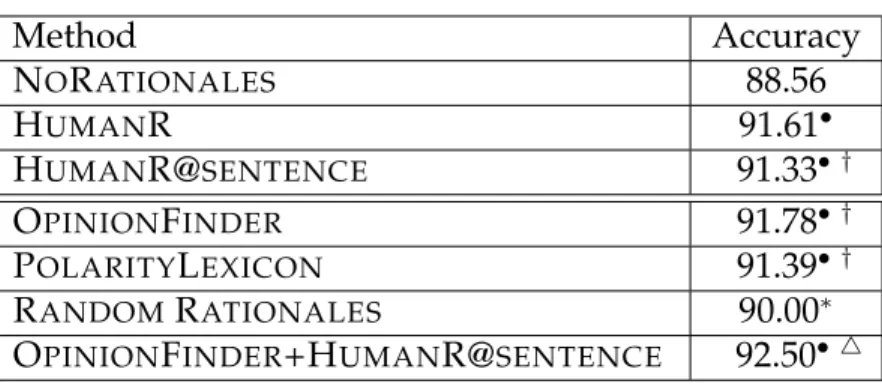
We follow Zaidan et al. (2007) for the training/test data splits. The top half of Table 3.2 shows the performance of a system trained withno annotator ratio-nales vs. two variations of human annotator rationales. The NORATIONALES
system is trained on the full text for each document.
Table 3.2: Experimental results for the movie review data.
Method Accuracy NORATIONALES 88.56 HUMANR 91.61• HUMANR@SENTENCE 91.33• † OPINIONFINDER 91.78• † POLARITYLEXICON 91.39• † RANDOMRATIONALES 90.00∗
OPINIONFINDER+HUMANR@SENTENCE 92.50• 4
– The numbers marked with • (or ∗) are statistically significantly better than NORATIONALESaccording to a paired t-test withp < 0.001(orp < 0.01).
– The numbers marked with 4 are statistically significantly better than HU
-MANR according to a paired t-test withp < 0.01.
– The numbers marked with† are not statistically significantly worse than the human rationales (HUMANR) according to a paired t-test withp > 0.1.
HUMANR treats each rationale in the same way as Zaidan et al. (2007). HU
-MANR@SENTENCEextends the human annotator rationales to sentence
bound-aries, and then treats each such sentence as a separate rationale. As shown in Table 3.2, we get almost the same performance from these two variations (91.33% and 91.61%).7 This result demonstrates that locking rationales to
sen-7The performance of H
tence boundaries was a reasonable choice.
Among the approaches that make use of only automatic rationales (bottom half of Table 3.2), the best is OPINIONFINDER, reaching 91.78% accuracy. This result is slightly better than results exploiting human rationales (91.33-91.61%), although the difference is not statistically significant. This result demonstrates that automatically generated rationales are just as good as human rationales in improving document-level sentiment classification. Similarly strong results are obtained from the POLARITYLEXICONas well.
Rather unexpectedly, RANDOM RATIONALES also achieves statistically sig-nificant improvement over NORATIONALES (90.0% vs. 88.56%). However, no-tice that the performance of RANDOMRATIONALES is statistically significantly lower than those based on human rationales (91.33-91.61%).
In our experiments so far, we observed that some of the automatic rationales are just as good as human rationales in improving the document-level sentiment classification. Could we perhaps achieve an even better result if we combine the automatic rationales with human rationales? The answer is yes! The accuracy of
OPINIONFINDER+HUMANR@SENTENCE reaches 92.50%, which is statistically
significantly better than HUMANR (91.61%). In other words, not only can our automatically generated rationales replace human rationales, but they can also improve upon human rationales when they are available.
3.3.2
Experiments with Product Reviews
We next evaluate our approaches on datasets for which human annotator ra-tionales do not exist. For this, we use some of the product review data from Blitzer et al. (2007): reviews for Books, DVDs, Videos and Kitchen appliances.
the performance we get (91.61%) and the oracle accuracy we get if we knew the best parameters for the test set (92.67%).
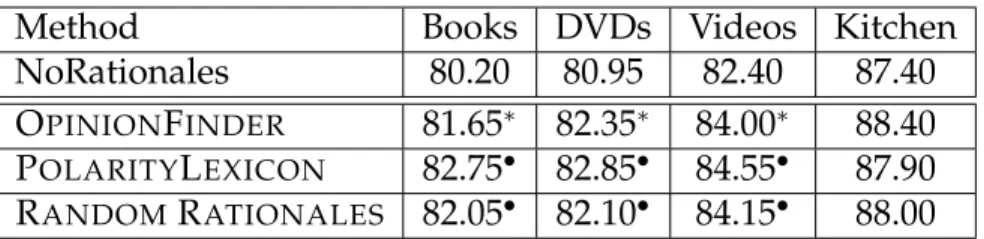
Each dataset contains 1000 positive and 1000 negative reviews. The reviews, however, are substantially shorter than those in the movie review dataset: the average number of sentences in each review is 9.20/9.13/8.12/6.37 respectively vs. 30.86 for the movie reviews. We perform 10-fold cross-validation, where 8 folds are used for training, 1 fold for tuning parameters, and 1 fold for testing. Table 3.3 shows the results.
Table 3.3: Experimental results for Product Review data.
Method Books DVDs Videos Kitchen
NoRationales 80.20 80.95 82.40 87.40
OPINIONFINDER 81.65∗ 82.35∗ 84.00∗ 88.40
POLARITYLEXICON 82.75• 82.85• 84.55• 87.90
RANDOMRATIONALES 82.05• 82.10• 84.15• 88.00
– The numbers marked with • (or ∗) are statistically significantly better than NORATIONALESaccording to a paired t-test withp < 0.05(orp <0.08).
Rationale-based methods perform statistically significantly better than NO
-RATIONALES for all but the Kitchen dataset. An interesting trend in product
review datasets is that RANDOM RATIONALES rationales are just as good as other more sophisticated rationales. We suspect that this is because product re-views are generally shorter and more focused than the movie rere-views, thereby any randomly selected sentence is likely to be a good rationale. Quantitatively, subjective sentences in the product reviews amount to 78% (McDonald et al. (2007)), while subjective sentences in the movie review dataset constitute only about 25% (Mao and Lebanon (2006)).
3.3.3
Examples of Automatically Acquired Informative
Sen-tences
In this section, we examine an example to compare the automatically gener-ated rationales (using OPINIONFINDER) with human annotator rationales for
the movie review data. In the following positive document snippet, automatic rationales are underlined, whilehuman-annotated rationalesare in bold face.
...