Covariate-Shift Adaptation with Cause and Effect Features
Julius von Kügelgen1,2 Alexander Mey3 Marco Loog3,4 1Max Planck Institute for
Intelligent Systems, Germany
2Univ. of Cambridge, United Kingdom
3Delft Univ. of Technology, The Netherlands
4Univ. of Copenhagen, Denmark
Abstract
Current methods for covariate-shift adapta-tion use unlabelled data to compute impor-tance weights or domain-invariant features, while the final model is trained on labelled data only. Here, we consider a particular case of covariate shift which allows us also to learn from unlabelled data, that is, com-bining adaptation with semi-supervised learn-ing. Using ideas from causality, we argue that this requires learning with both causes,XC, and effects, XE, of a target variable,Y, and show how this setting leads to what we call a semi-generative model,P(Y, XE|XC, θ). Our approach is robust to domain shifts in the distribution of causal features and leverages unlabelled data by learning a direct map from causes to effects. Experiments on synthetic data demonstrate significant improvements in classification over purely-supervised and importance-weighting baselines.
1
INTRODUCTION
With advances in algorithms and hardware, the amount of high-quality, labelled training data is becoming the bottleneck for many machine learning tasks. Meth-ods for making good use of available unlabelled data are thus an active area of research with great poten-tial. Two established methods addressing this issue are semi-supervised learning and domain adaptation. Semi-supervised learning aims to improve a model of
P(Y|X) through a better estimate of the marginal
P(X), obtainable via unlabelled data from the same distribution (Chapelle et al., 2010). However, due to
Proceedings of the 22nd International Conference on
Ar-tificial Intelligence and Statistics (AISTATS) 2019, Naha, Okinawa, Japan. PMLR: Volume 89. Copyright 2019 by the author(s).
different data sources, experimental set-ups, or sam-pling processes, this i.i.d. assumption is often violated in practice (Storkey, 2009). Domain adaptation, on the other hand, aims to adapt a model trained on a source domain (or distribution) to a different, but related target distribution from which no, or only lim-ited, labelled data is available (Pan and Yang, 2010; Quionero-Candela et al., 2009). This situation arises, for example, when training and test sets are not drawn from the same distribution.
This paper aims to investigate the possibility of semi-supervised learning in a domain adaptation setting, that is, not only adapting but also actively improv-ing a model given unlabelled data fromdifferent dis-tributions. Here, we focus on the most commonly used and well-studied assumption in domain adapta-tion: the covariate-shift assumption (Shimodaira, 2000; Sugiyama and Kawanabe, 2012).
With D = 0 and D = 1 indicating source and tar-get domains respectively, covariate shift states that the difference in distributions arises exclusively as a consequence of a shift in the marginal distributions,
P(X|D = 0) 6= P(X|D = 1), while the conditional,
P(Y|X), remains invariant. Using the domain variable
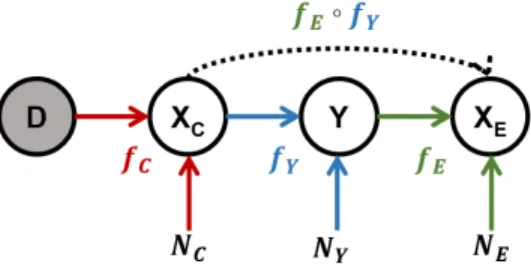
Dthis assumption can thus be formulated asY ⊥⊥D|X. Assuming that changes inP(X)are caused externally (D−→X)–as opposed to some internal process like, for example, a sampling bias (X −→D orY −→D)– this covariate-shift assumption thus implicitly treats all fea-tures as causal (X−→Y) (Storkey, 2009), for otherwise the v-structure at X (D−→X←−Y) would introduce a conditional dependence of Y on the domain D given
X (Koller and Friedman, 2009).
Recent work argued that semi-supervised learning should not be possible in such a causal learning setting (X →Y) asP(X)andP(Y|X)should be independent mechanisms in this case (Janzing and Schölkopf, 2010; Schölkopf et al., 2012). In other words, the conditional distributions of each variable given its causes (i.e., its mechanism) represent “autonomous modules that do not inform or influence each other” (Peters et al., 2017).
Figure 1: Causal graph of our setting for combining semi-supervised learning and covariate-shift adaptation by learning with both cause- (XC) and effect (XE) features. D indicates the domain, or distribution.
In the causal setting, a better estimate of P(X) ob-tainable from unlabelled data should thus not help to improve the estimate of the independent mechanism
P(Y|X). With effect features (Y −→X), on the other hand, semi-supervised learning is, in principle, possible (Janzing and Schölkopf, 2015).
This need for effect features for semi-supervised learn-ing motivates considerlearn-ing the specific case of covari-ate shift shown in Fig. 1. Note that, by the same v-structure argument as before, we requireD 6−→XE for covariate shift to hold. We thus assume throughout that–through prior causal discovery, expert knowledge, or background information–the underlying causal struc-ture is known and compatible with Fig. 1. We will make this assumption precise and discuss a possible relaxation in Sec. 3.1.
While requiring particular causal relationships between variables to be known a priori may seem a restrictive assumption, we have already seen that other commonly made, untestable assumptions such as covariate shift also carry implicit assumptions of a causal nature. Due to the lack of labels from the target distribution, the problem of unsupervised domain adaptation consid-ered in this paper is ill-posed, and thus requires such strong assumptions. Our assumptions enable us to go beyond adaptation and to explore the possibility of semi-supervised learning away from the i.i.d. setting when the underlying causal structure is known. The following two examples constitute real-world sce-narios which are compatible with the considered setting of prediction from cause and effect features.
1. Predicting disease,Y, from risk factors like genetic predisposition or smoking, XC, and symptoms,
XE: while we might have (possibly unlabelled) data from multiple geographical regions or demo-graphic groups leading to different distributions over risk factors (D→XC), we would not neces-sarily expect this to affect the behaviour of the disease itself (XC→Y →XE).
2. Predicting a hidden intermediate stateY of a phys-ical system with inputsXCand outputsXE: again, we might have data from various experiments with
differing input distributions (D→XC), but the laws of physics or nature (XC→Y →XE) should not change.
We highlight the following contributions:
• We introduce the causally-inspired semi-generative model, P(Y, XE|XC, θ), for learning with cause and effect features, and show how its parameters can be fitted from both labelled and unlabelled data in a covariate-shift adaptation setting using a maximum likelihood approach (Sec. 3).
• We empirically demonstrate that our proposed method yields significant reductions in classifica-tion error on synthetic data (Sec. 4 & 5).
• We show how our method may also be applied for regression, using real-world protein data (Sec. 4).
2
RELATED WORK
A sizeable body of literature has been published on the topic of domain adaptation, see e.g. (Patel et al., 2015) for a recent survey. Our focus is onunsuperviseddomain adaptation under covariate shift where no labels from the target domain are available and the conditional
P(Y|X)remains invariant. In general, the aim is to find a predictor, f : X → Y, which minimizes the target risk, EP(X,Y|D=1)L(f(X), Y), for a given loss function, L. Most previous works on this setting fit into one of two families.
Importance weighting approaches make use of the in-variance of P(Y|X) to rewrite the unknown target distribution asP(X, Y|D= 1) =w(X)P(X, Y|D= 0), where the importance weights w(X) =P(X|D=1)
P(X|D=0) can
be estimated from unlabelled data (Shimodaira, 2000; Sugiyama et al., 2007; Quionero-Candela et al., 2009; Sugiyama and Kawanabe, 2012). This allows for empir-ical risk minimization on the reweighted labelled source sample to approximate the expected target risk. Feature transformation approaches, on the other hand, are based on finding domain invariant features in a new (sub)space (Fernando et al., 2013; Gong et al., 2012). Generally, they learn a mapφ:X → X0s.t. the projected features are as domain invariant as possible,
P(φ(X)|D = 0) ≈P(φ(X)|D = 1). Various criteria have been used to measure such similarity, e.g., MMD (Pan et al., 2011), HSIC (Yan et al., 2017), mutual information withD(Shi and Sha, 2012), or performance of a domain classifier (Ganin et al., 2016). The final model is trained on the transformed labelled sample. Note that in either approach unlabelled data is used only for adaptation, while the final model is trained on
labelleddata only. The current work aims to also include unlabelleddata in the model fitting when labelled data is scarce. To the best of our knowledge, this is the first work addressing this novel setting.
3
LEARNING WITH CAUSE AND
EFFECT FEATURES
We now state our assumptions, show how they lead us to a semi-generative model, and show how to fit its parameters using a maximum-likelihood approach. Note, however, that our semi-generative model can also be applied in a Bayesian way, see Appendix D of the supplementary material for details and further experiments using a Bayesian approach.
3.1 Assumptions
Consider the setting of predicting the outcome of target random variable, Y, from the observation of two dis-joint, non-empty sets of random variables, or features,
XC andXE. Assume that we are given a small, la-belled sample{(xi
C, y i, xi
E)} nS
i=1 from a source domain (D = 0) and a potentially large, unlabelled sample {(xjC, xjE)}nS+nT
j=nS+1from a target domain (D= 1). We
formalise our causal assumptions as motivated in Sec. 1 using Pearl’s framework of a structural causal model (SCM) (Pearl, 2009).
An SCM over a set of random variables{Xi}d i=1 with corresponding causal graph G is defined by a set of structural equations,
Xi:=fi(PAXGi, Ni) for i= 1, . . . , d
wherePAGX
i is the set of causal parents of Xi inG,Ni
are mutually independent, random noise variables, and
fi are deterministic functions.
Assumption 1(Causal structure). The relationship between the random variables XC,Y,XE and the do-main indicator D is accurately captured by the SCM
XC:=fC(D, NC) (1)
Y :=fY(XC, NY) (2)
XE:=fE(Y, NE) (3) whereNC, NY, andNE are mutually independent, and
fC,fY, andfE represent independent mechanisms.
This SCM is shown schematically in Fig. 2. The (unknown) noise distributions together with Eq. (1)-(3) induce a range of observational and interven-tional distributions over (XC, Y, XE) which depend on D. Here, we focus on the two observational dis-tributions arising from the choice of D which we
de-Figure 2: Structural causal model of interest. The dashed arrow illustrates our approach of learning to mapXC toXE which can be seen as a noisy composi-tion of the mechanisms fY andfE.
note by P(XC, Y, XE|D = 0) (source domain) and
P(XC, Y, XE|D= 1)(target domain).1
It is worth pointing out, that Assumption 1 does not allow a direct causal influence of XC on XE, and is thus strictly stronger than necessary. (As stated in Sec. 1,D6−→XEis sufficient for covariate shift to hold.) This assumption of two conditionally independent fea-ture sets given Y also plays a key role in the popu-lar co-training algorithm (Blum and Mitchell, 1998). Interestingly, it has been shown for co-training that performance deteriorates once this assumption is vio-lated and the two feature sets are correvio-lated beyond a certain degree (Krogel and Scheffer, 2004). Similar behaviour can reasonably be expected for our related setting, justifying XC6−→XE.
3.2 Analysis
Given that the joint distribution induced by an SCM factorises into independent mechanisms (Pearl, 2009),
P(X1, . . . , Xd) =Qdi=1P(Xi|PAGXi),
it follows from Assumption 1 that
P(XC, Y, XE|D) =P(XC|D)P(Y|XC)P(XE|Y). (4) It is clear from Eq. (4) that only the distribution of causes is directlyaffected by the domain change, while the two mechanisms generatingY from XC, andXE fromY are invariant across domains. It is this invari-ance which we will exploit by learning a map fromXC to XE from unlabelled data, which can be thought of as a noisy composition of fY andfE as indicated by the dashed arrow in Fig. 2.
Note that changes in the distribution of causes are still propagated through the two independent, domain-invariant mechanisms, P(Y|XC) and P(XE|Y), and
1
Note that even though we focus on the caseD∈ {0,1} here, it should be straight forward to include additional labelled or unlabelled data from different sources as in domain generalisation (Rojas-Carulla et al., 2018).
therebyD alsoindirectlyaffects the distributions over
Y andXE. We also note that for importance weighting it is sufficient to correct for the shift in XC. Writing
w(XC) =PP((XXC|D=1)
C|D=0) it follows from Eq. (4) that P(XC, Y, XE|D= 1) =w(XC)P(XC, Y, XE|D= 0)
(5) Thus conditioning on causal features is sufficient to obtain domain-invariance–an idea which also plays a central role in "Causal inference using invariant predic-tion" (Peters et al., 2016).
Since it is the aim of domain adaptation to min-imise the target-domain risk, we are interested in obtaining a good estimate of the target conditional,
P(Y|XC, XE, D= 1). From Eq. (4), we have
P(Y|XC, XE, D) = P(XC, Y, XE|D) P(XC, XE|D) = PP(Y|XC)P(XE|Y) y∈YP(y|XC)P(XE|y) . (6)
As the last term does not depend onD, this shows that covariate shift indeed holds, as intended by construc-tion. While it would be possible to write the target conditional differently, only conditioning onXC as in Eq. (6) leads to a domain invariant expression. Such invariance is necessary since, due to a lack of target la-bels, the numerator involving Y can only be estimated in the source domain.
Moreover, Eq. (6) shows that the conditional
P(Y|XC, XE)can be expressed exclusively in terms of the mechanisms P(Y|XC)andP(XE|Y), and is thus independent of the distribution over causes, P(XC|D). A better estimate ofP(XC|D)obtainable from unla-belled data will thus not help improve our estimate of
P(Y|XC, XE). This is consistent with the claims of Schölkopf et al. (2012) that the distribution of causal features is useless for semi-supervised learning, while that of effect features may help. Another way to see this is directly from the data generating process, i.e., the SCM in Assumption 1. While Eq. (1) does not depend on Y (which is only drawnafterXC), Eq. (3) clearly does.
What is novel about our approach is explicitly consid-ering both cause and effect features at the same time. Substituting Eq. (2) into Eq. (3) we obtain
XE=fE fY(XC, NY), NE
,
so that learning to predictXE fromXC we may hope to improve our estimates of fY and fE. In terms of the induced distribution, this corresponds to improving our estimates ofP(Y|XC)andP(XE|Y)via a better estimate ofP(XE|XC), which we will refer to as the unsupervised model. This is possible since parameters
are shared between the supervised and unsupervised models.
3.3 Semi-Generative Modelling Approach Our analysis of the different roles played by XC and
XEsuggest explicitly modelling the distribution ofXE, while conditioning onXC,
P(Y, XE|XC, θ) =P(Y|XC, θY)P(XE|Y, θE), (7)
whereθ= (θY, θE). We refer to the model on the LHS assemi-generative, as it can be seen as an intermediate between fully generative, P(XC, Y, XE|θ), and fully discriminative,P(Y|XC, XE, θ).
As opposed to a fully-generative model, our semi-generative model is domain invariant due to condi-tioning on XC and can thus be fitted using data from both domains. At the same time, as opposed to a fully-discriminative model, the semi-generative model also allows including unlabelled data by summing (or integrating ifY is continuous) outY,
P(XE|XC, θ) =
X
y∈Y
P(Y =y, XE|XC, θ) (8)
For our setting, a semi-generative framework thus com-bines the best from both worlds: domain invariance and the possibility to include unlabelled data in the parameter fitting process.
It is clear from Eq. (8) that we can always obtain the unsupervised model exactly for classification tasks. For regression, however, we are restricted to particular types of mechanisms P(Y|XC, θY) and P(XE|Y, θE) for which the integral can be computed analytically. Otherwise we have to resort to approximating Eq. (8). Our approach can then be summarised as follows. We train a semi-generative model P(Y, XE|XC, θ), formed by the two mechanismsP(Y|XC, θY)andP(XE|Y, θE), on the labelled sample, such that the corresponding un-supervised modelP(XE|XC, θ)(Eq. 8) agrees well with the unlabelled cause-effect pairs. For prediction, given a parameter estimateθ, the conditionalP(Y|XC, XE, θ) can then easily be recovered from P(Y|XC, θY) and
P(XE|Y, θE)as in Eq. (6).
3.4 Fitting by Maximum Likelihood
The average log-likelihood of our semi-generative model given the labelled source data is given by
`S(θ) = 1 nS nS X i=1 logP(yi, xiE|xiC, θ) (9)
and importance-weighting by w(XC) as described in Eq. (5) yields the weighted, or adapted, form
`W S(θ) = 1 nS nS X i=1 w(xiC) logP(yi, xiE|xiC, θ). (10)
The corresponding average log-likelihood of the unsu-pervised model given unlabelled target data is
`T(θ) = 1 nT nS+nT X j=nS+1 logP(xjE|xjC, θ) = 1 nT nS+nT X j=nS+1 log X y∈Y P(y, xiE|xiC, θ). (11)
We propose to combine labelled and unlabelled data in a pooled log-likelihood by interpolating between average source (Eq. 9) and target (Eq. 11) log-likelihoods,
`λP(θ) =λ `S(θ) + (1−λ)`T(θ), (12) where the hyperparameterλ∈[0,1]has an interpreta-tion as the weight of the labelled sample. For example,
λ= 1 corresponds to using only the labelled sample, whereasλ= nS
nS+nT gives equal weight to labelled and
unlabelled examples, see Sec. 4.4 for more details.
4
EXPERIMENTS
Since it is our goal to improve model performance with unlabelled data (nT) when the amount of labelled data (nS) is the main limiting factor, we focus in our experiments on the case of small nS (relative to the dimensionality) and compare learning curves asnT is increased.
4.1 Estimators and Compared Methods We compare our approach with purely-supervised and importance-weighting approaches which take the known causal structure (Assumption 1) into account:
• θˆS = arg maxθ`S(θ) – training on the labelled source data only (baseline, no adaptation) • θˆW S = arg maxθ`W S(θ)– training on reweighted
source data (adaptation by importance-weighting using known weights on the synthetic datasets) • θˆPλ = arg maxθ`λP(θ) – training on the entire
pooled data set combining unweighted labelled and unlabelled data via λ (our proposed esti-mator)
Where applicable, we report the performance of a lin-ear/logistic regression model,θˆLR, trained on the joint
-4 -3 -2 -1 0 1 2 3 4 X C -4 -3 -2 -1 0 1 2 3 XE Y=0 (target) Y=1 (target) Y=0 (source) Y=1 (source)
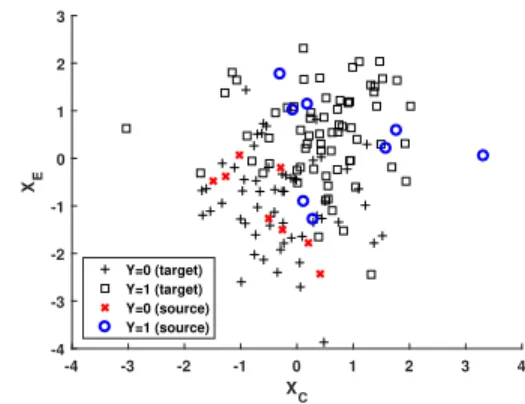
Figure 3: An example of synthetic classification data.
feature set(XC, XE), i.e., ignoring the known causal structure. Moreover, we also considerθˆLR trained af-ter applying different feature transformation methods: TCA (Pan et al., 2011), MIDA (Yan et al., 2017), SA (Fernando et al., 2013), and GFK (Gong et al., 2012). For this we use the domain-adaptation toolbox by Ke Yan with default parameters (Yan, 2016).
4.2 Synthetic Classification Data
To generate synthetic domain-adaptation datasets for binary classification which satisfy the assumed causal structure we draw from the following SCM:
XC:= ( µC+C if D= 0, −µC+C if D= 1, C∼ N(0,1) Y := ( 1 if Y ≤σ(XC−m), 0 if Y > σ(XC−m), Y ∼U(0,1) XE:= ( µ0+E if Y = 0, µ1+E if Y = 1, E∼ N(0,1)
whereσ(x) = (1 +e−x)−1 is the logistic sigmoid func-tion. The resulting datasets all have linear decision boundaries, but can differ in domain-discrepancy, class-imbalance, and class-overlap or difficulty, depending on the choice of µC, mandµ0/1, respectively. For one such choice, an example draw is shown in Fig. 3. This data generating process induces the distributions
Y|(XC=xC)∼Bernoulli σ(xC−m)
XE|(Y =y)∼ N(µy,1).
The corresponding unsupervised model (Eq. 8) for an unlabelled cause-effect pair(xC, xE)is thus given by
P(xE|xC, θ) =
φ(xE|µ0,1)e−(xC−m)+φ(xE|µ1,1) 1 +e−(xC−m)
where φ(x|µ, σ2) denotes the pdf of a normal ran-dom variable with mean µ and standard deviation
σ. Together withP(Y|XC, θY)andP(XE|Y, θE)given above, Eq. (13) suffices to compute our estimator. Note that, like a logistic regression model, our model has three parameters: θ= (m, µ0, µ1).
In addition, to test our approach in a discrete and higher-dimensional setting, we apply our approach to the LUCAS toy dataset2, treating ’Lung Cancer’
as target Y, ’Smoking’ and ’Genetics’ as causes XC, ’Caughing’ and ’Fatigue’ as effectsXE, and ’Anxiety’
as domain indicatorD.
4.3 Real-World Regression Data
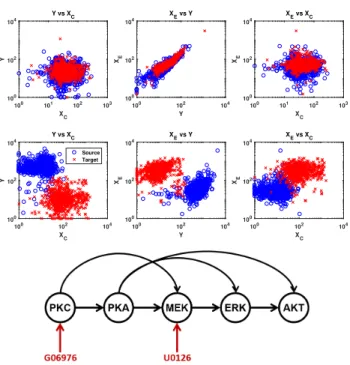
To demonstrate how a semi-generative model can be used for linear regression, we apply our approach to the “Causal Protein-Signaling Network” data by Sachs et al. (2005), which contains single-cell measurements of 11 phospho-proteins and phospho-lipids under 14 different experimental conditions, as well as–important for our method–the corresponding inferred causal graph. We focus on a subset of variables which seems most com-patible with our assumptions3, and from which we ex-tract two domain adaptation datasets by taking source data to correspond to normal conditions while target data is obtained by intervention on the causal feature, see Fig. 4. As can be seen,D1(MEK−→ERK−→AKT) shows a high similarity between domains, whereasD2 (PKC−→PKA−→AKT) seems more challenging due to high domain discrepancy.
As is often the case with biological data, variables span multiple orders of magnitude and seem to be reasonably-well approximated by power laws. We therefore decide to first transform the data by taking logarithms and then fit a linear model in log-space, corresponding to a power-law relationship in original space. Denoting the log-transformed cause, target, and effect byXC, Y and
XE as before, and using Gaussian noise with unknown variance, this corresponds to the following model
Y :=a+bXC+Y, Y ∼ N(0, σ2Y)
XE:=c+dY +E, E∼ N(0, σ2E),
(14) with corresponding distributions
Y|(XC=xC)∼ N(a+bxC, σY2)
XE|(Y =y)∼ N(c+dy, σ2E) (15)
2
http://www.causality.inf.ethz.ch/data/LUCAS. html
3Assumption 1 is not fully satisfied because of the
ex-istence of confounding variables (e.g., PKA, see Fig. 4), so that conclusions drawn may be limited. With causal inference and causal structures becoming of interest in more and more areas, however, more suitable real-world data will eventually become abundant. At this point our work should thus be considered more methodological in nature.
100 101 102 103 X C 100 102 104 Y Y vs X C 100 102 104 Y 100 102 104 XE X E vs Y 100 101 102 103 X C 100 102 104 XE X E vs XC 100 102 104 XC 100 102 104 Y Y vs XC Source Target 100 102 104 Y 100 102 104 XE XE vs Y 100 102 104 XC 100 102 104 XE XE vs XC
Figure 4: Protein count data sets for MEK−→ERK−→AKT (D1, top) and PKC−→ PKA−→AKT (D2, middle) in log-log scale. Tar-get domain data is obtained by interventions, shown by red arrows in the inferred causal graph (bottom).
Substituting for Y in the second line of Eq. (14), and given that the sum of two Gaussian random variables is again Gaussian, we can compute the unsupervised model (Eq. 8) in this case as follows:
XE|(XC=xC)∼ N(c+ad+bdxC, d2σ2Y +σE2) (16) Eq. (14) and (16) combined allow to compute our pro-posed estimator. To make predictions given a parame-ter estimate, we need to compute the arg max of the conditional (Eq. 6). It is given by
ˆ y= arg max y P(Y =y|XC=xC, XE=xE, θ) =σ 2 E(a+bxC) +d2σY2( xE−c d ) σ2 E+d2σY2 (17)
which can be interpreted as a weighted average of the predictions of each of the two independent mechanisms. A detailed derivation of Eq. (17) can be found in the supplementary material, Appendix A.
To investigate how background knowledge can aid our approach in challenging real-world applications, we also fit a model under the constraint b, d≤0, that is, fit-ting lines with negative slope on the harder data set D2. This constraint captures that both PKC→PKA and PKA→AKT appear to be inverse relationships– something which may be known in advance from do-main expertise.
4.4 Choosing the Hyperparameter λ
To chooseλ∈[0,1], we performed extensive empirical evaluation on synthetic data considering different com-binations of nS andnT, the results of which can be found in the supplement, Appendix C. For classifica-tion, data was generated as detailed in Sec. 4.2 with a fixed choice of parameters. For regression, we used a linear Gaussian model to generate synthetic data. For classification, we found that λ(nS, nT) = nSn+SnT, giving equal weight to all observations (c.f. Eq. 12), i.e., more weight to the unsupervised model as nT is increased, seems to be a good choice across settings. In contrast, for linear regression a good choice ofλdoes not seem to depend strongly on nS andnT. Rather than weighting all observations equally, values of λ giv-ing the fixed majority weight to the average supervised model appear to be preferred. We thus choose a con-stantλ= 0.8for our regression experiments. Note, how-ever, that this value can be further increased when more labelled data becomes available (e.g., λ(nS) = 1−n1
S)
and the unsupervised model becomes obsolete.
4.5 Simulations and Evaluation
For synthetic classification experiments, we fixµC = −1, m = 0 and vary µ0, and µ1 as indicated in the figure captions. We thus consider different amounts of labelled data and class-overlap, or difficulty. We perform 104 simulations, each time drawing a new training set of size(nS+nT)and a new target-domain test set of size103. We report test-set averages of error rate and semi-generative negative log-likelihood (NLL), −logP(Y, XE|XC, θ). The latter is the quantity our model is trained to minimise, and thus acts as a proxy or surrogate for the non-convex, discontinuous 0-1 loss. For real-world regression experiments, we draw nS la-belled source training data, and reserve 200 target ob-servations as test set. From the remaining target data, we then drawnT = 2,4, ...,512additional unlablelled training data. (Each experiment performed by Sachs et al. (2005) contains ca. 1000 measurements.) We perform103 simulations and report test set averages of root mean squared error (RMSE).
Code to reproduce all our results is available online.4
5
DISCUSSION
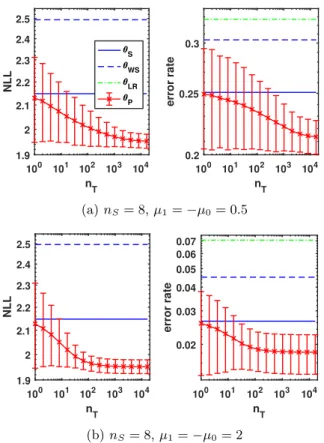
Classification results for two synthetic datasets are shown in Fig. 5. For both the more difficult (5a, Bayes error rate ≈ 0.21), and the simpler (5b) data sets,
4 https://github.com/Juliusvk/ Semi-Generative-Modelling 100 101 102 103 104 n T 1.9 2 2.1 2.2 2.3 2.4 2.5 NLL 100 101 102 103 104 n T 0.2 0.25 0.3 error rate S WS LR P (a)nS= 8,µ1=−µ0= 0.5 100 101 102 103 104 n T 1.9 2 2.1 2.2 2.3 2.4 2.5 NLL 100 101 102 103 104 n T 0.02 0.03 0.04 0.05 0.06 0.07 error rate (b)nS= 8,µ1=−µ0 = 2
Figure 5: Test set averages of negative log-likelihood (NLL) and error rate on synthetic classification data in log-log scale, using λ= nS
nS+nT. Error bars indicate
one standard deviation. Different values ofµ0 andµ1 lead to larger (a) or smaller (b) class overlap. This is reflected in the overall error rates. Note that the Bayes error rate in (a) is≈0.21.
average error rate and variance are monotonically de-creasing as a function of nT, leading to significant (paired t-test withp0.05) improvements ofθP over
θS, θW S, and θLR when sufficient unlabelled data is available. A very similar behaviour is observed for the semi-generative NLL, indicating that it is a suitable surrogate loss. Whereas the largest absolute drop in error rate (∼ 4%) is achieved on the more difficult dataset, the largest relative improvement (∼30%) and earlier saturation occur when–due to the larger abso-lute value of µ0/1–XE carries more information about
Y. The latter is intuitive as XE can be interpreted as a second label in this case.
Results for the LUCAS toy data in Table 1 show similar behaviour to those in Figure 5, and demonstrate that our approach is suitable also for discrete data and higher dimensional features.
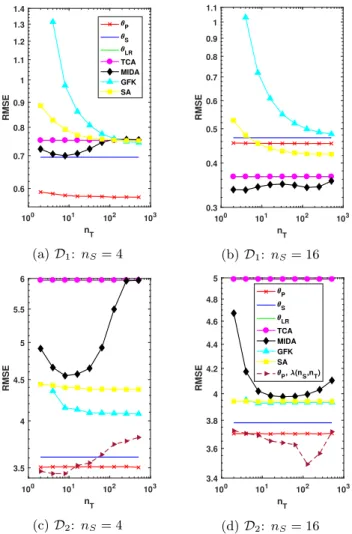
Regression results on the real datasets are shown in Fig. 6. On the simplerD1, our approach outperforms the others when only four labelled observations are
Table 1: Classification test set error rates on the toy LUCAS dataset forλ=nS/(nS+
√
nT).
nS\nT 0 1 4 16 64 256
8 0.232 0.230 0.226 0.220 0.212 0.208 16 0.206 0.205 0.203 0.198 0.192 0.188
available (6a). As nS is increased to 16 (6b), how-ever, feature transformation methods gain the upper hand. Given that evenθLR (coinciding with the curve of TCA) yields better results in this case, a possible explanation is that–due to the common confounder PKA (see Fig. 4)–our assumptions are violated. On the much more challenging D2, none of the methods yields low RMSE, but the restricted version of our ap-proach performs best, followed by the restricted version of the purely-supervised baseline.
Comparison with Feature-Transformation Methods The case of D2 illustrates a potential advantage of our approach for real-world applications. Since we use raw features, it is possible to incorporate available domain expertise in the model. Since variables resulting from a transformation of the joint feature set are no longer easily interpretable, including background knowledge is much harder for transformed features. As such transformations can also introduce new dependencies between variables, it is not clear how our approach and feature transformations can be easily combined. An interesting idea though could be to relax the assumptionD6−→XE, and then try to correct for the shift inXE due toD by learning a transformation of XE only which maximises domain invariance of
φ(XE)|XC prior to applying our approach. As a final note, runtime of our method is roughly an order of magnitude less than for feature-transformation methods.
Combination with Importance Weighting Im-portance weighting, on the other hand, should not be seen as an alternative, but rather as complementary to our approach. Through the unlabelled target sam-ple we obtain an estimate of P(XC, XE|D = 1) =
P(XC|D= 1)P(XE|XC). The first factor can be used to estimate importance weights, whereas our work has focused on improving the model via information carried by the second factor. Both ideas could be combined by forming a weighted pooled log-likelihood, `λ
W P, by replacing`S by`W S in Eq. (12).
Model Flexibility and Role of λ It seems our ap-proach is more promising for classification than for regression tasks. Too much emphasis on the unlabeled data (as controlled by λ) can, for regression in
par-100 101 102 103 n T 0.6 0.7 0.8 0.9 1 1.1 1.2 1.3 1.4 RMSE P S LR TCA MIDA GFK SA (a)D1: nS= 4 100 101 102 103 n T 0.3 0.4 0.5 0.6 0.7 0.8 0.9 1 1.1 RMSE (b)D1: nS= 16 100 101 102 103 n T 3.5 4 4.5 5 5.5 6 RMSE (c)D2: nS= 4 100 101 102 103 nT 3.4 3.6 3.8 4 4.2 4.4 4.6 4.8 5 RMSE P S LR TCA MIDA GFK SA P, (nS,nT) (d)D2: nS= 16
Figure 6: Test set averages of RMSE on the real-world regression data sets (Sachs et al., 2005) in log-log scale, using λ = 0.8except for the dark red curves on D2 which correspond toλ= nS
nS+nT. On the more difficult
dataset D2 (see the higher RMSE), we restricted θS andθP to lines with negative slope.
ticular, lead to overfitting of the unsupervised model. This can be observed on D2 for large enough nT us-ing λ(nS, nT), and is further illustrated on synthetic data in the supplement, Appendix B. Since the main difference between regression and classification in our approach is summing over a finite-, or integrating over an infinite number ofy when computing the unsuper-vised model (Eq. 8), we conjecture that model flexibility plays an important role in determining the success of our approach. If there is a bottleneck at Y, so that only few valuesy can explain a given cause-effect pair (xC, xE), then the unsupervised model can help to improve our estimates of P(Y|XC)andP(XE|Y), as demonstrated for the case of binary classification. If, on the other hand, many possible y can explain the observed (xC, xE)equally well, then the unsupervised model appears to be less useful.
Acknowledgements
The authors would like to thank Adrian Weller and Michele Tonutti for helpful feedback on the manuscript.
References
A. Blum and T. Mitchell. Combining labeled and unlabeled data with co-training. InProceedings of the eleventh annual conference on Computational learning theory, pages 92–100. ACM, 1998.
O. Chapelle, B. Schölkopf, and A. Zien. Semi-Supervised Learning. The MIT Press, 1st edition, 2010.
B. Fernando, A. Habrard, M. Sebban, and T. Tuyte-laars. Unsupervised visual domain adaptation using subspace alignment. In Proceedings of the IEEE international conference on computer vision, pages 2960–2967, 2013.
Y. Ganin, E. Ustinova, H. Ajakan, P. Germain, H. Larochelle, F. Laviolette, M. Marchand, and V. Lempitsky. Domain-adversarial training of neural networks. Journal of Machine Learning Research, 17 (59):1–35, 2016.
B. Gong, Y. Shi, F. Sha, and K. Grauman. Geodesic flow kernel for unsupervised domain adaptation. In Computer Vision and Pattern Recognition (CVPR), 2012 IEEE Conference on, pages 2066–2073. IEEE, 2012.
D. Janzing and B. Schölkopf. Causal inference using the algorithmic markov condition. IEEE Transactions on Information Theory, 56(10):5168–5194, 2010. D. Janzing and B. Schölkopf. Semi-supervised
interpo-lation in an anticausal learning scenario. Journal of Machine Learning Research, 16:1923–1948, 2015. D. Koller and N. Friedman. Probabilistic graphical
models: principles and techniques. MIT press, 2009. M.-A. Krogel and T. Scheffer. Multi-relational learning, text mining, and semi-supervised learning for func-tional genomics. Machine Learning, 57(1-2):61–81, 2004.
S. J. Pan and Q. Yang. A survey on transfer learning. IEEE Transactions on knowledge and data engineer-ing, 22(10):1345–1359, 2010.
S. J. Pan, I. W. Tsang, J. T. Kwok, and Q. Yang. Domain adaptation via transfer component analysis. IEEE Transactions on Neural Networks, 22(2):199– 210, 2011.
V. M. Patel, R. Gopalan, R. Li, and R. Chellappa. Vi-sual domain adaptation: A survey of recent advances. IEEE signal processing magazine, 32(3):53–69, 2015. J. Pearl. Causality. Cambridge university press, 2009.
J. Peters, P. Bühlmann, and N. Meinshausen. Causal inference by using invariant prediction: identification and confidence intervals. Journal of the Royal Sta-tistical Society: Series B (StaSta-tistical Methodology), 78(5):947–1012, 2016.
J. Peters, D. Janzing, and B. Schölkopf. Elements of Causal Inference - Foundations and Learning Algo-rithms. Adaptive Computation and Machine Learn-ing Series. The MIT Press, Cambridge, MA, USA, 2017.
J. Quionero-Candela, M. Sugiyama, A. Schwaighofer, and N. D. Lawrence. Dataset shift in machine learn-ing. The MIT Press, 2009.
M. Rojas-Carulla, B. Schölkopf, R. Turner, and J. Pe-ters. Invariant models for causal transfer learning. Journal of Machine Learning Research, 19(36), 2018. K. Sachs, O. Perez, D. Pe’er, D. A. Lauffenburger, and G. P. Nolan. Causal protein-signaling networks derived from multiparameter single-cell data.Science, 308(5721):523–529, 2005.
B. Schölkopf, D. Janzing, J. Peters, E. Sgouritsa, K. Zhang, and J. Mooij. On causal and anticausal learning. In29th International Conference on Ma-chine Learning (ICML 2012), pages 1–8. Interna-tional Machine Learning Society, 2012.
Y. Shi and F. Sha. Information-theoretical learning of discriminative clusters for unsupervised domain adaptation. InProceedings of the 29th International Coference on International Conference on Machine Learning, pages 1275–1282. Omnipress, 2012. H. Shimodaira. Improving predictive inference under
covariate shift by weighting the log-likelihood func-tion. Journal of statistical planning and inference, 90(2):227–244, 2000.
A. Storkey. When training and test sets are different: characterizing learning transfer. Dataset shift in machine learning, pages 3–28, 2009.
M. Sugiyama and M. Kawanabe. Machine learning in non-stationary environments: Introduction to covari-ate shift adaptation. MIT press, 2012.
M. Sugiyama, M. Krauledat, and K.-R. Müller. Covari-ate shift adaptation by importance weighted cross validation. Journal of Machine Learning Research, 8 (May):985–1005, 2007.
K. Yan. Domain adaptation toolbox.https://github.
com/viggin/domain-adaptation-toolbox, 2016.
K. Yan, L. Kou, and D. Zhang. Learning domainvariant subspace using domain features and in-dependence maximization. IEEE transactions on cybernetics, 2017.