optimisation problems. PhD thesis, University of
Nottingham.
Access from the University of Nottingham repository: http://eprints.nottingham.ac.uk/29960/1/main.pdf
Copyright and reuse:
The Nottingham ePrints service makes this work by researchers of the University of Nottingham available open access under the following conditions.
· Copyright and all moral rights to the version of the paper presented here belong to
the individual author(s) and/or other copyright owners.
· To the extent reasonable and practicable the material made available in Nottingham
ePrints has been checked for eligibility before being made available.
· Copies of full items can be used for personal research or study, educational, or
not-for-profit purposes without prior permission or charge provided that the authors, title and full bibliographic details are credited, a hyperlink and/or URL is given for the original metadata page and the content is not changed in any way.
· Quotations or similar reproductions must be sufficiently acknowledged.
Please see our full end user licence at:
http://eprints.nottingham.ac.uk/end_user_agreement.pdf A note on versions:
The version presented here may differ from the published version or from the version of record. If you wish to cite this item you are advised to consult the publisher’s version. Please see the repository url above for details on accessing the published version and note that access may require a subscription.
Multi-stage Hyper-heuristics for
Optimisation Problems
Ahmed Kheiri, B.Sc. (Hons), M.Sc.
Thesis submitted to the University of Nottingham for the degree of Doctor of Philosophy
There is a growing interest towards self configuring/tuning automated general-purpose reusable heuristic approaches for combinatorial optimisation, such as, hyper-heuristics. Hyper-heuristics are search methodologies which explore the space of heuristics rather than the solutions to solve a broad range of hard computational problems without re-quiring any expert intervention. There are two common types of hyper-heuristics in the literature: selection and generation methodologies. This work focusses on the former type of hyper-heuristics. Almost all selection hyper-heuristics perform a single point based iterative search over the space of heuristics by selecting and applying a suitable heuristic to the solution in hand at each decision point. Then the newly generated so-lution is either accepted or rejected using an acceptance method. This improvement process is repeated starting from an initial solution until a set of termination criteria is satisfied. The number of studies on the design of hyper-heuristic methodologies has been rapidly increasing and currently, we already have a variety of approaches, each with their own strengths and weaknesses. It has been observed that different hyper-heuristics perform differently on a given subset of problem instances and more importantly, a hyper-heuristic performs differently as the set of low level heuristics vary. This the-sis introduces a general “multi-stage” hyper-heuristic framework enabling the use and exploitation of multiple selection hyper-heuristics at different stages during the search process. The goal is designing an approach utilising multiple hyper-heuristics for a more effective and efficient overall performance when compared to the performance of each constituent selection hyper-heuristic. The level of generality that a hyper-heuristic can achieve has always been of interest to the hyper-heuristic researchers. Hence, a vari-ety of multi-stage hyper-heuristics based on the framework are not only applied to the real-world combinatorial optimisation problems of high school timetabling, multi-mode resource-constrained multi-project scheduling and construction of magic squares, but also tested on the well known hyper-heuristic benchmark of CHeSC 2011. The empir-ical results show that the multi-stage hyper-heuristics designed based on the proposed framework are still inherently general, easy-to-implement, adaptive and reusable. They can be extremely effective solvers considering their success in the competitions of ITC 2011 and MISTA 2013. Moreover, a particular multi-stage hyper-heuristic outperformed the state-of-the-art selection hyper-heuristic from CHeSC 2011.
I would like to express my profound gratitude to Almighty God for all the physical and mental strength He bestowed on me during all the activities of the project and finally during the preparation of this thesis.
I am deeply grateful to Dr. Ender ¨Ozcan, my supervisor who generously rendered help and encouragement during the process of this thesis. Whatever I have accomplished in pursuing this undertaking is due to his guidance and thoughtful advice. To him my thanks.
I have no doubt that this thesis is stronger because of the collaborative working I have had with Dr. Andrew J. Parkes, Dr. Daniel Karapetyan, Shahriar Asta, Leena N. Ahmed, Mohamed Elsayed, Dr. Moh’d Khaled Yousef Shambour and Dr. Mustafa Mısır.
I would like to thank the examiners, Professor Greet Vanden Berghe and Professor Robert John, for their valuable comments.
Also, I am grateful to all members of the Automated Scheduling, Optimisation and Planning (ASAP) research group for all what I have learnt from them.
My greatest debt is, as always, to my parents, brothers, sisters and my lovely wife who persistently rendered me the much needed support in my academic endeavours.
Abstract i
Acknowledgements ii
List of Figures vi
List of Tables viii
1 Introduction 1
1.1 Research Motivation and Contributions . . . 3
1.2 Structure of Thesis . . . 7
1.3 Academic Publications Produced . . . 7
2 Literature Review 10 2.1 Meta-heuristics . . . 10
2.1.1 Iterated Local Search . . . 11
2.1.2 Tabu Search . . . 12 2.1.3 Simulated Annealing . . . 13 2.1.4 Great Deluge . . . 14 2.1.5 Late Acceptance . . . 15 2.1.6 Evolutionary Algorithms . . . 16 2.2 Selection Hyper-heuristics . . . 17
2.2.1 Classification of Selection Hyper-heuristics . . . 19
2.2.2 Selection Methods . . . 19
2.2.3 Move Acceptance Methods . . . 21
2.2.4 Selection Hyper-heuristic Frameworks . . . 23
2.2.5 Other Trends in Selection Hyper-heuristics . . . 24
2.3 HyFlex Problem Domains and Cross-Domain Heuristic Search Challenge . 25 2.4 High School Timetabling Problem . . . 27
2.5 Multi-mode Resource-constrained Multi-project Scheduling Problem . . . 31
2.6 Constructing Magic Squares . . . 34
2.7 Summary . . . 37
3 Problem Domains 39
3.1 CHeSC 2011: HyFlex Problems . . . 39
3.2 ITC 2011: High School Timetabling Problem . . . 42
3.2.1 Problem Description . . . 42
3.2.2 Test Instances . . . 44
3.2.3 Low Level Heuristics . . . 44
3.3 MISTA 2013 Challenge: Multi-mode Resource-constrained Multi-project Scheduling Problem . . . 48
3.3.1 Problem Description . . . 48
3.3.2 Test Instances . . . 50
3.3.3 Solution Construction . . . 50
3.3.3.1 Construction Phase . . . 52
3.3.4 Low Level Heuristics . . . 55
3.3.4.1 Swap, Insert and Set Operators . . . 55
3.3.4.2 Project-wise Mutational Operators . . . 56
3.3.4.3 Ruin & Recreate Operators . . . 57
3.3.5 Improvement Phase . . . 59
3.4 SolveIT International Optimisation Competition: Constructing Magic Squares . . . 62
3.4.1 Problem Description . . . 62
3.4.2 Low Level Heuristics . . . 64
3.4.2.1 The Late Acceptance Hill Climbing Approach . . . 64
3.4.2.2 Set of Low Level Heuristics . . . 66
3.5 Summary . . . 69
4 Multi-stage Hyper-heuristics 70 4.1 A Multi-stage Hyper-heuristic Framework . . . 72
4.2 Greedy-gradient - Simulated Annealing Hyper-heuristic (GGHH) . . . 74
4.2.1 Origin . . . 74
4.2.2 Methodology . . . 75
4.3 Dominance-based Random Descent/Gradient Hyper-heuristic with Na¨ıve Move Acceptance (DRD) . . . 77
4.3.1 Methodology . . . 77
4.3.1.1 Greedy Stage . . . 78
4.3.1.2 Random Descent/Gradient Stage . . . 80
4.3.1.3 Na¨ıve Move Acceptance . . . 81
4.4 Robinhood Hyper-heuristic with an Adaptive Threshold Acceptance (RHH) 81 4.4.1 Methodology . . . 81
4.5 Selection Hyper-heuristic with an Adaptive Threshold Acceptance (HySST) 83 4.5.1 Methodology . . . 84
4.6 Dominance-based Roulette Wheel Hyper-heuristic with an Adaptive Thresh-old Acceptance (DRW) . . . 87
4.6.1 Methodology . . . 87
4.7 Dominance-based Roulette Wheel Multi-stage Hyper-heuristic using Re-lay Hybridisation and an Adaptive Threshold Acceptance (MSHH) . . . . 90
4.7.1 Stage One Hyper-heuristic . . . 91
4.7.2 Stage Two Hyper-heuristic . . . 93
4.8 Summary . . . 95
5 State-of-the-art in Problem Solving and Multi-stage Hyper-heuristics 98 5.1 HySST in an International Timetabling Competition . . . 99
5.1.1 Performance Analysis . . . 100
5.1.2 ITC 2011 Competition Results . . . 101
5.2 A Hybrid Approach Embedding a Multi-stage Hyper-heuristic . . . 103
5.2.1 Comparison of Different Approaches . . . 107
5.2.2 Performance Analysis of MCTS-DRW and RC-DRW . . . 110
5.3 Testing the Level of Generality of Multi-stage Hyper-heuristics on HyFlex Problems . . . 111
5.3.1 Parameter Settings . . . 117
5.3.2 Performance Comparison to the Constituent Hyper-heuristics . . . 119
5.3.3 Performance Comparison to Multi-stage Hyper-heuristics . . . 119
5.3.4 Performance Comparison to the Mock Competition Hyper-heuristics121 5.3.5 Performance Comparison to the CHeSC 2011 Hyper-heuristics . . 124
5.3.6 An Analysis of the Proposed Hyper-heuristic . . . 128
5.4 Experimental Results on Constructing Magic Square Problem . . . 132
5.4.1 Comparison of MSHH to the Best Known Heuristic Approaches . . 132
5.4.2 Performance Analysis of the Multi-stage Hyper-heuristic . . . 136
5.5 Summary . . . 138
6 Conclusion 141 6.1 Summary of Work . . . 141
6.2 Discussion and Future Work . . . 145
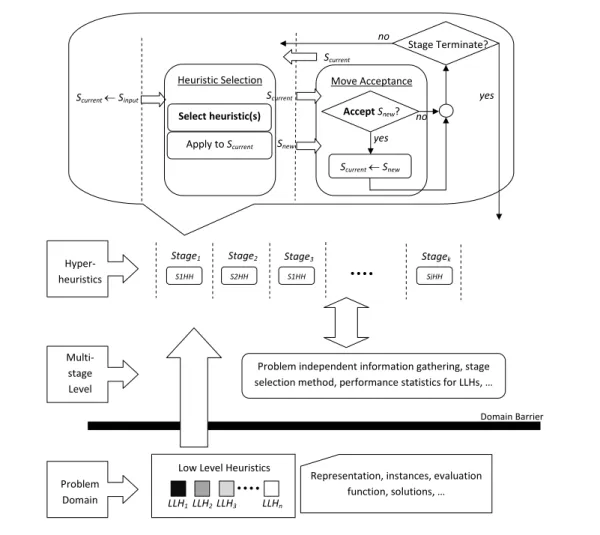
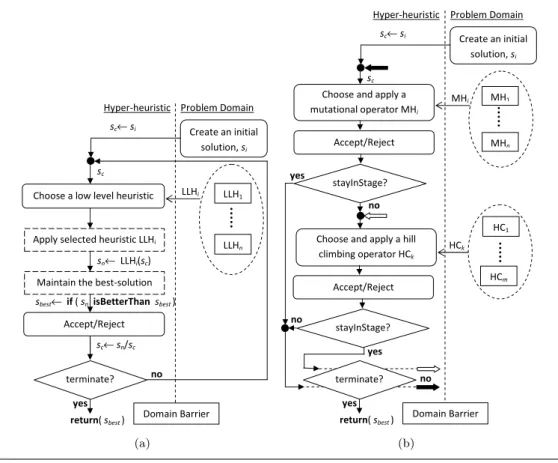
1.1 A selection hyper-heuristic framework and the domain barrier . . . 2 2.1 Illustration of how a single point based selection hyper-heuristic operates 18 2.2 The Loh-Shu tortoise and the magic square [1] . . . 35 4.1 A multi-stage hyper-heuristic framework . . . 73 4.2 An illustration showing how the list of active heuristics is built . . . 80 4.3 Illustration of a (a) generic and (b) HySST multi-stage selection
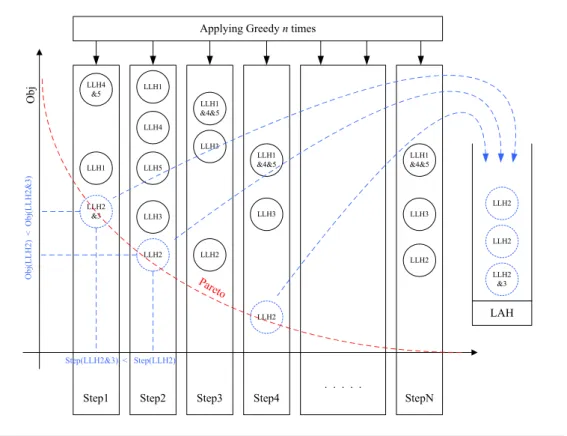
hyper-heuristic . . . 85 4.4 An illustation of how the second greedy hyper-heuristic operates . . . 90 4.5 An example of how the stage two hyper-heuristic works. Note that at
step1: LLH5 and LLH6 generate solutions with the same quality as in
Sinput . . . 95
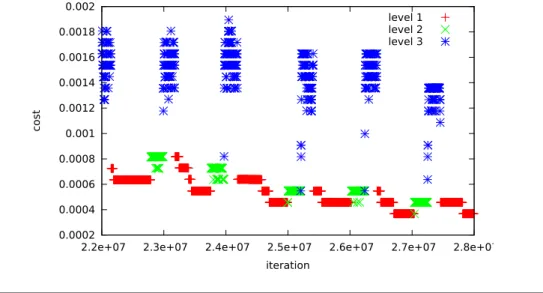
5.1 Cost versus iteration plot of a sample run towards the end of the search process which is obtained by applying the proposed approach to Instance4-Brazil using the threshold list of {0.001, 0.33, 1.99} . . . 100 5.2 Cost versus iteration plot of a sample run on WesternGreeceUni5 . . . 101 5.3 Cost versus iteration plot for BGHS98 - Australia (a) with and (b) without
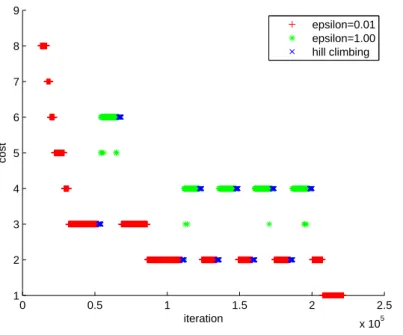
hill climbing (stage B) . . . 102 5.4 Performance of the proposed approach on instance B-1 . . . 107 5.5 Performance of the proposed approach on instance X-10 . . . 108 5.6 Plots of the objective values of the solutions in the population versus time
while solving instance B2 . . . 112 5.7 Plots of the objective values of the solutions in the population versus time
while solving instance B8 . . . 113 5.8 Plots of the objective values of the solutions in the population versus time
while solving instance X1 . . . 114 5.9 Plots of the objective values of the solutions in the population versus time
while solving instance X4 . . . 115 5.10 Average percentage utilisation of the low level heuristics while solving
instance B2 . . . 116 5.11 Average percentage utilisation of the low level heuristics while solving
instance B8 . . . 116 5.12 Average percentage utilisation of the low level heuristics while solving
instance X1 . . . 116 vi
5.13 Average percentage utilisation of the low level heuristics while solving instance X4 . . . 117 5.14 Comparisons of the different hyper-heuristics over each domain based on
Formula One points scoring system . . . 125 5.15 Ranking (performance comparison) of MSHH and CHeSC 2011
hyper-heuristics for each HyFlex problem domain based on the median results converted to the normalised objective function values. The dots in the box plots are outliers . . . 127 5.16 Ranking (performance comparison) of MSHH and CHeSC 2011
hyper-heuristics in overall based on the median results converted to the nor-malised objective function values. The dots in the box plots are outliers . 128 5.17 Average percentage utilisation of single/combined low level heuristics over
10 trials while solving a sample instance representing each problem do-main: (a) SAT, (b) BP, (c) PS, (d) PFS, (e) TSP, (f) VRP . . . 129 5.18 Plots of the average objective and threshold level values over 10 trials
versus time while solving a sample instance representing each problem domain . . . 131 5.19 Plots of the average of changes in the number of single/combined low
level heuristics versus time from 10 trials while solving a sample instance representing each problem domain . . . 133 5.20 The box plot of execution time (in seconds) of the hyper-heuristic
ap-proach constructing a magic square of various orders, n and plots of the regression models . . . 135 5.21 Box plots of execution time (in milliseconds) from all runs for MSHH,
LAHC and RP approaches constructing a constrained magic square using various randomly decided (i, j) locations for n = (a) 10, (b) 23, (c) 25 and (d) 2600 . . . 136 5.22 Average percentage utilisation of the low level heuristics obtained from
10 trials based on improving moves only forn= (a) 10, (b) 23, (c) 25 and (d) 2600 . . . 137 5.23 Plots of the average of objective values and the threshold level values
versus time in milliseconds from 10 trials for n = (a) 10, (b) 23, (c) 25 and (d) 2600 . . . 138
1.1 Some selected problem domains in which hyper-heuristics were used as
solution methodologies . . . 3
2.1 Categorisation of some existing move acceptance methods used within the selection hyper-heuristics . . . 21
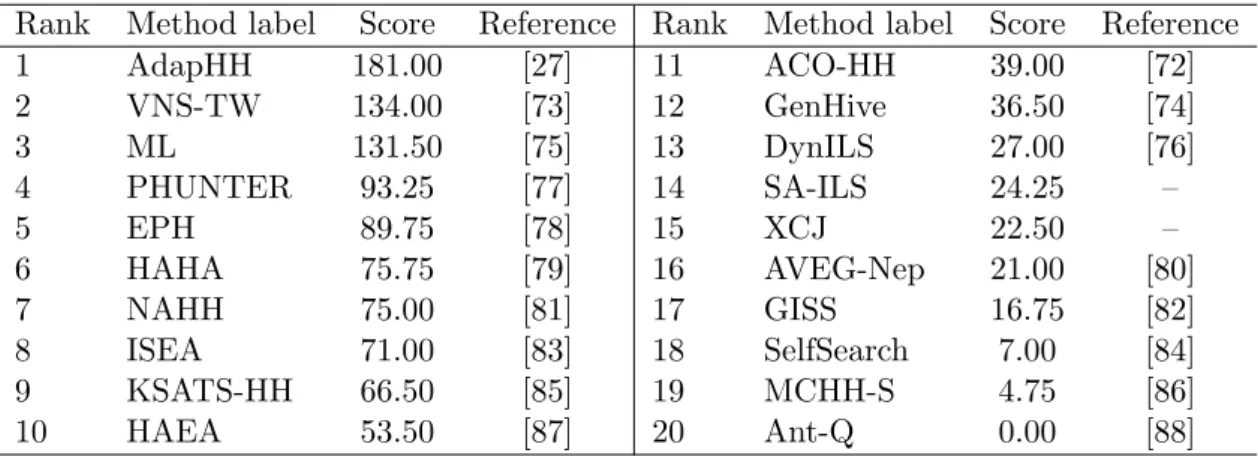
2.2 The CHeSC 2011 competing approaches . . . 27
2.3 The MISTA 2013 competing approaches . . . 34
3.1 Problem domains tested in this study . . . 40
3.2 The number of different types of low level heuristics {mutation (MU), hill climbing (HC), ruin and re-create (RC), crossover (XO)}used in each problem domain . . . 42
3.3 The nature of the low level heuristics used in each problem domain. The bold entries for each problem domain mark the last low level heuristic of each type . . . 42
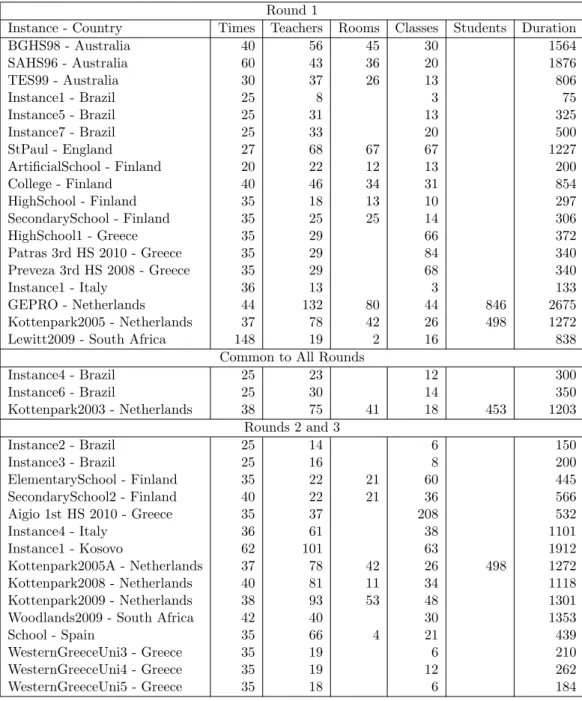
3.4 Characteristics of the problem instances used during three rounds of the competition . . . 45
3.5 Instances characteristics in MISTA 2013 . . . 51
4.1 The multi-stage hyper-heuristic approaches proposed in this thesis . . . . 71
4.2 Performance ranking of each hyper-heuristic combined with simulated annealing move acceptance over a set of problem instances . . . 75
5.1 The performance of the HySST approach in Round 1. The quality (cost) of a solution is indicated as feasibility-value.objective-value and BKN is the best previously known solution . . . 103
5.2 The performance comparison of the HySST approach to the other compet-ing approaches over 10 trials showcompet-ing the best quality (cost) of a solution indicated as feasibility-value.objective-value in Round 2. The best values are highlighted in bold . . . 104
5.3 The best-of-runs performance comparison of the HySST approach to the other competing approaches using the quality (cost) of a solution indi-cated as feasibility-value.objective-value in Round 3. The best values are highlighted in bold . . . 105
5.4 Summary of experimental results on MISTA 2013 instances. The objec-tive values are given as ordered pairs of “TPD”, total project delay, and “TMS”, total makespan. The ‘Comp.’ values are from the competition website for all the entrants in the qualification and final rounds. ‘Avg.’ values are average values for our algorithm under time and machine con-ditions intended to match those of the competition. ‘Best’ is the best solution encountered over a large number of runs . . . 106 5.5 The average ranking and the performance comparison of MCTS-DRW,
RC-LS, RC-S1HH, RC-DRW, MCTS-LS and MCTS-S1HH methods based on the average (avg.), standard deviation (std.), minimum (min.) of the objective values over 10 runs and the pairwise average performance com-parison of MCTS-DRW vs other approaches based on Mann-Whitney-Wilcoxon for each instance produced by each approach. The best avr. and min. values per each instance are highlighted in bold . . . 109 5.6 The performance comparison of the constructor methods (MCTS and RC)
based on the ‘time’ they take to construct a population of solutions in second, the average objective values of the initially generated solutions ‘Oinitial’, and the best objective values obtained after applying the
im-provement phase ‘Obest’ . . . 110
5.7 The average performance comparison of MSHH for different parameter settings over 10 trials. MSHH with “regular” setting of a given parame-ter is compared to MSHH when that setting is changed to a given setting based on Mann-Whitney-Wilcoxon statistical test for each selected in-stance from a public domain . . . 118 5.8 The performance comparison of MSHH, S1HH and S2HH based on the
average (avg.), associated standard deviation (std.), minimum (min.) of the objective values over 31 trials and the pairwise average performance comparison of MSHH vs S1HH and MSHH vs S2HH based on Mann-Whitney-Wilcoxon for each CHeSC 2011 instance produced by each ap-proach. The hyper-heuristic producing the best value for avr. and min. per each instance are highlighted in bold . . . 120 5.9 The performance comparison of MSHH, GGHH, DRD, RHH, HySST and
DRW multi-stage hyper-heuristics based on the average (avg.), associ-ated standard deviation (std.), minimum (min.) of the objective values over 31 trials and the pairwise average performance comparison of MSHH vs (GGHH, DRD, RHH, HySST and DRW) based on Mann-Whitney-Wilcoxon for each CHeSC 2011 instance produced by each approach. The hyper-heuristic producing the best value for avr. and min. per each in-stance are highlighted in bold . . . 122 5.10 SAT, objective function values obtained by the eight hyper-heuristics and
MSHH on the 10 instances. The last row summarises the number of wins/draws. The best values for each instance are highlighted in bold . . 123 5.11 BP, objective function values obtained by the eight hyper-heuristics and
MSHH on the 10 instances. The last row summarises the number of wins/draws. The best values for each instance are highlighted in bold . . 123
5.12 PS, objective function values obtained by the eight hyper-heuristics and MSHH on the 10 instances. The last row summarises the number of wins/draws. The best values for each instance are highlighted in bold . . 124 5.13 PFS, objective function values obtained by the eight hyper-heuristics and
MSHH on the 10 instances. The last row summarises the number of wins/draws. The best values for each instance are highlighted in bold . . 124 5.14 Ranking (performance comparison) of MSHH and the 20 hyper-heuristic
approaches competed at CHeSC 2011 across six problem domains based on the Formula One scoring system . . . 126 5.15 The average execution time (avr.) the standard deviation (s.d.) in
mil-liseconds and the pairwise performance comparison of 50 trials. The best values are highlighted in bold . . . 134 5.16 Regression models to predict the running time complexity of the MSHH,
Introduction
Currently, most of the decision support systems are developed by experts and they are often custom tailored to specific application domains. Hence, they cannot be reused for solving a problem from another domain. Such systems are expensive to build and maintain. Even a slight change in the same problem could require expert intervention. On the other hand, there has been some significant scientific progress in developing automated general purpose systems that can learn, adapt and improve their behaviour on the fly while solving a given problem. Such systems are applicable to different in-stances from not only the same domain but also other problem domains. Moreover, they are easy to build and maintain and so less costly. Hyper-heuristics have emerged as such general purpose high level search methodologies. A hyper-heuristic performs a search over the space formed by a fixed set of (meta-)heuristics which operate directly on the space of solutions, for solving computationally hard problems [2–8]. A class of hyper-heuristics aims to provide solutions across a range of problem domains by pro-cessing problem independent information obtained from selecting/mixing a set of low level heuristics which operate at the problem level during the search process. There are two main types of hyper-heuristics in the academic literature: methodologies used for
generation orselectionof heuristics [2, 4, 9]. Even though the term hyper-heuristic was coined and introduced recently, the idea of combining the different existing heuristics (neighbourhood operators) with the goal of exploiting their strengths dates back to the early 1960s [10, 11]. There has been a growing interest in hyper-heuristics since then. This study focuses on an iterative selection hyper-heuristic framework based on a single point search [8, 12].
Almost all previously proposed selection hyper-heuristics are designed respecting the concept of a domain barrier which separates the hyper-heuristic from the problem do-main containing the low level heuristics [12] as illustrated in Figure 1.1. In this frame-work, the hyper-heuristic layer interacts with the problem domain and heuristic layers through problem independent measures, such as the quality change in a candidate so-lution when the selected heuristic is employed. Traditionally, the barrier prohibits any problem domain specific information to pass through to the hyper-heuristic level. This type of layered and modular approach to the design of automated search methodologies supports the development of more general methods than currently there exist, which are applicable to unseen instances from a single problem domain or even different problem domains. Moreover, reuse of algorithmic components becomes possible.
Hyper-heuristic
DomainBarrier
Problem Domain
Low level heuristics
Space of solutions
o Select a heuristic to apply to a solution in
hand
o Accept/reject a new solution
o Book keeping (e.g., remember successful
heuristics) ... •Representation •Cost/evaluation/ objective function •Instance reader •Initialisation method ...
Figure 1.1: A selection hyper-heuristic framework and the domain barrier
A selection hyper-heuristic is a high level problem solving framework that can select and apply an appropriate low level heuristic used to modify a solution in hand at each decision point, given a particular problem instance and a number of low level heuristics. The selection hyper-heuristic framework combines two essential components: heuristic selectionandmove acceptancemethods processes under a single point search framework, as identified in [3, 7, 8, 12, 13]. Such a hyper-heuristic attempts to improve a solution (or solutions) by selecting a perturbative or constructive heuristic (or heuristics), each processing and returning a complete or partial solution when invoked, followed by a decision to accept or reject the resulting solution at a given step during the search process. The solution is evaluated according to the objective value (also referred as cost
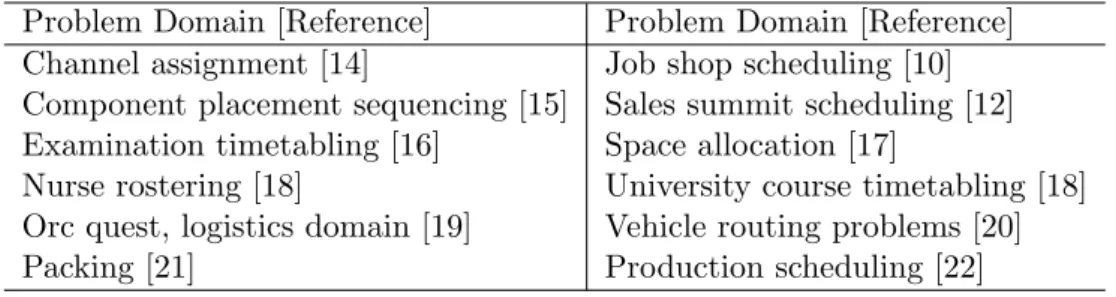
or fitness in this thesis). The search process continues iteratively until the termination criteria are satisfied. Finally, the best solution at hand is returned for a given problem. Many researchers and practitioners have been progressively involved in hyper-heuristic studies for solving difficult real world combinatorial optimisation problems ranging from channel assignment to production scheduling (Table 1.1).
Table 1.1: Some selected problem domains in which hyper-heuristics were used as solution methodologies
Problem Domain [Reference] Problem Domain [Reference] Channel assignment [14] Job shop scheduling [10] Component placement sequencing [15] Sales summit scheduling [12] Examination timetabling [16] Space allocation [17]
Nurse rostering [18] University course timetabling [18] Orc quest, logistics domain [19] Vehicle routing problems [20] Packing [21] Production scheduling [22]
1.1
Research Motivation and Contributions
Although Cowling et al. [12] implied that hyper-heuristics are problem independent ap-proaches, there is strong empirical evidence showing that the choice of selection hyper-heuristic components influences its overall performance [13]. Bilgin et al. [23] showed that different combinations of selection hyheuristic components yield different per-formances on examination timetabling problems. ¨Ozcan et al. [8] showed that the move acceptance is more influential on the performance of a selection hyper-heuristic if the number of low level heuristics is low and they are mutational. Then, the choice of move acceptance component becomes more crucial. A recent theoretical study showed that mixing heuristics could lead to exponentially faster search than using each standalone heuristic on some benchmark functions [24]. These observations are crucial, since they imply that another level can be introduced on top of the hyper-heuristics for managing them. Then the question arises: “How are we going to end this hierarchical growth in the levels?”.
This situation generates a curiosity and points out a potential modification of the stan-dard single point-based search framework of selection hyper-heuristics. Multi-stage oper-ation of multiple selection heuristics needs to be supported. Then, another hyper-heuristic level needs to be introduced for managing multiple hyper-hyper-heuristics which op-erate on top of low level heuristics. Considering the recursive hyper-heuristic definition
of ‘heuristics to choose heuristics’ [12], those hyper-heuristics could require another level and so on, causing a hierarchical growth in the hyper-heuristic levels like a tree. An attempt was made in [25] to flatten the hierarchical growth in the hyper-heuristic levels for the move acceptance via group decision making strategies. The authors suggest com-bining multiple move acceptance strategies under a group decision making strategy. The performance of four such group decision making move acceptance methods are analysed within different hyper-heuristics over a set of benchmark functions. The experimental results show that the group decision making strategies have potential to significantly improve the overall performance of selection hyper-heuristics.
In another study, ¨Ozcan and Burke [26] provided a generalmulti-level hierarchical search
methodology by taking advantage of the recursive nature of the hyper-heuristics defi-nition, ‘heuristics which search the space of heuristics’. Their proposal suggests an additional level on top of a hyper-heuristic in order to make use of different types of heuristics (operators) in cooperation. One of the frameworks proposed in [13] that han-dle a set of mutational and hill climber heuristics by invoking a mutational heuristic first followed by a hill climber, is actually performing a multi-level search. The higher level in this framework is managing two different hyper-heuristics allowing to employ diversifying (exploring of the search space) and intensifying (exploiting the accumulated search experience) phases. The effectiveness of the multi-level search framework that combines multiple selection hyper-heuristics suggested by ¨Ozcan and Burke [26] has not been investigated further.
This thesis describes a multi-level framework which allows the use of multiple hyper-heuristics during the search process. Given that one of the selection hyper-hyper-heuristics would be employed at each stage during the search process, we will refer to the over-all approach as multi-stage (selection) hyper-heuristic. The additional level on top of multiple selection hyper-heuristics will be referred to asmulti-stage level. The proposed multi-stage hyper-heuristic framework is general, reusable and useful in relieving the difficulty of choosing a hyper-heuristic method for solving a problem, by automating the process of selecting a hyper-heuristic at different point of the search process. Five novel multi-stage selection hyper-heuristics based on the framework is designed, implemented and analysed in this thesis:
• MSHH1: A greedy heuristic selection strategy referred to as dominance-based heuristic selection method reducing the number of low level heuristics consider-ing the trade-off between improvement achieved by a low level heuristic with a
given setting and the step it takes to achieve that performance, is combined with the random descent selection hyper-heuristic.
• MSHH2: TheRobinhood(Round-robin neighbourhood) hyper-heuristic contains a heuristic selection component that allocates equal share from the overall execu-tion time for each low level heuristic, while the different combined move acceptance criteria enable partial restarts when the search process stagnates.
• MSHH3: TheHySST(Hyper-heuristicSearchStrategies andTimetabling) hyper-heuristic switches between diversification and intensification processes automati-cally and allows partial restarts via a threshold move acceptance method whose parameter is also controlled by the proposed method.
• MSHH4: A multi-stage selection hyper-heuristic approach that extends the three approaches briefly described above. It uses the dominance-based method in MSHH1 combined with the round-robin strategy in MSHH2 to reduce the set of low level heuristics, and also applies a modified version of the move acceptance method used in MSHH3.
• MSHH5: A multi-stage selection hyper-heuristic approach that extends the previ-ous multi-stage hyper-heuristic (MSHH4) and makes use of therelay hybridisation
[27] technique which applies a low level heuristic to a solution generated by apply-ing a precedapply-ing heuristic.
Additionally, the technique used in [28, 29] is implemented as MSHH6 and applied to a benchmark to test its level of generality.
It is always of interest to researchers and practitioners to find the state-of-the-art ap-proach for solving a particular problem. Although hyper-heuristic research aims for the level of generality, still knowing the relative position of hyper-heuristics with respect to the state-of-the-art for a specific problem domain would be useful. One way of establish-ing state-of-the-art for a specific problem is through competitions/challenges. Therefore, Some of the multi-stage hyper-heuristics, briefly described above, are initially designed for solving some specific problems. This has indeed required design and implementation of the problem domain layer components, such as domain specific low level heuristics. High school timetabling is a well-known real-world combinatorial optimisation problem. The problem is known to be NP-complete [30] even in simplified forms. It requires the scheduling (assignment) of events and resources, such as courses, classes of students,
teachers, rooms and more within a fixed number of time slots subject to a set of con-straints. A competition has been organised on high school timetabling: the Third Inter-national Timetabling Competition (ITC 2011) to form a benchmark for future studies, determine the state-of-the-art solution method and promote researchers and practition-ers to deal with the problems as they are without discarding the real world complexities. MSHH3 is designed for high school timetabling problem and has entered into the three Rounds of the competition. This multi-stage hyper-heuristic has generated the best new solutions for three given instances in Round 1 and gained the second place in Rounds 2 and 3 at ITC 2011.
Project scheduling is a common real world optimisation problem, and has been addressed by a competition organised together with the MISTA 2013 conference. In the competi-tion, multiple projects had to be scheduled whilst taking into account the availability of local and global resources under a set of constraints. MSHH4 is designed for solving the multi-mode resource-constrained multi-project scheduling problem and eventually has won the competition becoming the state-of-the-art in this domain.
A magic square is a square matrix that contains distinct numbers in which the summa-tion of the numbers in each row, column and the two diagonals has the same constant total known as the magic number [31]. Constructing the magic square has been consid-ered as a hard computational problem domain [32]. This was topic of a competition and MSHH5 is used as a method to solve the constrained-version of magic squares.
In order to show that the proposed multi-stage selection hyper-heuristics are sufficiently general and can be applied to different problem domains without requiring any change, they are implemented as extension to a public software library, referred to as HyFlex (Hyper-heuristics Flexible framework) which provides an interface for the implementa-tion of not only hyper-heuristics but also other (meta)heuristics and problem domains. HyFlex has been used for benchmarking of hyper-heuristics [33]. The experimental re-sults indicate the success of the multi-stage selection hyper-heuristics designed under the proposed multi-stage framework. The framework is more general in the sense that it is applicable to a variety of problems and more effective than the existing approaches which frequently ignore the real-world complexities. A selection hyper-heuristic should be “(1) fast to implement, (2) requiring far less expertise in either the problem domain or heuristic methods, and (3) robust enough to effectively handle a range of problems” [12]. The proposed multi-stage hyper-heuristic framework in this thesis satisfies all previously suggested design criteria.
1.2
Structure of Thesis
The thesis is structured as follows:
• Chapter 1: Introduces the thesis topic and relevant concepts.
• Chapter 2: Provides the background and literature survey. Selection hyper-heuristics, problem domains dealt with in this work and the previous approaches used to solve those problem domains are summarised.
• Chapter 3: Introduces the problem domains in more detail, including the charac-teristics of the instances, low level heuristics and initialisation methods for each domain.
• Chapter 4: Describes the novelty and all algorithmic components of multi-stage hyper-heuristic framework. Additionally, several multi-stage hyper-heuristics to control a set of perturbative low level heuristics are explained.
• Chapter 5: Presents the competition results of the ITC 2011 and MISTA 2013 competitions, compares the performance of the different proposed multi-stage hyper-heuristics on HyFlex problems as well as constructing constrained-version of the magic-square problem; and reports the generality level of selection hyper-heuristics. The chapter provides the computational results and discussions. • Chapter 6: Presents the conclusions of the research outcome and points out some
future research directions.
1.3
Academic Publications Produced
The following academic articles, conference papers and extended abstracts have been produced as a result of this research. It is worthy to mention that the results and the performance analysis of the multi-stage hyper-heuristics which have been published on academic papers are revised in this thesis and additional results obtained from the testing on the different problem domains are reported.
• Ahmed Kheiri and Ender ¨Ozcan. Constructing constrained-version of magic squares using selection hyper-heuristics. The Computer Journal, 57(3):469-479, 2014. [journal]
• Murat Kalender, Ahmed Kheiri, Ender ¨Ozcan, and Edmund K. Burke. A greedy gradient-simulated annealing selection hyper-heuristic. Soft Computing, 17(12):2279-2292, 2013. [journal]
• Ahmed Kheiri, Ender ¨Ozcan, and Andrew J. Parkes. A stochastic local search algorithm with adaptive acceptance for high-school timetabling. Annals of Oper-ations Research, published online. [journal]
• Ahmed Kheiri and Ender ¨Ozcan. A multi-stage selection hyper-heuristic, under review. [journal]
• Ender ¨Ozcan, Mustafa Misir, and Ahmed Kheiri. Group decision making in selec-tion hyper-heuristics, under review. [journal]
• Shahriar Asta, Daniel Karapetyan, Ahmed Kheiri, Ender ¨Ozcan, and Andrew J. Parkes. Combining monte-carlo and hyper-heuristic methods for the multi-mode resource-constrained multi-project scheduling problem, under review. [journal] • Leena N. Ahmed, Ender ¨Ozcan, and Ahmed Kheiri. Solving high school timetabling
problems worldwide using selection hyper-heuristics, under review. [journal] • Ahmed Kheiri and Ender ¨Ozcan. A hyper-heuristic with a round robin
neighbour-hood selection. In Martin Middendorf and Christian Blum, editors, Evolutionary Computation in Combinatorial Optimization, volume 7832 of Lecture Notes in Computer Science, pages 1-12. Springer Berlin Heidelberg, 2013. [conference] • Mohd Khaled Yousef Shambour, Ahamad Tajudin Khader, Ahmed Kheiri, and
En-der ¨Ozcan. A two stage approach for high school timetabling. In Minho Lee, Akira Hirose, Zeng-Guang Hou, and Rhee Man Kil, editors, Neural Information Process-ing, volume 8226 of Lecture Notes in Computer Science, pages 66-73. Springer Berlin Heidelberg, 2013. [conference]
• Ender ¨Ozcan, Mustafa Misir, and Ahmed Kheiri. Group decision making hyper-heuristics for function optimisation. In 13th UK Workshop on Computational Intelligence (UKCI2013), pages 327-333. IEEE, 2013. [conference]
• Ender ¨Ozcan and Ahmed Kheiri. A hyper-heuristic based on random gradient, greedy and dominance. In Erol Gelenbe, Ricardo Lent, and Georgia Sakellari, editors, Computer and Information Sciences II, pages 557-563. Springer London, 2012. [conference]
• Murat Kalender, Ahmed Kheiri, Ender ¨Ozcan, and Edmund K. Burke. A greedy gradient-simulated annealing hyper-heuristic for a curriculum-based course timetabling problem. In 12th UK Workshop on Computational Intelligence (UKCI2012), pages 1-8. IEEE, 2012. [conference]
• Shahriar Asta, Daniel Karapetyan, Ahmed Kheiri, Ender ¨Ozcan, and Andrew J. Parkes. Combining monte-carlo and hyper-heuristic methods for the multi-mode resource-constrained multi-project scheduling problem. In Proceedings of the 6th Multidisciplinary International Scheduling Conference: Theory & Appli-cations (MISTA2013), Ghent, Belgium, pages 836-839, 2013. [extended abstract] • Ahmed Kheiri, Ender ¨Ozcan, and Andrew J. Parkes. HySST: hyper-heuristic
search strategies and timetabling. In Proceedings of the 9th International Confer-ence on the Practice and Theory of Automated Timetabling (PATAT2012), pages 497-499, 2012. [extended abstract]
Additionally, there are two other papers currently being prepared for submission to jour-nals. There is also a number of abstract submissions produced out of this study and presented at international conferences, including OR53, OR54, OR56, 3rd Student Con-ference on Operational Research (SCOR2012), 25th ConCon-ference of the European Chapter on Combinatorial Optimization (ECCO2012), and 20th Conference of the International Federation of Operational Research Societies (IFORS2014).
Literature Review
This chapter briefly describes some meta-heuristics commonly used for combinatorial optimisation and presents a survey of selection hyper-heuristics. In addition, an overview of the approaches proposed previously for solving the different problems dealt with in this work are provided.
2.1
Meta-heuristics
Pearl [34] defined heuristic as an intelligent search strategy for computer problem solving. In the field of optimisation problems, a heuristic can be considered as an educated guess or a ‘rule of thumb’, which guides the computational search required for finding a solution. Although the heuristic algorithms are designed to speed up the process of discovering a solution, yet the optimal solution is not guaranteed to be obtained. Heuristics are often problem-dependent methods that work well for an instance of a problem may or may not be used to solve another instance of another problem or even the same problem. In contrast, a meta-heuristic is a high level methodology which performs a search for solving any computationally hard problem.
The term meta-heuristic was first used by Glover [35] to describe Tabu Search and has recently been defined by S¨orensen and Glover [36] as: “A meta-heuristic is a high-level problem-independent algorithmic framework that provides a set of guidelines or strategies to develop heuristic optimisation algorithms. The term is also used to refer to a problem-specific implementation of a heuristic optimisation algorithm according to the guidelines expressed in such a framework.”
Meta-heuristics can be broadly classified into population-based meta-heuristics, also called multi-point meta-heuristics, and solution meta-heuristics, also called single-point meta-heuristics. The population-based meta-heuristics, such as, Evolutionary Al-gorithms [37], consist of a collection of individual solutions which are maintained in a population while the single-solution meta-heuristics, such as, Tabu Search [35], differ from population-based in that they improve and maintain a single solution.
Meta-heuristics provide “guidelines” for designing heuristic optimisation algorithms [36]. The exploration (diversification), being able to jump to the other regions of the search space and exploitation (intensification), being able to perform local search within a limited region using accumulated experience, capabilities and maintaining the balance between them are important for a metaheuristic, influencing its performance. Different meta-heuristics have different ways of maintaining that balance. Metaheuristics have to be tailored for a specific problem domain and often, they are successful in obtaining high quality solutions for that domain. However, meta-heuristics being a subset of heuristics come with no guarantee for the optimality of the obtained solutions. Moreover, they can-not be used for solving an instance from acan-nother problem domain. The maintenance of meta-heuristics could be costly requiring expert intervention. Even a slight modification in the description of the problem could require maintenance. Almost all meta-heuristics have parameters and their performance could be sensitive to the setting of those pa-rameters. There are automated parameter tuning methods, such as F-race [38], REVAC [39] and ParamILS [40] to overcome this issue. The parameter tuning process increases the overall computation time of an approach while searching for a high quality solution to a given problem instance. However, there could be a trade-off and a higher quality solutions could be obtained for a given problem in the expense of spending more time on tuning. A selected set of well known meta-heuristics, including Iterated Local Search, Tabu Search, Simulated Annealing, Great Deluge, Late Acceptance and Evolutionary Algorithms are briefly described in the following sections.
2.1.1 Iterated Local Search
Local search methods start from a candidate solution, and iteratively move from one solution to another from its direct neighbourhood [41]. The neighbourhood of a candi-date solution is the set of solutions that can be generated by making (usually a small) change to the candidate solution. Hill climbing is a type of local search that iteratively improves the candidate solution by looking for a better solution to replace it, among the
ones in its neighbourhood. Although such methods are very easy and straightforward to be implemented, yet they can easily be trapped in a valley of local optima (local mini-mum), where the qualities of all neighbouring solutions are equal or worse. An iterated local search (ILS) method [42] is introduced to escape the search from a local minimum. In ILS, the current local minimum solution, generated by applying a local search, is perturbated (changed) leading to a new solution, then the local search is applied to the modified solution. This cycle of applying perturbation and local search methods is repeated until a termination criterion is satisfied. Iterated local search maintains the balance between the exploration and exploitation processes explicitly using perturba-tion and local search operators, respectively. [43]. An iterated local search algorithm is illustrated in Algorithm 1.
Algorithm 1:Pseudocode of the iterated local search method
1 LetS represent the candidate solution; 2 LetSbest represent the best solution;
3 Sinitial←CreateInitialSolution();// generate random solution 4 Sbest←Sinitial;
5 S ←LocalSearch(Sinitial);// generate local optimal solution 6 repeat 7 S′ ←Perturbation(S); 8 S′′←LocalSearch(S′); 9 Sbest←maintainBestSolution(S, S′, S′′); 10 if Accept(S, S′′) then 11 S ←S′′; 12 end 13 until TerminationCriterionSatisfied(); 14 return Sbest; 2.1.2 Tabu Search
Tabu search is a meta-heuristic introduced by Glover [35] back in the 1986. The basic idea of tabu search is to prevent the cyclic repetition of recent moves by maintaining a memory, called tabu list, to prevent visiting the recently visited solutions. This may help to guide the search away from local optima. The pseudocode of the tabu search method is given in Algorithm 2. Hyper-heuristics can employ similar strategy by preventing the selection of relatively poor performing heuristics.
Algorithm 2:Pseudocode of tabu search
1 LetS represent the candidate solution; 2 LetSbest represent the best solution;
3 S ←CreateInitialSolution(); // generate random solution 4 Sbest←S;
5 repeat
6 Generate(S′); /* generate neighbour solution S′ that does not contain tabu elements */
7 UpdateTabuList(S′);
8 Sbest←maintainBestSolution(S′);
9 if S′ isBetterT han S then
10 S ←S′;
11 end
12 until TerminationCriterionSatisfied(); 13 return Sbest;
2.1.3 Simulated Annealing
Simulated Annealing (SA) [44] is a probabilistic meta-heuristic method, motivated by an analogy to the process of annealing in solids. At each step a new solution is generated. The new solution is accepted if it improved the previous solution. The non-improving solutions are accepted, to attempt escaping from local optimum, with a probability of p = e−∆T, where ∆ is the quality change, and T is the method parameter, called
temperature which regulates the probability to accept solutions with higher objective value (cost). Generally speaking, the search starts with a high temperature. Then according to the cooling schedule, the temperature decreases gradually towards the end of the search process. One way of reducing the temperature is to apply the geometric cooling schedule: Ti+1 =Ti.β, whereβcan be empirically tuned for a particular problem
domain [45]. Algorithm 3 shows the basic outline of simulated annealing. Due to its relatively easy to code and the ability to generate ‘good’ solutions, many papers have been published presenting simulated annealing applied to several problem domains, like school timetabling [44] and examination timetabling [46] problems. The disadvantage of this method is that repeatedly annealingis a slow process, especially if the objective function value is expensive to compute. Simulated annealing can be used as a move acceptance method within the selection hyper-heuristics [23].
Algorithm 3:Pseudocode of simulated annealing
1 LetS represent the candidate solution, andT the temperature; 2 LetSbest represent the best solution;
3 S ←CreateInitialSolution(); // generate random solution 4 Sbest←S;
5 T ←Tinitial; 6 repeat
7 Generate(S′); // generate neighbour solution S′ adjacent to S 8 Sbest←maintainBestSolution(S′);
9 if S′ isBetterT han S then
10 S ←S′; 11 end 12 else 13 p←e− ∆ T; 14 if p <UniformRandom[0,1]then 15 S ←S′; 16 end 17 end
18 Update(T);// update temperature according to cooling schedule 19 until TerminationCriterionSatisfied();
20 return Sbest;
2.1.4 Great Deluge
The Great Deluge (GD) algorithm was first introduced by Dueck [47]. GD is based on a stochastic framework which allows improving moves by default. Non-improving moves are accepted if the objective value of the candidate solution is better than an expected objective value, named as water level at each step. The water level gets updated according to the ‘rain speed’ parameter. Dueck [47] argued that if the rain speed value is chosen to be very small then the algorithm produces a high quality solution after a long time. The objective value of the first generated candidate solution can be used as the initial level in GD. The pseudocode of the great deluge is given in Algorithm 4. Dueck [47] proposed two variants of GD named Threshold Accepting (TA) and Record-to-Record Travel (RRT) methods. The idea of TA is based on that any new solution, which is not much worse than the old solution, is accepted. While in RRT, any new solution which is not much worse than the best solution recorded, is accepted. Great deluge can be utilised as a move acceptance method within the selection hyper-heuristics [14].
Algorithm 4:Pseudocode of great deluge
1 LetS represent the candidate solution, B the rain speed and τ the water level; 2 LetSbest represent the best solution;
3 S ←CreateInitialSolution(); // generate random solution 4 Sbest←S;
5 f0 ←Evaluate(S);// calculate initial objective function value 6 τ ←f0;// initial level
7 repeat
8 Generate(S′); // generate neighbour solution S′ adjacent to S 9 Sbest←maintainBestSolution(S′);
10 if Evaluate(S′) isBetterT han Evaluate(S) then
11 S ←S′;
12 end
13 else
14 if Evaluate(S′) isBetterT han τ then
15 S ←S′;
16 end
17 end
18 Update(τ);// update the water level τ =τ±B 19 until TerminationCriterionSatisfied();
20 return Sbest;
2.1.5 Late Acceptance
The late acceptance hill climbing was recently introduced as a meta-heuristic strategy [48]. Most of the hill climbing approaches modify the current solution and guarantee an equal quality or improved new solution at a given step. The late acceptance hill climbing guarantees an equal quality or improved new solution with respect to a solution which was obtained fixed number of steps before. Algorithm 5 provides the pseudocode of this approach. Late acceptance hill climbing requires implementation of a queue of size L
which maintains the history of objective function values of L consecutive visited states for a given problem. At each iteration, algorithm inserts the solution into the beginning of the array and removes the last solution from the end. The size of the queue L is the only parameter of the approach, which reflects the simplicity of the strategy. The late acceptance can be employed as a move acceptance method within the selection hyper-heuristics [16]. Jackson et al. [49] reported that the parameter of the method can influence the performance. IfLis too short, the search may quickly converge on a local optimum, ifL is too long the search may stagnate.
Algorithm 5:Pseudocode of the late acceptance hill climbing
1 LetS represent the candidate solution; 2 LetSbest represent the best solution;
3 S ←CreateInitialSolution(); // generate random solution 4 Sbest←S;
5 f0 ←Evaluate(S);// calculate initial objective function value 6 fori←0, L−1 do
7 f(i)←f0;
8 end
9 i←0; 10 repeat
11 Generate(S′); // generate neighbour solution S′ adjacent to S 12 f′ ←Evaluate(S′);// calculate objective function value 13 Sbest←maintainBestSolution(S′);
14 c←imod L;
15 if f′betterThanf(c) then
16 S ←S′;
17 end
18 f(c)←Evaluate(S); // include objective value in the list
19 i←i+ 1;
20 until TerminationCriterionSatisfied(); 21 return Sbest;
2.1.6 Evolutionary Algorithms
Evolutionary algorithms (EAs) are a class of population (multi-point) based search methodologies, inspired from the Darwinian theory of evolution. A genetic algorithm (GA) meta-heuristic is a subclass of EAs combining principles of natural evolution and genetics for problem solving [37]. A pool of candidate solutions (individuals) for a given problem is evolved to obtain a high quality solution at the end. Mate/parent selection, recombination (crossover), mutation and replacement are the main components of an evolutionary algorithm. A simple GA is outlined in Algorithm 6.
The candidate solutions, referred to as individuals or chromosomes, go through an evo-lutionary cycle (each referred to as generation) passing through those phases. First, parent individuals are selected from the population, often favouring the high quality solutions, then they are recombined, producing new individuals which are exposed to mutation perturbing those new solutions further. The usefulness of recombination is still under debate in the research community [50, 51]. The replacement operator decides which individuals will survive to the next generation. A memetic algorithm (MA) hy-bridises a genetic algorithm with local search which is commonly applied after mutation
Algorithm 6:Pseudocode of the genetic algorithm
1 CreateInitialSolutions(); // create initial population of solutions 2 repeat
3 Evaluate(); // calculate fitness of each solution in the population 4 SelectParents(); // select solutions from the population to breed 5 Crossover(); // apply crossover operator with a given probability 6 Mutate();// apply mutation operator with a given probability 7 ReplaceSolutions();// generate new population of solutions 8 until TerminationCriterionSatisfied();
on the new individuals [52, 53]. A ‘meme’ may denote a local search method capable of local learning. A memetic algorithm is often tailored for the problem dealt with [54]. Many improvements for MAs have been suggested, for example the population sizing [55] and interleaved mode of operation [56]. MAs have been successfully applied to many different problems ranging from generalised travelling salesman [57] to nurse rostering [58].
2.2
Selection Hyper-heuristics
Selection hyper-heuristics were initially defined as “heuristics to choose heuristics” in [12]. They are capable of selecting and applying an appropriate heuristic given a set of low level heuristics for a problem instance [3].
¨
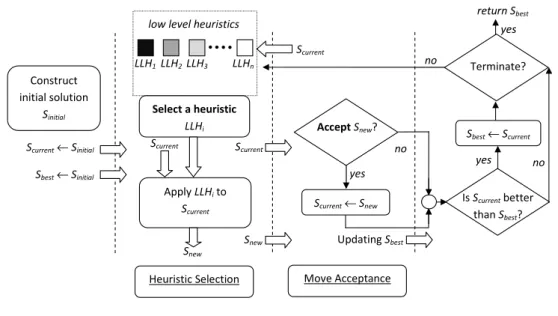
Ozcan et al. [8] identified two successive stages that are common to most of the single point based search hyper-heuristics (that is, without the use of populations of solutions) influencing their performance: heuristic selection and move acceptance, in attempting to improve a randomly created solution. An initially generated solution is iteratively improved passing through these stages. At each iteration, a candidate new solution is produced by selecting and applying a heuristic (neighbourhood operator) from a set of low level heuristics; A ‘move acceptance’ component then decides whether or not the candidate should replace the incumbent solution. This cycle continues until a termina-tion criterion is satisfied as illustrated in Figure 2.1 [8]. The processes indicated with bold font in Figure 2.1 take place at the hyper-heuristic level, while the rest take place in the problem domain level. Algorithm 7 illustrates a selection hyper-heuristic framework pseudocode performing a single point search.
Select a heuristic LLHi Apply LLHito Scurrent Construct initial solution Sinitial AcceptSnew?
low level heuristics
return Sbest
yes no
no
Scurrent← Sinitial
Heuristic Selection Move Acceptance
LLH1 LLH2 LLH3 LLHn Scurrent Snew Snew Scurrent Scurrent← Snew Terminate? Is Scurrentbetter than Sbest? Updating Sbest Sbest← Sinitial no yes Sbest← Scurrent Scurrent yes
Figure 2.1: Illustration of how a single point based selection hyper-heuristic operates
Algorithm 7:Pseudocode of the selection hyper-heuristic framework
1 LetScurrent represent the candidate solution;
2 LetLLH ={LLH1, LLH2, ..., LLHn} represent the set of all low level heuristics; 3 LetSbest represent the best solution;
4 Sinitial←CreateInitialSolution();// construct initial solution 5 Scurrent ←Sinitial;
6 Sbest←Sinitial; 7 repeat
8 LLHi ←SelectLowLevelHeuristic(LLH);
9 Snew ←ApplyHeuristic(LLHi, Scurrent); /* generate new solution Snew by applying LLHi to Scurrent */
10 if Accept(Scurrent, Snew) then// decide whether to accept Snew or not
11 Scurrent ←Snew;
12 end
13 Sbest←updateBestSolution(Scurrent); 14 until TerminationCriterionSatisfied(); 15 return Sbest;
Most of the selection hyper-heuristics in the literature feature a logical boundary filter, referred to as domain barrier which disallows any domain specific information to be passed from the problem domain layer to the hyper-heuristic layer during the search process [2, 12]. Hence, selection hyper-heuristics, once implemented, are reusable general methods, applicable to different unseen instances from a specific domain as well as different domains. Even the heuristic selection and move acceptance components of hyper-heuristics can be reused without requiring any change.
2.2.1 Classification of Selection Hyper-heuristics
Depending on the nature of the low level heuristics, two categories of selection hyper-heuristics can be defined, namely, selection perturbative hyper-hyper-heuristics and selection constructive hyper-heuristics [2]. Selection perturbative hyper-heuristics process com-plete solutions, while selection constructive hyper-heuristics process partial solutions. Selection hyper-heuristics can be further distinguished by their feedback mechanisms and they could either be with online learning, offline learning or no learning at all [13]. The online learning selection hyper-heuristic is the one that learns from feedback during the search process, whereas the offline learning selection hyper-heuristic learns before the actual search starts.
2.2.2 Selection Methods
Cowling et al. [12] presented a variety of selection hyper-heuristics embedding simple heuristic selection methods. They investigated the performance ofSimple Random(SR),
Random Descent (Gradient) (RD(G)), Random Permutation (RP), Random Permuta-tion Descent (Gradient)(RPD(G)),Greedy(GR) and a more sophisticated one, namely
Choice Function(CF) heuristic selection mechanisms. Two acceptance criteria were used to combine with the aforementioned heuristic selection mechanisms. The All Moves
(AM) acceptance criterion accepts all the generated solutions, while Only Improving
(OI) accepts only better quality solutions [12]. Improving or Equal (IE) accepts non-worsening moves.
Simple random selects a low level heuristic randomly based on a uniform probability distribution at each step, while random descent (gradient) selects a low level heuristic randomly and applies it to the solution in hand repeatedly as long as the solution is im-proved. If the solution worsens, then another low level heuristic is selected and the same
process is repeated. Random permutation applies a low level heuristic in a randomly generated permutation of all low level heuristics and applies the low level heuristics in the list one after another at each step sequentially. Random permutation descent (gra-dient) applies the random permutation but proceeds in the same manner as the random descent (gradient) approach without changing the order of heuristics. Greedy applies all low level heuristics to the candidate solution and selects a heuristic, hence a solution, which generates the largest improvement. The new solution could be still worse than the current solution, if all heuristics are performing random perturbation. The authors reported the success of a learning hyper-heuristic; namely, choice function. Greedy also showed some potential. Choice function utilises a mechanism that scores each low level heuristic based on its individual performance, pairwise successive performance and the duration since the last time a heuristic was invoked. The heuristic having the maximum score is chosen and applied to the candidate solution at each step and the relevant infor-mation for the chosen heuristic after its application to the current solution are updated. A hyper-heuristic either utilises a learning mechanism or operates without any learning at all [4]. Both GR and CF are online learning mechanisms, since they both learn from their previous experiences by getting and using feedback during the search process. The memory length of the choice function is determined by means of the limits on the score values. A larger range for the score indicates a longer term memory as compared to a lower range. On the other hand, GR has a very short term memory as the feedback (i.e., best candidate solution among all) is used instantaneously and then forgotten in the following step. Following that in different regions of the search space, a different heuristic might operate the best; a good hyper-heuristic is expected to recover the most appropriate heuristic to utilise in a given region as quickly as possible. Therefore, GR allows the search to react faster during the transitions from one region to another in the search space [2]. At the end of the experiments, the authors observed that although greedy heuristic selection was not the best, it delivered a comparable performance to some learning heuristic selection methods. Cowling et al. [12] observed that CF−AM was the most promising hyper-heuristic. The performance strength of CF has been illustrated in the other studies as well [7, 8, 23].
Nareyek [19] uses Reinforcement Learning (RL) that adaptively selects a heuristic from a set of low level heuristics according to the utility values associated with each heuristic. A tabu search based hyper-heuristic ranks the heuristics to determine which heuristic will be selected to apply to the current solution, while the tabu list maintains a list to disallow and avoid the use of low level heuristics performing badly has been suggested by Cowling and Chakhlevitch [59] and Burke et al. [18].
2.2.3 Move Acceptance Methods
The move acceptance criteria in the selection hyper-heuristic frameworks can be classi-fied asdeterministicornon-deterministic. Deterministic move acceptance criteria always return the same decision any time (iteration) they are called with a specific set of input values. Non-deterministic move acceptance criteria depend on the current time or step to make a decision. The latter category can be characterised as stochastic if a prob-abilistic framework is considered while making the decision e.g. simulated annealing;
non-stochasticif no probabilistic framework is considered while making the decision e.g. great deluge [2, 25]. Existing move acceptance criteria fall in one of the three categories presented in Table 2.1.
Table 2.1: Categorisation of some existing move acceptance methods used within the selection hyper-heuristics
deterministic non-deterministic
stochastic - Simulated Annealing variants,
EMCQ
non-stochastic Accept all, Improving or Equal,
Only Improving
Great Deluge, Late Acceptance, AILTA
Accepting all moves and some other simple deterministic acceptance methods are de-scribed in [12]. There are a number of deterministic and non-deterministic acceptance methods allowing the acceptance of worsening solutions. Mostly, those methods ac-cept all improving moves, but they differ in how they treat non-improving moves. The non-deterministic na¨ıve move acceptance accepts a worsening solution with a certain probability [60].
¨
Ozcan et al. [16] use Late Acceptance [48], which maintains the history of objective values of previously visited solutions in a list of a given size. Ayob and Kendall [15] compared different Monte Carlo based move acceptance criteria which allow the acceptance of non-improving moves using different probability formula. These strategies are similar to the simulated annealing move acceptance (Section 2.1.3) yet without a cooling schedule. Exponential Monte Carlo with Counter (EMCQ) [15] uses the probability ofe−∆f×m/Q
for accepting non-improving moves, where ∆f is the fitness change at a given step, m
is the duration of the selected heuristic execution and Q is the number of successive worsening moves. Q is reset whenever there is an improvement. Bilgin et al. [23] tested 36 different hyper-heuristics by pairing up a range of heuristic selection and move acceptance methods over a set of examination timetabling problem instances. A
selection hyper-heuristic using the simulated annealing move acceptance with a linear cooling rate, denoted as SA (Equation 2.1) performed the best when Choice Function is used as the heuristic selection method.
pt=e
− ∆f
∆F(1−Nt) (2.1)
where ∆f is the quality change at stept,N is the maximum number of steps, ∆F is an expected range for the maximum quality change in a solution after applying a heuristic. Kendall and Mohamad [14] experimented with a hyper-heuristic with the SR heuristic selection method and the Great Deluge (GD) (Section 2.1.4) acceptance criterion mech-anism. The level is updated at a linear rate towards a final objective value as shown in Equation 2.2.
τt=f0+ ∆F ×(1−
t
N) (2.2)
where τt is the threshold level at step tin a minimisation problem, N is the maximum
number of steps, ∆F is an expected range for the maximum fitness change andf0 is the
final objective value.
Misir et al. [61] proposed a new threshold move acceptance, named Adaptive Iteration Limited List-based Threshold Acceptance (AILLA). AILLA maintains a list of best l
solutions found. Initially, the threshold is set at the level of the previous best found solution. In case no best new solution can be obtained for a number of iterations, a worsening solution is accepted based on the current threshold level. If again no best new solution can be obtained for a number of iterations, then a larger value from the list is used as the new threshold level, and so on.
Four different group decision making strategies are proposed in [25] as a hyper-heuristic move acceptance mechanism: G-AND, G-OR, G-VOT, G-PVO. Each one of these move acceptance mechanisms provides a decision whether a new candidate solution is accepted or not by evaluating the decisions of their member move acceptance mechanisms. Gen-erally speaking, improvements are always accepted and a worsening move subject to the group decision criteria. G-OR and G-AND are biased strategies. G-OR makes an acceptance oriented decision. If the members willing to admit the new solution are in the minority, still, it is accepted. Even if there is a single member that admits the new solution, that member acts as an authority and makes the final decision. On the other hand, G-AND makes a rejection oriented decision. All the member move acceptance
mechanisms must be in agreement so that the new solution gets accepted. Even if the members that reject the new solution are in the minority, it is rejected. VOT and G-PVO are based on the majority rule. G-VOT is based on the traditional voting scheme. If the majority of members accept the new solution, it is accepted, otherwise it is re-jected. G-AND, G-OR and G-VOT act under certainty, whereas G-PVO is modelled favouring uncertainty to a degree using a probabilistic framework while making the final decision. The probability of acceptance of a new solution dynamically changes propor-tional to the number of members that vote for acceptance within the group at each step in G-PVO. For example, assuming that there are ten members in the group and six of them accept the new solution at a step, then this solution is accepted by G-PVO with a probability of 0.60. None of the group decision making move acceptance criteria requires an odd number of members, but it is preferable by G-VOT. The proposed group decision making move acceptance criteria can be represented by means of a more general model. In this model, givenkmove acceptance methods, a move is accepted if the inequality is satisfied by the Equation 2.3, otherwise it is rejected. The contribution of each member move acceptance mechanism towards a final decision for the acceptance can be adjusted through a weight, referred to as strength (si). Assuming that all si values are 1, the
method turns out to be G-AND for α =k and G-OR for α = 0.5. If α = k/2 and all
si values are 1, then the method becomes G-VOT. If α = k×r, where r is a uniform
random number in [0,1] and all si values are 1/k, then the method becomes G-PVO. k
∑
i=1
si×D(Mi)≥α (2.3)
whereMi denotes theith group member (a move acceptance mechanism),D(x) returns
1, if the strategy x accepts the new solution and 0, otherwise, si is the strength of the
decision made by theithmember move acceptance mechanism andαdenotes a threshold value.
2.2.4 Selection Hyper-heuristic Frameworks
¨
Ozcan et al. [13] demonstrate and compare between four selection hyper-heuristic frame-works discriminating betweenmutationalandhill climbinglow level heuristics: FA,FB,
FC andFD. A hyper-heuristic framework without differentiating the low level heuristics
(FA) is presented in [18]. The mutational low level heuristics perturb a given
solu-tion mostly at random and act as a diversificasolu-tion component which enables the search process to explore the other regions potentially leading to high quality solutions. The