Munich Personal RePEc Archive
Public-Private Monopoly
Moszoro, Marian
SGH Warsaw School of Economics
April 2018
Online at
https://mpra.ub.uni-muenchen.de/102697/
Public-Private Monopoly
Marian W. Moszoro∗
April 2018
The B.E. Journal of Economic Analysis & Policy 18(2): 1–15
Abstract
This paper presents comparative statics of organizational modes of natural monopoly in public utilities with a focus on co-ownership and co-governance. Private monopoly lowers output and increases the price to maximize profit; public monopoly incurs higher costs due to the lack of know-how; and a regulated monopoly results in regulation costs to overcome informational asymmetries. A public-private partnership arises as an efficient organization mode when it enables the internalization of private know-how and saves regulation costs due to correspondingly sufficient private and public residual control rights. Public-private partnerships support higher prices than marginal costs due to rent sharing, with its upper price frontier decreasing in private residual control rights.
JEL Classification: L22, L32, L43, L51
Keywords: Natural Monopolies, Operating Efficiency, Public-Private Partnerships, Orga-nization Structure, Regulation
∗George Mason University and Warsaw School of Economics; Email: [email protected]; Address for corre-spondence: Interdisciplinary Center for Economic Science (ICES), 3434 Washington Blvd, Arlington, VA 22201. I am thankful to Rick Geddes, Bertrand Qu´elin, and Dejan Makovˇsek, and to the participants in the presenta-tions made at Duke University and the World Bank for their comments and suggespresenta-tions.
1
Introduction
Milton Friedman stated that, “when technical conditions make a monopoly the natural outcome of competitive market forces, there are only three alternatives that seem available: private monopoly, public monopoly, or public regulation. All three are bad so we must choose among evils” (Friedman 1962, 28). This paper presents comparative statics of a fourth, arguably also imperfect, organizational mode of natural monopolies in the utilities sector: public-private partnerships (PPPs).
According to the World Bank (2017), a public-private partnership is “a long-term contract between a private party and a government entity, for providing a public asset or service, in which the private party bears significant risk and management responsibility, and remuneration is linked to performance.” When are PPPs a welfare superior organizational mode compared to private monopoly, public monopoly, and public regulation for the provision of public goods? Standard microeconomics (Varian 1992; Mas-Colell, Whinston, and Green 1995) focuses on the effective provision of public goods and conditions for Pareto optimality. The indus-trial organization and regulation literature (Tirole 1988; Newbery 2000; Viscusi, Vernon, and Harrington 2000; Armstrong and Sappington 2006) does not venture beyond the classic, al-beitlimited trichotomy of private, public, and regulated monopolies. In most cases, PPPs are analyzed in categories of “best practices” (Osborne and Gaebler 1993; Vaillancourt-Rosenau 2000) without formal modeling.
There are notable works of economic modeling of PPP. For example, Grout (1997, 2005) and Engel, Fischer, and Galetovic (2013) emphasize the efficiency gains from bundling in-frastructure development and operations; Hart (2003) focuses on contract incompleteness and residual control rights; and Iossa and Martimort (2012) model mechanism design to auction projects, incentivize private investments, and avoid costly renegotiations. In these papers, however, ownership and management are modeled as either private or public.
Grossman and Hart (1986) and Hart and Moore (1990) view ownership as residual control rights which matter only if contracts are incomplete. Twisting the central question of the Grossman-Hart-Moore property rights framework: “If privatization or concession contracts cannot fully specify the usage of the utility in every state of the world, then who gets the right to choose?” Subsequently, what are the benefits and costs of transferring (partial) ownership
of the utility from the public sector to private investors, and what is the optimal public-private ownership structure?
In contrast to the extant literature, I analyze on the impact ofmixed public-private own-ership on operating efficiency and welfare. I model specific drivers of PPP efficiency—namely, regulation cost and managerial expertise—as functions of private ownership. Regulation and managerial expertise capture the major differentials and trade-offs involved between public and private sectors in pursue of their goals: welfare and profit. Should regulation be costless, there would be no need for public provision, as the public administration would outsource the provi-sion of public goods and force private providers to supply welfare efficient outcomes. Likewise, if there were no managerial expertise differential between the public and private sectors, there would be no need for private provision, as the public administration would have access to the best technology and know-how. In particular institutional settings, the relevance of regulation cost and managerial expertise is subdued to political constraints; in general, however, they do matter and hence should be factored in.
Out of the nine combinations of public, mixed public-private, and private ownership and public, mixed public-private, and private management, seven—i.e., all but public provision of public goods (in-house) and full privatization—have been regarded in different literatures as public-private partnerships.
Hereafter, I center my analysis on institutional PPP—also referred as “equity public-private joint ventures”—where the public agent and public-private investor co-share ownership and management. The thrust of this paper is that institutional PPP encapsulates all major trade-offs of public-private relations, rendering alternative public-private schemes as particular cases. Comparative statics of institutional PPP will, therefore, shed light on the whole spectrum of public-private arrangements.
There are a number of idiosyncratic characteristics of institutional PPPs that make them interesting from the perspective of organizational economics and policy:
(a) Institutional PPPs reduce information asymmetries between investors and public admin-istrations regarding output quantity, actual investment, and operating cost. In strategic alliances, joint ventures create the best supervisory mechanism, and stimulate revealing information, sharing technologies, and ensuring good practices (Kogut 1988, p. 321);
(b) Institutional PPPs offset transaction costs concerningex ante negotiation and regulation, and ex post possible renegotiation of quality and price between the private investor and the public administration (Armstrong and Sappington 2006);
(c) Institutional PPPs enable the internalization of private technology and specific know-how that lead to operating cost reduction (Hart, Shleifer, and Vishny 1997; Iossa and Martimort 2015; Kwak, Chih, and Ibbs 2009) and quality improvement without complex monitoring systems (McDonald 1999; V¨alil¨a 2005);
(d) Institutional PPPs limit the social perception of private-sector opportunism thanks to direct formal and informal audits (Balakrishnan and Koza 1993); and
(e) Compared to private or regulated monopolies, institutional PPPs are associated with a higher social consent to public aid through guarantees, preferential loans, and direct sub-sidies (Trujillo, Cohen, Freixas, and Sheehy 1998).
Mixed public-private ownership utilities are quite common in Europe. According to the World Bank, ca. one fourth of infrastructure projects in Europe and Central Asia display private ownership between 20 and 80% (World Bank 2016). For example, major European airport hubs, including Charles de Gaulle in Paris, Hamburg, and Frankfurt, are co-owned by private investors and public administrations; in Poland, out of 466 steam heating producers which serve over 50% of the population, 51% are public, 19% are private, 13% are public-private with public majority, and 17% are public-private with private majority.
Moreover, institutional PPPs were recently revamped by the UK government’s “New [Pri-vate Finance] PF2” (HM Treasury 2013). The rationale provided in support of the agenda was that “as a shareholder, the public sector will have a seat on the board, giving it a stronger voice on the decisions concerning management of the project companies, marking an important step towards increased transparency and better partnership relationships between the public and private sectors” (HM Treasury 2013). This rationale surfaces the relevance of residual control rights (Grossman and Hart 1986; Hart and Moore 1990) for the management of PPPs and the alleviation of information asymmetries between the public administrations and private investors.
On the other hand, institutional PPPs are alien to the American market. Typical design-build-finance-operate-maintain (DBFOM) PPPs in US highways—e.g., the Dulles Greenway
in the DC metro area or 91 Express Lanes in California—would fall outside of this category, since there is no public-sector equity involved.
What explains, thence, the utilization of institutional PPPs in some jurisdictions and less so in other places? I analyze the economic and institutional constraints under which utilities co-owned and co-managed by public administrations and private investors are welfare superior to other organizational forms of provision of public goods. The upshot is that equity co-ownership—which allows for direct oversight and management (Williamson 1988)—can be an efficient governance structure for public utilities where know-how savings and regulation costs are significant.
The paper unfolds as follows: In section 2, I set up the framework of analysis as a partial equilibrium welfare economy. In section 3, model institutional public-private partnerships: their objective functions of public and private agents, governance structure, and payoffs as functions of ownership and control. In section 4, I provide comparative statics of public-private partnership vis-`a-vis other organizational forms of utilities. In section 5, I analyze the policy implications derived from the model, including testable predictions. In section 6, I relax some assumptions to accommodate extensions and special cases of public-private economics. Section 7 concludes.
2
Model Setup
I utilize a partial equilibrium setup with a representative consumer and a goodx produced by a natural monopoly.1 The consumer maximizes utility under budget constraints. Consumer utility is a function of quantity of good x, and quantity of the other goods produced on the competitive market. The private investor maximizes profit π. The public agent (benevolent planner) maximizes welfare given by joint consumer and producer surpluses. Quality is cor-related with the technical infrastructure and implemented technology—i.e., the development phase. Entering (or contesting) the natural monopoly requires sizable investments in specific non-redeployable assets (i.e., “sunk costs”). These costs are shown in cost accounting as fixed costs: financial costs and depreciation. To focus on quantity output, in this paper all invest-ment costs are sunk costs spread over time as fixed costs (Tirole 1988), and quality level is
constant and given by the planner in laws and regulation standards (Moszoro 2016).
A pricing tariff is set in two parts: a fixed part covering fixed cost F (as a function of investment in the technical infrastructure and implemented technology) and a variable part
p(x) which depends on actual consumption. I assume that the infrastructure is already built either by the public or private sector at the same development cost, the fixed cost (or lump sum) is covered by the fixed fee, and further analyze the variable component of the two-part tariff. The aim of this gimmick is to distill the drivers of efficiency differentials in public-private arrangements at the operating stage.
I also assume that average variable costAV C =c(x)/xreaches its minimum at a relatively low quantity output x. Average total cost AT C = T C(x)/x = [F +c(x)]/x decreases in the region of its intersection with the demand curve, which is a sufficient condition for the occurrence of a natural monopoly in a one-product company. A fixed fee equal to fixed cost and price equal to marginal cost guarantees profit in increasing economies of scale and increasing marginal cost (Coase 1946).2
Let p(x) be the inverse demand function after covering the fixed fee, differentiable, and non-increasing (p′(x) ≤ 0). The utility company sets price p and provides quantity demand x. Optimal quantity output x∗ will, therefore, occur at the level at which p(x∗) = M C(x∗) (Coase 1946; Mas-Colell, Whinston, and Green 1995). At x∗ consumer surplus equals:
CS∗ =
Z x∗
0
p(x) dx−p(x∗)·x∗ (1) and producer surplus equals:
P S∗ =p(x∗)·x∗−
Z x∗
0
M C(x) dx (2)
with profit equal to:
π∗=p(x∗)·x∗−c(x∗) (3)
This set of outputx∗ and price p∗ is the first-best benchmark for further comparative statics. Because quality output (and the investment expenses related to it) affects welfare, by fixing quality output and the fee that covers the investment cost this analysis presents comparative
2 If an industry shows decreasing marginal cost (∀x M C < AV C), the pricing policy should be changed to
average cost pricing. Such a pricing policy, however, would not be optimal from a welfare perspective (Viscusi, Vernon, and Harrington 2000, 347–348).
welfare differentials yielded by marginal cost pricing and quantity outputs under different organizational arrangements.3
I limit my analysis to single-product natural monopolies.4 These monopolies often produce
necessity goods, indispensable for living at minimum accepted standards. Water and sewage, electricity transmission, trackbeds, and bridges undoubtedly fall into this category. The basic and elementary character of these goods and egalitarian access to them support the argument for keeping them public or subject to regulation.
3
Modelling Institutional Public-Private Joint Ventures
In this section, I model regulation cost and managerial expertise as functions of private own-ership in joint venture (institutional) PPPs. From a model standpoint, institutional PPPs contain all possible public-private trade-offs and give the gist of other combinations of hybrid public-private ownership and management as extensions of the base model.5
3.1 Objective Functions
Letθ∈(0,1) be the private and 1−θbe the public share in profit of the joint-venture public-private monopoly.6 There is no integrative objective function of the institutional PPP, but two
interrelated target functions. On the one hand, depending on the competitive environment, investors maximize turnover (sales), market share, or return on investment; ultimately, they maximize profit. For simplicity, hereinafter the private investor maximizes profit given byθπjv. On the other hand, the benevolent public administration maximizes welfareW given by the sum of consumer and weighted producer surplus:
max x,θ W = Z xjv 0 p(x) dx− Z xjv 0 M C(x) dx−(1−α)θ[p(xjv)·xjv−c(xjv)] | {z }
profit share not in welfare
(4)
subject to xjv ≥ 0 and θ ∈ (0,1). The parameter α ∈ (0,1) is a calibration parameter that weights profit in welfare. Profit is a wealth transfer from the consumer to the producer.
3 In section 6.4, I analyze the case of feasible quantity–quality trade-offs.
4 For an analysis of regulation and liberalization in industries susceptible to competition—
telecommunications, natural gas provision, and electricity generation and retail sales—see, e.g., Armstrong and Sappington (2006).
5 In section 6.5, I analyze to remaining combinations of hybrid public-private ownership and management. 6 Note thatθ= 0 corresponds to public monopoly andθ= 1 to private and regulated monopoly.
Therefore, if the public administration weights more consumer surplus than producer surplus,
α will be lower than one. Likewise, if the private investor expatriates profit, it will not be part of the total welfare of the constituency the company serves, rendering α below one. θ and α
are negatively correlated, reasonably assuming thatα= 1 if and only if θ= 0.7 The LagrangianZ of equation (4) can be formulated as:
Z= Z xjv 0 p(x) dx− Z xjv 0 M C(x) dx−(1−α)θ[p(xjv)·xjv−c(xjv)] +λθ (5) with Kuhn-Tucker conditions:
∂Z ∂x ≤0, xjv≥0, and xjv ∂Z ∂x = 0 ∂Z ∂θ ≤0, θ≥0, and θ ∂Z ∂θ = 0,and θ≥0, λ≥0, andλθ = 0 (6)
where λis the Lagrange multiplier. DifferentiatingZ with respect to x andθ yields:
∂Z ∂x =p(xjv)−M C(xjv)−(1−α)θ ∂p(x) ∂x ·xjv+p(xjv)−M C(xjv) (7) ∂Z ∂θ =−(1−α)[p(xjv)·xjv−c(xjv)] +λ (8)
For any output xjv >0, optimization requires ∂Z/∂x= 0, i.e.:
p(xjv)−M C(xjv) = (1−α)θ ∂p(x) ∂x ·xjv+p(xjv)−M C(xjv) (9) If θ = 0 and α = 1 (public monopoly), market clearance is realized at a higher price
p(xpu) =M C(xpu) +k. Forα, θ ∈(0,1), in equilibrium:
∂p(x)
∂x =
[1−(1−α)θ]·[p(xjv)−M C(xjv)]
(1−α)θ·xjv (10)
As the price falls in quantity (∂p(x)/∂x <0), the welfare maximizing public agent would set
p(xjv) =AV C(xjv)< M C(xjv), which means incremental expropriation (loss).
From maximization conditions regardingθ:
λ= (1−α)[p(xjv)·xjv−c(xjv)] (11) whereλis the dual price of increasing welfare in relation to the private share constraint (θ≤1), it follows that if profit equals zero, sufficient Kuhn-Tucker conditions are met for everyθ >0.
The private investor maximizes profit: max
x,θ π =θ[p(xjv)·xjv−c(xjv)] (12)
subject to xjv ≥ 0 and θ ∈ (0,1). As θ is a linear multiplier, profit maximization results
directly from the F.O.C. of function (12): ∂π/∂x= 0. Therefore, the private investor will aim to maximize θ, which follows from investors–public administrators negotiations (i.e., it is not endogenous to the model).
3.2 Structure and Governance
The aim of regulation is to draw the private monopoly close to the first-best benchmark utility company described in equations (2) and (3) by setting the price close to marginal cost. The producer knows its cost and quality output, but the regulator does not. The regulator bears the costs of overcoming information asymmetry regarding operations, cash flows, cost of capital, and compliance with quality standards (Newbery 2000; Armstrong and Sappington 2006).8
Supposearguendo, that the regulator in order to assess the marginal cost has to incur cost
g for each unit of output. This regulation cost is next passed to the consumer (e.g., through higher taxation or higher price).
Let’s assume that in a PPP, the public agent requires a minimum ownership and profit share h to exercise internal regulation, so that:
M Cjv(x) =
(
M C(x) +g if 1−θ < h (information asymmetry)
M C(x) if 1−θ≥h (internal regulation) (13) On the other hand, the average variable cost—dependent on technology, administrative procedures, and management skills; hereinafter referred in short as “know-how”—of the public monopoly is higher than the average variable cost of the first-best benchmark utility company. Due to the lack of know-how, public monopoly’s production of each unit ofxis more costly by
kthan that of private monopoly.9 The variablek, therefore, corresponds to the agent’s (public
8 The use of bids to select a monopoly (Posner 1972; Armstrong and Sappington 2006) is a passive but
invasive form of regulation, since it requires external monitoring to trigger eventual contract termination and rebidding.
9An example of how private know-how can be conducive to lowering operating costs was presented by Dalkia
Termika (Vivendi group) to municipalities in Central and Eastern Europe in the early 2000s. The company offered to upgrade electricity generation and heating infrastructure in return for average historical revenue for a set period of time. The company’s strategy consisted of reducing variable costs from 75% to 62% by means of cogeneration technology, and administrative costs from 25% to 20%. Savings of 18% would constitute the company’s return on investment.
or private) effort choice to reduce cost. In Hart, Shleifer, and Vishny (1997), private agents select higher effort because they receive the residual profit.
Let’s assume that in a PPP, the private investor requirespjv ≥M C(xjv) and a minimum
ownership and profit shareeto transfer know-how, so that from the public agent’s perspective:
M Cjv(x) =
(
M C(x) +k if 1−θ≥e(lack of know-how)
M C(x) if 1−θ < e(know-how available) (14) Thus, private operation leads to lowering of marginal operating cost and public operation leads to lowering marginal regulating cost. Private operation may also lead to lowering fixed cost through lower investment outlays and shorter development time (Moszoro 2014). Like-wise, public operation may lead to lower regulation setup cost. The bundling of investment and operations in one entity yields inter-temporal efficiency trade-offs: for example, higher investment outlays may redound to lower operating costs (Iossa and Martimort 2012; Engel, Fischer, and Galetovic 2001). In this paper, I hold investment outlays constant for public- and private-sector investors, and focus on the operations of a PPP.10
PPP feasibility requires, hence, θ ∈ [e,1−h] to be not empty. I.e., the sum of the required minimum control rights shares cannot exceed 100%. If the minimum control rights share required by the private investoreto transfer know-how is larger than the complementary minimum control rights share of the public administration 1−h to forego external regulation in exchange for internal regulation, there is no feasible θ. Therefore, the parameter space
θ∈[e,1−h] is the contracting (negotiable) area.11
The private investor will aim for monopoly output and price, and the public agent will aim for the output at which the price equals average cost.
10The implications of bundling development and operations for the PPP’s ownership structure and pricing
are discussed in section 6.2.
11 For example, θ in public-private partnerships in water and sewage in Poland ranged between 33% and
64%, implying values ofθ∈[0.33,0.64] (Moszoro 2014). Should a private investor have required, say,e≥80%, that PPP may have not been feasible if the public administration’s required minimum control rights share was
4
Comparative Statics of Public-Private Partnership
12The welfare difference between public-private partnership (jv) and private monopoly (m) yields: Wjv−Wm = Z xjv 0 p(x) dx− Z xjv 0 M C(x) dx−(1−α)θ[p(xjv)·xjv−c(xjv)]− + Z xm 0 p(x) dx+ Z xm 0 M C(x) dx−(1−α)[p(xm)·xm−c(xm)] = = Z xjv xm p(x) dx− Z xjv xm M C(x) dx+ +(1−α){[p(xm)·xm−c(xm)]−θ[p(xjv)·xjv−c(xjv)]} (15)
Thus, PPP is welfare superior to private monopoly depending onxjv,pjv,α, and θ.
Necessity goods are goods that we cannot live without and will not likely cut back on even when times are tough. The price elasticity of the demand for most necessity goods provided by utilities—e.g., water and sewage, electricity, transportation—is low, since there is no adequate substitution for these goods, so demand responds only slightly to a change in price. Thence, for price-inelastic demand xjv =xm=xS,13
Wjv−Wm= (1−α)[xS(pm−θ·pjv)−(1−θ)c(xS)]>0, (16) which means that PPP is welfare superior to private monopoly for anyα∈(0,1),θ∈[e,1−h], and pjv ∈[p∗, pm).
The welfare difference between public-private partnership and public monopoly yields:
Wjv−Wpu= Z xjv 0 p(x) dx− Z xjv 0 M C(x) dx−(1−α)θ[p(xjv)·xjv−c(xjv)]− + Z xpu 0 p(x) dx+ Z xpu 0 [M C(x) +k] dx = Z xjv xpu p(x) dx− Z xjv xpu M C(x) dx−(1−α)θ[p(xjv)·xjv−c(xjv)] +k·xpu (17)
For price-inelastic demand xjv =xpu=xS andpjv∈[p∗, pm),Wjv > Wpu if:
(1−α)θπjv < k·xS, (18)
12 The welfare functions and comparative statics for public monopoly, private monopoly, and regulated
monopoly are presented in the online supplement “Comparative Statics of Organizational Forms of Public Utilities,” available at: https://ssrn.com/abstract=2872335.
such as when part of the profit not included in welfare is lower than the additional cost due to a lack of know-how.
The welfare difference between public-private partnership and regulated monopoly yields:
Wjv−Wre= Z xjv 0 p(x) dx− Z xjv 0 M C(x) dx−(1−α)θ[p(xjv)·xjv−c(xjv)]− + Z xre 0 p(x) dx+ Z xre 0
[M C(x) +g] dx+ (1−α)[p(xre)·xre−c(xre)] = = Z xjv re p(x) dx− Z xjv re M C(x) dx+g·xre+ +(1−α){[p(xre)·xre−c(xre)]−θ[p(xjv)·xjv−c(xjv)]}
(19)
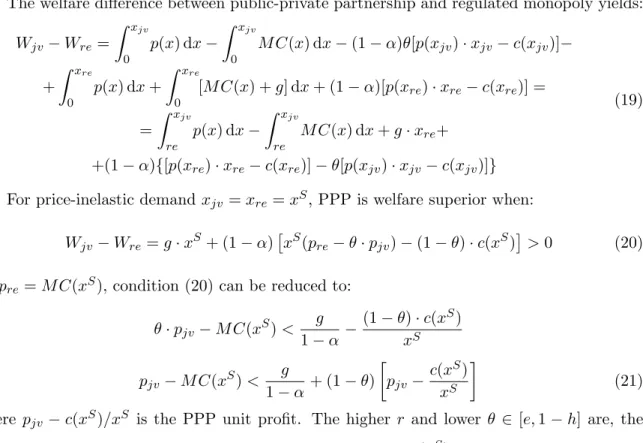
For price-inelastic demand xjv =xre =xS, PPP is welfare superior when:
Wjv−Wre=g·xS+ (1−α)xS(pre−θ·pjv)−(1−θ)·c(xS)>0 (20) Aspre=M C(xS), condition (20) can be reduced to:
θ·pjv−M C(xS)< g 1−α − (1−θ)·c(xS) xS pjv−M C(xS)< g 1−α + (1−θ) pjv−c(x S) xS (21) where pjv−c(xS)/xS is the PPP unit profit. The higher r and lower θ ∈ [e,1−h] are, the
more welfare efficient a PPP will be. For pjv close to M C(xS), PPP will generate profit
(pjv > c(xS)/xS) and will be more welfare efficient than regulation.
Figure 1 presents the PPP negotiating area. PU represents the aim of the public agent: low price downwardly constrained by average costppu and public ownership 1−θaboveh; PR represents the aim of the private investor: high price upwardly constrained by monopolistic pricepmand private ownershipθabovee. The higher the price above average cost and higherθ
are (towards PR set), the higher the bargaining (monopolistic) power of the private investor is. Conversely, the closer the price to average cost (towards PU set) is, the higher the bargaining (regulating) power of the public agent is.
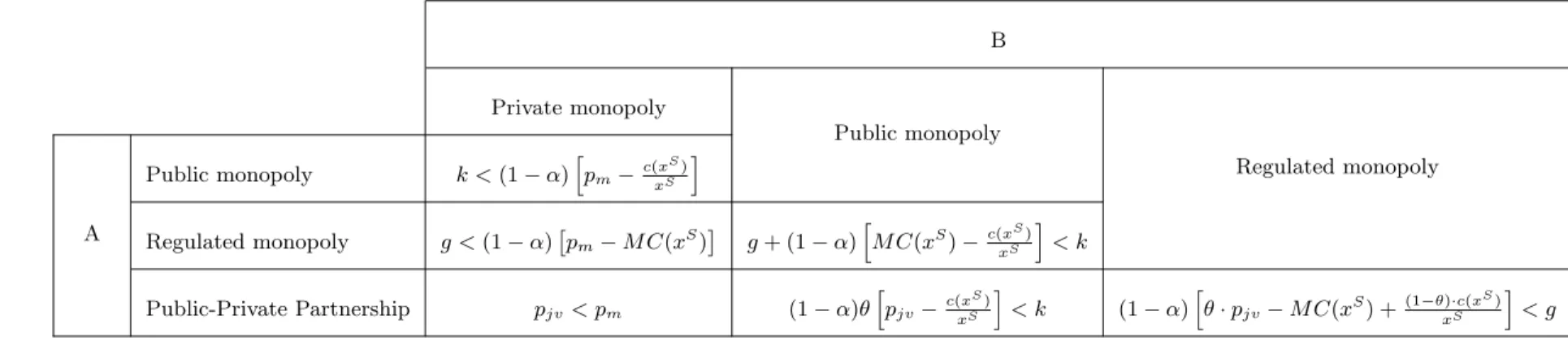
Table 1 presents the results of comparative statics of the four analyzed forms of organiza-tion of natural monopoly.
Deriving from equations 16, 18, and 21, welfare superiority of PPP requires meeting simultaneously the following conditions:
(1−α)θ pjv−c(x S) xS < k (22)
Table 1: Comparative statics of economic efficiency of institutional forms of organization of natural monopoly. Results are presented as
conditions for welfare superiority of row A compared to column B (A≻B) for price-inelastic quantity (xS), feasible PPP (θ
jv∈[e,1−h]), and α∈[0,1]. B Private monopoly Public monopoly Regulated monopoly A Public monopoly k <(1−α)hpm−c(x S ) xS i Regulated monopoly g <(1−α) pm−M C(xS) g+ (1−α)hM C(xS)−c(x S ) xS i < k Public-Private Partnership pjv< pm (1−α)θ h pjv−c(x S ) xS i < k (1−α)hθ·pjv−M C(xS) +(1−θ)·c(x S ) xS i < g 13
p 1 e θ 0 1 – h pm 1 – θ pjv PR PU h θ jv ppu
Figure 1: This figure presents the negotiating area in public-private partnerships. PU represents the aim set of the public agent: low price downwardly constrained by average costppuand public ownership 1−θ above h; PR represents the aim set of the private investor: high price upwardly constrained by monopolistic pricepmand private ownershipθabovee. The private investor requires minimum private ownership θ≥eto transfer know-how; the public agent requires minimum public ownership 1−θ≥h
to exercise internal control rights and waive costly regulation. Price cannot exceed monopoly pricepm nor be below variable average cost ppu. The negotiating area is, therefore, bounded by θ ∈ [e,1−h] andpjv∈(ppu, pm). and (1−α) θ·pjv−M C(xS) +(1−θ)·c(x S) xS < g (23)
Summing equations (22) and (23) yields the necessary condition for efficient PPP: (1−α)θ[pjv− c(x S) xS ] + (1−α)[θ·pjv−M C(x S) +(1−θ)·c(xS) xS ]< k+g (1−α) 2θ·pjv+ (1−2θ)c(x S) xS −M C(x S) < k+g (24)
PPP price pjv is, therefore, bounded by:
pjv < k+g 1−α−(1−2θ) c(xS) xS +M C(x S) 2θ , (25)
i.e., the maximum price charged by the joint-venture PPP pjv is a function of the marginal
cost M C(xS), the efficiency gains k+g from public-private co-ownership, the weight of profit
in welfare (i.e., the more the public administration values private profit in welfare, the more it will be prone to efficiency gains from private participation with higher PPP price), and a markup over average variable cost decreasing in private ownership.
Inequality (25) is a necessary but not sufficient condition for overall PPP welfare superi-ority. The necessary and sufficient condition is:
(1−α)θ pjv−c(x S) xS < min k, g+ (1−α) M C(xS)−c(x S) xS , (26)
i.e., the private profit markup over average variable costs that is not part of welfare cannot exceed the efficiency gains from private management nor the efficiency gains from internal regulation plus the difference between marginal cost and average variable cost that is not part of welfare.
Thus, the maximum negotiablepjv is bounded by:
pjv < min k (1−α)θ + c(xS) xS , g (1−α)θ + M C(xS) −c(xSxS) θ + c(xS) xS (27)
Proposition 1 Forα, θ ∈(0,1), the maximum feasible pjv(θ) is decreasing and convex in θ.
Proof: Forpjv = (1−kα)θ+c(xxSS), ∂pjv ∂θ = − k (1−α)θ2 <0 and ∂2pjv ∂2θ = 2(1−kα)θ3 >0. For pjv = (1−gα)θ +M C(x S) −c(xSxS) θ + c(xS) xS , ∂pjv ∂θ = − g (1−α)θ2 − M C(xS) −c(xSxS) θ2 <0 and ∂2pjv ∂2θ = g (1−α)θ3 −2 M C(xS) −c(xSxS) θ3 >0.
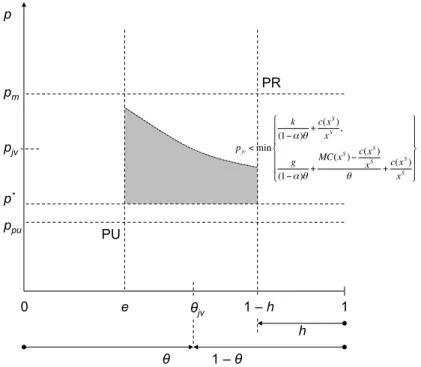
In other words, the more ownership shareθis required by the private investor to contribute cost-saving know-how, the lower the acceptable maximum price (i.e., private rent extraction). The downward slope ofpjv(θ) depends, ceteris paribus, onk,g, andα: the higher the savings from private know-how k and internal regulation g are, and the higher the weight of private profit in welfareαis, the steeper the slope will be. Minimumpjv is bounded by marginal cost, below which there is no incentive for the private investor to produce. Figure 2 depicts the PPP negotiating area upper and lower bounded by alternative organization modes and their welfare outcomes.
p 1 e θ 0 1 – h pm p* 1 – θ pjv PR PU h θ jv pjv<min k (1−α)θ+ c(xS ) xS , g (1−α)θ+ MC(xS)−c(x S) xS θ + c(xS) xS " # $ $ % $ $ & ' $ $ ( $ $ ppu
Figure 2: This figure presents the contracting area for efficient public-private partnership. The private investor requires minimum private ownership θ ≥ e to transfer know-how; the public agent requires minimum public ownership 1−θ ≥h to exercise internal control rights and waive costly regulation. Pricepjvis lower bounded by the best alternative for the private investor (i.e., first-best marginal cost pricing) and upper bounded by the best alternative for the public agent, either public or regulated monopoly pricing including k and g. This upper bound decreases in private ownership θ as part of private profit does not constitute welfare.
When factoring in alternative organization modes and their related costsg andk, the PR set becomes unattainable for the private investor. As the negotiation area is bounded by the ef-ficientpjvfrontier, the private investor aims to minimize the distance to PR set. This optimiza-tion problem can be reduced to minimizing the Cartesian distancep(pm−pjv)2+ (θ−1 +h)2,
adjustingpjv and θ. The required minimum public ownershiph is not knownex ante, but the private investor can estimate it during negotiations.
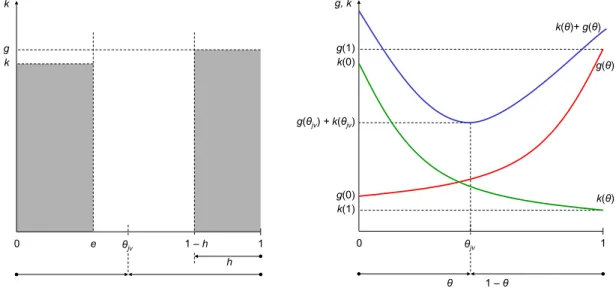
Hitherto, PPP efficiency is subject to saving regulation costg whenθ≤1−h and lack of know-how costkwhen θ≥e: i.e., e≤1−h, i.e., discrete functions of private ownership share in a PPP (see Figure 3, left graph).
Assuming differentiable and monotonic functionsg(θ) andk(θ) (see Figure 3, right graph), the necessary and sufficient conditions for welfare superior PPP can be formulated as the minimization of g+k:
Proposition 2 Forθjv∈(0,1), PPP is welfare superior if ∂θ∂g jv+ ∂k ∂θjv = 0and ∂2g ∂θ2 jv +∂2k ∂θ2 jv >0.
Proof:The proof is straightforward from the discussion above. Also,a contrario,∀θjv∈(0,1), if ∂θ∂g jv + ∂k ∂θjv 6= 0, or ∂g ∂θjv + ∂k ∂θjv = 0 and ∂2g ∂θjv2 + ∂2k
∂θ2jv <0, then the minimum is located on the
set boundary (i.e., public provision of public goods or full privatization).
1 e 0 1 – h h k g g, k θ jv 1 θ 0 g(1) 1 – θ θjv g(0) g(θ) k(θ)+ g(θ) k(θ) g(θjv) + k(θjv) k(1) k(0) g, k
Figure 3: This figure presents the regulatory and lack of know-how costs as discrete (left graph) and continuous (right graph) functions of private ownership share in a public-private partnership. Cost of lack of know-howkdecreases and regulation costgrises in private ownershipθ. PPP is welfare superior when regulation costg plus lack of know-how costkminimum is internal θ∈(0,1). Depicted levels of
g andkare arbitrary for illustrative purposes (e.g.,kmight be greater thang)
Paraphrasing Ronald Coase (1937), the optimal private ownership share of a utility com-pany is the share at which marginal regulatory cost equals marginal savings due to private know-how, where k(1) can be interpreted as the unit X-type inefficiency cost (Leibenstein 1966; Stigler 1976), and g(0) as the unit cost of internal regulation (Balakrishnan and Koza 1993).
5
Policy Implications
Holding financing and development outlays constant, the comparative statics on operational efficiency yield the following policy implications and testable predictions:
(a) A decrease in the marginal regulation cost (g) shifts the optimal utility ownership organi-zation mode towards regulated monopoly.
Jurisdictions with inefficient regulatory institutions may find it best to keep the provi-sion of public goods in-house. When regulation costs are low (as in the US), regulated monopoly is an efficient organizational mode for the provision of public goods.
(b) A larger technology gap between the private and public sectors (k) shifts the optimal utility organization mode towards private and regulated monopoly.
Developing countries, where the technology gap between the private and public sectors is high, may benefit from transferring the provision of public goods to the private sector. (c) A faster learning by the public sector (dynamic technology convergence ˙k < 0) increases
the preference for public monopoly.
Whereas the technology and managerial innovations are simple and the public sector learns quickly, the private delivery of public goods may be limited in time or skipped.
(d) A smaller weight of profit in welfare (α) shifts the optimal utility organization mode to-wards public monopoly.
For example, by backward induction larger profit expatriation 1−α by international cor-porations engaged in PPPs lowers the attractiveness of shifting, from the public sector’s perspective, the provision of public goods to the private sector.
(e) A decrease in the private ownership threshold (e) above which the private investors transfer cost-saving know-how and a decrease in the public ownership threshold (h) above which the public agent foregoes costly external regulation increases the probability of PPPs as the optimal utility organization mode. Jurisdictions with sound minority shareholder rights (e.g., piggyback rights or “shotgun” clause, which gives you the right to buy or sell—at a specified price or at fair value—the minority stake to another shareholder if the minority shareholder cannot resolve an issue regarding the company’s operations or sale) will attract more investors to PPPs.
Overall, private participation in the provision of public goods through PPPs finds home in jurisdictions where the technological and managerial gap between the private and public sectors is large, but requires efficient institutions and strong rule of law to lower regulatory costs, reduce profit expatriation, and provide protection to minority shareholders.
6
Extensions and Special Cases
In this section, I relax some assumptions and analyze their impact on the pricing and ownership structure of public-private partnerships. The aim of this section is to show how the model can accommodate other trade-offs present in policy analysis.
6.1 Private-Sector Spillovers
Private-sector involvement in public goods provision can induce positive welfare externalities. For example, municipalities can use new asphalting technologies introduced by a foreign in-vestor in a toll highway, or efficient water treatment methods used by a PPP can have a positive impact on crops.
Let’s assume that for each unit of PPP profitπjv,α∈[0,1] contributes directly to welfare (i.e., 1−αleaves the system) andχ >0 induces a positive spillover in other industries’ profits, so that the parameterα can be decomposed into α=α+χ.
If private-sector profit in public utilities creates spilloversχthat increase efficiency in other industries so thatα >1 (see, e.g., Grossman and Helpman 1994), conditions (22) and (23) are always satisfied and the maximum negotiablepjv is not not bounded by welfare considerations but only by income effects and “political” constraints. In other words, PPPs could support a higher pricepjv without detriment in welfare.
Politicians and policymakers are prone to (ideological) biases regarding the impact of pri-vate profit in welfare. An underestimation of α would bias θ towards the public sector or require bigger gains from know-how transferkand internal regulationg; conversely, an overes-timation of α would bias the results towards the private sector, creating potential distortions and corrective interventions in the long-run, including nationalization (or municipalization) when expectations are not met.
Indigenous (local) private participation in infrastructure is more likely to correspond to
α > 1. On the other hand, foreign direct investment in infrastructure is more likely to be associated with dividend and expatriation transfers from the PPP to the company parenthood, thus with α <1. Most of private investments in PPPs in developing countries come from the foreign sector, which explains in part why comparable PPPs there tend to show lower pjv and
6.2 Bundling
The bundling of investment and operations under one private entity has been pointed out in the literature as one of the efficiency sources of PPPs over public provision (Iossa and Martimort 2012; Engel, Fischer, and Galetovic 2001). For example, a private toll road operator can invest in quality materials to lower future maintenance costs or a private water company can invest in new pipelines to lower licks along the line.
If private ownership leads to lower investment outlays and thus lower fixed costF (Moszoro 2014), then PPPs that bundle investment and operations create inter-temporal trade-offs that make them viable—i.e., preferable for both the public agent and the private investor—at a higher pricepjv and higher private ownershipθ, or lower know-how advantagekand regulation savings g, than if the private investor would be assigned operations only.
In other words, if the PPP company bundles operations withefficientinvestment (i.e., lower fixed fee), then the efficient frontier in Figure 2 moves upwardly towards PR set for the same
k and g, or remains at the same level for lowerk and g.
6.3 Demand Elasticity
Most of goods and services produces by public utilities seem to be price inelastic (i.e., an increase in price corresponds to a proportionally lower decrease in demand). There may be cases where the demand for the goods or services provided by the PPP have adequate substitutes and prices pjv are elastic: e.g., a supplementary told road, municipal extra-curricular recreational centers for the youth, elderly housing, etc.
If demand is price elastic, an increase in the price charged by the PPPpjv can negatively affect profit. Both the public administration and the private investor will be prone to keep prices low or reduce them: to avoid welfare loss and profit loss, correspondingly.
In these instances, the focus of bargaining will shift from price to residual control rights
θ. In other words, price-inelastic demand simplifies the math of the economic analysis, but convolutes negotiations between the public administration and the private investor over price.
6.4 Quantity–Quality Trade-offs
Generally, regulators set the minimum quality output of public goods ex ante, thus dismiss-ing possible ex post quantity–quality trades between the utility company and the customers.
Allowing for quantity–quality trades (e.g., less quantity demand but at a higher quality level) would yield a different welfare function than equation (4), the outcome of which would be dependent on the endowment of consumers.
Under quasi-linear preferences on all goods but quality output yields a Coasean-type endowment-independent univocal quality level (Moszoro 2016). The optimal PPP ownership and governance structure under different quality–quantity preference function families is a topic for future research.
6.5 Unmatched Ownership and Profit Sharing
In the analysis hitherto, the parameterθencapsulated private share in investment and profit— the so-called “equity public-private joint ventures” or “institutional public-private partner-ships.” Many PPP structures, however, distinguish between infrastructure ownership on the one hand, and control rights of operations and profit sharing on the other hand (hereinafter noted θin and θop, respectively). In practice, the differentiation between ownership and
resid-ual control rights is implemented using dresid-ual-class shares (e.g., non-voting or preferred shares) and investment subsidies (i.e., financial contributions not reflected in the capital structure).
What are the implications of unmatched private infrastructure ownership and control rights of operations? Forθin6=θop:
(a) If the fixed feeF which covers investment sunk costs is prorated by the share in ownership
θin, the problem simplifies to the analysis of operations hereinbefore.
(b) If θin < θop, the public sector subsidizes the infrastructure. At the boundary whenθin =
0 (but still θop ∈ [e,1−h]), the public sector owns the infrastructure and leases it to
the private sector to operate it. For example, in many transport PPPs (e.g., toll road operators), the public sector finances in full the infrastructure, contracts out the operation of the assets, and takes a share in the profit and/or gets paid a fixed amount.
(c) If θin > θop, the private sector finances the infrastructure, which is then operated by
the public sector. This arrangement is used to develop social public infrastructure (e.g., courthouses, schools, etc.) when the public sector is debt-constrained, but the private sector has better financing capacity.
7
Concluding Remarks
In this paper, I focused on the operations of utility companies and modeled regulation cost and managerial expertise in the provision of public goods as functions of private ownership. Managerial incentives for cost-saving know-how are subject to sufficient private ownership. Likewise, provided sufficient public control rights, information asymmetry vanishes, quality is set and audited internally, and regulation cost is minimized.
Assuming away financing constraints, the optimal private ownership share of a utility company is the share at which the combined regulatory and lack of know-how cost is minimized. When the solution is interior, a PPP is efficient in comparison to the corner solutions—public provision and full privatization. In jurisdictions where regulation costs and private-sector know-how advantage are high and decreasing co-ownership and co-governance (e.g., in Europe), PPPs are feasible and potentially efficient. In these cases, PPPs are closer to the first-best benchmark—i.e., full internalization of know-how and no regulation cost—albeit with a price higher than marginal cost thanks to rent sharing. The PPP price is upper bounded by the degree in which private profit is part of social welfare.
In jurisdictions where regulation costs or private-sector know-how advantage are compar-atively low or decrease slowly in co-ownership and co-governance (e.g., in the US due to high disclosure standards and low information asymmetry between the public and private sectors), public provision and full privatization will be the efficient solutions and stable equilibria.
Appendix A
Notation
Variable Formula Meaning
AT C T C(x)/x Average total cost
AV C c(x)/x Average variable cost
c(x) Variable cost of producing x
CS Consumer surplus
F Fixed cost of natural monopoly
e Ownership threshold above which the private investors transfer cost-saving know-how (i.e., e≥θ)
g Marginal regulation cost
h Ownership threshold above which the public agent foregoes costly external regulation (i.e., h≥1−θ)
k Marginal operating cost increase due to lack of know-how
M C ∂T C(x)/∂x Marginal cost
p Variable part of a two-part tariff
P S Producer surplus
T C(x) Total cost of producing x
x Quantity output of the good produced by the natural
monopoly
Z Lagrangian
α Weight of profit in welfare
χ Weight of profit that increases efficiency in other industries
λ Lagrange multiplier
πjv Public-private partnership profit
πm Private monopoly profit
πpu Public monopoly profit
πre Regulated monopoly profit
θ Private investor’s share in investment and profit 1−θ Public agent’s share in investment and profit
Abbreviation Meaning
jv Joint venture, institutional public-private partnership
References
Armstrong, M. and D. E. M. Sappington (2006). Regulation, competition, and liberalization.
Journal of Economic Literature 44(2), 325–366.
Balakrishnan, S. and M. P. Koza (1993). Information asymmetry, adverse selection, and joint-ventures. theory and evidence. Journal of Economic Behaviour and Organisa-tion 20(1), 99–117.
Coase, R. H. (1937). The nature of the firm. Economica 4(16), 386–405.
Coase, R. H. (1946). The marginal cost controversy. Economica 13(51), 169–182.
Engel, E., R. Fischer, and A. Galetovic (2001). Least-present-value-of-revenue auctions and highway franchising.Journal of Political Economy 109(5), 993–1020.
Engel, E., R. Fischer, and A. Galetovic (2013). The basic public finance of public-private partnerships.Journal of the European Economic Association 11(1), 83–111.
Friedman, M. (1962). Capitalism and Freedom. Chicago, IL and London, UK: University of Chicago Press.
Grossman, G. M. and E. Helpman (1994). Protection for sale. American Economic Re-view 84, 833–850.
Grossman, S. J. and O. D. Hart (1986). The costs and benefits of ownership: A theory of vertical and lateral integration. Journal of Political Economy 94(4), 691–719.
Grout, P. A. (1997). The economics of private finance initiatives.Oxford Review of Economic Policy 13(4), 53–66.
Grout, P. A. (2005). Value-for-Money measurement in public–private partnerships. EIB Papers 10(2), 33–56.
Hart, O. (2003). Incomplete contracts and public ownership: Remarks, and an application to public-private partnerships. The Economic Journal 113(486), C69—C76.
Hart, O. and J. Moore (1990). Property rights and the nature of the firm.Journal of Political Economy 98(6), 1119–1158.
Hart, O., A. Shleifer, and R. W. Vishny (1997). The proper scope of government: Theory and an application to prisons.Quarterly Journal of Economics 112(4), 1127–1161.
HM Treasury (2013, October). New PF2: Government delivers new approach for investment in public infrastructure. Technical report, Infrastructure UK, London, UK.
Iossa, E. and D. Martimort (2012). Risk allocation and the costs and benefits of public– private partnerships. RAND Journal of Economics 43(3), 442–474.
Iossa, E. and D. Martimort (2015). The simple microeconomics of public-private partner-ships. Journal of Public Economic Theory 17(1), 4–48.
Kogut, B. (1988). Joint ventures: Theoretical and empirical perspectives.Strategic Manage-ment Journal 9(4), 319–332.
Kwak, Y. H., Y. Chih, and C. W. Ibbs (2009). Towards a comprehensive understanding of public private partnerships for infrastructure development. California Management Review 51(2), 51–78.
Leibenstein, H. (1966). Allocative efficiency vs. ‘X-efficiency’. American Economic Re-view 56(3), 392–415.
Mas-Colell, A., M. D. Whinston, and J. R. Green (1995).Microeconomic Theory. New York: Oxford University Press.
McDonald, F. (1999). The importance of power in partnership relationships. Journal of
General Management 25(1), 43–59.
Moszoro, M. W. (2014). Efficient public-private capital structures. Annals of Public & Co-operative Economics 85(1), 103–126.
Moszoro, M. W. (2016, 13). Coasean quality of regulated goods. B.E. Journal of Economic Analysis & Policy 16(4), 1.
Newbery, D. M. (2000). Privatization, Restructuring and Regulation of Network Utilities. The Walras-Pareto Lectures. Cambridge, MA: The MIT Press.
Osborne, D. and T. Gaebler (1993). Reinventing Government: How the Entrepreneurial Spirit Is Transforming the Public Sector. New York: Plume.
Posner, R. A. (1972). The appropriate scope of regulation in the cable television industry.
Bell Journal of Economics & Management Science 3(1), 98–129.
Stigler, G. J. (1976). The xistence of x-efficiency. American Economic Review 66(1), 213– 216.
Tirole, J. (1988). The Theory of Industrial Organization. Cambridge, MA: The MIT Press. Trujillo, J. A., R. Cohen, X. Freixas, and R. Sheehy (1998). Infrastructure financing with
unbundled mechanisms. Financier-Burr Ridge 5(4), 10–27.
Vaillancourt-Rosenau, P. (2000). Public-Private Policy Partnerships. The MIT Press. V¨alil¨a, T. (2005). How expensive are cost savings? on the economics of public-private
part-nerships.EIB Papersapers 10(1), 95–119.
Varian, H. R. (1992). Microeconomic Analysis (3rd ed.). New York: W. W. Norton & Com-pany.
Viscusi, W. K., J. M. Vernon, and J. E. Harrington (2000). Economics of Regulation and
Antitrust (3rd ed.). Cambridge, MA: The MIT Press.
Williamson, O. E. (1988). Corporate finance and corporate governance. Journal of
Fi-nance 43(3), 567—591.
World Bank (2016). Private Participation in Infrastructure Database. http://ppi.worldbank.org/, World Bank, Washington, DC.
World Bank (2017). Public-Private Partnerships Reference Guide. PPP Knowledge Lab, World Bank, Washington, DC.