Standar
ds T
Lisa Dusseault Open Source Applications Foundation Jim WhiteheadUniversity of California, Santa Cruz
Open Calendar Sharing
and Scheduling with CalDAV
Building on a decade of work on calendar standards, the CalDAV protocol promises to unlock the potential of widespread calendar interoperability. It permits calendar sharing over the Web and reduces the coordination cost of scheduling meetings across and within organizational boundaries.The protocol extends the Web Distributed Authoring and Versioning (WebDAV) protocol — itself, a simple extension of HTTP — to provide services for calendar maintenance, queries, event scheduling, and security.
C
onsider for a moment the effort it takes to schedule a meeting that includes people from multiple orga-nizations. Currently, doing so involves phone calls and multiple rounds of email, usually coordinated by one per-son, to build consensus for a time that works for most people; the coordinator must also delicately handle cases in which the chosen time excludes one or more participants.For meetings in which everyone comes from the same organization, participants can solve scheduling issues largely via calendar sharing and scheduling software. To schedule a meeting with Oracle Calen-dar or Microsoft Exchange/Outlook, for example, you log in to a calendar server and then issue search requests for avail-able times among a group of meeting par-ticipants. Once the application finds a free time slot, it sends a meeting request and then handles acceptance or rejection replies. Organizations that adopt this
tech-nology can see dramatic benefits as meeting-coordination time drops from tens to single-digit minutes — as long as everybody uses client software that sup-ports the chosen enterprise application.
Unfortunately, these applications work only within existing organizations. Con-sider what happens when Jim, who works outside the organization, wants to sched-ule a meeting with Larry and his cowork-ers, who are inside. Because he doesn’t have an account on the internal calendar system, Jim must send an email to Larry, who then takes on the coordination task to find meeting slots that work for his coworkers. Larry must then negotiate with Jim for a time slot that works for members of Jim’s organization. Even if Larry and Jim both had access to calen-dar systems for their respective organiza-tions, the process would remain tedious and prone to coordination breakdowns.
To efficiently schedule meetings, users need an interoperability protocol that lets
a diverse range of calendar clients and servers communicate over the Internet. With such a pro-tocol, we could use existing tools to schedule cross-organization meetings as efficiently as with-in-organization meetings. This protocol would also make it easier to support calendar access and scheduling functionality on a broad range of devices by providing an open, consistent, stan-dardized way to retrieve calendar data.
History of
Calendar Interoperability
Protocol developers have long recognized the need for a calendar access and scheduling protocol. A July 1996 press release from Netscape Communi-cations heralded the formation of a working group dedicated to developing standards for calendaring and scheduling on the Internet.1That group became the IETF’s Calendaring and Scheduling (CalSch) working group, which operated from October 1996 through September 2004. CalSch initially divided its work into three main lines of development: • a data model and textual representation for
cal-endar events (which generated the iCalcal-endar specification),
• the transport of calendar information via email and LDAP (which resulted in the iCalendar Message-Based Interoperability Pro-tocol [iMIP]), and
• a general-purpose specification for calendar access and scheduling (which became the Cal-endar Access Protocol [CAP]).
A key problem in developing interoperable calen-dar applications is determining a stancalen-dard way to represent calendar items, including those that repeat over time (a meeting held every Monday at 11 a.m., for instance). CalSch built on earlier work by the Versit consortium, which developed an ini-tial calendaring and scheduling specification called vCalendar (www.imc.org/pdi/). After two years of refining that work, CalSch produced RFC 2445,2 which is now in widespread use. The iCalendar data format it defines shares vCalendar’s non-XML format for representing attribute-value pairs.
CalSch also developed the iCalendar Transport-Independent Interoperability Protocol (iTIP) for calendar retrieval and scheduling operations.3This document described conceptually how to perform calendar-related operations, but it didn’t provide a concrete, on-the-wire protocol. The iMIP speci-fication,4 which describes how to perform iTIP
operations via email, has seen some success, including several vendor implementations and some cross-vendor interoperability. However, iMIP isn’t commonly used today by typical calendaring or email applications.
CAP provides services that calendar applica-tions can use to access calendar items from remote servers, search for open time periods in another person’s calendar (known as free/busy queries), and schedule meetings. (See www.calsch.org/ ietf/drafts.html for a complete list of CalSch’s doc-uments, drafts, and issues.) In versions 00 through 05 of CAP (released between August 1999 and July 2001), CalSch developed an entirely new pro-tocol that was distinct from all existing applica-tion-layer protocols, although it borrowed some-what from the Post-Office Protocol (POP) for its interaction style. In versions 06 through 11 (November 2001 through July 2003), the working group used the Blocks Extensible Exchange Pro-tocol (BEEP) for its marshalling syntax and mes-saging behavior.5CalSch made no further progress on CAP, and the IETF closed the working group in September 2004. After four years of development, CAP was dead.
As CAP development was slowly progressing, several implementers were routing around the working group to release functional Internet cal-endars. In 2002, Apple Computer released its iCal personal calendar application, which supports Internet-based calendar sharing. With iCal, a user can publish a calendar to a server running Web Distributed Authoring and Versioning (WebDAV),6 from which anyone else can view and download events. Although Apple designed the application to integrate with its WebDAV-based .Mac service, iCal works with any WebDAV server. A few open-source clients adopted iCal-over-WebDAV as the de facto first open calendaring standard.
In WebDAV,6Apple made an interesting choice. The protocol extends HTTP to include overwrite prevention (locking), namespace operations (list collection, move, copy, create collection), and metadata (properties). Combined with HTTP’s capa-bilities for reading, writing, and deleting Web resources, WebDAV provides all the features nec-essary for remote publishing and sharing of calen-dars. Given that Apple was already using WebDAV for access to its .Mac Internet disk service, it was able to piggyback calendar sharing on top of the existing WebDAV server infrastructure — a far more attractive option than implementing and fielding server infrastructure for a new protocol
such as CAP. Apple showed, in a very public way, that calendars could be treated like any other Web resource accessible via HTTP.
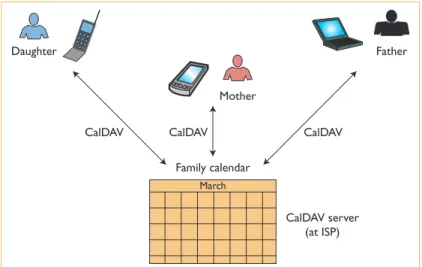
Although Apple’s iCal provides useful capabil-ities for individuals to publish and share their cal-endars, it does have drawbacks for corporate use. It isn’t easy to search for free/busy times across a large set of people or to find other people’s calen-dars. Due to synchronization issues, iCal also makes it very tricky to have someone else manage your calendar for you. These problems largely stem from protocol-level shortcomings. Although native WebDAV easily supports individual publishing and sharing, it doesn’t provide any support for calen-dar locating, searching, or workflow scheduling. Yet, Apple’s success with iCal-over-WebDAV raised the question of whether specialized calendar sup-port could be added to WebDAV, rather than requiring a new protocol like CAP. Ideally, we would like a calendar access protocol to support standard within-organization meeting scheduling, as well as collaborative calendar sharing such as a family might use (Figure 1). Additionally, we want to make it much easier to schedule a meeting between participants from multiple organizations (Figure 2). Supporting these scenarios is the moti-vation for the Calendaring and Scheduling Exten-sions to WebDAV (CalDAV) protocol.7
CalDAV in a Nutshell
The base CalDAV protocol provides three main features:
• Calendar maintenance. Users can create multi-ple personal calendars (one each for work, con-ference time slots, home, and so on) via a new mkcalendarmethod.
• Calendar queries. People can search other peo-ple’s calendars for free/busy times, or they can discover who is participating in a given meet-ing. Calendar applications can use queries to discover when to-do list items are due, and a flexible new report type supports a wide range of calendar queries.
• Calendar security. Users can control how much of their calendars are visible to others, and who has permission to change them, by using CalDAV extensions to the WebDAV access control protocol.
Using the same framework, a separate draft will build on the core CalDAV specification to provide optional scheduling workflow functionality. This
will let people using calendar applications make and reply to meeting invitations with a new schedulemethod along with inbox and outbox collections, and invitation fanout (replication) rules. Meeting participants can be from a single
Figure 1. Collaborative editing scenario with a shared calendar. This family uses a shared calendar maintained on a CalDAV server run by their ISP. The father uses a laptop computer at work and home to update the calendar; the mother uses a PDA with wireless access. Their daughter keeps in synch with the rest of the family by viewing and updating the calendar from her cell phone.
Mother
Daughter Father
CalDAV CalDAV CalDAV
Family calendar March
CalDAV server (at ISP)
Figure 2. Scheduling across an organizational boundary. Lisa and Jim work for two separate organizations and need to schedule a meeting. Using her CalDAV calendar client, Lisa first searches their calendars for free/busy times on the day she’d like to meet. She then sends a meeting invitation, which appears in Jim’s event inbox. Jim accepts the meeting and updates the calendars to show this.
Lisa Jim CalDAV CalDAV CalDAV Lisa's calendar March Jim's calendar March UCSC CalDAV server OSAF CalDAV server Open Source Applications Foundation University of California, Santa Cruz CalDAV iMIP
organization or span many. A person sends a meeting invitation by instructing the calendar application to invoke scheduleto place the meet-ing in their outbox, thereby causmeet-ing invitations to be placed in other attendee inboxes.
Modeling Calendaring Objects as HTTP Resources
HTTP resources have URLs and respond to get
requests. Calendar applications can also delete and write them as whole resources by using deleteand put. Although this is more a description than a def-inition, it’s useful to help decide what to represent as resources in a given application. What size object should have its own address? What size resource is most useful to download or upload? What size resource is most useful to create or destroy?
Within the iCalendar data format used by Cal-DAV, a calendar is composed of events, each repre-senting some activity a person or group will attend — meetings, appointments, performances, trips, or essentially anything with a start and end time.
In CalDAV, every event is represented as a resource, and resource contents are represented on the wire in the iCalendar text format.2Given that user operations often involve single calendar events, being able to provide a URL as an address for each event and to create, delete, or overwrite them is very convenient.
It might also be useful to have URLs and oper-ations for an event’s individual properties (such as its location, or start and end times), but that level of granularity is not required for reasonable performance. Although some use cases involve changing only an event’s location, it’s possible to do so within reasonable transmission and pro-cessing times by rewriting the whole event. There aren’t strong use cases for creating a resource that represents an event location without an event that has that location. The working group made a sim-ilar choice with the iCalendar standard in defin-ing event properties (except for timezone) only within the context of an actual event. To keep things simple, CalDAV doesn’t define URLs for event properties.
Given that CalDAV represents calendar events as HTTP resources, the protocol must decide which body and MIME type to assign these resources; this choice determines what the result of a getlooks like. The working group opted to use the iCalendar standard to represent all event data within the HTTP resource’s body. This makes use of existing work on the iCalendar standard, software libraries that implement iCalendar, and iCalendar interoperability experience. In fact, Web servers can already store files with the MIME type “text/calendar,” and it’s not unusual for existing Web browsers to dispatch downloaded iCalendar files to calendar applications to handle appropriately. Figure 3 shows an HTTP get request for an iCalendar-formatted event stored on a CalDAV server.
Figure 3. Using HTTP getfor a calendar event. The request shows an HTTP getsubmitted to a CalDAV server to retrieve a calendar event. The response shows an iCalendar event in the HTTP response body with a MIME type of text/calendar. The meeting is titled, “CalDAV draft review,” has three participants, and occurs on 2 September 2004, from 13:00 to 14:00 hours.
>> Request <<
GET /bernard/calendar/inbox/mtg456.ics HTTP/1.1 Host: cal.example.com
>> Response << HTTP/1.1 200 OK
Date: Thu, 02 Sep 2004 17:05:23 GMT Content-Type: text/calendar
Content-Length: xxxx BEGIN:VCALENDAR VERSION:2.0
PRODID:-//Example Corp.//CalDAV Server//EN BEGIN:VEVENT
DTSTAMP:20040901T200200Z DTSTART:20040902T130000Z DTEND:20040902T140000Z SUMMARY:CalDAV draft review UID:[email protected] ATTENDEE;PARTSTAT=ACCEPTED;ROLE=CHAIR;CUTYPE= INDIVIDUAL;CN=Lisa Dusseault:http://cal.example.com/lisa/inbox/ ATTENDEE;PARTSTAT=NEEDS-ACTION;ROLE=REQ-PARTICIPANT;CUTYPE=INDIVIDUAL; CN=Bernard Desruisseaux:http://cal.example.com/bernard/inbox/ ATTENDEE;PARTSTAT=NEEDS-ACTION;ROLE=REQ-PARTICIPANT;CUTYPE=INDIVIDUAL; CN=Cyrus Daboo:http://cal.example.com/cyrus/inbox/ END:VEVENT END:VCALENDAR
Recurring Events
A calendar repository needs a clear model of how to deal with recurring events. Imagine the confu-sion if one client represented recurrences as a property but another client couldn’t understand the syntax and saw only one instance of the event. The situation gets even more complex when we start modifying recurrences. The specification thus needs to be clear on whether a client can modify an existing resource or must create a new one to create a new instance of a recurring event.
The choice of iCalendar provides guidance here because it almost always represents a recurring event as a single component with a set of recur-rence dates or patterns. Following this pattern allows CalDAV to represent even infinitely recur-ring events in a noninfinite space — a definite plus for synchronizing an entire calendar.
Using HTTP Features on Calendars
With iCalendar events mapped to resources, we can use base HTTP to quickly solve an important set of use cases for CalDAV:
• To download an event, a calendar application uses get and interprets the body of the response as an iCalendar file.
• To create a new event, the application uses put (and an unmapped URL) and sends an iCalen-dar file in the request body.
• To overwrite an existing event or to change its location, time, or attendees, the calendar appli-cation sends a putrequest to an existing event URL with the new values for the event in the iCalendar-formatted request body.
• To delete an existing event, the application uses deleteon the event URL.
• To check whether an event has changed since last downloaded, the application uses the HTTP ETag.
Although HTTP supports many useful calendar operations on its own, it has its limits. HTTP has no capability for listing all of a person’s calendar events or preventing collaborators from overwrit-ing a shared calendar. The WebDAV protocol does support these functions; hence, CalDAV builds on both HTTP and WebDAV.
Using WebDAV Features on Calendars The functionality WebDAV provides on top of HTTP is also important to CalDAV. Events aren’t com-pletely unassociated with each other; instead, a
CalDAV server collects them into calendars that roughly represent the time commitments for a given person, object, or place. Sometimes it’s useful to see a single event, but other times we need the contents of a whole calendar or some time-slice thereof. For reasonable synchronization, it also helps to see which events have been added or removed since the last calendar synchronization.
In these use cases, CalDAV uses the WebDAV
collectionresource to model calendars. A WebDAV collection provides a way to list its resources in a clear, flexible, and machine-parsable (XML) way. And because we’ve already defined events as resources, WebDAV operations work on events and calendars in a straightforward way:
• To list all events in a calendar, use propfindon the calendar URL.
• To list all the calendars in a certain area of a repository, use propfindon the appropriate URL. • To copy an event to another calendar or cre-ate a dupliccre-ate event within one calendar day, use copy.
• To rename an event or move it to another cal-endar, use move.
• To lock an event or to lock an entire calendar while making changes, use lock/unlock. • To synchronize a calendar that has been
down-loaded before, use propfindand ask for the getetagWebDAV property, which provides the HTTP ETag value and shows new resources and changed and unchanged ETags, and omits deleted resources.
WebDAV also defines the mkcolmethod, which creates collections of resources, but CalDAV uses a different method because a calendar is a bit more than an ordinary collection, and the CalDAV client must signal that intention to the server.
New CalDAV Mechanisms
The native capabilities of HTTP and WebDAV sup-port many useful calendar-retrieval and update scenarios. However, it is necessary to extend Web-DAV’s core capabilities to provide rich support for calendar queries for free/busy times, creating col-lections of events, and supporting meeting invita-tion workflows.
Querying Calendars
The major use case that the HTTP and WebDAV methods we’ve described so far can’t handle is the ability to search a calendar. A generic search
mechanism that names properties and property values might seem attractive, but it doesn’t work well when dealing with time ranges and recur-rences, which are necessary complications of the event model defined in iCalendar. Alternatively, it is possible to download a copy of someone else’s calendar and then perform free/busy queries over this local data. Calendars typically have many entries, and the time required to download a local copy is far greater than asking a server to perform the equivalent free/busy query.
When scheduling a meeting, the most common use case is to request all events in a given time range. To schedule a meeting with a busy cowork-er, for example, you might want to see her sched-ule for the next week, including all recurring meetings and any multiday meeting that overlaps with the next week. This isn’t a complicated request, given a syntax that’s tailored to time-range objects.
CalDAV solves this by borrowing the report syntax defined in RFC 37448 and defining a calendar-specific time-range report.9This report provides a way to compile information in a single request and response that would be prohibitively expensive to collect using only getand propfind requests. At the same time, this report solves the problem already noted of expanding recurring events and identifying which events occur in a given time range. If the client asks for all events with start times after 8 a.m. this morning and end times before midnight tonight, for example, it could miss recurrences. With a report, on the other hand, the server can perform the necessary time and recurrence calculations and provide the exact set of events that should show up in a given time period.
Identifying and Creating Calendars
The need to be able to identify calendars follows from the need to support special reports on them. To treat a collection as a calendar, the client has to both know that it is a calendar and support the cal-endaring functionality. The mechanism that Web-DAV defines for this purpose is the resourcetype property, and CalDAV defines a new value for it: CALDAV:calendar.
The need for a special mechanism to create cal-endars then follows from the need to identify them. To ask servers to create calendars, clients need a method that indicates what kind of resource to create and what functionality to provide on it.
In CalDAV, the client simply sends a
mkcalendarrequest to the server, which creates a calendar (if it can) in a user’s calendar storage space on a CalDAV-compliant server. The server automatically assigns the correct resourcetype value, which enables other clients to detect that the new resource is a calendar that contains events. Scheduling Meetings
with Base CalDAV and iMIP
Scheduling meetings is already possible with the CalDAV features we’ve discussed (all of which are described in the core CalDAV specification). A client can use a report to view another user’s free/busy time, and then use the iMIP standard to send an invitation over email. CalDAV increases the likelihood that the meeting invitation will avoid time conflicts.
Although this approach works for many applications, however, it’s not sufficient for enterprise-level calendaring and scheduling. In existing systems (using proprietary protocols), the server generally does more to help schedule — in part, to improve the user experience, but also to help address email’s shortcomings as an application transport.
These shortcomings arise from the history and practice of handling email and spam. Mail can be delivered through several mail-transfer agents (MTAs) before arriving at one or more mail user agents (MUAs), as the IETF calls mail-reading applications. This architecture works great for email, but it was never designed to deal with things like iCalendar invitations. Some of the prob-lems it presents include:
• How does calendaring software know which MUA will receive invitations?
• How do MUAs know which application to send invitations to?
• Some email software bypasses these last two issues with an integrated calendar module, but what if users want to manage their calendars with a different application?
• What does the MUA on a PDA or cell phone do with an invitation if no calendar software is available?
• What do MUAs do with invitations that appear in inboxes?
• How do multiple MUAs — each of which will discover a given invitation in the user’s email inbox — know which MUA should deal with the invitation and whether it can be deleted? • What do MUAs do with invitations that have
already been moved to another folder, possibly by categorization rules or by another MUA? Recent antispam measures have made meeting scheduling using iMIP even more difficult. MTAs often alter or block messages with unrecognized attachments, and MUAs could mark calendar invi-tations as spam.
Finally, to make scheduling workflows more effective, existing enterprise calendaring systems include mechanisms for receiving and recognizing invitations before they’re even delivered to the cal-endar application. While on vacation, users often leave their computers off, so they aren’t checking for, accepting, or publishing invitations on the server. In the meantime, coworkers might want to schedule meetings for as soon as vacationers return. When a calendar server can receive and handle invitations on a user’s behalf, it can tenta-tively place such invitations on the user’s pub-lished calendar. Although the meetings aren’t yet accepted, coworkers can see which blocks of time might already be filled, so they can try to find unrequested times for other meetings.
Scheduling using CalDAV Directly
Given the advantages of scheduling via a calendar server rather than email, the CalDAV specification authors already have a separate draft in progress to define how to solve scheduling use cases with a
CalDAV server’s assistance. This work is still in greater flux than the base specification, partly because the challenges are a little more difficult.
With WebDAV, clients access stored resources, rather than receive them from servers. It assumes that resources are somewhat stable, so the model doesn’t fit as well for applications in which mes-sages are generally in transit. Thus, it’s tempting to treat scheduling as a simple repository-access problem: to schedule with Jim, Lisa should create an event in his calendar, and vice versa.
The straightforward repository-access approach doesn’t suit the way users handle events. Rather than letting everyone who is allowed to invite her to meetings simply put them on her schedule — implying confirmed attendance — Lisa wants to treat each new scheduling item as a request to be reviewed.
The authors of CalDAV’s scheduling support are currently looking at scheduling inbox collections
to solve that problem. Jim could put a request in Lisa’s scheduling inbox, where it would be consid-ered tentative until she moved it to the main cal-endar. This approach seems to work better with common scheduling workflows, but it still leaves many unresolved details. For example:
• If Jim can place events in Lisa’s scheduling inbox, does that mean he can change events in that collection, including the one he created?
Learning More about Calendaring
I
nformation about Internet calendaring and scheduling is tricky to find because it is spread across multiple unconnected Web sites. Unfortunately, no books cover the iCalendar standards, but the following list highlights some of the best sources of information about iCalendar, CalDAV, and WebDAV.• The CalDAV Resources site has links to the CalDAV mailing list, protocol drafts, and recent CalDAV news (http:// ietf.webdav.org/caldav/).
• The IETF’s Calendaring and Scheduling working group (www.calsch.org) main-tains a list of calendaring RFCs and revision histories for the iCalendar, iCalendar Transport-Independent Inter-operability Protocol (iTIP), iCalendar
Message-Based Interoperability Pro-tocol (iMIP), and Calendar Access Protocol (CAP) specifications. It also maintains a rich list of pointers to calendaring products, articles, and open-source projects.
• The Internet Society’s Internet Report site houses the most recent CalDAV specification, along with its revision history (http://ietfreport.isoc.org/idref/ draft-dusseault-caldav/).
• The Open Source Applications Foun-dation maintains the CalDAV mailing list, which is open to all (http:// lists.osafoundation.org/mailman/listinfo/ ietf-caldav).
• The Calendaring and Scheduling
Consortium’s CalDAV Technical Committee maintains a limited Web
page about CalDAV efforts (www. calconnect.org/tc-caldav.html). • Lisa Dusseault’s book,WebDAV:
Next-Generation Collaborative Web Authoring (Prentice-Hall, 2004), provides a detailed description of the WebDAV, Access Control, and DeltaV protocols. • Julian Reschke’s Greenbytes WebDAV page (www.greenbytes.de/tech/webdav/) tracks ongoing activity in the WebDAV protocol space including the CalDAV specification.
• Finally, last issue’s Standards track article, “WebDAV: Versatile Col-laboration Multiprotocol” (IEEE In-ternet Computing, Jan./Feb. 2005, pp. 66–74), provides an overview of recent activity in the IETF WebDAV working group.
• When Lisa accepts a request, does the client put it on the calendar, or does the server handle that? • Is there more than one scheduling inbox if Lisa
has more than one calendar?
• What happens to a meeting request after Lisa accepts it?
• Can a user review the request history for a meeting, including updates as well as the orig-inal request?
• Can a user review the history of outgoing requests, including acceptances and requests that counter a suggested meeting time with an alternate?
The CalDAV draft authors and CalDAV mailing list participants are currently discussing how to resolve these issues.
CalDAV Status
After consuming significant committee time in debates over requirements, scope, and basic model assumptions, previous attempts at standardizing a protocol for calendar access proved inconclusive. Part of the difficulty is that many different mod-els exist and work well for the applications that use them. Although it’s possible in many software areas to define a single standard that encompass-es most of the featurencompass-es in existing nonstandard applications, this hasn’t proven feasible for calen-daring applications. Instead of a committee approach, the dedicated work of a few like-minded individuals thus seems likely to make more progress at this point.
Because CalDAV is an individual submission to the IETF, the current work on it is in the hands of the draft authors:
• Cyrus Daboo, chief technology officer of Isamet (www.isamet.com),
• Bernard Desruisseaux, who works on the Oracle Calendar server (www.oracle.com/collabsuite/), and
• Lisa Dusseault, of the Open Source Application Foundation (www.osafoundation.org).
To streamline the standardization process, they plan to develop CalDAV quickly in a small but open group. They welcome input, either in person or through the open mailing list at http://lists. osafoundation.org/mailman/listinfo/ietf-caldav. Once they have a stable proposal with interopera-ble implementations, the authors plan to introduce CalDAV fully into the IETF standardization process.
Currently, the Calendaring and Scheduling Consortium (www.calconnect.org) is contributing to the requirements for CalDAV and supporting interoperability testing events. Although it isn’t a standards organization, CalConnect is working to improve the interoperability of calendaring and scheduling applications as well as public aware-ness of standards in this area.
Isamet (client), Oracle (server), Mozilla (open-source client), and Slide (open-(open-source server) have already begun developing CalDAV imple-mentations. The first interoperability test event took place in January 2005, and demonstrated CalDAV interoperability among two servers and three clients.
W
ork continues on refining the CalDAV specifi-cation according to implementation experi-ence, and those involved expect to make the first deployment of CalDAV capabilities available to users within the coming year. Once CalDAV demonstrates a track record of interoperability and the base of users working with CalDAV-aware clients and servers increases, we expect other cal-endar client applications and servers to adopt it — especially given that CalDAV is the only viable calendaring access protocol.CalDAV will help millions of users schedule meetings within and across organizations using their PCs, personal information managers, and cell phones. It will remove much of the accidental complexity of gathering people together for a common purpose, freeing us for more creative and productive work. Moreover, because open stan-dards beget open-source implementations, CalDAV promises to bring advanced calendar scheduling capabilities to families, small nonprofits, schools, and many others for whom current calendar tech-nology is too complex and expensive.
References
1. “More than 20 Companies Join Netscape to Help Define Open Standard for Internet Calendaring and Scheduling,” press release, Netscape Communications, 24 July 1996; http://wp.netscape.com/newsref/pr/newsrelease194.html. 2. F. Dawson and D. Stenerson, Internet Calendaring and
Scheduling Core Object Specification (iCalendar), RFC 2445, Nov. 1998; www.ietf.org/rfc/rfc2445.txt.
3. S. Silverberg et al., iCalendar Transport-Independent Inter-operability Protocol (iTIP) — Scheduling Events, Busy Time, To-Dos, and Journal Entries, RFC 2446, Nov. 1998; www. ietf.org/rfc/rfc2446.txt.
4. F. Dawson, S. Mansour, and S. Silverberg, iCalendar Mes-sage-Based Interoperability Protocol (iMIP), RFC 2447, Nov. 1998; www.ietf.org/rfc/rfc2447.txt.
5. M. Rose, The Blocks Extensible Exchange Protocol Core, RFC 3080, Mar. 2001; www.ietf.org/rfc/rfc3080.txt. 6. Y. Goland et al., HTTP Extensions for Distributed Authoring
— WebDAV, RFC 2518, Feb. 1999; www.ietf.org/rfc/ rfc2518.txt.
7. C. Daboo, B. Desruisseaux, and L. Dusseault, “Calendaring and Scheduling Extensions to WebDAV (CalDAV),” IETF Internet draft, Feb. 2005; work in progress.
8. G. Clemm et al., Web Distributed Authoring and Version-ing (WebDAV) Access Control Protocol, RFC 3744, May 2004; www.ietf.org/rfc/rfc3744.txt.
9. G. Clemm et al., Versioning Extensions to WebDAV, RFC 3253, Mar. 2002; www.ietf.org/rfc/rfc3253.txt.
Lisa Dusseaultis a development manager and standards archi-tect at the Open Source Application Foundation, where she
is responsible for email, calendaring, and general sharing protocols for Chandler, a personal information manager. Dusseault is currently cochair of the IETF WebDAV working group as well as the iMap Extensions WG, and she partic-ipates regularly in other IETF work particularly relating to HTTP and Instant Messaging (XMPP). She has a BS in sys-tems design engineering from the University of Waterloo. Contact her at [email protected].
Jim Whiteheadis an assistant professor in the Department of Computer Science at the University of California, Santa Cruz. He founded the IETF WebDAV WG and served as its chair from its inception in March 1997 through March 2004. His research interests include collaborative author-ing, software configuration management, software evolu-tion, and Web engineering. Whitehead received a PhD in information and computer science from the University of California, Irvine. He is a member of the ACM, Usenix, and the IEEE. Contact him at [email protected].
EXECUTIVE COMMITTEE President:
GERALD L. ENGEL*
Computer Science & Engineering Univ. of Connecticut, Stamford 1 University Place
Stamford, CT 06901-2315 Phone: +1 203 251 8431 Fax: +1 203 251 8592 [email protected]
President-Elect:DEBORAH M. COOPER*
Past President: CARL K. CHANG*
VP, Educational Activities: MURALI VARANASI†
VP, Electronic Products and Services:
JAMES W. MOORE (2ND VP)*
VP, Conferences and Tutorials:
YERVANT ZORIAN†
VP, Chapters Activities:
CHRISTINA M. SCHOBER*
VP, Publications: MICHAEL R.WILLIAMS (1ST VP)*
VP, Standards Activities:SUSAN K. (KATHY) LAND*
VP, Technical Activities: STEPHANIE M. WHITE†
Secretary: STEPHEN B. SEIDMAN*
Treasurer: RANGACHAR KASTURI†
2004–2005 IEEE Division V Director:
GENE F. HOFFNAGLE†
2005–2006 IEEE Division VIII Director:
STEPHEN L. DIAMOND†
2005 IEEE Division V Director-Elect:
OSCAR N. GARCIA*
Computer Editor in Chief: DORIS L. CARVER†
Executive Director: DAVID W. HENNAGE†
* voting member of the Board of Governors †nonvoting member of the Board of Governors
E X E C U T I V E S T A F F Executive Director:DAVID W. HENNAGE Assoc. Executive Director:ANNE MARIE KELLY Publisher:ANGELA BURGESS
Assistant Publisher:DICK PRICE
Director, Administration:VIOLET S. DOAN Director, Information Technology & Services: ROBERT CARE
Director, Business & Product Development: PETER TURNER
PURPOSE The IEEE Computer Society is the world’s largest association of computing profes-sionals, and is the leading provider of technical information in the field.
MEMBERSHIPMembers receive the month-ly magazine Computer, discounts, and opportu-nities to serve (all activities are led by volunteer members). Membership is open to all IEEE members, affiliate society members, and others interested in the computer field.
COMPUTER SOCIETY WEB SITE
The IEEE Computer Society’s Web site, at
www.computer.org, offers information and
samples from the society’s publications and con-ferences, as well as a broad range of information about technical committees, standards, student activities, and more.
BOARD OF GOVERNORS
Term Expiring 2005:Oscar N. Garcia, Mark A. Grant, Michel Israel, Rohit Kapur, Stephen B. Seidman, Kathleen M. Swigger, Makoto Takizawa
Term Expiring 2006:Mark Christensen, Alan Clements, Annie Combelles, Ann Q. Gates, James D. Isaak, Susan A. Mengel, Bill N. Schilit
Term Expiring 2007: Jean M. Bacon, George V. Cybenko, Richard A. Kemmerer, Susan K. (Kathy) Land, Itaru Mimura, Brian M. O’Connell, Christina M. Schober
Next Board Meeting: 11 Mar. 2005, Portland, OR IEEE OFFICERS
President: W. CLEON ANDERSON President-Elect: MICHAEL R. LIGHTNER Past President: ARTHUR W. WINSTON Executive Director: TBD
Secretary: MOHAMED EL-HAWARY Treasurer: JOSEPH V. LILLIE
VP, Educational Activities: MOSHE KAM VP, Pub. Services & Products: LEAH H. JAMIESON VP, Regional Activities: MARC T. APTER VP, Standards Association: JAMES T. CARLO VP, Technical Activities: RALPH W. WYNDRUM JR. IEEE Division V Director: GENE F. HOFFNAGLE IEEE Division VIII Director: STEPHEN L. DIAMOND President, IEEE-USA: GERARD A. ALPHONSE
COMPUTER SOCIETY OFFICES
Headquarters Office 1730 Massachusetts Ave. NW Washington, DC 20036-1992 Phone: +1 202 371 0101 Fax: +1 202 728 9614 E-mail: [email protected] Publications Office
10662 Los Vaqueros Cir., PO Box 3014 Los Alamitos, CA 90720-1314 Phone:+1 714 821 8380 E-mail: [email protected]
Membership and Publication Orders: Phone: +1 800 272 6657 Fax: +1 714 821 4641 E-mail: [email protected] Asia/Pacific Office Watanabe Building 1-4-2 Minami-Aoyama,Minato-ku Tokyo107-0062, Japan Phone: +81 3 3408 3118 Fax: +81 3 3408 3553 E-mail: [email protected]