The research reported in this thesis was carried out at the Open Universiteit in the Netherlands at Welten Institute – Research Centre for Learning, Teaching and Tech-nology,
and under the auspices of SIKS, the Dutch Research School for Information and Knowledge Systems.
SIKS Dissertation Series No. 2017-46 © Jan Schneider Barnes, 2017 Printed by Datawyse
Cover design: Jan Schneider Barnes and Chris Peeters ISBN/EAN: 978 94 6159 769 4
Sensor-based Learning Support
Proefschrift
ter verkrijging van de graad van doctor aan de Open Universiteit op gezag van de rector magnificus
prof. mr. A. Oskamp ten overstaan van een door het College voor promoties ingestelde commissie
in het openbaar te verdedigen op vrijdag 24 november 2017 te Heerlen
om 16:00 uur precies door
Jan Schneider Barnes
Promotor Prof. dr. M. M. Specht Open Universiteit Co-Promotor Dr. D. Börner Open Universiteit Dr. P. van Rosmalen Open Universiteit
Overige leden van de beoordelingscommissie Prof. dr. J. T. Jeuring
Open Universiteit, Universiteit Utrecht
Prof. dr. K. Luyten
Universiteit Hasselt
Prof. dr. J. Xiao
Shanghai Open University
Prof. dr. M. Kalz
Open Universiteit
Dr. H. Jarodzka
Contents
List of Tables
List of Figures 11
Chapter I General Introduction 13
First steps 14
Technology and Learning 14
Interactive Learning Technologies 15
Context of the Research 17
Outline of the research 17
Part I Literature Study 21
Chapter II Augmenting the Senses: A Review on Sensor-Based
Learning Support 23
Introduction 25
Classification Framework 26
Classification Framework for Learning Domains 27
Classification Framework for Formative Assessment Support 29
Classification Framework for Feedback 30
Method 32
Results 34
Classification for Learning Domains 34
Classification for Formative Assessment Support 38
Feedback Analysis 40
Discussion 44
Conclusion 46
Part II First Iteration 49
Chapter III Stand Tall and Raise your Voice! A Study on the
Presentation Trainer 51
Introduction 53
Presentation Trainer Application 53
Feedback Framework 54
Voice Analysis 54
Body Language Analysis 55
First Study 55
Output Interface Version 1 55
6
User Tests Setup 56
Results of the First User Study 57
Evaluation of First Results 58
Second Study 58
Tackling the complexity 58
Second Study User Tests Setup 62
Results of the Second Study 63
Discussion of Second Study 63
Conclusion and Future Work 64
Chapter IV Can you help me with my pitch? Studying a tool for
real-time automated feedback 67
Introduction 69
Background 69
Presentation Trainer 70
Presentation Trainer Architecture 71
Presentation Trainer Feedback 72
Purpose of the study 77
Method 78
Participants 78
Apparatus and Materials 78
Procedure 79
Results 81
Discussion 86
Conclusions and Future Work 88
Part III Second Iteration 91 Chapter V Presentation Trainer: What experts and computers can tell
about your nonverbal communication 93
Introduction 95
Method 96
Design and Sampling 96
Instruments and Procedure 96
Data Collection 97
Data Analysis 97
Validity and Reliability 97
Results 98
Nonverbal communication ineffective and best practices 98
Formative evaluation of the Presentation Trainer 103
Discussion 105
General nonverbal communication behaviors 105
Technical nonverbal communication behaviors 105
Formative expert evaluation of the PT 106
Chapter VI Enhancing public speaking skills - an evaluation of the
Presentation Trainer in the wild 109
Introduction 111 Background Work 111 Purpose 113 Method 114 Study Context 114 Study procedure 114
Apparatus and Material 115
Results 116
Discussion 120
Conclusion and Future Work 122
Part IV Third Iteration 125
Chapter VII Do you know what your nonverbal behavior communicates? – Studying a self-reflection module for the Presentation
Trainer. 127 Introduction 129 Presentation Trainer 129 Self-reflection module 130 Method 133 Study Context 133 Study Procedure 133
Apparatus and Material 134
Results 134
Discussion 138
Conclusion and Future Work 139
Chapter VIII Do you want to be a Superhero? Boosting emotional states
with the Booth 141
Introduction 143
Background 143
The Booth 144
The Booth Narrative 145
Lecture 1: Superhero Posture 145
Lecture 2:Superhero Powers 146
Lecture 3: Inspiration 146
Lecture 4: Saving the World 147
Lecture 5: Celebration 148
Evaluation 148
First Step 148
Second Step 152
Discussion 158
8
Chapter IX A Field Study of Technological Tutors Teaching Teenagers
to Talk in Public. 163
Introduction 165
LVO Parkstad approach towards ICT 166
Researched Prototypes 167
Purpose 169
Method 169
Study Context 169
Study Procedure 170
Apparatus and Material 171
Results 171
Training session: Reception of the PT 171
Training session: PT scores 173
Preparation-presentation session 174
Discussion 177
Conclusion 180
Chapter X General Discussion 183
Review of Findings 184 Literature Study 184 First Iteration 185 Second Iteration 186 Third iteration 187 Unreported Findings 189 Limitations 190
Implications for future research 191
Into the future 193
Acknowledgments 195
Funding sources 196
References 197
Appendices 209
Appendix A. Identified sensors together with their measured property and
identified functions 211
Appendix B. List of the analyzed prototypes during the literature review 212 Appendix C. List of Nonverbal communication practices for giving presentations 218
Summary 223
Samenvatting 229
List of Tables
Table 2.1 Strategies supporting learning in the cognitive domain. 34
Table 2.2 Strategies supporting learning in the affective domain. 36
Table 2.3 Overview of the support for learning in the psychomotor domain. 37
Table 2.4 Support for the aspects of formative assessment. 38
Table 2.5 Prototypes answering to “where am I going?”. 41
Table 2.6 Prototypes answering to “how am I going?”. 42
Table 2.7 Prototypes answering to “where to next?”. 44
Table 4.1 Average results on the 3 dimensions of user experience extracted from
the post session questionnaire (ratings from 1 to 10). 82
Table 4.2 Average differences between perceived mistakes and mistakes capture
by the PT for the final pitch 82
Table 4.3 pTM average for each training session 84
Table 4.4 Total pTM average for each training session 84
Table 4.5 Total pTM averages for the final elevator pitch 85
Table 5.1 Phases in a Presentation 101
Table 5.2 Limitations regarding the PT according to experts. 104
Table 5.3 Improvements for the PT according to experts. 104
Table 6.1 pTM scores capture during the practice sessions. Mean and standard
deviation. 117
Table 6.2 Pearson’s linear correlation between aspects that can be trained with
the PT and overall quality of the pitch. 118
Table 6.3 pTM values for the last three speakers on their final pitches. 119
Table 6.4 Results from the user experience questionnaire. Mean and standard
deviation. 120
Table 7.1 Scores from the post-test questionnaire regarding the Pause report 134
Table 7.2 Scores from the post-test questionnaire regarding the Posture report 135
Table 7.3 Scores from the post-test questionnaire regarding the Gesture report 135
Table 7.4 Scores from the post-test questionnaire regarding the Overall
performance report and Future Improvements 136
Table 7.5 pTM scores captured during the practice sessions (mean and standard
deviation). 136
Table 7.6 Comparison of the captured improvements grouped by the participants who selected to improve a specific behavior against the
whole set of participants. 137
Table 8.1 List of Emotions grouped by positive and negative 149
10
Table 8.3 Self-Reported Emotional State (alphabetically sorted in negative,
neutral and positive emotions) 151
Table 8.4 Self-Reported Emotional State for Control and Treatment Group 154
Table 9.1 Sketch of the of the study procedure. 171
Table 9.2 Participants report on what they learned while interacting with the PT. 172
Table 9.3 PT’s mean scores for practice, preparation and presentation sessions 174
Table 9.4 PT’s mean scores for the final presentations grouped by the type of
preparation followed by the participants (PT vs Booth) 175
Table 9.5 Peer and self assessment mean scores for the final presentation
List of Figures
Figure 2.1 Sensor-based learning support on the learning domains. 28
Figure 2.2 Sensor-based support on formative assessment. 30
Figure 2.3 Framework used for the analysis of sensor-based support on effective
feedback. 32
Figure 3.1 Presentation Trainer interface showing that the user was speaking too
loud. 56
Figure 3.2 The setup sketch of the first user test 57
Figure 3.3 Freestyle Mode Interface 59
Figure 3.4 Examples of influential speakers standing in the Reset Posture 60
Figure 3.5 Interface of Reset Posture exercise. Top Left: Enhanced Mirror. Top Right: Sample slide to use for the exercise. Bottom: Exercise
instruction. 61
Figure 4.1 Presentation Trainer Architecture 72
Figure 4.2 Wristband used for haptic feedback 75
Figure 4.3 Immediate corrective feedback for crossing arms 76
Figure 4.4 Interruptive feedback for a long time of crossing arms 77
Figure 4.5 Left: PT version for control group. Right: PT version for treatment
group 79
Figure 4.6 Experimental Procedure 80
Figure 4.7 Training session setup with the PT giving feedback 81
Figure 4.8 pTM average values for training sessions and final elevator pitch 85
Figure 5.1 Experts’ impressions regarding the Presentation Trainer. 103
Figure 6.1 PT telling the user to correct the posture. 112
Figure 6.2 Study Procedure 115
Figure 6.3 Timeline displaying all tracked events, showed to the user after the
presentation. 116
Figure 6.4 Evaluation scores of the first pitches. 117
Figure 6.5 Evaluation scores of the second pitches. 118
Figure 6.6 Comparison between first and second pitch 119
Figure 7.1 PT telling the user to correct the posture. 130
Figure 7.2 Pauses Report sub-module. 131
Figure 7.3 Left: Posture Report; Right: Gesture Report 132
Figure 7.4 Overall performance report showing the events capture by the PT
during practice 132
Figure 7.5 Left: Future Improvement Screen. Right: Practice session showing
Improvement Text on top 133
12
Figure 8.7 Superhero Posture 146
Figure 8.8 Screenshot of the report of Lecture 4 147
Figure 8.9 Top: the differences for the reported negative emotions grouped by the number of participants before and after using the Booth. Bottom: the differences for the reported positive emotions grouped by number
of participants before and after using the Booth. 152
Figure 8.10 Top: the differences for the reported number of negative emotions grouped by the number of participants from the control group. Bottom: the differences for the reported number of negative emotions grouped by the number of participants from the treatment group. 156
Figure 8.11 Top: the differences for the reported number of positive emotions grouped by the number of participants from the control group. Bottom: the differences for the reported number of positive emotions grouped by the number of participants from the treatment group. 157
Figure 9.1 PT displaying feedback regarding the learner’s posture. 167
Figure 9.2 Left: Gesture report, showing three different gestures captured and asking the user to reflect about them. Right: General report showing
all the events captured by the PT. 168
Figure 9.3 The Booth: From left to right the figure shows a sequence of screen
shots displaying the three steps of the Posture lecture. 168
Figure 9.4 Shows the amount of users that give a particular score to the PT in terms of motivation, learning perception, and the comparison between using the PT and learning in the traditional classroom setting. 172
Chapter I
Chapter I
14
First steps
Humans first step on earth roughly 200 000 years ago (Alemseged, Coppens, & Ger-aads, 2002; Stoneking & Soodyall, 1996). In contrast with most animals that come to the world with an almost fully developed brain, the human brain is underdeveloped at birth. It comes to the world with a limited amount of genetic hardwiring. While genes provide general guidelines for the human brain’s neural network, world experience and learning have an enormous role in its development (Eagleman, 2015). This underde-velopment at birth results in a great vulnerability, humans must be taken care of for many years and learn from others in order to survive. On the bright side, this underde-velopment at birth results also in the possession of a brain with an enormous flexibility allowing humans to adapt and learn from the world. Learning from the world and from others has not only helped humans to survive, it has allowed humans to spread and survive in every ecosystem in the planet (Boyd, Richerson, & Henrich, 2011). In current times learning is still a vital and an essential quality of human nature.
Technology and Learning
For some 160 000 years humans learned without the support of any known technolo-gy. Humans learned through imitation (Bolton, 1923; Meltzoff & Prinz, 2002), by trial and error (Young, 2009; Starch, 1910), and with the help of other human teachers. These ancient learning practices that are still being practiced nowadays have some limitations that humans have been trying to address with the use of technology. Exam-ples of these limitations are persistence, scalability and accessibility of learning re-sources. In those times teachers could be identified as the learning resources that were able to pass their experience and knowledge to younger generations. Probably the major limitation of these ancient learning practices is the persistence of the learning resources. Without the use of technology, this persistence is bound to the human memory. Human memory is not very reliable, humans have a limited lifespan, and a tendency to distort and forget facts (Schacter, 1999). If knowledge was not passed on through words of mouth, it had to be reconstructed or it would be banished forever.
Some 40 000 years ago humans came up with a technological solution to overcome the human memory limitations. They discovered a way to create abstract representa-tions of their thoughts and print them on walls of caves (Pike, et al., 2012; Clottes, 2003; Amos, 2012). Thousands of years of storytelling and learning through word of mouth were enhanced by the persistence of printed thoughts. Some 4600 years ago with the use of papyrus (Tallet, 2012) and the development of writing systems, it be-came possible to document experiences and knowledge in a printed portable way without direct access to its originators. The reproduction of printed knowledge was still very time consuming and the vast majority of people could not get access to it. Nevertheless, the new mobility feature of printed knowledge provided an important change with regard to the accessibility of learning resources. A few thousands of years later, in the middle of the 15th century the printing press was discovered. This
discov-General Introduction
ery allowed the mass distribution of printed knowledge contributing to the accessibility and scalability of learning resources, and the expansion of literacy in layman people (Kreis, 2004). In current times with the use of the Internet and mobile technologies it is possible to get access to virtually all information in the world almost at anytime and anywhere.
Having unlimited access to information, however, is not sufficient for learning. As Aristotle points out: “For the things we have to learn before we can do them, we learn by doing them, e.g. men become builders by building and lyre players by playing the lyre; so too we become just by doing just acts, temperate by doing temperate acts, brave by doing brave acts” (Barnes, 2004). Aristotle is not the last person who suggest-ed that the learner has to take an active role in the learning process. This suggestion has also been supported by thinkers such as B.F. Skinner who methodically studied the effects of positive reinforcement as a feedback mechanism for learning, and J. Piaget who proposed that learners are the constructors of their knowledge (Austin, Orcutt, & Rosso, 2001). The proposition that the learner is not a mere observer but rather an active participant of the learning process unveils the complexity of this process. It reveals that besides the transmission of information, interventions such as practice and feedback have a powerful impact on the learning process (Hattie & Timperley, 2007).
Interactive Learning Technologies
In the first half of the 20th century S. L. Pressey invented the first teaching machines.
These machines were able to give immediate feedback to multiple-choice tests (Pres-sey, 1927). Inspired by Pressey’s work, in 1956 B.F. Skinner conceptualized teaching machines able to provide feedback for subjects such as arithmetic, vocabulary and spelling. Following the behavioristic approach of providing positive reinforcement as feedback, these machines allowed the learner to proceed once their performance was correct (Skinner, 1958). In the early 1960s mechanical versions of Skinner’s conceptu-alized teaching machines reached the market. Technologies were now capable to pro-vide learners with basic personalized support. One example of these learning machines is the Min-Max that sold over 100,000 copies (Benjamin, 1988). The popularity of these machines came with all sorts of criticism, some of it claiming the dehumanization of learning (Kreig, 1961; Greene, 1968), lost of teaching jobs (Broudy, 1962), and the poor quality of education provided by these machines (Wohlwill, 1962).
During the decades of the 1960s and 1970s, mechanical teaching machines became outgrown by computer-assisted instruction (CAI). One representative CAI system of these decades was the Programmed Logic for Automatic Teaching Operations (PLA-TO) developed at the University of Illinois. PLATO supported the creation of digital courses allowing teachers and students to communicate through the network (Pagliaro, 1983). Another exemplary CAI system from this period is LOGO which was an inter-active programming language designed to support students with the development of their programming skills (Fischer & Kling, 1974). During this period research on CAI started with the exploration of means to provide educational resources to students
Chapter I
16
based on their current level of knowledge (Carbonell, 1970; Barr, Beard & Atkinson, 1976; Koffman & Perry, 1976). These studies showed how technology could support learning through instructional scaffolding, and gave birth to the foundations of the adaptive systems used nowadays. Regardless of the complexity and utility of the sys-tems developed in this period, the general access to computers was minimal and only relatively few students could benefit from them.
In the early 1980s, soon after the introduction of the first IBM personal computer, intelligent tutoring systems (ITS) started to appear. One example of an early ITS, is the classic LISP tutor, which is able to provide feedback to learners of the LISP program-ming language (Farrell, Anderson, & Reiser, 1984). In contrast with the teaching ma-chines and systems developed in the past decades, the newly developed ITS were able to go beyond supporting learners through a behavioristic approach. ITS were able to make intelligent decisions on how to support the learner based on knowledge of the domain, the learner, instructions and/or commonly occurring errors (Buchanan, 2006). The interaction with desktop computers available at the time presented some limita-tions to the ITS. Learners were restricted to interact with ITS through direct input, using the available input devices at the time (in most cases mouse and keyboard). Therefore, learning interactions were rather obtrusive, and learning applications that ITS could support were limited to the things that one can do and learn while sitting down before a desktop.
In the following years computers became more powerful and accessible. In the middle of the 1990s with the boom of the Internet computers became a popular tool for communication. Universities all over the world introduced stepwise Learning Man-agement Systems (LMS), bringing support to millions of students.
The evolution of computers continued. Computers became more powerful, small-er, energy efficient, mobile, user friendly and popular. In 2007, 122 million smartphones with computing capabilities were sold world wide, and these numbers have continuously risen since then 1. Educational technologies embraced the advances
of these mobile technologies and the concept of Mobile Learning started to spread. Mobile Learning applications allow learners to perform learning tasks outside of a classroom. This allows learners to receive contextualized instruction based on variables such as time and location. Moreover, learners can use the features of their mobile de-vices to collect data for their assignments (Ternier, Klemke, Kalz, Van Ulzen, & Specht 2012).
Currently, not only phones are being enhanced with computational features. With the use of sensors, everyday objects which previously seemed to be unanimated, are turning into smart devices with the capability to sense the environment, integrate and present digital information and services for nearly every situation and context (Börner, Kalz, & Specht, 2013). A sensor is a device which detects or measures a physical prop-erty and records, indicates or otherwise responds to it (Oxford Dictionaries, 2017). Sensors are able to retrieve information about persons, their environment, and interac-tions among persons and their environment (Van Est, Rerimassie, Van Keulen &
General Introduction
Dorren, 2014). With the use of sensors it should become possible to automatically detect and measure the activities performed by learners, and on a second step use this sensor data to support the learning process.
Supporting the learning process through the use of sensors presents some technical and educational challenges. The technical challenges deal with investigating how to use sensors and their data in order to infer and present useful information to the learner. Which sensors should be used? What type of data do the sensors provide? Is it possi-ble to make inferences out of the sensor data?
The educational challenges deal with identifying the relevant learning features to be tracked, how to assess them correctly and how to present this assessment in ways that have a positive effect on learning. Which inferences can support the learning process? What kind of support can be provided by these inferences? How should these infer-ences be presented to humans in order to support learning?
Can sensors become a driving factor in the evolution of interactive learning tech-nologies? This dissertation aims to tackle technical and educational challenges explor-ing how sensors, as technologies that are becomexplor-ing pervasive in our civilization, can be used to support learning, an essential quality of the human nature.
Context of the Research
The research presented in this dissertation was partially funded by the Metalogue pro-ject 2. The main goals of this project were to design a dialogue system with
metacogni-tive capabilities that is based on natural spoken language and multimodal interaction and to evaluate the developed technologies in an educational setting.
The research conducted for this dissertation fits into the project by investigating how the multimodal data collected by sensors can be used to support the development of nonverbal communication skills for public speaking.
Outline of the research
The research conducted for this dissertation consists of three different sections. It started with a literature study, and continued following a design-based research ap-proach (Anderson & Shattuck, 2012) that comprised three iterations.
Literature Study
Chapter II presents a systematic literature review of the state-of-the-art of sensors-based platforms sensors-based on their learning support. The sensor-sensors-based platforms were examined according to their potential contribution to the cognitive, affective and psy-chomotor domain of learning (Bloom, Englehart, Furst, Hill & Krathwohl, 1956). The
Chapter I
18
review explores their possible contribution to formative assessment, and analyses how they provide feedback to learners. The main findings from this analysis showed that sensor-based platforms have been used to support a vast number of applications with potential support for learning. However, the learning effects of these sensor-based platforms have hardly been studied. Additionally, the feedback provided by these plat-forms is limited to the emission of a particular auditory, visual or haptic signal whenev-er the uswhenev-er’s pwhenev-erformance is outside of the established parametwhenev-ers. Ovwhenev-erall, while sen-sors can give an abundant amount of information to their users, the main challenge is to select and present this inferred information in such a way that it becomes feedback or information that learners can assimilate effectively.
First Iteration
Steered by the main findings of the literature study, the research of this dissertation continued following a design-based research approach, which consists of an iterative process where sensor-based prototypes would be designed and tested in order to pro-ceed to the following iteration of the research. Constrained by the context of the Meta-logue project, which investigated multimodal diaMeta-logue systems, the development of public speaking skills was the scenario chosen for the studied prototypes. Public speak-ing is a simplification of a dialogue were multimodal aspects such as the nonverbal communication of the speaker are very important.
Chapter III describes a formative study on the Presentation Trainer (PT), a sensor-based prototype designed to support the development of nonverbal communication skills for public speaking. This study describes the first two versions of the PT and the results from their corresponding user tests. The results of these tests provide with practical guidelines on how to design immediate feedback interfaces that support the development of complex skills such as public speaking.
Chapter IV portrays a quasi-experimental study of the third version of the PT. This third version of the PT was built according to the guidelines provided by the previous prototypes. The results showed that the feedback of the PT helped learners to im-proved self-awareness, self-confidence and performance according to machine-based measurements.
Second Iteration
This second iteration addresses the limitations of the first one. The first iteration shows how to construct a prototype able to provide feedback to learners in an effec-tive manner, thus helping them to improve their performance according to machine-based measurements. Obviously, instead of machines, human audiences are the actual receivers of a public speech or presentation. Giving a flawless presentation according to a machine-based score does not mean much if the presentation does not appeal to humans. A crucial point to address in this second iteration was to explore whether training with the PT leads to better presentations according to humans and therefore
General Introduction
supports learners in becoming better public speakers. Chapter V and Chapter VI of this dissertation aim to address this point.
Chapter V describes an expert study. This study consists of interviews with experts in public speaking. These interviews allowed the identification of behaviors that affect the quality of presentations, together with the identification of limitations and im-provements of the PT.
Chapter VI studies whether practicing with the PT can actually help learners to give better presentations according to human audiences. Participants in the study had to deliver an elevator pitch to an audience two times: the first time without having any special practice, and the second time after practicing with the PT. The audience as-sessed both pitches. Results from the study show that the pitches given after the prac-tice sessions with the PT received better scores.
Third Iteration
The third iteration continues with the improvement of sensor-based applications for the development of public speaking skills by addressing pending gaps from the previ-ous iterations and literature review. It also ties findings from the previprevi-ous studies to-gether and starts with the exploration on how, in the future, educational institutions can successful adopt sensor-based applications for public speaking.
One key finding from Chapter V is that ultimately there is no right way to do a presentation, therefore providing the learner only with corrective feedback, as the PT does, might not always be desirable. Experts, interviewed in Chapter V, commented on how a tool such as the PT could be improved by helping learners to reflect about their performance. Chapter VII presents a formative study on a self-reflection module for the PT, which was built based on the findings of the expert study. Testing the self-reflection module revealed some interesting findings: some participants expressed their need to rewrite the script of their presentation based on the information revealed by the self-reflection module. Results also revealed that the use of the self-reflection module does not necessarily translate into better performance according to machine-based measurements.
Results from the literature review in Chapter II indicated that support given by sen-sor applications to the affective domain of learning was underdeveloped when com-pared to the support given to the cognitive domain. Since speaking to the public is considered an event that causes anxiety (Hofmann, Gerlach, Wender & Roth, 1997), and anxiety can undermine performance (Derakshan, & Eysenck, 2009), it was decided to explore this further. Chapter VIII tackles this problem and presents a study on the Booth.The Booth is a sensor-based prototype designed to elicit a resourceful emotional state in learners. Main findings from this study showed that the use of the Booth resulted in a reduction of negative emotions such as anxiety, stress, etc. and an increment in positive emotions such as happiness, confidence and joy.
Chapter IX builds on the findings from all previous studies, and explores the use of the PT and the Booth in a real world scenario. The chapter reports on a study conducted in a secondary school where first year students following a course in oral
communica-Chapter I
20
tion tested the tools. Results from this study point out the current limitations and edu-cational opportunities of these two tools, with the purpose to mitigate the risks for the successfully adoption of these type of sensor-based applications by educational institu-tions in the future.
General discussion
Finally, Chapter X reviews the general findings of the dissertation, addresses its limita-tions. By taking into account the findings and limitations previously reviewed, the chapter then suggests paths for future research and discusses how some of the findings of the conducted research can be generalized for different types of sensor-based learn-ing applications. The chapter concludes with the author expresslearn-ing his personal vision regarding the purpose of education taking in consideration current advances in tech-nology.
Part I
Chapter II
Augmenting the Senses:
A Review on Sensor-Based Learning Support
This first part of the dissertation explores the state-of-the-art of sensor-based learning support. This chapter presents a systematic literature review that analyzed 82 sensor-based prototypes exploring their learning support. To study this learning support the prototypes were first classified according to the Bloom’s taxonomy of learning do-mains. The analysis continues by exploring how the analyzed prototypes could be used to assist on the implementation of formative assessment, paying special attention to their use as feedback tools. The analysis leads to the identification of current gaps in the field and suggests paths for future research.
This chapter was published as: Schneider, J., Börner, D., Van Rosmalen, P., & Specht, M. (2015). Augmenting the senses: A review on sensor-based learning support. Sensors, 15(2), 4097-4133. doi:10.3390/s150204097
Augmenting the Senses: A Review on Sensor-Based Learning Support Introduction
The digital and physical worlds are currently merging, opening new possibilities for us to interact with our environment, as well as for our environment to interact with us. This development is mainly driven by two technologies: display technologies and sen-sor technologies. Display technologies in the sense of personal mobile displays, as also a variety of embedded public displays, enable the integration and presentation of digital information and services in nearly every situation and context (Börner, Kalz & Specht, 2013). Sensor technologies enable the development of real-time information systems and the extension of classical objects to be enhanced and integrated into digital eco-systems. Everyday objects, which previously did not seem aware of the environment at all, are turning into smart devices with sensing and tracking capabilities. Cisco esti-mates that by 2020 there will be 50 billion devices connected to the Internet (Evans, 2011) and one of the main drivers for this to happen is the increasing number of low-cost sensors available (Swan, 2012).
A sensor is commonly defined as: “a device that detects or measures a physical property and records, indicates, or otherwise responds to it.” (Oxford Dictionaries, 2014). The mere linguistic definition of a sensor seems restrictive, in the sense that specific computer programs have been used as sensors, by tracking recent songs played, current URLs open, log of incoming calls and some other non-physical proper-ties (Miluzzo, Lane, Eisenman, & Campbell, 2007). Consequently, the definition of a sensor being used in this review is: “a physical or virtual object used for tracking, re-cording or measuring.” An overview of the identified sensors together with their measured properties and identified usages is shown in Appendix A. Coupling sensors with software components creates new types of tools with the capability to measure, analyze and (immediately) present results of the obtained data. The name for these instruments has not been standardized yet, and in previous works they have been re-ferred as smart-sensors (Hunter, Stetter, Hesketh, & Liu, 2010) sensor systems (Guo, Wu, Tsinalis, O., Silva, & Gann, 2012), sensor platforms (Tørresen, Hafting & Nymoen, 2013), ecosystems (Swan, 2012), etc. In the remainder of this article these tools will be denoted as sensor-based platforms.
The ability of sensor-based platforms to act according to their retrieved and ana-lyzed data suggests a possible use of them as learning tools. In order to get an overview of the state-of-the-art of sensor-based learning support and to find directions for fur-ther research on it, in this literature review we analyzed the learning support of sensor-based platforms that were designed for educational purposes as well as sensor-sensor-based platforms that were designed for other purposes but that are also able to support learn-ing through the presentation of relevant information for performance support, analysis and contextual awareness. With the purpose to get an overview of the different areas of learning that have already been influenced by sensor-based platforms, we started our study analyzing the connections between the different types of sensor-based platforms and their support for the commonly distinguished learning domains: the cognitive, psy-chomotor and affective domain (Bloom, Engelhart, Furst, Hill, & Krathwohl, 1956). Since one of the current educational challenges is the implementation of formative
Chapter II
26
assessment (Russell, 2008), within the learning domains we in particularly focused on exploring whether sensor-based platforms can assist on its implementation. Formative assessment provides learners with information that allows them to improve their per-formance and learning. In our study we carefully analyzed how sensor-based platforms have been used as feedback tools, since formative assessment includes high quality feedback, which should be given as soon as possible after submission; be relevant to the task and the pre-defined assessment criteria; and should help the student to understand how to improve her work (not just highlighting strengths and weaknesses) (Gedye, 2010). However, the required effort for this type of assessment easily leads to a work overload for teachers forcing them to give merely summative instead of formative feed-back (Berlanga, Van Rosmalen, Boshuizen, & Sloep, 2012). Implementing formative assessment with more human work force is currently not a feasible solution, therefore in this review we explored whether sensor-based platforms can contribute to it.
To summarize, this article gives an overview on how sensor-based platforms have been used for learning support, by exploring their contribution on the different learn-ing domains, the implementation of formative assessment, and their status as feedback tools. The remainder of this article is organized as follows: Section 2 presents the clas-sification framework used to analyze the prototypes described in the articles. Section 3 gives an outline of the used methodology. Section 4 presents the results of the analysis. Finally, Section 5 discusses the results and presents an outline for further research on the topic.
Classification Framework
With the purpose of identifying the already existing best practices for the use of sen-sors in learning as well as identifying directions for the further development on the state-of-the-art of sensor-based learning support, in this review we examined and stud-ied the current link between learning support and the state-of-the-art of sensor-based platforms prototypes found in literature. In order to conduct our research we pro-posed a classification framework examining:
• Learning domains: get an overview of sensors and learning.
• Formative assessment: focus our research in sensors and learning, exploring how they can assist with a main current educational challenge.
• Feedback: deepening our research in sensors and learning studying how they have been used for giving feedback, which is a key element for formative assessment and one of the most important interventions in learning.
To get an overview of the type of learning support that has already been tinted by sensor applications, we first analyzed and classified the existing sensor-based platforms according to the support that they give in the commonly identified learning domains (Bloom et al., 1956). This classification seems suitable because to our knowledge it covers all aspects of learning, allowing us to get an impression of the development of sensor-based learning support, highlighting the areas of learning that have been already influenced by sensors.
Augmenting the Senses: A Review on Sensor-Based Learning Support
The unobtrusive capabilities of sensor-based platforms to measure and analyze data lead us to think of their possible support for assessment. Therefore we deepen our analysis exploring how the state-of-the-art of sensor-based platforms can assist in the implementation of formative assessment, which is a current educational challenge. To study this contribution we analyzed how the state-of-the-art of sensor-based platforms can be used to assist in the 9 aspects of formative assessment that have been identified in (Sadler, 1998; Bennett, 2011). Feedback is a key aspect of formative assessment and one of the most important influences in learning (Hattie & Timperley, 2007), hence to gain insight in the effectiveness of sensor-based platforms as feedback tools, we stud-ied their feedback based on the framework of effective feedback Hattie & Timperley, 2007).
Classification Framework for Learning Domains
Currently most well known sensor applications on the market, such as the Polar heart rate monitors (Polar, 2014), Nike+ (Nike+, 2014), Digifit (Digfit, 2014), or Xbox fit-ness (Xbox Fitfit-ness, 2014) are used in the field of sports. They are designed to track and give feedback about the physical performance of the users, helping them in train-ing their motoric skills. With the intention to explore whether the use of sensor data can go beyond that, we explored in scientific literature the areas where learning sup-port have been given by sensor-based platforms. For that we analyzed the prototypes described in literature according to their support given on the commonly identified learning domains. These domains are: the cognitive, affective and psychomotor do-main (Bloom et al., 1956) (see Figure 2.1). The cognitive dodo-main refers to knowledge and the development of intellectual skills. It includes the recall or recognition of facts, and the development of intellectual abilities and skills (Bloom et al., 1956). This learn-ing domain contains two dimensions: the knowledge dimension and the cognitive process dimension. The knowledge dimension refers to the type of knowledge that can be acquired and consists of four categories: factual, conceptual, procedural and meta-cognitive knowledge. The meta-cognitive process dimension deals with how the knowledge is used. It contains six categories ranging from remembering facts to the creation of new concepts and objects using the acquired knowledge (Krathwohl, 2002). In order to get an understanding on how sensors can support the cognitive domain of learning, we explored the practices that have been used by sensor-based platforms to support these two dimensions.
The affective domain refers to the approach in which learners deal emotionally with things, such as values, feelings, motivations and attitudes. This domain is usually categorized according to the complexity of the behavior incorporated by the learner. Starting from being open to receive the phenomena to internalize these phenomena until they become a characteristic feature of the learner (Krathwohl, Bloom, & Masia, 1973). In this review we explored how the identified prototypes have been used to affectively support learning, enabling us to extract and analyze the strategies used by sensor-based platforms to present support on the affective domain.
Chapter II
28
Figure 2.1 Sensor-based learning support on the learning domains.
The psychomotor domain deals with physical movement, coordination and the use of the motor-skill areas. The development of these skills requires practice and it is evalu-ated in terms of precision, distance, speed or techniques in execution. Six categories have been identified for this domain: reflex movements, fundamental movements, perceptual, physical activities, skill movements, and non-discursive communication (Harrow, 1972). To explore the current sensor-based learning support on the psycho-motor domain of learning, we investigated which of these categories have already been supported by sensor-based platforms and analyzed how this support has been achieved.
Augmenting the Senses: A Review on Sensor-Based Learning Support
Classification Framework for Formative Assessment Support
Once having an overview of the possible use of sensors in learning we wanted to ex-plore whether they can be used to help solving a current challenge in education and learning. As introduced above, sensor-based platforms can unobtrusively measure and analyze data, thus suggesting their use in assessment tasks. Therefore, in this second dimension of our classification framework we have classified the analyzed prototypes according to their functions for formative assessment, investigating in which ways sensor-based platforms can contribute to its implementation. From a broad perspec-tive formaperspec-tive assessment refers to the assessment that provides the learner with in-formation, which allows them to enhance their learning and performance (Gedye, 2010). By examining the qualities that allow highly competent tutors to contribute to formative assessment (Sadler, 1998), and the strategies discussed on the “Keeping Learning on Track® Program” (Bennett, 2011), we have identified nine aspects that
contribute to formative assessment (see Figure 2.2):
• Knowledge of subject matter, allows analyzing the performance of the learner, identifying the origin of its errors.
• Knowledge of criteria and standards, allows giving learners tasks according to their current level.
• Attitudes toward teaching, deals with the empathy from the tutor towards the stu-dents and the desire to help stustu-dents in their development.
• Skills in setting, referring to the capacity of setting assessments that reveal under-standing and skills and testing the desired outcomes.
• Evaluative skills, allowing to make appropriate judgments and to deal with the possible responses of the learners.
• Sharing learning expectations, identifying the learners’ expectations and allowing sharing them across the peers.
• Self-Assessment, allowing to structure opportunities to take responsibility of own learning.
• Peer-Assessment, allowing to structure opportunities for activating learners instruc-tional resources for each other.
• Feedback, referring to the evaluative information on the positive and negative fea-tures of the student’s work.
In this dimension of the classification framework we investigated how the sensor-based prototypes described in literature support these aspects of formative assessment. The analysis of feedback, an essential aspect of assessment, will be done separately and discussed in the next section.
Chapter II
30
Figure 2.2 Sensor-based support on formative assessment.
Classification Framework for Feedback
Feedback is one of the most powerful interventions in learning (Hattie & Timperley, 2007), and one of the most beneficial thing tutors can do to students is to provide them with feedback that allows them to improve their learning (Nicol & Macfarlane‐ Dick, 2006). High quality feedback is a key element of formative assessment (Gedye, 2010). Therefore, we decided to analyze the type of feedback given by the studied prototypes. Feedback in this study is defined as the information about a person’s be-havior or performance of a task, which is used as a basis for improvement (Oxford Dictionaries, 2014). The effective feedback framework in (Hattie & Timperley, 2007) focuses on how feedback can be used to positively influence the learning process. Consequently, we analyzed the alignment between the feedback of the studied proto-types and this framework.
Augmenting the Senses: A Review on Sensor-Based Learning Support
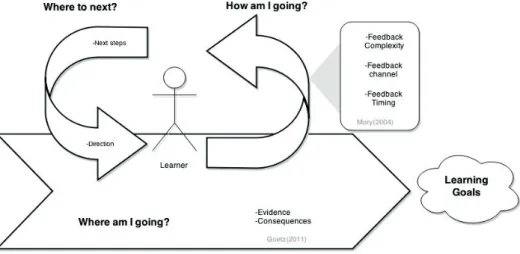
Effective feedback gives answers to the following questions: “where am I going?”, “how am I going?” and “where to next?” (see Figure 2.3) (Hattie & Timperley, 2007). The question “where am I going?” refers to the learner’s goals; goals produce persis-tence at task performance while facing obstacles, and support the resumption of dis-rupted tasks in the presence of more attractive alternatives (Bargh, Gollwitzer, Lee-Chai, Barndollar, & Trötschel, 2001). The answer to “how am I going?” provides in-formation relative to a task or performance goal of the user. Finally, the answer to “where to next?” shows the learner the next steps to take towards the completion of her goal. Implementing the answers to these questions on a computerized system is not a straightforward task. In order to answer the question of “where am I going?” first it is important to know the goals of the user. The challenge comes in reminding the user about these goals and presenting the user with feedback on how the current task and performance aligns to the goals. Work regarding feedback loops has suggested that by presenting the user with evidence of his current behavior together with the consequences allows the user to perceive an alignment between his performance and goals (Goetz, 2011). Sensors can be used as tools to collect this evidence. Presenting this evidence and the potential consequences is something that can be implemented on a sensor-based platform.
In order to answer “how am I going?”, the performance of the user needs to be tracked, and this performance has to be compared with some rules. The proposed way to classify the type of feedback that gives answer to this second question of is through the five different levels of the complexity of feedback dimension (Mory, 2004), which are:
• No feedback: no indication provided about the performance of the learner. • Simple verification: indication of correct or incorrect performance of the learner. • Correct response: indicates the learner how the correct performance should be. • Elaborated feedback: indicates why the performance of the learner is correct or
incorrect.
• Try again feedback: informs the learner when the performance is incorrect and allows her to attempt to change it.
The implementation to the answer of “where to next?” has two basic requirements. First, a map with all steps to achieve the learner’s goal is required. Second, it is im-portant to identify the current position of the learner on this map. The measuring and analysis qualities of sensor-based platforms seem suitable to identify the current posi-tion of the learner on the learning map. Moreover, sensor-based platforms that make use of system adaptation techniques such as direct guidance, content-based filtering (Brusilovsky, 2004), and self-adaptation through feedback loops (Brun et al., 2009), open the possibility for them to present the learner with a personalized learning map.
In this review, we analyzed how these three questions of effective feedback have been answered by the studied prototypes. To identify the answer to the first question: “where am I going?”, we examined whether the technique described of presenting the evidence together with its consequence (Goetz, 2011) has been used by the prototypes, and explored whether some other techniques have been used to address this answer.
Chapter II
32
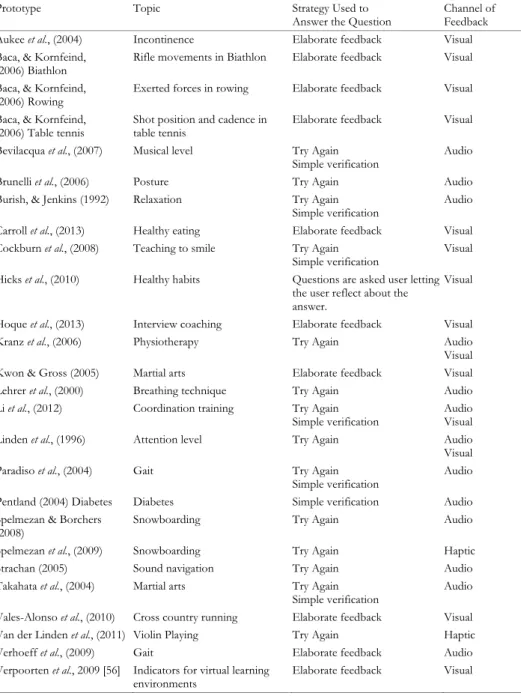
For “how am I going?”, we analyzed how the feedback given by the prototypes re-lates to the feedback complexity levels (Mory, 2004). Together with this dimension, we also explored the feedback channel used by the prototypes. This channel can usually be visual, audio or haptic. The reason for this exploration is to investigate whether empir-ical evidence exists backing up these feedback practices.
For “where to next?” we explored how the prototypes have implemented an an-swer to this question, presenting attention to the inclusion of system adaptation tech-niques for personalized answers.
Figure 2.3 Framework used for the analysis of sensor-based support on effective feedback.
Method
The purpose of this study is to get an overview on the state-of-the-art of sensor-based learning support and to explore how the existing sensor-based platforms could bring assistance to the solution of an educational challenge, which is the implementation of formative assessment. Therefore we collected articles describing studies about sensor-based prototypes and analyzed them according to our classification framework in order to identify their learning support.
The underlying search for articles was conducted using the online repositories of: Education Resources Information Center Digital Library (ERIC), ScienceDirect (Else-vier), IEEE Computer Society, Association for Computer Machinery and the publisher Springer. The first repository ERIC was selected for being considered the largest re-pository in education. Elsevier was selected because it contains journals that publish research that merges the technical and educational aspects. The three other repositories were selected for containing the largest digital libraries in computing and engineering.
Augmenting the Senses: A Review on Sensor-Based Learning Support
The search for articles was executed in different phases. The first phase was in the context of an internal study, for which we performed an initial search in early 2013 using the keywords “sensor”, “application” and “learning”. We examined the abstract of these papers looking for computerized applications that have been enhanced by the use of sensors, paying special attention to the ones describing applications that were designed for human learning. This first search left us with 111 articles that were con-sidered relevant for further study.
With the purpose to include the latest research in our repository and to start a for-mal research on the state-of-the-art of sensor-based learning support, a second search was done in January 2014 using the keywords “sensors”, “software”, “applications” and “learning”, while searching for articles published from 2012 to 2013. The term “software” was added to the query to restrict our search, and to exclude research fo-cused on the hardware of sensors and not on sensor applications. After a scan through the abstracts, looking for applications where sensors have been used for human learn-ing support, 24 articles were selected for a deeper study. While studylearn-ing the literature we decided to explore more cases where systems have used sensors to adapt their be-havior in order to support learners, therefore a later search was performed in March 2014 using the keywords “sensor”, “adaptive”, “system adaptation” and “education” for articles published after 2012. An examination of the abstracts of these search re-sults let us with three articles that have been included in this study.
Finally in order to be sure to include some missing relevant work the state-of-the-art on sensor-based learning support; we included eight more state-of-the-articles and three com-mercial products to this review that have been pointed out by experts in the field of Technology Enhanced Learning and Human Computer Interaction as representative work in the field of tutoring, feedback and sensor systems.
To select the studies that were included in our analysis, we followed the criteria of including only articles describing sensor-based prototypes, and of which the descrip-tion of these prototypes presented some informadescrip-tion on how they can propordescrip-tionate some learning support to their users. From the 146 reviewed articles and three com-mercial products, we were able to identify 112 different sensor-based platforms proto-types. When analyzing articles describing these prototypes, we could identify that only 82 of them include a description of the communication channel between the proto-types and the user. Since this link between the prototype and the user, is the element in a sensor-based prototype responsible to support learning, we decided to only include these 82 prototypes for further analysis.
We conducted the analysis of the prototypes in three stages. On the first stage we explored the learning support given by the prototypes. This support was classified according to the Bloom’s taxonomy of learning domains (Bloom et al., 1956). On the second stage we analyzed the contribution of the prototypes in key identified aspects of formative assessment. Finally, on the third stage we took a close examination on which of the prototypes did give feedback to the user and how this feedback compared to the effective feedback framework (Hattie & Timperley, 2007).
Chapter II
34
Results
Out of the 82 analyzed prototypes that were selected for further analysis, 51 of them were created inside of an educational context specifically designed to support learning; nevertheless by analyzing the description of their communication channel and reports of their usage we identified a total of 79 prototypes providing users with relevant in-formation for evaluation and analysis, performance support or contextual awareness, hence providing users with learning support. We recognized 79 prototypes supporting learning on the learning domains, 51 prototypes contributing to at least one key identi-fied aspect of formative assessment and 35 prototypes giving feedback to the learner. An overview of these prototypes is found in Appendix B.
Classification for Learning Domains
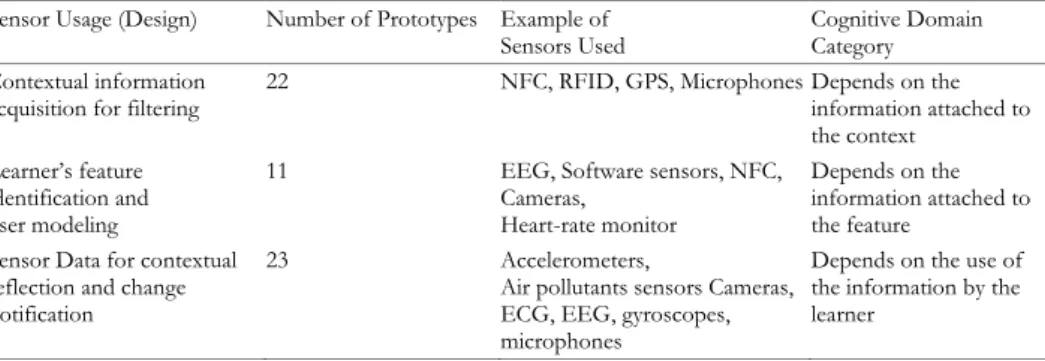
With the intention to get an overview of the learning support that has already been given by sensor applications, we classified the analyzed prototypes according to their support in the different learning domains. Out of the list of 82 prototypes we identi-fied 79 prototypes presenting learning support. By examining the output given by the prototypes, we identified that 56 of them present the user with information that can help her to remember facts, understand concepts, analyze situations, etc. Therefore, we classified them as prototypes supporting the cognitive domain of learning. Six of them present information with the purpose to engage users in specific activities, thus we classified them as presenting support to the affective domain of learning. Following this criterion we identified two prototypes supporting both the cognitive and affective domain of learning. The output of 17 of the prototypes presents the learner with in-formation that aims to help her with the improvement of specific movements or her physical abilities. Hence we classified these prototypes as giving support on the psy-chomotor domain of learning. By analyzing the 56 prototypes that we classified as giving support to the cognitive domain of learning, we could identify three different strategies (see Table 2.1) that have been used by sensor-based platforms to give this support.
Table 2.1 Strategies supporting learning in the cognitive domain. Sensor Usage (Design) Number of Prototypes Example of
Sensors Used Cognitive Domain Category Contextual information
acquisition for filtering 22 NFC, RFID, GPS, Microphones Depends on the information attached to the context
Learner’s feature identification and user modeling
11 EEG, Software sensors, NFC,
Cameras, Heart-rate monitor
Depends on the information attached to the feature
Sensor Data for contextual reflection and change notification
23 Accelerometers,
Air pollutants sensors Cameras, ECG, EEG, gyroscopes, microphones
Depends on the use of the information by the learner
Augmenting the Senses: A Review on Sensor-Based Learning Support
The first strategy identified uses sensors to infer the learner context, in order to present the learner with relevant contextual information. We identified 22 prototypes following this strategy. The learner’s context is commonly inferred by detecting specific objects that are situated in her surroundings. The most common technology that has been used to identify these objects is by attaching Near Field Communication (NFC) or Radio Frequency identification (RFID) tags to them. The sensors of the prototypes are able to read these tags and to present the learner with relevant contextual information. The information presented by the prototypes determines the category of the cognitive domain (Krathwohl, 2002) that receives the learning support. For example, the proto-type in (Kaasinen et al., 2010) presents support on remembering factual knowledge. For this prototype NFC tags have been attached to everyday objects. When the proto-type senses one of these tags, information about the tagged object is shown to the learner, this information helps her to remember specific facts about it. The prototype in (Edge, Searle, Chiu, Zhao, & Landay, 2011) uses the same strategy. Nevertheless, this prototype supports the category of applying factual knowledge. The purpose of the prototype is to help learners to learn Mandarin, for that it uses GPS sensors to identify the context of the learner and presents him with Mandarin phrases that are suitable to be applied in this context.
The second strategy identified on 11 of the prototypes, is similar to the first one; nonetheless this strategy instead of using sensors to track the learner’s contexts, it uses sensors to track specific features of the learner such as the learning style (Dung, & Florea, 2012), competences based on the score of predefined pre-tests (Hsu, & Ho, 2012), attention (Linden, Habib, & Radojevic, 1996; Szafir, & Mutlu, 2013; Börner, Kalz, & Specht, 2014), emotional state (Arroyo, Cooper, Burleson, Woolf, Muldner, & Chris-topherson, 2009; Littlewort, Bartlett, Salamanca, & Reilly, 2011), uncertainty while using a tutoring system (Jraidi, & Frasson, 2013; Whitehill, Bartlett, & Movellan, 2008), trouble solving problems (Anderson, &. Reiser, 1985) or driving style (Serbedzija, & Fairclough, 2012). The information presented to the learner by these prototypes depends on the tracked values for these features.
The third strategy identified uses sensors to gather relevant data and presents this data to the learner. We identified 23 of the prototypes following this strategy. For example the prototype of NoiseSpy (Kanjo, Bacon, Roberts, & Landshoff, 2009) uses the mi-crophone and GPS of mobile devices to retrieve the amount of noise in different plac-es of a city. Thplac-ese different noise measurements are prplac-esented in a map allowing town planners to learn about the noise distribution patterns of a city. In this case the use that the learner gives to this information establishes the cognitive domain category sup-ported by the prototype. This strategy is the only one identified being used by com-mercial products (Globisens, 2015; Vernier Software & Technology, 2015; PASCO, 2015). These products provide different visualizations of sensor data, which could help learners to analyze different phenomena from natural sciences. The application domain for prototypes using this technique of showing sensor data to support the cognitive domain of learning is broad. It can go from the field of civil engineering as in (Amara-tunga, & Sudarshan, 2002), to the field of sports where due to the advances in weara-ble sensors, human movements are being studied in new and more precise manners
Chapter II
36
(James, Davey, & Rice, 2004; Ghasemzadeh, Loseu, & Jafari, 2009; Spelmezan, Schanowski, & Borchers, 2009). Another common application where sensor data sup-ports learning in the cognitive domain is by monitoring the activity, behavior and state of patients in order to gain insight about their health (Greene et al., 2010; Hester et al., 2006; Hicks et al., 2010; Lee, & Carlisle, 2011; Pentland, 2004). These prototypes have been classified as supporting the cognitive domain of learning instead of the psycho-motor domain, because the users of these prototypes who are able to make direct use of the sensor data are experts. By analyzing the data these experts can later use their gained knowledge to give proper advice to patients. This proper advice might indeed support them in the psychomotor learning domain, but it comes from the expert and not from the prototype. The prototype shown in (Hester et al., 2006) is an example of this; this prototype shows how wearable sensors have been used to monitor the movements of people following a heart stroke helping doctors to select the best thera-py for them.
The affective domain of learning deals with attitudes, motivations, values, etc. We identified that the information presented to the learner in eight prototypes had the purpose to support them in this domain The analysis of these eight prototypes let us recognize three different strategies that have been used to achieve this support (see Table 2.2).
Table 2.2 Strategies supporting learning in the affective domain.
Strategy Number of Prototypes Example of Sensors Used
Behavior overview
and review 4 Accelerometers, Barometer, Camera, Compass, GPS, Humistor, Microphone Software sensors, Thermometer
Social network visualization 2 Blood glucose meter, Software sensors Involving learners
in data collection 2 Accelerometers, Camera, Microphone, Thermometers
The strategy of behavior overview and review uses sensors to track certain aspects of the learner’s behavior and presents the learner with the overview of it. By doing so, the learner becomes aware of how she is approaching towards the desired goal, motivating her to change or keep up with his current behavior. This strategy has been used by four of the prototypes. The prototype described in (Consolvo et al., 2008) exemplifies this strategy. The purpose of this prototype is to engage users into a more active life-style, for that, this prototype uses sensors to track the physical activities performed by the user, and displays the overview of them on their mobile devices. Watching the presented activity overview motivates the user to engage into a more active lifestyle.
The strategy of social network visualization has been used by two of the prototypes; this strategy lets learners compare themselves with peers of their network, motivating them to perform well in their learning activities. An example of this is described in the pro-totype in (Verpoorten, Glahn, Kravcik, Ternier, & Specht, 2009). This propro-totype pre-sents to students of virtual learning environments some smart indicators informing them about their activities, achievements and progress in comparison with other peer students.
Augmenting the Senses: A Review on Sensor-Based Learning Support
The strategy of involving learnersin data collection has been identified in two of the proto-types, it supports learning in the affective and the cognitive domain. This strategy has been used to engage learners into scientific activities, by letting them participate in the data-gathering phase of the scientific process. Learners use sensor measurements to gather this data. An example of this strategy is the prototype in (Heggen, 2012). This prototype allows learners to create scientific experiments that are compiled into mobile applications. These applications use the sensors of the mobile devices to assist the learners to conduct their experiments.
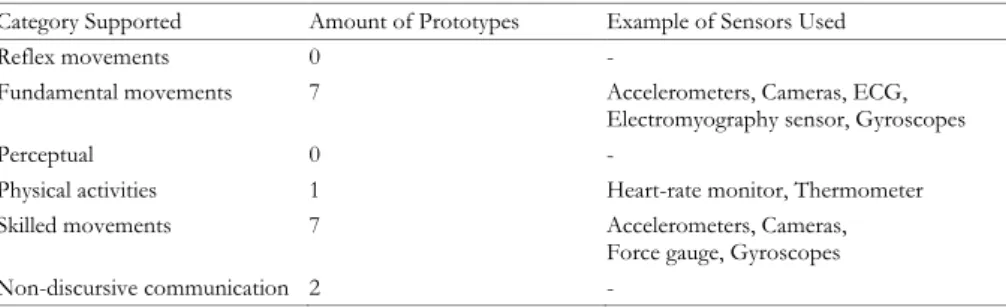
Seventeen prototypes have been identified to support the psychomotor domain of learning (see Table 2.3). For the exploration of this domain we analyzed how the pro-totypes give support on the six categories of the psychomotor domain of learning (Harrow, 1972), identifying support in four of them: fundamental movements, skilled move-ments, physical activities and non-discursive communication.
Table 2.3 Overview of the support for learning in the psychomotor domain.
Category Supported Amount of Prototypes Example of Sensors Used
Reflex movements 0 -
Fundamental movements 7 Accelerometers, Cameras, ECG,
Electromyography sensor, Gyroscopes
Perceptual 0 -
Physical activities 1 Heart-rate monitor, Thermometer
Skilled movements 7 Accelerometers, Cameras,
Force gauge, Gyroscopes
Non-discursive communication 2 -
Seven of the prototypes present support to fundamental movements, such as walking, run-ning, sitting, etc. The purpose of these prototypes is to help patients going through a rehabilitation process. These prototypes use sensors to track the patients’ movements, analyze these movements and give feedback to the patients informing them whether the movements have been performed correctly or incorrectly. As an example, the pro-totype in (Brunelli, Farella, Rocchi, Dozza, Chiari, & Benini, 2006) uses wearable iner-tial sensors to identify the posture of patients who are going through rehabilitation after a damage of their motor system. Whenever the posture is incorrect the prototype provides audio feedback.
Support for learning skilled movements, referring to the movements used for dancing, recreation and sports, has been recognized in seven of the prototypes. The strategy used to support the skilled movements is similar as the one used to support the basic ones, prototypes use sensors to track the learner’s movements, analyze how they are being performed and show the analyzed results to the learner. The areas of this type of learning assistance that have been identified are: music gestures (Bevilacqua, Guédy, Schnell, Fléty, & Leroy, 2007; Van Der Linden, Johnson, Bird, Rogers, & Schoonderwaldt, 2011), special rehabilitation exercises (Kranz, Holleis, Spiessl, Schmidt, & Tusker, 2006), taekwondo movements (Kwon, & Gross, 2005), snow-boarding (Spelmezan, & Borchers, 2008; Spelmezan, Jacobs, Hilgers, & Borchers, 2009) and karate punches (Takahata, Shiraki, Sakane, Y., & Takebayashi, 2004).