9
Effects of Computer-Assisted Instruction (CAI) on Students’
Academic Achievement in Physics at Secondary Level
Qaiser Suleman1* Dr. Ishtiaq Hussain1 Dr. M. Naseer Ud Din1 Dr. Khalid Iqbal2
1.Institute of Education & Research, Kohat University of Science & Technology, Pakistan 2.Subject Specialist, Elementary & Secondary Education Department Khyber Pakhtunkhwa, Pakistan Abstract
The paper was aimed to examine the effects of computer-assisted instruction (CAI) on the academic achievement of secondary school students in the subject of physics. A sample of 46 students of Grade-09 was selected randomly from Government High School Khurram Karak. For data collection, pretest-posttest equivalent groups design was used. Experimental group was taught through computer-assisted instruction technique whereas control group was taught through conventional teaching method. On the completion of six weeks’ experimental process, posttest was planned immediately to examine the level of students’ achievement of both groups. Two weeks later, retention test was arranged to examine their retention. Statistical tools such as mean, standard deviation and independent samples t-test were employed through SPSS for analyzing data. The findings show that computer-assisted instruction has a significant positive effect on students’ academic achievement and retention in Physics. Based on findings, it was recommended that computer assisted instruction technique should be used by the science teachers for stimulating and boosting students’ academic achievement in Physics at secondary level.
Keywords: Computer Assisted Instruction, Academic Achievement, Physics, Secondary Level Introduction
Advancement in science and technology has recently changed the education systems in societies. The increasing importance of skilled persons not only as users of knowledge but producers of knowledge puts additional responsibilities on the educators of science (Gonen, Kocakaya, & Inan, 2006). Recently, accentuation has been given to utilize computer technology in education as instructional medium although it was used for management and administration etc. As an instructional medium, computers are described in various forms such as computer-based learning (CBL), computer-enhanced learning (CEL), computer-computer-based instruction (CBI), computer-aided instruction (CAI), computer-aided learning (CAL) and computer-assisted instruction(CAI). Among these, CAI has been ended up being successful and beneficial instructional approach for boosting interest, uplifting mentality, building up students' retention capacity and boosting the students’ performance (Osemmwinyen, 2009; Yusuf & Afolabi, 2010). Computers provide exciting, stimulating and energizing approaches to instructional process that were not even imagined for two decades back, yet the degree to which the instructive capability of computer technology will be accepted remains to be seen (Amara, 2006). Computer assisted learning can have great potential as instructional tools in the classroom (Moore, 1997).
Computer-assisted instruction (CAI) is an instructional approach where a computer is used to communicate the instructional materials and evaluate the learning outcomes. It uses a blend of graphs, texts, sounds and videos for learning process (Onasanya, Daramola, & Asuquo, 2006). CAI refers to virtually any sort of computer application in instructional settings comprising of drill and practice, simulations, instructional exercises, supplementary exercises, instructional management, database development, programming, composing using word processors, and other different applications (Cotton, 2001; Gana, 2013). Gana (2013) expressed that CAI is learner-centered and activity oriented. The challenge is how to optimize usage, Gonzalez and Birch (2000) ascertain that computer-assisted learning has the ability to promote active learning in a wide variety of disciplines from literature to the social sciences and beyond. Ochoyi & Ukwumunu (2008) announced that the utilization and growing development of technology in the classroom gives new chances for delivering instruction. Educators use technology to enhance instruction and this method has been turned out to be more powerful and effective. Research has revealed that technology in the classroom can be valuable in the management of instructional method and an effective teaching improvement.
The advantages of CAI method according to Orjika (2012) include, ensuring the application of proven teaching methods to students; offering equal educational opportunities for students by using the same programme; changing the role of the teacher from teaching capacity to that of a guide; also when properly handled, removing fright and embarrassment on students and bringing about meaningful learning and academic achievement (Orjika, 2012). Research has discovered that those learners who utilize computers have extensive self-assurance, confidence and are more efficacious and propelled to learn than those learners who are subjected to learn in traditional learning environment (Wishart, 2002). CAI helps to enable learners to focus on the physical meaning of the abstract concepts, subsequently, to get a detailed understanding of the theory (Azar & Şengüleç, 2011; Bayrak et al., 2007; Hargunani, 2010). It has been proved empirically that CAI is an excellent
10
approach of teaching that strengthen students’ achievement, stimulate their interest and decrease their exhausting and abstract nature (Gambari, 2008). CAI provides flexibility to learners which are sometimes denied by the traditional process and method. CAI could be of great assistance as it comprises of drill-and-practice, tutorial, or simulation activities. Computer programming gives numerous instructional advantages and CAI can have a substantially more prominent effect on students’ learning when compared to traditional methods. Investigators have additionally discovered that CAI improves learning proportion, that is, students become able to learn a similar amount of content in less time than the conventionally taught students. Besides, CAI has a significant better effect on retention of the students (Cotton, 2001). CAI can encourage the advancement of students’ decision-making and critical thinking aptitudes, data processing skills and communication abilities. By the application of computers, students can get accessibility to extensive learning links and expand their exposure to differing individuals and points of view (Bakac, Kartal, & Akbay, 2011). The exercises that help learners the visualization of abstract concepts will encourage their conceptual comprehension. These exercises would be consistent and harmonizing to conventional teaching, and could be concrete physical exercises, or computer simulations and animations (Bayrak, 2008; Fraser et al., 2007; Serin, 2011). An assortment of visual representations of physics concepts in the computer simulations become perceptible that are generally imperceptible to learners (Finkelstein et. al., 2005). Simulations provide educators with the chances to give learners an instructional tool that can enable learners to transform their alternate science conceptions into precise science conceptions. Learners could detach and manipulate parameters and in this way, help them to build up a comprehension of the relationships among physical ideas, variables and phenomena (Arvind & Heard, 2010; Bakaç, Taşoglu, & Akbay, 2011; Tao & Gunstone, 1999).
The application of CAI in science subjects would empower the exposure and ability of the learners in building skills, understanding, abilities, learning and accessibility to information in the technological world. Such ability building will boost social, mechanical significance and sustainable development of the country (Kareem, 2015). Advancing technology has unlocked numerous entryways in physics education. The utilization of computer based teaching in physics gives numerous options to students, for example, visualization of abstract concepts that will stimulate students’ understanding (Meltzer & Manivannan, 2002). Physics is a physical science that deals with the study of matter in relationship with energy. It has many branches that include mechanics, optics, heat, electricity, magnetism, nuclear physics, solar energy, plasma physics etc. There is a very close association between physics and the four basic needs of man, which includes food, shelter, medical services and security (KanKia, 2007). Ayuba (2010) stated that physics is the bedrock for scientific and technological advancement, the development of manpower in the country and it will be impossible to have a sound knowledge of the subject if it is not properly taught and learnt in the nation’s secondary schools. Discussing the importance of physics, Michael (2006) expressed that the technological advancement of any country depends upon the study and research of science and this advancement would not be possible without advancement in physics. Danjuma (2008) expressed that physics as the soul of science assumes an indispensable role in all human efforts and serves as a pre-requisite for courses, for example, geology, medicine, forestry, computer engineering, agricultural science, space navigation, pharmacy etc. Physics is a science that uses quantitative measurement and experimental observations in order to understand natural events. It can explain natural events mathematically and can relate these events to daily life events (Eren & Gurdal, 2010; Tekbiyik & Akdeniz, 2010). Of all the sciences, Physics is the one that students experience the most difficulties with because most of the physical notions are abstract. Also, when compared to other lessons, although there are many relationships between main subjects and number of the subjects to be learned, simply knowing definitions is not enough to learn the subject (Karaca, 2013). Theories and numerical expressions also make it difficult to understand Physics and to make a connection between the subjects (Arvind & Heard, 2010; Bakac, Tasoglu, & Akbay, 2011; Ergul & Cigrik, 2013; Jian-Hua & Hong, 2012).
The international society for technology in education (2005)) suggests that teachers who move away from traditional learning environment to new learning environment promote active learning, higher level thinking, collaborative and multisensory stimulation. These environments support multiple intelligence, constructivism and cooperative learning. Saka & Cerrah (2004) stated that in education and learning process, traditional education and the existing educational materials neither helped to solve the existing problems nor assisted in the development of conceptual learning. In order to manage effective learning in Physics, there should be a learning environment where the level of the students’ prior knowledge is known, real life events are discussed, students are both mentally and physically ready and cognitive change is provided. At the same time, these learning environments should provide opportunities to students to consolidate the recently-learned notions (Guvercin, 2010). To develop the students’ cognitive learning and their performance in solving problems, there is a need to teach Physics by using different student-centered education methods instead of the traditional methods (Ergun, 2010). Computer assisted instructional materials are more successful in building an ideal and desirable attitude, and in capturing enthusiasm towards learning physics (Azar & Sengüleç, 2011). The outcomes of Bunkure (2007) research study revealed that CAI improved students’ accomplishment in physics yet educators are not interested
11
to use it. They use lecture method and in this way, there is need to attempt another teaching strategy in accordance with worldwide patterns of utilizing CAI, particularly for science teaching. Salahudeen (2012) investigated the effects of CAI on students’ achievement and found that the experimental group achieved better scores than the control group. Gender and age differences were found to have no substantial impact on the mean achievement of the experimental group.
Objectives of the Study
1. To examine the effects of CAI on the students’ academic achievement in Physics at secondary level 2. to explore the effects of CAI on students’ academic achievement in different level of cognitive domain
i.e., knowledge, comprehension, application, analysis, synthesis and evaluation in Physics at secondary level
3. To investigate the impacts of CAI on the retention of students in Physics at secondary level Research Hypotheses
Ho1: There might be no substantial contrast between the academic achievement of students of control and
experimental groups on pre-test.
Ho2: There might be no substantial contrast between the academic achievement of students who were taught
through CAI and those who were taught through traditional method on post-test.
Ho3: There is no substantial contrast in students’ academic achievement of experimental and control groups in
different levels of cognitive domain i.e., knowledge, comprehension, application, analysis, synthesis and evaluation on post-test.
Ho4: There might be no substantial contrast between students’ retention who were taught through CAI and those
who were taught through traditional method on retention test. Method and Materials
Participants
All the secondary school students studying in public secondary schools in Karak District constituted the study population. A sample of 46 students of Grade-09 was selected through simple random sampling technique from Government Boys High School Khurram Karak. The participants were similar with respect to a number of characteristics i.e., age, sex, locality, socioeconomic status etc. The participants were separated into control and experimental groups based on pretest outcomes. Pretest was developed in their previous knowledge about physics.
Research Design & Instrumentation
The current study was experimental type that seeks to examine the effects of computer-assisted instruction on the academic achievement of students in subject of Physics. Due to experimental nature, “Pretest-Posttest Equivalent Groups Design” was used to achieve the required outcomes. Physics Achievement Test was used as research instrument comprising of six levels of cognitive domain i.e., knowledge, comprehension, application, analysis, synthesis and evaluation. The test was developed in four units of Physics taught during the experiment. The units were; Physical Quantities & Measurement; Kinematics; Dynamics; and Gravitation. There were total 60 MCQs in the said achievement test carrying 120 marks in total. Each level of domain was comprised of 10 MCQs. The same Physics Achievement Test was used as retention test after making slight modifications in the order of the items.
Validity and Reliability
To confirm validity and reliability of research instrument is crucial for precise and authentic outcomes of the study. Without confirming validity and reliability of the instrument, conduction of research is useless and timewasting. Therefore, after developing achievement test, it was properly validated through experts having doctorate degrees in the relevant field with respect to criterion validity, content validly and construct validity. Apart from validity, reliability was confirmed through test retest reliability technique. For this purpose, the test was distributed among 25 students of another schools which were not in sample. Then again the same test was given to the same students after two weeks. Pearson’s product moment correlation was applied between the results of tests. The reliability coefficient was found 0.813 which showed that the test was reliable.
Data Collection and Analysis
The study was experimental and therefore, data was collected though pretest, posttest and retention test. After collection of data, it was organized properly, classified, tabulated, analyzed and interpreted based on descriptive statistics i.e., mean, standard deviation and inferential statistics i.e., independent samples t-test through SPSS. Furthermore, the outcomes were also presented graphically for the better understanding of the readers.
12
Appointment of Teachers for Experiment
For successful execution of the experiment, two teachers having same academic qualification and experience were selected. The teacher appointed to experimental group was expert in the application of computer and other information and communication technology. He had Diploma in Information technology (DIT).
Procedure of the Treatment
Before conduction of experimental, formal approval was sought from the head of school where experiment was to be done. After getting permission, experimental process was started. Students of control group were taught through conventional teaching method while students of experimental group were taught through a computer assisted instruction. The experimental process was completed in six weeks. Then a posttest was given to the students of both groups immediately to examine their academic achievement. Then after two weeks, the said posttest with slight sequential change with respect to items was given to the both groups as retention test. After completion of experimental process, raw data was organized, tabulated and analyzed through statistical tool i.e., mean, standard deviation and independent samples t-test.
Results and Data Interpretation
The study was experimental and pre-test post-test equivalent groups design was used for data collection. Raw data was organized, tabulated and analyzed based on descriptive as well as inferential statistics i.e., mean, standard deviation and t-test. Statistical process is described as under:
Ho1:
There might be no substantial contrast between the academic achievement of students of control and experimental groups on pre-test.
Table 01:
Independent-Samples t-test Analysis of the Achievement of Experimental & Control Groups on Pretest
Groups n Mean St. Dev. SEd Mean Diff: t-value p-value
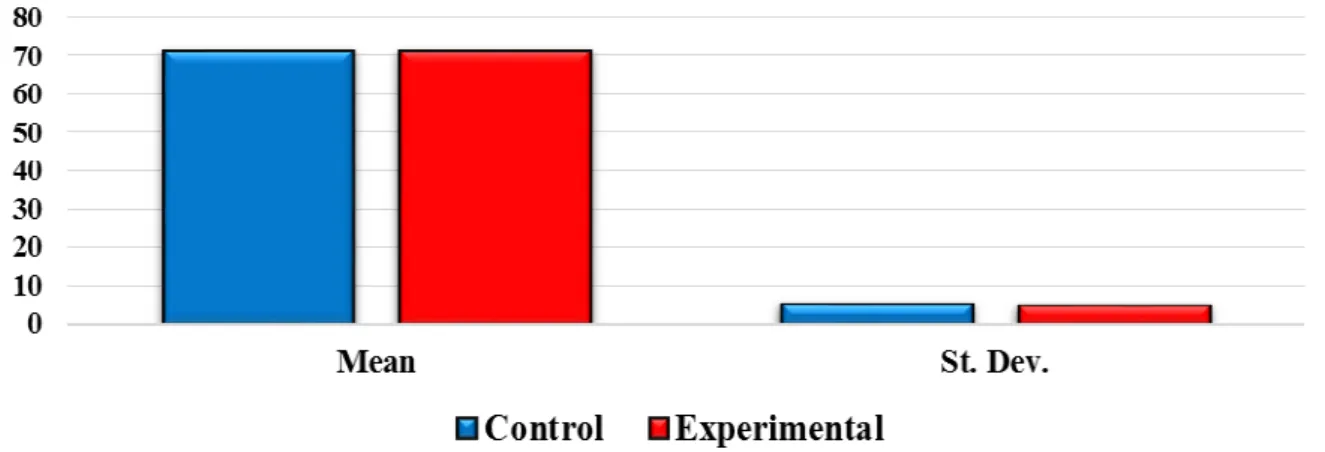
Control 23 71.62 4.93 1.42 0.11 0.077 0.939
Experimental 23 71.51 4.73
Insignificant df = 44 Value of t at 0.05 = 2.0154 The inferential analysis of table 1 reflects that there is no substantial (p>0.05) difference between the accomplishment of experimental and control groups on pretest as the calculated t-value is smaller than tabulated t-value at 0.05. Additionally, the mean values unambiguously depict that experimental group (mean=71.51, SD=4.73) demonstrated more excellent performance as compared to control group (mean=71.62, SD=4.93). Therefore, the null hypothesis was accepted.
Fig. 01: Showing the academic achievement of control and experimental groups on pretest. Ho2:
There might be no substantial contrast between the academic achievement of students who were taught through CAI and those who were taught through traditional method on posttest.
13 Table 02:
Independent-Samples T-test Analysis of the Achievement Scores of Experimental and Control Groups on Posttest
Groups n Mean St. Dev. SEd Mean Diff: t-value p-value
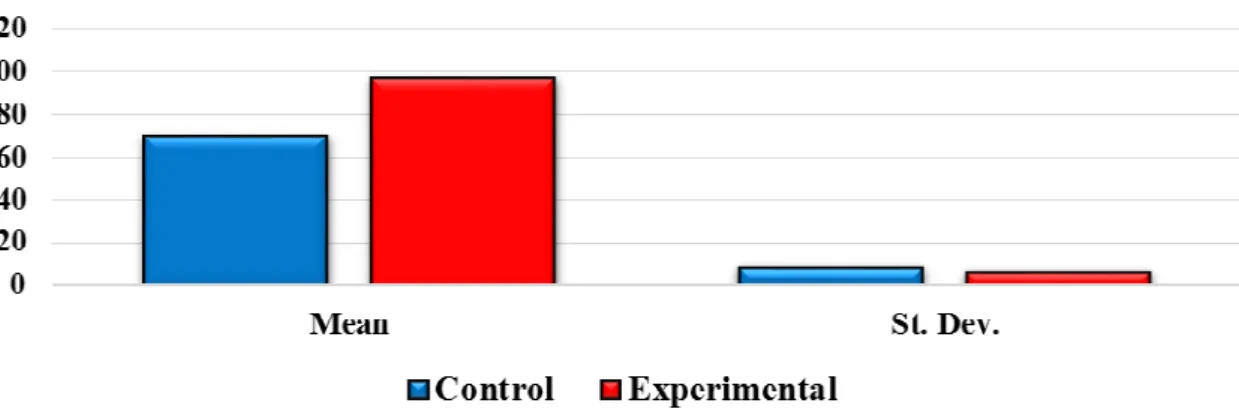
Control 23 74.39 9.83 2.46 23.70 -9.618 0.000
Experimental 23 98.09 6.56
*Significant df = 44 Value of t at 0.05 = 2.0154
The outcome of table 2 portrays that there is significant (p<0.05) difference between the achievement of experimental and control groups on posttest as the calculated t-value is larger than tabulated t-value at 0.05. Furthermore, the mean values undoubtedly reveal that experimental group (mean=98.09, SD=6.56) demonstrated more excellent performance as compared to control group (mean=74.39, SD=9.83). Thus, the null hypothesis was rejected.
Fig. 02: Showing the academic achievement of control and experimental groups on posttest. Ho3:
There might be no substantial contrast in students’ academic achievement of experimental and control groups in different levels of cognitive domain i.e., knowledge, comprehension, application, analysis, synthesis and evaluation on post-test.
Table 03:
Inferential Analysis of Academic Achievement of Students of Experimental and Control Groups in Different Level of Cognitive Domain
Levels of Cognitive Domain Control Group Experimental Group
t-value p-value Mean SD Mean SD Knowledge 15.38 7.21 16.03 5.67 -0.340 0.736 Comprehension 11.84 7.23 16.08 6.37 -2.110* 0.041 Application 12.81 6.81 17.23 5.39 -2.441* 0.019 Analysis 10.55 6.96 15.07 5.74 -2.403* 0.067 Synthesis 10.83 7.34 15.85 5.64 -2.601* 0.013 Evaluation 12.98 4.39 17.83 4.98 -3.504* 0.001 *Significant df = 44 Value of t at 0.05 = 2.0154
Table 3 reflects that the calculated t-values in five levels were observed to be -2.110, -2.441, -2.403 -2.601, and -3.504 which are significant (p<0.05) because these calculated t-values are larger than the tabulated t-value at 0.05. Therefore, the null hypothesis was rejected. The mean values explicitly reveal that there is significant difference between the performance of control (mean=11.84, 12.81, 10.55, 10.83, and 12.98) and experimental (mean=16.08, 17.23, 15.07, 15.85, and 17.83) groups in five levels of cognitive domain i.e., comprehension, application, analysis, synthesis and evaluation respectively on post-test. Hence, it was concluded that the students of experimental group showed better performance in the said five levels of cognitive domain as compared to the students of control group. Conversely, no significant difference was found between the academic achievement of control and experimental groups in case of knowledge.
14
Fig. 03: Showing the academic achievement of control and experimental groups in different level of cognitive domain on posttest.
Ho4:
There might be no substantial contrast between the retention of students who were taught through CAI and those who were taught through traditional method on retention test.
Table 04:
Independent-Samples t-test Analysis of the Achievement of Experimental & Control Groups on Retention Test
Groups n Mean St. Dev. SEd Mean Diff: t-value p-value
Control 23 70.21 8.73 2.27 26.66 -11.75 0.000
Experimental 23 96.87 6.49
*Significant df = 44 Value of t at 0.05 = 2.0154
Based on inferential analysis, the outcome of table 4 indicates that there is significant (p<0.05) difference between the achievement of experimental and control groups on retention test as the calculated t-value is greater than tabulated t-value at 0.05. Furthermore, the mean values clearly show that experimental group (mean=96.87, SD=6.49) showed better performance than control group (mean=70.21, SD=8.73). So, the null hypothesis was rejected.
Fig. 04: Showing the academic achievement of control and experimental groups on retention test.
Discussion
The study was conducted to explore the effects of CAI on students’ academic achievement in Physics at secondary level. The study was quantitative and experimental in nature and pretest-posttest equivalent groups designed was used. Students were seated in two similar rooms with similar facilities. The room of experimental group was facilitated with computer, multimedia and other related gadgets. Students of experimental groups were instructed through CAI while students of control group were taught through traditional method. This experimental process was ended in six weeks. After completion of experiment, students of both groups were subjected to posttest and retention test in order to investigate and compare their academic achievements. The
15
findings exposed that control group. Furthermore, students of experimental group were found more interested, excited, satisfied and participated as compared to the students of control group who were found exhausted and bored. It means that CAI is an effective and successful method contributing to students’ academic achievement in subject of Physics causing high scores.
Based on interferential analysis of academic achievement of experimental and control groups in different level of cognitive domain on post-test, the study outcomes revealed that students of experimental group showed superiority over the students of control group in five levels of cognitive domain i.e., comprehension, application, analysis, synthesis and evaluation whereas in case of knowledge, no substantial difference was found between the academic performance of both groups. However, it clearly indicates that computer assisted instruction is very effective in different level of cognitive domain. Likewise, based on retention test, students of experimental group showed more excellent academic performance than students of control group. The students of experimental group retained learning for longer time than students of control group. The findings of the current study support the findings of Bayrak (2008) and Yesilyurt (2011) who found that CAI was significantly more viable than conventional teaching in learners’ achievement in physics. The findings of the study are in line with the findings of many research outcomes in which it was found that CAI has positively affected learners' perceptions about computer supported instruction and their scholastic accomplishment (Azar & Sengulec, 2011; Bakac et al., 2011; Kayri et al., 2012; Kocakaya, 2010; Pondhe, 2011; Yigit, 2005).
Conclusions and Recommendations
The findings revealed that computer-assisted instruction has a remarkable positive effect on students’ academic achievement in Physics. CAI was found more effective and successful than traditional teaching method in subject of Physics. CAI was found more useful in different level of cognitive domain. Furthermore, computer assisted instruction was found more effective in the retention of students as compared to traditional method. CAI was found more useful in clarifying students’ concept of difficult topics in Physics. So, it is recommended that science teachers especially physics teachers should adopt CAI approach instead of traditional teaching approach in teaching physics. All the science teachers should be given special training in the effective utilization of computers and other technologies in teaching physics. Furthermore, computers, multimedia and other related gadgets should be provided to all secondary schools on priority basis.
References
Agommuoh, P. C., & Nzewi, U. M. (2003). Effect of Videotaped Instruction on Secondary School Students Achievement in Physics. Journal of the Science Teacher Association of Nigeria, 38(1&2), 88-93.
Akinbobola, A. O. (2006). Effects of Cooperative and Competitive Learning Strategies on Performance of Students in Physics. Journal of Research in Education, 3(1), 1-5.
Amara, S. (2006). Computer Literacy of Teachers. Retrieved on 19/6/2017.
Arvind, V. R., & Heard, J. W. (2010). Physics by simulation: Teaching circular motion using applets. Latin American Journal of Physics Education, 4(1), 35-39.
Ayuba, M. G. (2010). The Global Economic Meltdown in Nigeria Physics Perspective in Journal of the Science Teachers Association of Nigeria 51th Annual Conference Preceding(Ed) Nsikak – Abasi.
Azar, A., & Sengüleç, O. A. (2011). Computer-assisted and laboratory-assisted teaching methods in physics teaching: The effect on student physics achievement and attitude towards physics. Eurasian Journal of Physics and Chemistry Education, Jan (Special Issue), 43-50.
Bakaç, M., Taşoglu, A. K., & Akbay, T. (2011). The effect of computer assisted instruction with simulation in science and physics activities on the success of student: Electric current. Eurasian Journal of Physics and Chemistry Education, (Special Issue), 32-42.
Bayrak, C. (2008). Effects of computer simulations programs on university students’ achievement in physics.
Turkish Online Journal of Distance Education, 9(4), 53-62.
Boyle, D., & Dunleavy, K. (2003). Learning Styles and Academics Outcome, The Validity and Utility of Vermunts Inventory of Learning Styles in a British Higher Education Setting. British Journal of Educational Psychology, 73(2), 267-290.
Bunkure, Y. I. (2007). Effect of CAI on Students Achievement and Attitudes in Physics among Secondary School Students in Kano State. Unpublished Med. Thesis submitted to faculty of Education, Ahmadu Bello University Zaria.
Cotton, K. (2001). Computer Assisted Instruction. Eurasian Journal of Physics and Chemistry Education,
(Special Issue), 34-42.htt://www.eurasianjournals.com/index.php/ejpce. Retrieved on 25/5/2017.
Danjuma, A. B. (2008). The Perception of Physics Teachers and Students on Physics Education for Economic Empowerment and Development in Niger State. Paper Presented at School of Science, Niger State College of Education. Monthly Seminar Series.
16
Physics Students of Different Abilities in Niger State, Nigeria. Master Thesis, Ahmadu Bello University Zaria, Nigeria.
Eren, C. D., & Gurdal, A. (2010). The effect of teaching physics with fragmented teaching method on students' academic success, recalling the attitudes towards group work, Pamukkale University Journal of Education, 28, 67-79.
Ergun, H. (2010). The Effect of Problem Design in Physics Education on Cognitive Learning and Problem Solving, PhD Thesis, Marmara University, Institute of Education, İstanbul.
Finkelstein, N. D., Adams, W. K., Keller, C. J., Kohl, P. B., Perkins, K. K., Podolefsky, N. S., Reid, S., & LeMaster, R. (2005). When learning about the real world is better done virtually: A study of substituting computer simulations for laboratory equipment. Physical Review Special Topics - Physics Education Research, 1(1), 1-8.
Fraser, D. M., Pillay, R., Tjatindi, L., & Case, J. M. (2007). Enhancing the learning of fluid mechanics using computer simulations. Journal of Engineering Education, 96(4), 381-388.
Gambari, A. I., & Adeghenro, D. V. (2008). Effects of computer assisted instruction on mathematics achievement amongst students in Minna Metropolis. Ilorin Journal of Education, 27, 63-70.
Gana, C. S. (2013). Effects of Computer Assisted Instruction with Animation on Achievement and Retention of Students of Colleges of Education in Quantum Physics. Unpublished PhD Thesis, Department of Science Education, University of Nigeria, Nsukka
Gönen, S., Kocakaya, S., & İnan, C. (2006). The Effect of the Computer Assisted Teaching and 7E Model of The Constructivist Learning Methods on The Achievements and Attitudes of High School Students. The Turkish Online Journal of Educational Technology, 5(4).
Gonzalez, G. M., & Birch, M. A. (2000). Evaluating the instructional efficacy of computer-mediated interactive multimedia: Comparing three elementary statistics tutorial modules. Journal of Educational Computing Research, 22(4), 411-436.
Guvercin, Z. (2010). The effect of simulation-based software on students’ academic achievement, attitudes and retention in Physics lesson. Unpublished Master’s Thesis, Cukurova University, Institute of Social Sciences, Adana.
International Society for Technology in Education. (2005). National educational technology standards for students. ISTE (Interntl Soc Tech Educ).
Jian-Hua, S., & Hong, L. (2012). Explore the Effective Use of Multimedia Technology in College Physics Teaching. Energy Presidia, 17, 1897-1900. International Conference on Future Electrical Power and Energy Systems.
Kankia, N. A. (2007). Qualitative Physics Education for Empowerment and Development. Nigerian Journal of Science and Educational Research, 1(1), 142-146.
Karaca, K. (2013). Views of Pre-service Teachers’ on Contribution of Visual Materials in Physics Instruction, Gazi University, Institute of Education, Ankara.Kareem, A. A. (2015). Effects of Computer Assisted Instruction on Students’ Academic Achievement and Attitude in Biology in Osun State, Nigeria. Journal of Emerging Trends in Educational Research and Policy Studies, 6(1), 69-73.
Kayri, S., Gencoglu, M. T., & Kayri, M. (2012). The Computer Assisted Education and its Effects on the Academic Success of Students in the Lighting Technique and Indoor Installation Project Course.
International Journal of Advances in Engineering & Technology, 2(1), 51-61.
Kocakaya, S. (2010). The Effect of Computer Assisted Instruction Design according to 7E Model of constructivist learning on Physics Students Teachers Achievement, Concept Learning, Self-Efficacy perceptions, and Attitude. Turkish Online Journal of Distance Education, 11, 3-12.
Michael, P. (2006). The importance of physics: Breakthroughs drive economy, quality of life, world leaders, public increasingly take scientific advances for granted. Retrieved on 05 August 2017 from http://www.physics2005.org.
Meltzer, D. E., & Manivannan, K. (2002). Transforming the lecture-hall environment: The fully interactive physics lecture. American Journal of Physics, 70(6), 639-654.
Moore, D. S. (1997). New pedagogy and new content: The case of statistics. International Statistical Review,
65(2), 123-137.
Ochoyi, U. E., & Ukwumunu, A. I. (2008). Integration of ICT in secondary school curriculum in Nigeria: Problems and Prospects. Proceedings of 49th Annual Conference of Science Teachers’ Association of
Nigeria (STAN).
Onasanya, S. A., Daramola, F. O., & Asuquo, E. N. (2006). Effect of Computer Assisted Instructional Package on Secondary School Students’ Achievement in Introductory Technology in Ilorin, Nigerian. The Nigeria Journal of Educational Media and Technology, 12(1), 98-107.
Osemwinyen, A. C. (2009). Effects of e-learning on retention and achievement in secondary school mathematics in Abuja, Nigeria. Unpublished Doctoral Dissertation, University of Nigeria, Nsukka.
17
Owusu, K. A. (2009). Effect of Computer-Assisted Instruction on Senior High School Students’ Achievement in Biology. Unpublished M.Ed Thesis, University of Cape Coast Ghana.
Pondhe, M.S., (2011). Effectiveness of CAI method in Teaching Physics to the XIth Standard. Indian Streams Research Journal, 1(10).
Saka, A., & Cerrah, L. (2004). Fen Bilgisi Öğretmen Adaylarının Genetik Kavramları Hakkındaki Bilgilerini Değerlendirilmesi. Çukurova Üniversitesi Eğitim Fakültesi Dergisi, 2(27), 46-51.
Salahudeen, Y. (2012). Effects of Computer Assisted Instructional Package on Learning of Longitude and Latitude among Secondary School Students in Minna Metropolis. Minna Journal of Educational Studies (MIJES), 5(1), 131-138.
Serin, O. (2011). The effects of the computer-based instruction on the achievement and problem solving skills of the science and technology students. The Turkish OnlineJournal of Educational Technology, 10(1), 183-201.Tao, P. K., & Gunstone, R. F. (1999). The process of conceptual change in force and motion during computer-supported physics instruction. Journal of Research in Science Teaching, 36(7), 859-882.
Tekbiyik, A., & Akdeniz, A. R. (2010). Up to Date Physics Attitude Scale for Secondary School Students: Development, Validity and Reliability, Journal of Turkish Science Education, 7(4).
Wishart, J. (2002). Students and Teacher’s Motivation and Learning through Use of CD –ROMs. Journal of Multimedia and Hypermedia, 9(4), 333-47.
Yeşilyurt, M. (2011). Meta-analysis of the computer assisted studies in physics: A sample of Turkey. Energy Education Science and Technology Part B: Social and Educational Studies, 3(2), 173-182.Yigit, N. (2005). The Effect of Constructivist Implementation with Computer Based Physics Instruction on Cognitive and Affective Domain, Eurasian Journal of Educational Research, 21, 273-284.