Interdisciplinary Journal of Problem-Based Learning
Interdisciplinary Journal of Problem-Based Learning
Volume 13Issue 2 Unpacking the Role of Assessment in
Problem- and Project-Based Learning Article 1
Published online: 8-30-2019
Implementing and Evaluating a Course-Based Undergraduate
Implementing and Evaluating a Course-Based Undergraduate
Research Experience (CURE) at a Hispanic-Serving Institution
Research Experience (CURE) at a Hispanic-Serving Institution
Michele I. Shuster PhDNew Mexico State University, [email protected] Jennifer Curtiss
New Mexico State University, [email protected] Timothy F. Wright
New Mexico State University, [email protected] Camilla Champion
New Mexico State University, [email protected] Maryam Sharifi
New Mexico State University, [email protected]
See next page for additional authors
IJPBL is Published in Open Access Format through the Generous Support of the Teaching Academy at Purdue University, the School of Education at Indiana University, and the Jeannine Rainbolt College of Education at the University of Oklahoma.
Recommended Citation Recommended Citation
Shuster, M. I. PhD , Curtiss, J. , Wright, T. F. , Champion, C. , Sharifi, M. , & Bosland, J. (2019). Implementing and Evaluating a Course-Based Undergraduate Research Experience (CURE) at a Hispanic-Serving
Institution. Interdisciplinary Journal of Problem-Based Learning, 13(2). Available at: https://doi.org/10.7771/1541-5015.1806
This document has been made available through Purdue e-Pubs, a service of the Purdue University Libraries. Please contact [email protected] for additional information.
This is an Open Access journal. This means that it uses a funding model that does not charge readers or their institutions for access. Readers may freely read, download, copy, distribute, print, search, or link to the full texts of articles. This journal is covered under the CC BY-NC-ND license.
Experience (CURE) at a Hispanic-Serving Institution
Experience (CURE) at a Hispanic-Serving Institution
Authors Authors
Michele I. Shuster PhD, Jennifer Curtiss, Timothy F. Wright, Camilla Champion, Maryam Sharifi, and Judith Bosland
This article is available in Interdisciplinary Journal of Problem-Based Learning: https://docs.lib.purdue.edu/ijpbl/ vol13/iss2/1
September 2019 | Volume 13 | Issue 2
The Interdisciplinary Journal of
Problem-based Learning
SPECIAL ISSUE: UNPACKING THE ROLE OF ASSESSMENT
IN PROBLEM- AND PROJECT-BASED LEARNING
Introduction
Background
Course-based undergraduate research experiences (CUREs) are increasingly used on a national scale to enhance STEM persistence and to retain diversity in the STEM pipeline (e.g., Auchincloss et al., 2014; Bangera & Brownell, 2014; Corwin, Graham, & Dolan, 2015). CUREs are intended to provide authentic and early research experiences to stu-dents at scale, engaging more (and potentially more diverse) students than traditional mentored research experiences. Students in CUREs work on extended (e.g., semester-long) projects to address a research question for which the answer is unknown. CURE projects are also relevant to the broader scientific community (beyond the context of the course) and have the potential to produce publishable results (Auchincloss et al., 2014). By offering an authentic research
experience, CUREs can promote STEM interest, motivation, and persistence, potentially fostering a well-trained, diverse, and innovative STEM workforce (e.g., Bangera & Brownell, 2014; Elgin et al., 2016).
There are many open research questions about CUREs, particularly how specific aspects of CURE design contrib-ute to specific outcomes (Auchincloss et al., 2014; Corwin et al., 2015; Shortlidge & Brownell, 2016). While many reports of CUREs have noted a variety of positive outcomes (see Corwin et al., 2015 for a review of CURE outcomes), it is still not known if all outcomes are achieved consistently across all CUREs, or whether outcomes vary based on student-specific factors (e.g., academic level, racial/ethnic background), characteristics of the institution, or aspects of the CURE itself (Corwin et al., 2015; Dolan, 2016). For example, in a recent study, Corwin et al. (2018) demonstrated that discov-ery, iteration, and collaboration had positive impacts on stu-dent intentions to pursue a research career, and these were
Implementing and Evaluating a Course-Based
Undergraduate Research Experience (CURE)
at a Hispanic-Serving Institution
Michèle I. Shuster, Jennifer Curtiss, Timothy F. Wright, Camilla Champion, Maryam Sharifi, and Judith Bosland
(New Mexico State University)
ABSTRACT
We are examining the impact of a course-based undergraduate research experience (CURE) at a land-grant, Hispanic-serving institution in the southwestern United States. Students in our CURE completed one or two extended research proj-ects over a single semester. Our CURE enrolled a high proportion of underrepresented minority students (70.3%), including 60.2% Hispanic students. One year after CURE completion, 31.5% of CURE students had graduated with a STEM degree, and 54.3% were enrolled in a STEM major. Pre- and postcourse surveys of indicators of persistence including scientific self-efficacy, scientific identity, valuing scientific community objectives, and intention to persist showed positive shifts. Impacts on STEM persistence have implications for the role of our CURE in diversifying the STEM pipeline, particularly for students historically underrepresented in STEM.
Keywords: CURE, undergraduate research, STEM persistence, STEM retention
mediated by project ownership. This highlights the impor-tance of CURE design features and begins to provide a mech-anism by which design features influence student outcomes. It remains to be determined whether the same mediators will drive outcomes in other CUREs.
We are beginning the fourth year of implementation of a CURE at a land-grant, Hispanic-serving institution in the southwestern United States. We have documented the characteristics of the students who have participated in our CURE to determine the extent to which our CURE is serving our diverse population of students. We have also evaluated the impact of our CURE on student attitudes that have been linked to STEM persistence, and the one-year post-CURE outcomes of CURE students. These baseline data will con-tribute to our understanding of the impact of the CURE at our institution and will allow us to begin to generate models and test hypotheses about how our CURE is contributing to specific outcomes. This study has the potential to contribute to the growing body of literature on the impacts of CUREs, particularly in diverse student populations.
Literature Review
The Problem With STEM
It is well known that students leave STEM at high rates, and that students who are traditionally underrepresented in STEM disciplines leave at higher rates. This means that the STEM workforce does not reflect the diversity of the nation, and that underrepresented groups (URMs) remain under-represented in STEM (National Science Foundation, 2017; President’s Council of Advisors on Science and Technology [PCAST], 2012). While there are myriad factors contributing to this problem, we are focusing here on access to research experiences. Discipline-specific research experiences can be transformative for students in terms of persistence in the STEM pipeline, but all too often occur late in a student’s aca-demic career, or not at all (PCAST, 2012).
Undergraduate Research Experiences
Undergraduate research experiences have positive impacts on student retention and persistence in STEM (e.g., Frantz et al., 2017; Jordan et al., 2014; Lopatto, 2004; PCAST, 2012; Villarejo, Barlow, Kogan, Veazey, & Sweeney, 2008). These experiences have traditionally taken the form of research apprenticeships, in which students work as part of a faculty member’s research group. While research apprenticeships have been shown to be effective in increasing self-efficacy for scientific research, increasing scientific identity, reducing sci-ence anxiety, producing gains in thinking and working like a scientist, understanding the research process, and under-standing how scientists work (e.g., Frantz et al., 2017; Hunter,
Laursen, & Seymour, 2006; Lopatto, 2004), they are limited in terms of their capacity to serve a substantial fraction of STEM-interested students (e.g., Brownell et al., 2015; Frantz et al., 2017; Jordan et al., 2014). There may also be barriers to participation for students traditionally underrepresented in STEM (Bangera & Brownell, 2014). For example, the fact that many mentored research apprenticeships are directed at advanced students, and that most attrition in STEM degrees occurs in the early stages of student careers, means that many students leave STEM before encountering these engaging opportunities (PCAST, 2012). First-generation college stu-dents and their families may be unaware of undergraduate research opportunities, may be unaware of the importance of undergraduate research experiences, or may even consider undergraduate research to be a distraction from coursework (Bangera & Brownell, 2014). For students of lower socioeco-nomic status who rely on paid work to support their studies, volunteering in labs to gain research experience may not be economically feasible. CUREs offer solutions to these bar-riers, particularly if they are required of all students at the introductory level (so everyone takes them as part of their studies and the course is included in their tuition) (Bangera & Brownell, 2014).
CUREs have the potential to reduce barriers to participa-tion and make research experiences more inclusive by provid-ing access through course enrollment (in some cases required course enrollment) rather than an application process and by targeting students earlier in their undergraduate careers (Bangera & Brownell, 2014; Brownell et al., 2015; Elgin et al., 2016; University of Texas at Austin, 2018). As noted by Elgin et al. (2016), CUREs can transform research experiences from experiences of privilege to a “pedagogical necessity.”
What Defines a CURE?
CUREs are laboratory-based courses in which students engage in authentic (“real”) research (Auchincloss et al., 2014; Bangera & Brownell, 2014; Jordan et al., 2014; Shortlidge & Brownell, 2016). CUREs are characterized by five critical fac-tors (Auchincloss et al., 2014). These include (1) the use of scientific practices, (2) discovery (i.e., the outcomes of the research are unknown to both students and the instructor), (3) broadly relevant or important work (i.e., the research has impact beyond the classroom, including other researchers or community stakeholders), (4) collaboration, and (5) itera-tion (Auchincloss et al., 2014).
Types of CUREs
There are several models of CUREs, each distinguished by the nature of scientific research questions and how they are generated. In some CUREs, the research question is inde-pendent of the research interests of the instructor (Brownell
Shuster, M. I., et al. Implementing and Evaluating a CURE at a Hispanic-Serving Institution
3 | www.ijpbl.org (ISSN 1541-5015) September 2019 | Volume 13 | Issue 2 et al., 2015; Olimpo, Fisher, & DeChenne-Peters, 2016;
SEA-PHAGES, n.d.; Small World Initiative, n.d.). In these CUREs, students ask research questions using model systems (e.g., baker’s yeast, marine copepods [a type of zooplankton], bacteriophages [viruses that infect bacteria], or bacteria isolated from local soils) that are relatively straightforward and low-cost, making them feasible at a variety of institu-tions, including primarily undergraduate institutions and two-year colleges. Some of these CUREs have been devel-oped for national distribution and include training work-shops for instructors, as well as laboratory protocols and ordering information for necessary equipment and supplies (SEA-PHAGES, n.d.; Small World Initiative, n.d.). These “off-the-shelf” CUREs are thus relatively straightforward to set up, facilitating broad implementation at low cost. These CUREs all include discovery by allowing students to discover novel bacteriophages or antibiotic-producing bac-teria (SEA-PHAGES, n.d.; Small World Initiative, n.d), ask novel questions about the evolution or life history of marine
plankton (Olimpo et al., 2016), or examine the impact of pre-viously uncharacterized mutations in a protein that is altered in at least 50% of all human cancers (Brownell et al., 2015).
Other CUREs focus on an ongoing research question related to the research program of the instructor (Bascom-Slack, Arnold, & Strobel, 2012; the Freshman Research Initiative at the University of Texas at Austin [University of Texas at Austin, 2018]; the Python Project [Harvey, Wall, Luckey, Langer, & Leinwand, 2014]). In addition to pro-viding research opportunities for students, this model has the potential to advance the faculty member’s research program and increase its research capacity (Brownell & Kloser, 2015; Fukami, 2013; Kloser, Brownell, Chiariello, & Fukami, 2011), and also provides an opportunity for research-focused faculty to become more engaged in teach-ing (Brownell & Kloser, 2015).
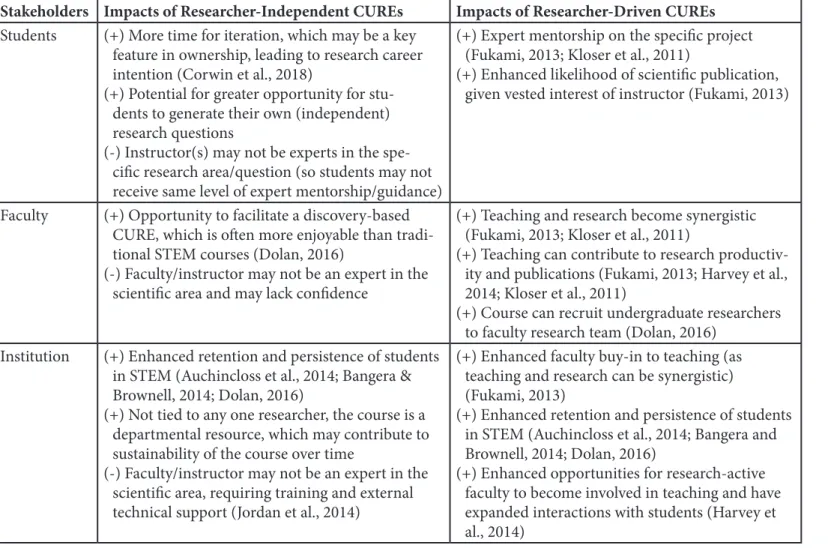
Which CURE model is “better” in a given situation will depend on the desired outcomes in terms of students, faculty, and the institution. Some of the impacts of each CURE model on students, faculty and institutions are noted in Table 1.
Stakeholders Impacts of Researcher-Independent CUREs Impacts of Researcher-Driven CUREs
Students (+) More time for iteration, which may be a key feature in ownership, leading to research career intention (Corwin et al., 2018)
(+) Potential for greater opportunity for stu-dents to generate their own (independent) research questions
(-) Instructor(s) may not be experts in the spe-cific research area/question (so students may not receive same level of expert mentorship/guidance)
(+) Expert mentorship on the specific project (Fukami, 2013; Kloser et al., 2011)
(+) Enhanced likelihood of scientific publication, given vested interest of instructor (Fukami, 2013)
Faculty (+) Opportunity to facilitate a discovery-based CURE, which is often more enjoyable than tradi-tional STEM courses (Dolan, 2016)
(-) Faculty/instructor may not be an expert in the scientific area and may lack confidence
(+) Teaching and research become synergistic (Fukami, 2013; Kloser et al., 2011)
(+) Teaching can contribute to research productiv-ity and publications (Fukami, 2013; Harvey et al., 2014; Kloser et al., 2011)
(+) Course can recruit undergraduate researchers to faculty research team (Dolan, 2016)
Institution (+) Enhanced retention and persistence of students in STEM (Auchincloss et al., 2014; Bangera & Brownell, 2014; Dolan, 2016)
(+) Not tied to any one researcher, the course is a departmental resource, which may contribute to sustainability of the course over time
(-) Faculty/instructor may not be an expert in the scientific area, requiring training and external technical support (Jordan et al., 2014)
(+) Enhanced faculty buy-in to teaching (as teaching and research can be synergistic) (Fukami, 2013)
(+) Enhanced retention and persistence of students in STEM (Auchincloss et al., 2014; Bangera and Brownell, 2014; Dolan, 2016)
(+) Enhanced opportunities for research-active faculty to become involved in teaching and have expanded interactions with students (Harvey et al., 2014)
CURE Outcomes
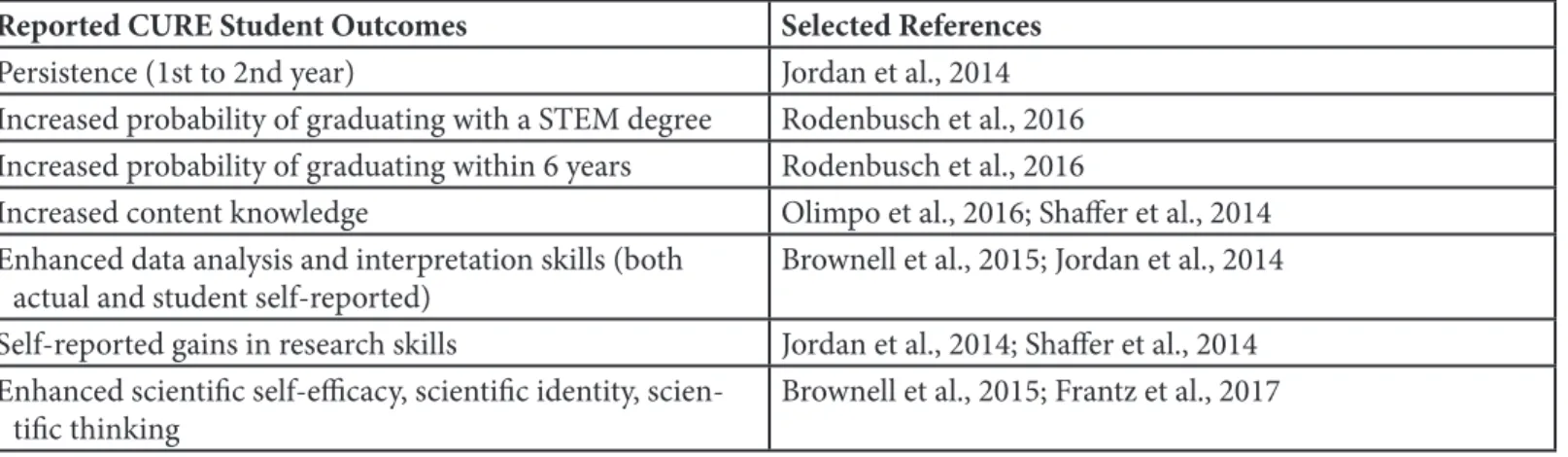
Many outcomes have been associated with CUREs, and Corwin et al. (2015) have summarized and categorized them as probable, possible, or proposed. Student outcomes resulting from CURE participation appear to be similar to those resulting from mentored research experiences, and in fact, students participating in the SEA-PHAGES CURE have higher self-reported learning gains across a wide range of skills compared to students participating in a summer men-tored research experience (Jordan et al., 2014). A sampling of student CURE outcomes is presented in Table 2, and other sources provide more comprehensive reviews (e.g., Corwin et al., 2015).
Relationship Between PBL and CUREs
As is probably apparent, a CURE could potentially be con-sidered an “extreme” form of PBL, in which the driving question/problem is an authentic research question and the solution results in discovery of new (to everyone) knowl-edge. Despite the various models of PBL implementation, it is generally agreed that features thought to be important for PBL problems include being open-ended, authentic, ill-structured, and requiring collaborative learning to solve (e.g., Ertmer & Glazewski, 2018; Hung, 2016; Pierrakos, Zilberberg, & Anderson, 2010).
The idea that research questions can serve as the foundation of PBL problems has been explored by Pierrakos, Zilberberg, and Anderson (2010) in a survey of undergraduate engineer-ing students who were participatengineer-ing in research experiences. The researchers were interested in determining the extent to which the research questions that the students were investi-gating (e.g., in a laboratory or industry setting) were suitable for adaptation for use as classroom PBL problems. Given the nature of the research questions identified in their survey,
Pierrakos, Zilberberg, and Anderson (2010) concluded that the research questions “meet the criteria for ideal PBL prob-lems” (p. 55). In fact, their vision is to adapt research-based problems into a PBL context to begin to introduce a stronger research model into a nonlaboratory classroom environment (Pierrakos, Zilberberg, & Anderson, 2010).
Allchin (2013) has also characterized key features of PBL and case-based learning (CBL). While there is an acknowl-edgement of “boundary disputes” when characterizing these approaches, there is also a recognition of key (and common) features of PBL and CBL. These include student-centeredness, contextualization of the content, learning to think and to understand the process of science and how science is car-ried out (Allchin, 2013). Of these features, contextualization (in a real research question), learning to think, and learn-ing about how science is practiced are all also shared with CUREs. Allchin (2013) also notes that PBL problems can be structured so that students generate new knowledge (at least to them). As noted above, CUREs are intentionally designed for new knowledge generation (new to students, instruc-tors, and the field), so they may be considered the ultimate knowledge-generating problems or cases. And if translated to a classroom (rather than a laboratory) environment, knowledge-generating cases may be critical in students’ developing an enhanced understanding of scientific research (Allchin, 2013).
In summary, CUREs and PBLs differ fundamentally in that CUREs are laboratory (or field) based, with students carrying out experiments to discover completely new knowl-edge, and PBL is more typically a classroom-based strategy, but still frequently relies on knowledge generation by stu-dents. These approaches share common features as noted above, including contextualization in the real world, open-ended and potentially “messy” questions, and collaboration.
Reported CURE Student Outcomes Selected References
Persistence (1st to 2nd year) Jordan et al., 2014 Increased probability of graduating with a STEM degree Rodenbusch et al., 2016 Increased probability of graduating within 6 years Rodenbusch et al., 2016
Increased content knowledge Olimpo et al., 2016; Shaffer et al., 2014 Enhanced data analysis and interpretation skills (both
actual and student self-reported) Brownell et al., 2015; Jordan et al., 2014 Self-reported gains in research skills Jordan et al., 2014; Shaffer et al., 2014 Enhanced scientific self-efficacy, scientific identity,
scien-tific thinking Brownell et al., 2015; Frantz et al., 2017
Shuster, M. I., et al. Implementing and Evaluating a CURE at a Hispanic-Serving Institution
5 | www.ijpbl.org (ISSN 1541-5015) September 2019 | Volume 13 | Issue 2 Given the authentic practice of science and the discovery
nature of CUREs, CUREs are likely to be most effective when the desired student outcomes include exposure to hands-on science and scientific research, and the resources permit a laboratory experience at scale. On the other hand, as pos-ited by Pierrakos, Zilberberg, and Anderson (2010), research questions such as those addressed in CUREs can provide the “fodder” for the development of classroom-based PBL problems, or even cases for CBL (Allchin, 2013; Ertmer & Glazewski, 2018).
Here we evaluate the impact of our CURE on our popula-tion of students, particularly persistence in STEM enrollment and psychological predictors of STEM persistence, specifi-cally scientific self-efficacy, scientific community, scientific identity, and intention to persist (Chemers, Zurbriggen, Syed, Goza, & Bearman, 2011; Estrada, Woodcock, Hernandez, & Schultz, 2011). These are likely to be important mediators and predictors of long-term persistence in STEM (Chemers et al., 2011; Corwin et al., 2015; Corwin et al., 2018; Estrada et al., 2011). These short- and medium-term outcomes also allow us to evaluate our CURE and implement revisions in instruction or structure if these outcomes are not being met (Corwin et al., 2015). More broadly, this work contributes to a call for the use of common metrics (particularly the established instrument of Estrada et al. [2011] with infor-mation on reliability and validity), as well as characteriza-tion of many diverse CUREs (Corwin et al., 2015; Dolan, 2016), which will eventually lead to a greater understanding of how CUREs can best be implemented with diverse popu-lations of students to achieve important student outcomes (Auchincloss et al., 2014).
Methods
We used a case study design to address our research ques-tions (Heale & Twycross, 2018; Merriam, 1998, p. 39). As noted by Heale & Twycross (2018), there is no single defi-nition to describe the case study research design. However, this design is generally acknowledged to provide a careful exploration of a particular situation, in a particular context, without an expectation of generalizability. In our case, we are seeking to better understand our CURE and specific impacts on our diverse population of students, essentially a “what is” question (a description of what is happening to students dur-ing and after our CURE) (Bass, 1999). Once we have a better understanding of what is happening, we can begin to develop and test hypotheses about why it is happening, including identifying critical factors that may be greater or lesser con-tributors. Thus, this case study is the first step toward a better understanding of our CURE, and it can suggest additional avenues for exploration and course refinement.
Research Questions
1. What are the one-year post-CURE outcomes for STEM enrollment and completion?
2. What is the impact of our CURE on shorter-term psychological predictors of STEM persistence in our students?
Context
We teach at a land-grant, Hispanic-serving institution in the southwestern United States. Many of our students are first-generation college students with a low socioeconomic status. We used external funding to develop a CURE in the Biology Department. Our objectives for offering the CURE align with national CURE objectives:
• Provide an early-stage authentic research experience for STEM-interested students
• Increase interest in and motivation for STEM
• Provide an early entry-point into undergraduate research (e.g., start with the CURE, then move to internships or research apprenticeships)
• Support and increase diversity in STEM
Our CURE is offered as a 3-credit upper division (300 level) laboratory course, with no separate lecture or recita-tion secrecita-tions. The course meets twice a week for a total of six hours each week. The course meets in a renovated teaching laboratory that is equipped as a molecular biology research space and can hold up to 24 students. The only course pre-requisite is our cellular-based introductory biology course and its corresponding lab. This means that students can register for the CURE as soon as they have completed their introductory biology course work. The CURE satisfies a biol-ogy degree requirement for an upper division laboratory course, but is not required for the biology major. The vast majority of CURE students to date (~80%) have been biology majors, and over 90% have been majors in the life sciences. To date, the CURE has been offered eight times (including the current spring 2019 semester, in progress) by five differ-ent instructors. Enrollmdiffer-ents have ranged between 14 and 22, with an average of seven unfilled seats per offering.
Our CURE model gives ownership of the design and for-mat of each iteration to the instructor. Instructors develop the general research topics/questions and details of course logistics and organization. Despite the instructor-driven focus of each iteration, we work to preserve the elements of a CURE (Auchincloss et al., 2014) and our overall CURE objectives across all iterations by discussing these objectives
with instructors during the course design phase, and by pro-viding them materials from previous iterations of the course (which they are free to modify or replace entirely). Below we provide a general description of our CURE based on the experience of two instructors: the instructor with the most CURE experience (three semesters, including the “founding” semester of our CURE) and the instructor with the most recent past CURE experience.
Despite the differences in research focus (described below), each of these instructors implemented several com-mon elements in their CUREs. Both did some degree of front-loading of the course, using early class meetings to teach students the basic laboratory techniques and skills that are specific to, and necessary for, the students to complete their research projects.
In both versions of the course, students generally worked collaboratively in pairs, which were formed by student choice and/or by seating arrangement. Most typically students worked with their laboratory benchmate. In both versions of the course, students had the ability to develop their own questions (within boundaries set by the instructors), and in both cases, the research questions and hypotheses were developed after students had begun to read the literature and learn more about the particular system in each course (ant behavior and genetics, and genes that influence eye develop-ment in fruit flies and humans, as described below). In the ants course, students had more flexibility to develop wider-ranging questions. In the fly eye course, students developed their research questions and hypotheses based on a collection of genes that had been pre-identified as potentially having a role in eye development. Thus their choice of an individual gene to study was limited, although there were more genes to choose from than there were student groups.
As noted above, the research questions and hypotheses were developed after students started to become familiar with the relevant scientific literature. To provide structured and scaffolded practice reviewing and dissecting the primary literature, both instructors incorporated student presenta-tions of papers from the primary literature and their research proposals (which incorporated the primary literature). In both cases, students received constructive feedback from the instructor, the graduate teaching assistant, and the under-graduate teaching assistant. Each CURE culminated in a stu-dent poster session in which stustu-dents presented their research as a scientific poster, as they would at a scientific conference.
In terms of student projects, one instructor had students work on two successive projects during the semester. The overall theme was the connection between social behavior and genetics, using local harvester ants as a model system. In the first project, students generated their own questions and hypotheses for a field-based study of harvester ant colonies
(focusing on social interactions within or between colonies). The students then used molecular genetic tools to test their hypotheses about genetic diversity within colonies or genetic relatedness between colonies. Finally, students tied their two projects together in their poster, linking the genetic results to the social interaction data. In this case, the student proj-ects were completely independent of the faculty member’s research program, which uses a vertebrate animal model system that is not amenable for project completion by nov-ice researchers in the compressed time available in a course. However, the instructor’s research focus is on genetics and behavior, allowing them to bring their expertise to the stu-dents in the course. Thus this course design was a hybrid between the two CURE models discussed above.
The other instructor used a CURE model in which stu-dents worked on aspects of the instructor’s research program. In this case, the overall goal was to use genetic techniques in the fruit fly to study the functions of genes about which little is known but that have been linked to human eye diseases. Each pair of students chose a gene and designed an experi-ment to test whether or not that gene played a role in eye development. Each student pair studied what was known about their gene (based on the scientific literature and genetic databases) and generated hypotheses about how that gene could be influencing eye development (based on what was known about the function of the gene). They then devel-oped and defended a proposal of research to be carried out, used molecular biological methods to manipulate the expres-sion of that gene during eye development and verify that the expression had indeed been altered, and observed the impact on the development of eyes. While not all students were able to generate results, they were all able to generate a hypothesis supported by the primary literature, to generate a reasonable experimental design, and to successfully present these dur-ing the poster session. Others generated results, carried out quantitative analyses of the data, and presented their results, conclusions, and future direction during the poster session.
Methods and Data Sources
Research Question 1: We have used institutional data to determine demographic characteristics and the one-year post-CURE outcomes with respect to STEM enrollment and STEM graduation. Our participants for the former (demo-graphics) include all CURE participants from completed CUREs (six offerings through spring 2018), and for the lat-ter, the subset of former CURE students who are one year out from their CURE completion.
Research Question 2: We administered a pre- and post-course survey to students in the spring 2018 iteration of the CURE (Table 3). This survey is based on published instru-ments (Chemers et al., 2011; Estrada et al., 2011) to measure
Shuster, M. I., et al. Implementing and Evaluating a CURE at a Hispanic-Serving Institution
7 | www.ijpbl.org (ISSN 1541-5015) September 2019 | Volume 13 | Issue 2 key constructs of scientific self-efficacy, scientific identity,
valuing science community objectives, and intention to persist. These are important short and intermediate CURE outcomes that contribute to long-term persistence in STEM (Corwin et al., 2015). Students used a unique identifier (known only to them) on their pre- and postsurveys, allowing responses to be matched by student while preserving student anonymity. As the survey administration was anonymous, it is not possible to link survey gains with institutional data on
a per-student basis. However, the survey includes items that allow students to self-report age, gender, race, ethnicity, and academic level (freshman through senior).
Students responded to survey items on a Likert scale (pro-vided for each construct in Table 3). Eleven of 16 registered students completed both the pre- and the postsurvey. We calculated class means for each survey item (pre- and post-) and used a paired, 2-tailed t-test to compare the pre- and postsurvey scores for each item. We also report the Cohen’s d
for effect size for each item.
Items (arranged by construct) Scientific Self-Efficacy
Scale: 1 (not at all confident) to 5 (absolutely confident)
I am able to use technical science skills (tools, instruments, and/or techniques) I am able to generate a research question to answer
I am able to figure out what data/observations to collect and how to collect them I am able to create explanations for the results of a study
I am able to use scientific literature and/or reports to guide research
I am able to develop conclusions (integrate and coordinate result from multiple studies)
Scientific Identity
Scale: 1 (strongly disagree) to 5 (strongly agree)
I have a strong sense of belonging to the community of scientists
I derive great personal pleasure from working on a team that is doing important research I have come to think of myself as a “scientist”
I feel that I belong in the field of science The daily work of a scientist is appealing to me
Valuing Scientific Community Objectives
Scale: 1 (not like me at all) to 5 (very much like me)
A person who thinks it is valuable to conduct research that builds the world’s scientific knowledge A person who feels discovering something new in the sciences is thrilling
A person who thinks discussing new hypotheses and ideas between scientists is important A person who thinks that scientific research can solve many of today’s world challenges
Intention to Persist
Scale: 1 (definitely will not) to 10 (definitely will)
To what extent do you intend to pursue a science-related research career?
Findings
We are reporting on 108 students who have completed our CURE over six semesters (through spring 2018) and four instructors. Academic and demographic characteristics of CURE students are reported in Table 4. The average age of all CURE students is 22.5 years (range 18–42; SD = 4.2). Excluding an influential student (age 42 years) gives an aver-age aver-age of 22.3 years (SD = 3.7).
Persistence in STEM
Persistence in STEM has been defined as students remain-ing in a STEM track one year after their CURE completion (Corwin et al., 2015; Jordan et al., 2014). We have examined the one-year post-CURE status for the 92 students who are at least one year out from completing the CURE, recording outcomes that indicate persistence in STEM. Almost 86% of all students, close to 80% of URM students, and approxi-mately 85% of female students have either graduated with a STEM degree, remain enrolled in a STEM major, or are newly enrolled in a STEM major (i.e., have switched to a STEM major from a non-STEM major) (Table 5). Note that students who are newly enrolled in a STEM major repre-sent only 5.4% of the 92 students who are one year out from CURE completion.
Psychological Predictors of Persistence
Eleven of 16 students completed the pre- and postcourse surveys in spring 2018. Based on self-reported data, the 11 students who completed both the pre- and postsurveys were predominately female (81.8%). Over 80% of the 11 partici-pating students identified as Hispanic, and all were biology majors. Ten of the 11 participating students were seniors, and the average age of the 11 participating students was 24.8 years (SD = 3.7).
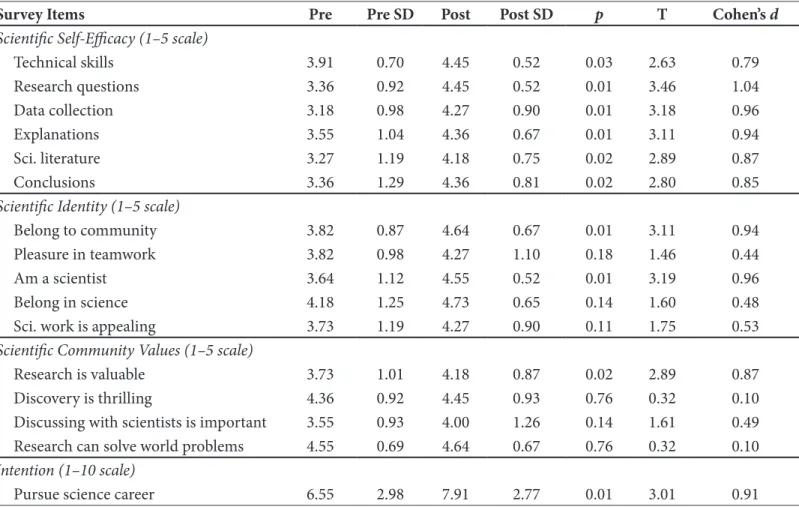
The survey results (Table 6) showed statistically significant shifts toward “more confident” on all six items of the Scientific Self-Efficacy scale, with five having a large effect size. All five items on the Scientific Identity scale showed a positive shift, two of which were statistically significant. Both of the signifi-cant items had a large effect size (> 0.8). One of the four items on the Scientific Community Values scale showed a signifi-cant shift (with a large effect size), although all items showed a positive shift toward “very much like me.” There was a sta-tistically significant and positive shift on the single item of the Intention to Persist scale, with a large effect size of 0.91.
Characteristic n % Class Standing Freshman or Sophomore 20 18.5 Junior 33 30.6 Senior 55 50.9 Gender Female 70 64.8 Male 38 35.2 Race/Ethnicity URM* 76 70.3 Hispanic 65 60.2
*Includes Hispanic (86% of the URM population in this study), as well as American Indian/Alaska Native, Hawaiian/Pacific Islander, and Black (each of which includes less than seven stu-dents, preventing individual reporting, per institutional policy). Table 4. Academic and demographic characteristics of the
108 CURE students over six semesters of the CURE.
Outcome Number students)% (of 92 Number URM % (of 61 URM students) Number Female female students)% (of 59
Degree completed in
a STEM major 29 31.5 17 27.9 15 25.4
Still enrolled in a
STEM major 50 54.3 31 50.8 35 59.3
Shuster, M. I., et al. Implementing and Evaluating a CURE at a Hispanic-Serving Institution
9 | www.ijpbl.org (ISSN 1541-5015) September 2019 | Volume 13 | Issue 2
Discussion
Our CURE is clearly serving a diverse population of students (Table 4). At 64.8% female and 60.2% Hispanic, our CURE participants include a higher proportion of females and Hispanics than our institution as a whole (between 53.9% and 54.9% female and between 49.7% and 54.4% Hispanic in the same interval; Office of Institutional Analysis, New Mexico State University). The demographics of our CURE students closely match those of the Biology Department (56.3%– 62.8% Hispanic and 66.4%–68.7% female). This sug-gests that our CURE fosters broad participation, consistent with a research experience via course enrollment rather than by a selective application process (Bangera & Brownell, 2014; Elgin et al., 2016). By providing a diverse group of students with an authentic research experience, we are contributing to an inclusive research environment, and possibly stimulating student interest in continuing participation in research.
As noted above, our CURE objectives align with national objectives (PCAST, 2012) in that we want to provide an early-stage authentic research experience for STEM-interested students. We have been surprised at the high proportion of advanced students enrolling in our CURE, which was pri-marily, although not exclusively, targeted toward and mar-keted to early career students (Table 4). This trend suggests that our CURE is filling a gap for more senior students who have previously not had a research experience, either because of interest arising later in their academic career, and/ or because of limited departmental capacity to provide men-tored research apprenticeships to all interested students, a recognized barrier to participation in research (Auchincloss et al., 2014; Bangera & Brownell, 2014; Elgin et al., 2016). As noted above, although we are enrolling a high proportion of more advanced students, the course is not yet reaching capacity. On average, there are ~7 seats remaining open each semester (range 3–10), suggesting that we have not excluded
Survey Items Pre Pre SD Post Post SD p T Cohen’s d
Scientific Self-Efficacy (1–5 scale)
Technical skills 3.91 0.70 4.45 0.52 0.03 2.63 0.79 Research questions 3.36 0.92 4.45 0.52 0.01 3.46 1.04 Data collection 3.18 0.98 4.27 0.90 0.01 3.18 0.96 Explanations 3.55 1.04 4.36 0.67 0.01 3.11 0.94 Sci. literature 3.27 1.19 4.18 0.75 0.02 2.89 0.87 Conclusions 3.36 1.29 4.36 0.81 0.02 2.80 0.85
Scientific Identity (1–5 scale)
Belong to community 3.82 0.87 4.64 0.67 0.01 3.11 0.94 Pleasure in teamwork 3.82 0.98 4.27 1.10 0.18 1.46 0.44
Am a scientist 3.64 1.12 4.55 0.52 0.01 3.19 0.96
Belong in science 4.18 1.25 4.73 0.65 0.14 1.60 0.48 Sci. work is appealing 3.73 1.19 4.27 0.90 0.11 1.75 0.53
Scientific Community Values (1–5 scale)
Research is valuable 3.73 1.01 4.18 0.87 0.02 2.89 0.87 Discovery is thrilling 4.36 0.92 4.45 0.93 0.76 0.32 0.10 Discussing with scientists is important 3.55 0.93 4.00 1.26 0.14 1.61 0.49 Research can solve world problems 4.55 0.69 4.64 0.67 0.76 0.32 0.10
Intention (1–10 scale)
Pursue science career 6.55 2.98 7.91 2.77 0.01 3.01 0.91
*The degrees of freedom for all items is 10.
Table 6. Pre- and postsurvey means, standard deviations, p-values, T statistics, and Cohen’s d from paired two-tailed T-tests.* Items are grouped by construct.
beginning students from enrolling. Thus, any skew toward more advanced students appears to reflect demand, rather than exclusion of less advanced students.
Our one-year post-CURE outcomes are positive with respect to measures of persistence (Table 5). Our relatively high STEM graduation rates in the year since CURE comple-tion (31.5% for all students and 27.9% for URM students) likely reflects the high proportion of seniors (50.9%) in our CURE. Our high persistence rates (54.3% of all students and 50.8% of URM students enrolled in a STEM degree program one year post-CURE completion) may also be influenced by the high proportion of juniors and seniors. Rodenbusch et al. (2016) reported higher STEM graduation rates for students participating in a three-semester CURE (starting in their first semester) than for students who did not participate in a CURE. Similarly, Jordan et al. (2014) reported a first- to second-year retention rate of approximately 93% for students who completed the year-long SEA-PHAGES CURE in their first year. Our combined one-year post-CURE graduation and persistence rates are similarly quite high—85.8% for all students and 78.7% for URM students (Table 5). However, this positive result may be biased by the more advanced stu-dents in our CURE. The highest attrition from STEM typi-cally occurs earlier in the academic pathway (e.g., PCAST, 2012), so we cannot definitively state that our CURE is transformative for early-stage students. As we eventually have more students at all levels participate in our CURE, we would like to specifically compare outcomes for freshmen/ sophomores and juniors/seniors.
Despite the potential bias in one-year measures of persis-tence presented by advanced students enrolling in our CURE, we are still seeing significant gains in psychological indica-tors of persistence, suggesting that even advanced students can still gain in critical areas (90.9% of students completing the surveys were seniors) (Table 6). For example, there were significant gains in all items of the Scientific Self-Efficacy scale, suggesting that even advanced students have room to enhance their self-efficacy. Furthermore, there were positive shifts on all items of the Scientific Identity scale, including two significant shifts with a large effect size (“I am a scientist”; “I belong to the community”). This is in contrast to observa-tions in an upper division and advanced biochemistry CURE (Shanle, Tsun, & Strahl, 2016) in which there were no detect-able shifts in scientific identity over the course of the CURE. However, their measure of scientific identity had two items (“I am a researcher” and “I am a scientist”) that may not have been able to address this construct at a finer grain. It is inter-esting that we saw significant gains on a Scientific Identity scale item (“I am a scientist”), which was not observed by
Shanle, Tsun, and Strahl in an upper division biochemistry CURE (2016). This is an example that supports the argu-ment for the field using common and validated instruargu-ments, so that results of different studies can be more meaningfully compared and differences can be more readily attributed to differences in the CURE or students, rather than the assess-ment instruassess-ments used. In our CURE, most of the nonsignif-icant gains were in the area of scientific community values. However, for many of the items with nonsignificant gains, precourse means were already high, leaving relatively little room for improvement (potentially reflecting advanced sta-tus and already developed appreciation for science) (e.g., items including “belong in science,” “discovery is thrilling,” “research can solve real-world problems”).
The fact that we are seeing significant gains in scientific self-efficacy and scientific identity is important, as they can be predictors of persistence in STEM (Corwin et al., 2015; Estrada et al., 2011; Hernandez, Wesley Schultz, Estrada, Woodcock, & Chance, 2013). The observed gains in these areas, as well as the significant gain on the intention to persist item on our survey (“To what extent to do you intend to pur-sue a science-related research career?”) (from 6.55 precourse to 7.91 postcourse) (Table 6), appear to be borne out by our actual measures of one-year post-CURE persistence (Table 5).
Limitations
As discussed above, while we intended to enroll students who had recently completed their introductory biology courses, the highest demand was from more advanced students. While this opens questions about why the course was so attractive to more advanced students, it also may influence the survey results, as one might expect more advanced students to have high senses of scientific self-efficacy, scientific identity, and scientific community values. We did observe relatively high presurvey scores, but were surprised to see significant shifts, particularly on items related to scientific self-efficacy and sci-entific identity. Until we have more lower division students participate, we will not be able to determine the impact of our CURE on the intended target population.
As this study was intended to determine “what is” happen-ing with respect to important predictors of persistence (Bass, 1999), we focused on collecting data that would allow us to measure these indicators. However, we are unable to deter-mine why these shifts are occurring, particularly in our sam-ple with a high representation of academically advanced and traditionally underrepresented students. Qualitative data in the form of surveys or focus groups would allow us to begin to understand what might be driving the observed shifts and to make design tweaks to the course to foster such shifts.
Shuster, M. I., et al. Implementing and Evaluating a CURE at a Hispanic-Serving Institution
11 | www.ijpbl.org (ISSN 1541-5015) September 2019 | Volume 13 | Issue 2
Future Directions
As we continue to offer our CURE, we will continue to use assessment and evaluation to better understand the impact of our CURE on measures and predictors of persistence for freshmen and sophomores. These data will allow us to address several outstanding questions regarding CUREs. For example, can our CURE impact psychological predictors of persistence in freshmen and sophomores to the same extent that we observe for our seniors? Can participation in our CURE influence persistence for both URM and non-URM freshmen and sophomores (relative to students who do not participate)? We are also interested in continuing to evalu-ate the impact of the CURE on our more advanced students. While there were positive shifts on survey items predicting persistence, the precourse means were relatively high. Does this mean that our CURE is primarily confirmatory (e.g., Lopatto, 2007; Seymour, Hunter, Laursen, & Deantoni, 2004; Thiry, Laursen, & Hunter, 2011) with respect to STEM per-sistence for these more advanced students, or is it having a transformative impact (e.g., Villarejo et al., 2008)? Finally, as is the case for the field in general, we would also like to better understand what aspects of our CURE are contrib-uting to our measures and predictors of persistence, so we can ensure these aspects are maintained across all iterations of our CURE (Auchincloss et al., 2014; Corwin et al., 2015; Shortlidge & Brownell, 2016). For example, a recent study found that project ownership mediated the positive impacts of CURE design elements of discovery, iteration, and collab-oration on scientific career intentions (Corwin et al., 2018). Will this be true in a CURE at a minority-serving institution with a high URM population?
Finally, while not a focus of this study, we have worked to adapt an ant behavior research question from one CURE itera-tion for an introductory biology inquiry lab, and it is our inten-tion to continue to use CURE research quesinten-tions and findings as the basis for classroom PBL or CBL activities. This effort enacts the suggestions of Pierrakos, Zilberberg, and Anderson (2010), whose work suggests that research questions have the potential to be effective classroom PBL problems.
In conclusion, we have developed a CURE that serves a large proportion of students who are underrepresented in STEM. We have found that students show positive shifts on psychological indicators of persistence and have high rates of STEM persistence one year after completion of the CURE.
Acknowledgments
This program was supported in part by a grant to New Mexico State University from the Howard Hughes Medical Institute through the Science Education Program, Grant No. 52008103. We would like to thank former NMSU-HHMI
program director Ralph Preszler for initiating the CURE at NMSU. The CURE program would not have been pos-sible without the hard work of program coordinator Anja Hansen, all CURE instructors, and the students who have taken our CURE.
References
Allchin, D. 2013. Problem- and case-based learning in sci-ence: An introduction to distinctions, values, and out-comes. CBE-Life Sciences Education, 12, 364–372.
Auchincloss, L., Laursen, S. L., Branchaw, J. L., Eagan, K., Graham, M., Hanauer, D. I., . . . Dolan, E. L. (2014). Assessment of course-based undergraduate research experiences: A meeting report. CBE-Life Sciences Educa-tion, 13, 29–40.
Bangera, G., & Brownell, S. E. (2014). Course-based under-graduate research experiences can make scientific research more inclusive. CBE-Life Sciences Education, 13, 602–606. Bascom-Slack, C. A., Arnold, E., & Strobel, S. A. (2012). Stu-dent-directed discovery of the plant microbiome and its products. Science, 338, 485–486. https://doi.org/10.1126 /science.1215227
Bass, R. (1999). The scholarship of teaching: What’s the prob-lem? inventio, 1(1).
Brownell, S. E., Hekmat-Scafe, D. S., Singla, V., Seawell, P. C., Imam, J. F., Eddy, S. L., . . . Cyert, M. S. (2015). A high-enrollment course-based undergraduate research experi-ence improves student conceptions of scientific thinking and ability to interpret data. CBE-Life Sciences Education, 14, 1–14. https://doi.org/10.1187/cbe.14-05-0092
Brownell, S. E., & Kloser, M. J. (2015). Toward a conceptual framework for measuring the effectiveness of course-based undergraduate research experiences in undergraduate biology. Studies in Higher Education, 40, 525–544.
Chemers, M. M., Zurbriggen, E. L., Syed, M., Goza, B. K., & Bearman, S. (2011). The role of efficacy and identity in science career commitment among underrepresented minority students. Journal of Social Issues, 67, 469–491. Corwin, L., Graham, M. J., & Dolan, E. (2015). Modeling
course-based undergraduate research experiences: An agenda for future research and evaluation. CBE-Life Sci-ences Education, 14, 1–13.
Corwin, L., Runyon, C., Ghanem, E., Sandy, M., Clark, G., Palmer, G., . . . Dolan, E. (2018). Effects of discovery, itera-tion, and collaboration in laboratory courses on under-graduates’ research career intentions fully mediated by student ownership. CBE-Life Sciences Education 17:1r20. Dolan, E. L. (2016). Course-based undergraduate research
experiences: Current knowledge and future directions. Paper commissioned for the Committee on Strengthening
Research Experiences for Undergraduate STEM Students. Board on Science Education, Division of Behavioral and Social Sciences and Education. Board on Life Sciences, Division of Earth and Life Studies. Retrieved from http:// nas.edu/STEM_Undergraduate_Research_CURE
Elgin, S., Bangera, G., Decatur, S. M., Dolan, E. L., Guertin, L., Newstetter, W. C. . . . Labov, J. B. (2016). Insights from a convocation: Integrating discovery-based research into the undergraduate curriculum. CBE-Life Sciences Educa-tion, 15, 1–7.
Ertmer, P. A., & Glazewski, K. D. (2018). Problem-based learning: Essential design characteristics. In R. A. Reiser & J. V. Dempsey (Eds.), Trends and issues in instructional design & technology (4th ed., pp. 286–295). New York, NY: Pearson.
Estrada, M., Woodcock, A., Hernandez, P., & Schultz, P. W. (2011). Toward a model of social influence that explains minority student integration into the scientific commu-nity. J. Educ Psychol, 103(1), 216–222.
Frantz, K. J., Demetrikopoulos, M. K., Britner, S. L., Carruth, L. L., Williams, B. A., Pecore, J. L., . . . Goode, C. T. (2017). A comparison of internal dispositions and career trajecto-ries after collaborative versus apprenticed research expe-riences for undergraduates. CBE-Life Sciences Education, 16(ar1), 1–12. https://doi.org/10.1187/cbe.16-06-0206 Fukami. T. (2013). Integrating inquiry-based teaching with
faculty research. Science, 339, 1536–1537.
Harvey, P. A., Wall, C., Luckey, S. W., Langer, S., & Leinwand, L. A. (2014). The Python Project: A unique model for extending research opportunities to undergraduate stu-dents. CBE-Life Sciences Education, 13, 698–710.
Heale, R., & Twycross, A. (2018). What is a case study? Evid Based Nurs, 21, 7–8.
Hernandez, P., Wesley Schultz, P., Estrada, M., Woodcock, A., & Chance, R. C. (2013). Sustaining optimal motiva-tion: A longitudinal analysis of interventions to broaden participation of underrepresented students in STEM.
J. Educ Psychol, 105(1), 89–107.
Hung, W. (2016). All PBL starts here: The problem. Interdis-ciplinary Journal of Problem-Based Learning, 10(2). Avail-able at: https://doi.org/10.7771/1541-5015.1604
Hunter, A-B., Laursen, S. L., & Seymour, E. (2006). Becom-ing a scientist: The role of undergraduate research in stu-dents’ cognitive, personal , and professional development.
Science Education, 91, 36–74. https://doi.org/10.1002 /sce.20173
Jordan, T. C., Burnett, S. H., Carson, S., Caruso, S. M., Clase, K., DeJong, R. J. . . . Hatfull, G. F. (2014). A broadly imple-mentable research course in phage discovery and genom-ics for first-year undergraduate students. mBio, 5(1), e01051-13.
Kloser, M. J., Brownell, S. E., Chiariello, N. R., & Fukami, T. (2011). Integrating teaching and research in undergradu-ate laboratory education. PLoS Biol, 9(11), e1001174. https://doi.org/10.1371/journal.pbio.1001174
Lopatto, D. (2004). Survey of undergraduate research experi-ences (SURE): First findings. CBE, 3, 270–277.
Lopatto, D. (2007). Undergraduate research experiences sup-port science career decisions and active learning. CBE-Life Sciences Education, 6, 297–306.
Merriam, S. B. (1998). Qualitative research and case study applications in education. San Francisco, CA: Jossey-Bass. National Science Foundation, National Center for Science
and Engineering Statistics. (2017). Women, minorities, and persons with disabilities in science and engineering: 2017. Special Report NSF 17-310. Arlington, VA. Avail-able at www.nsf.gov/statistics/wmpd/
Office of Institutional Analysis, New Mexico State University. Retrieved September 9, 2018, from Factbooks. https://oia .nmsu.edu/data-reports/factbooks/
Olimpo, J. T., Fisher, G. R., & DeChenne-Peters, S. E. (2016). Development and evaluation of the Tigriopus course-based undergraduate research experience: Impacts on students’ content knowledge, attitudes, and motivation in a majors introductory biology course. CBE-Life Sciences Education, 15(ar72). https://doi.org/10.1187/cbe.15-11-0228
Pierrakos, O., Zilberberg, A., & Anderson, R. (2010). Understanding undergraduate research experiences through the lens of problem-based learning: Implica-tions for curriculum translation. Interdisciplinary Journal of Problem-Based Learning, 4(2). Available at: https://doi .org/10.7771/1541-5015.1103
President’s Council of Advisors on Science and Technology (PCAST). (2012). Engage to excel: Producing one million additional college graduates with degrees in science, tech-nology, engineering and mathematics. Retrieved from https://obamawhitehouse.archives.gov/sites/default/files /microsites/ostp/pcast-engage-to-excel-final_2-25-12.pdf Rodenbusch. S. E., Hernandez, P. E., Simmons, S. L., &
Dolan, E. L. (2016). Early engagement in course-based research increases graduation rates and completion of science, engineering, and mathematics degrees. CBE-Life Sciences Education, 15, 1–10.
SEA-PHAGES. Retrieved August 22, 2018, from https://sea phages.org/.
Seymour, E., Hunter, A-B., Laursen, S., & Deantoni, T. (2004). Establishing the benefits of research experiences for undergraduates in the sciences: First findings from a three-year study. Sci Ed, 88, 493–534.
Shaffer, C. D., Alvarez, C. J., Bednarski, A. E., Dunbar, D., Goodman, A. L., Reinke, C. . . . Elgin, S. C. R. (2014). A course-based research experience: How benefits change
Shuster, M. I., et al. Implementing and Evaluating a CURE at a Hispanic-Serving Institution
13 | www.ijpbl.org (ISSN 1541-5015) September 2019 | Volume 13 | Issue 2 with increased investment in instructional time. CBE-Life
Sciences Education, 13, 111–130. https://doi.org/10.1187 /cbe-13-08-0152
Shanle, E., Tsun, I., & Strahl, B. (2016). A course-based undergraduate research experience investigating p300 bromodomain mutations. Biochemistry and Molecular Biology Education, 44(1), 68–74.
Shortlidge, E. E., & Brownell, S. E. (2016). How to assess your CURE: A practical guide for instructors of course-based undergraduate research experiences. Journal of Microbiol-ogy and BiolMicrobiol-ogy Education, 17(3), 399–408. https://doi.org /10.1128/jmbe.v17i3.1103
Small World Initiative. Retrieved August 22, 2018, from http://www.smallworldinitiative.org/.
Thiry, H., Laursen, S. L., & Hunter, A-B. (2011). What expe-riences help students become scientists? A compara-tive study of research and other sources of personal and professional gains for STEM undergraduates. Journal of Higher Education, 82(4), 357–388.
University of Texas at Austin, College of Natural Sciences. (2018). Freshman Research Initiative. Retrieved August 20, 2018, from https://cns.utexas.edu/fri/about
Villarejo, M., Barlow, A. E., Kogan, D., Veazey, B. D., & Swee-ney, J. K. (2008). Encouraging minority undergraduates to choose science careers: Career path survey results. CBE-Life Sciences Education, 7, 394–409.
Michèle I. Shuster, PhD, is a professor and NMSU-HHMI programs director in the NMSU Department of Biology. Shuster’s work focuses on diversifying and supporting the STEM pipeline; mentoring K–12 teachers, grad students, postdocs, and faculty in scientific teaching; and developing innovative curriculum materials for K–16 STEM education. Jennifer Curtiss, PhD, is an associate professor and associ-ate department chair in the NMSU Department of Biology. Curtiss leverages her expertise in the use of the molecular genetic tools available in Drosophila melanogaster (the fruit fly) to study fundamental questions of relevance to human health. She recently facilitated NMSU’s Course-based Undergraduate Research Experience (CURE), using the D. melanogaster eye as a model system for student research projects addressing the functions of D. melanogaster genes with human orthologs linked to human eye disease.
Timothy F. Wright, PhD, is a professor and NMSU-HHMI programs co-director in the NMSU Department of Biology. Wright studies the phenomenon of vocal learning and its neu-rogenetic underpinnings using avian models. He designed the first iteration of NMSU’s CURE course in which students investigated the relationship between genetic relatedness and behavioral interactions in colonies of local harvester ants. Camilla Champion, MS, is a graduate research assistant for Institutional Analysis at NMSU. Champion recently com-pleted a graduate certificate in public health from NMSU, and also has her master of science in applied statistics at NMSU. Maryam Sharifi, MS, is a graduate research assistant for Institutional Analysis at NMSU. Sharifi holds a master of sci-ence in mathematical scisci-ences from NMSU, and is currently working toward her master of science in applied statistics, also at NMSU.
Judith Bosland, MS, is a retired assistant vice president for Institutional Analysis at NMSU. Bosland has been commit-ted to promoting a culture of excellence for student learning and experiences at NMSU for over 25 years.