© 2015 Mitek Inc. All rights reserved. Reproduction of this white paper by any means is strictly prohibited.
Mobile Onboarding: Reducing
Abandonment Using Photo Prefill
Prepared for:
TABLE OF CONTENTS
EXECUTIVE SUMMARY ... 3
INTRODUCTION ... 4
METHODOLOGY ... 4
CONSUMERS’ INCREASING EMBRACE OF THE MOBILE CHANNEL ... 5
MOBILE ONBOARDING ... 7
BENEFITS OF MOBILE ONBOARDING ... 8
MOBILE SELF-SERVICE ONBOARDING ... 8
BENEFITS OF MOBILE WEB ... 8
BENEFITS OF NATIVE APP ... 9
ASSISTED-SERVICE MOBILE ONBOARDING ... 9
IN-BRANCH BANKING ... 9
OFF-SITE PROMOTIONAL EVENTS ... 10
BENEFITS OF ASSISTED-SERVICE MOBILE ONBOARDING ... 10
QUANTIFYING THE BENEFITS ... 13
CONCLUSION ... 15
ABOUT AITE GROUP... 16
AUTHOR INFORMATION ... 16
CONTACT ... 16
LIST OF FIGURES
FIGURE 1: FIS' PLANNED MOBILE BANKING CAPABILITIES ... 6FIGURE 2: PRODUCTS WITH HEAVY MARKETING FOCUS ... 6
FIGURE 3: ESTIMATED PROFITS FROM ONBOARDING CREDIT CARD APPLICATIONS OVER THE WEB ... 13
FIGURE 4: POTENTIAL IMPACT OF MOBILE ON ESTIMATED PROFITS FROM ONBOARDING CREDIT CARD APPLICATIONS OVER THE WEB ... 13
EXECUTIVE SUMMARY
Mobile Onboarding: Reducing Abandonment Using Photo Prefill, commissioned by Mitek and produced by Aite Group, explores the benefits that banks can achieve by embracing mobile-camera-enabled onboarding.
Key takeaways from the study include the following:
Banks can fundamentally change onboarding processes, currently burdened by
labor-intensive workflows and high abandonment rates, by enabling customers and bank personnel to use mobile-device cameras to capture images of identity
documents, such as drivers’ licenses and passports, and using them to prefill a variety of onboarding forms.
By reducing the amount of onboarding-process friction, banks can increase
acquisition rates for, and profits from, basic products such as checking accounts and personal lines of credit.
Two modes of usage are possible for mobile-image-based onboarding. The first is
assisted mobile-image-based onboarding, in which a bank employee uses the technology to capture images of identity documents to onboard a new customer in-person. The second is a self-service mode, in which a bank’s customers or prospects use the technology to capture images of identity documents and independently complete an onboarding process wherever they might be.
Both modes of image-based onboarding enable banks to provide a customer
experience that is far faster and easier than traditional means, which typically involve paper forms, face-to-face interviews, or Web-based forms that have high user-error rates―and are burdened with high abandonment rates as a result.
By delivering more structured data than traditional onboarding workflows allow, mobile-photo-based onboarding reduces the amount of manual input required of onboarding staff, increasing their productivity and freeing them up for more value-generating activities such as sales.
INTRODUCTION
Although financial institutions have broadly adopted mobile as a channel for promoting and selling services, banks still struggle to use it for customer onboarding, that critical last mile of data exchange required to initiate a banking relationship. When consumers attempt to onboard themselves over a mobile device, the number of required data points, the small interface, and various keying errors often cause frustration and even abandonment. This is no small issue for banks, for which mobile is a powerful channel. Even when a channel is capable of promoting products and reaching customers, if it can’t support onboarding, the bank will lose revenue opportunities. In this white paper, Aite Group examines a potential innovation available to banks: the use of mobile-device cameras by bankers or customers to capture images of identity documents, which are then used to automatically prefill onboarding forms, a process commonly referred to as mobile-camera-enabled onboarding.
Managers in retail banking operations can use this white paper to understand how mobile-camera-enabled onboarding can impact their customers’ experience, bring scale to bank operations, and reduce costs. Senior bankers can use it in evaluating proposed investments in such a technology.
M E T H O D O LO GY
This white paper is based on ongoing, in-depth Aite Group surveys of and discussions with professionals at banks in North America, Europe, the Middle East, and the Asia-Pacific region. Sources of such discussions include:
A Q1 2014 global survey of executives at 141 banks with more than US$10 billion in assets
Three Q1 2015 interviews with U.S.-based banks that have placed mobile
onboarding on their technology roadmaps or plan to do so as a result of beta tests
A Q1 2014 Aite Group survey of 233 U.S.-based bank and credit union executives
A Q4 2014 survey of 262 U.S.-based senior financial services marketing executives by Aite Group and The Financial Brand
Executives contributing to this research have extensive business or IT responsibilities and titles that include chief technology officer, chief risk officer, chief information officer, executive vice president, vice president, senior vice president, and director. Also incorporated are results from Aite Group discussions with regulators and reviews of government reports and guidance. This white paper is also based on an in-depth examination of Mobile Photo Account Opening, a mobile-camera-enabled onboarding capability from Mitek.
CONSUMERS’ INCREASIN G EMBRACE OF THE
MOBILE CHANNEL
Americans’ reliance on mobile technology is growing. Nearly 160 million people in the United
States—about two-thirds of all U.S.-based mobile phone subscribers—own a smartphone.1
Smartphone owners used an average of 27 mobile applications each month during Q4 2013, up slightly from an average of 26 apps in Q4 2012 and 23 apps Q4 2011.2 Although the number of apps used hasn't changed dramatically, the time spent using those apps has. In Q4 2011, smartphone owners spent, on average, a little more than 18 hours each month using mobile apps. In Q4 2013, smartphone users engaged with mobile apps for more than 30 hours a month—with 18- to 24-year-old consumers interacting with mobile apps in excess of 37 hours per month.
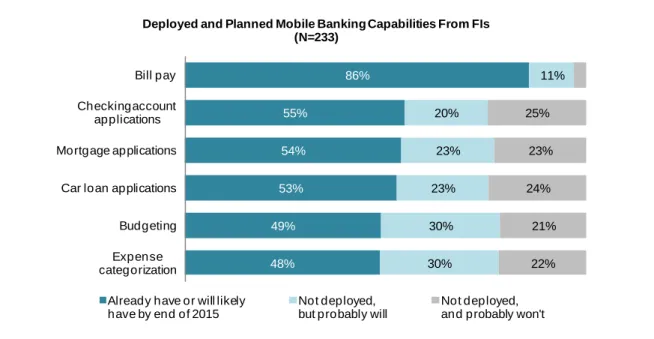
How are FIs responding to consumers' use of mobile devices? Not surprisingly, many are focused on building out mobile banking capabilities. Nearly nine in 10 FIs expect to offer mobile bill pay by the end of 2015, and another one in 10 say they will probably offer it at some point. More than half of FIs anticipate taking checking account, mortgage, and car loan applications via mobile device by the end of 2015. And almost half of FIs expect to have implemented mobile personal financial management features, such as budgeting and expense categorization, by the end of 2015 (Figure 1). Indeed, when U.S.-based banks are asked about the products and services they plan to most heavily market in 2015, mobile capabilities are among banks’ top five priorities (Figure 2).
1. ComScore, "comScore Reports January 2014 U.S. Smartphone Subscriber Market Share," March 7, 2014, http://www.comscore.com/Insights/Press-Releases/2014/3/comScore-Reports-January-2014-US-Smartphone-Subscriber-Market-Share.
2. MarketingCharts, "Smartphone App Usage,"
http://www.marketingcharts.com/wp/wp-content/uploads/2014/07/Nielsen-Smartphone-App-Usage-Q42011-Q42013-Jul2014.png, accessed July 24, 2014.
Figure 1: FIs' Planned Mobile Banking Capabilities
Source: Aite Group survey of 233 U.S.-based bank and credit union executives, Q1 2014
Figure 2: Products With Heavy Marketing Focus
Source: Financial Brand/Aite Group survey of 262 U.S.-based senior financial services marketing executives, Q4 2014 48% 49% 53% 54% 55% 86% 30% 30% 23% 23% 20% 11% 22% 21% 24% 23% 25% Expense categorization Budgeting Car loan applications Mortgage applications Checking account
applications Bill pay
Deployed and Planned Mobile Banking Capabilities From FIs (N=233)
Already have or will likely have by end of 2015
Not deployed, but probably will
Not deployed, and probably won't
4% 10% 10% 10% 11% 11% 13% 16% 18% 20% 22% 23% 30% 34% 37% 38% 47% 47% 52% 56% 59% Prepaid cards Person-to-person payments Retirement products Personal financial management Savings accounts Certificates/term deposits Youth/kids accounts Interest checking accounts Mobile wallet Investment products/services Checking accounts (fee-based) Financial education Business banking services Free checking accounts Business lending Online banking/bill pay Home equity loans/lines Credit cards Auto loans/refinancing Mobile banking solutions Mortgage loans/refinancing
Q. What products and services will your FI most heavily market in 2015? (N=262)
MOBILE ONBOARDING
Given banks’ appetite for the onboarding and sale of their products via mobile devices, technology that onboards customers to such products and services warrants a close examination. Typically deployed as a new channel and already adopted in successful beta deployments by several large banks, mobile-camera-enabled onboarding capabilities automate various tasks, including the following:
Reducing friction:Across banks’ channels and product types, transaction friction can be reduced when the data acquired from mobile-camera enabled onboarding is used to prefill forms that would otherwise be manually completed by either
customers or bank personnel, common sources of errors, delays, transaction friction, and process abandonment.
Capturing user-driven and image-based data: Mobile onboarding reduces
transaction and process friction by using the cameras on mobile devices to capture images required when a banker has closed a sale. Such captured documents include driver’s licenses and passports, and they can be captured by bank personnel on or off bank property, or by consumers, wherever they may choose to complete such a process in self-service mode. Other captured documents include trailing documents such as utility bills for verifying identities or checks for funding accounts. Data can also be acquired over mobile devices via interview-like dialogues with consumers.
Processing applicants:Downstream capabilities aggregate data captured by mobile devices. Banks also analyze such data to make rapid, and often real-time, fraud-deterrent and credit-related decisions, which are then forwarded to bank personnel and consumers.
Supporting remote events: One of the banks Aite Group interviewed uses its mobile onboarding capabilities to support staff at remote promotional events, such as sports events or concerts. In such situations, bank staffers use tablets, rather than paper, to help consumers apply for credit and provide supporting documentation. Strategies for mobile-camera-enabled onboarding are focused on simple products, such as checking accounts, savings accounts, credit cards, and other personal lines of credit, all of which require relatively few documents and require neither collateral nor extensive underwriting. Mobile deserves emphasis in branch-based banking due to its potential impact on branch economics. Fixed in its number of teller windows and offices, the typical branch is thus also limited in the number of transactions that each employee can complete in a day. The tablet’s mobility, however, can overcome this limitation. Tablets can be used in spaces not formally dedicated to transactions, such as foyers, waiting areas, or anywhere that has a reasonable amount of privacy where a bank employee can interact with a customer.
BENEFITS OF MOBILE ONBOARDING
When Aite Group examined the use of mobile-device cameras for onboarding data capture, we identified benefits for two broad types of interactions: mobile self-service, in which the
customer independently completes onboarding with the use of a mobile-device camera, and assisted service, in which a mobile-device camera facilitates onboarding during a face-to-face interaction between a bank employee and a customer or prospect.
M O B I L E S E LF - SE RV IC E O N B OA R D I N G
Aite Group expects extensive adoption of mobile self-service onboarding. Banks have two opportunities to embrace this type of onboarding:
Mobile Web: Banks that have created mobile-compatible versions of their Web presence can add mobile self-service onboarding to their mobile website so that customers and prospects have more ways to open accounts, apply for credit, and onboard.
Native app: A second deployment mode, the “native app” approach, has consumers downloading a bank’s mobile self-service applications to their mobile devices. For both use cases of mobile self-service onboarding, Aite Group sees benefits that are different but closely related.
B E N E F I T S O F M O B I L E W E B
In embracing mobile-device-based onboarding over the mobile Web, Aite Group sees a valuable opportunity for banks to add a new sales channel. This is an opportunity that rarely arises, especially for relatively mature financial institutions. In meeting the needs of its customers, banks must accommodate wide customer variations. Mobile Web enables banks to market to the banking customer who, in addition to using traditional channels, is ready to buy and enroll in bank products and services over a mobile device. Seeing the opportunity to use this channel to improve onboarding, many banks have placed this technology on their roadmaps. At a top 10 U.S. bank that has embraced mobile-Web self-service onboarding, a manager of retail channel management said,
We are already planning to have ad campaigns for credit cards based on Mitek’s Mobile Photo Account Opening capability. There will be a QR code in print media, and people will just scan the code, take a picture of their license, and type in their annual income. That’s all it will take for them to respond to a campaign and start the process.
B E N E F I T S O F N A T I V E A P P
Still another approach for banks is the “native app,” mobile-enabled onboarding in which customers download to their mobile device applications that enable them to use their mobile-device camera to onboard with a bank. Aite Group sees two types of banks embracing native-app mobile onboarding: nontraditional “branchless” banks, and traditional banks that seek another channel over which customers can onboard themselves.
For banks such as Ally, which embrace a “branchless bank” approach as a benefit to cost structure and brand image, native-app mobile self-service onboarding can broaden their reach and rapidly achieve economies of scale. By turning to a third-party vendor rather than building a capability in-house, branchless banks can avoid the costs of both building such capabilities and keeping them updated to accommodate the continual changes in mobile devices, their operating systems, and wireless transmission standards.
Although branchless banks seek to be as virtual as possible, it’s not possible for these institutions to be free of the manual workflows and back-office costs of a traditional bank. By embracing the native app, branchless banks can reduce costs by nearly virtualizing the gathering of onboarding-critical data. One champion of the native app approach to onboarding said,
The processing of onboarding new customers, based on the data they manually provide, is extremely labor intensive. But as I watch our beta test of remote onboarding, I see lots of manual application work being automated away. I anticipate being able to grow by more than 15% with headcount growing at a far lower pace; that means the capability is delivering scale.
A S SI ST E D - S E RV I C E MO B I LE O N B OA R D IN G
Assisted-service mobile onboarding has two primary venues: in-branch banking, and off-site promotional events.
I N - B R A N C H B A N K I N G
Although rapidly maturing and increasingly eclipsed by the Web and mobile devices, branches are still important to banks. Branches provide banks a venue in which to complete physical transactions that require hard copies of documents or the physical presence of a banker or customer. Branches are also a primary way for banks to enhance their brand and acquire new customers. Unfortunately, the economics of branch operations have become drastically challenging over time: Although ATMs, mobile devices, and Web presences have reduced customer branch visits, these facilities still incur relatively unchanged levels of costs related to rent, maintenance, IT, and staffing. This means that bankers must increase the yield on every employee and square foot of real estate in a branch.
In meeting branch-network challenges, banks have a significant opportunity to use assisted-service mobile onboarding. By rendering mobile a branch banker’s ability to complete onboarding processes, such processes can be completed anywhere a document can be photographed with a relative amount of privacy. Resulting benefits include shorter wait times and higher yields on branch employees, rent, and other fixed costs.
O F F - S I T E P R O M O T I O N A L E V E N T S
Hindered by paper-based workflows, off-site promotional events—a primary venue for new-customer acquisition by financial institutions—are ripe for improvement through assisted-service mobile onboarding. Sports events, college campuses, and Select Employer Group (SEG) promotions (hosted by credit unions) all present opportunity for mobile onboarding.
Traditionally, off-site promotional events have had attendees filling out paper forms in order to receive promotional merchandise, apply for credit or a bank account, and ultimately benefit from such a new bank service. This represents many a problem. Off-site promotional events are often characterized by the following types of issues:
Throughput: Application volume at off-site events can be low because filling out paperwork takes time and reduces the number of attendees who can apply for a product at such an event.
Data quality: Data quality is often low at offsite events―people often make errors when providing their personal data by hand, bank employees often make errors when transferring such data to bank systems, and event attendees sometimes provide bogus data in return for free promotional merchandise.
By using snapshots of identity documents from mobile-device cameras, rather than paper and pen, to capture onboarding-relevant data, retail staff can dramatically reduce the length of time spent with each applicant, increasing throughput and the total number of interactions per event. The digital- and camera-based capture of identity documents will have two additional benefits: It will increase the accuracy of the acquired data, and it will thus deter attendees from providing bogus data for promotional merchandise.
B E N E F I T S O F A S S I S T E D - S E R V I C E M O B I L E O N B O A R D I N G
Whether utilized in the branch or at off-site events, some of the benefits of assisted-service mobile onboarding include:
Reducing abandonment: One of the biggest challenges in retail banking—whether at the branch or at an off-site event―is process abandonment, the fatigue-induced stoppage of lengthy tasks such as account opening or credit applications. By using assisted-service mobile onboarding to speed data capture, banks can dramatically simplify the traditionally lengthy processes required to onboard customers. The easier such tasks are, the less they'll be abandoned, and the higher the rates of cross-sell and upsell branch personnel will achieve. In fact, reduced process abandonment is one anticipated benefit of forthcoming mobile onboarding
adoption at a top 25 U.S. retail bank. At this bank, a deployment advocate for photo-based onboarding stated that,
One of the first destinations of this capability is the branches, where we want to eliminate every source of transaction friction. The easier it is for a customer to apply for a car loan or credit card, the more likely you are to both sell to and onboard them.
Increasing staff utilization: In the absence of costly renovations, branches have a fixed number of offices and teller windows available for bank transactions. Inherently fixed in their footprint and design, bank branches present few opportunities for higher levels of productivity or revenue generation. Tablets, however—given their wireless and mobile nature—can make branches far more flexible. Such devices, equipped with mobile-camera-enabled onboarding capabilities, enable retail bankers to roam the branch, completing transactions in areas not originally designated for transactions and reducing wait times by increasing teller throughput. By rendering a branch's operations more flexible and increasing utilization rates, tablets, equipped with mobile-camera-enabled
onboarding, allow bankers to increase branch earnings and returns on investment in this costly and maturing channel. One advocate of his or her bank’s Mobile Photo Account Opening capability from Mitek said,
This capability makes applications shorter. The shorter they are, the more such transactions your employees can initiate and close, whether at an event or in the branch.
Creating more acquisitions per campaign and per branch banker:By enhancing the customer experience with a more iPhone-like interaction, assisted-service mobile onboarding also improves the productivity of retail bank personnel. This is enabled by two features within the technology:
Speed: First, using images of data-rich documents, such as drivers’ licenses, in the onboarding process, significantly accelerates data gathering. A driver’s license contains up to nine data points, including a customer’s name, date of birth, and current address. By capturing nine such data points in just one workflow, bankers’ basic data-gathering tasks often decline from 12 to approximately three, resulting in a far shorter and easier onboarding or application process, actions completed by branch staff many times a day.
Mobility: By rendering the onboarding process mobile, assisted service mobile onboarding vastly expands where and when an employee can onboard a customer. Often compensated based on sales volume, retail bankers typically respond to such productivity improvements by increasing their number of customer interactions in a given hour at a branch or off-site event.
Improving quality of acquired data: Traditionally, the acquisition of low-quality data has been one drawback of off-site events and, to a lesser degree, face-to-face branch interactions. Poor data acquisition is one problem. Abandonment-related data is also a challenge. Customers and prospects who abandon processes rarely leave behind enough information to be used in outbound sales efforts. Mobile onboarding systems, their onboard cameras, and purpose-built data acquisition capabilities can ease data acquisition. By capturing images, these systems obtain highly structured data that can be more readily ingested by downstream data management and analysis capabilities. One advocate of a bank’s embracing Mobile Photo Account Opening, which uses its brick-and-mortar network to reach a traditionally underbanked target market with a high level of credit risk, said,
Right now we have 30 people who spend about 20% of their time on the vetting of application data, which really doesn't add or create value. They spend about 80% of their time managing risky exposures, which does add value. We expect to increase that 80% to more than 95% with remote onboarding.
Another advocate of assisted-service mobile onboarding, who saw an increased layer of fraud deterrence as one benefit of deployment, said,
We take pictures of the fronts and backs of licenses. Embedded within the bar code on the back of a license is a lot of information that can be used to detect fake IDs.
An advocate of assisted-service mobile onboarding deployment identified the ability to reduce credit risk:
When we do business with a person, we know that we have identifying data on him or her that is complete, accurate, and recent, so we are in a better position should the situation wind up in collections.
Yet another user indicated a reporting benefit:
By gathering all of a customer’s identifying data in such a structured fashion, we know we have verified the customer’s identity, and that there are minimal problems with the data we rely upon to comply with Know Your Customer regulations.
QUANTIFYING THE BENEFITS
By increasing the seamlessness and ease of onboarding for bank products such as checking accounts and credit cards, mobile onboarding can reduce abandonment rates for these products. The resulting fees and the spreads earned over the cost of a bank's funds for these credit facilities—which would not have been extended in the absence of remote onboarding— are both profit sources attributable to the adoption of this technology.
Given the potential magnitude of such a benefit, a bank should estimate its financial impact. First, the bank must assess the current cost of abandonment for a given product and channel. Figure 3 estimates cost of abandonment for credit card applications over a bank’s website. The bank is small, with only 4,000 credit card users onboarded annually over the Web, charges an annual credit card fee of US$25, and earns 100 basis points on its credit card balances. Figure 3: Estimated Profits From Onboarding Credit Card Applications Over the Web
Source: Aite Group estimates
Aite Group estimates that when consumers apply for a credit card by using their mobile device to take a picture of their driver’s license, rather than manually inputting its eight to 10 data points, abandonment will reduce by a significant amount. This delta, though currently inestimable due to the beta nature of the five deployments of mobile onboarding cited, is anticipated by Aite Group to be significant, and likely in well excess of 25%. For the bank with abandonment activity characterized by Figure 3, an estimation of the benefits from a
deployment of mobile onboarding is captured in Figure 4.
Figure 4: Potential Impact of Mobile on Estimated Profits From Onboarding Credit Card Applications Over the Web
Source: Aite Group
It’s important to note that the potential deployment benefit captured in Figure 4 is only one product sold over one channel. Such estimations should be made for the impact of mobile onboarding on the sale of checking accounts, savings accounts, and credit cards over the Web, at
Manual onboarding 10,000 60% 4,000 $25 $100,000 $9,000 1.00% $360,000 $460,000 Total profit to bank Onboard attempts per annum Abandonme nt rate Successful onboardings per annum Annual fees earned Average credit card balance Spread earned over cost of funds Profit from spread earned Annual fee per card Manual onboarding 10,000 60% 4,000 $25 $100,000 $9,000 1.00% $360,000 $460,000 Mobile-enabled onboarding10,000 45% 5,500 $25 $137,500 $9,000 1.00% $495,000 $632,500
Impact of mobile-camera enabled onboarding $172,500
Total profit to bank Onboard attempts per annum Abandonme nt rate Successful onboardings per annum Annual fees earned Average credit card balance Spread earned over cost of funds Profit from spread earned Annual fee per card
the branch, and at customer events. Additionally, for every new channel added to a bank’s business model as a result of mobile onboarding, estimates similar to the quantification in Figure 3 should be made to quantify the addition to the bank’s bottom line.
CONCLUSION
Challenged by ever-increasing customer demands for seamless processes, multiple sources of disintermediation, and regulatory demands that complicate sales and onboarding, bankers are under pressure to find new customer acquisition channels. One such new channel, capable of improving the customer experience, is the use of cameras on mobile devices for onboarding by both customers and employees. Among the potential benefits of this technology identified by Aite Group are―
Enhanced customer experience: By using device-based cameras to digitally capture data from onboarding-related documents such as drivers’ licenses, mobile
onboarding capabilities eliminate the need for consumers to manually enter data on a mobile device.
Lower abandonment rates: Benefitting from a far shorter and easier onboarding process, bank customers are far more likely to complete such processes, resulting in higher customer acquisition rates for banks.
Improved productivity: While mobile onboarding makes onboarding processes easier for consumers, this technology also improves outcomes for bank staff. With fewer data points to acquire, validate, and record, bank employees can reduce their error rates while increasing their productivity. Such efficiencies mean that
employees can spend more time closing additional business or examining acquired data to make better decisions.
Higher branch utilization rates: By using mobile onboarding to improve the productivity of branch-based employees, managers of retail branch operations can improve the performance metrics of their branches, which are increasingly
ABOUT AITE GROUP
Aite Group is an independent research and advisory firm focused on business, technology, and regulatory issues and their impact on the financial services industry. With expertise in banking, payments, securities & investments, and insurance, Aite Group’s analysts deliver comprehensive, actionable advice to key market participants in financial services. Headquartered in Boston with a presence in Chicago, New York, San Francisco, London, and Milan, Aite Group works with its clients as a partner, advisor, and catalyst, challenging their basic assumptions and ensuring they remain at the forefront of industry trends.
AUT H O R I N FO R MAT IO N
David O’Connell +1.617.338.6001
C O N TAC T
For more information on research and consulting services, please contact: Aite Group Sales
+1.617.338.6050 [email protected]
For all press and conference inquiries, please contact: Aite Group PR
+44.(0)207.092.8137 [email protected]
For all other inquiries, please contact: [email protected]