How gesture and speech interact during production
and comprehension
Isabella Fritz
A thesis submitted to
The University of Birmingham
for the degree of
Doctor of Philosophy
Department of English Language and Applied Linguistics School of English, Drama and American and Canadian Studies College of Arts and Law The University of Birmingham September 2017
University of Birmingham Research Archive
e-theses repository
This unpublished thesis/dissertation is copyright of the author and/or third parties. The intellectual property rights of the author or third parties in respect of this work are as defined by The Copyright Designs and Patents Act 1988 or as modified by any successor legislation.
Any use made of information contained in this thesis/dissertation must be in accordance with that legislation and must be properly acknowledged. Further distribution or reproduction in any format is prohibited without the permission of the copyright holder.
ABSTRACT
This thesis investigates the mechanisms that underlie the interaction of gesture and speech during the production and comprehension of language on a temporal and semantic level. The results from the two gesture-speech production experiments provide unambiguous evidence that gestural content is shaped online by the ways in which speakers package information into planning units in speech rather than being influenced by how events are lexicalised. In terms of gesture-speech synchronisation, a meta-analysis of these experiments showed that lexical items which are semantically related to the gesture’s content (i.e., semantic affiliates) compete for synchronisation when these affiliates are separated within a sentence. This competition leads to large proportions of gestures not synchronising with any semantic affiliate. These findings demonstrate that gesture onset can be attracted by lexical items that do not co-occur with the gesture. The thesis then tested how listeners process gestures when synchrony is lost and whether preceding discourse related to a gesture’s meaning impacts gesture interpretation and processing. Behavioural and ERP results show that gesture interpretation and processing is discourse dependent. Moreover, the ERP experiment demonstrates that when synchronisation between gesture and semantic affiliate is not present the underlying integration processes are different from synchronous gesture-speech combinations.
ACKNOWLEDGMENT
First and foremost, I would like to thank my supervisors Andrea Krott, Sotaro Kita and Jeannette Littlemore. I am very grateful for your guidance, valuable advice and interest in my project. I couldn’t have wished for better supervisors. I’d like to give special thanks to Andrea Krott ‒ not only for being a wonderful advisor on my PhD project but also for your patience and constant encouragement through the ups and downs of the last four years.
My PhD studies would have not been the same without my office mates and friends Zheni and Beinan. I could always count on your support and for that I would like to thank you. It has been great working in Hills 1.08.
I would also like to thank my fellow PhD students and friends for being part of my PhD journey and special thanks to my friends from back home for their support from the distance. Thank you, Thitima, Rawan, Martine, Asma, Mahmoud, Alper, Magdalena, Betty and Eva. To the members of the psycholinguistics lab, thanks for your valuable feedback and
comments through the different stages of my PhD project.
The College of Arts and Law, I would like to thank for funding which allowed me to undertake this PhD. The gesture lab of RWTH Aachen University and the Institut für
Sprachen und Literaturen at the University of Innsbruck, I would like to thank for letting me collect data in their departments. Further, I would like to thank Effie Pearson for her help with the intercoder-reliability.
Finally, I couldn’t have done this PhD without my parents Josefine and Walter, my sister Julia, my aunt Erika and my grandma Elisabeth. I greatly appreciate your constant support and patience throughout my PhD studies. Dankeschön!
TABLE OF CONTENTS
Introduction ... 1
Research Topic ... 1
Overview of the Thesis ... 2
Chapter 1 The Study of Co-speech Gestures ... 4
1.1. Aren’t Gestures Non-verbal? ... 4
1.2. Classification of Gestures ... 5
1.3. Gesture Components ... 5
Chapter 2 Speech-Gesture Production ... 8
2.1. Motion Events ... 9
2.2. Semantic Coordination ... 10
2.2.1. Motivation & Research Questions (Semantic Coordination) ... 12
2.3. Temporal Coordination ... 13
2.3.1. Motivation & Research Questions (Temporal Coordination) ... 16
2.4. Research Paradigms in Gesture-speech Production ... 16
2.4.1. Methods ... 17
2.4.2. Statistics ... 20
Chapter 3 Information Packaging in Speech Shapes Information Packing in Gesture: The Role of Speech Planning Units in the Coordination of Speech-Gesture Production. ... 26
3.1. Abstract ... 26 3.2. Introduction ... 27 3.3. Methods – Experiment 1 ... 33 3.3.1. Participants ... 33 3.3.2. Material ... 34 3.3.3. Design ... 34 3.3.4. Procedure ... 36
3.3.5. Data Coding and Analysis ... 37 3.4. Results ... 41 3.5. Discussion ... 43 3.6. Experiment 2 ... 44 3.7. Methods – Experiment 2 ... 45 3.7.1. Participants ... 45 3.7.2. Material ... 46 3.7.3. Design ... 46 3.7.4. Procedure ... 47
3.7.5. Data Coding and Analysis ... 49
3.8. Results ... 50
3.9. Discussion ... 54
3.10. General Discussion ... 55
Chapter 4 Gesture-speech Synchronisation: Surface Locations of Semantic Affiliates within a Sentence Predict Gesture Onset and Gesture Duration ... 60
4.1. Abstract ... 60 4.2. Introduction ... 62 4.3. Present Study ... 67 4.4. Methods ... 70 4.4.1. Participants ... 70 4.4.2. Procedure ... 71
4.4.3. Data Coding and Analyses ... 71
4.5. Results ... 74
4.5.1. Gesture Onset Analyses ... 77
4.5.2. Gesture Duration Analyses ... 85
Chapter 5 Speech-gesture Comprehension ... 100
5.1. Do gestures influence language comprehension? ... 100
5.2. Motivation and Research Questions ... 101
5.3. ERP Technique (Event-related potential) ... 103
5.4. What can ERP studies tell us about language processing? ... 106
5.4.1. N400 ... 107
5.4.2. P600 ... 109
5.4.3. N400 & P600 Revisited ... 111
5.4.4. Nref ... 113
5.5. ERP Research and Co-speech Gesture ... 114
5.5.1. Research Paradigms ... 114
5.5.2. ERP Components ... 117
Chapter 6 Multimodal Language Processing: How Preceding Discourse Constrains Gesture Interpretation and Influences Gesture Processing ... 119
6.1. Abstract ... 119
6.2. Introduction ... 120
6.3. The Present Study ... 127
6.4. Experiment 1 – Behavioural Experiment ... 128
6.5. Methods ... 129
6.5.1. Participants ... 129
6.5.2. Material ... 129
6.5.3. Stimuli Recordings & Editing ... 132
6.5.4. Procedure ... 134
6.6. Results ... 136
6.7. Discussion Experiment 1 - Behavioural Experiment ... 139
6.8.1. Relevant ERP components: Nref, N400, P600 ... 141
6.8.2. Relevant ERP components and speech-gesture processing ... 143
6.8.3. ERPs time-locked to the gesture’s onset ... 145
6.8.4. ERPs time-locked to the gesture’s semantic affiliate ... 146
6.9. Methods ... 147
6.9.1. Participants ... 147
6.9.2. Material ... 148
6.9.3. Procedure ... 149
6.9.4. EEG Recording and Analysis ... 150
6.10. Results ... 152
6.11. Discussion Experiment 2 - ERP Experiment ... 159
6.11.1. Interpretation of ERPs time-locked to the gesture’s onset ... 160
6.11.2. Interpretation of ERPs time-locked to the semantic affiliate’s onset ... 161
6.11.3. Interpretation of posterior and anterior P600 effects ... 162
6.11.4. Ecological validity of the stimuli... 163
6.12. General Discussion ... 164
6.13. Conclusions ... 168
Chapter 7 General Discussion ... 169
7.1. Summary of Findings & Conclusions ... 169
7.2. Implications ... 172
7.2.1. Planning Units in Speech and Gesture Production ... 172
7.2.2. The Attraction Point Hypothesis of Gesture-speech Synchronisation ... 173
7.2.3. Gesture-speech Production ... 175
7.2.4. Discourse and Gesture Processing ... 175
7.2.5. Gesture-speech Synchrony ... 176
7.3.1. Attraction Point Hypothesis ... 177
7.3.2. Gesture and Discourse ... 180
List of References ... 181
APPENDIX 1 ... 199
Particle Verbs from Experiment 1 ... 199
Particle Verbs from Experiment 2 ... 200
APPENDIX 2 ... 201
Training Phase ‒ Experiment 2 ... 201
APPENDIX 3 ... 203
LIST OF TABLES
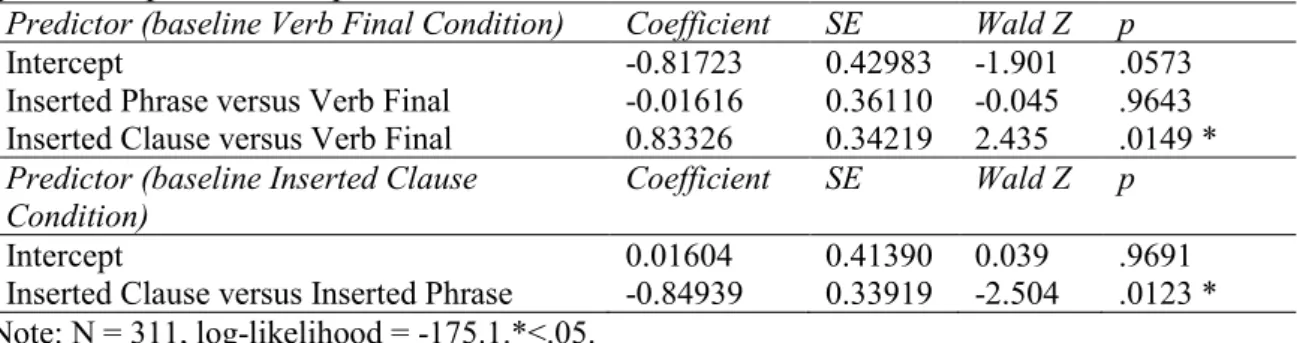
Table 2.1. Summary of studies on speech-gesture production using motion events as test domain. ... 22 Table 3.1. Summary of the fixed effects of the full mixed logit model for gestural depiction in Experiment 1 ... 42 Table 3.2. Summary of the fixed effects in the mixed logit models in English for gestural
depiction in Experiment 1. ... 43 Table 3.3. Summary of the fixed effects in the mixed logit models in German for gestural
depiction in Experiment 1. ... 43 Table 3.4. Summary of the fixed effects in the mixed logit model for the occurrence of pauses in the Inserted Clause Condition versus the Inserted Phrase Condition in Experiment 2. ... 51 Table 3.5. Summary of the fixed effects (Construction Type) in the mixed logit model for
gestural depiction in Experiment 2... 53 Table 3.6. Summary of the fixed effects (Pause) in the mixed logit model for gestural
depiction in Experiment 2 (Inserted Clause and Inserted Phrase Condition only). ... 53 Table 3.7. Summary of the fixed effects (Pause and Clause Type) in the mixed logit model for
gestural depiction in Experiment 2 (Inserted Clause and Inserted Phrase Condition only). ... 54 Table 4.1. Gesture synchronisation categories ... 72 Table 4.2. Means (ms) of the duration of Gesture Onset for Path Gestures synchronising with
the Verb, the Particle and gestures that were placed between the verb and particle in the Inserted Clause Condition (including Main Clause Condition from Experiment 1) and Inserted Phrase Condition... 77 Table 4.3. Summary of fixed effects in the mixed linear model for Gesture Onset (Path
Gestures that synchronised with the Verb) ... 78 Table 4.4. Summary of fixed effects in the mixed linear model for Gesture Onset (Path
Gestures falling between Verb & Particle) ... 79 Table 4.5. Summary of fixed effects in the mixed linear model for Gesture Onset (Path
Table 4.6. Summary of fixed effects in the mixed linear model for Gesture Onset (Conflated Gestures that synchronised with the Verb and Verb & Particle) ... 82 Table 4.7. Summary of fixed effects in the mixed linear model for Gesture Onset (Conflated
Gestures that fell in between verb and particle) ... 83 Table 4.8. Summary of fixed effects in the mixed linear model for Gesture Onset (Conflated
Gestures that synchronised with the Particle) ... 83 Table 4.9. Summary of fixed effects in the mixed linear model for Gesture Onset (Conflated
and Path Gesture that either fell between Verb and Particle or synchronised with the Particle) ... 83 Table 4.10 Summary of fixed effects in the mixed linear model for Gesture-Particle
Asynchrony in the Inserted Clause Condition from Experiment 2 plus the Main Clause Condition from Experiment 1 and the Inserted Phrase Condition from Experiment 2. 84 Table 4.11. Means (ms) of the duration of Gesture Duration for Path Gestures synchronising
with the Verb, the Particle and gestures that were placed between the verb and particle in the Inserted Clause Condition (including Main Clause Condition from Experiment 1) and Inserted Phrase Condition. ... 86 Table 4.12. Summary of fixed effects in the mixed linear model for Gesture Duration (Path
Gestures that synchronised with the Verb) ... 87 Table 4.13. Summary of fixed effects in the mixed linear model for Gesture Duration (Path
Gestures that fell between the Verb and the Particle) ... 87 Table 4.14. Summary of fixed effects in the mixed linear model for Gesture Duration (Path
Gestures that synchronised with the Particle) ... 87 Table 4.15. Summary of fixed effects in the mixed linear model for Gesture Duration
(Conflated Gestures that synchronised with the Verb and Verb & Particle) ... 88 Table 4.16. Summary of fixed effects in the mixed linear model for Gesture Duration
(Conflated Gestures that fell between the Verb and the Particle) ... 88 Table 4.17. Summary of fixed effects in the mixed linear model for Gesture Duration
(Conflated Gestures that synchronised with the Particle) ... 88 Table 4.18. Correlations between Gesture Duration and Gesture-Particle Asynchrony for Path
Gestures and Conflated Gestures for the synchronisation categories Particle and Between Verb and Particle ... 90
Table 5.1. Example Response from the speech-gesture production study presented in
Chapter 4 where gesture-speech synchrony is lost... 102 Table 6.1. Example stimulus including all four stimuli sets. For the behavioural experiment
the stimuli were cut before the second word in bold in the target sentence column. The onset of the first word in bold co-occurred with the onset of the gesture. For the ERP study, ERPs were time-locked to the onset of the words in bold (target sentence). The four stimuli sets were counter-balanced across participants. Target-verbs and speech elements between the gesture and the target-verb were counter-balanced as follows: Stimuli Set 1 and Stimuli Set 2 differ in terms of the elements between the gesture and the target-verb, the same applies to Stimuli Set 3 and Stimuli Set 4. The target-verbs are the same in Stimuli Set 1 and Stimuli Set 2 but differ from Stimuli Set 3 and Stimuli Set 4. ... 133
LIST OF FIGURES
Figure 1.1. Example of a Gesture Unit. ... 7 Figure 3.1. Example stimulus for the English Subordinate Clause condition. A fourth slide
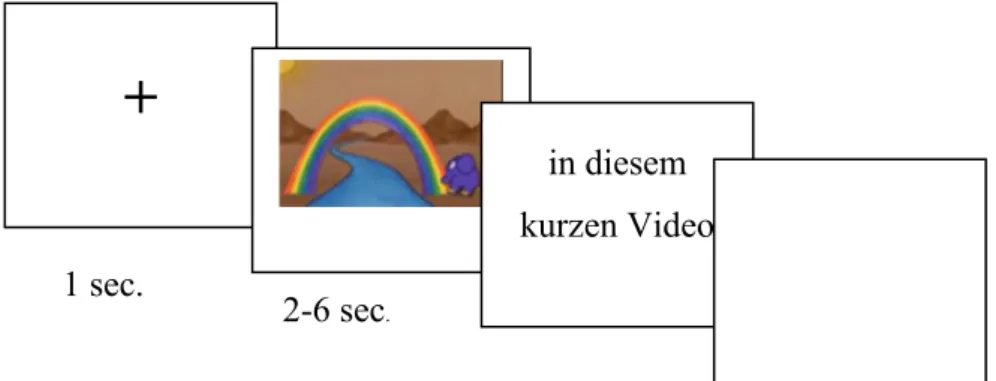
illustrated the sentence that the participants were expected to produce, i.e. I can see in the video that the elephant is climbing up the rainbow. Participants started to describe the video once the slide turned blank. ... 37 Figure 3.2. Mean Proportions of Separate Response (i.e., responses in which gesture separated
Manner and/or Path) and Conflated Only Responses (i.e., responses that include only gestures that conflated Manner and Path) in Main Clauses versus Subordinate Clause in English and German in Experiment 1. Error bars represent standard errors. The bottom of the figure shows an example sentence of each of the four conditions. For the German conditions, a word-by-word translation is provided. ... 42 Figure 3.3. Example stimulus for the Inserted Clause Condition in Experiment 2 ... 48 Figure 3.4. Mean proportions of responses with a pause produced either before or after the
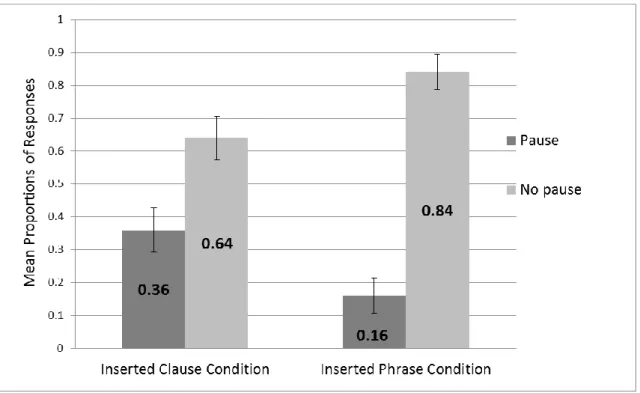
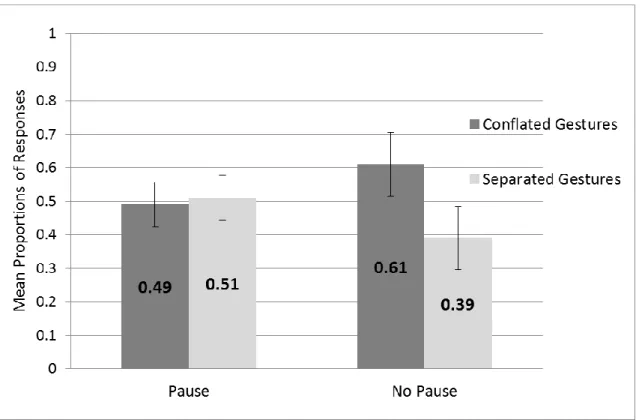
inserted element (phrase/clause) versus responses without any pauses in Experiment 2. ... 51 Figure 3.5. Mean Proportions of responses with Conflated Gestures and Separated Gestures
across conditions of Experiment 2. Error bars represent standard errors. The bottom of the figure shows an example sentence of each of the three conditions including a word-by-word translation of the examples. ... 52 Figure 3.6. Mean Proportions of responses with Conflated Gestures and Separated Gestures
with and without a pause in the Inserted Clause and Inserted Phrase Condition of Experiment 2. Error bars represent standard errors... 54 Figure 4.1. Top: Mean proportion of Path Gestures that synchronised with the Verb, Particle,
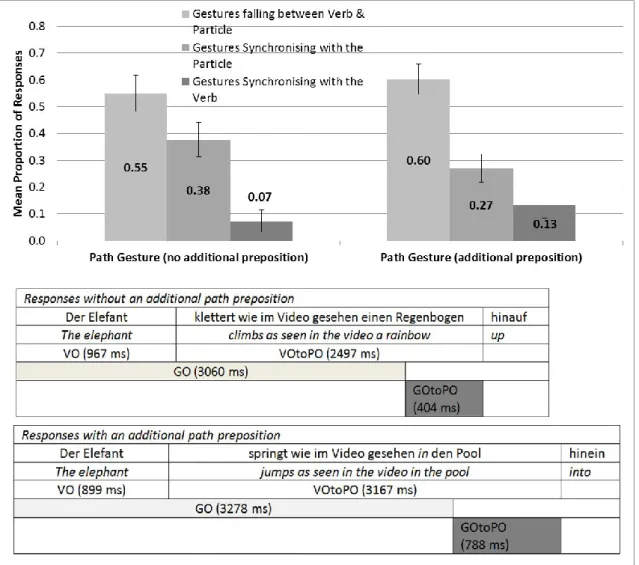
or Between Verb & Particle (see Table 4.1 for definitions), split into responses with and without an Additional Path Preposition. Note that no Path Gestures synchronised with Verb & Particle. Bottom: Means (ms) of the duration of Sentence Onset to Verb Onset (VO), Verb Onset to Particle Onset (VOtoPO), Sentence Onset to Gesture Onset (GO) and Gesture Onset to Particle Onset (GOtoPO) for Path Gestures whose stroke onset occurred after the verb. ... 75
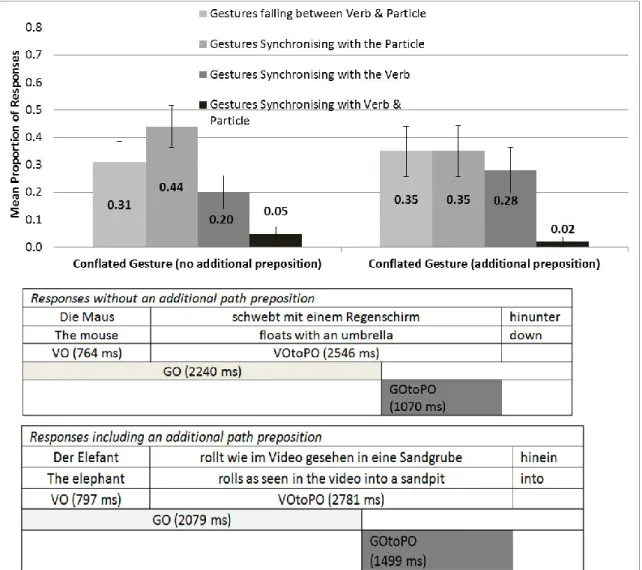
Figure 4.2. Top: Mean proportion of Conflated Gesture which synchronised with the Verb, Particle, Between Verb & Particle, or Verb & Particle, split into responses with and without an Additional Path Preposition. ... 76 Figure 4.3. Relationship between Gesture Onset and Verb Onset for Path Gestures
synchronising with the Verb, the Particle, and gestures that were placed between the Verb & Particle... 80 Figure 4.4. Relationship between Gesture Onset and Particle Onset for Path Gestures
synchronising with the Verb, the Particle, and gestures that were placed between the verb and the particle. ... 80 Figure 4.5. Relationship between Gesture Onset and Verb Onset for Conflated Gestures
synchronising with the Verb (including gestures that synchronised with Verb & Particle), the Particle and gestures that were placed between the verb and the particle. ... 82 Figure 4.6. Relationship between Gesture Onset and Particle Onset for Conflated Gestures
Synchronising with the Verb (including gestures that synchronised with Verb & Particle), the Particle and gestures that were fell between the verb and the particle. ... 82 Figure 4.7. Relationship between Stroke Duration and Gesture Onset – Particle onset
asynchrony for Path Gestures synchronising with the Verb, the Particle and for
gestures that fell between Verb and Particle. ... 87 Figure 4.8. Relationship between Stroke Duration and Gesture Onset – Particle Onset
asynchrony for Conflated Gestures synchronising with the Verb (including Verb & Particle), the Particle and for gestures that fell between Verb and Particle. ... 89 Figure 6.1. Example of a trial used in the behavioural study. ... 136 Figure 6.2 Distribution of response to the open question: “What does the gesture represent?”,
split into Related and Unrelated Discourse conditions. The Y-axis shows the number of different responses per item across all participants. The light and dark lines show the Discourse Related and Unrelated conditions, respectively. Items in the X-axis are ordered from the lowest number of different responses to the highest number of
different responses in the Discourse Related Conditions. ... 136 Figure 6.3. Mean ratings for the question “How easy was it to interpret the gesture?” for the
Related and Unrelated Discourse Condition. Error bars represent the standard error of the means. ... 137
Figure 6.4. Effects of Gesture Match and Discourse Relatedness on mean ratings for gesture match/mismatch for Question 3: “How well does your interpretation of the gesture match the following word?” Error bars represent the standard error of the means. ... 138 Figure 6.5. Mean ratings for Question 4: “Could the gesture (also) represent [verb]?” for
matching/mismatching gestures and Related and Unrelated Discourse conditions. Error bars represent the standard error of the means. ... 139 Figure 6.6. Stimulus presentation in Experiment 2 (ERP experiment) ... 150 Figure 6.7. ERP responses at a subset of electrodes in the Related Discourse Condition
compared to the Unrelated Discourse Condition time-locked to gesture onset. ... 154 Figure 6.8. Topographical map of the ERP difference between Unrelated Discourse Condition
and the Related Discourse Condition in the time-window 800 -950 ms post gesture onset. Black dots show electrode sites and circles the ROIs included in the statistical analysis. ... 155 Figure 6.9. Gesture Match and Gesture Mismatch waveforms for selected electrodes in the
Related Discourse Condition time-locked to the target verb onset. ... 157 Figure 6.10. Gesture Match and Gesture Mismatch wave forms for selected electrodes in the
Related Discourse Condition time-locked to the target verb onset. ... 158 Figure 6.11. Topographical maps of the ERP difference between mismatching and matching
gestures in the Related Discourse Condition and the Unrelated Discourse Condition for the 800-1200 ms time-window. Black dots refer to the electrode sites and circles to the ROIs included in the statistical analysis. ... 159
1
Introduction Research Topic
When speaking, we inevitably use gestures. Gestures accompanying speech are considered to be universal because to date there is no report of a culture whose members do not gesture (Kita, 2009). Traditionally gestures have not been seen as part of our language system, but in recent years the view that language and gesture comprise two completely separate channels has started to be challenged (McNeill, 2015). Research from the growing field of gesture studies has produced increasing evidence that demonstrates a tight link between gestures and speech during production and comprehension. As Goldin-Meadow (2003, p. 3) points out, “[t]o ignore gesture is to ignore part of the conversation”.
Gestures play an important role in how we communicate and in how we think. The influence of gestures on thinking processes benefit speakers in different ways and situations. When we translate our thoughts into speech, gestures help break down complex spatial information in order to package them into units that are suitable for speech production (Kita, 2000; Kita & Özyürek, 2003). Recently it has been found that pupils gain a deeper understanding of mathematical concepts when solving a maths problem with the help of gestures (Novack, Congdon, Hemani-Lopez, & Goldin-Meadow, 2014). Studies of gesture in the language classroom show that the use of iconic gestures (gestures depicting an object or motion) aid language learners when remembering new vocabulary (Macedonia, 2014; Macedonia & Knösche, 2011).
In terms of the communicative functions of gestures, an increasing number of studies suggest that co-speech gestures influence language comprehension. Behavioural studies have demonstrated that information solely conveyed via gesture is available for retelling in speech (Cassell, McNeill, & McCullough, 1999; Goldin-Meadow, Wein, & Chang, 1992).
2
Electrophysiological research (using ERPs) has shown that difficulties of gesture integration (i.e., gesture-speech mismatch) elicit a similar effect (N400 effect) as when speakers have difficulties in semantically integrating a word into a sentence or discourse context (Kelly, Kravitz, & Hopkins, 2004). Taken together, the bulk of research on gesture-speech comprehension supports the claim that listeners use information conveyed by gestures to form a unified representation of a message (Hostetter, 2011; McNeill, 1992).
The field of gesture studies has grown rapidly in recent years (http://www.gesturestudies.com). Gesture researchers are working in various disciplines including linguistics, psychology, neuroscience and anthropology. This thesis is situated in the field of psycholinguistics and investigates cognitive processes involved in gesture-speech production and comprehension. Despite the growing research on the relationship between gesture and speech, the exact nature of this relationship is still controversial. Although it is generally accepted that gestures are coordinated with speech both on a semantic and on a temporal level (McNeill, 1992, 2005), the exact mechanisms underlying these two main features of co-speech gestures are unclear. The aim of this thesis is to contribute to the understanding of how speech and gesture interact on a semantic and on a temporal level during production and comprehension.
Overview of the Thesis
This section provides an outline of the thesis. The thesis has two main parts: A gesture-speech production part that includes two studies on how gesture and gesture-speech are coordinated on a semantic level and on a temporal level. The second part of the thesis is on the gesture-speech relationship in comprehension. This part includes a study on whether discourse information can guide gesture interpretation and gesture integration into a listener’s discourse model. The structure of this thesis is as follows: Chapter 1 consists of a general introduction to major
3
concepts in gesture studies with a focus on the definition of relevant terms. Chapter 2 reviews research on how gesture and speech are coordinated on both a temporal (i.e., gesture-speech synchrony) and on a semantic level in production. This review leads up to the research questions and the motivation of the first two studies presented in this thesis. Since both studies look at the coordination of gesture and speech in the retellings of motion events, the focus of the literature review is on motion event gestures. Chapter 2 also includes a review of methods used in previous speech-gesture production experiments that investigated motion event gestures as well as a justification of the study design used in this thesis. Chapter 3 reports the first study that investigated on which linguistic level (planning unit level or lexicalisation level) gesture and speech are coordinated. Chapter 4 deals with the question of gesture-speech synchronisation. In this chapter a new hypothesis that aims to explain the mechanisms underlying gesture-speech synchronisation within a sentence context is put forward (Attraction Point Hypothesis). Chapter 5 introduces the second main topic of this thesis: the relationship between speech and gesture during comprehension. This chapter bridges the production and comprehension studies of this thesis. It also includes an introduction to the ERP technique and a literature review that focusses on research using the ERP technique to investigate gesture-speech processing. Chapter 6 introduces the final study of this thesis. The study reported in Chapter 6 was designed to investigate the role of discourse information on gesture-speech comprehension. In this study a behavioural experiment and an ERP experiment were conducted. Finally, Chapter 7 brings together all experiments and discusses the findings in relation to the existing literature. Chapter 7 also includes theoretical implications of this thesis as well as suggestions for future research directions.
4
Chapter 1
The Study of Co-speech Gestures
Chapter 1 provides an introduction to the field of gesture studies. In this chapter, important terms and concepts will be defined in order to provide a theoretical framework for the studies presented in this thesis.
1.1. Aren’t Gestures Non-verbal?
For approximately 2000 years the study of gestures focussed on how gestures express emotions and inner states and already in Antique rhetoric, gestures were analysed in terms of how they are perceived by an audience. (see Müller, 2002 for a history of gesture studies). Moving forward to the twentieth century, linguists and psychologists did not show much interest in the study of gestures. Exceptions were Wilhelm Wundt, the “father of experimental psychology”, who discussed the topic of gesture in detail at the beginning of the century and David Efron who was probably the first researcher who investigated the link between speech and gesture (see Kendon, 2004 for an overview of Efron's & Wundt's work on gestures). Only in the 1970s researchers became increasingly interested in gestures as a research subject (McNeill, 2005). Important for the field of psycholinguistics is McNeill’s (1985, 1992) pioneering work on the relationship between gesture and speech. Only his claim that gestures and speech constitute an integrated process during production introduced gestures into the field of psycholinguistics (Kita, 2014). In numerous publications, including his article “So you think gestures are nonverbal?” from 1985, McNeill promoted the importance of gesture research within the field of linguistics. Within the last three decades, researchers within the newly established field of gesture studies found striking evidence that co-speech gestures are so much more than just meaningless hand-waving (cf. Goldin-Meadow, 2003).
5
1.2. Classification of Gestures
The term “gesture” in this thesis refers to hand movements that co-occur with speech. These gestures are assumed to be part of our communication. Thus, they are in contrast to so-called adaptors which do not have any communicative functions (Goldin-Meadow, 2003). Adapters include movements such as holding your chin or soothing your hair. In everyday communication, we use different types of hand gestures while speaking. In an influential gesture classification put forward by McNeill (1992), he distinguishes between four types of speech accompanied gestures, i.e. iconic gestures, metaphoric gestures, deictic gestures and beat gestures. Iconic gestures depict something concrete including an action, event or object (e.g., speech: the ball is rolling down the hill; gesture: the index finger is pointing away from the body and makes circles as it moves downwards) which may or may not be encoded in speech (Kita & Özyürek, 2003). Metaphoric gestures are similar to iconic gestures but they represent an abstract idea (e.g., a music teacher talks about high and low notes while using corresponding path gestures indicating high is up and low is down). Deictic gestures are pointing gestures that can either refer to something concrete or abstract. Finally, beat gestures are small rhythmic movements that align with prosodic peaks in speech. Beat gestures have been found to be important for structuring discourse (McNeill, 1992). The outline of the relationship between speech and gesture in this literature review chapter is based on research investigating iconic gestures with a focus on motion event gestures. Motion event gestures are the subject of the first two studies in this thesis.
1.3. Gesture Components
Gestures usually consist of multiple components that serve different functions. The gesture anatomy introduced in this section, is based on McNeill’s (1992) work. According to McNeill every gesture is embedded in a so-called Gesture Unit. A Gesture Unit begins when
6
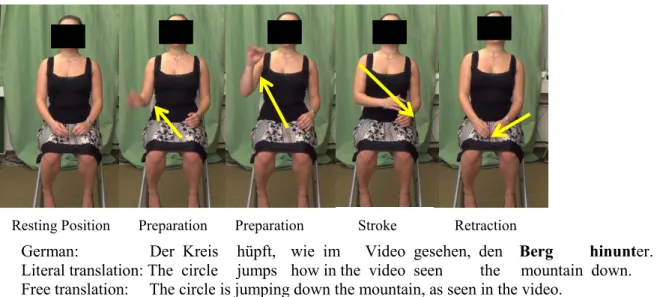
the limbs move away from their resting position and ends with the return of the limbs to a resting position. This unit includes one or more gestures. Within a Gesture Unit we find Gesture Phrases that again can contain up to five different Gesture Phases (Kendon, 1980; McNeill, 1992). Not all of these five components of a gesture phrase are obligatory. As the name indicates, during the preparation phase (optional) the speaker’s limb is getting ready to perform the stroke (e.g., arm moves up next to the head to perform a downwards path gesture). After the limb is in position for the stroke, a pre-stroke hold (optional) can occur (Kita, 1990). This often happens if the gesture is in the right position to perform the stroke before the corresponding element in speech has caught up. The stroke (obligatory) is the meaningful part of the gesture (e.g., downwards movement to indicate path). When the stroke is completed, a post-stroke hold (optional) can be important in terms of gesture-speech synchrony. Because if the element in speech has not completed its encoding yet, the post-stroke hold helps to achieve a gesture-speech alignment (Kita, 1990). Finally, at the end of a Gesture Unit the limbs return to their resting position. However, the endpoint of this so-called retraction phase does not necessarily have to be the same as the starting point of the Gesture Unit (McNeill, 2005). Although all components of a gesture have their specific functions, the most important one is the stroke which carries the meaning of the gesture (McNeill, 2005). Figure 1.1 shows an example of a Gesture Unit that depicts an iconic gesture.1 The Gesture Unit includes a resting position, preparation phase, stroke phase and retraction phase. Semantically, the gesture depicts a downward path movement (bold face indicates when the participant performed the stroke in relation to speech). In the remainder of this thesis, when gesture-speech synchronisation is mentioned, this synchronisation refers exclusively to the gesture’s stroke if not otherwise stated.
1 For all foreign language examples presented in this thesis a word-by-word translation and a free translation are
7
Resting Position Preparation Preparation Stroke Retraction
German: Der Kreis hüpft, wie im Video gesehen, den Berg hinunter. Literal translation: The circle jumps how in the video seen the mountain down. Free translation: The circle is jumping down the mountain, as seen in the video.
8
Chapter 2
Speech-Gesture Production
In this chapter two vital features of co-speech gestures will be introduced; i.e. the gestures’ temporal and semantic relationship with speech. Researchers investigating the semantic and temporal link between these two modalities aim for a better understanding of how gesture and speech exchange information during production. This information exchange refers to the feedback channelling between gesture and speech during the different stages of production, i.e. from the pre-linguistic stage to the execution phase of the gesture. First, research in this area will be discussed and gaps in the literature highlighted. Second, the literature review leads up to the research questions of the two gesture-speech production studies presented in this thesis. The first study looks at the interaction of gesture and speech on a semantic level, i.e. how is the meaning expressed in gesture coordinated with the meaning expressed in speech (Chapter 3). In the second study it was tested how gesture and speech are coordinated on a temporal level. In particular, it was investigated whether the surface occurrence of the speech elements that are closest to the gesture’s meaning have an influence on where within a sentence a gesture occurs (i.e., gesture onset) and for how long a gesture is prolonged (i.e., gesture duration) (Chapter 4). Furthermore, motion events will be introduced since they are an important test domain in gesture studies. Moreover, the current chapter provides a review of research on gesture-speech production studies where motion event gestures were used as test domain. The focus of this review is on methods used in previous studies. Besides a review of previous methods including their drawbacks for statistical analyses, also the study design used in this thesis will be introduced and a justification why previous research methods were not suitable to answer the current research questions will be provided.
9
2.1. Motion Events
How are gesture and speech coordinated on a semantic and on a temporal level? In the last two decades this question has received much research attention (see P. Wagner, Malisz, & Kopp, 2014 for a review). Researchers who have investigated this issue have focused on a cross-linguistic perspective. More specifically, cross-cross-linguistic studies on motion event gestures tested whether the content and the synchronisation patterns of iconic gestures are shaped by language (e.g., Kellerman & van Hoof, 2003; Kita & Özyürek, 2003; Stam, 2006; Wessel-Tolvig & Paggio, 2016). One important observation of these studies is that imagery for speaking and gesturing has been found to vary systematically across languages. This is evident in differing synchronisation patterns but also in the gestural content (McNeill, 2009; McNeill & Duncan, 2000). Here, motion events have proven to be appropriate subject matter for cross-linguistic research because they are vital in all languages and their cross-linguistic encoding varies greatly across languages (cf. Slobin, 2003). According to Talmy’s (2000) influential typology, languages generally fall into one of two categories depending on how they lexicalise motion events. In so-called satellite-framed languages the manner component of a motion event is linguistically encoded within the verb whilst path is encoded in a particle (“satellite”) outside of the verb (1). Satellite-framed languages include Germanic languages like English and German. Although the lexicalisation pattern is the same in German and English, the word order of the utterance differs.
Satellite-framed Language – English
(1) The balls is rolling down the hill.
MANNER+MOTION PATH
Satellite-framed Language – German
(2) Der Ball rollt den Hügel hinunter.
The ball rolls the hill down.
10
In verb-framed languages on the other hand, the path component is encoded within the verb whilst the encoding of manner is not obligatory and can be omitted. If manner is linguistically encoded it is subordinated to the main verb in either a gerund, new verb or a clause. In the category of verb-framed languages fall, for example, Romance languages, Japanese and Turkish.
Verb-framed Languages – French 2
(3) Le chien est entré dans la maison (en courant). The dog has entered in the house (by running).
FIGURE PATH + MOTION GOAL MANNER
The dog ran into the house.
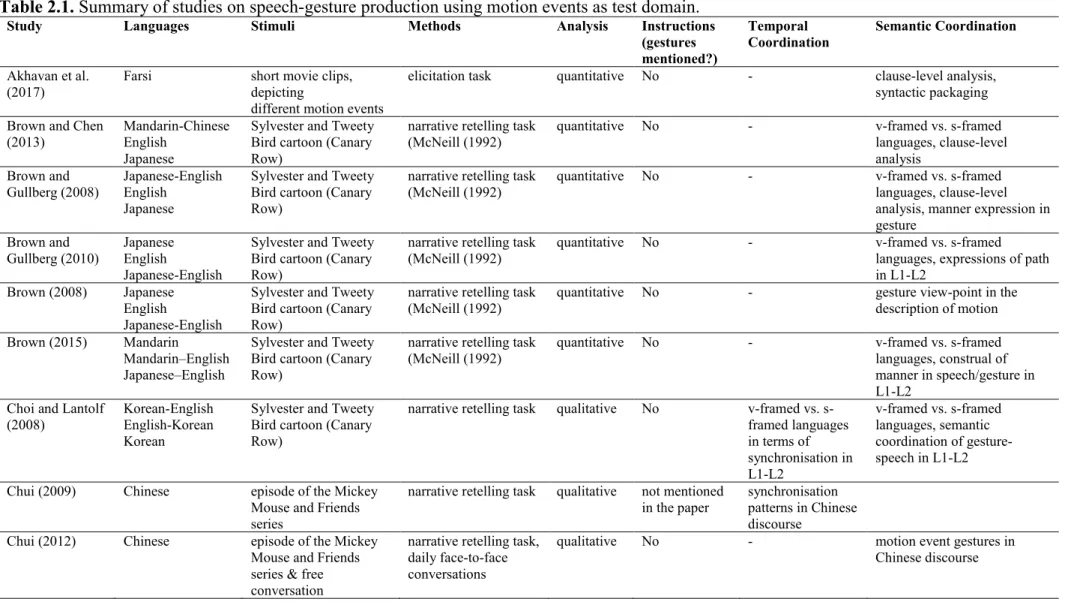
Based on this typological distinction, numerous studies have been conducted to test how the linguistic encoding of motion events influences how speakers gesture when describing such events (see Table 2.1 for a list of studies).
2.2. Semantic Coordination
How motion event gestures differ across typologically different languages has been shown in studies where narratives from speakers across typologically different languages were analysed. These analyses have shown that in English (a satellite-framed language) speakers tend to break down the path component of a motion event into multiple path gestures. In contrast, speakers of Spanish (a verb-framed language) tend to represent path more holistically by indicating path with a single gesture. This reflects the linguistic structure used in the retellings (McNeill, 2009, p. 522ff.) that is illustrated in the example below. In this example an English and a Spanish speaker explain a scene from the Sylvester and Tweety cartoon (Freleng, 1950) where Tweety drops a bowling ball into a drainpipe in which Sylvester is trying to climb up. The bowling ball and Sylvester meet half way and Sylvester falls down and together with
11
the bowling ball rolls out of the drainpipe and onto the street. The English speaker breaks the scene down into six path gestures whilst the Spanish speaker describes the same event with one gesture indicating a curved trajectory.
English3
(1) and it goes down (2) but it rolls him out
(3) down the (4) rainspo (5) ut out into
(6) the sidewalkinto a bowling alley
Spanish entonces SSS4
then he-falls ONOM then SSS he falls
McNeill explains these differences in gestural encoding with his Growth Point Theory (1992; 2000). Growth Points (GP) are seen as theoretical idea units which underlie speech and gesture. More specifically, a GP is a “minimal unit of an imagery-language dialectic” (McNeill, 2005, p. 105). From this GP speech and gesture emerge in the course of a dynamic process. A GP can be identified through the semantic content of a gesture as well as the gesture’s synchrony with speech. In terms of characteristics of the GP, McNeill & Duncan (2000, p. 154) argue that “[t]hinking emerges via the GP with language categories built in.” Thus, different encoding possibilities of a languages (e.g., verb-framed vs. satellite-framed) encourage different forms of thinking. The idea of a Growth Point fits nicely into Slobin’s (1987, 2000, 2003) influential thinking-for-speaking hypothesis. The thinking-for-speaking hypothesis proposes that in the online process of speech production our thoughts have to be put into the given linguistic encoding possibilities of a language. Slobin’s thinking-for-speaking hypothesis has often been considered as a weak version of the Sapir-Whorf Hypothesis (cf. Whorf, 1956) in which language has an influence on our “habitual thought”. Slobin (2003) does not claim
3 Annotation has been simplified. Only the stroke phase is indicated (bold face) 4 Onomatopoeia which is a frequent substitute of verbs in Spanish (McNeill, 2009)
12
that language has an influence on our thinking per se, rather grammatical encoding possibilities of a language guide our thinking while we are speaking. The claim that while speaking visuospatial cognition varies across languages is also evident in varying gestural patterns across typologically different languages (McNeill, 2009).
From a more psycholinguistic perspective, Kita & Özyürek (2003) found that gesture and speech are coordinated on a clausal level. In their study they also made use of linguistic differences between verb-framed and satellite-framed languages. Besides different lexicalisation patterns (i.e., verb plus particle versus two verbs), typologically different languages also differ in terms of clausal packaging of motion events. Motion events in satellite-framed languages are encoded within one single clause (e.g. “rolling down”), whilst in verb-framed languages manner and path is distributed across two clauses (e.g. “going down while rolling”). Kita & Özyürek (2003) found that when speakers use a one-clause construction, they also tend to package gestural information within one gesture; i.e. conflating manner and path gesturally. Since Kita & Özyürek’s (2003) paper, numerous studies have investigated the relationship between lexicalisation patterns, clausal encoding and gestural content. These studies include a wide range of languages as well as different participant groups (e.g., L1-L2, children and aphasic patients). Methods used in these studies are discussed later in this chapter. 2.2.1. Motivation & Research Questions (Semantic Coordination)
Despite the presence of a large body of research that investigates the semantic coordination of speech and gesture, researchers thus far have not been able to clarify on which linguistic level gestures and speech are coordinated. The main reason for this is that in studies so far, whenever the lexicalisation patterns differed (verb-framed vs satellite-framed constructions) also the clausal packaging differed (one-clause vs. two-clause structure). Thus, the differences in gestural content could either stem from different lexicalisations of motion
13
events (i.e., one-verb versus two-verb constructions) or from the encoding of the motion event in either one clause (satellite-framed) or two clauses (verb-framed). Since a clause is assumed to be a good proxy for planning units (Bock, 1982; Levelt, 1989), the coordination on a clausal level would indicate that planning units in speech shape gestural planning units. However, this “Planning Unit Account” has not been tested directly. In the first study described in this thesis (Chapter 3), two experiments were designed to test directly on which linguistic level speech and gestures are coordinated during production. The studies were conducted in German (Experiment 1 and Experiment 2) and English (Experiment 1). Both languages can be classified as satellite-framed languages. Thus, the visuospatial cognition that according to McNeill (2009) influences gestural content should not play a role in the conducted studies.
2.3. Temporal Coordination
The close temporal coordination of gesture and speech is another important concept within the field of gesture studies. The importance of the temporal coordination lies in the claim that speech and gesture emerge from the same idea unit which is evident in their synchrony on the linguistic surface structure (McNeill, 1985, 1992). Generally, gestures synchronise with speech elements that are closest to the gesture’s meaning which is also known as McNeill’s (1992, 2005) Semantic Synchrony Rule. These lexical items that reflect the gesture’s meaning are often referred to as a gesture’s “lexical affiliate” (introduced by Schegloff, 1984). However, the term “lexical affiliate” implies that there is a one-word-one-gesture mapping which is often not the case. More often, more than one word constitutes a gesture’s lexical affiliate (de Ruiter, 1998). In this thesis the term “semantic affiliate” will be used to refer to lexical items that are semantically related to the meaning of an iconic gesture. The term “semantic affiliate” is similar to the term “conceptual affiliate” which has been used by de Ruiter (2000). However, the term “semantic affiliate” focusses on the meaning relationship between gesture and specific speech
14
elements whilst the term “conceptual affiliate” suggests a more loose relationship between the two modalities.
McNeill (2005, p. 22) suggests that when we are speaking “our mind is doing the same thing in two ways”. For example, if a speaker talks about a cake, she might use a gesture indicating the shape of the cake whilst this information is not mentioned in speech. However, close examination of where exactly a gesture is placed in relation to its semantic affiliate has shown that the concept of synchrony is not straight-forward. As de Ruiter (1998, p. 17) has aptly pointed out “the issue of temporal synchronization is a nebulous one”, however defining the temporal relationship between gesture and speech has already proven to be problematic for researchers. One reason for this unresolved issue lies in the way meaning is conveyed across the gesture and speech channels. The meaning of a gesture is conveyed globally whilst speech conveys the meaning of a message in a more linear fashion (McNeill, 1992; Özyürek, 2014).
In terms of synchronisation, this leads to a technical problem; i.e. uttering the semantic affiliate might take longer/shorter than representing the underlying idea unit gesturally. Due to these restrictions, gesture and speech cannot be in complete synchrony (cf. de Ruiter, 1998). Thus, de Ruiter (1998, 2000) suggests that a gesture’s onset is only roughly time-locked to its semantic affiliate. Indeed, research suggests that the onset of a gesture tends to precede its semantic affiliate (Beattie & Aboudan, 1994; Morrel-Samuels & Krauss, 1992; Schegloff, 1984). However, the precise nature of these asynchronies and their underlying cause are not clear yet.
Another problem with defining synchrony arises when investigating gestures within a sentence or discourse context. As mentioned above, not every gesture can be allocated one semantic affiliate. Rather, gestures can have multiple lexical items which function as an affiliate. If the claim holds that a gesture is temporally aligned with its semantic affiliate, where
15
would a speaker place a downward path gesture produced while uttering the following sentence:
The leaf is floating down into pond? In this case the manner verb, the path particle, the path
preposition could function as the gesture’s semantic affiliate. Given multiple lexical items that can function as a gesture’s affiliate, what factors determine which lexical item(s) a gesture co-occurs with? According to research on motion event gestures, gesture placement is influenced by different factors. This includes the focus of the speaker (McNeill & Duncan, 2000) and discourse development (what is newsworthy) (Chui, 2005). As mentioned above, it has also been found that the imagery for speaking and gesturing varies systematically across languages. This is evident in different synchronisation pattern across languages (McNeill, 2009; McNeill & Duncan, 2000).
To sum up, researchers who focus on gesture-speech synchrony are primarily interested in testing exactly where and when a gesture is placed in relation to speech. The question of
“where” concerns the semantic and pragmatic synchronisation which indicates a common idea
unit (McNeill, 1992, 2005). In other words, researchers are interested in the semantic relationship between the lexical items the gesture synchronises with and the gesture’s content within a discourse context. The “when” is a more psycholinguistic question, dealing with the production mechanisms of these two modalities. In particular, it concerns the precise coordination between speech and gesture during different stages of production. However, this research question has been widely neglected when it comes to iconic gestures, especially within a sentence context. The few studies undertaken in this area focussed on the synchronisation of deictic gestures and speech when one of the two modalities is interrupted (Chu & Hagoort, 2014; Levelt, Richardson, & La Heij, 1985).
16
2.3.1. Motivation & Research Questions (Temporal Coordination)
As the review of the literature on gesture-speech synchronisation research has shown, the question of how synchronisation between gesture and speech is achieved remains unresolved. Moreover, the exact nature of when an iconic gesture has its onset in relation to its semantic affiliate is far from clear. For the synchronisation study presented in Chapter 4 a meta-analysis of the experiments of Chapter 3 was conducted. In this meta-analysis of motion event gestures it was tested whether gesture onset and gesture duration are influenced by where within a sentence the gestures’ semantic affiliates are encoded (i.e., the manner verb and the path particle and possible additional path prepositions). This detailed analysis of the relation between semantic affiliates, gesture onset and gesture duration allowed us to infer how gesture and speech are coordinated during the different stages of production as well as the gesture’s execution phase.
2.4. Research Paradigms in Gesture-speech Production
In order to explain the methodology employed in this thesis, in this section methods used in previous studies on gesture-speech production that used motion events as test domain are reviewed. More specifically, material, procedure and analyses used in previous studies will be discussed and their advantages and drawbacks will be highlighted. This assessment of the value of previous study designs will then lead up to the justification of the study design and the statistical analysis employed in this thesis.
The review includes 21 studies (see Table 2.1) on motion event gestures using speech production tasks. The scope of this review is limited to journal papers and book chapters. (except one conference paper by Mol and Kita (2012) because of its methodological relevance). Furthermore, the review is limited to studies conducted with adult participants. Studies conducted with participants from a special population were excluded (e.g., studies with people
17
with aphasia: Dipper, Pritchard, Morgan, & Cocks, 2015). The reviewed papers include cross-linguistic studies (spoken languages only) as well as studies conducted with monolinguals and/or bilinguals. In terms of the research topic, the review includes studies that investigate the effect of linguistic encoding (clausal structure and/or lexicalisation) on the gesture’s content and synchronisation patterns. Most of the studies tested the effect of clausal structure or lexicalisation on gestural content (e.g., type of motion event gesture: manner path conflated versus manner and path separated). Only 8 out of 21 studies investigated the influence of linguistic encoding on gesture-speech synchrony.
2.4.1. Methods
In terms of the studies’ procedure, a large number of studies (10 studies) on motion event gestures follow McNeill’s5 (1992, 2005) approach of collecting narratives through cartoon retellings. In his studies, McNeill used an approximately six minute long Sylvester and Tweety Bird cartoon as stimulus (Freleng, 1950) which the participants had to retell to a confederate. This type of study design elicits a comprehensive narration whilst it is up to the participant which information s/he wants to include.
In more recent studies, also shorter animated clips/movies were used as stimuli for an elicitation task. This includes the Tomato Man Movies (Özyürek, Kita, & Allen, 2001) which were specifically designed to elicit different syntactical packaging of manner and path in speech. These short clips that depict single motion events do not elicit comprehensive narratives. This makes them especially useful for eliciting specific sentence structures but also to keep the influence of discourse and context to a minimum.
5 McNeill’s work is not included in the review table since the methodology he used in his studies is described in
18
Other researchers also created animated stimuli that depict motion events (e.g., Akhavan, Nozari, & Göksun, 2017; Wessel-Tolvig & Paggio, 2016). Occasionally, The Frog Story (Mayer, 1969) was used as stimulus material (Kellerman & van Hoof, 2003; Negueruela, Lantolf, Jordan, & Gelabert, 2004) despite McNeill’s (2005) observation that this static-picture story lowers gesture frequency.
As stimuli for the experiments in this thesis, short clips taken from a German educational programme for children “Die Sendung mit der Maus” (The Programme with the Mouse) (WDR 1971-2014) 6 were used. In every clip, a mouse, an elephant or a duck is performing a motion event that the participants (English and German speaking) could encode with a particle verb (e.g., rolling down). Furthermore, clips from the Tomato Man Movies (Özyürek et al., 2001) were part of the stimuli set. Compared to previous studies on motion events, the participants were trained to use specific sentence structures and also the particle verbs describing the motion event were given. By doing so, it was possible to better control speech outcome. Furthermore, this enabled us to compare gesture use across different sentence structures.
In McNeill’s tradition, the experimenter does not mention that the purpose of the study has anything to do with gestures (McNeill, 2005: for Methods of gesture recording, transcription and coding). The reason for deceiving the participants in terms of the study’s purpose is to minimise the participants’ awareness of their gesture production (Gullberg, 2010). Thus, the aim is to collect spontaneously produced co-speech gestures. In terms of statistical analysis these rather unguided elicitation tasks can be problematic. First, a long stimulus movie such as the Sylvester and Tweety Bird cartoon makes it difficult to control for the content of the retelling. Although such a study design enhances gesture production (McNeill, 2005), not all participants use gestures describing specific target events and some participants do not
6 We got permission from the WDR (Westdeutscher Rundfunk) to use clips from “Die Sendung mit der Maus” for
19
gesture at all. In studies where the focus is on specific constructions in speech or specific gestures such as motion event gestures, it can be particularly difficult to reach a sufficient sample size. Another issue arising from individual differences in gesture frequency is the unequal distribution of gestures across items (Gullberg, 2010). Possibly, that is one reason why a number of the studies listed in Table 2.1 (6 in total) did not include any statistical analysis but analysed their data qualitatively.
One option to control better for gesture production is to encourage participants to use gestures. This methods has been used in studies investigating the role of gestures in problem solving tasks (Broaders, Cook, Mitchell, & Goldin-Meadow, 2007; Chu & Kita, 2011; Novack et al., 2014) or in the production of metaphorical speech (Argyriou, Mohr, & Kita, 2017). In speech-gesture production studies where motion events were the test domain, this method has rarely been used. For co-speech gesture studies, only Özçalışkan, Lucero, and Goldin-Meadow (2016, p. 12) instructed their participants to describe the stimuli scene “while using their hands as naturally as possible”. In another study on motion event gestures, Mol and Kita (2012) told the participants which gestures they have to use during their retellings of the Tomato Man Movies. With this study design they were able to test whether a given gestural content (verb-framed vs. satellite-(verb-framed gesture pattern) has an influence on how the participants package the motion event syntactically (one clause structure vs. two clause structure).
To sum up, most of the studies on motion event gestures are using a quasi-experimental method and do not mention gestures in the participants’ instructions. On the other hand there are some studies that use more experimental methods (e.g., Mol & Kita, 2012; Özçalışkan et al., 2016) where participants were encouraged to gesture. In the study design developed for the experiments presented in this thesis, the participants were also encouraged to use gestures. This decision was based on a pilot study for Experiment 1 which showed that without telling the
20
participants to use their hands, barely any gestures were produced. Consequently, this would have made a sound statistical analysis problematic.
2.4.2. Statistics
As already mentioned, in a number of studies on speech-gesture production listed in Table 2.1 the data was analysed qualitatively. If statistical analyses were used, studies tended to conduct ANOVAs and t-tests on proportions (e.g., Kita et al., 2007; Özyürek, Kita, Allen, Furman, & Brown, 2005) or they used their non-parametric counterparts (e.g., Brown & Chen, 2013). Only one study by Özçalışkan et al. (2016) used mixed effects statistical model.
This statistical method is also used in this thesis since it offers numerous advantages for analysing gesture data. In a nutshell, in mixed effects models subject and item can be included as random effects in a single analysis. Having multiple random factors in the same analysis contrasts with traditional repeated-measures ANOVAs where subject and item have to be tested individually (Quené & van den Bergh, 2008). In this regard mixed models are more powerful since they enable researchers to generalise across both items and subjects. Apart from combining by-subject and by-item within one analysis, mixed effects models have further advantages for analysing gesture data.
One advantage of mixed effects models is how missing data is treated. If the missing cells occur randomly, mixed models are robust against these missing cells (Quené & van den Bergh, 2008). As mentioned above, in gesture studies it is very difficult to control for gesture use (e.g. participants gesture rate differs or participants do not produce gestures which are relevant for research question) leading to an increased number of missing values. Thus, a statistical method that tolerates these missing data points is appropriate for gesture research.
Another advantage of mixed models is that categorical data can be included in the model as explanatory variables (i.e., predictors). Hence, we do not have to run ANOVAs on
21
proportions which despite applying the arcsine-square-root transformation are prone to Type I and Type II errors (Jaeger, 2008). A detailed explanation of how models were fitted in this thesis will be given in the relevant methods chapters.
22
Table 2.1. Summary of studies on speech-gesture production using motion events as test domain.
Study Languages Stimuli Methods Analysis Instructions
(gestures mentioned?)
Temporal
Coordination Semantic Coordination
Akhavan et al.
(2017) Farsi short movie clips, depicting different motion events
elicitation task quantitative No - clause-level analysis, syntactic packaging Brown and Chen
(2013) Mandarin-Chinese English Japanese
Sylvester and Tweety Bird cartoon (Canary Row)
narrative retelling task
(McNeill (1992) quantitative No - v-framed vs. s-framed languages, clause-level analysis
Brown and
Gullberg (2008) Japanese-English English Japanese
Sylvester and Tweety Bird cartoon (Canary Row)
narrative retelling task
(McNeill (1992) quantitative No - v-framed vs. s-framed languages, clause-level analysis, manner expression in gesture
Brown and
Gullberg (2010) Japanese English Japanese-English
Sylvester and Tweety Bird cartoon (Canary Row)
narrative retelling task
(McNeill (1992) quantitative No - v-framed vs. s-framed languages, expressions of path in L1-L2
Brown (2008) Japanese English
Japanese-English
Sylvester and Tweety Bird cartoon (Canary Row)
narrative retelling task
(McNeill (1992) quantitative No - gesture view-point in the description of motion Brown (2015) Mandarin
Mandarin–English Japanese–English
Sylvester and Tweety Bird cartoon (Canary Row)
narrative retelling task
(McNeill (1992) quantitative No - v-framed vs. s-framed languages, construal of manner in speech/gesture in L1-L2
Choi and Lantolf
(2008) Korean-English English-Korean Korean
Sylvester and Tweety Bird cartoon (Canary Row)
narrative retelling task qualitative No v-framed vs. s-framed languages in terms of synchronisation in L1-L2 v-framed vs. s-framed languages, semantic coordination of gesture-speech in L1-L2 Chui (2009) Chinese episode of the Mickey
Mouse and Friends series
narrative retelling task qualitative not mentioned
in the paper synchronisation patterns in Chinese discourse
Chui (2012) Chinese episode of the Mickey Mouse and Friends series & free conversation
narrative retelling task, daily face-to-face conversations
qualitative No - motion event gestures in Chinese discourse
23
Duncan (2002) English
Mandarin three elicitation tasks: 1. Sylvester and Tweety Bird cartoon (Canary Row),
2. action sequences involving small plastic characters or inanimate objects (1-1.5 sec.) (Supalla et al., n.d.) 3. early feature film by Alfred Hitchcock
narrative retelling task,
elicitation task qualitative No gesture duration in relation to the speech element the gesture
synchronises with
influence of verb aspect in discourse context on gestural content and gesture duration
Kellerman and
van Hoof (2003) English Dutch-English Spanish-English
The Frog Story (static
picture story) retelling the picture story qualitative No v-framed vs. s-framed languages in terms of synchronisation in L1-L2 v-framed vs. s-framed languages, semantic coordination of gesture-speech in L1-L2 Kita and
Özyürek (2003) English Turkish Japanese
Sylvester and Tweety Bird cartoon (Canary Row)
narrative retelling task quantitative No - v-framed vs. s-framed languages, clause-level analysis, semantic coordination of gesture-speech
Kita et al. (2007) English Tomato Man Movies elicitation task quantitative not mentioned
in the paper - v-framed vs. s-framed constructions within a language, clause-level analysis, semantic coordination of gesture-speech
Mol and Kita
(2012) Dutch Tomato Man Movies elicitation task quantitative participants were told to use specific gestures during their retellings: Condition 1: manner-path conflated gestures Condition 2: one manner
- testing influence of gesture on speech production
24
and one path gesture Negueruela et al.
(2004) English Spanish English-Spanish Spanish-English
The Frog Story (static
picture story) retelling the picture story qualitative No v-framed vs. s-framed languages in terms of synchronisation in L1- L2 v-framed vs. s-framed languages, semantic coordination of gesture-speech in L1-L2 Özçalişkan (2016) English Turkish Turkish-English
animated motion clips elicitation task quantitative condition 1: No instructions on gestures Condition 2: Just gestures no speech - v-framed vs. s-framed languages,
(co-speech gesture vs. silent gesture)
Özçalışkan et al.
(2016) English Turkish three dimensional scenes that depict motion along three different
types of paths
elicitation task generalized linear mixed-effect modelling
condition 1: use your hands as naturally as possible while speaking (co-speech gestures) Condition 2: use only your hands without any speech (silent gestures) - v-framed vs. s-framed languages,
(co-speech gesture vs. silent gesture)
Özyürek et al.
(2005) Turkish English Tomato Man Movies elicitation task (if participants did not mention the target event, they were encouraged to do so by a question about manner/path component)
quantitative not mentioned
in the paper synchronisation pattern across languages.
syntactical packaging and gestural content
Stam (2006) Spanish English Spanish-English
Sylvester and Tweety Bird cartoon (Canary Row)
narrative retelling task quantitative not mentioned
in the paper gesture speech co-occurrence in L1-L2
gestural content in L1-L2; expression of path in gesture and speech
25
Stam (2015) Spanish-English Sylvester and Tweety Bird cartoon (Canary Row)
narrative retelling task qualitative not mentioned
in the paper - gesture speech coordination L1-L2; longitudinal case study
Wessel-Tolvig and Paggio (2016)
Danish
Italian Tomato Man Movies and additional clips similar to the Tomato Man Movies
elicitation task quantitative not mentioned
in the paper co-expressivity of speech-gesture within a clause
syntactic packaging and gesture-speech coordination (verb/satellite-framed constructions)
26
Chapter 3
Information Packaging in Speech Shapes Information Packing in Gesture: The Role of Speech Planning Units in the Coordination of Speech-Gesture Production.
Preliminary results of Experiment 1 presented in this chapter have been published in the following Conference Proceedings:
Fritz I., Kita S., Littlemore J., & Krott A. (2015) The Influence of Clause Structure on Gestural Depiction of Motion Events. In G. Ferré, & M. Tutton (Eds.), Proceedings of the 4th GESPIN - Gesture & Speech in Interaction Conference. Nantes: Université of Nantes, 113-117.
3.1. Abstract
Linguistic encoding influences gestural manner and path depiction of motion events. Gestures depict manner and path of motion events differently across languages, either conflating or separating manner and path, depending on whether manner and path are linguistically encoded within one clause (e.g., “rolling down”) or multiple clauses (e.g., “descends as it rolls”) respectively. However, it is unclear whether such gestural differences are affected by how speech packages information into planning units or by the way information is lexicalised (as verb plus particle or as two verbs). In two experiments, we manipulated the linguistic encoding of motion events in either one or two planning units while lexicalisation patterns were kept constant (i.e., verb plus particle). It was found that separating manner (verb) and path (particle) into different planning units also increased gestural manner and path separation. Thus, lexicalisation patterns do not drive gestural depiction of motion events. Rather gestures are shaped online by how speakers package information into planning units in speech production.
27
3.2. Introduction
When we speak, we often spontaneously produce gestures. Gestures are tightly linked to how we encode information linguistically at the temporal and semantic levels (McNeill, 1992, 2005). In terms of synchronisation, gestures co-occur with the element in speech that is closest to the gesture’s content, often initiated before their semantic affiliates (McNeill, 1992; Morrel-Samuels & Krauss, 1992; Schegloff, 1984). From a semantic perspective speech-gesture coordination is reflected by linguistic choices. This coordination is evident on both a lexical and structural level. For instance, gestures have been found to adapt to fine-grained differences in verb semantics (Gullberg, 2011; Gullberg & Narasimhan, 2010; Kita & Özyürek, 2003), and it has been suggested that the content of a gesture is linked to how clauses package information in speech (Kita, 2000; Kita & Özyürek, 2003).
Evidence for the influence of linguistic packaging on gestural content stems from cross-linguistic studies on motion event gestures (Kita & Özyürek, 2003; Özçalişkan, 2016; Özyürek et al., 2008; Özyürek et al., 2005; Wessel-Tolvig & Paggio, 2016). Motion events are linguistically encoded differently across languages. Based on Talmy’s typology (2000), languages generally fall into two different categories. In so-called satellite-framed languages (e.g., German and English) the manner component of a motion event is usually encoded within the verb, while the path component is encoded in a “satellite” (a particle or an affix). Both components together often form a so-called particle verb (e.g., “to roll down” or “to climb up”). In verb-framed languages (e.g., Spanish and Japanese), path is encoded in the verb, while manner, if encoded in speech at all, is encoded in a phrase, gerund or in a separate clause (e.g., “he descends the hill as he rolls”).
Gestures that accompany descriptions of motion depict manner and path in different ways in satellite-framed and verb-framed languages. In satellite-framed languages, where the motion event is linguistically encoded within one clause, manner and path tend to be conflated in one