- 2523 -
Foundation Size Effect on Modulus of
Subgrade Reaction on Sandy Soils
Aminaton MartoProfessor of Faculty of Civil Engineering,
University Technology Malaysia (UTM) 81310 Skudai, Johor Bahru, Malaysia; e-mail: [email protected]
Nima Latifi
Ph.D. Student of Faculty of Civil Engineering, Universiti Teknologi Malaysia, 81310 Skudai, Johor Barhu, Malaysia; e-mail: [email protected]
Masoud Janbaz
Ph.D. Student of Faculty of Civil Engineering, University of Rutgers, New Jersey, USA; email: [email protected]
Mehrdad Kholghifard
Ph.D. Student of Faculty of Civil Engineering, Universiti Teknologi Malaysia, 81310 Skudai, Johor Barhu, Malaysia; e-mail: [email protected]
Mahdy Khari
Ph.D. Student of Faculty of Civil Engineering, Universiti Teknologi Malaysia, 81310 Skudai, Johor Barhu, Malaysia; e-mail: [email protected]
Payman Alimohammadi
Ph.D. Student of Faculty of Civil Engineering, Universiti Teknologi Malaysia, 81310 Skudai, Johor Barhu, Malaysia; e-mail:
Ali Dehghan Banadaki
Ph.D. Student of Faculty of Civil Engineering, Universiti Teknologi Malaysia, 81310 Skudai, Johor Barhu, Malaysia; e-mail: [email protected]
ABSTRACT
Winkler model is one of the most popular models in determining the modulus of sub grade reaction. In this model the sub grade soil is assumed to behave like infinite number of linear elastic springs. The stiffness of these springs is named as the modulus of sub grade reaction. This modulus is dependent to some parameters like soil type, size, shape, depth and type of foundation. The direct method for estimating the modulus of sub grade reaction is plate load test that is done with 30-100 cm diameter circular plate or equivalent rectangular plate. Afterward, we have to extrapolate the test value for exact foundation. In the practical design procedure, Terzaghi's equation is usually used to determine the modulus of sub grade reaction for actual foundation, but there are some uncertainties in utilizing such equation. In this paper the size effect of foundation on sandy sub grade with use of finite element software (Plaxis) is proposed to investigate the validation of Terzaghi's formula on determination of sub grade reaction modulus. Also the comparison between Vesic's equation, Terzaghi's one and obtained results are presented.
KEYWORDS:
Subgrade, reaction modulus, finite element, Mat foundation, Plate load test.INTRODUCTION
Soil medium, because of the nonlinear, stress-dependent, anisotropic and heterogeneous nature, has very complex mechanical behavior. Hence, instead of modeling the subsoil in its three-dimensional nature, subgrade is replaced by a much simpler system, called a subgrade model that dates back to the nineteenth century. Searching on this concept leads to two basic approaches which are Winkler approach and the elastic continuum model. Both of these models are of widespread use, both in theory and engineering practice.
Winkler (1867) assumed the soil medium as a system of identical but mutually independent, closely spaced, discrete and linearly elastic springs. The ratio between contact pressure (P) at any given point, and settlement (y) produced by load application at that point, is named the coefficient of subgrade reaction, Ks:
=
(1)
In fact, in this model subsoil is replaced by fictitious springs whose stiffness equals to Ks.
However, the simplifying assumptions, which this approach is based on, cause some approximations. One of the basic limitations of it lies in the fact that this model cannot transmit the shear stresses, which are derived from the lack of spring coupling. Also, linear stress-strain behavior is assumed. The coefficient of subgrade reaction, Ks, identifies the characteristics of foundation supporting and
has a dimension of force per length cubed.
Many researches including Biot (1937), Terzaghi (1955), Vesic (1961), and most recently
Vallabhan (2000) have investigated the effective factors and determination approaches of Ks.
Geometry and dimensions of the foundation and soil layering are assigned to be the most important
effective parameters on Ks. Generally, the value of subgrade modulus can be obtained in the
following alternative approaches:
1- Plate load test, 2- Consolidation test, 3- Triaxial test, 4- CBR test
Many researchers have worked to develop a technique to evaluate the modulus of subgrade reaction, Ks. Terzaghi (1955) made some recommendations where he suggested values of Ks for 1×1
ft rigid slab placed on a soil medium; however, the implementation or procedure to compute a value of Ks for use in a larger slab was not specified. Biot (1937) solved the problem for an infinite beam
with a concentrated load resting on a 3D elastic soil continuum. He found a correlation of the continuum elastic theory and Winkler model where the maximum moments in the beam are equated. Vesic (1961) tried o develop a value for Ks, by matching the maximum displacement of the beam in
both aforementioned models. He obtained the equation for Ks for using in the Winkler model.
Another works by Filonenko-Borodich (1940) Heteneyi (1950) and Pasternak (1954)... attempt to make the Winkler model more realistic by assuming some form of interaction among the spring elements that represent the soil continuum.
ESTIMATION OF K
SFOR FULL SIZED FOOTINGS
The modulus of subgrade reaction method is preferred, because of its greater ease of use and substantial savings in computation time. A major problem is to estimate the numerical value of Ks. Terzaghi in 1955 proposed that Ks for full sized footing in sandy subgrade can be obtained from:
=
(2)
Vol. 17 [2012], Bund. S 2525
B1 =side dimension of square base used in the plate load test to produce Ks
B= side dimension of full-size foundation
K1= the value of Ks for 0.3×0.3m bearing plate or other size load plate
Ks= desired value of modulus of subgrade reaction for the full-size foundation
According to Terzaghi (1955) this equation deteriorates when B/B1 ≥ 3 ,another uncertainty is according to Bowles(1997) this equation is not correct in any case, as Ks using a 3 m footing would not be 0.1 the value obtained from a B1= 0.3 m plate. Another equation, which can be used for estimating the modulus of subgrade reaction, is Vesic's equation. It is based on elastic parameters of soil medium like elasticity modulus of soil, E, and Poisson ratio, μ.
= ×( ²)
(3)
where:
Ks= modulus of subgrade reaction E = elasticity modulus of soil B = width of foundation μ = Poisson ratio
In present paper, according to these uncertainties, with use of finite element software (plaxis 8.2) the effect of the width of foundation on modulus of subgrade reaction, Ks, are investigated and the obtained results are compared with Terzaghi's and Vesic's equations.
CALIBRATIONS AND ANALYSIS METHOD
The element used in analysis is based on program and is the 15-node triangular elements to model soil layers and other volume clusters. It provides a fourth order interpolation for displacements and the numerical integration involves twelve Gauss points.
Axi-symmetric model is used to model the soil, plate and load. The calibration of axi-symmetric modeling is based on the results of plate load tests on sandy soil by Anderson et al. (2007). The soil parameters, used in Mohr-Coulomb soil behavior model, are based on this article as shown in Table 1. There are 4 layers of sand that is used in this paper and the soil parameters are based on CPT results as follows.
Table 1: Soil parameters
Layer C (kPa) Φ (°) ν E (MPa) γ (kN/m3) γsat (kN/m3) K0 H (m) 1 1 47.5 0.3 32060 18.2 18.9 2.16 2.44 2 1 42 0.3 14880 17.3 18.1 0.63 1.5 3 1 42.8 0.3 23080 15.7 17.3 0.66 3.05 4 1 38 0.3 7820 15.7 17.3 1.04 0.9
The sides of axi-symmetric model with side dimension of plate or foundation in X direction is 3B where B is half of the plate or foundation dimensions and 8 m in Y direction as in the calibration example, as shown in Figure 1. For higher dimensions, the ratio between thicknesses of footing to side dimension is 1/12, according to the plate of plate load test, and is constant in all the models. The calibration results from axi-symmetric analysis and the result by Anderson et al. (2007) are shown in Figure 2.
Fi
Fig
igure 1: Sid
gure 2: Com
de dimension
mparison of c
ns of model
calibration results
Vol. 17 [2012], Bund. S 2527
As shown in Figure 2, the points that represent mean value of different methods in computing foundation settlement have good agreement with finite element analysis and therefore calibration is satisfactory.
ANALYSIS AND DISCUSSION OF RESULTS
60 vertical plate load tests analysis are performed on plaxis software. The vertical settlement (y) for each analysis obtained, according to the constant contact pressure (p) about 220(KN/m²) plotted
and Then the secant modulus of each graph (Ks) is determined. The finite element analysis is
performed both with ground water level and without it. One of the uncertainties about Terzaghi's formula is that it neglects the effect of water table in the soil. Figure 3 represents the effect of ground water level in comparison with Terzaghi's equation. Full results are shown in Table 2.
Figure 3: Comparison of obtained results with Terzaghi's Equation
Figure 4: Comparison of obtained results in Dry and Wet case
0 0.5 1 1.5 2 2.5 3 3.5 4 0 3 6 9 12 15 18 Ks Dry /K s Wet B (m)
Based on obtained results, the modulus of subgrade reaction (Ks) is decreased as the side
dimension of plate increased. This is due to increasing load area which consequences in increasing settlement. As shown in Figure 3, the effect of water in the soil is very significant, and Ks obviously
have larger values in dry soil. This effect is very significant until 10 times of plate dimension. This fact is showed in Figure 4, the effect of water in the soil, as side dimension of footing increases, decreases. It could be due to in small dimensions water can lubricate the particles contact pressure while in bigger dimensions the effect of loading area is much more significant in settlements and water is not very effective.
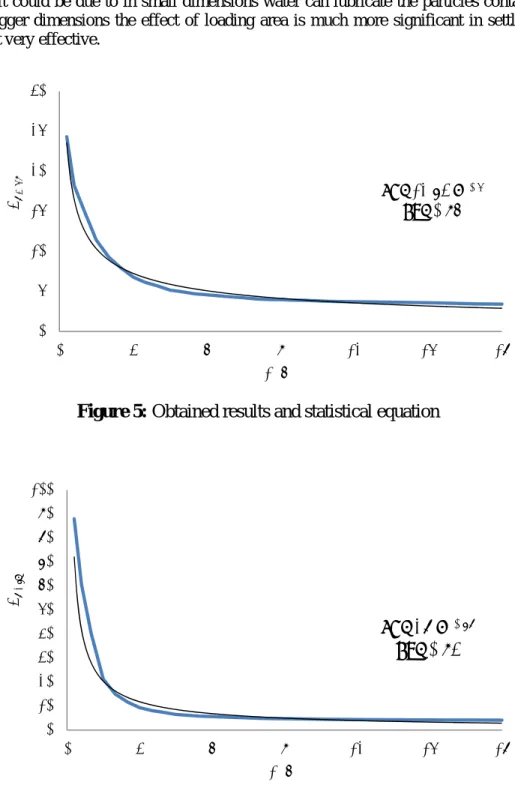
Figure 5: Obtained results and statistical equation
Figure 6: Obtained Results and statistical equation
Ks = 12.73 B -0.5 R² = 0.96 0 5 10 15 20 25 30 0 3 6 9 12 15 18 Ks W e t B (m)Ks = 28 B
-0.78R² = 0.93
0 10 20 30 40 50 60 70 80 90 100 0 3 6 9 12 15 18 KsD ry B (m)Vol. 17 [2012], Bund. S 2529
These two simple power equations represent the Ks in this study, as shown in Figure 5 and 6: Wet case: Ks = 12.73 B -0.5
Dry case: Ks = 28 B -0.78
CONCLUSION
In this article a finite element analysis of plate load test is performed for sandy soil. The obtained results are as followed:
The statistical correlation between modulus of subgrade reaction (Ks) and side dimension of
footing (B) is obtained for two cases, with and without water. The comparison between Terzaghi's
famous equation for sandy subgrade and obtained results shows that the usual Ks computing
equation does not consider the effect of ground water table and soil layering. Also this equation gives lower values for Ks.
As side dimension of footing (B) increased the modulus of subgrade reaction (Ks) decreased.
The modulus of subgrade reaction that obtained from Terzaghi's equation for prototype footing has lower value than finite element obtained Ks.
Presence of water can reduce the value of Ks due to decreasing internal contact pressures of soil
particles, but as dimension of footing increases this effect decreases and for big side dimensions the dry and wet Ks is almost the same.
Table 2: Complete results
B (m) P (kN/m2) Settlement (m) Dry Settlement (m) Wet Ks Dry (MN/m3) Ks wet (MN/m3) Ks Terzaghi For Wet case 0.3 220 0.0025 0.00904 88.00 24.34 24.34 0.6 220 0.00363 0.01252 60.61 18.27 10.28 1 220 0.00545 0.01453 40.37 15.14 6.40 1.5 220 0.01035 0.01924 21.26 11.43 4.12 2 220 0.01472 0.02361 14.95 9.32 3.08 2.5 220 0.0188 0.02769 11.70 7.95 2.49 3 220 0.02348 0.03237 9.37 6.80 2.06 3.5 220 0.027 0.0359 8.15 6.13 1.81 4 220 0.02974 0.03867 7.40 5.69 1.64 4.5 220 0.03365 0.0425 6.54 5.18 1.47 5 220 0.03577 0.04441 6.15 4.95 1.39 5.5 220 0.03786 0.04674 5.81 4.71 1.31 6 220 0.03904 0.04798 5.64 4.59 1.26 6.5 220 0.04054 0.04942 5.43 4.45 1.22 7 220 0.04187 0.05089 5.25 4.32 1.18 7.5 220 0.04333 0.0522 5.08 4.21 1.14 8 220 0.04521 0.0541 4.87 4.07 1.09
8.5 220 0.04623 0.05513 4.76 3.99 1.07 9 220 0.04645 0.05532 4.74 3.98 1.06 9.5 220 0.04732 0.05617 4.65 3.92 1.04 10 220 0.04765 0.05655 4.62 3.89 1.03 11 220 0.04976 0.05861 4.42 3.75 0.99 12 220 0.05046 0.05936 4.36 3.71 0.97 13 220 0.051 0.05981 4.31 3.68 0.96 14 220 0.05169 0.06058 4.26 3.63 0.95 15 220 0.05255 0.06143 4.19 3.58 0.93 16 220 0.05285 0.06243 4.16 3.52 0.91 17 220 0.053 0.06389 4.15 3.44 0.89 18 220 0.0534 0.06429 4.12 3.42 0.88
REFERENCES
[1] Anderson, J.B., Townsend, F.C. and Rahelison, L. (2007) "Load testing and settlement prediction of shallow foundation", Journal of Geotechnical and Geoenvironmental Engineering, Vol, 133, pp 1494-1502. [2] Biot, M. A. (1937) "Bending of an infinite beam on an elastic foundation", Journal of Applied mechanics, March, pp A1-A7.
[3] Bowels, J. E. (1998) "Foundation Analysis and Design" (fifth edition) The Mc Graw-Hill.
[4] Daloglu, A.T. and Vallabhan, C. V. G. (2000) "Values of K for slab on Winkler foundation", Journal of Geotechnical and Geoenvironmental Engineering, Vol. 122, pp 463-471.
[5] Filonenko-Borodich, M. M. (1940) "Some approximate theories of the elastic foundation", Uchenyie Zapiski Moskovskogo Gosudarstvennoho Universiteta Mekhanica, 46, pp 3-18 (in Russian).
[6] Hetenyi, M. (1946) "Beams on elastic foundations", The university of Michigan Press, Ann Arbor, Michigan.
[7] Pasternak, P. L. (1954) "On a new method of analysis of an elastic foundation by means of two foundation constants", Gosudarstvennoe izdatelstro liberaturi po stroitelsvui arkhitekture, Moscow (in Russian).
[8] Terzaghi, K.V. (1955) "Evaluation of coefficient of subgrade reaction", Geotechnique, Vol. 5, No. 4, pp 297-326.
[9] Vesic, A. S. (1961) "Beams on elastic subgrade and the Winkler's hypothesis", fifth ICSMFE, Vol. 1, pp 845-850.
[10] Winkler, E. (1987) "Die Lehre von Elastizitat and Festigkeit (on elasticity and fixity)", Praguc, 182.