Worcester Polytechnic Institute
Digital WPI
Doctoral Dissertations (All Dissertations, All Years)
Electronic Theses and Dissertations
2017-04-24
Software-defined Networking: Improving Security
for Enterprise and Home Networks
Curtis Robin Taylor
Worcester Polytechnic Institute
Follow this and additional works at:
https://digitalcommons.wpi.edu/etd-dissertations
This dissertation is brought to you for free and open access byDigital WPI. It has been accepted for inclusion in Doctoral Dissertations (All Dissertations, All Years) by an authorized administrator of Digital WPI. For more information, please [email protected].
Repository Citation
Taylor, C. R. (2017).Software-defined Networking: Improving Security for Enterprise and Home Networks. Retrieved from https://digitalcommons.wpi.edu/etd-dissertations/161
Software-defined Networking: Improving Security for
Enterprise and Home Networks
by Curtis R. Taylor
A Dissertation Submitted to the Faculty
of the
WORCESTER POLYTECHNIC INSTITUTE In partial fulfillment of the requirements for the
Degree of Doctor of Philosophy in
Computer Science by
May 2017
APPROVED:
Professor Craig A. Shue, Dissertation Advisor
Professor Craig E. Wills, Head of Department
Professor Mark Claypool, Committee Member
Professor Thomas Eisenbarth, Committee Member
Abstract
In enterprise networks, all aspects of the network, such as placement of security devices and performance, must be carefully considered. Even with forethought, networks operators are ulti-mately unaware of intra-subnet traffic. The inability to monitor intra-subnet traffic leads to blind spots in the network where compromised hosts have unfettered access to the network for spreading and reconnaissance. While network security middleboxes help to address compromises, they are limited in only seeing a subset of all network traffic that traverses routed infrastructure, which is where middleboxes are frequently deployed. Furthermore, traditional middleboxes are inherently limited to network-level information when making security decisions.
Software-defined networking (SDN) is a networking paradigm that allows logically centralized control of network switches and routers. SDN can help address visibility concerns while providing the benefits of a centralized network control platform, but traditional switch-based SDN leads to concerns of scalability and is ultimately limited in that only network-level information is available to the controller. This dissertation addresses these SDN limitations in the enterprise by pushing the SDN functionality to the end-hosts. In doing so, we address scalability concerns and provide network operators with better situational awareness by incorporating system-level and graphical user interface (GUI) context into network information handled by the controller. By incorporating host-context, our approach shows a modest 16% reduction in flows that can be processed each second compared to switch-based SDN.
In comparison to enterprise networks, residential networks are much more constrained. Residen-tial networks are limited in that the operators typically lack the experience necessary to properly secure the network. As a result, devices on home networks are sometimes compromised and, un-beknownst to the home user, perform nefarious acts such as distributed denial of services (DDoS) attacks on the Internet. Even with operator expertise in residential networks, the network infras-tructure is limited to a resource-constrained router that is not extensible.
Fortunately, SDN has the potential to increase security and network control in residential networks by outsourcing functionality to the cloud where third-party experts can provide proper support. In residential networks, this dissertation uses SDN along with cloud-based resources to introduce enterprise-grade network security solutions where previously infeasible. As part of our residential efforts, we build and evaluate device-agnostic security solutions that are able to better protect the increasing number of Internet of Things (IoT) devices. Our work also shows that the performance of outsourcing residential network control to the cloud is feasible for up to 90% of home networks in the United States.
Acknowledgements
First and foremost comes my wife, Mary Clare. She has supported me throughout my graduate studies. Without her support, I would have undoubtably not been able to complete this work. Ad-ditionally, I would like to thank my parents, who have also provided continual support throughout my entire life.
I owe my advisor, Craig Shue, an enormous thanks for all the time and effort spent in helping me develop as a researcher. I would also like to give thanks to the rest of my committee: Mark Claypool, Thomas Eisenbarth, and Nathanael Paul for their advice and feedback.
A special thanks to my fellow ALAS lab members over the years, including but not limited to: Hang Cai, Mohamed Najd, Douglas MacFarland, Joshua Pritchett, Daniel Moghimi, Salman Saghafi, Doran Smestad, Tim Nelson, and Evan Frenn. You all have been an invaluable resource and good friends. Finally, I would like to thank both the ALAS and PEDS research groups for listening and providing valuable feedback on my research. I am also grateful to have heard all the interesting research presentations in other research areas, which has helped broaden my horizon.
Material presented in Chapter 3 has been accepted for publication and is co-authored with Douglas MacFarland, Doran Smestad, and Craig A. Shue [166]. Material in Chapter 6 has been published in a peer-review venue and is co-authorized with Mohamed E. Najd and Craig A. Shue [168]. Similarly, material in Chapter 7 has been published in a peer-review venue and is co-authored with Craig A. Shue [167]. Finally, material in Chapter 4 is in preparation to be sub-mitted to a peer-review venue and work in Chapter 8 has been subsub-mitted to a peer-review venue along with co-authors Tian Guo, Mohamed E. Najd, and Craig A. Shue.
This material is in part based upon work supported by the National Science Foundation un-der Grant No. 1422180 and the National Science Foundation Scholarship for Service Grant No. 1503742.
Contents
1 Introduction 1
2 Background and Related Work 4
2.1 Software-defined Networking . . . 4 2.1.1 Data Plane . . . 5 2.1.2 Southbound Interface . . . 5 2.1.3 Control Plane . . . 6 2.1.4 Northbound Interface . . . 6 2.1.5 Management Plane . . . 7 2.1.6 SDN Considerations . . . 7 2.2 Network Outsourcing . . . 8
2.3 Network Function Virtualization . . . 9
2.4 Residential Networking . . . 10
3 Contextual, Flow-Based Access Control with Scalable Host-based SDN 11 3.1 Introduction . . . 11
3.2 Related Work . . . 13
3.2.1 Extracting Context from End-Hosts . . . 13
3.3 Threat Model: User-Level Adversary . . . 14
3.4 Approach: SDN via Host Agents . . . 14
3.4.1 Host Agent: Intercepting Packets . . . 15
3.4.2 Host Agent: Extracting Operating Context . . . 17
3.4.3 SDN Controller . . . 18
3.5 Security Enhancements: Contextual Policies . . . 18
3.6 Evaluation . . . 19
3.6.1 Host Agent Performance . . . 19
3.6.2 Scalability of the Controller and Agents . . . 21
3.6.3 Evaluating Policy Enhancements on Security . . . 22
3.7 Discussion . . . 23
3.7.1 Partial Deployment . . . 23
3.7.2 Compatibility with Non-Linux Hosts . . . 23
3.7.3 Potential for Network Security Policy . . . 24
3.8.1 Integrating OpenFlow into Host-based SDN . . . 25
3.8.2 Performance Analysis of a Contextual Host-based . . . 26
3.9 Concluding Remarks . . . 26
4 Extending Host Context into the GUI 28 4.1 Introduction . . . 28
4.2 Approach: GUI Signatures . . . 30
4.2.1 GUI Signature Components . . . 30
4.2.2 Signature Paths . . . 31
4.3 Threat Model . . . 32
4.4 Signature Generation and Enforcement . . . 32
4.4.1 Empty Signatures . . . 32
4.4.2 Generating Application Signatures . . . 33
4.5 Implementation . . . 35
4.5.1 Client Module . . . 35
4.5.2 Collection Server . . . 35
4.6 Overview of Signatures . . . 36
4.6.1 Methodology for Building Signatures . . . 36
4.7 System Evaluation . . . 37
4.7.1 Valid Signature Enforcement . . . 37
4.7.2 Example: Invalid Empty Signatures . . . 37
4.7.3 Example: Backdoor with Known Signature . . . 38
4.8 Discussion and Limitations . . . 38
4.9 Integration into SDN . . . 39
4.10 Graphical User Interface Related Work . . . 40
4.11 Conclusion . . . 41
5 Enhancing Residential Networks with Cloud Middleboxes 42 5.1 Introduction . . . 42
5.2 Approach: Inspection in Cloud-based Middleboxes . . . 44
5.2.1 Consumer Router Modifications . . . 44
5.2.2 Cloud Controller Considerations . . . 45
5.3 Deploying Applications . . . 46
5.3.1 DNS Blacklist . . . 46
5.3.2 Partial Path Encryption via Waypoints . . . 46
5.4 Implementation . . . 47
5.4.1 DNS Blacklist . . . 48
5.4.2 PPE via Waypoints . . . 48
5.5 Evaluation . . . 48
5.5.1 Performance Overhead Analysis . . . 48
5.5.2 Partial Path Encryption . . . 50
6 ReSDN Application 1: Whole Home Proxies 52
6.1 Introduction . . . 52
6.2 Related Work on Skype . . . 53
6.2.1 Distinguishing Skype Network Traffic . . . 53
6.2.2 IP Address Privacy in Skype . . . 54
6.3 Approach: Tailored Proxying and Tunneling . . . 54
6.3.1 Platform: Router, Controller, Proxy . . . 54
6.3.2 Tailored Control: The SkyP Module . . . 55
6.4 Implementation . . . 58 6.5 Evaluating SkyP . . . 58 6.5.1 Evaluation Setup . . . 58 6.5.2 Verification . . . 59 6.6 Discussion . . . 59 6.7 Conclusion . . . 60
7 ReSDN Application 2: Validating Security Protocols 61 7.1 Introduction . . . 61
7.2 Transport Layer Security Background and Related Work . . . 62
7.2.1 TLS Background . . . 62
7.2.2 TLS Research . . . 62
7.2.3 Existing TLS Security Systems . . . 64
7.3 Securing Connection Establishment . . . 64
7.3.1 System Overview and Trusted Computing Base . . . 64
7.3.2 Cloud-based Flow Redirection . . . 64
7.3.3 TLSDeputy Middlebox . . . 65
7.3.4 CRL Enforcement . . . 66
7.3.5 Enforcing TLS Validation via Participatory OFAs . . . 67
7.3.6 Obtaining and Maintaining CRLs . . . 68
7.4 Implementation . . . 69
7.4.1 Managing MTU Restrictions . . . 69
7.5 TLSDeputy Evaluation . . . 70 7.5.1 Experimental Setup . . . 70 7.5.2 Security Effectiveness . . . 70 7.5.3 Performance Results . . . 71 7.5.4 Evaluation Summary . . . 73 7.6 Discussion . . . 73 7.7 Conclusion . . . 74
8 Evaluating Cloud-Based ReSDN Controllers and Middleboxes 75 8.1 Introduction . . . 75
8.2 Classes of SDN and Middlebox Modules . . . 76
8.2.2 Measurement Objectives . . . 78
8.3 Measurement Methodology . . . 78
8.3.1 Cloud Controller Latency Measurement . . . 78
8.3.2 Cloud Middlebox Throughput Measurement . . . 79
8.4 The Cloud Controller Placement Problem . . . 80
8.4.1 Quantifying Performance Impact with Page Load Time . . . 81
8.4.2 Impact of Advertisements on Page Load Time . . . 82
8.4.3 Impact of Router Hardware on Page Load Time . . . 83
8.4.4 Controller Latency Summary . . . 83
8.5 Cloud Middlebox Placement . . . 83
8.6 Discussion . . . 85
8.6.1 Controller Elevation Models . . . 86
8.6.2 Client Measurement Accuracy . . . 86
8.7 Conclusion . . . 87
9 Towards a ReSDN Testbed 88 9.1 Introduction . . . 88
9.2 Creating Residential Testbed . . . 89
9.3 Deployment Considerations . . . 89
9.3.1 Controller Placement . . . 89
9.3.2 Securing OpenFlow Communication . . . 89
9.3.3 Privacy . . . 90 9.4 Testbed Deployment . . . 91 9.4.1 ReSDN Data . . . 91 9.5 Summary . . . 92 10 Future Work 94 10.1 Enterprise Host-based SDN . . . 94 10.1.1 Forensics . . . 94 10.1.2 User-in-the-Loop Security . . . 94 10.2 Residential SDN . . . 95
10.2.1 Advancing the IoT Security . . . 95
10.2.2 IoT Fingerprints and Profiles . . . 95
10.2.3 IoT Universal Two-factor Authentication . . . 97
11 Summary and Concluding Remarks 99 11.1 Research Summary . . . 99
List of Figures
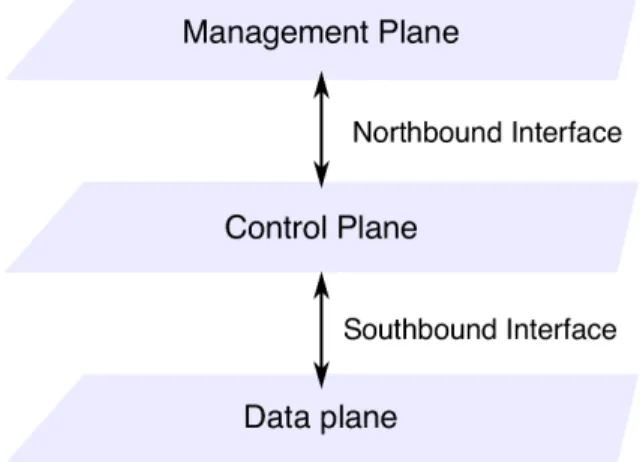
2.1 SDN consists of three different planes connected through two interfaces. . . 5
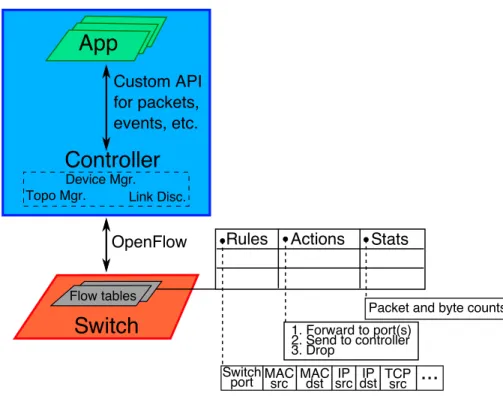
2.2 A more detailed overview of an SDN using the OpenFlow protocol. . . 8
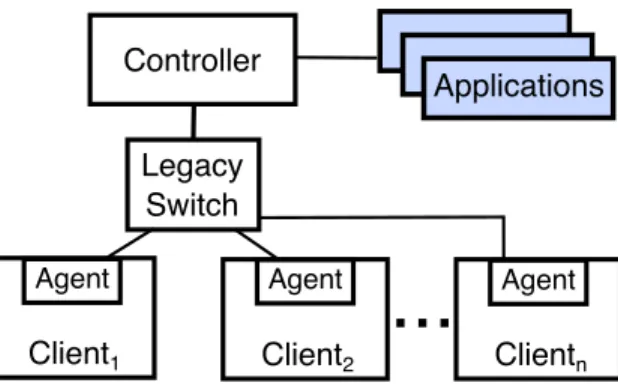
3.1 Integrating SDN functionality in host-based agents allows use of legacy switch in-frastructure. . . 12 3.2 Overview of kernel and agent communication. Dashed lines represent network
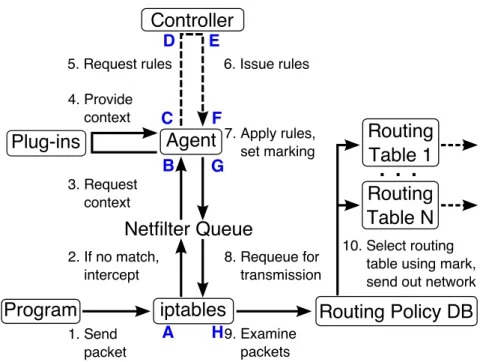
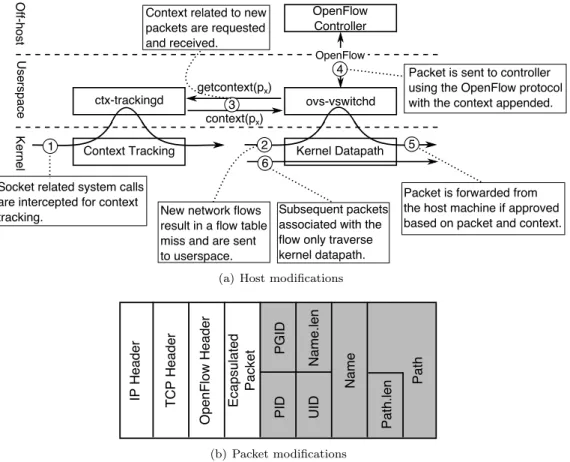
traf-fic while solid lines represent intra-system communication. The bold, blue letters indicate measurement points for the performance evaluation in Table 3.1. . . 16 3.3 Figure (a) shows how we will perform host modifications toovs-vswitchdto append
context to OpenFlow packets. Figure (b) shows the context appended to the original OpenFlow packet where the shaded portions represent host context. . . 26 4.1 A GUI signature is composed of all valid interaction paths that result in network
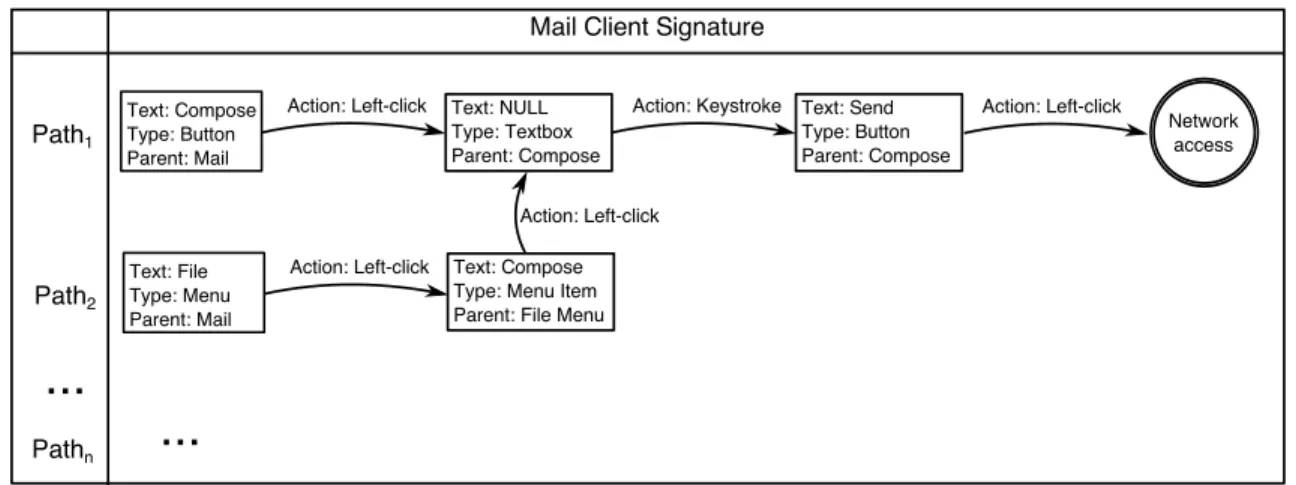
access. . . 29
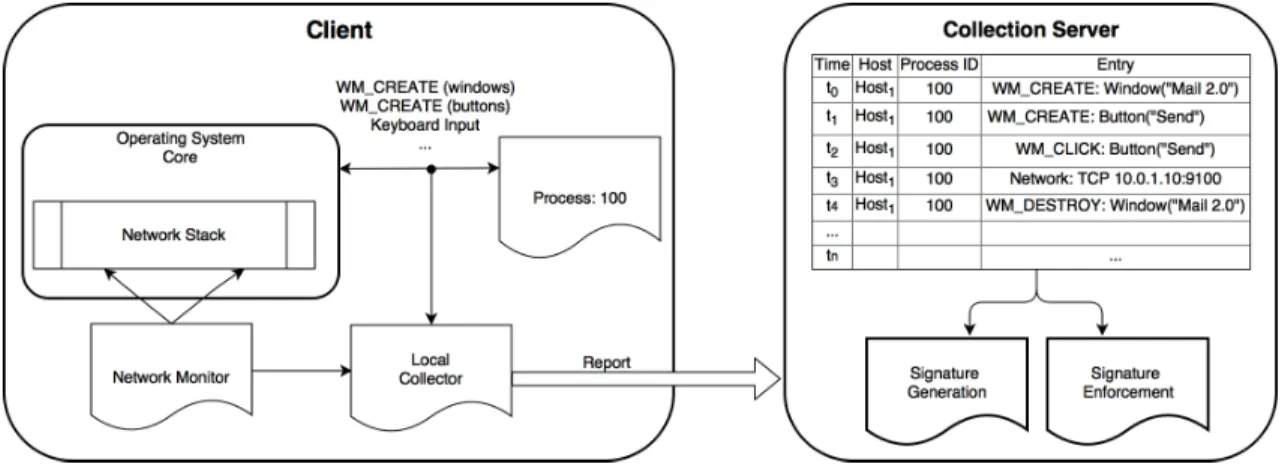
4.2 Our approach hooks into the Windows message passing system to determine what
application objects exist and are being interacted with by the user and what network traffic the application generates in response. This information is sent to a local collector and stored at a collection server. . . 30
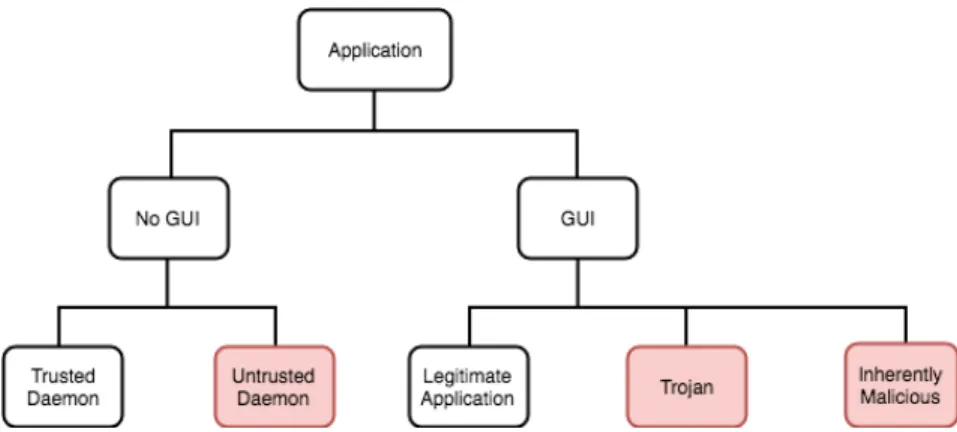
4.3 Applications can be broken down by whether a GUI component exists and
fur-ther broken down into what is considered malicious or not. Red shaded boxes are considered malicious. . . 33
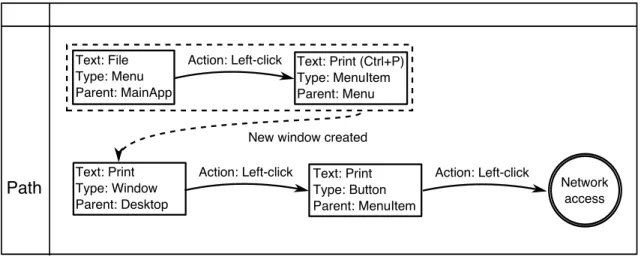
4.4 Common interaction path for printing. The dashed arrow and box represent the
part of the path that is inferred. . . 34 4.5 GUI context integration with host-based SDN. . . 39
5.1 Our proposed ReSDN architecture with residential routers supporting OpenFlow.
Our controller supports fine-grained flow control (FGFC) and runs a partial path encryption module that supports directing traffic to waypoints in the cloud. . . 44 5.2 Overview of how partial path encryption with waypoint works. Traffic is encrypted
at the router per flow and routed through a waypoint in the cloud where it is decrypted and routed to the destination. This incurs a smaller number of hops where the original traffic is unencrypted. . . 47 5.3 End-to-end latency of DNS requests over 100 trials. . . 49 5.4 TCP handshake latency over 100 trials. . . 49
6.1 Overview of how our Skype proxy approach works using multiple cloud providers for controlling OpenFlow and proxying traffic. Our controller uses fine-grained flow control (FGFC) and the Skype Proxy (SkyP) module to detect Skype calls and
update the route agent to send traffic through the proxy. . . 55
6.2 Our decision-making process in the SkyP module for proxying traffic. . . 57
6.3 Our evaluation setup for testing SkyP on different devices. . . 59
7.1 TLS Handshake . . . 63
7.2 Our system uses a cloud-based OpenFlow controller and middlebox for TLS verifi-cation and revoverifi-cation. TLSDeputy relays verifiverifi-cation results to a controller module using a special OpenFlow Agent (dashed line). Similarly, TLSDeputy has a module on the controller that steers new TLS connections through its MB software. Blue dotted lines represent logical communication using OpenFlow. . . 65
7.3 Once the TLSDeputy has verified the handshake, it can contact the controller through a custom OpenFlow agent to request the connection be sent directly rather than diverted through the middlebox. The controller can then send FlowMods to the ReSDN router causing packets to be transmitted directly rather than via a tunnel. 68 7.4 Leaf certificate verification comparison between CRL, OCSP, and TLSDeputy over 40k random domains. . . 72
7.5 Complete chain verification using CRLs. . . 73
8.1 System diagram for residential SDN and middlebox solutions. These approaches use a SDN-capable router within the home, a cloud-based OpenFlow controller, and a number of cloud-hosted middleboxes for NFV support. Paths labeled as 2.a, 2.b and 3.a use pre-established tunnels. . . 76
8.2 Caption for LOF . . . 79
8.3 RTT measurements and the resulting page loading time (PLT) analysis based on those RTT measurements. We compare the PLTs by fetching top Alexa 100 websites at different controller latencies on our ReSDN switch and see how PLT is affected by blocking non-essential connections. Finally, we compare our consumer-grade switch to an enterprise-grade HP switch. . . 81
9.1 A centralized cloud controller allows us to manage multiple independent home net-works. . . 89
9.2 ReSDN DNS whitelist processing for better privacy control. A local process parses DNS packets and manually inserts OpenFlow rules as necessary without involving the cloud controller. . . 90
9.3 We group network port usage of outgoing connections into 50 bins that evenly divide all network ports for 42 devices on the ReSDN testbed. Devices that appear on multiple networks are shown multiple times. . . 92
10.1 Scenario showing how a device within the home could be fingerprinted and subse-quently have a profile built. . . 96
10.2 How 2FA can be generically applied to all IoT devices on a home network by cen-tralizing the 2FA software and reversing the order of the first and second-factor authentication. . . 97
List of Tables
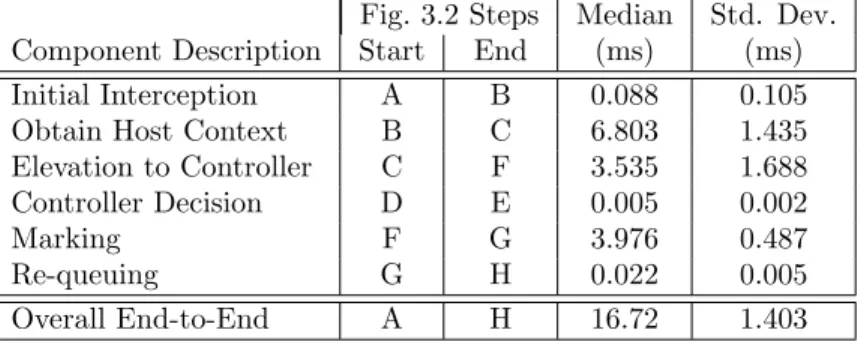
3.1 Component-wise characterization of latency overheads over 1,000 TCP connections. Columns 2 and 3 correspond to the bold, blue letters in Figure 3.2. . . 20 3.2 Round trip times with each host transmitting 1,000 packets. . . 21 3.3 Table showing the performance characteristics of host-based SDN using Open vSwitch.
Modifying Open vSwitch to support appending context results in approximately 16% reduction in flows per second. These results are incorporated from Najdet al. [135]. 27 4.1 Data collected at the Collection server when a user clicks the print button on the
print dialog screen for an application. GUI object entries are named using the
struc-ture of object ident = text:class:parent text:parent class:depth. Double
colons represent NULL values. . . 34
4.2 Applications we use for signature generation and enforcement evaluation. . . 36
5.1 Performance results for traditional network versus OpenFlow using D-ITG and 50
TCP connections. Initial connection overhead is amortized over a 60 second con-nection. . . 50
5.2 PPE hop reduction between the residential network and an Amazon EC2 waypoint
and the RTT to the destination. . . 50 6.1 List of devices used in our experiments . . . 56 7.1 Evaluation of TLSDeputy on IoT and mobile platforms with a revoked leaf certificate 69 8.1 These five sites benefited the most by blocking non-essential connections. The PLT
reduction is calculated as the difference of median load times by turning off/on blocking when using a 50ms RTT to the controller. . . 84
8.2 Residential bandwidth measurement results for 13 users and 12 cloud servers. We
compare the throughput impact of using the best throughput server as a proxy to the worst throughput server and to the second best throughput server. The percentage and throughput impact are a comparison from the proxied connection to the direct connection. . . 84 9.1 Overview of ReSDN testbed data. . . 91
Chapter 1
Introduction
Computer networks are the transportation superhighway of modern computing by providing a means of interconnectivity between different physical and virtual platforms. These networks are expected to provide high performing and reliable data transport to and from different machines all over the world. In many ways, the push for higher performance to meet the growing demands of the Internet has left a gap in security. Operators are beginning to seriously consider what new approaches exist for securing their network. This dissertation work leverages relatively new networking techniques to provide security solutions that are impossible in modern enterprise and residential networking environments.
At a high-level, we see the evolution of the Internet having resulted in several key network
infrastructure types. Of these types enterprise networks, cloud or data center networks, and
residential networks are some the most frequently accessed. Among these three network types, there are many overlapping goals, including performance, security, privacy, between each network type, but the approach to achieving these goals is drastically different based on each network type’s characteristics. Enterprise networks are networks that are largely self-sufficient and host many resources internally. Examples of enterprise networks include government, universities, and private companies. Similar to enterprises, public cloud infrastructure is self-sufficient in hosting resources. In fact, cloud providers often work in conjunction with enterprises by providing a general computing platform. Residential networks provide homes with Internet access and typically interact with services provided by enterprises. The number of residential networks far outweigh the number of enterprise connections at over 690 million worldwide [160].
Enterprise and residential networks directly host computing devices used by clients. In contrast, cloud infrastructure is typically used transparently by clients when enterprises outsource services, such as hosting webpages in the cloud. Enterprise and residential networks act as front-line net-works by directly hosting clients and results in challenging security obstacles. These obstacles include providing scalable network security solutions that protect a diverse set of devices including desktops, mobile phones, and IoT devices.
The average American spends approximately two-thirds of their day between enterprise and residential networks [47]. As such, we refer to these networks as “front-line networks”. If security compromises are to happen, they will likely involve either an enterprise or residential network. This dissertation considers the importance of front-line networks and how to provide better means of security to them. We present new methods to improve security in front-line networks using a
networking paradigm called software-defined networking (SDN), which allows operators the ability
to control a network from a logically centralized location. We do so by first rethinking how
enterprise SDN is deployed. We then introduce SDN, along with cloud support, into the residential environment. The result of our work shows how SDN-based security solutions can be tailored to meet deployment challenges while considering each network’s characteristics and limitations. In doing so, this dissertation addresses problems that exist in today’s front-line networks and without our SDN techniques, would otherwise remain unaddressed.
We first consider how rethinking SDN deployment in the enterprise can address existing scalabil-ity and situational awareness concerns. Scalabilscalabil-ity and situational awareness become problematic due to network complexity. This complexity leads to situations where operators are blind to net-work traffic, making it difficult to have a complete, global view of the netnet-work. Netnet-work operators could mitigate risks such as malware spreading from a compromised system if they had a better understanding of the network activity from end-systems. In traditional systems, network operators are typically blind to intra-subnet traffic, since hosts directly forward the traffic without travers-ing security enforcement and monitortravers-ing devices. In an event of malware outbreak, containment techniques require shutting down important network services and even disconnecting the entire network to prevent the spread [161]. However, recent innovations, such as the software-defined networking (SDN) paradigm, hold the potential to partially address the problem. Using appro-priately crafted fine-grained flows, the OpenFlow protocol [128], a popular SDN protocol, allows a centralized controller to learn each time a new network flow is created regardless of a host’s position in the network.
The first major contribution of this dissertation is to apply host-based SDN techniques to the enterprise network. While switch-based SDN with OpenFlow may help address visibility concerns, such an approach faces two significant challenges: 1) fine-grained flows in OpenFlow’s switch-based data plane do not scale to large networks [79] and 2) OpenFlow is inherently blind to end-host system activities, since it operates at the level of switches and routers. To answer these challenges, our work embraces the “dumb network, smart hosts” mindset. Specifically, we push OpenFlow functionality from switches and routers to end-host machines using a software agent. In doing so, we are able to address the aforementioned challenges. We distribute flow state to individual end-hosts helping reduce scalability concerns, and by running the agent on the end-hosts, we also gain insight into the host’s operating context. With host-based SDN, we show how operators are able to write powerful, centralized security policies that include system level information such as process path in addition to incorporating user interactions via the graphical user interface (GUI) to endorse network traffic.
While there are many more residential networks than enterprise networks, most network security measures are directed at enterprises. Often, home networks are hosting devices that also frequent enterprise networks when “bring your own device” policies are in place, but when home, users operate under a vastly different network configuration. The difference is a result of enterprises having the resources to deploy strong security measures. Residential networks, on the other hand, are much more constrained in these aspects, which limits the viability of most protective measures. Attempting to deploy even the most straightforward enterprise security measures can be
chal-lenging to execute in residential networks. Residential networks are different than the enterprise in multiple aspects. When compared to the enterprise, residential networks have vastly different network characteristics, limited infrastructure, IT experience, and cater to a heterogenous group of devices. This dissertation recognizes these differences and introduces an approach we refer to as
Residential SDN (ReSDN). ReSDN is an attempt to build a solution that takes into account all of the previous considerations in order to provide a new residential network infrastructure support-ing better network functionality. Our infrastructure is designed to be immediately deployable and practical from a performance perspective. ReSDN allows a third-party to remotely manage a home network using cloud-based infrastructure. To realize our infrastructure, ReSDN uses modified com-modity home routers, which is the focal point of all residential network traffic. This dissertation shows the power of ReSDN and how future residential networks can be better managed and secured by performing the following research activities:
• Outsourcing network functionality: We begin addressing residential network limitations by outsourcing network functionality to the cloud. Rather than require the home router to provide network functionality locally, we configure the router to use cloud-based infrastruc-ture to handle security and policy enforcement.
• ReSDN application development: We develop new network applications in the cloud that are impractical for traditional residential networks. These network functions include
an automated privacy proxy for the popular Skype VoIP application called SkyP and a
TLS verification and revocation application calledTLSDeputy. These applications address real-world concerns for residential networks.
• Large scale performance evaluation: We leverage Amazon’s Mechanical Turk [7] to per-form a large scale perper-formance evaluation of residential networks and public cloud providers. The performance evaluation shows that our approach is broadly applicable to approximately 90% of residential networks in the US.
• Deployment of a residential testbed: Using modified routers, we go through an IRB-approved study that enables us to deploy modified routers in real residential networks. This testbed enables us to gather data from multiple vantage points and in the future, will enable large scale evaluation of new services.
Chapter 2 presents background information that will provide an understanding of the foun-dation this dissertation work is built upon as well as providing relevant related work. Chapter 3 presents our host-based SDN approach related to our enterprise security efforts. Chapter 4 discusses how host context can be extended into the GUI. Chapter 5 introduces our ReSDN infrastructure while Chapters 6 and 7 discusses applications of ReSDN. Finally, Chapter 8 analyzes ReSDN per-formance on a large scale and Chapter 9 discusses our efforts towards building a ReSDN testbed.
Chapter 2
Background and Related Work
Software-defined networking (SDN), network function virtualization (NFV), and security are all important components of this dissertation. We recognize SDN’s powerful abstraction, as well as its limitations. In some cases, we use it alongside NFV for implementing security components. We now provide an overview of SDN, NFV, and security with respect to our goals of security enterprise and residential networks. In other cases, we provide related work in each Chapter to provide better context.
2.1
Software-defined Networking
The following background relates to a relatively new networking paradigm known as software-defined networking. Software-software-defined networking is an approach that separates the data plane, or packet forwarding hardware, from the control plane, or the logic that decides if and how a packet should be forwarded. A defining feature of SDN is its ability to provide a logically centralized
view of the network. In theory, this allows for improved security, performance, and resiliency in the network. Although multiple SDN implementations exist, academics and industry have chosen
OpenFlow [129] as the de facto SDN standard. A high-level overview of the SDN abstraction is
shown in Figure 2.1. For the remainder of this work, our SDN implementation and discussion will strictly consider the OpenFlow SDN implementation.
The logically centralized nature of SDN enables network management that would otherwise be impossible. As an example, consider a commodity unmanaged switch connecting machines at a university. Unfortunately, after these switches are deployed throughout the network, administra-tors do not have the ability control or alter the logic. Moreover, switches that do allow limited control often require physical access and a special adapter for configuration and are limited to the functionality provided by proprietary software. However, SDN decouples the control and data plane to allow consumers to use a manufacturer’s hardware while having the ability to implement their own control software. The restrictions of modern switches has already been recognized by cloud providers and data centers. Accordingly, operators of these networks are using SDN to allow operators to quickly reconfigure the network or provision resources based on dynamic network conditions [117].
Figure 2.1: SDN consists of three different planes connected through two interfaces.
plane, and management plane interconnected with the southbound and northbound interfaces.
2.1.1
Data Plane
In a bottom up fashion, the data plane is the forwarding device interconnected through wired or wireless means. The data plane’s purpose is to forward packets as quickly and efficiently as possible. One way traditional OpenFlow switches (i.e., the data plane) provide these forwarding properties is through Ternary Content-Addressable Memory (TCAM) hardware. Our enterprise research looks to push the forwarding functionality to end-hosts, which lack TCAM hardware, but because end-hosts must already maintain and manage state associated with network connections, our approach introduces negligible overhead.
OpenFlow controls forwarding devices by maintaining flow tables. The OpenFlow data plane maintains one or more of these flow tables. Each flow table is comprised of three different com-ponents: rules, action, and statistics. The rules are a set of matches on various network-related fields such as protocol ports, IP addresses, and VLAN tags. For each rule there is an associated action. The action tells the data plane how to forward the packet. The action could be be to drop, forward, or even modify the packet inline. Finally, for all rules in the flow table, statistics are kept such as the number of packets and bytes triggering a certain rule.
2.1.2
Southbound Interface
The southbound interface is how the control plane and data plane communicate and determines the communication protocol between the data plane and the control plane. It also defines the instruction set that the data plane will use to control forwarding of packets. In our work, the southbound interface protocol is OpenFlow. Other protocols such as Forwarding and Control Element Separation (ForCES) [86] exist, but they lack OpenFlow’s level of support.
2.1.3
Control Plane
The SDN control plane, often referred to as the controller, is the component that programs and
manages forwarding devices over the southbound interface. Accordingly, the control plane is
required to understand the OpenFlow protocol. In addition to speaking the OpenFlow protocol on the southbound interface, the control plane also speaks over a northbound interface, which is discussed in the next section. The control place is comprised of a “network operating system” (e.g., Floodlight [12]) and all the built in components offered by the network operating system.
Many OpenFlow controllers exist in the research community and industry today. Industry often has a preference towards towards building their own SDN controllers [21], but many open source controllers also exist [3, 12, 28, 31, 89]. While these open source controllers support the OpenFlow protocol, each controller has particular characteristics that should be considered before deployment. In particular, the programming language the controller is written in is indicative of the performance. The POX controller is written in Python and is inherently limited due to the lack of true multithreading functionality in Python. Accordingly, its performance can be considered subpar with a processing rate of around 35,000 packets per second versus other controllers that process more than 100,000 [89]. However, there is a tradeoff between performance and usability with any controller. As result, our work leverages multiple controller types depending on the application at hand and whether flexibility in design or better performance is desired. However, any controller implementing the OpenFlow protocol can be used.
Some controllers may provide different built-in functionality. For example, Floodlight provides several built in modules such as a topology manager, device manager, and link discovery. Such functionality is extremely useful for certain applications. Rather than requiring developers to build a custom topology manger, the controller can determine the topology and provide a uniform API to all management applications. These controller-supplied modules typically run in the same privilege zone as the other management plane applications. As a result, applications provided by other developers can influence the state of built-in controller modules. This relationship has been the focus of recent security research showing that existing controllers are vulnerable to poisoning attacks [111] [157]. Controller security will become increasing relevant to our research as our work grows and begins to incorporate controller modules that may be developed by other entities, such as device manufacturers.
2.1.4
Northbound Interface
The southbound interface must be a well-defined protocol, such as OpenFlow, in order to allow the switch and controller to communicate, However, the northbound interface is provided by the controller and is an API offered to the management plane. This interface allows developers to write higher level applications to control the data plane. The API may also provide information on abstraction layers run by the control plane, such as topology discovery, as previously discussed. It is important to note that the northbound API is offered by the controller, and as such, this API may not be standardized; standardization remains an open question [83]. While this question is out of scope for our work, we note that it hinders a straight-forward conversion of management
applications between controllers.
2.1.5
Management Plane
Applications that leverage the northbound interface to control the data plane are referred to as the management plane. The management plane runs more traditional applications such as firewalls, routing, and other applications that enforce policy. These applications may maintain their own state in addition to leveraging the control plane’s API for information such as the current network topology.
Each management plane application registers with the controller what OpenFlow events the application wishes to consider. Some applications may act in a proactive manner in which rules can be preemptively pushed to the switch. For example, a layer 2 firewall may only be interested in new connections from switches in order to push static flows and will require no further interaction with the switch. Applications, such as a load balancer, need to act in a reactive manner where network packets are sent to the controller dynamically to be evaluated. Management applications need to introduce minimal delay when processing packets. A delay in processing new packets will cause queueing delays to increase. Accordingly, applications requiring longer term, in-depth analysis, such as an intrusion detection system (IDS) must insert flows that cause dedicated middlebox processing. Packets are processed sequentially in the management plane by each application. For added efficiency, if any management plane application determines unequivocally how the packet should be processed or is the only application requiring the packet, that application can push the corresponding OpenFlow rules and stop other modules from wasting cycles handling the packet.
We present a more detailed view of SDN consisting of a single controller and switch that uses the OpenFlow protocol in Figure 2.2.
2.1.6
SDN Considerations
SDN can simplify network management and security while allowing dynamic reconfiguration, but it does not come without its own considerations. We briefly highlight a few considerations that should be taken into account for SDN deployments.
Controller Placement
The Controller Placement Problem [106] in SDN is important to the performance of the network since the location of a controller will affect the network’s ability to respond to network events. The metrics surrounding the controller placement problem will vary between scenarios and will depend-ing on factors such as latency, the number of hosts, geographic layout and available resources. In Chapter 8 we focus on the controller placement problem when dealing with residential networks.
Scalability
OpenFlow is particularly concerned with scalability at the data plane and the control plane. Open-Flow data plane scalability research focuses on switch performance with respect to the number of rules and actions that can be stored in a switch’s TCAM. Traditional (non-OpenFlow) switches
OpenFlow
Switch
Rules
Actions
Stats
Switch
port MACsrc MACdst srcIP dstIP TCPsrc
...
1. Forward to port(s) 2. Send to controller 3. DropPacket and byte counts
Controller
Topo Mgr. Device Mgr. Link Disc.App
Custom API
for packets,
events, etc.
Flow tablesFigure 2.2: A more detailed overview of an SDN using the OpenFlow protocol.
typically only need to store course-grained layer 2 information such as media access control ad-dress (MAC) pairs. OpenFlow switches need to support rules, actions, and statistics. Rules alone can have over 12 different match fields [94]. With limited TCAM, OpenFlow switches can sup-port between 750 and 2,000 flows, with an unspecified number of flows being stored in software tables [119]. Some enterprise grade OpenFlow switches have a maximum of 97,000 OpenFlow rules [98]. The inability to handle fine-grained flows scalably makes OpenFlow switches a target for denial of service attacks [153].
The control plane must also be scalable. If a logically centralized controller becomes unavail-able, OpenFlow networks face the same challenges of other single point of failure systems. Namely, switches without a control plane are unable to forward packets associated with new network flows. The original OpenFlow specification did not support distributed controllers. Since OpenFlow’s de-but, other approaches have retroactively developed physically distributed but logically centralized controllers [84, 118, 170].
2.2
Network Outsourcing
The residential research in this dissertation is dependent upon the notion that network function-ality can be practically outsourced. In a position paper, Feamster [91] first suggested outsourcing home network security to third-parties who are more knowledgable and better equipped to manage home networks. To outsource, the paper proposes using programmable switches. Programmable switches enable a third-party to aggregate data for all networks under its control. With aggregate
data, distributed network monitoring and inference algorithms can then be used to, for exam-ple, detect distributed, coordinated behavior. Research challenges presented in Feamster’s work include scalability, privacy, remote manageability, resiliency to attack, and policy conflict resolu-tion. This dissertation work either directly attempts to address each of these issues or is indirectly addressed by way of leveraging existing work (e.g., SDN policy conflict resolution work). Gibb
et al. [103] presented a more generalized outsourcing viewpoint that introduced the notion of a Feature Provider that would provide a Feature API to enterprises. Their prototype and evaluation included outsourcing a web cache and intrusion detection system.
Gibb’s work lacked a thorough evaluation and left several unanswered questions. In particu-lar, their work left unanswered questions related to performance and traffic redirection. A more thorough analysis of outsourcing was presented in [154]. The Appliance for Outsourcing Mid-dleboxes (APLOMB) approach considers the question of whether it was possible to outsource an enterprise’s network middleboxes to the cloud. APLOMB’s motivations for outsourcing were to reduce infrastructure cost, simplify management, and leverage the cloud for dynamic scaling and failover mechanisms. In outsourcing, APLOMB focuses on meeting functional equivalence, low complexity at the enterprise, and minimal performance overhead. APLOMB finds that by using DNS techniques for cloud redirection and adding a specialized gateway at the enterprise they can meet their goals for nearly all enterprise middleboxes. Exceptions to this were internal firewalls that the gateway does not see.
Existing work has proposed outsourcing network functionality and the key challenges with doing so, and has presented preliminary work in the area. A commonality between past research research is that the enterprise is the core focus. In some instances, the techniques applied have no relevance in the residential network. For example, APLOMB considers multiple techniques for transparently inserting cloud-based middleboxes in path of enterprise network traversing the boarder gateway, but for the best performance, the chosen solution was to use a cloud DNS server to help direct clients through the middleboxes. In the residential environment, where most connections are outgoing, this approach is not feasible. Furthermore, performance considerations have been strictly limited to an enterprise, which has substantially different performance characteristics. This dissertation work explores similar questions with similar goals to the APLOMB architecture in the residential environment.
2.3
Network Function Virtualization
Network Function Virtualization (NFV) is an effort being pushed to move previously hardware de-pendent network applications into a virtual environment [25]. NFV would allow hardware specific functions such as, carrier grade network address translation (NAT), firewalls, and content distri-bution networks (CDNs), to be virtualized and placed in a general computing platform. Among several benefits, NFV aims to reduce operating costs and enable scalability.
NFV is frequently considered in deployment scenarios using SDN. SDN lends itself as a natural abstraction to chaining network functions together; however, NFV is a standalone movement from SDN and neither are reliant on each other. Our work, particularly in the residential network,
intertwines the NFV and SDN abstractions.
2.4
Residential Networking
Feamster’s [91] position paper first suggested outsourcing home network security to third-parties who are more knowledgable and better equipped to manage home networks. Project BISmark [163] is the most well-known body of work in residential networks and extends Feamster’s position pa-per on outsourcing home network security to third-party expa-perts. In comparison to our work, BISmark’s deployment model is largely reminiscent of what exists today by hosting all necessary software on the home router itself. Further, BISmark has been used for extensive performance char-acteristics of residential network ISP’s [164] and wireless performance [165] and has not thoroughly examined residential SDN. The only exception to this being a data cap enforcement application which only needs to probe a router regularly for information to handle enforcement [116] and did not consider the implications of controller placement outside of the LAN. Finally, BISmark per-formance results have not examined connectivity to public cloud infrastructure or the implications of hosting a cloud-based controller or NFV middleboxes.
Other research has also focused on deploying SDN within the home. The Homework project [134] uses a PC acting as a router running an OpenFlow controller within the LAN to understand HCI as-pects of LAN network management. Yiakoumiset al.[178] proposed using the FlowVisor [155] tool to allow an ISP to facilitate the management of certain home devices by outside service providers, such as utility companies and later created an approach for users to express QoS preferences to the user’s ISP [177] . Yiakoumis’s work measured the impact of an OpenFlow controller that was within 16ms of 7 homes and does not provide broad analysis of data on viability for nation-wide deployments of SDN and NFV solutions. Similarly, Gharakheiliet al.[102] allows a home network user the ability to express bandwidth restrictions for QoS/QoE with ISP participation, using an API with a cloud agent. This work is silent on both performance and support for other applica-tions. Lee et al. [123] suggest using cloud-based SDNs for auto-configuration and identification of devices, but only considers the overhead of the configuration and identification protocol rather than all network traffic.
While some of these prior efforts have focused on outsourcing network management, they do not address significant deployability considerations or security concerns. In particular, they have not considered approaches to outsource security controls in an incrementally deployable way, nor approaches that allow users to be self-sufficient in doing so. In this dissertation, we instead focus on using SDNs to create an immediately deployable solution for specific applications without requiring support from entities such as the residential ISP. By sharing these applications and tools, we demonstrate that experts can create and share security tools with less technologically sophisticated users.
Chapter 3
Contextual, Flow-Based Access Control with Scalable
Host-based SDN
3.1
Introduction
This Chapter begins by first rethinking how SDN is deployed in the enterprise. A host-based SDN deployment, as opposed to a switch-based deployment, enables us to address existing scalabil-ity concerns with SDN that may hinder real-world deployments. We also show how system-level context can be incorporated into network control information to improve the situational aware-ness operators have when attempting to understand network activity. By fully understanding the network activity from end-systems, network operators can mitigate security risks, such as data exfiltration of personal information including credit cards, the spread of malware or system com-promises. In traditional systems, network operators are typically blind to intra-subnet traffic, since hosts directly forward the traffic without traversing security enforcement and monitoring devices. Recent innovations, such as the software-defined networking (SDN) paradigm, hold the potential to partially address the problem: with appropriately crafted fine-grained flows, the OpenFlow pro-tocol [128], a widespread standard in the SDN community, allows a centralized controller to learn each time a new network flow is created.
While SDN approaches hold promise, they face two significant challenges: 1) fine-grained flows in OpenFlow’s data plane controls do not scale to large networks [79] (described in Section 2.1.6) and 2) OpenFlow is inherently blind to end-host activities, since it operates in switches and routers. Beyond scalability concerns, OpenFlow does not provide network operators with detailed visi-bility into the end-hosts operating on the network. The OpenFlow standard creates matches based on network headers, but this information may not be semantically meaningful. As an example, a popular video conferencing application uses ports 80 and 443 for communication [132], even though these ports are intended for HTTP or HTTPS traffic. Without application layer proxies or deep packet inspection tools, operators cannot determine the actual origin or destination of the traffic or correctly determine if the traffic is communication between a Web browser and Web server. Even more concerning, malware can take a similar approach to create connections that look like Web requests while actually communicating to exfiltrate information or for command and control [68]. Network operators need details about the host context surrounding the network request to make informed access control decisions.
In this Chapter, we ask two research questions: 1)How can we scalably obtain flow-level infor-mation for all network traffic? and 2)How can we provide network operators with detailed context surrounding each network flow?
To answer these questions, we embrace the “dumb network, smart hosts” stance. We take the OpenFlow agent functionality out of network switches and routers and instead place equivalent functionality in the end-hosts themselves, as shown in Figure 3.1. In doing so, we create an SDN approach that provides detailed host context and can scale to large networks while still yielding high performance.
Our contributions are the following:
• Host context for all network flows: We allow operators to craft detailed policies for flow authorization that include information about the applications creating the traffic. The approach is modular and allows the communication of arbitrary context. As an example, we created a policy that tracked applications and users and allowed only root-installed programs to access the network. We found that even this simple policy would successfully block multiple malware attack vectors while introducing low performance overheads.
• Scalable, fine-grained flow-based access control: We address the “southbound” or data-plane scalability concerns in OpenFlow by leveraging the distributed computing power of the end-hosts to apply the rules that hardware switches would otherwise be required to manage. This allows the hosts to apply fine-grain rules while allowing the hardware to apply coarse-grain rules, providing scalable, detailed network understanding. Even in our unoptimized setup, we found that hosts could create 25 new flows per second and established flows introduced no new constraints on the hosts, scaling far beyond the capacity of TCAMs in modern OpenFlow hardware. Further, the approach introduced only 38 ms of delay to flow establishment.
• Integration of host context into OpenFlow: We provide an initial look into how our approach of incorporating host context into network flow information can be adapted to work with the existing OpenFlow protocol.
Controller Legacy Switch Client1 Agent Client2 Agent Clientn Agent
...
ApplicationsFigure 3.1: Integrating SDN functionality in host-based agents allows use of legacy switch infras-tructure.
In creating this approach, we note that it can be deployed immediately and inexpensively using standard enterprise software deployment tools [133]. This allows organizations to incrementally adopt the approach with minimal effort and no capital costs.
3.2
Related Work
We briefly describe research surrounding host-context in SDNs for making informed decisions. Work related to SDN scalability is discussed in Section 2.1.6.
3.2.1
Extracting Context from End-Hosts
Ethane [72], an early SDN implementation, sought to enhance network security by allowing network operators to write detailed security policy that could include named entities such as users, end-host machines, and access points. Unfortunately, Ethane is a switch-based SDN approach, like OpenFlow, and it lacks information from the end-hosts that is needed to enforce the policy about
users. Our work embraces the ideals of Ethane and augments it by instrumenting end-hosts
and providing controls that allow policy enforcement using named entities, such as users and applications.
HoNe [93] provides process attribution by correlating network traffic to processes. The approach lacks centralized coordination and does not support arbitrary host context or embrace the SDN
paradigm. Dixon et al. [85] use virtual machines and TPMs to allow network administrators to
securely push network management to the end-hosts themselves but they lack situational awareness
inherent to OpenFlow based SDNs. Parno et al. [141] present an approach called Assayer that
uses end-host TPM capabilities to explore performance and security aspects of networks where the end-host verifies state already being maintained locally (e.g., number of packets sent) rather than requiring another device to determine the state manually. Participating systems push policies to off-path verifiers that supply clients with tokens to allow continual communication. Assayer’s approach does not follow the OpenFlow SDN model, is reactive, and does not scale when attestation is required on a per packet basis.
Naouset al.[136] proposed a revision to theident[115] protocol to allow a remote system to query for details about the application and other information associated with a flow. The authors
designed ident++ to work under the OpenFlow protocol to allow network operators to delegate
administration of end-hosts from a centralized operator to local operators in the network. Our work shares the goal of fusing end-host information with network control withident++. However,
ident++ does not describe or evaluate an implementation of the approach nor does it indicate
how it would overcome the inherent scalability concerns of fine-grained flows in a switch-centric SDN architecture. In our approach, we take a host-based approach to address scalability. We then create and evaluate an implementation of the approach, both using a native OS solution and using a bump-in-the-wire implementation.
Other approaches have focused more on the context available on an end-host and how to extract this information for automated systems to better understand a user’s workflow. These works can augment our approach and range from collecting mouse-clicks and keyboard presses [78]
to application-specific implementations such as the user’s interaction with a web browser [126,181]. Each of these approaches can be used to inform the host-based agents in our architecture, providing more context on the system’s operation and enable stronger policies to be written.
3.3
Threat Model: User-Level Adversary
We deliberately scope our threat model to yield tangible results to many organizations in common scenarios while describing avenues to relax the stronger assumptions. In our threat model, we consider an external adversary that has compromised a user-level account on a system inside the defending organization’s perimeter. The following are our two key assumptions.
• Trusted Operating System: We allow regular user accounts to be compromised, but we assume a root-level compromise cannot happen, which would allow an adversary to change how the operating system kernel functions. Most host-based defenses, including anti-virus software, software firewalls, and host intrusion detection software assume that a system compromise only occurs at the regular user level, consistent with the best practice of “least
user privilege” [151, 171]. We share this assumption, but note it may be relaxed using
techniques such as trusted computing hardware or virtualization with trusted hypervisors. Even without such innovations, our approach can directly address many common user-level compromise attacks.
• No Physical Attacks: We focus on an adversary that lacks a physical presence inside the organization; otherwise, an adversary could sabotage systems and or use custom hardware to bypass our implementation. While we may address physical attackers in the future, we note that many attacks are launched remotely.
Since our approach instruments end-hosts, we focus on devices that can be modified by an organization’s IT staff. For legacy devices (e.g., network printers) or “bring your own device” equipment, organizations can use individual VLANs to isolate the devices and proxy all the device traffic through a trusted network forwarding system. This approach allows full flow-management compatibility for these devices, albeit with a performance overhead.
3.4
Approach: SDN via Host Agents
Given OpenFlow’s scalability concerns and lack of host context, we instead take a host-based approach. We push all of the fine-grained rule matching and control to system-level software agents running on each of the hosts. The network infrastructure may continue using coarse-grain rules, whether in a legacy enterprise network or in a network using OpenFlow. The approach only minimally affects end-host performance and scalability because these end-hosts already manage per-flow state to manage the connection, as in TCP connections.
In describing our approach, we provide details of our reference implementation on the Ubuntu Linux operating system. While the details of the approach will vary across operating systems, the concepts are consistent and similar functionality may be available. To enable communication
between agents and the controller, we used Python and asynchronous messaging provided by the Twisted framework [172]. These components were not optimized for performance and thus are conservative estimates of what would be possible in a production implementation.
While the approach is intuitive, it achieves powerful outcomes. Our system not only replicates the elevation and caching paradigm of traditional OpenFlow, it further supports features analogous to the “actions” in OpenFlow [44]. Some details of the behaviors may differ slightly as OpenFlow resides within network switches capable of controlling the datalink layer. Being a host-based implementation, our approach natively works at the network layer and above, though we do have the ability to influence datalink layer actions. We note that in addition to replicating the OpenFlow functionality, our approach scales even to extremely large networks as the end-hosts only store entries for their own flows and the logically centralized controller can be physically implemented using distributed controllers [170].
In addition to flow-based controls and context, our approach has the following features:
• A capability to arbitrarily route traffic through proxies, IDSes, and other middleboxes,
• A modular design allowing arbitrary plug-ins to enable additional host context on demand,
• Explicit notification to network controllers when a flow ends, allowing accurate real-time network flow insight,
• Optimal traffic filtering at the source host to avoid network overheads, and
• Avoids the need for kernel or application modifications by using established kernel features. We now describe how we achieve each of these outcomes.
3.4.1
Host Agent: Intercepting Packets
Our host agent does not require special kernel or application modifications. However, the agent does run with administrator privileges, allowing it to manage the system’s configuration and op-eration. Similar agent-based system administration tools are popular in large enterprises [133] and the agent software can be installed as a system service using traditional enterprise software deployment mechanisms. As a result, organizations can quickly and easily deploy the technology across parts or all of the enterprise network.
In our implementation, we leverage the connection marking feature of theiptablesfirewall: when a flow has been vetted, we update the marking value stored in the kernel’s connection tracking table. We then use the Linux kernel’s netfilter queue library to tell the kernel that it should intercept any unmarked packets and send them to an agent running on the host. We further update
iptables to create a special “drop mark” that can be used to discard all packets in connections that have that marking. Therefore, if the controller ever decides to disallow a network flow, it may command the sending host’s agent to set the drop mark on the flow, causing all packets in the flow to be dropped (either silently or with an ICMP error to the sending application) before entering the network. Accordingly, a controller can squelch malicious behaviors efficiently, with no overhead or state in the network. This allows the controller to easily mitigate traffic floods.
Program
iptables
Routing Policy DB
Agent
Controller
Netfilter Queue
Plug-ins
2. If no match, intercept 7. Apply rules, set marking 3. Request context 6. Issue rulesRouting
Table 1
10. Select routing table using mark, send out network1. Send packet 4. Provide context 5. Request rules 8. Requeue for transmission 9. Examine packets
Routing
Table N
. . .
A
B
C
D
E
F
G
H
Figure 3.2: Overview of kernel and agent communication. Dashed lines represent network traffic while solid lines represent intra-system communication. The bold, blue letters indicate measure-ment points for the performance evaluation in Table 3.1.
In Figure 3.2, we provide an overview of how the SDN agent manages an end-host. When two communicating parties are using our approach, the process shown in Figure 3.2 is completed by both participants. In this process, the initial packet transmitted will not match any existing approved kernel flow, which is specified using the network layer addresses, transport protocol, and transport layer ports. Accordingly, while the packet is queued for transmission in the OS kernel, our SDN agent will extract the packet from the kernel queue.
Once the agent has intercepted the application’s packet, it analyzes it and determines the context for the communication (Figure 3.2, steps 3 and 4). The agent is extensible and can encode and transmit arbitrary host context from any data source on the end-host. As an example, the agent may determine the owner and executable path associated with the process and provide this context. The agent then transmits a message to the SDN controller (Figure 3.2, step 5), which contains the flow tuple and the extracted host context, and requests instructions from the controller and, if desired, the packet payload as well.
Once the host agent receives a response from the SDN controller, the host agent will install appropriate NAT, firewall, routing and forwarding rules supplied by the controller (Figure 3.2, step 7). The agent then indicates the flow should not be diverted to the agent in the future. In our Linux implementation, we use a temporaryiptablesrule to update the marking for the flow to indicate the flow is authorized. The agent then signalsnetfilter queue to release the packet, providing the altered version if requested by the controller.
Unlike in OpenFlow, where the controller does not directly learn when a connection ends, the host agent can inform the controller about connection terminations. In our implementation, we
intercept theCONNTRACK DESTROY kernel event using thenetfilter-conntracklibrary and alert the controller. OpenFlow instead uses timeouts to approximate when a connection ends, causing the flow to be re-elevated to the controller if it continues. In our implementation, we use the
netfilter-cttimeout library to re-create this functionality. Our approach allows the controller to have real-time knowledge of the network, rather than relying upon timeouts to approximate the network activity.
Normally, the controller will allow the host to forward packets using its default routing table. However, the controller may choose to specify an arbitrary next hop for the flow instead. This can be used to proxy traffic through a third-party, such as an IDS or application-layer firewall. To do so, the controller orders the host-agent to create a unique routing table for each available next hop. The table contains a single entry: a default route to the controller’s desired next hop. The controller can then use policy routing to specify which flows should use the alternate routing table. In our implementation, we use the Linuxip-rulecommand to manage the routing policy database (RPDB). We create a policy rule indicating that the connection marking from the controller should be re-used to determine which routing table to use. This allows the controller to specify the default routing table or an arbitrary secondary routing table, dictating the connection’s next hop behavior. Next hop hosts, and by extension the connection marks associated with each, can be reused across connections. The alternate routing tables can forward to a host inside the subnet, specify a host outside the subnet, or even indicate that traffic should be tunneled via a specified waypoint. At any time, the controller may alter or remove the forwarding instructions without interrupting the flow.
Since the host agent runs on both the initiator and responder systems, the controller will have the ability to control all network flows as long as one of the participating end-host deploys the agent. Accordingly, the approach grants operators full access control and at least partial host context for the communication. If both hosts deploy, the controller can fuse the context on the initiating and responding systems for a comprehensive view of the system.
3.4.2
Host Agent: Extracting Operating Context
Given the administrator privileges of the host agent, it can gather arbitrary information from the host and transmit it to the controller. The agent can be modified to gather whatever information is needed for the network operator to write effective policy. Accordingly, in our implementation, we used a modular design that can include any number of arbitrary plugins to provide context from the host to the controller. In our initial implementation, we built a plugin to provide information about the process associated with a specified network flow along with the owner and user group associated with the process.
Starting in v3.18, the Linux kernel’s netfilter queue library allows the agent to determine the user name and group associated with the extracted packet. To gather data about the process using the socket, we use an approach similar to lsof. Once we obtain the process ID associated with the socket, we extract additional details from/proc, including the executable path associated with the process and the command line arguments used when the executable was launched. We examine the executable path and indicate whether any directory or file in the directory path
is owned or writeable by a non-root user. We further collect similar information about all the process’s ancestors (e.g., parent process). We also collect whether a given ancestor is a shell or a GUI coordinator (such as a window manager).
Future plugins could easily extract context about the connection’s flow rate and number of bytes transferred or other system features, such as resource activity (e.g., CPU load, memory consumption, disk I/O) or integrate with SELinux policy and containers.
3.4.3
SDN Controller
While our work focuses on modifying end-hosts to provide greater context to the network controller, the controller itself is an important consideration. In future work, we plan to modify the agents to speak the OpenFlow protocol, allowing us to use a standard, high-performance OpenFlow controller with applications that use the host context for decisions. However, our current implementation is a Python controller that interprets fairly simple policy and pushes rules to the host agents.
3.5
Security Enhancements: Contextual Policies
The increased visibility and control inherent in the fine-grained flows we enable can directly em-power security systems [97, 100, 121]. Further, our approach enables new network security policies. We now describe such policies and their potential.
Network operators can use a variety of contextual languages, such as POL-ETH [72],
Flow-based Security Language (FSL) [107], and Flow-Flow-based Management Language [108], to specify the high-level policies for a network. While these policies are amenable to formal analysis, their current instantiations are unable to distinguish among multiple users on a system. While prior work proposed such differentiation in the future [136], to our knowledge, our effort is the first to actually do so. Further, our approach provides additional contextual information from the end-host that was not considered in some of these prior efforts.
To illustrate the power and simplicity of the policies available, we provide an example for a Linux environment that was not possible to enforce in prior work and highlight the power associated with it. We express the policy in English, while noting the policy can be easily translated into programmatic conditions. The policy is written with the intention that it would be considered in order and in a short-circuited manner (i.e., the first applicable grant or deny decision is used and processing aborts without considering subsequent steps).
1. Allow Administrative Processes: If the process requesting network access is owned by user ID 0 through 999, grant access.
2. Deny All User-Installed Programs: If the process requesting network access, or any of the process’s ancestors (e.g., such as its parent process), was started from an executable that was not installed by an administrator (i.e., one or more files or directories in the program’s path are owned or writable by a regular user), deny access.