Recognition
Sarah Al-Shareef
Department of Computer Science University of Sheffield
United Kingdom
This dissertation is submitted for the degree of Doctor of Philosophy
I would like to dedicate this thesis to my loving parents Ahmad and Haya and my supporting brothers Mansour and Mashhour.
I hereby declare that except where specific reference is made to the work of others, the contents of this dissertation are original and have not been submitted in whole or in part for consideration for any other degree or qualification in this, or any other university. This dissertation is my own work and contains nothing which is the outcome of work done in collaboration with others, except as specified in the text. This dissertation contains 65,164 words excluding bibliography, footnotes, equations and tables and has 56 figures and 54 tables.
“All praise is due to Allah” and “whoever do not thank people do not thank Allah”. Undertaking this PhD has been a truly life-changing experience for me and it would not have been possible without the support and guidance that I received from many people.
First and foremost I offer my sincerest gratitude to my supervisor, Professor Thomas Hain. It is an often used cliché, but in this case it is no overstatement to say that without the consistent guidance, support, knowledge, and encouragement of my supervisor, this thesis would never have existed. You went above and beyond to read every line of my draft in meticulous detail. I have learnt more from you than I can possibly put into words.
Secondly, I must say a special thank you to Professor Georg Struth who believed in me and offered me his complete support as a PG Tutor. Additionally, I have been blessed with a friendly and cheerful group who offered and shared many interesting discussions, ideas, thoughts and support, in particular: Amy Beeston, Erfan Loweimi, Chenhao Wu, Raymond Ng, and all former and present members of MINI and SpandH groups. Thank you Mark Summers for taking the time to proof read this thesis, your input was invalu-able. Thanks to my examiners, Professor Phil Green and Professor Martin Russell for the valuable comments and an intellectually stimulating and enjoyable viva.
To my brother Mashhour, who have agreed to embark this journey with me, leaving his life back home and starting from scratch out side his comfort zone, just to be there for me. You are everything a sister could have asked for in a brother and more. My mother and father, Haya Al-Karimi and Ahmad Al-Shareef, thank you for ... everything. You made me into who I am. For my brother Mansour and his sons, Nasser and Hussain, thank you for enlightening my darkest days with your precious laughters.
To all my friends scattered around the globe, in particular: Nora Alkhaldi, Maryam AlRayyashi, Noura and Bedour Abouammoh, Manal AlGhamdi, Najwa AlGhamdi, Wadha AlMattar, Noof AlMulihan, Rana Zaini and Hanan Niaz, thank you for making Sheffield felt like home even when I’m thousands of miles away. Thank you for the memorable trips and chats, our “girlish” parties and for being the sisters I’ve never had.
Finally, despite my love for what I do, the work reported in this thesis would not have been possible without the financial support of Umm Al-Qura University and the Saudi Ministry of Education, for which I am grateful.
Colloquial Arabic (CA) is the set of spoken variants of modern Arabic that exist in the form of regional dialects and are considered generally to be mother-tongues in those re-gions. CA has limited textual resource because it exists only as a spoken language and without a standardised written form. Normally the modern standard Arabic (MSA) writ-ing convention is employed that has limitations in phonetically representwrit-ing CA. Without phonetic dictionaries the pronunciation of CA words is ambiguous, and can only be ob-tained through word and/or sentence context. Moreover, CA inherits the MSA complex word structure where words can be created from attaching affixes to a word.
In automatic speech recognition (ASR), commonly used approaches to model acoustic, pronunciation and word variability are language independent. However, one can observe significant differences in performance between English and CA, with the latter yielding up to three times higher error rates.
This thesis investigates the main issues for the under-performance of CA ASR sys-tems. The work focuses on two directions: first, the impact of limited lexical coverage, and insufficient training data for written CA on language modelling is investigated; second, obtaining better models for the acoustics and pronunciations by learning to transfer be-tween written and spoken forms. Several original contributions result from each direction. Using data-driven classes from decomposed text are shown to reduce out-of-vocabulary rate. A novel colloquialisation system to import additional data is introduced; automatic diacritisation to restore the missing short vowels was found to yield good performance; and a new acoustic set for describing CA was defined. Using the proposed methods improved the ASR performance in terms of word error rate in a CA conversational telephone speech ASR task.
List of Figures xiii
List of Tables xix
1 Introduction 1
1.1 Varieties of Arabic . . . 1
1.2 Colloquial Arabic automatic speech recognition . . . 3
1.3 Motivations and problem definition . . . 4
1.4 Research objectives . . . 6
1.5 Thesis overview . . . 7
2 Arabic language: standard vs. colloquial 11 2.1 Varieties of Arabic . . . 12
2.2 Arabic phonology . . . 15
2.3 Arabic orthography . . . 18
2.4 Relation between Arabic phonemes and graphemes . . . 21
2.5 Arabic morphology . . . 26
2.6 Arabic syntax . . . 29
2.7 Challenges in developing colloquial Arabic ASR . . . 31
2.8 Summary . . . 31
3 Colloquial Arabic automatic speech recognition: previous work 33 3.1 Brief introduction to ASR . . . 34
3.2 State-of-the-art CA ASR systems . . . 40
3.3 Colloquial Arabic language modelling . . . 42
3.4 Colloquial Arabic acoustic and pronunciation modelling . . . 47
3.5 Summary . . . 50
4 Sub-lexical unit language modelling in colloquial Arabic 51 4.1 Related research . . . 53
CONTENTS
4.2 Word decomposition . . . 59
4.3 Sub-lexical unit LMs for CA . . . 62
4.4 Incorporating sub-lexical unit classes . . . 63
4.5 Experiments . . . 66
4.6 Summary and conclusion . . . 76
5 Exploiting standard Arabic data for colloquial Arabic language modelling 79 5.1 Related research . . . 80
5.2 Colloquialising MSA resources using SMT framework . . . 81
5.3 The use of paraphrastic language modelling . . . 85
5.4 Experiments . . . 88
5.5 Summary and conclusion . . . 98
6 Explicit modelling of short vowels in colloquial Arabic ASR 101 6.1 Related research . . . 103
6.2 Generic short vowel (GV) model . . . 107
6.3 Grapheme-to-phoneme (G2P) based diacritisation . . . 111
6.4 Extralinguistic information and diacritisation . . . 115
6.5 Conditional random field (CRF) based diacritisation . . . 116
6.6 CTS ASR Experiments . . . 131
6.7 Summary and conclusion . . . 133
7 Redefining the Arabic Acoustic Inventory 135 7.1 Related research . . . 138
7.2 Development of the new Arabic acoustic inventory . . . 140
7.3 Context-independent multi-phoneme graphemes and restructuring the acous-tic inventory . . . 162
7.4 CTS ASR Experiments . . . 186
7.5 Summary and conclusion . . . 190
8 Conclusions and future work 193 8.1 Scientific contributions . . . 194
8.2 List of publications . . . 199
8.3 Relation to other research work . . . 199
8.4 Future work . . . 201
8.5 Summary . . . 202
B Resouces and experimental paradigms 207 B.1 Resources . . . 207 B.2 Experimental paradigm . . . 211
C The use of crowdsourcing in standardising LCA 213
D Derivation of the intergal of a product of two Gaussian distributions 217
1.1 Choosing a diacritised form for the undiacritised word “
ملع
” according to the given context. . . 2 1.2 NIST STT benchmark test history 1988-2009. CA ASR performance ismarked with green circles and MSA ASR performance is marked with light blue squares. Conversational English ASR performance is marked with or-ange and red markers. (NIST, 2009)1. . . . 4
1.3 Thesis structure. Each chapter is represented by a block and the dependen-cies between chapters are represented by arrows. Chapters are grouped in parts within dashed lines. . . 8 2.1 The language status at the beginning of Islamic conquests (Holes, 2004)2. . 12
2.2 Map of the Arabic dialects as mentioned in Alghamdi (2000) and Watson (2002); The continuous spectrum of dialect variations does not take into account national borders. . . 14 2.3 Arabic consonants shown in an IPA consonants chart (IPA, 1999); grey
shading marks sounds that are used in colloquial Arabic only. Adapted from Alghamdi (2000) and Watson (2002) . . . 16 2.4 Arabic vowels shown in an IPA vowels chart (IPA, 1999); vowels in grey
appear in CA only. Adapted from Alghamdi (2000) and Watson (2002). . . 17 2.5 Writing system for the Arabic language. Graphemes are grouped into three
sections: Lunar, Solar and Glides and long vowel graphemes. All possible shapes a grapheme can take according to its position within a word are shown along with its name written in Arabic script and Roman letters. The symbol “_” is shown when a grapheme is not allowed at a certain position within a given word. Buckwlater transliteration equivalent is shown for each grapheme. . . 19 2.6 Arabic diacritics. . . 20
LIST OF FIGURES
2.7 Grapheme-to-phoneme mapping in the Arabic language. Each grapheme and diacritic is shown in Arabic script (left) and Buckwalter transliteration (right) while phoneme are written in IPA. Mappings introduced by CA are shown in dashed lines. . . 22 3.1 An overview of the main components in a standard ASR system. . . 35 3.2 An HMM model that contains 3 emitting states and entry and exit
non-emitting states. The transition between these states is strictly left-to-right. 36 3.3 An example of modelling an Arabic letter “
ب
” as a grapheme model andall phonetic values that should be modeled within. . . 48 4.1 Vocabulary growth for two variants of Arabic when no decomposition is
applied in comparison to when the definitive Al is decomposed. . . 59 4.2 Clustering of histories in DTLMs . . . 65 4.3 Relative difference in vocabulary size after applying different word
decompo-sition approaches on training and testing sets and the vocabulary list. Each segmentation is shown in the format of (A-B), where A is the decomposition method and B is the included vocabulary. . . 68 4.4 Relative difference in the total number of words after applying different word
decomposition approaches on training and testing sets. Each segmentation is shown in the format of (A-B), where A is the decomposition method and B is the included vocabulary. . . 69 4.5 Character-level perplexity of morph-based LMs of order 2 to 7. Models were
estimated from decomposed text using several decomposition methods. . . . 73 4.6 Character-level perplexity of bigram CLMs estimated from decomposed
train-ing data . . . 74 4.7 Character-level perplexity when linearly interpolating a 4-gram morph-based
LM with a bigram CLM estimated from decomposed training data. . . 75 4.8 Character-level perplexity of trigram morph-based RFLMs and a
corre-sponding morph-based LMs. . . 75 4.9 Character-level perplexity of trigram morph-based RFLMs estimated from
(a) FisherLCA and (b) AppendLCA individually using various numbers of decision trees. . . 76 5.1 A statistical machine translation (SMT) framework for colloquialising MSA
text to CA text. . . 82 5.2 Schematic diagram for developing a language model based on colloquialised
6.1 Generic vowel model (GV) topology. A standard 3-state HMM with a skip from the start non-emitting state to end non-emitting state to model the absence of the short vowels. . . 109 6.2 Spectrogram and phoneme labelling for the utternace “$w >xbArk” using
two acoustic model sets: diac, containing graphemes and true vowels, andgv, containing graphemes and a generic vowel model (denoted with @). Some occurances of @ have a zero duration (colored in grey) and some are longer than the expected length for a short vowel. Thespmodel is a word boundary indicator that does not hold any acoustic value i.e. has a zero duration. . . 109 6.3 Diacritisation error rates using G2P convertion among different 𝑛-gram
lengths. . . 114 6.4 G2P-based diacritisation performance trained on LCA words, with different
orders and using different sizes of training sets. . . 116 6.5 Examples of directed and undirected graphical models . . . 118 6.6 Two possible factorisations for the graph shown in Figure 6.5b . . . 120 6.7 Graphical structure of three examples of first-order Markov graphical models
for sequence labelling tasks: hidden Markov models (HMMs), maximum en-tropy Markov models (MEMMs) and linear-chain conditional random fields (CRFs). Each node represents a random variable while edges denote a prob-ablistic dependency between the connected nodes. In each model, the top layer of nodes represents the output labels while the bottom layer (coloured in gray) represents the observed input data. . . 122 6.8 Statistical details about the AppenLCA development and test sets. . . 128 6.9 DWER and DER gain over training set size. . . 130 7.1 Vocabulary growth in different variants of Arabic in comparsion to English. 136 7.2 Graphemic representation (undiacritised and diacritised) and their
map-pings to phonemes of an LCA sentence “mn $An Al$wfryp ytqblwA” (for the drivers to be accepted). If no mappings between grapheme and phoneme, it is a silent grapheme. Issues in diacritised graphemes are shown by markers under graphemes with these issues. . . 139 7.3 Mappings between graphemes and phonemes in CA that cause issues in
acoustic modelling. Phonemes are written in IPA symbols. Nominated grapheme is the grapheme usually chosen in the language to represent the associated phoneme. . . 141
LIST OF FIGURES
7.4 Average frequency of diacritised graphemes in the transcriptions of a 36-hour set from four CA: MSA, LCA, ICA and GCA. Phonetic classes are labelled on the top x-axis while models belong to each class is shown on the bottom x-axis between enclosed between the dashed vertical lines. . . 143 7.5 HMM topology for skippable acoustic units. . . 147 7.6 Frequency of the new acoustic units. . . 152 7.7 Perplexity across English dialects for phonotactic language models of order
2 to 5 grams . . . 154 7.8 Correlation of perplexities by unit for different dialects using PLMs. . . 156 7.9 UER of Lattice re-scoring experiments. Each plot represents a test set of a
certain dialect, while lines show the PER (y-axis) over increasing the gram-mar scaling factor (x-axis) when using different combination of acoustic model (line styles) and PLM (line colors) with different orders (line mark-ers). Arabic dialects: Gulf (GLF), Iraqi (IRQ), Levantine (LEV) and MSA. Northern American English dialects: Canadian (CAN), Midlands (MID), Northern (NTH), Southern (STH) and Western (WST). . . 160 7.10 Comparison of the PLP features (first 13 dimensions) represented by three
acoustic models: iy (vertical blue), th (horizontal orange) and s (diagonal gray). Each model has 32 Gaussian mixtures. The models s and th are closer to each other than to iy. . . 163 7.11 Comparison of the first derivatives of the PLP features represented by three
acoustic models: iy (vertical blue), th (horizontal orange) and s (diagonal gray). Each model has 32 Gaussian mixtures. The models s and th are closer to each other than to iy. The scale of the x-axis is different from that of Figure 7.10 . . . 164 7.12 A hypothetical illustration of all triphones of the three models /s/, /th/ and
/iy/ in Figure 7.10 and Figure 7.11 in some model similarity space. (left) current situation of the three models; (right) optimum model separation. . . 165 7.13 An example of state occupancy probabilities for each state in a 3-state
left-to-right HMM. State[0] is the entry non-emitting state, which it is occupied only when 𝑡 = 0. State[4] is the exit non-emitting state. . . 170 7.14 An example of a dendrogram and choice of clusters using the fixed height
cut method. Different cut-off points define the number of obtained clusters which are the number of first internal nodes encountered below the cutt-off point. . . 172
7.15 Assignment of units in the phn acoustic set to the cX acoustic set when using a different number of clusters: (a) 41 clusters, (b) 60 clusters. The darker a cell, the more triphones occupy it . . . 177 7.16 Assignment of units in the phn acoustic set to the cX acoustic set when
using 80 clusters. The darker a cell, the more triphones occupy it. . . 178 7.17 Similarity matrix based on the Cauchy-Schwarz divergence between 1038
states of undiacriticsed grapheme set. These states were estimated from 9 hours of AppendLCA training. . . 183 7.18 Symbol error rate for G2P converters based on dictionaries in cX models
when using different depth of context (Model order (n)) without any pro-nunciation reduction strategies such as filtering or force-alignment. . . 184 7.19 Pronunciations per word forBaseu dictionaries in bothc41 and60 acoustic
units as the pronunciation probability threshold increased. . . 185 7.20 The change in G2P performance using different depth of context when
train-ing on filtered dictionaries, either by removtrain-ing pronunciations with a prob-ability lower than 0.35, or by just selecting the pronunciation with highest probability. . . 187 B.1 Graphemic units average frequency distribution across 9-hour sets from
dif-ferent dialect in English and Arabic. . . 210 C.1 Instructions for the annotators (first page) . . . 214 C.2 Instructions for the annotators (second page) . . . 215
2.1 Summary of differences between the high (H) and low (L) variants of the Arabic language in a diglossic speech community as discussed by Ferguson (1959). . . 13 2.2 Different diacritised forms for the undiacritised word “
سرد
”, Buckwlatertransliteration enclosed within ( ), where each diacritisation specifies differ-ent meaning for the word. . . 24 2.3 An example of several pronunciations of the Arabic word “
لوقي
” (he issay-ing) in CAs which is also written in different undiacritised forms as it is pronounced: MSA, Gulf (GCA), Levantine (LCA), Iraqi (ICA), Egyptian (ECA) and Magharbi (MCA). The third column shows the orthographic forms used by transcribers: left form is how is it commonly written by re-trieving to MSA undiacritised form and right form is another written form describes how it is pronounced. . . 25 2.4 Morphosemantic patterns that can be on triliterals. The third column shows
the semantic modification obtained when applying these patterns along with some examples in the fourth column and its English translation on the se-matics in the fifth column. All examples used the triliteral “Elm”, where C1=E, C2=l and C3=m except Pattern IX where the triliteral “Hmr”, where C1=H, C2=m and C3=r was used. . . 27 2.5 Examples of six patterns for augmented root with one phoneme (Pattern
II) to define nouns and verbs. All patterned applied on the augmented root “El~m”, where C1=E, C2=l and C3=m. . . 27 2.6 Verb prefixes in both MSA and their alternatives in LCA, which specify
the verb number, person and gender. Some of these prefixes require specific suffixes; optional affixes are surrounded by round brackets. The grey-shaded cells indicate the non-existence of the conditions. X should be replaced by a modified root. . . 29
LIST OF TABLES
2.7 Verb suffixes in MSA and their alternatives in LCA which specify the verb number, person and gender. The grey-shaded cells indicate the non-existence of the conditions. X should be replaced by a modified root. . . 29 3.1 Description of test sets mentioned in the literature for colloquial Arabic ASR
task. CTS: Conversational telephone speech, BC: Broadcast conversation, DI: Dialect identification. . . 41 3.2 Comparison of state-of-the-art ECA ASR systems performance . . . 43 3.3 Comparison of state-of-the-art LCA and ICA ASR systems performance . . 44 3.4 An example of a morphological profile of the word “
اهنوسرديسو
”. . . 46 4.1 An example of a morphological profile of the undiacritised word “drshm”for each valid diacritised variant . . . 54 4.2 A comparison between different strategies in modelling morpheme-based
LMs and the achieved relative reduction in WER (WER Red%) in Arabic ASR. All results combined morpheme-based LM with a full word LM. . . . 58 4.3 Training and testing set characteristics. . . 67 4.4 Characteristics of resulting morphs when applying various word
decomposi-tion approaches. . . 70 4.5 Relative reduction in normalised OOV rate for morph-based LMs compared
to the baseline word-based LM (=2.5%). Models were estimated from de-composed text using different decomposition setting for each model. . . 71 4.6 Morph-based perplexity of morph-based LMs of order 2 to 7. Models were
estimated from decomposed text using different decomposition setting for each model. . . 72 5.1 Example of normalising the colloquial sentence “mrp kwys” into five valid
MSA equivalents. . . 84 5.2 Example of paraphrase variants along with their paraphrase probabilities.
A colloquial word is marked by a subscript which indicates all dialects the word belongs to. . . 87 5.3 Perplexity and relative difference in perplexity compared with the LCA
tri-gram LM with interpolated LM with different combinations of LM compo-nents estimated on (a) MSA resources or (b) colloquialised MSA resources. If the interpolation weight is 1.0 that means there is no interpolation with any other component. . . 90
5.4 Relative difference in the number of 𝑛-grams (of order 1 to 3) between LMs estimated from MSA resources (baseline) and LMs estimated from colloquialised MSA resources. . . 90 5.5 Number of paraphrase variants, |{𝑣′}|, induced from multiple corpora of
different dialects, with different combinations of excluding disfluencies or not and paraphrasing to certain dialects only or not. Variants can have variable length between (𝑙min=1) to (𝑙max=4) shared a left and right context of (𝑙cxt=3) words. Also, the distribution of paraphrase variants by dialect. . 93 5.6 Number of paraphrase variants, |{𝑣′}|, induced from multiple corpora of
different dialects, with different combinations of excluding disfluencies or not and paraphrasing to certain dialects only or not. Variants can have variable length between (𝑙min=1) to (𝑙max=4) shared a left and right context of (𝑙cxt=2) words. Also, the distribution of paraphrase variants by dialect. . 95 5.7 Perplexity of trigram standard LMs (3g LM) and ParaLMs estimated from
CA (LCA, GCA and ICA) and MSA (BC and NW10) corpora. ParaLM.3-1-4.exH used paraphrase variants of length one to four words sharing left and right context of three words excluding disfluency tags. ParaLMs.3-1-4.exH.2L is similar to ParaLMs.3-1-4.exH but only targeting the LCA dialect. Relative difference in perplexity of ParaLM (%diff) is computed for each row by considering the perplexity of the 3g LM in that row as baseline. 96 5.8 Perplexity of interpolating a standard trigram LM (wLCA) with a 3g
ParaLM.3-1-4.exH. Each column represents an interpolation combination where an empty cell indicates that the ParaLM was not included in the interpola-tion. If the interpolation weight is 1.0 that means there is no interpolation with any other component. The bottom two rows show the perplexity and relative difference from the perplexity of the first column. . . 96 5.9 Perplexity of interpolating a standard trigram LM (wLCA) with a 3g
ParaLM.3-1-4.exH.2L. Each column represents an interpolation combination where an empty cell indicates that the ParaLM was not included in the interpola-tion. If the interpolation weight is 1.0 that means there is no interpolation with any other component. The bottom two rows show the perplexity and relative difference from the perplexity of the first column. . . 97 5.10 Relative difference in the number of𝑛-grams found across several ParaLMs
when paraphrase variants targeting LCA and when no specific dialect is targeted. All these ParaLMs were estimated using the same vocabulary list. 97
LIST OF TABLES
6.1 An example of several diacritised forms for the Arabic word “drs” written in Buckwalter transliteration. The provided diacritisations exclude the last vowel because it is syntactically decided in MSA and essentially absent in CA. . . 102 6.2 An example of applying three different morphological templates to the
con-sonantal Arabic root [d r s] shown in the first row, the second row shows the applied templates while the derived words and their meaning are shown in the third and fourth rows and their CV-skeleton equivalences in the last row.107 6.3 Percentage of different arrangements of a consonant (C) and a vowel (V) in
four different Arabic dialects. . . 108 6.4 Pronunciation entries for the words in the utterance “$w >xbArk” (How are
you?) when using GV model, gv, or ture vowels,diac. . . 109 6.5 G2P model training resource statistics, showing the total number of words
and diacritised variants; and the percentage of diacritics observed among the total number of graphemes in each source. . . 114 6.6 Lexical-level properties for each Arabic grapheme. Place-voicing-manner
attributes are assigned to a grapheme based on its most frequent associated phoneme. Lam indicates whether the lam in the definitive “Al” is assimi-lated (solar) or not (lunar) if it is followed by a grapheme. Groupindicates whether a grapheme shares its pronunciation with another or whether they are substituted by mistake. The final grapheme “sp” or “-” indicates word boundaries with no acoustic value. . . 126 6.7 Values for each property extracted from the training text for CRF diacritiser
training . . . 127 6.8 An example of properties corresponding to the sentence “masaA Alxayr”
used in diacritisation. . . 127 6.9 Diacritisation performance and feature counts when using different
combi-nation of properities in training CRF-based diacritisers. . . 130 6.10 ASR recognition performance and number of generated pronunciations per
word using undiacritised graphemes (graph), manually diacritised graphemes (mandiac), generic vowels (gv) and CRF-based autodiacritised graphemes (crfdiac). . . 131 6.11 Percentage of data available for each sub-dialect from AppenLCA
train-ing set and the correspondtrain-ing DER, DWER and WER when automatically and manually diacritising is employed. LCA sub-dialects are Syrian (SYR), Palestinian (PAL), Jordanian (JOR) and Lebanese (LEB). . . 131
7.1 The percentage of words affected by applying the phonological rules to derive a new acoustic inventory in LCA training set in the vocabulary list (%vocab) and weighted by word frequency in the training data (%data). 𝑒is a glottal stop. 𝑋0 are skippable models (disambiguated by skip topology) while 𝑋𝑎
are ambiguous models (disambiguated by pronunciation variants). Solar ∈ {𝑣, ∗, 𝑍, 𝑡, 𝑇 , 𝑑, 𝐷, 𝑧, 𝑠, 𝑆},Nunation ∈ {𝐾, 𝑁 , 𝐹 }and 𝑉short∈ {𝑎, 𝑢, 𝑖}. . . 149 7.2 Skippable and ambiguous units and their proportions within the initial
train-ing set. . . 150 7.3 Forced-alignment results for the distributions of skippable and ambiguous
models. 𝑋0 represents skippable models while 𝑋𝑎 represents ambigious models. . . 151 7.4 Perplexity across Arabic dialects for phonotactic language models (PLM) of
orders (n value) 2, 3, 4 and 5 grams in (a), (b), (c) and (d) respectively. . . 153 7.5 Unit error rate (UER) and frame error rate (FER) for various test settings
across Arabic dialects using the proposed phonetic acoustic inventory. . . . 158 7.6 Unit error rate (UER) and frame error rate (FER) for various test settings
across English dialects using a phonetic acoustic inventory. . . 159 7.7 Results for phone recognition task using bigram PLM on AppenLCA testing
set across several acoustic sets. . . 180 7.8 Comparison of different strategies in generating state-tying decision trees for
undiacritised grapheme acoustic models in terms of UER and the relative difference (% difference) to the basline UER. . . 181 7.9 The relative reduction in the number of pronunctions and the pronunciations
per word when applying pronunciation reduction strategies. . . 185 7.10 Recognition performance for CTS ASR experiments using the AppenLCA
corpus using different sets of acoustic sets: Graphemic sets: undiacritised graphemes (graph) and diacritised graphemes, manually diacritised (man-diac) and automatically diacritised (crf(man-diac), phonemic set (phn) and acous-tically clustered sets (c41 and c60). . . 188 7.11 Recognition performance in WER for CTS ASR experiments using
Ap-penLCA with several combination of training and testing dictionaries using either (a) the c41 or (b) the c60 acoustic sets. Dictionaries can be either unreducted (all) or reduced in terms of number of pronunciations by remov-ing all pronunciations where their pronunciation probabilities are less than 0.35 (filtered-0.35) or by only including the pronunciation with the highest pronunciation probability (filtered-best). . . 189
LIST OF TABLES
7.12 Recognition performance for CTS ASR experiments using the FisherLCA corpus with different acoustic sets: Graphemic sets: undiacritised graphemes (graph) automatically diacritised graphemes (crfdiac), phonemic set (phn) and acoustically clustered sets (c41,c60,c80 andc100). . . 189 A.1 MSA consonants and their pronunciation in CA . . . 203 B.1 Data specifications for CTS ASR experiments. . . 208 B.2 Amount of data (hours) for dialect and gender on training set “trainLCA”
and test set “testLCA”. Lev: general Levantine dialect, UNK: unknown dialect, which could be non-Levantine. . . 209 B.3 Data specifications for language modelling experiments. . . 210
Introduction
Contents
1.1 Varieties of Arabic . . . . 1
1.2 Colloquial Arabic automatic speech recognition . . . . 3
1.3 Motivations and problem definition . . . . 4
1.4 Research objectives . . . . 6
1.5 Thesis overview . . . . 7
1.1 Varieties of Arabic
Arabic is the official language for 22 countries with around 300 million native speakers. It has two main variants: standard and colloquial Arabic. Classical Arabic (CLA) has been codified by the Qur’an, the Islamic Holy book, and pre-Islamic poetry. A modernised version of CLA that retained its syntax but developed its vocabulary is known as Mod-ern standard Arabic (MSA). MSA is taught in schools and used for formal written and oral communication and discussions such as lectures, public speeches, news, magazines and books. Learning MSA facilitates access to written media in the language system. In contrast to the written language, which has maintained its morphology and syntax throughout the years, varieties of modern Arabic have appeared in the spoken language as regional dialects that are significantly distinct from MSA phonologically, syntactically and morphologically. These dialects, collectively known as colloquial Arabic (CA), are defined as the mother-tongues for individuals in any Arabic country. CA is also referred to interchangeably as dialectical Arabic and conversational Arabic because it only exists in dialects and is used mainly for conversations.
CA introduced new phones to the Arabic phonetic system and some of the MSA phones are not used in some of the CA variants. The MSA phonetic system has 28 consonants,
1.1. Varieties of Arabic داحتحلا ملع فرفري ءايحﻷا ملع يف تأرق Union's is waving I read in of livings Diacritised
form speechPart of translationEnglish
مللعع verb knew
مللعع verb instructed
ملععع noun flag
ملعل noun science
Figure 1.1: Choosing a diacritised form for the undiacritised word “
ملع
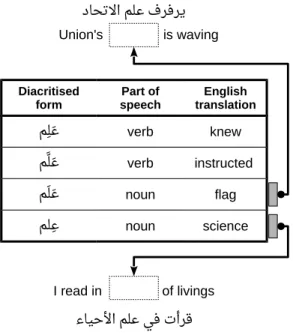
” according to the given context.three vowels and two diphthongs. Duration is a phonemic in Arabic generally, conse-quently, the phonemic inventory is expanded to include short and long variants of each phone. Arabic is written using two elements: letters, also known as graphemes, and dia-critics. In MSA, most graphemes have a one-to-one mapping to a phone. Diacritics are small strokes that are added to the top or bottom of a grapheme to lengthen its duration or attach a short vowel to it. An Arabic sentence, written using graphemes and diacritics, provides the best possible representation for its phonetic realisation. Despite the signifi-cance of diacritics in describing the phonetic realisation, the use of diacritics is optional and they are actually rarely added. Consequently, an undiacritised word is ambiguous. Every grapheme can be diacritised using one of the six combinations of diacritics; however, not all possible diacritisations are valid. A conventional Arabic dictionary provides a list of valid diacritisations for each Arabic stem, without phonetic transcriptions as in an En-glish dictionary. Each diacritised form carries its own meaning and the choice for a certain diacritised form is based on its surrounding context. Figure 1.1 illustrates an example of choosing a diacritised form for the Arabic word “
ملع
” according to the context. In the top sentence, “داحتالا ملع فرفري
” (Union’s flag is waving), the chosen diacritisation is the one suitable to fit in the context of the sentence.CA increases the level of ambiguity by introducing additional phones. Because CA is a spoken language, it does not have a standardised writing system. No standard graphemes
are assigned for these new phones. Arabic writers improvise the spelling of a given CA word inconsistently. Writers are usually influenced by their knowledge of MSA, which makes them substitute a spoken CA word with its original MSA form even if the latter does not describe the spoken word phonetically.
Arabic in general has a complex word structure. An Arabic word can be created by applying one or more modification processes to an abstract root. These processes are known as morphological processes. Inflection, a morphological process, concatenates some linguistic particles, such as pronouns, to a verb or a noun. As a consequence, an Arabic word can be equivalent to a full sentence. For example, the word “
هتملع
” is equivalent to the English sentence (I taught him). This property of Arabic allows freedom in the word order since each word almost encapsulates a self-sufficient meaning.1.2 Colloquial Arabic automatic speech recognition
Automatic speech recognition (ASR) aims to convert an acoustic speech signal into written form. To achieve state-of-the-art performance, ASR systems require transcribed speech corpora, pronunciation dictionaries and a large volume of textual data to model the large variability in the acoustics, pronunciations and word sequences respectively. Collecting or constructing these resources is a costly task where linguistic expertise is necessary.
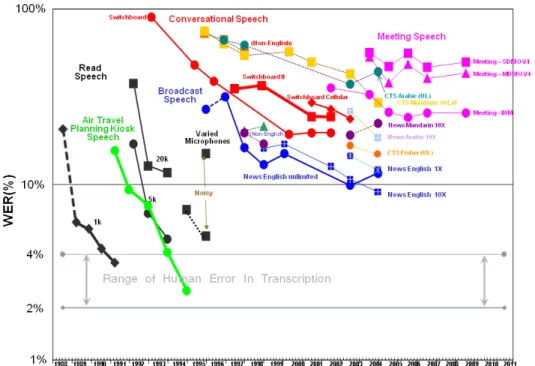
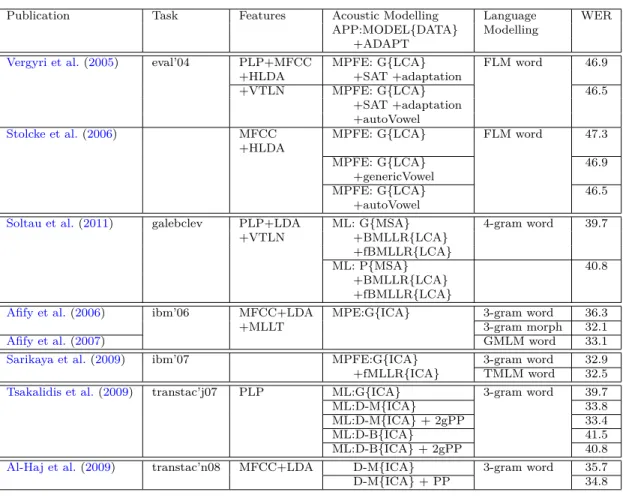
Over the past 50 years, ASR performance has improved steadily. Figure 1.2 shows an overview of the recognition performance of ASR in the NIST benchmark tests. For example, English systems for transcribing conversational speech achieved 14% word error rate in the NIST 2009 evaluation. In contrast, Egyptian CA systems in the NIST 2003 evaluation and Levantine CA systems in the NIST 2004 evaluation have significantly poorer performance with 37.5% and 46.5% word error rates respectively, three times worse performance than English systems. Reviewing more recent state-of-the-art ASR systems designed for CA, the performance range has not significantly changed. For instance, the recognition performance for Iraqi CA ASR systems achieved 32.1% WER (Afify et al.,2006) and Levantine CA ASR achieved 39.7% WER (Soltau et al.,2011).
The main reason for favouring MSA over CA in developing ASR systems is that MSA is shared by all native Arabic speakers and accepted as the formal Arabic language. As two CAs can widely differ from each other, speakers from these dialects use MSA to communicate. Hence, most language processing technology has targeted MSA instead of CA to access more users. Automatic speech recognition for Arabic, in particular for MSA, has been studied for two decades and, as for English, has improved steadily.
1.3. Motivations and problem definition
Figure 1.2: NIST STT benchmark test history 1988-2009. CA ASR performance is marked with green circles and MSA ASR performance is marked with light blue squares.
Conversational English ASR performance is marked with orange and red markers. (NIST,2009)1.
1.3 Motivations and problem definition
MSA is only accessible for literate and educated members of the Arab society and only can be learned in schools. However, CA is accessible for all Arab society as their own mother-tongue where they learn it in their homes. An educated native Arabic speaker can switch between the two variants according to the situation. For example, news anchors use MSA for broadcasting the news on air and then switch to CA when speaking to their colleagues off the air. For written communication, MSA has been used traditionally for all written correspondence whilst CA has remained only a spoken language without a standard writing system. This is starting to change with the emergence of social media, which provide an informal environment for communication. Arabic participants begin to write as they speak and consequently, more CA words have started to be used in the digital media. Without a standard writing convention, native Arabic writers improvise their own spelling which is mainly derived from MSA writing conventions.
With the increased demand of native Arabic speakers for accessing information using their own mother-tongue, more technologies emerge to facilitate using CA. As outlined above, ASR systems for CA suffer from a significant under-performance in comparison to
both conversational English and MSA ASR systems. Such highlighted difference suggests the existence of underlying modelling issues so different approaches must be considered. Several potential sources for the poor performance in CA can be identified in the following. Due to the rich morphology of Arabic, words are created from concatenating or inflect-ing, small particles at the beginning or at the end of a given word. These particles may represent pronouns and prepositions. For example, the inflected word from adding the particle “
ـلا
” (the) at the beginning of the word “ملع
” is (flag) is “ملعلا
” (the flag). Further inflection can be applied to create the word “ملعلاب
” (by/with the flag). Language models depend on counting word occurrences in a context to be able to estimate word probabilities in that context. This estimation is made for a selected word list which usually part of the seen vocabulary in the training corpus. If the two words: “ملع
” (flag) and “ملعلا
” (the flag) occur in the same context, they will be counted separately even though they are essentially referring to the same word. As a consequence, more training samples are required in order to obtain reliable word probabilities for each inflected word. In an English case, including (flag) would be sufficient to cover the three sentences: (flag), (the flag) and (with the flag), whilst in the Arabic case, all three inflected words must be included in the chosen word list to have the same lexical coverage. Otherwise, these inflected words not included in the word list cannot be recognised. If a word is not included in the chosen word list, it is referred to as an out-of-vocabulary (OOV) word. The percentage of the total occurrence of OOVs in a given text is known as the OOV rate. It is expected for languages with rich inflectional morphology, such as Arabic, to have high OOV rates. For instance, a 60K lexicon has an OOV rate of less than 1% for North American English broadcast news (Rosenfield, 1995); however, for a similar task in rich morphological languages such as Finish this rate reached 15% for a 69K lexicon (Hirsimäki et al.,2006), 10% for Estonian with a 60K lexicon (Hirsimäki et al., 2006), 9.3% for Turkish with 50K lexicon (Arısoy et al.,2008) and 5.4% for MSA with 64K lexicon (Vergyri et al.,2008).There is a large discrepancy between the written and spoken forms in MSA in gen-eral and in CA in particular. This is due to the omission of diacritics, which describe a large proportion of the phonetic realisation. English has an even larger difference between the written and spoken form; however, this is resolved by phonetic dictionaries. Phonetic dictionaries map the written form, in letters, with its spoken form, in phones. For exam-ple, the word “phone” is mapped to /foʊn/. Such dictionaries do not exist for Arabic. As aforementioned, a conventional Arabic dictionary provides a list of valid diacritisation variants for a given word without an explicit phonetic transcription. This implicitly shows an assumption that a fully diacritised variant is equivalent to a phonetic transcription. For a collection of symbols to be defined as a phoneset, i.e. a phonetic description alphabet, they must be phonetically separable. Choosing Arabic graphemes as the phonetic units
1.4. Research objectives
will not provide the desired phonetic separation because there exist multiple graphemes as-sociated with the same phone. Moreover, CA has introduced additional phones which were associated inconsistently with some of the existing graphemes, hence, multiple phones are associated with the same grapheme. This invalidates the assumption about the optimality of diacritised form as a phonetic transcription.
1.4 Research objectives
Motivated by the above discussion, the work in this thesis is divided in to two directions: first, investigating linguistic issues (Objectives 1 and 2); second, narrowing the gap between the written and the spoken forms of CA (Objectives 3 a nd 4). The following objectives were chosen to address each of the identified issues. For each objective, a definition statement along with related research questions are presented.
Objective 1: Investigate word decomposition in colloquial Arabic language modelling
Arabic is a morphologically rich language so the rate of vocabulary growth increases as the amount of training data increases. This is reflected in high out-of-vocabulary (OOV) rate, and therefore a worse recognition performance. It has been reported that using morphological decomposition of words can limit vocabulary growth. For instance, the three inflected words: “
ملع
” (flag), “ملعلا
” (the flag) and “ملعلاب
” (by/with the flag) are decomposed as follows:“
ملع
” (flag) “ملع
”“
ملعلا
” (the flag) −−−−−−−−−−→decomposed into “ملع +ـلا
” “ملعلاب
” (by/with the flag) “ملع +ـلا +ـب
”Here, the word “
ملع
” would have more reliable probability estimates. However, there has been limited work on this approach due to the lack of appropriate tools for morphologically analysing a CA sentence. To counter this, the first objective of this thesis is to investigate whether word decomposition can be effective in reducing the OOV rate and perplexity for an CA language model.Objective 2: Investigate the use of MSA resources for CA language modelling Increasing the amount of training data improves language models and their prediction ability. As discussed earlier, with the existence of inflected words, more training samples are necessary to obtain reliable word estimates and better prediction ability. Since CA is
only a spoken language, the lack of training data becomes a core obstacle to implementing language models with reliable word probabilities. However, there exists a considerable amount of textual resources in MSA that may be of some use. The second objective of this thesis is to investigate methods that use the available MSA textual resources to train a CA language model.
Objective 3: Narrow the gap between the spoken and written forms of CA
Most Arabic resources are written in undiacritised form where short vowels are not marked. A reader can infer these vowels and disambiguate words from their context. Although the diacritised form of a CA word might not equivalent to its phonetic transcription, with no doubt it describes a spoken CA word better than the undiacritised form. Therefore, re-trieving these diacritics can be considered as a first step toward narrowing the gap between the spoken word and its common written form. All the available automatic diacritisation tools either rely on the local context or require a morphological analysis preprocessing stage, and almost all of them are designed for MSA. The third objective of this thesis is to develop an automatic diacritisation technique for colloquial Arabic using a longer context and without any prior linguistic preprocessing. This is taken further with an investigation of whether the inclusion of the phonological profile, such as the associated phone classes, and paralinguistic information, e.g. a speaker’s gender and dialect, can be used as auxiliary information to improve diacritisation accuracy.
Objective 4: Find an appropriate acoustic inventory for CA
CA introduces several new phonemes to the Arabic acoustic inventory in addition to new mappings between the graphemic and phonemic systems. This creates a high level of ambiguity in generation of a pronunciation dictionary, which for Arabic is customarily derived directly from the fully diacritised written form. Thus there is a need to define a wider acoustic inventory. The fourth objective is to redefine the Arabic acoustic inventory to accommodate these new colloquial mappings, and to investigate if this new inventory has a clear mapping to the graphemic form where it can be learned in grapheme-to-phoneme techniques to generate new pronunciations to be used in speech recognition tasks.
1.5 Thesis overview
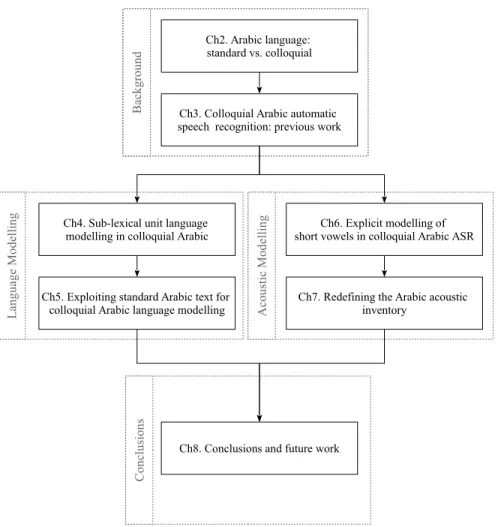
This thesis can be grouped into four parts, that are displayed in Figure 1.3. Here, each chapter is represented by a block and the dependencies between chapters are represented by arrows. Chapters are theoretically grouped with dashed lines. At first, background
1.5. Thesis overview C on cl us io ns A co us ti c M od el li ng L an gu ag e M od el li ng B ac kg ro un d B ac kg ro un
d Ch2. Arabic language: standard vs. colloquial
Ch3. Colloquial Arabic automatic speech recognition: previous work
Ch4. Sub-lexical unit language
modelling in colloquial Arabic short vowels in colloquial Arabic ASRCh6. Explicit modelling of
Ch5. Exploiting standard Arabic text for colloquial Arabic language modelling
Ch7. Redefining the Arabic acoustic inventory
Ch8. Conclusions and future work
Figure 1.3: Thesis structure. Each chapter is represented by a block and the dependencies between chapters are represented by arrows. Chapters are grouped in parts
within dashed lines.
is provided about the Arabic language (Chapter 2) and the tasks this thesis is concerned with (Chapter 3). The background from Chapters 2 and 3 is necessary for the two main contribution areas achieved in this thesis: language modelling (Chapters 4 and 5) and acoustic modelling (Chapters 6 and 7) for colloquial Arabic ASR. Chapter 8 presents conclusions and suggestions for future work. The following gives detail of the contents of each chapter.
Chapter 2 provides background information about the Arabic language and its vari-ants. It gives a thorough comparison of CA to its standard counterpart phonologically, orthographically and morphologically. It also identifies the challenges that the language properties pose for developing an ASR system. Chapter 3 provides a concise introduction to the fundamentals of ASR along with an overview of the recent advancements and state-of-the-art technologies in developing an automatic speech recognition for CA. It identifies and summarises the current gaps in this area.
Chapter 4 discusses related research that employs word decomposition, especially for inflectional and morphologically rich languages such as Arabic, Turkish and German. As this chapter covers the intended work for Objective 1, the three methods of word decom-position are explained and discussed in terms of applying them to CA text.
The majority of the work in Chapter 5 is directed towards Objective 2 of this thesis. The chapter starts with a critical discussion of techniques for importing standard Arabic resources to build colloquial Arabic language models. Then, three different techniques are proposed and applied on word-level and morph-level.
As Chapters 4 and 5 focus on language modelling issues and pursue the first two objectives of the thesis, Chapter 6 and 7 shift the focus to the acoustic and pronunciation modelling issues in CA. Normally in written text, diacritics are optionally added because they can be inferred from the word and the context, thus a considerable part of the acoustic information is not written. Chapter 6 investigates retrieving the omitted diacritics from the textual data of CA, a task which derives from Objective 3 of the thesis. Two automatic diacritisation schemes that incorporate context information are proposed and empirically evaluated on a conversational telephone speech (CTS) ASR task. The context information considered for these tools is not only derived from the textual level but also from higher levels such as the extralinguistic level. As a fully diacritised form is retrieved, Chapter 7 concentrates on Objective 4 and discusses the issues of using graphemic units in acoustic modelling and addresses each of them to reduce the resulting ambiguity in the acoustic model. As a result, two acoustic inventories are introduced along with derivation algorithms for each inventory. The proposed derivation procedures are analysed and the resulting inventories are empirically evaluated in CTS ASR tasks.
Finally, the thesis is concluded in Chapter 8, which also summarises the main contri-butions of this thesis and suggests directions for future research.
Arabic language: standard vs.
colloquial
Contents 2.1 Varieties of Arabic . . . . 12 2.2 Arabic phonology . . . . 15 2.3 Arabic orthography . . . . 18 2.3.1 Arabic graphemes . . . 18 2.3.2 Diacritics . . . 18 2.3.3 Punctuations . . . 21 2.3.4 Arabic transliteration . . . 212.4 Relation between Arabic phonemes and graphemes . . . . 21
2.5 Arabic morphology . . . . 26
2.5.1 Derivational morphology . . . 26 2.5.2 Inflectional morphology . . . 28 2.5.3 Difference between MSA and CA morphology . . . 28
2.6 Arabic syntax . . . . 29
2.7 Challenges in developing colloquial Arabic ASR . . . . 31
2.8 Summary . . . . 31
Arabic is the most popular living Semitic language and is the official language for 22 countries with around 300 million native speakers. In addition, Classical Arabic (which is one of the Arabic variants) is the liturgical language for Islam where it is learnt by 1.6 billion Muslims around the world. A variant similar to classical Arabic, known as Modern Standard Arabic (MSA), is used primarily in education and formal media and correspondence but does not exist as a native language. Arabic has changed with the
2.1. Varieties of Arabic
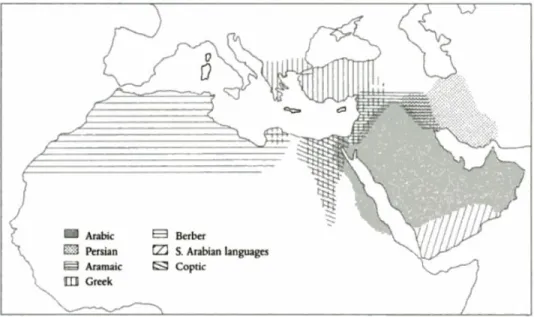
Figure 2.1: The language status at the beginning of Islamic conquests (Holes,2004)1.
exposure to other languages over the years, resulting in new variants of Arabic, namely dialects or colloquial Arabic (CA). In contrast to MSA which is taught at schools in both written and spoken forms, CA is used exclusively in informal daily conversations, is not written and is learnt at home as the native tongue.
This chapter gives a phonetic, orthographic and morphological overview of the Arabic language and its dialects. In addition, it outlines the main challenges to developing an ASR system for the language.
2.1 Varieties of Arabic
With the emergence of Islam in the fifth century, classical Arabic (CLA) was centralized in the Arabian Peninsula, and was codified by the Qur’an, the Islamic Holy book, and pre- Islamic poetry. The association with Islam made Arabic the official and religious language of Islam as it spread from the Arabian Peninsula to cover western Asia to North Africa and the south of Europe. At the beginning of the seventh century, Islamic conquests carried Arabic natives to the conquered territories and Arabic was used as the main means of communication between local residents and the incomers, who are usually Islamic officials (Holes,2004). Figure 2.1 locates the boundaries of languages at the beginning of the Islamic conquests. Arabic in those regions went through number of developments in the following period until the twelfth century. Fearing the loss of the ability to understand Qur’an 1Copyright 2004 by Georgetown University Press. From Holes (2004). Reprinted with permission.
Table 2.1: Summary of differences between the high (H) and low (L) variants of the Arabic language in a diglossic speech community as discussed by Ferguson(1959).
Aspect H variant (MSA) L variant (CA)
Function Formal. Informal.
Prestige Prestigious and beautiful. Corrupted and not real. Literary heritage Highly esteemed with long
his-tory.
Less appreciated literature such as political cartoons.
Acquisition Formal education. At home as a mother tongue. Standardization Orthography is well
estab-lished.
No settled orthography. Established norm for linguistic
resources.
No norm for linguistic re-sources.
Very limited variation in pro-nunciation.
Wide variation in pronuncia-tion.
Stability Stable. Changing.
Grammar Complex grammatical struc-ture.
Simplified grammatical struc-ture.
Lexicon Technical terms and learned ex-pressions.
Popular expressions. Phonology Considered as the basic
phono-logical system.
Evolving.
in Arabic, elite and cultured people, such as Al-Khalil (Al-Farahidi, 1980) and Sibawayh (Sibawayh,1983), codified norms and rules from their way of speaking to retain the Arabic language (Ibn Khaldoun,2001).
Until the nineteenth century, the original Arabic became exclusively written and was used only by the elite, literate society. Then, Arab countries were colonized by non-Arabic civilizations for more than fifty years, influencing the Arabic lexis and stylistics and re-sulting in the modernized version of the CLA known as Modern Standard Arabic (MSA) (Hawkins, 1983; Watson, 2002). Today, MSA is taught in schools and used for most of the written media, such as newspaper, magazines and books. Also, it is used in formal oral communication and discussions, such as in lectures, public speeches, broadcast news and most of talk shows. While the written language has maintained its morphology and syntax throughout the years, varieties of modern Arabic have developed along side it, ap-pearing in the spoken language as regional dialects which are significantly distinct from MSA phonologically, syntactically and morphologically. Ferguson (1959) was the first to refer to this sociolinguistic phenomenon as diglossia and distinguished it from a situation where two dialects co-exist within a single speech community. In diglossic speech com-munities, there are two varieties of a language where each has its functionally exclusive domains: a highly valued variant, referred to as H, that is learnt at schools and is not used for daily conversations, and a low variant, referred to as L, that is used in informal
2.1. Varieties of Arabic
Figure 2.2: Map of the Arabic dialects as mentioned inAlghamdi(2000) and Watson
(2002); The continuous spectrum of dialect variations does not take into account national borders.
conversations. According to Ferguson, H dialect is believed by its speakers to be the real language while L dialect is a corrupted form of the language. Table 2.1 summarises other differences between H and L varieties in Arabic.
There are about thirty different Arabic dialects (Lewis, 2009) which can be classified geographically, socially or phonologically. Linguists, such as Alghamdi(2000) andWatson
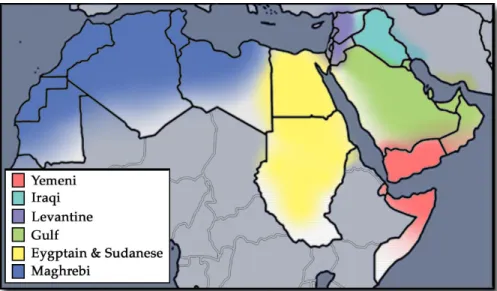
(2002), have categorized those geographically into two major groups: Mashriqi (Eastern) and Maghribi (Western) Arabic. The former includes roughly all the dialects to the east of Sudan and Chad to the border of Oman; the latter includes all the dialects to the west of that line as far as Morocco. Additionally, these groups can be divided into six dialectical families based on their origins and characteristics: Magrebi, Egyptian, Levantine, Iraqi, Gulf and Yemeni (Maisel and Shoup,2009). The approximate geographical spread of these dialects is shown in Figure 2.2. As stated by Watson(2002):
“Dialects of Arabic form a roughly continuous spectrum of variation, with the dialects spoken in the eastern and western extremes of the Arab speaking world being mutually unintelligible.”
Considering the aforementioned development of the dialects, Holes (2004) observed that socioeconomic lifestyle has a cross-cutting effect over the geographical distribution of phonological systems, especially in the Bedouin dialects. Bedouin dialects show a greater degree of similarity, in terms of their phonology and morphology, over geographical spread of the Arab world. Bedouin people reside far from the cities where interaction with other foreigners is limited. Holes accounted for the similarity across Bedouin dialects by the
slow effect of external influences, as compared with those who live in the cities, though this similarity was not observed among urban groups across national borders. For exam-ple, a Libyan and Saudi Bedouin dialects are more similar each other than their urban counterparts.
2.2 Arabic phonology
In general, by comparing the number of consonants against the number of vowels, Arabic language has a rich consonantal system compared with its limited range of vowels with twenty-eight consonants in total and only three vowels. Dialects add yet more flexibility to the vowelic system and limit some of its consonantal inventory.
This section summarizes the phonological similarities and differences between MSA and its colloquial varieties.
Consonants: there are twenty-eight distinct consonantal sounds. A set of the prominent acoustic sounds in Arabic are those articulated in the velar and postvelar regions of the vocal tract, heard in /k/, /q/, /ɣ/, /x/, /ħ/, /ʕ/, /ʔ/, and /h/2. Another evident
feature of Arabic phonology is the emphatic consonant, articulated by retracting the tongue root. These are the emphatic alveolar plosives /tˁ/ and /dˁ/, the emphatic alveolar fricative /sˁ/ and the emphatic dental fricative /ðˁ/. All Arabic consonants are illustrated in Figure 2.3.
As a part of spoken dialect development, additional phonemes appeared in some dialects, such as /g/, /v/, /tʃ/ and /p/, and some of the existing MSA phonemes disappeared or have become rarely used. For example, the uvular plosive /q/ in MSA is replaced by the glottal stop /ʔ/ in Levantine and Egyptian dialects, while it was raised to the velar plosive /g/ in Gulf and Yemeni or /k/ in Jordanian and Palestinian and softened in Sudanese to the velar fricative /ɣ/. Another example is the retraction of the articulation location from the dental, as in /θ/ and /ð/, to alveolar location, to be /s/ and /z/ respectively. More of these different realizations are summarized in Table A.1 in Appendix A.
Vowels: there are three vowels, which are the open-low front unrounded vowel, /a/, the close-high back rounded vowel, /u/, and the close-high front unrounded vowel, /i/. These vowels shift slightly to neighbouring vowels in CA and create allophones. Two 2Phonetic sounds are represented using IPA symbols (IPA,1999) between two slashes (/).
2.2. Arabic phonology Bi lab ial Lab iod en tal D en tal A lve ol ar P os tal ve ol ar R etr ofl ex P al atal V el ar U vu lar P h ar yn ge al G lottal P los ive
b
t
t
ˤ
d
d
ˤ
k
ɡ
q
ʔ
N as alm
n
Tr illr
Tap or F lapɾ
F ric ati vef
v
θ
ð
ð
ˤ
s
s
ˤ
z
z
ˤ
ʃ
ʒ
x
ɣ
ħ
ʕ
h
Late ral fr ic ati veɬ
A p p roxi man tj
Late ral a p p roxi man tl
W he re sy mb ols a pp ea r i n p air s, t he o ne to th e r ig ht re pr es en ts a v oic ed co ns on an t. Wh er e s ymb ols a pp ea r i n t w o r ow s, t he b ot to m on e r ep re se nt s e mp ha tic co ns on an ts . Sh ad ed a re as d en ot e a rti cu la tio ns ju dg ed imp os sib le . A d d iti on al so u n d s: The l ab io -‐v ela r c en tra l a pp ro xima te (w ) Figure 2.3: Arabic consonan ts sho wn in an IP A consonan ts chart ( IP A , 1999 ); grey shading marks sounds that are used in collo quial Arabic only. A dapted from Alghamdi ( 2000 ) and W atson ( 2002 )Figure 2.4: Arabic vowels shown in an IPA vowels chart (IPA,1999); vowels in grey appear in CA only. Adapted fromAlghamdi(2000) andWatson(2002).
phones are considered allophones if they are perceived as a single phoneme. Gen-erally, the open-low front unrounded vowels /a/ may retract to the open-low back unrounded vowel /ɑ/ when it occurs with emphatic consonants while it may raise to the open-mid vowel /æ/ when it occurs with labial consonants. In contrast, both close vowels, /i/ and /u/, are lowered to the close-mid vowels /e/ and /o/, respec-tively, especially for loanwords such as /ʃokola:ta/ (chocolate). Some western Arabic dialects today merge two vowels together, either /i/ and /u/ or /a/ and /u/ into /ə/(Watson,2002). Eastern Arabic dialects offer a more flexible vowel system than MSA. Figure 2.4 locates the Arabic vowels on the IPA schematic vowels chart (IPA,
1999) and shows in grey the vowels that are used in dialects but not in MSA. Diphthongs: two diphthongs exist in MSA, which are: /aw/ and /aj/, but they are less
frequently used in dialects and might be replaced with other vowels such as /o/ and /e/ respectively (Watson, 2002). For instance, the Arabic word for “sword” is pronounced as /sajf/ in MSA but as /se:f/ in CA, and the word for “turn” is pronounced as /dawr/ in MSA but as /do:r/ in CA.
Duration is phonemic in Arabic by which a phone is pronounced for an audibly longer time, usually twice the length of a normal phone (Alghamdi, 2000). Consequently, the basic Arabic phonemeic inventory is composed of 64 phonemes made of short and long phones. Longer consonants are called geminated consonants. For example, for the word /darasa/ (he studied), if the first vowel /a/ is pronounced longer, i.e. /da:rasa/, it means (he studied together with), whereas the word /dar:asa/ with a geminated /r/ means (he taught). Generally, phonetic duration is retained in most Arabic dialects except for dialects
2.3. Arabic orthography
that replace some short vowels with /ə/. In such dialects, long vowels become shorter while keeping their vowelic quality (Holes,2004).
2.3 Arabic orthography
In this section, a brief overview of how words and sentences are written in the Arabic language will be given. The Arabic phonemic inventory is represented through script that is written from right to left using graphemes, or letters, along with diacritics above and below those letters. Letters are connected together horizontally from right to left to form words. The words follow each other and are separated by a blank or a white space to constitute a sentence.
2.3.1 Arabic graphemes
There are thirty-six different graphemes in the Arabic writing system, where each one of them alters its shape according to its position in the word, whether it is in an initial, middle, final or isolated position. The main goal for having these different shapes is to connect those letters together into one continuous unit that forms a word. However, not all letters can be connected from both sides. Figure 2.5 lists all different shapes for each Arabic graphemes along with their names. Some graphemes have restrictions on which position in a word they are allowed to appear at, shown as symbol “_” in Figure 2.5, for instance (
ؤ
) and (ئ
) cannot begin a word while (ة
) and (ى
) can only appear as word endings.2.3.2 Diacritics
The Arabic writing system uses eight diacritics to represent phonetic phenomena. Some of these diacritics are phonemic and some are morphemic and syntactic, i.e. they identify the word case or state but not the meaning. Three of these diacritics are used to represent the short vowels that can be written above the letter (/a/ and /u/) or below it (/i/) and another three diacritics mark nominal indefiniteness in MSA, known as nunation, which adds /n/ to the attached short vowel. There exists a special diacritic that is written above a consonant to represent its geminated version where it can be combined with any of the previous diacritics as shown in Figure 2.6. Finally, there is also a diacritic for marking the absence of vowels.
Lunar graphemes Lunar graphemes Lunar graphemes Lunar graphemes Lunar graphemes Lunar graphemes
Lunar graphemes Solar graphemesSolar graphemesSolar graphemesSolar graphemesSolar graphemesSolar graphemesSolar graphemes
Buckwalter NameName Final Medial Initial Isolated Buckwalter NameName Final Medial Initial Isolated
| alif !"أ $ـ $ـ آ آ t taa ء() *ـ ـ+ـ ـ) ت > alif !"أ -ـ -ـ أ أ v thaa ء(. /ـ ـ0ـ ـ. ث < alif !"أ ــــ ــــ إ إ d dal لاد 6ـ 6ـ د د ʻ hamza ة89: ء ء ء ء * thal لاذ <ـ <ـ ذ ذ
& hamza ة89: =ـ =ـ ــــ ؤ r raa ءار @ـ @ـ ر ر
}
hamza ة89:
Aـ ـBـ ــــ ئ z zain DEز 8ـ 8ـ ز ز
b baa ء(G Hـ ـIـ ـG ب s seen KL Mـ ـNـ ـL س
j jeem PQR Sـ ـTـ ـR ج $ shen KV Wـ ـXـ ـV ش
H haa ء(Z [ـ ـ\ـ ـZ ح S sad د(^ _ـ ـ`ـ ـ^ ص
x khaa ء(b cـ ـdـ ـb خ D dhad د(f gـ ـhـ ـf ض
E ayn Kj kـ ـlـ ـj ع T taa ء(n oـ ـpـ ـn ط
g ghayn Kr sـ ـtـ ـr غ Z thaa ء(v wـ ـxـ ـv ظ f faa ء(z !ـ ـ{ـ ـz ف l lam م~ •ـ ـ€ـ ـ" ل q quaf ف(• ‚ـ ـƒـ ـ• ق n noon ن†‡ Dـ ـˆـ Dـ ن k kaf ف(‰ Šـ ـ‹ـ ـ‰ ك m meem PQ• Pـ ـ9ـ ـ• م h haa ء(: Žـ ـ•ـ ـ: ه p marbwtataa ء() ‘n†G@• ‘ـ ــــ ــــ ة
Glides and long vowels graphemes Glides and long vowels graphemes Glides and long vowels graphemes Glides and long vowels graphemes Glides and long vowels graphemes Glides and long vowels graphemes Glides and long vowels graphemes
Buckwalter NameName Final Medial Initial Isolated
A alif !"أ (ـ (ـ ا ا
Y maqswraalif ةر&''()*!"أ ’ـ ــــ ــــ ى
w waw واو †ـ †ـ و و
Figure 2.5: Writing system for the Arabic language. Graphemes are grouped into three sections: Lunar, Solar and Glides and long vowel graphemes. All possible shapes a grapheme can take according to its position within a word are shown along with its name
written in Arabic script and Roman letters. The symbol “_” is shown when a grapheme is not allowed at a certain position within a given word. Buckwlater transliteration