ARCHITECTURE- AND WORKLOAD-AWARE
GRAPH (RE)PARTITIONING
by
Angen Zheng
BS, Beijing Information Science and Technology University, 2009
MS, Beijing University of Posts and Telecommunications, 2012
Submitted to the Graduate Faculty of
the DIETRICH SCHOOL OF ARTS AND SCIENCES in partial
fulfillment
of the requirements for the degree of
Doctor of Philosophy
University of Pittsburgh
2017
UNIVERSITY OF PITTSBURGH
DIETRICH SCHOOL OF ARTS AND SCIENCES
This dissertation was presented by
Angen Zheng
Dr. Alexandros Labrinidis, Department of Computer Science, University of Pittsburgh Dr. Panos K. Chrysanthis, Department of Computer Science, University of Pittsburgh
Dr. Jack Lange, Department of Computer Science, University of Pittsburgh Dr. Peyman Givi, Department of Mechanical Engineering and Materials Science,
University of Pittsburgh
Dissertation Director: Dr. Alexandros Labrinidis, Department of Computer Science, University of Pittsburgh
ARCHITECTURE- AND WORKLOAD-AWARE GRAPH (RE)PARTITIONING
Angen Zheng, PhD University of Pittsburgh, 2017
Graph partitioning and repartitioning have been studied for several decades. Yet, they are receiving more attention due to the increasing popularity of large graphs from various do-mains, such as social networks, web networks, telecommunication networks, and scientific simulations. Traditional well-studied graph (re)partitioners often scale poorly against these continuously growing graphs. Recent works on streaming graph partitioning and lightweight graph repartitioning usually assume a homogeneous computing environment. However, mod-ern parallel architectures may exhibit highly non-uniform network communication costs. Several solutions have been proposed to address this, but they all consider the network as the primary bottleneck of the system, even though transferring data across modern high-speed networks is now as fast as the local memory access. As such, minimization of the network data communication may not be a good choice. We found that putting too much data communication into partitions assigned to cores of the same machines may result in serious contention for the shared hardware resources (e.g., last level cache, memory con-troller, and front-side bus) on the memory subsystems in modern multicore clusters. The performance impact of the contention can even become the dominant factor in limiting the scalability of the workload, especially for multicore machines connected via high-speed net-works. Another issue of existing graph (re)partitioners is that they are usually not aware of the runtime characteristics of the target workload. To enable efficient distributed graph com-putation, this thesis aims to (1) understand the performance impact of non-uniform network communication costs, the impact of contention on the memory subsystems, as well as the
impact of workload runtime characteristics on distributed graph computation; and (2) design and implement new scalable graph (re)partitioners that take these factors into account.
TABLE OF CONTENTS
PREFACE . . . xix
1.0 INTRODUCTION . . . 1
1.1 Research Overview . . . 3
1.1.1 Thesis Statement . . . 3
1.1.2 Target Computing Infrastructure . . . 3
1.1.3 Assumptions . . . 4
1.1.4 Main Contributions . . . 4
1.1.5 Main Impact . . . 6
1.2 Outline . . . 6
2.0 BACKGROUND AND MOTIVATION . . . 8
2.1 Literature Review . . . 8
2.1.1 Distributed Graph Computation . . . 8
2.1.2 Graph Partitioning and Repartitioning . . . 9
2.2 Importance of Architecture-Awareness . . . 12
2.2.1 Network Characteristics of Modern HPC Infrastructures . . . 13
2.2.2 Resource Contention on HPC Memory Subsystems . . . 14
2.2.3 Understanding the Performance Impact of Heterogeneity and Con-tentiousness . . . 17
3.0 ARCHITECTURE-AWARE STATIC GRAPH PARTITIONING . . . 21
3.1 Problem Statement . . . 21
3.2 ARGO: Architecture-Aware Graph Partitioning. . . 22
3.2.1.1 Graph Partitioning Model . . . 22
3.2.1.2 Incorporating Heterogeneity Awareness . . . 23
3.2.1.3 Incorporating Contention Awareness . . . 24
3.2.2 Evaluation . . . 25
3.2.2.1 Setup . . . 25
3.2.2.2 Effectiveness of Being Architecture-Aware . . . 27
3.2.2.3 Scalability in terms of Graph Size . . . 30
3.2.2.4 Scalability in terms of Number of Partitions. . . 31
3.3 Chapter Summary . . . 33
4.0 ARCHITECTURE-AWARE DYNAMIC GRAPH PARTITIONING . 34 4.1 Problem Statement . . . 34
4.2 ARAGON: Architecture-Aware Graph Repartitioning . . . 37
4.2.1 Algorithm Design and Implementation. . . 37
4.2.1.1 Inter-Node Graph Repartitioning. . . 37
4.2.1.2 Intra-Node Graph Repartitioning. . . 42
4.2.2 Evaluation . . . 44
4.2.2.1 Setup . . . 44
4.2.2.2 Varying Number of Partitions . . . 46
4.2.2.3 Varying Number of Computation Steps . . . 47
4.2.2.4 Varying Sized 3D-Torus . . . 48
4.2.2.5 Communication and Migration Volume Breakdown . . . . 49
4.2.2.6 Degree of Imbalance . . . 50
4.2.2.7 Repartition Time . . . 50
4.2.3 Section Summary . . . 51
4.3 PARAGON: Parallel Architecture-Aware Graph Repartitioning . . . 52
4.3.1 Algorithm Design and Implementation. . . 52
4.3.1.1 Partition Grouping . . . 53
4.3.1.2 Shuffle Refinement. . . 55
4.3.1.3 Group Server Selection . . . 56
4.3.1.5 Master Node Selection . . . 57
4.3.1.6 Incorporating Contention-Awareness . . . 58
4.3.2 Evaluation . . . 58
4.3.2.1 Setup . . . 58
4.3.2.2 MicroBenchmarks . . . 60
4.3.2.3 Real-World Applications (BFS & SSSP) . . . 65
4.3.2.4 Billion-Edge Graph Scaling . . . 68
4.3.3 Section Summary . . . 69
4.4 PLANAR and PLANAR+: Parallel Lightweight Architecture-Aware Graph Repartitioning . . . 70
4.4.1 PLANAR: Algorithm Design and Implementation . . . 70
4.4.1.1 Phase-1a: Minimizing Communication Cost . . . 71
4.4.1.2 Phase-1b: Ensuring Balanced Partitions . . . 74
4.4.1.3 Phase-2: Physical Vertex Migration . . . 77
4.4.1.4 Phase-3: Convergence . . . 77 4.4.1.5 Incorporating Contention-Awareness . . . 78 4.4.2 PLANAR: Evaluation . . . 79 4.4.2.1 Setup . . . 79 4.4.2.2 Parameter Selection . . . 81 4.4.2.3 Microbenchmarks . . . 81
4.4.2.4 Real-World Applications (BFS & SSSP) . . . 85
4.4.2.5 Billion-Edge Graph Scaling . . . 87
4.4.3 PLANAR+: Optimized PLANAR . . . 90
4.4.3.1 Eliminating Per Adaptation Superstep Physical Vertex Mi-gration . . . 90
4.4.3.2 Optimizing Network Communication Cost Measurement . 91 4.4.3.3 Optimizing Vertex Gain Computation . . . 93
4.4.4 PLANAR+: Evaluation . . . 96
4.4.4.1 Setup . . . 96
4.4.4.3 Scalability Study. . . 100
4.4.4.4 Real-World Workload (PageRank) . . . 102
4.4.5 Section Summary . . . 104
5.0 SKEW-RESISTANT GRAPH PARTITIONING . . . 106
5.1 Traversal-Style Graph Workload Characterization . . . 107
5.1.1 Active Vertex Distribution Across Supersteps (Table 5.1) . . . 108
5.1.2 Active Vertex Distribution Across Partitions (Fig. 5.1 & 5.2) . . . 109
5.1.3 Workload Predictability (Fig. 5.3 & 5.4) . . . 111
5.2 Multi-Label Graph Partitioning . . . 113
5.2.1 Problem Statement . . . 113
5.2.2 Streaming-Based Implementation . . . 114
5.2.2.1 Graph Partitioning Model . . . 114
5.2.2.2 Streaming Heuristic . . . 114
5.2.2.3 Restreaming Model . . . 115
5.3 Skew-Resistant Graph Partitioning. . . 115
5.3.1 MLGP: Traversal-Style Graph Workloads . . . 116
5.3.1.1 Avoiding Algorithmic Skewness. . . 116
5.3.1.2 Avoiding Structural Skewness . . . 116
5.3.2 MLGP: Multiphase Graph Workloads . . . 117
5.3.3 MLGP: Graph Database Partitioning . . . 117
5.4 Evaluation . . . 118
5.4.1 Setup . . . 118
5.4.2 Microbenchmarks . . . 119
5.4.2.1 Effectiveness in terms of Skewness . . . 119
5.4.2.2 Effectiveness in terms of Partitioning Quality . . . 120
5.4.3 Real-World Workloads (BFS & SSSP) . . . 121
5.4.4 Scalability Study. . . 123
5.4.4.1 Scalability in terms of Graph Size . . . 123
5.4.4.2 Scalability in terms of # of Partitions . . . 124
6.0 CONCLUSIONS AND FUTURE WORK. . . 126
6.1 Main Contributions . . . 126
6.2 Main Impact . . . 129
6.3 Discussion and Future Work . . . 130
LIST OF TABLES
2.1 State-of-the-art Graph (Re)Partitioners. . . 12
2.2 Intra-node shared resource contention. . . 16
2.3 Workload execution time in seconds on com-orkut dataset . . . 18
2.4 Workload LLC misses in millions on com-orkut dataset . . . 20
3.1 Datasets used in our experiments . . . 26
3.2 Cluster compute node configuration . . . 26
3.3 Workload execution time in seconds on com-orkut dataset with varying mes-sage grouping size. . . 27
3.4 Workload LLC misses in millions on com-orkut dataset with varying message grouping size . . . 28
3.5 Workload execution time in seconds as the graph size increased . . . 30
3.6 Workload execution time in seconds as the # of partitions increased . . . 31
4.1 Relative network communication costs . . . 38
4.2 Original combustion simulation dataset . . . 44
4.3 Synthetic datasets . . . 44
4.4 Four flavors ofAragon . . . 45
4.5 Cache access latencies . . . 46
4.6 Degree of imbalance . . . 50
4.7 Datasets used in our experiments . . . 59
4.8 Cluster compute node configuration . . . 60
4.9 BFS job execution time (s) . . . 65
4.11 Relative network communication costs . . . 73
4.12 BFS job execution time (s) . . . 86
4.13 SSSP job execution time (s) . . . 86
4.14 Skewness of the resulting decompositions . . . 100
4.15 PageRank communication volume breakdown in GB . . . 104
5.1 Active vertex distribution across supersteps of BFS & SSSP execution with one randomly selected source vertex . . . 108
5.2 BFS and SSSP execution time in seconds on com-orkut dataset with varying message grouping size . . . 122
5.3 BFS execution time in seconds with 10 randomly selected source vertices on varying sized graphs . . . 123
5.4 BFS execution time in seconds with 10 randomly selected source vertices on varying number of partitions. . . 124
6.1 A summary of the Proposed Graph Repartitioners: Part1. . . 128
LIST OF FIGURES
2.1 Example architectures of modern compute nodes . . . 13
2.2 Theoretic bandwidth for different generations of InfiniBand and memory tech-nologies [16]. . . 15
2.3 Memory transactions of inter- and intra-node data communication . . . 16
3.1 Breakdown communication volume for the execution of BFS, SSSP, and PageR-ank on com-orkut partitionings. . . 29
3.2 Partitioning time on Twitter dataset . . . 32
3.3 Argo partitioning time as a percentage of CPU time saving . . . 32
4.1 Old Decomposition . . . 38
4.2 Better Decomposition . . . 38
4.3 Best Decomposition . . . 38
4.4 Topology Tree. . . 42
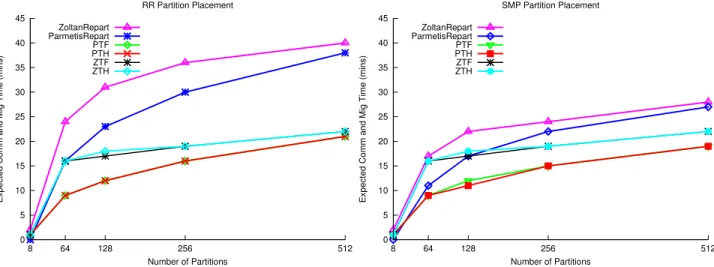
4.5 Varying num. of partitions (RR) . . . 46
4.6 Varying num. of partitions (SMP) . . . 46
4.7 Num. of computation steps . . . 48
4.8 Different sized 3D-torus . . . 48
4.9 Normalized communication and migration volume distribution in terms of the number of hops each byte travels. . . 49
4.10 Refinement time and normalized communication costs of the com-lj decom-positions after being refined with varying degree of refinement parallelism on two 20-core compute nodes. . . 61
4.11 Y-axis corresponds to the communication costs of the com-lj decompositions after being refined with varying number of shuffle refinement times on two 20-core compute nodes when they were normalized to that of the decompositions refined by Aragon; X-axis denotes the corresponding refinement time; the
labels on each data point were the number of refinement times. . . 62
4.12 Communication cost of the initial decompositions computed by HP, DG, LDG, and Metis across cores of two 20-core compute nodes for a variety of graphs. . . 63
4.13 Paragon’s sensitivity to varying initial decompositions in terms of the com-munication cost for a variety of graphs, which were initially partitioned by HP, DG,LDG, and Metis across cores of two 20-core compute nodes.. . . 63
4.14 Overhead of the refinement on varying decompositions that were initially par-titioned by HP, DG, LDG, and Metis across cores of two 20-core compute nodes. . . 64
4.15 The breakdown of the accumulated communication volume across all super-steps for BFS on PittMPICluster. . . 66
4.16 The breakdown of the accumulated communication volume across all super-steps for BFS on Gordon. . . 66
4.17 BFS JET with Graph Dynamism . . . 67
4.18 BFS JET vs Graph Size . . . 68
4.19 Refinement Time vs Graph Size . . . 68
4.20 Old Decomposition . . . 72
4.21 Better Decomposition . . . 72
4.22 Best Decomposition . . . 72
4.23 Planar parameter selection. . . 80
4.24 Planar parameter selection. . . 80
4.25 Planar parameter selection. . . 80
4.26 Planar parameter selection. . . 80
4.27 Communication costs of the initial decompositions partitioned by HP, DG, LDG, and Metis into 40 partitions. . . 82
4.28 Communication cost of the resulting decompositions and improvement achieved after runningPlanar over varying initial decompositions generated byHP,
DG, LDG, and Metis across two 20-core machines. . . 82
4.29 Overhead of the adaptation on varying initial decompositions computed by HP, DG,LDG, and Metis into 40 partitions. . . 83
4.30 Planar converge time in terms of supersteps . . . 84
4.31 Planar convergence study on the wave dataset . . . 84
4.32 Planar convergence study on the com-lj dataset . . . 84
4.33 The communication volume breakdown of SSSP on both clusters. . . 87
4.34 BFS Job Execution Time (JET) . . . 88
4.35 Repartitioning Time . . . 89
4.36 Percentage of hopcut and edgecut reduced by the repartitioners over the de-compositions initially generated by LDG. . . 98
4.37 Percentage of vertices migrated the repartitioners . . . 99
4.38 Percentage of hopcut reduced after running the repartitioners over the de-compositions with varying number of partitions. . . 100
4.39 Repartition time of the repartitioners over the decompositions with varying number of partitions. . . 101
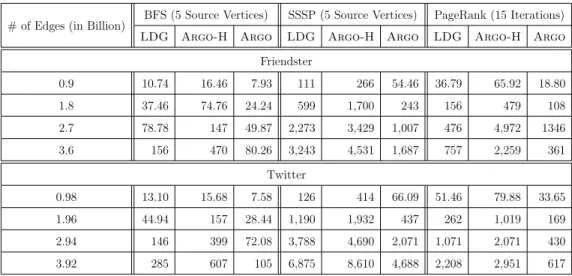
4.40 PageRank execution time on Friendster and Twitter datasets with varying message grouping sizes.. . . 102
5.1 BFSactive vertex distribution across partitions for the most time-consuming superstep (Step 4 of Table 5.1) on com-orkut dataset with one randomly selected source vertex. The distribution was measured, when the graph was partitioned across six 20-core machines with one partition per core. . . 110
5.2 BFSactive high-degree vertex distribution across partitions for the most time-consuming superstep (Step 4 of Table 5.1) on com-orkut dataset with one randomly selected source vertex. The distribution was measured, when the graph was partitioned across six 20-core machines with one partition per core. 110 5.3 Repeatability of BFS and SSSP execution trace: tr1 with respect to different traces on the Orkut dataset. . . 112
5.4 Distribution of BFS and SSSP execution trace repeatability across all trace pairs. . . 112
5.5 Active (high-degree) vertex distribution across partitions for the most time-consuming superstep of a BFS execution on com-orkut dataset with one randomly selected source vertex. The distribution was measured when the dataset was partitioned across six 20-core machines with one partition per core.120
5.6 The quality of the partitionings computed by different partitioners over a variety of graphs, as well as the corresponding partitioning overhead (in log scale). The datasets presented were partitioned across six 20-core machines with one partition per core. . . 121
LIST OF ALGORITHMS
1 TopoFM. . . 40
2 Paragon . . . 53
3 Planar Overview . . . 70
4 Phase-1a: Vertex Migration . . . 71
5 Phase-1b: Quota Allocation . . . 75
6 Phase-1b: Vertex Migration . . . 77
7 Planar+ Full Repartitioning . . . 90
8 Phase-1a: Migration Destination Selection . . . 94
9 Planar: Vertex Gain Computation . . . 94
LIST OF EQUATIONS 3.1 Equation (3.1) . . . 21 3.2 Equation (3.2) . . . 21 3.3 Equation (3.3) . . . 22 3.4 Equation (3.4) . . . 23 3.5 Equation (3.5) . . . 23 3.6 Equation (3.6) . . . 23 3.7 Equation (3.7) . . . 24 4.1 Equation (4.1) . . . 34 4.2 Equation (4.2) . . . 35 4.3 Equation (4.3) . . . 36 4.4 Equation (4.4) . . . 36 4.5 Equation (4.5) . . . 39 4.6 Equation (4.6) . . . 39 4.7 Equation (4.7) . . . 39 4.8 Equation (4.8) . . . 40 4.9 Equation (4.9) . . . 40 4.10 Equation (4.10) . . . 40 4.11 Equation (4.11) . . . 43 4.12 Equation (4.12) . . . 56 4.13 Equation (4.13) . . . 58 4.14 Equation (4.14) . . . 72 4.15 Equation (4.15) . . . 72
4.16 Equation (4.16) . . . 72 4.17 Equation (4.17) . . . 72 4.18 Equation (4.18) . . . 73 4.19 Equation (4.19) . . . 74 4.20 Equation (4.20) . . . 76 4.21 Equation (4.21) . . . 94 4.22 Equation (4.22) . . . 94 4.23 Equation (4.23) . . . 94 4.24 Equation (4.24) . . . 95 4.25 Equation (4.25) . . . 95 4.26 Equation (4.26) . . . 95 5.1 Equation (5.1) . . . 111 5.2 Equation (5.2) . . . 113 5.3 Equation (5.3) . . . 113 5.4 Equation (5.4) . . . 114 5.5 Equation (5.5) . . . 114 5.6 Equation (5.6) . . . 114 5.7 Equation (5.7) . . . 115 6.1 Equation (6.1) . . . 128
PREFACE
First and foremost, I want to thank my advisor Alexandros Labrinidis and co-advisor Panos K. Chrysanthis. It has been an honor to be their Ph.D. student. They have taught me, both consciously and unconsciously, how good scientific research is done. I appreciate all their contributions of time, ideas, and funding to make my Ph.D. experience productive and stimulating.
The members of the ADMT group have contributed immensely to my personal and professional time at Pitt. The group has been a source of friendships as well as good advice and collaboration.
For this dissertation, I would like to thank my thesis committee members: Alexandros Labrinidis, Panos K. Chrysanthis, Jack Lange, Peyman Givi, and Patrick Pisciuneri for their time, interest, insightful questions, and helpful comments. I would also like to thank Christos Faloutsos at the Carnegie Mellon University for his collaboration on the last piece of my thesis work. I also want to thank Juli Stresing, Wenchen Wang, Zhaohong Wu, and Xiang Xiao for proofreading my thesis.
I gratefully acknowledge the funding sources that made my Ph.D. work possible. My work was supported by the NSF awards CBET-1250171, CBET-1609120, and OIA-1028162. My time at Pitt was made enjoyable in large part due to the many friends and groups that became a part of my life. I am grateful for the time spent with roommates and friends, and for many other people and memories.
1.0 INTRODUCTION
Large graph datasets are becoming increasingly popular nowadays. For example, graphs like Web Graphs, Biological Networks, and Social Networks, are often at the scale of hundreds of billions or even a trillion (1012) edges, and they are continuously growing. As a consequence, many distributed graph computing frameworks, such as Pregel [1], GraphLab [2] and Pow-erGraph [3], have been developed. In addition to the data that is inherently represented as graphs, many problems in scientific simulations [4] as well as machine learning and data mining [2] can be modeled as graph problems.
In such systems, distributing vertices of the graph evenly across partitions often cor-responds to an even load distribution, while minimizing the edgecut (the number of edges connecting different partitions) helps minimize the amount of data communication. This is known as the balanced graph partitioning problem. Balanced graph partitioning has been extensively studied and proved to be NP-hard [5, 6, 4, 7, 8, 9, 10]. The most well-known heuristic-based approaches are multi-level ones [5, 6,4] and streaming ones [8,9, 10].
One of the pitfalls of a big portion of the proposed solutions is that minimal data com-munication does not always mean minimal network comcom-munication cost, since the comput-ing infrastructures may exhibit highly non-uniform network communication costs. Several
hopcut-based solutions [11, 12, 13, 14] have been proposed to make the graph partitioning procedure aware of the issue of non-uniform network communication costs.
Nevertheless, both edgecut- and hopcut-based solutions are designed with the assumption that the network is the primary bottleneck and should be avoided at all costs. This assumption has been broken by new advancements in HPC (high performance computing) infrastruc-tures. It is common to see clusters that are, nowadays, connected via high-performance networks with RDMA (remote direct memory access) capabilities, like Infiniband. In fact,
Infiniband was reported to connect 65% of the HPC platforms, and 39% of the overall TOP500 systems by November 2016 [15]. It was also reported that transferring data across the network (like Infiniband) has been almost as fast as local memory access [16]. The next generation of Infiniband (EDR Infiniband) is even able to deliver up to 100Gbps net-work bandwidth. As a result, focusing on minimizing netnet-work data communication may not always lead to performance improvement.
At the same time, the microprocessor industry has shifted from boosting the clock speed of uniprocessors to multicore processors by continuously integrating many small processing units onto a single chip. Multicore machines nowadays have become the backbone of modern HPC infrastructures. Due to the increasing core count per node, the contention for the shared resources (e.g., last level cache, memory controller, and front-side bus) on the memory subsystems is becoming more and more notorious. It has been shown that the contention can significantly impact the performance of the collocated workloads [17,18] even for collocated processes from the same distributed workload [19]. What is even worse is that the core count per node is continuously increasing. It is expected that there will be nodes with hundreds of cores in the near future. The fast development of high-speed networks further aggravates the issue. Nevertheless, none of the existing graph partitioning algorithms is aware of the contention issue. In fact, they may even increase the degree of the contention on the memory subsystems, especially the hopcut-based solutions. This is because existing solutions always try to avoid network data communication even at the cost of increasing intra-node data communication (data communication among partitions assigned to cores of the same machine), despite the fact that excess intra-node data communication may saturate the memory subsystems, amplifying the contention.
As mentioned earlier, existing graph (re)partitioners often assume that distributing ver-tices of the graph evenly across partitions corresponds to an even load distribution. In other words, they assume that vertices of the graph are always active during the computation. Nevertheless, for some workloads, like Breadth-First Search (BFS) and Single-Source Short-est Path (SSSP), only a subset of the vertices participate in the computation in a specific time period. As a result, the execution of such workloads on the partitionings computed by existing graph (re)partitioners may suffer from significanttime-varying skewness, leading to
resource underutilization. Another issue of existing graph (re)partitioners is that many of them assume that vertices of the graph have uniform computation requirements and uni-form communication requirements with their neighbors. Nevertheless, the computation and communication requirements of the vertices are highly application-dependent.
In this dissertation, we argue that computations performed on the partitionings com-puted by existing graph partitioning algorithms could not always fully utilize the underlying computing infrastructures, which impedes the efficiency of the computing infrastructures as well as the scalability of the target workload. To enable efficient distributed graph compu-tation on modern HPC infrastructures, we advocate for architecture- and workload-aware graph partitioning. Architecture-aware means that we should consider the performance im-pact of these new hardware trends while partitioning, whereas workload-aware indicates that the (re)partitioner should be aware of the runtime characteristics of the target workload.
1.1 RESEARCH OVERVIEW
1.1.1 Thesis Statement
Architecture- and workload-aware graph partitioning enables efficient distributed graph com-putation on modern HPC infrastructures.
1.1.2 Target Computing Infrastructure
In this thesis, we study the graph partitioning problem for distributed graph computing on
dedicated HPC clusters. In such clusters, the compute nodes are equipped with multiple CPU sockets and each CPU socket has multiple cores. Compute nodes of the cluster are often connected via high-speed networks, like Infiniband. To perform a computation on such systems, users need to first submit their jobs to the cluster. The cluster manager will allocate the resources requested for the user. Once allocated, the user will have dedicated access to the allocated resources.
1.1.3 Assumptions
In our study of the problem, we assume (1) that graphs are partitioned across cores of the allocated compute nodes with one partition per core for parallel processing; (2) that the mapping of a partition to a core, as well as the number of partitions remains unchanged throughout the computation; and (3) that the set of the allocated cores used for graph processing is also the set of cores used for the (re)partitioning.
1.1.4 Main Contributions
We first investigated the performance impact of the new hardware trends (i.e., multicore machines connected via high-speed networks) on distributed graph workloads. As a result of this study, we identified two important factors that one should be aware of while partitioning the graphs: (a) the non-uniform network communication costs of the underlying computing infrastructures; and (b) the contention for the shared hardware resources on the memory subsystems of modern HPC clusters. We also provided a holistic view on: (a) why we have to be aware of such factors for distributed graph workloads; and (b) to what extent these factors may impact the performance of distributed graph workloads.
To avoid such negative performance impact, we proposed anarchitecture-aware graph partitioning algorithm, Argo [20], for efficient distributed graph computation on static
graphs. Argo follows the same streaming partitioning model proposed by others. In this
model, vertices arrive at the partitioner in a certain order along with their adjacency lists. The partitioner decides the placement of each newly arrived vertex to one of the partitions permanently based on the placements of the vertices previously arrived. The key novelty of
Argo lies in making the vertex placement aware of (a) the non-uniform network
communi-cation costs of the underlying computing infrastructures; and (b) the contentiousness of the memory subsystems of modern HPC clusters. We also makeArgoaware of the non-uniform
computation and communication requirements of the vertices by encoding such information into the vertex and edge weights of the graph. Since making the (re)partitioner aware of such workload characteristics is fairly straightforward, we will primarily focus on the discussion of architecture-awareness throughout the thesis.
We also proposed four new architecture-aware graph repartitioning algorithms:
Aragon [21], Paragon [22], Planar [23], and Planar+ [24] for efficient distributed
graph computation on dynamic graphs. They all attempt to adapt the current partitioning to the changes in the graph by migrating vertices among the partitions. The migration is only allowed if the gain of moving the vertex from its current partition to an alternative partition is positive. The gain of migrating a vertex is defined as the reduction in the com-munication cost incurred by the vertex during the computation. One of the key contributions of this thesis is that we make the vertex gain computation process aware of both the com-munication heterogeneity and contentiousness of the underlying computing infrastructures. Nevertheless, Aragon is a centralized solution with the assumption that the graphs are
small enough to be held in the memory of a single machine, whereas Paragonis a parallel
version of Aragon designed for median-sized graphs. Planar and Planar+ overcome
the drawbacks of Paragonby scaling it to even larger graphs and by increasing the degree
of parallelism the repartitioning algorithm can have. In addition to being highly scalable, the partitionings computed by them also have much lower hopcut/edgecut than that ofAragon
and Paragon. Planar+ further reduces the overhead of Planar, by introducing an
effi-cient way of modeling the communication heterogeneity and contentiousness. This, in turn, enables an optimized vertex gain computation. Making the partitioning algorithms scale efficiently against large graphs is another key contribution of the thesis. Similar to Argo, Aragon,Paragon,Planar, andPlanar+are all aware of the non-uniform computation
and communication requirements of the vertices.
Finally, we examine a special type of workload-aware graph partitioning: skew-resistant graph partitioning. In particular, we would like to distribute the vertices that are ac-tive in the same time period evenly across the partitions and thus avoid the issue of time-varying skewness. Towards this, we studied the runtime characteristics of two representative traversal-style graph workloads: BFS and SSSP. Based on the study, we introduced the idea of multi-label graph partitioning (MLGP) and an application of this idea is to do skew-resistant graph partitioning. We also identified a set of target workloads that MLGP can be applied to.
1.1.5 Main Impact
The main impact of this thesis is that we identified an important aspect that has been ignored by the current graph processing community, that is, the performance impact of the underlying HPC infrastructures, especially the contentiousness of the memory subsystems, on distributed graph computation. In fact, this is also a blind spot for general distributed computation, where people often assume that the network is the bottleneck.
In particular, we made an in-depth analysis about the factors that one should consider while (re)partitioning the graph for distributed graph computing, namely, the non-uniform network communication costs (Section 2.2.1) and the contention on the memory subsys-tems (Section 2.2.2). We also experimentally demonstrated that (1) the network may not always be the bottleneck in modern HPC clusters (Section 2.2.3); and (2) the contention on the memory subsystems can impact the performance of distributed graph computation significantly (Section 2.2.3). Based our analysis and our observations, we showed that even with simple managed graph (re)partitioning we can achieve significantly better performance (Chapters 3 & 4). All these observations will enable the graph processing community to rethink the design of graph (re)partitioning algorithms and even the design of distributed graph computing frameworks.
1.2 OUTLINE
The rest of the dissertation is organized as follows:
In Chapter 2, we will first review the literature on the topics of distributed graph compu-tation and graph partitioning and then motivate our work by demonstrating the importance of architecture-awareness.
In Chapter 3, we will introduce Argo, an architecture-aware graph partitioning algo-rithm we proposed for static graph partitioning.
In Chapter 4, we will study the problem of architecture-aware graph partitioning for dynamic graphs. In particular, we will present four solutions we proposed: Aragon,
Paragon, Planar, and Planar+.
In Chapter 5, we will investigate the problem of skew-resistant graph partitioning. Finally, we will conclude in Chapter 6
2.0 BACKGROUND AND MOTIVATION
2.1 LITERATURE REVIEW
In this section, we review the topic of distributed graph computation as well as the state-of-the-art graph partitioning and repartitioning algorithms.
2.1.1 Distributed Graph Computation
Recently, many distributed graph computing frameworks, such as Pregel [1], Giraph [25], GraphLab [2], PowerGraph [3], Mizan [26], Giraph++ [27], GoFFish [28], and Blogel [29], have been proposed for big graph processing. These systems hide the complexity of data partitioning, computation parallelization, and fault tolerance from users, providing a simple and elegant way for users to design and implement scalable distributed graph algorithms.
Pregel, as one of the most popular graph computing engines, adopts the vertex-centric
model. In such a model, users only need to specify the logic for one vertex, whereas the system will hide the complexity of executing the logic on all the vertices in a distributed fashion. The execution is carried out in a sequence of supersteps separated by a global synchronization barrier. In each superstep, the vertex can change its state and the state of its outgoing edges, send messages to its neighbors to be processed in the next superstep, or even modify the structure of the graph. Vertices can vote to halt at the end of each superstep and be reactivated by messages from its neighbors. The execution ends when all the vertices are inactive.
However, the vertex-centric model has its own drawbacks (e.g., high communication cost for graphs with high average vertex degree and long convergence time for graphs with
large diameters). To address these limitations, Giraph [25] allows the use of customized graph partitioners to mitigate the communication cost, and Mizan [26] exploits dynamic load balancing to avoid runtime skewness. GraphLab [2] introduces the asynchronous execution mode to eliminate the need of per superstep global synchronization, whereas PowerGraph [3] proposes the idea of vertex-cut graph partitioning to speed up the processing of power-law graphs. In addition to Giraph++ [27], GoFFish [28], and Blogel [29], which adopt the
block- or subgraph-centric model, there are also query-centric systems, like Horton [30] and Quegel [31], which are designed for online querying of big graphs.
2.1.2 Graph Partitioning and Repartitioning
A common characteristic of these graph computing engines is that the distribution of the graph (the partitioning of the graph) across the computing elements can impact the perfor-mance greatly. Most of the systems adopt the edgecut-based graph partitioning solution, where vertices of the graph are distributed across the partitions while edges connecting different partitions are cut. This is also the type of graph partitioners this thesis focuses on. Heavyweight Graph Partitioning Edgecut-based graph partitioning have been exten-sively studied [32,33,34,35,36]. Among these, the multi-level graph partitioner,Metis[32],
is the most well-known one. Nevertheless, these graph partitioners often scale poorly against large graphs, even if performed in parallel like ParMetis [33] and Zoltan [36]. Besides,
none of them is architecture-aware. Although work [11] and [12] are heterogeneity-aware (i.e., they consider the issue of non-uniform network communication costs while partitioning), nei-ther of them is contention-aware (i.e., none considers the contention issue on the memory subsystems of modern multicore clusters). Last but not the least, they both rely on the use of heavyweight graph partitioners, making them infeasible for large graph partitioning. Streaming Graph Partitioning To address the scalability issue of the heavyweight graph partitioners, a new family of graph partitioning heuristics, namely streaming graph partition-ing [8, 10,37], has been proposed recently for online graph partitioning. They can produce partitionings that are comparable to Metis in terms of partitioning quality (edgecut) but
are two heterogeneity-aware streaming graph partitioners, they are not contention-aware. To address this issue, we proposedArgo, an architecture-aware (heterogeneity- and
contention-aware) streaming graph partitioner.
In addition to these streaming graph partitioners, a new distributed architecture-agnostic graph partitioner, Sheep [38], has been proposed for large graph partitioning. It is similar in spirit to Metis. They both first reduce the original graph to a smaller tree or a sequence
of smaller graphs, then do a partition of the tree or the smallest graph, and finally map the partitioning back to the original graph. In terms of partitioning time, Sheep performs better than both Metis and streaming partitioners. For partitioning quality, Sheep is
competi-tive with Metis for a small number of partitions and is competitive with streaming graph
partitioners, such as LDG [8], for larger numbers of partitions.
Lightweight Graph Repartitioning The majority of the above referenced graph parti-tioners (exceptParMetisandZoltan) are designed for static graph partitioning. However,
many graphs are dynamic, continuously evolving over time. The changes can be either in the graph structure (like vertex/edge addition/deletion) or in the graph properties (like changes in vertex weights and edge weights). As a result, the quality of the partitioning computed on the stale graph may degrade over time, requiring the graph to be repartitioned periodically to maintain good performance. Indeed, the model adopted by the streaming graph partitioners can handle a certain type of graph dynamism (e.g., vertex/edge addition). However, they tend to lead to suboptimal performance for the computation in the presence of dynamism [39] and they are incapable of handling other types of dynamism. Although we could potentially use existing graph partitioners to compute a new partitioning for the changed graph from scratch, they usually lead to high migration costs. Besides, existing graph partitioners cannot be used as online graph repartitioners, since they scale poorly against large graphs.
Consequently, many lightweight graph repartitioners [40, 39, 41, 26, 42] have been pro-posed for dynamic graph partitioning. They tackle the scalability issue of heavyweight graph (re)partitioners and the issue of streaming graph partitioners with dynamic graphs by incrementally migrating vertices among the partitions on-the-fly based on some heuris-tics. Nevertheless, they are architecture-agnostic. Also, many of them assume uniform vertex weights (uniform computation requirements of the vertices) and vertex sizes (uniform
amount of application state associated with the vertices), and some [39, 41] even assume uniform edge weights (uniform amount of data communication along the edges). However, real-world graphs often have non-uniform vertex weights, vertex sizes, and edge weights. In fact, the weights and sizes are highly algorithm-dependent.
Work [26] is a Pregel-like graph computing engine, which allows it to migrate vertices based on the runtime characteristics of the target workload (i.e., the number of messages sent/received by each vertex and response time). Paper [42] also presents a repartitioning system which migrates vertices on-the-fly based on some runtime statistics (i.e., the average compute and communication time of each superstep, and the probability of a vertex becoming active in the next superstep). Because of this, they are tightly coupled with their systems. In contrast, we encode such workload characteristics into the vertex and edge weights, avoiding coupling our proposed solutions with a specific graph computing engine.
Vertex-Cut Graph Partitioning Several vertex-cut graph partitioners [43, 44, 3, 45] were also proposed to improve the performance of distributed graph computation on power-law graphs. In this case, edges are mapped to partitions and vertices are cut if their edges happen to be assigned to different partitions. Although they belong to a different type of graph partitioners, they all have to face the heterogeneity and contention issue as edgecut-based solutions. Work [45] is a first vertex-cut attempt to address the heterogeneity issue. State-of-The-Art Graph (Re)Partitioners We summarize the state-of-the-art edgecut graph (re)partitioners in Table 2.1, according to three dimensions: the supported graph properties, architecture-awareness, and algorithmic properties. In terms of graph properties (GP), we characterize each approach as to whether it can handle graphs with (a) dynamism, (b) weighted vertices (i.e., non-uniform computation), (c) weighted edges (i.e., non-uniform data communication), and (d) vertex sizes (i.e., non-uniform data sizes on each vertex). In terms of architecture-awareness (AA), we distinguish three aspects: (a) CPU heterogeneity, (b) network heterogeneity, and (c) resource contention. Lastly, in terms of algorithmic properties (AP), we characterize each approach as to whether it (a) runs in parallel, and (b) is lightweight. The reason why we omit the comparison of vertex-cut solutions is because the focus of this thesis is edgecut-based solutions.
Table 2.1: State-of-the-art Graph (Re)Partitioners
Graph RePartitioners
Algorithm Properties Graph Properties
Parallel Lightweight Architecture-Aware Dynamism Weighted Vertex Size CPU Network Contention Vertex Edge
Graph Partitioners Metis[32] X X Chaco [35] X X ICA3PP’08 [11] X X X X SoCC’12 [12] X X X LDG[8] X Limited Fennel [10] X Limited arXiv’13 [37] X X TKDE’15 [13] X X X Limited X X Sheep [38] X X Argo[20] X X X Limited X X Graph Repartitioners ParMetis[33] X X X X X Zoltan[36] X X X X X Scotch [34] X X X X CatchW [40] X X X X X xdgp [39] X X X Hermes [41] X X X X Mizan [26] X X X X X LogGP [42] X X X X X Aragon[21] X X X X X Paragon[22] X X X X X X X Planar[23] X X X X X X X X Planar+[24] 2.2 IMPORTANCE OF ARCHITECTURE-AWARENESS
In this section, we first describe two important factors that one should consider while par-titioning the graphs for efficient distributed graph computation on modern HPC clusters (Section 2.2.1 & 2.2.2), followed by an experimental demonstration of their performance impact on three representative distributed graph workloads (Section2.2.3).
Memory Controller (Northbridge) Memory Socket 0 Socket 1 L2 L2 FSB Interface core core core core
L1 L1 L1 L1
FSB Interface
L2 L2
FSB Interface core core core core
L1 L1 L1 L1
FSB Interface
FSB FSB
(a) Uniform Memory Access (UMA) Node
core core core core
L2 L2 L2 L2 L3 Memory Controller Inter-socket Link Controller Memory Socket 1
core core core core
L1 L1 L1 L1 L2 L2 L2 L2 L3 Memory Controller Inter-socket Link Controller Memory Socket 0 QPI/HT L1 L1 L1 L1
(b) Non-uniform Memory Access (NUMA) Node
Figure 2.1: Example architectures of modern compute nodes
2.2.1 Network Characteristics of Modern HPC Infrastructures
For distributed graph computations on multicore systems, communication can be either
inter-node (i.e., among cores of different compute nodes) or intra-node (i.e., among cores of the same compute node). In general, intra-node communication is an order of mag-nitude faster than inter-node communication. This is because in many modern parallel programming models like MPI [46, 47], a predominant messaging standard for HPC appli-cations, intra-node communication is implemented via shared memory/cache [48, 49], while inter-node communication needs to go through the network interface. Additionally, both inter-node and intra-node communication are themselves non-uniform.
Non-uniform Inter-Node Network Communication Modern parallel architectures, like supercomputers, usually consist of a large number of compute nodes linked via a network. Consequently, the communication costs among compute nodes vary a lot because of their varying locations. For example, in the Gordon supercomputer [50], the network topology is a 4x4x4 3D torus of switches with 16 compute nodes attached to each switch. As a result, the distance to different compute nodes starting from a single node varies from 0 to 6 hops. Also, supercomputers often allow multiple jobs to concurrently run on different compute nodes and contend for the shared network links, limiting the effective network bandwidth available for each job and thus amplifying the heterogeneity.
the same compute node is also non-uniform because of the complex memory hierarchy. Com-munication among cores sharing more cache-levels can achieve lower latency and higher ef-fective bandwidth than cores sharing fewer cache-levels. For example, in the architecture described by Figure 2.1a, communication among cores sharing L2 caches (e.g., between the first and second core of Socket 0) offers the highest performance, while communication among cores of the same socket but not sharing any L2 cache (e.g., between the first and third core of Socket 0) delivers the next highest performance. Communication among cores of different sockets performs the worst. Similarly, in Figure 2.1b, cores of the same socket (intra-socket communication) usually communicate faster than cores residing on different sockets (inter-socket communication). This is because intra-(inter-socket communication can be achieved via the shared caches, while inter-socket communication has to go through the front-side bus and the off-chip memory controller (Figure2.1a) or the inter-socket link controller (Figure2.1b). Take-away To improve the performance of graph-based big-data applications, we should not only minimize the number of edges across different partitions (edgecut), but also the number of edges connecting partitions having higher network communication costs (hopcut). This is the major difference between architecture-agnostic solutions (that only minimize edgecut) and architecture-aware ones (that try to minimize both edgecut and hopcut).
2.2.2 Resource Contention on HPC Memory Subsystems
Clearly, it is critical to make the graph partitioning or repartitioning procedure aware of the non-uniform network communication costs in cases where the network is the bottleneck. Nevertheless, network nowadays may no longer be the bottleneck due to the presence of
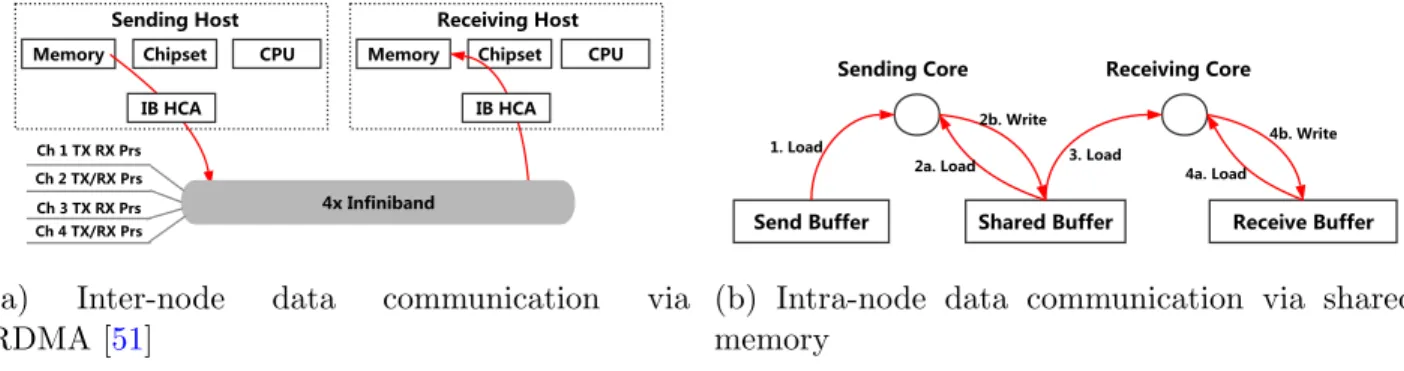
remote direct memory access (RDMA) technology [16]. RDMA-enabled networks allow a compute node to read/write data from/to the memory of another compute node without involving the processor, cache, or operating system of either node, enabling true zero-copy data communication [51] (Figure 2.3a). Besides, the bandwidth of modern RDMA-enabled networks has been reported to be in the same ballpark as memory bandwidth [16]. As shown in Figure 2.2, DDR3 memory bandwidth is currently between 6.25GB/s (DDR3-800) and 16.6GB/s (DDR3-2133) per memory channel, whereas InfiniBand bandwidth ranges from
Figure 2.2: Theoretic bandwidth for different generations of InfiniBand and memory tech-nologies [16].
1.7GB/s (FDR 1x) to 37.5GB/s (EDR 12x) per NIC port. Thus, the memory bandwidth of a machine with 4-channel DDR3-1600 memory can be roughly provided by four dual-port FDR 4x NICS. As a result, the contention for the shared resources on the memory subsystem of modern multicore machines is becoming more and more noticeable.
Inherent Contention in Multicore Machines Multicore machines usually consist of multiple sockets and each socket has multiple cores. Each core is a logical processing unit, but they are not physically isolated. Cores of the same socket have to contend with each other for the shared hardware resources. For example, in the architecture depicted in Figure 2.1a, cores sharing the L2 caches have to compete with each other for the shared L2, Front-Side Bus (FSB), and the Memory Controller. Although cores on different sockets do not share the L2, they may still contend for the shared FSB and Memory Controller. In fact, even if they are residing on different sockets, they may have to contend for the shared Memory Controller. Table2.2 provides a concise summary for the resources that different cores may have to contend for, in theUniform Memory Access (UMA) architecture of Figure2.1a and the Non-Uniform Memory Access (NUMA) architecture of Figure 2.1b. The summary is based on whether the cores are on the same socket and whether they share the last level cache (LLC).
Contention and Intra-Node Data Communication The fact that intra-node data communication is often achieved via shared memory further amplifies the contention, because
Memory Chipset CPU Sending Host Memory Chipset Receiving Host IB HCA IB HCA 4x Infiniband Ch 2 TX/RX Prs Ch 4 TX/RX Prs Ch 1 TX RX Prs Ch 3 TX RX Prs CPU
(a) Inter-node data communication via RDMA [51]
Send Buffer Shared Buffer Receive Buffer Sending Core Receiving Core
1. Load 2a. Load 2b. Write 3. Load 4b. Write 4a. Load
(b) Intra-node data communication via shared memory
Figure 2.3: Memory transactions of inter- and intra-node data communication
Table 2.2: Intra-node shared resource contention
Cores/Resources Sharing Contention
Core Groups Socket LLC LLC FSB/QPI(HT) Memory Controller
G1 X X X X X
UMA G2 X X X
Fig.2.1a G3 X
NUMA G1 X X X X
Fig.2.1b G2 X
intra-node data communication requires additional data copies [48,49], which, in turn, may lead to significant cache pollution and thus saturate the memory controller. Figure 2.3b
shows the corresponding memory/cache transactions for sending a message from one core to another. The sending core first needs to load the message from the application sending buffer into its cache (Step 1 in Figure 2.3b) and then write the data to the shared buffer (Step 2b). However, the write may require loading the shared buffer block into the sender’s cache first (Step 2a). Then, the receiving core reads the data from the shared memory (Step 3). Finally, the receiver writes the data to the receiving buffer (Step 4b), which may again require loading the receiving memory block into the receiver’s cache first (Step 4a).
Thus, if the sending core shares the same last level cache with the receiving core, there will be multiple copies of the same message in LLC. This is because in addition to the cached message for the sending and receiving buffer, the message in the shared memory has also to be cached in the LLC. Even if the sender and receiver do not share LLC, the LLC of both sender and receiver may still have to maintain multiple copies of the message as long as they
reside on the same machine (one for the shared memory buffer and the other one for the sending or receiving buffer). Clearly, intra-node data communication may lead to serious cache pollution and therefore saturate the memory controller.
What is even worse is that cores of the same machine are often communicating with each other at the same time for parallel computation and the number of cores per node is continuously increasing. The fact that graph workloads often have poor locality [52] (because of the irregular and unstructured nature of real-world graphs) and high memory access to computation ratio [52] (since graph algorithms are often based on the exploration of the graph structure with little computation work per vertex) further aggravates the contention. Take-AwayFocusing solely on minimizing the edgecut or the hopcut may not be sufficient for scalable performance. This is because edgecut-based solutions have no guarantee on how the edgecut is distributed across the partitions. They may end up with lots of data communication among partitions that are assigned to the same machine, leading to contention on the memory subsystems. On the other hand, hopcut-based solutions advocate for grouping neighboring vertices as close as possible, further aggravating the contention on the memory subsystems.
2.2.3 Understanding the Performance Impact of Heterogeneity and Contentious-ness
In this section, we experimentally demonstrate and quantify the performance impact of architecture-awareness (especially contentiousness) on distributed graph computing using four graph partitioners: (a) Metis, the most well-known graph partitioner [32], (b) LDG,
the most well-known streaming graph partitioner [8], (c)Argo, an architecture-aware graph partitioner presented in Chapter3, and (d)Argo-H, a variant ofArgothat only considers
the communication heterogeneity. The demonstration was achieved by comparing runs of an MPI implementation of three classic graph workloads: PageRank, Breadth-First Search (BFS), and Single-Source Shortest Path (SSSP) with different process (rank) affinity pat-terns.
For presentation clarity, we labelled an execution of a workload under a specific parti-tion (rank) to core mapping as m:s:c, where m, s, and c, respectively, denote the number
Table 2.3: Workload execution time in seconds on com-orkut dataset
Configuration BFS (10 Source Vertices) SSSP (10 Source Vertices) PageRank (30 Iterations)
Metis LDG Argo-H Metis LDG Argo-H Metis LDG Argo-H
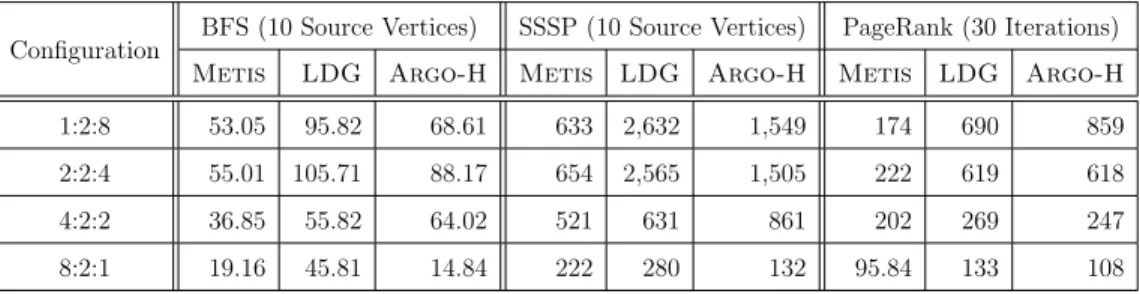
1:2:8 53.05 95.82 68.61 633 2,632 1,549 174 690 859 2:2:4 55.01 105.71 88.17 654 2,565 1,505 222 619 618 4:2:2 36.85 55.82 64.02 521 631 861 202 269 247 8:2:1 19.16 45.81 14.84 222 280 132 95.84 133 108
of machines used, the number of sockets used per machine, and the number of cores used per socket. For example, label 1:2:8 indicates that the experiment was performed on one dual-socket machine with eight MPI ranks per socket (one rank per core). To quantify the performance impact of the contention, we ran each workload with a fixed number of MPI ranks (16) under four different configurations: {1:2:8, 2:2:4, 4:2:2, 8:2:1}. Note that the de-gree of contention gradually decreased from configuration 1:2:8 to configuration 8:2:1. This is because the number of active cores per socket of the configurations gradually decreased from 8 to 4, to 2, and finally to 1. This also explains why we only used 16 cores per node at most (8 cores per socket) in this experiment, although each compute node of the cluster had 20 cores. More details about the evaluation platform are presented in Section 3.2.2.
To mitigate the impact of other factors, executions of BFS/SSSP under different config-urations all started from the same set of randomly selected source vertices (10 by default). Also, given the long execution time of the jobs, we grouped multiple (256) messages sent by the same MPI rank to the same destination into a single one. In the experiment, the com-orkut dataset was partitioned into 16 partitions across corresponding cores (one parti-tion per core) using Metis, LDG, Argo, and Argo-H. Orkut is a social network ran by
Google for people across the world to discuss their common interests [53]. The dataset used is a subset of the Orkut user population (around 11.3% at the time crawled by A. Mislove et. al. [54]). The dataset has around 3M vertices and 234M edges. The degree distribution of the dataset follows the power-law distribution with average and maximal vertex degree equal 76.281 and 33,313, respectively. The maximal diameter of the dataset is 10 with the effective diameter of 5.4489.
Results in terms of execution time (Table2.3) Table2.3shows the resulting execution time of the workloads under different configurations on the com-orkut dataset. As expected, the higher the contention, the longer the execution time would be. When compared with configuration8:2:1, the slowdown caused by the contention can be as high as 5.94, 11.69, and 7.94 times for the execution of BFS, SSSP, and PageRank, respectively. We also noted that even if we reduced the number of active cores per socket by half (configuration 2:2:4), the application may still suffer from serious contention. We believe the reason why the execution of BFS under configuration2:2:4 sometimes took longer than that of configuration1:2:8 was because configuration 2:2:4 and configuration 1:2:8 has similar degree of contentiousness, but configuration 2:2:4 required data communication across machines (which was typically slower than intra-node data communication).
Another interesting observation was thatMetisperformed better thanLDGand Argo-H in most configurations except configuration 8:2:1. We believe this was because the
par-titionings computed by Metis had the lowest edgecut and thus the lowest amount of
con-tention on the memory subsystems. The reason why Argo-H was worse than Metis and
sometimes even worse than LDG in dense configurations (i.e., 1:2:8, 2:2:4, and 4:2:2) was
becauseArgo-H was a hopcut-based solution. It aims to avoid inter-machine data
commu-nication by gathering neighbouring vertices as close as possible, which may lead to significant intra-node data communication and thus increase the contention on the memory subsystems. However, Argo-H outperformed Metis and LDG on two out of the three workloads
under configuration 8:2:1. This was expected because under configuration 8:2:1 reducing inter-machine data communication became more critical than mitigating the contention. This also confirmed the fact that the network may not always be the bottleneck. The reason whyArgo-Hdid not outperformMetison PageRank execution was because PageRank was
more communication-intensive than BFS and SSSP, and thus the contention on the memory subsystems was still the dominant factor even under the sparsest configuration.
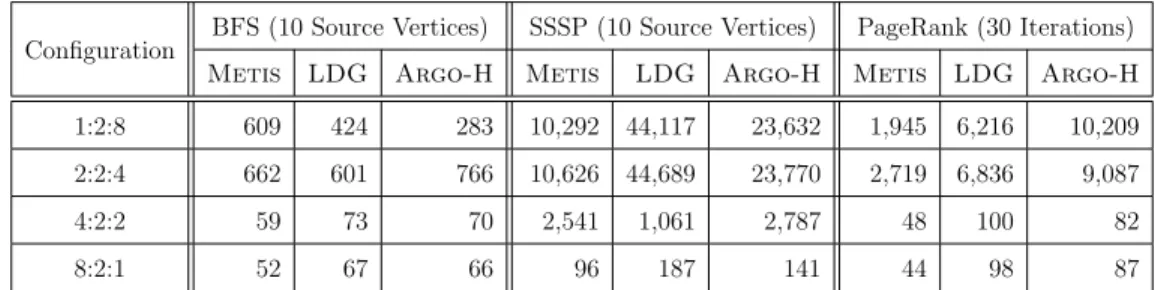
Results in terms of LLC misses (Table 2.4) To confirm that the slowdown was indeed caused by the contention on the memory subsystems, we also reported the LLC misses for each execution of the workloads in Table 2.4. The LLC misses were collected via the PAPI L3 TCM event provided by the hardware performance counter programming tool,
Table 2.4: Workload LLC misses in millions on com-orkut dataset
Configuration BFS (10 Source Vertices) SSSP (10 Source Vertices) PageRank (30 Iterations)
Metis LDG Argo-H Metis LDG Argo-H Metis LDG Argo-H
1:2:8 609 424 283 10,292 44,117 23,632 1,945 6,216 10,209 2:2:4 662 601 766 10,626 44,689 23,770 2,719 6,836 9,087
4:2:2 59 73 70 2,541 1,061 2,787 48 100 82
8:2:1 52 67 66 96 187 141 44 98 87
PAPI [55], and the values reported were the average LLC misses across partitions (MPI processes). By comparing Tables 2.4 and 2.3, we observed that the timing results were highly consistent with the LLC miss results. The denser the configuration was, the larger the LLC misses and thus the longer the execution time of the workload. We also observed that under configuration 8:2:1 Argo-H had much higher LLC cache misses than that of
Metis for BFS and SSSP, but it still outperformed Metis in terms of the execution time.
This further confirmed our observation that under configuration8:2:1 reducing inter-machine data communication was more critical to the performance than mitigating contention on the memory subsystems (e.g., cache pollution caused by inter-socket data communication) for BFS and SSSP.
Discussions The above experimental results can be summarized as follows:
Take-Away 1 The contention on the memory subsystem can also have significant per-formance impact on distributed workloads, especially for multicore machines connected via high-speed networks.
Take-Away 2 Heterogeneity-aware graph (re)partitioners are designed for cases where the network is the bottleneck, especially for geo-distributed clusters or cloud computing environ-ments.
3.0 ARCHITECTURE-AWARE STATIC GRAPH PARTITIONING
In this chapter, we first formally define the problem of architecture-aware graph partitioning for static graphs (Section 3.1). Then, we introduce a streaming-based implementation of such a graph partitioner, Argo(Section 3.2).
3.1 PROBLEM STATEMENT
LetG= (V, E) be a graph, whereV is the vertex set and E is the edge set.
Workload-Awareness To make the partitioning aware of the runtime characteristics of the target workload, we assign each vertex and edge a weight for partitioning. Vertex weight,
w(v), indicates the computation requirement of vertexv, while edge weight w(e) reflects the amount of the data communicated along edgeeduring the computation. Since the encoding of such information to the vertex and edge weights is fairly straightforward, we will primarily focus on the discussion of how to make the partitioning algorithm architecture-aware here. Architecture-aware graph partitioning aims to partition the graph into n balanced
partitions:
P ={Pi :∪ni=1Pi =V and Pi∩Pj =φ for any i6=j} (3.1) such that the communication cost of the partitioning is minimized.
We define the communication cost of a partitioning P as:
comm(G, P) = X e=(u,v)∈E
andu∈Piandv∈Pjandi6=j
where c(Pi, Pj) can be either the relative network communication cost, the degree of shared resource contentiousness between Pi and Pj or a hybrid of both. Existing architecture-agnostic graph partitioners usually assume c(Pi, Pj) = 1, which fails to reflect the charac-teristics of modern HPC infrastructures. Thus, to minimize comm(G, P), we should avoid data communication among partition pairs having high c(Pi, Pj) as much as possible.
We say a partitioning is balanced if the skewness of the partitioning is within a user-defined threshold. The skewness of a partitioning P is defined as:
skewness(G, P) = max{w(P1)Pn, w(P2),· · · , w(Pn)} i=1w(Pi)
n
(3.3) where w(Pi) =Pv∈Piw(v).
Assumptions Throughout this chapter, we assume that (a) Pi is assigned to server Mi for parallel processing; (b)Pi andMi are used interchangeably; and (c) the server can be either a hardware thread, a core, a socket, or a machine. By default, the servers are cores since we target for clusters of multicore machines.
3.2 ARGO: ARCHITECTURE-AWARE GRAPH PARTITIONING
In this section, we introduceArgo, an architecture-aware graph partitioner we implemented
for static graph partitioning. Argo is short for Architecture-Aware Graph PartitiOning.
3.2.1 Algorithm Design and Implementation
3.2.1.1 Graph Partitioning Model Argo follows the same streaming partitioning model first proposed by [8]. In such a model, vertices arrive at the partitioner in a certain order along with their adjacency lists. Upon the arrival of each vertex, the partitioner decides the placement of the vertex to one of the partitions based on the placements of vertices previously arrived. The placement of the vertex never changes once it is assigned to a partition.
A variety of heuristics have been proposed by [8] for the vertex placement, among which the linear deterministic greedy (LDG) performs the best. LDG tries to assign a vertex, v,
to a partition, Pi, which maximizes: (1− w(Pi)
C(Pi)
)∗ X
e=(u,v)∈Eandu∈Pi
w(e) (3.4)
where w(Pi) is the aggregated weights of vertices that have been assigned to Pi (indicating the computational requirement of the vertices of the partition), C(Pi) denotes the maximal amount of work Pi can have, and w(e) is the edge weight (reflecting the amount of data communication along the edge). Essentially, LDGplaces each vertex to a partition with the
maximum number of its neighbors while penalizing the placement based on the load of the partition.
3.2.1.2 Incorporating Heterogeneity Awareness Argotakes the non-uniform
net-work communication costs into account by replacing the vertex placement heuristics to max-imize the following objective:
(1− w(Pi)
C(Pi)
)∗ 1
comm(v, Pi) + 1
(3.5) where comm(v, Pi) is defined as
comm(v, Pi) =
X
e=(u,v)∈Eandu∈Pj andi6=j
w(e)∗c(Pi, Pj) (3.6)
Thus, if c(Pi, Pj) represents the relative network communication cost between Pi and Pj,
comm(v, Pi) defines the communication cost that v would incur during the computation if it is assigned to Pi. As a result, the above heuristic will put neighboring vertices to partitions as close as possible according to the relative network communication cost matrix. We denote this version ofArgoasArgo-H, since it only considers the heterogeneity of the network communication costs while ignoring the contentiousness of the underlying computing infrastructures.
3.2.1.3 Incorporating Contention Awareness As analyzed and demonstrated in Sec-tion2.2, edgecut (e.g.,LDG) and hopcut (e.g.,Argo-H) based solutions may lead to serious
resource contention on the memory subsystems of modern multicore clusters. One common way to avoid this contention issue is to disallow the use of all the cores of the machine, which leads to resource underutilization.
Fortunately, we found that the contention is caused by the excess data communication among cores of the same node and can be avoided by offloading a certain amount of intra-node data communication across compute nodes. This is because inter-node data communication is often implemented using RDMA and rendezvous protocols [56], which allows a compute node to read/write data from/to the memory of another compute node without involving the processor, cache, or operating system of either node (Figure 2.3a), thus alleviating the traffic on memory subsystems and cache pollution. In fact, with Intel Data Direct I/O technology [57], it is even possible to transfer data from one machine directly into the cache of another. Another reason why offloading intra-node data communication across compute nodes (via contention-aware graph partitioning) works is that graph workloads are often data-driven. The computations performed by a graph algorithm are dictated by the vertex and edge structure of the graph on which it is operating rather than being directly expressed in code [52].
Recall that guided by a relative network communication cost matrix,Argo-Hcan gather
neighboring vertices close to each other (Eq. 3.5), which causes contention on the mem-ory subsystems due to the excess intra-node data communication. Thus, to make Argo
contention-aware, we penalize intra-node network communication costs via a penalty score. The score is computed based on the degree of contentiousness between the communication peers. By doing this, the amount of intra-node data communication and the contention on the memory subsystems will decrease accordingly. Specifically, we refine the intra-node network communication costs as follows:
c(Pi, Pj) =c(Pi, Pj) +λ∗(s1+s2) (3.7) wherePi andPj are two partitions collocated in a single compute node;λ is a value between 0 and 1, denoting the degree of contention; ands1 denotes the maximal inter-node network
communication cost, while s2 equals 0 if Pi and Pj reside on different sockets and equals the maximal inter-socket network communication cost otherwise. s1 is used to avoid excess intra-node data communication, whereass2is used to prevent load imbalance on the memory controllers and to further avoid the contention on the shared LLC.
Clearly, if λ = 0, Argo degrades to Argo-H, and λ = 1 means that contention on the memory subsystems is the biggest bottleneck and should be prioritized over the com-munication heterogeneity. Argo with anyλ ∈(0,1] considers both the contention and the
communication heterogeneity. Considering the impact of resource contention and commu-nication heterogeneity is highly application- and hardware-dependent; users will need to do simple profiling of the target applications on the actual computing infrastructures to deter-mine the idealλfor them. Typically, for multicore clusters with high-speed network, a larger
λ is recommended, and vice-versa.
3.2.2 Evaluation
3.2.2.1 Setup In our experimental study, we first evaluated the effectiveness of Argo
in avoiding contention using three representative graph workloads: Breadth-First Search (BFS), Single-Source Shortest Path (SSSP), and PageRank (Section 3.2.2.2). Then, we examined the scalability of Argo in terms of both graph size and the number of partitions (Section 3.2.2.3 &3.2.2.4).
Workload Implementation All the workloads were implemented using MPI [58] based on the idea presented in [59, 60]. The specific MPI implementation we used in the experiment was OpenMPI 1.8.6 [46]. Note that the workloads were implemented using MPI Isend and MPI Irecv functions.
Algorithms We compared Argo to three graph partitioners: (a) Metis, the most
well-known multi-level graph partitioner [32], (b) LDG, a state-of-the-art streaming graph
par-titioner [8], and (c) Argo-H, a variant of Argo that only considers the communication
heterogeneity.
Datasets Table 3.1 describes the datasets used. com-orkut and Friendster datasets were undirected, whereas the original Twitter dataset was directed but was treated as an
undi-Table 3.1: Datasets used in our experiments
Dataset |V| |E| Description com-orkut [61] 3,072,627 234,370,166 Social Network Friendster [61] 124,836,180 3,612,134,270 Social Network Twitter [62] 52,579,682 3,926,527,016 Social Network
Table 3.2: Cluster compute node configuration
Socket (2 Intel Haswell Sockets)
Memory Cores/Socket Clock speed L3 Cache Capacity Bandwidth
10 2.6GHz 25MB 128 GB 65 GB/s
rected graph in the experiment. Note that these datasets were allscale-free and small-world
graphs. The vertex degree-distribution of the scale-free graphs asymptotically follow a power law distribution [63, 64], whereas small-world graphs are known to have low diameters.
Throughout our experimental study, the graphs were partitioned with the vertex weights (i.e., computational requirement) set to their vertex degree and the edge weights (i.e., amount of data communicated) set to 1. The vertex degree is a good approximation of the compu-tational requirement of each vertex for the execution of BFS, SSSP, and PageRank, while an edge weight of 1 is a close estimation of their communication patterns. By default, the graphs were partitioned across cores of a given set of machines with one partition per core. During the partitioning, we allowed up to 2% load imbalance among the partitions. Note that for the streaming graph partitioners: LDG, Argo, and Argo-H, the vertices of the
graphs were presented to the partitioner in the BFS order [8].
Evaluation Platform All the experiments were performed on a 32-node university clus-ter [65]. The cluster had a flat network topology with all the compute nodes connected to a single switch via 56Gbps FDR Infiniband. Table3.2depicts the compute node configuration of the cluster.
Network Communication Cost Modeling The relative network communication costs among the partitions were approximated using a variant of the osu latency benchmark [66].
![Figure 2.2: Theoretic bandwidth for different generations of InfiniBand and memory tech- tech-nologies [16].](https://thumb-us.123doks.com/thumbv2/123dok_us/10224951.2926342/34.918.316.599.105.313/figure-theoretic-bandwidth-different-generations-infiniband-memory-nologies.webp)