UNDERSTANDING THE TRANSITION FROM HIGH SCHOOL TO COLLEGE FOR EIGHT STUDENT WRITERS
BY
SCOTT RYAN FILKINS
DISSERTATION
Submitted in partial fulfillment of the requirements
for the degree of Doctor of Education in Curriculum and Instruction in the Graduate College of the
University of Illinois at Urbana-Champaign, 2017
Urbana, Illinois
Doctoral Committee:
Professor Mark Dressman, Chair Professor Sarah McCarthey
Professor Cris Mayo, University of West Virginia Professor Catherine Prendergast
ii ABSTRACT
The purpose of this three-semester qualitative study was to better understand, from a student’s perspective, what it means to transition from high school to college as a writer. Drawing on student interviews, school-based and out-of-school writing, process logs, think-aloud protocols, and interviews with students’ family members and teachers, the study also sought to understand how and why students’ composing processes changed in the transition to college, the instructional contexts they found most and least helpful, and the contribution the transition made to students’ larger life narratives.
Taking a sociocultural view toward writing development, but also acknowledging the evidence of development residing within changes of written products and processes, the study found, first of all, that most of the participants were successful in their
transition to college writing, despite the popular narrative that US high school students are underprepared (Arum & Roska, 2011;Tinberg & Nadeau, 2011). Their transition narratives varied significantly, however, because of a number of factors, including the different writing experiences they had in high school, their varying attitudes and beliefs about writing, the different college contexts they encountered, and the wide range of writing experiences in which they engaged there.
More specifically, students in the study reported varying (and sometimes contradictory) beliefs about the importance of becoming more independent in their transition to college. They widely agreed that the reading demands of college were new and overwhelming, and their responses to these demands were deeply interconnected with their writing processes; most commonly, students used writing tasks to decide what actually needed to be read. Another key source of development for some students was
iii
engaging for the first time with the new expectations of writing in disciplines other than English, despite having written in other content areas in high school.
The last pair of findings relates to students’ need to understand and negotiate new audiences for their writing in college. Students perceived a new degree of distance between themselves and their teacher-readers as they transitioned to college, and they reflected on how that distance affected (mostly negatively) their writing processes. Students also found themselves newly responsible to advocate for themselves about and through their writing. Equipped by school writing instruction that framed argument as presentation of evidence, they drew on other communicative experiences to craft writing that asserted their authority while also attempting to preserve the authority of the
audience.
Taken as a whole, the findings for this study suggest, first, the need for high school teachers to consider the social facets of writing as legitimate and necessary areas of study and instruction for college preparation. Second, high school and college teachers can potentially better serve students by recognizing the ways in which their personal relationships serve as a resource for student writers. Last, high school and college teachers, as well as students, families, policymakers, researchers need to increase awareness and understanding of the ways in which sociocultural factors such as racial and cultural identity inform all aspects of the transition, particularly when students are moving from a high school that is, in fact, more diverse than the college or university context to which the transition occurs.
iv
dedicated fondly to Emily Stipes Watts and Gail E. Hawisher,
writing teachers, mentors, and friends who set me down paths of learning and living that I never could have imagined for myself
v
ACKNOWLEDGMENTS
I wish to thank, foremost, the students who agreed to participate in this study, for opening up their lives and writing from their first year of college with so much honesty and insight. Additionally, I thank their family members and teachers for taking the time to talk with me about the students’ home and school worlds.
Deep gratitude goes to my committee: Dr. Cris Mayo, for staying on board despite a move, and for being the last great teacher I encountered at Illinois; Dr. Catherine Prendergast, for teaching me so much in my first writing course as an
undergraduate and then in my first course in Writing Studies as a graduate student (and all the time in between and since); Dr. Sarah McCarthey, for the patience and good humor she needed to put up with me through our work with the National Writing Project and the advice she provided throughout the preliminary exam and dissertation process; and to Dr. Mark Dressman, who agreed to meet on a frigid day in January 2014 to (finally) come up with a dissertation project with/for me. Getting to know these students and writing about them through this dissertation has been the most satisfying professional work I’ve ever engaged in, and I am thankful for Mark’s support, guidance, and
encouragement all along the way.
I’m grateful, too, for the other faculty at Illinois who have been instrumental in shaping my thinking and writing, most notably David Zola, Paul Prior, Sue Noffke, Libbie Morley, and Anne Haas Dyson. They always treated this high school teacher who just would not leave the classroom with respect, and the feeling was mutual.
Thanks to my English department colleagues for allowing me to share early and developing versions of the findings of this project, with special thanks to my lunch crew,
vi
Liz and Stephen, who heard more than they wanted but always responded with
enthusiasm to texts I sent as I made new discoveries about the participants in the study.
And, last, huge thanks to my friends and support system Lisa Storm Fink, Jennifer Buehler, Cathy Fleischer, Karla Zaccor, Phil Wilder, Haeny Yoon, Cathy Gorman, Jenn Raskauskus, Sarah Durst, Dave Hohman, Renée Dinnerstein, Patrick Berry, Anna Smith, and the Wendys: Maa and Maxson.
vii
TABLE OF CONTENTS
CHAPTER 1: INTRODUCTION………1
CHAPTER 2: REVIEW OF RELEVANT LITERATURE………...12
CHAPTER 3: METHODS……….…44
CHAPTER 4: THE VARIED NATURE OF THE TRANSITION TO COLLEGE WRITING………..67
CHAPTER 5: WRITING INTO (AND AROUND) NEW ACADEMIC EXPECTATIONS IN COLLEGE………...121
CHAPTER 6: NEGOTIATING NEW AUDIENCES AND WRITING CONTEXTS IN THE CLASSROOM AND BEYOND...…...161
CHAPTER 7: CONCLUSION………....201
REFERENCES………211
APPENDIX A: DATA COLLECTION TOOLS...…...226
APPENDIX B: SAMPLE STUDENT WRITING CATALOG WITH DESCRIPTIVE CODING……….……….233
APPENDIX C: FULL TEXT OF CALVIN’S APPEAL LETTER DRAFT…………...240
1 CHAPTER 1 INTRODUCTION
At a 2009 news conference at a Brooklyn charter school early in his tenure as Secretary of the United States Department of Education, Arne Duncan told the press that he wished to be able to look any second grade student in the eye and tell him or her, “’You’re on track, you’re going to be able to go to a good college, or you’re not’” (as qtd. by Hernández, 2009). Duncan’s desire to know with certainty whether an eight-year-old child is on the path to a “good college” might be viewed as a well-intentioned desire to ensure that all American schoolchildren are prepared for future academic endeavors, regardless of their address or parents’ income or level of education. But Duncan’s comment also raises a number of questions. Can we know what college will be like ten years into the future? What would one need to know about that child to know if he or she is “on the right track” for such a future? And perhaps more importantly, what might we be missing in our understanding of that child in the present if we view him or her as a potential college student at eight years old?
Though Duncan’s statement can be dismissed as an exaggeration made by someone without much experience in education, the goals and beliefs that underlie it are signs of the very real policy context in which this project is situated—namely, in an era in which the rhetoric of and activity around college readiness are prominent and powerful. Discussion of college readiness saturates contemporary K-12 educational discourse, most evident in language such as “Preparing America’s Students for College and Career,” the subtitle of the Common Core State Standards (NGACBP/CCSSO, 2010) which had been adopted in 41 states at the time of this study, following on the heels of the ACT’s College and Career Readiness Standards (ACT, 2010). K-12 public education, historically a site
2
of contested goals and varied potential outcomes (Labaree, 2009), seems at the moment particularly focused on the single facet of preparation for post-secondary education and labor (see Karp [2013], Larson [2013], and Ravitch [2013] for discussions that take the contemporary neoliberal agenda into account).
Duncheon (2015) describes recent and ongoing efforts of the college readiness agenda, including curricular alignment between high schools and colleges and the development of lists of skills and attendant assessments to measure them, but she contends that the notion of what college readiness is remains “elusive” (p. 5). She offers as a commonly agreed upon (if vague) definition of college readiness as “the preparation required to enroll in college and persist to graduation without need for remediation” (Duncheon, 2015, p. 25). She also summarizes college-readiness research by offering three broad categories, including cognitive academic factors (content knowledge and cognitive skills), non-cognitive academic factors (mindsets and behaviors), and campus integration factors (“college knowledge” and relationships to self and others) (pp. 8-10).
The research behind these categories has been, of course, the object of some critique, particularly in relation to the degree to which non-majority perspectives are represented in what it means to be ready for and to transition to college. Carter, Locks, and Winkle-Wagner (2013), for example, summarize three categories of barriers especially salient for students of color: finances, academic preparation, and a negative climate for students of color at predominantly white schools. While the concept of “academic preparation” maps onto Duncheon’s (2015) model, “campus integration factors” surely take on different meanings for white and non-white students, and finances are not even part of the conversation in the mainstream discussion of college readiness.
3
Similarly, Welton and Martinez (2013) caution against taking a “one size fits all approach” to defining college readiness and cite the need to consider the “contextual needs” and “cultural identities” of students in ways that broad, uncritical approaches may not (p. 200).
High schools have typically been held formally accountable for only the first readiness indicator in the list—content knowledge and cognitive skills—and at that, through the 1990s and 2000s, only the narrow slice of students’ proficiency in reading and mathematics was of concern. With the arrival of the CCSS and assessments that rely heavily on writing as both an object and means of assessment, students’ performance not only as readers but also as writers is, for better or for worse, factoring prominently into the debate over what makes a student “ready for college” (Applebee, 2013).
Concern over students’ preparation for success in college writing is not, however, new, nor is evidence of it located solely in documents tied to systems of private (ACT) or state/federal assessment (associated with the CCSS). Almeida (2015) points to early concerns over college readiness in writing in Harvard’s 1874 implementation of its freshman English course to respond to perceptions of weakness in their incoming students’ writing. He also explains that in 1898, the University of California at Berkeley was the first institution to offer a remedial writing class to prepare students for the demands of credit-bearing “college-level” courses in the future (p. 48).
A more contemporary effort to support students and teachers in the work of preparing college-ready writers is the Framework for Success in Postsecondary Writing (2011), a joint project of the Council of Writing Program Administrators, the National Council of Teachers of English, and the National Writing Project. The document goes
4
beyond most standards’ purely cognitive indicators of readiness and product-based evidence of success by identifying key habits of mind (e.g., curiosity, openness, engagement) and listing experiences with reading, writing, and critical analysis that develop certain skills and capacities (e.g., rhetorical knowledge and critical thinking). In response to the attempt to synthesize what preparation for writing in college means, Severino (2012) and Summerfield and Anderson (2012) wonder about the Framework’s lack of social habits such as empathy, and how to connect the identified habits with the suggested experiences. Hansen (2012) is concerned that, even with the breadth of habits of mind and experiences, trying to create any sort of general model for instruction or competency is inherently limiting. McComiskey (2012), though, contends that when viewed as “additional support for the CCSS or as a guide to developing assessment instruments based on the CCSS, then it should have some impact on secondary education and the preparation of high school students for the rigors of college writing” (p. 538).
The National Writing Project is also in the midst of a federally funded grant program entitled The College-Ready Writers Program (CRWP) that focuses specifically on the production of certain kinds of text. According to the program’s website, the CRWP takes as its central goal “to help students become skilled at writing arguments from nonfiction sources” and provides sample text sets, prompts, teaching activities, and professional development offerings. Gallagher, Woodworth, and Arshan (2015) found that through implementation across 22 districts in 10 states, the CRWP had a “positive, statistically significant effect on the four attributes of student argument writing: content, structure, stance, and conventions” and that “students demonstrated greater proficiency in the quality of reasoning and use of evidence in their writing,” but there has not yet been a
5
study of the program’s actual effectiveness at preparing students for writing in college (p. 1).
All this is to say that the transition from high school to college for student writers, the topic of this project, is an issue much on the minds of policymakers, educators, and key professional organizations in our field. Alsup and Bernard-Donals (2002) describe misguided attempts to seek out a “seamless high school to college writing curriculum” that fail to take into account the differences in contexts and students in those contexts, and instead call for conversations around the notion of compatibility—of curriculum and delivery of curriculum (p. 117). Carroll (2002) offers a similarly realistic view of what might be possible in terms of preparing students for college writing, noting the
impossibility of creating a single college preparatory writing curriculum, and
acknowledging that students in fact develop because of the struggles they encounter with new contexts and expectations. We might be able agree though that the struggle,
whatever form it takes in students’ particular situations, should be productive and manageable, whether by students on their own (supported by resources they bring with them and have their genesis in previous social interactions), or with the explicit support of knowledgeable or caring others who can provide advice, feedback, or guidance along the way.
Indeed, most colleges and universities acknowledge institutionally the key role writing plays in the high school to college transition through their official curriculum, in the form of first-year composition requirements. Although this project is not limited to students’ experiences in first-year composition courses, it is informed by an
6
students’ transition to college. Durst (1999) argues for the goals of first-year composition by explaining that
The course can and does attempt to provide a kind of intellectual orientation to university academics and a set of strategies, or dispositions of mind, that will help prepare students for not just the writing, but also the kinds of intensive, rigorous thinking, reading, speaking, and problem solving that make up a university education. (p. 73)
An NCTE brief (2013), furthermore, synthesizes research that points to the role first-year composition can play in fostering engagement and retention, in enhancing rhetorical knowledge, and in developing metacognition.
Yet, scholars such as Downs and Wardle (2007) acknowledge that writing is “neither basic nor universal but content- and context-contingent and irreducibly
complex,” making it difficult for a single course or series of courses to provide students what they need to navigate all those complexities (p. 558). Knodt (2006) suggests that the diversity of approaches first-year composition courses take in introducing students to college writing—from programs rooted in classical rhetoric to those with clear contemporary sociopolitical motivations—makes it difficult to discuss first-year composition as an entity itself, due in part to the contested nature of what it means to write successfully in college.
I come to this project (ironically, perhaps) with no direct experience with first-year composition, but with multiple facets of interest nonetheless. As a first-generation college student who was certified as “highly successful” in my K-12 education, I came to the university feeling nonetheless underprepared as a writer. I earned a 4 out of 10 on the
7
timed essay designed to facilitate placement in a first-year composition track (I’m sure I had as little insight on Orwell’s comparison of sports to war then as I do now), but my score on the English subtest of the ACT placed me out of an introductory university writing course. Even at the time, I found that means of placement odd and a bit unnerving, but even more unnerving was the C I received on my first college essay, a very clunky explication of T. S. Eliot’s “The Wasteland.” This grade was by far the lowest grade I had ever received on any writing (or anything). My confidence shaken and questions about my suitability for college swirling, I met with that professor several times that semester after the sting of the grade wore off. Partly because of the profound impact this teacher had on me, and partly because the teaching of writing became such a
significant part of my life (I had been a mathematics major at the time), the experience of writing that first college essay and my response to it is one of my most vivid memories as an undergraduate. It was the first time I had to muster up any sort of academic resilience, and I have always been grateful for that professor’s care and support through the process.
As a high school English teacher charged, in part, with preparing students for writing in college, I often wondered if I was doing enough, if my assumptions about what writing in college were accurate (after all, I was basing my theory of college writing on my own very limited experiences), and if there were other things I should be doing to increase students’ likelihood of success as writers in postsecondary education. As an educator who began his career only slightly before the major federal accountability movement associated with No Child Left Behind (2001), my professional life has been permeated with concerns about certifying readiness. Being in the classroom during the implementation of the Common Core Standards, an example of what Tierney (2015)
8
considers the type of coordinated activity that has the potential to have positive effects on students’ readiness for college, has fueled my curiosity about the standards themselves and the notions of readiness they espouse1.
Over the course of this project, I began teaching dual credit English, which meant I was teaching a writing class for which students received both high school English and college first-year composition credit. This teaching assignment only heightened my interest in knowing exactly what I was preparing students for, and what that preparation should look like. As I embarked on this project, I found myself becoming aware of broad generalizations that I would make, or that I would hear colleagues make, to students about “what it’s going to be like in college.” Based on personal experiences often from ten or more years ago, and almost always used to induce some sense of fear in or compliance from students, these statements seemed unhelpful at best, and often harmful for the potentially inaccurate picture of students’ possible futures they created.
Last, as a graduate student engaged in coursework in Writing Studies, I am aware of the preponderance of scholarship focused on college-level writers from the perspective of college faculty. While I certainly find immense value in that work, I also found myself interested in the possibility of a project that could contribute to the knowledge about early college writers from the perspective of someone who knows high school contexts well, and knew the particular students who will be framed in the research as “writers in college” before they were in college.
The approach for this project, then, is to study broadly students’ transition from high school to college, considering their experiences in high school—and even earlier as
1 The Common Core Standards for Writing will be a focus of discussion in the review of literature provided in Chapter 2.
9
possible—and the writing events they found in all of their classes and school lives in the first year of college. This project is informed by calls such as Harklau’s (2001) for the need for more research that links “college students’ perceptions of collegiate literacy practices to previous schooling histories in secondary education” (p. 37) and that “cross[es] institutional boundaries [by] contextualiz[ing] entering college students’ beliefs and responses in their high school academic literacy experiences” (p. 39).
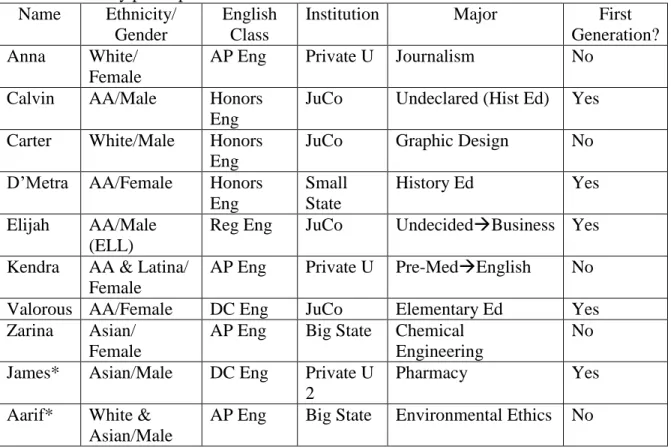
Harklau (2001) also calls for particular attention to be paid to students’ own views of the transition, framed by their perspectives and not those of the interested institutions. Durst (1999) makes a similar assertion when he notes that “we have not been sufficiently aware of students’ attitudes and prior knowledge about writing, nor of how their attitudes and knowledge affect the way they approach composition instruction” (p. 37). This project takes as its primary data source interviews with eight students—Anna, Calvin, Carter, D’Metra, Elijah, Kendra, Valorous, and Zarina (all names are pseudonyms)— introduced first as seniors in their last semester of high school and followed into the summer after their first year of college, seeking to investigate these research questions:
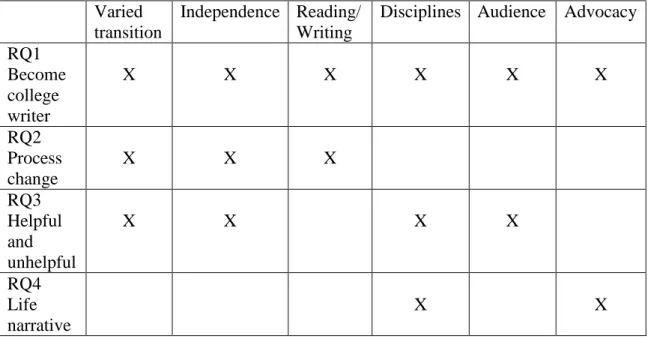
From a student’s point of view, what does it mean to “become” a college writer?
How do students decide when to adopt, adapt, or abandon a writing practice?
What instructional contexts or practices do students view as supporting—or impeding—the transition from high school to college as writers?
How does the transition to college contribute to students’ larger life narratives as literate people?
The chapters that follow will review literature related to the high school to college writing transition by examining first what is known about writing instruction in US high schools, then the varied conceptions of the high school to college transition, followed by
10
a review of several major longitudinal studies of college writers, and last, the relative absence of student voices in conversations around college readiness in writing. I will then describe the methods I used for developing case studies and thematic discussions of student writers that take an attitude of respect for students’ complex individual experiences as literate beings rather than the predictive, certain gaze toward students inherent in the statement that began this introduction.
Drawing from interviews with students, selected family members, and influential teachers, as well as think-aloud reading and writing protocols and student writing from three semesters, in Chapter 4, I offer explorations of students’ diverse transition
experiences and the complex role the concept independence played in students’ descriptions of them. In Chapter 5, I turn to two sources of academic challenge that students frequently cited—the increased reading load and the demands of writing in unfamiliar disciplines—and their responses to them. In Chapter 6, I examine how the transition to college presented shifts in students’ familiar writing situations, documenting how students wrote for an audience that they did not know well and wrote to
self-advocate within a new institutional system, before closing in Chapter 7 with a discussion of implications for theory and practice and avenues for research that builds on the
findings of this study.
Throughout, I draw on data from both high school and college, not to suggest clear cause-and-effect or before-and-after relationships, but to keep students’ past contexts in conversation with their transition experiences. Together, these findings will suggest an understanding of the college writing transition as diverse, highly socially
11
situated, and much more complex than any list of cognitive skills or descriptions of desired texts could reveal.
12 CHAPTER 2
REVIEW OF RELEVANT LITERATURE
This review of the literature focused on the notion of college readiness in writing and the transition from high school to college for student writers draws from large-scale quantitative studies, large and small qualitative studies of student and classroom writing practices, longitudinal studies of college writers in development, and essays on the topic of college writing from the perspective of both educators and students. For the purposes of framing the context and assumptions of my study, the literature in this review is organized into four main content sections—the state of writing in high school, the transition from high school to college, the development of college writers, and students’ perspectives on the transitions—and a section synthesizing varying views on the concept of development, a key theoretical concept that will guide this study.
What Do We Know about Writing in High School?
Despite the general concern over the adequacy of high schools as sites of
preparation for future college writers (Arum & Roska, 2011;Tinberg & Nadeau, 2011), we know relatively little about high school English curriculum and subsequent practice in general (Burroughs & Smagorinsky, 2006), and perhaps even less about contemporary writing practices in high schools more specifically (Kiuhara, Graham, & Hawken, 2009). By combining findings from large-scale and classroom-level studies, this section will attempt to synthesize what is known about writing in high school (largely centered around what students write and how they are taught to write), a first step toward understanding the transition from high school to college for writers.
13
Findings from Large-Scale Studies
Scherff and Piazza (2005) surveyed high school students from diverse academic tracks from multiple sites in Florida to learn about the types and frequency of writing they did in their English classes, as well as their perspectives on their participation in writing process-oriented instruction. Students reported writing most frequently in response to literature, typically once every week or every other week. Other types of writing such as narratives, persuasive essays, and summaries occurred less frequently, with research papers reported as typically occurring just once a year. Beyond variety of type, Scherff and Piazza (2005) found that about a third of students reported their teachers had used models of writing to help them write better as part of writing instruction. They found, however, that most students recalled inconsistent experience with process writing approaches, such as brainstorming, revising, and peer review. Overall, they assert, students are not guaranteed ample opportunities to write or access to widely acknowledged effective practices in writing instruction.
Kiuhara, Graham, and Hawken’s (2009) large-scale study of high school writing turns the research focus away from students’ perspectives to teachers’ self-reported practice, but their findings are similarly mixed. They found that teachers assigned short-answer responses, worksheets, and summaries most frequently (once a week or more), with considerable variation among disciplines for other types of writing. Overall, teachers seldom assigned writing requiring multiple paragraphs, and much of the writing required little processing on the students’ part—in their words, it is “writing without composing” (p. 151). Teachers reported using most frequently research-based teaching techniques such as providing verbal praise, direct instruction/modeling, and establishing specific
14
goals for a written piece. Few teachers (11%) reported using any sort of writing
curriculum to shape their approach to teaching writing, with those responses running the gamut from the writing activities embedded in a commercially prepared literature anthology to stand-alone writing programs such as the Jane Schaffer method (a highly prescriptive program focusing on structure).
This finding aligns with Applebee and Langer’s (2013) assertion that writing, “perhaps more than any other school subject, lacks a widely accepted framework for discussing what students should know and be able to do” (p. 8). The findings from their National Study of Writing Instruction suggest a portrait of tempered hope regarding the state of writing instruction in America’s high schools, largely because of the historical scope it offers as a follow-up study from earlier iterations of similar work. They note an improved understanding of literacy process development in the field generally (with particular focus on adolescent literacy development), as well as calls for improved writing instruction and increased time for writing from groups such as the National Commission on Writing and documents such as the Common Core State Standards.
Overall, however, Applebee and Langer (2013) offer a view of writing instruction that complements that of Scherff and Piazza (2005) and Kiuhara, Graham, and Hawken (2009) when they state that
The actual writing that goes on in typical classrooms across the United States remains dominated by tasks in which the teacher does all the composing, and students are left only to fill in missing information, whether copying directly from a teacher’s presentation, completing worksheets and chapter summaries,
15
to “show what they know” the particular information the teacher is seeking. Writing as a way to study, learn, and go beyond…is rare. (p. 27)
More specifically, they found that high school students are “not writing a great deal”— approximately 1.6 pages of text per week in English class and 2.1 pages per week for all other subjects combined (p. 13). Classroom observations suggest that high school students spend only around 8 percent of class time engaged in extended writing, a figure whose optimism is challenged by Fisher’s (2009) observational study in which he found students wrote only 2.8% of the time.
In their analysis of the writing instruction students receive, Applebee and Langer (2013) found that teachers most frequently specified the parts of a written assignment to include, and claimed to engage students in activities traditionally associated with a process approach. But they also posit that teachers may be under the impression that their instruction “is process-oriented, even though it isn’t” (p. 5). In other words, teachers may be employing a range of isolated activities that, when presented as part of a coherent writing process approach would represent the kinds of instruction associated with improved student achievement, but when experienced on their own do not. Emig (1971) notes similar concern with teachers’ tendency to under-conceptualize and oversimplify the writing process, with outlining serving, for example, as a substitution for planning and correcting surface errors substituting for revision. Importantly, though, Vetter, Myers, and Hester (2014) illuminate how challenging it can be for teachers to develop a process-approach ideology if their systemic context has other goals (such as preparing for standardized tests) or is already committed to other approaches (based more on
16
Applebee and Langer’s (2013) skepticism about the prevalence of process-approach instruction comes, in part, from the mismatch between teacher self-reports of practice and achievement data from sources such as the National Assessment of
Educational Process (NAEP), to which I will now turn. The most recently available NAEP writing data (2011) found that only 27 percent of 12th grade students wrote at or above the proficient level, defined as writing that is at least “coherent,” “well structured,” develops “ideas in a logical, clear, and effective manner,” and uses “relevant details and examples [that] contribute to overall communicative effectiveness” (p. 39).
Even within that 27% of students who wrote at the proficient level by the end of high school, though, there was considerable variation by race, gender, and socioeconomic class. On average, white, Asian, and multiracial students outperformed African-American and Latino/a students; female students outperformed males; students who came from households with higher educational attainment outperformed those who came from households with lower educational attainment; and students from schools in suburban settings outperformed students from schools in cities or rural settings. NAEP also found that students who wrote 4-5 pages per week for homework in their English class
outperformed those who wrote less. Note that this figure is approximately double what Applebee and Langer (2013) found was typical in a high school English class.
Findings from Classroom-Based Studies
While data from large scale surveys and assessments is crucial for understanding the broad view of what is happening with high school writers, studies from within classrooms offer additional understanding of how process pedagogy is enacted in actual
17
classrooms. Here I will discuss three studies that examine specifically the use of model essays, brainstorming through talk, and peer response.
Samuelson (2009) explored how teachers and students discussed sample papers in an Advanced Placement English class, where one might expect the most (if not the best) writing instruction to occur in a high school setting. The samples in question are those produced in response to prompts from past AP exams for the purpose of preparing for the exam. Samuelson found that a significant force behind the discussion of the models was ventriloquation of the voice of a potential rater of the exam, mediated by rubrics
produced and released by the College Board. This finding points to the complicated relationship between process pedagogy and the pressures of standardized assessment, but is also tempered by other more generative examples of ventriloquation in which students use the voices of others to “try out new ways of talking about writing and the speak back to authority” (Samuelson, 2009, p. 77).
In her study of a tenth grade writing class, Sperling (1995) found that within a single instructional period in which students were talking about a controversial topic in preparation for writing, they assumed a number of school roles, friendship roles, and performative stances, all tied to the particular ways they were situating themselves socially in the moment. More broadly, their talk (and writing) took on pragmatic roles such as the historian, the prognosticator, and the philosopher. Her study was small, so she cautions against specific implications to be drawn from it, but she urges teachers to be ready for the complexity of roles to avail themselves, and to view that complexity not as a problem to be concerned about, but rather as a resource to exploit for developing students’ capacities as speakers and writers.
18
Similarly, Freedman’s (1992) study of peer response groups in two different English classrooms suggests that the talk students engaged in was highly linked to social roles students took on or resisted. If students were provided a sheet to guide their
response process, they would often take on the role of “good student” and work together to get the assignment done, at the expense of any substantial talk about the paper under consideration. Students also resisted the role of critic to one another, with the ethics implicit in a peer relationship complicating the desire to be a good student in the response process.
While these small, unrelated studies may do little to represent broad trends in high school writing instruction, they together offer a glimpse into the complexity of practice that is by necessity flattened in large surveys or national assessments. They remind us that even when we might say with some certainty that a particular practice is occurring in a large number of US high school classrooms (which is itself not often the case), how that practice is being enacted by teachers and students will vary significantly across districts, classrooms, and individuals in those classrooms.
Conceptions of “College Readiness” for Writers
The very notion of college-level writing, with is implication of a belief in stage-based theory of development that can be separated into clear, hierarchical categories seems at odds with a sociocultural view of literacy that sees writing as highly dependent on context, not definable by the features of the written text itself, and embedded in valued practices that enable increased participation within a community (Heath, 1983; Hull & Moje, 2012; Prior, 2006). The editors of NCTE’s two volumes of essays around the college-level writing question (Sullivan & Tinberg, 2006; Sullivan, Tinberg, & Blau,
19
2010) seem aware of this tension by placing college-level in quotation marks, suggesting through punctuation the slippery nature of the term, but still using the term.
Sullivan’s (2006) cornerstone essay of the first collection, in fact, seems fairly rooted in a more autonomous view of literacy, treating writing as activity that is acontextual, skill-based, predictably sequenced, and politically neutral (deCastell and Luke, 1986; Street, 1984). Sullivan (2006) argues for the need to establish “a clear understanding of what we mean by college-level writing” (p. 5) and then frames the benefits of such an understanding in terms of the needs of the institution: placement policies, classroom pedagogy, and program-level decisions. Acknowledging that many students who are admitted to college seem unready for the writing that will be required of them, he refers to basic writing courses and stresses the need to “be able to define with some degree of precision when a particular student has passed from the basic writing stage to college-level” (p. 6). This threshold-level mentality seems to imply both that there is a context-free notion of what college-level writing is (and once a student has gotten there, he or she is “set”) and that this threshold is knowable, almost certainly in terms of the features of the finished product, the written text that gets the student through the gate from “basic” to real college-level work.
Sullivan (2006) goes on to discuss his view of how one might define college-level writing with a bit more consonance with a sociocultural view. He suggests college-level writing is inseparable from notions of reading and thinking; is indicated by the ability to evaluate abstract ideas; has relatively predictable features related to ideas, organization, and editing; and is best viewed as an introduction to “an ongoing conversation that is multilayered and complex” (pp. 16-17). I place the notion of conversation last not
20
because he does, nor because he gives it the most attention (he does not), but rather to draw attention to writing in terms of its social purpose for students, not just in the qualities of the text itself. Certainly these notions are highly inter-related: writing that gives students entry into particular ongoing conversations is likely to look and sound certain ways, but the converse is not always true. Students are often “trained” to mimic textual features without any sense of what purposes those features serve in the social-communicative aspects of writing. Others, such as Appleman and Green (1993) bring to light the tension college educators feel in valuing both complex notions of process and certain surface textual features, especially in matters related to course placement, where student texts themselves—not an examination the processes that created them—are the basis of judgment.
Unlike Sullivan (2006) who works from text features to inklings of participation, Blau (2010), in his essay “Academic Writing as Participation: Writing Your Way In,” takes a more fully realized developmental approach, including discussion of the complications associated with viewing writing as student participation in ongoing academic conversations. Blau takes as the premise of his essay that “students will best learn to produce academic discourse the way they learn to produce any other specialized discourse: through their cultural experiences as members of a discourse community… [allowing them to become eventual] active participants in the community” (p. 31). He then goes on to describe the way in which his first-year English literature course at Columbia facilitates such scaffolded participation. Offering this model is certainly important, a point Blau underscores by suggesting that students are often required to write as if they are members of a certain discourse community before they have even read
21
a text from the conversations, leading to “formula and outlines and formal requirements designed to ensure that student papers will at least appear to observe the formal
conventions of published work” from a particular field (p. 29).
Possibly even more important, though, is Blau’s point concerning student agency around writing in first-year or introductory level courses. Acknowledging the identity of students as more than just producers of text, he argues that many students do not aspire to participation in the intellectual communities of their first-year course disciplines—or perhaps any traditional academic community at all, an observation echoed by Durst (1999). As Dyson (1995) notes, “learning to write is not only interactional work, but is ideological work as well; that is, it involves writing oneself into, or in some way against, taken for granted assumptions, including assumptions about relations of teacher and student…of people of different races, genders, and classes” (p. 17). With this in mind, technical descriptions of practice such as Blau’s are useful, but any discussions of writing development from a sociocultural perspective need to be sensitive to the ways in which interactions in which writing is embedded are raced, gendered, and classed—and they need to include the perspective to the student on the “receiving end” of the pedagogy in order to do so (e.g., Everhart, 1983; Finders, 1997; Kirkland, 2011; Smith & Wilhelm, 2002).
In the subsections that follow, I will review existing literature on the transition from high school to college writing, organized around three main views of the transition: textual/strategic, contextual, and attitudinal. Certainly these three categories are not completely distinct, but they offer a sense of the varied ways the field discusses the distinction between writing in college and high school.
22
The Transition as Textual/Strategic
If the kinds of writing students do in high school may not necessarily align with the expectations of college (Beil & Knight, 2007), students’ flexibility in producing new textual forms (or, better put, students’ adaptable use of knowledge of various written forms and structures) offers one way of viewing the transition from high school to college. Reiff and Bawarshi (2011) studied how students draw from and adapt the resources from high school writing experiences in new writing contexts. They found that students tended either to be boundary crossers, who were able to break down genre knowledge and apply it in new ways in new situations, or boundary guarders, who relied on and applied entire known genre structures, regardless of the specific nature of a new task. The ability to notice what a writing task is not calling for in relation to extant genre knowledge and writing skill helps define the difference, with the boundary crossers being more sensitive to mismatches between resources they already have and the requirements of a particular writing task.
Similarly, Artemeva and Fox (2010) found that students entering an unfamiliar writing situation may be able to identify features required of written genre, but will likely be able to produce text resembling the required task only if they have participated in writing in that genre before (though even that is not necessarily a sufficient condition for success). Specifically, students were able to identify a technical report in a
pre-assessment in an engineering communication course, but unless they had written such reports in other contexts, they were likely to produce a straightforward academic essay when prompted to write a technical report themselves.
23
Together, these two studies reinforce the notion of college transition that students will bring “their habitual ways of writing to the [college] classroom only to discover that these ways [are] inappropriate” and will need to find ways to respond (Artemeva & Fox, 2010, p. 499). Hassel and Giordano (2009) similarly frame students’ desire to “cling” to familiar habits or the likelihood for students to “revert” to high school writing patterns, stressing the tension that students feel when they are unable to match the task at hand with the resources they have most readily available. Indeed, a common thread within the literature seems to suggest that a significant part of the transition is “un-doing” what has been learned in high school (see also Blau [2006], cited below), or, put more positively, transforming textual knowledge that was useful in one context but that is insufficient in another2.
The Transition as Attitudinal
Lunsford (2006) argues that the transition to college-level writing is marked less by the features of written products and more by the adoption of particular attitudes or orientations toward writing—namely, the willingness to learn from one’s own writing. Others view college-readiness as attitudinal, as well, though not always in the same way as Lunsford does. Kearnes (2006), for example, notes that the three most common views toward writing that students bring with them to college are largely monological: writing as performance or transaction, writing as contractual agreement, or writing as
instrumental tool. It is not until students develop a dialogical attitude toward writing, recognizing “that the desire to be understood requires us to find ourselves in relation to
2 Published academic standards are a major indicator of a textual view toward college readiness and the
transition to college. Discussion of the CCSS for Writing (NGACBP/CCSSO, 2010) as a document that takes such a view follows in the section on competing theories of writing development at the end of this chapter.
24
the purposes and needs of the readers, who must serve as a partner in shaping our
language” that students are participating in college-level writing (Kearnes, 2006, p. 349). Alsup and Bernard-Donals (2002) take the notion of the dialogic even further when they suggest that the shift for college writers is to view their writing with an “ethical
orientation toward others” (p. 121), so that even if the goal of a piece of writing is persuasion or argument in a purely academic sense, those motives are embedded in concern a larger social fabric and awareness of the needs of others.
Durst’s (1999) study of incoming first-year composition students offers a related, but substantially different, perspective on attitudinal shifts in becoming a college writer. He frames the necessary shift in attitudes less as a one-sided view of students taking on the already held view of the institution and more as the need for a negotiation between students and teachers. He found that incoming college writers tend to hold a pragmatic, career-oriented views toward college generally, and, by extension, to first-year
composition. So, while instructors attempted to instill attitudes of critical awareness and approaches that embraced the recursive nature of processes, students were interested in streamlining their writing process and resisted changes to their ideologies about writing and beyond. Rather than simply calling for a more persuasive or forceful way to change students’ viewpoints, however, Durst (1999) calls for instructors to be more aware of their students’ attitudes toward writing and look for ways to bridge gaps between institutional and student goals.
The Transition as Contextual
Blau (2006) suggests that attempting to define boundaries between high school and college writing without acknowledging their very different contexts can lead only to
25
ill-informed generalizations. As Durst (1999) points out, incoming college students often feel anxiety borne out of “their need to learn to negotiate the complex new environment [of college], not just the physical and social settings of the large campus and, for many, new city…but the academic terrain as well” (p. 65). Carter, Locks, and Winkle-Wagner (2013) go a step further and acknowledge that first-year students are also responsible for managing “their finances, course choices, friendships, and relationships with family and faculty in a more complex environment” than they experienced in high school (p. 93).
One way of viewing the difference between high school and college writing, then, is to frame the difference in terms of their different contexts they provide for teaching, learning, and living. Coming close himself to offering an ill-informed generalization he warns about, Blau (2006) explains that one such contextual difference comes from the locally-controlled nature of public schools, designed to “reflect and preserve the parochial values of the community and the parents who send their children to those schools” rather than to challenge those values actively, as one might expect to occur in a college writing class (p. 371). He further suggests that the function of the first year of college (including, presumably, a first-year composition course) is “to debunk much of what [students] learned in high school…and to initiate them into an academic and intellectual community…whose most distinctive features are those that render it wholly unlike the culture of the high school” (p. 370).
Addison and McGee (2010) offer a more practical view of the contextual
differences between high school and college by focusing not on the cultural contexts, but rather on the nature of actual writing support services provided to students. They found, for example, that a college faculty member is three times as likely as a high school
26
writing teacher (58% compared to 18%) to refer a student to institutional support services such as a writing center, a difference largely explainable by the fact that most US high schools do not offer such supports in the first place. Guzy (2011) also points out that in college students are typically “in the company of more culturally diverse peers, of greater intellectual caliber,” both of which offer the potential to prompt growth not necessarily possible in a high school setting (p. 69).
Last, a key contextual consideration from the literature is the degree to which high school writing is shaped and bounded by externally imposed standardized tests. Fanetti, Bushrow, and DeWeese (2010), for example, found that high school teachers wished to teach a more dynamic, fluid process approach to prepare students for their perception of the demands of college writing, but felt they were constrained from doing so by pressure exerted by standardized tests. As a result, they argue, students are taught to see writing in fairly constrained, formalistic ways3.
How Do Students “Become” College Writers?
Though they vary in scope and specific approach, five longitudinal studies (Carroll, 2002; Herrington & Curtis, 2000; Sommers & Saltz, 2004; Sternglass, 1997; Walvood & McCarthy, 1990) explore student development across the years of
undergraduate education, illustrate how the three aforementioned facets of transition—as textual/strategic, as attitudinal, as contextual—work together simultaneously, and offer four broad themes that illuminate how students become college-level writers.
First, writing development and, indeed, students’ performance on the varied writing tasks in college need to be viewed not just in terms of the texts they produce, but
3 See McCarthey (2008) for further evidence of the constraints on writing instruction imposed by external
27
as representations of more complex literacy practices. Carroll (2002) notes that “the complexity and messiness of this critical literacy, with writing as only one component, makes it difficult to assess a student’s writing ability at any given point in the student’s career, and even harder to measure a student’s ‘development’ over several years” (p. 4). Although the goal of this study will not be to measure either ability or development, but rather to describe the students’ experience in the process of development, Carroll’s assertion that writing is much broader than production of text—echoed by the other studies—is well taken4.
In addition, the four studies validate the approach Blau (2010) represents, noting the importance of finding a legitimate way to participate in academic discourse, to write for more than mere completion of an assignment, and to feel that they are making a worthwhile contribution to the field. All of the studies touch on this concept in some way, with Sternglass (1997) offering the more modest notion of students at least managing to see what their contribution to a given field might be. Herrington and Curtis (2000) saw the value of students finding on their campus a “sponsoring group,” or discourse
community that valued and encouraged their contribution. Of the studies, Sommers and Saltz (2004) are the most adamant on the point, claiming that the most significant
distinguisher between students who find success as college writers and those who do not is the willingness to take on the stance of novice—as an intellectual who at once has much to learn and who can only learn through the act of attempting themselves the behavior of the more experienced in the field. Carroll (2002), like Blau (2006),
4 In fact at a session at the 2014 convention of the National Council of Teachers of English, Sullivan,
Tinberg, and Blau indicated that the follow-up project to their two college-level writing collections will be a volume about the relationship between reading and writing in college.
28
complicates the notion of taking on a novice stance, pointing out that academic communities are not neutral, and students may have reasons for choosing not to
participate that should not be viewed as personally pathologizing, but rather are informed by the ways the university as historical institution is raced, classed, and gendered.
Third, the studies together suggest the importance for students to be able to find ways to combine their personal interests with the learning and writing expected of them in their coursework. Herrington and Curtis (2000) in particular take the view that writing development is the writer’s struggle to compose a public self that is acceptable both to him or herself and to his or her audience. Though they do not present their findings in such a fully theorized way, Carroll (2002) and Sommers and Saltz (2004) certainly support the notion of students feeling the need to connect the personal with the academic, and associating success with being able to do so. Sternglass (1997) makes the finding the lynchpin of her book’s argument, stating that “the integration of students previous life experiences into their academic studies allows them to analyze, critique, modify, and apply the worldviews they held previously to their new learnings” (xv) and suggests that teachers are doing a personal and political disservice if they disallow such integration between students’ lives and academic writing topics.
Last, the studies agree that the place to look for development in student writing is not in within the four corners of the page of any single text they produce, but in their talk and understanding of what is expected of them across a variety of contexts—in their increasing sense of flexibility and adeptness at transferring that flexibility into writing that meets the expectations of varied audiences. Nearly all of the studies relate how students became savvier at understanding the preferences of their instructors, which may
29
be viewed narrowly at attempts to teacher please and earn high grades. Those grade-based motives notwithstanding, the flexibility such rhetorical moves requires is
significant, and Carroll (2002) notes that as students take on a more participatory role in a discourse community they begin to view requirements of a text being more governed by the norms of the field or discipline and less a function of individual teacher’s
idiosyncrasy.
All of these findings align in some ways with the approach Walvood and McCarthy (1990) take to their longitudinal cross-disciplinary study of college writers. Most notable from their work is the focus on the roles students take as writers,
highlighting the social aspects of thinking and writing behaviors as means of constructing relationships. They found that three roles helped explain student writing behavior across a variety of contexts: that of a text processor (one merely recycling text to demonstrate knowledge of the text), a layperson (one engaged in disciplinary knowledge as an outsider), and a professional in training (one engaged in disciplinary learning as an insider). Most writing tasks in discipline-specific classes required the adoption of the professional in training role, but not all students were adept at taking it on, instead relying more heavily on their habits as text processors or laypeople.
Student Voice in the College Readiness Question
The selection of student-authored essays contained in the two NCTE collections (Sullivan & Tinberg, eds., 2006; Sullivan, Tinberg, & Blau, eds., 2010) offers additional insight to what it means to develop as writer from high school to college. First, though, it is important to acknowledge the limitations inherent in this small collection of essays, specifically that they are all written by students who have ostensibly succeeded as college
30
writers and are now telling their story through academic writing for an audience of professional educators. Many of them have affiliations with their college or university writing centers, which only adds to the skew toward knowing, insider competence the selection brings to the conversation. Despite this weakness as a collection stemming from a fundamental lack of diversity in the sample, the published student essays offer a range of ways to think about the transition from high school to college writing, directly from students.
Kimberly Nelson (2006), for example, explains how she drew on a familiar practice in her past—participating in a focused writing group she had first experienced in a high school Advanced Placement class—and created new opportunities to talk through her ideas with her family and fellow students in her dorm. Her essay’s focus on talk and the avenues it provides for idea generation aligns with her explicitly stated definition of college-level writing as “not merely a list of skills, but rather … as much about process as it is about product” (p. 293). While this conclusion may seem cliché, it is important to honor still the profundity of a familiar idea; her essay traces the trajectory of a practice, narrating a history and development of participation in social groups to support her work as a writer. The fact that she found new ways to engage conversants in her process does indeed seem a sign of development from a sociocultural perspective. That the other student essays remain significantly more focused on form or individual development only highlights the importance of this student’s story.
Casey Maliszewski’s (2010) chapter offers the most contrast to Nelson’s, as she cites as a “major breakthrough” the development of a stronger thesis, which she describes as “more balanced (i.e., not too narrow, not too broad)…[and representing] a more
31
complex argument that came from reading beneath the text to determine broader
patterns” (p. 264). Continuing the students’ focus on the important role of certain textual features is Mike Quilligan’s (2006) essay in which he characterizes the development of a truly argumentative thesis as “the trick” (p. 297) to good college writing, the result of the university “breaking incoming students of…the habit” of mere exposition (p. 298). In an interesting contrast to Blau’s (2006) rather nurturing introduction to a writing
community, Quilligan discusses his university’s success in socializing student writers with relatively violent imagery. He speaks in terms of “uncivilized” high schoolers— himself included—arriving at the university to be “civilized” into argumentation, while Blau approaches the matter from a more sociocultural perspective, viewing the students’ current stances and skills as resources to be drawn from.
All but one of the student essays remain located exclusively in the realm of academic writing to describe college-level writing or their development as college writers. Steven Schmidt’s (2010) essay differs as he traces from his years in high school when he would write poetry to combat the boredom he felt with school-based
assignments and explains how his job in the tech industry after high school (but before college) brought him into a discourse community that valued writing that was “focused, comprehensive, and clear” (p. 268). He also describes the public/personal writing he engaged in while undergoing cancer treatment, using a blog to “deal with the toll of the chemicals and emotions” associated with treatment and to mediate the physical distance between him and his family (p. 269). Though he does not draw together all the currents of development he discusses, his essay certainly offers a glimpse into the ways that student
32
learning about writing in out-of-school contexts might be flexibly drawn on in academic settings.
While not student authored itself, Bergman and Zepernick’s (2007) study of how students perceive their own process of learning to write adds to the student perspectives from the essays. Drawing on interviews of high achieving students who came to college well-prepared based on most traditional achievement indicators, they found that students saw a significant divide between the writing they did for their first-year composition class (labeled as an English class) and the writing they did in the disciplines. Students viewed English teacher feedback as less valid than feedback in “disciplinary” courses and
considered the writing they learned there to be more natural and idiosyncratic. Writing in the disciplines, on the other hand, required “a very strong acceptance of the authority of disciplinary standards, conventions, and expectations” (p. 129). Echoing earlier cited-research, especially Durst (1999), students in this study cited knowledge and perhaps even admiration of a thoroughly developed process approach to writing, but admitted to their practice being highly focused on product. For the students in this study, notions of audience were tightly bounded by the classroom context, with the student writer’s job being to discover what the particular teacher wants and finding a way to deliver that kind of writing.
Theoretical Framework: Views on the Concept of Development in Writing
Although not everything that occurs to students in their transition from high school to college as writers might be characterized as development, the concept is central to the conversations about college readiness and the transition to college writing and is, consequently, the dominant theoretical concern for this project. I will begin this section
33
by discussing views of development that focus on product and process, as these views are certainly the most influential in K-12 school curriculum and instruction. I will include in this discussion analysis of the Common Core Standards for Writing (NGACBP/CCSSO, 2010) for their illustration of development in terms of product and process.
I will then turn my attention to more socioculturally informed notions of
development in response to Duncheon and Tierney’s (2014) call for an understanding of college readiness that takes a more nuanced view of writing, including attention to the social and personal significance of writing, with emphasis on the important role that specific contexts play in writing development, as opposed to a “a catalog of cognitive skills [that] cannot capture the process of meaning making and self-discovery that writing facilitates” (p. 216).
Product- and Process-based Models of Writing Development
In their introductions to more socioculturally informed definitions of development, Applebee (2000) and Schultz and Fecho (2000) summarize views of development that have had strong influence on curriculum, teaching, and learning in schools—that is, views that suggest writing development is most evident in changes in the written product or the writing process, but not necessarily in the writers themselves. Applebee (2000) notes that traditional discussions of development have “emphasized purposes for writing, fluency and writing conventions, the structure of the final product, or strategic knowledge” (p. 92). In a similar vein, Schultz and Fecho (2000) argue that earlier models of writing development have viewed writing as a series of skill-based stages that students move through, including “mastery of conventions such as spelling, discourse structures, and revision” (p. 54). While these descriptions do not provide
34
distinctions between product and process models, they share a focus on decontextualized writing work and locate development in the text or the immediate processes associated with its production.
Andrews and Smith (2011) review more extensively both product-related and process-related models. They point out that product-centered models typically focus on on development of greater syntactical sophistication in written pieces and growing familiarity with more (and more sophisticated) rhetorical modes. Process-related models, on the other hand, emphasize students’ abilities to improve their written product with changes between drafts and the development of more automatic use of writing strategies at certain stages in the writing process. In their discussion of the process movement, they call attention to the dominance of cognitive approaches to development as indicated by improved ability to problem solve, set specific goals, monitor, and move between processes.
As useful as developmental views focusing solely on product may be in providing general guidance on what student writing “should” look like from grade to grade, there is wide agreement concerning the limitations of such views, namely the potential for
creation of ideal models of texts that students should be able to produce at specific times in their academic careers, thus creating the illusion of a linear path of development for all students to follow (Andrews & Smith, 2011; Dyson & Freedman, 2003). Most studies of writing product development also suffer from an overly narrow focus on school-based writing, so the developmental trajectory of a child is less about the child’s development and more about the curricular tasks with which he or she was asked to engage (Applebee, 2000).
35
Developmental models focusing on process are less common, so there is less consensus on either their benefits or limitations, but Andrews and Smith (2011) point out that process-based development still largely focuses on improvements to texts, and therefore remain largely bound to end products as a sign of development. In either case, a developmental model focused on product or process will likely see writing as an act separated from the development of the writer as an active participant in multiple social worlds, reducing the concept of growth to production of more “accurate” text or sophisticated metacognition, without concern for the writer’s understanding of how “accuracy” is shaped by social expectations or how metacognition is tied to their identities as a writer or the way in which they wish to position themselves to others through text.
The CCSS as a Model of Writing Development
I will offer a brief discussion of the Common Core State Standards for Writing (NGACBP/CCSSO, 2010) at this point because of their political dominance at the time in which the students in this study moved through high school and for the ways in which they illuminate the drawbacks of a particular model of development that is rooted in product- and process-based views. The CCSS Standards for Writing consist of ten anchor standards with corresponding grade-specific standards fleshed out for K-8 and grade band standards for 9-10 and 11-12. These standards are organized into four categories: “Text Types and Purposes” (Standards W1-W3), “Production and Distribution of Writing” (W4-W6), “Research to Build and Produce Knowledge” (W7-W9), and “Range of Writing” (W10). The CCSS for writing are nearly unapologetic in their autonomous view of literacy and literacy development (Botzakis, Burns, & Hall, 2014; Street, 1984), as