Volume 2008, Article ID 870492,15pages doi:10.1155/2008/870492
Research Article
Global Interior Robot Localisation by a Colour
Content Image Retrieval System
A. Chaari,1, 2S. Lelandais,1C. Montagne,1and M. Ben Ahmed2
1IBISC Laboratory, CNRS FRE 2873, University of Evry 40, Rue du Pelvoux, 91020 Evry Cedex, France 2RIADI Laboratory, National School of Computer Science, University of Manouba, 2010 La Manouba, Tunisia
Correspondence should be addressed to A. Chaari,[email protected]
Received 2 October 2006; Revised 10 April 2007; Accepted 3 August 2007
Recommended by Jose C. M. Bermudez
We propose a new global localisation approach to determine a coarse position of a mobile robot in structured indoor space using colour-based image retrieval techniques. We use an original method of colour quantisation based on the baker’s transformation to extract a two-dimensional colour pallet combining as well space and vicinity-related information as colourimetric aspect of the original image. We conceive several retrieving approaches bringing to a specific similarity measureDintegrating the space organ-isation of colours in the pallet. The baker’s transformation provides a quantorgan-isation of the image into a space where colours that are nearby in the original space are also nearby in the output space, thereby providing dimensionality reduction and invariance to minor changes in the image. Whereas the distanceDprovides for partial invariance to translation, sight point small changes, and scale factor. In addition to this study, we developed a hierarchical search module based on the logic classification of images follow-ing rooms. This hierarchical module reduces the searchfollow-ing indoor space and ensures an improvement of our system performances. Results are then compared with those brought by colour histograms provided with several similarity measures. In this paper, we focus on colour-based features to describe indoor images. A finalised system must obviously integrate other type of signature like shape and texture.
Copyright © 2008 A. Chaari et al. This is an open access article distributed under the Creative Commons Attribution License, which permits unrestricted use, distribution, and reproduction in any medium, provided the original work is properly cited.
1. INTRODUCTION
The autonomous robot navigation in a structured interior or unstructured external environment requires the integra-tion of much funcintegra-tionality, which goes from the navigaintegra-tion control to the mission supervision, while passing by the per-ceived environment modeling and the planning of trajecto-ries and strategies of motion [1]. Among these various func-tionalities, the robot localisation, that is, the capacity to es-timate constantly its position is very significant. Indeed, the knowledge of the robot position is essential to the correction of trajectory and the execution of planned tasks.
Sensors constitute the fundamental elements of a locali-sation system. According to the type of localilocali-sation needed, we can use either proprioceptive sensors or exteroceptive sensors. Proprioceptive sensors measure displacements of the robot between two moments. The integration of their mea-sures allows estimating the current position of the robot compared to its starting one. On the other hand, the exte-roceptive sensors measure the absolute position of the robot
by observing benchmarks whose positions are known in an environment frame-attached reference.
The localisation problem is fundamental in mobile robotics and always pokes a crescent number of contribu-tions. DeSouza and Kak propose in [2] an outline of the var-ious approaches, as well in interior structured as in external unstructured environments. These techniques can be gath-ered in two principal categories: relative localisation methods and absolute localisation methods:
(i) relative or incremental localisation where the robot position is computed by incrementing its preceding position and the measured variation with proprio-ceptive sensors (the two principal methods of rela-tive localisation are odometry and the inertial local-isation, these techniques use unstructured data and produce an accumulating error to estimate the robot position);
Robot
Global localization
Coarse position (room, orientation. . .)
Fine localization
Exact position (coordinates, distances. . .)
Figure1: Proposed global localisation task which aims to give a coarse position of the robot. These global localisation’s outputs could be used to keep only a part of the indoor space as inputs to a fine and exact localisation system for navigation purpose.
to periodically readjust incremental estimate (naviga-tion) produced with relative localisation techniques. Exteroceptive sensors are used and various techniques can be distinguished to compute the robot position. The most known approaches are the magnetic com-passes localisation, the active reference marks localisa-tion, the passive reference marks localisalocalisa-tion, and the model-based localisation techniques [3].
We propose in this paper a new approach for the robot local-isation problem which consists in using an image database model and consequently content-based image retrieval tech-niques to provide a qualitative and a coarse estimate of the robot position. The central idea is to provide to the system a set of images and features potentially visible and detectable by computer vision techniques. The system’s aim, thus, con-sists in searching attributes and features to identify the closest images from this set which indicate a coarse position and ori-entation of the robot. We introduce thus the term of global localisation which aims to indicate a coarse position of the robot like its room or orientation and which is different from fine or absolute localisation problem. This global localisa-tion generally intervenes before the fine localisalocalisa-tion process which aims to compute accurately the robot position (cf. Figure 1). We intend by fine localisation any localisation sys-tem developed for a purpose of robot navigation and which gives an exact position of the robot. The next section gives an overview of this fine localisation systems which could be as well map-based systems as maples systems.
In this work, we developed a global localisation robotic solution for disabled people within a private indoor environ-ment. This global localisation could simplify the fine local-isation by searching the robot position in a simple part of the space instead of the entire environment. Moreover, this global localisation is necessary after a long displacement of the robot to know its position whether it is lost and when the problem of fine localisation is difficult to solve.
We work through the ARPH project (Robotics Assistance
to Handicapped People) [4] defined with the French
Asso-ciation against Myopathies (AFM). The aim of the project
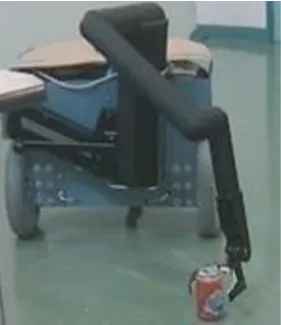
is to embark an arm manipulator (seeFigure 2) on an
au-tonomous mobile basis. By using the arm, a handicapped person is able to carry out various tasks of the current life. The various control modes include or not the handicapped
Figure2: Prototype of the handicapped person assistance’s robot.
person. Thus, the base must be able to be completely au-tonomous. To ensure this capacity, various sensors equip the base: proprioceptive odometric sensors for the relative locali-sation, ultrasonic sensors for obstacles detection and a colour camera as exteroceptive sensors.
For the global localisation, we use the colour camera fixed in the base and we propose a content-based image retrieval method. The principle is to build an image database of the indoor space in which the robot evolves/moves. To find it-self, the robot takes an image of its environment called re-quest image. Then the system seeks the closest image from the database to the request image from which it deduces the room and the orientation of the robot.
Unlike most retrieval systems, request images taken by the robot’s camera differ from images stored in the database. Although, the image database describes the totality of the indoor environment, the random navigation of the robot (according to the implicit need of the handicapped per-son) always gives different request images from those of the database. It is a question of extracting from the database, the closest image compared to the request image. This image will be used to determine the room where the robot is and its orientation in this room: two essential information needed for the global localisation of the robot in an indoor envi-ronment. In order to achieve this goal, colour information is needed. Unfortunately, illumination is not controlled and is not known to have invariant template against its changes. In addition, many small objects are removable and make par-tial occlusion of other objects. Thus it is necessary to rather seek features which tolerate these changes, from which one can find the image in question, than nonstable and com-plete features, which proves too restrictive. What is required is the compactness of features with the rapidity of computa-tion since the image database is not very bulky.
described in Sections5and6, respectively. We present and discuss our results in Sections7and8and we draw conclu-sions inSection 9.
2. RELATED WORK
2.1. Vision indoor robot localisation
The first vision systems developed for mobile robot localisa-tion relied heavily on the geometry of space and other metri-cal information for driving the vision processes and perform-ing self-localisation. In particular, interior space was repre-sented by complete CAD models containing different degrees of detail. In some of the reported work [5], the CAD models were replaced by simpler models, such as occupancy maps, topological maps, or even sequences of images.
DeSouza and Kak [2] gather the existing approaches in three categories according to the apriori knowledge provided to the system:
(i) map-based localisation:these systems depend on user-created geometric models or topological maps of the environment;
(ii) map-building-based localisation:these are systems that use sensors to construct their own geometric or topo-logical models of the environment and then use these models for localisation and navigation;
(iii)mapless localisation: these systems do not use any ex-plicit representation of the environment. Rather, they are based on recognised objects found in the envi-ronment and the tracking of those objects by
gener-ating motions based on visual observations. Figure 3
resumes these categories and give maisn approaches within each one.
Most vision techniques for autonomous mobile robotics are map-based approaches, especially those based on abso-lute localisation which matches perceived data with an ini-tial model to determine the robot position and those based on incremental localisation when the initial position of the robot is known. Incremental localisation methods use gen-erally geometrical representation [6] or topological repre-sentation [7] of space. However, in large-scale and complex spaces, incremental localisation methods are not sufficiently accurate to determine the robot’s position due to the accu-mulating error of the robot position’s estimate. On the other hand, for absolute localisation methods, the step which es-tablishes matches between robot’s observation and features often stored in a geometrical-based model (expectation) is the most difficult among all steps in localisation systems and pose several problems. Moreover, if we consider a large-scale and complex space, matches between observation and expec-tation is increasingly difficult to solve. One can do localisa-tion by landmark tracking when both the approximate loca-tion of the robot and the identity of the landmarks seen in the camera image are known and can be tracked. The landmarks used may either be artificial ones, such as stretched tapes and circles with a unique bar-code as reported by Tsumura in [8], or natural ones, such as doors, windows, and so forth. In this
last case, this technique is related to object recognition meth-ods.
Map-building-based systems allow robot to explore an unknown environment and build a map of that environment with simultaneous localisation and mapping (SLAM) meth-ods. SLAM methods generate either topological [9] or geo-metrical representation of a space [10]. A challenging prob-lem in map-building-based systems is the robot’s ability to ascertain its location in a partially explored map or to deter-mine that it has entered new territory. On the other hand, in mapless systems no maps are ever created. We usually call these systems as mapless navigation systems because of the needed robot motion purpose and the unknown abso-lute positions of elements of the environment. Indeed, rele-vant information about the elements in the environment are stored and associated with defined commands that will lead the robot navigation. Unlike this purpose, our global mapless localisation system aims rather to localise coarsely the robot and thus simplify the search space. It resembles appearance-based matching methods [11], but in our case we use image retrieval techniques to give a coarse estimate of the robot po-sition. Thus, its outputs are one room label and one main orientation in this room. These characteristics make partic-ular our approach (definition and results points of view).
2.2. Image retrieval systems
Content-based image retrieval (CBIR) systems have been es-sentially developed because the digitalised images databases are increasingly bulky. These images are, in general, com-pressed before being filed in databases. Once these data are stored, the problem is the capacity to retrieve them simply. An efficient reuse of these databases passes by the joint de-velopment of indexing and retrieving methods. A coarse rep-resentation of such a data management can be described as follows:
{image} −→features−→indexing. (1)
The first systems suggested in the literature are based on the use of key words attached to images. The retrieving results of a particular type of image are inevitably a function of the lexical fields used. The indexing phase is, in this case, tedious and the coded data of the image remains limited. Thus, the content-based image retrieving is quickly developed giving rise to many systems allowing an image query method in-stead of the textual searching.
A content-based image retrieval system comprises gener-ally four tasks. The principal ones are obviously theindexing
Indoor localisation
Map-based localization Map-building-based localization
Mapless localization
Absolute localization
Incremental localization
Landmark tracking
Optical flow
Appearance-based matching
Using
Object recognition
Using
Geometrical representation
of space
Topological representation
of space
Figure3: Robot localisation categories.
to a given request. A new type of research more interactively results in a more incremental approach and especially more adaptive to the users needs. From the retrieved images re-sulting from the first stage, the user can refine his research according to an object or a selected zone. This analysis is pro-viding quantitative results and not of visual nature (e.g., the number of images with a blue colour bottom). This function-ality is thus summarised to extract statistics from images.
In addition, image retrieval systems are generally based on a query by example (QBE): further to a request image taken by a robot in our case, the search engine retrieves the closest images of the database on the basis of a simi-larity distance. Then the ideal retrieving tool is that which quickly and simply gives access to the relevant images com-pared to a request image taken instantaneously by the mobile robot. The question is how to retrieve, automatically from the database, images visually similar to the request image. The similarity is evaluated by using a specific criterion based on colour, shape, texture, or a combination of these features. Many techniques were proposed with colour-based image re-trieval [12–14], and it is impossible to define the best method without taking account of the environment. We can never-theless release a general methodology through the following stages [15]:
(i) elicitation of a significant reference base allowing stor-ing images and files of index associated with each im-age;
(ii) quantisation of each image by keeping only the rele-vant colours in order to optimise the efficiency in time and in results;
(iii) defining images signatures according to the desired re-quests (signature consists of a combination of generic attributes and specific attributes related to the applica-tion);
(iv) choice of a metric for the similarity measure;
(v) implementation of an interface allowing requests by image examples for the concerned applicability.
Many academic and/or industrial content-based image re-trieval systems were developed: Mosaic [16], Qbic [17], Sur-fimage [18], Netra [19], VisualSEEK [20], and so forth. They allow an automatic image retrieving per visual similarity. The standard architecture of all these marketed systems com-prises an offline phase to generate image’s features and an on-line phase for image retrieving task (as showed byFigure 4).
Some systems are conceived for general public applica-tions (e.g., the search of images on Internet). Image databases are then general and include heterogeneous type of images. Other systems are conceived for specific applications. The used image databases are in this case more concise and spe-cific to the application. Images are characterised by homo-geneous contents (faces, medical images, fingerprints, etc.). In the specific databases, the developed features are dedi-cated and optimal for the target considered (eccentricity of the contour of a face, position of a tumour, etc.). On the other hand, for the generic databases, the extracted features are universal (colour, texture, shape, etc.) [21]. Although our specific applicability (the global localisation of a robot in an indoor environment), image databases are generic because of the variety of objects present in a house and indoor spaces in general (seeFigure 5).
3. IMAGE DATABASES
Two complete and well-structured image databases are built
in two different indoor spaces (domestic environment) to
Offline phase
Database indexing
Image databases
Index databases Similarity measure
Signature computation Interface
User Online phase
Figure4: Content-based image retrieving architecture.
images is 960×1280 pixels.Figure 5shows examples of im-ages from the first database (a, b) and from the second one (c, d).
In the second database, we take also the luminosity into account (cf., Figures5(c),5(d)). For the same position, we have two or three images which have been taken at different day time. We also took a lot of request images which are dif-ferent from the database images. For the first database, we have 20 request images and 35 for the second database.
4. COLOUR HISTOGRAMS
Colourimetric information is very significant in a domestic environment. Indeed, such a space includes various elements without colourimetric coherence between them. A discrimi-nation of these elements can be more powerful by taking into account their colours.
Colour histograms remain the most used techniques as for adding colour information to retrieval systems. The ro-bustness of this feature and its invariance to the position and orientation of objects make its strong points. Nevertheless, these performances are degraded quickly when the database is large. But in our application, the image database is not very bulky. Indeed, in an indoor environment, we do not exceed a few hundreds of images to describe structurally the environ-ment of the robot. The use of the histograms for colour im-ages indexing is based primarily on the selection’s techniques of the adapted colour space, the quantisation of the selected space, and the comparison methods by similarity measures. We have tested the RGB and the LUV colour spaces. To the RGB colour space which gave best results, we developed sev-eral uniform quantisations in order to test different pallet sizes.
Given a colour imageI, of sizeMbyNpixels, the colour distribution of a colour bincwhich ranges over all bins of the colour space is given by
hIc = 1 MN
M−1
i=0
N−1
j=0
δI(i,j)−c. (2)
In the above equation,δ() is the unitary impulse function. We notice that thehcvalues are normalised in order to sum to one. The value of each bin is thus the probability that the colourcappears in a pixel of the image. Different sim-ilarity measures were implemented and tested to our image databases. Two category of measures are presented: the bin-by-bin similarity measures which compare contents of cor-responding histogram bins (Minkowski distance, histogram
intersection, and the χ2 test) and the cross-bin measures
which compare noncorresponding bins (Mahalanobis dis-tance and EMD Disdis-tance). Hereafter we present those
sim-ilarity measures between a request image (I) and all the
database images (H).
(1) Minkowski distance:
d(I,H)=
c
hI c−hHc
r1/r
r≥1 (3)
(a) Manhattan distanceL1:r=1
(b) Euclidean distanceL2:r=2
(2) Histogram intersection:
Inters (I,H)=
cmin
hI c,hHc
chHc
. (4)
This function deducts the number of pixels of the model which have a direct correspondent in the re-quest image. Values close to 1 indicate a good resem-blance [12].
(3) Theχ2test. A colour histogram can be considered as
the realisation of a random variable giving colours in an image. Thus, the histogram comparison can be brought back to a test of assumptions, on which it is necessary to determine if two achievements (i.e., two histograms) can come from the same distribution. The χ2test is based on the assumption that the present
dis-tribution is Gaussian [22]. Theχ2test is given by
χ2=
c
hI c−hHc
2
hI c+hHc
(a) (b)
(c) (d)
Figure5: Examples of indoor images.
(4) Mahalanobis distanceor generalised quadratic distance
DQG was used by Niblack et al. [23] to take into
account the intercorrelation between colour
compo-nents. A weighting matrix W which includes the
re-semblance between colours was proposed. The gener-alised quadratic distance resulting from the Euclidean distance is defined by the following formula:
dQG(I,H)= (H−I)W(H−I)T. (6)
The componentswi jof the weighting matrixWcan be interpreted like similarity indices between theie and
thejeelement of the pallet. ThusWis generally repre-sented by the reverse of the intercorrelation matrix be-tween colour bins. Other proposals of weightings ma-trices attached to the representation of colour spaces were introduced by Striker and Orengo to define the colourimetric distances between colours [24]. (5) EMD distance.Earth mover distanceproposed by
Rub-ner et al. [25] consists in the extraction of the minimal quantity of energy necessary to transform a signature into another. Having the distancesdi jbetween colours
components of the two histogramsHandIofmand
ndimensions, respectively, it is a question of finding a whole flowF =[fi j] which minimises the cost of the following quantity:
m
i=1
n
j=1
di jfi j. (7)
To control the implied energy exchanges, the direction of transfer must be single (fi j ≥ 0) and a maximum quantity of transferable and admissible energy of each
colour component should be defined. From the whole of optimal transferF, EMD distance is then defined as the following resulting work:
dEMD(H,I)= m
i=1 n
j=1di jfi j m
i=1 n
j=1fi j .
(8)
The formalism suggested by Rubner meets all condi-tions to determine the optimal distance between two histograms but the complexity introduced by the algo-rithm of optimisation makes it complex in time com-puting [26].
5. A NEW COLOUR FEATURE DEFINITION
5.1. Baker’s transformation
The baker’s transform (BT for short) is based on the defini-tion of mixing dynamical systems [27,28]. The main interest of these transformations is that they mix in a very homoge-neous way all the elements of the involved space.
Arnold and Avez [27] give a lot of examples of such mix-ing transformations, which are defined on the unit square
[0, 1]×[0, 1]. We have used one of them, the BT. We just
Figure6: 256×256 original image.
Figure7: First step of BT initial iteration.
Figure8: Second step of BT initial iteration.
An iteration of the BT is based on two steps:
(i) first, an “affine” transformation is used which gives an image twice larger and half higher (cf.Figure 7) from an original image (cf.Figure 6);
(ii) then, the resulting image is cut vertically in the middle and the right half is put on the left half (cf.Figure 8).
After a suitable number of iterations, we obtain a well-mixed image (cf.Figure 9). From this mixed image, we extract a def-inite size window (16×16 in the example) which gives after some iterations a reduced scale version of the original image (cf.Figure 10). The BT requires that the image size is 2N×2N pixels and we can show that the BT is periodic with period equal to 4Niterations. The image is well mixed withN iter-ations. If we divide the mixed image and take a 2p×2p re-sulting window (P < N), we can obtain a good version of the original image at a reduced scale after applying 3piterations of the BT to the mixed 2p×2pwindow.
Figure9: Well-mixed image.
Figure10: 16×16 pallet deduced from the mixed window.
5.2. The colour feature
As shown inFigure 10, a small image of size 16×16 gives a good colour, shape, and texture representation of the original image and we can consider it as a representative colour pal-let. In [29], we presented a first use of this method to quan-tify colour images. The idea is to use one of these windows as a colour pallet to reduce all the colour levels of the orig-inal image. With a 2N ×2N image, it is possible to propose pallets containing 22pcolours (P < N). So the number of dif-ferent pallets available from one image is given by the num-ber K = 22(N−p). Given a pallet, the common principle is,
for each pixel, to compute the Euclidean distance between its colour and all colours present in the pallet. Then the new colour assigned to the pixel is that which minimises the dis-tance. The problem is how to choose the representative win-dow to build the good pallet? We analyse four different solu-tions and we show that the best of them uses selection of “the median pallet.” The evaluation of results is done by a sim-ilarity distance between the original image and the reduced one. This distance, baptised “delta,” is computed on each of the three colour channels (red, green, and blue) for all im-age pixels; in (9),I1andI2represent, respectively, the colour
levels of a pixel in the initial image and in the reduced image:
delta=
2N
i=1 2N
j=1I1(i,j)−I2(i,j)
2N×2N . (9)
Table1: “delta” distance between request image and reduced ones. Figure delta R delta V delta B <delta>
8(a) 4.01 4.12 5.19 4.44
8(b) 73.19 30.49 23.86 42.52
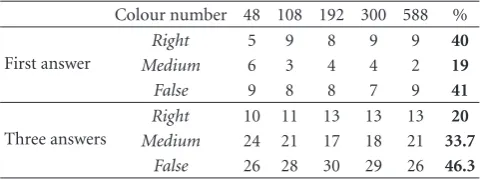
Table2: Results for database n◦1–20 request images. Colour number 48 108 192 300 588 %
First answer
Right 5 9 8 9 9 40
Medium 6 3 4 4 2 19
False 9 8 8 7 9 41
Three answers
Right 10 11 13 13 13 20
Medium 24 21 17 18 21 33.7
False 26 28 30 29 26 46.3
Consequently, a look up table (LUT), which indicates for each pixel of an image its coordinates in the mixed image, allows to obtain the pallet more quickly. In another way, BT simply consists to extract in a homogeneous way pixels from the image. Thus, it is possible, for rectangular images, to ob-tain a same feature by applying a subsampling technique.
6. RETRIEVAL APPROACHES
6.1. Colour reduction retrieval approach
If it is possible to extract a sample of pixels, which the colours are representative of the original image and which are stable for images having the same sight, then this feature is called colour invariant. This colour feature is used as an indirect signature [30]. The strategy to retrieve the closest image from the database, to the request image, is shown in Figure 11. First we build a pallet database by computing for each im-age of the original database its colour invariant. Then, the re-quest image is projected in the colour space defined by each pallet from this pallet database. We compute the colour dif-ference between the request image and the projected ones (cf. Table 1), and we select the pallet (i.e., the image) which leads to the minimum of this distance.
6.1.1. Results of the colour reduction retrieval approach
From each image database, we have built 5 pallet databases, to assess different size of pallet: 48, 108, 192, 300, and 588, which, respectively, correspond to these two dimensional pallets of: 6×8, 9×12, 12×16, 15×20, and 21×28. In order to speed up the retrieval process, we subsampled the request image (60×80 pixels). Tables2and3display a syn-thesis of obtained results. The retrieved images are organised in three classes.
(i) Right: the image proposed by the retrieval system is taken in the same room and with the same orientation than the request image.
Table3: Results for database n◦2–35 request images. Colour number 48 108 192 300 588 %
First answer
Right 10 16 17 21 19 47.5
Medium 13 7 12 6 7 25.7
False 12 12 6 8 9 26.8
Three answers
Right 23 35 37 37 35 31.8
Medium 43 32 36 37 38 35.4
False 39 38 32 31 32 32.8
(ii) Medium: the image proposed by the retrieval system is taken in the same room than the request image. (iii) False: the image proposed by the retrieval system is
taken in other room than the request image.
We analysed two cases: the quality of the first answer and the quality of the three first answers. We can see that we obtain 40% or more of good answers when we take only one an-swer into account. If we want a coarse anan-swer to the ques-tion “In which room is the robot”?, we sum the “Right” and the “Medium” answers. Then the rate of correct answer is about 60% for the database n◦1 and over 70% for the second database. When we take the first three answers into account, we obtain degraded results especially for the first database which contains no more than one image for each sight.
Moreover, the relationship between accuracy and colour number is not monotonic. Above a certain threshold, perfor-mance gains from increased colour number cease to be ob-served and become too small to justify the increased compu-tational cost. In the second database, we obtain results over 75% with 192 and 300 colours in the pallet. Finally, we retain this last size (300 colours) to work with for the next experi-ments.
Figures12(a) and13(a)show request images from the
first and the second databases, respectively. Figures 12(b), 12(c), and 12(d) present the first three answers obtained
(Figures 12(b) gives the right response, Figures 12(c) and
12(d)are false). Figures13(b)and13(c)present two exam-ples of the first answer obtained with two different pallets. We can see that the result is right with a pallet of 192 colours (seeFigure 13(b)), but it is false with a pallet of 48 colours (seeFigure 13(c)).
In spite of its interest which validates the concept of colour invariant, our method is handicapped by a very signif-icant computing time (over than 15 minutes). The projection of the request image according to all pallets of the database takes a more and more time that the bulky database. We can however consider the pallet as a feature and compare pallets between them in the retrieving phase instead of comparing request image with reduced ones.
6.2. The interpallet distance
Request image
(a)
(c)
(b)
(d)
Two images from the first database
Their two “300 colours” pallets
Figure11: Request image reduced by pallets of the images (a) and (b) give the result images (c) and (d), respectively.
(a) (b) (c) (d)
Figure12: Three answers with a pallet of 300 colours from the request image (a).
search the closest image to the request image is described as follows (cf.Figure 14).
(i) First we build a pallet database by the computation of the colour invariant of each image from the original database.
(ii) Then, we extract the pallet of the request image to compute the colour difference between this one and all pallets already built in the database. Euclidean distance is computed between correspondent colour having the same position in these pallets.
(iii) Finally, we select the pallet (i.e., the image) which leads to the minimum of this distance.
The space organisation of colours of this two-dimensional pallet is an additional information who can present invari-ance property to some changes in image sample. Thus, we emphasis this colour feature aspect and try to model it by preserving the interpallet distance which gives interesting re-sults. Indeed, as the below figure shows it, the pallet pserves the spatial distribution and the principal vicinity re-lations between colours present in the original image. This should give us a relative invariance as well for sight point small changes as for scale factor (i.e., distance separating the camera to objects).
6.3. Space distribution of colours
In order to coarsely describe colours distribution form of the image and to build an invariant feature as well for sight point small changes as for scale factor, we extract the three first colour statistical moments of the pallet. These moments are largely used in pattern recognition systems and give a robust and complete description of analysed patterns. Stricker and Orengo [24] establishes a balanced sum of the average, the variance, and skewness (the third-order moment) computed for each colour channel, to provide a single number used in the indexing process. These moments are defined by
μi= 1 N
N
j=1 pi j,
σi= 1 N
N
j=1
pi j−μi
2
,
si= 1 N
N
j=1
pi j−μi
3 1/3
,
(10)
(a) (b) (c)
Figure13: First answer with a pallet of 192 colours (b) and 48 colours (c) from the request image (a).
Robot
Request image
Pallet
Closest image
Room & orientation Euclidean distance
Room pallet database Image pallet database
Offline phase
Figure14: Interpallet distance.
The distance between two images is then defined like a weighted sum between these quantities for each channel:
dmom(I,H)
=
3
i=1
wi1μIi −μHi +wi2σiI−σHi +wi3siI−siH.
(11)
We have applied these moments on our two-dimensional pallet.pi jare in this case pixels from the pallet andNis the number of colour in the pallet. We notice that a space de-scription of our two-dimensional pallet by colour moments as showed in [20], gives better results than a similar descrip-tion of the entire original image. We deduce that such a de-scription of a pallet, which is a represention on a reduced scale of the original image, gives a more precise visual sum-mary of it. In addition, the search time is much more faster while operating on pallets (0,7 second against 3 to 4 sec-onds for retrieving by image moments with an image size of 1260×960 pixels).
Nevertheless, the success rate remains rather weak com-pared to our objectives (50% to find the right room). Thus, we studied the discriminating capacity of each of the first
four moments (average, variance, skewness, and kurtosis) to use the best of them as a weighting factor to the proposed in-terpallet distance. After the computation, the first four mo-ments variance, the greatest on is used to build a weighting coefficient enough discriminating for strong variations and neutral for weak variations (lower than a thresholdα). Then
we discriminate through the coefficient λ images having a
variance of the first two moments lower than a thresholdβ. Following some experiments on our two image databases, we fixedαat 20 andβat 128:
w1 = λ Δσ
σim + σreq
(12)
with
Δσ=
α ifσreq−σim< α,
σreq−σim otherwise, (13)
λ=
⎧ ⎨ ⎩
1 ifσreq−σim< β,μreq−μim< β,
∞ otherwise. (14)
Thus
D1=w1·L2
Preq−Pim
. (15)
6.4. Vicinity template of colours
To describe the textural aspect of colours distribution, we de-veloped the cooccurence matrix and some relating features defined by Haralick et al. [32] and extended to colour infor-mation by Tr´emeau [33] which are
(i) colour inertia:
I=
N
i=0
N
j=0 D2
i j·P(i,j) (16)
withD2
i j =(Ri−Rj)2+ (Gi−Gj)2+ (Bi−Bj)2;R,G, andBare the three colour channels of the RGB colour space;
(ii) colour correlation:
C=
N
i=0
N
j=0 Di·Dj
σi·σj P
(i,j) (17)
withDi =((Ri−Rμi) 2
+ (Gi−Gμi) 2
+ (Bi−Bμi) 2
)1/2, Dj=((Rj−Rμj)
2
+ (Gj−Gμj) 2
+ (Bj−Bμj) 2
μi,σi(resp.,μj,σj) who represent the colour average and the colour standard deviation for all the transi-tions for which the index colour first pixel isi(resp., the index colour second pixel is j).
Thusμi=(Rμi,Gμi,Bμi) with
Rμi=N 1
j=0P(i,j)
· N
j=0
P(i,j)·Rj,
σi=
N 1
j=0P(i,j)
· N
j=0
P(i,j)·D2
j
(18)
(iii) homogeneity:
H =
N
i=0
N
j=0
P(i,j)2 (19)
(iv) entropy:
E =
N
i=0
N
j=0
P(i,j)·logP(i,j). (20)
Moreover, we extract the maximum value of the cooccurence matrix and its two colour components that we note (c1,c2).
Owing to the fact that a fine quantisation of a colour space gives a large signature, the construction of cooccurence matrices related to pallets (low-size images) brings smooth and not enough discriminating distributions. To mitigate this problem, we kept only the main colours vicinity and we developed a new cooccurence matrix related to a coarse uni-form quantisation of the RGB colour space in 64 bins. We considered, in addition, an isotropic vicinity (8 connexities) of each pixel.
For the retrieval phase, we developed the Euclidean dis-tance L2(Mreq −Mim) between cooccurence matrices Mreq
andMim, respectively, of request image pallet and database
image pallet. This distance is weighted with the factor w2
computed on the base of the entropy variation which has the greatest dynamics and so the discriminating capacity among the other cooccurrence matrix features. This gives theD2
dis-tance hereafter:
w2=λ ΔE
Eim+Ereq
(21)
with
ΔE =
γ ifEreq −Eim < γ,
Ereq −Eim otherwise. (22)
Thus
D2=w2L2
Mreq−Mim
. (23)
We analysed the colour components of the maximum value of the cooccurence matrix. We estimated the valueλ accord-ing to the three-dimensional connexity of the request image colour components and those of database images. By assimi-lating uniform colour bins to cubes (cf.Figure 15), the three-dimentional connexity is evaluated as follows:
Blue B
(0, 0, 255) Magenta (255, 0, 255)
G
Red (255, 0, 0) (0, 0, 0)
Black
1 3
2 4 5
Yellow
(0, 255, 0) (255, 255, 0) Green
(1, 1, 1) White
Cyan
(0, 255, 255)
(255, 255, 255)
R
Figure15: RGB colour cube.
Connex1: cubes adjacent by a surface, for example, cubes (1, 2), (1, 3);
Connex2: cubes adjacent by an edge, for example, cubes (2, 3), (3, 5);
Connex3: cubes adjacent by a point, for example, cubes (2, 4).
We retained the best connexity of the request image pair of colour (c1,c2)reqwith each database image pair of colour
(c1,c2)imthrough the following algorithm:
if (c1,c2)req=(c1,c2)im, thenλ=1,
if (c1,c2)reqConnex1 (c1,c2)im, thenλ=2,
if (c1,c2)reqConnex2 (c1,c2)im, thenλ=3,
if (c1,c2)reqConnex3 (c1,c2)im, thenλ=4,
elseλ=8.
6.5. The final distanceD
TheD2distance built by cooccurence matrices of the pallets
gives lower results than theD1distance (only 55% of right
room). But by finely analysing answers of each request, we note that there are some cases where theD1distance led to
a false result whereas the distanceD2 leads to a right result
(and vice versa).
The final distanceD we propose takes the normalised
distances between pallets and between cooccurence matri-ces into account, each one balanced by a resulting term from colour moments and cooccurence matrices attributes, re-spectively. The balanced sum distanceDis given by
D=w1L2
Preq−Pim
+w2L2
Mreq−Mim
. (24)
6.6. Hierarchical approach
Robot
Request image
Pallet
4 closest rooms Corresponding pallets
Ddistance
Closest image Euclidean distance
Room & orientation
Room pallet database Image pallet database
Offline phase
Figure16: Hierarchical search.
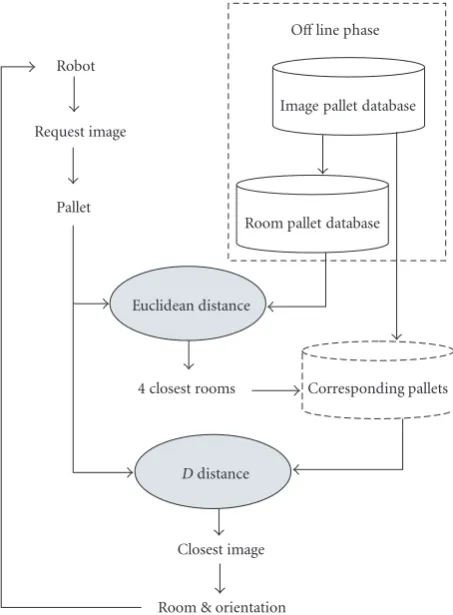
a discriminating colour pallet. Each room pallet is built by sampling colour pallets of images belonging to this room and by adding colours whose minimal distance to those retained is higher than a threshold fixed at 10.
During the retrieval phase, we compute the difference be-tween the request and room pallets by using the Euclidean distance and then classify these distances by ascending order. We eliminate firstly rooms presenting no similar colours to those of the request image (cf.Figure 16). Finally, we apply
the distanceDto retrieved images where the robot is high
probably lost.
To increase the speed of the system it is necessary to
elim-inate the maximum of rooms. However, we should not affect
the system effectiveness by eliminating the room correspond-ing to the request image where the robot is lost. After some experiments on our two image databases, we kept in search process the first four rooms given by the hierarchical process. It should be noted that our aim is to simplify the large-scale indoor space to a simple part (some rooms) where a fine lo-calisation system should be more efficient. This being made, we eliminate, from the localisation process, rooms on which certain images distort results. By keeping the first four rooms from eight rooms in the indoor environment, we divide by two the space where one seeks to locate the robot.
Usual localisation contributions assess their system in simple indoor environments with a maximum of two rooms to draw results and conclusions of a robot’s exact localisa-tion. We evaluate our method in two indoor environments
(a) (b)
Figure17: (a) Request image from the second database; (b) Re-sponse image withinDdistance.
much more large and complex. We do not propose a solu-tion of exact localisasolu-tion, but rather a solusolu-tion to simplify the complexity of the space. If we want to make robot’s fine localisation with a map-based method, for example, our al-gorithm can simplify from the search half of the map without compromising any result. Indeed, for our both assessment databases, we can undoubtedly simplify 4 of the 8 rooms of the indoor space without eliminating the required room. These results make of this hierarchical process an effective preliminary stage not only for our localisation method but for all indoor localisation systems. Moreover, all the process does not take more than two seconds to have half of the in-door space simplified.
7. EXPERIMENTAL RESULTS
We performed various experiments with 20 test images for the first database and 35 for the second one. Test images are different from those of the data sets. We note that a system which guesses the right room and orientation of the robot would be right one out of hundred times, giving an error rate of 99%.
We note better results with our distanceDthan the inter-pallet distance owing to the fact that we consider as well the space organisation and colour vicinity as the colourimetric aspect of the pallet. For the request image (cf.Figure 17(a)), we have false results by using the interpallet,D1andD2
dis-tance separately. The disdis-tance Dcombining these two last
measures gives the right result. We have in this case the re-sult image ofFigure 17(b)indicating the right room and the right orientation.
Table 4shows results of our retrieval strategies based on a two-dimensional colour pallet extract from the Baker’s trans-formation, showing the advantages of our approach.
Table4: Results of our methods.
Database 1 Database 2 Databases1 & 2
Time (s) Results % Time (s) Results % %
Colour reduction retrieval approach Right
0.7
9 45%
65%
1.1
21 60%
77.2% 71.5%
Medium 4 20% 6 17.2%
False 7 35% 8 22.8% 28.5%
Interpallet distance Right
0.7
10 50%
60%
1.1
15 42.8%
60% 60%
Medium 2 10% 6 17.2%
False 8 40% 14 40% 40%
Spatial and colour distanceD Right
2
12 60%
65%
3
18 51.5%
71.5% 69%
Medium 1 5% 7 20%
False 7 35% 10 28.5% 31%
Hierarchical approach with the distanceD Right
4
12 60%
70%
5
20 57%
88.5% 82%
Medium 2 10% 11 31.5%
False 6 30% 4 11.5% 18%
In order to improve even more the performances of room identification, we developed a hierarchical retrieving method eliminating in a preliminary stage a number of rooms from
the indoor environment to combine speed and effectiveness
of the localisation process. Results are clearly improved to ex-ceed the 80%. The hierarchical procedure being consuming in computational time, the computing time of the global so-lution tends to increase to reach 4 seconds, a time considered to be acceptable for the task of global localisation.
In order to validate this work, we compare these results with a classical image retrieval technique which uses colour histogram. We developed colour histograms on RGB and Luv spaces. The RGB colour space which gives best results is per-formed to three uniform quantisations into 64, 512, and 4096 colour bins. The various bin-by-bin (histogram intersection, L2andχ2) and cross-bin (earth mover distance and
Maha-lanobis distance) similarity measures developed previously were implemented and tested to our image databases.
As showed inFigure 18, the quantisation to 64 colours proves very coarse for colour histograms. Quantisation to 512 bins improve considerably these results but the 4096 bins discretisation gives the best results except the Euclidean distance which gives best results with 512 bin quantisation. We display results of the 4096 colour histograms inTable 5. We note the worst results with the cross-bin similarity mea-sures which tend to overestimate the mutual similarity of colour distributions. Moreover, the computational complex-ity of the EMD and Mahalanobis distance are the highest among the evaluated measures. Indeed, computing the EMD between 4096 colour histograms in our database takes over than 30 minutes. Theχ2test gives the best results among the
five developed distance. This statistical measure gives an er-ror rate of 22% to find the right room. In addition, com-puting time at around 4 seconds is acceptable for a global localisation task.
50 60 70 80 90
(%)
64 512 4096
Quantisation L2
Histogram intersection Khi2
Mahalanobis EMD
Figure18: Histogram results.
Our method gives better results than those of the colour histograms. We have especially best results than the effective χ2test. For the second database which integrates different
il-lumination conditions, we have a rate of 88% to find the right room giving a correct estimate of the robot position. Results provided only with a colour-based description of indoor im-ages are encouraging. A final system obviously must integrate other type of signature like shape and texture with a more structured model of the environment.
8. FURTHER RESEARCH
We can identify the following avenues for improving perfor-mances.
Table5: Histogram results. Base 1 & 2
Time (s) Results
Histogram Intersection Right
4 31 56.4% 74.5%
Medium 10 18.1%
False 14 25.5%
Euclidean DistanceL2
Right
4
27 49.1%
67.2%
Medium 10 18.1%
False 18 32.8%
χ2test
Right
4
32 58.2%
78.2%
Medium 11 20%
False 12 21.8%
Mahalanobis Distance Right
60
20 36.4%
63.6%
Medium 15 27.2%
False 20 36.4%
Earth Mover Distance: EMD Right
2100
23 41.8%
65.4%
Medium 13 23.6%
False 19 34.6%
of the global solution (whole image processing) and the local approach may improve our system’s perfor-mances. The characteristics developed in this paper were computed globally in the entire image. How-ever, a system only based on global characteristics can-not give the desired results. Indeed, an image con-tains many objects having very different characteris-tics (colours and textures), the feature vector extracted from the whole image loses local information (related to objects) and gives a coarse idea about images’ con-tents. A possible solution consists on indexing some known and nonremovable objects in the room’s house [34]. A preliminary retrieving phase could determine whether one of these objects is in the sight field of the robot reducing the size of retrieving space. Such a combination of the global solution with a preliminary local approach has to improve even more the perfor-mances of our system.
(2) More careful modelling of the colour distribution for our similarity measure, for example, by using Tamura signature features [35] like directivity, con-trast, and coarseness with a more fine colour pallet, or a frequency-based model [36] can introduce texture-useful information to improve discrimination between images.
(3) Another prospect for image retrieving problematic would consist on the exploration and the search for other features and invariants such as differential in-variants for colour images and inin-variants for pre-dictable change of illumination [37]. A comparison
between our results and those gotten by these ap-proaches could induce ideas to improve results. (4) We could consider a procedure of reinforcement of the
decision-making by asking the robot to take a second image of its environment (after a small translation and rotation) and by comparing the response obtained to that resulting from the first request image. A confi-dence factor attached to the answer could achieve this procedure effectively. It will be necessary, in any event, to seek a compromise between the quality of the results and the response time.
9. CONCLUSION
We have presented a new approach by image retrieval tech-niques which aims to localise an indoor robot. This approach uses a pallet extracted by using baker’s transformation. This pallet gives a good representation of initial colours and pre-serves the spatial organisation of the original image. We also build an appropriate distance which integrates the space and the colour aspects of this pallet in order to find the closest im-age. We obtain results which are better than results obtained from a colour histogram method. Thus we have developed one retrieval technique which is fast and effective.
REFERENCES
[1] J.-J. Gonzalez-Barbosa and S. Lacroix, “Localisation d’un robot mobile dans un environnement naturel par indexation d’images panoramiques,” inLAAS/Robotique et Intelligence Ar-tificielle Seminars, Toulouse, France, Decemebr 2001. [2] G. N. DeSouza and A. C. Kak, “Vision for mobile robot
nav-igation: a survey,”IEEE Transactions on Pattern Analysis and Machine Intelligence, vol. 24, no. 2, pp. 237–267, 2002. [3] O. Ait-Aider, Localisation r´ef´erenc´ee mod`ele d’un robot
mo-bile d’int´erieur, Ph.D. thesis, Universit´e d’Evry, Val d’Essonne, France, 2002.
[4] P. Hoppenot, E. Colle, O. Ait-Aider, and Y. Rybarczyk, “ARPH: assistant robot for handicapped people—a pluridisciplinary project,” inProceedings of the 10th IEEE International Work-shop on Robot and Human Communication, pp. 624–629, Bor-deaux, Paris, France, September 2001.
[5] R. Chatila and J.-P. Laumond, “Position referencing and con-sistent world modeling for mobile robots,” inProceedings of IEEE International Conference on Robotics and Automation, pp. 138–145, St. Louis, Mo, USA, March 1985.
[6] A. Kosaka and A. C. Kak, “Fast vision-guided mobile robot navigation using model-based reasoning and prediction of un-certainties,”Computer Vision, Graphics, and Image Processing: Image Understanding, vol. 56, no. 3, pp. 271–329, 1992. [7] M. Meng and A. C. Kak, “Mobile robot navigation using
neural networks and nonmetrical environment models,”IEEE Control Systems Magazine, vol. 13, no. 5, pp. 30–39, 1993. [8] T. Tsumura, “Survey of automated guided vehicle in a Japanese
factory,” in Proceedings of IEEE International Conference on Robotics and Automation, vol. 3, pp. 1329–1334, San Francisco, Calif, USA, April 1986.
[10] H. P. Moravec and A. Elfes, “High resolution maps from wide angle sonar,” inProceedings of IEEE International Conference on Robotics and Automation, vol. 2, pp. 116–121, St. Louis, Mo, USA, March 1985.
[11] S. D. Jones, C. Andresen, and J. L. Crowley, “Appearance based processes for visual navigation,” inProceedings of the IEEE/RSJ International Conference on Intelligent Robots and Systems (IROS ’97), vol. 2, pp. 551–557, Grenoble, France, September 1997.
[12] M. Swain and D. Ballard, “Color indexing,”International Jour-nal of Computer Vision, vol. 7, no. 1, pp. 11–32, 1991. [13] Y. Rui, T. S. Huang, and S.-F. Chang, “Image retrieval: current
techniques, promising directions, and open issues,” Journal of Visual Communication and Image Representation, vol. 10, no. 1, pp. 39–62, 1999.
[14] J. R. Smith and S.-F. Chang, “Local color and texture extrac-tion and spatial query,” inProceedings of the IEEE International Conference on Image Processing (ICIP ’96), vol. 3, pp. 1011– 1014, Lausanne, Switzerland, September 1996.
[15] C. Fernandez-Maloigne, “Quantification et segmentation pour l’indexation de bases d’images couleur,” inTraitement et Analyse d’Images: M´ethodes et Applications (TAIMA ’01), pp. 61–66, Hammamet, Tunisia, October 2001.
[16] S.-T. Goh and K.-L. Tan, “MOSAIC: a fast multi-feature image retrieval system,”Data & Knowledge Engineering, vol. 33, no. 3, pp. 219–239, 2000.
[17] M. Flickner, H. Sawhney, W. Niblack, et al., “Query by image and video content: the QBIC system,”Computer, vol. 28, no. 9, pp. 23–32, 1995.
[18] C. Nastar, “Indexation et recherche d’images: enjeux, m´ethodes et perspectives,” Congr`es IDT, 1999.
[19] W.-Y. Ma and B. S. Manjunath, “NeTra: a toolbox for navigat-ing large image databases,”Multimedia Systems, vol. 7, no. 3, pp. 184–198, 1999.
[20] J. R. Smith and S.-F. Chang, “VisualSEEk: a fully automated content-based image query system,” inProceedings of the 4th ACM International Multimedia Conference, pp. 87–98, Boston, Mass, USA, November 1996.
[21] N. Boujemaa, S. Boughorbel, and V. Constantin, “Descrip-tion de la r´eparti“Descrip-tion spatiale de la couleur pour l’indexa“Descrip-tion d’images,” in13eme Congr`es Francophone ARIF-AFIA (RFIA ’02), vol. 2, pp. 405–414, Angers, France, January 2002. [22] P. Gros, G. Mclean, R. Delon, R. Mohr, C. Schmid, and
G. Mistler, “Utilisation de la couleur pour l’appariement et l’indexation d’images,” Research Report 3269, topic 3, Insti-tut National de Recherche en Informatique et en Automatique (INRIA), Le Chesnay, France, 1997.
[23] W. Niblack, R. Barber, E. Equitz, et al., “QBIC project: query-ing images by content, usquery-ing color, texture, and shape,” in Stor-age and Retrieval for ImStor-age and Video Databases, vol. 1908 of
Proceedings of SPIE, pp. 173–187, San Jose, Calif, USA, Febru-ary 1993.
[24] M. A. Stricker and M. Orengo, “Similarity of color images,” inStorage and Retrieval for Image and Video Databases III, vol. 2420 ofProceedings of SPIE, pp. 381–392, San Jose, Calif, USA, February 1995.
[25] Y. Rubner, C. Tomasi, and L. J. Guibas, “A metric for distribu-tions with applicadistribu-tions to image databases,” inProceedings of the 6th IEEE International Conference on Computer Vision, pp. 59–66, Bombay, India, January 1998.
[26] A. Tr´emeau, C. Fernandez-Maloigne, and P. Bonton, Image Num´erique Couleur: De L’acquisistion au Traitement, Dunod, Paris, France, 2004.
[27] V. I. Arnold and A. Avez,Probl`eme Ergodiques de la M´ecanique Classique, Monographies Internationales de Math´ematiques Modernes, Gauthier-Villars, Paris, France, 1967.
[28] P. Billingsley,Ergodic Theory and Information, John Wiley & Sons, New York, NY, USA, 1965.
[29] C. Montagne, S. Lelandais, A. Smolarz, and P. Cornu, “Adap-tive color quantization using the “Baker’s Transform”,” in Pro-ceedings of the 2nd European Conference on Color in Graph-ics, Imaging, and Vision and Sixth International Symposium on Multispectral Color Science (CGIV ’04), pp. 353–358, Aachen, Germany, April 2004.
[30] C. Montagne, S. Lelandais, A. Chaari, and M. B. Ahmed, “Invariant couleur bas´e sur la transform´ee du boulanger— application `a la localisation globale d’un robot d’int´erieur,” in International Conference Sciences of Electronics, Technol-ogy of Information and Telecommunication (SETIT ’05), Susa, Tunisia, March 2005.
[31] S. Lelandais, A. Chaari, A. Smolarz, C. Montagne, and B. Jacquin, “A new color invariant for image retrieval using the baker’s transformation,” in Beijing International Conference on Imaging: Technology and Applications for the 21st Century (BICI ’05), pp. 328–329, Beijing, China, May 2005.
[32] R. M. Haralick, K. Shanmugan, and I. Dinsytein, “Textural fea-tures for image classification,”IEEE Transactions on Systems, Man, and Cybernetics, vol. 3, no. 6, pp. 610–621, 1973. [33] A. Tr´emeau and B. G´erin, “Utilisation de la matrice de
cooc-currence couleur pour l’analyse de texture,” inAutomatic Con-ference. Data-Processing Genius. Image (AGI ’96), pp. 303–306, June 1996.
[34] K. Mikolajczyk and C. Schmid, “Scale & affine invariant inter-est point detectors,”International Journal of Computer Vision, vol. 60, no. 1, pp. 63–86, 2004.
[35] H. Tamura, S. Mori, and T. Yamawaki, “Textural features cor-responding to visual perception,”IEEE Transactions on Sys-tems, Man and Cybernetics, vol. 8, no. 6, pp. 460–473, 1978. [36] K. S. Thyagarajan, T. Nguyen, and C. Persons, “A maximum
likelihood approach to texture classification using wavelet transform,” inProceedings of IEEE International Conference on Image Processing (ICIP ’94), vol. 94, pp. 640–644, Austin, Tex, USA, November 1994.