University of Pennsylvania
ScholarlyCommons
Gansu Survey of Children and Families Papers
Gansu Survey of Children and Families
4-2014
Educational expectations, school experiences and
academic achievements: A longitudinal
examination
Yuping Zhang
Lehigh University
Follow this and additional works at:
http://repository.upenn.edu/gansu_papers
Part of the
Education Commons
Reprinted fromChina: An International Journal12, no. 1 (2014): 43-65. Publisher URL: http://muse.jhu.edu/article/542865
This paper is posted at ScholarlyCommons.http://repository.upenn.edu/gansu_papers/22 For more information, please [email protected].
Zhang, Yuping, "Educational expectations, school experiences and academic achievements: A longitudinal examination" (2014). Gansu Survey of Children and Families Papers. 22.
Educational expectations, school experiences and academic achievements:
A longitudinal examination
Abstract
This study incorporates teacher and child perceptions of child school experiences into the examination of the reciprocal influence between teacher and child educational expectations and child academic achievements. Analysing a longitudinal data from north-west rural China, the results highlight strong lagged effects of child school experiences: a child’s early feelings of disengagement have strong negative impact on his/her later educational expectations and achievements, while the teacher’s early evaluations of the child are closely linked to later teacher expectations and child achievement. A child’s family background has almost no direct effect on child and teacher expectations and achievements when controlling child and teacher perceptions of child’s progress in school. The findings suggest that future studies should focus more on child school experiences, which is a topic that has brought much insight to disparities in educational outcomes in developed countries.
Disciplines
Education
Comments
Reprinted fromChina: An International Journal12, no. 1 (2014): 43-65. Publisher URL: http://muse.jhu.edu/article/542865
1
Educational Expectations, School Experiences, and Academic Achievements: A LongitudinalExamination
Running Title: Expectations, School Experiences and Achievements
Yuping Zhang
Department of Sociology and Anthropology Lehigh University 681 Taylor Street Bethlehem, PA 18015 [email protected] [email protected] 610-758-3820
Funding for the Gansu Survey of Children and Families has come from The Spencer Foundation, the World Bank, NIH Grants 1R01TW005930-01 and 5R01TW005930-02, and the Economic and Social Research Council/Department for International Development Research Award RES-167-25-0250.
2
Educational Expectations, School Experiences, and Academic Achievements: A LongitudinalExamination Abstract
This study incorporates teacher and child perceptions of child school experiences into the examination of the reciprocal influence between teacher and child educational expectations and child academic
achievements. Analyzing a longitudinal data from northwest rural China, the results highlight the strong lagged effects of child school experiences: child early feelings of disengagement have strong negative impact on child later educational expectations and achievements, while teacher early evaluations of child are closely linked to later teacher expectations and child achievement. Child family background has almost no direct effect on child and teacher expectations and achievements, when controlling for child and teacher perceptions of child progress in school. The findings suggest that future studies should pay more attention to child school experiences, which is a topic that have brought much insights to disparities in educational outcomes in developed countries.
3
Educational Expectations, School Experiences, and Academic Achievements: A LongitudinalExamination
Introduction
Educational research has identified many factors that could influence student school
achievements, including teacher educational expectations, and teacher and student perceptions of student school experiences. There are numerous studies about the relationships between teacher expectations of student future school attainment and student school achievements.1 Other studies have provided evidence that teacher perceptions of students can positively or negatively influence student performances and achievements.2 Self-fulfilling prophecy is one of the main theories that have been used to explain the influence of teacher expectations and perceptions of students on student achievements. Empirical studies testing this theory have reported different conclusions.3
1
William D. Crano and Phyllis M. Mellon, “Causal Influence of Teachers' Expectations on Children's Academic Performance; A Cross-Lagged Panel Analysis”, Journal of Educational Psychology 70 (1978): 39-49. Karl Alexander, Doris Entwisle, and Maxine Thompson, "School Performance, Status Relations, and the Structure of Sentiment: Bringing the Teacher Back in”, American Sociological Review 52 (1987): 665-82. Lee Jussim and Jacquelynne Eccles, “Teacher Expectations II: Construction and Reflection of Student Achievement”, Journal of Personality and Social Psychology 63 (1992): 947-61. Ronald Ferguson, “Teachers' Perceptions and Expectations and the Black-White Test Score Gap”, Urban Education 38 (2003): 460-507.; Douglas Downey and Shana Pribesh, "When Race Matters: Teachers' Evaluations of Students' Classroom Behavior", Sociology of Education 77 (2004): 267-82.; Aprile D. Benner and Mistry S. Rashmita, “Congruence of Mother and Teacher Educational Expectations and Low-Income Youth's Academic Competence”, Journal of Educational Psychology 99 (2007): 140-53.; Doris Entwisle, Karl Alexander, and Linda Steffel Olson, “First Grade and Educational Attainment by Age 22: A New Story”, American Journal of Sociology 110 (2005): 1458-502.; Maureen Hallinan, “Teacher Influences on Students’ Attachment to School”, Sociology of Education 81 (July 2008): 271-283.; Rashmita S. Mistry, Elizabeth S. White, Aprile D. Benner, and Virginia W. Huynh, “A longitudinal study of the simultaneous influence of mothers and teachers educational expectations on low-income youths academic achievemen”, Journal of Youth and Adolescence 38:6 (2009): 826-38.
2
Jere E. Brophy, “Research on the Self-Fulfilling Prophecy and Teacher Expectations”, Journal of Educational Psychology 75 (1983): 631-61.; Gary Natriello and Sanford M. Dornbusch, “Bringing Behavior Back In: The Effects of Student Characteristics and Behavior on the Classroom Behavior of Teachers”, American Educational Research Journal 20:1 (March 1983): 29-43.; Alexaner, Entwisle and Thompson, “School Performance, Status Relations, and the Structure of Sentiment: Bringing the Teacher Back in”.; George Farkas, Robert Grobe, Daniel Sheehan, and Yuan Shuan, “Cultural Resources and School Success: Gender, Ethnicity, and Poverty Groups Within an Urban School District”, American Sociological Review 55 (1990): 127-142.; Lee Jussim, A. Smith, S Madon, and P. Palumbo, “Teacher Expectations” in Advances in Research on Teaching, ed. JE Brophy (Greenwich, CT: JAI, 1998), pp. 1-48.; Robert Croninger and Valerie Lee, “Social Capital and Dropping Out of High School: Benefits to At-Risk Students of Teachers’ Support and Guidance”, Teachers College Record 103:4 (2001): 548-581.; R. S. Weinstein, Reaching Higher: The Power of Expectations in Schooling (Cambridge, MA: Harvard University Press, 2002).
3
Ferguson, Ronald, "Teachers' Perceptions and Expectations and the Black-White Test Score Gap".; Lee Jussim and Kent Harber, “Teacher Expectations and Self-Fulfilling Prophecies: Knowns and Unknowns, Resolved and Unresolved Controversies", Personality and Social Psychology Review 9 (2005): 131-55.
4
Another line of research examines more closely the connections between student educational expectations, their school experiences, and achievements4. Student perceptions of school experiences as reflected in their self-evaluations of academic abilities and achievements and feelings of disengagement are closely related to their educational outcomes.5
However, we have limited knowledge about how each factor influences and is influenced by other factors when all are taken into consideration across time. Also, most of the research mentioned above is conducted in the U.S. and other developed countries. To date, only a few studies in the context of developing countries have examined the reciprocal relationships among teachers’ and students’
expectations, their perceptions of children’s school experience, and students’ achievement over time. In the setting of a developing country, where the social structure and educational systems, as well as conceptions on the roles of teachers and the values of education might be different from those in the developed countries, exploring the mechanisms through which school processes may affect students’ educational outcomes will bring insights into the educational stratification research, and will provide an opportunity to test the theoretical frames that often used in educational stratification research as well. The purpose of this study is to begin to fill this gap by analyzing a longitudinal data from rural Northwest China. This study aims to answer the following main questions: (1) whether there is stability or change over time in teacher and child expectations, their perceptions of school experience, and achievements; and (2) whether there is reciprocal relationships between teacher expectations and achievements and between child expectations and achievements; and (3) whether teacher and child interpretations of child school experience mediate these relationships. In this study, teacher interpretation of child school experience refers to teacher assessments of child learning abilities and achievement levels, as well as study habits and
4
Christopher E. Sanders, Tiffany M. Field, and Miguel A. Diego, “Adolescents' Academic Expectations and Achievement”, Adolescence 36:144 (December 2001): 795-802.; Claudia Buchmann and Ben Dalton, "Interpersonal Influences and Educational Aspirations in 12 Countries: The Importance of Institutional Context", Sociology of Education 75 (2002): 99–122.; Jacquelynne S. Eccles and Allan Wigfield, “Motivational Beliefs, Values, and Goals”, Annual Review of Psychology 53:1 (02) (2002): 109.; Kum-Shia Liu, Ying-Yao Cheung, Yi-Ling Chen, and Yuh-Yih Wu, “Longitudinal effects of educational expectations and achievement attributions on adolescents' academic achievements”, Adolescence 44:176 (Winter 2009): 911-24.
5
Jennifer A. Fredricks, Phyllis C. Blumenfeld, Alison H. Paris, “School Engagement: Potential of the Concept, State of the Evidence”, Review of Educational Research 74:1 (2004): 59-109.; Liu, Cheung, Chen and Wu, “Longitudinal effects of educational expectations and achievement attributions on adolescents' academic achievements”; Brian P. Daly, Richard Q. Shin, Charu Thakral, Michael Selders, and Elizabeth Vera, “School engagement among urban adolescents of color: Does perception of social support and neighborhood safety really matter”, Journal of Youth and Adolescence 38:1 (Jan. 2009): 63-74.
5
behaviors at school. Child interpretation of school experiences refer to two aspects: child self- evaluations of their achievement levels and efforts in school work comparing with their peers, and feelings of
disengagement from school.
Previous Research
Teacher and Student Educational Expectations
Research in educational stratification has identified the links between teacher educational expectations for student future education attainments and student school outcomes. Studies found that in general teachers tend to have lower educational expectations for students from low income families as compared with their peers from higher income families, and for students from minority groups. At the same time, students from disadvantaged families tend to have lower expectations themselves.6 These low expectations are closely connected with student poor achievements at school and a high drop-out rate later.7 Using data from the Chicago Longitudinal Study, Gill and Reynolds (1999) found that teacher expectations are strong predictors of student reading and math achievements among African American children. Smith, Jussim and Eccles’s (1992) study found that teacher expectations in middle school have latent effect on student high school standard test scores. One of the recognized mechanisms whereby teacher expectations may influence school outcomes is through their influence on student educational expectations, their self-concept of abilities and attainment values. In turn, these factors have been
6
. William Crano and Phyllis M. Mellon, "Causal Influence of Teachers' Expectations on Children's Academic Performance; A Cross-Lagged Panel Analysis".; P. M. Wilson and J.R. Wilson, “Environmental Influence on Adolescent Educational Aspirations: A Logistic transform model”, Youth and Society 24 (1992): 52-70.; J. Alvidrez and R. S. Weistein, “Early Teacher perceptions and Later Student Academic Achievement", Journal of Educational Psychology 91 (199): 731-46.; Chandra Muller, Susan Roberta Katz, and L. Janelle Dance, “Investing in Teaching and Learning: Dynamics of the Teacher-Student Relationship From Each Actor’s Perspective”, Urban Education (September 1999): 292-337.; Aprile D. Benner and Mistry S. Rashmita,
“Congruence of Mother and Teacher Educational Expectations and Low-Income Youth's Academic Competence”, Journal of EducationalPsychology 99 (2007): 140-53.; Grace Kao and Marta Tienda, “Educational Aspiration of Minority Youth”, American Journal of Education 106 (1998): 349-384.; Wei-Cheng Mau and L.H. Bikos, “Educational and Vocational Aspirations of Minority and Female Students: A Longitudinal Study”, Journal of Counseling and Development 78 (2000): 186-94.
7
Suchdeep Gill and Arthur J. Reynold, “Educational Expectations and School Achievement of Urban African American Children”, Journal of School Psychology 37 (1999): 403-24.; Muller, Katz and Dance, “Investing in Teaching and Learning: Dynamics of the Teacher-Student Relationship From Each Actor’s Perspective”.; R. W. Rumberger, “Dropping out of Middle School: a Multilevel analysis of students and schools”, American Educational Research Journal 32 (1995): 583-625.
6
identified as predictive of later school outcomes including grades, test scores, and dropping out.8 Muller et al. (1999) found that teacher expectations are the strongest predictor of whether students have
aspirations to attend college. Using data from the New Hope study, Benner and Mistry (2007) found that teacher expectations have a strong impact on student achievements, and this impact is mediated by student expectations and the self-concept of competency.
Student educational expectations are associated with both behavioral choices that facilitate academic success and educational attainments.9 The positive impact of student educational expectations on attainment holds even when controlling for previous achievements.10 Eccles and Wigfield (2002) argue that expectations are closely related to achievement performance; at the same time, they are influenced by individual interpretations of previous achievements. They point to the cyclical influence between
expectations and achievements. Several studies have reported the reciprocal relationship between child educational expectations and school achievements.11 Bui’s (2007) study found that the impact of school achievements on educational expectations is stronger than in the opposite direction. The above studies point to the interrelationship among teacher and student educational expectations and student academic achievements at school. However, the reciprocal effects between expectations and achievements over time are less clear.
Teacher and Student Perceptions of Student School Experience
8
Muller, Katz and Dance, “Investing in Teaching and Learning: Dynamics of the Teacher-Student Relationship From Each Actor’s Perspective”.; S. R. Sirin and L. Rogers-Sirin, “Exploring School Engagement of African American Adolescents", Youth and Society 35 (2004): 23-40.; Aprile D. Benner and Mistry S. Rashmita, “Congruence of Mother and Teacher Educational Expectations and Low-Income Youth's Academic Competence”, Journal of Educational Psychology 99 (2007): 140-53.
9
Wilson and Wilson, "Environmental Influence on Adolescent Educational Aspirations: A Logistic transform model".; Lingxin Hao, and Melissa Bonstead-Bruns, “Parent-Child Differences in Educational Expectations and the Academic Achievement of Immigrant and Native Students", Sociology of Education 71:3 (1998): 175-198.; Grace Kao and Marta Tienda, “Educational Aspiration of Minority Youth”, American Journal ofEducation 106 (1998): 349-384.; Liu, Cheung, Chen, Wu “Longitudinal effects of educational expectations and achievement attributions on adolescents' academic achievements”.
10
Jerry Trusty, M. Plata, C.F. Salazar, “Modeling Mexican Americans’ Educational Expectations: Longitudinal Effects of Variables across Adolescence", Journal of Adolescent Research 18:2 (2003): 131-153.
11
Christopher E. Sanders, Tiffany M. Field, and Miguel A. Diego, “Adolescents' academic expectations and achievement”, Adolescence 36:144 (December 2001): 795-802.; K. Bui, “Educational Expectations and Academic Achievement among Middle and High school Students”, Education 127:3 (2007): 328-331.
7
Another line of research focuses on the impact of teacher perceptions of students such as evaluations of student academic abilities, performance, and behaviors at school. Previous research has shown that teacher perceptions of student cognitive and non-cognitive skills can positively or negatively influence student performances and achievements, be they accurate or not.12
In examining the mechanisms through which teacher perceptions may influence student outcomes, research points to self-fulfilling prophecy effects.13 Teachers expect students to continue to act or perform according to previously established patterns and may disregard contradictory evidence of change, and this initially erroneous belief leads to its fulfillment. Teacher perceptions of students may lead to different treatment in daily interactions between the teachers and the students. Marshall and Weinstein (1984) point out that differential teacher treatment can influence student learning directly (e.g., the opportunity to learn), and this treatment can also have indirect effects. Teacher perceptions signal to students messages about their capabilities to learn to the extent that students internalize these messages, and their
performance may reflect the beliefs of the teacher. In this way, teacher perception effects are mediated by student perceptions of competency.
Students from disadvantaged social groups seem to be more vulnerable to the negative self-fulfilling effect.14 Analyzing data from New Zealand, Rubie-Davies and his colleagues15 came to the conclusion that teachers have obvious lower academic expectations and judgments for Maori students
12
Brophy, "Research on the Self-Fulfilling Prophecy and Teacher Expectations".; Jussim and Eccles, "Teacher Expectations II: Construction and Reflection of Student Achievement”.; Farkas, Grobe, Sheehan, and Shuan, “Cultural Resources and School Success: Gender, Ethnicity, and Poverty Groups Within an Urban School District”.; R. S. Weinstein, “Reaching Higher: The Power of Expectations in Schooling”, (Cambridge, MA: Harvard University Press, 2002).; Ferguson, "Teachers' Perceptions and Expectations and the Black-White Test Score Gap".; Douglas Downey and Shana Pribesh, "When Race Matters: Teachers' Evaluations of Students' Classroom Behavior", Sociology of Education 77 (2004): 267-82.; Entwisle, Alexander and Olson, "First Grade and Educational Attainment by Age 22: A New Story".; Christine Rubie-Davies, John Hattie, and Richard Hamilton, “Expecting the Best of Students: Teacher Expectations and Academic Outcomes”, British Journal of Educational Psychology 76 (2006): 429-44.
13
Brophy, "Research on the Self-Fulfilling Prophecy and Teacher Expectations".; T.L Good and Jere E. Brophy, Looking in Classrooms (Boston, MA: Allyn and Bacon).; M. A. Rolison and F.J. Medway, “Teachers' Expectations and Attributions for Student Achievement: Effects of Label, Performance Pattern, and Special Education Intervention”, American Educational Research Journal 22 (1985): 561-73.; Jussim and Harber, "Teacher Expectations and Self-Fulfilling Prophecies: Knowns and Unknowns, Resolved and Unresolved Controversies".
14
Doris Entwisle and Karl Alexander, “Factors Affecting Achievement Test Scores and Marks of Black and white First Graders", Elementary School Journal 88 (1988): 449-71.; Ferguson, "Teachers' Perceptions and Expectations and the Black-White Test Score Gap".; Downey and Pribesh, "When Race Matters: Teachers' Evaluations of Students' Classroom Behavior".; Rubie-Davies, Hattie, and Hamilton, “Expecting the Best of Students: Teacher Expectations and Academic Outcomes".
15
Christine Rubie-Davies, John Hattie, and Richard Hamilton, “Expecting the Best of Students: Teacher Expectations and Academic Outcomes”.
8
than students of other ethnic groups. Although the Maori student achievements were similar to other students at the beginning of the year, by the end of the year, Maori students had made the least gains of all groups.
Other studies present different conclusions. After reviewing the past three decades of empirical studies on teacher perceptions and academic expectations of students and their association with student achievements, Jussim and Harber16 conclude that self-fulfilling prophecies do occur, but these effects are typically small, and they do not accumulate greatly across perceivers or over time. Teacher expectations may predict student outcomes specifically because these expectations are accurate rather than self-fulfilling effects. They suggest the claims that self-self-fulfilling prophecy effects accumulate over time are based on the assumptions that teachers do not change their perceptions of students even if the perceptions are not accurate, and the perceptions remain the same across multiple teachers and over time. On the other hand, students are passively influenced and change their behavior accordingly. The results of some empirical studies have shown that these assumptions are not valid.17
Ferguson (2003) argues that teacher perceptions may lead to differences in their behavioral interaction with students, and teacher and student behaviors might be both causes and consequences of racially disparate perceptions and expectations regarding achievements. He concludes that teacher perceptions, expectations and behaviors interact with student beliefs, behaviors and work habits in ways that help to perpetuate and even to expand the black-white test score gap. The magnitude of this effect could be substantial if effects accumulate from kindergarten through high school (Ferguson 2003).
16Lee Jussim and Kent Harber, “Teacher Expectations and Self-Fulfilling Prophecies: Knowns and Unknowns, Resolved and
Unresolved Controversies", Personality and Social Psychology Review 9 (2005): 131-55.
17
M. A. Rolison and F.J. Medway, “Teachers' Expectations and Attributions for Student Achievement: Effects of Label, Performance Pattern, and Special Education Intervention”, American Educational Research Journal 22 (1985): 561-73.; Ray C. Rist, “Student Social Class and Teacher Expectations: The Self-fulfilling Prophecy in Ghetto Education”, Harvard Educational Review 40:3 (1970): 411-451.; E. Smiths, and L. Jussim, and A. Eccles, “Do Self-fulfilling Prophecies Accumulate, Dissipate or Remain Stable over Time”, Journal of Personality and Social Psychology 77 (1999): 548-565.; Lee Jussim and Kent Harber, “Teacher Expectations and Self-Fulfilling Prophecies: Knowns and Unknowns, Resolved and Unresolved Controversies".
9
Student daily participation in school is an important aspect of educational experiences. Hallinan points out that learning is “a social psychological as well as a cognitive process.”18
How students perceive their school experience, including self-evaluation of achievements and efforts as compared with peers, and feelings of disengagement from school is closely linked to both achievements and plans for future schooling.19 Some scholars argue that student engagement is one of the most important factors related to student academic success and the prevention of school drop-out.20 Other studies consider student engagements themselves as important academic outcomes and identify the factors that influence student engagements, including teacher’s roles in shaping student feelings about school.21
China Context and Research
China provides an interesting comparative case in studying school processes and educational outcomes. As a developing country, China has been experiencing rapid economic growth and expansion of education. Traditionally, the Chinese culture puts great emphasis on the value of education. In recent decades, education has become an important factor for social upward mobility, as economic reform has brought many employment opportunities and a rapid increase in returns to schooling.22 It is a strong belief shared by many rural residence that education is one of the major ways for rural children to “walk out” of villages and to have a future life better than their parents.23 At the same time, China also witnesses
18
Maureen Hallinan, “Teacher Influences on Students’ Attachment to School”, Sociology of Education 81 (July 2008): 271-283. Pg. 271.
19
Becky Smerdon, “Engagement and Achievement: Differences between African-American and White High School Students”, Research in Sociology of Education and Socialization 12 (1999): 103-134.; Monica Kirkpatrick Johnson, Robert Crosnoe and Glen H. Elder, Jr., “Students’ Attachment and Academic Engagement: The Role of Race and Ethnicity”, Sociology of Education 74:4 (October 2001): 318-340.; Jennifer A. Fredricks, Phyllis C. Blumenfeld, and Alison H. Paris, “School engagement: Potential of the concept, state of the evidence”, Review of Educational Research 74:1 (March 2004): 59-109.; Hallinan, “Teacher
Influences on Students’ Attachment to School”.
20 Jeremy Finn and Kristin Voelkl, “School Characteristics Related to Student Engagement”, Journal of Negro Education 62
(1993): 249-268.; Smerdon, “Engagement and Achievement: Differences between African-American and White High School Students”.; F.M. Newmann, ed., Student Engagement and Achievement in American Secondary Schools (Teachers College Press,1992).
21
Hallinan, “Teacher Influences on Students’ Attachment to School”; Daly, Shin, Thakral, Selders, and Vera, “School engagement among urban adolescents of color: Does perception of social support and neighborhood safety really matter?”.
22
Junsen Zhang, and Yaohui Zhao. 2006. "Rising Schooling Returns in Urban China." In Education and Reform in China, edited by Emily Hannum and Albert Park (London: Routledge 2006)pp.406-434.
23
Emily Hannum and Jennifer Adams. "Girls in Gansu, China." In Exclusion, Gender, and Education: Case Studies from the Developing World, edited by Maureen Lewis and Marlaine Lockheed 2007. pp.71-98. Washington, D.C.: Center for Global Development. Emily Hannum and Jennifer Adams. "Beyond Cost: Rural Perspectives on Barriers to Education." In Creating Wealth and Poverty in Postsocialist China , edited by Deborah Davis and Wang Feng (Stanford: Stanford University Press 2008),
10
growing social inequality, and educational stratification still exists, especially because of regional and rural-urban differences.24
Previous research on rural educational stratification has mostly focused on how lack of economic resources both at community and household levels, traditional gender norms, and the decentralization policies at the beginning of economic reform have put children living in impoverished areas and especially girls at disadvantage in educational attainment.25
The Chinese government in recent years has made a series of efforts and policy changes to address access problems long experienced by children living in impoverished rural areas. These efforts include implementing policies that eliminate all schooling fees and provide financial help for children in need to complete compulsory education, and to improve the quality of rural education.26 The Long and Mid-Range Term Plan for Educational Reform and Development (Central Government 2010) expresses continued commitment to preventing the drop out of rural students because of financial difficulties and poor performance. These policy changes help greatly in lifting the financial barrier to rural children’s education, especially at compulsory education level. However, rural children still struggle with lack of resources, especially when they reach levels beyond compulsory education. At the same time inadequate school quality also impose barriers for advancing in schooling. Students have to pass two examinations at critical points when they go through the education system: senior high school entrance examination upon finishing compulsory education in order to gain access to academic track secondary school, and college
pp.156-171.Peggy Kong.. "To Walk Out: Rural Parents' Views on Education." China: An International Journal 8(2) (2010):360-373.
24
Emily Hannum and Meiyan Wang. “Geography and Educational Inequality in China.” China Economic Review 17(2006):253-265.
25
Phil Brown and Albert Park. “Education and Poverty in Rural China”, Economics of Education Review 21(6)(2002): 523-541. Emily Hannum. “Poverty and Basic Education in Rural China: Villages, Households, and Girls’ and Boys’ Enrollment”, Comparative Education Review 47(2)(2003): 141-159. Yuping Zhang, Grace Kao and Emily Hannum. “Do Mothers in Rural China Practice gender Equality in Educational Expectation for their Children? “ Comparative Education Review 51(2007): 131-158. Hannum, Emily, Peggy Kong and Yuping Zhang. “Family Sources of Educational Gender Inequality in Rural China: A Critical Assessment”, International Journal of Educational Development 29 (5) (2009): 474-486.
26 Gerard Postiglione. “School Access and Equity in Rural Tibet”, In Education and Reform in China, edited by Emily Hannum
and Albert Park. London: Routledge. 2007. Ministry of Education of PRC. 2006. Compulsory Education Law of the People’s Republic of China.
http://202.205.177.9/edoas/en/level3.jsp?tablename=1242700726117393&infoid=1248314859053682&title=Compulsory%20Ed ucation%20Law%20of%20the%20People%A1%AFs%20Republic%20of%20China.
The Central People’s Government of PRC. 2010. The Long Term Guidlines for Educational Reform and Development 2010-2020 (国家中长期教育改革和发展规划纲要). http://www.gov.cn/jrzg/2010-07/29/content_1667143.htm
11
entrance examination. Both are highly competitive and selective that determines an individual’s future life chances.27 In such circumstance, it becomes increasingly important to examine, once in school, how children’s school experience can lead to different educational outcomes.
Some recent educational research in China has focused on school processes that may contribute to differences in educational outcomes. The Hannum and Adams 28 study shows that rural parents and children view poor school performance, unwillingness to attend school, and the opportunity costs of school attendance as major barriers to children’s school attainment. A few qualitative studies on drop- out in rural China also suggest that students’ relationships with teachers and engagement in school are
important factors that influence student decisions to quit school.29 While exploring the mechanism
through which school processes may influence children’s educational outcomes, some studies investigates the role of teachers. In the context of rural China, teachers are, historically, and still considered as
authority in the education of children at school, especially in situations where parents have limited schooling themselves. 30Similar to findings in developed countries, studies in China point to the strong relationship between teachers’ expectations and children’s school outcomes. Teachers tend to have lower expectations for children from impoverished families and girls 31, and teachers who perceive home environment as the key influence of children’s school success have lower evaluations of children’s learning abilities and lower expectations for children. In turn, teachers’ early expectations help to accurately predict children’s later school persistence. 32
27
Emily Hannum, Xuehui An and Sebastian Cherng. “Examinations and Educational Opportunity in China: Mobility and Bottlenecks for the Rural Poor”, Oxford Review of Education (2011). Tanja Sargent, Peggy Kong and Yuping Zhang. “Home Environment and Educational Transitions on the Path to College in Rural Northwest China”, (Paper presented at the Comparative International Education Society Annual Conference, Toronto, 2 May 2011).
28
Emily Hannum and Jennifer Adams. “Beyond Cost: Rural Perspectives on Barriers to Education”, In Creating Wealth and Poverty in Postsocialist China, edited by Deborah Davis and Wang Feng. 2008 pp.156-171 Stanford: Stanford University Press.
29
Xiao, Diyu. "Investigation and Discussion on the Problem of Primary and Secondary School Dropouts in Poor Areas." Chinese Education and Society 33(2001):49-58. Liu, Fengshu. "BasicEducation in China's Rural Areas: A Legal Obligation or an Individual Choice? International Journal of Educational Development 24(2004):5-21.
30
Peggy Kong. "To Walk Out: Rural Parents' Views on Education." China: An International Journal 8(2010):360-373.
31
Yiu, Lisa and Jennifer Adams. “Reforming Rural Education: Understanding Teacher Expectations for Rural Youth” (Working Paper). Gansu Survey of Children and Families. http://repository.upenn.edu/gansu_papers/33/
32
Yuping Zhang. Importance of Home Environment for Children's Schooling: From the Teacher's Perspective, in Tiedan Huang, Alexander W. Wiseman (ed.) The Impact and Transformation of Education Policy in China(International Perspectives on Education and Society, 2011, Volume 15), Emerald Group Publishing Limited, pp.237-265. Jennifer Adams and Emily Hannum,
12
Other studies focus on children’s perceptions of their experience in school. Consistent with research in both developed and developing countries, children’s attachment and engagement in school have been identified as closely related to their continued enrollment, as they reflect children’s own willingness to stay in school.33 In Adams and Sargent’s study, 34 the authors found that with the new curriculum reform, teachers’ practices in classroom are gradually changing, and student-centered teaching is positively associated with children’s engagement. The subjective measure of children’s school
experience, their academic achievement is another important predictor of children’s later school outcomes. Considering China’s highly competitive examination system, academic performance is crucial to
determine whether rural children could stay in school beyond compulsory education.
Hypotheses
The above studies point to the interrelationship among teacher and student educational expectations and student academic achievements at school. However, the reciprocal effects between expectations and achievements over time are less clear. Drawing on the comparative and China context specific research, this study aims to disentangle these relationships. To test the self-fulfilling prophecy effect in the setting of rural China, in this study I will first examine whether there are changes in both teacher and student educational expectations and in student achievements across time, especially as many children have changed schools and teachers over time. Another way to test the self-fulfilling prophecy is to investigate the relationships between expectations and achievement over time. Considering the strong influence of teachers, I hypothesize that teacher educational expectations have both a long-term and a current influence on student achievements and expectations; meanwhile teachers take into consideration student achievements while forming their expectations. Also, students with better achievements are likely to have high expectations while their early high expectations serve as a motivation to strive for better
Girls in Gansu, China. in Exclusion, Gender and Education: Case Studies from the Developing World, edited by Lewis, M. &Lockheed,M. (Brookings Institution Press,2007). Pp.71-98
33
Emily Hannum and Jennifer Adams. Beyond Cost: Rural Perspectives on Barriers to Education.
34
Adams, Jennifer and Tanja Sargent. “Curriculum Transformation in China: Trends in Student Perceptions of Classroom Practice and Engagement” Gansu Survey of Children and Families Working Paper, 2012.
13
achievements. Finally, I test over time whether teacher and child perceptions of child school experience are associated with changes in expectations and achievement. I hypothesize that teacher evaluations and student perceptions of school experiences mediate the reciprocal relationships between expectations and achievements.
Research Design
Analytical Approach
To investigate the reciprocal influence between educational expectations and school
achievements, I conducted the analysis in two steps. First, I closely examined the stability and changes in both teacher and child expectations, their perceptions of child school experiences, and child achievements over time. Next, I estimated two sets of cross-lagged models (one for child expectations and their
achievements and one for teacher expectations and child achievements) to explore whether there are reciprocal and lagged effects between expectations and achievements. The cross-lagged model is widely used to assess causal associations in non-experimental, longitudinal data. This approach examines the cross-effects which are the impact of one set of variables on another over time. In this approach, each variable is regressed on its lagged measure and the lagged measure of other variables of interest.35 The cross-lagged analysis allowed me to isolate and compare the effects of expectations on achievements and achievements on expectations. At the same time, by including teacher and child perceptions of child school experience, I am able to explore whether the relationships between expectations and achievements are mediated by the views of each group on child schooling experiences. In addition, the analysis will reveal whether the relationships between expectations and achievements vary by child family
socioeconomic status.
35
Richard Shingles, “Causal Inference in Cross-Lagged Panel Analysis”, in Causal Models in Experimental Designs, ed. H. M. Blaclock Jr. (Piscataway, NJ: Transaction Publishers, 2009), pp 219-250.; M.R. Greene, R. Pasnak, and S. L. Romero, “A Time Lag Analysis of Temporal Relations between Motivation, Academic Achievement, and Two Cognitive Abilities”, Early Education and Development 20:5 (2009): 799-825.; William D. Crano and Phyllis M. Mellon, “Causal Influence of Teachers' Expectations on Children's Academic Performance; A Cross-Lagged Panel Analysis”, Journal of Educational Psychology 70 (1978): 39-49.
14
DataThis study uses two waves of the Gansu Survey of Children and Family (GSCF) collected in rural Gansu province, China, in year 2000 and 2004. The GSCF draws a representative sample of 2,000
children aged 9 to 12 from 100 villages in rural Gansu, using multilevel random sampling precedure. The first wave of data was collected in 2000, and the second wave in 2004. Besides sample children, there are also linkable secondary samples of sample child homeroom teachers. In both 2000 and 2004, teachers and children reported their educational expectations. The child questionnaire included questions regarding child perceptions of their own efforts in school work, levels of achievement compared with peers, and feelings of disengagement from school. Teachers reported evaluations of the child learning abilities and levels of achievement as well as efforts in school work and behaviors at school. Most of this information was collected from answers to questions with the same wording in both the 2000 and the 2004
questionnaires.
The GSCF longitudinal data makes it possible to investigate the changes of both groups in expectations and achievements as well as providing the chance to explore whether there are reciprocal and lagged effects among different factors. In the first wave, most children were in primary school. Four years later, about more than half of those children who were still in school advanced to junior high school. The sample used in this study is limited to those children who were in school in 2000 and were still in school in 2004, since expectations and school achievements are the major outcomes examined in this study. 36After eliminating cases with missing data on all the measures used in the analysis, 1616 cases are used.
36
By 2004, when the second wave of data was collected, about 13% of the sample children were out of school. Those children who dropped out had on average lower achievement and expectations in 2000 than that of those children who stayed in school, though there are no significant differences between these two groups in their academic self-concept and feeling of disengagement.
15
MeasuresEducational Expectations
Teacher educational expectations for children are measured by answers of the homeroom teacher of sample child to the question: “What is the highest level of education you think the child can attain?” The answers are in 10 categories in wave 1 and 12 categories in wave 2 and range from “not finishing primary school” “finish primary school” “some junior high school” to “graduating from college or above.” Child educational expectations are constructed from their answers to the same question: “What is the highest level of education you think you can attain?” The answers include 6 categories ranging from “finish primary school” “finish junior high school” to “graduating from college or above.” Teachers and children were asked the same question at both wave 1 and wave 2. In the analysis, educational
expectations are translated into the number of years it takes to complete the levels.
Child School Achievements
Child school achievements are measured by their mathematics grade from the previous semester as reported by the teachers at both time points. The choice of the mathematics grade as a measure of their achievements is based on the consideration that children may have little help from their parents in learning mathematics due to parents having achieved only a low level of formal schooling, and thus the children must rely mostly on their classroom learning and teachers. Therefore, the grades reflect more of what the children have learned in school. The grades are measured on a 100-point scale. Child
achievements together with teacher and child expectations are the major outcomes of this study.
Perceptions of Child School Experiences
The GSCF provides rich information on how teachers and children perceive child schooling in both waves. I first conducted an exploratory factor analysis to identify different dimensions of teacher evaluations of children and child self-evaluations. Factors with egnevalue larger than 1 are extracted based on results of promax rotation, which yield two factors in teacher perceptions, and two factors in
16
child self-evaluations. Scales were then created using items (standardized) that have high loading on the same factor. Some items are reversely recoded to make sure that items in the same factor are coded in the same direction. Appendix 1 provides the item questions used in creating scales.
Two scales were created to measure teacher perceptions of children: Good Student is a scale with 9 items (some items with slight different wording across waves) which includes teacher assessment of child learning abilities, achievement levels as compared to others students in the class, study habits and behaviors at school. Another scale reflects teacher perception that the child is Experiencing Problem
which includes 7 items in wave 1 and 6 items in wave 2 (with some items different across waves). Teachers consider factors such as disciplinary problems, absence of efforts, lack of confidence, and seemingly depressed.
Two factors are identified to measure child self-evaluation: Child Academic Self-Concept
includes 7 items in wave 1 and 5 items in wave 2. The scale reflects how children evaluate themselves in terms of their learning abilities, their achievement levels as compared to peers and whether they consider themselves to be making efforts in school work. Another scale measures child feelings of Disengagement
in schooling (7 items in wave 1 and 3 items in wave 2), which includes items that reflect child feelings of being bored and lonely at school (for both waves) and beliefs that better achievements depend on luck but not hard work (for wave 1 only).
Child Individual Characteristics
Child Gender is included in all analyses, with boys coded as 0 and girls as 1. Child Age is also included in all analysis.
Family Background Measures
Family background measures include Mothers’ and Fathers’ Education (measured in years of formal schooling they have completed), Family Wealth and Number of Children in the family. Family wealth is a measure of family material resources calculated by adding together the value of household
17
assets (including house, farming equipment and household durable goods). The logged wealth is used in multivariate analysis. There is almost no change across time in these measures.
Analysis Results
Descriptive
Table 1 presents the descriptive statistics of child characteristics and family background. Children on average are about 15 years of age at 2004, and 46 percent of the sample are girls. Parents in rural Gansu have limited formal education: fathers on average have little more than primary school education while mothers have only about 4 years of schooling. On average, there are 2.3 children in the family. There is disparity in family economic situations. Families at the bottom 10th percentile of family wealth have only about 10 percent of the wealth of those families who are at the 90th percentile (calculation not shown). Here we have to bear in mind that Gansu is one of the most impoverished provinces in China.
(Table 1 about here)
Stability and Change in Teacher and Child Educational Expectations and Achievements
In this part of the analysis, I examined the stability and changes over time in teacher and child expectations and child achievements. Table 2 presents the descriptive statistics of teacher and child expectations in both 2000 and 2004, and the correlations over time.
(Table 2 about here)
Children expressed extremely high expectations at both points in time, with an average of 13.7 years in 2000 and have increased to 14.7 years in 2004, which equals to more than two years of college. Interestingly, the correlation of child expectations between two time points is quite low (r=.12), revealing that many children have changed their expectations over time. The mean achievement at the two time points shows that they remain stable over time with only less than 2 points difference. However, the correlation of child mathematics grades over time is also very low, with r=.25, indicating that there are
18
also many relative changes in child school performances during the four-year time period. 37 It is also worth noting that child expectations are not closely correlated with achievements at each time point. There are also low correlations between teacher and child expectations at both time points, showing that teacher expectations for children are often different from child own expectations.
In the year 2000, teachers expected children to have on average of 11.4 years of schooling when most children were still in primary school. Four years later, teacher expectations on average rose by less than a year to 12.2 years which is slightly more than the completion of senior high school when the majority of children are in junior high school. The correlation of teacher expectations between two time points is moderate (r=.31). Teacher expectations are relatively closely related to child achievements of the time, with r=.45 in 2000 and r=.46 in 2004, indicating that child performance is an important factor that teachers consider when forming their expectations for children. Next, I examined changes in child expectations and achievements more closely.
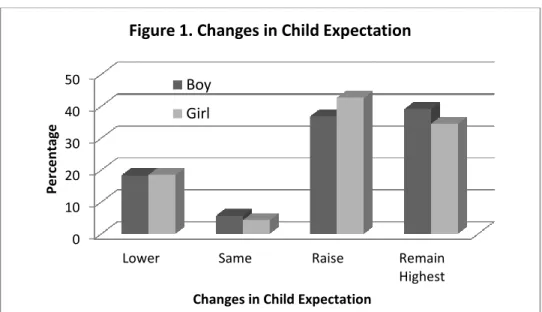
Figure 1 presents changes in child educational expectations over time by child gender. Over time, about 37% of boys and 43 % of girls who were still in school raised their expectations. Among children who expected to finish no more than junior high school in 2000, most expected to complete senior high or college in 2004. There are many children retained their college expectation: 39% of boys and about 34 % of girls who were still in school. One possible explanation is that children gain more confidence regarding their chances of continuing school as they make the transition to junior high school. However, about 18% of children lower their expectations over time.
(Figure 1 about here)
Table 3 presents descriptive of child mathematics achievements at 2000 and 2004 by child grade level in 2004, and correlation over time at each grade level. In a 100 point scale, below 60 is considered
37 To check the relatively weak correlation of the math grades between the two waves, I examined the relationship
between children’s math grades and their Chinese grades. The math grades are highly correlated with their Chinese grades at both 2000 and 2004, which in a sense verifies the accuracy of the data, and also indicates indeed much relative change occurred in children’s school performance. Further checking also shows that the average grades of 2004 increase with each quintile of grades in 2000, indicating that on average children with better achievement maintained their better performance in 2004.
19
as cutting point for pass the class. As indicated by the table, the average achievement of children at each grade level is about the same over time. But the relative low correlations over time indicate much change, as also reflected in the overall low correlation in table 2. When examining by child grade level in 2004, we see that among children who were still in primary school in 2004, their average achievement actually increased over time. However, for those children who have advanced to junior high school, their
achievement dropped, though not much as measured by their mean values. For the whole sample, among children whose mathematics grades were under 60 at wave 1, 65 percent of them caught up during the four-year time period to achieve a grade above 60 at wave 2. However, there are some children who passed in 2000 failed the class four years later. Only half the children with mathematics grades above 80 remained in the top group (calculation not shown). These results reveal the instability of child academic performance. This might be due to changes in school environments and working with different teachers, and more challenging nature of school work as children advance to higher grades.
(Table 3 about here)
The above descriptive analysis reveals that there is much relative change in both child educational expectations and achievements although the means remain similar across time. These findings do not provide support for the self-fulfilling prophecy. It is also interesting to notice that child expectations are only weakly correlated with their achievements at each time point when no other factors are considered. Also, teachers and children have different ideas about how far children can advance in their schooling. The instability of child expectations and achievements, as well as low correlations between child expectations and achievement, indicates there are other factors that may influence the changes in both their expectations and achievements.
Child and Teacher Evaluations
Table 4 presents the descriptive and correlation of factor scales that measure child and teacher subjective evaluations of child school experience, and the Cronbach alpha of each scale. We see much relative change in how children interpret their school experiences over time. The correlation of child academic self-concept between two time points is only r=.19, and the correlation of their feelings of
20
disengagement is as low as r=.06. On average, children reported better self-concept and less feeling of disengagement in 2004 compared with what they reported in 2000. It is good to see that many children who felt disengaged from school in year 2000 no longer feel the same way four years later. Teacher evaluations of children being good students changed relatively less over time, with correlation of r=.30 between two time points. However, teachers have different opinions about whether a child is experiencing problems over time, with a cross time correlation of r=.10 for this measure. The results are in line with the notion that teacher perceptions do not remain the same across multiple teachers and over time.
(Table 4 about here)
Cross-lagged Examination of Child Expectations and Achievements
To test the reciprocal relations between child educational expectations and child achievements, cross-lagged OLS models are estimated with child educational expectations and achievements at wave 2 as separate outcomes. The first set of models contains only the wave 1 measures of the outcomes as predictors. The second set of models includes child academic self-concepts and feelings of disengagement from wave 1 to evaluate whether child self-evaluations mediate the reciprocal relationships between expectations and achievements. The third set are full models with measures of family background added. All models control for child gender and age. Considering the cluster of children, village fixed effect is used to consider the possible impact of village characteristics. As many children have changed schools between the two waves, it would be inappropriate to use school fixed effect.
Table 5 presents the cross-lagged estimation results of child expectations and achievements. The cross-lagged coefficients in the first set of models show that child early achievements have a significant but rather weak effect on later expectations, while early expectations cannot predict later achievements.
(Table 5 about here)
The second set of models includes measures of child early academic self-concept and feelings of disengagement from school. The observed relationships between expectations and achievements remain the same. Meanwhile, child feelings of disengagement from school at an early time point has a strong negative lagged effect on later expectations, and much stronger negative lagged effect on their later
21
achievements. Child academic self-concept at early point in time has no lagged effect on their later expectations, but some positive lagged effect on their later achievement.
The last set of models add in family background measures: parents’ education, number of
children in the family, and family wealth. Adding in family characteristics does not change the patterns of observed relationships. Family background measures have almost no direct impact on child expectations and achievements, except a rather weak association between father education and child expectation, Which is the only coefficient that is significant at 0.05 level.
The cross-lagged models of child educational expectations and achievements reveal that child early higher expectations do not serve as a motivation for children to strive for better achievement later. Early better grades help children to form higher expectations later although the effect is not strong. Feelings of disengagement from school, rather than academic achievements, at an early time point have strong negative lagged effects on both expectations and achievements. It is also interesting to note that family backgrounds have almost no direct effect on child expectations and achievements when controlling for factors included in the models. It is also worth noticing that these cross-lagged models explain little of the variations in expectations and achievements.
Cross-lagged Examination of Teacher Expectations and Child Achievements
Next, I examined the reciprocal relationships between teacher educational expectations for children and child school achievements. Three sets of models are estimated using the same set-up as the previous part of the cross-lagged examination, with teacher expectation and child achievement as separate outcomes.
Table 6 presents the results: The first set of models include only the early measures of the outcomes. The results show there are lagged effects of both early teacher expectations on later achievements and early achievements on later teacher expectations.
The second set of models encompasses early teacher evaluations of children. In the teacher expectation model, child early achievement still has positive lagged effect on later teacher expectations. Teacher early evaluations of children as good students are closely associated with later teacher
22
expectations. In the achievement model, the lagged effect of early teacher expectations on later
achievements is no longer significant, while teacher early evaluations of children as good students have a strong lagged impact on later child achievements. In both models, teacher perceptions of the child
experiencing problems initially have no lagged effect on later teacher expectations nor later achievements. The last set of models includes family background measures, which do not change the observed relationships. Mother’s education is the only measure of family background that has some influence on teacher expectation, though with very small magnitude. Through all sets of models, teachers tend to have lower expectations for girls after controlling for other factors in the model although teachers have better evaluations of children (calculation results not shown) and there is no gender difference in child
achievements.
(Table 6 about here)
The results of this part of the analysis indicate that when teachers form expectations for children, they take into account child early achievements. However, early teacher expectations do not show direct impact on later achievements once teacher evaluations are included. The lagged effects of teacher influences on child later achievements are mostly through teacher perceptions of children. It is likely that teacher evaluations of children manifest more in the daily teacher-child interactions and thus have a stronger impact. The above results indicate that in order to understand the stratification in school outcomes for children, we must take into consideration both the teacher and child perceptions of child school experiences
Conclusion
This study investigated the reciprocal influence between teacher and child educational
expectations and child school achievements, taking into consideration the mediating effects of teacher and child perceptions of school experiences. Analyzing two waves of longitudinal data from rural northwest China, three findings stand out : First, there are many relative changes in child educational expectations and achievements over a four-year time period; second, the strong lagged influence of child feelings of
23
disengagement on their later expectation and achievement, and the close association between teacher early evaluations and child later achievement; and finally, measures of family socioeconomic status have almost no direct influence on both teacher and child expectations, nor on child academic achievement, holding constant the factors considered in the model.
The many relative changes in child achievements and expectations over time provides no support for self-fulfilling prophecy effects. As children advance in school (especially as they move from primary school to junior high school), they have experienced changes in school environments, working with different teachers, and dealing with different levels of difficulty in the subjects they learn. At the same time, they changed their expectations, and their academic performance also changed. Some children who had below average achievements caught up four years later; while some high achievers experienced falling in their grades. These changes are especially obvious among those who advanced to junior high school. It is good to notice that many children raised their expectations, or remain their college expectations as their advance in school provides them more confidence and hope.
Cross-lagged analyses reveal that child early higher expectations do not serve as an inspiration for better achievements, and their expectations are rarely based on previous achievements. Actually what matters most for both child expectation and achievement is child interpretations of their early school experience, especially their feeling of disengagement from school. The strong lagged effect of child early disengagement on their later expectations and achievement indicates that, once they are in school, their school experience is an important factor that determines their educational outcomes. While the presence of chances to migration and work increase the opportunity costs of staying in school, the very competitive educational system requires great commitment and motivation from the students in order for rural
children to stay in school and succeed.
Teachers take into consideration child early achievements when they form educational expectations for children while teacher early expectations do not show a direct impact on child later achievements once taking into consideration of teacher evaluation of child. The strong correlation between early teacher evaluation and expectation and later child achievements may indicate that teachers
24
have accurate evaluations of children and thus could predict children’s later schooling. Considering the relative changes happened in child expectations and grades, the strong relationship between teacher early positive evaluations and child later achievement may also implies that children benefit from teacher high evaluations. In the setting of rural Gansu, parents could hardly provide any assistance to their children’s academic work due to their own limited education, and teachers are considered as authority in child education. In such situation, the encouragement from teachers could serve as important factor that help disadvantaged children to achieve better school outcomes.
It is worth noticing that child family backgrounds as measured by parent education, family wealth, and number of children in family have little direct impact on teacher and child expectations and child school achievements, when taking into consideration teacher and child perceptions of child school experiences.
The findings suggest that future studies on educational stratification in China should “go beyond the cost”38
to pay more attention to child school experiences. As recent educational policy changes in China concerning the financing of education have helped to alleviate financial barriers to enrollment for rural children, what children experience in school, once they are enrolled, has become an increasingly important factor that may lead to educational stratification. The findings also point to the importance of bringing in teacher and child voices while examining the school processes. The conventional measures of teacher quality and attributes may not be able to catch the interpersonal aspects of child daily participation in school. These findings are also informative for educational research in other developing countries and for educational research in general.
The findings from this study also provide timely information for policy makers in China, as the government is making efforts to improve the quality of education for rural children. Further research on the creation of more engaging school environment is much needed. After all, it is the interaction between teachers and students on daily bases that create children’s school experiences.
25
Table 1. Descriptive of Child and Family CharacteristicsMean or Proportion Standard Deviation Child Characteristics Girls 0.46 0.50 Age 14.94 1.12 Family Background Father's Education 6.98 3.90 Mother's Education 4.42 3.55 Family Wealth 23442.40 41712.09
Number of Children in Family 2.33 0.71
26
Table 2. Educational Expectations and Achievement by YearMean Std. Correlation Child Expectation 1 2 3 4 5 1 2000 13.69 2.80 2 2004 14.69 2.17 0.12 Teacher Expectation 3 2000 11.47 2.70 0.24 0.14 4 2004 12.22 2.71 0.13 0.21 0.31 Math Grade 5 2000 74.84 13.42 0.20 0.12 0.55 0.33 6 2004 72.18 16.46 0.09 0.17 0.18 0.46 0.25 Note: N=1616
27
Table 3. Child Achievement by Grade Levels in 2004Math Achievement (2000) Math Achievement (2004)
Grade Level (2004) Mean (SD) Mean (SD) Correlation N
6th Grade or Below 71.98 (15.00) 74.24 (14.50) 0.27 437
7th Grade 73.64 (12.91) 69.63 (17.02) 0.26 404
8th Grade 76.83 (12.08) 70.80 (17.13) 0.23 403
28
Table 4. Descriptive and Correlation of Perception ScalesMin. Max. Correlation
Cronbach Alpha Child 1 2 3 4 5 6 7 Academic Self-Concept 1 2000 -2.24 1.05 0.70 2 2004 -2.61 1.17 0.19 0.67 Disengagement 3 2000 -1.34 1.65 -0.04 -0.09 0.82 4 2004 -1.07 2.69 -0.07 -0.17 0.06 0.67 Teacher Good Student 5 2000 -2.19 1.45 0.28 0.20 -0.15 -0.11 0.86 6 2004 -1.75 1.19 0.18 0.28 -0.12 -0.12 0.30 0.85 Experiencing Problem 7 2000 -0.80 1.96 -0.16 -0.04 0.02 0.04 -0.44 -0.07 0.67 8 2004 -0.82 2.37 -0.17 -0.16 0.02 0.10 -0.17 -0.39 0.10 0.68 Note: N=1616
29
Table 5. Cross-Lagged OLS of Child Expectations and Achievements
Expectation (2004) Achievement (2004) (1) (2) (3) (1) (2) (3) (2000) Expectation 0.054*** 0.044** 0.040* 0.086 -0.058 -0.052 (2.654) (2.090) (1.897) (0.583) (-0.375) (-0.338) Achievement 0.017*** 0.016*** 0.015*** 0.252*** 0.225*** 0.220*** (4.036) (3.503) (3.391) (8.024) (6.900) (6.743) Self-Evaluation Academic Self-Concept -0.092 -0.081 1.210* 1.209* (-0.932) (-0.825) (1.688) (1.682) Disengagement -0.354*** -0.357*** -2.059*** -2.010*** (-3.603) (-3.636) (-2.877) (-2.808) Family Background Father's Education 0.034** 0.120 (2.302) (1.128) Mother's Education -0.005 0.214* (-0.285) (1.676) Number of Children in Family -0.156* 0.325 (-1.937) (0.553)
Family Wealth (logged) -0.020 -0.380
(-0.305) (-0.797)
Child Gender (Girl) -0.042 -0.026 0.006 0.265 0.137 0.104
(-0.391) (-0.247) (0.051) (0.342) (0.176) (0.132) Child Age 0.112** 0.059 0.059 -0.248 -0.587 -0.627* (2.314) (1.162) (1.151) (-0.699) (-1.584) (-1.688) Constant 10.994*** 12.052*** 12.477*** 55.740*** 64.876*** 66.867*** (13.325) (13.315) (11.477) (9.273) (9.829) (8.424) Overall R-Squared 0.028 0.034 0.037 0.062 0.067 0.071 N 1,616 1,616 1,616 1,616 1,616 1,616 note: *** p<0.01, ** p<0.05, * p<0.1
30
Table 6. Cross-Lagged OLS of Teacher Expectations and Child Achievements
Teacher Expectation (2004) Child Achievement (2004)
(2000) (1) (2) (3) (1) (2) (3) Teacher Expectation 0.161*** 0.112*** 0.102*** 0.540*** 0.231 0.219 (5.304) (3.348) (3.033) (2.943) (1.144) (1.078) Child Achievement 0.048*** 0.036*** 0.036*** 0.197*** 0.121*** 0.121*** (7.857) (5.087) (5.107) (5.382) (2.882) (2.866) Teacher Evaluation Good Student 0.529*** 0.514*** 3.517*** 3.476*** (3.311) (3.225) (3.649) (3.603) Experiencing Problem 0.041 0.048 0.976 0.991 (0.299) (0.357) (1.191) (1.208) Family Background Father's Education 0.029 0.089 (1.637) (0.839) Mother's Education 0.057*** 0.204 (2.727) (1.605)
Number of Children in Family 0.066 0.408
(0.688) (0.699)
Family Wealth (Loggeed) 0.015 -0.482
(0.189) (-1.011)
Child Gender (Girl) -0.380*** -0.436*** -0.430*** 0.389 0.093 0.025
(-2.969) (-3.379) (-3.291) (0.504) (0.119) (0.032) Child Age 0.028 0.021 0.011 -0.320 -0.362 -0.403 (0.479) (0.355) (0.190) (-0.905) (-1.025) (-1.137) Constant 6.556*** 8.144*** 7.646*** 55.855*** 65.719*** 68.705*** (6.799) (7.640) (5.925) (9.595) (10.219) (8.799) Overall R-Squared 0.139 0.140 0.157 0.063 0.071 0.075 N 1,616 1,616 1,616 1,616 1,616 1,616 Note: *** p<0.01, ** p<0.05, * p<0.1
31
0 10 20 30 40 50Lower Same Raise Remain
Highest P er ce n tag e
Changes in Child Expectation
Figure 1. Changes in Child Expectation
Boy Girl
32
Appendix 1: Items in Factor Scales Child
Academic Self-Concept (2000) How do you rate your Chinese ability compared to your peers?
How do you rate your mathematics ability compared to your peers?
Are you a good student?
Are you good at being a student leader?
Do you generally finish your homework?
Do you study hard on Chinese?
Do you study hard on mathematics?
Academic Self-Concept (2004) How do you rate your Chinese ability compared to your peers?
How do you rate your mathematics ability compared to your peers?
Do you generally finish your homework?
Do you study hard on Chinese?
Do you study hard on mathematics?
Feelings of Disengagement
(2000) I don't want to go to school most of the time
I feel bored at school
I feel lonely at school
Success in mathematics depends on inborn ability
Success in Chinese depends on inborn ability
Success in mathematics depends on luck
Success in Chinese depends on luck