OpenBU http://open.bu.edu
Theses & Dissertations Boston University Theses & Dissertations
2018
Learning deep embeddings by
learning to rank
https://hdl.handle.net/2144/34773
GRADUATE SCHOOL OF ARTS AND SCIENCES
Dissertation
LEARNING DEEP EMBEDDINGS BY LEARNING TO
RANK
by
KUN HE
B.Eng., Zhejiang University, 2010
M.Sc., Boston University, 2014
Submitted in partial fulfillment of the
requirements for the degree of
Doctor of Philosophy
2018
First Reader
Stanley Sclaroff, PhD
Professor of Computer Science
Second Reader
Kate Saenko, PhD
Associate Professor of Computer Science
Third Reader
Brian Kulis, PhD
First, I must express my deepest gratitude to my advisor, Prof. Stan Sclaroff, for his mentoring and patience over the years. Being his student, I was the fortunate recipient of a tremendous amount of academic freedom, as well as rigorous training. His never-waning enthusiasm and high standards trickle down into our everyday interactions, and from him I have learned a great deal about conducting academic research, writing, and critical thinking in general. I am certain that these will continue to reward me for many years to come.
I am also very grateful to my thesis committee members, Prof. Margrit Betke, Prof. Kate Saenko, Prof. Brian Kulis, and Prof. Leonid Sigal. With each of them, I have had many research-oriented interactions, and their feedback is very helpful for improving this thesis. I also thank Dr. Hao Jiang, Prof. Octavia Camps, Prof. Pedro F. Felzenszwalb, and Dr. Yan Lu, for mentoring me at various points in my research career so far.
During my PhD study, I had the privilege of interacting with, and learning from, numerous past and current members of the IVC group. In particular, I would like to thank my main collaborators, Dr. Fatih C¸ akir and Sarah Adel Bargal, for many of the formulations presented here came out of our long discussions, without which this thesis would be very different. I have also benefited greatly from collabora-tions and interaccollabora-tions with Dr. Qinxun Bai, Dr. Shugao Ma, Dr. Jianming Zhang, Prof. Danna Gurari, Dr. Zheng Wu, Dr. Tai-Peng Tian, Dr. Ashwin Thangali, Dr. Vitaly Ablavsky, Prof. Liliana Lo Presti, Huijuan Xu, and Xide Xia. In ad-dition, I thank the following IVC members and alumni: Dr. Rui Li, Dr. Diane H. Theriault, Dr. Mehrnoosh Sameki, Dr. Mikhail Breslav, Dr. Andrea Zunino, Dr. Antonio Hern´andez-Vela, Wenxin Feng, Ajjen Joshi, Vasili Ramanishka, Ben Usman, Xingchao Peng, Donghyun Kim, and Fred Qi Feng.
have been otherwise. First, I am more than fortunate to be accompanied by my amazing wife Shanshan Dai, whose support, encouragements, and positivity have been there all along this journey. My parents also made selfless sacrifices in their unconditional support for me. Lastly, I thank my son Yunfan, for showing me many of the greatest simple joys in life.
The research reported in this thesis was supported in part by National Science Foundation grant 1029430. Any opinions, findings, and conclusions or recommenda-tions expressed in this material are those of the author and do not necessarily reflect the views of the National Science Foundation. Also, we gratefully acknowledge the support from a BU IGNITION award, and gifts from NVIDIA.
RANK
KUN HE
Boston University, Graduate School of Arts and Sciences, 2018
Major Professor: Stan Sclaroff, Professor of Computer Science
ABSTRACT
We study the problem of embedding high-dimensional visual data into low-dimensional vector representations. This is an important component in many computer vision applications involving nearest neighbor retrieval, as embedding techniques not only perform dimensionality reduction, but can also capture task-specific semantic sim-ilarities. In this thesis, we use deep neural networks to learn vector embeddings, and develop a gradient-based optimization framework that is capable of optimizing ranking-based retrieval performance metrics, such as the widely used Average Preci-sion (AP) and Normalized Discounted Cumulative Gain (NDCG). Our framework is applied in three applications.
First, we studySupervised Hashing, which is concerned with learning compact binary vector embeddings for fast retrieval, and propose two novel solutions. The first solution optimizes Mutual Information as a surrogate ranking objective, while the other directly optimizes AP and NDCG, based on the discovery of their closed-form expressions for discrete Hamming distances. These optimization problems are NP-hard, therefore we derive their continuous relaxations to enable gradient-based optimization with neural networks. Our solutions establish the state-of-the-art on
Next, we learn deep neural networks to extractLocal Feature Descriptorsfrom image patches. Local features are used universally in low-level computer vision tasks that involve sparse feature matching, such as image registration and 3D reconstruc-tion, and their matching is a nearest neighbor retrieval problem. We leverage our AP optimization technique to learn both binary and real-valued descriptors for local image patches. Compared to competing approaches, our solution eliminates complex heuristics, and performs more accurately in the tasks of patch verification, patch retrieval, and image matching.
Lastly, we tackle Deep Metric Learning, the general problem of learning real-valued vector embeddings using deep neural networks. We propose a learning to rank solution through optimizing a novel quantization-based approximation of AP. For downstream tasks such as retrieval and clustering, we demonstrate promising results on standard benchmarks, especially in the few-shot learning scenario, where the number of labeled examples per class is limited.
1 Introduction 1
1.1 Learning Embeddings for Nearest Neighbor Retrieval . . . 1
1.1.1 Supervised Hashing . . . 3
1.1.2 Learning Local Image Descriptors . . . 5
1.1.3 Deep Metric Learning . . . 6
1.2 Contributions . . . 8
1.3 Organization of Thesis . . . 10
1.4 List of Related Papers . . . 12
2 Mathematical Background 13 2.1 Learning Deep Embeddings . . . 13
2.1.1 Deep Supervised Hashing . . . 14
2.1.2 Deep Metric Learning . . . 15
2.2 Ranking-based Evaluation . . . 15
3 Related Work 19 3.1 Vector Embedding using Neural Networks . . . 19
3.2 Learning to Rank . . . 20
3.3 Hashing for Nearest Neighbor Retrieval . . . 23
3.4 Learning Local Image Descriptors . . . 26
4 Hashing with Mutual Information 30 4.1 Optimizing Mutual Information . . . 34
4.1.2 End-to-End Optimization . . . 36
4.1.3 Efficient Minibatch Backpropagation . . . 38
4.2 Experiments . . . 40
4.2.1 Datasets and Setup . . . 40
4.2.2 Results . . . 43
4.2.3 Discussions . . . 46
4.3 Summary . . . 49
5 Hashing as Tie-Aware Learning to Rank 51 5.1 Tie-Awareness in Hashing . . . 53
5.2 Optimizing Tie-Aware Ranking Metrics . . . 55
5.2.1 Continuous Relaxation . . . 56
5.2.2 End-to-end Optimization . . . 56
5.3 Implementation Details . . . 58
5.3.1 A Simplified Version of Tie-Aware AP . . . 59
5.3.2 A Lower Bound for Tie-Aware DCG . . . 60
5.4 Experiments . . . 61
5.4.1 Datasets and Setup . . . 61
5.4.2 Binary Relevance: AP . . . 62
5.4.3 Graded Relevance: NDCG . . . 65
5.4.4 Tightening the Continuous Relaxation . . . 66
5.4.5 Effects of Tie-Braking Strategies . . . 68
5.5 Summary . . . 69
6 Local Descriptors Optimized for Average Precision 71 6.1 Feature Matching is Nearest Neighbor Retrieval . . . 73
6.2 Optimizing Binary and Real-valued Descriptors . . . 74 ix
6.3.1 Spatial Transformer Module . . . 75
6.3.2 Label Mining . . . 78
6.4 Experiments . . . 80
6.4.1 UBC Phototour Dataset . . . 81
6.4.2 HPatches Dataset . . . 84
6.4.3 RomePatches Dataset . . . 86
6.4.4 Oxford Dataset . . . 87
6.5 Implementation Details and Discussions . . . 88
6.5.1 Minibatch Sampling . . . 89
6.5.2 Time Complexity . . . 91
6.6 Summary . . . 91
7 Deep Metric Learning with FastAP 93 7.1 FastAP: Quantization-based AP Approximation . . . 95
7.2 Experiments . . . 100
7.2.1 Datasets and Setup . . . 100
7.2.2 Implementation details . . . 102
7.2.3 Results . . . 103
7.3 Discussions . . . 106
7.3.1 Connection Between FastAP and Tie-Aware AP . . . 106
7.3.2 Graded Relevance Extension . . . 107
7.4 Summary . . . 108
8 Conclusions 110 8.1 Main Contributions . . . 110
8.2 Discussion of Limitations . . . 112
8.3 Directions for Future Research . . . 115 x
B Proof of Proposition 1 123
C Proof of Proposition 2 125
C.1 Proof . . . 125 C.2 Approximation Error Analysis . . . 127
References 129
Curriculum Vitae 146
4.1 Results on CIFAR-10 and NUS-WIDE with VGG-F . . . 44
4.2 mAP@1K values on ImageNet100 using AlexNet . . . 45
4.3 22K LabelMe results with GIST features . . . 45
5.1 AP comparison on CIFAR-10 and NUS-WIDE datasets . . . 64
5.2 AP@1000 comparison on the ImageNet100 dataset . . . 65
5.3 NDCG comparison on the NUS-WIDE and LabelMe datasets . . . 67
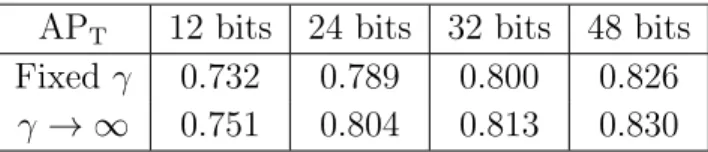
5.4 Comparison between continuous relaxation strategies . . . 68
6.1 Patch verification performance on the UBC Phototour dataset . . . . 82
6.2 Patch retrieval performance on the RomePatches dataset . . . 87
7.1 Performance comparison on the Stanford Online Products dataset . . 104
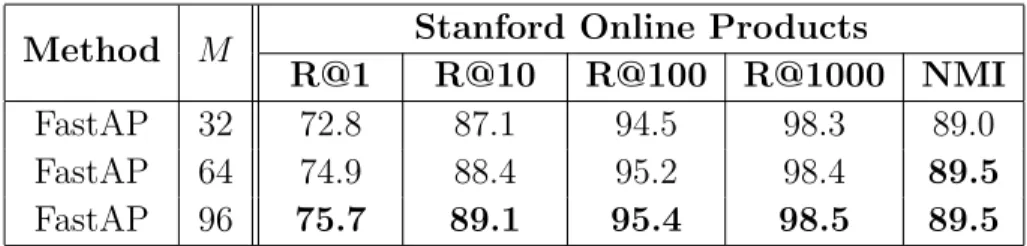
7.2 Ablation study on the batch size M. . . 106
1·1 Supervised hashing for nearest neighbor retrieval . . . 4
1·2 Detection and matching of local image features . . . 5
1·3 Metric learning with deep vector embeddings . . . 7
4·1 Overview of the proposed MIHash method . . . 32
4·2 The distribution separating effect of MIHash . . . 46
4·3 Correlation between MI and AP . . . 47
4·4 Visualization of learned hash codes . . . 48
5·1 Tie-aware ranking metrics for hashing . . . 52
5·2 The flow of computation in the proposed TALR method . . . 58
5·3 Effects of tie-breaking in evaluating hashing algorithms . . . 69
6·1 An example local feature-based image matching pipeline . . . 72
6·2 Patch alignment using the Spatial Transformer . . . 77
6·3 Label mining in the HPatches dataset . . . 79
6·4 Examples from patch-based datasets . . . 80
6·5 Influence of training batch size . . . 83
6·6 Results on the HPatches dataset . . . 85
6·7 Image matching performance on the Oxford dataset . . . 88
7·1 AP as a general objective for metric learning . . . 94
7·2 Quantization of the precision-recall curve . . . 97
7·3 Example images from the Stanford Online Products dataset . . . 100
AP . . . Average Precision
CDF . . . Cumulative Distribution Function CNN . . . Convolutional Neural Network DCG . . . Discounted Cumulative Gain DNN . . . Deep Neural Network
DOAP . . . Descriptors Optimized for Average Precision DOF . . . Degrees of Freedom
FPR . . . False Positive Rate IR . . . Information Retrieval KNN . . . K-Nearest Neighbor LSH . . . Locality Sensitive Hashing LSTM . . . Long Short-Term Memory LTR . . . Learning to Rank
MI . . . Mutual Information
MIHash . . . Hashing with Mutual Information mAP . . . mean Average Precision
NDCG . . . Normalized Discounted Cumulative Gain NMI . . . Normalized Mutual Information
PDF . . . Probability Distribution Function
RPN . . . Region Proposal Network SGD . . . Stochastic Gradient Descent SIFT . . . Scale Invariant Feature Transform SLAM . . . Simultaneous Localization and Mapping SVM . . . Support Vector Machine
TALR . . . Tie-Aware Learning to Rank
Chapter 1
Introduction
Computer vision systems often face the tasks of storing, processing, and searching through high-dimensional visual data, such as mega-pixel images and high-definition videos. Examples include content-based image and video retrieval [4, 107], person and object recognition in photo collections [78, 100], and action detection and classification in surveillance video [68, 76]. To make such systems large-scale, it is desirable to map the high-dimensional data objects to low-dimensional vector representations, both to reduce storage costs and to allow for efficient processing. High-dimensional data also pose challenges for semantic-level understanding: owing to the curse of dimensionality [13], standard similarity metrics in high-dimensional spaces do not necessarily reflect the true perceived similarities between visual objects. Therefore, another requirement for the mapping process is that it should encode desired task-specific similarities, such that objects that are semantically similar are mapped to close neighbors in a low-dimensional vector space.
1.1
Learning Embeddings for Nearest Neighbor Retrieval
In this thesis, we consider the problem of learning low-dimensional vector embeddings of high-dimensional visual data. First and foremost, this task has direct connections to dimensionality reduction [12, 40, 132], which is a well-studied problem in its own right. However, considering that vector embeddings find applications in many differ-ent scenarios, each having differdiffer-ent goals and forms of supervision, we argue that it is
likely suboptimal to take a purely unsupervised, “one-size-fits-all” dimensionality re-duction approach. Instead, we aim to optimize the vector embeddings in a task-driven manner, by learning from data and their accompanying supervision signals.
The primary application scenario that we consider in this thesis isnearest neighbor retrieval, which is a core component in many computer vision applications. Given a query object (e.g. image search query) and a database of indexed objects (e.g. a database of images), a standard retrieval procedure is to first encode the query into a vector representation. Then, distances between the query vector and database vectors are evaluated, either exhaustively over the entire database, or on a subset of the database. The result is a ranking of database items by increasing distance to the query, and finally, objects that have the lowest distances to the query are returned as nearest neighbors. In computer vision, this paradigm is naturally instantiated in problems like image and video retrieval.
It is crucial to have a high-quality distance metric for nearest neighbor retrieval, and when distances are evaluated between vector embeddings, it becomes necessary tooptimize the embeddings so as to achieve high quality. Inspired by the recent suc-cess of deep neural networks (DNNs) in important computer vision problems such as image classification [85], in this thesis we focus on using DNNs to optimize vector em-beddings, as DNNs provide excellent function approximation abilities when coupled with appropriate hardware acceleration. Consequently, our main optimization ma-chinery would be Stochastic Gradient Descent (SGD) [15, 130], which is the standard tool for training DNNs.
In supervised learning of vector embeddings, supervision is commonly given in the form of pairwise affinities. Pairwise affinity labels are easy to obtain (e.g.from agree-ment of class labels), yet they enable learning powerful representations. In its simplest form, we are given pairs of objects, with binary labels indicating their pairwise
rela-tionships as either “similar” or “dissimilar”. Alternatively, the similarity labels could have multiple levels, or “grades”, indicating different strengths. Intuitively, in formu-lating the learning problem, we would like the learned vector embeddings to evaluate to small distances between similar pairs, and large distances between dissimilar pairs. In this thesis, based on the “learning to rank” formalism [105], we design a principled learning framework to capture such intuitions. This framework is applied to learn deep vector embeddings in several problem domains, which we discuss next.
1.1.1 Supervised Hashing
We start by considering the problem of supervised hashing, where the goal is to learn binary vector embeddings, or hash codes, of data. Please see Figure 1·1 for an illustration. A natural use case for hashing is in content-based retrieval in large databases, including for images, video, audio, or even between different modalities. The Hamming distance between binary vectors can be evaluated efficiently using bitwise operations on modern CPUs, which enables fast approximate nearest neighbor search; the approximate search can also be used as a filtering step to return a shortlist of candidate retrievals, before more expensive and time-consuming distance metrics are applied. In addition, with compact codes, the memory and storage footprint for the entire database can be significantly reduced.
Although hashing can be viewed as a binarization or vector quantization technique, this view implies that there is some original distance metric that is being preserved. In fact, this is true for most unsupervised hashing methods. But as we have argued, distance metrics between high-dimensional raw data representations may not be se-mantically meaningful. Therefore, we consider supervised hashing, and learn hash codes (and in turn, a Hamming distance metric) so as to best agree with supervision signals. For content-based image retrieval, a common case is that images with the
Figure 1·1: In supervised hashing, our goal is to learn a hash map-ping Φ from the original high-dimensional feature space to some low-dimensional Hamming space. The resulting binary vector embeddings, or hash codes, enable fast approximate nearest neighbor retrieval in large databases. In this thesis, we parameterize the hash mapping Φ using deep neural networks.
same semantic class label are indicated as similar, and dissimilar otherwise.
It is worth noting that hashing is a discrete problem, as the hash codes are binary by nature. For any objective defined over the hash code assignments in a finite train-ing set, in order to optimize it, the worst case is to try all possible bit combinations, except in cases where special structures exist. Therefore, the optimization problems in supervised hashing are often NP-hard. Unfortunately, this creates a mismatch when learning using DNNs, which are continuously parameterized and rely on gradient-based optimization. To tackle this challenge, in our proposed supervised hashing solutions, we follow a standard recipe: first derive continuously differentiable relax-ations to the discrete objectives, and then apply gradient methods. At test time, the learned representations, which are continuous, are thresholded to give binary codes.
Figure 1·2: An example of detection and matching of local image features between two images, using the SIFT pipeline [108]. Top: de-tected interest points, showing scale and orientation. Bottom: matched feature pairs.
1.1.2 Learning Local Image Descriptors
The next application scenario that we consider is image matching in low-level com-puter vision. Traditionally, this is done by identifying localized “interest points” (such as corners, blobs, etc.) in images, and finding their correspondences across images. When local matches between images are established, global geometric corre-spondences or transformations can be estimated using robust estimation techniques, such as RANSAC [49]. Please see Figure 1·2 for an example.
The local feature matching pipeline plays a fundamental role in many low-level computer vision tasks, such as image registration, camera localization, structure from motion, 3D reconstruction, and Simultaneous Localization and Mapping (SLAM).
SIFT [108] is perhaps the most well-known such pipeline, which consists of carefully handcrafted solutions for 1) detection of interest points, 2) extraction of local feature descriptors from image patches around interest points, and 3) matching between the descriptors. Many learning-based alternatives have been proposed, and they often show improvements on certain benchmark datasets. However, according to recent studies [139], when the entire pipeline is considered, handcrafted solutions like SIFT still perform competitively in complicated low-level vision tasks. This has motivated more research efforts in optimizing low-level vision pipelines using deep learning.
Among the various stages in feature-based low-level vision pipelines, we are partic-ularly interested in a key stage: extraction of local feature descriptors. This is exactly a vector embedding problem: the input is a local image patch, and the output is a fixed-length vector representation. Differently from the image/video retrieval prob-lem where the desired distance metric is usually based on content, a good distance metric for local feature descriptors should be geared towards the robustness of feature matching, especially under viewpoint and illumination variations in the scene. Many other solutions for extracting local feature descriptors have also been developed over the years, including handcrafted ones such as LBP [1], RootSIFT [6], and SURF [11], and ones that are learned with shallow models, e.g. [143]. Instead, our focus in this thesis is on learning local feature descriptors using DNNs.
1.1.3 Deep Metric Learning
Finally, we focus on the deep metric learning problem, namely, learning real-valued vector embeddings using deep neural networks.
Metric learning [86] is a general umbrella term for learning distance metrics from data, and the vast majority of existing methods work by learning a transformation to the input data, and then applying standard distance metrics such as the Euclidean
Figure 1·3: Metric learning with deep neural networks is essentially a vector embedding problem: inputsxand y are embedded into vector representations φ(x) and φ(y), which are then plugged into standard distance metrics, e.g. the Euclidean distance. In this formulation, the embedding functionφ is modeled as a deep neural network, which con-tains all the learnable parameters.
distance. Depending on the type of transformation, metric learning approaches can be grouped into linear and nonlinear methods. Traditionally, linear methods, especially those that learn Mahalanobis distances [109], are extensively studied, partly due to the ease in formulating tractable optimization problems. For nonlinear metric learning, kernel methods have been studied to some extent, and recentlydeep metric learning methods using DNNs have received much attention. While kernel-based metric learning does not necessarily involve vector embeddings, deep metric learning, on the other hand, is essentially a vector embedding problem, since the input data is transformed by a neural network to a vector representation, as shown in Figure 1·3. In fact, the two previously discussed problems, supervised hashing and learning local feature descriptors, can both be regarded as special cases of deep metric learning.
Despite the generality in its formulations, metric learning is still a task-driven problem: the learned distance metric will ultimately be used to perform some specific task. And indeed, it is often motivated by nearest neighbor retrieval or nearest neighbor classification, where the distance metric is of central importance. Metric learning is also useful for producing distance metrics for data clustering. To stay
within the scope of this thesis, we again focus on the nearest neighbor retrieval aspect, and study learning to rank formulations for deep metric learning. Nevertheless, we will show that the distance metrics learned by this approach can also perform well in other related tasks.
1.2
Contributions
In this thesis, we provide novel solutions to all three problems described above. To start with, we propose two novel solutions to the supervised hashing problem. In the first solution, we use an information-theoretic quantity, mutual information, as a quality measure and ranking surrogate for supervised hashing. We then optimize mutual information to learn high-quality binary embeddings. In the second solution, we instead directly optimize commonly used ranking metrics, such as Average Preci-sion (AP) and Normalized Discounted Cumulative Gain (NDCG). For this purpose, we first identify the problem of tied rankings with the discrete Hamming distance, and propose to optimize tie-aware versions of AP and NDCG. Due to the constraint that the learned hash codes must be binary, the optimization problems in both solutions are combinatorial and NP-hard. We employ continuous relaxations and differentiable approximations to enable end-to-end optimization using DNNs. In learning to rank terminology [105], both of our solutions use loss functions belonging to the listwise ranking loss category, which are superior to a range of simpler losses in the current lit-erature. We establish the current state-of-the-art for supervised hashing on standard image retrieval benchmarks.
Next, we apply our techniques to the problem of learning local feature descriptors. We first discover an equivalence between the matching of local features and nearest neighbor retrieval, which allows us to apply learning to rank formulations again. Specifically, the problem of learning binary local feature descriptors can be treated as
an instance of supervised hashing, and is solved by directly reusing the formulation that we developed. Additionally, to learn real-valued descriptors, we also devise a real-valued extension to our formulation. Lastly, we augment our models with task-specific components, so that the nature of local feature matching is better taken into account. Experimental results on standard benchmarks suggest the superiority of our approach compared to other learned and handcrafted ones. Notably, on two of the benchmarks, our learned descriptors outperform SIFT for the first time.
Finally, we focus on learning real-valued vector embeddings using deep neural networks, which is a special case of metric learning [86]. Building on our gradient-based optimization framework, we propose a new quantization-gradient-based formulation for approximately optimizing AP, which is an excellent surrogate objective for metric learning, especially in thefew-shot learning scenario. Experiments on standard image benchmarks for nearest neighbor retrieval and classification show the promise of this method.
To summarize, the major contributions of this thesis are as follows:
• A novel supervised hashing method based on optimizing the information-theoretic quantity of mutual information (published in [62] and [64]),
• A novel supervised hashing method based on directly optimizing ranking-based retrieval evaluation metrics (published in [63]),
• A learning to rank approach for learning robust local feature descriptors with deep neural networks (published in [65]),
• A deep metric learning approach based on a novel quantization-based approxi-mation of AP.
1.3
Organization of Thesis
The remainder of thesis is organized as follows.
Chapter 2: Mathematical Background
This chapter defines notation that will be used throughout this thesis, and reviews necessary mathematical background in the following areas: learning vector embed-dings, nearest neighbor retrieval, and learning to rank.
Chapter 3: Related Work
This chapter reviews related work and prior art in the following categories: distance metric learning, learning to rank, hashing for nearest neighbor retrieval, and the learning of local features in low-level computer vision.
Chapter 4: Hashing with Mutual Information
This chapter describes our first contribution to the supervised hashing problem. We propose an information-theoretic solution based on optimizing Mutual Information, which as we demonstrate, is a good surrogate ranking objective. We relax the NP-hard optimization problem into a continuous version, and then perform gradient-based optimization with deep neural networks. On standard image retrieval benchmarks, our solution achieves convincing improvements over competing methods.
Chapter 5: Hashing as Tie-Aware Learning to Rank
This chapter describes our second contribution to supervised hashing, where we de-velop gradient-based methods to directly optimize AP and NDCG. We first observe that the integer-valued Hamming distance results in tied rankings, which induces am-biguity in evaluation of supervised hashing. We then leverage an existing result in the information retrieval literature to derive tie-aware ranking metrics. By deriving
continuous relaxations to the closed-form expressions of tie-aware metrics, we enable their end-to-end optimization. This solution further improves the state-of-the-art on standard image retrieval benchmarks.
Chapter 6: Local Feature Descriptors Optimized for Average Precision
This chapter describes our proposed solution for learning local feature descriptors. We reuse our AP optimization technique for the supervised hashing problem to learn bi-nary descriptors, and develop an extension to also learn real-valued descriptors. Two improvements are introduced, which are designed for the image descriptor matching task: robustness to geometric distortions using spatial transformer networks [73], and mining additional supervision using clustering. The learned descriptors achieve state-of-the-art performance in three benchmark tasks: patch verification, patch retrieval, and image matching.
Chapter 7: Deep Metric Learning via Learning to Rank
This chapter describes our learning to rank solution for the general problem of deep metric learning, or learning real-valued vector embeddings using deep neural net-works. We propose a novel formulation, named FastAP, to approximately optimize AP for real-valued embeddings. This formulation obtains competitive results, es-pecially when the few-shot learning assumption holds, i.e. the number of labeled examples available for each class is limited.
Chapter 8: Conclusions
This chapter concludes this thesis. Specifically, it summarizes our major contribu-tions, discusses the limitations of our current work, and proposes directions for future research.
1.4
List of Related Papers
This thesis is based in part on the following publications:
1. Kun He*, Fatih Cakir*, Sarah Adel Bargal, and Stan Sclaroff. “MIHash: Online Hashing with Mutual Information,” in Proceedings of the IEEE International Conference on Comoputer Vision (ICCV), Venice, Italy, October 2017 [62]. (*Equal contribution)
2. Kun He*, Fatih Cakir*, Sarah Adel Bargal, and Stan Sclaroff. “Hashing with Mutual Information,” arXiv preprint arXiv:1803.00974 [64]. (*Equal contribu-tion)
3. Kun He, Fatih Cakir, Sarah Adel Bargal, and Stan Sclaroff. “Hashing as Tie-Aware Learning to Rank,” in Proceedings of the IEEE Conference on Computer Vision and Pattern Recognition (CVPR), Salt Lake City, UT, June 2018 [63]. 4. Kun He, Yan Lu, and Stan Sclaroff. “Local Descriptors Optimized for Average
Precision,” in Proceedings of the IEEE Conference on Computer Vision and Pattern Recognition (CVPR), Salt Lake City, UT, June 2018 [65].
Chapter 2
Mathematical Background
We review necessary mathematical background related to the vector embedding prob-lem and nearest neighbor retrieval, and define notation that will be used in later chapters.
2.1
Learning Deep Embeddings
Let X ⊂ RN be the feature space. The goal of learning embeddings is to learn a mapping from X to some embedding space, where the induced distance metric in the learned embedding space has desirable properties. To enforce the desired properties, we consider a standard setup where supervision is given in the form of pairwise relevance. Formally, we assume an relevance oracleA, whereA(xi, xj)>0 if
xi, xj ∈ X are said to be “similar”, with the value indicating the strength of similarity. Otherwise,xiandxj are said to be not similar whenA(xi, xj) = 0. Roughly speaking, the goal of embedding learning is to make the induced distance between the embedding vectors of xi and xj small if A(xi, xj)>0, and large otherwise.
In this thesis, we restrict A to take values from a finite setV, which includes two important special cases. First, the case where V ={0,1} is called binary relevance, which is extensively studied in the hashing and metric learning literature. In practice, binary relevance values can often be derived from agreement of class labels, or from thresholding some distance metric inX. The second case is when V consists of non-negative integers, referred to as multi-level relevance or graded relevance. Graded
relevance is a more fine-grained model, and is frequently considered in information retrieval tasks, including in web search engines [38].
In this thesis, we parameterize the functional mappings by deep neural networks, as they have recently shown to have superior function approximation capabilities when coupled with appropriate hardware acceleration, and have achieved significant advances in problems such as image classification [85]. Consequently, the optimization approaches that we develop would be gradient-based, in order to take advantage of end-to-end training by backpropagation, as well as recent advances in stochastic optimization.
2.1.1 Deep Supervised Hashing
In the supervised hashing problem, we wish to learn a hash mapping Φ : X → Hb, where the embedding space Hb is taken to be the b-dimensional Hamming space. This induces the Hamming distance dΦ : X × X → {0,1, . . . , b}. Practically, the
Hamming distance can be efficiently evaluated by counting bit differences between binary vectors: dΦ(x, x0) = b X i=0 1[φi(x)6=φ(x0)]. (2.1) Since we focus on gradient-based optimization, we adopt an equivalent formulation of the Hamming distance that is more amenable to differentiation:
dΦ(x, x0) = 1 2 b−Φ(x) > Φ(x0), (2.2) Φ(x) = (φ1(x), . . . , φb(x)), φi(x) = sgn(fi(x;w))∈ {−1,+1},∀i, (2.3)
wherefi are the “logits” for each bit, produced by a neural network with parameters
2.1.2 Deep Metric Learning
In deep metric learning, we wish to learn a real-valued embedding Ψ :X →Rd, where typically d < N. As the embedding space now is an Euclidean space, the induced distance metric is naturally the Euclidean distance:
dΨ(x, x0)2 =kΨ(x)−Ψ(x0)k2 (2.4)
=kΨ(x)k2+kΨ(x0
)k2−2Ψ(x)>
Ψ(x0). (2.5)
Also, note that if the vectors are L2-normalized, then the distance is simplified as
dΨ(x, x0)2 = 2−2Ψ(x)>Ψ(x0). (2.6)
Similarly, we parameterize the embedding with neural networks:
Ψ(x) = (f1(x;w), . . . , fd(x;w)), fi(x;w)∈R, (2.7)
where fi are the activations from the output layer of a neural network.
2.2
Ranking-based Evaluation
There are many ways to evaluate learned embeddings. For example, metric learning is often motivated by nearest neighbor classification or clustering, and therefore can be evaluated in terms of kNN classification or K-means clustering performance. In this thesis, we are instead interested in the nearest neighbor retrieval aspect, which finds applications in a wide range of retrieval tasks.
Specifically, we assume the setup where a query xq ∈ X is retrieved against some database S ⊆ X. Retrieval is performed by ranking the instances in S (referred to as database items or documents in this thesis) by increasing distance to xq, where the distance is induced from the learned embedding. The ranking can be represented
by an index vector R, whose elements form a permutation of {1, . . . ,|S|}.1 Unless
otherwise noted, we implicitly assume dependency on xq and S in our notation, and omit them for brevity when applicable. We will also use the shorthand Aq(i) = A(xq, xi).
Ranking-based metrics usually measure some form of agreement between the rank-ing and ground truth relevance values. Intuitively, given queryxq, ranking metrics are optimized when instances having high relevance to xq are placed high in the ranking, and low otherwise.
Precisionis applied in the case of binary relevance, and measures the proportion of retrieved neighbors (xi for which Aq(i) = 1) at a certain cutoff k in the ranking:
Prec@k(R) = 1 k k X j=1 Aq(Rj). (2.8)
Recall is another widely used metric for binary relevance. Like Precision, it is also evaluated at a cutoff k, but measures the proportion of retrieved neighbors out of all the neighbors in the database:
Rec@k(R) = 1 N+ k X j=1 Aq(Rj), (2.9) where N+=|{x
i ∈S|Aq(i) = 1}| is the total count of neighbors.
Recall Rateis closely related to Recall, but involves a set of queries Q. It is defined as the ratio of queries for which there is at least one neighbor in the top k retrievals. Mathematically, for each query xq ∈ Q, let its corresponding ranking be R(q), and
1For simplicity, we consider the ranking to be over the entire database here. More sophisticated strategies could be used to limit the ranking to be performed on a subset of the database.
Recall Rate can be written as R@k({R(q)|xq ∈Q}) = 1 |Q|1 " k X j=1 Aq(R (q) j )>0 # , (2.10)
where 1[·] denotes the binary indicator.
Average Precision (AP) takes the average of Precision values over all positions where there is a neighbor:
AP(R) = 1 N+ |S| X k=1 Aq(Rk)Prec@k(R). (2.11)
An alternative definition of AP, that is also useful for our later analysis, is the area under the Precision-Recall curve. Specifically, if we view Precision and Recall as continuous values, and view Precision as a function of Recall, then AP corresponds to the following integral:
AP =
1
Z
0
Prec(Rec)dRec. (2.12)
Discounted Cumulative Gain (DCG) is used for graded relevance. The idea is to sum up the contributions (gain) from the relevance values in the ranked list, while weighting them (discount) according to the rank:
DCG(R) = |S| X k=1 G(Aq(Rk))D(k), (2.13) where G(a) = 2a−1, D(k) = 1 log2(k+ 1), (2.14)
are called the gain and discount functions, respectively. Other gain and discount functions can also be used (e.g. linear discount instead of logarithmic), but the
com-bination shown above is used the most.
Normalized Discounted Cumulative Gain (NDCG) is the normalized variant of DCG. It divides DCG by its maximum possible value, ensuring a range of [0,1]:
NDCG(R) = DCG(R) maxR0DCG(R0)
. (2.15)
Note that, to achieve maximum DCG, retrieved items need to be sorted in descending order according to relevance to the query. Therefore given a query and a database, the maximum DCG is a constant and can be precomputed if necessary. Also, this means that theoptimization of NDCG is independent of the normalizing factor, which boils down to optimizing DCG.
Chapter 3
Related Work
In this chapter, we review related work and prior art.
3.1
Vector Embedding using Neural Networks
Vector embeddings play a central role in many application areas of pattern recog-nition, since they allow encoding data to fixed-length representations. In addition, performing the embedding with a small number of dimensions can lead to savings in computation and space. One classical example, the Bag-of-Words (BOW) model [110], is first studied in information retrieval and natural language processing, which represents documents by histograms of word counts. BOW models were also widely adopted in computer vision [39, 93, 159]; in fact, the second-best entry in the Ima-geNet Large-Scale Visual Recognition Challenge (ILSVRC) in 2012, behind the now-famous AlexNet [85], was based on BOW-type features [133].
With the advent of deep learning, the vector embedding problem has been increas-ingly studied with deep neural networks. The classical example of vector embedding using neural networks is Siamese networks [18], originally designed for the computer vision problem of handwritten signature verification, and later used in face verifica-tion [33]. After the success of AlexNet [85], it was found that off-the-shelf activaverifica-tion features from pretrained deep convolutional neural networks can directly give com-petitive baselines for image retrieval [8] and general visual recognition [140]. However, it is often necessary to learn the embeddings so as to optimize for certain tasks. For
example, in the complicated image captioning task, vector embeddings can be used to aid nearest neighbor search [79]. Another example is learning local image descriptors for sparse feature matching [48, 142].
Outside of computer vision, vector embeddings also find important applications in areas such as natural language processing, where Word2Vec [114] and Skip-Thought Vectors [83] have become widely used tools for encoding words and sentences. Shared vector embeddings are often learned across different modalities to enable cross-modal retrieval and recognition, examples include Cross-Modal Transfer [144], DeViSE [51], Cross-Modal Scene Networks [28], and Audio-Visual Embedding [7].
Connection to Metric Learning
Broadly speaking, the vector embedding problem is an instance of metric learning [86], which is concerned with learning distance functions from data. The distance functions can be parameterized in various ways, for example, a large body of the metric learning literature focuses on learning Mahalanobis distances [98, 111, 168, 174], which essentially learn a linear transformation to the input data. On the other hand, recently much attention has been paid to learning vector embeddings with deep neural networks, e.g. [94, 123, 146, 147, 155, 171]. When used with standard distance metrics, e.g. Euclidean distance, the learned vector embeddings effectively induce new distance metrics. In this light, the specific problems of supervised hashing and learning local feature descriptors using neural networks, which we study in this thesis, are instances of metric learning.
3.2
Learning to Rank
Nearest neighbor retrieval has often been studied in the Information Retrieval (IR) literature, motivated by practical applications such as web search engines [38] or
recommendation systems [14]. For consistency with the IR literature, here we use a terminology inspired by search engines, and assume a set of queries (e.g. text input from the user) and a set ofdocuments (e.g.web pages) in the database. An IR system generally includes a scoring function, such that given a query, candidate documents in the database are assigned scores to indicate the relevance to the query. By sorting the scores, a ranked list of documents is produced and returned to the user. The quality of such a ranked list is commonly evaluated using ranking-based metrics [110], such as Precision, Recall, Average Precision (AP), and Normalized Discounted Cumulative Gain (NDCG). In fact, the optimization of such metrics is also studied extensively in the “Learning to Rank” literature [105], which is a subfield of IR.
Learning to Rank (LTR) is concerned with learning the parameters of the scoring function used in IR systems, such that the overall retrieval performance is optimized. Although the ultimate goal usually is to optimize entire ranked lists, in practice a wide spectrum of approaches exist. In [105], they are cateogrized into pointwise, pairwise, and listwise approaches.
Pointwise and Pairwise Methods
The simplest approach to LTR is pointwise, where the input is the feature repre-sentation of a document, and the desired output is its relevance score to the query. Documents with low relevance to the query should receive low scores, and vice versa. An example of pointwise LTR is Ordinal Regression [35, 67].
In pairwise approaches, the input is a pair of documents in some feature repre-sentation, and the model is tasked with deciding which document is more relevant to the query. In this case, the model being learned can still be in the form of a scor-ing function, except that the absolute relevance scores are not as important as their relative comparison. Notable examples of pairwise LTR approaches include RankNet
[19] and RankSVM [77].
Listwise Methods
In listwise LTR approaches, the input is a list of documents, and the model needs to optimize the total ordering of such documents according to relevance. Two of the most important listwise evaluation metrics are AP and NDCG, which are found to be well-correlated with user satisfaction in various IR applications. Therefore, many listwise LTR methods are motivated from optimizing such metrics.
The main difficulty in optimizing listwise IR metrics is that the sorting operation, required in producing ranked lists, is non-differentiable. Therefore, gradient-based methods cannot be directly applied, and this gives rise to a plethora of alternative strategies. For instance, surrogates of AP [179] and NDCG [29] can be optimized in the structural SVM framework [154], and bound optimization algorithms exist for NDCG [156]. Mohapatraet al.[116, 117] tackle the optimization of ranking-based loss functions using a quicksort-flavored algorithm. Additionally, there are gradient-based methods based on smoothing or approximating IR metrics [20, 30, 90, 150].
Among gradient-based methods, the direct loss minimization framework proposed by Hazan et al.[58] is notable. Although not directly motivated by learning to rank, it gives a principled way to asymptotically derive gradients for a wide family of loss functions, including the ranking-based AP and NDCG. The framework is extended to deep neural networks by Song et al. [148], and is recently used by Triantafillou et al. [152] to tackle the problem of few-shot learning.
Connection to Metric Learning
The scoring function in learning to rank can also be induced from a distance metric: a low distance between the query and document indicates high relevance, and vice versa. Therefore, learning to rank can be transformed to a metric learning problem,
or put differently, metric learning can use loss functions from learning to rank. For learning Mahalanobis distances with shallow models, learning to rank formu-lations are discussed in [32, 98, 111], to name a few. In the context of learning deep embeddings, Siamese networks [18] can be viewed as a pointwise approach, in the sense that an instance pair can be viewed as consisting of a query and a document, and the loss function encourages the distances between the query and relevant doc-uments to be low, and high otherwise. Similarly, triplet-based loss functions used in recent deep metric learning approaches [89, 147, 171, 178] can be viewed as pairwise ranking losses, in that the query is constrained to have lower distance to a relevant document than the other irrelevant document.
We take inspiration from the large body of work in Information Retrieval and Learning to Rank, and propose novel ranking-based formulations to tackle the vector embedding problem for nearest neighbor retrieval. Our primary application context is computer vision, and the loss functions that we use belong to the listwise category. In IR terminology, our ranking models are query-dependent, since each time a new query is encountered, the document vectors are compared to a different vector, and in general a different ranking is produced. On the other hand, the document embed-dings are query-agnostic, since queries and documents are independently embedded to vector representations using neural networks. In fact, in the computer vision prob-lems that we study, the notions of query and document are often interchangeable; for example, in image retrieval, an image could either be a query or a document in the database.
3.3
Hashing for Nearest Neighbor Retrieval
Hashing is a widely used approach for practical nearest neighbor retrieval [162], thanks to the efficiency of evaluating Hamming distances using bitwise operations, as well as
the low memory and storage footprint. Hashing methods can be grouped into data-independent and data-dependent techniques. Data-independent techniques, such as the the well-known Locality Sensitive Hashing (LSH) [54, 88], can preserve certain distance metrics with theoretical guarantees. On the other hand, it is widely observed empirically, and theoretically demonstrated [3], thatdata-dependent hashing methods can outperform data-independent ones. Below, we review two different approaches to data-depenedent hashing.
Quantization Methods
Quantization methods generally optimize an objective involving a reconstruction er-ror, and do not assume the availability of supervision. Noteworthy work includes PCA-inspired methods such as Iterative Quantization [55] and K-means Hashing [59], where principal components are taken as the hash functions. If “groups” that are suitable for clustering exist within the data, then further refining the principal components has proven to be beneficial.
Unsupervised quantization can also be approached as a special case of generative modeling. Semantic Hashing [137] is one early example of such algorithms based on the autoencoding principle, using stacked Restricted Boltzmann Machines (RBMs). Binary Autoencoders [27] construct autoencoders with a binary latent layer, so that relaxation errors could be avoided. More recently, Stochastic Generative Hashing [41] learns a generative hashing model based on the minimum description length principle, which optimizes a variational objective.
Supervised Hashing
The supervised hashing problem is also known as affinity-based hashing [87, 106, 127], where supervision is often given in the form of pairwise affinity/similarity labels.
learning. In the pioneering work Binary Reconstructive Embeddings [87], Kulis and Darell propose a kernel-based solution where the goal is to construct hash functions by minimizing an empirical loss between the input and Hamming space distances via a coordinate descent algorithm. Supervised Hashing with Kernels [106] also proposes a kernel-based solution, and learns the kernel function weights by minimizing an objective function based on binary code inner products. Minimal Loss Hashing [120] and Hamming Distance Metric Learning [121] minimize a hinge loss function in online fashion, motivated by structural SVMs [154]. Another notable line of work includes Spectral Hashing [169] and Self-Taught Hashing [181], where the similarity of the instances is preserved by solving a graph Laplacian problem.
Recently, following the success of deep neural networks in related tasks such as image classification, deep supervised hashing methods have gained significant promi-nence. Xia et al. [173] and Lai et al. [91] are among the first to consider jointly learning the image features and the hash mapping. Lin et al. [104] finetune a net-work originally trained for classification with a softmax cross-entropy loss, and then threshold the activations in the penultimate layer as the hash codes. In VDSH [186], a deep neural network consisting only of fully-connected layers is proposed, and simi-lar to [27], auxiliary variables are used to circumvent the vanishing gradient problem during training. Differently, DPSH [97] and DTSH [166] directly optimize likelihood functions similar to the cross-entropy loss for classification, defined pairs or triplets of training instances. In HashNet [25], the mismatch between the discrete nature of hashing and the use of gradient-based continuous optimization is mitigated by using the continuation method [2].
Finally, a notable family of approaches is two-step methods, which decompose the learning into two steps: binary code inference and hash function learning. The binary code inference step yields binary hash codes for training instances according
to supervision, and the hash function learning step uses them as target vectors. Ex-amples include Fast Hashing with Decision Trees [102, 103], Supervised Hashing with Error-Correcting Codes [23], Fast Training of Triplet Embedding Networks [188], and Binary Matrix Pursuit [22].
In terms of optimization, the discrete nature of hashing usually results in NP-hard problems. Relaxation-based methods relax the discrete constraints and entirely rely on continuous optimization, e.g.[87, 106] and nearly all the deep hashing meth-ods. Other methods alternate between optimizing the binary codes and continuous model parameters [101, 121, 127], including a deep hashing method [45]. In two-step methods, the binary code inference step typically solves a binary quadratic program, and the hash mapping learning step is usually continuous. Our proposed supervised hashing solutions [62, 63, 64] belong to relaxation methods.
Learning to Rank in Hashing
Supervised hashing can be cast as a distance metric learning problem [121], in that the learned metric space is a Hamming space. As we discussed earlier, metric learning can be solved using learning to rank formulations. In the hashing literature, different strategies have been proposed to handle the difficulties in optimizing listwise ranking metrics, mostly using shallow models. For example, [164] decomposes listwise super-vision into local triplets, [101, 177] use structural SVMs to optimize surrogate losses, [145] maximizes precision at the top, and [165, 187] optimize NDCG surrogates.
3.4
Learning Local Image Descriptors
Computer vision can be modeled as a hierarchy consisting of low-level, mid-level, and high-level tasks. Of these, low-level computer vision has the longest history, and is concerned with analyzing intrinsic and primitive properties of images and videos,
such as finding edges or corners, establishing correspondences between images, and estimating optical flow. A very common low-level computer vision task is image matching, which serves as the foundation for more complicated tasks such as camera localization, 3D reconstruction, and SLAM. An image matching pipeline typically works by identifying sparse “features” or “interest points” in each image, and finding correspondences between them. This involves the following stages: interest point detection, feature extraction, and feature matching. Afterwards, the correspondences are often filtered by robust estimation algorithms such as RANSAC [49] to remove outliers and improve the accuracy of estimated geometric transformations.
The most prominent example in low-level computer vision is the SIFT pipeline [108], which is widely used for image matching. It includes carefully handcrafted solutions for interest point detection, feature extraction, and feature matching. Al-most 20 years after its initial introduction, SIFT is still being used successfully in complicated vision tasks such as 3D reconstruction [139].
Learning the Low-Level Computer Vision Pipeline
Parallel with the long history of handcrafted computer vision pipelines, numerous researchers have attempted to replace handcrafted components with learned coun-terparts. There exist many formulations for learning different components in lo-cal feature based pipelines. For example, interest point detectors are learned in [96, 138, 161, 183], Georgakiset al.[53] learn keypoint detectors and feature descrip-tors jointly for 3D depth maps, Yiet al.learn three components separately in a feature matching pipeline named LIFT [176], and Brachmann et al. [16, 17] approximately learn a camera localization pipeline end-to-end. In this thesis, we instead focus on learning a key component in the pipeline: local feature descriptors.
Evaluating Local Feature Descriptors
A question that needs to be answered prior to the learning of local feature descrip-tors is how they should be evaluated, as evaluation metrics often drive the design choices in learning. Ideally, local features should be evaluated in terms of final task performance. For example, Mikolajczyk and Schmid [113] use precision and recall derived from image matching as evaluation metrics, and Schonbergeret al. [139] use a large-scale benchmark where the task is 3D reconstruction. However, in complex vision pipelines, final task performance can be affected by individual components. For example, Balntas and Lenc et al.[9] observe that without controlling for components such as interest point detection in image-based benchmarks, different conclusions can be drawn when comparing the relative performance of feature descriptors. There-fore, for the sole purpose of evaluating learned local feature descriptors, patch-based evaluation is preferred.
Patch-based benchmarks provide unambiguous evaluation for local feature de-scriptors. First, thepatch verification task is proposed in [170], formulated as binary classification on the relationship (same/different) between patch pairs. However, it has been observed that good performance on the patch verification task does not guarantee good matching performance in practice. Two more recent benchmarks, RomePatches [124] and HPatches [9], both consider the patch retrieval task, which simulates nearest neighbor matching by forming a retrieval task defined on local im-age patches, and is shown to be more realistic and challenging compared to patch verification. Average Precision is adopted in both benchmarks as the evaluation met-ric. HPatches also includes theimage matching task, which is even more realistic and challenging compared to patch verification and retrieval.
Learning Local Feature Descriptors
For learning local feature descriptors, early works are based on shallow models. For example, handcrafted architectures are used by [153, 170]. Simonyan et al. [143] also explore the use of convex optimization with shallow models. Later approaches mainly use deep neural networks, where the optimization problems are non-convex. First, PhilippNet [48] learns deep descriptors by creating a surrogate classification task using “pseudo-classes”. Later works take metric learning style approaches, such as DeepDesc [142] which employs Siamese networks, as well as MatchNet [57] and DeepCompare [180], which both learn nonlinear distance metrics for matching. An interesting exception is [124], where a novel model architecture called Convolutional Kernel Networks is adopted. A series of recent works have considered more advanced model architectures and triplet-based deep metric learning formulations to learn fea-ture descriptors, including UCN [34], TFeat [10], GLoss [89], L2Net [151], HardNet [115], and GOR [185].
Instead of optimizing triplet-based surrogate losses, in this thesis we employ our listwise learning to rank framework to directly optimize the performance of the match-ing stage, which, as we show later, can be measured by Average Precision. Although end-to-end optimization of the entire pipeline is attractive, it is unfortunately highly difficult and task-dependent. By focusing on the two task-independent stages (de-scriptor extraction and matching), our solution is general-purpose and can be poten-tially integrated into larger optimization pipelines.
Chapter 4
Hashing with Mutual Information
In this chapter, we describe our first contribution to the supervised hashing prob-lem, where the goal is to learn compact binary embeddings for fast nearest neighbor retrieval.
Although many different formulations exist, all supervised hashing formulations essentially constrain the learned Hamming distance to agree with the given supervi-sion. In this chapter, we exclusively consider the binary relevance setup, where pairs of objects are annotated with binary labels indicating their pairwise relationships as either “similar” or “dissimilar.” Given an anchor example ˆx ∈ X, we can construct a set of instances that are labeled as similar to it, or simply, its neighbors, denoted
Sx+ˆ, and similarly the non-neighbor setSxˆ−. We also refer to the pair (Sˆx+, Sx−ˆ) as the neighborhood structure of ˆx.
In learning a hash mapping Φ, the goal is to preserve the neighborhood structure, so that neighbors have smaller distances to the anchor than non-neighbors. In other words, we would like to satisfy the following constraint,
dΦ(ˆx, xp)< dΦ(ˆx, xn), ∀xp ∈Sx+ˆ,∀xn∈Sx−ˆ, (4.1)
in which case the neighborhood structure can be recovered by simply thresholding the learned dΦ. However, this constraint is difficult to optimize directly. In the
are enforced on the absolute values of the learned Hamming distance:
dΦ(ˆx, xp)< t1, dΦ(ˆx, xn)> t2, ∀xp ∈Sxˆ+,∀xn∈Sx−ˆ, (4.2)
where t1 ≤ t2 are threshold parameters. Alternatively, loss functions can also be
defined in terms of relative distance comparisons within triplets of examples, where a neighbor is encouraged to have smaller distance to the anchor than a non-neighbor:
dΦ(ˆx, xp) +η≤dΦ(ˆx, xn), ∀xp ∈Sx+ˆ,∀xn ∈Sˆx−, (4.3)
where η >0 is a margin parameter. This can be termedlocal ranking.
Loss functions used in affinity matching and local ranking methods typically have simple forms so as to make the resulting optimization problems easily solvable. How-ever, the downside is that these loss functions are only indirectly related to retrieval performance, and in order to optimize overall retrieval performance, it is often nec-essary to introduce additional regularization terms, or parameters such as margins, thresholds, and scaling factors. These formulations are also inflexible, since the same threshold or margin parameters are applied for all anchors ˆx. Furthermore, it is often observed in practice that these parameters are nontrivial to tune.
We now discuss a different formulation for learning the Hamming embedding Φ. We propose a novel formulation based on the idea of minimizingneighborhood ambigu-ity, which is more directly related to the quality of nearest neighbor retrieval. We say that Φ induces neighborhood ambiguity if the mapped image of somexn∈Sx−ˆ is closer to that of ˆx than some xp ∈ Sx+ˆ in the Hamming space, i.e., dΦ(ˆx, xn) < dΦ(ˆx, xp). When this happens, it is no longer possible to exactly recover the neighborhood structure by thresholdingdΦ. Consequently, when Φ is used to perform retrieval, the
retrieved “nearest neighbors” of ˆx would be contaminated by non-neighbors. There-fore, a high-quality embedding should minimize neighborhood ambiguity.
Figure 4·1: Overview of the proposed hashing method, MIHash. We use a deep neural network to computeb-bit binary codes for: a (1) query image ˆx, (2) its neighbors inSx+ˆ (blue), and (3) its non-neighbors inSx−ˆ
(orange). Computing hamming distances between the binary code of the query and the binary codes of neighbors and non-neighbors yields two distributions of Hamming distances. The information-theoretic quantity, Mutual Information, can capture the separability between these two distributions, and is used as our learning objective. In this example, hash mapping Φ1 is of higher quality than Φ2.
To concretely formulate the idea, we define two random variables:
Dx,ˆΦ:X → {0,1, . . . , b}, x7→dΦ(x,xˆ), (4.4)
Cˆx:X → {0,1}, x7→1[x∈Sx+ˆ]. (4.5) Then, we naturally have two conditional distributions of the Hamming distance:
P(Dx,ˆΦ|Cxˆ = 1) and P(Dx,ˆΦ|Cxˆ = 0). Note that minimizing neighborhood ambiguity
amounts to minimizing the overlap between these distributions. Please see Figure 4·1 for an illustration.
We use themutual information between random variablesDˆx,Φ and Cxˆ to capture
mutual information is defined as
I(Dx,ˆΦ;Cxˆ) =H(Cˆx)−H(Cxˆ|Dx,ˆΦ) (4.6)
=H(Dx,ˆΦ)−H(Dx,ˆΦ|Cxˆ), (4.7)
where H denotes (conditional) entropy. In the following, for brevity we will drop subscripts Φ and ˆx, and denote the two conditional distributions and the marginal
P(Dx,ˆΦ) as p+D, p −
D, and pD, respectively.
By definition, I(D;C) measures the decrease in uncertainty in the neighborhood information C when observing the Hamming distances D. If I(D;C) attains a high value, which means C can be determined with low uncertainty by observing D, then Φ must have achieved good separation (low overlap) between p+D and p−D. I is maxi-mized when there is no overlap, and minimaxi-mized whenp+D andp−D are exactly identical. As H(Cxˆ) is typically constant, maximizing mutual information corresponds to
mini-mizing the conditional entropyH(Cxˆ|Dˆx,Φ). Mutual information is also related to the
Kullback-Leibler divergence measureDKL, specifically as
I(D;C) =EDJDKL(P(C|D)||P(C))K, (4.8)
corresponding to the expected divergence between the distributionsP(C|D) andP(C). Intuitively, if D were to be informative, these two Bernoulli distributions should differ. Indeed, maximizing the DKL divergence maximizes the difference of the two distributions.
Next, for any hash mapping Φ, we can integrate I over the feature space to give a quality measure:
O(Φ) =
Z
X
I(Dˆx,Φ;Cxˆ)p(ˆx)dx.ˆ (4.9)
parameter-free: the objective encourages distributions p+D and p−D to be separated, but does not include parameters dictating the distance threshold at which separation occurs, or the absolute amount of separation. The absence of such fixed parameters also increases flexibility, since the separation could occur at different distance thresholds depending on the anchor ˆx.
4.1
Optimizing Mutual Information
Having shown that mutual information is a suitable measure of hashing quality, we consider its use as a learning objective.
Clearly, optimizingO(Φ), as defined in (4.9), is intractable. As is usually the case in supervised learning, we optimize the parameters of Φ over a finite training set T
of i.i.d. samples from p(ˆx). Our learning problem is then formulated as
max Φ 1 |T | X x∈T I(Dx,Φ;Cx). (4.10)
It is worth noting that for each x ∈ T, elements of S+
x and Sx− are now restricted to be within T. Inspired by recent advances in stochastic optimization, we will use stochastic gradient descent to solve this above problem.
We start by deriving the gradients ofIwith respect to the output of the hash map-ping, Φ(x). First, note that withb-bit Hamming distances, the discrete distributions
p+D and p−D can be modeled using normalized histograms over {0, . . . , b}. Specifically, letp+D,l be thel-th element ofp+D, which is estimated by performing hard assignments on Hamming distances into histogram bins:
p+D,l = 1
|Sx+ˆ|
X
x∈S+ˆx
1[dΦ(ˆx, x) = l], l= 0, . . . , b, (4.11)
The mutual information I is continuously differentiable, and using the chain rule we can write ∂I ∂Φ(x) = b X l=0 " ∂I ∂p+D,l ∂p+D,l ∂Φ(x) + ∂I ∂p−D,l ∂p−D,l ∂Φ(x) # . (4.12)
Due to symmetry, we next only focus on terms involving p+D. Let p+ and p− be shorthands for the priors P(C = 1) and P(C = 0). For l= 0, . . . , b, we have
∂I ∂p+D,l =− ∂H(D|C) ∂p+D,l + ∂H(D) ∂p+D,l (4.13) =p+(logp+D,l+ 1)−(logpD,l+ 1) ∂pD,l ∂p+D,l (4.14) =p+(logp+D,l−logpD,l). (4.15)
Note that for (4.15), we used the fact that
pD,l =p+p+D,l+p
−
p−D,l. (4.16)
4.1.1 Continuous Relaxation
To complete the chain rule, we need to further derive the term∂p+D,l/∂Φ(x) in (4.12). However, the hash mapping Φ is discrete by nature, precluding the use of continuous optimization. While it is possible to maintain such constraints and resort to discrete optimization, the resulting optimization problems are NP-hard.
Instead, in order to apply gradient-based continuous optimization, we take the relaxation approach to sidestep the NP-hard problems. Correspondingly, we need to perform a continuously differentiable relaxation to Φ. Recall from (2.3) that each element in Φ is obtained by thresholding neural network activations with the sign function. We relax Φ into a real-valued vector ˆΦ by adopting a standard technique in hashing, e.g. in [24, 106], where the discontinuous sign function is approximated
with the tanh function, ˆ
Φ(x) = ( ˆφ1(x), . . . ,φˆb(x)) (4.17) = (tanh(γf1(x;w)), . . . ,tanh(γfb(x;w))). (4.18)
We include a tuning parameter γ, used to control the “steepness” of the approx-imation. Typically, we choose γ ≥ 1 so as to reduce the error introduced by the continuous relaxation, and determine the best value through validation. Although with γ → ∞ the approximation approaches the sign function, in practice a large
γ can make gradients vanish due to the saturation of the tanh function. Other al-ternative relaxation strategies include using a quantization error term [97, 166] and applying the continuation method [25].
With the continuous relaxation in place, we move on to the partial differentiation of p+D and p−D with respect to ˆΦ(x). As mentioned before, these discrete distribu-tions can be estimated via histogram binning (4.11); however, histogram binning is a non-differentiable operation, due to the use of the binary indicator function. In the following, we describe a differentiable approximation to the discrete histogram binning process, thereby enabling end-to-end backpropagation.
4.1.2 End-to-End Optimization
Without the continuous relaxation, (4.11) performs histogram binning by assigning
dΦ(ˆx, x), which is an integer, into a specific bin. With the continuous relaxation
de-veloped above, we note thatdΦ in is no longer integer-valued, but is also continuously
relaxed into
ˆ
dΦ(ˆx, x) =
b−Φ(ˆˆ x)>Φ(ˆ x)
2 . (4.19)
assignment. The key is to approximate the binary indicator 1[·] with a differentiable function. For this purpose, we employ a technique from [155]. Specifically, the binary indicator is replaced by a triangular kernel function δ with slope parameter ∆, cen-tered on the histogram bin center, which linearly interpolates the real-valued ˆdΦ(ˆx, x)
into the l-th bin:
δ(d, l) = max 0,1−|d−l| ∆ . (4.20)
It is easy to see that this triangular approximation approaches the original binary indicator as ∆→0. Also, this soft assignment admits simple subgradients:
δl0(d)=∆ ∂δ(d, l) ∂d = 1 ∆, d∈[l−∆, l], −1 ∆, d∈[l, l+ ∆], 0, otherwise. (4.21)
We are now ready to tackle the term ∂p+D,l/∂Φ(ˆ x). From the definition of p+D,l in (4.11), we have, for x= ˆx: ∂p+D,l ∂Φ(ˆˆ x) = 1 |Sˆx+| X x∈S+ˆx ∂δ( ˆdΦ(ˆx, x), l) ∂Φ(ˆˆ x) (4.22) = 1 |Sˆx+| X x∈S+ˆx ∂δ( ˆdΦ(ˆx, x), l) ∂dˆΦ(ˆx, x) ∂dˆΦ(ˆx, x) ∂Φ(ˆˆ x) (4.23) = −1 2|Sˆx+| X x∈Sx+ˆ δl0( ˆdΦ(ˆx, x)) ˆΦ(x). (4.24)
For the last step, we used the definition of ˆdΦ in (4.19). Next, for x6= ˆx:
∂p+D,l ∂Φ(ˆ x) = 1 |Sx+ˆ|1[x∈S + ˆ x] ∂δ( ˆdΦ(ˆx, x), l) ∂dˆΦ(ˆx, x) ∂dˆΦ(ˆx, x) ∂Φ(ˆ x) (4.25) = −1 2|Sx+ˆ|1[x∈S + ˆ x]δ 0 l( ˆdΦ(ˆx, x)) ˆΦ(ˆx). (4.26)
![Table 4.2: mAP@1K values on ImageNet100 using AlexNet. MIHash outperforms HashNet, a state-of-the-art deep hashing formulation using continuation methods [25].](https://thumb-us.123doks.com/thumbv2/123dok_us/339983.2537310/61.918.283.693.162.281/imagenet-alexnet-mihash-outperforms-hashnet-hashing-formulation-continuation.webp)
![Table 5.2: AP@1000 results on ImageNet100 with AlexNet [85]. Our method, TALR-AP, outperforms state-of-the-art solutions using mutual information [62] and continuation methods [25].](https://thumb-us.123doks.com/thumbv2/123dok_us/339983.2537310/81.918.285.698.162.305/results-imagenet-alexnet-outperforms-solutions-information-continuation-methods.webp)
![Table 6.2: Patch retrieval mAP comparison on RomePatches. SIFT is a strong baseline, previously only surpassed by the high-dimensional CKN-grad [124]](https://thumb-us.123doks.com/thumbv2/123dok_us/339983.2537310/103.918.265.709.160.334/table-retrieval-comparison-romepatches-baseline-previously-surpassed-dimensional.webp)
![Table 7.1: Metric learning performance comparison on the Stanford Online Products dataset [147]](https://thumb-us.123doks.com/thumbv2/123dok_us/339983.2537310/120.918.189.785.157.527/metric-learning-performance-comparison-stanford-online-products-dataset.webp)