SAT Applications
Dissertation
der Mathematisch-Naturwissenschaftlichen Fakult¨at
der Eberhard Karls Universit¨at T¨
ubingen
zur Erlangung des Grades eines
Doktors der Naturwissenschaften
(Dr. rer. nat.)
vorgelegt von
MSc. (Bioinf.) Christian Zielke
aus Rathenow
T¨
ubingen
2015
Gedruckt mit Genehmigung der Mathematisch-Naturwissenschaftlichen Fakult¨at der Eberhard Karls Universit¨at T¨ubingen.
Tag der m¨undlichen Qualifikation: 15.12.2015
Dekan: Prof. Dr. Wolfgang Rosenstiel
1. Berichterstatter: Prof. Dr. Michael Kaufmann
First and foremost I want to thank my advisor, Prof. Dr. Michael Kaufmann, for giving me the opportunity to work in such an inspiring and light-hearted research group as his, for his support, for the freedom he gave me to follow my research ideas and last but not least, for the uncounted rides he gave me to the mensa.
I always enjoyed the easy, funny and friendly atmosphere at our group. I will surely miss the coffee breaks (although I did not drink a single coffee during all the time), the (active and passive) sports events we attended, the insightful discussions about research, life and weekend plans.
I am really grateful to my current and former colleagues, namely Michael Bekos, Till Bruckdorfer, Philip Effinger, Andreas Gerasch, Markus Geyer, Niklas Heinsohn, Stephan Kottler, Robert Krug, and Martin Siebenhaller for creating such a nice atmosphere. A special thank you has to be directed towards Renate Hallmayer, our secretary.
Furthermore, I want to thank all the students, that did their theses under my tutelage. It was a pleasure working with you. A special thanks has to be directed towards Johannes Dellert, since a lot of important ideas originate from the joint work with him.
Last but not least, I want to thank my family and friends, especially my parents, for their unwavering support.
Das Erf¨ullbarkeitsproblem der Aussagenlogik (SAT) ist nicht nur in der theoretis-chen Informatik ein grundlegendes Problem, da alle NP-vollst¨andigen Probleme auf SAT zur¨uckgef¨uhrt werden k¨onnen. Durch die Entwicklung von sehr effizienten SAT L¨osern sind in den vergangenen 15 Jahren auch eine Vielzahl von praktis-chen Anwendungsm¨oglichkeiten entwickelt worden. Zu den bekanntesten geh¨ort die Verifikation von Hardware- und Software-Bausteinen.
Bei der Berechnung von unerf¨ullbaren SAT-Problemen sind Entwickler und Anwender oftmals an einer Erkl¨arung f¨ur die Unerf¨ullbarkeit interessiert. Eine M¨oglichkeit diese zu ermitteln ist die Berechnung von minimal unerf¨ullbaren Teil-formeln. Es sind drei grundlegend verschiedene Strategien zur Berechnung dieser Teilformeln bekannt: mittels Einf¨ugen von Klauseln in ein erf¨ullbares Teilprob-lem, durch Entfernen von Kauseln aus einem unerf¨ullbaren Teilproblem und eine Kombination der beiden erstgenannten Methoden.
In der vorliegenden Arbeit entwickeln wir zuerst eine interaktive Variante der Strategie, die auf Entfernen von Klauseln basiert. Sie erm¨oglicht es den Anwendern interessante Bereiche des Suchraumes manuell zu erschließen und aussagekr¨aftige Erkl¨arung f¨ur die Unerf¨ullbarkeit zu ermitteln. Der theoretische Hintergrund, der f¨ur die interaktive Berechnung von minimal unerf¨ullbaren Teilformeln entwickelt wurde, um dem Benutzer des Prototyps unn¨otige Schritte in der Berechnung der Teilformeln zu ersparen werden im Anschluss f¨ur die automatische Aufz¨ahlung von mehreren minimal unerf¨ullbaren Teilformeln verwendet, um dort die aktuell schnell-sten Algorithmen weiter zu verbessern. Die Idee dabei ist mehrere Klauseln zu einem Block zusammenzufassen. Wir zeigen, wie diese Bl¨ocke die Berechnungen von minimal unerf¨ullbaren Teilformeln positiv beeinflussen k¨onnen. Durch die Im-plementierung eines Prototypen, der auf den aktuellen Methoden basiert, konnten wir die Effektivit¨at unserer entwickelten Ideen belegen.
Nachdem wir im ersten Teil der Arbeit grundlegende Algorithmen, die bei unerf¨ullbaren SAT-Problemen angewendet werden, verbessert haben, wenden wir uns im zweiten Teil der Arbeit neuen Anwendungsm¨oglichkeiten f¨ur SAT zu. Zuerst steht dabei ein Problem aus der Bioinformatik im Mittelpunkt. Wir l¨osen das so-genannte Kompatibilit¨atproblem f¨ur evolution¨are B¨aume mittels einer Kodierung als Erf¨ullbarkeitsproblem und zeigen anschließend, wie wir mithilfe dieser neuen Kodierung ein nah verwandtes Optimierungsproblem l¨osen k¨onnen. Den von uns neu entwickelten Ansatz vergleichen wir im Anschluss mit den bisher effektivsten Ans¨atzen das Optmierungsproblem zu l¨osen. Wir konnten zeigen, dass wir f¨ur den ¨
uberwiegenden Teil der getesteten Instanzen neue Bestwerte in der Berechnungszeit iii
iv
erreichen.
Die zweite neue Anwendung von SAT ist ein Problem aus der Graphentheorie, bzw. dem Graphenzeichen. Durch eine schlichte, intuitive, aber dennoch effektive Formulierung war es uns m¨oglich neue Resultate f¨ur dasBook EmbeddingProblem zu ermitteln. Zum einen konnten wir eine nicht triviale untere Schranke von vier f¨ur die ben¨otigte Seitenzahl von 1-planaren Graphen ermitteln. Zum anderen konnten wir zeigen, dass es nicht f¨ur jeden planaren Graphen m¨oglich ist, eine Einbettung in drei Seiten mittels einer sogenanntenSchnyder-Aufteilung in drei verschiedene B¨aume zu berechnen.
1 Introduction 1
1.1 Algorithms . . . 1
1.2 Solving Problems by Translation into SAT . . . 3
1.3 Algorithm Engineering . . . 4
1.4 Outline . . . 6
2 Preliminaries 9 2.1 Propositional Logic . . . 9
2.1.1 Conjunctive normal form . . . 10
2.1.2 Resolution . . . 10
2.2 Basic SAT Solving Techniques . . . 10
2.2.1 DPLL algorithm . . . 11
2.2.2 SAT solving with selector variables . . . 12
2.3 Minimal Unsatisfiable Subsets . . . 12
2.3.1 Deletion-based MUS extraction . . . 13
2.3.2 Model rotation . . . 15
2.3.3 Insertion-based MUS extraction . . . 16
2.3.4 Hybrid MUS extraction . . . 17
3 Visualizing MUS extraction 19 3.1 Introduction . . . 19
3.2 Classification of Clauses . . . 20
3.3 The Application . . . 21
3.3.1 Automation through reduction agents . . . 23
3.4 Saving unnecessary SAT Solver Calls . . . 24
3.4.1 Criticality information via unsuccessful reductions . . . 25
3.4.2 Successful reductions . . . 26
3.4.3 Blocks of selector variables . . . 27
3.5 Additional Meta Constraints . . . 28
3.5.1 Inclusion or exclusion of specific clauses in USes . . . 28
3.5.2 Expressing GMUS extraction . . . 29
3.5.3 Enforcing limits on MUS sizes . . . 30
3.6 Summary . . . 30 v
vi Contents
4 Improving MUS enumeration 33
4.1 Introduction . . . 33
4.2 Hitting Set Duality of MUSes and MCSes . . . 34
4.3 Related Work . . . 35
4.3.1 Enumerating subsets . . . 37
4.3.2 The algorithmCAMUS. . . 38
4.3.3 The algorithmDAA . . . 39
4.4 TheMARCOAlgorithm . . . 40
4.4.1 Implementation . . . 42
4.4.2 Variants ofMARCO . . . 47
4.4.3 Practical analysis of MARCOand its optimizations . . . 50
4.5 Determine more MUS Members viamap . . . 53
4.6 Using Blocks to boost MUS Enumeration . . . 54
4.6.1 Determine the blocks . . . 54
4.6.2 Proving the block property . . . 56
4.6.3 Using block information duringshrink . . . 57
4.6.4 Using block information to find more MCSes . . . 58
4.7 Practical Results . . . 60
4.7.1 Workload computation . . . 63
4.7.2 Influence of enumerated MCSes on shrink . . . 64
4.7.3 Using block property within shrink . . . 67
4.8 Summary . . . 68
5 Using SAT to reconstruct phylogenies 71 5.1 Introduction . . . 71
5.2 Preliminaries . . . 72
5.3 Related Work . . . 73
5.3.1 Answer set programming . . . 74
5.3.2 Pseudo boolean optimization . . . 75
5.4 SAT Formulation . . . 75
5.4.1 The split encoding . . . 76
5.4.2 Using non-displayed quartets to prune search space . . . 82
5.4.3 Using the input to prune the search space . . . 84
5.5 Solving MQC . . . 86
5.6 Practical Results . . . 88
5.6.1 Comparison of SAT approaches and formulations . . . 89
5.6.2 Comparison to PBO and ASP . . . 89
5.6.3 Comparison to available MaxSAT approaches . . . 91
5.7 Summary . . . 93
6 Using SAT to embed graphs in books 97 6.1 Introduction . . . 97
6.2 SAT Formulation . . . 101
6.2.1 A variant to check Hypothesis 3 . . . 104
6.2.2 A variant to check Hypothesis 4 . . . 106
6.2.3 A variant to check Hypothesis 5 . . . 107
6.3 Practical Results . . . 108
6.3.1 Established benchmark sets . . . 108
6.3.2 Crafted graphs . . . 110
6.3.3 Finding “difficult” graphs . . . 110
6.3.4 1-planar graphs . . . 112
6.3.5 Phase transition . . . 113
6.3.6 Randomized planar graphs . . . 114
6.4 Summary . . . 114
1
Introduction
1.1
Algorithms
“Before there were computers, there were algorithms. But now that there are computers, there are even more algorithms, and algorithms lie at the heart of computing.”
These two sentences that were stated in the preface of the third edition of the book “Introduction to Algorithms” by Thomas H. Cormen et al. [33] summarize the current situation very well. The idea of designing machines which are capable of solving problems automatically, is highly appealing and fascinating for many people. Several hundred years ago scientists started to develop the theory and con-structed some early automatic machines, whose applications were basic arithmetic operations. Blaise Pascal and Wilhelm Schickard, the latter a former professor of the University of T¨ubingen, are considered to be the first two inventors of the mechanical calculator in the early 17th century1.
In fact, even the origin of the word “algorithm” has a mathematical background. The Persian mathematician, astronomer and geographer al-Khwarizmi wrote the book “On the Calculation with Hindu Numerals” around 825 AD. The Latin trans-lation of the title is known as “Algoritmi de numero Indorum” and led to the term “algorithm”, which nowadays refers to “a set of rules that precisely defines a se-quence of operations” that terminates eventually [135].
The development of the computer in the last century was the major break-through in the creation process of a universal machine that is capable of system-atically executing algorithms to solve problems that naturally arise from the most diverse applications in the growing areas of engineering, economy, science, and daily life. Although the vast majority of people have access to computers nowadays and although the development of faster and cheaper computation technology leads to the creation of record breaking super-computers every year, the need for optimiz-ing algorithms is not diminishoptimiz-ing. In fact, the need for sophisticated algorithms is bigger than ever. The application of an algorithm that searches in the huge data space of the internet is a prime example for that. The available data are enormous
1Further information about the debate Pascal vs Schickard is available athttp://metastudies.
net/pmwiki/pmwiki.php?n=Site.SchicardvsPascal
2 Algorithms
8
9 6
2
8
7 1
6
8 7
1 6
4
9
4
1
9
2
6 5
2 3
6
3 7
9
1
4 6
3
(a)8
5 3
1
9 6
7
2
4
9 4 5
3 6
8
2
7 1
6
3 2
5
8 7
4 1 9
2
1 6
7
4
8
5 3
9
8 6 2
4
7
1
3 9 5
9
8 4
1
2
3
6 5
7
7 9 4
2 3
5
1 8
6
3 7
1
9
5 2
6 4 8
5
1
7
4 6
9
8 2
3
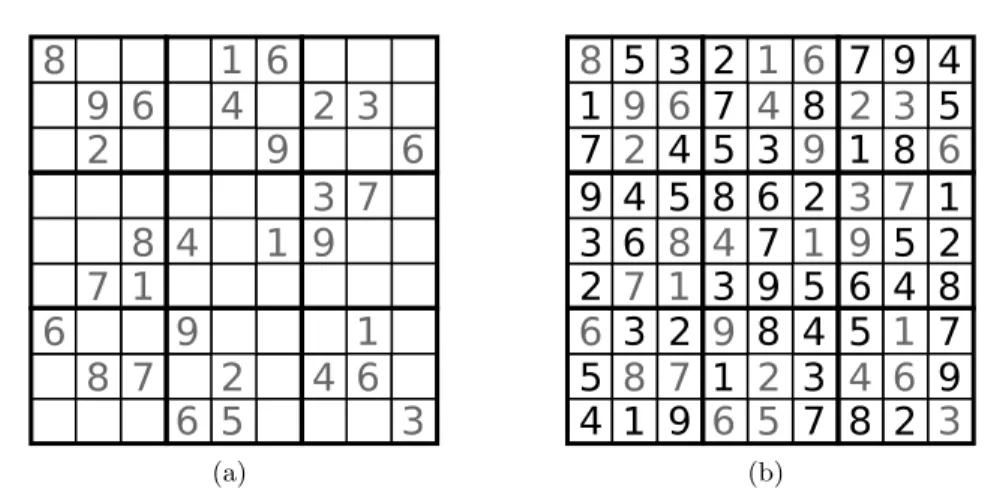
(b)Figure 1.1. (a) A typical Sudoku puzzle. (b) The solution for the same puzzle, black numbers were added due to reasoning.
and rise rapidly every year2. With the help of algorithms that harvest information
out of petabytes (1015 bytes) of data within fractions of a second and further
algo-rithms that process the relations between different entities of the internet to filter relevant information out of the whole data set, the search engines changed the way we currently handle knowledge.
Consider now the well-known Sudoku puzzle as an application that can be solved by algorithms. It is a logic-based, combinatorial puzzle that is played on a partially filled 9×9 grid. The task is to complete the assignment using numbers from 1 to 9 such that the numbers in each row, each column and each major 3×3 block are pairwise different. See Figure 1.1 for a typical Sudoku puzzle and its solution. Sudoku is often referred to as the “21st century Rubik’s cube”. It is easy to understand, but the reasoning needed to reach completion may be difficult. Each puzzle is supposed to have a unique solution, which does not require the use of trial and error or guessing. Thus, each puzzle can be solved merely by reasoning. Nevertheless, there is a wide range of algorithms to solve Sudoku puzzles. The easiest is probably just to iteratively create every possible combination of numbers for the 9×9 grid and to check whether that solution contains the partially filled assignments of the input puzzle. However, there are approximately 6.67∗1021
possible final grids. Finding the single one that corresponds to the given puzzle might take a lot of time. Assuming that 10 million different possible final grids can be tested within 1 millisecond, this algorithm can take up to 20,819.5 years to finish.
Another, more promising algorithm would be the idea to solve a Sudoku puzzle by placing the digit 1 in the first cell and checking if it is allowed to be there by checking the row, column, and box constraints. If it is allowed, the algorithm advances to the next empty cell and places a 1 in that cell. Assume that the
2In the first quarter of the year 2015 over 294 million top level domains were registered, an
increase of 6.5% over the span of one year; numbers taken fromhttp://www.verisign.com/en\
subsequent test discovers that the 1 is not allowed there. In that case, the value of that cell is increased to a 2. If a cell within the grid is discovered where none of the 9 digits is allowed, the algorithm leaves that cell blank and moves back to the previous cell. The value in that cell is then increased by 1. The algorithm is continued until a valid solution for all 81 cells is found.
However, there is also the possibility to translate the Sudoku puzzle into a so-calledconstraint problem(cf. [129, 95]) and to use several highly optimized algo-rithms that solve these problems. With the help of this approach, it is possible to solve even the hardest known instances [134] in less than a second on average [129].
1.2
Solving Problems by Translation into SAT
The Boolean logic is the underlying concept of this work. It uses exactly two
values,trueand false. With the help of special rules a Boolean formula can be created, which represents relations between basic atomic elements (calledvariables) in the domain of the Boolean logic. A real-world problem can be formally specified by encoding it as a logical formula in such a way that solutions of the problem correspond to models of the formula. In this context, a model is an assignment to the variables such that the formula evaluates totrue. If the problem has no solution, then any possible assignment to the variables evaluates tofalse.
The problem that describes the possibility to evaluate a formula totrueis the
Satisfiability problem(SAT). It was the first problem known to be NP-complete [32].
Thus, all currently known algorithms for SAT, in the worst case, require a runtime that grows exponentially with the size of the formula. Whether there exist efficient (polynomial time) solutions to NP-complete problems is arguably the most famous open question in computer science. Although there is no definitive conclusion, most researchers are convinced that the answer is in the negative.
It follows from NP-completeness that many interesting problems can be solved by translating them into a SAT problem. Some of the first attempts to bring this result into practice were applications of the satisfiability technology to solve problems in the areas of planning [82, 60, 51] and scheduling [35].
The success in this field has aided the development of the most well-known application of SAT: hardware verification, special tasks are microprocessor ver-ification [143], automated test pattern generation [128], equivalence checking of circuits [61], and bounded model checking [19].
Other fields, where satisfiability was successfully applied are natural language processing [84], knowledge representation [93], security protocols [3], cryptanaly-sis [101], and even bioinformatics [94, 25]. A more complete list of possible appli-cations can be found in the overview paper by Gu et al. [67].
The description as a Boolean formula allows to solve many further interesting problems using SAT technology. For example, (i) when solving the maximal sat-isfiability problem, an optimal solution for a formula is searched that satisfies the largest possible part of an unsatisfiable formula, (ii) a minimal unsatisfiable sub-formula can be extracted, which represents a subproblem that cannot be satisfied. We will cover both problems, as well as the basic SAT problem, within this work.
4 Algorithm Engineering Applications Experiments Modelling Algorithm Design Implementation Libraries Analysis
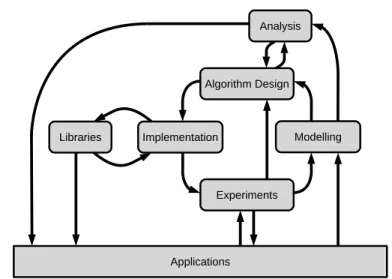
Figure 1.2. Methodological structure of algorithm engineering
1.3
Algorithm Engineering
Motivated by the paradigm of algorithm engineering, we will follow an experiment driven approach, as described in [121] and [105]. Over the last years the term algo-rithm engineering has become a wide spread synonym for experimental evaluation in the context of algorithm development. It is motivated by the fact that for a long time in classical algorithmics the analysis of algorithms focused exclusively on the theoretical analysis of asymptotic worst-case runtimes leading to the development of highly sophisticated data structures and algorithms.
However, theoretically efficient algorithms do not necessarily turn out to be fast in practice: the theoretic analysis may hide huge constants, the algorithm may perform poorly on typical real-world instances, where alternative methods may be much faster, or the algorithm and data structures may be too complex to be implemented for a specific task. On the other hand, theoretically slow algorithms may be efficient in practice, since the worst-case behavior can be seen only at some highly artificial inputs, and the main applications are of much better structure for the algorithm.
A classic example for this can be found in the field of mathematical program-ming: The most popular algorithm for solving linear programming problems, the simplex algorithm introduced by Dantzig in 1947, provides very good performance for most input instances occurring in practice but it has been shown to have ex-ponential worst-case time complexity [86]. In the 1970s it was shown that linear programs are solvable in polynomial time using the ellipsoid method [85]. However, the simplex method and its variants are most widely used for decades due to their superior performance.
The general idea of the algorithm engineering approach is represented by the scheme shown in Figure 1.2. The algorithm engineering cycle can be interpreted in the following way (cf. [105]). It usually starts with some specific application in
mind, for which a realistic model has to be found, such that the solutions we will obtain match the requirements as well as possible. The main cycle starts with an initial algorithmic design. Based on this design we analyze the algorithm from a theoretical point of view to obtain performance guarantees like asymptotic run-time or approximation ratios. The next step of the algorithmic development is the implementation of the proposed algorithm, which is probably the most important step of algorithm engineering. We can only succeed in this step if the algorithm is reasonable in its implementation complexity. Since the next step is the exper-iments, the implementation has to be sufficiently effective regarding possible side effects, which are often underestimated. A very prominent example for this is the memory efficiency. In modern hardware architectures the memory is organized in a hierarchy, where the access costs may differ between different levels by several orders of magnitude. Cache misses should be avoided as much as possible, other-wise the algorithm has to load new data from memory levels that are much slower. Because of this, it may be beneficial to evaluate in particular early experiments not exclusively on the runtime of an approach, but on other quality measures. We will see an example for that approach in Chapter 4 of this thesis.
It remains to close the main cycle of the algorithm engineering scheme and start a new iteration by finding an improved algorithmic design using the knowledge obtained during the steps of analysis, implementation, and experimentation.
A final by-product of the algorithm engineering cycle should be some kind of algorithm library that allows simpler verification of the findings and allows other groups to compare their new results against preceding algorithms.
The SAT community can be seen as a key example for the paradigm of algorithm engineering, due to several observations:
• Satisfiability problems are solved in a broad range of applications. This led to the creation of different benchmark sets. In its entirety, these sets cover a wide range of different applications, as well as several possible sizes of the formulae.
• Any common SAT solver is publicly available, often even with source code. • An extensive practical analysis is the basis for determining the most
perfor-mant SAT solver. Therefore, the SAT competition/SAT race3 is organised
every year.
• The basic branch-and-bound algorithm to solve SAT, which was published in 1962 [36], and which can still be identified in nearly any state-of-the-art SAT solver is, in fact, an extension to an algorithm from 1960. The original DP algorithm [37] was found to be too memory consuming in practice, leading to the development of the much more memory friendly DPLL algorithm.
6 Outline
1.4
Outline
The basic preliminaries are introduced and defined in Chapter 2. We focus not only on the DPLL algorithm and the translation into SAT, but also on interesting problems that can be tackled when operating on unsatisfiable instances: the ex-traction of a Minimal Unsatisfiable Subset (MUS), and its dual, the exex-traction of a Maximal Satisfiable Subset (MSS).
The MUS extraction will play a central role in the next two chapters. Chapter 3 introduces a tool that enables the user to interactively extract different MUSes. Since all the automatic MUS extraction algorithms do not have any idea about the search space and the underlying application domain we give the user full con-trol of the MUS extraction mechanism by interactively focusing on, or eliminating parts of, the search space. That way, we will not only help domain experts, who usually have good intuitions about the clauses relevant for good explanations, to find meaningful explanations of unsatisfiability, but also researchers and students in analyzing unsatisfiable instances and evaluating the effects of different heuristics for selecting deletion candidates. However, the main result of this tool is the de-velopment of ameta instance that speeds up the extraction algorithm by enabling the user to save unnecessary steps in the MUS extraction algorithms. The chapter is based on the published work in [45]. The idea of using a meta instance that is an extra SAT formula representing additional information about the search space, will be reoccurring through the thesis in multiple ways.
In Chapter 4 we introduce a technique to speed up the extraction of multiple MUSes. The improvements are based on techniques from the interactive MUS ex-traction, which are modified to fit the new purpose. We will show how to identify a set of clauses that exhibit a very importantblock property: either none or all mem-bers of the set are present in every MUS. With the help of this information, we put the focus on the computation of an often undesired by-product of the extraction of multiple MUSes: Minimal Correction Sets (MCSes). We will use these MCSes and a meta instance to speed up a single MUS extraction by reducing the search space considerably. We will incorporate the ideas into a state-of-the-art MUS enumerator and analyze the effect of exploring theblock property in detail. The main results of this chapter are also presented in [156].
The remaining parts of the thesis will introduce two new applications to the satisfiability problem. Chapter 5 focuses on a SAT formulation of a problem from bioinformatics. The so-called Quartet Compatibility problem is a decision problem that describes whether the relationship information given in small trees can be pre-served in a big tree. We introduce a novel SAT formulation for this problem, and show how to solve the related optimization problem of maximizing the amount of relationship information that can be preserved. Motivated by the earlier chapters, we will again use a meta instance to solve the optimization problem in one of the approaches. The practical analysis will cover a well-established benchmark set and compares our SAT formulation to state-of-the-art approaches from other optimiza-tion domains.
The second new application comes from the field of graph theory and graph drawing. Chapter 6 introduces a novel SAT formulation for the Book Embedding problem. In a book embedding, the vertices of a graph are placed on the spine of a book and the edges are assigned to pages, so that edges on the same page do not cross. We approach this problem of determining whether a graph can be embedded in a book of a certain number of pages from a SAT solving perspective by encoding it as a satisfiability problem. Since this is a problem that was not tackled by SAT before, we are required to create benchmark sets that model the possible inputs properly. We will show how to generate different benchmark sets based on underlying hypotheses we want to prove or disprove for particular graph classes. The material of this chapter is published in [153].
2
Preliminaries
This chapter defines the basic notation used in this thesis and introduces the most relevant concepts. Some additional (mostly application-based) definitions and al-gorithms will be introduced within later chapters. For basic concepts from graph theory and algorithms we refer the reader to comprehensive textbooks, like [33].
2.1
Propositional Logic
The SAT problem describes the problem, whether a given Boolean formula can be evaluated totrue. To understand this problem in its full quality, we have to define what a Boolean formula is, and how to evaluate it.
A Boolean formula consists of a countably infinite set of variables V. To-gether with the two constants true (>) and false (⊥) the set of atoms A = V ∪ {true,false} is built. A propositional formula is constructed from the set of atomsA, the unary operator ¬for negation, and the binary connectives ∨ for disjunction, and∧for conjunction and the parentheses ( and ).
Definition 2.1(Syntax of Propositional Logic).
• The constants>and⊥are formulae.
• Each variablev∈ V is a formula.
• If ϕis a formula,¬ϕis a formula.
• If ϕandψare formulae, then (ϕψ) :∈ {∨,∧}is a formula.
Further operations can be derived, e.g. implication (→), equivalence (↔), and exclusive-or (⊕).
If a is an atom, then a and ¬a are literals, where a is a positive literal and ¬a is a negative literal. The set of literals of a formula F is L(F). The polarity of a literalλa is positive if ais a positive literal. Otherwise, the polarity of λa is
negative.
The semantics of propositional logic is defined relative to an assignment τ : V 7→0,1 of variables to the numbers 0 and 1, where 0 represents the truth value false, and 1true. We will encounter both partial and complete assignments in
10 Basic SAT Solving Techniques
this thesis. The truth value of a formulaϕunder a complete assignmentτis defined recursively via an evaluation functioneval(ϕ, τ):
Definition 2.2 (Semantics of Propositional Logic). For a complete assignment τ
and formulae ϕ, ψ, we define the evaluation functioneval(ϕ, τ)by
• eval(⊥, τ) = 0 andeval(>, τ) = 1 • ∀v∈ V:eval(v, τ) =τ(v)
• eval(¬ϕ, τ) = 1eval(ϕ, τ)
• eval(ϕ∨ψ, τ) = max{eval(ϕ, τ), eval(ϕ, τ)} • eval(ϕ∨ψ, τ) = min{eval(ϕ, τ), eval(ϕ, τ)}
The ground-breaking work by Davis and Putnam [37] started to consider Boolean formulae in conjunctive normal form (CNF). Any Boolean expression can be trans-formed into CNF [115].
2.1.1
Conjunctive normal form
A formulaF in CNF is a set of clauses that are connected as conjunctions. LetV be the set of Boolean variables ofF. A clausec∈ F is a disjunction of|c|literals, whereas each literal is either a variable or its negation. A clause cis called unit if it contains only one literal (|c|= 1), binary if|c|= 2 and ternary if|c|= 3.
The formulaF is satisfied by an assignmentτ, if and only if every single clause
c ∈F is evaluated to true. A complete assignment τ that evaluates the formula to 1 (true) is calledmodel. A formula F is satisfiable if and only if at least one model exists; it is unsatisfiable if no such assignment exists.
As already stated, the satisfiability problem is one of the original NP-complete problems [32]. In general it suffices, that the formula F contains ternary clauses to be NP-complete. However, ifF contains at most binary clauses, then the SAT problem can be solved in polynomial time.
2.1.2
Resolution
The resolution rule in Boolean logic is an inference rule that allows for the creation of a new valid clause [118]. It requires two clauses,c1, c2∈ F, that contain for the
variable v the complementary literalsλ,¬λ. Let c1 = (¬λ∨α) and c2 = (λ∨β),
where α and β are both a disjunction of some literals λ0 ∈ L(F). The derived clause (α∨β) is called the resolvent of c1 and c2 on the variable v. If α and β
contain a pair of complementary literals, then (α∨β) is a tautology. It is satisfied for any assignment of variables and can be removed from the formulaF.
2.2
Basic SAT Solving Techniques
SAT solvers can generally be categorized into two distinct types, complete and incomplete solvers. Given a satisfiable formulaF in CNF, both kinds of solvers are
able compute a satisfying assignment forF. However, complete solvers can also prove unsatisfiability for formulae that cannot be satisfied by any assignment.
Incomplete solvers are mostly local search approaches [54], that use stochastic models to decide how the current assignmentτ should be changed. They have been shown to be especially successful for satisfiable random SAT instances. Solving SAT with local search is beyond the scope of this thesis and we refer the reader to [74]. The central technique of modern complete SAT solvers is the DPLL algo-rithm [37, 36] extended by conflict-driven clause learning (CDCL). However, we will only introduce the DPLL algorithm here, since it covers already the basic techniques (like unit propagation and variable decision) we will be referring to throughout this work.
2.2.1
DPLL algorithm
The original variant of the DPLL algorithm that was presented by Davis and Put-nam in 1960 [37] is based on propositional resolution. Two years later the first approach was reworked by Davis, Logemann and Loveland [36] to cope with mem-ory restrictions [20]. The algorithm can be described by the following rules:
R1 unit propagation: If there is a unit clause c = (λv), add the corresponding
variablev with the polarity ofλv to the assignmentτ. Furthermore, remove
all clauses that contain the literal λv and remove the literal ¬λv from any
clause it is contained in.
R2 pure literal assignment: If there is a variable v such that λv occurs only in
positive polarity or only in negative polarity, add the variable v with the polarity of λv to the assignment τ. Furthermore, remove all clauses that
contain the literalλvand remove the literal¬λvfrom any clause it is contained
in.
R3 decision and branching: Choose one (unassigned) variable uof the formula
F and examine both subproblems (F ∧(λu)) and (F ∧(¬λu)).
The main idea of this algorithm is a branch-and-bound technique over all possi-ble assignments of the variapossi-bles ofF. The search space can be visualized as a tree, with the nodes being partial assignments, where the decision and branching rule was executed. Whenever the algorithm finds a contradiction (an empty clause), it prunes the search tree at a partial assignment, where the last decision had to be done. However, there is no information about the structure of this contradic-tion. This means that the DPLL algorithm probably runs into the same situation for another partial assignment, finding the same contradiction again. This can be avoided by the so-calledconflict driven clause learning, an efficient extension of the DPLL algorithm [125].
Adding redundant constraints, that enables the SAT solver to find conflicts earlier in the search tree, can have a significant impact on the performance of the solver. We will observe this behavior in Chapter 5 of this thesis.
12 Minimal Unsatisfiable Subsets
2.2.2
SAT solving with selector variables
Clause-selector variables (or short selector variables) can be used to augment a CNF formula F in such a way that standard Boolean satisfiability (SAT) solvers can manipulate and, in effect, reason about the formula’s clauses without any modification to the solver itself. This augmentation has been used in many al-gorithms [96, 112, 91, 106].
Every clause ci in a CNF formula F is augmented with a negated selector
variablesi to createc0i= (¬si∨ci) in a new (augmented) formulaF0. Notice that
each augmented clausec0i is an implication: c0i = (si→ci). Assigning a particular
si the value true implies the original clause, essentially enabling it. Conversely,
assigning si to false has the effect of disabling or removing ci from the set of
constraints, as the augmented clause c0
i is satisfied by the assignment tosi. This
augmentation gives an unmodified, standard SAT solver the ability to enable and disable constraints as part of its normal search, checking the satisfiability of the enabled subsets of the formulaF within a single backtracking search tree.
2.3
Minimal Unsatisfiable Subsets
The majority of this thesis will handle unsatisfiable formulae and the problems that arise when dealing with these. In the past few years, there has been an upswing of interest and research in a mechanism for providing information beyond the basic response that a given formula F is unsatisfiable: extraction of Minimal Unsatisfiable Subsets of constraints (MUSes), also called unsatisfiable cores. Given an unsatisfiable formulaF, an MUS ofF is a subset ofF that is (i) unsatisfiable and (ii) minimal in the sense that removing any one of its elements renders the remaining set of constraints satisfiable. It is defined as follows:
Definition 2.3 (Minimal Unsatisfiable Subset). A subset M ⊆ F is an MUS⇔
M is unsatisfiable and ∀c∈M :M \ {c} is satisfiable
An MUS minimizes an unsatisfiable constraint set to a “core” proof of its incon-sistency. They are called “unsatisfiable cores” in some works, but we use the term MUS instead. Unsatisfiable formulae often contain many MUSes, and the presence of any one makes the formula unsatisfiable. Finding a single MUS is like pointing to a single hole to explain why a sieve does not hold the water, and “repairing” a single MUS (by relaxing constraints in the MUS to make it satisfiable) will not necessarily affect other MUSes, leaving the formulaF infeasible.
This observation leads us to the closely related concept of Minimal Correction Subsets (MCS):
Definition 2.4 (Minimal Correction Subset). A subset M ⊂ F is an MCS ⇔
F \M is satisfiable and∀c∈M : (F \M)∪ {c} is unsatisfiable
The removal of an MCS from the formulaFrestores its satisfiability (“corrects” it). The minimality is again not in cardinality, but in the fact that no proper subset of an MCS is a correction set itself. An MCS can also be defined as the complement of a Maximal Satisfiable Subset (MSS):
Definition 2.5(Maximal Satisfiable Subset). A subsetM ⊆ F is an MSS ⇔ M
is satisfiable and∀c∈(F \M) :M∪ {c} is unsatisfiable
A very common problem regarding MSSes is finding the MSS with the largest cardinality. It is also well-known as the MaxSAT problem. Any MaxSAT solution is an MSS, but the converse does not necessarily hold.
2.3.1
Deletion-based MUS extraction
Many of the high-performance algorithms for MUS extraction from CNF instances can be classified as deletion-based. In such algorithms, starting from some un-satisfiable subset, we gradually try to remove clauses while making sure that the candidate set stays unsatisfiable. When the candidate set cannot be further re-duced, we have arrived at an MUS.
Algorithm 2.1 A deletion-based MUS extraction algorithm using selector vari-ables.
Require: an unsatisfiable SAT instanceF={c1, . . . , cm} in CNF
Ensure: some MUS⊆ F
1: F0← ∅
2: for allclausesci∈ F do
3: F0← F0∪ {ci∨ ¬si} . add selector variables
4: end for
5: UC← F . clauses of unknown status
6: MUS← ∅ .this set will be the MUS in the end
7: whileUCis not emptydo
8: ci←select one clause∈UC
9: UC←UC\ {ci}
10: res=SAT(F0,{si:ci∈UC∪MUS}) . reduction attempt
11: if res=truethen .unsuccessful reduction,ci is critical
12: MUS←MUS∪ {ci}
13: end if
14: end while
15: returnMUS
In the pseudocode, the setMUScollects the indices of clauses known to be critical. A clauseci is said to becritical in an unsatisfiable subset F0 if its deletion from
F0 will cause thatF0\ {ci} becomes satisfiable. Thus, the critical clauses form an MUS, since the deletion of any of them results in a satisfiable subformula. The set UCcontains clauses that have to be tested for criticality.
In line 10 of Algorithm 2.1 a SAT solver is called with two parameters: the formulaF and a set of selector variables in positive polarity. This set of selector variables can be seen as forced variables assignments, that are given as an input to a SAT solver. As described in Section 2.2.2, the clauses corresponding to these selector variables will be enabled. All other clauses of the formula will be disabled by thepure literal rule of the underlying DPLL algorithm (see Section 2.2.1).
14 Minimal Unsatisfiable Subsets
The complexity of MUS extraction algorithms is commonly measured in the number of necessary SAT calls. Obviously, the number of SAT calls for this algo-rithm is∈O(m), i.e. linear in the size of the input formulaF={c1, . . . , cm}.
Clause set refinement
The advantage of deletion-based approaches lies in the possibility to execute larger reduction steps by analyzing the refutation proofs produced by the SAT solver, rather than only eliminating one constraint c from the U S F0. When the SAT solver determines that a current subformula is unsatisfiable, the refutation proof returned by the solver is guaranteed to contain at least one MUS. If we generate such a proof and only select those clauses which were used in it, we are guaranteed to receive an unsatisfiable subset F00 smaller than or equal to the reduced clause set, F00 ⊆F0\ {c}. This technique is often referred to as clause set refinement in the literature. It was made popular by Alexander Nadel [106], who uses it in the following simple, but very efficient algorithm for deletion-based MUS extraction: Algorithm 2.2A deletion-based MUS extraction algorithm using selector variables and clause set refinement.
Require: an unsatisfiable SAT instanceF ={c1, . . . , cm} in CNF
Ensure: some MUS⊆ F
1: F0← ∅
2: for allclausesci∈ F do
3: F0 ← F0∪ {ci∨ ¬si} .add selector variables
4: end for
5: hres, proofi=SAT(F0,{s
1, . . . , sm})
6: for allclausecj∈/proof do .clause set refinement 7: F0 ← F0∪ {¬sj} .disable the clauses that are not used for the proof 8: end for
9: US← {ci :ci ∈proof} .clauses of unknown status
10: MUS← ∅ .this set will be the MUS in the end
11: whileUSis not emptydo
12: ci ←select one clause∈US\MUS
13: US←US\ {ci}
14: hres, proofi=SAT(F0,{si:ci∈US}) . reduction attempt
15: if res=truethen . unsuccessful reduction,ciis critical
16: MUS←MUS∪ {ci}
17: else
18: US← {cj :cj∈proof}
19: for allclausecj∈/proof do .clause set refinement 20: F0← F0∪ {¬sj} .disable the clauses that are not used for the
proof
21: end for
22: end if
23: end while
In comparison to Algorithm 2.1 a few things have changed: In addition to the basic result whether the given formula is satisfiable or not, we are using the capability of a SAT solver to return a refutation proof for the unsatisfiability for the given formulaF0 (see line 5 and line 14 in Algorithm 2.2). For simplicity reasons we interpret the proof as a set of clauses that are used to deduce the unsatisfiability. In addition to the setMUS, that continues to collect the clauses known to becritical, we use the setUSto store the clauses of the current unsatisfiable subset, which is always a superset of MUS.
The asymptotic complexity of the Algorithm 2.2 is ∈ O(m) as well, but the actual number of SAT solver calls is in many cases much less than without the clause set refinement.
2.3.2
Model rotation
Another very useful technique for speeding up deletion-based MUS extraction is called model rotation and was introduced by Marques-Silva and Lynce [127]. This technique uses the model returned by the SAT solver to get a lot more information out of unsuccessful reduction attempts. Recall that an unsuccessful reduction at-tempt results in the detection of one critical clauseci that has to be present in the
MUS.
A critical clauseci in an unsatisfiable clause set F is characterized by having
an associated assignment, i.e. an assignment τ which satisfies F \ {ci}, but not
ci. Model rotation exploits this property by cheaply deriving from an associated
assignment other assignments which can quickly be tested whether that model is associated to another clause, which then has to be critical and hence is a part of the MUS that is extracted. A formal proof of the fact that a clause is critical if and only if it has an associated assignment can be found in [10].
Algorithm 2.3The recursive model rotation routine.
Require: an unsatisfiable SAT instanceF ={c1, . . . , cm}in CNF, critical clause
ci ∈ F, modelτ ofF \ {ci}
Ensure: a set of further critical clausescrit⊆ F
1: crit← ∅
2: for eachvariable vj∈ci do
3: τ(vj)←1−τ(vj) . flip the variablevj in the modelτ 4: unsat={ck :τ(ck) = 0} .collect clauses not satisfied by rotated modelτ 5: for eachclausecl∈ F do
6: if unsat={cl}then . τ is an associated assignment forcl
7: crit←crit∪ {cl}
8: crit←crit∪modelRotation(F, cl, τ) . recursive call 9: end if
10: end for
11: τ(vj)←1−τ(vj) . flip the variablevj back
12: end for
13: returnMUS
16 Minimal Unsatisfiable Subsets
Since this algorithm identifies other critical clauses without having to perform a costly SAT solver call, it should be executed after each unsuccessful reduction attempt in deletion-based MUS extraction to significantly decrease the number of SAT solver calls necessary to arrive at an MUS.
Siert Wieringa [146] gives an alternative description of recursive model rotation based on traversals of the flip graph, achieves further improvements to the algorithm based on these insights, and provides some analysis of benchmark instances which (partially) explain its high usefulness in practice. Marques-Silva and Lynce [127] determine in benchmarks that recursive model rotation is the single most effective technique for speeding up MUS extraction.
2.3.3
Insertion-based MUS extraction
A second class of MUS extraction algorithms works in a dual fashion to the deletion-based approach. In insertion-deletion-based approaches, we start with a satisfiable subset of the formula, gradually expanding it by additional clauses until our candidate set becomes unsatisfiable.
While insertion-based algorithms tend to require a higher number of SAT solver calls, an advantage of them is that they profit immensely from the use of incremental SAT solving. Incremental SAT solving describes a process of adding clauses to a SAT solver iteratively. That way, the SAT solver will store the data it derived (e.g. variable assignments, learnt clauses, heuristic measures) while processing a clause set, to reuse the data to solve later inputs more efficiently, since a large subset of the new formula was already known to the SAT solver. In an insertion-based approach which gradually adds more clauses to a candidate set, the individual calls to a SAT solver can therefore be performed incrementally at a much lower cost. Algorithm 2.4 An insertion-based MUS extraction algorithm.
Require: an unsatisfiable SAT instanceF ={c1, . . . , cm} in CNF
Ensure: some MUS⊆ F
1: MUS← ∅ .this set will be the MUS in the end
2: F0← F . candidates for critical clauses
3: while|MUS|<|F0|do
4: F00←MUS
5: lastAppended← ∅
6: for allci∈F0\MUSdo
7: res=SAT(F00∪ ¬ci,{}) . insertion attempt
8: if res=truethen
9: F00← F00∪ {ci}
10: lastAppended← {ci} .detect the last non-redundant element 11: end if
12: end for
13: MUS←MUS∪lastAppended
14: F0 ← F00
15: end while
The first algorithm for insertion-based MUS extraction was presented by Hans van Maaren and Siert Wieringa [141]. Their algorithm operates in rounds that repeatedly enlarge a satisfiable under-approximation until a new critical clause is found. During the enlargement, redundant clauses are detected and pruned away for the next iteration. A clausecis redundant in a CNF formulaFifF \ {c} ∪ ¬cis unsatisfiable. Here “¬c” denotes the set of unit clauses{{¬λ1}, . . . ,{¬λk}}for the
clausec= (λ1∨. . .∨λk). This result can be exploited to create a more constrained
SAT instance without losing any satisfying assignments, often considerably reducing the time needed for each SAT solver run.
The last non-redundant element (line 10 in Algorithm 2.4) that could be added during inflation before F becomes unsatisfiable, is identified as a critical clause. The outerwhileloop (line 3 to 15) terminates whenlastAppendedis empty, which is the case when every element remaining inF \MUSis redundant. The number of SAT solver calls is∈O(k∗m) withkbeing the size of the MUS that is extracted. Marques-Silva and Lynce developed a variant [127] that improves the number of SAT solver calls toO(m) for this paradigm as well, showing that insertion-based approaches are not asymptotically slower than deletion-based algorithms.
2.3.4
Hybrid MUS extraction
Incorporating the ideas from both, the deletion-based and insertion-based MUS extraction, Marques-Silva and Lynce [127] proposed the Algorithm 2.5. The hybrid algorithm uses the efficient redundancy check by van Maaren and Wieringa [141] and the clause set refinement from Nadel [106]. However, clause set refinement cannot be used every time the deletion of one candidate resulted in an unsatisfiable subsetS ofF0, since the redundancy check in line 6 adds new unit clauses to the formula. These unit clauses can mask other clauses ofF0 in a sense that without the redundant unit clauses, other elements of F0 would have been used to prove the unsatisfiability ofS.
Algorithm 2.5 A hybrid MUS extraction approach that incorporates the ideas from deletion and insertion-based approaches.
Require: an unsatisfiable SAT instanceF={c1, . . . , cm} in CNF
Ensure: some MUS⊆ F
1: MUS← ∅ .this set will be the MUS in the end
2: F0← F .candidates for critical clauses
3: whileF0 is not emptydo
4: ci←select one clause∈ F0
5: F0← F0\ {ci}
6: hres, proofi=SAT(MUS∪ F0∪ ¬ci,{}) .redundancy check
7: if res=truethen
8: MUS←MUS∪ {ci}
9: else if proof ∩ ¬ci=∅ then
10: F0←proof \MUS . clause set refinement 11: end if
12: end while
3
Visualizing
MUS extraction
3.1
Introduction
Finding small reasons for unsatisfiability of a SAT formula by extracting a Minimal Unsatisfiable Subset (MUS) is used in many different settings. Examples of appli-cations include inconsistency measurement [76, 151], type error debugging [40, 4], debugging of relational specifications [138, 139], analysis of over-constrained tem-poral problems [90], axiom pinpointing in description logics [123], software and hardware model checking [2], among many others [132, 112].
Aided by the broad range of applications a remarkable amount of work in recent years caused a significant progress in efficient extraction of a MUS. The develop-ment ofmodel rotation (see Section 2.3.2), an improved use of resolution [107] and refutation proofs [8] or completely new algorithms [100] are examples for the fact, that the field of MUS extraction has become an emerging research field in the SAT community, leading to the introduction of a special MUS track in the SAT compe-tition 20111. However, most of the formulas that can be tackled relatively easily
by SAT solvers are very hard for MUS extraction algorithms, since the number of SAT solver calls to extract one MUS is∈O(m) (see Section 2.3) withmbeing the number of clauses in a CNF formulaF.
In general the algorithms for MUS extraction can be characterized as construc-tive(insertion-based),destructive (deletion-based) or ahybrid combination of both (see Section 2.3), but they all focus exclusively on the number of clauses or clause sets (calledgroups) [11] present in the minimal explanation.
In this chapter we introduce a completely new approach to guiding the basic destructive MUS extraction algorithm, which is due to the effectivity of theclause
set refinement(see Section 2.3.1) andmodel rotationstill among the top performing
algorithms for industrially relevant instances [126]. The central idea of destructive MUS extraction, which was first proposed more than 20 years ago [29, 5], is to perform a series of reduction steps, moving into smaller unsatisfiable subsets F0
1http://satcompetition.org/2011/#tracks
20 Classification of Clauses
until all subsetsF00⊂ F0 are satisfiable.
The idea ofinteractive MUS extraction is to give a user full control over the individual reduction steps, providing an interface for interactively focusing on or eliminating parts of the search space. This is done in our tool MUStICCa, an ab-breviation for “MUS extraction with interactive choice of candidates”, by reverting to intermediate results, the non-minimal unsatisfiable subsets (US), and exploring new parts of the search space by choosing alternative deletion candidates. This feature will not only help domain experts (who usually have good intuitions about the clauses relevant for good explanations) to find meaningful explanations of un-satisfiability, but also researchers and students in analyzing unsatisfiable instances and evaluating the effects of different heuristics for selecting deletion candidates.
During the extraction of different MUSes, the user (or any other MUS extraction algorithm) has to perform “unnecessary” deletion tests. These tests are unneces-sary, since the same information that is obtained with this step is already known due to other reduction steps within another part of the search space. We will show how these unnecessary steps can be avoided by an efficient representation of all the clause criticality information that was gained anywhere in the search space. By that we are able to reuse this information to not only save expensive SAT solver calls for the user, but also to pave the way for the ideas that were used to boost state-of-the-art MUS enumeration approaches (see Chapter 4).
This chapter is based on the work published in [45] and is organized as follows. In the next section we describe a useful classification scheme of clauses in unsatis-fiable clause sets, that will be used throughout this work. The scheme divides the set of clauses regarding the information, whether they are present in all MUSes, only in some MUSes, or in no MUSes at all. Section 3.3 introduces the tool’s user interface and the possibilities to guide the interactive MUS extraction procedure. We focus on the graphical representation of the search space, and of the criticality information of clauses, and introduce the possibilities to start automatic proce-dures that reduce the current unsatisfiable subset to reach an MUS finally. The main contribution of this chapter is the development of an additional SAT formula on selector variables, the so-called meta instance. It is introduced in Section 3.4. We will show in Section 3.5 how the meta instance can be extended to represent not only the criticality information of clauses, but also to enforce properties on the MUS that is extracted. A short summary concludes this chapter.
3.2
Classification of Clauses
Typical MUS extraction problems contain not only a single MUS, but rather a large set of different ones. These MUSes of an unsatisfiable SAT instance tend to overlap, containing a common core set of clauses, which is satisfiable on its own. To arrive at some MUS, this common core must be made unsatisfiable by adding some combination of other clauses. Kullmann, Lynce and Marques-Silva [27] build on this observation to formally distinguish different degrees of necessity for clauses with respect to MUSes. These definitions introduce some very useful vocabulary
for talking about the role of different clauses in interactive MUS extraction. We useFfor some unsatisfiable SAT formula, andM U Ses(F) for the set of all MUSes of the formulaF.
Definition 3.1 (Necessary Clause). A constraint c ∈ F is called necessary if
and only ifF \ {c} is satisfiable. Thus, the constraint c is critical in every MUS
M ∈M U Ses(F).
The set of necessary clauses forms the mentioned core that is contained in every MUS, and can therefore be written asT
M U Ses(F). Givenmclauses inF,
T
M U Ses(F) can be computed bymcalls to a SAT solver by checking ifF \ {c}is satisfiable for each constraintc. This process can be speeded up by a large factor by using the aforementioned techniques of model rotation (see Section 2.3.2) and
clause set refinement(see Section 2.3.1).
The dual to this strongest notion of necessity is a very weak notion of redun-dancy of a clause. It describes the fact that unsatisfiability is maintained when the single clausecis removed from the original formula F. Thus, there exists at least one MUS wherecis not present. However, it does not ensure that two unnecessary clauses can be removed at the same time.
Definition 3.2(Unnecessary Clause). A constraintc∈ F is called unnecessaryif
and only ifF \ {c} is unsatisfiable. Thus,∃M ∈M U Ses(F)withc /∈M.
The strongest redundancy of a clause is defined by the following.
Definition 3.3 (Never Necessary Clause). A constraint c ∈ F is called never necessaryif and only ifcis unnecessary in all unsatisfiable subsets F0⊆ F. Thus,
c /∈S
M U Ses(F).
The definition implies that we can safely remove any clause known to benever
necessary, although this might make the unsatisfiability a lot harder to prove
be-cause they can contribute to much shorter proofs of unsatisfiability, which might be a lot easier to understand than the proof of a MUS. We will not explore this issue further here, as it is a general problem with the approach of taking minimal subsets as formal approximations to small explanations of infeasibility.
3.3
The Application
By default, the graphical user interface (see Figure 3.1) consists of three main view components. The central component is a representation of the current knowledge about the search space. Explored USes are inspected in a separateUS view com-ponent, which also provides the interface for starting reduction steps. The third component is responsible for administering automated reduction procedures, the
agents.
The interface is based on the open-source Kahina framework [44] for graphical debugging, which was chosen because it already provided the needed view compo-nents and native support for managing a database of computation steps as nodes in a graph structure.
22 The Application
Figure 3.1. Screenshot of MUStICCa’s default user interface.
Since deletion-based MUS extraction can be viewed as a downward traversal of the powerset lattice for an unsatisfiable clause set F, the explored part of the search space is modeled by means of a reduction graph, which is a subsemilattice of the powerset lattice whose edges represent successful reduction attempts. The powerset lattice will be introduced in a more detailed fashion in Section 4.3.
A deterministic deletion-based MUS extraction algorithm will only create a linear structure of US states connected by the subset relation. But as soon as we allow the exploration of multiple deletion alternatives, the structure of the encountered USes will probably branch out. Since there can be different sequences of deletions leading to the same US, the structure is a directed acyclic graph (dag) which can be defined as:
Definition 3.4 (Reduction graph). Let F be an unsatisfiable clause set. A
reduc-tion graph R= (V, E)forF is defined as a tuple of verticesV and edgesE. V is
a set of unsatisfiable subsets V ⊂2F, and an edge (V
1, V2)∈E exists if and only
ifV2 was the result of removing some non-critical clause fromV1, possibly followed
by clause set refinement.
The USes encountered on reduction paths are the obvious choice for defining the meaningful steps of an MUS extraction process, and were therefore chosen as the nodes in the graph. Since every US is a unique subset of the original clause set, it can be represented and uniquely identified by a set of clause indices representing the clauses it contains.
In the visualization of USes, the number on each node gives the size of the corre-sponding US, followed in brackets by the number of clauses of unknown criticality. MUSes are marked in red, dark green color marks non-MUSes where all reduction options have been explored, and light green color marks USes where all clauses are
known to be either critical or unnecessary. The unnecessary clauses are unexplored reduction options. Note that not every unnecessary clausec is unusable; we only know that there is at least one MUS which does not containc.
Whenever a node in the reduction graph view is selected, the US corresponding to the node is displayed in the US view. The default format for clauses in the
US view consists of the clause ID (numbered according to the order in the input
DIMACS file) and the set of integers representing its literals. The clauses in theUS view are color-coded to reflect their criticality status: critical clauses are displayed in red, explicitly reduced clauses in a dark green, other unnecessary clauses in a lighter green, and clauses of unknown status in black. The color codes make it easy to spot interesting deletion candidates for reduction steps, which are started by double-clicking on clauses in theUS view.
For advanced interactions, one or more clauses in theUS view can be selected, and are then highlighted by a yellow background color. The selection of interesting clauses is supported by a selection refinement interface in the form of a hierarchy of sub-menus in the US view’s context menu. This menu provides the options of manually executing reduction attempts followed by model rotation, and two different options for executing reduction operations on sets of clauses: (i)
Semi-automation initiates a batch processing of deletion attempts for all the clauses in
the current selection. This helps to quickly open up several new branches in the reduction graph at once, or to speed up series of criticality checks. (ii)Simultaneous
reduction is an attempt to delete all the currently selected clauses at once. If the
attempt was successful, the new node (or link) will appear in the reduction graph, just like in the case of deleting a single clause. If a simultaneous reduction attempt fails, this only yields very weak criticality information, since it might have been possible to delete some of the clauses under the condition that others stay in.
3.3.1
Automation through reduction agents
During a process of interactive extraction, a user will often want to quickly explore parts of the search space without having to manually execute hundreds of reduc-tion attempts, especially in contexts where domain knowledge has not yet become relevant. For this purpose, our tool MUStICCa includes an automated reduction mechanism in the form ofreduction agents which in essence act like autonomous additional users who were given sets of simple instructions. In addition to pre-defined reduction agents which emulate standard deletion-based algorithms, it is possible to implement own heuristics to select deletion candidates as well.
The most important option in the dialog for creating and starting new reduction agents serves to select one of the predefined heuristics from a drop-down menu. Each new agent is initialized with a random signal color that can freely be redefined. The new reduction agent starts at the US that is currently selected in the reduction graph, and runs until it has determined an MUS. The downward path of an agent through the powerset lattice (see Section 4.3 for more details) is highlighted in its signal color.
24 Saving unnecessary SAT Solver Calls
3.4
Saving unnecessary SAT Solver Calls
Whenever at least two different branches in the reduction graph exist, the possi-bility of unnecessary SAT solver calls arises. We start our analysis of this problem
c1, c2, c3, c4 c1, c3, c4 c2, c3, c4 c1, c2 c1, c3 c2, c3 c1 c2 c3 c4 ∅ c1, c2, c3 c1, c2, c4 c1, c4 c2, c4 c3, c4 Figure 3.2. c2 is critical in{c2, c3, c4}
by considering the powerset lattice of an-other small example instance {c1, c2, c3, c4}.
To simplify the example, we will assume that clause set refinement is of no relevance here, so that each single reduction step will at most lead one step down in the powerset lattice. Assume a state (see Figure 3.2) of interactive reduction where the reduction graph spans the edges colored in black (fat), and the grey edges and subsets have not yet been explored. In the subset {c2, c3, c4}, the clause c2 has
just been determined to be critical, which we
again symbolize by coloring critical clauses and the corresponding transition edges in red, fat and dashed.
The criticality of c2 in {c2, c3, c4} is propagated downwards in the reduction
graph via the black edge to the subset{c2, c4}, but not to the other subsets. Now
as-sume that in the next reduction step, we successfully delete c1
c1, c2, c3, c4 c1, c3, c4 c2, c3, c4 c1, c2 c1, c3 c2, c3 c1 c2 c3 c4 ∅ c1, c2, c3 c1, c2, c4 c1, c4 c2, c4 c3, c4
Figure 3.3. propagated criticality
from the set {c1, c2, c3}. The propagation
and the reduction attempt together lead us to the following new state of the reduc-tion graph shown in Figure 3.3. We do not derive the criticality information of c2 in
the new US {c2, c3}, causing us to waste
a call to a SAT solver when we attempt to deletec2later. This type of problem is
quite virulent in larger instances with a lot of different MUSes, because it is likely to occur whenever one branch of the reduc-tion graph arrives at a US which would also be reachable by a reducreduc-tion starting in some other node where some unsuccessful reduction attempts have already been performed.
The approach developed in this chapter aims to achieve the storage of the criti-cality information by explicitly representing and processing this information in the form of Boolean constraints over selector variables. Before, selector variables si
had the only purpose of extending the clausesci of the original instance in such a
way that the clausecican effectively be switched off by assigning the corresponding
selector variable si to false. In this chapter, we will go beyond that by reusing
the selector variables as direct handles for talking about the presence or absence of clauses in subsets of the formula F. As we have seen in our motivating example, whenever we find during our reduction attempts a set of clauses{c1, c2}that cannot
be reduced at the same time (otherwise c2 would not be critical for {c2, c3, c4}),
contains positive literals for the two selector variables corresponding toc1 andc2.
This clause enforces the presence of eitherc1 or c2 in any subset we consider in
the future. We will be using a collection of such clauses to store all the derived criticality information, and use it to efficiently determine all the clauses already known to be critical in new unsatisfiable subsets.
All these additional clauses will be saved in the so-called meta instance. In the following we will introduce shortly what kind of information we can store, and how to use this information during the execution of MUSes. We will use the meta instance to express conditions for clause set unsatisfiability. Thus, if the meta in-stance is satisfiable (under given assumptions), the subset that corresponds to the given assumptions is unsatisfiable. Analogously, if the meta instance is unsatisfi-able under given assumptions, the subset that corresponds to the assumptions is satisfiable.
We will see, that themeta instancewill contain only clauses withselector
vari-ables in positive polarity. Thus, without further assumptions the additional SAT
formula is always satisfiable by thepure literal rule (see Section 2.2.1). Assuming the meta instance contains the clausec= (si∨sj∨sk). The instance is unsatisfiable
if and only if at least one clause (w.l.o.g. c) is unsatisfiable, which is the case if all variables ofc are assumed to be negative.
3.4.1
Criticality information via unsuccessful reductions
Assume that we attempt to delete a clause ci from an unsatisfiable clause setU ⊆ F, and that this results in a satisfiable instance U \ {ci}. Thus, ci is now
known to be critical in the USU. This criticality information depends on all the clausesU =F \Uwhich had already been reduced or fallen away in the state where we attempted the deletion. This is often described as the complement ofU. The new information can be expressed as (V
¬sj)→si: cj ∈U. This can directly be
expressed as a single clause in CNF (Ws
j∨si) for cj ∈U, which is added to the
meta instance.
The added constraint (W
sj∨si) can be read as preventing all the elements
of the set {U ∪si} from being removed at the same time, by requiring that one
element of the set must be present in any unsatisfiable subset. In our motivating example, we would learn the meta clause (s1∨s2), expressing that either c1 orc2
must be present in any unsatisfiable subset of{c1, c2, c3, c4}.
We use that criticality information during the MUS extraction in the follow-ing way. Assume again that in the next reduction step, we successfully reduce {c1, c2, c3}to{c2, c3}. If we now want to determine whetherc2is critical in{c2, c3},
we can perform a first check for the satisfiability of{c3}by testing the satisfiability
of the meta instance under the assumptions {¬s1∧ ¬s2∧ ¬s4}. Given that the
meta instance contains the constraint (s1∨s2), the meta instance will be
unsatis-fiable, indicating that the clause set{c3}is satisfiable. Thus,c2must be critical in
{c2, c3}. As intended, we do not need to waste a much more costly SAT solver call