COPYRIGHT AND CITATION CONSIDERATIONS FOR THIS THESIS/ DISSERTATION
o Attribution — You must give appropriate credit, provide a link to the license, and indicate if changes were made. You may do so in any reasonable manner, but not in any way that suggests the licensor endorses you or your use.
o NonCommercial — You may not use the material for commercial purposes.
o ShareAlike — If you remix, transform, or build upon the material, you must distribute your contributions under the same license as the original.
How to cite this thesis
Surname, Initial(s). (2012). Title of the thesis or dissertation (Doctoral Thesis / Master’s Dissertation). Johannesburg: University of Johannesburg. Available from:
Teachers’ knowledge and practice in screening for Autism
Spectrum Disorder in a mainstream primary school
AMY-LEIGH SEGEREN
MINOR DISSERTATION
submitted in partial fulfilment of the
requirements for the degree
MAGISTER EDUCATIONIS
in
EDUCATIONAL PSYCHOLOGY
in the
FACULTY OF EDUCATION
at the
UNIVERSITY OF JOHANNESBURG
SUPERVISOR: Dr M.P. van der Merwe
CO-SUPERVISOR: Ms. T.D. Soni
ii
EDUCATING LEARNERS WITH NEURODEVELOPMENTAL LEARNING
NEEDS
This research is sponsored through the Teaching and Learning Development Capacity Improvement Programme which is being implemented through a partnership between the Department of Higher Education and Training and the European Union.
Co-funded by the European Union
v
ACKNOWLEDGEMENTS
I would like to express my sincere gratitude to my loved ones who have supported me unconditionally throughout this journey and who have encouraged me to keep on going despite the late hours and cancelled plans. Without your love, support and unwavering belief in my ability to complete this study, I would not have been able to succeed.
To my parents, I am forever grateful for your support in affording me the opportunity to further my studies and achieve my dream of becoming an Educational Psychologist. A special thanks to my mom who inspired this research topic through her personal journey of dealing with learners with ASD as a mainstream nursery school teacher.
A huge thank you to my supervisor, Dr Martyn Van der Merwe, whose time, commitment and constant encouragement allowed me to pursue my vision for this study. Thank you to my co-supervisor, Trishana Soni, for sharing her knowledgeable insight and passion for this topic. I would like to give credit to my editor, Ruth Nicola, who dedicated her time to ensuring the professional outcome of this study. Importantly, thank you to the Department of Higher Education and Training and the European Union who co-founded this research as part of the larger project involving studies on educating children with Neurodevelopmental Disorders.
Lastly, and most importantly, to the Almighty God. Through Him, there is no limit to what you can do, there is no obstacle you can’t overcome, through Him, all things are possible.
vi
ABSTRACT
Supporting children as they learn at their own pace is important for their early childhood development, especially for learners with Neurodevelopmental Disorders like Autism Spectrum Disorder (ASD). ASD is a growing epidemic with a worldwide increase in prevalence of children with ASD in mainstream primary schools. Learners are being diagnosed with ASD in the later school-going years, causing further long-term complications. Early identification and intervention for learners with ASD is vital for their overall emotional, physical and cognitive development. It is therefore essential for teachers to understand ASD and to be able to screen for ASD, using the appropriate tools. This study aims to explore, and provide critical insight into, teachers’ knowledge and practice in appropriately screening for ASD in order to support learners with ASD in a mainstream primary school.
The theoretical framework of this study was based on Bronfenbrenner’s Bioecological Systems Theory (1979) and Vygotsky’s Social Constructionist View on Disability (1978). The supporting theories, the Developmental Theory of Autism and Theory of Mind (1995), were incorporated due to their relevance in understanding learners with ASD.
Using an interpretivist paradigm, this generic qualitative study used a purposive sample of seven Foundation Phase teachers in a mainstream primary school. These participants each used a Google Form to complete sentences for the researcher to gain insight into their general knowledge and understanding of ASD. Participants then took part in a focus group interview for the researcher to gain insight into what teachers do, and what tools and procedures teachers use to screen for ASD. Physical artefacts deemed relevant to this study were collected. Thematic analysis was used to interpret the themes that emerged from the analysis of data.
Findings indicated that teachers have limited knowledge on ASD due to their lack of training on the disorder. Teachers appear to resist changes in their role when faced with learners who have disorders like ASD. They face the challenge of the lack of appropriate teaching resources and curricular adaptations to help provide inclusive support. Teachers relied heavily on the guidance and training of the on-site Occupational Therapists (OT) in this school, but also found find value in inter-collegial teacher collaboration. Finally,
vii
teachers experience pressure, intimidation, and distress when dealing with the parents of learners with identified struggles.
It is recommended that the school outsource appropriate formal training on ASD for teachers. Support in the form of on-going collaboration between colleagues is encouraged. Teachers are recommended to harness motivation and remain metacogntively and behaviourally active in their learning through self-study on ASD. Finally, it is recommended that the school establish and implement a comprehensive policy to manage and support the process of teaching and learning for learners within the system who experience barriers to learning. It is recommended that Educational Psychologists provide psychoeducation on ASD through presenting more workshops and training to schools and teachers, as part of a multidisciplinary team of professionals.
Keywords: Autism Spectrum Disorder, Neurodevelopmental Disorder, knowledge and practice, screening, support for teachers
viii
TABLE OF CONTENTS
Page
CHAPTER 1: INTRODUCTION AND ORIENTATION TO THE STUDY ... 1
1.1 INTRODUCTION ... 1
1.1.1 Inclusive Education for Diverse Learners ... 2
1.2 RATIONALE ... 4
1.2.1 Screening and Early Interventions for ASD ... 7
1.3 PROBLEM STATEMENT ... 9
1.4 RESEARCH QUESTIONS ... 9
1.4.1 Main Research Question ... 9
1.4.2 Secondary Questions ... 10
1.5 PURPOSE and AIM OF THE STUDY ... 10
1.5.1 Research Aim ... 10
1.5.2 Research Objectives ... 11
1.6 CLARIFICATION OF KEY TERMS ... 11
1.6.1 Autism Spectrum Disorder (ASD) ... 11
1.6.2 Mainstream School ... 11
1.6.3 Screening, Identification, Assessment and Support (SIAS) Policy (December 2014)... 12
1.6.4 School Based Support Team (SBST) ... 12
1.6.5 Red Flags ... 12
1.7 THEORETICAL FRAMEWORK ... 13
1.7.1 Bronfenbrenner’s Bioecological Systems Theory ... 13
1.8 RESEARCH DESIGN AND METHODOLOGY ... 17
1.9 CONCLUSION... 19
1.10 ORGANISATION OF CHAPTERS ... 20
CHAPTER 2: LITERATURE REVIEW ... 21
2.1 INTRODUCTION ... 21
2.2 THEORETICAL FRAMEWORK ... 21
2.2.1 An Ecosystemic View on Autism Spectrum Disorder ... 21
2.2.2 A Developmental Theory of Autism ... 25
2.2.3 Theory of Mind ... 27
2.3 AUTISM SPECTRUM DISORDER (ASD) ... 32
2.3.1 Diagnostics Criteria and Classification of ASD ... 32
2.3.2 Nature vs Nurture ... 32
ix
2.3.4 ASD and Education ... 34
2.4 INCLUSIVE EDUCATION ... 35
2.4.1 Screening, Identification, Assessment and Support Policy (SIAS) (2014) ... 36
2.5 TEACHER SUPPORT FOR ASD ... 37
2.5.1 Teacher Knowledge and Practice ... 38
2.5.2 Appropriate Screening ... 40
2.6 CHAPTER SUMMARY ... 41
CHAPTER 3: RESEARCH DESIGN AND METHODOLOGY ... 42
3.1 INTRODUCTION ... 42
3.2 DESIGN AND METHODOLOGY ... 42
3.2.1 Paradigm Informing the Study ... 42
3.2.2 Research Approach ... 43 3.2.3 Time Horizons ... 44 3.2.4 Methodology ... 44 3.2.5 Data Analysis ... 51 3.3 QUALITY CRITERIA... 52 3.3.1 Validity ... 53 3.3.2 Reliability ... 53 3.3.3 Transferability ... 54 3.4 ETHICAL CONSIDERATIONS ... 54 3.5 CHAPTER SUMMARY ... 55
CHAPTER 4: DATA ANALYSIS AND DISCUSSION ... 56
4.1 INTRODUCTION ... 56
4.2 CONTEXT FOR THE ANALYSIS ... 56
4.2.1 Data Collection ... 56
4.3 ANALYSIS PROTOCOL ... 58
4.4 ORGANISATION OF FINDINGS ... 62
4.5 THEMATIC EXPLORATION ... 63
4.5.1 Theme 1: Manifested Awareness of Autism Spectrum Disorder (ASD) ... 63
4.5.2 Theme 2: Knowledge Ambiguity ... 68
4.5.3 Theme 3: Affective Capability ... 74
4.5.4 Theme 4: Inter-Collegial Reliance ... 78
4.5.5 Theme 5: Aversion to Change ... 80
4.6 COLLATERAL FINDINGS ... 82
4.6.1 Theme 1: Reputational Constraints ... 82
x
CHAPTER 5: FINDINGS, CONCLUSIONS AND RECOMMENDATIONS ... 84
5.1 INTRODUCTION ... 84
5.2 SUMMARY OF FINDINGS ... 84
5.3 COLLATERAL FINDINGS ... 88
5.4 CONCLUSIONS AND RECOMMENDATIONS BASED ON FINDINGS ... 88
5.4.1 Conclusions ... 89
5.4.2 Conclusions Relating to the Theoretical Framework ... 92
5.4.3 Recommendations for Practice ... 94
5.4.4 Recommendations for Educational Psychologists ... 97
5.4.5 Recommendations for Future Research ... 97
5.5 CRITICAL REFLECTION AND LIMITATIONS OF THE STUDY ... 98
5.6 STRENGTHS OF THE STUDY ... 99
5.7 RESEARCHER BIAS... 100
5.8 CONCLUDING REMARKS ... 101
REFERENCE LIST ... 103
APPENDIX A: ETHICAL CLEARANCE– UNIVERSITY OF JOHANNESBURG .. 122
APPENDIX B: RESEARCH SITE APPROVAL ... 123
APPENDIX C: PARTICIPANT CONSENT AND CONFIDENTIALITY ... 124
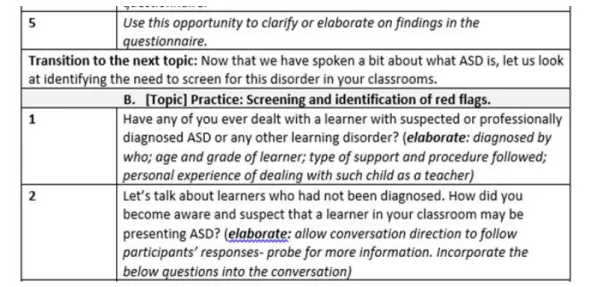
APPENDIX D: FOCUS GROUP INTERVIEW SCHEDULE ... 126
APPENDIX E: SENTENCE COMPLETION GOOGLE FORM ... 130
APPENDIX F 1: PHYSICAL ARTEFACT 1 ... 133
APPENDIX F 2: PHYSICAL ARTEFACT 2 ... 134
APPENDIX G: SAMPLE OF FOCUS GROUP INTERVIEW TRANSCRIPTION ... 136
APPENDIX H: SAMPLE OF FOCUS GROUP INTERVIEW CONTENT ANAYLSIS ... 137
APPENDIX I: SAMPLE OF SENTENCE COMPLETION GOOGLE FORM CONTENT ANAYLSIS ... 138
APPENDIX J: SAMPLE OF CONTENT ANALYSIS CODING ... 139 APPENDIX K: DIAGNOSTIC CRITERIA OF AUTISM SPECTRUM DISORDER . 140
1
CHAPTER 1:
INTRODUCTION AND ORIENTATION TO THE STUDY
1.1 INTRODUCTION
Childhood is a sensitive phase in one’s life. The nurturing and support that one receives during this period has a profound impact on one’s development into adulthood. For a child to achieve optimal development into adulthood, parents and schools need to meet learners’ individual specialised needs so that holistic development of their physical, cognitive and emotional aspects is possible (Shastry, 2018). Supporting children as they learn at their own pace is important for their early childhood development, especially for learners with Neurodevelopmental Disorders, which create barriers to learning. Neurodevelopmental Disorders (NDDs) refer to a group of disorders where there is an impairment in some aspect of mental development (Bishop & Rutter, 2007). According to the Diagnostic and Statistical Manual of Mental Disorders, 5th Edition (DSM-5) of the American Psychiatric Association (2013), Neurodevelopmental Disorders are a group of conditions with onset in the developmental periods of early infancy. These disorders typically manifest in the younger pre-school years. These disorders are characterised by deficits that produce impairments of personal, social, academic or occupational functioning and can present as delays in achieving developmental milestones. This becomes more apparent in the young school-going child.
Since the notion of Inclusive Education was put forward in the Education White Paper 6 (EWP6) (Department of Education, 2001), there are now more learners diagnosed with mild to more severe Neurodevelopmental Disorders in mainstream schools (p. 26). Thus, teachers and other stakeholders require additional competence and more specialised skills to identify, assess and support this specific group of learners. This support includes the development of individualised learning support plans (ISPs), curriculum differentiation, and adapted classroom practices (p. 26). According to research by the Department of Higher Education and Training, there appears to be limited teacher education in pre-service teaching qualifications to support learners who
2
exhibit different Neurodevelopmental Disorders (Dunbar-Krige & Fourie, 2018). This is specifically the case regarding Autism Spectrum Disorder.
As discussed by Homberg, Kyzar, Nguyen, Norton, Pittman, Poudel, Kalueff, (2016), NDDs are highly prevalent and severely debilitating brain illnesses caused by atypical brain growth and development, which results in cognitive, social, motor, language and affective disabilities. A common NDD is Autism Spectrum Disorder (ASD), which presents with abnormal development, central nervous system issues, immune irregularities and digestive illness caused by a combination of environmental and genetic factors (Star Academy, 2011).
Autism Spectrum Disorder has become a growing epidemic that affects one in every 36 children in America. ASD is five times more prevalent in boys (Alspaugh-Jackson & Penrod, 2017). As stated by Brock, Jimerson and Hansen (2007), a worldwide increase in individuals identified with ASD in the past decade leads to the need for early identification and intervention in order to improve outcomes for children with Autism. Most children are identified within the school environment using school resources (Brock, Jimerson, & Hansen, 2007). Within the South African context, the Department of Basic Education (DBE) Policy on Screening, Identification, Assessment and Support (SIAS) is a policy that requires teachers to adhere to the protocol of screening, identifying and assessing barriers to learning experienced by learners (Department of Basic Education, 2014).
1.1.1 Inclusive Education for Diverse Learners
Being able to recognise diversity amongst learners and their barriers to learning is important. Recognising learner diversity helps teachers tailor content and teaching methods. It allows them to communicate their awareness and appreciation for the learners’ unique needs as individuals in order to maximise their learning (Plank & Rohdieck, 2007). Lynch (2016) agrees with the notion of recognising learner diversity. He highlights the teacher’s responsibility in recognising diversity and structuring learners’ lessons to reflect their differences. Being able to recognise these diverse needs of learners allows for the act of inclusive education.
3
As described by Greenstein (2016), the act of radical inclusive education explores how current education practices exclude and fail many students with disabilities, and one needs to recognise the value of diversity, needs and capacities of each individual to address these inequalities. Environmental accommodation concerns were raised regarding the incompatibility of the idea of inclusion and the reality of mainstream school provisions. Inclusive education is more than just the placement of students; it is also the environmental accommodations provided by the school to facilitate the students (Greenstein, 2016). Accommodations are the changes made by the school or teacher to remove barriers to learning, which results in changing how students learn and not what they learn. This is to ensure equal education for all students (Lee, 2015). Many mainstream schools have started to acknowledge the need for equal opportunities for those with disorders and barriers. Schools have begun to integrate creative attributes of communication, socialisation and imagination into teaching in order to achieve inclusivity by adapting traditional methods. These methods are teacher-focused, reinforce the power differential between students and the teacher and enforce standards of behaviour (CCSS, 2017). These, however, are methods that learners with ASD struggle with and therefore do not benefit from these adaptations made within the classroom (Hewit, 2004). One needs to be aware of the individual’s unique ways of thinking and viewing the world to adapt traditional teaching methods for all learners. Therefore, in order for the mainstream classroom to implement inclusive principles and interventions, teachers need to be able to identify the need for special accommodation and flexibility in curricula. The ability to appropriately screen for Neurodevelopmental Disorders such as ASD is vital.
Having discussed the importance of inclusivity and support for learners with barriers to learning, it is evidently imperative that schools provide the necessary Autism-specific education and interventions. Therefore, as discussed, teachers need thorough knowledge of ASD in order to implement these interventions (Hendrick, 2011). It is therefore essential for this study to explore and understand teachers’ knowledge and practice in appropriately screening for Autism Spectrum Disorder. According to Saggers (2016), a lack of training on Autism-related professional development is a key barrier to supporting the complex needs of learners on the Autism spectrum.
4 1.2 RATIONALE
A UNICEF census conducted over 10 years (2001-2011) indicates that there are approximately 474 000 children living with severe disabilities in South Africa (UNICEF, 2012). According to Boonzaier (2017), developmental disability research has not been a priority in Africa, with few funds available and few skilled people trained to identify these disabilities. Regarding Neurodevelopmental Disorders, high-incomes countries have identified a high rate of Autism and almost everything we know about this specific disorder comes from these areas. “To diagnose Autism Spectrum Disorder in a particular culture, we need to be familiar with what behaviours are acceptable and unacceptable in that culture” (Boonzaier, 2017). Thus, standardised diagnostic and screening tools that are developed in these “high-income countries” have been shown to be inefficient in the South African context where different cultures are prevalent. It is therefore essential to recognise the opportunity for improvement in the awareness and identification of characteristics of such disorders in this country. We also need to recognise the importance of the development and implementation of South African-specific screening tools, although this is not the focus of this minor dissertation. As noted earlier, the prevalence of ASD in schools could be located in any school. The Department of Basic Education (DBE) is responsible for the following schools within the South African context; public schools (which includes specialised education schools) and private/independent schools (which includes specialised education schools).
Public schools are funded by the government and operate at a local level in their province, which means that education varies between areas (Government Gazette, 2011). Public schools follow the National Curriculum Statement (NCS) and thus adhere to the Curriculum Assessment Policy Statement (CAPS).
The government does not fund private schools in South Africa (Expatica, 2018). These private/independent schools often have smaller class sizes and usually offer more extracurricular activities. Private/independent schools can select their own curriculum and examinations as they do not have to follow the NCS as long as their curriculum of choice meets the standards prescribed by the NCS (Gazette, 2010). Most private/independent schools often choose to follow the Independent Examinations Board (IEB). They are also permitted to include international exams like the Cambridge International Examinations (CIE), O and A-levels from the United Kingdom or the
5
Scholastic Aptitude test (SAT) from the United States, concurrently. These international examinations need to be approved by Higher Education South Africa (HESA) (Gazette, 2010). It is important to note this information as this study focused on, and took place in, a private/independent school.
The GDE established and approved the Screening, Identification, Assessment and Support (SIAS) policy in 2014, which is applicable to all schools, yet compulsory for public schools. The policy was designed to manage and support the process of teaching and learning which affects learners within the system who experience barriers to learning. It aims to promote maximum participation by all learners (Department of Education, 2008). This process provides the most effective support plan for learners with Neurodevelopmental Disorders. However, little emphasis is placed on the SIAS policy within the education system, despite teachers being alerted during their training to the fact that they need to follow such processes when identifying barriers to learning (Roberts, 2011). Subsequently, teachers continue to struggle with implementing inclusion within their classrooms (Nel, Tlale, Engelbrecht, & Nel, 2016).
A select few private schools, schools funded by the Department of Basic Education, and a few mainstream schools, have shown some progress in supporting learners with various needs within the classroom through curriculum and teaching strategy adaptations (Donohue & Bornman, 2014). Despite this, support has proven insufficient in the past as teachers are not sufficiently trained in the screening and identification of such needs. As stated by Swart, Engelbrecht, Eloff & Pettipher, (2002), there is a need for training due to the “disturbing lack of skills in identifying the needs of learners within the system and evaluating support effectiveness”. It can be assumed that the lack of training on the SIAS policy can lead to lack of understanding by the schools of how it is supposed to be implemented. This is due to little guidance on effective implementation of the policy (Donohue & Bornman, 2014). It is argued that the lack of understanding of the implementation of the SIAS policy could lead to the increase of unaddressed neurodevelopmental challenges in the classroom, including ASD.
According to Donohue and Bornman (2014), addressing and accommodating extrinsic barriers to learning requires more explicit guidelines from the DBE. The researcher argues in this study that the implementation of the SIAS policy in schools may be associated with possible misinterpretations as well as a lack of knowledge and skills
6
required to appropriately implement it. One could argue that the ‘Identification’ step in this SIAS process is often misinterpreted by non-healthcare professionals, such as teachers, and can lead to illegitimate conclusions based upon incorrect assumptions regarding the policy process.
For teachers to make legitimate conclusions, they should be trained through courses or workshops to identify red flags of neurodevelopmental disorders like ASD. Red flags are warning signs that indicate an individual should be further evaluated (in this case warning signs specific to ASD) (Wetherby, et al., 2004). Further investigation of these red flags then leads to the ‘identification’ of disorders like ASD. Therefore, to be able to move from acknowledging the need for further evaluation and identifying red flags to the identification of the disorder, one first requires some measure of knowledge and understanding of the disorder. When teachers have insufficient knowledge and understanding of the disorder, incorrect assumptions are made, which results in incorrect identification and labelling.
It can be argued that these incorrect assumptions are underpinned by the ‘medical’ model stance. The ‘medical’ model stance considers disabilities to be caused by a predisposition to biological impairments within the individual with an organic or physical cause. The ‘medical’ model shows little regard for external environmental factors (McLeod, 2014).
However, Bronfenbrenner’s Bioecological Systems Theory takes all systems and the surrounding environment into consideration when considering learners with diverse abilities and needs. Although the medical model offers frameworks for understanding impairments and the impact on the individual, one needs to be aware of the individual’s unique and alternative ways of thinking and viewing the world and systems around them, as emphasised in the Bioecological Systems Theory. Thus, it is important to consider both models in understanding an individual holistically. A further implication may also be that the often ‘rigid’ and ‘institutional’ methods employed in the mainstream environment may need to be adjusted to accommodate and include all learners adequately (Greenstein, 2016).
Therefore, it can be argued that teachers are expected to be involved in the identification of NDD barriers but seldom have the training and knowledge to
7
appropriately screen for these disorders, such as ASD, due to this lack of training and guidance as discussed by Donohue and Bornman (2014).
1.2.1 Screening and Early Interventions for ASD
If interventions are started at an early age, children with developmental disorders have a greater chance of successful outcomes (Karanth & Chandhok, 2013). This statement is particularly true for Autism Spectrum Disorder as early intervention leads to improvements in areas of deficits and prevents the decline of intellectual development experienced by learners with ASD. As explained by Bottcher and Dammeyer (2016), the biological time window for the development of certain abilities, such as language development, stresses the crucial need for early interventions (Bottcher & Dammeyer, 2016). According to Chong (2017), diagnosing ASD in Florida before the age of 24 month is difficult, yet signs of Autism Spectrum Disorder can be detected by the age of 18 months. Intensive treatment may reverse symptoms. According to Setokoe (2018), it is believed that a child with ASD is born every 45 minutes in South Africa, yet these diagnoses are only made at an average age of three to four years old. Therefore, it is essential for teachers to have the knowledge to be able to identify learners exhibiting the warning signs or ‘red flags’ of ASD in order to provide early intervention.
Identifying and diagnosing at an early age would not only allow for earlier intervention but would also allow the teacher to support the learners’ development in an academic, emotional and physical capacity. The teacher would develop awareness of the learners’ unique needs and would be able to act within their best interests.
This intervention and support would likely result in developmental improvements in interactions with peers, decreased symptomology and an increase in IQ scores and language ability due to the plasticity of the young, developing brain (Baird et al., 2006). Grinaker et al. (2012), identify the need for South African schools to perform appropriate screening and early diagnosis of ASD as healthcare resources and facilities are limited. This would reduce the burden on education and healthcare systems. As discussed by Lombard (2018), parents are often the first to notice that their child is showing unusual behaviour, such as failing to make eye contact, not responding to their name being called, playing with toys in an unusual manner, and repetitive actions. Until the age of 36 months, babies should ideally be screened for
8
developmental milestones during routine visits to the paediatrician or at an accessible clinic. Such assessments could determine if the child needs to be referred to another specialist. Due to the increased lack of access to health services in South Africa, as stated by McLaren, Ardington and Liebbrandt (2013), and the busy career-driven lives of parents, these important steps are not always possible to take. Thus, it is essential for the teacher to be able to notice unusual behaviour (as they spend most of the day with the learners) and know when and how to appropriately screen for these disorders for early intervention.
According to Springer, Toorn, Laughton, and Kidd (2013), “studies have yet to be done to determine the prevalence and characteristics of ASD in Africa”. Recent studies such as research on the ‘Psychometric Analysis of the Systematic Observation of Red Flags for Autism Spectrum Disorder in Toddlers’ by Dow, Guthrie, Stronach and Wetherby (2017), as well as the ‘Impact of Early Interventions on Children with Autism Spectrum Disorders as Measured by Inclusion and Retention in Mainstream Schools’ by Pediatr (2013), have indicated the dearth of literature and research available on red flag identification and the importance of early interventions. However, there appears to be a lack of literature regarding the knowledge that teachers in mainstream schools need to screen for ASD and their ability to see when it is necessary. As stated by Greenstein (2016), “those who set themselves up as educators must themselves be educated”. Thus, teachers evidently need to be educated in order to offer maximum education to learners. As discussed in the preceding argument, there appears to be a lack of understanding amongst teachers of how the Screening, Identification, Assessment and Support (SIAS) policy should be implemented in schools in order to provide the most effective support plan for learners with neurodevelopmental challenges.
Thus, this study wished to bridge the gap between the already identified prevalence of ASD and screening measures developed for ASD, and teachers’ knowledge and practice in appropriately screening for ASD. Therefore, the main question this study attempted to answer in order to provide the necessary support was: “What do teachers know about Autism Spectrum Disorder and how do they practise appropriate screening for Autism Spectrum Disorder in a mainstream primary school?”
9 1.3 PROBLEM STATEMENT
In view of the above arguments, it is apparent that learners with Neurodevelopmental Disorders do not always receive the collaborative support needed in the schooling environment. There appears to be a lack of understanding of how the Screening, Identification, Assessment and Support (SIAS) policy should be implemented in schools in order to provide the most effective support plan for learners with neurodevelopmental challenges. Early interventions are an important and successful means in the care and treatment of individuals with ASD. As discussed by Brock, Jimerson and Hansen (2007), the prevalence of Autism Spectrum Disorder is rising each year, with more learners being diagnosed in the later school-going years, causing further long-term complications. This leads to the increase of neurodevelopmental challenges for learners who have ASD. For this reason, identifying red flags in the classroom environment plays a vital role in providing the individual with the support and interventions required. For these learners with ASD to avoid slipping through the cracks of the education system, teachers need to be able to screen for ASD while selecting the appropriate tools and following acceptable procedures. This research The purpose of this study is to provide critical insight into teachers’ knowledge and practice in appropriately screening for ASD in order to support learners in a mainstream primary school.
1.4 RESEARCH QUESTIONS
A research question focuses the study at hand while directing all stages of inquiry to guide the researcher throughout. (Jansen, 2007). The following main and secondary research questions guided this study.
1.4.1 Main Research Question
What do teachers know about Autism Spectrum Disorder and how do they practise appropriate screening for Autism Spectrum Disorder in a mainstream primary school?
10 1.4.2 Secondary Questions
The sub questions that were answered in this study are as follows:
1. What are the tools teachers select to screen for ASD in a mainstream primary school?
2. Why do teachers select specific tools to screen for ASD in a mainstream primary school?
3. What procedures are followed by teachers in a mainstream primary school when screening for ASD?
With these questions, the researcher attempted to gain an understanding of the knowledge and practice of teachers in appropriately screening for ASD. This was followed by exploration of the procedures that teachers follow to address Neurodevelopmental Disorders in the classroom.
1.5 PURPOSE and AIM OF THE STUDY
The main purpose of this study was to contribute to the larger project aim of investigating and describing how principals, SBSTs and teachers in primary schools monitor and implement the Screening, Identification, Assessment and Support (SIAS) policy in order to determine the appropriate support and/or placement of learners with Neurodevelopmental Disorders.
The specific aim of this study was to explore, understand and describe teachers’ knowledge and practice in appropriately screening for ASD in a mainstream primary school in order to implement Autism specific interventions. The underlying assumption of the study is that if teachers were able to identify possible characteristics of ASD at an early school age, they would be able to improve the outcomes for the child by means of early responsive intervention, support and appropriate placement of the learner as indicated by the SIAS policy.
1.5.1 Research Aim
Based on the research questions, the aim of this specific study was:
To explore and describe teachers’ knowledge and practice in appropriately screening for Autism Spectrum Disorder in a mainstream primary classroom in order to implement Autism specific interventions.
11 1.5.2 Research Objectives
Based on the research aim, the objectives of this study were:
To explore and describe the tools teachers select to screen for Autism Spectrum Disorder in a mainstream primary school;
To explore the procedures that teachers follow when screening for Autism Spectrum Disorder in a mainstream primary school.
1.6 CLARIFICATION OF KEY TERMS
1.6.1 Autism Spectrum Disorder (ASD)
ASD refers to a group of complex disorders of brain development. Neurobiological aspects of ASD include anatomical abnormalities identified in many areas of the brain (Baron-Cohen, 2004, p.945). Thus, the individual communicates, interacts, behaves and learns in ways that are different to the ‘neurotypical’ learner. It is a life-long neurodevelopmental disorder. Individuals with ASD need support as they develop ongoing challenges in language, social interaction, flexibility in thinking, as well as in behaviour and sensory perception (Lombard, 2018). According to the Diagnostic Statistical Manual of Mental Disorders, 5th Edition (DSM-5) (2013), the diagnostic criteria of ASD includes persistent deficits in social communication and social interactions across multiple contexts such as social reciprocity, nonverbal communicative behaviour used for social interaction and skills in developing, maintaining and understanding relationships. The diagnostic criteria also includes restricted or repetitive patterns of behaviour, interests or activities. Symptoms may change with development and may be masked by coping mechanisms. These symptoms must cause significant impairment in one’s social, occupational or other important areas of current functioning. ASD causes clinically significant impairments in social, occupational or other important areas of current functioning.
1.6.2 Mainstream School
This refers to a school that principally meets the needs of learners who do not have special educational needs and is therefore an ‘ordinary’ school (The National Autistic Society, 2008). Mainstreaming refers to a school placing children with special needs into classrooms with peers who do not have disabilities or barriers to learning. This is mandated by the government because of the right that each child has to be educated
12
with the general education population with no means of discrimination against them (Masters in Special Education Program Guide, 2018).
1.6.3 Screening, Identification, Assessment and Support (SIAS) Policy (December 2014)
Screening refers to evaluating a large number of subjects in order to identify those with a specific set of attributes or characteristics (Screening, 2018). The SIAS policy is designed to manage and support the process of teaching and learning which affects learners within the system who experience barriers to learning. It aims to promote maximum participation by all learners, and thus inclusion (Department of Education, 2008).
1.6.4 School Based Support Team (SBST)
This is a support team referred to in the Education White Paper 6. It is an on-going collaborative problem-solving unit of school personnel based at the school, who meet regularly to assist teacher development and implement instructional strategies that support the learning of students (School Based Support Team, 2015). The South African Department of Education established the SBST in schools to deal with inclusive education and its implementation at school level. These teams organise support and the establishment of individualised education programmes for vulnerable learners or those who have barriers to learning (Makoelle, 2014).
1.6.5 Red Flags
Red flags are ‘absolute indicators’ which indicate that an individual should be further evaluated (Wetherby, et al., 2004). Red flags of Autism are the warning signs that attract attention based upon unusual or unique behaviours, which are not typically appropriate according to developmental milestones of a specific age. According to the DSM-5 (2013), some common red flags of ASD include impairments in reciprocal social communication and social interaction; restricted, repetitive patterns of behaviour, interest or activities; lack of non-verbal communication and eye contact; lack of verbal communication; lack of relationships, play and object exploration; being easily upset by routine change; sensory sensitivities; self-stimulatory behaviours such as hand flapping or rocking.
13 1.7 THEORETICAL FRAMEWORK
A theoretical framework is a blueprint for inquiry. It consists of interrelated concepts and theories that guide a study and provides a connection between the researcher and existing knowledge in order to bring structure to the researcher’s stance (Mertz & Anfara , 2014). This study focuses on the theory of Bronfenbrenner’s Bioecological Model.
1.7.1 Bronfenbrenner’s Bioecological Systems Theory
The discussion below outlines the basic theory of Bronfenbrenner’s Bioecological Systems Theory (1979). This theory and the applications in terms of ASD are further discussed in more detail in Chapter 2 (2.2.1).
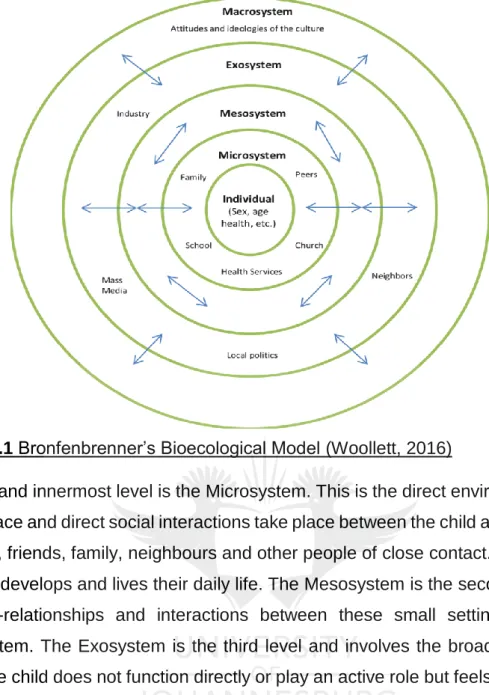
Bronfenbrenner (1979) developed a Bioecological Systems Model that proposes that the child is surrounded by levels of external influencing relationships and that each level plays a vital role in the holistic development and being of the individual (Leonard, 2011). As discussed by Scott-Croff (2017), research based on Bronfenbrenner’s Bioecological Systems Theory noted that this ideology has been widely used to support children with Autism Spectrum Disorder.
Bronfenbrenner’s Developmental Theory comprises the Microsystem, Mesosystem, Macrosystem and Exosystem, all of which interact with the Chronosystem, which brings in the dimension of time (p. 77). Sincero (2013) explains these five levels, otherwise referred to as environmental systems, which are encountered and may influence the child’s behaviour and development.
14
Figure 1.1 Bronfenbrenner’s Bioecological Model (Woollett, 2016)
The first and innermost level is the Microsystem. This is the direct environment where face-to-face and direct social interactions take place between the child and their peers, teachers, friends, family, neighbours and other people of close contact. This is where the child develops and lives their daily life. The Mesosystem is the second inner level of cross-relationships and interactions between these small settings within the Microsystem. The Exosystem is the third level and involves the broader community where the child does not function directly or play an active role but feels the influence, for example, the kind of services offered in the child’s surrounding community. The Macrosystem is the outermost level and includes socioeconomic status, cultural norms, morals, customs and societal conditions (Sincero, 2013).
With the primary importance of the individual’s own biological development at the centre, this model identifies systems and the importance of the family composition in these systems. In addition to family members, other external influencing relationships and factors are also central as they serve as the nucleus of the child’s development. For instance, the interactions of family members and other important role players, such as teachers and the school, with an individual who has ASD are important to the shaping and development of that individual. Thus, one needs to comprehend the facets of the environments that affect and help shape and develop a learner with ASD in order to understand that specific learner and their needs. The focus of this study is
15
on the Mesosystemic level, where the interactions and relationships between Microsystems or connections between contexts are found (Impact of Special Needs, 2017). This study specifically looks at the relationship between school experiences and learners with ASD. Thus, Vygotsky’s Social Constructionist Theory is incorporated into this study within the Mesosystem level of teacher and peer interaction and relations.
Vygotsky views disabilities from a social constructionist perspective, which indicates that the person develops in their socio-cultural context that includes cultural, contextual and discourse elements. Alfred (2002) speaks about important socio-cultural contexts for learning. The importance of teachers creating a learning environment where learners can participate without sacrificing their personal and cultural identity is vital in the learning process. Therefore, learners with ASD should be provided with a safe environment where they can participate regardless of their difficulties or required accommodations.
Alfred (2002), also speaks of the different contexts as sites for learning. These are the learner’s interactions with their surrounding environment. Some examples of the environment include the family, community and the school, which brings in the concept of the Mesosystem of the Bioecological Systems Theory (1979). The importance of interactions and collaboration between the school and family of a learner with ASD is thus vital in their learning process.
Alfred (2002) explains discourse communities as contexts for learning which refers to how a group of people within the learner’s context shapes their identity and their relationships within their social world. This element also links the Bioecological Systems Theory where community involvement is important in the identity of an individual.
The socio-cultural context acts as a means to develop cognitively through shared activity with adults, and in this case, teachers. (Dovey, 2016). For teachers to be able to engage in shared activity with learners with ASD, teachers need to have acquired knowledge on how to engage in terms of their own culture, context and discourse. Vygotsky’s theory of knowledge acquisition was drawn on with specific focus on teacher knowledge. Vygotsky refers to the gap between the level of potential development that an individual can reach with the help and guidance of a more
16
knowledgeable individual (the teacher) and the level at which they currently function, as the zone of proximal development (ZPD) (Hurst, 2018). This area is where the most sensitive instruction and guidance should occur. Hurst (2018) also explains how scaffolding is the support mechanism that helps an individual to successfully perform a task within their ZPD. “Learners with disabilities often do not conform to how schools are arranged and may find participation in learning activities difficult without the needed support” (Dovey, 2016). Aligned with Vygotsky’s view on learners with disabilities, teachers need to be able to identify the way in which they are developing and participating differently to other students in the class. This falls within the Mesosystemic level where teachers offer support and scaffolding to help these learners reach their ZPD.
Vygotsky speaks of a complex structure of disability with primary disability based on primary impairment and secondary and tertiary disability based on cultural distortions of socially conditioned, higher mental functions. These socially conditioned interactions and cultural distortions take place on the Macrosystemic level. According to Rodina (2006), this theory determines primary disorders to be visual, language, speech-related and motor related impairments (Neurodevelopmental Disorders). If not addressed, these disorders lead to secondary disabilities due to exclusion within the classroom environment. Therefore, “the importance of a distinction between primary and succeeding symptoms in the study of upbringing, teaching and education of children with different disabilities” is stressed (Rodina, 2006).
Secondary disabilities are identified as results of social and psychological consequences of unattended primary disabilities and may be prevented and eliminated by medical and educational means – thus Mesosystemic interventions. The way in which learners with ASD think, speak and behave differs from other children and is misunderstood by mainstream culture. In order to accommodate and appropriately place learners on the Autism Spectrum, the teacher needs to have an understanding and knowledge of the disorder. This would help to address the barriers that hinder participation. It is essential for this study to focus on learners with Neurodevelopmental Disorders, particularly ASD, and the importance of early identification of warning signs and appropriate scaffolding offered by teachers. Thus, the study focused on the Mesosystemic interactions and relationships between relevant individuals within the classroom.
17
1.8 RESEARCH DESIGN AND METHODOLOGY
The following discussion is a basic outline of the research design and methodology. An extensive explanation is provided in chapter 3.
SECTION BRIEF DESCRIPTION
DESIGN & METHODOLOGY
Paradigm informing the study The main focus of this study was the interpretivist paradigm which is based upon the belief that reality is multiple and relative (Edirisingha, 2012).
Research approach A bottom-up approach was used in this qualitative study to condense raw data and establish clear links between research objectives and findings (Thomas, 2003). This study focused on the qualitative approach where the researcher made sense of a social phenomenon by contrasting, comparing, cataloguing and classifying the object of study while building concepts and hypotheses in order to reach and understand a general pattern (van Zyl, 2012).
Time horizons A cross-sectional time horizon was
adopted to make comparisons at a single point in time during this study.
Methodology This study made use of focus-group
interviews, sentence completion and physical artefacts as qualitative tools to explore phenomenon though a variety of lenses (Nieuwenhuis, 2016)
18
Participant recruitment Purposive sampling was implemented in this study. This non-randomised nature allowed the participants to represent a theoretical population. However, this participation was made voluntary.
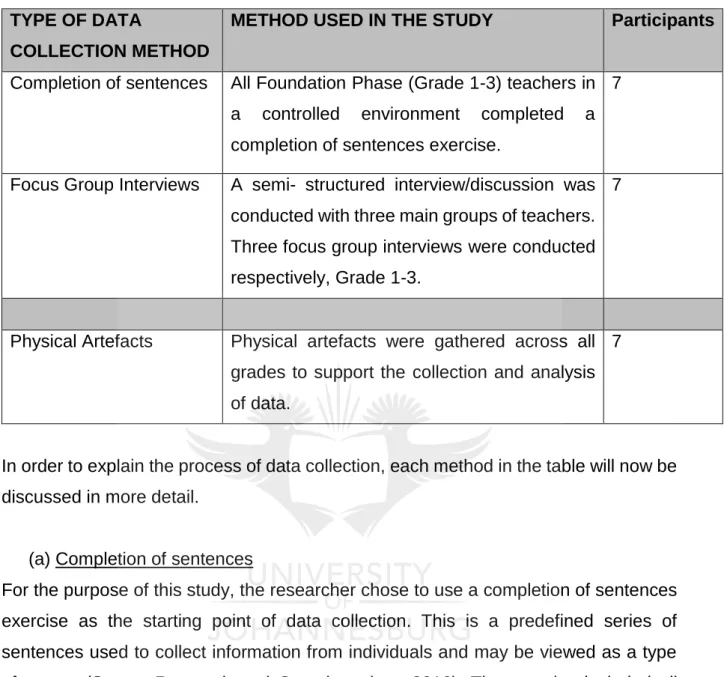
Data collection More than one method of data collection was used in order to gather a wide variety of information from various teachers to allow for in depth triangulation of findings. Data was collected through a completion of sentences exercise in Google Forms, followed by focus-group interviews. Both according to respective grade groups. Any relevant physical artefacts were also collected.
Data analysis Data collection and data analysis is part of a cyclical, iterative and ongoing process (Nieuwenhuis, 2016). All data collection methods were analysed separately. In order to analyse the data gathered, a cyclical process of reflecting on data, identifying gaps in data and planning further data gathering took place. All data was analysed using Thematic Analysis in order to make sense of themes in the data collected. The six-step framework developed by Braun and Clarke (2006), was followed with emphasis placed on both the semantic and latent levels. QUALITY CRITERIA
Validity To ensure validity, the researcher used
descriptive validity where no fabrication or change of data during the gathering of
19
data occurred. The focus-group interviews and sentence completion were facilitated in a controlled environment monitored by the researcher.
Reliability The chosen methods of data collection are relevant to the study and were guided by the DSM-5 and other diagnostic information published on ASD. The data analysis was member-checked to ensure reliability of results, otherwise termed as ‘rigour’.
Transferability To ensure transferability of the study, data collection schedules and sources are provided as appendices. Findings are described in detail.
ETHICAL CONSIDERATIONS
All participants were voluntary, were over the age of eighteen and understood their role and rights in the study. Consent was obtained by all participants. Confidentiality was assured, by maintaining anonymity to ensure participant privacy and protection. The study was approved by the Gauteng Department of Education and received ethical clearance to conduct the research in an education institution, ethical clearance number: 2019-100.
1.9 CONCLUSION
In this chapter, the researcher has consolidated the issues around the increasing prevalence of ASD within the South African context. Specific focus on the prevalence of learners with ASD within the primary school years has also been discussed. The
20
importance of inclusive education for learners with ASD through early implementation of appropriate interventions by teachers has been explored. This chapter has also discussed the rationale, research questions, aims and objectives of the study accompanied by definitions of key terminology. Finally, this chapter introduced Bronfenbrenner’s Bioecological System Theory and the placement of an individual within this model. The researcher intends to further explore and discuss the theories underpinning ASD while developing a holistic representation of learners with ASD within the education and broader environment. Chapter 2 will provide the literature review in detail.
1.10 ORGANISATION OF CHAPTERS
This Study is divided in the following chapters:
CHAPTER 2: Literature Review. In this chapter, the researcher has reviewed the literature available for this study. Bronfenbrenner’s Bio ecological Systems Theory, as well as Autism-specific theories, have been explored in depth.
CHAPTER 3: Research Design and Methodology. This chapter explored the research approaches, collection and analysis of data and the trustworthiness of the study.
CHAPTER 4: Data Analysis. In this chapter, the data analysis process was explored along with the discussions of emerging themes from all data collection methods.
CHAPTER 5: Findings, Conclusion and Recommendations. This chapter discussed the findings in the context of existing literature while concluding with reflections and recommendations for further study, based upon these findings.
21
CHAPTER 2:
LITERATURE REVIEW
2.1 INTRODUCTION
With the prevalence of learners diagnosed with Autism Spectrum Disorder (ASD) rising each year (Alspaugh-Jackson & Penrod, 2017), it has become increasingly important for teachers to be able to recognise the characteristics and warning signs of ASD in order to provide appropriate screening and vital educational support.
This chapter reviews literature on the theoretical framework underpinning this study, Bronfenbrenner’s Bioecological Systems Theory; on the complex development and characteristics of Autism Spectrum Disorder; and the implementation of the SIAS strategy in South Africa. The chapter will build incrementally on previous sections to facilitate a deeper understanding of the implications and fundamental needs of learners with ASD within the learning environment.
2.2 THEORETICAL FRAMEWORK
Bronfenbrenner’s Bioecological Model (Bronfenbrenner, 1979) was used as the main theory to inform this study, drawing on his ecosystemic stance along with concepts of Autism Spectrum Disorder.
The research incorporated supporting theories, such as Developmental Theory of Autism and Theory of Mind (1995).
2.2.1 An Ecosystemic View on Autism Spectrum Disorder
The Bioecological Systems Theory explains the dynamics of the school environment. Thus, understanding the influence of the school environment dynamics on learners with ASD is important. According to this theory, a child develops within interacting contexts which exert bidirectional impacts on the child’s life (Fabrizi, 2015). These contexts are referred to as levels of environmental influences. These levels include the Microsystem, Mesosystem, Microsystem, Exosystem, and Chronosystem, as previously discussed in Chapter 1 (1.7.1). The primary level is the Microsystem, which is the inner circle and direct environment where face-to-face, direct social interactions take place between the child and the individuals that the child interacts with most often.
22
The Mesosystem is the second inner level of cross-relationships and interactions between these small settings within the Microsystem. It includes the family, peers and most importantly in this study, the school. This relates to the interaction between child and teacher. The Exosystem is the third level and involves the broader community, where the child is influenced by the interactions but does not function directly or play an active role. In this study, this Exosystem refers specifically to the interaction between teachers and the schooling system at large. The Macrosystem is the outermost level and includes socio-economic status, cultural norms, morals, customs and societal conditions. The Chronosystem is the dimension of time that reflects the transitions and shifts in the child’s lifespan and timing of events within their environment. The dimension of time plays an important role in influencing the development of the child over the schooling years (Sincero, 2013).
2.2.1.1 Autism and the Mesosystem
It is important for this study to focus on the Mesosystemic level of the Bioecological Systems Model where relations between teacher, learner and the environment of the school setting are scrutinised. This is important as learners spend most of their five-day weeks at school or in an education environment where interactions between teachers, children and the child’s peers occur.
Individuals with ASD experience the world very differently to others. For example, they focus on details of their surrounding environment rather than a global perspective. This overload of detail surrounding them leads to anxiety and stress due to the unpredictable and unfamiliar nature of these stimuli (Green, 2015). Smaller spaces with fewer details and quality lighting are important, according to Green (2015). He explains that some individuals with ASD display hyper-receptivity and noise causes them to feel disorientated. When considering learners with ASD, these are important aspects to be made aware of within the school environment and the classroom setting.
As discussed by Saggers (2016), every individual with Autism Spectrum Disorder is unique and has unique needs. The classroom is a social environment, which relies on the ability of learners to interact, socialise and communicate effectively. All of these are aspects, which ASD learners struggle with. Research shows the importance of understanding the link between academic learning and social and emotion competence. A lack of these aspects could lead to a decrease in student’s connection
23
with the school and deteriorating academic performance. Saggers (2016) also discusses how the required focus on curriculum often overshadows mental health and social and emotional learning. Considering that learners with ASD require curricular adaptations and accommodations, as discussed in Chapter 1 (1.1.1), this overshadowing is detrimental to their academic, social and emotional development.
To support the relationship between the individual and the classroom learning environment one needs to be aware of the importance of routine for a learner with ASD. According to Family Health Guide (2018), this need for routine is partly due to their rigid personality. A learner with ASD needs to know where they are in time and space. They require predictable situations. In order to learn efficiently in class, these learners require a supportive classroom environment where expectations are not lowered but are different. Differentiating expectations rather than lowering them is what inclusive education aims to achieve, as discussed in Chapter 1 (1.1.1). This includes simple and clear tasks set out by the teacher, keeping language literal and having visual timetables for routine, as well as a quiet area when the class becomes too noisy or overstimulating (Emma, 2018).
Weber (2013) speaks of the importance of consistency and predictability. It is evident that learners with ASD require routine in their daily lives, an important aspect to consider in the classroom. Weber (2013) also discusses the importance of visual aids within the classroom to reduce confusion and ensure predictability, reduce stress and help the learner with ASD move from the abstract to the concrete.
It is evident that learners with ASD experience their day-to-day learning very differently from the other learners in their classes, thus it is essential to be able to identify these learners in order to make the necessary accommodations and provide the necessary support, drawing on a social constructionist view of disabilities.
2.2.1.2 Social Constructionist View on Disability
In order to understand a social constructionist view on disability, one needs to first understand the concept of social justice. As cited in McMahon and Watson (2010), “social justice defines actions that contribute towards affording equal access to all within a particular nation or society” (O’Brien, 2001). Social justice has to be understood contextually as the issues at hand are dependent on the context of the
24
community. This is supported by Bronfenbrenner’s Bioecological Systems Theory (1979), which suggests that all systems around the individual interact and thus have a direct or indirect impact on the learner (Leonard, 2011). According to Landsberg (2005), creating schools that are grounded in democratic principles and constructs of social justice should be the logical response to the rapidly evolving social, political and economic contexts. He also explains how social justice aims to use human resources to the mutual benefit of all learners, even those with disorders like ASD. Thus, this notion supports equal educational opportunities for all learners including those who experience barriers to learning.
Vygotsky (1978) proposed that learners with disabilities, or barriers to learning, should be viewed as having developed differently, rather than being less developed than other peers their age (Dovey, 2016, p.22). It is important to note that these learners interact differently within the Mesosystem to that of the ‘neurotypical’ learner. It is evident that learners with disorders such as ASD do not conform to the norm and find participation in learning activities difficult without specific support structures (refer to Chapter 1 (1.1.1)). As these learners require different interventions and accommodations, Vygotsky’s view on disability (1978) explores the need for adaptation in the way scaffolding is provided for these learners. He explores the importance of teachers being flexible in teaching curricula to address the diverse needs of learners with disorder like ASD.
Vygotsky refers to the gap between the level of potential development that a child can reach with the help and guidance of a more knowledgeable individual and the level at which they currently function, as the Zone of Proximal Development (ZPD) (Hurst, 2018). Scaffolding refers to the assistance that is provided by that more knowledgeable individual to reach the ZPD. In the classroom, the teacher provides scaffolding for the learners through intervention and support. However, a learner with ASD requires a uniquely adapted type of intervention and support by the teacher in this scaffolding process.
Effective teaching of learners with ASD first requires the teacher’s understanding of the learner’s socio-cultural context. This context includes the learner’s individual and collective cultural identity, the contextual sites where they interact with the environment and individuals in their environment, and their identity and relationship to their social world, which is shaped by their community discourses (Alfred, 2002). As
25
discussed by Alfred (2002), these socio-cultural contexts are important aspects for the teacher to take into consideration in order to achieve the successful educating of learners (see Chapter 1 (1.7.2)).
Secondly, effective teaching of learners with ASD requires the teacher’s understanding and knowledge of Autism in order to address these barriers to participation (Attwood, 2011, as cited in Dovey, 2016). In order to provide these learners with the support and scaffolding on a Mesosystemic level, the teacher needs to focus on the strengths of the individual with ASD, rather than their deficits, through curricular adaptation. Therefore, teachers need to be flexible in their teaching methods in order to address the diverse needs of learners with ASD as all learners have the right to equality and equity in education.
2.2.2 A Developmental Theory of Autism
According to Whitman (2004), the Developmental Theory of Autism is a multivariate theory that is based on a number of factors and helps to understand Autism in its diverse manifestations. The theory of Autism is influenced by the lifespan conceptualisation of human development, which is a lifelong process. The development of an individual continues to occur in multiple domains, namely cognitive, social, physical, and emotional. Development within all these domains is influenced by biological factors interacting with social-learning processes. These include Bronfenbrenner’s Microsystemic level.
These domains are viewed as having plasticity, which is defined as positive or negative lasting alterations due to a specific input or situation during development (Nettle & Bateson, 2015). Plasticity in the development also relates to Bronfenbrenner’s Chronosystem, which reflects the lifespan and timing of events in the environment of the individual. ASD can develop over the lifespan of an individual and can be identified at any stage of life. However, ASD is predominantly identified in the earlier years of an individual’s life, rather than in adulthood, as explored in Chapter 1 (1.1). Therefore, this study focuses on a certain life-stage where ASD is commonly identified and diagnosed.
The Chronosystem is in a constant state of reorganisation. This Developmental Theory of Autism allows for the possibility that specific processes and changing systems may
26
play a role in the development of different symptom patterns on the Autism Spectrum Disorder and may explain individual differences in people with ASD.
The way in which individuals control their emotions, cognition and behaviours is influenced by their ability to regulate. People with Autism find it difficult to self-regulate. Remembering that the teacher is part of the Mesosystemic level and seeing that these learners cannot self-regulate, it is important for the teacher to be able to assist the learner in doing so.
According to Haimour and Obaidat (2013), emphasis is placed on teacher skills and training to ensure that school teachers are adequately prepared and possess requisite knowledge and skill to identify the need to screen for ASD within the classroom environment. Teachers should note how learners with ASD react to the environment in extremes, either with high or fluctuating intensities, displaying great anxiety, fear, panic or ‘abnormal’ reactions due to their inability to self-regulate. These reactions serve as key warning signals or ‘red flags’ for the teachers to identify and respond to. According to the DSM-5 (2013), some common red flags of ASD include:
Impairments in reciprocal social communication and social interaction; Restricted, repetitive patterns of behaviour, interest or activities; Lack of non-verbal communication and eye contact;
Lack of verbal communication;
Lack of relationships, play and object exploration; Being easily upset by routine change;
Sensory sensitivities;
Self-stimulatory behaviours like hand flapping or rocking.
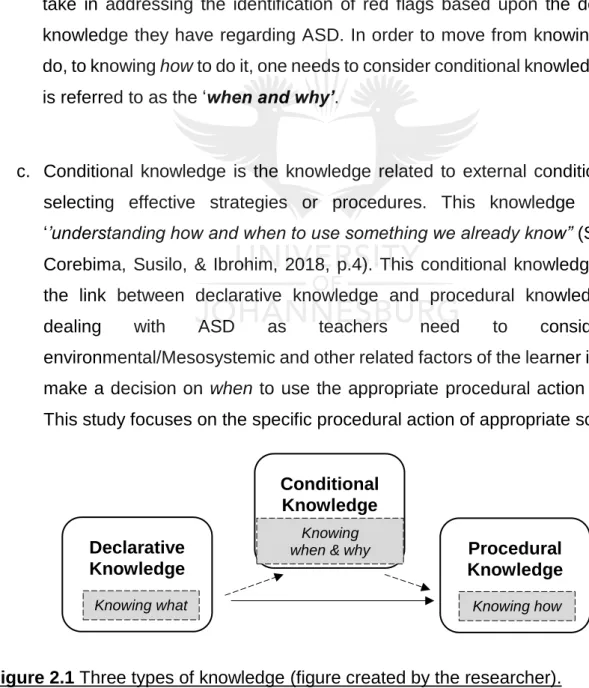
As explained by Haimour and Obaidat (2013), for teachers to take the necessary action, they need to be familiar with all aspects of ASD. “Knowledge held by teachers is information that creates change” (p.45). For teachers to be able to notice these atypical behaviours and characteristics, they need to be familiar with the developmental theories and milestones of the ‘neurotypical’ learner within the specific age group that they teach. Milestones allow parents and teachers to monitor a child’s learning and behaviour and track healthy development from as early as four months (Autism Speaks, n.d.). Learners with ASD will not meet all the expected developmental
27
milestones within the expected timeframes. As discussed by Rodriguez (2010), parents and caregivers are most likely to spot warning symptoms of ASD through tracking their baby’s basic initial developmental milestones, which are prevalent before the age of three years.
As the ‘typical’ child advances from infancy and approaches three years of age, their physical growth and motor development will slow down while their intellectual, social and emotional abilities will change tremendously (American Academy of Pediatrics, 2019). Intellectual milestones include fantasy play and sorting shape and colour. Social skills milestones include imitating the behaviour of others, being aware of themselves as separate from others and being enthusiastic about being in the company of other children. Physical milestones include walking alone while pulling toys behind them, standing on tiptoe and beginning to run (American Academy of Pediatrics, 2019). According to the founder of Reach Autism, specific milestones that children with ASD do not meet include anticipation during pause in play, incidental learning of their surrounding environment (such as being able to identify a light without being taught it’s a light), responding to their name when not followed by an instruction or demand, and nonverbal communication (like pointing to something) (Buckle, 2019). This age stage is the prime time to identify concern for signs of ASD.
Teachers also hold responsibility for the identification of learning acquisition milestones, which take place in the early school-going years. With the knowledge of these basic developmental milestones and the knowledge of red flags of ASD, teachers are able to identify a need for concern based on the milestones of a ‘neurotypical’ child.
2.2.3 Theory of Mind
Bowen (2008) explains how ‘Theory of Mind’ is a term developed by Simon Baron-Cohen in 1995 and is used to describe the cognitive processes involving one’s ability to recognise and understand the thoughts, beliefs and desires of themselves and others, as well as the ability to predict what they, or others, will do next. Individuals with ASD find great difficulty in understanding and predicting the behaviour of others and their own behaviour in response to other people. This difficulty in predicting behaviour creates a barrier in socialisation and forming meaningful relationships.