arXiv:0901.0275v2 [cs.IT] 16 Apr 2009
1
Physical-Layer Security: Combining Error
Control Coding and Cryptography
Willie K Harrison and Steven W. McLaughlin
Abstract
In this paper we consider tandem error control coding and cryptography in the setting of the wiretap channel due to Wyner. In a typical communications system a cryptographic application is run at a layer above the physical layer and assumes the channel is error free. However, in any real application the channels for friendly users and passive eavesdroppers are not error free and Wyner’s wiretap model addresses this scenario. Using this model, we show the security of a common cryptographic primitive, i.e. a keystream generator based on linear feedback shift registers (LFSR), can be strengthened by exploiting properties of the physical layer. A passive eavesdropper can be made to experience greater difficulty in cracking an LFSR-based cryptographic system insomuch that the computational complexity of discovering the secret key increases by orders of magnitude, or is altogether infeasible. This result is shown for two fast correlation attacks originally presented by Meier and Staffelbach, in the context of channel errors due to the wiretap channel model.
I. INTRODUCTION
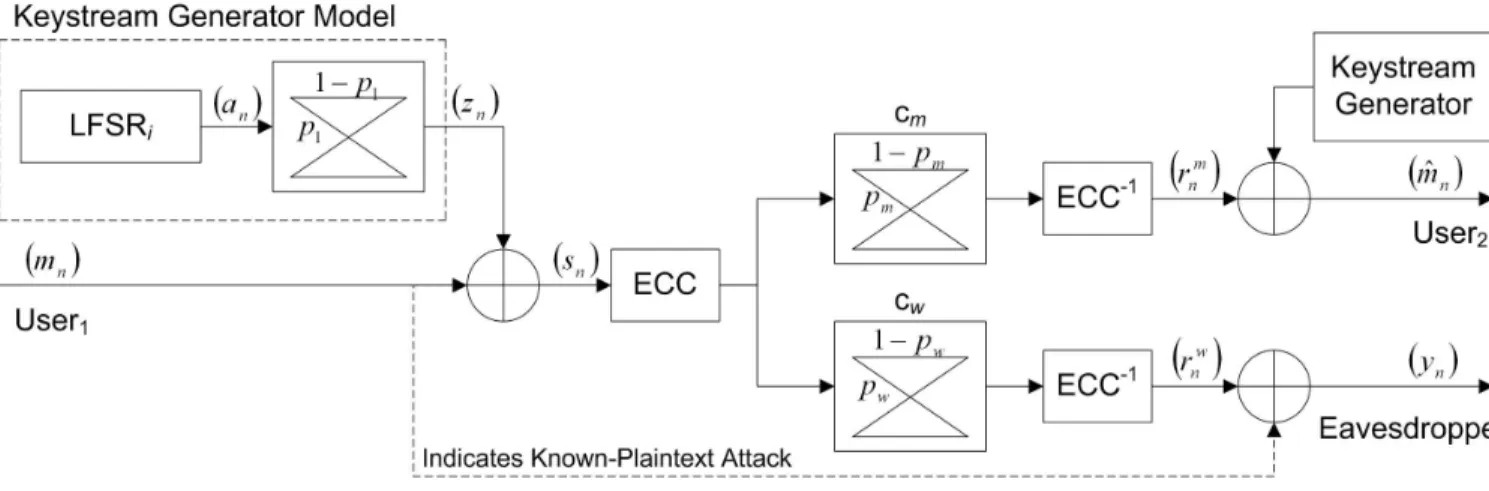
Traditionally communication systems have implemented security measures by cryptographic means. However, with the introduction of the wiretap channel model by Wyner [1], it became clear that security can also be achieved through means of channel coding. The wiretap channel model portrays two friendly users sharing information over a main communications channel cm (e.g. a fading wireless channel [2]) and a passive eavesdropper observing a degraded version of the information through a wiretap channel cw. As in [1], we will assume that both channels are discrete and memoryless. Fig. 1 portrays this scenario using binary symmetric channel (BSC) models for bothcm andcw. If the communication overcm is of a private nature, it then becomes necessary to accomplish two seemingly conflicting tasks of reliability
Willie K Harrison and Steven W. McLaughlin are with the School of ECE, Georgia Institute of Technology, Atlanta, GA. This work has been submitted and accepted to IEEE International Conference on Communications, and will be presented there June 14-18, 2009.
Fig. 1. Portrayal of a known-plaintext attack on the wiretap channel model where two friendly parties share information over a main channel cm and an eavesdropper observes communications through a wiretap channel cw. In practice the keystream
generator is comprised ofMLFSR output sequences combined according to a functionf. It is simplified from its true condition and modeled as a single LFSR with a BSC.
between the friendly users and security against the eavesdropper through some encoding technique. The purpose of this paper is to quantify the additional complexity that the eavesdropper faces when the security problem is addressed with channel errors at the physical layer in mind.
The existence of codes providing reliability to friendly parties while maintaining some level of con-fidentiality is crucial to increasing necessary computations for an eavesdropper, and has been proven by Wyner in [1] as well as Csiszar and Corner in [3]. Practical codes of this kind, however, were not discovered until much later [4]. It has since been shown for many varying circumstances and channels that practical codes exist which satisfy both design constraints of reliability and secrecy. For example, it has been shown in [5] that practical low-density parity-check (LDPC) codes exist which achieve these two criteria for a noiseless channelcm and a binary erasure channel cw. Similar results have been shown in [6], also making use of LDPC codes as well as multilevel coding for the case of independent quasi-static fading channelscm andcw. In this paper we address a practical scenario where bothcmandcw are treated as BSCs with probabilities of a bit flip pm and pw, respectively. It is assumed that the wiretap channel quality is less than that of the main channel, that is pw > pm. This might be the case, for example, in a zoned-security application where the friendly parties are inside a building and the eavesdropper is outside the building monitoring communications.
focus our attention on linear feedback shift register (LFSR) cryptographic applications because attacks against them have been well documented and we are able to quantify the increase in complexity that the eavesdropper experiences due to errors in the wiretap channel. Two well-known attacks originally given in [7] will be considered, and it will be shown that an eavesdropper can be made to fail in obtaining the secret key in an otherwise successful scenario by considering the effects of channel errors presented by some physical means. The background for the LFSR-based cryptography is given in section II, while the attacks are presented briefly in section III. Afterwards, section IV provides evidence of a physical-layer of security under the conditions of the attacks presented in the previous section. Theoretical results as well as simulation output for the two attacks are also included in this section. Finally conclusions of these findings are provided in section V.
II. BACKGROUND
It has been shown by Shannon and others that a one-time pad can achieve perfect secrecy as a cryptographic encoding technique [8], meaning that knowing the codeword or encoded sequence gives no information on the value of the original message. However, implementation of a one-time pad relies on a perfectly random key sequence. Assuming that a user is capable of generating this sequence of elements, the problem of communicating with absolute secrecy can be solved, but at the expense of requiring distribution of a secret key which is the same length as the original message [9].
Due to the issue of key distribution inherent in the one-time pad encoding mechanism, other methods are used to attempt to emulate the secrecy aspects of the one-time pad while providing a more practical key length. One such system is given in [7], [10], [11], and [12]. The encoder for this system is comprised of a keystream generator that produces a pseudorandom key sequence(zn)by combiningM LFSR output sequences using a function f. The notation (zn) = (z0, z1, . . .) denotes a sequence or vector whose nth
element is zn. Assuming all data sequences to be binary, a ciphertext bit sequence (sn) is produced using a bit-wise exclusive or (XOR) operation between the message sequence (mn) and the keystream sequence(zn), as portrayed in Fig. 1. The sequence(an) is the output sequence of a single LFSR, say the ith one. The effective key of the system consists of the initial conditions of the M shift registers, and hence is fixed in length regardless of the length of(mn). Decoding is accomplished using the XOR operation with the same keystream sequence (zn), which friendly parties can duplicate once they know the key. If it is assumed that the bits of (zn) are random independent and identically distributed (i.i.d.), and therefore that bits in the sequence cannot be predicted by an eavesdropper, then the system achieves the secrecy of the one-time pad.
This assumption is untrue, however, in many instances. For example, Siegenthaler showed using only ciphertext that the secret key (initial state) of a contributing LFSR can be obtained by calculating a correlation metric for all possible initial conditions of the LFSR, and then comparing to a Neyman-Pearson threshold determined by the statistics of the data [10]. While this particular attack requires2k−1 correlation calculations, fast-correlation techniques exist where it is shown that a low-weight connection polynomial of an LFSR, i.e. one with a small number of feedback loops, produces a more susceptible system to correlation methods [7], [11]. Despite the shortcomings of LFSR-based generators, they continue to be used in modern cryptographic systems, includingE0 the system employed by Bluetooth [13]. This
is the case due to the relative ease in computations that an LFSR-based system provides. Many wireless and handheld technologies benefit from LFSR-based cryptography.
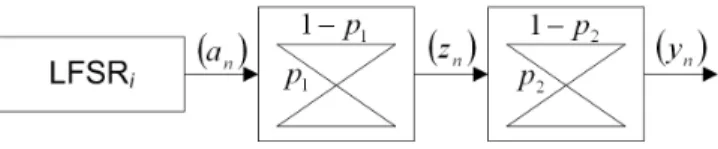
The attack of the LFSR-based cryptographic primitive assumes that the keystream sequence (zn) is correlated to the output sequence of the ith LFSR (an) with correlation value 1−p1, and thus can be modeled as a BSC withPr (aj 6=zj) =p1 forj= 0,1, . . . , N−1, whereN is taken to be the length of an observed sequence. Fig. 1 shows this modeling of the keystream generator. A known-plaintext attack is portrayed in the figure where an eavesdropper has some means of obtaining N bits of the original message; therefore, if the sequence(sn) is observed without error, then the firstN bits of the keystream sequence (zn) can be reconstructed exactly. It is assumed that pw > pm implying more errors in the wiretap channel than in the main channel; therefore, an encoding technique is chosen to guarantee reliable communications between friendly parties while maintaining some percentage of bit errors in the wiretap channel. The effective error rate after applying error control coding (ECC) in the wiretap channel is given as p2, and the model considered for the eavesdropper is simplified to that shown in Fig. 2. This figure indicates a pair of BSCs, where the first models the correlation of the sequences (an) and (zn), and the second models bit errors in the wiretap channel after channel decoding. The output sequence of the final BSC (yn) is obtained in practice by applying the N known bits of (mn) to the decoded sequence as shown in Fig. 1. This sequence can be thought of as a noisy version of (an), with a single BSC separating the two sequences. The probability of a bit flip in this BSC is denotedp′ and is calculated to
be
p′=p
1(1−p2) + (1−p1)p2=p1+p2−2p1p2. (1)
The cryptographic system is said to be compromised if an eavesdropper can obtain the initial contents of theith LFSR using (yn) assuming knowledge of the LFSR connection polynomial is public.
Fig. 2. Wiretap channel model flow diagram relating sequences(an),(zn), and(yn)using a pair of binary symmetric channels.
III. CRYPTOGRAPHIC ALGORITHMS
Both attacks presented in [7] reconstruct the key of the ith LFSR using checks which are derived from the feedback polynomialg(x). This polynomial governs the structure of the LFSR, and guarantees a maximal-length output sequence before repeating if and only ifg(x) =g0+g1x+g2x2+· · ·+gkxk is primitive in GF(2), wheregj ∈ {0,1}forj= 0,1, . . . , k[14]. Definetto be the number of feedback loops in the LFSR. For primitive g(x) of orderk, g0 =gk = 1 and the total number of nonzero coefficients of g(x) is odd [7], thus providing an even value of t (gk does not feed back). Let the indices of the nonzero coefficients ing(x) be denotedj0, j1, . . . , jt; then j0 = 0 and jt =k. Now consider thejth bit of the sequence (an). Due to the structure of g(x), aj+j0+aj+j1+· · ·+aj+jt = 0. This expression is
calculated in GF(2), and thus simplifies to
aj =aj+j1+aj+j2+· · ·+aj+jt. (2)
Except for those within t bits of the end of the sequence, every bit can be expected to contribute to t+ 1checks of this kind. Additional checks are generated using a rule sometimes referred to as freshman exponentiation which states that for elementsxandyin GF(2),(x+y)2=x2+y2[14]. Check expressions
given by (2) can then be repeatedly squared until limited by the length of the sequence N, providing additional check expressions with each squaring. Both attacks rely on computing these checks using the bits of (yn), and counting checks which hold with equality. Of course a check can still hold if an even number of bits in a check expression have been flipped, hence bits are assigned conditional probabilities of being correct given the number of satisfied checks. These probabilities are stored in the vector (p∗
n). Let the number of satisfied checks containingyj be denoted as cjs, while the number of total checks for which yj plays a role is expressed as cjto. If csj =h and cjto=m, then
p∗ j = Pr (yj =aj|cjs=h, cjto=m) = p′sh p′sh(1−s)m−h (1−s)m−h +(1−p′)(1−s)h sm−h, (3) wheresis defined as the probability that an even number of errors occur in the bits of the check expression discountingyj [7]. This value can be calculated recursively ass(j) = (1−p′)s(j−1) +p′(1−s(j−1))
where s(1) = 1−p′ ands=s(t).
A. Attack A
The first attack in [7] is founded on the principle that bits which satisfy the most checks are the most reliable. Using the k bits which have the greatest values in (p∗
n), a system of equations is determined and solved where the solution is the key or initial contents of the LFSR. This system of equations is constructed using the fact that every output of an LFSR is merely a linear combination of the bits in the initial state. The key is obtained by solving the system using a method such as LU decomposition tailored to operations in GF(2) [15]. Measures must be taken to ensure that the group of k bits chosen have linearly independent key bit combinations.
In order to determine whether the obtained solution is the key, a threshold for a correlation metric between(yn)and a sequence generated by the solution to the system of equations must be formed [10]. If the solution is determined to be incorrect by the threshold comparison, the algorithm must then perform an exhaustive search on possible error combinations in the k chosen bits. The calculations necessary to perform this task dominate the performance of the algorithm, and hence define the computational complexity of attack A. Variations of thek bits with Hamming distance 1,2,. . . ,kare tried until a key is found which satisfies the correlation condition. In order to calculate a worst-case scenario, it is assumed that the eavesdropper is always able to detect a correct key.
B. Attack B
The second attack presented in [7] also makes use of the conditional probabilities (p∗
n); however, the iterative nature of this attack alters these calculations slightly. Attack B is extremely comparable to Gallager’s LDPC decoding algorithm [16]. In the attack all conditional probabilities in the sequence(p∗
n) are calculated using (3). A threshold pthr is derived by calculating the best possible increase in correct bits assuming that all bits with probability less than the threshold are flipped. This correction threshold is set to the value where any bit yj with p∗j < pthr has a maximum likelihood of being incorrect. If a certain predetermined number of bitsNthr have values in (p∗
n)less than pthr, then those bits are flipped. Otherwise the conditional probabilities p∗
j for j = 0,1, . . . , N−1 are recalculated by exchanging the a priori probability p′ with the previous value of p∗
j in (3). After a few iterations of probabilities, or once at least Nthr untrustworthy bits are found, the bits are flipped and the algorithm continues in this way until a solution is obtained.
IV. PROOF OFCONCEPT WITHSIMULATION RESULTS
If a channel encoding technique can guarantee bit errors for a passive eavesdropper regardless of ECC, then these errors can clearly contribute to the overall security of the system. The questions then remain of how to quantify the amount of security gained, and what value of p2 will prevent an eavesdropper from gaining advantage in a correlation-based attack. To provide answers to these two questions, metrics used in [7] are analyzed. First in the case of attack A, suppose there are exactlyr errors in thekchosen bits. Then the maximum number of iterations in an exhaustive search is
A(k, r) = r X i=0 k i ! ≤2H(r/k)k. (4)
The inequality makes use of the binary entropy function H(x), and is well known. Of course r is not readily available in practice, but it can be estimated making use of (3) in the expression r¯ = k(1−
Pr (yj =aj|cjs=h′, cjto=m′)), where m′ is the average number of checks relevant to any one bit, and
h′ is the maximum integer such thatkbits exist which are expected to satisfy at leasth′checks. Therefore,
given that the bestkbits are chosen,r¯of them are still expected to be in error. An estimate on an upper bound of the number of trials required is then given as 2H(¯r/k)k.
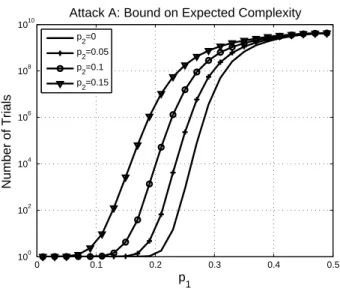
Fig. 3 shows this bound for varyingp2values in an example featuring a length-32 LFSR while assuming
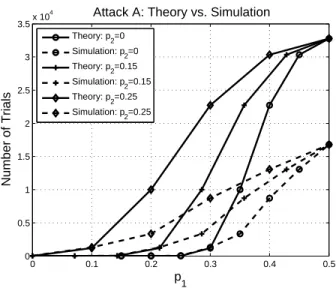
thatN = 32×106 bits of (mn) are known by the eavesdropper. The greater the length of the observed data sequence, the easier the system will yield to a correlation-based attack. Simulations of the attack are compared with this bound and can be seen in Fig. 4, although for a shorter LFSR. Both the theoretical bounds and the simulations show channel conditions where attacks are expected to require a significant amount of additional computations due to nonzero p2. As shown in Fig. 4, the expected bound is much
tighter for smallerp′ values. Clearly asp′approaches 0.5, attack A reverts to a brute-force attack which is
expected to require2k−1iterations, while the bound approaches2k. For smallerp′ the difference between
the bound and the simulation results is not as pronounced. Regardless of this difference, whenkis large and p′ is close to 0.5 the task of finding the secret key becomes overwhelmingly expensive, and not
feasible in many cases. Physical-layer considerations can be addressed in the choice of channel codes which can then drivep′ to 0.5 by increasingp
2, and thus obtain this extra level of security.
A similar analysis can be conducted for attack B; however, the attack has an underlying bipartite graph which connects check nodes to probabilities in(p∗
n). Since the graph contains many cycles, after a few iterations probabilities become difficult to track; thus numbers of computations are likewise difficult to estimate. The strength of this attack is instead calculated by determining the effect of the first iteration of the algorithm. Recall that a threshold pthr was determined to maximize the probability that yj 6=aj
0 0.1 0.2 0.3 0.4 0.5 100 102 104 106 108 1010 p1 Number of Trials
Attack A: Bound on Expected Complexity
p 2=0 p 2=0.05 p2=0.1 p2=0.15
Fig. 3. Expected bound on the number of trials required to find the secret key using attack A fork= 32,N =k×106, and
t= 6.
given that p∗
j < pthr. Let Nw be the expected number of bits such that both aj =6 yj and p∗j < pthr, and let Nv be the expected number of bits such that aj = yj and pj∗ < pthr, for j = 0,1, . . . , N −1. Also let Ni=Nw−Nv. If Nc0 represents the total number of bits such thataj =yj prior to iteration, then the toggling of all bits with p∗
j < pthr will result in an expected Nc0+Ni correct bits. Obviously ifNi is negative, then the expected outcome of the first iteration will leave more bits in error than were originally so.
The only way to ensure that the algorithm does not eventually converge on the correct sequence is to insist that attack B have no correction capability. While this would be impossible to guarantee under every scenario, we say that attack B has correction capability zero ifNi<0, i.e.Nv > Nw. The ratio
C= Ni
Nw+Nv (5)
is used to scale the value of Ni to a real number in the range [−1,1] while maintaining its sign. Fig. 5 shows the value of the correction ratio C for several BSC parameters p2, over a range of p1 values.
It should be noted that while a negative value of C implies a correction capability of zero, conditions yielding positiveC values still may not converge on the correct sequence. Simulations of attack B have been consistent in a lack of convergence for cases whereC ≤0.
An example is in order. Let the primitive connection polynomial for the ith LFSR be written as g(x) = x31 +x21+x12+x3+x2 +x+ 1 [17], and the correlation between (an) and (zn) be 0.8,
0 0.1 0.2 0.3 0.4 0.5 0 0.5 1 1.5 2 2.5 3 3.5x 10
4 Attack A: Theory vs. Simulation
p 1 Number of Trials Theory: p 2=0 Simulation: p2=0 Theory: p2=0.15 Simulation: p 2=0.15 Theory: p 2=0.25 Simulation: p 2=0.25
Fig. 4. Results from simulations of attack A showing necessary computations to crack the LFSR-based cryptographic system. Herek= 15,N=k×100, andt= 4. 0 0.1 0.2 0.3 0.4 0.5 −0.4 −0.2 0 0.2 0.4 0.6 0.8 1
Attack B: Correction Capability
p 1 (N w −N v )/(N w +N v ) p 2=0 p 2=0.05 p2=0.1 p 2=0.15
Fig. 5. Correction capability of attack B fork= 32,N=k×106, andt= 6. Negative values give a correction capability of zero indicating an inability to converge on the correct sequence.
TABLE I
SIMULATION RESULTS OF ATTACKBCOMPARING SCENARIOS WITH AND WITHOUT ADDED SECURITY DUE TO THE PHYSICAL LAYER. FOR THESE SIMULATIONS,k= 31,N=k×100,t= 6,ANDp1= 0.2.
Case 1:p2= 0 Case 2:p2= 0.1
Number of Total Number of Total Round bits flipped correct bits bits flipped correct bits
1 30 2487 1 2276 2 91 2526 3 2277 3 122 2586 6 2277 4 42 2628 8 2275 5 50 2676 11 2268 .. . ... ... ... ... 14 43 3075 2 2204 15 23 3098 100 2164 16 2 3100 4 2164 .. . - - ... ... 34 - - 1 2079 35 - - 0 2079 .. . - - 0 2079
implying p1 = 0.2. In the first of two cases p2 = 0, meaning the eavesdropper is able to decode all channel errors in the wiretap channel using ECC, thus p′ = p
1 = 0.2 and the correction ratio C is
calculated using (5) to be 0.826. Case two assumes that p2 = 0.1 indicating an error rate of 10 percent
in(yn) which yieldsp′ = 0.26 by (1), andC =−0.034 by (5). Due to these values ofC, it is expected
that attack B will succeed in case one and fail in case two. Comparisons of the attacks are shown in Tab. I, where it is seen that case one converges on the correct output sequence in 16 rounds. Case two, however, requires 34 rounds before the algorithm stagnates and fails, a majority of rounds resulting in more bits in error than the previous round. Clearly an eavesdropper has been made to fail in an otherwise successful scenario due to the increased security inherent in the system which can be produced by wise implementation of channel coding.
V. CONCLUSION
In conclusion, the wiretap channel model has been used to show security enhancements for wireless applications by considering the channel coding problem and the cryptography problem in tandem. These enhancements occur due to effects in the physical layer of a communications system. For a variety of applications where an eavesdropper experiences worse channel conditions than those between friendly parties, proper implementation of channel coding can ensure an increased difficulty in cracking crypto-graphic systems by preserving bit errors in the wiretap channel due to the physical layer. This principle was shown using an LFSR-based cryptographic system which is susceptible to correlation attacks in some cases. It has been shown using theory and simulations for two different attacks that channel coding can be used to either increase the difficulty of the attack or make it altogether impossible, thus providing a physical layer of security to the system.
REFERENCES
[1] A. D. Wyner. The wire-tap channel. Bell System Technical Journal, 54:1355–1387, Oct 1975.
[2] J. Barros and M. R. D. Rodrigues. Secrecy capacity of wireless channels. Information Theory, 2006 IEEE International Symposium on, pages 356–360, July 2006.
[3] I. Csiszar and J. Korner. Broadcast channels with confidential messages. Information Theory, IEEE Transactions on, 24(3):339–348, May 1978.
[4] V. K. Wei. Generalized hamming weights for linear codes. Information Theory, IEEE Transactions on, 37(5):1412–1418, Sep 1991.
[5] A. Thangaraj, S. Dihidar, A. R. Calderbank, S. W. McLaughlin, and J-M. Merolla. Applications of ldpc codes to the wiretap channel. Information Theory, IEEE Transactions on, 53(8):2933–2945, Aug 2007.
[6] M. Bloch, J. Barros, M. R. D. Rodrigues, and S. W. McLaughlin. Wireless information-theoretic security. Information Theory, IEEE Transactions on, 54(6):2515–2534, June 2008.
[7] W. Meier and O. Staffelbach. Fast correlation attacks on certain stream ciphers. Journal of Cryptology, 1:159–176, 1989. [8] C. E. Shannon. Communication theory of secrecy systems. Bell System Technical Journal, 28(4):656–715, 1949. [9] D. Welsh. Codes and Cryptography. Oxford University Press, Walton Street, Oxford OX26DP, 1988.
[10] T. Siegenthaler. Decrypting a class of stream ciphers using ciphertext only. Computers, IEEE Transactions on, C-34(1):81– 85, Jan 1985.
[11] V. V. Chepyzhov and B.J.M. Smeets. On a fast correlation attack on certain stream ciphers. In EUROCRYPT, pages 176–185, 1991.
[12] T. Johansson and F. Jonsson. Theoretical analysis of a correlation attack based on convolutional codes. Information Theory, IEEE Transactions on, 48(8):2173–2181, Aug 2002.
[13] Promoter Members of Bluetooth SIG. Specification of the Bluetooth System - Core Version 2.1 + EDR. Bluetooth SIG, Inc., July 2007.
[14] T. K. Moon. Error Correction Coding: Mathematical Methods and Algorithms. John Wiley & Sons, Inc., Hoboken, NJ, 2005.
[15] T. K. Moon and W. C. Stirling. Mathematical Methods and Algorithms for Signal Processing. Prentice-Hall, Inc., Upper Saddle River, NJ 07458, 2000.
[16] R. G. Gallager. Low-Density Parity-Check Codes. MIT Press, Cambridge, MA, 1963.