The London School of Economics and Political Science
Developing the cyranoid method of mediated interpersonal
communication in a social psychological context: Applications in
person perception, human-computer interaction, and first-person
research
Kevin C. Corti
A thesis submitted to the London School of Economics and Political
Science’s Department of Social Psychology for the degree of Doctor
of Philosophy
DECLARATION
I certify that this thesis, presented for examination for MPhil/PhD degree at the London School of Economics and Political Science, is solely my own work except for where clearly indicated (in which case the extent of any work carried out jointly be me and any other person is clearly identified in it).
The copyright of this thesis rests with the author. Quotation from it is permitted, provided that full acknowledgement is made. Any citation of the work in this thesis that has been published by an academic journal or other publisher must give credit in accordance with standard referencing practices. This thesis may not be reproduced without my prior written consent.
I warrant that this authorization does not, to the best of my belief, infringe the rights of any third party.
ABSTRACT
This thesis revisits Stanley Milgram’s “cyranoid method” of interactive social psychological experimentation (Milgram, 2010a) and explores the technique’s empirical potential in several domains. The central component of the method is speech shadowing, a procedure that involves a person (the shadower) repeating in real-time words they receive through an inner-ear monitor by-way-of radio-relay from a remote source. Speech shadowing effectively creates a hybrid agent (a “cyranoid”) composed of the body of one individual (the shadower) and the “mind” (or more precisely, the words) of another (the source). Interactants naïve to this manipulation perceive speech shadowers as autonomous communicators, and this perceptual bias (the “cyranic illusion”) affords researchers the ability to inspect the effects of separately altering the physical (outer) and dispositional (inner) elements of an interlocutor’s identity in contexts involving spontaneous and unscripted face-to-face dialog.
combines conversation analysis techniques (e.g., Schegloff, 1992, 1993) with the echoborg method to investigate factors that influence how people repair misunderstandings that arise during dialog with conversational agents. Chapter 5 (Article 4), “Cyranoids in first-person, self-experimental research” (published in Integrative Psychological and Behavioral Science
under the title “The researcher as experimental subject: Using self-experimentation to access experiences, understand social phenomena, and stimulate reflexivity”), explores the history of researcher-as-subject self-experimentation in social psychology and illustrates how the cyranoid method can be used as a first-person means of directly experiencing the consequences of a transformed social identity through systematic self-experimentation. Finally, Chapter 6, “Cyranoid ethics,” discusses the various ethical concerns involved in cyranoid research, outlines how they were mitigated in the current thesis, and offers suggestions for ensuring positive research participant experience.
ACKNOWLEDGEMENTS
I wish to thank Alex Gillespie, whose guidance over the last four years has been immeasurably valuable. There are few academics within our discipline who would have agreed to supervise a thesis such as this one, let alone pour as many hours into the supervisory relationship as Alex did in my case. Alex’s contagious curiosity and penchant for philosophical conversation both broadened and sharpened my thinking immensely. For these things I will forever be grateful.
I want to thank Tom Reader for his supervision and for giving me opportunities to work on research outside of my thesis area over the course of my time at the LSE. These experiences broadened my skills and showed me how research can create impact beyond the laboratory.
I have enormous gratitude for all of my fellow PhD candidates in the Department of Social Psychology, whose friendship and intellectual companionship will last long past our days as students. And to all of my friends and colleagues in the Department of Methodology – thank you. I thoroughly enjoyed teaching alongside you.
I would like to thank the faculty members and administrators in the Department of Social Psychology. I will always try to carry with me your passion for wanting to understand the world as people actually experience it.
I am indebted to those colleagues who assisted me on this research, particularly Geetha Reddy, who spent so much of her valuable time helping to make my experiments possible. I also want to thank my IPOC colleagues – Mark, Meghan, and Brett.
I want to thank Stanley Milgram, whose unfinished work inspired this thesis. Hopefully the research presented herein does justice to the ideas he held so much hope for.
I wish to thank my family, particularly my mom and dad – Vince and Tanice – for supporting me on my academic journey and for trusting my decision to pursue such a path.
TABLE OF CONTENTS
INTRODUCTION 11
CHAPTER 1 – Introducing and Situating the Cyranoid Method 18
A cyranoid is… 18
The origins of the cyranoid method: Stanley Milgram 20
Evaluating Milgram’s cyranoid research 33
Examining the dormancy of the cyranoid method: The passing of the “classical paradigm” of social psychology
36
The argument for revisiting and reapplying the cyranoid method 41
Moving forward 47
CHAPTER 2 – Replicating Milgram 48
Preface 48
Article 1 - Revisiting Milgram’s cyranoid method: Experimenting with hybrid human agents
51
Introduction 51
Background 53
Methodological and theoretical implications of the cyranoid 55
Overview of studies 57
Study 1: Exploring the cyranic illusion in dyadic interactions 59 Study 2:Exploring interpersonal biases with incongruent cyranoids 62
General discussion 76
CHAPTER 3 – Echoborgs: Cyranoids With Computer Program Sources 83
Preface 83
Article 2 - A truly human interface: Interacting face-to-face with someone whose words are determined by a computer program
86
Introduction 87
The echoborg 94
Overview of studies 98
Study 1: Turing Testing with echoborgs 99
Study 2: A human imitating a chat bot? 103
Study 3: Can covert echoborgs pass as human in the everyday contextual frame?
108
General discussion 113
CHAPTER 4 – Using echoborgs to assess intersubjective effort in human-agent dialog
120
Preface 120
Article 3 - Co-constructing intersubjectivity with artificial conversational agents: People are more likely to initiate repairs of misunderstandings with interlocutors represented as human
121
Introduction 121
Intersubjectivity and intersubjective effort 123
Experimental Study 131
A closer look at the co-construction of intersubjectivity 137
General discussion 147
CHAPTER 5 – Cyranoids in First-Person, Self-Experimental Research 153
Preface 153
Article 4 - The researcher as experimental subject: Using self-experimentation to access experiences, understand social phenomena, and stimulate reflexivity
156
Introduction 156
A brief history of psychological self-experimentation 159
Contemporary researcher-as-subject approaches 162
Milgram’s cyranoid method 164
Reflections from researchers who have self-experimented with cyranoids 168
CHAPTER 6 – Cyranoid Ethics 180
APA and BPS stance on the use of deception in psychological research 180
The nature of the deception used in this thesis 181
How deception was managed: Design and debriefing 182
Participants’ reactions to the deception 186
Ethics considerations for future cyranoid research 186
CONCLUSION 193
Limitations of the current work 203
Going forward: Ideas for future work 207
Final remarks 210
REFERENCES 213
APPENDECIES 248
A: Experimental materials from Chapter 2 248
B: Experimental materials from Chapter 3 251
C: Experimental materials from Chapter 4 258
D: Example transcripts from Chapter 2 260
E: Example transcripts from Chapter 3 309
TABLE OF FIGURES
CHAPTER 1 – Introducing and Situating the Cyranoid Method
Illustration of a basic cyranoid interaction 19
CHAPTER 3 – Echoborgs: Cyranoids With Computer Program Sources
Illustration of a basic cyranoid interaction 96
Illustration of a Turing Test scenario involving speech shadowing 102
Illustration of interaction scenarios in Study 2 and Study 3 106
TABLE OF TABLES
CHAPTER 2 – Replicating Milgram
Multilevel model fixed factor effect size estimates for utterance length: Study 2 68 Multilevel model fixed factor effect size estimates for question difficulty: Study 2 69 Multilevel model fixed factor effect size estimates for response sophistication:
Study 2
69
Comparison of interlocution measures: Study 2 70
Person perception score comparison: Study 2: {[Adult]Adult} vs. {[Adult]Child} 72
Person perception score comparison: Study 2: {[Child]Child} vs. {[Child]Adult} 75
CHAPTER 4 – Using echoborgs to assess intersubjective effort in human-agent dialog
Interactant responses to interlocutor non-repair 147
CHAPTER 6 – Cyranoid Ethics
Participants’ thoughts on the ethical nature of the study (Chapter 4: “covert echoborg” condition)
INTRODUCTION
Background and motivation
In the fall of 2011, a little over a month into my M.Sc. program at the London School of Economics, I attended a Department of Social Psychology student-faculty retreat at Cumberland Lodge on the outskirts of London near Windsor Castle. On the first night of the retreat, Dr. Alex Gillespie, a senior lecturer in his first term with the department, gave a presentation on an experiential installation art project he and Robb Mitchell had produced several years prior in Glasgow (Mitchell, 2009; Mitchell, Gillespie, & O’Neill, 2010). The premise of the installation was that of experiencing social life through another body, and of encountering friends, family, and strangers who had themselves been given different bodies through which to interact. The title of the presentation was “Cyranoids.”
A cyranoid, I would learn, is a hybrid social agent composed of the “mind” (or more precisely, the words) of one individual and the body of another, a real-world fusion of separate personae capable of socially engaging with people in all manner of situations. The concept works like this: one person (the “shadower”) wears a discreet inner-ear monitor and uses an audio-vocal technique known as speech shadowing to articulate words transmitted to them by another other person (the “source”). A well-rehearsed speech shadower can perform this technique more or less effortlessly, giving rise to the illusion that they are speaking self-authored words. The shadower thus becomes an interface through which the source interacts with interlocutors (“interactants”) and through which these interlocutors interact with the source. Cyranoids had been the brainchild of Stanley Milgram, the social psychologist made famous by his obedience to authority “shock” experiments of the 1960s (Milgram, 1963). Milgram coined the term “cyranoid” in reference to the character Cyrano from the Edmund Rostand play Cyrano de Bergerac, which tells the story of a poet (Cyrano) who vicariously fulfils his unrequited love for Roxane by providing to Christian (an inarticulate but handsome nobleman) words with which to woo her.
other social psychological phenomena. What I was drawn to in particular was the fact that the cyranoid seemed to present a means of studying these phenomena in an interactive, highly experiential way. Contemporary experimental methods used to study, for example, how aspects of outer identity affects person perception, are generally quite static and often involve research participants engaging with the implied presence of other people via written vignettes rather than involve the actual presence of people (Blascovich et al., 2002; Zebrowitz, 2002; Zimbardo, 1999). Where contemporary methods are more interactive, they tend to involve distancing people through computer interfaces or having participants interact in scripted environments so as to achieve a desired level of experimental control. In my estimation, the cyranoid method presented an opportunity to create mundanely realistic yet controllable social experiments given that it allowed research participants to interact in person with a stimulus person (a cyranoid) who had all the attributes of a real person (a non-cryanoid), but whose component parts (the source and the shadower) could be manipulated independently of one another in order to answer a research question about the separate effects of these components.
It came as a surprise to learn following Dr. Gillespie’s presentation that Milgram had never formally published any of his work with cyranoids, and the method has remained relatively dormant within psychology since his death in 1984. In fact, Milgram’s only concerted effort to publicize his cyranoid studies came in the form of a speech he recorded for an American Psychological Association conference in Toronto a few months before his death, a transcription of which appears in the edited volume of collected Milgram essays The Individual in a Social World (Milgram, 2010a). I thus approached Dr. Gillespie with the idea of conducting a Ph.D. that would attempt revive the cyranoid method in order to see what it might offer to psychological research, and this thesis is the culmination of four years of attempting to do precisely that.
Thesis format
make the linkages between the articles more clear, each journal article chapter includes a preface that explains the relationship of the subsequent journal article to the aims of the thesis. I served as the principal investigator, data analyst, and primary author for each journal article, with Dr. Alex Gillespie serving as a secondary author and research supervisor. Two additional secondary authors (Geetha Reddy and Ellen Choi) contributed to Chapter 5’s journal article. Each preface includes details as to the proportional contribution of each author. All other sections of this thesis were authored solely by me.
Overview of aims and chapters
Instead of there being overarching theoretical aims to this thesis, the cyranoid method itself will serve as the tissue that connects each chapter as different empirical, historical, ontological, and ethical issues relevant to social psychology are explored. This thesis seeks to lay the groundwork for future research involving the method by demonstrating the unique affordances it can bring to bear on different topics within social psychology, affordances which include allowing for mundanely realistic yet controllable and manipulable person stimuli. This primary aim will be approached via attempting to resolve six sub-aims particular to the thesis’s six chapters as well as tertiary aims particular to the various studies contained within each chapter.
why the cyranoid method is worth revisiting and discusses analogous modern methodologies within contemporary social psychology that might serve as a framework for future cyranoid research.
The second sub-aim comprises validating the cyranic illusion (the phenomenon described by Milgram as failing to perceive when one is interacting with a covert cyranoid; Milgram, 2010a). This is primarily covered in Chapter 2, as well as to a certain extent in Chapter 3. Chapter 2, “Replicating Milgram” (published in the Journal of Social Psychology under the title “Revisiting Milgram’s cyranoid method: Experimenting with hybrid human agents”; Corti & Gillespie, 2015b), is an empirical article that includes experimental replications of two of Milgram’s original cyranoid pilot studies. It is demonstrated that even when a cyranoid is composed of highly incongruent component parts (i.e., a child shadower paired to an adult source, and vice versa), naïve interactants reliably fail to notice when their interlocutor is simply speech shadowing. The cyranic illusion provides the cyranoid method with perhaps its greatest affordance: the ability to present multiple and in some cases vastly incongruent individuals together as a singular social actor (a cyranoid) while preserving the interactant’s impression that they are interacting with an autonomously communicating person. Insofar as it is a researcher’s goal to keep a source hidden from an interactant, the cyranoid method can only ever be useful under conditions where participants reliably succumb to the cyranic illusion, and this fact necessitates exploring the robustness of the illusion under various source-shadower pairings. Chapter 2 also examines how interactant addressivity is affected by the composition of the cyranoid they encounter: people adjust what they say to a cyranoid on the basis of the outer identity of the cyranoid. Furthermore, the article demonstrates how interactants anchor onto aspects of outer identity when describing the character of a cyranoid post-interaction and prior to their becoming aware of the true nature of the cyranoid.
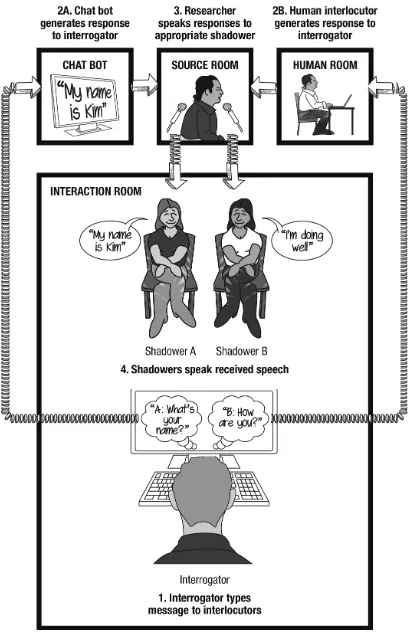
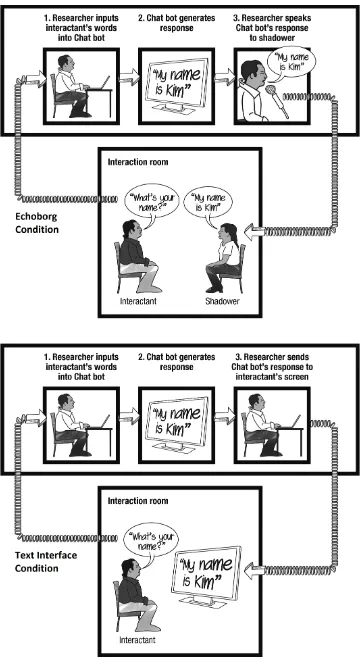
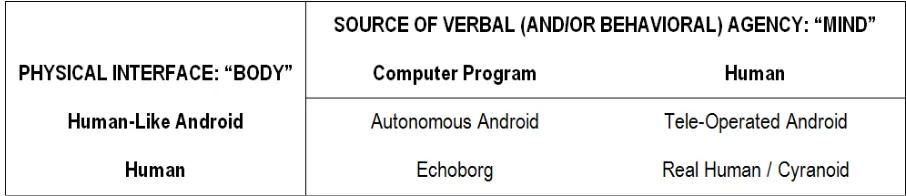
proofs-of-concept for this derivative of the cyranoid method are described in Chapter 3, “Echoborgs: Cyranoids with computer program sources” (published in Frontiers in Psychology under the title “A truly human interface: Interacting face-to-face with someone whose words are determined by a computer program”; Corti & Gillespie, 2015a). Chapter 3 seeks to demonstrate how echoborgs can serve as useful experimental tools within the field of android science, a discipline that seeks to use machine imitations of humans to better understand human social psychology and cognition (MacDorman & Ishiguro, 2006b; Ishiguro & Nishio, 2007). The chapter’s three studies investigate the extent to which echoborgs “pass” as fully human (in the social psychological and sociological sense of identity “passing”; see Goffman, 1963; Renfrow, 2004; Khanna & Johnson, 2010). The first experiment demonstrates how echoborgs can be used in a classic Turing Test (Turing, 1950) scenario. The second experiment explores whether people see echoborgs as autonomous persons speaking self-authored thoughts even when primed to suspect the possibility of encountering an echoborg. A final experiment investigates whether participants take covert echoborgs to be autonomous persons and explores how people make sense of the behaviors of covert echoborgs.
within the Conversation Analysis tradition to use formal statistical methodology to analyze how conversational phenomena are affected by different experimental manipulations. Furthermore, the article makes a contribution to the literature that combines intersubjectivity theory and human-agent interaction (e.g., Cassell & Tartaro, 2007) by showing how the echoborg method can be used as a means of benchmarking intersubjectivity in human-agent interaction.
The fifth sub-aim is to argue that the cyranoid method can serve not only as a means of conducting traditional, third-person observational experiments, but also as a means of conducting first-person, self-experimental research in which the researcher participates in a cyranoid experiment as either the source or the shadower. This argument is put forward in Chapter 5, “Cyranoids in first-person, self-experimental research” (published in Integrative Psychological and Behavioral Science under the title “The researcher as experimental subject: Using self-experimentation to access experiences, understand social phenomena, and stimulate reflexivity”; Corti, Reddy, Choi, & Gillespie, 2015). Whereas the preceding chapters largely focus on understanding interactants’ behavioral reactions to and perceptions of cyranoids, this chapter turns attention to the fact the experiences of the source and shadower can also serve as objects of inquiry. Chapter 5 begins with a discussion of self-observation/self-experimentation in the early schools of psychology (e.g., Wilhelm Wundt’s Leipzig model of experimentation) and how analogues to these models were preserved through the mid-20th century among a cohort of social psychologists that included Milgram and other ethnomethodologists interested in first-person “breaching” experiments (e.g., Garfinkel, 1967). It is argued that first-person self-experimentation can complement contemporary mainstream third-person experimentation and that acting as a source or shadower within a cyranoid in the context of a researcher-as-subject self-experiment affords researchers three potential benefits: (1) access to “social qualia” (i.e., direct experience of a transformed inner or outer identity), (2) improved mental models of social phenomena on account of systematic experiential knowledge, and (3) an enhanced ability to be reflexive about a given experiment via a more complete understanding of the various perspectives involved. Three first-person reflections from researchers who have self-experimented with cyranoids are provided in support of these claims.
details how various ethical concerns were dealt with in each of the studies contained in this thesis and how participants responded during debriefing when the true nature of the studies were described and the identities of the sources revealed. The chapter gives an overview of the important ethical considerations that should be made when designing and conducting cyranoid research and is meant to serve as a guide for researchers planning on adopting the cyranoid method in their own work.
CHAPTER 1 | Introducing and Situating the Cyranoid Method
A cyranoid is…
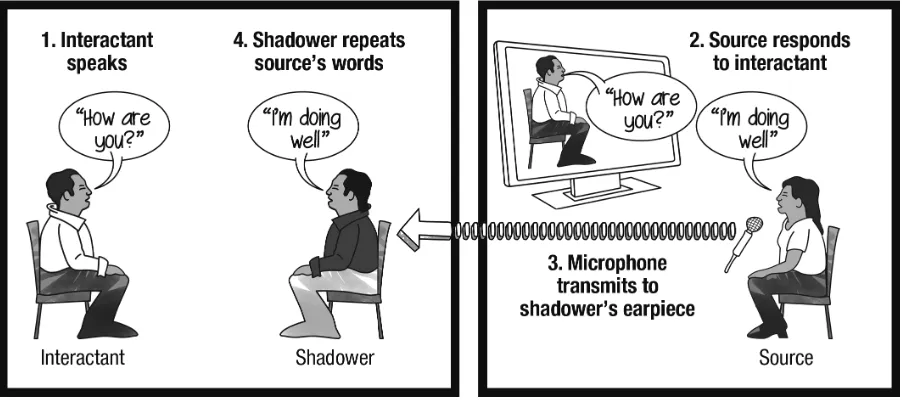
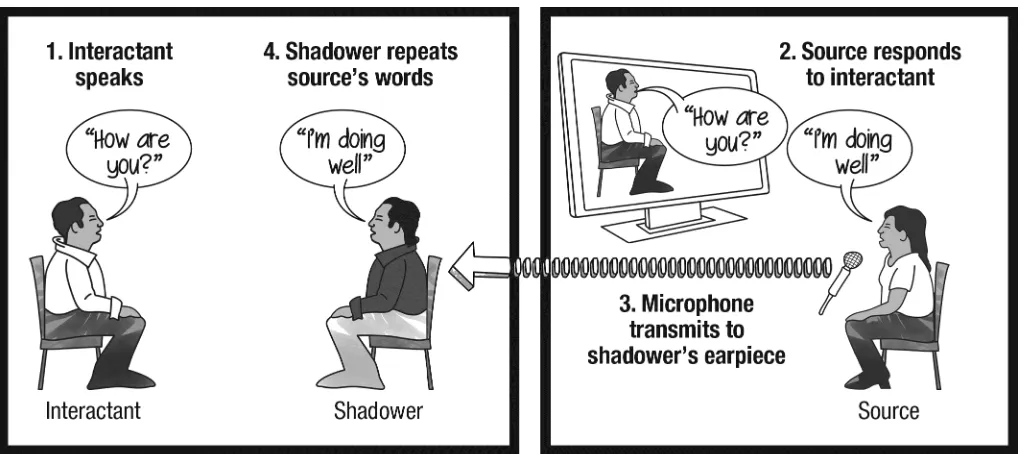
A cyranoid, in its most basic form, is a hybrid social agent composed of two individuals, one of whom behaves as the shadower, and the other as the source. The source is the metaphorical mind of the cyranoid and supplies the shadower (the body) with verbal communication to instantaneously replicate, and this is accomplished using an amalgam of devices that enable audio produced by the source to be transmitted to an earpiece worn by the shadower. In the studies detailed in this thesis, the shadower remains verbally non-autonomous while ventriloquizing for their source (i.e., they communicate solely the sounds produced by the source and vocalize no self-authored thoughts). Cyranoids engage
interactants – third parties who encounter the shadower in person but from whom the source may or may not remain hidden. Thus, an elementary cyranic interaction is a tripartite face-to-face social encounter (see Figure 1.1).
To accomplish a fluid cyranic interaction, the shadower must be well rehearsed at speech shadowing – a vocal technique that involves replicating the words one hears in as close to real-time as feasible. The specifics of speech shadowing are discussed in detail throughout this thesis, but the point that will be emphasized here is that shadowing comes quite naturally to native-language speakers. Shadowers can achieve latencies (i.e., the time between the start of a source-utterance and the commencement of replication by the shadower) as low as a few hundred milliseconds (Bailly, 2003; Marslen-Wilson, 1973). This produces an effect whereby from the first-person perspective of interactants, shadowers appear as though they are delivering self-authored prose (a phenomenon known as the “cyranic illusion”). As shall be demonstrated in this thesis, this illusion is extremely robust and can be maintained even in conditions involving high degrees of source-shadower incongruity (e.g., a child sourcing for an adult shadower and vice versa). The means by which a shadower’s earpiece receives verbal stimuli from their source can vary depending on the type of cyranic scenario the researcher wishes to construct; the studies detailed in this thesis involve sources transmitting audio to shadowers by-way-of FM radio transmitters connected to microphones that they speak into.
Figure 1.1: Illustration of a basic cyranic interaction.
[image:19.595.44.556.117.344.2]& Higgins, 2008).
The task of accomplishing presentation authenticity while shadowing is not as difficult to accomplish as it may sound, however. For a decently practiced shadower, the act of spontaneous speech replication requires very little cognitive load. This is thanks in part to the fact that there is strong evidence for a two-route system of speech production whereby the semantic representation of words is cognitively processed separately from the phonetic and motor requirements of verbal language (McCarthy & Warrington, 1984, 2001). Shadowed speech is facilitated by an input/output loop that bypasses other neural language structures (Bailly, 2003; McLeod & Posner, 1984). As a consequence, shadowers don’t necessarily have to spend cognitive resources thinking about what to say, and instead may divert attention to convincingly performing nonverbal cues and other motor tasks (see Spence & Read, 2003).
The origins of the cyranoid method: Stanley Milgram
The cyranoid concept originates with Stanley Milgram (2010a), the social psychologist whose obedience to authority “shock” experiments (Milgram, 1963) are among the most widely cited and remain among the most controversial psychological studies ever to have been performed (Reicher, Haslam, & Miller, 2014). During the time he conducted his research with cyranoids (a period which spanned from 1977 until his death in late 1984), Milgram served as Distinguished Professor of Psychology at the City University of New York (CUNY) Graduate Center in Manhattan. He never published material from his work with cyranoids and died a little over a year after he had secured a small research grant from CUNY to explore the ideas he had for a formal set of cyranoid studies. Secondary sources that detail this research are scant and typically offer little more than a basic description of the method. The limited number of more detailed accounts of Milgram’s cyranoid studies have primarily come from Thomas Blass, Professor of Psychology at the University of Maryland. Blass has produced a biography of Milgram’s life (Blass, 2004) as well as edited a well-known collection of Milgram’s which contains a brief chapter on cyranoids derived from a transcription of a speech Milgram recorded for the 1984 American Psychological Association (APA) annual convention (Milgram, 2010a).
contain numerous documents that offer a general picture of the arc the method took with Milgram. Though a small component of this content has been briefly described by Blass (2004), this chapter shall offer the first formal survey of the archive’s most relevant material.
Beginnings. One of the more substantial documents contained in the archive, and one that provides a glimpse into the origins of the cyranoid method and Milgram’s vision for it, is a lab report dated 17 November, 1977 titled “The person as a medium: studies in the cyranic mode” (Milgram, 1977b). In it, Milgram describes having conducted his first cyranic interactions three days prior during his graduate course in mass media. The report begins with a reference to Cyrano de Bergerac – the story made famous by playwright Edmund Rostand (1981) in the late 19th century that tells the tale of a poet (Cyrano) who prompts an inarticulate nobleman (Christian) with what to say so that they may jointly woo Roxane. Milgram discusses how he and his students went about constructing a “cyranic contraption” (a term introduced by Mitchell, Gillespie, & O’Neill, 2011) by-way-of an FM radio transmitter that relayed to an inner earphone worn by the “medium” (a term Milgram used early on to refer to the speech shadower). A microphone relayed audio from the interactant to another room where the source was located. According to this document, Milgram’s initial explorations with the method involved him and his students taking turns functioning as the shadower, source, and interactant. It is in this document that Milgram first describes the cyranoid method as analogous to mind-body interchange, stating that his and his students’ experiences witnessing shadowers was akin to observing a social situation in which “one person is given the mind of another” (Milgram, 1977b, p. 4), and that “it is a somewhat uncanny experience to have a onversation [sic] with someone whose brain is not formulating the words with which he responds to you” (p. 3).
or months) impact the shadower? Furthermore, Milgram was interested in whether or not interactants could detect source-consistency (i.e., if numerous people rotated functioning as the source for a single shadower while in conversation with a single interactant, would the interactant notice the inconsistency? Would it seem as though the shadower had amnesia when sources were rotated?). Milgram was also determined to investigate the experiences of the source, wondering whether or not people who functioned as sources were more or less likely to communicate certain things through the shadower with whom they were paired than through their own bodies.
The list of potential research directions Milgram outlines in this early document is important because it suggests that Milgram was keenly aware from an early stage of one of the great affordances of the cyranoid method: all three components of a cyranic interaction (source, shadower, and interactant) can serve as objects of inquiry for a researcher. Interactants encounter cyranoids, and thus lend themselves to questions concerning social attribution, person perception, stereotyping, and so on. Shadowers experience having an alternative source of thoughts and have to participate in social encounters without verbal agency, thus the cyranoid method presents a novel way of studying phenomena such as cognitive dissonance (e.g., if one is forced to say something their source articulates that is not aligned with their own inner disposition, does their inner disposition subsequently change to match the words spoken?). Finally, from the perspective of the source, one could ask classic questions surrounding phenomena associated with social disinhibition, self-perception, and behavioral confirmation (e.g., does one’s behavior as a source align with stereotypes about the shadower?).
famous “imitation game” (Turing, 1950) raises the philosophical issue of how one can ever know that they are dealing with a legitimate autonomous person as opposed to a computer should the behavior of computers someday come to perfectly match that of an autonomous person. Milgram draws an analogy to this by wondering whether one could ever truly know that they were dealing with an autonomous person as opposed to a cyranoid should the cyranoid’s behavior be indistinguishable from that of an autonomous person. His growing enthusiasm for the cyranoid method stemmed from the fact that, to him, the method appeared to provide a means of approaching these philosophical questions “with a degree of technical precision” (Milgram, n.d., p. 21).
Despite these metaphysical musings, what becomes clear when reading this transcription is that Milgram was still searching for a suitable scientific domain within which to focus the cyranoid method. Ever the dramatist, some of the hypothetical scenarios involving the technique that he proposes implementing contain more theatrics than psychological substance. For instance, he suggests using the cyranoid method to simulate a hostage negotiation situation wherein a remote expert negotiator would feed lines to a person who, for whatever reason, was a more ideal candidate to physically encounter the hostage taker. He also suggests conducting suicide intervention simulations wherein a speech shadower was used to talk-down a potential victim by channelling the words of someone sufficiently trained to deal with a suicidal person. Milgram believed that these scenarios would test people’s performance in and out of “cyranic mode.” He saw the ability to access and subsequently vocalize the thoughts of a remote expert source as akin to a form of mind augmentation: a person connected to a source, if given the freedom to articulate both their own thoughts in addition to those of their source, would not be constrained by the limited information available within their own central nervous system (i.e., they would have real-time access to a secondary brain, one that was potentially more capable of handling a certain social situation than their own).
document opens with what Milgram perhaps intended as a subtle allusion to his Lewinian roots1, stating that “Certain research methods are useful for the very reason that they alter the ordinary manner in which things work; by doing so they force us into a more rigorous examination of the processes of normal functioning” (Milgram, 1979, p. 1). He follows by directly referencing Garfinkel’s (1964) method of conducting breaching experiments – experiments wherein researchers and confederates directly manipulate a social context by acting in a highly abnormal manner in order to observe how people’s reactions to such breaches expose the web of implicit social norms that are ordinarily taken-for-granted.
In the proposal, Milgram (1979) outlines four research projects he plans to pursue with the grant money. The first project, “Cyranic persuasion,” proposes using the cyranoid method to test whether audiences are more persuaded by a speaker in cyranic mode whose words are determined by a remote expert source than the same speaker functioning autonomously. Study 2, “Application to emergency counselling situations,” suggests using the method within the context of staged hostage negotiations, wherein a non-expert shadower would speak either their own thoughts or those of a remote expert negotiator while being filmed; research participants would then rate whether the shadower is more effective in cyranic mode. Study 3, “Studies in person perception,” proposes using the method to see how the physical identity of the shadower affects how audiences perceive personality attributes of a cyranoid whose source is controlled. Also suggested for Study 3 is an experiment wherein it will be determined whether any discrepancy in personality will be perceived by those who observe a cyranoid whose source changes intermittently (Milgram states that “this question touches deeply on all of human experience. We assume that when we leave a person, then see him again, he is the same person,” p. 9). Finally, Study 4, “The cyranic continuum,” proposes exploring situations of variable shadower-autonomy (i.e., situations wherein the shadower may elect when to interject with their own thoughts rather than strictly repeat solely those of the source they are paired to). In the general discussion of the grant proposal, Milgram conveys that the cyranoid method’s strength is the researcher’s ability to independently vary the source and the shadower in relation to the research question, and at the end of the document he suggests that he wishes to leave open the question of whether or not cyranoids be presented to research participants live or via a pre-recorded video stimulus.
At best, the grant proposal’s four studies each suffer from conceptual shortcomings, and at worst, the experiments Milgram suggests undertaking contain serious design flaws. For example, in describing Study 1 (“Cyranic person”), Milgram fails to convincingly demonstrate why the cyranoid method is needed at all to explore the question of whether or not an expert source’s words are more persuasive to an audience when projected through a speech shadower than the shadower’s own words. The shadower could, for example, simply articulate two versions of a script (one expert, one non-expert). Furthermore, Milgram failed to notice a glaring confound in this proposed dual-condition experiment: two factors are actually being manipulated in the treatment condition (expert vs. non-expert, cyranic mode vs. non-cyranic mode), not one. The scientific justification Milgram provides for conducting Study 2 (“Application to emergency counselling”), meanwhile, is very weak. He briefly mentions developments in telemetered medical assistance (e.g., when a lay person is able to access experts within a call center in order to attend to a medical crisis) and suggests that shadowers could potentially relay this expert information when dealing with a crisis rather than resort to their own limited knowledge, but Milgram does not offer any reasons why the simulations he proposes would contribute anything of value to the discipline of social psychology. The proposal for Study 4 (“The cyranic continuum”), is very brief and limited to Milgram simply wondering aloud how “effective” a shadower would be in a given situation in relation to the level of input they received from a source (effective in terms of what, however, Milgram does not make clear). The strongest of the grant application’s four proposed studies is Study 3 (“Studies in person perception”), as Milgram offers various factorial experimental designs that aim to investigate how differences between inner and outer identity (e.g., a male source paired with female, and vice versa) impact perceived personality – a question with clear social psychological foundations. A significant flaw of Study 3, however, is that Milgram proposes using pre-recorded videos of cyranoids rather than have research participants interact live with a cyranoid. This design aspect undersells the power of the cyranoid method because, again, it could be argued that simply showing participants video-recordings of confederates speaking from scripts is a more controlled means of tackling the same research question.
male speech shadower in dialog with a female interactant located in an adjacent room (the interaction room). Several minutes into the interaction, Milgram begins swapping different lab assistants in as the source while the camera shifts back and forth between the source room and the interaction room. We witness the interactant continue to engage the shadower while naïve to the fact that the source of the shadower’s words has been rotating every few minutes, though it is clear that the interactant has the impression that they are interacting with a coherent, singular individual. In a second video clip, a female speech shadower is used, and this time Milgram reveals to the interactant that their interlocutor (the female shadower) is merely replicating the words of a remote source (an example of an “overt” cyranoid scenario wherein the interactant knows the true nature of their interlocutor). When this is disclosed, the interactant refuses to believe they are interacting with a cyranoid – they have the strong impression that they have engaged an autonomously speaking person. The shadower then reveals to the interactant the radio device that forms part of the cyranic contraption, to which the interactant responds with amusement.
On July 30, 1979, Milgram received a letter from the NSF informing him that his grant application had been rejected. Blass (2004) documents the reasons the various subcommittee members decided to issue a rejection, the common denominator being a lack of theoretical focus. As one reviewer put it:
It seems obvious that the PI [principal investigator] has become fascinated with a method he has invented and is seeking uses to which it can be put. Unfortunately, it seems to me that none of the studies he proposes will illuminate our understanding of social behavior in any substantial way (quoted in Blass, 2004, p 241).
given a clever hammer and now needs something that needs pounding” (quoted in Blass, 2004, p. 242).
Later years with cyranoids. Despite failing to secure a grant from the NSF in 1979, Milgram continued exploring the cyranoid method through pilot studies with his graduate students. In April 1981, he produced more short videos demonstrating the method, this time using more formal experimental procedures compared to what appeared in his earlier videos (Milgram, 1981). In these newer videos, research participants are shown entering an interaction room where they are told by a research assistant that the study they are involved in concerns how people talk to each other. Participants are asked to engage in a 10-minute discussion with a stranger (a confederate shadower seated across from them) on a topic of their choosing related to current events. In some sessions Milgram acts as the source while in others he acts as the shadower. In several of the iterations showed in the video, once a participant has finished participating in a trial as a naïve interactant, they are instructed by Milgram on how to speech shadow and subsequently perform as the shadower during the next experimental trial. Milgram uses this device to emphasize to the observer just how non-technical a skill shadowing is – people with only a few minutes of rehearsal with the technique are shown to sufficiently perform as a covert shadower while interacting with complete strangers. In one particular trial, the shadower is a local high school student paired with a college student source. Following the interaction, the interactant, an adult naïve to the nature of their interlocutor, remarks that the person with whom they spoke seemed brighter and considerably more articulate than a typical high school student. This particular trial is notable because it reveals the movement Milgram was making toward studying cyranic interactions wherein the source and shadower were significantly incongruent; convinced of the robustness of the cyranic illusion, he seemed to be pushing the method in the direction of creating cyranoids whose inner and outer identities were vastly divergent from one another (in this same spirit, Chapters 2-5 of this thesis involve exploring radically incongruent source-shadower pairs).
Milgram (1983) laments being unclear as to what dependent measure he should focus the cyranoid method upon and wonders aloud whether cyranoids can yield any scientific value, stating: “Sometimes I suspect [cyranoids] more a theatrical than a scientific phenomenon, evoking artistic wonder, rather than serving as a source of scientific propositions” (p. 1). In the same letter, Milgram reveals the connection between cyranoids and his prior work on obedience to authority, stating that in the obedience to authority paradigm, “one person tells another what to do [while in] the cyranoid situation, one person tells another person what to say” (p. 1). Milgram then takes on the critique that the cyranoid method cannot contribute to real world social psychological inquiry given that cyranoids are not real world phenomena; he does so by drawing an analogy to non-Euclidian geometry, “wherein an entire system of logic is worked out based on premises which don’t hold up in the real world” (p. 1-2). Milgram states that such a system can be useful even if its premises don’t hold up in the real world because it forces thinkers to clarify their taken-for-granted assumptions. In his reply (dated November 9, 1983), Albert (1983) outlines a number of suggestions to Milgram and draws a connection between Milgram’s cyranoids and the concepts of self-monitoring and self-perception, remarking: “by monitoring what we say, we may conclude that we are other than we thought, if only because we are formed from the reflections of others, and what is reflected depends in part on what is initially sent” (p. 1).
through this process that people develop improved understanding. The self, as an object, undergoes this same scrutiny as it is explored in different contexts and in different embodied formats (e.g., we may discover something about ourselves by observing how we behave when augmenting our bodies or by wearing masks or anonymizing costumes). Green argues that cyranic experiences allow one to directly manipulate the World 1 manifestation of the self, and that such a transformation can allow one to test theories held about the self and thereby become more enlightened as to the self’s true nature.
On October 7th, 1982, Milgram applied for a small internal grant from CUNY to formally
conduct cyranoid research (a coversheet for the proposal can be found in the archive; Milgram, 1982). Milgram seems to have simply taken the original NSF proposal from three years prior and attached it to his CUNY grant application (albeit requesting only $11,840) because he suggests conducting the same four studies outlined in the previously-rejected NSF proposal (i.e., emergency negotiation, persuasion, person perception, and cyranic continuum). CUNY awarded him $5,000 to conduct this research from mid-1983 through mid-1984 (Blass, 2004; Milgram, 1983).
into his forays with the method, Milgram still saw pre-recorded video presentations of cyranoids as a worthwhile experimental stimulus. It is unclear whether Milgram ever encountered the critique that pre-recording negated the necessity of the cyranic technique (again, scripted interactions would more straightforwardly achieve the same effect). The true power of the cyranoid method is that it enables participants to directly interact with a cyranoid in person or have the experience of being a cyranoid (indeed, all explorations of cyranic interactions in this thesis involve in person interaction). Videos of cyranoids, by comparison, are a much weaker stimulus and cause the mind-body discontinuity of the cyranoid to be presented in a significantly more distal way.
Two more substantial pilots exploring person perception that Milgram conducted at around this time, however, did involve research participants interacting in person with a cyranoid. In the first pilot study (Milgram, 2010a), which was designed mainly to gauge whether interactants would succumb to the cyranic illusion, Milgram sourced for four separate shadowers in communication with 20 adult interactants naïve to the deception (with each participant speaking with one shadower). The shadowers Milgram used were a 16-year-old African-American male high school student, a 16-year-old male high school student of Korean descent, a 22-year-old female graduate student (no ethnicity reported), and a 32-year-old Caucasian male graduate student. Interactants were instructed to engage in conversation with their partner on personal and political issues and were provided with a set of questions to guide the interaction. Therefore, although far from scripted, the conversations (which lasted upwards of 20 minutes) did stay within a certain defined range of topics. Following these dialogues, and before disclosing the true nature of the interaction to interactants, Milgram elicited interactants’ general impressions of the encounters via a questionnaire composed of a mixture of written-response and multiple-choice items. Milgram only reported select excerpts from these responses, conveying the general sense that interactants were totally unaware of the illusion. The written responses Milgram highlights do indeed suggest that interactants genuinely believed they were speaking to an autonomously functioning individual.
questions, but were told that they should touch upon areas related to science, literature, and current events. Each panel interviewed both children one at a time, with one of the children in each set speaking autonomously while the other shadowed for Milgram. The children alternated shadowing and speaking autonomously such that each child was interviewed an equal number of times autonomously and as a cyranoid in order to allow baseline condition evaluations to be compared against cyranoid condition evaluations. Following the encounters, Milgram measured the cyranic illusion by prompting teachers with a questionnaire item that read, “I can now tell you that there was a very unusual feature in the interview situations you participated in today. Could you indicate what it was?” (Milgram, 2010a, p. 407). None of the teachers, according to Milgram, came close to identifying the true deception. One teacher, having noticed the earpiece worn by one of the child shadowers, suspected that their interviewee might have had a hearing disability, but did not attribute anything further to the fact that interviewee wore such a device. Milgram concluded that the impression of an authentic personality could be achieved via the cyranic method even in instances when a cyranoid is a “mash-up” of highly disparate individuals.
Aside from the accomplishment of showing that the cyranic illusion holds in such incongruent cases, Milgram’s second pilot highlighted the cyranoid method’s ability to reveal two major social phenomena: (1) how people engage with others on account of the implicit attributions they make (e.g., through acts of addressivity), and (2) how this in turn affects post-interaction judgement. To illustrate, Milgram felt that while sourcing for the young children he was unable to fully demonstrate his intellect due to the fact that the teachers simply didn’t think to ask the types of questions to the children they might otherwise ask to an adult, remarking: “As the source, I was hoping [the teachers] could ask the cyranoid about Freud, Jung, Adler, or at least Darwin and Wittgenstein, but some teachers stuck to fractions and parts of speech” (Milgram, 2010a, p. 407). Due to the low-level questions he received on account of teachers’ beliefs that they were really speaking to a child, Milgram was only able to achieve in certain cases modest increases to the children’s perceived baseline intellect:
art, Jason received a mean score of twelfth grade, compared to an eighth-grade level when he was on his own. In social studies, he was elevated from ninth to tenth grade, a gratifying improvement to the source, who, as I have indicated, was a professor of psychology (Milgram, 2010a, p. 406).
Milgram made note of how the social and interactive capacities of the cyranic method allowed for participants to experience embodied, emotional, and deeply personal responses. In their post-interaction evaluations of the cyranoid they believed to be an autonomously communicating child, teachers described feeling embarrassed for not being as intellectually gifted as the child cyranoid, while others spoke of the warmth and sincerity of the cyranoid’s personality. One teacher remarked of a child cyranoid they interviewed, “He is sincere in his beliefs but I feel he cannot be opposed graciously” (Milgram, 2010a, p. 407), while another wrote “He was poised and expressive (hands, face). He was fascinating and again for me a little frightening. I feel his self-confidence is almost overwhelming” (p. 406). These types of responses are integral to social experience, yet as Milgram pointed out, too often social psychological methods remove all manner of actual social interaction from the field of study:
We thus see very clearly how the impressions people form are to some extent generated by their own interaction with the stimulus person, the things they bring out and suppress. It is not enough, as some studies in our field do, to present a subject with a prepackaged description of a stimulus person, for in the real world the subject significantly shapes those aspects of the person to which he is exposed (Milgram, 2010a, p. 407).
live talk. The original audio recording can be found in the Stanley Milgram Papers Archive (Milgram, 1984), a full transcription of which is presented in The individual in a social world
(Milgram, 2010a). Milgram tried to continue recruiting participants for additional cyranoid studies in the fall semester at CUNY following the APA convention, but from the material available in the archive it does not appear as though anything substantial manifested from these efforts.
On December 20th, 1984, Milgram suffered his fifth heart attack and died at the age of
fifty-one. With his death came the end of cyranoid research at CUNY. None of Milgram’s doctoral students had used the method in their dissertations (see Blass, 2004, p. 293), and thus none would go on to involve cyranoids in their own research careers.
Evaluating Milgram’s cyranoid research
Part of the genius of Milgram, according to Blass (2004), was his ability to invent novel and elaborate forms of experimentation in his pursuit of social psychological questions. This was no doubt the case for his obedience to authority experiment (Milgram, 1963), which entailed both performance theatrics on the part of the confederates employed in the study and the development of an intricate technical apparatus (for a discussion of how Milgram designed his “shock generator”, see Oppenheimer, 2013). His “small world” experiments, which sought to explore the number of connections between any two persons in the United States, used a methodology that was highly inventive for the time, involving sending information packets to random recipients in cities in the middle of the country and tracing their pathway back to Harvard University in Boston (Milgram, 1967; Travers & Milgram, 1969). It was in this same creative vein that Milgram developed his cyranoid studies, which combined science with theatrics, artistry, technology, and subterfuge.
methodology. Moreover, Milgram’s discovery that a child as young as 11-years-old could spontaneously and convincingly speech shadow for an adult demonstrated the power the cyranoid method has for creating hybrid personae from incongruent individuals. Milgram’s work with the method also showed that cyranoids can be used for first-person experiential research. As demonstrated by his expressing frustration at not being asked the types of questions that would allow him to display the range of his intellect when interviewed by teachers through the body of children, Milgram (2010a) experienced something of the subjective qualia of having the outward identity of a young child. The cyranoid method is perhaps the first reported means of enabling individuals to experience a face-to-face intersubjective context vicariously through another person’s body in real-time.
The major empirical contributions of Milgram’s cyranoid pilots are what they add to our understanding of person perception. The fact that the participants in Milgram’s studies succumbed to the cyranic illusion so consistently, even when encountering highly incongruent cyranoids, underscores a certain tolerance for ambiguity at work during social encounters with strangers. People simply don’t question the communicative authenticity of those they meet unless they enter into the encounter with pre-existing doubts. This reinforces the general social psychological phenomenon that people tend to perceive unity between outer appearance and inner character (Dion, Berscheid, & Walster, 1972; Eagly, Ashmore, Makhijani, & Longo, 1991), suggesting that dichotomies between the mind and body implicitly reconcile in the minds of interactants and observers, particularly during brief casual encounters. In assigning an intellectual score their interviewee, the teachers in Milgram’s adult-child cyranoid pilot, while no doubt recognizing the child as extremely intelligent, in most cases scored the child only several years above their baseline (autonomous) scores. Milgram’s investigations of the cyranic illusion lend support to the notion of perceptual salience – the principle that describes humans as having a predisposition toward attributing causality to what is most salient to them (Jones & Nisbett, 1972; Taylor & Fiske, 1975).
pilots seems to have proceeded in a very disorganized and ad-hoc fashion. Milgram collected
a lot of quantitative data during his time exploring the cyranoid method (as the reams of raw data spreadsheets in the Stanley Milgram Papers Archive will attest), with observations consisting mostly of personality scale responses made by interactants, but unfortunately he seems not to have formally tied this data together in a manner that led to discernible conclusions. Furthermore, despite the dialogical richness produced by the interactive cyranoid pilots, Milgram did not seem to perform even so much as a basic qualitative analysis of these interactions (this thesis, on the other hand, uses a mixture of qualitative and quantitative approaches to arrive thick descriptions of the emergent dynamics of cyranic interactions). In his writings and dictations on cyranoids, Milgram presents very little in terms of concrete evidence in support of the inferences he makes and instead appears to reach deductions via a reliance on instinct; Milgram thus reported his cyranoid research more like a science journalist than a professional psychological researcher. Even in his failed grant proposal to the NSF (Milgram, 1979), Milgram attempted to sell the panel members on the method by-way-of a presenting a clever and theatrical narrative rather than elucidate potential contributions to the field of social psychology via a presentation of preliminary data (quantitative or otherwise) drawn from the pilots he had conducted up until that point.
research projects involved real interactions between subjects and confederates (e.g., his obedience studies and his breaching experiments; Milgram, 2010c; Milgram, 2010d). This, with the benefit of hindsight, was a critical error of Milgram’s, and it is hardly a surprise that the NSF panel members were so underwhelmed by Milgram’s presentation of cyranoids.
Examining the dormancy of the cyranoid method: The passing of the “classical paradigm” of social psychology
Upon Milgram’s death, the cyranoid method entered a long period of dormancy, with the studies contained in the subsequent chapters of this thesis being the first formal reapplications of the method within a scientific context. This begs the question as to why Milgram’s work with cyranoids went ignored and un-replicated within social psychology for so long. Milgram’s other works, particularly his obedience to authority experiments, are widely referenced throughout the social sciences (Miller, Collins, & Brief, 1995) and he is among a small and select group of figures from throughout history whose names and works are near-universal in introductory social psychology syllabi (Miller, 2013). Although he never published material on cyranoids, the second edition of The Individual in a Social World, released in 1992, contained the aforementioned transcription of Milgram’s pre-recorded APA speech (Milgram, 2010a), so it is not as if evidence of his cyranoid work remained buried deep in his Yale archive and in the memories of those students and colleagues who had witnessed the method first-hand. The method’s dormancy is even more puzzling considering the fact that Milgram’s work with cyranoids came during the emergence of the dual process theories of social influence, namely the “elaboration likelihood model” (Petty & Cacioppo, 1986) and the “heuristic-systematic model” (Chaiken, 1980). These models attempt, in part, to account for the effects of source-cues (e.g. factors such as age, gender, attractiveness, etc.) on attribution formation, person perception and persuasion. The cyranoid method, with its capacity to nimbly construct and control physical and dispositional traits of a stimulus person for the purposes of live, face-to-face experimentation, could have seen wide application as a research tool that contributed to the dual systems paradigm.
as an assistant to while at Harvard). Asch in particular was known for his predilection for experiments that involved research participants being placed in group contexts populated with confederates and observing how variations on the different facets of the group or the group’s environment induced changes in overt behavior (Martin, 2015; see Asch’s famous social conformity line experiments: Asch, 1951), a design format Milgram readily adopted. This situationist approach to social psychology was known for being primarily concerned with “empirical demonstrations of the power of immediate situations to affect individuals” (Martin, 2015, p. 25), a research perspective that appealed to Milgram’s flair for the dramatic and his preference for method over theory. This penchant was on full display in Milgram’s obedience to authority experiments (Milgram, 1963), as he set out to uncover through elaborate laboratory staging how “situational factors might induce obedience in individuals in order to reveal the psychological dimensions of the experience of obedience to a malevolent authority” (Lunt, 2009, p. 25), and was echoed by his situationist contemporaries, most notably Phillip Zimbardo, whose infamous “prison experiment” at Stanford University (Haney, Banks, & Zimbardo, 1973) is perhaps the only other classical era social psychological study to rival Milgram’s obedience studies in terms of notoriety and controversy. In both Milgram’s obedience research and Zimbardo’s prison study, method largely preceded theory, as theorizing as to why participants engaged in certain behaviors followed from the practice of first constructing an immersive experimental situation that functioned as an abstraction of some real-world scenario.
topics throughout his career, with each new research question bringing with it the need to invent a novel and often theatrical methodology.
Despite Milgram’s successful and wide-ranging research resume, the end of both his life and his research career coincided with a substantial paradigm shift in social psychology, one that saw the field largely move away from the experimental approach Milgram was known for. By the mid-1970s, experimental social psychology was in the midst a self-described “crisis” (Kim, 1999). Serious doubts lingered from both outside and inside the discipline as to the relevance of major research areas (Silverman, 1971). Prominent scholars began to suggest that the targeting of overt human behaviors as dependent experimental measures in an effort to construct predictive behavioral models was problematic given that the types of behaviors that interested social psychologists were fundamentally distinct from the behaviors of objects in the “natural” (non-human) world; human social behavior was prone to change over time as a result of “enlightenment effects,” and thus, as some argued, social psychology encompassed more of a historical science than a natural science (Gergen, 1973). The crisis made it increasingly clear that social psychologists lacked sound theoretical guidance, needed to address critiques concerning the ethical components of experimental research, and needed to give new thought to research design and data analysis (Adair, 1991; Elms, 1975). The method most criticized was the traditional laboratory experiment, which, it was argued, produced behavioral artifacts by-way-of researcher effects, demand characteristics, and difficult-to-replicate staging (see Orne & Holland, 1968; Rosenthal, 1966).
experimental stimuli generally delivered in a non-social way (often via priming or interaction with a computer interface). These new methods minimized the need for potentially confounding laboratory effects (e.g. direct experimenter/confederate interaction with subjects), reduced the cost of conducting large-scale studies, made experiments more replicable and standardized, and enabled a convergence among researchers on the use of certain psychometric techniques and statistical tools.
Milgram’s cyranoid studies thus came about at a time when his own field was largely moving away from the very interactive experimental methods cyranoids are so emblematic of, and as a result, today’s social psychology bears very little resemblance to that of Milgram’s era, both in terms of the research questions pursued and the methodological tools employed. Milgram and his contemporaries were concerned with, in the words of Zimbardo (1999), “real on-line behavior: what people do, how they act, what they report feeling or thinking in response to the particular situation they have encountered… not research that begins and ends with what people say they would do in a given situation” (p. 136). Cyranoids were conceived of as a social stimulus that would confront the research participant face-to-face under varying conditions in order to generate a visceral reaction that manifested in observable behaviors. Social psychology’s move toward cognitivism made this style of empiricism old-hat, a shift in emphasis that did not sit well with many classic experimentalists:
For the new breed of cognitive social psychologists, the action is not in gross behavior but in subtle predictions, estimations, judgments, and decisions. A one-paragraph typed description of a scene or setting takes the place of the laboriously constructed stage sets of old-time experimentalists. A check mark on a five-point scale fills in for the buttons on a shock generator or the amount of food or water consumed by a subject. It is so clean, concise, and effortless to construct, to analyse, and to publish that I imagine newcomers to our field wonder why anyone would waste so much time and effort with the old-line experimental approach (Zimbardo, 1999, 138).
greater and greater resistance leading up to the crisis and was one of the principal reasons for the field’s movement toward a new style of laboratory research (Adair, 1991; Blass, 2004; Elms, 1975). In 1973, in the wake of the controversy sparked by Milgram and Zimbardo, the APA published its “Ethical Principles in the Conduct of Research with Human Participants” (American Psychological Association, 1973), which in addition to mandating informed consent in research, established the standard that the use of deception should only be used if the reasons for its use are thoroughly described to the research participant following the experiment in order to “restore the quality of the relationship with the investigator” (p. 79). The next year, and in reaction to more serious abuses of research subjects in biomedical research (e.g., the Tuskegee Experiment), the United States Congress passed the National Research Act (1974), which created the National Commission for the Protection of Human Subjects of Biomedical and Behavioral Research. The commission produced the Belmont Report, which established bedrock ethical principles for human subjects research: (1) respect for persons (including the right to informed consent), (2) beneficence (“do no harm”), and (3) justice (the fair administration of procedures). In 1975, the United States Department of Health, Education, and Welfare mandated that all human subjects research be reviewed by an institutional review board (IRB) so as to ensure participant wellbeing (Blass, 2004). The vesting of IRBs with the power to regulate research protocols within institutions, as well as the internalization of ethical norms established by the APA, created a selection pressure for experimental methods that shied away from a dependence on deception, and as such, the use of deception in social psychological research declined after the 1970s (Nicks, Korn, & Mainieri, 1997). Cognitivist social psychology was well-positioned to benefit from this selection pressure as its methods are generally less dependent on what one might consider the most troublesome forms of social deception (e.g., those of the Asch, Milgram, and Zimbardo variety).
![Table 2.5 Person perception score comparison – Study 2: {[Adult]Adult} vs. {[Adult]Child}](https://thumb-us.123doks.com/thumbv2/123dok_us/383296.1038897/72.595.68.528.107.277/table-person-perception-comparison-study-adult-adult-adult.webp)
![Table 2.6 Person perception score comparison – Study 2: {[Child]Child} vs. {[Child]Adult}](https://thumb-us.123doks.com/thumbv2/123dok_us/383296.1038897/75.595.67.526.108.277/table-person-perception-comparison-study-child-child-child.webp)