ECIS 2015 Completed Research Papers
ECIS 2015 Proceedings
Spring 5-29-2015
A Typology of Multi-sided Platforms: The Core
and the Periphery
Kalina Stefanova Staykova
Copenhagen Business School, [email protected]
Jan Damsgaard
Copenhagen Business School, [email protected]
Follow this and additional works at:
http://aisel.aisnet.org/ecis2015_cr
This material is brought to you by the ECIS 2015 Proceedings at AIS Electronic Library (AISeL). It has been accepted for inclusion in ECIS 2015
Recommended Citation
Staykova, Kalina Stefanova and Damsgaard, Jan, "A Typology of Multi-sided Platforms: The Core and the Periphery" (2015).ECIS 2015 Completed Research Papers.Paper 174.
ISBN 978-3-00-050284-2
Completed Research
Staykova, Kalina S., Copenhagen Business School, Copenhagen, Denmark,
[email protected]
Damsgaard, Jan, Copenhagen Business School, Copenhagen, Denmark,
[email protected]
Abstract
In this paper we address how the composition of a platform impacts the platform’s business model. By platform’s business model we mean platform features, platform architecture and platform governance. To this end, we construct the Platform Business Model Framework. We apply the framework to three exemplary cases which allow us to illustrate the platform heterogeneity and to support new MSPs ty-pology. As examples we include a physical two-sided platform (Gatwick Airport) that adds a third side, a digital one-sided platform transformed into being two-sided (Pingit) and a digital one-sided platform which evolved several steps into being multi-sided (Facebook). Our analysis shows a struc-tural difference between one-sided, two-sided and multi-sided platforms and that platforms consist of a core and potentially also a periphery. The sides of a platform and the ties which connect them can be arranged in several configurations. The particular platform architecture can explain the difficulties in designing a viable business models for platforms.
Keywords: Multi-Sided Platforms, MSPs Business Models, platform architecture, platform governance
1
Introduction
Sixteen of the twenty-five most valuable brands for 2014 as pronounced by BrandZ Top 100 function as multi-sided platforms (MSPs) (Taube, 2014). The list comprises Visa and MasterCard, the credit card companies which function as two-sided platforms and facilitate the interaction between cardhold-ers and merchants; Facebook, which started as digital one-sided platform (enabling the interaction be-tween one distinctive group of users) and evolved into being multi-sided platform (connecting users, advertisers and third-party game content providers); and Amazon, which adopts a multiple business model functioning as a MSP when it offers products that are sold by third-party sellers and as a re-seller when it sells items under its own name (e.g. Amazon Kindle) (Hagiu, 2006).
Although platform-based companies prevail over “traditional” manufacturers such as Coca Cola and Marlboro, they display a high degree of heterogeneity in their structures, evolutionary paths and busi-ness models. Visa and MasterCard have had well-established busibusi-ness models from the onset, while Facebook concentrated first on building huge user base before moving on to a viable business model. Despite being 10th in the ranking of the world’s top 100 valuable brands, Amazon has yet to deliver any convincing profits (Mourdoukoutas, 2014). It is fair to state that platforms have various business models and not all of them are profitable.
Yet MSPs have emerged as some of the most powerful and valuable business models around (Hagiu and Wright, 2013). MSPs, which engage in highly complex strategies, have business models that are currently not well understood (Evans and Schmalensee, 2008). In this paper, we seek to explain and categorize the platform heterogeneity and to investigate how the different structure of a platform
(one-sided, two-sided or multi-sided) impacts the platform’s business model and its ability to generate rev-enue. Thus, we formulate the following research question:
How does a particular platform structure impact the platform’s business model and its ability to gen-erate revenue?
To answer this question we construct a theoretical framework which helps us analyze not only the number of the sides affiliated to the platform, but also how they are connected and what their sequen-tial entry (if any) is. We then investigate how the platform’s structure changes as the platform evolves and how this impacts the platform’s business model.
The rest of the paper is organized as follows. In section two we review the existing literature on multi-sided platforms and outline the common features which are characteristic for platforms. In section three we propose a theoretical framework to study the different business models which platforms adopt and how they relate to the specific structure of the platform. In section four we describe our re-search approach and present and analyze three exemplary cases. We outline our findings and draw some conclusions, recommendations and limitations in the final section of the paper.
2
Multi-Sided Platforms
Platforms are not new; they have been around for hundreds of years. Two-sided platforms have been largely studied from an economic point of view (Armstrong, 2006; Evans, 2003; Evans and Schma-lensee, 2008; Rochet and Tirole, 2003). A growing amount of literature has also addressed platforms as “multi-sided” (Hagiu, 2006; Hagiu and Wright, 2011). There is often confusion between the exact difference between one-sided, two-sided, and multi-sided platforms. The problem stems from the lack of a clear definition (Hagiu and Wright, 2011), which leads to an overlapping in the way two-sided and multi-sided platforms are defined (Evans and Schmalensee, 2008; Hagiu and Wright, 2011). A clear distinction between one-sided platforms, two-sided platforms and multi-sided platforms which demonstrates how platforms develop and grow over time by adding new sides and functions to their initial value preposition is offered by Staykova and Damsgaard (2014).
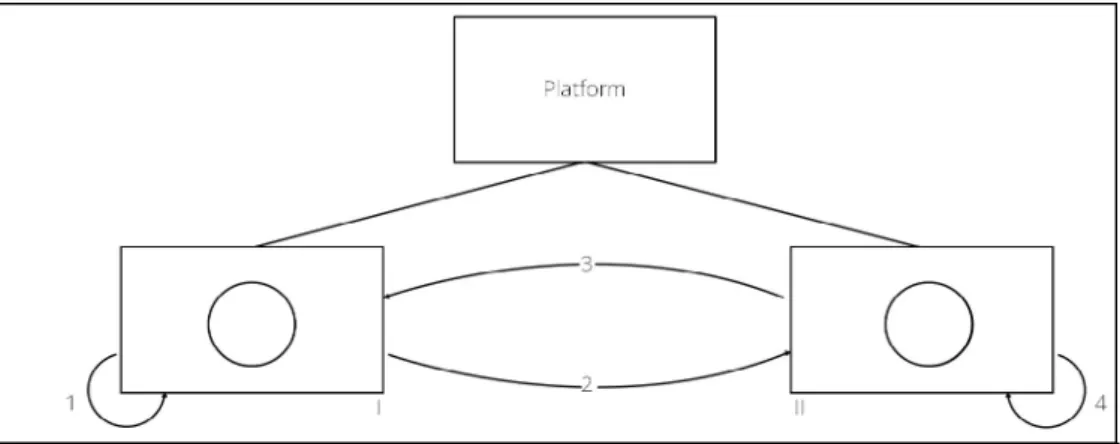
The existing literature on MSPs investigates platforms as phenomena which exhibit common charac-teristics (Evans, 2003) (see fig. 1). MSPs enable the direct interaction between two or more customers or participant groups (I+II) affiliated to them (Hagiu, 2014). Platforms are characterized by homing costs, which are related to the adoption, operation, or any other costs incurred due to platform affilia-tion (Armstrong, 2006), and by switching costs, or the costs which consumers pay for switching from one platform to another (Shapiro and Varian, 1999). The key to MSPs is to understand the network effects which occur when the value of a product depends on the number of other users (Shapiro and Varian, 1999).
Figure 1. Two-Sided Platforms (MSPs). I and II represent the platform’s sides. 1 and 4 indicate the presence of same-side network effects, whereas 2 and 3 indicate the presence of cross-side network effects.
The concept of the positive direct network effects (also known as same-side effects) (1+4 in fig. 1) presupposes that consumers may value a product more if similar consumers use that product as well. A classic example of this is the fax machine. If only one business owned a fax, the machine would have no practical value. An installed second fax machine is a vital requirement for the existence of the first machine. Thus, by increasing the number of fax machines, the benefits of the already existing users also increase. Positive same-side network effects strengthen the ties between the different users and contribute to the formation of a distinct group of users affiliated to the platform.
Cross-side network effects are present when users value the other side of the platform. The demand by one side depends on the participation of the other sides and vice versa. Thus, the large installed base of one side (I) attracts a second distinct side (II) which leads to cross-side network effects (2+3). As Hagiu (2006) points out cross-side network effects can flow in either one or both directions. An exam-ple of indirect network effects flowing in one direction is advertisers on Google who are attracted to the large user base of people who search online. Google’s users, however, are not attracted by the number of advertisers who have access to the search engine. Network effects go in both directions in card payment systems where the presence of the cardholders is dependent on the presence of mer-chants.
Platforms typically adopt a multi-sided business approach, charging different prices to groups of cus-tomers that reflect indirect network externalities flowing between them (Van Alstyne, 2013). A plat-form owner may decide to subsidize one side of the platplat-form by lowering the costs to consumers on that side for participating in the market (Evans, 2013). Typically, multi-sided platforms have a subsidy side which constitutes of a group of users who when attracted to the platform are highly valued by the money side.
3
Platform Business Model Framework
Tiwana (2014) defines platform’s business model as how platform owners intend to generate revenue. Evans (2013) investigates business models in relation to getting two sides on board, balancing inter-ests, multi homing costs, scaling and liquidity. Eisenmann et al. (2011) link platform’s business model to identifying the subsidy and revenue side of the platform. Osterwalder et al. (2009) define MSPs’ business model as creating value by bringing together two or more distinct but interdependent groups of customers. They state that a multi-sided platform grows in value as it attracts more users. According to Hagiu (2014) the strategic design of MSPs includes deciding who the relevant groups of customers for the platform are and the fundamental services the platform needs to perform for those customers. The above definitions investigate the platform’s business model by looking into some of its common characteristics. In this paper we complement this by providing a holistic and dynamic approach to plat-forms’ business models. Mason and Spring (2011) suggest that business models are dynamic in nature since they are not static but rather constantly evolving in an iterative and evolutionary way. Thus, we investigate platform’s business model as a system that is made up of components, linkages between the components, and dynamics (Afuah and Tucci, 2000) or as activity systems (Amit and Zott, 2001). To this end, we adopt Amit and Zott’s seminal model of the sources of value creation in e-business (2001; 2012) which we adapt to MSPs. Content, structure and governance are the three design ele-ments that characterize a company’s business model (Amit and Zott, 2001). If any of them are changed, the business model changes (Amit and Zott, 2012). The content refers to the selection of ac-tivities to be included, while structure refers to how the acac-tivities are linked and in what sequence. Fi-nally, governance refers to who performs the activities and what is the degree of power which they can exercise over the platform (Amit and Zott, 2001; Amit and Zott, 2012). Thus, we define the platform’s business models as consisting of platform features, platform architecture and platform governance. As these three elements vary among the different platforms and change throughout the evolution of a spe-cific platform, we also seek to explain and categorize the existing platform heterogeneity and
plat-form’s evolution dynamics. This implies that platforms create and capture value in different ways which has direct implications for the platform’s business model and thus its revenue potential.
3.1
Platform features
MSPs consist of many features and functionalities which minimize transaction, coordination and search costs between two or more distinct groups of users. Platforms solve a transaction-cost problem that makes it difficult or impossible for agents in different groups to get together (Evans and Schma-lensee, 2013). A classic example of this is the payment systems which significantly ease transactions between buyers and sellers by eliminating the need for barter (Hagiu, 2006). A multi-sided platform also creates value by coordinating the multiple groups of agents by ensuring that there are enough agents of each type to make participation worthwhile for all types (Evans and Schmalensee, 2013). MSPs can encompass a large variety of functionalities and features that reduce search costs (Hagui, 2014). Search costs can be divided in two types, according to whether each of the two (or multiple) sides is searching for each other or only one is (Hagiu, 2006). If a platform performs primarily a matchmaking function both sides are searching for each other (e.g. Airbnb). Platforms that reduce one-sided search costs, such as Google, are making audiences for the searching side while providing a standalone service to the non-searching side (the audience). The distinction in the types of search cost has implication for the design of the platform. When only side A values reaching side B, the platform provider needs to be careful when adding functionalities in order not to decrease the value which side B receives from the platform (Hagiu, 2006).
The number of features and functionalities which a platform offers can vary throughout its evolution. As the DPIE model proposed by (Staykova and Damsgaard, 2014) stipulates digital payment platforms can evolve from being one-sided to being two-sided and multi-sided. One-sided platforms offer lim-ited amount of functionalities as they connect users which form only one distinct group. As the plat-form develops and adds more sides, it incorporates more features and functionalities in order to lock-in its customers. Thus, a platform can add additional features to its initial value proposition and unlock new sources of value.
The decision about which features to include at what stage of the evolution of the platform (main fea-ture vs. additional) is a strategic one and amenable to a straightforward cost-benefit analysis (Hagiu, 2014). Hagiu (2006) argues that the gradual transition from one-sided to two – (or multiple) sided plat-forms solves the chicken-and-egg problem. A pre-condition for executing an expansion strategy is achieving depth which relates to creating more value for the existing side(s) by adding functionalities. This increases the stickiness of the platform and makes it less likely to be attacked by other contend-ers. The breadth of MSPs platforms is driven by the quest for unlocking new sources of value and cre-ating new indirect network effects with the addition of new sides to the platform (Hagiu, 2006). Thus, a platform owner that requires additional sources of value may decide to add new sides or functionali-ties to the platform.
3.2
Platform architecture
Platforms are purposefully designed complex systems with an underlying structure that influences how they behave, function and evolve over time (Tiwana, 2014). Platforms exhibit architectural features, in that they consist of a set of low variety components surrounded by high-variety components (Baldwin and Woodard, 2009). Platform architecture is structured around a densely connected core surrounded by a sparsely connected periphery consisting of elements which are loosely integrated among them-selves and to the core (Baldwin and Clark, 2000; Baldwin and Woodard, 2009; Murmann and Frenken, 2006).
The core of a platform consists of the main features and functionalities offered by the platform owner and of the initial number of sides which are affiliated to the platform. The initial platform’s success is dependent upon building the platform around a lean, minimal core that forces responsiveness,
initia-tive and substantial costs to flow toward the platform‘s periphery (Olleros, 2008). Olleros (2008) con-nects the structure of the core to the platform’s ability to scale and evolve over time and he argues that a heavy core hinders rapid scalability and growth, while a lean core enables rapid development.
The periphery of a platform constitutes additional sides which are added to the platform during its evo-lution. Thus, initially upon its launch, a platform does not have a periphery, but only a core. The addi-tional sides serve as platform enhancers.
The periphery consists of different loosely connected to the core sides (modules). In a product system a module is a component or group of components designed to deliver a unique function (Pil and Co-hen, 2006). A modular system is composed of units (or modules) that are designed independently but still function as an integrated whole (Kodama, 2004). Modularity increases the evolutionary potential of a system by making it more flexible and market friendly, but also more network friendly (Benkler, 2006). The key promise modularity offers to managers is the possibility of delivering a continuous stream of incremental innovations around a common technological platform, or product architecture (Brusoni and Fontana, 2005).
3.3
Platform governance
Platform governance is inseparable from platform architecture as the realization of the potential of modular platform architectures requires aligning them (Tiwana et al.,2010; Tiwana, 2014). One of the dimensions of platform governance is platform pricing policies which include decisions about sym-metric (charge both sides) or asymsym-metric pricing (charge one side), pricing for access versus usage etc. (Evans, 2013; Tiwana, 2014). MSPs can also regulate their various customers by resorting to nonprice governance rules such as regulation of access (who is allowed to join) and interactions (what are the various sides allowed to do) around MSPs (Boudreau and Hagiu, 2009; Hagiu, 2014).
Pricing is considered to be one of the key issues when designing platform’s business model (Eisen-mann et al., 2011). Rochet and Tirole (2003) point out that the choice of a business model (or the pric-ing) which will get both sides on board is the key to the success of a platform. In order to create posi-tive network effects and to reach critical mass many platforms decide to provide the service for free (i.e. freemium model) or even to pay the users to take it up (negative pricing). For example, Netscape gave away its browser to most users to get a critical mass on the computer user side of the market, whereas PayPal initially offered visitors USD $ 15 just to sign up and open an account.
Platform governance can also be associated with openness which is defined as lack of restrictions placed on participation in its development, commercialization or use (Eisenmann et al., 2013) or as absence of control at the platform level (Parker and van Alstyne, 2013). Platforms may open up by granting access to independent providers, thus facilitating the emergence of a market for complementary components around the platform, or by giving up control over the platform itself (Cenmano and Visnjic, 2013). The notion of platform periphery (adding additional sides) does imply that a platform opens up to third parties. We investigate platform openness in terms of the platform’s ability to add more sides to its initial value proposition (i.e. forming a periphery) and its ability to gen-erate revenues from value added-services (sides situated in the periphery). Thus, platform openness is present in our analysis of the Platform Architecture and the Platform Governance.
4
Case analysis
In the following section we analyze three platforms using the Platform Business Model framework. In order to illustrate the usefulness of our framework and to provide an answer to our research question, we started by identifying various companies which function as Multi-Sided Platforms. Data was gath-ered from publicly available sources: press releases, online news, academic articles, interviews and industry reports. From the collected data we tried to group the companies into specific categories, namely one-sided, two-sided and multi-sided platforms. We then singled out an exemplary company
from each of the three categories to which we applied the previously introduced Platform Business Model Framework as an explanatory framework.
The companies were selected as to represent the heterogeneity of the existing Multi-Sided Platforms. In our analysis we included a physical two-sided platform (airports) that adds a third side, a digital one-sided platform transformed into being two-sided (Pingit) and a digital one-sided platform which evolved into being multi-sided (Facebook). Thus, our observations are not limited to only a specific type of platforms (i.e. only physical platforms), but provide an overall view of the MSPs and their evo-lutionary paths.
We performed a qualitative analysis of the gathered data by applying the Platform Business Model Framework to the selected cases. The proposed Platform Business Model Framework serves as an ana-lytical tool to identify differences and similarities among the three studied cases. Frameworks, which are referred to as Type I Theory of Information Systems (Gregor, 2006), describe or classify specific dimensions or characteristics of individuals, groups, situations, or events by summarizing the commonalities found in discrete observations (Fawcett and Downs, 1986). These descriptive theories are used when little is known about a phenomenon.
Qualitative research methods tend to be more appropriate in the early stages of research (exploratory research) for studying phenomena that are not well understood (Bouchard, 1976), whereas quantitative methods tend to be more appropriate when theory is well developed, and for purposes of theory testing and refinement (Edmondson and McManus, 2005). 'How' and 'why' questions are more explanatory by nature, and are likely to lead to the use of case studies (Schell, 1992). Thus, we choose to perform a qualitative multiple case analysis as it provides tools for researchers to study complex phenomena within their contexts (Baxter and Jack, 2008) and to explore differences and replicate findings across cases (Yin, 2003).
4.1
Pingit (one-sided to two-sided platform)
The UK-based Barclays bank launched in 2012 its P2P transfer app Pingit which allows for one user to send money to another user fast, easily and efficient. The service is available for Barclays customers and non-customers as long as they have a UK current account and a mobile phone number. Pingit has been downloaded over 3.5 million times, while over 48 000 businesses have registered to use the ser-vice (First Group, 2014).
4.1.1 Platform features
Just a few months after Pingit’s launch, Barclays released a new version of the app incorporating new features such as QR code scanning, integration with current accounts, and user-friendly options for handling joint accounts and multiple phone numbers. As the app’s depth has increased by adding new features, it has strengthened its value offer and has facilitated the efforts to add another side. With the introduction of the Mobile Checkout and Buy it features, which were added to the platform in Sep-tember 2013, the app allows for users to connect to merchants (C2B). In November 2013 Barclays retooled its Pingit app to enable large firms to send funds for insurance claims, utility refunds and oth-er corporate payments directly to consumoth-ers. Large businesses use Barclays’ existing File Gateway channel to send electronic payments directly into an individual’s Barclays Pingit account. Even though Pingit was extended to cover B2C payments, the app still functions as two-sided platform.
4.1.2 Platform architecture
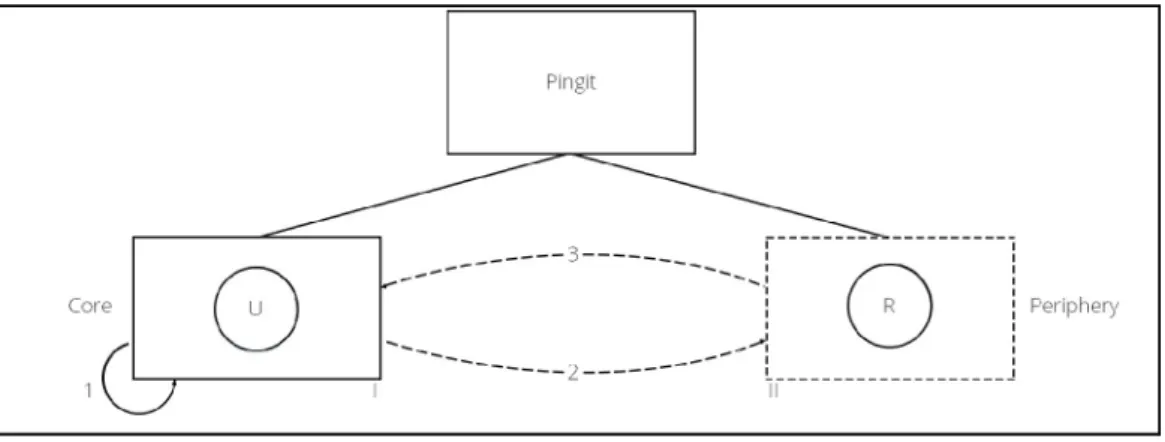
Upon its launch Pingit facilitated the interaction between a receiver and a sender that are subject to same-side network effects (see fig. 2 (1)). The more people use the app, the more valuable it becomes. As the sender and receiver of P2P payments can change their roles easily, they form one distinct group of users (I). Thus, upon its launch Pingit functioned as one-sided platform. As the Pingit’s user base grew in size, it became attractive to a second distinctive group of users (II) who pay to get access to
the installed user base. As Pingit added retailers on board, it was transformed from being one-sided to being two-sided platform.
The two-sided platform consists of a tightly connected core and loosely connected to the core periph-ery (see fig. 2). The core allows a one distinct group of users (I) connected by strong same-side net-work effects (1) to execute P2P transfers. As Pingit can function without enabling C2B and B2C transactions, the retailers, who form the second side of the platform (II), constitute the periphery of the platform. The connection between users (I) and retailers (II) is enabled by the presence of cross-side network effects (2+3) which flow in both directions; from I to II and vice versa, creating a positive feedback loop. As the number of users increases, the number of retailers who want to be affiliated with the platform grows, and vice versa.
Figure 2. Pingit’s Platform Architecture. I (Users) and II (Retailers) represent the platform’s sides. 1 indicates the presence of same-side network effects, whereas 2 and 3 indicate the presence of cross-side network effects. The core is presented with continuous thick lines and the periphery with punctuated lines.
4.1.3 Platform governance
The platform architecture and the structure of the ties between the different sides as defined by the presence of network effect determine the pricing structure of the platform. This allows for a different pricing strategy. Pingit is free to download and use as there are no charges for sending or receiving money. For large corporations, there's a transaction charge. For small businesses, fees could be built into existing tariffs as stated by Darren Foulds, director of Barclays Mobile and Pingit (Green, 2013). A one-sided platform aims at attracting as many users as possible. Since the network effects are weak, pricing the participation in (or the access to) the platform will have a negative effect on the adoption rate. As the lock-in cycle (Shapiro and Varian, 1999) shows during the first stages of trying a service or a product, consumers are still not entrenched and the switching costs are low. Furthermore, Pingit functions as a digital platform with fixed development costs and economies of scale. The marginal costs of adding an additional user to a digital platform is close to zero and hence competition will drive the costs of using the platform to zero. Thus, the price of using the platform for users will be equal to the marginal cost (zero). As the platform grows in size, it becomes attractive to another dis-tinctive group (i.e. retailers) who are willing to be charged to have access to the first group due to cross-side effects. Thus, the revenue side of Pingit comes from the merchants, who form the second distinct group and are situated in the periphery.
Platform features Platform architecture Platform governance P2P money transfer (one-sided) Core (connecting senders
one distinct group) C2B payments (two-sided) Periphery (connects
con-sumers to retailers) Revenue side (pay foraccess) B2C payments (two-sided) Periphery (connecting
business to consumers) Revenue side (pay foraccess)
Table 1. Overview of Pingit as a two-sided platform
4.2
Gatwick Airport (two-sided to multi-sided platform)
Gatwick Airport is the world’s busiest single-use runway, 2nd largest in the UK and 10th in Europe (Wingate and Dunn, 2014). A total of 35.9 million passengers have travelled through Gatwick in 2014; an increase of 1.7 million passengers or 4.8% from the previous year (Gatwick Airport, 2014). In total, around 45 airlines operate from the airport serving approximately 200 destinations in 90 countries.
4.2.1 Platform features
A growing amount of literature analyzes airports as two-sided platforms which connect airlines and passengers (Gillen, 2009; Gillen and Mantin, 2013; Ivaldi et al., 2011; Wright, 2004). Passengers are attracted if they are offered a large number of destinations, frequencies, choices of different airlines, convenient schedules, while airlines are more likely to pick an airport if a lot of passengers can be at-tracted to it (Fröhlich, 2010). Passengers are better off if there are more airlines and airlines are better off if there are more passengers. Thus, an airport acts as a platform, which creates value for two sides. Apart from aeronautical services, Gatwick Airport also provides non-aeronautical services. The air-port’s profits are increasingly coming from commercial activities such as retailing, which include duty and tax free shops, specialists’ shops, catering (Gatwick Airport, 2014). Thus, we can investigate Gatwick Airport as a multi-sided platform as passengers also value a wide-range of retail outlets and hotels situated at the airport, while retailers and hotels value being located where a large number of potential customers are present (Gatwick Airport, 2010).
4.2.2 Platform architecture
Gatwick Airport facilitates the interaction between airlines (A) and passengers (P) which is the main function of an airport (fig. 3). Airlines depend on the airport fees and the number of passengers, while the later depend on the number of airlines operating at a given airport. Thus, the core of the platform consists of airlines (I) and passengers (II) which are attracted to each other through strong cross-side network effects (1+2). The network effects flow in both directions as airports cannot function without any of the sides which the core consists of. An airport which cannot attract passengers has no value for airlines and vice versa. Thus, a platform core constitutes the main value proposition of the platform. Merchants (M) are affiliated to the two-sided platform (A+P) through the presence of cross-side net-work effects (3+4) as they value the number of passengers which an airport can attract. Thus, a plat-form is transplat-formed from being two-sided to being multi-sided. Merchants, who constitute a third par-ty to the airport, provide value added service and function as platform enhancers. However, if retailers are not present at an airport, it can still continue to operate by providing aeronautical services. Thus, the presence of merchants is not vital for the survival of the platform but instead constitute a platform periphery which is loosely connected to the platform core (3+4).
The strength of the interdependency between the three sides of the platform is not the same for the value proposition of the platform. I (A) and II (P) are interdependent, while III (M) is dependent on one of the core’s sides (i.e. passengers) (see fig. 3). Thus, the ties between the different sides are con-structed in different ways; 1+2 exhibit strong cross-side effects, while 3+4 exhibit weak strong side effects. The passengers-airline dyad is the strong foundation for the development of the platform. There is a strong dependency between passengers and airlines. Airports as platforms cannot exist if the
passengers-airlines dyad is broken down. Airports cannot function if there are not any airlines as they will not attract passengers. At the same time lack of any passengers makes an airport unattractive for airlines.
Although passengers value the different retail stores and hotels which are located at a given airport (Starkie, 2008), a change in the number of merchants (III) has limited effect on the interaction between airlines (I) and passengers (II). As merchants provide additional services to the platform, if the number of retailers decreases, the airport can still function, although with decreased value. A change in the interaction between I (A) and II (P) will have strong effect on III (M), but a change in III (M) will have limited impact on the I (A)/II (P) interaction. We attribute this to the fact that III (M) is depend-ent on the I (A)/II (P) interaction, whereas I (A)/II (P) interaction is not dependdepend-ent on III (M).
Figure 3. Gatwick Airport’s Platform Architecture. I (Airlines), II (Passengers) and III (Mer-chants) represent the platform’s sides. 1 and 2 indicate the presence of same-side net-work effects, whereas 3 and 4 indicate the presence of cross-side netnet-work effects. The core is presented with continuous thick lines and the periphery with punctuated lines.
4.2.3 Platform governance
For the period March 2013-March 2014 Gatwick Airport reported £317 million aeronautical income, which is driven by both passenger traffic and the level of airport charges (Gatwick Airport, 2014). Usually airports did not consider that passengers represented a source of revenue independently from the airlines (Gillen, 2009).
During the last decade, however, airports have identified that non-aviation revenues are important. £135 million out of the £593 million total income of the Gatwick Airport came from merchants, which is an increase by £11.9 million or 9.7% from the previous reporting period. Merchants constitute an additional source of revenue for the airport as they pay rent to the airport administration in order to get access to passengers and to use the airport’s facilities.
Passengers, unless they pay for car parking facilities at the airport (Gatwick Airport, 2010), are con-sidered to be the subsidy side. Both airlines and merchants, who pay fees for access and usage of the airport, constitute the revenue side of the airport. Retailers, which we define as Gatwick platform’s third side and situated in the platform periphery, have turned to be an important additional source of income for Gatwick Airport, which can even grow to be the primary one (Gatwick Airport, 2014). F.e. 60% of the profits for Fraport, Frankfurt´s airport, comes from non-aeronautical services, meaning that the platform periphery generates more profits than the core activity of the airport (Malavolti, 2014).
Platform features Platform architecture Platform governance Aeronautical services (two-sided) Core (connecting airlines and
passengers) Revenue side (airlines payfor access and usage of the airport)
Non-aeronautical services
(multi-sided) Periphery (connecting mer-chants to passengers) Revenue side (pay for ac-cess and usage)
Table 2. Overview of Gatwick Airport as a multi-sided platform
4.3
Facebook (one-sided to multi-sided)
Facebook was launched as a student directory in 2004 by a student named Mark Zuckerberg. Two years later, in 2006, Facebook was opened to everyone at least 13 years old and with a valid email ad-dress. Since then, Facebook has acquired 1.28 billion monthly active users (Popper, 2014) and 1.5 mil-lion advertisers (Smith, 2014).
4.3.1 Platform features
After registering to use Facebook, users may create a personal profile, post status updates and photos, share videos and receive notifications when others update their profiles. Facebook enables its users to add other users as friends, exchange messages with them or participate in different groups with other users who have similar interests.
With over 1.2 billion monthly active users worldwide (2013), Facebook has managed to attract more sides to its platform. In 2007 Facebook introduced “Facebook Ads” which allows advertisers to send marketing messages to Facebook users. Thus, Facebook serves as a platform which performs a matchmaking function by allowing advertisers to target ads to Facebook users based on age, location, gender, education, and other specific interests, and by allowing advertisers to match their own data or third-party data with data from Facebook, so they can find existing customers or potential new ones directly on Facebook (Facebook, 2013). In 2007 Facebook Platform was also introduced which pro-vides a set of development tools and application programming interfaces (APIs) that enable developers to easily integrate with Facebook in order to create mobile and web applications. Fourteen months lat-er, more than 30,000 apps existed on the Facebook Platform (Buck, 2012).
4.3.2 Platform architecture
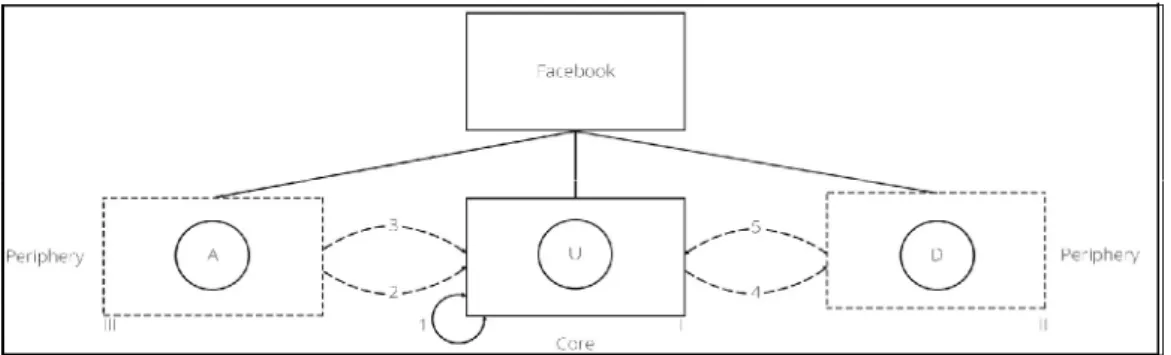
Platforms evolve over time as they search for new sources of revenue. By investigating closely the evolution of a platform, we are able to analyze how the platform’s value creation changes over time. Over the years Facebook has grown to be a multi-sided platform which facilitates the interaction be-tween users (U), app developers (D) and advertisers (A). The analysis of the platform architecture’s evolution allows us to investigate how the core and the periphery are formed and how the platform’s value is created and shifted.
Right upon its launch Facebook functioned as one-sided platform which connected a closed group of university students. The users exhibited strong same-side network effects (1) where the value for one user increased if more of its friends or acquaintances have joined the social platform. Thus, people with Facebook profiles form one distinct group of users (U). As the number of Facebook users has increased rapidly, it attracted several distinct groups of users, thus transforming Facebook into multi-sided platform. As Facebook can function just by enabling the interaction between its users, side I (U) forms the core of the platform, while the other parties affiliated to the platform (II (D) and III (A)) constitute its periphery. The connection between the core and the periphery is enabled by the presence of cross-side network effects (2+3; 4+5) which direction, however, is different depending on the side it points to. Game developers can be valued by the Facebook users, thus creating cross-side network ef-fects which flow in both directions. This is not the case with advertisers whose presence may lead to negative reactions in some Facebook users. Thus, the connection between advertisers and Facebook users flows in one direction. It is important to note that although there is a connection between side I (U) on one hand, and side II (D) and side III (A) on the other, there aren’t any cross-side network ef-fects between side II (D) and side III (A). Thus, the periphery can consist of n-sides which are not connected one to another.
Figure 4. Facebook’s Platform Architecture. I (Users), II (Developers) and III (Advertisers) represent the platform’s sides. 1 indicates the presence of same-side network effects, whereas 2, 3, 4 and 5 indicate the presence of cross-side network effects. The core is presented with continuous thick lines and the periphery with punctuated lines.
4.3.3 Platform governance
For Facebook’s users the platform’s main service is free of charge. The sheer size of Facebook users attracts the other sides affiliated to the platform (A+D). Facebook has no incentive to charge the inter-action among its users as this constitutes the main value proposition of the platform. Thus, users con-stitute the subsidy side of the platform.
In 2013 Facebook recorded revenue of $7.87 billion generated by advertising and by fees associated with its Payments infrastructure that enables users to purchase virtual and digital goods from develop-ers with applications on the Facebook website. Thus, Facebook monetizes the cross-side network ef-fects which the platform exhibits with the integration of more sides to the platform.
For 2013, 2012, and 2011, advertising accounted for 89%, 84% and 85%, respectively, of Facebook’s revenue. In 2013 this amounts to $ 6,986 billion (Facebook, 2013). Payments and other fees revenue in 2013 was $886 million and came from fees from developers' use of Facebook’s Payments infrastruc-ture. Facebook receives a fee of up to 30% when users make such purchases from developers (Face-book, 2013). However, the revenues from the developers, which we situate in the platform periphery, are generated mainly by a limited number of the most popular social games. In addition, a relatively small percentage of the Facebook’s users have transacted with Facebook Payments (Facebook, 2013). This indicates for a major discrepancy between the revenues generated by the two sides which form the platform periphery. While advertisers (III) are accountable for 89 % of the total Facebook’s reve-nue, developers (II) generate a significant less revenue. This has certain implications for the platform connectivity as the two sides in the periphery are not connected to the platform core in the same way as the ties (2+3; see fig. 4) between users (I) and advertisers (III) are stronger than the ties (4+5) be-tween users (I) and developers (II).
Platform features Platform architecture Platform governance Content creation (status update, post
videos and pictures, create events); search and interact with friends (one-sided)
Core (connecting different
us-ers) Subsidy side
Facebook Ads (two-sided) Periphery (connecting
advertis-ers to usadvertis-ers) Revenue side (pay for access) Facebook Platform (multi-sided) Periphery ( connecting app
de-velopers and third-party web-sites to users)
Revenue side (pay for ac-cess)
Table 3. Overview of Facebook as a multi-sided platform
5
Discussion and Conclusions
In this paper we adopted a framework to study MSPs business models by investigating platform fea-tures, platform architecture and platform governance. To this end, we applied the framework to three selected case studies which have allowed us to understand the platform heterogeneity and to propose a new MSPs typology.
We found out that there is a structural difference between one-sided, two-sided and multi-sided plat-forms (see Table 4). Although all platplat-forms consist of a core and potentially of a periphery, they are constructed differently. The sides of a platform and the ties which connect them can be arranged in several configurations. The core, in particular, can be structured in different ways. In the Gatwick Air-port case the platform core constitutes of two distinct groups (A+P), while in the examples of Pingit and Facebook the core consists of only one distinct group (U). The formation of the platform core pre-cedes the formation of the periphery. The latter consists of sides enhancing the value proposition of the platform. The periphery’s structure also varies. It can consist of one side loosely connected to the core (Pingit’s merchants) or of n-sides which are connected to the platform but have no ties to one an-other (Facebook’s advertisers and game developers).
The particular platform architecture can explain the difficulties in designing a viable business models for Facebook, Twitter, Snapchat, Pingit etc. which function as one-sided platforms upon their launch. As they facilitate the interaction within one distinct group of users, they exhibit low multi-homing and switching costs and thus it is very difficult to define a revenue side. The platform has to evolve and add a second side before being able to propose a viable business model and generate revenue. In con-trast, credit card companies such as Visa and MasterCard, which function as two-sided platforms, have been able to develop successful business models by identifying the card holders as subsidy side and the merchants as revenue side, but platforms that start with a core of two sides are more difficult and riskier to launch. Thus, one-sided platforms need to evolve with a rapid pace in order to strengthen their value proposition.
We also notice that two-sided platforms differ in structure. Airports can function as two-sided plat-forms which enable the interaction between airlines and passengers. These two sides constitute the core of the platform as they are connected with strong cross-sided network effects. In contrast, book turned into two-sided platform when it added advertisers to its initial value proposition. Face-book’s two-sided platform differs from the airport’s two-sided platform in terms of structure. While airports connect two sides to form the platform core, Facebook connects a core (users) to its periphery (advertisers). The two-sides of the airport’s two-sided platform (airlines and passengers) are strongly connected to each other, while the sides of Facebook’s two-sided platform (users and advertisers) are loosely connected. Thus, we distinguish between sided platforms by design (airports) and two-sided platforms by evolution (Facebook). Pingit also functions as a two-two-sided platform by evolution. The observed difference in the nature of the two-sided platforms also has a clear implications for the subsequent transformation of the two-sided platforms into being three (or multiple)- sided platforms. Both Gatwick Airport and Facebook in their latest developments function as three-sided platforms, but their structure is different due to the inherited characteristics of their initial design (compare fig. 3 and 4). The structure of their platform cores and peripheries is different.
Platform Type Platform
Fea-tures Platform Archi-tecture Platform Governance Pingit
One-sided Main Core Subsidy side (Users)
Airport
Two-sided Main Core Subsidy (Passengers)
/Revenue side (Airlines)
Multi-sided Complimentary Periphery Revenue side (Merchants)
One-sided Main Core Subsidy side (Users)
Two-sided Complimentary Periphery Revenue side (Advertisers)
Multi-sided Complimentary Periphery Revenue side (Developers)
Table 4. Summary of the business model evolution of the three analysed cases
We also demonstrate that the platform architecture has clear implications for the pricing strategies and opportunities of the platform. Our starting point is the assumption that each side situated in the periph-ery is like a module with no independent value (Brousseau and Pénard, 2007). Only the core has inde-pendent value or value of its own. By making the platform core strong, the platform owner can in-crease the attractiveness of the platform and make it easier to attract additional sides which not only will constitute additional value source, but, as obvious in the case of the Frankfurt Airport (see p. 9), it can turn to be the main source of value for the platform. For example, if a platform owner lowers the aeronautical fees which airlines have to pay, this will result in increased frequency of flights for the existing airlines and the attraction of new airlines. The more airlines operate in an airport, the more passengers it will attract. The positive feedback loop will increase the value of the core which will make the platform more attractive to third parties. Thus, the less revenue coming from the core will be balanced by the increased revenue from the periphery which signals for a shift in the platform’s busi-ness model.
The analysis of the platform architecture also demonstrates that platforms exhibit different levels of modularity which we associate with modules (platform sides) situated in the platform’s periphery. Multi-sided platforms tend to be more modular (and more open) than two-sided platforms (either by design or by evolution). Two-sided platforms by design do not possess periphery (no modularity) and consist only of a core. This has certain implications for the features they possess (predominantly main features) and for their ability to generate value. Two-sided platforms by evolution do possess a periph-ery (added side), which is always defined as revenue side (Pingit, Facebook at a certain stage of its evolution). Multi-sided platforms have the most modular (most open) platform architecture as their periphery consists of many sides and thus, of many revenue sources. The different degree of modulari-ty has implications for the platforms’ innovation capabilimodulari-ty and for its openness. The more modular a platform is, the more innovative capability it possesses as it can add more sides (i.e. add value) to its initial value proposition. At the same time as more sides are added to the platform’s periphery, the more open it becomes. A prerequisite for the existence of modular periphery, however, is the strength and the attractiveness of the core for other potential sides.
Although we observe differences in the platform architecture, we limit our analysis to investigating only how these structural changes impact the platforms’ business model. Future research may pinpoint other important implications for the platform development (e.g. openness) based on the different struc-tures. A detailed empirical study is needed to explain better the impact of the structural differences of the MSPs on the platform evolution. A subject to future research could also be platforms with core consisting of three sides which we have not been able to identify any instances of.
6
Acknowledgement
This work was in part done in association with the Copenhagen Fintech Innovation and Research (www.cfir.dk ). CFIR is a non-profit association which gathers companies and organizations with in-terests within the finance IT area.
References
Afuah. A. and C. L. Tucci (2000). Internet Business Models and Strategies: Text and Cases, New York:Irwin/McGraw-Hill.
Amit, R. and C. Zott (2012). “Creating Value Through Business Model Innovation.”MIT Sloan Man-agement Review53(3), 41-49.
Amit, R. and C. Zott (2001). “Value Creation in e-Business.”Strategic Management Journal22 (6-7), 493-520.
Armstrong, M. (2006). “Competition in two-sided markets.”RAND Journal of Economics37 (3), 668– 691.
Baldwin, C. Y. and C. J. Woodard (2009). “The Architecture of Platforms: A Unified View.”Platforms, Markets and Innovation, 19-44.
Baldwin, C. Y. and K. B. Clark (2000)Design Rules, volume 1: The Power of Modularity.Cambridge, MA: The MIT Press.
Baxter, P. and S. Jack (2008). “Qualitative Case Study Methodology: Study Design and Implementa-tion for Novice Researchers.”The Qualitative Report13 (4), 544-559.
Benkler, Y. (2006).The Wealth of Networks: How Social Production Transforms Markets and Freedom. New Haven: Yale University Press.
Bouchard, T. J. Jr. (1976). “Field research methods: Interviewing, questionnaires, participant obser-vation, systematic obserobser-vation, unobtrusive measures.” In M. D. Dunnette (ed.), Handbook of In-dustrial and Organizational Psychology. Chicago: Rand McNally College Publishing Company. Boudreau, K. and A. Hagiu (2009). “Platforms Rules: Multi-sided Platforms as Regulators.” In A.
Gawer (ed.)Platforms, Markets and Innovation. London: Edward Elgar.
Brousseau, E. and Th. Pénard (2009). “Assembling Platforms: Strategy and Competition.” Economics Papers Number 123456789/12317. University Paris Dauphine.
Brusoni, S. and R. Fontana (2005). “Modularity as an Entry Strategy: The invasion of new niches in the LAN equipment industry.”CESPRI working papers 171, Universita Bocconi, Milano, Italy. Buck, S. (2012). The History of Facebook's Developer Platform. URL:
http://mashable.com/2012/05/24/facebook-developer-platform-infographic/ (visited on 21/11/2014).
Cenmano, C. and I. Visnjic (2013). “The Gang of Four. Acquaintances, Friends or Foes? Towards an Integrated Perspective on Platform Competition.” 35th DRUID Celebration Conference 2013, Barcelona, Spain, June 17-19.
Edmondson, A. and S. McManus (2005).Methodological Fit in Management Field Research. Harvard Business School.
Eisenmann, T., P. Geoffrey and M. Van Alstyne (2011). “Platform envelopment.” Strategic Management Journal32(12), 1270-1285.
Eisenmann, T., G. Parker and M. Van Alstyne (2009). “Opening platforms: How, when and why?” In A. Gawer (Ed.), Platforms, Markets and Innovation. Cheltenham, UK: Edward Elgar Publishing Limited.
Evans, D. S. (2013). Economics of Vertical Restraints for Multi-Sided Platforms. University of Chicago Institute for Law & Economics Olin, Research Paper No. 626.
Evans, D. S. (2003). “Some Empirical Aspects of Multi-sided Platform Industries.” Review of Net-work Economics2 (3).
Evans, D. S. and R. Schmalensee (2013). “The Antitrust Analysis of Multi-Sided Platform Business-es.” In R. Blair and D. Sokol (Eds.) Oxford Handbook on International Antitrust Economics, Oxford University Press.
Evans, D. S. and R. Schmalensee (2008). “Markets with Two-Sided Platforms.”Issues in Competition Law and Policy (ABA Section of Antitrust Law)1 (28).
Facebook (2013). Facebook Annual Report 2013. URL: http://files.shareholder.com/downloads/AMDA-NJ5DZ/3676792219x0x741493/EDBA9462-3E5E-4711-B0B4-1DFE9B541222/FB_AR_33501_FINAL.pdf(visited on: 17/11/2014).
Fawcett, J. and F. S. Downs (1986). The Relationship of Theory and Research. East Norwalk, CT: Appleton-Century- Crofts.
First Group (2014). First Bus becomes first nationwide public transport operator to offer Barclays Pingit as mobile payment option. URL: http://www.firstgroupplc.com/news-and-media/latest-news/2014/19-11-14.aspx(visited 20/11/2014).
Fröhlich, K. (2010). “Airports as two-sided markets? A critical contribution.” University of Applied Sciences Bremen.; Werderstr. 73, D-28199 Bremen.
Gatwick Airport (2014).Annual Report and Financial Statements for the year ended 31 March 2014. URL:
http://www.gatwickairport.com/Documents/business_and_community/investor_relations/Year_End _2014/Gatwick_Airport_Limited_Financial_Statements_31March2014.pdf (visited on 14/11/2014).
Gatwick Airport (2010).Two-sided platforms and airports.Discussion paper, 8 August 2010.
Gillen, D. (2009). A New View of the Airport Business – Two-sided Platforms. Airneth Fellow Col-umn, April 2009.
Gillen, D. and B. Mantin, (2013). “Transportation Infrastructure Management, One- and Two-sided Market Approaches.”Journal of Transport Economics and Policy47 (2), 207-227.
Green, T. (2013). The Big ME Interview: Darren Foulds, Pingit. URL: http://www.mobile-ent.biz/brands/the-big-me-interview-darren-foulds-pingit/041456(visited on 03/11/2014).
Gregor, S. (2006). “The Nature of Theory in Information Systems.”MIS Quarterly30(3), 611-642. Hagiu, A. (2014). “Strategic Decisions for Multi-sided Platforms.”MIT Sloan Management Review55
(2).
Hagiu, A. (2006). “Multi-Sided Platforms: From Microfoundations to Design and Expansion Strate-gies.” Working Paper 07-094. Harvard Business School.
Hagiu, A. and J. Wright (2013). “Do You Really Want to Be an eBay?”Harvard Business Review91 (3), 102–108.
Hagiu, A. and J. Wright (2011).Multi-Sided Platforms. Harvard Business School Working Paper 12-024.
Ivaldi, M., S. Sokullu and T. Toru (2012). ”Are airportrts two-sided platforms?: A methodological approach.” In J. Peoples (ed.) Pricing Behaviour and Non-Price Characteristics in the Airline Industry. Wagon Lane: Emerald Group Publishing.
Kodama, F. (2004). “Measuring emerging categories of innovation: Modularity and business model.” Technological Forecasting and Social Change71 (6),623–633.
Malavolti, E. (2010). “Single till or dual till at airports : a two-sided market analysis.” WCTR 2010, 12th World Conference on Transport Research, Jul 2010, Lisbon, Portugal.
Mason, K. and M. Spring (2011). “The sites and practices of business models.”Industrial Marketing Management40 (6), 1032-1041.
Mourdoukoutas, P. (2014). What's Wrong With Amazon's Business Model?. URL:
http://www.forbes.com/sites/panosmourdoukoutas/2014/10/27/whats-wrong-with-amazons-business-model/(visited 30/10/2014).
Murmann, J. P. and K. Frenken (2006). “Toward a systematic framework for research on dominant designs, technological innovations, and industrial change.”Research Policy35, 925–952.
Olleros, X. (2008). “The lean core in digital platforms.”Technovation28 (5), 266–276.
Osterwalder, A., Y. Pigneur and T. Clark (2009). Business model generation, A handbook for visionaries, game changers, andchallengers. Hoboken, N.J. ; John Wiley & Sons.
Parker, G. and M. Van Alstyne (2013). “Innovation, Openness & Platform Control.” Research Paper. URL:http://ssrn.com/abstract=1079712
Popper, B. (2014). Facebook now has more than a billion mobile users every month. URL: http://www.theverge.com/2014/4/23/5644740/facebook-q1-2014-earnings(visited on 11/11/2014). Pil, F. and S. Cohen (2006). “Modularity: Implications for imitation, innovation, and sustained
ad-vantage.”Academy of Management Review31 (4), 995–1011.
Rochet, J-C. and J. Tirole (2003). “Platform Competition in Two-Sided Markets.”Journal of the Eu-ropean Economic Association1(4), 990-1029.
Schell, C. (1992). “The Value of the Case Study as a Research Strategy.” Manchester Business School.
Shapiro, C. and H. Varian (1999).Information Rules. Boston: Harvard Business School Press.
Smith. C. (2014). By the Numbers: 60 amazing Facebook Advertising Statistics. URL: http://expandedramblings.com/index.php/facebook-advertising-statistics/(visited 05/11/2014). Starkie, D. (2008).The Airport Industry in a Competitive Environment: A United Kingdom
Perspec-tive. Discussion paper No. 2008-15. Joint Transport Research Center, OECD, International Transport Forum.
Staykova, K. and J. Damsgaard (2014). “A Model Of Digital Payment Infrastructure Formation And Development: The EU Regulator´s Perspective.” In Proceedings of the 13th International Conference on Mobile Business, 2014 ICMB 2014, London, 3-4 June 2014.
Taube, A. (2014). The 20 Most Valuable Brands In The World. URL:
http://www.businessinsider.com/the-20-most-valuable-brands-in-the-world-2014-5?op=1#ixzz3KMHUTYmY(visited on 23/10/2014).
Tiwana, A. (2014). Platform ecosystems, Aligning architecture, governance, and strategy. Amster-dam: Morgan Kaufmann.
Tiwana, A., B. Konsynski and A. Bush (2010). “Platform Evolution: Coevolution of Platform Architecture, Governance, and Environmental Dynamics.”Information Systems Research, (Dec 2010).
Van Alstyne, M. (2013). Rise of the Platform and What It Means for Business. Presentation. URL: http://www.slideshare.net/InfoEcon/the-rise-of-platforms-and-what-it-means-for-business (visited on 15/10/2014).
Wingate, S. and N. Dunn (2014). Investor Presentation Gatwick Airport. URL: http://www.gatwickairport.com/Documents/business_and_community/investor_relations/Gatwick_ Airport_Limited-Investor_Presentation_March2014.pdf(visited: 09/11/2014).
Wright, J. (2004). “One-sided Logic in Two-sided Markets.”Review of Network Economics, 3.1. Yin, R. K. (2003).Case study research: Design and methods, 3rd Edition. Thousand Oaks, CA: Sage.