Tomkins, Susannah Chloe (2006) Proxy respondents in a case-control study: validity, reliability and impact. Doctoral thesis, London School of Hygiene Tropical Medicine.
Downloaded from: http://researchonline.lshtm.ac.uk/768483/
Usage Guidelines
Please refer to usage guidelines at http://researchonline.lshtm.ac.uk/policies.html or alterna-tively [email protected].
lSHTM
1111
001115848XProxy respondents in a case-control study:
validity, reliability and impact
by
Susannah Tomkins
Thesis submitted for the degree of Doctor of Philosophy
london School of Hygiene and Tropical Medicine
University of london
Abstract
In many research settings, the study subject is unable to provide responses, requiring
researchers to find alternative respondents. This thesis explores the use of proxy
respondents in a case control study of premature mortality among Russian men of
working age (25-54 years).
Data obtained from proxy respondents is explored in four ways. Firstly, proxy
questionnaire responses are validated against external data sources which were
routinely collected, blind to case-control status - the city alcohol treatment clinic
(Narcology Dispensary), Social Security and Police records. Secondly, agreement
between proxy and index (control) responses to questions about alcohol use, tobacco
use, health and socioeconomic factors is explored. Thirdly, the effect of proxy type is
explored by examination of proxy-proxy and index-proxy agreement in a subset of
households in which two proxy interviews were obtained. Finally, the impact on
analysis outcomes is explored by mortality analyses using proxy versus index data.
Cohen's
kappa coefficient was
used
to explore inter-respondent agreement.
Differences in agreement between pairs of respondents were examined using
Agresti's loglinear model, and the directionality of disagreements were evaluated
using McNemar's test.
Findings confirm some assertions in the literature. Questions about easily observable
characteristics and behaviours, avoiding excessive detail, subjective or sensitive
topics, elicit valid proxy responses. Proxies tend to over-report alcohol use, but
provide particularly valid responses about tobacco use and socioeconomic factors.
Validity was highest among proxies who were the index's spouse. However,
further
exploration suggested that men who have spouses differ in their behaviour from men
who do not
in
ways which affect its reporting. There was little additional evidence
that proxy characteristics affect validity.
The
use of proxy responses biases odds
ratios
in
this case control study toward more conservative estimates. These findings
are generalisable to study settings which employ a protocol to ensure selection of the
best available proxy.
Table of contents
T
ABLE OF TABLES •....•.•.•••...••..••••.••••...•.•••••••••••••••••••••••••••••••••••••••••••••••••••••••••••7
TABLE OF FIGURES •••••••••••••••••.•••..•...•.•••••.•.•...•.••.•••.•••••••••.•••••••••••••••••••••••••••••• 10
ACKNOWLEI)(;EMENTS .•••••••••••••••••••..••••••••••••••.•••.••••.•••.•..••.•••.•••.•••••••••••••••••••••••••• 12
PERS()NAL CONTRIBUTION TO THIS THESIS ••••••.•••.••••••••••••••.•.•.•••••.•...••••••••••••••..•••• 13
AIMS .•••..••••.•••.•••••••••.••••.•••••••••..••...••.••••.•••••••••••.••••••••.•••.•.••.•••••••...•••••••.••••.•.... 14
CHAPTER
1
DoES IT MATTER WHO WE ASK? THE VALIDITY OF PROXYRESPONDENTS INOBSERVATIONAL STUDIES - A LITERATURE
REVIEW •••••••••••••••••••••••••••••••••••••••••••••••••••••••••••••••••••••••••••••••••••••••••••
IS
1.1 SUMMARYOFCHAPTERCONTENTS ...•...•.. 15
1.2 BACKGROUND 15
1.3 MATERIALS AND METHODS 17
1.4 RESULTS 18
1.4.1 Alcohol 18
1.4.2 Tobacco use 19
1.4.3 Other subject areas 20
1.4.4 Index and proxy attributes 21
1.4.5 Question style 22
1.4.6 Response rates ··..···..····..··· 23
1.5 DISCUSSION 23
CHAPTER 2 THE RUSSIAN MORTALITY CRISIS ••••••••••••••••••••••••••••••••••••••••••••••••••••45
2.1 SUMMARY OF CHAPTER CONJ'ENTS 45
2.2 POOR LIFE EXPECTANCYIN RUSSIA 45
2.3
THE
ROLE OF ALCOHOL ••.••.••.•..•..••...•.•...•..••.••••••••••.•••...••.•...••••.•.•••.•••••...•.••••••••••• 46CHAPTER 3 THE IZHEVSK FAMILY STUDY: DESIGN OVERVIEW 52
3.1 SUMMARY OF CHAPTER CONTENTS 52
3.2 IZHEVSKFAMILY S11JDYAIMS 52
3.3 BACKGROUND •••.•••••••••••.•••.•••..••····•···••·•·••· 53
3.3.1
Why
a case-control study? 533.3.2 Study setting 54
3.4 SUMMARYOFDESIGN ·•.. •• • • 54
3.4.1 Piloting phase 55
3.5 DESCRIPTION OF MEllIODS 57
3.5.3 Control defmition 58
3.5.4 Identification of appropriate proxies 58
3.5.5 Interviews 60
3.6 SOURCES OF INFORMATION ...•..•... 62
3.6.1 Questionnaire 62
3.6.2 External sources of data 64
3.7 E1lIICAL APPROVAL ...•... 64 3.8 AUNIQUE OPPORTUNITY ...•....•...•...•...•...•... 64
CHAPTER
4
THE IzHEVSK FAMILY STUDY: DATA COLLECTION ANDPR<X:ESSING •••••.•••••••••••••.••••.•••••••••.•••••••••••••••••••••••••••••••••••••••••••.••••• 66
4.1 SUMMARY OF CHAPTERCONTENTS ...•...•.••••...•..• 66 4.2 DATA ENTRY ANDCLEANING ...•...•...•...•. 66 4.3 DESCRIPTION OF RESPONDENTS ...•....•...•...•...•... 68
4.3.1 Responserate 68
4.4 RESTRICTION: ELIGIBILITY FOR ANALYSIS AND DESCRIPTIVE SUBSETS ...•••..••.••.... 69
4.4.1 Quality of interviews 70
4.4.2 Proxy characteristics 71
4.4.3 Formal index-proxy relationship 72
4.4.4 Proxy-reported characteristics of the index-proxy relationship 74
4.4.5 Subsets ··· 75
4.5 EXPOSURES OF INTEREST 76
4.5.1 Questionnaire items 76
4.5.2 External sources of data 80
4.5.3 Autopsy data ···· 82
4.6 DATASECURrrY ANDCONFIDENTIALITY 82
CHAPTER
5
STATISflCAL METHODS •••••••••••••••••••••••••••••••••••••••••••••••••••••••••••••••••••83
5.1 SUMMARY OF CHAPTER CONfENTS 83
5.2 KEy VALIDATION COMPARISONS 83
5.3 STATISTICAL METHODS 84
5.3.1 Sensitivity and specificity: exploring agreement between proxy
responses and external data 85
5.3.2 Cohen's kappa coeft"tcient: exploring agreement between two
respondents 87
5.3.3 Loglinear models: comparing the agreement of pairs ofrespondents 90
5.3.4 Relation of log-linear estimate tokappa 96
CHAPTER
6
ARE
PROXIES VALID? USING EXTERNAL DATA TO VALIDATECONTROL PROXY AND CASE PROXY RESPONSES •••••••••••••••••••••••••••••••98
6.1 SUMMARY OF CHAPTER CONfENfS 98
6.2 METHODS 98
6.3 RESULTS 100
6.3.3 Agreement between questionnaire derived data and external data
according to attributes of the index-proxy relationship 107
6.3.4 Can narcology data beused to validate other alcohol-related
questions? 114
6.4 DISCUSSION •...•...•...••... 116
CHAPTER
7
AGREEMENT BETWEEN PROXY AND INDEX RESPONDENTS •••••••••••••123
7.1 SUMMARY OF CHAPTER CONTENTS ...•.•...••.•.•..•••... 123
7.2 BACKGROUND ..•...••...•.•.•...••...•...•.•... 124
7.3 METHODS 125
7.4 RESULTS 126
7.4.1 Index-proxy agreement for alcohol-related variables 127
7.4.2 Index-proxy agreement for tobacco use and other exposure variables 132
7.4.3 Restriction to subsets 134
7.4.4 Do proxies over or underestimate relative to controls? 137
7.4.5 Do attributes of the index-proxy relationship improve agreement? 143
7.5 DISCUSSION 150
CHAPTER
8
AGREEMENT BETWEEN PROXIES WITHIN THE SAMEHOUSEHOLD •••••••••••••••••••••••••••••••••••••••••••••••••••••••••••••••••••••••••••••••••••
158
8.1 SUMMARY OF CHAPTER CONTENTS 158
8.2 METHODS 159
8.2.1 Does proxy type affect the response obtained? 159
8.2.2 Does case-control status of the index affect proxy response? 160
8.2.3 Examination of households from which a validation interview was
obtained 161
8.3 RESULTS 162
8.3.1 Formation and description of validation interview subset 162
8.3.2 Does proxy type make a difference? (1) Within-household agreement
between two proxies 165
8.3.3 Does proxy type make a difference? (2) Formal comparison of
within-household index-proxy pairs 169
8.3.4 Is there case-control bias in the effect of proxy type on response
validity? 173
8.3.5 Generalisability of this subset 178
8.4 DISCUSSION 185
CHAPTER
9
IMPACf OF USING PROXY DATA ON CASE-CONTROL RESULTS. •••••••I90
9.1 SUMMARY OFCHAPTER CONfENTS 190
9.2 METHODS 190
9.3 RESULTS 193
9.3.1 Comparison of odds ratios obtained in all households 193
9.3.2 Comparison of odds ratios obtained in households where the proxy is
the index's spouse (subset 4) 195
9.3.3 Comparison of odds ratios obtained in households where proxies
9.4 DISCUSSION 199
CHA"P'fER 10 DISCUSSION ••••••••••••••••••••••••••••••••••.••••.•••.••••••••••••••.•••.••••.•••••••••.•.•.• 205
REFERENCES ••••••••••••••••••••••••••••••••••••••••••••••••••••••••••••••••••••••••••••••••••••••••••••••••••••••••
215
ApPENDIX
1
FIELDWORK PROTOCOL, PROXY RESPONDENT SELECTION ANDRESPONDENT INFORMATION SHEET
226
ApPENDIX
2
DESCRIPTION OF QUESTIONNAIRE SURVEY FIELDWORKPROCEDURES ••••••••••••••••••••••••••••••••••••••••••••••••••••••••••••••••••••••••••••••••• 233
ApPENDIX 3 FINAL ENGLISH VERSION OF THE CASE PROXY
QUE~IONNAIRE ••••••••••••••••••••••••••••••••••••••••••••••••••••••••••••••••••••••••••••
242
ApPENDIX
4
INDEX-PROXY AGREEMENT: KAPPA ANALYSES PERFORMEDUSING PILOT DATA •••••••••••••••••••••••••••••••••••••••••••••••••••••••••••••••••••••••••
295
ApPENDIX 5 EXTERNAL DATA COLLECTION FORMS 332
ApPENDIX
6
DISTRIBUTION OF RESPONSES BY RESPONDENT TYPE IN THEMAIN SAMPLE ••••••••••••••••••••••••••••••••••••••••••••••••••••••••••••••••••••••••••••••••
339
ApPENDIX
7
DISTRIBUTION OF ANALYSED RESPONSES TO VALIDA nONINTERVIEW QUESTIONS BY RESPONDENT TYPE 352
ApPENDIX
8
FREQUENCY OF RESPONSES TO QUESTIONS ABOUTFREQUENCY OF ALCOHOL CONSUMPTION BY RESPONDENT
Table of tables
Table 1.1
Table 1.2
Table 3.1
Table 3.2
Table 3.3
Table 4.1
Table 4.2
Table 4.3
Table 4.4
Table 4.5
Table 4.6
Table 4.7
Table 5.1
Table 5.2
Table 5.3
Table 5.4
Table 6.1
Table 6.2
Table 6.3
Table 6.4
Key findings related to index-proxy agreement on alcohol and
tobacco use
20
Studies addressing the use of proxy respondents
27
Comparison of death distribution in Izhevsk with Udmurtia,
and Russia as a whole, in males aged
25-54
in 2003(84)
54
Pilot stages carried out May-July 2003
56
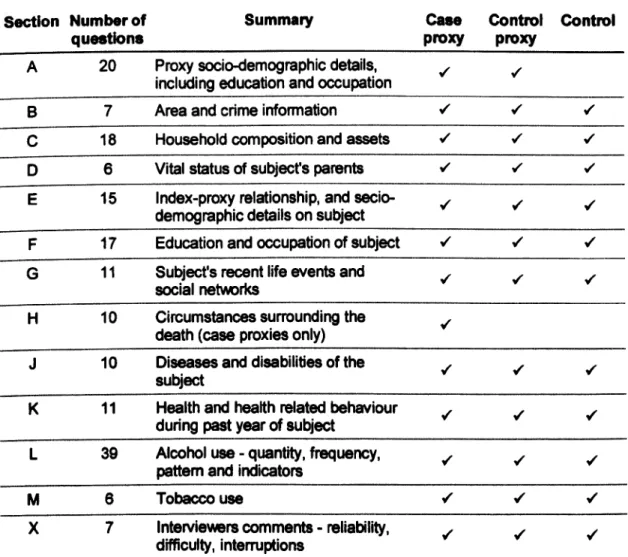
Summary of questionnaire module content
63
Was anyone else present at any time during the interview?
70
Relative timing of interviews in control households
71
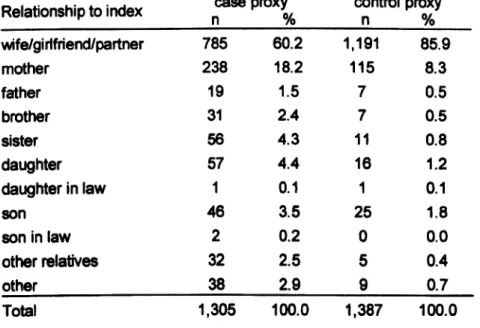
Index-proxy relationship as reported by proxy
72
Characteristics of the index-proxy relationship among case
and control proxies
75
Questions related to alcohol consumption
78
Questions related to tobacco use
79
Questions related to socioeconomic factors and health
80
Questionnaire items and the external data sources against
which they were compared
85
Example association between questionnaire responses and
external data records
86Example table expressing the frequency of responses to a given
question provided by two classes of rater, A and B
87
Example: frequency of responses (iJ) to a given question
provided by two classes of rater, A and B
91
External data and questionnaire item comparisons
99
Distribution of index subjects by proxy report (questionnaire
data) and from external data sources by case-control status
102
Association of questionnaire variables with external data
illustrated by odds ratios, and by sensitivity/specificity
of the
questionnaire to predict the external data registration where
.
106
appropriate
.
Association of questionnaire item 'Is he registered disabled'
Table 6.5
Table 6.6
Table
6.7
Table 7.1
Table 7.2
Table 7.3
Table 7.4
Table 8.1
Table 8.2
Table 8.3
Table 8.4
Table 8.5
Table 8.6
Table 8.7
Association of questionnaire item Has he ever spent time in any
kind of prison reported by controls, control proxies and case
proxies, and Police data regarding prison stays by subset
110
Association of questionnaire item L36 (Has the subject ever
had help or advice from a doctor, narcologist, social worker or
some other professional for an alcohol problem? ') and
Narcology Dispensary registration by respondent and subset
113
Association of questionnaire items 'Has he ever used
surrogates in the past year? ' and 'Has he been on zapoi in the
past year? ' with Narcology Dispensary registration by
respondent
115
Cohen's kappa coefficients for agreement between control
index and control proxy for alcohol, tobacco use,
socioeconomic factors and health questions by subset
129
Number of discordant and concordant index-proxy responses
for alcohol questions
139
Number of discordant and concordant index-proxy responses
for tobacco, socio-economic and health related questions
142
t
and p-value for the comparison in agreement distribution of
index-proxy reports, comparing those pairs excluded from each
subset with those included in the subset
144
Number of possible proxy respondents in case/control
households from which a successful first proxy interview was
obtained
162
Number of possible proxy respondents and percentage success
in obtaining validation interview in eligible case/control
households for which a successful validation interview
was/was not obtained
163
Distribution ofproxy1 by proxy2 type in case and control
households
}64
Cohen's kappa coefficient to show agreement between proxy}
and proxy2 for questions on alcohol use
}66
Cohen's kappa coefficient to show agreement between proxy1
and proxy2 for questions on tobacco use, socioeconomic
factors and health
168
'f
and p-value for the difference in agreement between the index
with proxy2
and
the index with proxy} in control households
}70
'f
and p-value for the difference in agreement distribution of
proxy}-proxy2
reports for alcohol-related questions, in
Table
8.8
rand p-value for the difference in agreement distribution of
proxy1-proxy2
reports in control versus case householdsfor
questions related to tobacco use, socioeconomic factors and
health
177
Table
8.9
Distribution of index characteristics among case/control
households in which a second proxy interview was/was not
obtained
180
Table 8.10
rand p-value for the difference in index-proxy1 agreement for
questions relating to alcohol use in households for which a
validation interview was not/was obtained
182
Table
8.11
l'and p-value for the difference in index-proxy agreement in
control households for which a validation interview was
not/was obtained for questions relating to tobacco use,
socioeconomic factors and aspects of health
184
Table
9.1
Mortality adjusted odds ratios by frequency of drinking in all
households
194
Table
9.2
Mortality adjusted odds ratios by frequency of drinking:
households in households where the proxy is the index's spouse
(subset
4)
196
Table
9.3
Mortality adjusted odds ratios by frequency of drinking using
proxies who report 'good' /'extremely good' knowledge of the
Table of figures
Figure 1.1
Figure 2.1
Figure 2.2
Figure 3.1
Figure 4.1
Figure 4.2
Figure 4.3
Figure 4.4
Figure 5.1
Figure 5.2
Figure 5.3
Figure 5.4
Figure 5.5
Figure 7.1
Figure 7.2
Figure 7.3
Figure 7.4
Comparing proxy reports, index reports and external data - the
example ofalcohol
16
Russian life-expectancy at birth
J970_2002(81.83.84)
46
Cause-specific standardised death rate in Russian males aged
0-64, 1980-2004(81)
48Detailed informationflow
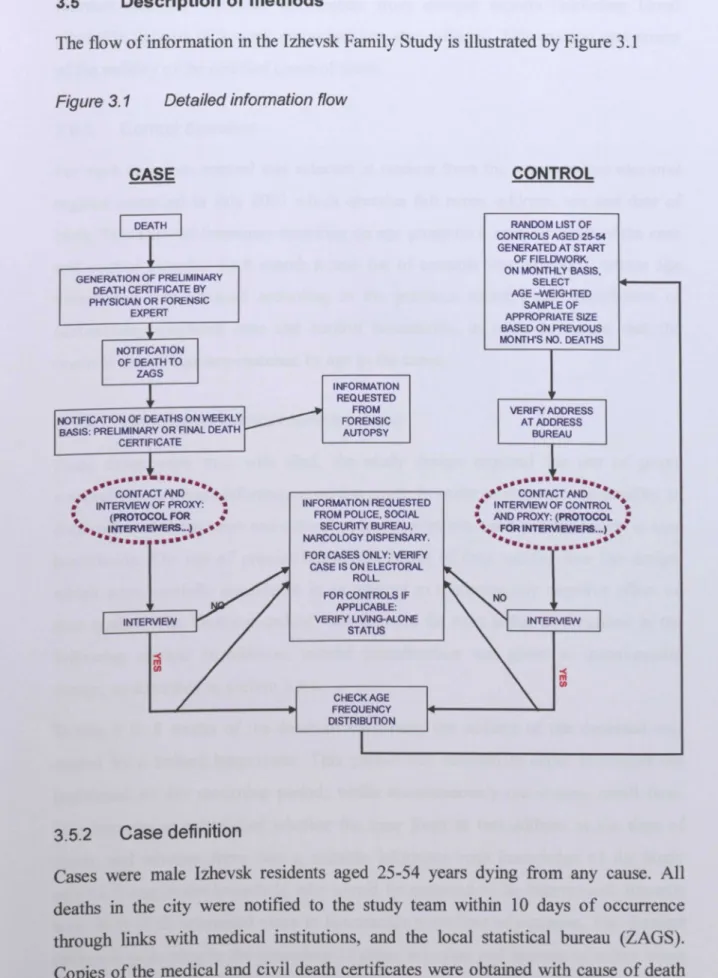
57
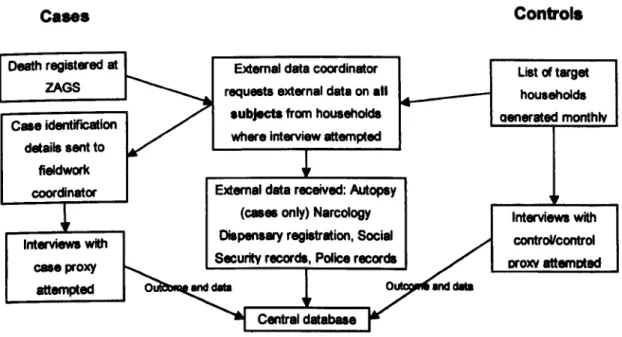
Information flow: interviews and external data
67
Outcome of attempts to locate and interview case proxy,
control proxy and control respondents
69
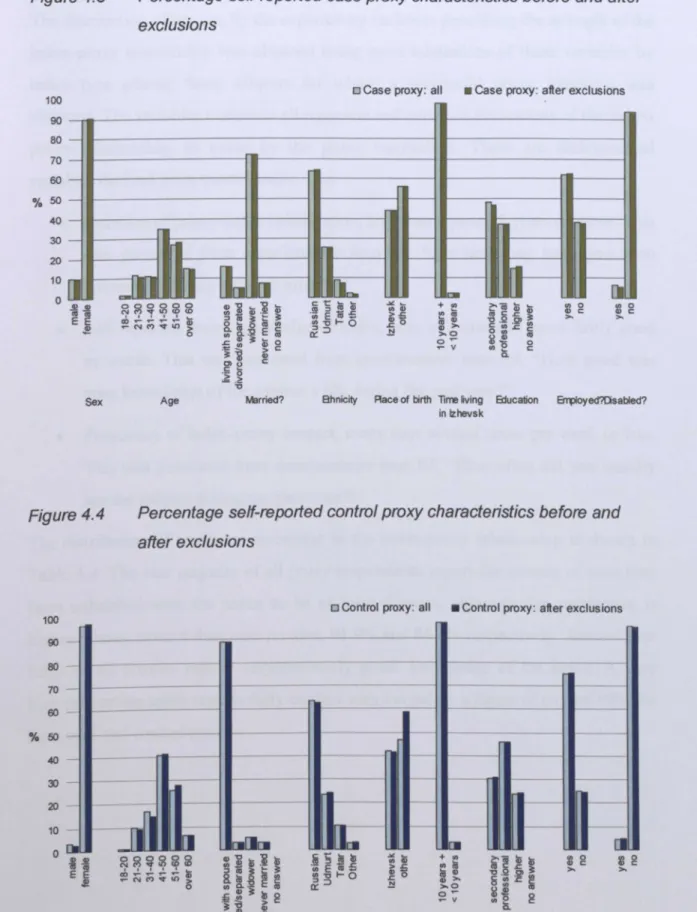
Percentage self-reported case proxy characteristics before and
after exclusions
73
Percentage self-reported control proxy characteristics before
and after exclusions
73
Overview of validation comparisons within the Izhevsk Family
Study
84Schematic diagram of the kappa coefficients which can be
obtained in different households
89Distribution of indicator 'sin a
5*5
table and corresponding
predicted log cell counts (log nu)
93
Scatter plot of
0
against unweighted kappa, comparing
responses from proxy
1and proxy2 among 200 case households
for a range of nominal and binary questions
97Scatter plot of log(
8)
against weighted kappa, comparing
responses from proxy
1and proxy2 among 200 case households
for a range of ordinal questions
97Kappa for whole sample and confidence intervals: alcohol
questions
J32
Kappa for whole sample and confidence intervals: tobacco
use, socioeconomic factors, and health related questions
134
Cohen's kappa coefficient for the unrestricted sample and four
subsets, alcohol questions
136
Cohen's kappa coefficient for the unrestricted sample and four
Figure
7.5
Quantile-quantile plot of
t/standarderror, for comparisons
between pairs of respondents not included versus included in
subset
1
146
Figure
7.6
Quantile-quantile plot of
t/standarderror, for comparisons
between pairs of respondents not included versus included in
subset
2
147
Figure
7.7
Quantile-quantile plot of t/standard error, for comparisons
between pairs of respondents not included versus included in
subset
3
149
Figure
7.8
Quantile-quantile plot of
t/standarderror, for comparisons
between pairs of respondents not included versus included in
subset
4
150
Figure
8.1
Quantile-quantile plot of
r/standard error, for the difference in
agreement between the index with proxy2 and the index with
proxy1
172
Figure
8.2
Quantile-quantile plot of
t/standarderror, for the difference in
proxy1-proxy2 agreement in control versus case households
for alcohol-related questions
176
Figure
8.3
Quantile-quantile plot of
t/standarderror, for the difference in
proxy1-proxy2 agreement in control versus case households
for questions on tobacco use, socio-economic factors and
health
178
Figure
8.4
Quantile-quantile plot of t/standard error for the difference in
index-proxy agreement in pairs of respondents in control
households for which a validation interview was not/was
obtained
185
Figure
9.1
Mortality adjusted odds ratios and
95%
confidence interval by
frequency of drinking in all households
193
Figure
9.2
Mortality adjusted odds ratios and
95%
confidence intervals by
frequency of drinldng in households where the proxy is the
index's spouse (subset
4)
195
Figure
9.3
Mortality adjusted odds ratios and
95%
confidence intervals by
frequency of drinking in households where proxies report
'good' or 'extremely good' knowledge of the index (subset 2) ... 197
Figure
9.4
Mortality adjusted odds ratios and
95%
confidence intervals
for frequency of surrogate drinking in different types of
Acknowledgements
The work described in this thesis could not have been undertaken without the
Izhevsk Family Study team. From its inception to the end, our team of international
collaborators have provided intellectual input, enthusiasm and insights, enabling the
study to be run to the highest possible standard. It has been a privilege to work with Evgueni Andreev, Martin McKee and Vladimir Shkolnikov.
The study was entirely fmanced by the Wellcome Trust, whose confidence in the
research undertaken has enabled us not only to conduct the previous study, but now to embark on a new research program in Izhevsk.
Collaborators based in Izhevsk conducted the fieldwork leading to the collection of
the data on which this thesis is based with unflagging professionalism, efficiency and
attention to detail and have been a pleasure to work with during the past 4 years. I am
particularly grateful to Nikolay Kiryanov, without whom nothing would happen in
Izhevsk, and to Lyudmila Saburova and her team of interviewers who spent two
years painstakingly carrying out interviews to a very high standard. Without their
meticulous work, our data would not exist.
Several colleagues at the London School of Hygiene and Tropical Medicine have
assisted me. First and foremost, enormous
thanks
go to Dave Leon who has providedan indispensable mixture of guidance, encouragement, criticism and support
throughout, for which I am very grateful. Pat Doyle allowed me the flexibility and
space to finish this thesis. Thanks to Ruth Stewart, whose calm interest helped me
focus my thoughts early on, and to Diana Elboume who provided support
at
the
endwhen it was most essential Mike Kenward offered statistical guidance when I could
not see how to proceed. Particular thanks must go to Dan Altman and Richard Atkins
for spending many hours helping me develop and interpret
the
statistical analyses.Last,
but by no means least, my family and friends have been unbelievablysupportive of me throughout
this
venture - in particular, allthe
Tomkins', Alexis(,Encouragement, encouragement, encouragement!') and Yoni. Your unfailing faith
Personal contribution to this thesis
I was employed as a research fellow for the Izhevsk Family Study from September
2002 until its completion, and played a key role in the development of certain aspects
of its design. I carried out an initial literature review in to the quality of proxy
respondents which fed directly into questionnaire development: an updated version
of this review is found in Chapter 1. I
also
carried out a series of kappa analyses on
the control-proxy agreement observed in data collected during the last piloting phase,
the findings of which again fed directly into the questionnaire development and are
found in Appendix 4. I was responsible for the detailed drafting of the questions in
the three questionnaires (for the case proxy, control proxy and control) which are
described in section 3.6.1. I was also responsible for the development and overseeing
of the piloting phases in Izhevsk, and for development of the protocol for selection of
proxy respondents and validation interviews. In addition, I was the overall
coordinator of the project throughout the development phase, and played a key role
in data cleaning and analysis both during and after the fieldwork phase,
takingresponsibility for the creation and documentation of a full analytic dataset which was
made available to the study team via a secure website which I designed, created and
maintained. I have visited Izhevsk more than 10 times.
Aims
This thesis aims to assess the validity and reliability of proxy respondents in a case-control study of premature mortality, particularly with respect to alcohol.
Specifically:
1. To systematically review the existing literature on validity of proxy respondent data in observational studies
2. To investigate the validity of data provided by proxy respondents using data
collected by a major case-control study of premature male mortality in Russia. Specifically, to:
(i) investigate the validity of proxy respondents with respect to external
data.
(ii) investigate the validity of proxy respondents with respect to index
respondents.
(iii) investigate the importance of the index-proxy relationship.
3. To investigate the impact of proxy respondent data on estimates of the strength of associations between alcohol and other factors and mortality
Chapter 1
Does it matter who we ask? The validity
of proxy respondents in observational
studies - a literature review
1.1
Summary of chapter contentsIn epidemiology we sometimes need to obtain exposure information about
individuals unable to provide it themselves. One approach to addressing this problem is the use of secondary, or proxy, respondents as informants about the subject (the index). Use of this methodology raises the question of whether data obtained from
proxy respondents is valid. This chapter examines the extant literature investigating
the validity of proxy responses with respect to index responses.
1.2
BackgroundWhere the subject of epidemiological research is unconscious, is unable to
understand or respond to questions due to dementia or other illness(33), has died, or
is
unable to respond for other reasons, it is sometimes not possible to obtain exposure
information from the subject themselves. The use of secondary, or proxy,
respondents as informants about the subject (the index) is one approach to addressing
this problem. For example, many studies of Alzheimer's disease rely on proxy
infonnants(S,12,25,3443),as indexes are considered unable to respond to questions
reliably. Other circumstances where proxies are
used
include studies of someconditions among the elderly (6,14,17,26,28,44,45)or children(4648) where, because of age
or cognitive ability, the index may be unable to provide reliable responses. In all
such situations, use of proxies to obtain data is necessary to ensure a representative
sample of the study popuJatiOn(16), or simply to obtain any data at
all.
Yet this raisesthe question of whether data obtained from proxy respondents
is
adequately reliableto be
used
either at an individual level, or on aggregate to determine exposureprevalence in study populations.
Of major importance in public
health
are two common subject areas, alcoholand
These areas may perform quite differently to one another with respect to the validity
of proxy-reported data. The phenomenon of under-reporting, denial, in self-reported
responses on alcohol consumption and alcohol problems in particular is
well-documented, although non-differential misclassification and over_reporting(49,SO)are
also possible. It is important to acknowledge that over-reporting by indexes relative
to proxies does not necessarily indicate that it is the proxy who isunder-reporting - it
may
be
that the index is over_reporting(49,Sl,S2).Conversely, in most societies smokingis not generally regarded as a taboo behaviour, especially among adult males, so
reporting of tobacco use is likely to
be
free of some of the biases we would anticipateencountering with respect to alcohol reporting(49-S1,S3-S7).
This
is concordant with theconsensus in the literature(l9,21,23,24,27,S8-66)as discussed in this chapter and later in this
thesis. Questions arise regarding the way in which proxies perform in these, and over a wide range of other subject areas.
These are empirically testable issues. To take
this
question forward, one must assumethere is a 'true' answer to every question posed. Intheory, responses which reported
this truth would provide the highest quality data and would
be
the 'gold standard'. Inpractice, however, the truth may not be obtainable using a questionnaire, and the
direction and magnitude of departure from the theoretical gold standard may vary
according to the respondent asked. In order to assess proxy response quality,
different comparative standards may be used. Proxy response quality can be assessed
either by comparing proxy-provided data with index-provided data, using the index
as the standard, or by comparing proxy-provided data with that obtained from an
objective, external source, as illustrated by Figure 1.1.
Figure 1.1
Comparing proxy reports, index reports and extemal data - the
example of alcohol
ElIterNIIdatil
mar1cerd
The latter is discussed in the literature and
is
acknowledged as a reasonable methodto validate proxy responses under certain conditions'I", However, this chapter
examines the former, while recognizing that indexes themselves may be fallible
sources of data, and that in some situations the proxy might be the better data source.
1.3
Materials and methodsA systematic literature review of studies that used proxy respondents to obtain some or all of their data on alcohol use, tobacco use and other subject areas was carried
out. Databases searched were Web of science, MedlinelPubmed and Embase from
the inception of the databases until
20
th May2006.
Search terms were 'proxy','surrogate' , 'next-of-kin' or 'informant'. Only papers written in English were
included. Titles and abstracts of identified papers were inspected individually to
assess whether they related to studies in humans, did not include only children,
specifically evaluated quality of proxy respondents as an aim and explicitly
quantified agreement between index and proxy responses using either Cohen's kappa for categorical data, or weighted kappa coefficient for ordinal data, or the intraclass
correlation coefficient for continuous data. Papers using percentage agreement as
their sole statistical method of evaluating agreement were excluded, since this
common way of assessing agreement does not account for the role of chance and
therefore cannot be
used
to compare across questions. Papers in which the number ofindex-proxy
pairs
was less than 50, and papers where the mode of interview (e.g.face to face, telephone) differed among proxies and indexes were also excluded.
The remaining papers were obtained. Data extracted from each study included
statistical methods
used
to compare proxy and index responses, and the effect ofthe
following on index-proxy agreement: index characteristics;
proxy
characteristics;proxy selection method; index-proxy relationship. Where kappa values were
available, degree of agreement was classified in accordance with
the
schemedeveloped by
Landis and
Koch(67):<0,
poor;0.00-0.20,
slight;0.21--0.40, fair;
1.4
ResultsThe initial inclusion terms yielded 2161 papers. 1615 were excluded based on the exclusion terms. A further 443 were excluded following inspection of titles and 71 more after inspection of abstracts, leaving 32 papers for detailed assessment. These papers are summarised in Table 1.2.
The majority of the 32 papers examined were based on cross-sectional surveys, with
the remainder being case-control studies and one cohort study. Studies varied in size from 81 to 10011 index-proxy pairs, with larger studies tending to use telephone or
self-administered questionnaires, and smaller studies using face to face interviews as
the mode of data collection. Study subjects varied widely, including people with
brain injury, Alzheimer's disease or dementia, men and women aged over 65 years,
cancer patients and patients recovering from injuries, as well as some randomly
selected population based samples. The choice of also proxy varied between studies,
with some only considering specific proxy types (e.g. spouse, next of kin), some
using index-nominated proxies or caregivers, and others using whoever was
available. As described above, only studies using Cohen's kappa coefficient or ICC
were considered, however it was noted that only one third of the eligible studies
calculated precision estimates for these parameters. Some studies detailed procedures taken to avoid data contamination, which is potentially caused when index and proxy
respondents have the opportunity to communicate with one another and possibly
discuss their responses between interviews which may then influence responses
given by the second respondent. However, many did not provide this level of detail.
1.4.1
Alcohol
The literature on proxy-reported alcohol consumption is wide-ranging
and
fmdingsby different investigators are largely complimentaryCS.7.10,24,27).The key findings are
summarised in Table
1.1.
Broad indicators of alcohol consumption (averagefrequency, average number of
drinks
per occasion) show almost perfect index-proxyagreement when classified into ordinal categories(S.7,24), and alcohol consumption
status
(yes/no) shows substantial agreement(27). Composite measures of daily alcoholconsumption (grams) show only moderate agreement(24) with considerable variability
type: there is a suggestion it is highest for wine but only moderate for beer and hard liquor, although this could reflect differences in drinks consumed inside and outside the home, and thus whether they are directly observable by the proxy(24). There is a suggestion that agreement for binge- and heavy drinking is moderate/good'i",
1.4.2
Tobacco use
There was a consensus in the literature regarding index-proxy agreement on cigarette
use (5,10,23,24,27),whereby agreement depends on the required level of detail: whereby
there is 'good' to 'excellent' agreement about general cigarette-use
(currentlnonlex-smokeri23,24,27),but 'poor' agreement for more detailed information, such as brand
smoked and number of years of smoking. There is no clear consensus when
examining agreement on amount. Some authors suggest that detail beyond that
required to calculate pack-years is hard to obtain(24), whilst others found agreement
for current amount to be almost perfect(5,27).This lack of consensus may be due tothe
wide range of data collection methods and study settings which addressed this
Table 1.1
Study details
Key findings related to index-proxy agreement on alcohol and tobacco use
Study Design Comment
Cross sectional survey. Self-administered questionnaire carried out by non-demented Alzheimer sufferers (index) compared with two proxies. n=81
---.---Men and women aged 25-64 who were representative sample of myocardial infarction controls and
small number of cases from a larger case control study interviewed face to face. Closest next of kin (proxies) interviewed 6-8Iater. n=514. Demissee. S. etal 2001 (5) Graham. P.and Jackson. R. 1993(7)
Observed 'almost perfect' agreement on overall smoking behaviour (kappa = 0.87).
Observed 'substantial' agreement on overall alcohol use (kappa = 0.74).
Found no evidence that proxies systematically over-or under-repover-orted drinking frequency (kappa = 0.79 among cases, 0.80 among controls)
Hatch.
M.C. etal
1991 (10)
Cross-sectional survey of prenatal patients recruited from obstetric services andtheir spouses/partners. 0=136.
Found evidence of considerable misclassification with respect to alcohol use even though statistics
sometimes indicated good index-proxy agreement. Found agreement on smoking behaviour to be high (Private patients: kappa = 0.84 for first trimester smoking, 0.95 forcurrent smoking; public patients 0.84, 1.00 respectively)
Navarro. A.M.1999
(23)
Cross-sectional survey. Of adults randomly selected. Index andproxy completed detailed interview by telephone (n=IOOll)
High agreement on smoking status between index and proxy (kappa = 0.76-0.91), although this differed by ethnic group
Nelson. L.M. etaI
1994 (24)
Casecontrol, interviewer-administered interviews of all controls andtheir proxies and where possible of cases andtheir proxies from case-control study of spmtaneous subarachnoid
haemorrhage. n=283 (control pairs), 68(case pairs)
Alcohol consumption showed varying range of agreement depending on measure. Lowest agreement was forgrams perday (kappa = 0.52). Highest agreement wasfor amount of drinks peroccasion (kappa - 0.83) and frequency of drinking (kappa = 0.82).
Cigarette smoking history showed very high agreement (kappa = 0.79 - 0.93)
Passaro. KT. etal
1997(27)
Cross sectional studyof pregnant women. Index and spouse (proxy)
bothcompleted self-administered questionnaire. N=8414.
1.4.3
Other subject areas
Kappa coefficient for drinking status showed 'substantial' agreement (kappa =0.74).
Kappa coefficient for smoking status 'almost perfect'
(kappa=0.90)
Proxies
tend tobe good
informants
for easily observable
socio-demograpbic
characteristics
including
marital
status,education
and
for
body
habitus
measurements(I0,24). Although
there
is an extensive
literature
examining
proxy
responses
in studies of occupational
exposures
(e.g,asbestos), no studies met the
inclusion criteria employed
here.
There is, however, a suggestion that responses are
There is a lack of consensus regarding the extent of index-proxy agreement among
ten studies addressing reports on physical health and symptoms(5,6,9,14,16,17,24-26,31).
There was a tendency for proxies to display moderate or better agreement when
reporting
overall
health
and easily
observable,
especially
'chronic
physical'
conditions, and for visible and unambiguous
medical history items (e.g. diabetes,
amputation).
Agreement
is lowest for conditions that are either private or very
general. Agreement is generally higher for physical activities of daily living (PADL)
than
for instrumental activities of daily living (IADL). The former tend to be more
easily observable and less subjective than IADL
(31).Five reviewed studies addressed psychological state(2,6,16,l7,25).
There
wasa consensus
that index-proxy agreement was only fair for emotional states and emotional and
nervous conditions and psychological
well-being,
since these feelings tend to be
private and not well-known by proxies(l6,l7). Observable facets of social networks
and social interaction are well-judged by proxies.
As
might be expected however,
proxies are poor judges of perceived emotional support'", Life events are often used
as indicators of exposure
tostress; agreement is substantial for public and observable
(e.g. death of a parent), and lower for other (e.g. serious illness of a spouse), life
events'",
There is a suggestion that proxies are not able to accurately capture a
patient's own perception of their quality of life and tend towards underestimation(2S).
Only two studies were identified addressing physical activity(8,24): little information
is available on physical activity as such data tend to be collected on healthy subjects,
a group that do not require proxy respondents. The available literature indicates that
broad indicators of physical activity level (PAL) show very good, whilst detailed
aspects show only moderate agreement(24). Substantial agreement for both leisure and
work-time activity was reported, using 3-point scale(8).
1.4.4
Index and proxy attributesNine reviewed
papers
identified
specific
index attributes
and were largely
in
agreement
in their assessment
of how these affected
proxy response
quality(7-9,16.18.19,22,26,29).
No difference in quality of response
wasfound by index's age or
seX(8),nor did there tend to be any difference in either quality of response or response
difficult to observe (e.g. back paini9). Due to the impossibility of comparing any
proxy response with the 'true' subject response, the above findings should not be
generalised to studies where the index
has
died.Fourteen papers assessed the quality of proxy responses obtained(I,4-10,14,16,19,20,29,33)
according to proxy age and sex, and the index-proxy relationship. Most studies
agreed that spouses provide highest-quality data and highest response rate, but there
is no clear consensus on the optimal order of relationship beyond that(S,7,10,14,19,24),
and several studies have found little effect of relationship type of relationship on
agreement level(7,20,29).It is reported elsewhere to be the quality and nature, rather
than
formal relationship (e.g. spouse, sister etc), which most affects the proxyresponse quality<9,IS,16,20,26).Depending on question content, the proxy attributes age
and gender have been found to affect response quality(S,8,20,33).
There is consensus in the literature that caregiver proxies overestimate disability and
underestimate index's independence, function and quality of life, and that the extent
of index-proxy disagreement increases with increased caregiving burden(l,4,14).
1.4.5
Question style
Ten identified papers focused on the effect of the way in which questions are asked
on proxy data quality (4,8,14,16,17,22,29,31,33,68).There was a consensus that broader
categories and reduced detail in question design increase agreement(4,16,22,31,33),and
questions requiring a yes/no answer or that assess concrete, observable information
show better agreement than questions requiring judgement, opinion, firsthand
experience of activities outside the home, or
the
proxy's subjective perception.Agreement is also reported to be highest for recent exposures(22,29)~ Mode of
interview appears
to
affect response quality: agreement in telephone interviews tendsto
be lower than in face-to-face interviews, although thisis
difficultto
interpret as anumber of other factors vary between studies that use different modes of interview.
No study was identified here that explicitly set out
to
evaluatethe
agreement using1.4.6
Responserates
Response rates differ between proxy and index respondents, due to different
exposure knowledge and altered motivation(64.69):
missingness is often greater for
proxy than index responses(S.6,20).
This has implications for study power due to
smaller sample sizes(64,69),
and may lead to biased effect measures depending on the
reasons influencing non-response.
There is some evidence that non-response rate may be affected by choice of proxy,
with the highest response rate observed when spouses are proxies and lower rates
observed
for
distant
relatives
and
friends
compared
with
first
degree
relatives(s.6,8,20,70).
In case-control studies, proxy response rates may differ between groups also leading
to biased effect measures. However, Poulter
et al
found mainly non-significant
differences in the proportion of 'don't know' responses between case and control
proxies in a case-control study examining reliability of
datafrom proxy respondents,
and found little difference in recall bias(29).Non-response is dependent on both the
proxy-index relationship and on the
typeof questions asked(s.6.32.33.64).
1.6
Discussion
This chapter provides a thorough evaluation of the available research investigating
the reliability of proxy respondents in observational studies. The issues explored here
have previously been the subject of three overviews(33.71.72),
but none was exhaustive:
Sprangers and Aaronson(72)concentrated on the use of health care providers as
proxies in evaluating quality of life among patients with chronic disease; Neumann et
al(71)reviewed the validity of care providers and 'significant others' as proxy
respondents in studies of adults aged 60 and older, in
24
studies investigating
functioning, physical health, cognitive
statusand
psychological well-being; Nelson et
al(33)provide an overview of the impact of proxy-provided information on the
exposure-disease association in epidemiologic research, but their paper
was
a
theoretical discussion of the issue rather than a literature review. The current chapter
is a comprehensive review of the literature comparing proxy to index responses to
surveys, which confirms the findings of the previous three overviews, whilst
additionally investigating all types of proxy respondent, index subject and study question.
There are several limitations inherent in examination of this range of studies.
Methods of information collection from respondents were not always internally
consistent. In some studies, index and proxy separately undertook an
interviewer-administered questionnaire within a short time period, with the same interviewer.
This is the ideal data collection method for ensuring data comparability, since little
opportunity arises for data contamination between interviews. However, elsewhere
there was a lengthy delay between interviews allowing ample opportunity for data
contamination. Additionally, the literature reviewed is very heterogeneous with
respect to study design and methods, characteristics of indexes and proxies and the
exposures and outcomes being investigated. Consequently, comparisons are often
difficult. Despite these limitations, some clear conclusions emerge.
The quality of responses obtained from proxies in observational studies is variable,
depending on factors relating to the content and style of the question. Alcohol use elicits a wide range of index-proxy agreement depending on the specific context and question. Agreement tends to be highest where questions focus on broad indicators of alcohol consumption (e.g. average frequency of drinking alcohol) rather than detailed information, and in general appears to be highest for questions about wine and lower
for other alcohol types. Questions asking about comparatively observable measures
of alcohol consumption also elicit better agreement than those asking about
behaviours which are difficult for a proxy to observe (e.g. alcohol consumption
outside the home).
It
is important to note that these findings cannot be generalised tovery heavy drinkers, since such individuals tend to not respond to surveys or even be identified within target populations, and hence the behaviour of this extreme group is
not usually captured in observational studies. Contrastingly, tobacco use is almost
uniformly well-reported by proxies with respect to index reports, provided questions
again
focus on easily observable aspects of this behaviour (e.g. brand smoked) ratherthan attempting to obtain detailed information such as number of cigarettes smoked
per day. Assessment of psychological state is fairly unreliable. This is expected
impossible to have reliable knowledge of the index's internal state of mind. This is, however, the only area where reliability is consistently poor.
In general, proxy responses agree more closely with index responses when the
question addresses easily observable, objective measures or where the subject matter
is not embarrassing or awkward. Questions asked using broad yet clearly defmed
categories, without seeking high levels of detail, tend to elicit greater agreement.
Greater agreement is also achieved when questions are asked face-to-face by a
trained interviewer, rather than by telephone or via a self-administered questionnaire.
These fmdings are supported by the results investigating specific question content,
which consistently showed that questions asked on recent or current, less detailed
and more easily observable exposures elicit higher agreement than more detailed
questions, or those addressing past exposures.
The quality of responses obtained from proxies in observational studies also varies
according to characteristics of the proxy. There is a general consensus in the
literature is that spouses provide most reliable proxy data and yield the highest
response rate. These findings suggest that it may be relationship quality, such as the amount of time regularly spent together or number of years the index and proxy have known one another, rather than formal relationship (e.g. spouse, daughter), which has
greater impact on quality of responses. The evidence presented here shows that
reliability also diminishes as caregiver burden increases. This further indicates the
importance of the state of mind of the proxy themselves in the accuracy of their
responses - it may
be
hypothesized that the increased burden falling on caregiversrenders them liable to overestimate incapacity through heightened awareness of the
index's problems.
The extant literature is inconclusive regarding direction of misclassification of proxy
responses in comparison to index responses. Random, or non-differential
misclassification may
be
greater for proxy than index respondents, leading toprecision loss, although odds ratios computed using either proxy or index data where
misclassification is non-differential are similar in magnitude(7,24.43).However, proxies
may systematically over- or under-report exposure information compared with
indexes, both of which would lead to biased estimates of exposure prevalence(16,24.43):
cross-sectional surveys, whilst in studies employing a comparison group, the direction of
proxy exposure misclassification may differ between groups resulting in gross
over-or under-estimation of the effect measure, i.e. if proxies for cases in a case-control
study tend to over-report exposure whilst proxies for controls tend to under-report,
the resulting odds ratio for the effect of the exposure on outcome will be
substantially biased towards overestimation. Evidence presented here indicates that
case-control status seems unrelated to proxy reporting bias, suggesting that effect
measures obtained when using proxies for cases or controls would be unbiased.
However, the very limited evidence in this area limits the possibility of drawing firm
conclusions in this matter. Future research would greatly benefit from a quantitative
investigation into the extent of bias introduced into estimates of measures of effect
when using proxy respondents. In the specific situation that the case
has
died, there isvery little literature describing extent of misclassification, and it is not possible to
generalize other study findings to this extremely specific situation.
Several researchers argue that proxies provide reasonable data. Demissee et al(S),
describing reliability of proxy information collected in family studies of Alzheimer's disease concluded that the 'study supports the reliability of proxy responses for most
categories of questions that are elicited in typical epidemiological studies'. Others
have identified question categories where proxy use is inappropriate. For example, in
assessment of internal psychological states such as pain, anxiety and self-assessed
quality of life, by definition the answer must be given by the index. Magaziner et
al(16)observed proxies to be poor judges of perceived emotional support: a proxy can
offer their opinion of the index's internal psychological states, but their response
answers a different question. It must be accepted that such questions cannot be
addressed when the index is unable to respond.
In summary, therefore, proxy informants can be a useful source of information in
observational epidemiology where the index, is unable for whatever reason to
provide information about
him
or herself. The reliability of that information isconsiderably greater where that being asked about is directly observable and where
i'3 ... A...c ~
_.
...
..c:OcB(BE~:g'f! ....'e ~. «I cB
8·_
=-
s
od'~
l'i]
'if
A.0.5 ~ ] ~ ~~ 8.:S..c > >
!.~
v '"~:ajl1r
~i~
A.ij'Ou 6a ....~
'"t)]
- [ijOll}O
... 0 '-'
!.~
8 \0 C C ,...,ocBKl"'} C
'if~t):=
°It
"'3
:= ~
··R
~ ~ ~] ~~ ;9'!_ u .~'(ii c ....!I
.;~6a5e~li
o
008.
od'.9 2 0 - 1'1 ... -!5..'" ~
r;;; ~
ao:o ~ .5-5
'C''ifcB:E2:Oo t)",~c8 ...
'"
t(j1f·5
e
-g
'0 A. ._U«I ~'6 ~
=
6'8
5
~ ~ ] ~'8]
[ij ~ lj~c
U1 ._
~>~l~
e
....~li
t) Ce·-
51r
'f!1
1t.5 u·6,...,
d
s ._
.5·§ Kltl _!.
._ ::s «I ~ ~00
-8!
ao
t
'Eh
tl ~.ij ~ 'iI '" .... -'"~:g
u:f·i1-
Q. ~} .~ ~ ~ 0 ~ocr
1r
~~ §~~Q.A.I~]§ ~..c5'- ~
8,!
....
~.
~.g
ll!~
ill
«I ... «I C i!i..§"
._
.~
~ ::s \O~b.~1
6
1
i
l~
!.-~
j'6
] ~ ~~ 'if~.fi
Co O"'«18,,....:_ ....j-8
aj
>et
E
Co~ 0 u] uo
!5s.8.5
c!'3j
J2
'if
t
jj If>liu,,Ij:O:a'''._ -. b ...5
2
«I8
g-a'5
0'-'u ~
- [~11r
~.§~
Q.>.Q~§:«I:O..2 ~ u8._ ~._
~i
~ §
~g'H~
!~
g ;
... u Co -:0• .e~~J2]
e';;; U ~8.
>-
>-~ >-'0 '0 '0>..
u.5 ~]
>..cJfrfG5
~a~
~rfG5
rfaG
~ 'iI 00 u
~ § ~
!I c ~ b'fi1'~
~Ii
ii~]i1·t
~~£J
f'~ ~.5 ~
i:s ~
];,s
B
~ ~._ '"
~ ... ;,s
M ~ .5 c::....~.5
.~ fi ~'3
t)fi-~j
J
0.:; 19.~
~
'B
u._ 8:s ._
11'1!5.-8
:s ._
11'1lS.-8
8
!
li.~ot
~11.8
i:g
!
'B
5
'13 ~ Cf.8
i'5 ~e~~
~._
~'"
._
~'"
l!?
f~ ....
-s~
~ u1;afi
i ~
II .~'"
~l~
0 .;e
._
J6
t
l:a·~
5
:a
i
Cl..6
d~
[i!l
:: :a
'!3J!
....
'" t.2 ~ '5 ~ 'C>a:a
0 o .. 1'1 8'a::
W)",..8
~ ... Q) ~ 00 ~ c'8,
~ ~ 0)·i
·1
la
~1
Cl) ~Q
14"
1~~
~ ~ O'iii '0 -0'ill;
4
~Q.§
8~;.:
l
]!cs
l
co Cl).g-
•, .13H'-
G. ~
i
i
'i~
t .
i~.~~
.S?
"tjen
~.H~-S·i"U
Hj~
.2
~i~jj]._i
~i.il
Cl)'"
1
~r
ora
ore
..-
i :
~.!!~:e
~H
J~
i
.~
;:
~ol~
rl~
Ic
e
~_
8~1
~u
c
._
u
o
8..
-C.l:!::: >._"0
u].~VJ
~
11d
url~-rll
;~~
~"O§
~1
e
._
Cu
~
u-tso-g
~rl1jjlJt:
i~i~~§lfi~-g~
u u ~
..s·t
>.._.sq~
8 ~
'0
a
.s
e
.8
I
0
['0 ~-a--~
=-
§._ ~-a
E
J
as1.8 ~ ~
!l~'-.c
~...
8 ~ e
..
13~..s
~e'o~~i~~~~c'B~
]
~u~a
0".coOicS6
cSts
l!i!jl!Jlfi~liill~IJ;il
!.-e"! .
<"I '[ ~ ~..2='§ii
o
ss ~.
~ .::;
u u {:)u.~ u.~ §
I~ 60
~
8~"5~
~
-G~>'
01) ~S::!
S::!
U
"0.g ~
>"ij
. ~ ~.c ~ ....
~ ~
ob ~-a-
>. '>( ~ ~ § § ~ ~c
....
-.2~..s~
~ ~
..'g0
g!
A '-' ....~~ "0 ~ ._ - ~ IS,c
u
>. .. ._~_~cS~~§
~~bo~~~
8~a5~8.
u
o cS;.- ~
.~u
IS,!+:e
§ c·_·;: ~
b" ._~~li~§c~id~ij~el~1e§gfiJ
._.~._ a
u c ;
~ ]..2
;:i 8-g ~
~g
§!5!~..8oe ~.~
ji~-g~:'B~i!!§~ju~-a]~~jii
-5
-.s
"O"Oo§s
58-a~
-
'0] ;.0 15..
:5
0. ~e
~
-ae-ar-I
....
~~c--
~~~"O.8-ai~
]1' ...
o.!ls
-a
u
g'_
"0 01):e.
0 ~ u 0 ~ 5
::a
18 .::: c
o
~
0- '0o'_
OI)'_ !!;~~~=']!f~~e§~6
-a!~~~
~ ~ u ~ .~'5~
§
.§ ~~~
~0Ie~§1~6u~~'5~J"oI~~~
gUS::!U&5e.srl~
I::s ..u
0..8
>.~~8.j ~] ~ '-'
8 ~
s .~
~
g.E
§ g ~
s ; ~
]:cc~
tf
c8-oOO
8c"
"0 >(o~c
~
ui§~>'ic~a
~
19 IS,gf-a--._ U §..8.2,] IS.
ri
g
~6
h
h
Il.tl'B.~
!1;;
ii
Bit]
g~ ~H,~
~'~l'::;
-= ~ - ]
.~
r ~
i':
'5 ~'g~ ;;
i~~~gl~~§l~
ct1'gj~!~;1~
~-gc[8'gug.c
:t]
j ~
~'o ~ ~ ~ ~ ~ ~ ~'o ~
1
a
~:8 ~ ..
e:S
VJ ._._
..0 ~ 0 _
u
>-
>-S::!
j
>-.c
>.1f~
:8
~.
]<i!.'a.
o
&
~~~]
00u-~
N.5 ~ ~ NVJ~
_
.c~.
'!
~u
.~ U Ni 'a~
~
'Bb
J
~'j:5'~
:2
ClI)J
ij ~
.8
~.5
G
!!jl~JJ!]iif
85~~
z"O:cca
u
r~ ....
'! ....
~8
§-5!!
u
6
l~
0
0
e]
.·~]o
>c
~i·9.e~
5
j'.
.;:
::::.e
6
SiS ~ ]~]
~ e
~
u.s
l
I:::
'o:ce~.8
8i
-. if rJ E!!
oo~~l
c'8.
.._, Nt
g
~
'B
0
Ii
'8
!
!
1~
.s~
lUI]
" ~·'IPS
I
gfugfts8
i
.:91 .5 rJi
n,-:el!
~ t'.5'j
.s.~
~ .5
!.~
1~
! ._
ui10"!g_
1$ 1$1
a:
rn
U~
I~
I
~§
'-8
!~
~_-g~]-g'g
5-;;1
v
8 8'5~c&~~l~~l~lt~ll
11~5~1
~~cJ=~ji~-~~§~§i~
1f~8jrj~§G~~
~
v
~c5S~-g~~~~~
~~ e-g
~.§$l~ ~~
9uB'_'~v
-g_
8 ....
>
M~'gci~
i-;;5]~b~v8
d ~
~i
v~
~~'g Sg
~~]>~ ['ij
- 5:Q ~ ~
8
!f:jl)-"'VC
l,g ~
"0
Q.,~
IIQ.,=~~~:Q~~ti~~~'5]5~~
..86 oW
8 '-'
5 ~
'f!,5rl
'6.§ ~
6=8
,g
..88:8]
~vo=
-g,~<+=iH
~,
tUlg~
~:i .. ~
b'~ ';
'"
-
6
~ ~
0tU
rl
g '5 [ ~1!
'><'5
II
.0 ';tU ,-
08'~ 6 ,_'"
v ~
.... ~C:.a~8>"-i:i=s~I~~
Jlrl~t]l~
.... '8,-
o
>. ,_ ~b"
0] 0'0 ]a
6
§S
~
>0
-
]I ~o8:.a5=8.68-15
...
B~'
:.a5~
~ ~ ~'!i
"0 ] ~ ~
1
'5 ~ ':i ~ ~ ~ '"v
>.tiloB
'u'5
.!8 ~ -
'0rl
] :a~ ~ £:i3oo-g..s
=,Q.,
..s= ~~
a ~
='"'-v~~08.
,5 ~ ts~:s
!Iv ~ >
Ui
,_
'0 '~~g~~lj]l[G~
0015~]~i]~
~~5~!tUj'"
~~~~t$'O>~1:.a
§=~- ...
oo -
Gv
,~~~
~-'-'~0'05='_o
5-S
§ &;0c'O-S
'_'~.B"-~'50~~
~~=G=_o_,,'O
b~~~6£J~~~IJ~
61
....
B
Iii8'~
,5 ~ .!!l ...t'.g:a
~bj81~
~! ~'~
[>.]]
~8g~~[~~~]='Oe]
~- la
onQ., ~
~8~1~J~"O~~i>']
~1fj
8..9~~§
j-! -!
6,=~
00 ....
0 ..~Q.,
I=a
,_-
B
5
b {'g
[]..9 ~ ..
~
=
:a ~ ~
-;;
='-g
0 co Cll Cll ~ ~ ~,5,
~
i i
g
-g
t
§
i.'"
§
ga ~ [,~ ~ ~,~
i~
b'
.§ ~ ~]
8
r ~~]
's, 's,
6
!I:a £ = 6 £ ~ ~
=
,5 tij ..>
tU
N 0 ,_:;i ~u
>-~
!
>-
>-....-1 ..
=
>.,_v
0 :.i2 ~ui~
115-3j;g
~
-
11
0'1 ~ Ncn..s-5'ie-5
u=
onl~
"fa.. ]
~~bl
10,g
>.gs
i
v:a
§ .-. 0";1'05 ~
GIlc.
''8.!!l 10 S'i oS~Ilfi~
~ >. 0~~~~t
!
l~
j
11
i
I!
t
u
=1
3 §1
; 1....
,S! ~ ~ ,ii,g
~~~
0 ~- ~ 0!
'i~
i -
0 '6.§
='8
~~[ ~lj
i(
,I
f
1
i]
i
~e~
o ~ ..,_
~~~l
iiiC
.-. l'.l N 00:1'C],
~-
onu
0..0 'Ii
=~ ~
1';
,c cSr!
§
&
!
1 [,-1 ~
1
0 '; ~1
j
'1
£
,!
,- I'Cl
'S:'Ci
·fiJlilti1!,-]·~
i
!.s~u~
~'it'i
Hhi1
JJ:§~
~; '0 U",.s
tii._
u ",._",,_
DO< ~
0j
u ~
d 1S~
1
~CII!!!
~1~
lJ~
Hi
,
I
~
)(,-., t - II) II)~ "",
°
..c:
-g .£ ~
O~~;E,s
c:::.- lr
r3
c.II)...~SorA'
... ee
~..c: ~
g.c ;S-3
-8 ~ §
cS ~.- .... -
)(...
cS,scS
a,...:.,
i»r3,s]
E
-a
e 8..:.:
.~ JJ c. 5 5i ...
~,s~-a-.a~05cS
~-- ...oo~
~.s.>
c,
]"" ! ..
8..
-a
.-
~'-"i!~c:a!3.-.g .:: ~ ~ ~
jg ...'~"'i.
II) 'i»~ II) ~ c
°
.g
15 ...!
.s
].~
~
§ ~
~!3 00'-:g~~~'5~1i~~i
~ 'U
15 § ~ ~ 1:--08~-a~~o",~
c 1: II)cO:S ....s
c Aadr3~~81)1)
0
'-..c:
.
c o . ~ .~ ~ 'ti on ~ o _g c. ~5 c'i ~.-
II) ~. a.. . '2:.s
0'>
00ff
.f!..
e,0 ,...:.,
d ~
0, ~ ~£
jgtf·~
o:s
A.S·-Ql II) ~ i» ~ ~ ~ ';;"0 ~ ~ e.>
§
.g
U
B .
.c_
r3 )(
0 - ....°
'> ]
o:s'fa
e
..c:-- e
° --
b
0 1)'LIsa
o. ...tIl....,J{I)
f.t:i ....i].
~5 1:.. ...!.g
cscs08
l:l§
O1:Q:ll:l.-.g
oe.>ISQ:lC.
.-.c
oCl
'5
si
cs£1i~l
.8...
--! ~
>.°
0 ~ ~.~
~8
gls
...ooi~-~
~t
e
1::';('~tf.&l
f!j
""r3<S;.c
B'"
)011)0.... ..8._
-a
e
8::: 8.
e
o:s
.... G~~;E..c:5~_§f!j~
II) ~ II) c.B
._... 'r 0~
~
I
"":"A:8
g
B
~'ij..8:a
~lit
~i
0:>0(
8
0n..c:
11)0
~ °
1S.:a
~e,cs. ~ ...
~.8 ~] ~ ~
~ ~ u>-~
!
>-.... 'Oi» 00 i» '-.!! ~-]:8 ~
~'0
:au
Ui'- ~ ><c!
f!j
i:a]
!]
g
5
0z:saf!j~
rn~~~.8e
C""l , i» II)]'0
~
fjg.~ .S00i
.k ]
i»8
~
jici5
§~!!I:6
ul-ff"o~
..5
~~Io:s!]i'oj
jhliH~1
o:s",.8...
££'o:a
='0
i
filii
i~
0
~ '" "'00~
It:
8.] .- .~
B.&li
.s
i»6
S
'__!..c:U=
e:s
!C..-'Ci
~j:al~il~i:a
o c.. .-,...
g_
11
~
i» ~ >081) ·!..8
i
11
=],
on -.:t- B ~-
8
J
"I"B'~
£
~1
:B£
'0
i
1
11
.s
S!
1 ~ ]
E
!
i~r~l
~I
j
8
.i=§·-e.l~J
.rl·!j
u~
!
'0 8
.~'j8
iJ
1~
"B
~.~.~ "B
~-i
'I"~
l!!i'~~
8l!!°~~rl~iiE]
1
if
5.-,,1~
l?>·.
c'i
!.2·i.ll:S·_·_
1
i .
.~'-:sa
1
8 ~
1
U U .-:B
g
'i2'~§ ~
&;I
'"._:!
u
1
'0 ._ J ~._ ~ ._ ~
i
a
J
51
8
G. ~
8
l:e
1
-;'"
1$1
~CII! v.ii
Hi
~~J
u
~
-
e
'"8.
c ~
~5
a~
»~ ~..!!~j
'"e e
c
cc.
U 8""e